
Leigh Stringer's Blog
May 24, 2020
Connecting with Nature to Improve Mental Health and Resilience
Can connecting with nature help improve our mental health and personal resilience in the age of COVID-19? Melanie Choukas-Bradley believes it can.
Choukas-Bradley is a trusted source on the subject of nature and its benefits to human health. An award-winning nature book author and Certified Nature and Forest Therapy Guide, she leads forest bathing walks and tree tours for the Audubon Naturalist Society, United States Botanic Garden, Smithsonian, Rock Creek Conservancy, Nature Conservancy, Casey Trees, Aspen Institute and other organizations. I got the chance to interview her after she launched her book The Joy of Forest Bathing: Reconnect With Wild Places & Rejuvenate Your Life a couple of years ago. Her passion for nature is awe-inspiring. She led a massive effort to catalog every tree in Washington DC and wrote a field guide in 1981, City of Trees, now on its third edition.
So when she told me about her latest book, Resilience: Connecting with Nature in a Time of Crisis, intended to help all of us leverage nature as a way to combat stress and anxiety in the era of COVID-19, I couldn’t wait to read it, and it’s contents did not disappoint.
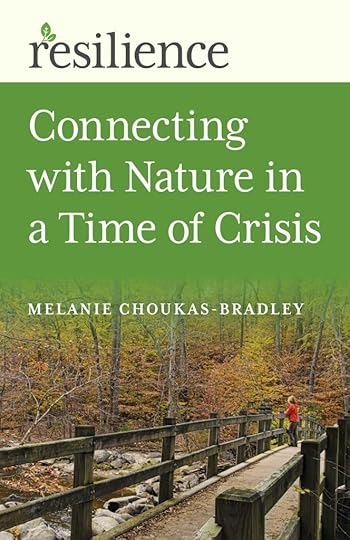
This book provides insight and practical ways connecting with nature can help us to become more mindful, more connected to each other and more environmentally aware. I’m thrilled to share with you glimpses into the book’s background and some of the stories inside. I hope you will purchase a copy for yourself and your closest 1,000 friends. It gives a wonderfully positive and empowering message at a time when stress and anxiety levels are high and likely to stay that way for a while.
Leigh Stringer: Tell us about the Audubon Naturalist Society.
Melanie Choukas-Bradley: The Audubon Naturalist Society (ANS) is the oldest conservation organization in the Washington DC area. Founded in 1897 for the protection and study of birds, today the society offers many nature education programs, field trips and classes for adults, children and families, operates a nature preschool and is involved in environmental advocacy, working in concert with other conservation groups. Membership conveys many benefits — discounts in the naturalist shop, discounts for program registration, a quarterly publication, and I think, most important, a sense of community with other nature lovers and conservation-minded people! I have been leading nature trips and teaching classes for ANS for many years.
LS: The publisher’s story behind your book is pretty impressive. Can give give a little context as to why you wrote it in ten days? I understand your book is one of several coming out on the topic of resilience.
MCB: All ten authors of the books in the “Resilience” series felt a sense of urgency to write books quickly enough so that books that were contracted in late March could be published by early May. Changemakers Books, an imprint of the John Hunt Publishing Company, usually takes 18 months to publish a book from the time it’s contracted. In this case, in order to respond to the urgent needs of the global pandemic, ten books were brought forth within forty days.
LS: I love the John Muir quote from your book, “Going out is really going in.” Can you elaborate?
MCB: The full quote is: “I only went out for a walk, and finally concluded to stay out ’til sundown, for going out I found was really going in.” I think Muir’s words speak to the inner and outer harmony he felt when he was with nature. I know I feel in touch with my own heart, mind and soul when I’m walking in a beautiful beloved place — and I feel no urgency to go back indoors!
Leigh Stringer: The story you write about Ann Frank and the horse-chestnut tree really captivated me. I only learned recently of this tree’s connection to Washington DC!
Melanie Choukas-Bradley: Anne Frank wrote in her diary about the horse-chestnut she could see through the window from her hiding place in Amsterdam. Anne died in a concentration camp at the age of 15 and the tree she loved and wrote about lived into the 21st century, finally succumbing to a windstorm. Trees were propagated from the original tree and one of them was planted on the US Capitol grounds in 2014. I always take people to see the Anne Frank tree during my tours of the historic trees of the Capitol grounds.
LS: Can you explain the concept of phenology and why it’s so important for human health?
MCB: Phenology is the science of seasonal and cyclical timing in nature: when plants bloom, birds migrate, etc. There’s been a renewed interest in phenology in response to climate change concerns and many citizen scientists around the world are recording their observations about the timing of natural phenomena.
LS: In your book you mention that Theodore Roosevelt connected a love of nature to a love of books. What exactly does he mean?
MCB: In his autobiography, Roosevelt wrote that some people love the out-of-doors but have no interest in books and some love books but “the great book of nature is a sealed volume…” My friend the historian Clay Jenkinson calls Roosevelt “the readingest and writingest” of all American presidents. He wrote over thirty books himself and was a voracious reader. I think our 26th president deeply valued books and nature equally and he wrote, “It is an incalculable added pleasure to any one’s sum of happiness if he or she grows to know, even slightly and imperfectly, how to read and enjoy the wonder-book of nature.”
LS: What is your take on the impact of our quarantine on the environment long term? To paraphrase you a bit, “When we walk out of the storm, will we be the same person who walked in?”
MCB: The short-term positive benefits of lighter traffic resulting in cleaner air and frolicking animals won’t last. I’m concerned that environmental protections may actually weaken due to many factors related to the pandemic. However, it is my hope that individuals who have slowed down, breathed cleaner air, and had some opportunities for reflection and nature-connection during the pandemic will become more attuned to the natural world and the serious environmental threats we face. I interviewed several people for the book who told me that the pandemic brought climate change into clearer focus for them, inspiring them to do more as individuals to help mitigate our serious problems. If individual transformations can become collective ones there may be a silver lining for the environment.
For more books by Melanie Choukas-Bradley, and to learn more about how connecting with nature is good for mental health and resilience, check out her website.

Leigh Stringer is a workplace strategy expert and researcher. She is a managing principal at EYP, an architecture and engineering firm, and the author of The Healthy Workplace: How to Improve the Well-Being of Your Employees—and Boost Your Company’s Bottom Line. She lives in Washington DC.
The post Connecting with Nature to Improve Mental Health and Resilience appeared first on LeighStringer.com.


March 19, 2020
Healthy work from home habits in the age of COVID-19
How can you stay healthy, productive (and sane) in the age of coronavirus? Here are a few healthy habits for working at home full-time that you might not have thought about.
Does any of this sound familiar?
Your company decided to pivot from being a company where people primarily work into the office everyday to company where staff primarily work from home. It’s the kind of transformation that, in a normal world, would have taken six to twelve months of prep and some serious change management to pull off. You did it in a week. As a very wise person once told me, “A strong ‘why’ can help navigate when the ‘how’ isn’t so clear.” Nothing like a pandemic to motivate!
Your company has operational policies and the infrastructure in place for employees to work effectively from home, but you’re wondering if they are enough. I mean, how long will this coronavirus keep us working remotely? At my firm, we’ve been going through this virtual transformation too, and decided to add in some healthy habits into our work from home guidelines. I thought they would be helpful and relevant to share with you, since they are based on solid research and relevant for so many in our world right now. The short version:
Plan movement into your workdaySet up your kitchen to enable good eating habits. Get some sunshine to help you stay alert (and sleep better) Integrate biophilia into your homeBuild in time to socialize and collaborate
Want to know how? Read more about healthy work from home habits, specific tips, and some of the research behind them on EYP’s website HERE.
Please be safe and keep yourself healthy and at your productive best. The world needs you to be. And if you’re looking for some great coronavirus humor (and who isn’t these days), check out this Facebook page. Please add your favorite memes to the comment box!
Leigh Stringer is a workplace strategy expert and researcher. She is a managing principal for EYP, an architecture and engineering firm, and the author of The Healthy Workplace: How to Improve the Well-Being of Your Employees—and Boost Your Company’s Bottom Line.
The post Healthy work from home habits in the age of COVID-19 appeared first on LeighStringer.com.
February 12, 2019
Design Well Conference Summary
In case you missed the first annual Design Well Conference in San Diego, California this January, fear not! Here is a recap of what you missed, c/o Work Design Magazine.
Recap of the First Annual Design Well Conference in San Diego
One of the best parts of the conference for me was an exercise where we asked participants three questions:
1. What are pressing questions about design and health your clients have today?
2. When it comes to health and design, what would you would like to know more about to deepen your expertise?
3. What are the biggest barriers to integrating health and wellbeing into your work?
In general, the most common questions asked by clients were about specific design strategies to improve health and wellbeing and the cost of adopting these strategies.
Participants said they personally wanted to know more about detailed design strategies, research and metrics. When it came to barriers, there were many. In addition to cost and the need for a good business case, specific barriers included:
• Perceived cost (even if actual cost was less!)
• Need for better metrics to define what is better for health and why
• Time and capacity on project to research and specify healthy and sustainable products
• Resistance to change including design team and client
• Lack of client interest – for many it’s a lower priority
• Silos and bureaucracy within project team and client teams
• Clear communication with clients about the pro and cons of adopting healthy strategies
• Existing building constraints
Read our full recap with lots of useful links, here.
The post Design Well Conference Summary appeared first on LeighStringer.com.
August 29, 2018
Forest Bathing 101: An Interview with Melanie Choukas-Bradley
Have you heard of the term forest bathing?
If you’re like me, you may have heard about it, or even read a few articles about forest bathing in Japan and some of it’s incredible health benefits. But it wasn’t until I met Melanie Choukas-Bradley that I really understood it. Melanie has just finished the book, The Joy of Forest Bathing: Reconnect with Wild Places and Rejuvenate Your Life, where shares the science of forest bathing, also the practical ways we can it into our life. It is a lovely book and a perfect gift by the way! The illustrations are beautiful. I recently got the chance to have coffee with Melanie and ask her some of my burning questions about her background and this practice.

Leigh Stringer: When you are at a dinner party, how do you describe what you do?
Melanie Choukas-Bradley: I always lead with the fact that I write nature books. Years ago this would elicit glazed eyes, but people are much more receptive to careers that are connected with nature these days! If I meet with a receptive response, I may go on to describe the tree tours, nature trips and forest bathing walks I lead in the Washington, DC area and, increasingly, farther afield.
LS: You probably know more about the trees in Washington DC than any other person on the planet. Why are the trees in DC so special and how did you develop this expertise?
MCB: The trees of Washington are special for many reasons. We are located in the fall zone between the Coastal Plain and Piedmont and midway between North and South. This gives us natural botanical diversity. Then you add to the natural flora all the favorite trees people have brought from far-flung parts of the country and the world. When George Washington and Pierre L’Enfant planned the capital, they incorporated green spaces and trees into the original plan and this legacy still serves us well today. I came to Washington as a young woman when my husband entered Georgetown Law School. I had been the news director for a radio station in New Hampshire and thought I’d sail into my dream job here in Washington. During my lengthy job search I fell in love with the trees and my life began to take a different turn. We were living on Capitol Hill and those were the days when you could thumb through a physical card catalog at the Library of Congress and request books that would be delivered to the historic main reading room. While my outdoor explorations were focused on the magnificent trees of Capitol Hill, my library research began teaching me that the trees of Washington had many stories to tell. I discovered that Washington had been known for many decades as the “City of Trees” and that George Washington and Thomas Jefferson were serious tree lovers. I don’t consider myself any kind of an expert. I simply wanted to learn everything I could about the trees of Washington and this led me down almost every street and avenue and to experts at the National Arboretum, National Park Service, Smithsonian and the City who were incredibly generous with their time and knowledge.
(I recently read Melanie’s book, City of Trees: The Complete Field Guide to the Trees of Washington DC, now in it’s third edition. If you’re from the area or a frequent visitor, it’s a fantastic guide if you want to know more about DC’s amazing tree history and tree diversity).
LS: How would you describe forest bathing to the novice? I mean, how is it different than just taking a nice hike through the woods?
MCB: It’s all about pace and awareness. On a forest bathing walk you slow way down, breathe deeply, and tune into your surroundings with all your senses. It’s a very immersive experience and it’s hard to describe what makes it so special. When you grow quiet and open your heart, mind and five senses to all that’s around you, it’s extremely restorative. Your “to do” list and the day’s headlines simply cease to exist when you’re on forest bathing time. I have a hard time meditating in a room but nature helps me to achieve peace and serenity.
LS: What are the health benefits to forest bathing?
MCB: Health research conducted in Asia, Europe, and North America has revealed many mental, physical and emotional benefits derived from quiet time spent in nature. The research shows that forest bathing lowers your blood pressure and cortisol (stress hormone) levels, lowers your pulse, increases heart rate variability (a good thing), and improves mood. I participated in some of the Japanese health research during a forest bathing trip to Japan last fall, both in the field, where my vital signs were checked before and after each forest bathing walk, and in Dr. Miyazaki’s lab at Chiba University. Dr. Miyazaki and Dr. Li are pioneers in the field of forest bathing health research. Dr. Li is studying how phytoncides, volatile compounds emitted by plants to protect themselves from pathogens, have a positive effect on human health as well.
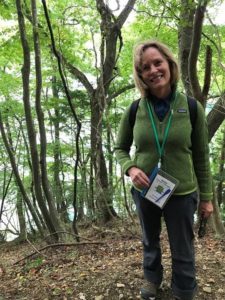
Melanie on a forest bathing walk in Okutama, wearing a booklet recording her vital signs before and after forest bathing walks in Japan.
LS: Are there benefits to sneaking in “mini baths” during the workday? How would that work?
MCB: Even if you have just 15 or 20 minutes to spare, there are enormous benefits associated with a “mini bath.” If you can find a quiet spot in a small park, a garden, or under a tree near your office, put your phone in airplane mode (I call it “forest bathing mode”), get settled and take a few deep belly breaths. Once you feel yourself letting go of the cares of the day and growing calmer, focus your senses on your surroundings. Notice what’s in motion; tune in to sound, both birdsong and city sounds; smell the earth and the plants around you; take off your shoes if you can, and bury your feet in the grass.
LS: There are several great books about forest bathing out there. What are some of them and how is your book unique?
MCB: I recommend Florence Williams’s book, The Nature Fix, as well as books on forest bathing by Dr. Li, Dr. Miyazaki and Amos Clifford, the founder of the Association of Nature and Forest Therapy Guides and Programs (from which I received certification as a nature and forest therapy guide).
What’s unique about my book? I take you through the three major steps of a forest bathing walk and describe ways to forest bathe in each of the four seasons. As a naturalist, I’m able to go into some depth with creative ideas for connecting with nature as the weather changes. I describe ways that you can adopt a “wild home” and forest bathe near where you live and work even if your time is limited. I discuss forest bathing for all ages and suggest ways you can combine forest bathing with other outdoor activities such as hiking, cycling, paddling, yoga, tai chi, meditation and nature journaling.
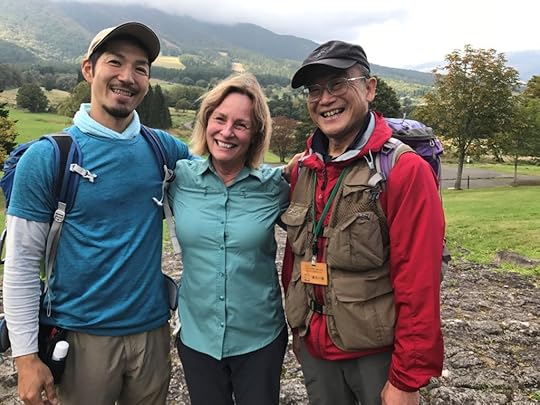
Melanie with shinrin-yoku (forest bathing) guides Akira and Kouriki in the Japanese Alps
LS: Where can people learn more about your books, your forest bathing walks and retreats or just generally connect with you?
MCB: My website address is www.melaniechoukas-bradley.com. I will be posting fall events in early September on my website calendar. Upcoming book talks/signings for The Joy of Forest Bathing: September 25th—Chevy Chase, MD Library; September 26th—Politics & Prose, Union Market; October 23rd—Audubon Naturalist Society, Woodend Mansion, Chevy Chase, MD. I have several forest bathing walks scheduled for this fall.

Leigh Stringer is a workplace strategy expert and researcher. She works for EYP, an architecture and engineering firm and is the author of The Healthy Workplace: How to Improve the Well-Being of Your Employees—and Boost Your Company’s Bottom Line.
The post Forest Bathing 101: An Interview with Melanie Choukas-Bradley appeared first on LeighStringer.com.
July 26, 2018
How Design Can Positively Impact Civic Engagement
In Washington DC where I live, civic engagement is part of the DNA of the city. My daughters don’t go to sports games, they go to marches on the National Mall. We talk politics at parties (which can be, believe it or not, pretty friendly) and just about everyone I hang out with is engaged in public service in some way – it’s just part of their job.
But I realize not everyone is so engaged with their community and there are many who feel disenfranchised or excluded from civic life. I’ve seen research on how design can help engage people in their community, but it wasn’t until I read the recently published Assembly: Civic Design Guidelines that I made the connections between the physical environment and civic engagement. Did you know, for example, that the built environment can positively impact civic trust, stewardship of community spaces and local voting? Powerful stuff.
Suzanne Nienaber, Partnerships Director for the Center for Active Design (CfAD), is the main author of the Assembly Guidelines, and has led the development of the guidelines over the past four years. She shares a the backstory of it’s development and some of the impressive research inside with me here.
LS: What exactly are the Assembly: Civic Design Guidelines?
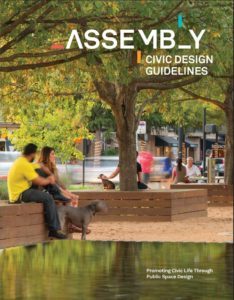
SN: The Assembly: Civic Design Guidelines is the latest publication from the CfAD. We’re incredibly excited to share this groundbreaking resource, which offers a playbook for creating well-designed and well-maintained public spaces as a force for building trust and healing divisions in local communities.
With Assembly, we’re defining a new field of study on how to leverage the design of public spaces to enhance the civic life of communities. This publication captures the culmination of four years of research and collaboration—with input from 200+ studies, 50+ cities, and dozens of expert advisors—not to mention over 130 full-color images submitted from projects across the country.
We’re aiming big with this publication, and look forward to seeing these evidence-based design and maintenance strategies implemented broadly in communities across the country. We want everyone to be talking about the essential role design can play in creating cities where people trust each other, have confidence in local institutions, and actively work together to address local priorities.
LS: How did this research come about? Who was involved and what were your objectives?
SN: Four years ago, the John S. and James L. Knight Foundation approached CfAD about undertaking this initiative. Knight was greatly impressed by New York City’s Active Design Guidelines, which demonstrates how urban design and architecture is associated with people’s physical activity habits. They were interested in using the same methodology to look at how community design connects to civic life.
We were thrilled with the concept, but saw that there wasn’t an existing scholarly literature base comparable to the Active Design Guidelines’ solid foundation of public health research. As such, we convened an Advisory Committee over the course of three years to reflect on this topic, and worked with scholars from University of California at Berkeley and New York University to craft our own original research approaches. This collaborative effort was extraordinarily multi-disciplinary in nature—bringing in perspectives from the fields of urban design, architecture, political science, behavioral psychology, public space management, real estate development, public policy, community organizing, technology, branding, and more.
As we approached this research, one of the first things we realized was that we needed a uniform understanding of the specific outcomes we wanted to study. We worked with Knight and the Advisory Committee to identify four key civic life outcomes that we used to structure our research, define relevant metrics, and assess the civic value of design interventions. They are: 1) civic trust and appreciation; 2) participation in public life; 3) stewardship of the public realm; and 4) informed local voting.
 LS: How long was this research in the making?
Our research efforts spanned a four-year period that started from early discussions with the Advisory Committee and culminated in the publication of the Assembly: Civic Design Guidelines. For our first phase of research, we undertook a comprehensive analysis of existing resources—collecting scholarly literature from across a range of disciplines, analyzing existing data sets (including the extensive Soul of the Community study), and exploring real-world projects that pointed to practices worthy of replication.
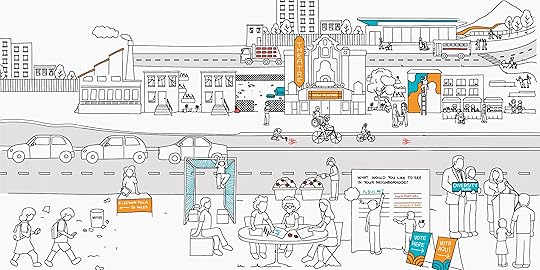
At this point, we saw that more research was needed to solidify the connection between public space design and civic life, and embarked on a series of original research initiatives. Most notably, our Assembly Civic Engagement Survey (ACES) captured data from over 6,600 respondents across 26 cities over a two-year period. ACES was the first study of its kind to ask people about the design qualities and maintenance conditions of their neighborhood, AND inquire about their civic perceptions and behaviors. ACES also incorporated innovative photo experiments that began to unpack causal relationships in how design can impact our civic perceptions—showing that minor changes in design can shift things like community pride and trust in local government.
This survey-based research was supplemented by field studies in several communities, including studies exploring the civic impacts of a park redesign in Miami, a government plaza renovation in Charlotte, and community-driven input on the extension of the Riverwalk in Bradenton, Florida. Look for detailed spreads about each of these field studies interspersed throughout the Assembly Guidelines!
Leigh Stringer: What is the overall framework of the guidelines?
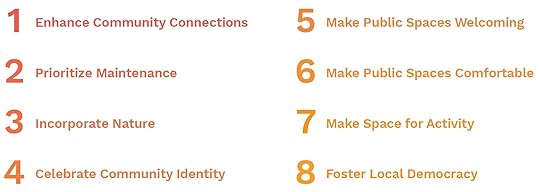
Suzanne Nienaber: The Assembly Guidelines are intended to be very practical, easy-to-navigate, and inspiring. They are organized into eight chapters, based upon the dominant themes that emerged from our research efforts.
Within each chapter, you’ll find 3-4 general guidelines. Each guideline provides research findings that demonstrate how it connects civic life, practical strategies to put the guideline into action, and inspiring images that illustrate how strategies have been implemented in diverse communities around the country.
At the end of the book, all of the guidelines and strategies are synthesized into an easy-to-use checklist that can be applied to any project.
LS: One of the more surprising findings to me is the strong connection between good community design/programming and things like public trust, perception of safety, even increased political engagement. Can you briefly summarize this research?
SN: When we talk about civic life, that’s exactly what we’re trying to achieve—leveraging the public realm to foster communities where people feel safe, trust their neighbors and their local government, and feel a sense of agency when it comes to making positive changes in their neighborhood. Through our research, we discovered so many different variables that play a role in influencing these outcomes. Take lighting for example: ACES respondents who report that their local park has well-maintained lighting tend to score significantly higher across all four civic life outcomes—trust, participation, stewardship, and voting. On the flip side, ACES found that broken lights are associated with dramatically lower perceptions of neighborhood safety (-20%).
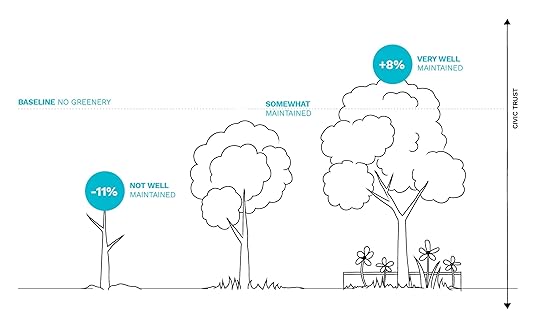
One of the most surprising and important themes weaving throughout this book is the crucial value of maintenance in supporting civic life. Anyone who uses the Assembly Guidelines will recognize that, on the whole, some of the most important actions to take revolve around maintaining and activating the resources already available—whether that means mitigating litter, cleaning up a vacant lot, repairing a playground, maintaining public greenery, or activating an underutilized public space.
As we developed the Assembly Guidelines, we were especially focused on translating the research to be as accessible as possible. Throughout the book, we inserted compelling infographics that make the research tangible. We believe anyone should be able to use these to spark conversations around public space and civic life, and advocate for change in local communities.
LS: I love some of the strategies that focus on “positive messaging” and the connection to public trust. Could you share some background and good examples?
SN: Our inspiration for this research stemmed from a collaboration with the City of Charlotte. So many signs we see in public spaces are about rules—they tell you what not to do. The City’s idea was to supplement typical signage with positive, whimsical “Can do” signs that offer inspiring suggestions for using public spaces. We tested a prototype of this concept through a photo experiment, and were excited to report that such positive messaging had a major impact on civic perceptions. Compared to those who viewed a tradition rules-based sign, respondents who were randomly assigned a positive, Can do sign were 11% more likely to say they would be really proud in the community, and 9% more likely to believe the city cares for its residents.
We’ve presented this messaging research at several conferences, and we’re already seeing other communities pick up on Charlotte’s lead. I think the appeal is that we’re capturing a simple, low-cost, yet powerful strategy for re-framing how designers and public spaces managers “speak” to the users of public space. Yes, you may need to post some rules, but why not emphasize the positive side of the equation—for example, a park might emphasize its open hours, “Open every day from sunrise to sunset,” rather than “Park closes at dusk.”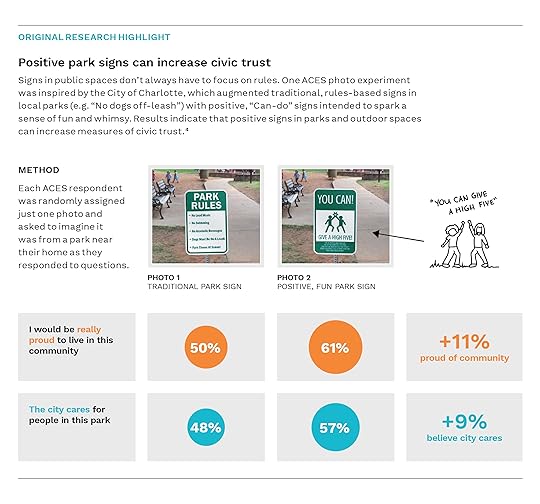 LS: Who would you say is the audience for these guidelines?
SN: While our primary audience is comprised of public sector leaders (mayors, agency heads, planners, policymakers, etc.), the Assembly Guidelines are meant to be useful to anyone who designs, builds, manages, studies, or advocates for great public spaces.
We’ve already seen close to 2,000 downloads in the first month of its release, as well as a major uptick in conversations across social media channels. In a time of diminishing trust, increasing social isolation, and growing neighborhood inequities, this work has more resonance than ever. I’d like to think the Assembly Guidelines offer an underlying sense of optimism about the future of local democracy, packaged in an an inspiring, practical tool for anyone who cares about improving their local community.
LS: Where can people go to find out more information about the guidelines and the Center for Active Design?
SN: We’re excited to get the Assembly Guidelines out into the hands of as many people as possible, and encourage anyone and everyone to download a copy here! You can also reach out the Center for Active Design for more information, at info@centerforactivedesign.org
LS: Anything I missed?
SN: I think it’s important to emphasize the importance of digging into the practicalities of implementation. In the Assembly: Civic Design Guidelines, we do this with a section called Stories from the Field, which offer a detailed glimpse into implementation efforts in five different cities, and show how different elements from the Guidelines come together to support civic life for these specific projects. We look at everything from the design of the Detroit Riverfront, to data-driven city maintenance solutions in San Francisco, to the impact of a library redesign in Queens, and more.
In its essence, Assembly captures a remarkable collaborative effort showcasing a multiplicity of voices. CfAD is proud to be leading this effort, and honored to have the opportunity to recognize so many people working each day to transform public spaces and turn them into powerful civic assets. The full impact of the Assembly Guidelines will rely upon the ongoing commitment of decision-makers and implementers willing to put these ideas into action. We look forward to continuing to collaborate with diverse communities to implement the research methods and strategies featured in the Assembly Guidelines, capture measurable outcomes, and promote civic live in neighborhoods across the country.
Leigh Stringer is a workplace strategy expert and researcher. She works for EYP, an architecture and engineering firm and is the author of The Healthy Workplace: How to Improve the Well-Being of Your Employees—and Boost Your Company’s Bottom Line.
Photos and graphics courtesy of the Center for Active Design
The post How Design Can Positively Impact Civic Engagement appeared first on LeighStringer.com.
June 20, 2018
Being an Outsider at Work
Being an Outsider at Work
If you’ve bought anything from L.L.Bean recently you might have noticed their “Be An Outsider” campaign, encouraging people to go outside and enjoy the great outdoors. I’m super excited to be working with L.L.Bean, Industrious (a co-working company), Jack Morton (marketing) and Weber Shandwick (PR) on the next gen of this campaign, “Be An Outsider at Work”! Research shows that we spend 95% of our waking hours indoors, and half of those hours are at work. It’s time we got outside more during the workday, not just evenings and weekends.
If you’re in New York City over the next couple of days (June 20 or 21), please stop by Madison Square Park, where we’re launching the first-ever outdoor coworking space, complete with individual work spaces, collaborative “rooms” and even a bike conference table, all under a gorgeous tree canopy. We’re more productive, more creative, less stressed and happier when we get outside. It just makes sense. Being outdoors puts us in touch with the way we spent most of our days until just a few hundred years ago.
In a recent survey of 1,000 American indoor workers, our team found that most respondents feel their job is the strongest barrier to getting outdoors during the workday (over things like bad weather or bugs). Interestingly, many of the barriers are easily overcome – like the need for wifi, power or protection from screen glare. The more challenging inhibitors to working outdoors include company culture or just plain inertia! Most respondents said they like the idea of getting out during the workday, but they just get caught up in their work and forget the outside even exists. It’s time to change that.
After New York this week, L.L.Bean’s outdoor coworking space will travel to Boston, MA July 10-12, Philadelphia, PA July 17-19, and Madison, WI in July 24-26. Check out BeAnOutsiderAtWork to reserve a seat ahead of time and check out it out in person. You can also find really juicy research, outdoor working / team building tips and much much more on the website. If you feel so inclined, take a picture of yourself and/or your team working outdoors (wherever you are) and share it with others on #BeAnOutsider. Let’s spread this movement far and wide!
Photo and video courtesy of L.L.Bean
Leigh Stringer is a workplace strategy expert and researcher. She works for EYP, an architecture and engineering firm and is the author of The Healthy Workplace: How to Improve the Well-Being of Your Employees—and Boost Your Company’s Bottom Line.
The post Being an Outsider at Work appeared first on LeighStringer.com.
May 22, 2018
Co-Working Is Not What You Think
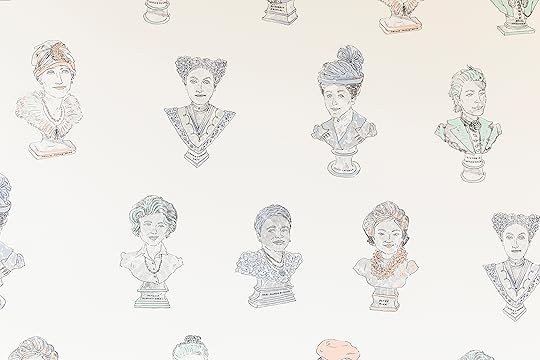
Several weeks ago a women-only co-working / social club space opened up in Georgetown, DC just a few blocks from my firm’s office. I have never actually used a co-working space, and decided that as workplace researcher, I owed it to myself to try it out. I also thought the fact that it was women-only was intriguing and might make a good story for New America’s Better Life Lab. It did, and you can find the article here:
Where Is the Demand for Women-Only Co-Working Spaces Coming From?
This co-working company, called the Wing, has received a great deal of press lately. Most of the stories out written about them are pretty snarky and a little unfair in my view. I decided to dig a little deeper and interview several women who are currently using the space to find out about their unique experiences and perspectives. I also spent time there myself for a few hours at a time, and at different times of the day and week. I continue to spend time there when I can. It’s a lovely place to work.
The co-working revolution is still very new, but already there are all sorts of boutique communities out there, each created for different needs and cohorts. It’s a rapidly expanding market, with many of these new co-working businesses starting in just the past year or two. My advice to reporters, architects, workplace designers, gig workers and anyone else who is curious about co-working… don’t judge these places until you’ve hung out in them for a while. Maybe even try a few of them. You might just find a new design ideas, new business partners, new friends or… a new perspective.
The post Co-Working Is Not What You Think appeared first on LeighStringer.com.
May 5, 2018
The Breakers: Making the Case for Work-Life Balance
I get asked all the time to share examples of companies that really showcase what a “healthy” company should look like. In almost the same breath I’m asked for examples that prove that investments in employee health are a business-savvy investment. There are many studies out there that look at large epidemiological data sets and health records, but I find that sometimes the best way to really understand how a healthy company works is to peek inside one for yourself and hear what employees have to say.
The Better Life Lab (led by Brigid Schulte) at New America encouraged me to do a little investigative reporting and dig into the culture, engagement and health strategies at The Breakers, a resort in Palm Beach, Florida. I interviewed Denise Bober, vice president of human resources, an assistant director of food and beverage, a manager of one of their restaurants and an assistant director of housekeeping. They were all extremely forthcoming, candid, and in their own way, inspirational.
The Breakers is an impressive organization and they share many important lessons for all of us trying to figure out how to balance work and life. They make a fantastic business case for why companies should invest in their people. They also doing really well (financially) by doing good. Click on the link below, tell me what you think, and please let me know of other organizations that are figuring out how to balance health, engagement and profitability. We need more of these stories out there.
Not All Workplace Wellness Programs Are Corporate Shams: But making them work takes a serious investment.
The post The Breakers: Making the Case for Work-Life Balance appeared first on LeighStringer.com.
April 4, 2018
The Intersection between Caregiving, Leadership, and Financial Wellbeing
GW4W launches first white paper!
As some of you may know, I’m heavily involved with a new non-profit called Global Women 4 Wellbeing (GW4W). The idea for this organization was first introduced (as many good ideas are) during drinks over dinner at a conference. Each of us at the dinner were very engaged with health and wellbeing in one way or the other, and all of us women. We realized that there were some gaps in the research around women’s health and wellbeing and, in addition, we were individually struggling with keeping our own health and wellbeing in check with busy work schedules, travel and family commitments. And so, after many follow-up phone calls, frank discussions, market research, and soul searching, GW4W was born.
In late October 2016, we launched our little non-profit in Washington, DC, then throughout 2017 hosted a series of events across the country to better understand the diverse needs of women leaders in New York, Boston, Atlanta, Chicago, Las Vegas, San Francisco and Los Angeles. A special thanks to all of you who attended some of these events and gave needed early support during GW4W’s first critical year! Your attendance at these events, donations from early sponsors and membership fees helped us to incorporate, set up a website, buy needed technology and most importantly, invest in our first research project.
I’m thrilled to share with you, “Caregiving, Leadership, and Financial Wellbeing: Connecting the Issues that Hold Women Back.” This white paper is informed by a fairly exhaustive literature review that investigated the range of issues facing women today.
Our research addresses three gender issues that women face globally and how they intersect with one another: serving as a caregiver, managing a competitive career and achieving (and maintaining) financial wellbeing. These issues each have significant impact on women’s overall health – often negative – yet are often addressed separately and distinctly from each other. Part of GW4W’s mission is to understand and address these gaps by leveraging and connecting a diverse group of people to work on these problems together.
What is next for GW4W? The world! We launch events this year in Japan, Argentina, and are incorporating in Singapore. We are also hosting and attending many, many events in the U.S. I am particularly excited about a one-day event we are planning in San Francisco later this year that will be specifically focused on health and wellness in design, but also on the health and wellbeing of women in the design industry.
Please check out our white paper and download it HERE. I welcome your thoughts and ideas and hope to see you at our next event in a location near you!
Facebook: www.facebook.com/GW4Wvoice/
Twitter: @GW4Wvoice
 Leigh Stringer is a workplace strategy expert and researcher. She works for EYP, an architecture and engineering firm and is the author of The Healthy Workplace: How to Improve the Well-Being of Your Employees—and Boost Your Company’s Bottom Line.
The post The Intersection between Caregiving, Leadership, and Financial Wellbeing appeared first on LeighStringer.com.
March 13, 2018
The Nesting Instinct: Why we “need” our own stuff and our own space at work
If you have ever been pregnant or known someone who is pregnant, you are aware of the nesting instinct. During pregnancy, women experience an increase in the production of estradiol, which, among other things, results in an uncommonly strong desire to organize and clean. Anthropological data, like this study from Marla Anderson and M.D. Rutherford at McMaster University, suggest that having control over the environment is a key feature of childbirth preparation in humans, including decisions about where birth will take place, and who will be welcome in the birthing environment. Interestingly, this is not unique to humans; a strong nesting instinct is also found birds, fish, squirrels, mice and pigs.
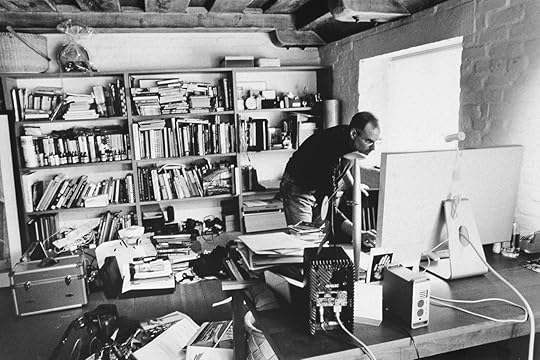
I’ve been thinking lately about how this urge to nest, and how it is not unique to pregnant women, but pretty important for the rest of us too. Nesting tendencies show up in our homes, at work, or just any place where we spend time. Having a spot to call your own and the liberty to set it up the way you like it is core to our DNA. As a workplace designer, I’ve spend thousands of hours observing others at work as part of my job. I’m always surprised by the amount of “stuff” laid out on desks and displayed on walls. I have seen a fair share of paper piles, toys, trophies, sport paraphernalia, games, framed diplomas, artwork, photos, candy jars, holiday decorations, even a fish bowl or two. Some of these things are related to work, but most are personal affects. You could claim that they are extraneous, until you try to take them away.
Many office workers today are being asked to give up their individual desk and sit in a different seat every day as part of a mobile/ flexible work strategy. This makes a ton of sense from an economics point of view. But try to sell people on the idea of sharing space, or taking away assigned space to individuals, and you will be met with extreme resistance. To ask workers to get rid of their individual spot and move into an environment where they share space with others is like asking them to remove an arm. It doesn’t happen without a lot of pain and anguish.
I’m not here to argue about the rights or wrongs of “unassigned” seating at work – at least not here. What I am interested in understanding, is why we feel so strongly about having a territory to call our own and find such comfort in surrounding ourselves with certain artifacts. And I’m not just picking up on our feelings or behaviors at work. If you’ve ever been around my mother-in-law’s house and seen her vast and almost overwhelming Hummel figurine collection, you’ll see a perfect example of what I mean.
There are two major themes from psychology that help explain this nesting phenomenon.
Territory Marking
Most of us are familiar with the need to mark territory. Dog and cats will mark territory with their urine, but us humans do so in different ways. Sometimes we erect physical boundaries to stake claim to a personal space, like putting up a fence or a wall. Other times, we mark territory by making a claim on it in some way, like placing a coat over the back of a chair at a restaurant or spreading books on a table at the library. There are all kinds of fascinating studies that show how the more personal space you occupy (either because you mark it for yourself or other people give it to you), the more likely you are to have power.
Why are we so territorial? From a biological perspective, similar to other animals, we tend to claim a territory or space of our own to secure resources and to have a private place to live and work. Unlike other animals, our need for personal territory has a socio-cognitive reason as well. We mark territory for simplification and order. A fence around my house is a signal that the property inside is mine and you can’t just walk in and take food out of my fridge. The physical boundary is a protective barrier and a symbol that someone controls the area within.
Studies of human territoriality describe it as having certain traits: physical space, possession, defense, exclusiveness of use, markers, personalization and identity. If you can claim any or all of these things, the turf is yours. The ultimate marking of territory in the workplace is an assigned office with a lockable door, a name plate outside of it and diplomas all over the walls showcasing credentials of the occupant. Individual “ownership” of space and the desire to claim a patch of grass, wherever that happens to be, is second nature to us. It’s a system we understand and trust.
Interestingly, not all cultures value territory the same way. According to studies of country culture by Hofstede and Hofstede, the need for individual territory is particularly strong in countries that value independence (versus interdependence). These countries include the United States, Australia, Great Britain, Canada, New Zealand, Germany, France and Sweden, among others. According to Sally Augustin, in her book Place Advantage, “people from cultures that value independence feel their environment should conform to their needs and are more apt to change it…” versus people in countries that value interdependence like Venezuela, Mexico, the Philippines, South Korea, China, etc.
The Endowment Effect
Claiming territory doesn’t explain the powerful need we have to surround ourselves with artifacts. This is what psychologists call the “endowment effect” otherwise known as the divestiture aversion. The endowment effect hypothesis suggests that people ascribe more value to things merely because they own them. According to Dr. Christian Jarret, in an article for the British Psychological Society, “Our possessions become extensions of the self. We use them to signal to ourselves, and others, who we want to be and where we want to belong. And long after we’re gone, they become our legacy. Some might even say our essence lives on in what once we made or owned.” Apparently, the attachment to possessions starts very early in life. Jarret explains, “The idea that we can own something, possess it as if a part of ourselves, is one that children grasp by the age of two.”
The endowment effect explains why people do not throw things away, including my mother-in-law and her Hummels as well as my husband and his old economics school books that must be thirty years out of date. It might also explain why people feel hurt at work when we ask them to remove or reduce the number of personal items they can have at their desk. We are taking away what they perceive to be an extension of themselves. A TED Video by Jarret that explains this phenomenon beautifully.
The Anti-Nest Movement: Modernism
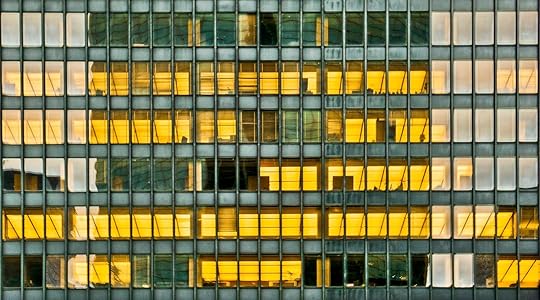
If ever there was a time in recent human history when the idea of nesting was given a bad name it was the modern architecture movement. Modern architecture or modernist architecture is a term applied to a style of buildings that emerged in the first half of the 20th century, inspired by new technologies in construction, particularly glass, steel and reinforced concrete. Modernist buildings were about expressing the new structural capabilities of the materials used and “ornamentation” was discouraged. Not only were these buildings designed intentionally to be austere, but often modernist architects insisted that building occupants stick with a limited palette of furniture and accessories. Mies Van Der Rohe, who coined the famous saying “less is more,” was a firm believer in keeping his designs very clean and uncluttered. The Seagram’s Building on Park Avenue in New York City is a great example of this. All tenants were required to have white window blinds, and to keep them fully open, halfway open/closed or fully closed, so that the building would have visual uniformity from the street.
I was trained as an architect to really love and appreciate the modernist design movement, but many people find it cold and inhumane. I think the endowment effect may have something to do with this negative reaction.
The New Nest at Work
Oprah has us purging our closets, the sustainability movement has us reducing our carbon footprint and mobility has us storing everything in the cloud. There is clearly is a movement afoot to reduce the amount of territory we use and “stuff” we have around us. But I don’t believe we will ever completely lose the desire for individual control over our environment – it’s human nature. The question is, what form will our nests take in the future? And for those organizations that move away from assigning workers individual spaces, what are the right substitutes? Is technology enough to fill the gap, i.e. a tablet to call your own vs. an office? I don’t think we have the answers quite yet. The good news is that we now know what is driving our subconscious, so we can find new (and possibly better!) ways to fill our cravings for individual ownership, take control of our surroundings and evolve our workplace at the same time.
The post The Nesting Instinct: Why we “need” our own stuff and our own space at work appeared first on LeighStringer.com.
Leigh Stringer's Blog

- Leigh Stringer's profile
- 2 followers

