Noah Fleming's Blog
January 11, 2022
Set The Trajectory of 2022 in 30 Minutes or Less 🚀
Over the past ten years, I’ve focused heavily on simple interventions and pushed back when my clients wanted complex.
“You say you want a fancy CEO dashboard with a dozen visual reports that you can quickly glance at every morning? That sounds great, but tell me how you’ll use those dozen reports. Actually, just tell me how you’ll use one or two of them.”
Most can’t.
Over the past ten years, if there’s been one lesson that’s proven true over and over again:
The companies most that are unwilling to spend time on the basics are the ones that need them the most.
Early in my career, I focused on the most boring topic – nurturing your existing clients over getting new ones. Everybody wanted the sexy side of sales.
This was the cornerstone of my first book, Evergreen. My clients have done very well by turning their focus inwards to dramatically reduce attrition rates, improve the lifetime value of their clients, and as a side benefit, have better reputations & higher referral rates.
Since then, I’ve identified a dozen other similarly important areas and again overlooked by most companies for being too basic.
Avid readers will recognize many of these.
Among them are building out your processes, internal benchmarking, coaching, and exception reporting.
All of these areas of focus are worth an investment of time, attention, and money (most companies aren’t)
Here’s a small example:
I’ve focused a lot in the last year, specifically on helping companies build the right processes and ensuring people do what you expect them to be doing.
Much of that work has revolved around helping senior executives recognize what they should be measuring and the things they can safely ignore.
This work has had such a demonstrable impact on my clients that it’s hard to quantify fully.
It’s allowed us to build a collaborative sales process in a single day instead of laboring over this for six months only to have your sales team revolt when you tell them the company is bringing on a new CRM.
It’s allowed us to trim the fat and build a meaningful corporate strategy in a day, rather than a binder full of fluff that accumulates over a year.
It’s allowed us to make ongoing client engagement a primary driver of new revenue growth and give senior executives confidence that those efforts are occurring.
Here’s something to consider:
If you’ve read more than five of my Tidbits, you know that these areas are essential.
If you haven’t put them into place in a way that you’re 100% confident is working yet, then chances are you’re not going to be able to do it on your own now all of a sudden.
After all, if you could have done it already, it would be done.
If it’s not, then let me help.
I now work with my best clients in two ways.
Through a trusted advisory relationship where I can become an integral part of your team to help you create the most meaningful changes immediately and ongoing.The 1-Day Sales Process which is applicable in far more areas than just sales.It’s now the 10th day of January, and the year is just getting going! So NOW is the perfect time to have a conversation.
If we haven’t had a discussion, now’s the time. Reach out
So feel free to reply to this email, and let’s set up a time to talk. To make things easier, go ahead and schedule a time on my calendar HERE.
Your Challenge For This Week:
The Boring Eat The Bold – Embrace It in 2022!
Spend 15-30 minutes with me over the next two weeks to see what boring things you’re missing at the expense of things that may be sexy but lack the substance needed for the year you want to have.
Cheers
Noah
P.S. The third way to interact with me is in a CEO Peer Group with me. We’re off to the races with a global, dynamic group of CEOs. We still have room for you to check it out. Reach out if you’d like to learn more.


January 4, 2022
Make 2022 Your Best Year with This Simple Exercise
Here’s the type of thing I heard a lot of over the past few weeks:
“Noah, I’m starting to feel a little antsy about the annual ritual of budgeting and setting our goals for this year.
Of course, we want to hit our growth numbers, but I’m not sure what concrete plans we have in place to get there. We can keep riding the X% growth we’ve had over the past four years, but there’s so much going on in the industry right now that we need to shake things up.”
We all know what we want, but we don’t always know what specific things we’re going to do to get there or the best course of action to take to achieve our goals.
Moreover, we often don’t think about how we’re going to measure progress or plan for course corrections along the way.
As we kick off the new year, there’s a simple strategy that can dramatically improve your chances of success this year.
You might be looking to increase revenue, create better customer relations, or maximize customer value.
Whatever your goals or objectives are, this strategy might be the ticket.
Here are three simple steps as you look ahead to the year ahead of us. Grab a piece of paper and spend 30-60 minutes doing this exercise over the next few days.
Step One: Identify what’s important to you or your company this year.
Step Two: Look back at the past year with an objective and critical eye, giving yourself an honest assessment of how you did and why you didn’t reach the goals that you had set.
Step Three: Ask yourself, what would a realistic action plan look like to ensure you work towards what you want this year and utilize the lessons you learned from looking back in step two.
It’s essential to be specific here. Broad, vague goals are never going to cut it.
For example, if you say you need to improve customer service this year, what steps are required to make that a reality?
What got in the way of it happening last year? What will you give up, or do differently, to make it a success this year?
What does it mean to have improved customer service?
How will you measure it?
In March, how would you know you’re making progress?
What specific things are you going to do? For example, is it something you’re going to do daily (like outreach to existing clients) or something that happens in response to an outside event (No more than 45 seconds of hold time for clients on the phone)?
Please don’t be lazy here. If it’s important enough to strive for, it’s important enough to plan for.
We know how these things go. You’re probably already swamped, and it’s January 3rd. December 31st, 2022, will be here before you know it.
And when we get there, there are always two types of people and companies out there…
There are those saying, “WOW! That was one heck of a year,” and there are those those saying, “Where on earth did the year go?!?!”
What did you say at the end of this past year?
What do you think you’ll say at the end of this year?
Best,
Noah
December 28, 2021
A Simple Tidbit Challenge for 2022
So here we are.
In a few days, we’ll ring in the New Year.
2022.
A time for new goals, a new you, a better company?
Everybody makes plans to be better at this time of year, and as you know, they don’t always work out…
The gym will be busier than ever over the next three weeks, and then things will fizzle out and go back to the way they were.
Quickly, people realize, once again, that working out is hard; following a meal plan isn’t easy.
Here’s one thing that helps New Year’s goals stick, though…
Getting help with accountability.
You’re far more likely to succeed in your fitness and nutrition goals if you invest with a good coach or personal training.
The same goes for nearly everything else.
As the old saying goes, if you could have done it yourself, you would have already.
It’s the main reason why people like Tiger Woods and Lebron James still have coaches they rely on.
So here’s what I’ll do for you.
Hit reply right now, and tell me what you want to work on this year in your company and how you want to get better.
Then (in 3 sentences or less), tell me what you’re going to do to meet those goals.
That’s it.
Super short, super simple.
I’ll reach out to you periodically throughout the year to see how you’re doing.
Take a second before closing this, and consider:
If you’re not willing to reply to an email, do you think you’re willing to put in the work to be as good as you want to be?
Success is all about the small steps.
Make this the first.
Hit reply and tell me what you’re working on and your big objectives for 2022.
Best,
Noah
P.S. Happy New Year!
December 21, 2021
Spread Holiday Cheer with Your Clients
It’s hard to believe yet another year has passed.
Last year at this time, I’m sure many of us would have hoped the pandemic would be well behind us. And while I do believe we’re close, depending on where you live, we’re not all there yet.
And yet, I’ve watched many businesses thrive in the face of new challenges from inventory challenges and products stuck on shipping containers, to talent retention and more.
I’ve been honored to work with various clients from here in Canada to New Zealand and many places in between.
In addition, I successfully launched and continue to grow a new CEO Peer Group, including CEOs from across the globe. Reach out if you’d like to learn more about this opportunity for 2022.
If we haven’t been able to work together yet, I hope we can change that in 2022.
Regardless of what you’ve experienced this past year, I’m sure the year has surprised you yet again. And at the end of the day, nearly every one of us still has so much to be grateful for.
Your challenge this week: Between now and Friday, reach out personally to a couple of your key clients, vendors, or employees that have helped you through the year and say thanks.
Shoot them a quick video and send it over.
Remember my MMP principle. Make your outreach meaningful, memorable and personal.
After that, enjoy this holiday season. Eat well, stay safe, be joyful and merry.
Until next Tuesday, Merry Christmas and Happy Holidays from my family to yours.
Best,
Noah

December 14, 2021
How To Get The Results You Expect
My gym has a “fun” tradition.
On your Birthday, they give you or the entire class extra work. Notice the “quotes” around “fun?” It’s usually pretty brutal. And if you try and skip the gym on your Birthday, they’ll wait, and next time you’re in, they’ll get you.
Tomorrow, it will be my turn.
This past weekend we celebrated my daughter’s Birthday, my Birthday, and those ritualized holidays treats have started magically appearing in the kitchen.
While the extra workout is bound to be extra challenging, It will allow me to pay down some of my dieting debts from the weekend.
One of the things I’ve done well with over the past few months is measuring and tracking everything I eat. My gym recently ran a 6-week challenge, and I managed to finish third out of over 50 people.
That’s not to say there isn’t a weekend here or there where things go awry (this past weekend comes to mind) but working with the coaches at the gym, I’ve done a great job of measuring what I eat, and they’ve done a fabulous job holding me accountable.
I’m working with a client to help them bring that same kind of accountability to their sales teams.
We’ve spent a lot of time working together to build their sales process and, more importantly, how it would be measured and monitored.
I can’t help but continue to harp on this from a business point of view. I continue to work with clients – very successful companies – where many things they know should be measured aren’t measured. These companies have no way of knowing if they’re being done.
Let’s use the sales division as an example. Sales are the beating heart of a great company. Not only are companies expected to keep our customers healthy and lively, but most companies are also dependent on sales to keep the blood of new customers flowing.
You need to be measuring the activity happening every day. Otherwise, you’ll end up bloated, overweight, and out of shape. It would help if you held yourself and your people accountable.
We need to be measuring the activity and NOT just the result after a slow, lazy weekend of pizza, cookies, and birthday cake.
How many calls were made?How many new contacts were added to your CEM?Has the team followed up on all outstanding quotes and proposals?How many new appointments have been set?How many new deals closed?What about deal lost?New opportunities found?Referral requests?Testimonials gathered?If you’re relying on individual reporting and overall stats from your sales team to determine their performance, then you’re robbing both the company and your people of the ability to identify what is working and what is not at a company-wide level.
This also leaves you without the evidence to better train, coach, and mentor your people (either as a group or individually) in areas where they may need help.
To make any change, it’s not enough to know what needs to be done. The gap between “knowing” and “doing” could easily swallow the Grand Canyon.
None of the clients I work with are suffering from not knowing what to do – instead, what’s missing is the ability to pick the suitable projects and to be relentless in their execution, day in and day out.
In other words – don’t tell yourself you should eat better – actually track everything that goes into your mouth for two weeks.
Don’t say, “I need to be better at reaching out to my clients.” Instead, track every outbound contact that you make and look at that number every day.
More importantly, make sure your sales managers are working with their salespeople to be tracking this and providing the help and coaching they need to identify the areas that will have the most significant impact on sales
Your challenge for this week:
Where could you do a better job measuring?
Are you only tracking and rewarding outputs when you could be rewarding your people for the right inputs/activity?
Pick one area that you’re going to measure more fully, and be consistent with it for at least one week.
Please send me an email at noah@noahfleming.com and let me know what you’re working on.
Best,
Noah
December 7, 2021
The Recipe for Success in 2022?
Every year, around this time, people start coming out of the woodwork to tell you how you can do better next year and make 2022 your company’s best year ever.
The truth is, there are no new trends you need to jump on or magic bullets you need to be worried about missing out on.
It will be a year like other years.
And if you don’t have the core fundamental building blocks in place, your company will continue to fall further behind that of your competitors.
The most challenging question is: “What exactly are those building blocks?”
Let’s return to one of my favourite books, The Checklist Manifesto by Dr. Atul Gawanda. This book highlights the importance of the core fundamental building blocks.
When Dr. Atul Gawande got a call in late 2006 from the World Health Organization, he was shocked by their request.
They wanted to get his help in creating a program that would reduce the number of deaths and illnesses from surgeries that would apply to ANY hospital on the planet.
They wanted something that would work in Downtown Manhattan, Timbuktu, and a remote hospital set up on a battlefield.
The task sounded impossible.
They had no budget, and their goal was outrageously aggressive.
Just how aggressive was their goal?
Consider this: In 2004, the number of surgeries performed every year was about 230 million. And each year, around seven million people came out of surgery disabled, and over a million died because of complications!
It sounded impossible, but Gawande was up for the challenge.
Here’s the best part.
Not only did he do it, but he succeeded beyond anybody’s wildest dreams.
He was able to implement a process that reduced deaths and illnesses by between 30-47% in any hospital, anywhere on the planet.
it worked regardless of if they were in the worst hospitals in the world or the best-equipped hospitals, the result was the same…an over 30% reduction across the board.
Could your company increase sales by 30% across the board?’
Could you increase revenue given the current global supply chain challenges in 2022?
Could you dramatically improve employee retention without spending a dime when people are leaving companies in record numbers?
Gawande’s challenge seemed crazy too when you think about it, but he did it and you can too.
His solution wasn’t overly complex.
There was ZERO technology involved.
There was no new drug introduced and nothing overly complex.
He used one of my favorite tools of all time.
The checklist.
You’ve heard me talk about the power of checklists in other tidbits (including this one, and this one, and this one).
But a checklist that saved lives!?
Of course, not everyone believed it.
Many doctors felt that the checklist was beneath them.
They were arguing, “I spent four years doing my undergrad, then two years in med school, and then five years working my butt off in hospitals! I know what I’m doing, and I don’t need your little checklist to help!
On top of that, every patient is different, and every surgery is different–you can’t capture what I do in a checklist.
You think I’m going to use a checklist?”
I hear something similar in many companies where we implement instrumental–and sometimes elementary–solutions to drive dramatic and profitable results.
“I’ve been doing sales for 35 years!
No new tool, process, or CRM is going to change what I’ve been doing. I’m not changing my process for YOU or anyone. My way works.”
“If increasing revenue was that simple, we’d already be doing it. Unfortunately, our customers aren’t buying right now because our prices are too high.”
“We’ve already tried something like that last year and it didn’t work.”
“We’re already doing something like that. What else can you show us?”
Nine times out of ten, they’re not doing something similar, and they haven’t in the past.
We’re often quick to dismiss the simple things that generate results because they’re new, or different.
The moral of today’s tidbit is simple.
Don’t dismiss something just because it seems too simple or too easy.
Don’t let others in your company tell you that something you know is essential is beneath them.
There’s a reason your pilot still walks around the plane with a simple checklist before take-off, and you can thank your lucky stars for the checklist that reminded your surgeon to wash her hands before slicing you open.
Here’s Your Challenge: Think about the “building blocks for 2022.”
Consider an important area of your business like sales or customer experience–where do you need more structure or routine?
Do you need a process for every time a customer walks into your business, or for how the phones answered?
What type of post-sale customer retention process do you have in place?
Is there a process to ensure all quotes are followed up on?
Have you defined your sales process?
In my experience, if a company doesn’t have a defined sales process and puts one into place, it’s not uncommon for sales teams to see 10-20% increases in sales revenue after putting the right processes into place.
This is one of those building blocks for 2022.
For companies looking for an “extra edge” in 2022, I have a special Evergreen Growth offering I’m making available to only a select number of new clients. I’ll work closely with your company over the next 12 months and help make 2022 your best year ever.
We’ll work to create and develop critical, and perhaps non-existent processes, or improve your existing processes to operate at a world-class level.
We’ll grow your revenue, improve your client experience, and create a culture your people will never want to leave.
If you’ve ever considered working with me, this might be the best time ever.
To learn more and discuss what this looks like, schedule a call now.
Best,
Noah
November 30, 2021
Why Your People are Leaving? Revisit The Red Pen / Green Pen Test
Years ago, in the spirit of Christmas, I wrote a Tuesday Tidbit called The Red Pen / Green Pen Test.
When I wrote the tidbit, I spoke about the mistakes companies make with their outbound communication to prospects and customers alike.
An executive shared an email with me the other day, sent from his management team for Thanksgiving.
The reader said he remembered the Red Pen / Green Pen tidbit and decided to put his company’s Thanksgiving memo to the test.
The result wasn’t pretty.
Spurred on by my recent Tidbit on The Great Resignation, he agreed that their company wasn’t doing enough to care for their talent and treat them well.
As a result, people were leaving in droves. The culture was poor, and people were unhappy.
But why?
Well, what was meant to be a message of optimism and thanks was nothing more than a sea of red pen.
This reader said he had contemplated leaving, was hoping to give management a chance, but now the evidence was sitting right there in front of him, staring him in the face.
Let’s revisit the Red Pen Green Pen Test from December 22nd, 2015.
As you read this, consider your internal messaging with your employees and use the same test. Again, you might be surprised by the message you’re sending.
The Red Pen / Green Pen TestAs I’m sure is the same with you, I get a lot of emails and phone calls from salespeople looking to sell me the next great thing.
Just the other day, I received a call back I had been expecting from a sales rep with a technology firm.
Immediately after exchanging pleasantries, he immediately jumped into a long spiel about why they were a great tech company, why their product is fantastic, and how they were far superior to the competition.
At no time did the representative take the time to ask any specific or direct questions about how my company specifically might be able to utilize their technology.
It was about eight minutes before I could get a single word in, but I had already tuned out after five. So he took eight minutes to talk about himself before spending thirty seconds asking about me.
After pondering the call for a while, and in the spirit of Christmas, I’d like to introduce The Red Pen / Green Pen Test.
The red pen / green pen test is simple.
Think about any time you’re communicating with prospects and customers.
For example, consider sales calls, customer service calls, website copy, social media, emails to prospective clients, proposal language, RFPs, etc.
Now review some of those communications with a red pen and a green pen.
Any time you use language like “I,” or “we,” or “our,” circle it with the red pen.
Any time you’re speaking something that benefits you and your company, but not the customer, you want to mark it red.
Next, look for the areas where you use language like “you” or “your.”
Look for all the times when you communicate beneficially to the customer – look for where you add value, and mark those green.
If you see more red than green, then you’ve got some work to do.
Here are a few examples from different industries. If you want a specific example of how you might do this for your company, feel free to contact me, but for example:
If you’re a tech company or an early-stage startup, spend some time going through your pitch decks and looking at how they’re structured and ordered.
Ask yourself, at what point do you start talking about how prospective clients might use your technology or how current clients have used your technology?
If you’re in the banking or wireless industry, look at your customer service procedures.
How often do you say things like, “it’s our policy,” or “we can’t do that” instead of saying something like, “I understand why you want this to happen, and it’s impacting you in this way, but unfortunately here’s why we can’t do that because of….”
If your company is a sales-driven organization, look at the sales scripts, listen to a few customer conversations or prospect calls, and pay attention to every time they use words like “I” and “we,” and “our,” and “us.”
For just about every other company, think about your overall marketing messaging.
If you send regular communications to your customers, look at how many times you’re talking about you versus talking about them.
Whenever you’re saying anything to customers, in any format, in any medium, always remember the red pen / green pen test.
Today’s Challenge: Try the red pen / green pen test on recent customer communication.
You might review your “About Us” page on your website, or you might check the last email you sent to a client, or you might decide to listen in on a couple of customer service calls today.
Whatever you decide, the next few days are the best time of the year to stock up on red and green pens.
But don’t let this be a once-a-year thing! Unlike December 25th, this simple rule can make it seem like Christmas all year round in your company.
Now that’s the essence of Evergreen!
Best,
Noah
November 23, 2021
No More Meetings.
Pictured below is the boardroom in my office.
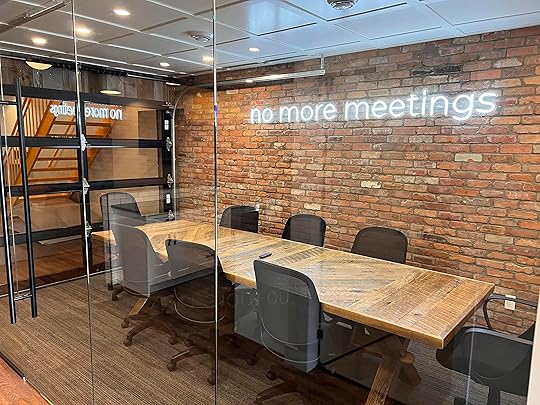
My colleague Jim and I put this sign in here for one reason.
So many meetings are a complete waste of time. This is true in the real world, this is true of a pre-pandemic world, the virtual world, and a post-pandemic world.
Most meetings are poorly run, lack an agenda and often end with no meaningful decisions being made.
We use the boardroom to meet prospects and clients, have lunches, and hold special events, but most of our meetings are short & sweet.
It also serves as a daily reminder to Jim and I that we can help drive better meetings.
Here’s an example…
A couple of months ago, I was with a client for a full-day event. I was invited to sit in on the meetings to help them with facilitation and add my value when and where I saw fit.
While most of the work I do is much more in-depth, I love the facilitation role, mainly because it allows me to intervene much earlier in the planning stages than I usually can, which helps me save my client’s tremendous amounts of time and energy.
I was gratified with this specific client when the CEO confided in me that he felt both he and his President would have been “dead in the water” without my involvement after the event.
Without this coming across as an overly self-aggrandizing Tidbit, this really had little to do with me except that I could get them focused on what truly mattered during their discussions and break through some of their stumbling blocks.
That success was due almost solely to the practical application of the Tidbit philosophies that I share every week.
It comes from asking impactful questions before committing to resource-intensive courses of action – the same kinds of questions that I leave you with every week.
Here’s how I could add such value to them (and how you can do the same thing in your meetings).
In the room were the CEO, the President, an outside vendor who’d been developing sales tools for them, a guest speaker on the topic, and the internal champions who worked closely with the vendor.
Almost immediately, the meeting started getting dragged into the weeds with discussions of technical minutiae.
I stopped everybody repeatedly and refocused them on one question:
How will the organization be better off once these decisions are made?
I’ll be frank – I could see that I was annoying many of the people in the room with my questions.
People don’t like being stopped and told to refocus, or to reframe their questions, or to stop telling a long and arduous story.
Some don’t like being told they’ve had a lot of airtime and it’s time to hear from others.
Regardless, time and again, there was no good answer to my question…
They were getting derailed by issues with no regard for how those issues would make an actual difference.
And annoyingly, I kept shutting it down and attempting to refocus them. But then, things started to happen.
When they realized I wasn’t going to stop, they started changing their approach.
Minimally at first, the lightbulbs started triggering and we quickly made progress.
It reminds me of a comment I’ve made in the Tuesday tidbits before:
“Often I talk to senior executives who tell me: “I don’t want to hear any of that back to basics stuff, I’m paying a lot of money, give me something advanced.”
The irony is that their companies aren’t doing the basics. They want to skip ahead without doing the simple, high-value work. Much of the work I do is around ensuring businesses that are already doing well, have the basics in place to do even better.”
The point here isn’t that this is a magic question (although it’s close!)
The point is that companies are often led astray by neglecting to focus on the simple but high-value questions.
Let me give another practical example of something that most companies face at least once per year, and that I see with at least 80% of the clients I work with.
Companies often think that they can improve their sales by getting more talented salespeople, or more talented sales managers in place.
They spend a lot of time searching, vetting, interviewing, and training people in their sales roles.
But what they don’t do is develop a fundamental understanding of what those people should be doing (formalized sales process), who will hold them accountable (proper senior leadership involvement in sales function), or ensuring they have the right infrastructure in place to be successful.
Indeed – they’re focusing on the wrong things!
If you’re trying to find mythical “A-player unicorns”, but you haven’t invested in developing a sound sales process, coaching culture, and data-driven sales management approach to ensure that your team is working as you expect, then all of your hiring efforts are going to be wasted.
We all want more advanced stuff.
We all want the glitzy marketing promotions, and the viral ad campaigns, and the stuff that makes our competitors ooooh and ahhh.
But we often want that at the expense of the things that would generate far greater success.
Your Challenge For This Week:
Before your next meeting, challenge everybody to think about what they’re presenting through the lens of:
‘How will the organization be better off once these decisions are made?’
If it’s unclear what the answer to that question is during the meeting, ask the person speaking to answer it.
You’ll find that the improved focus provided by that simple question will help keep you from getting diverted.
And more importantly, it will highlight the most important opportunities and threats that you face.
If you can’t do this, then my suggestion is no more meetings.
Best,
Noah
November 16, 2021
The Great Resignation? Start with Loyalty
The Great Resignation of 2021 is what they’re calling it.
People are leaving the working world in record numbers to do something new, find new work or more meaning. A recent Forbes article called it “The Worker’s Revolution” in a post-pandemic world.
But I don’t buy it.
The reality is, there are just a lot of companies who have been treating their people poorly, and the pandemic has made those people realize there’s something else out there.
However, there are many companies NOT dealing with these issues.
Why?
I recently spoke to the leader of an organization who asked me how they could influence greater customer loyalty and encourage their salespeople to invest in building great client relationships – both of which would dramatically impact the long-term success of any organization.
We all know that it’s your loyal customers who often generate the most revenue, and we need to continuously engage our customers to help them become more “loyal.”
We all know that it’s your loyal customers who often generate the most revenue, and we need to continuously engage our customers to help them become more “loyal.”
I responded by asking, “Are you treating employees like your best clients?”
I continued, “What efforts do you have in place to influence greater relationships with your key people?
How are you investing in your employees and talent?”
“Of those salespeople you’re asking to do this, what are you doing for them?”
He smiled and then went on to tell me he believed they were doing a lot right, but he also said that he knew they could be doing more.
When you think about it, if we want our employees and those on the front lines to invest in the success of our organization, then we need them to buy into the vision and long-term success of the company, our goals, and our key objectives.
We need to treat those relationships with the same level of gravitas we give to our clients.
But in more cases than not, we’re not.
That same Forbes article suggests people are leaving the working world because of (for example):
1) lack of flexibility
2) contributions and ideas not valued
3) too many internal/organizational changes
4) Personal well-being not supported or acknowledged
When I thought more about my response to his question over the weekend, I came up with some key questions to ask yourself and your executive team.
1. We talk about the importance of intimately knowing your ideal customer, but how well do you know your employees?
Do you know their challenges, struggles, and what keeps them up at night?
You expect them to know your expectations, but do you know what they expect?
Do you know what their day-to-day experience is truly like?
Are you constantly nurturing your employees the same way you nurture your best clients? (I don’t mean Yoga classes and free massages at lunch)
Are they being heard and given the ability to contribute?
Are their opinions valued and acted upon or just hidden in a drawer on your desk, or archived in your inbox?
Do you know the different strengths and weaknesses of those on the front lines?
Try this: Experience the company as your customers do – from start to finish. If you need to, get outside help for this. Discover if your team is working together.
Are their employees who need encouragement, additional training, accountability, or outside help?
If you want to achieve great results, then you need to pay attention to your most valuable relationships.
Your team needs to be constantly engaged and heard.
The Great Resignation is happening within a lot of companies.
Is it happening at yours? I certainly hope not!
Best,
Noah
November 9, 2021
What To Work on Next? Start Here
I spoke to a prospective client last week, and it reminded me of many of the conversations I’ve had with hundreds of CEOs and Presidents over the past 10+ years.
Having worked with many mid-market private and public companies, I’ve often realized that almost every company faces at least one (and usually all three) of the following problems:
A disconnect between the expectations of the sales team and the executive team.Lack of customer loyalty / high client attrition ratesLack of process and structure around sales, marketing, customer service, and retentionIf you struggle with all three, they typically create an environment where your salespeople push for lower prices as the only way to compete, your marketing/sales/service departments are continually pointing the finger at each other, and where there is no way for you to predict the sales growth rate accurately you should expect.
So the million-dollar question – what do you do about it?
Well, here’s a start. Take the time and answer these ten questions.
These will help you identify the problem areas that lead to these creating these challenges. But, more importantly, these will help you focus on areas that need improvement.
1) Do you have clearly defined and understood expectations for sales activity?
2) Have you mapped out the first 90 days from the moment a prospect becomes a customer?
3) Have you carefully thought about your customer retention process? Do you even have one? I asked a room of 500 company owners this question, and only about seven people raised their hands!
I then asked how many thought they should be thinking about this, and every hand in the room went up.
4) How do you know when a salesperson/front-line employee/customer service rep is underperforming? (The wrong answer here is “We wait a year and see how his/her annual sales compare to last year”)
5) How often does your marketing team check in with your sales team to ensure that the messaging is congruent? And vice-versa? Is your right hand talking to the left?
6) What “early warning systems” do you have in place to alert you when high-value clients are likely to leave?
7) How do you measure the effectiveness of your marketing?
8) What is your internal coaching strategy for your customer-facing teams?
9) What systems do you have in place to alert you to changing customer service issues?
10) How quickly do you respond to valid suggestions/concerns/challenges brought up by your sales, marketing, and customer service teams?
When working with a new client, these questions are often the starting point to pinpoint the most effective ways to help them quickly get robust results. Taken together, they help identify areas where your company is doing great and areas where you could make simple changes that have an enormous impact.
When you ask these questions about your company/team, pay attention to where you feel uncomfortable (or even slightly embarrassed). Pay attention to where you say, “Well, we don’t need to do that because….”
Those are the areas where you are most likely to find an opportunity to grow, which can only improve your client’s experience, as well as your revenue!
That’s your challenge for this week. Review the ten questions. Do you struggle in one of these areas or all ten? Do you want some help?
Reach out.