
Adam D. Watson's Blog
December 4, 2025
"Tabletop Role-Playing Games in the Classroom" is now in print!
.jpg)
In August 2023 -- a year after launching Kentucky Educators for Role-Playing Games -- I began writing a book. It was born from a pragmatic perspective; I had spend a lot of time and energy curating resources and stories for KyEdRPG, so why not package it for an outside audience? But as I began, I had no idea if it would ever be published, much less seen by more than a handful of friends.
Six months later in February 2024, the first complete draft of my manuscript was ready, but more importantly, I found a publisher in McFarland as part of their "Studies in Gaming" series. I am so thankful that Matthew Wilhelm Kapell (series editor) and Layla Milholen (executive editor) gave me such early affirmation, and helped guide my book to publication. Friends, educators, and rollers of the dice, I give you: Tabletop Role-Playing Games in the Classroom: Infusing Gameplay into K-12 Instruction!

When I received my author's copies a few weeks ago, I did an "unboxing" video, and perhaps befitting the holiday season we are in, I was once again full of gratitude and thanks.
My Acknowledgment section is long and full of names, but in this blog entry I'll add one more: Kalli Colley, a Regional Innovation Specialist with the Kentucky Department of Education. The first of our Kentucky "Dungeons & Desks" series (which continues!) was in March of this year, well past the point where my manuscript was locked in for copy editing. Therefore, I was unable to include her in the Acknowledgements, so I'll make that up here. It's been a joy co-facilitating sessions with Kalli, leading and learning with attendees from Kentucky and beyond about TTRPGs in education. I'm thankful for her expertise!
And by reading this, thank you. Over a decade ago, Edtech Elixirs began, and it's the practice of writing thousands of words over 200+ blog entries that gave me the confidence to tackle something as audacious as a book. I hope that Tabletop Role-Playing Games in the Classroom is also something you can consider worthy of your time to read -- and inspires you to try some joyful instruction in your own learning spaces.
I'll end with helpful links and information for how you can order your copy:
Print ISBN Number: 9781476697550
eBook ISBN Number: 9781476657905
I highly recommend special ordering the book via its print ISBN number at your favorite local brick-and-mortar independent bookstore (mine is Carmichael's!). If you use my Bookshop portal, 10% of sales go to support independent bookstores, and I also earn a small percentage.


October 25, 2025
The Nature of Expertise in the Age of AI
For several years, I've been providing content and student support for the University of Kentucky's Changemakers program, designed and managed by the Center for Next Generation Leadership. It's an online one year continuing education option where Kentucky educators can get a rank change for successful completion. I appreciate that Next Gen believes in "parallel pedagogy"; while it provides valuable resources and materials to be read, viewed, and reflected on, it also requires the program's students to complete meaningful transfer tasks, pursue an action research project, and participate in a final defense of learning that demonstrates how transformative practices are happening in the Changemaker's own classroom.
This professional learning pathway to rank change involves mostly asynchronous work through online modules focused on the awareness and implementation of what Kentucky calls "vibrant learning" in the classroom, with module topics such as Learner Agency and Inquiry Based Learning. It's my contribution to the latter module where the content below originally began, but I've expanded and added more detail for this blog entry.
Inquiry-based learning is a powerful pedagogy. For students, it can be as extensive as working on a multi-week project-based learning unit, or as simple as asking more high-quality questions in class. Inquiry comes from curiosity, and the attempt to answer challenging questions and solve problems that have no obvious solution.Complicated problems requires help. Two heads are better than one, after all. With this in mind, seeking community partners can make perfect sense. (As an aside, this teacher guide can help shape your conversations when you attempt to bring the community into your classroom; while it mentions PBL, the strategies can help for any scale project or problem you want your students to tackle.)

These community partners or "outside experts" can authenticate what may seem abstract into real world problems, and even motivate students to "dig in" when the work gets difficult, to echo the title of this excellent Next Generation Learning Challenges article. But before we consider how bringing in experts from outside of your classroom can increase vibrant learning, let’s first discuss inside experts, and even the idea of “expertise.”
Keep in mind that traditionally, and for decades (centuries!), you have been considered to be the expert in the room – of your content, of your pedagogy, of your ability to manage your classroom. The professionalism required of the vocation, much less the idea of professional standards boards that grant, review, and in some cases revoke certification to teach, adds to the foundational belief that a teacher has earned their well-deserved “expert” credentials.
But you are usually one human in a room of thirty. Leaning into the expertise of your students can be at its most basic level a strategy of smartly leveraging your numbers. Viewing your classroom through an asset mindset, we can see students as learners that bring their own powerful POVs which can enrich your culture and community. For example, with the right scaffolding, structures, and practice, your students are capable of providing peer-to-peer feedback.
However, some of our stumbling blocks in education are self-induced, born out of a desire to remain humble. For example, calling yourself or anyone else an “expert” can sound or feel lofty and divisive. Educators are sometimes their own worst critic, and may wonder aloud what right they have to declare themselves the expert on such-and-such. As for students, they may view their own bountiful and beautiful knowledge with a shrug of their shoulders. If someone in middle school knows how to disassemble and reassemble a car engine, it simply reflects their personal interests, or the fact that their mother loves hot rods. They are told early and often in traditional school that such knowledge isn’t “book learnin’.” Loving hot rods or diesel mechanics doesn’t matter, thinks the student, because it’s not a part of my third period class, and it won't show up on my multiple choice test on Friday.
Therefore, let’s consider a broadening of our definition of “expert,” and look more at the first five letters of the word. What we really hope to provide, increase, articulate and bring into a classroom is experience. From another person’s POV, your experience may be long and traveled (which can make you “more experienced”), or simply a road I’ve never traveled upon (which makes your experience a novel one, compared to mine). Viewing expertise in this kind of inclusive light opens up what an “expert” is. We can see an expert as simply (but powerfully!) a person with a different, valued perspective. The key word is “valued.” You may have a different POV, you may have twelve degrees on the wall, but if I don’t care about you and especially if you don’t care about me, your “expertise” won’t matter much. We can also see an expert as a person who is recognized as skillfully applying knowledge. The key word is “applying.” Remember that old chestnut that answers the question, “What’s the difference between intelligence and wisdom?” Intelligence is knowing that a tomato is a fruit, but wisdom is knowing you would never put a tomato in a fruit salad. Expertise that feels too detached and theoretical, or a bunch of random facts you can Google anyway, won’t personally matter very much to your learners.
With our new, more expansive definition of “expert” behind us, how do these experts from outside of a classroom still have potential to help? Vibrant learning is memorable and authentic, and community partners can be both. A parent who is a car mechanic might come in to demonstrate the torque caused by automobile engines. Not only does that make abstract laws of motion and physics seem more relevant to students, it also has a far greater chance of making tonight’s dinner conversation when the student is asked “What did you do at school today?” By permitting alternative voices into your learning space, you open up different perspectives and bring the outside community inside of your classroom community. Outside partners could also provide feedback to students as they ideate and prototype a solution in a PBL, or serve as a panel audience for defenses of learning. Of course, in a world full of wondrous technology, we are not limited to in-person guest speakers. Someone from a European museum might Zoom in for a mini-lecture and a Q & A. There are over twenty billion uploaded YouTube videos , so with the right discernment and curation skills, an expert is just a click away.
You might have noticed that artificial intelligence wasn’t mentioned above as a potential “outside expert.” Going back to our expanded definition, it certainly can seem to checkmark the same boxes. AI can offer a different perspective, powered by code and fueled by billions of artifacts from our culture and knowledge. Is that perspective valued, or valuable? It might, although AI is not always accurate, unbiased, or trustworthy; however, the same can be said of Wikipedia entries created by humans, or the theory from a popular scientist of the past which has been discredited in the present. Discernment and critical thinking is key, particularly from the teacher who should be monitoring, filtering, and observing the AI usage (and teaching students to be critical AI users as well). AI can also certainly apply its knowledge scraped across the terabytes of the Internet within (milli)seconds of being prompted. Is that knowledge skillfully applied? Based on the uploaded rubric of a teacher alongside the first draft of a student’s essay (being mindful of your platform's privacy protections, of course), or the public domain text of an author, AI could provide nuanced feedback on student writing or pretend to be a character in a book for a fascinating interactive conversation. But some of the proficiency of AI’s application will depend on qualitative measures: of the rigor of the rubric you uploaded, or the veracity and bias of the knowledge it grabbed from its database, or the depth of skills the AI has been taught to emulate. And again, AI hallucinations can happen.
What will hopefully emerge, as we become more skilled and critical users of AI, is that our ethical priorities will shape the machines instead of letting the machines shape us. A promising example is the “ Dimensions in Testimony ” website, a partnership between the University of Southern California and the Shoah Foundation. The site began by digitizing recorded interviews of actual survivors of the Holocaust and the Nanjing Massacre. Next, an interviewee has a separate page where, via a looping video, they seem to sit and wait for your questions.

When prompted, a short video plays where the interviewee “answers” your question, creating a virtual conversation. You can do this via your microphone or by typing. What may seem miraculous is really just clever programming – the interviews were transcripted and time-coded, so AI simply takes your prompt, scans the text, finds a corresponding clip that seems to best answer your question, and plays from that particular time-stamped portion of the interview. Still, you can see the power of providing such “expertise” to students, giving them a chance to be both empathetic as well as practicing their questioning/prompting skills. (It should also be noticed the dignity and care given to the subject matter by USC and Shoah. The interviews were real, using genuine survivors of genocide and the Holocaust, not actors. While you technically could have AI “pretend” to be a survivor of a war crime as a customized chatbot, or have students interact with some kind of digital fictionalized Holocaust survivor avatar, there are many reasons why this would be an unethical and inappropriate use of such technology.)
As you ponder ways to increase and improve inquiry, reflect on the nature of “expertise,” both inside and outside of your own four walls. As you do so, you can cautiously consider how AI can be one of many types of “outside experts” you can bring into your classroom.For more information on Changemakers, be sure to check out this page for the latest links to sign up for updates and apply to join the next cohort.
October 9, 2025
KyEdRPG Spotlight: Librarian Laura Mann and TTRPGs for Literacy

Librarians -- and the library -- are often the heartbeat and hub of a school. Since extracurricular game clubs are frequently held in such learning spaces and therefore led by a librarian, it shouldn't be a surprise when such educators also use an innovative approach like tabletop role-playing games (TTRPGs) as part of their instructional time too. They recognize it as an engaging way to enrich student literacy (and a little numeracy as well).

When librarian Laura Mann told me about the TTRPG she had created around a book her middle school students were reading, I was eager to see it in action. Last month, I visited Laura at Bernheim Middle School (Bullitt County), a beautiful and recently renovated building.


Walking around the nooks and tables, I was impressed with the sixth graders' eagerness to play the game. I took pictures and conducted an interview with Mann to share the details (and her resources!). As an aside, I am also proud for Laura to be our first Kentucky librarian to be featured on the Kentucky Educators for Role Playing Games website!
Laura, welcome to Edtech Elixirs! Please share your educational journey.
My teaching and library careers have been a dynamic journey, to say the least.
I first stepped into the classroom in January 2011 as a substitute teacher in Bullitt County, fresh off graduating from Campbellsville University the previous month with my BS in Elementary Education. I quickly gained a host of diverse experience, moving into specialized roles such as Reading Interventionist at Vine Grove Elementary (Hardin County, 2011-2012) and Math Interventionist at Old Mill Elementary (Bullitt County, 2012-2013). This period of focused, one-on-one teaching truly helped me get my foot in the door and it was during this time that the library truly began calling to me.
While working as a Math Interventionist, I took on a part-time role as a Library Page at the Louisville Free Public Library and began work on my Master of Science in Library and Information Science. This paved the way for my first full-time role as a Library Media Specialist (LMS) at Nichols Elementary (2013-2014). After a brief return to the classroom to teach second grade in 2014-2015, I took a sabbatical to complete my MSLIS. The question was, where would I take my skills? Back to the public schools or into the public library?

I decided, at this point, I would try the public library again and took on a position at Spencer County Public Library in 2016, where I continued until 2018. I loved the job, but discovered my true love was students. I was offered a position as the LMS at Bloomfield Middle School in Nelson County Schools (2018-2019) before moving into a District LMS for the next 5 years. All of this rich experience has led me to where I am today: the Library Media Specialist (LMS) at Bernheim Middle School, back in Bullitt County. This is a role I absolutely love, and I can't wait to continue it for the foreseeable future.
What is your personal experience with playing TTRPGs?
My experience with actually playing TTRPGs is limited, but my interest is not! I've always loved playing board games, and hearing a good story. TTRPGs combine the best of both worlds into one.
I watch streams and videos of others playing on various platforms, and it always looks like such a great time. I was struggling to find friends to play with, but I'm hoping to join the TTRPG group that meets at my local Bullitt County Public Library branch—as soon as I can clear my schedule for their next play night!
Some people outside of education may be surprised that school librarians “teach classes.” Can you briefly describe your related arts schedule with your middle school students?
One of the great perks of my current role is the flexibility it offers. School librarian schedules often fall into three main categories, depending on the school's needs:
Fixed: While not exclusive to elementary schools, this is very common in such settings, where the librarian is part of the Related Arts rotation teaching classes for most of the day.Responsive: This is the ideal scenario—the librarian is free to schedule their time as needed to serve students and staffulty (staff + faculty).Partially Responsive: This is the schedule our school uses.I'm very lucky to only teach two classes per day, which rotate every nine weeks. This partial teaching schedule is a huge benefit because it frees me up for the rest of the day to focus on critical library operations. With the help of my fantastic library aides, we manage the constant flow of activity: fixing Chromebooks, checking out books, and making sure the library runs smoothly all day long.
What inspired you to bring TTRPGs into your learning space?
I wanted to add TTRPGs to include a little more fun to our learning, but also to deepen the learning with Kentucky Academic Standards for Library Media—especially in the Collaborate domain. I'm thinking specifically focusing on pushing past basic "group work" (like dividing up a poster project) and moving toward the high-level collaboration detailed in standards like M.CL.T3.A “Learners identify collaborative opportunities by: Deciding to solve problems informed by group interaction.”

I love how you wrapped your TTRPG adventure around a text the students are reading. Tell us about your game!
The official title is “The Bernheim Riddle”, a play on the book we are reading The Bletchley Riddle by Ruta Sepetys and Steve Sheinkin. The game mechanics are based on a simplified version of Dungeons & Dragons.
The first step in setting up the game was making sure the students had a grasp on Character Sheets and how to use them. At the start of the term, students made Character Sheets for themselves. This was to help them understand the sheets for later game play, but also to help me get to know them better. We played a brief game using where students had to follow the Community Agreements (being respectful, responsible, safe, kind, courageous, and using excellent work ethic) while finding a lost library book.
A copy of the Filling Out You Character Sheet (Google Slides).
Then, we began reading our book. I wanted to create a strong connection to the historical world of Bletchley Park. We started with some light research on the people who actually worked there. We would play our game as these people.
Students used the official Bletchley Park website, using its "The Roll of Honour" page to find their historical figure. Their research was focused on discovering key information such as who the person was, what their specific job was at Bletchley Park, and any other available biographical details.
A copy of the Bletchley Park Research Sheet (Canva).
Then, we completed Character Sheets for their historical figures. This was a challenge for them as strengths were not listed on the Bletchley Park website. We had to think about what specific job they had and what skills the person doing that job may have. I used a base character sheet I found from a member of the Dungeons and Dragons Aotearoa NZ Facebook Group (posted by Abigail Ea) and edited it to ensure the skills and strengths perfectly matched the historical context we were working with.
A copy of Laura's adapted Character Sheet (Canva).
The original Kids Character Sheet by Abigail Ea. (Please support the creator!)
Copy of Filling Out Your Historical Figure Character Sheet (Google Slides).
Once students had their historical figure’s sheet completed, we could begin our game!
Each student has taken on a role within their group. There is a leader, an ambassador, a dice tamer, an adventure tracker, and a writer. Each person has specific roles/jobs they are responsible for. For example, the ambassador is the only person who can come ask me questions!

The narrative centers on a mysterious person named "Enoch" who has been causing problems at the famous code-breaking facility, Bletchley Park. Throughout the game, students take on the roles of their Bletchley Park workers and must figure out Enoch's plan by breaking codes and ciphers, making decisions as a team, and dealing with the repercussions of their choices.
To make the game manageable, I split the entire story into four weekly sections, each with a clear stopping point: "Part One: The Whispering Witness," "Part Two: The Missing Machine," "Part Three: The Double Agent’s Diary," and "Part Four: The Evacuee’s Enigma."
Since I have so many groups and can't possibly be a Game Master for all of them, I built a self-guided system that requires minimal involvement from me after set-up. This allows groups to move at their own pace and collaborate without interruption.
The two main components are the Canva Slide Decks which function as the narrative and clue delivery system, and a Google Form which acts as a sort of Game Master.
For example, if students are required to interpret a Morse code message, they submit their answer into the Google Form. If they put in an incorrect answer, the Form simply tells them, "That is not the right code." If they get it right, the Form validates the answer, links them to the next section of the Form, and provides the link for the next Canva slide deck.
[Editor's note: you can learn how to create "Response Validation" rules for how a person answers on a Google Form from this help site, to replicate what you might see in a Breakout EDU game.]
If students choose to talk to a certain non-player character, the slide deck will take them on that path. They'll get information that is either helpful or sends them right back to their choices—simulating the consequences of real TTRPG interaction. While this system does limit the range of options, it allows groups to work through the game on their own, making decisions without the need for constant intervention from the teacher.
As an example, here are the "Part Three: The Double Agent’s Diary” Canva Slides which were what the students were playing on the day you visited:
How have the students reacted?
Some students are excited to play and ready to take on the challenges. Others are not sure where to begin and don’t participate as much with their groups. I'm thinking of revisions for next time to keep everyone involved. Students do regularly ask when we are going to play the game again, since we only play on the last day of the week.
What feedback have you gotten from the staff at Bernheim Middle about using a TTRPG for instruction?
Our band/music teacher is very much into RPGs of all kinds and was a bit jealous of my class. He mentioned skipping his classes to come play with mine! My principal Chase Goff came into the class to see my students playing. He later shared with me, “I really enjoyed talking to the students about the tabletop games. Honestly, I have never played these or engaged with them so it was really cool to see it. I also thought it was great to see the students productively struggling, having to back up and try again.”
What’s next for TTRPGs in your library?
I plan to incorporate TTRPG with my classes the rest of this year. I will, however, use different books for each grade level just so I don’t have to read the same book twice a term for the entire year! I will choose from Kentucky Bluegrass Award books in an attempt to drum up excitement for those selections. I know we will not finish our current read and I already have students clamoring to be the first on the list to check it out! It shows me that the students are in love with the book, regardless of how they feel about TTRPGs.
This has been awesome, Laura! Thank you for sharing your story. Last question: What advice would you give to a school librarian who wants to start using TTRPGs in their library?
Just try it! Even if it is with one class or coordinating with another teacher. Was there a big learning curve? Yes. Is there a lot of prep before you can even start? Absolutely. Has it been a fun adventure and a good opportunity to try something new? For sure.
Special thanks to Ms. Mann for taking the time to answer my questions, and inviting me to visit!
August 24, 2025
Serious Play Conference 2025

Ever since the first time I discovered the Serious Play Conference, I was eager to attend. However, for several years it was at the University of Toronto and therefore didn't seem to be an affordable option for a work trip. This year, however, it was at St. John Fisher University in Rochester, New York. I was thankful to have the conference approved by OVEC as my annual out-of-town professional learning, and doubly grateful when I was asked (along with my TTRPG educator colleague Kalli Colley) to speak on a panel! On a side note, I've been curious about the Erie Canal ever since I sang a folk tune in pre-school, so I was also glad for the chance to see it in person, as it ran just outside of our hotel. (On a side note to my side note, the Del Monte Lodge was a beautiful place to stay, run by an incredibly friendly staff.) While in Rochester, I even ate a version of their local delicacy: a "garbage plate" (it was delicious).
Canals and garbage plates aside, how was the three day conference? In a word: illuminating. Like the Play Make Learn conference in Wisconsin I attended last year, it was energizing to be around hundreds of educators and game designers who enthusiastically believe in the power of play- and game-based learning. While I created an extensive Wakelet covering the depth and breadth of the sessions I attended and the resources I gained (also embedded at the end of this blog entry), here I will share a dozen highlights:
Michelle King, our keynote for the first day of conference, inspired us with the notion that "words create worlds," and told us a paraphrase of Brian Eno's difference between the solitary genius (an "egosystem") and the collective innovation from a scenius (a vibrant and healthy "ecosystem"). What kind of playful and positive world will we create together?Stephen Reid, our second day keynote, implored us to not forget that "play matters." We are often limited by anti-play policies and taught to be suspicious of adults who engage in what is perceived as frivolous activity; as a particularly evocative example, he showed us the difference between what you find when you google "man in a tree" and "child in a tree." Reid also shared anecdotes of using Command and Conquer and Minecraft in his classrooms.Deb Fuller and Luigi Guarniccio discussed the need for accessibility in games. As Fuller reminded us, things like curb cuts are not just niceties for those permanently in wheelchairs, as "we are just temporarily abled" and, with age or an accident, will eventually need such supports. How can we design better for those that are (among many other examples Fuller and Guarniccio provided) left-handed, or have vision challenges?Meghan Gardner discussed what makes a game truly "transformative" versus merely "remarkable." Additionally, Gardner is the founder of Guardian Adventures, a treasure trove of educational gaming resources and examples.Kelly McNeil, a Learning Experience Designer with Digital Promise, shared her journey in bringing play into professional development. She reminded us that while fun can help in engagement, we still need to construct adult learning around evidence-based practices, such as Darling-Hammond, Hyler and (Madelyn) Gardner's "Seven Models of Effective Professional Development."I first read about Dr. Megan Connell's work using Dungeons & Dragons as a part of her therapeutic pedagogy in Shelly Mazzanoble and Greg Tito's book Welcome to Dragon Talk. So I was particularly excited to hear her speak, alongside learning what teacher Greg Gordon has done in his own classroom. MagiKids is a charitable foundation that donates Magic: The Gathering kits to learning spaces. From that session, I was also blessed to meet Lyla Ross, the head of the Washington State-based 501(c)(3) Gamers Engaged, one of the many "backbone organizations" that help fund MagiKids.Sharon Peck demonstrated multiple examples of how games can improve literacy. (Also, check out Professors at Play!) Speaking of professors...University of Toronto professors Leslie Stewart Rose (Ontario Institute for Studies in Education) and Quinn Jacobs (Department of Arts, Culture, and Media) shared "How Play Solves Problems of Practice in Classrooms." One of the examples indicated was the use of Dungeons & Dragons! I appreciated their ample research references throughout their presentation, and how we better appreciated play in a learning setting by actually playing a game.Lt. Col. James "Pigeon" Fielder (ret.) uses a semester-long simulation game for one of his political science courses at Colorado State University. He was candid about what worked, and what he would do differently in the future.I picked up two books while at the conference: Becky Keene's AI Optimism and Tracy Fullerton and Matthew Farber's The Well-Read Game: On Playing Thoughtfully . I can't wait to dive into both!Last but not least, I visited The Strong National Museum of Play twice for after-hours conference events. It was a charming and delightful institution, and it alone would make planning a trip to Rochester worthwhile. (For a plethora of pictures, check out my Facebook post from my KyEdRPG Page.)
As I mentioned at the beginning, Kalli Colley and I were asked to speak on a session panel: "Adventures in TTRPG: Building Learning Worlds with Dice, Devices, and Dialogue." It was wonderfully moderated by Sana Alimohamed, and we were joined by an impressive group of educators: Sharon Lee De La Cruz, Phill Cameron, and Huaidian (Daniel) Hou. Thank you to the 50+ attendees of the session, who leaned in with great interest and questions! A special thanks to Sana, who in addition to her moderation duties took the time to curate and share several resources discussed in the panel in a LinkedIn post.
View this post on InstagramA post shared by Kentucky Educators for Role Playing Games (@kyedrpg)
 From left to right: Sana, Phill, Kalli, me, and Huaidian.
Besides the learning gained at the Serious Play Conference, I am grateful for the chance to have met so many admirable people in person. A final shoutout needs to be given to Paul Darvasi and Elisa Navarro for putting together the event (and for Dr. Darvasi's personal reach out that led to Kalli and I submitting proposals). If you have a chance to attend a future Serious Play Conference, I highly recommend it.
Speaking of Kalli Colley, our "Dungeons & Desks" FREE regional PD series returns this fall to two Kentucky locations: London (October 20) and Hazard (November 3). Come play and learn with us!
August 8, 2025
Google Vids (and other Google updates for Summer 2025)
Google has had a busy summer with plenty of updates, including a new product that I've finally had some time to play with: Google Vids. But before we get to Vids, let's briefly cover some other territory that educators will find important to know.

If you're a teacher who has logged into Google Classroom lately, you've probably noticed that your workspace now includes Gemini baked in, and more specifically, has multiple tools at your fingertips to help you more effectively complete tasks. It's clear that the popularity of the "custom bot dashboards" prevalent in several other AI learning platforms has encouraged Google Classroom to do the same.
[Update 10/14/25: Eric Curts created a deep dive video on the various pre-made AI tools inside Google Classroom, linked here (19:03)].
While the built-in capability of Gemini is currently only available for the teacher side of Google Classroom, Gemini itself is now available for students of all ages. Additionally, Google NotebookLM (perhaps the most pragmatic AI tool I currently use) will also be available for "all ages in the coming months" (per a Google Workplace Team email sent June 17, 2025). You can read more in Google's June 2025 blog announcement. Of course, your Google Admin may choose to keep this toggled off for certain age groups (or for all of your students!) and/or for one or both tools; it's worth asking what your district's plan might be. Remember that for educational accounts only, Google has made assurances that AI data and usage will remain private to the domain itself, usage will not train Google's AI machine, and inputs/outputs will not be human reviewed, as they first announced back in May 2024.
Speaking of NotebookLM, it's perhaps no surprise that it continues to upgrade. The output language can now be changed, and that can include the (in)famous "Audio Overviews." You've likely been wowed by the Audio Overviews feature (and if you're like me, also a bit disturbed by its capacity for human mimicry); customization can now allow you to make them shorter or longer in length, or give the Overview specific topics to focus upon. But perhaps the most dramatic leap for NotebookLM is the beginning of Video Overviews:
I was able to try this out on a personal free gmail account (upgraded features usually tend to chronologically lag behind for educational domains, so be patient if you don't see the feature yet). I picked a Notebook with two sources that were focused on the topic of flexible learning spaces: a Google Slide conference presentation I did back in 2021 about the then just opened K-8 school Marnel C. Moorman in Shelby County, and a 2018 article in Edutopia. Despite only having those relatively short sources, the generation for what turned out to be a seven minute Video Overview took at least ten minutes on a Friday night. While it's likely this will get better, or possibly be another incentive to go Pro (for faster generations?), I would caution you from expecting a Video Overview to load in the same short time it currently takes to generate an Audio Overview. Yes, yes, you might be asking, but what was the quality? Well...I was blown away, just like I was about Audio Overviews only a year ago. As I'm still impressed and mulling over the possibilities of what an Audio Overview can bring to the table for learners, the Video Overview comes along. It basically creates your very own short documentary of your uploaded sources. And like Audio Overviews, you can share or download the videos. (In order to watch the video via a shared hyperlink, you have to share viewing rights to the entire Notebook.) As always, the AI was not perfect, but I'll take some of the blame too. For example, my presentation had a quote from a different Edutopia article spoken by a teacher in a California school (attributed by the article name and hyperlink on the slide), but the video narrator mistakenly stated "as one of the MCM teachers Stacey Lamb said..," which, given the slide scanned superficially as is, seems a fair misunderstanding. Watching the whole seven minutes, I found very little else to nitpick, especially considering if my goal was to create a sophisticated summarization of my sources. Here's the Video Overview it generated for me, also downloaded and saved to my Google Drive:
Staying on the topic of videos: one of Google's tools getting some considerable press recently is Veo 3. This is another example of the continual evolution of text-to-video genAI in the marketplace; the outputs are longer, more sophisticated, and can now include AI-generated sound and dialogue. It's impressive, and brings more ethical concerns, but I mainly passed it by for practical reasons -- it's not cheap, and therefore not likely to be in a typical K-12 teacher's classroom anytime soon. (However, Google is offering a free year of their AI Pro plan to college students, if they redeem the offer by October 6.)
But if you are looking for a practical Google video tool for teachers and students, it's now finally time to discuss Google Vids. In a nice flip, this is currently available for all educational users at no charge, but is not available for free/personal Google accounts. Here's a quick elevator pitch to describe the tool: "An online video editor that's as easy to use as Google Slides."
Creating a new Google Vid is like creating most products in the Google Suite: it's an option for the New button in your Drive, or a choice on your waffle, or simply typing vids.new in your address bar. There are templates you can choose from if you want to create your project more quickly.

You can import media (such as Google Slide decks, audio files, and screencasts), make everything from scratch, or do a bit of both. A tip: I think it's easier to "compose" the skeleton of your video by starting in Google Slides, then importing it into Vids. However, note that anything animated, or clickable, will simply "flatten" once it gets into Vids (after all, you can't hyperlink inside a video), much in the same way that Slides downloaded as a PDF may lose the same features.

Once in editor mode, you can easily add transitions between "scenes," or lengthen/shorten a scene by dragging it by the end. You can also record a video or audio file to insert into your project, making choices like doing a voiceover a breeze. One of my favorite features of Vids is Script, located in the sidebar. You can type what you want to say and it will scroll like a teleprompter while you record your audio or video. If recording a video, this also means you can look directly into the webcam while you speak.
 This screenshot of creating a Script is courtesy of a Google for Learning course.
 This screenshot of using a Script as a teleprompter while recording video is courtesy of a Google for Learning course.
Collaboration in Vids happens like a typical Google doc -- you can share viewing, commenting or editing rights to your project. If it's viewing only, the viewer will actually only be able to play the video from your project. This deserves a bit of emphasis, because in a practical sense it means your Vid becomes a real-time living artifact just like a Doc or a Sheet; you could share a link just once and the viewer will always see the most recent updates, as opposed to having to delete an old video and resharing a new link to the latest uploaded version. This alone can save significant time and increase workflow. That capability aside, you can also download the final video as a MP4.
You can create Vids as an assignment in Google Classroom for your students! First, create a template that you want students to customize and add their own text and materials. (One of the fun Inserts to consider is a "Video Placeholder," available in various cutout frames; when an editor comes across one of these icons, they can click on it to record their own video that will be automatically matted to the chosen shape.) You can then assign it in Classroom, making sure it "force copies" for each student. Students can open the assignment, edit it and turn in the Vid like any other Google doc. Here's a short video about creating Vids assignments in Classroom, from a free Google for Learning course:
There is admittedly a cookie-cutter aspect that could occur when students are creating videos within the templated perimeters of Vids. However, the intuitive ease of editing in Vids "in the cloud," as well as the ability to quickly share and collaborate, means that students should be able to spend more time on the content than on the clicking. The bottom line: you can make polished videos in a fraction of the time it took before, and for free.
 This screenshot is courtesy of a Google for Learning course.
It's worth noting that if you pay for an upgraded AI license, you can also use Gemini inside of Vids to create genAI video content or voiceovers. Here's a video (7:59) showing how Gemini integration with Vids works:
It used to be that improvements or new tools in Google were incremental -- you might be lucky to see something new every few years. As with all edtech nowadays, that speed of change has rapidly increased. By the time we hit spring 2026, I will expect new Google features that will likely make even the amazing ones in this blog entry seem quaint and "sooooo 2025."
July 19, 2025
Rollin' Down to Richmond for The Twenty Sided Tavern (and +2 on Keynotes)

Summer for a professional development facilitator and digital learning consultant is a busy time. I've also found time for play! As we cross the mid-point of the season, I wanted to highlight some of my summer adventures so far.
Let's go chronological.
 Soon before kickoff at the Cave City Conference Center on June 18.
On June 18 (right before I left for a family vacation), I was both the morning and afternoon keynote for an artificial intelligence conference held by the Green River Regional Educational Cooperative (GRREC). (I also squeezed in a breakout session on AI and PLCs.) In a packed ballroom at the Cave City Conference Center, more than 250 educators from across Kentucky learned, collaborated, and shared. One teacher from Allen County came up afterward to tell me it was the best keynote she's ever attended -- a high compliment I'm not sure I deserved, but I humbly thanked her for it. And speaking of thanks, I'm very grateful to GRREC's Jessica Turner (who I congratulate for just taking a principal position at Meade County!) and Merissa Waddy for asking me to keynote their conference.
As soon as vacation ended, I was off to Washington Community High School (Illinois). My old friends Dan Reem and Tom Gross (Teachers in the Dungeon) are WCHS's head of social studies and librarian/game club sponsor, respectively. For years, they have run an annual student RPG summer camp, with multiple breakout session options and two different strands (a player and "Dungeon Master" [DM] track). Community partners lead sessions or facilitate games; for example, d20 Dinner show students how to make homemade dice. This year (with the help of Stefanie Crawford of Illinois Digital Educators Alliance), Dan and Tom arranged a precursor to the student camp with a teacher "express conference" on July 7 and invited me to kick it off with a keynote on tabletop role-playing games (TTRPGs) in education. On July 8, attendees were able to shadow students on the first day of their camp. (Chris Tatum of NerdLouisville also came up to talk to the educators and ran some breakout sessions for students.)


 Dan Reem (left) and Tom Gross.
 Students rolling up their D&D characters on the first day of camp.
There was such great enthusiasm from attendees eager to bring TTRPGs back to their own schools, and the adults encouraging them to do so. (Special nod to Dan Crawford of Cabbages and Kings Games for donating dice to the teachers as well as DM'ing a student D&D game!) I was particularly inspired by the students at the camp, who were positive, polite, excited, and focused. I had the chance to teach students by running a breakout camp session for budding DMs on building an adventure, but more importantly, I was taught how to better DM from a D&D one-shot led by a just-graduated WCHS senior. The summer camp isn't just for fun -- it creates leaders.
As always, I'm grateful for the chance to learn from others, and of course special thanks to Dan and Tom for inviting me up! As they shared on a recent episode, they seem committed to having the conference again next year, so stay tuned to their podcast for updates.
As a final share, my wife and I were fortunate to attend the kickoff of the world tour for Dungeons & Dragons: The Twenty Sided Tavern in Richmond, Kentucky on July 18. While the EKU Center for the Arts might seem a inauspicious site for such an endeavor, it's a beautiful theater, and it was full of raucous fans. The traveling company could not have picked a better place to preview their show.

 For more pictures, visit this Instagram post.
 Note the "Hit Point" bars at the top of the screen, representing the real-time health of the three "player characters."
With a sly sense of humor, the story is infinitely changeable (no two shows on this tour will be exactly the same!), as one would expect from a theatrical experience based on D&D. In a sense, the show is a liveplay of a D&D adventure, and my wife -- who has never played -- began quickly catching on to the basic mechanics. The embedded improvisation is not only hectic (the actors often asked for shouted out answers to feed the story, such as names for monsters), but haptic; it's also powered by audience interaction via our mobile phones and a browser-based platform from Gamiotics. We were involved from the start, voting on which kind of characters each of the three "players" would take on; choosing whether they should go left or right, which shop to visit, or which spell to use; and even valiantly mashing a screen button to give characters enough "oomph" to accomplish goals. Kudos not only to the actors portraying the DMs and players, but to the production crew -- the stage sets, lighting and backdrop screen effects keep you perpetually delighted and immersed.
The Twenty Sided Tavern definitely had my mental wheels turning (and mental dice rolling?) for applicability to a classroom. While you might need a DM to rule set and give players a sandbox to play in, a true D&D adventure needs everyone to participate in order to complete a journey, much as a cohesive classroom is one made up of learners, not just "teacher and students." A community of learners is a community of trust, with room to both fail and play. Speaking of play, I wonder how the kinds of interactive polling that makes The Twenty Sided Tavern so much fun can also be an innovative strategy for teaching? For years, we have used such real-time tools for judging comprehension (i.e. pushing out a question, seeing if students get the right answer), but what if teachers similarly used them to transform direct instruction into a story with agentic student control, provided we are prepared to quickly pivot? Imagine a social studies class learning about ancient Egypt:
Okay, the archaeologist goes inside the pyramid's inner chamber and finds...a sarcophagus! Does she look closely at the sarcophagus, or at the various objects placed around it inside the chamber? [class voting on their devices] Looks like...you want to see the sarcophagus! You notice the intricate hieroglyphics....
Lastly, the story that binds the discrete parts is key in both D&D and in teaching -- and narrative is what makes learning memorable. Indeed, all TTRPG stories are co-created, and truly vibrant learning is similarly an act of a co-created classroom.
I'll wrap up this blog entry by wishing you all the rest and rejuvenation you need and deserve this summer, while realizing that even in your most playful moments, you are likely still plotting for the school year ahead!
For more resources on TTRPGs in the classroom, visit Kentucky Educators for Role Playing Games.
June 1, 2025
KyEdRPG Spotlight: Ben Little and his Periodic Table TTRPG
When I presented about TTRPGs in education at the Aurora Institute Symposium last year, one of the attendees was Benjamin Little, a secondary science teacher in Massachusetts. Mr. Little teaches as part of "an innovative, competency-based program at Brookline High School for up to 48 students, entering grades 10-12, who feel they will find more intellectual satisfaction and be more academically successful in a non-traditional setting," where "students get the chance to experience engaging, experiential learning that takes thematic topics and explores them in great depth – often culminating in performance-based assessments" ("About ACE").
As I heard about his clever approaches of incorporating some TTRPG-style play in his classroom, I was intrigued. After we talked briefly at the conference, we promised to stay in touch.
Ben -- or "Mr. Ben," as his students call him -- has tried some new things since our November meeting, and in the spirit of reflection we all find ourselves doing at the end of the school year, I thought it might be a good opportunity to celebrate his accomplishments! Here is our interview.
Ben, welcome to Edtech Elixirs! Share your educator story.
I began teaching biology in 2006 in Tanzania, where I was stationed for the Peace Corps. I spent the next decade adding science subjects, countries, and states to my teaching repertoire. It was the perfect preparation for the job I have now, teaching Biology, Chemistry, Environmental Science, Forensics and Nutrition to mixed grade level classes of sophomores, juniors, and seniors in the ACE program at Brookline High School.
What kinds of games do you personally play?
I’ve been interested in the fantasy and sci-fi genres since I was old enough to read. I distinctly remember the original Final Fantasy video game on Nintendo, and how immersed I became. I have been playing games ever since, although my experience with full-blown TTRPGs has been limited.
You’ve shared in previous conversations that you use a TTRPG gaming mechanic in your Chemistry class. Share what you’re doing, and how it’s evolved and changed.
 Student art of the character Plutonium.
I invented a TTRPG to teach the periodic table that I call Elementopia.
The unit on the periodic table is traditionally one of the most boring units in chemistry, as teachers focus on atomic radii, electron configurations, and ionization energies. This reductivist approach can help some students see the patterns that will become important later on to understand bonding patterns and molecular formation, but it completely misses the depth of properties that the elements have or what technological applications any of them are used for. For any students not interested in chemistry for chemistry’s sake, this is a huge turnoff, as they don’t even know why they’re supposed to be learning all of this boring garbage.
I started doing an “adopt an element” project to get students to become familiar with elements’ personalities. This finally got them to appreciate the character and uses of a single element, but students still didn’t learn much about trends of properties across the table or, for some, spark their interest.
 Student art of the character Fluorine.
I then had them illustrate their elements, personifying them as characters. They would incorporate a number of properties into their designs, and put it on a poster with information about its properties and uses. These really got students engaged, but I noticed that they still weren’t necessarily learning the trends on the periodic table, and realized I needed a different product.
Next, I invented a simple turn based game where they would turn their research about properties into character attribute scores. I took the basic mechanic from Dungeons & Dragons, but modified the attributes to reflect chemical and physical properties. Some of them were the same, like Strength and Constitution, but things like their magical ability and Charisma changed to Reactivity and Luster. The scores for the attributes were determined by the properties the element displayed: Strength would depend on density, hardness, and weaponization, Dexterity on malleability and state at room temperature, Reactivity on toxicity, flammability, ionization energy and electronegativity, etcetera, with a total attribute score calculated by adding up the points from each indicator.
Once they had their character's attributes, they needed to come up with attacks and defenses. These could be based on attributes, such as “I am going to body slam you with my density,” but students also needed to incorporate uses and applications, like “I negate your electricity attack because my element is used in lightning rods.” The power of each move is based on the attribute score that it draws from plus the roll of a 6 sided die. One character attacks while the other tries to defend, and the one with the highest power move (attribute plus roll) wins out, as in if the attack score is higher the attack is successful but if the defense move is stronger no damage is inflicted.
 Student art of the character Sulfurious.
The first round of this was fun, but it quickly became apparent that I needed a lot more structure. I added hyperlinks to the character attribute sheet to resources and tables to streamline the research process. I simplified the basic attacks so that they all inflict one Hit Point (HP) of damage after a student who ran the D & D club at the school made a broken Boron dragon whose moves were all ridiculously overpowered. I added the opportunity to get creative by allowing a single super move and single passive ability that could afflict conditions, break the simple turn based mode, or do extra damage.
At this point the kids were really into it, but the tournament at the end was kind of a let-down because they did all this work then only used their character once or twice. So, I added other modes of play, like exhibition matches, where they could gain experience points by playing each other for homework outside of class that would increase their base HP. I had prizes for winning battle royales and beating raid bosses like score boosts or 8 sided die that they could upgrade to. Kids really got into it!
 Student art of a Mercury Alien.
To learn about all the trends on the periodic table, I came up with lore. Each elemental family acts like a class of character. Students in the same family have to write a tome of lore, or family biography, about their group. I make these available to students, and have an assignment where I ask them to identify strategies for playing against other elements. Finally, I was getting most students to learn about all the trends on the periodic table, because they wanted to win!
I noticed that the emphasis on competition was not motivation for some students, or even turned some anxious kids off, though. After all, they could still pass if they made a character but didn’t ever win. So, in my most recent revision of the game, I’m adding a mandatory campaign mode. I’m turning the periodic table into a “map of Elementopia” that they will use as an actual game board. In each region, there is a boss element that exemplifies that group of elements that they must defeat by strategically teaming up with each other to make a party that will counter that boss’s strengths and capitalize on its vulnerabilities. The cooperative nature of it should appeal to those kids that shy away from competition, and finally require that they really understand not just some, but all of the groups on the periodic table.
That's all so amazing! And kudos to you for all the work you've put into this project. How have the students reacted?
Students that have never played games are initially apprehensive, but it’s so highly scaffolded that they don’t usually have difficulty. Students that are really artistic or are gamers are always really excited, and many of them will start planning their character’s units before the project begins or continue playing the game long after the class has ended. The most interesting take is from students that took chemistry and didn’t pass it in the mainstream before coming to ACE; they all start out thinking they hate chemistry then fall in love with it. I just had one of those students visit me. They are studying music production in university now, but their favorite leisure activity is watching chemistry videos on YouTube. Most students really enjoy and learn a lot from the game, and a few have even made characters without taking the class because they just want to.
It could certainly be a challenge to convince non-gamer students to give this kind of instruction a try. It sounds like you've built in some very helpful supports.
Thank you! As I mentioned, the competitive nature of the tournament is off-putting for students with anxiety, and the open-ended nature of the moves can be hard for students on the autistic spectrum and other "concrete thinkers" to wrap their minds around. The cooperative modes that I’ve added have helped the anxious ones, and sitting with me to concretize ideas has helped those for whom abstraction is a barrier.
Besides some reluctant students, what other challenges have you encountered? How did you overcome them?
The biggest challenge that I’m facing now is the traditional thinking of chemistry educators. It remains one of the most traditional, formulaic, and pedantic fields of both science and education. Most of them think there’s only one way to learn chemistry, even if that doesn’t work and isn’t interesting for many students. They also don’t value the completely novel content that the project inserts: nowhere in chemistry do they actually talk about technological applications or the intersection between physics properties like conductivity and magnetism. Most other teachers think what I do is boutique and cute; I think I have revolutionized the way that the unit on the periodic table can be taught, and made chemistry relatable for everyone, not just formulaic thinkers.
I plan to overcome this by going above and beyond. I’d love to launch a website that students can use to create characters. Every normal person that I talk to wishes they had learned the periodic table this way. Once enough people know that it’s possible, I hope that other chemistry teachers will take notice. This actually started to happen after we met at Aurora 2024; students that saw the project in a workshop went home, found the chemistry teacher in the hallway, and demanded that he contact me about how to do the project. I hope that even more will contact me after reading this.
 Student art of Dragoron the Boron Dragon.
Do you have some future plans for using TTRPGs in the classroom?
I plan to develop a version of Elementopia that is less work; it would still be educational, but more focused on storytelling and game play and geared towards the masses. That will probably be my retirement project.
I also use games in a bunch of my other classes. I use a game to teach about natural selection in evolution, competition and carrying capacity in population dynamics, the cycling of Carbon in climate change, and more! Most of these don’t rise to the threshold of TTRPGs, but I do have an idea for a TTRPG about the dueling energy and environmental crises. In it, students would play as countries. They would have to produce energy via various methods (solar, geothermal, nuclear, wind, coal, etcetera) to meet constantly rising energy demand, while also tabulating greenhouse gas outputs and avoiding catastrophic climate change. Each nation/character would have affordances and limitations according to its economic and political approach. For example, Germany would get to start with lots of wind but couldn’t develop nuclear power, or China would be able to build plants quickly due to government sponsored industry but would have their energy demand grow faster because of rapid modernization.
That would be a great educational tabletop role-playing game! Last question. What advice would you give to an educator who wants to start using TTRPGs instructionally with their students?
Don’t get intimidated. It doesn’t have to be perfect to still be good, and you can tweak it continually to make it better, like how I developed my project over many iterations. Enlist student feedback! I use former students as bosses, and even had a few help me balance the attributes of the game so that no one attribute would be overpowered compared to others.
Thank you Mr. Little for all you do for your students! Be sure to reach out directly to Ben via email with any questions, comments, or feedback.
This interview was slightly edited and condensed.
May 17, 2025
Flint
Flint enters a crowded market of AI tools pitched toward teachers and students. However, it offers some compelling features and detailed transparency of how it stands out. In particular, Flint is one of a handful of AI tools that is GDPR and COPPA-compliant, and FERPA-aligned. That means that Flint can potentially be used by students under 13.
While Flint can definitely make teaching easier, it clearly believes not only in the importance of students using AI, but doing so in a non-passive, critical way.
 Flint argues how they are different than other AI tools.
 Flint does not get pulled off topic, nor does it lower the cognitive work of your students -- although this is adjustable (see below).
Let's dig into Flint and see what learning campfires we can kindle!
How does it work?
As shared on its website, "Flint is powered by Claude 3.7 Sonnet." Flint also offers a point-by-point comparision between itself and other AI tools such as ChatGPT, Toddle, Brisk, Khanmigo, SchoolAI, and MagicSchoolAI.
A teacher can sign up with Google or their Microsoft account. (Student spaces and "accounts" are handled inside the teacher account -- they don't need to create separate accounts.)
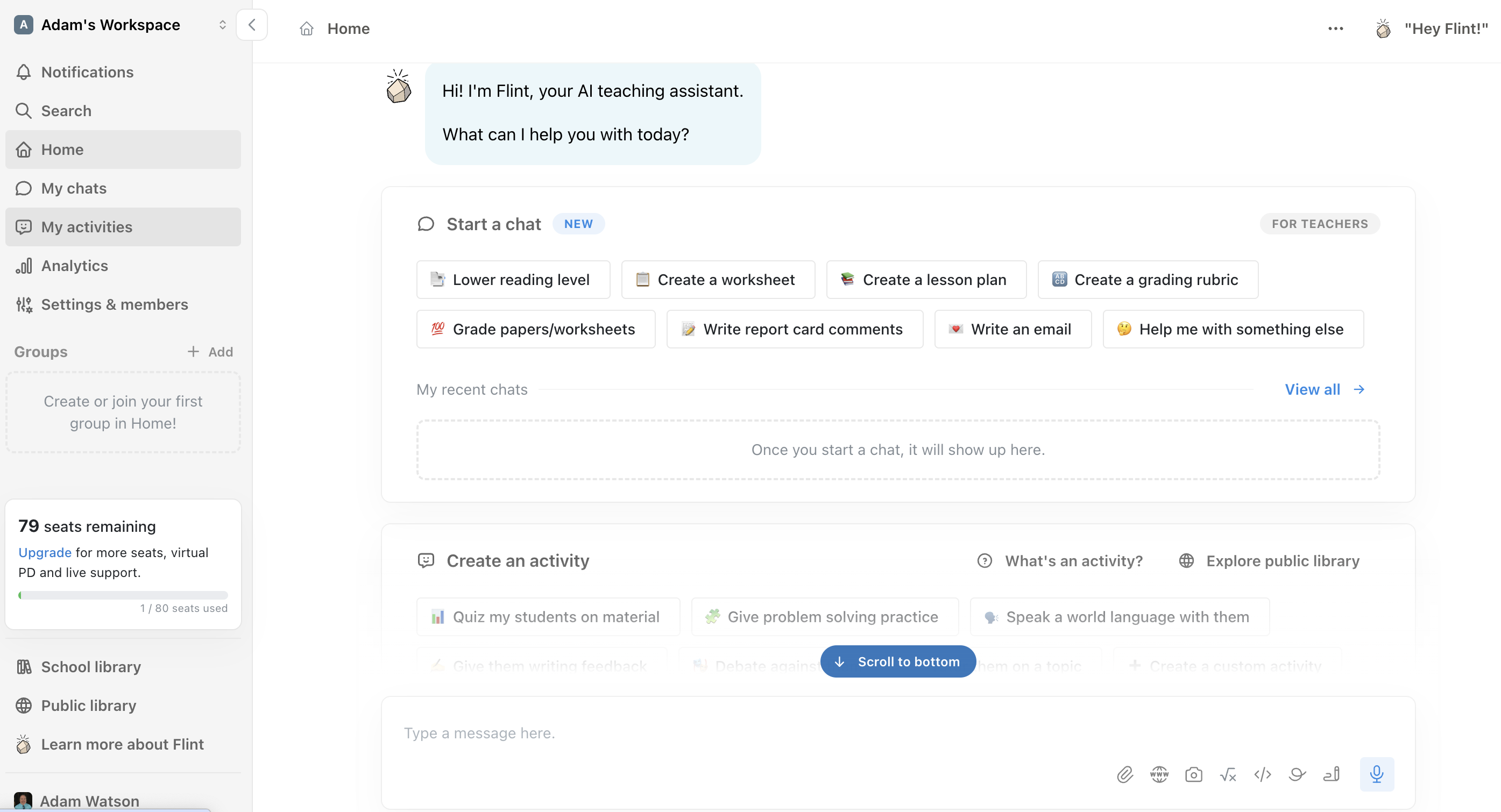
Once logged in, Flint offers itself as your "AI Teaching Assistant." For the upper section of the home screen, it suggests several ways it can help your instruction, such as lowering the reading level of a text, creating a lesson plan or rubric, and writing an email. In the lower section, you can create an activity published to an online space made accessible to students by a URL. Teachers can also save time by using an activity from a public library of pre-made content.

"Activities" are broadly defined here. It could be "problem solving practice," "speak a world language" (50+ are available!), provide writing feedback, or create a "quiz." Here, however, is an example of Flint using an antiquated term of expectations when compared to what students would really experience.
A quiz in Flint is really a conversation between the student and the AI. Once you give it objectives, potential material to utilize via uploads, and/or standards, Flint begins an assessment by probing what students know, coaxing them when they struggle. The results of this or any other activity are provided as "Analytics" that look at both how the class did overall as well as an individual's strengths and areas for growth.
 Building an activity is a conversation between teacher and Flint. Here, I asked if I could upload a standards-based rubric to make a quiz.
 You could also just provide the standard you are wanting to assess.
Safety seems essential to Flint, given several different features it has to protect students. Student and teacher data is not shared to third parties and data is not used to train AI models; the data stays secure in the school/district's domain. Additionally, you can export any student-AI conversation to PDF, inappropriate messages are flagged, and every user exchange can be viewed by admin.
 Educators can make Flint "more or less flexible" with how it helps students.
Flint offers a depth of support for new users, from professional development resources to an onboarding guide for teachers. They even have an AI Literacy Course for students, which includes lesson materials such as videos, slide decks, and Flint activities you can push out.
Here is Flint's most recent overview video on the platform posted on Loom (1:43).
How could you use it?
Flint offers specific, targeted opportunities for both instructional design and student demonstration of understanding. Its offerings of World Language activities is unique. Flint provides students a first tier of tutoring support, particularly with its integration of a whiteboard that could improve math practice and review. A quiz's use of naturalistic language changes the game for what it means for a teacher to assess. Last but not least, Flint's ability to discover class data trends as well as drill down to individual student performance makes the potential action pivot from assessment analysis to adjusted instruction much quicker and easier.
Downsides?
One must always be cautious with the accuracy and veracity of artificial intelligence tools, as well as verifiable impact on student learning. To Flint's credit, they mention several times in their list of features their efforts to be as accurate and transparent as possible, and they share several detailed case studies of partnerships with schools where student learning has improved.
 "In-line citations" is one of several ways Flint attempts transparency in its AI results.
Elementary teachers will likely be just fine with the limit of 80 students in the free account, although secondary teachers may rightfully fret. However, secondary instructors can delete and reassign the seats every few periods to get through a typical day, sacrificing historic data for extending the free usage. That would hopefully give enough of an opportunity for a teacher to try out Flint to see if a premium account would be worth it.
Flint is not the only tool to promote itself as "AI for personalized learning," but its suite of features make it a contender for honoring that vaulted claim. Come to it as a skeptic and see if it sparks some innovation for your instruction.
Have you used Flint? If you are a heavy user of another AI platform, how does Flint compare? Comment below!
Full disclosure: Flint is in talks with my employer OVEC for potential offers and opportunities for its members.
May 9, 2025
KyEdRPG Spotlight: Christopher Woo and Seneca High School's "TableTop RPG Club's Adventures"
Christopher Woo -- a social studies teacher who has been at Seneca High School since starting his educational career in 2014 -- came across my social media feed last month in the form of a video by JCPS (the Jefferson County Public School district, in Louisville, KY):
At first, the story seemed wonderfully typical of today's pop culture scene -- yet another high school's afterschool Dungeons & Dragons club was well liked by its students -- but I was quickly struck by two things. The first was the passionate, palpable community that Mr. Woo cultivated, made evident in the testimony of the young people in the video. The second was the discovery of Woo's self-published book series that turns the fictional exploits of his students' characters into a recorded, narrative history.
I had to visit, and a few weeks ago I made the pilgrimage to Mr. Woo's classroom to learn more.

Christopher Woo become a player of the game in the 1990's, when he first got his hands on the Advanced Dungeons & Dragons Monstrous Manual. (He still has a copy in his classroom!) But the club's story began several years into Woo's teaching, when a student asked if he would sponsor it. What started with four students in 2018 has now grown to a dozen, ranging from freshmen to seniors. Woo is usually the Dungeon Master (DM) who facilitates the adventures, and like many DM's, took on the burden of capturing each session's detailed notes for what choices were made by the characters and how the narrative they co-created together marched forward. Additionally, Woo's club is somewhat unique for an extracurricular K-12 experience, because the game's "campaign world" has been consistently growing since its start; as students graduate and leave Seneca, the feats of their heroes become legendary lore for the incoming new members of the club.
But such continuity created a conundrum. How would the new players ever catch up on all of that lore? Additionally, Woo wanted to give the members of the club something to remember of their playing time together -- tangible proof that their voice matters, that it makes an impact and carries a legacy. Last but not least, what's a catchy way to recruit new members for your afterschool club? The solution for all of these problems: put it in a book. And so, the first volume of Fate, Friends, and Fortune: A High School TableTop RPG Club's Adventures was self-published by Woo via Amazon in April 2023. As of now, the series is up to eight books, with Volume Nine in the works for late summer.
 The first book in the series, held by the real Mr. Woo, with the cover Mr. Woo peeking behind a DM screen.
It's important to note that Woo gives away the copies of the book to the members of the club, and that the cost of the self-publishing comes out of his personal pocket (currently over $200 per new edition). While that is certainly one kind of impressive obstacle that Woo rises to overcome, the second is the time involved, from writing the original session notes to later crafting the notes into a coherent story.
Thankfully, he has help from La'Kori Carson, a former Seneca student. After Mr. Woo set up an introductory email, I was grateful she agreed to an interview to share her perspective.

La'Kori had played a little D & D in middle school, but hadn't planned to join Woo's club until a friend brought her in. "I came in, and I was like, okay, I'm just actually going to sit here the first day. And [Mr. Woo] was like, you can join. I'm like, you want me to join? Very well. So I ended up joining with a character named Holland who starts off as a rock gnome and gets completely obliterated through the story, funnily enough."
Despite such inauspicious beginnings, La'Kori kept coming. Over time, she became a "secondary DM" to help Mr. Woo out with running adventures. By the time she graduated in 2023, her role grew to be a session notetaker (she still occasionally drops in on gameplay remotely via Woo's laptop and Zoom). These notes are not vague and general. As an example: "They rolled an 18, which means this passed the DC check that had been say a 15 at the time. This is how they did the attack. This is their name. This is who they attacked." By Volume 6 of the Fate, Friends, and Fortune series, she also became a volunteer editor and co-author. La'Kori manages all of this while attending college ("I'm a criminal justice major, sociology, anthropology with a minor in environmental justice sustainability with certifications alongside agriculture and different parts like veterinary sciences, animal sciences") and now runs a personal campaign as a DM herself. And the gameplay she sets up for her players is not just hack and slash combat! "I'll puzzle them with random problems, and they have to sit here and try to figure out these math equations. They're like, when did algebra get into D&D? I'm like, oh, I don't know." You could hear the smile of professed innocence in her voice. "And I'm honestly testing their real-world skills, and that's something that my players have mentioned that they like. I've brought in real-world problems for them to fix. Each location that I write has some real-world problem. One area has poverty. Another area has bad schooling because of who's in charge. There's a monarchy that's falling apart."
In his own quest for authentic learning, Mr. Woo also brings in TTRPGs into his social studies instruction. He has students roleplay as President Kennedy and members of his cabinet during the Cuban Missle Crisis -- a roll of the dice at the end (augmented by their choices) determines whether the world ends in nuclear war. Students participate in a simulation based on the War in Ukraine, gaming out whether they as the United States can de-escalate, or will inadvertently escalate, the situation. As 13th century explorers and merchants on the Silk Road to China, students play to see if they end up rich from trade, or dead from a duel. Woo emphasized that reflection afterwards is essential. What did you learn? Could the outcome have gone differently if you had made other choices? He hopes to one day share modules of his TTRPG examples so that teachers could benefit from his front-loaded work, as he can see what a difference playing TTRPGs makes in student engagement and learning.
As we wind down this blog entry, it seems fitting to return to La'Kori to ask about the impact of Mr. Woo and the Seneca D & D club. By many metrics, she was a successful student - yet prior to that fateful afternoon her rock gnome was "completely obliterated," she felt unappreciated as the creative and multifaceted person she truly is. "I've been a student that's always been categorized by their test scores. A 3.99 GPA student who passed with straight A's and B's or just straight A's in many semesters. But I'm horrible at standardized testing. So I was never with all the smart kids. I didn't receive the rewards being on a bus that had multiple destinations, a compound bus. I didn't get my perfect attendance award, and that was something that I couldn't handle. That wasn't even something that was my fault, and it was still held against me."
Mr. Woo, and by extension the D & D club, was crucial for La'Kori to feel connected, seen and heard, and highly recommends other teachers run their own: "It allows you to form bonds outside of it. And if students are having trouble with, say, schooling, for example, they may even come to you because they feel connected to you through this game to ask for help. And that's a great way to form a bond because a teacher's job is to help students, and what better way for a teacher to help them than to understand their problems better?"
Today, La'Kori is a published writer who will likely graduate college early with multiple majors, and she enthusiastically gives credit to Woo's D &D club for helping to launch her on that adventure. "I really do appreciate what experience he gave me because I'm part of the small student group of like, say, minority. And that also just didn't make friends well. So to be put into a team-based game where me as a person, I don't like group projects. I don't like group projects solely because I'm always the one who does everything. I'm always the one who has to take a leadership position. I'm always put into a leadership position by my teachers, by my professors, so to be put into a game where I can just kind of sit down, de-stress after schooling, it was fine. Then I became the group leader, funnily enough, through the situation, and I was allowed to like reach my own peaks of interest where I could play out what I could do. That was pretty cool, but I also understood balancing out my skill set. I was not a fighter, but I was a healer of the group. And through being a healer, I was probably, I think, the smartest person in my group."
Amplifying voices. Finding balance. Challenging what it means to be "smart." Giving opportunities for leadership. Healing. For La'Kori, and for so many other Seneca High School students that have gone through Christopher Woo's D & D club through the years, the fantasy game of funny shaped dice has transformed real lives.
April 23, 2025
Writing with AI: WeWillWrite and Short Answer
As a former high school English teacher, a big fan of game-based learning, and a person with a keen interest in how artificial intelligence can positively impact student learning, I'm delighted when an edtech tool ticks off all three boxes. Friends, I give you two such tools: WeWillWrite and Short Answer. In a world where we wonder what writing instruction will look like in the near future of school, these AI-empowered tools might show us one possible way.
There are several similarities between the platforms:
Both combine competitive and cooperative gameplay to writing; an individual student replies to a prompt set by the teacher, then uses established criteria to evaluate the writing of others presented anonymously (providing gamified feedback), "voting" until a winner emerges.You should hopefully get enough in the free versions to test out each platform (including premium trials), but as with many AI tools today, you'll have to pay to unlock more features.Both have libraries of pre-made material.Once the teacher launches an activity, students join with a PIN; the students do not have to create an account.There's a process at the end of games that encourages the teacher to show and share submitted responses to elicit further discussion.Both platforms have teachers as part of their design teams.However, both have different strengths. Here's more details on each tool.
WeWillWrite
WeWillWrite was developed by a Norwegian team of educators. (I found it interesting that one of their advisors is Johan Brand, founder of Kahoot, as I can see a bit of Kahoot's design aesthetic in the platform.) WeWillWrite's learning principles are Social, Safe, and Playful; you can read more here.
First, you create a login with email and password (no Google SSO option). After walking you through your teaching areas of interest, you have the ability to create classes to organize your activities inside. You can choose prompts from the library in the "Discover" tab (via filters for ELA-related "Topic" and "Type"), or create your own with the premium plan. The teacher determines the length of the response timer when launching a game.
A "Classroom Simulator" allows you to see what it will look like for you and your students.
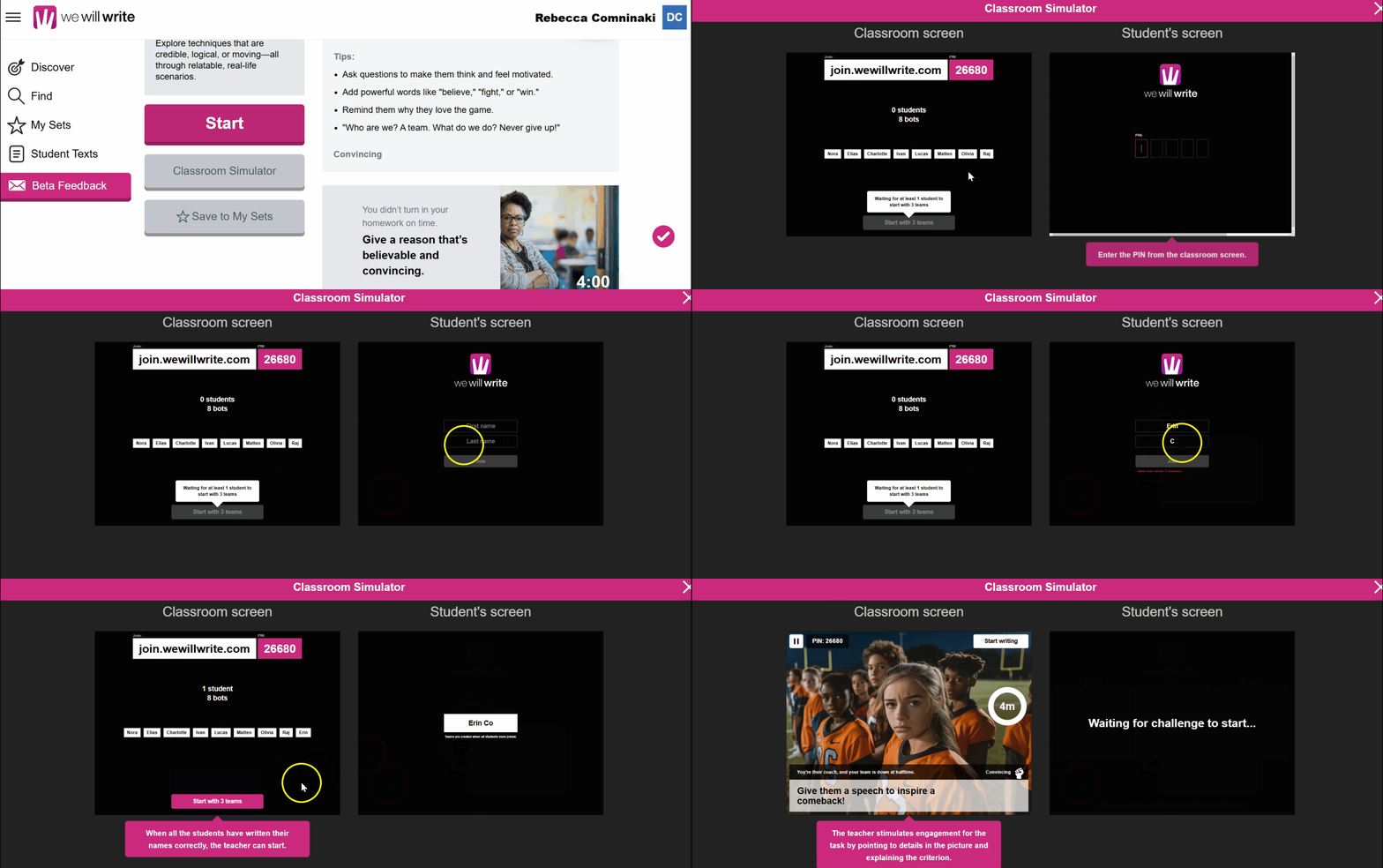 From a Google Slide deck of teacher resources.
Note that AI generated images are prominently placed alongside the prompts (with the premium plan, you can generate new ones or upload your own images, AI or not). The overall visual look of WeWillWrite seems a bit more appealing to younger students, although I could see high schoolers also enjoying it too.
Before gameplay, students are randomly assigned teams. (Manually selecting team membership doesn't look like an option currently.) For WeWill Write, a student first evaluates writing from their own team, which leads to a text that will represent their team in the game's final for another round of voting; therefore, the team is celebrated at the final leaderboard.
Once students have completed their work, you can view and download results under "Student Texts":
 From a Google Slide deck of teacher resources.
For an overview of the platform, you can watch this video (1:48):
For more support, a Google Slide deck of teacher resources that could function as a solo PD is available here, which includes "Strategies for Success."
If you're interested in an upgrade, the paid plans are listed here. Besides the ability to create your own content, it gives you full access to the WeWillWrite library, student history of work over time, and allows you to do the "AI literary device analysis" feature as briefly shown in the video overview above.
Short Answer
Short Answer was designed at the Stanford Graduate School of Education, creating "an experience based on learning science." (Cofounder Adam Sparks was an English and Social Studies teacher.) You can read more about their approach here.
You can create a teacher account for Short Answer with Google.
Unlike WeWillWrite, Short Answer does not have a class organizational structure for your activities.
You can choose prompts from the library or create your own (even in the free version). You add "Feedback Criteria" (a bank of suggestions are available). However, it's worth noting that Short Answer's library includes prompts for multiple contents and grade levels -- even, to my surprise, guides to help create prompts for math as high as trigonometry!
 In the "Discover" tab, there are some "Starter Activities" prompts suggested, or tab across to one of the four main academic content areas to see others.

One of the premium AI features is helping students with stems and outline tools when they begin writing their response.
Short Answer has more gameplay modes than WeWillWrite, such as "All-In," "Pair-It," and "Battle Royale." (And I appreciate that Short Answer provides guided walk-throughs of each game via Arcade.)
 The teacher and student view from the start of a "Battle Royale."
These games take anywhere from 10 to 45 minutes to complete. Students play the games individually, and as such, the student with the most "points" is celebrated at the final leaderboard. I noticed that a student can attach files or even use LaTeX formula characters in their response.
Once students have completed their work, you can view their individual results, but you cannot export/download results in the free version.
For an overview of the platform, you can watch this video (4:57):
For more support, a robust page of resources is here.
If you're interested in an upgrade, the premium option is described here. Besides some of the features listed above, you can have unlimited question creation, open peer-to-peer feedback options for students, Immersive Reader support, and an additional game called Quick Write that has AI feedback.
As of the published date of this blog entry, it looks like the premium version of Short Answer may cost a bit more than the premium version of WeWillWrite, but to be fair, Short Answer also offers several more premium features.
I hope this blog entry inspires you to try both platforms out in your classroom. Turn composition into a joyful, vibrant experience by gamifying your students' writing!
Adam D. Watson's Blog

- Adam D. Watson's profile
- 2 followers

