Kristin Maschka's Blog
January 3, 2017
Kristin Maschka for Assembly District Delegate AD41
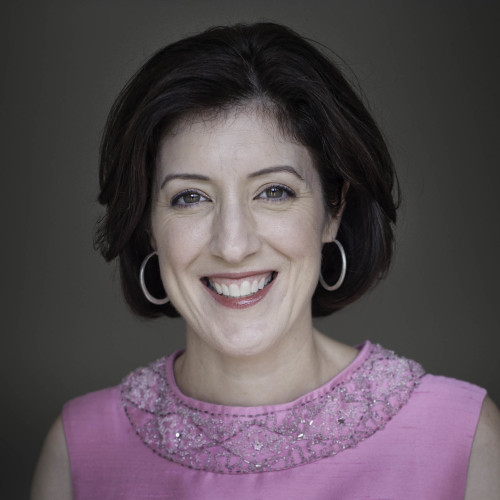 I ask for your vote as I run for Assembly District Delegate to the California Democratic Party and a member of the Executive Board. On Saturday January 7, registered Democrats from the 41st Assembly District can vote for delegates to represent them in the party. The 41st covers Altadena, Claremont, La Verne, Monrovia, Pasadena, San Dimas, Sierra Madre, South Pasadena, Rancho Cucamonga and Upland. I am honored to be part of a slate of seven women and seven men committed to progressive values and helping a united CA Democratic Party ensure that California continues to prove what is possible when we live by those values.
My priorities are:
Democrats win elections. Period.
The California Democratic Party becomes an even stronger united force for our progressive, democratic values that resonates across the country.
Helping the party engage more people effectively and operate more transparently.
Making sure a healthy debate around issues and strategies does not become a permanent divide internally that keeps us from executing effectively.
41st Assembly District Delegate Election
Saturday, January 7. 10:30 am to 12:30 pm
Flintridge Center. 236 West Mountain Ave, Suite 117. Pasadena, CA 91103
Any registered Democrat in the district is eligible to vote. You do not have to stay for the entire meeting.
RSVP on Facebook
About Me:
I am an activist, best-selling author, TEDx speaker, and executive coach inspired by my recent experience with Hillary for America to get more involved with the California Democratic Party.
 From April 2016 to November 2016 I was the Regional Organizing-Co Leader for the Hillary for America campaign in the Pasadena and San Gabriel Valley area. We ran phone banks for the June primary in California. From July to November we ran eight phone banks a week calling into battleground states. I was the Staging Location Director for four days of Get Out the Vote in battleground states. With volunteers and community donations, we transformed a private home into a campaign office that ran from 6 am to 9 pm every day, could handle 65 volunteers at a time, and supported over 1000 volunteers over four days.
In May I volunteered to support the caucus for Hillary delegates in the 29th District.
After serving for three years on the board of Planned Parenthood Pasadena & San Gabriel Valley, I am now the founding Board Chair of Planned Parenthood Advocates Pasadena & San Gabriel Valley, our new local political action fund. In that role, I also serve on the Board of Planned Parenthood Affiliates of California.
I was the founding Board Chair of the Pasadena Education Network, and in that role for six years. PEN promotes family participation in public education to ensure a quality education for all students in Pasadena, Altadena and Sierra Madre.
I worked on my first political campaign as a senior in high school in southern Minnesota in 1987. I managed the database for placing lawn signs for my English teacher, a Democrat running for state office, who defeated a Republican incumbent by 77 votes and went on to serve in the Minnesota state legislature for twenty years.
I now run my own consulting business providing coaching for executive women and for executive leadership teams in non-profits, higher education institutions and high-tech companies. My TEDx talk is “How I Learned to Love Unconscious Bias,” and I am the author of “This is Not How I Thought It Would Be: Remodeling Motherhood to Get the Lives We Want Today.”
I hold two degrees from the University of Chicago, where I am also in the Athletics Hall of Fame for basketball. I have lived in Pasadena for over 20 years with my husband and teenage daughter.
About Our Slate:
I ask that you vote for our entire slate of 7 women and 7 men who will work together on your behalf. You can read their candidate statements here.
Female Candidates:
Anna Iskikian
Michelle Kechichian
Kristin Maschka
Teresa Lamb Simpson
Alta Skinner
Joanne Wendler
Shoghig Yepremian
Male Candidates:
Ryan Asao
David Bratt
Robert Nelson
Tommy Randle
Joe Salas
Tim Wendler
Bruce Wright
Save
Save
The post Kristin Maschka for Assembly District Delegate AD41 appeared first on Kristin Maschka.


March 9, 2016
Research and Resources for Caltech SupCon 2016
Women’s Progress Stalled
The Wage Gap: A History of Pay Inequity and the Equal Pay Act http://www.infoplease.com/spot/equalpayact1.html#ixzz3ZPLYa9iP
http://thinkprogress.org/economy/2013/06/10/2128041/equal-pay-act-anniversary/
http://www.nytimes.com/2013/02/17/opinion/sunday/why-gender-equality-stalled.html?_r=0
“Women’s labor-force participation in the United States also leveled off in the second half of the 1990s, in contrast to its continued increase in most other countries. …. By 2004, a smaller percentage of married women with children under 3 were in the labor force than in 1993.”
http://www.cnbc.com/id/44687999 summary of Catalyst research findings.
Women in Higher Education
“Key findings illustrated that women in academia make up more than half of all college students, but only slightly more than a quarter of all full professors and less than 15% of the presidents at doctoral degree granting intuitions.”
According to the Colorado Women’s College 2013 Benchmarking Women’s Leadership in the United States report, the average percentage of women holding leadership positions in higher education is a startlingly low 24.53%.
Unconscious Bias in Scientists
http://www.timeshighereducation.co.uk/421746.article provides a summary of the study.
“In the study, Yale University researchers asked scientists at six universities to review identical CVs purporting to belong to senior undergraduate students that had been randomly assigned male or female names.
The researchers found that in considering the applicants for a laboratory manager position, staff consistently judged male candidates to be more competent and deserving of an extra $4,000 (£2,475) pay on average. They were also more willing to provide male applicants with mentoring and were more likely to hire them.
Women in the study were just as likely as men to make these judgements, and scientists responded no better than control groups.”
The full study is “Science faculty’s subtle gender biases favor male students”
Science with male/Liberal arts with female
Harvard’s Implicit Association Test reveals several implicit associations or unconscious biases including gender-science, race, weight, age, sexuality, gener-career. http://spottheblindspot.com/the-iat/
You can take any one of the Implicit Association Tests online in just 15 to 20 min.
Asian American = Foreign
https://www.researchgate.net/publication/7994359_America_White
“Just like me” Bias
Also called in-group favoritism.
http://citeseerx.ist.psu.edu/viewdoc/summary?doi=10.1.1.197.4614
Objective and Fair/Meritocracy More Prone to Unconscious Bias
[R]esearch demonstrates that people who value their objectivity and fairness are paradoxically particularly likely to fall prey to biases, in part because they are not on guard against subtle bias.”
Moral credentials and the expression of prejudice. Monin B, Miller DT (2001)
And…
“I think it, therefore it’s true”: Effects of self-perceived objectivity on hiring discrimination. Uhlmann EL, Cohen GL (2007)
And…
The Paradox of Meritocracy in Organizations. Castilla E, Benard S.
Language in Performance Reviews
http://fortune.com/2014/08/26/performance-review-gender-bias/
http://www.wsj.com/articles/gender-bias-at-work-turns-up-in-feedback-1443600759
Benefits of Diversity to Teams and Organizations
There are lots of sources for these benefits. This provides a good summary.
Anger from Women Judged More Harshly
http://pss.sagepub.com/content/19/3/268.short
Three studies examined the relationships among anger, gender, and status conferral. As in prior research, men who expressed anger in a professional context were conferred higher status than men who expressed sadness. However, both male and female evaluators conferred lower status on angry female professionals than on angry male professionals.
Mothers
http://www.hbs.edu/faculty/Pages/item.aspx?num=34511
Warmth and Competence As Universal Dimensions of Social Perception: The Stereotype Content Model and the BIAS Map (p.80 Housewives rated low competence, high warmth)
“When Professionals Become Mothers, Warmth Doesn’t Cut the Ice.” by Amy Cuddy
[1] “Not only are [working mothers] viewed as less competent and less worthy of training than their childless female counterparts, they are also viewed as less competent than they were before they had children. Merely adding a child caused people to view the woman as lower on traits such as capable and skillful, and decreased people’s interest in training, hiring, and promoting her.”
Getting a Job: Is There a Motherhood Penalty? Shelley J. Correll, Stephen Benard, In Paik (Resume study)
Jamal Jones and Greg Baker
https://www.aeaweb.org/articles.php?doi=10.1257/0002828042002561
“White names receive 50 percent more callbacks for interviews. Callbacks are also more responsive to resume quality for White names than for African-American ones.”
Tall People Earn More
http://www.apa.org/monitor/julaug04/standing.aspx
“When it comes to height, every inch counts–in fact, in the workplace, each inch above average may be worth $789 more per year, according to a study in the Journal of Applied Psychology (Vol. 89, No. 3).”
Noticing Out Loud is Good
http://www.newgirlsnet.com/what-works-for-women-at-work-answers-to-common-questions-sexist-remarks/
“However, confronting sexism head-on may not incur the hostile backlash that you might expect. In a recent study, researchers from Loyola University Chicago found that men who were called out on their use of sexist language responded with greater sensitivity to gender issues and treated the women who confronted them better than those who were not called out did. Research also indicates that directly challenging instances of sexism improves women’s feelings of competence and self-esteem. And substantial scholarship has suggested that speaking up against any sort of bias reduces expressions of that bias in the future.
When Women Negotiate, They are Penalized
http://www.huffingtonpost.com/joan-williams/women-dont-negotiate_b_2593106.html
“A 2006 study Babcock did with Hannah Riley Bowles and Lei Lai helped explain why women are less likely to negotiate their starting salaries (referred to as the Bowles study). When they do, both men and women are less likely to want to work with or hire them. The effect size is large. Women who negotiated faced a penalty 5.5 times that faced by men.”
Change the What: Negotiation
https://hbr.org/2014/10/hacking-techs-diversity-problem
“…researchers Andreas Leibbrandt and John A. List posted two versions of announcements for administrative assistant jobs in stereotypically masculine businesses—NASCAR, football, and basketball. One version said nothing about salary; the other said “salary negotiable.” Leibbrandt and List wanted to investigate the well-documented phenomenon that women are less likely to negotiate their salaries than men, which contributes to the pay gap between the sexes. Could a simple two-word phrase interrupt that pattern?
It could. In fact, not only did the “salary negotiable” language close the negotiation gap between men and women, it closed the pay gap between the male and female hires by 45%.”
Change the What: Anonymous Applications/Blind resumes
Change the What: Scan job ads for gender and jargon
Evidence That Gendered Wording in Job Advertisements Exists and Sustains Gender Inequality (Journal of Personality and Social Psychology, July 2011, Vol 101(1), p109-28).
http://www.nytimes.com/2016/02/28/magazine/is-blind-hiring-the-best-hiring.html Cliché’s and jargon particular turnoff for non-white and women.
Webpage That Scans a Pasted Job Description
http://gender-decoder.katmatfield.com/
Textio
Change the What: Hiring Processes
This article summarizes several interventions proven to reduce gender bias, including focusing on proportion in the pool, committing to criteria and credentials in advance, and using structured interviews.
Interventions That Affect Gender Bias in Hiring: A Systematic Review Carol Isaac, PhD, PT, Barbara Lee, PhD, and Molly Carnes, MD, MS
OTHER RESOURCES
My TEDx talk is a great way to start a conversation about unconscious bias.
Hacking Tech’s Diversity Problem by Joan Williams in Harvard Business Review. Great article for sharing and discussing. Williams is an incredible thought leader and heads the WorkLife Law Center at Hastings Law School
“Women Rising: The Unseen Barriers” Harvard Business Review Another great article to share and discuss.
Paradigm is a company that helps organizations reduce unconscious bias in talent management. Their white paper is a well-done overview of the topic.
The post Research and Resources for Caltech SupCon 2016 appeared first on Kristin Maschka.
September 11, 2015
TEDxPasadenaWomen: How I Learned to Love Unconscious Bias
Ready to join the team?
Let go of being right and notice your own unconscious bias. One humbling way is to take the 15-minute Implicit Association Test from Harvard.
Notice unconscious bias out loud. Notice it out loud in person, share it with us on Twitter and Facebook.
Change the what. What’s one thing you can do NOW to change the environment, change a system or change a process? Do it and share it!
For more, here are all the things that went into designing and delivering a TEDxTalk for me. Here are the links to the research and more resources to notice and change the impacts of unconscious bias.
The post TEDxPasadenaWomen: How I Learned to Love Unconscious Bias appeared first on Kristin Maschka.
My TEDx Talk Team
A TEDx talk may appear to be a solo thing. Not for me. So much and so many people went into speaking at TEDxPasadenaWomen. I am so grateful for the team that helped me pull this off.
The practical and soulful support of the amazing John Bates of Executive Speaking Success and his colleague Nataly.
125+ hours of designing the talk, practicing, rehearsing with volunteers in the living room, meeting with my coaches.
TEDxPasadenaWomen organizers Amber and Nadine.
TEDxPasadenaWomen speaker coaches Michele Lando and David Samuels.
A timely gift from my friend Kim of the book Resonate by Nancy Duarte.
Facebook messages about Asian American stereotypes with my friend Scott.
Sticky notes. LOTS of sticky notes.
Makeup by Sara.
Rides from Beth.
Emergency calls to and from my HS BFF Tammy.
Emergency texts to and from my local BFF Rosemary.
Yoga and meditation.
My writing group Kim and Bev.
Feedback from my clients at Caltech.
Volunteer audience members Julianne, Dave, Haley, Kristen, Julie, Dave, Marshall, Sally, Paul, Gail, De, Melissa, Chris, John, Rebecca.
Encouraging emails from Gin, Catie, Brence, and Cathy.
TEDx eve dinner of Domenico’s, rosé and Carmela ice cream.
The support of my husband and daughter.
The post My TEDx Talk Team appeared first on Kristin Maschka.
TEDxPasadenaWomen: Resources and Research for “How I Learned to Love Unconscious Bias”
Women’s Momentum Has Stalled
The Wage Gap: A History of Pay Inequity and the Equal Pay Act http://www.infoplease.com/spot/equalpayact1.html#ixzz3ZPLYa9iP
Until the early 1960s, newspapers published separate job listings for men and women. Jobs were categorized according to sex, with the higher level jobs listed almost exclusively under “Help Wanted—Male.” In some cases the ads ran identical jobs under male and female listings—but with separate pay scales. Separate, of course, meant unequal: between 1950 and 1960, women with full time jobs earned on average between 59–64 cents for every dollar their male counterparts earned in the same job.
It wasn’t until the passage of the Equal Pay Act on June 10, 1963 (effective June 11, 1964) that it became illegal to pay women lower rates for the same job strictly on the basis of their sex
http://thinkprogress.org/economy/2013/06/10/2128041/equal-pay-act-anniversary/
“The gender wage gap was wider in 2011 than in 2010 and was actually at the same level as in 2009. Back in the 1980s, the gap narrowed by more than 10 percentage points. But it’s only closed by about one percentage point since 2001.”
http://www.nytimes.com/2013/02/17/opinion/sunday/why-gender-equality-stalled.html?_r=0
“Women’s labor-force participation in the United States also leveled off in the second half of the 1990s, in contrast to its continued increase in most other countries. Gender desegregation of college majors and occupations slowed. And although single mothers continued to increase their hours of paid labor, there was a significant jump in the percentage of married women, especially married women with infants, who left the labor force. By 2004, a smaller percentage of married women with children under 3 were in the labor force than in 1993.”
http://www.cnbc.com/id/44687999
The number of women in the boardroom has stagnated, holding around 15 to 16 percent for the past several years.
The number of executive officers has not improved appreciably, rising from 13 percent to just 14 percent over the past couple of years.
In 2010, women held 14.4 percent of executive officer positionsat Fortune 500 companies and 7.6 percent of top earner positions.
Unconscious Bias in Scientists
http://www.timeshighereducation.co.uk/421746.article
In the study, Yale University researchers asked scientists at six universities to review identical CVs purporting to belong to senior undergraduate students that had been randomly assigned male or female names.
The researchers found that in considering the applicants for a laboratory manager position, staff consistently judged male candidates to be more competent and deserving of an extra $4,000 (£2,475) pay on average. They were also more willing to provide male applicants with mentoring and were more likely to hire them.
Women in the study were just as likely as men to make these judgements, and scientists responded no better than control groups.
Anger from Women Judged More Harshly
http://pss.sagepub.com/content/19/3/268.short
Three studies examined the relationships among anger, gender, and status conferral. As in prior research, men who expressed anger in a professional context were conferred higher status than men who expressed sadness. However, both male and female evaluators conferred lower status on angry female professionals than on angry male professionals.
When Women Negotiate, They are Penalized
http://www.huffingtonpost.com/joan-williams/women-dont-negotiate_b_2593106.html
A 2006 study Babcock did with Hannah Riley Bowles and Lei Lai helped explain why women are less likely to negotiate their starting salaries (referred to as the Bowles study). When they do, both men and women are less likely to want to work with or hire them. The effect size is large. Women who negotiated faced a penalty 5.5 times that faced by men.
Change the What: Negotiation
https://hbr.org/2014/10/hacking-techs-diversity-problem
…researchers Andreas Leibbrandt and John A. List posted two versions of announcements for administrative assistant jobs in stereotypically masculine businesses—NASCAR, football, and basketball. One version said nothing about salary; the other said “salary negotiable.” Leibbrandt and List wanted to investigate the well-documented phenomenon that women are less likely to negotiate their salaries than men, which contributes to the pay gap between the sexes. Could a simple two-word phrase interrupt that pattern?
It could. In fact, not only did the “salary negotiable” language close the negotiation gap between men and women, it closed the pay gap between the male and female hires by 45%.
Change the What: Anonymous Applications
http://maytree.com/blog/2013/08/anonymous-job-applications-the-next-step-towards-bias-free-hiring/
Change the What: Hiring Processes A great article you can hand to your Human Resources team.
Interventions That Affect Gender Bias in Hiring: A Systematic Review
Carol Isaac, PhD, PT, Barbara Lee, PhD, and Molly Carnes, MD, MS
Unconscious Bias Impacts All of Us
http://scholar.harvard.edu/jlhochschild/publications/skin-color-paradox-and-american-racial-order
Data on other social and economic arenas of life show the same association between dark skin and disadvantage. Consider criminal justice: among 66,927 male felons incarcerated for their first offense in Georgia from 1995 through 2002, the dark-skinned received longer prison sentences. Whites’ sentences averaged 2,689 days, and Blacks’ were longer by 378 days.
http://papers.ssrn.com/sol3/papers.cfm?abstract_id=253712
There is evidence that African Americans are treated worse than similarly situated Whites in sentencing. For example, federal Black defendants were sentenced to 12 percent longer sentences under the Sentencing Reform Act of 1984.
See David B. Mustard, Racial, Ethnic, and Gender Disparities in Sentencing: Evidence From the U.S. Federal Courts, 44 J.L. & ECON. 285, 300 (2001) (examining federal judge sentencing under the Sentencing Reform Act of 1984
http://www.sentencingproject.org/detail/news.cfm?news_id=1870
Judges are also more likely to sentence people of color than whites to prison and jail and to impose longer sentences, even after accounting for differences in crime severity, criminal history, and educational level.
See Steffensmeier, D. & Demuth, S. (2000). Ethnicity and Sentencing Outcomes in U.S. Federal Courts: Who is Punished More Harshly? American Sociological Review, 65(5), 705–729; Steffensmeier, D. & Demuth, S. (2001). Ethnicity and Judges’ Sentencing Decisions: Hispanic-Black-White Comparisons. Criminology, 39(1), 145–178
http://www.rethinkingschools.org/archive/22_02/math222.shtml
(The anecdote in the talk was inspired by a story my friend Scott told me about something that happened to him. But here’s an intro to the research on bias about Asian Americans.)
The Myth of the Model Minority asserts that, due to their adherence to traditional, Asian cultural values, Asian-American students are supposed to be devoted, obedient to authority, respectful of teachers, smart, good at math and science, diligent, hard workers, cooperative, well-behaved, docile, college-bound, quiet, and opportunistic.
(So many fathers I know have had this happen to them, but here is some of the research on it.)
When Kevin Kruse is spotted out with his children, people often ask if he is babysitting. Despite the frequency of the inquiry, it still makes the Princeton history professor bristle.
“No, ‘babysitting’ is what you do with other people’s kids,” Kruse said. “These are my own kids, so it’s called ‘parenting.'”
…
What they found, however, was that men and women, particularly in terms of parenting, were judged overall to be subjectively different.
Identical words can be used to describe a mother and a father, but those words do not retain a consistent definition: They are translated to reflect parenting stereotypes.
The post TEDxPasadenaWomen: Resources and Research for “How I Learned to Love Unconscious Bias” appeared first on Kristin Maschka.
TEDxPasadenaWomen: How I Learned to Love Unconscious Bias
Ready to join the team?
Let go of being right and notice your own unconscious bias. One humbling way is to take the 15-minute Implicit Association Test from Harvard.Notice unconscious bias out loud. Notice it out loud in person, share it with us on Twitter and Facebook.Change the what. What’s one thing you can do NOW to change the environment, change a system or change a process? Do it and share it!For more, here are all the things and people that went into designing and delivering a TEDx Talk for me. Here are the links to the research and more resources to notice and change the impacts of unconscious bias.
The post TEDxPasadenaWomen: How I Learned to Love Unconscious Bias appeared first on Kristin Maschka.
TEDxPasadenaWomen: Resources and Research for “How I Learned to Love Unconscious Bias”
Women’s Momentum Has Stalled
The Wage Gap: A History of Pay Inequity and the Equal Pay Act http://www.infoplease.com/spot/equalpayact1.html#ixzz3ZPLYa9iP
Until the early 1960s, newspapers published separate job listings for men and women. Jobs were categorized according to sex, with the higher level jobs listed almost exclusively under “Help Wanted—Male.” In some cases the ads ran identical jobs under male and female listings—but with separate pay scales. Separate, of course, meant unequal: between 1950 and 1960, women with full time jobs earned on average between 59–64 cents for every dollar their male counterparts earned in the same job.
It wasn’t until the passage of the Equal Pay Act on June 10, 1963 (effective June 11, 1964) that it became illegal to pay women lower rates for the same job strictly on the basis of their sex
“The gender wage gap was wider in 2011 than in 2010 and was actually at the same level as in 2009. Back in the 1980s, the gap narrowed by more than 10 percentage points. But it’s only closed by about one percentage point since 2001.”
http://www.nytimes.com/2013/02/17/opinion/sunday/why-gender-equality-stalled.html?_r=0
“Women’s labor-force participation in the United States also leveled off in the second half of the 1990s, in contrast to its continued increase in most other countries. Gender desegregation of college majors and occupations slowed. And although single mothers continued to increase their hours of paid labor, there was a significant jump in the percentage of married women, especially married women with infants, who left the labor force. By 2004, a smaller percentage of married women with children under 3 were in the labor force than in 1993.”
http://www.cnbc.com/id/44687999
Unconscious Bias in Scientists
http://www.timeshighereducation.co.uk/421746.article
In the study, Yale University researchers asked scientists at six universities to review identical CVs purporting to belong to senior undergraduate students that had been randomly assigned male or female names.
The researchers found that in considering the applicants for a laboratory manager position, staff consistently judged male candidates to be more competent and deserving of an extra $4,000 (£2,475) pay on average. They were also more willing to provide male applicants with mentoring and were more likely to hire them.
Women in the study were just as likely as men to make these judgements, and scientists responded no better than control groups.
Anger from Women Judged More Harshly
http://pss.sagepub.com/content/19/3/268.short
Three studies examined the relationships among anger, gender, and status conferral. As in prior research, men who expressed anger in a professional context were conferred higher status than men who expressed sadness. However, both male and female evaluators conferred lower status on angry female professionals than on angry male professionals.
When Women Negotiate, They are Penalized
http://www.huffingtonpost.com/joan-williams/women-dont-negotiate_b_2593106.html
A 2006 study Babcock did with Hannah Riley Bowles and Lei Lai helped explain why women are less likely to negotiate their starting salaries (referred to as the Bowles study). When they do, both men and women are less likely to want to work with or hire them. The effect size is large. Women who negotiated faced a penalty 5.5 times that faced by men.
Change the What: Negotiation
https://hbr.org/2014/10/hacking-techs-diversity-problem
…researchers Andreas Leibbrandt and John A. List posted two versions of announcements for administrative assistant jobs in stereotypically masculine businesses—NASCAR, football, and basketball. One version said nothing about salary; the other said “salary negotiable.” Leibbrandt and List wanted to investigate the well-documented phenomenon that women are less likely to negotiate their salaries than men, which contributes to the pay gap between the sexes. Could a simple two-word phrase interrupt that pattern?
It could. In fact, not only did the “salary negotiable” language close the negotiation gap between men and women, it closed the pay gap between the male and female hires by 45%.
Change the What: Hiring Processes A great article you can hand to your Human Resources team.
Interventions That Affect Gender Bias in Hiring: A Systematic Review
Carol Isaac, PhD, PT, Barbara Lee, PhD, and Molly Carnes, MD, MS
http://www.researchgate.net/publication/38059649_Interventions_That_Affect_Gender_Bias_in_Hiring_A_Systematic_Review
Unconscious Bias Impacts All of Us
http://scholar.harvard.edu/jlhochschild/publications/skin-color-paradox-and-american-racial-order
Data on other social and economic arenas of life show the same association between dark skin and disadvantage. Consider criminal justice: among 66,927 male felons incarcerated for their first offense in Georgia from 1995 through 2002, the dark-skinned received longer prison sentences. Whites’ sentences averaged 2,689 days, and Blacks’ were longer by 378 days.http://papers.ssrn.com/sol3/papers.cfm?abstract_id=253712
There is evidence that African Americans are treated worse than similarly situated Whites in sentencing. For example, federal Black defendants were sentenced to 12 percent longer sentences under the Sentencing Reform Act of 1984.
See David B. Mustard, Racial, Ethnic, and Gender Disparities in Sentencing: Evidence From the U.S. Federal Courts, 44 J.L. & ECON. 285, 300 (2001) (examining federal judge sentencing under the Sentencing Reform Act of 1984
Judges are also more likely to sentence people of color than whites to prison and jail and to impose longer sentences, even after accounting for differences in crime severity, criminal history, and educational level.
See Steffensmeier, D. & Demuth, S. (2000). Ethnicity and Sentencing Outcomes in U.S. Federal Courts: Who is Punished More Harshly? American Sociological Review, 65(5), 705–729; Steffensmeier, D. & Demuth, S. (2001). Ethnicity and Judges’ Sentencing Decisions: Hispanic-Black-White Comparisons. Criminology, 39(1), 145–178 http://www.rethinkingschools.org/archive/22_02/math222.shtml
(The anecdote in the talk was inspired by a story my friend Scott told me about something that happened to him. But here’s an intro to the research on bias about Asian Americans.)
The Myth of the Model Minority asserts that, due to their adherence to traditional, Asian cultural values, Asian-American students are supposed to be devoted, obedient to authority, respectful of teachers, smart, good at math and science, diligent, hard workers, cooperative, well-behaved, docile, college-bound, quiet, and opportunistic. http://www.theatlantic.com/sexes/archive/2013/01/dads-caring-for-their-kids-its-parenting-not-babysitting/267443/
(So many fathers I know have had this happen to them, but here is some of the research on it.)
When Kevin Kruse is spotted out with his children, people often ask if he is babysitting. Despite the frequency of the inquiry, it still makes the Princeton history professor bristle.
“No, ‘babysitting’ is what you do with other people’s kids,” Kruse said. “These are my own kids, so it’s called ‘parenting.'”
…
What they found, however, was that men and women, particularly in terms of parenting, were judged overall to be subjectively different.
Identical words can be used to describe a mother and a father, but those words do not retain a consistent definition: They are translated to reflect parenting stereotypes.
The post TEDxPasadenaWomen: Resources and Research for “How I Learned to Love Unconscious Bias” appeared first on Kristin Maschka.
June 3, 2015
TEDxPasadenaWomen Highlights!
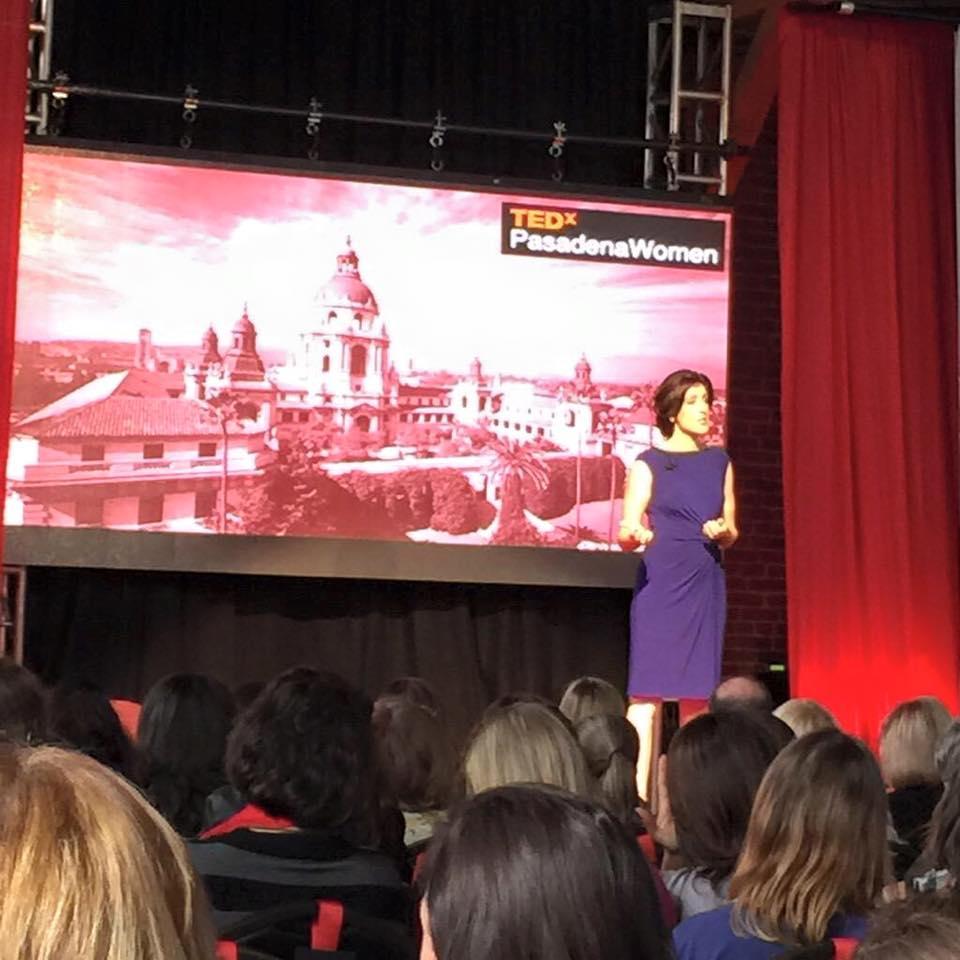
TEDxPasadenaWomen on May 30, 2015. One of 250 independently organized TEDx Women events happening across the globe in connection with the main TEDWomen event in Monterey CA the same week. 14 speakers, 3 special guests, 100 in the audience. What a day.
In a few short weeks, around the fourth of July, you’ll be able to view videos of all the TEDxPasadenaWomen speakers, guests, and interviews too. In the meantime, here are a few of my own highlights and some of the other speakers I am looking forward to sharing when the videos are up.
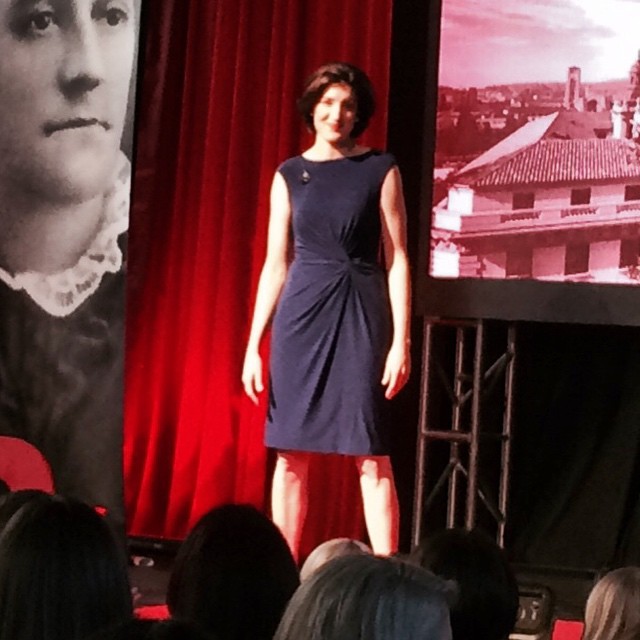
The title for my talk is “How Unconscious Bias Puts Us on the Same Team.” I spoke about how unconscious bias is stalling women’s progress but that noticing out loud the ways unconscious bias impacts ALL of us, puts us on the SAME TEAM where we can change the WHAT (the processes, systems, environment) not the WHO (each other) to make difference for everyone. But really I told stories – a story about Kate and her Equal Pay Day t-shirt, two stories from high school basketball that taught me lessons about dealing with unconscious bias, and a story about my husband David.
Favorite quotes from people after my talk:
“You knocked it out of the park.”
“I felt like I just had a talk with my best friend.”
“I want to be on your team.”
 My daughter Kate attended as my guest, and she wore the t-shirt she made for Equal Pay Day (Women, Like Men Only Cheaper) which figures prominently in the talk I shared with the audience. So after my time on stage, everyone wanted to talk to her. They even interviewed her on camera as part of my post-talk interview. I knew it would be great to have her there, but it was absolutely incredible – she thought I was cool for a day, we got to share this amazing experience, she got to talk with people who cared what she thought as a person – not a
  kid, and she got to be part of a room full of people who believe you can make a difference if you speak up.
Favorite quote of things people said to Kate:
“You and your mom are badasses.”
I fell in love all of our speakers and special guests from that day, but a blog post with all of them would be too long, so I’m going to highlight a few that have special connections for me.
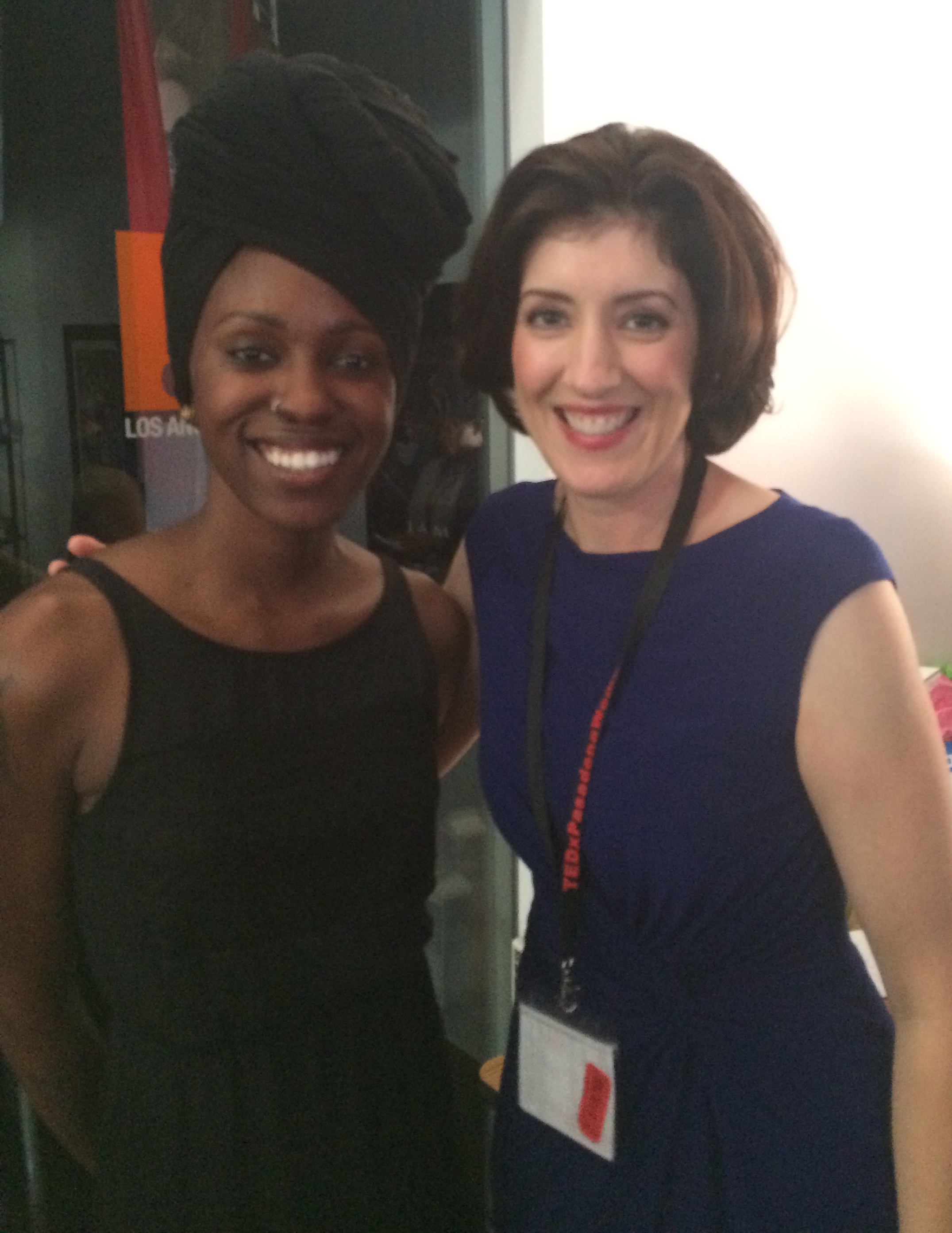
The moment after I get to share my own video, I am going to share Alyesha Wise’s video. She kicked off the day with a strong, wise-beyond-her-years, vulnerable performance poem that grabbed the audience by the collar and said “Wake up and listen to me!” This young woman is going places.
Favorite quote:
“It’s not about what you’re running to but about what you find out about yourself when you get there.”
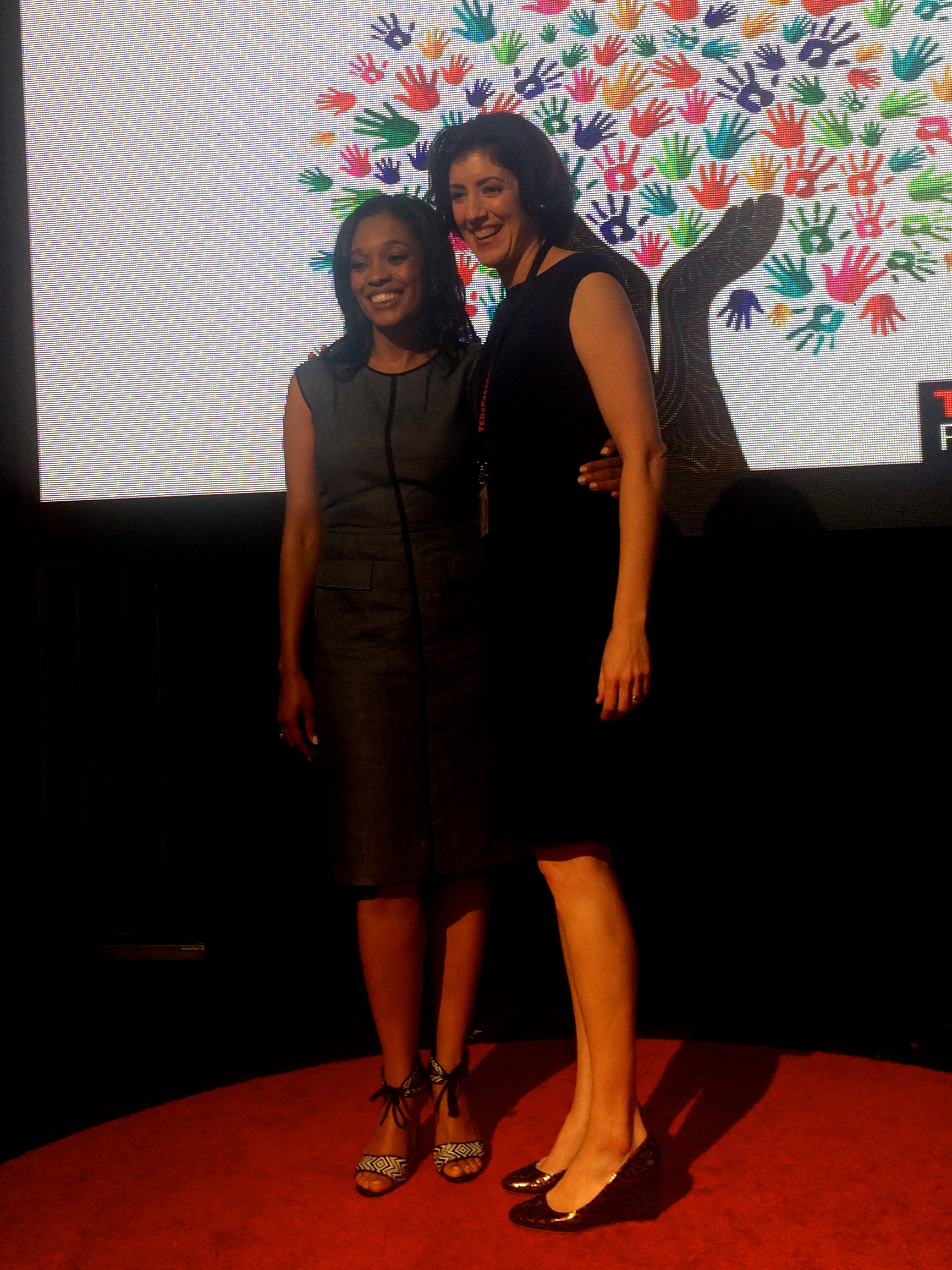 Tembi Locke and I met in a UCLA weekend writing workshop, and we knew we’d meet again. Tembi shared a moving message about the loss of her husband and the power of connection and unconditional love in our lives, and especially in the midst of caregiving and grief. Her website, The Kitchen Widow, is my go-to source for how to compassionately support people I love through grief. (And I got more cool points with my daughter for knowing the actress in “Bones.”)
Favorite quote:
“It is in giving that we are receiving life’s greatest gifts.”
As many of you know, one of the many issues I care about is the economic security of women and the need for women to take charge of their own financial well-being. So I’ll be sharing Ron Florance’s video too. Ron tosses out the complex, off-putting, jargon of financial advisors in favor of asking yourself three questions. All of which Kate and I remembered the next day.
Favorite quote:
“What’s your money for? What are you worried about? What will make you happy?”
As a fan, it was a treat to meet Alex Cohen, from KPCC, who compared motherhood to roller derby – which makes way more sense than you may think – and paralleled my own experience so closely. Frank Chechel spoke about what it is like to be a man and father who cares about women’s momentum. As soon as he started telling a story of trying to make a cheese quesadilla for his child and being critiqued by his wife, my daughter and I locked eyes from across the room and both mouthed “CRUNCHY WAFFLES!” – the equivalent story from my book.
And that’s just a taste of the day. I’ll try to share more highlights as we all wait for the videos!
~ Kristin
The post TEDxPasadenaWomen Highlights! appeared first on Kristin Maschka's Blog.
TEDxPasadenaWomen Highlights!
TEDxPasadenaWomen on May 30, 2015. One of 250 independently organized TEDx Women events happening across the globe in connection with the main TEDWomen event in Monterey CA the same week. 14 speakers, 3 special guests, 100 in the audience. What a day.
In a few short weeks, around the fourth of July, you’ll be able to view videos of all the TEDxPasadenaWomen speakers, guests, and interviews too. In the meantime, here are a few of my own highlights and some of the other speakers I am looking forward to sharing when the videos are up.
The title for my talk is “How Unconscious Bias Puts Us on the Same Team.” I spoke about how unconscious bias is stalling women’s progress but that noticing out loud the ways unconscious bias impacts ALL of us, puts us on the SAME TEAM where we can change the WHAT (the processes, systems, environment) not the WHO (each other) to make difference for everyone. But really I told stories – a story about Kate and her Equal Pay Day t-shirt, two stories from high school basketball that taught me lessons about dealing with unconscious bias, and a story about my husband David.
Favorite quotes from people after my talk:
“You knocked it out of the park.”
“I felt like I just had a talk with my best friend.”
“I want to be on your team.”
My daughter Kate attended as my guest, and she wore the t-shirt she made for Equal Pay Day (Women, Like Men Only Cheaper) which figures prominently in the talk I shared with the audience. So after my time on stage, everyone wanted to talk to her. They even interviewed her on camera as part of my post-talk interview. I knew it would be great to have her there, but it was absolutely incredible – she thought I was cool for a day, we got to share this amazing experience, she got to talk with people who cared what she thought as a person – not a kid, and she got to be part of a room full of people who believe you can make a difference if you speak up.
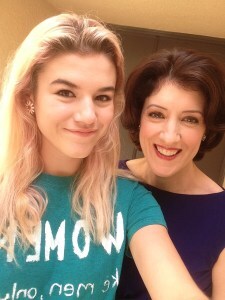
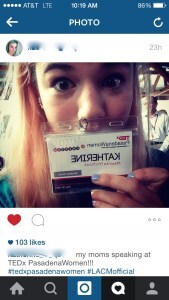
Favorite quote of things people said to Kate:
“You and your mom are badasses.”
I fell in love all of our speakers and special guests from that day, but a blog post with all of them would be too long, so I’m going to highlight a few that have special connections for me.
The moment after I get to share my own video, I am going to share Alyesha Wise’s video. She kicked off the day with a strong, wise-beyond-her-years, vulnerable performance poem that grabbed the audience by the collar and said “Wake up and listen to me!” This young woman is going places.
Favorite quote:
“It’s not about what you’re running to but about what you find out about yourself when you get there.”
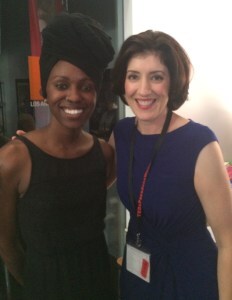
Tembi Locke and I met in a UCLA weekend writing workshop, and we knew we’d meet again. Tembi shared a moving message about the loss of her husband and the power of connection and unconditional love in our lives, and especially in the midst of caregiving and grief. Her website, The Kitchen Widow, is my go-to source for how to compassionately support people I love through grief. (And I got more cool points with my daughter for knowing the actress in “Bones.”)
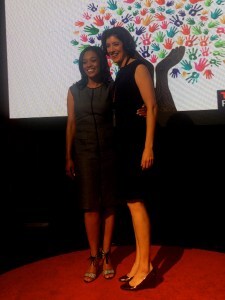
Favorite quote:
“It is in giving that we are receiving life’s greatest gifts.”
As many of you know, one of the many issues I care about is the economic security of women and the need for women to take charge of their own financial well-being. So I’ll be sharing Ron Florance’s video too. Ron tosses out the complex, off-putting, jargon of financial advisors in favor of asking yourself three questions. All of which Kate and I remembered the next day.
Favorite quote:
“What’s your money for? What are you worried about? What will make you happy?”
As a fan, it was a treat to meet Alex Cohen, from KPCC, who compared motherhood to roller derby – which makes way more sense than you may think – and paralleled my own experience so closely. Frank Chechel spoke about what it is like to be a man and father who cares about women’s momentum. As soon as he started telling a story of trying to make a cheese quesadilla for his child and being critiqued by his wife, my daughter and I locked eyes from across the room and both mouthed “CRUNCHY WAFFLES!” – the equivalent story from my book.
And that’s just a taste of the day. I’ll try to share more highlights as we all wait for the videos!
~ Kristin
The post TEDxPasadenaWomen Highlights! appeared first on Kristin Maschka.
April 30, 2015
TEDxPasadenaWomen!
 When I learned I had been accepted to speak at TEDxPasadenaWomen on Saturday May 30,th my first wave of emotion was pure excitement.
TEDxPasadenaWomen is an independently organized satellite event of TEDWomen event taking place in Monterey, CA on May 27, 28 and 29.
The next, much larger tsunami was panic and anxiety.
My preferred solution to any large, anxiety-producing task is to gather a team. So I am casting far and wide for teammates as I prepare for this talk. Starting lineup includes:
My husband, my business coaching group, and my speaking coach, John Bates of Executive Speaking Success, who kicked my butt until I submitted the application.
Lunch with Rosemary, breakfast with Nancy, a book from Kim, offers to provide feedback from my clients.
My best friend Tammy calling magically (as usual) at a moment of serious creative block.
Tweets and emails with all the other amazing speakers on May 30.
My daughter energetically talking with me about my idea. She is going as my guest that day!
I’ll be talking about how getting everyone on the same team and attacking the unconscious bias we all have NOT each other is the only way to accelerate progress for women, and accelerate progress for all of us.
If you’d like to join my TEDx team, send me an encouraging word. Forward me your favorite TED talk, relevant articles and your stories. Apply to attend TEDxPasadenaWomen. TODAY IS THE LAST DAY!). Offer to come to a practice session. Volunteer to host a practice session for me.
We can do so much together!
~ Kristin
The post TEDxPasadenaWomen! appeared first on Kristin Maschka's Blog.