Lesley Krueger's Blog
April 26, 2026
Returned damaged: Review of David Nasaw’s The Wounded Generation (part two)
I always pause when a new section in a non-fiction book begins, “Five years later.” Five years is a long time in our short human lives, and even if those five years pass without historic conflicts, we still experience a series of fascinating, traumatic and often life-changing events as we ricochet through our allotted three score years and ten.
Or these days in Canada, an average of 85 years for women and 80.7 for men.
That’s one thing I particularly like about David Nasaw’s new book, The Wounded Generation: Coming Home After World War II. He doesn’t telescope. According to cliché, heroic Allied troops returned from the war and quickly settled into a peaceful mid-century modern life. But in his meticulously-researched book, Nasaw busts open the fairy tale on two fronts. Millions of veterans weren’t at peace with themselves. And those first five post-war years were raucous and often violent.
I wrote last time about Nasaw’s portrayal of the men and women who came home, his father and mine among them.[1] Many veterans were indeed heroic, but most had also been damaged by the war. Nasaw explores at length the post-war epidemic of undiagnosed Post Traumatic Stress Disorder, known at the time as psychoneurosis.
Most veterans tried to suck it up, never seeking psychiatric help and seldom talking about the war. But their PTSD could show itself in problem drinking, or maybe an addiction to a pack or two of smokes a day. Many vets had nightmares and unpredictable outbursts of rage, or they overworked to try to exhaust themselves into a heavy and forgetful sleep.
Behind much of this was a common feeling that they didn’t count for much. When fighting overseas, they’d come to see themselves as cannon fodder, expendable, “a big nothing,” as my father would say. “They think I’m a big nothing.”
The second fairy tale: immediate access to housing
Despite their trauma, and because of it, veterans felt they’d earned a good job and a comfortable house. Yet as Nasaw writes, when the men arrived home, there wasn’t enough of either to go around. The lack triggered a wave of post-war protests, divorce, fraud and a sickening increase in lynchings in the American South, with racists murdering “uppity” returned Black soldiers who demanded their rights.
How fascinating to learn that both the U.S. government and the military had anticipated the disorder.
Writes Nasaw, “No one in Washington and few among the general public had forgotten what had happened in 1932, when world war veterans thrown out of work by the Depression marched on Washington to demand the payment of bonuses that were due (later) but that they needed now to support their families…
 Veteran protesters evicted in 1932
“(In response,) General Douglas MacArthur, with four companies of artillery, four of cavalry, and six tanks, routed the veterans, chased them from government buildings, and burned down their shacks.
“Images of the violence meted out to this ragtag, poorly organized army of aging, infirm, impoverished, unemployed veterans were captured by newsreel cameras and played back on a seemingly endless loop to theatregoers across the land. Recurring memories of the protesting veterans, destitute and desperate, would haunt the public and politicians for years to come.”
One of the first high-level attempts to avoid post-World War II conflict almost immediately backfired. Fearing it would be disastrous to release too many soldiers at once, the U.S. army announced a “slow demobilization” after the Allied victory. Under the initial plan, it would take more than a year to send five million U.S. servicemen home.
Stuck overseas, the soldiers grew increasingly bored and rebellious. Some began disappearing without leave, mobbing nearby cities while drinking heavily and brawling. Many rapes of local women were reported (and seldom punished). Enlisted men began to refuse orders from officers, which had graver consequences. White soldiers could end up in the brig, but when one Black serviceman talked back, an officer pulled out his gun and shot him.
At home, families formed “Bring Back Daddy” clubs and began letter-writing campaigns to their congressmen, warning that they wouldn’t vote for candidates who ignored their demands. Writes Nasaw, “More than thirty members of the Maryland chapter ‘threatened to put on slacks and picket the Capitol unless Congress orders the release of all fathers from the armed services.’”
They won. Or did they?
As a result of the protests, the U.S. army accelerated the rate of discharge—and those arriving home found, as predicted, little housing and few jobs. Many were forced to live with their parents.
 Frank O’Hara
“The future poet Frank O’Hara, who had enlisted in the navy at age eighteen, gently but firmly warned his parents via letters that he was a different man now, ‘on the whole, more independent, freer, more confident, happier and more at ease…but I imagine our mutual affection will take care of most of the obstacles.’ It didn’t. At home on leave for Christmas 1945, he and his father fought as they had never fought before the war.”[2]
Things were even more complicated for married veterans. Many wives disliked being forced to live with their husband’s parents, and it was especially difficult for women who had worked during the war and grown used to living independently. Their unhappiness was compounded by the fact that many of them had been fired from their jobs so male veterans could take their place.[3] The divorce rate skyrocketed.
“In mid-November 1945, The Washington Post reported that the offices of two of Washington’s busiest divorce attorneys were swamped with returning veterans. The rate of filings had ‘shot upward 60 per cent during the fiscal year of 1945 over the fiscal year of 1939, and is increasing monthly.’” By 1950, a million U.S. veterans had been divorced.
Years of ongoing dissent
Housing was another huge issue. Nasaw’s book focused on the U.S., but veterans in Canada protested the lack of available housing as well, including a group of demobilized soldiers in Vancouver. Less than a year after the war ended, they occupied the once-plush Hotel Vancouver to demand housing. The hotel had been commandeered by the military during the war, but the army decamped after peace was declared, and the owners of the building planned to tear it down.

In a well-planned operation, the veterans marched into the hotel lobby on Saturday, January 26, 1946, demanding that the rooms be converted to apartments for soldiers and their families with nowhere else to go.
“By Monday morning,” according to The Vancouver Sun, “700 homeless veterans had registered at the hotel, which was run with ‘rigid’ house rules. By Jan. 29, a group called the Vancouver Citizens Rehabilitation Council was formed to operate the hotel as a hostel for a year, with the city and federal government kicking in $70,000 apiece to subsidize the hotel.”
As The Sun notes in its retrospective story, the public was sympathetic and housing developments would be pushed through, but it was two years before the last veterans were able to move out of the hotel.
The famous GI Bill
Back in the U.S., a series of bills to reward veterans passed through congress, the last one enacted in 1950. Among other initiatives, the legislation provided monthly payouts to unemployed veterans to keep them quiet. They were promised loan guarantees that would allow them to purchase homes, businesses or farms. Free medical care was established in veterans’ hospitals, and the men were offered free tuition in colleges and trade schools, a move largely meant to divert them from the job market until the post-war economy could be retooled.
As a result, a veteran named Henry Kissinger went to Harvard, which he couldn’t otherwise have afforded, and looked what happened afterward. Joseph Heller, who would write the novel Catch-22, had his way paid when he enrolled in the University of Southern California, transferred a year later to New York University, earned his BA in two years, then did his MA at Columbia. Heller later said the GI Bill allowed him “to delay, to buy time. I didn’t want—I felt myself much too young—to have to decide right away what I was going to do for the rest of my life.”
Other artists knew exactly what they wanted, and the bill funded a few rich years of creative cross-pollination. In Oakland, jazz great Dave Brubeck studied under Darius Milhaud, “’one of the few great accepted classical composers that absolutely liked and accepted jazz.’ Milhaud ‘guided the 26-year-old’s studies in counterpoint, theory, polyrhythms and polytonality,’ lessons that he would incorporate into the music he composed and played for decades to come.”
 Order the book
here
.
Order the book
here
.On the east coast, veterans Harry Belafonte, Walter Matthau and Tony Curtis studied at New York’s Dramatic Workshop, which helped all three launch their celebrated careers. “The school, which had barely survived the war, needed the veterans’ tuition payments to stay afloat; the veterans needed the living allowances,” Nasaw writes. “‘A lot of the GIs who went to that school,’ Curtis recalled in a memoir, ‘were just scammers. They went through the motions so they could withdraw their GI Bill stipend of 60 bucks a month without having to get a job.’”
As Nasaw points out, some of the schools themselves were grifts. Many trade schools were set up quickly after the war so the owners could scoop GI Bill money. They taught the veterans few skills, although not all of the men cared. Like Joseph Heller, some used their time in school to try to decide what they wanted to do. Yet many of these schools failed veterans who had hoped to learn trades, especially Black veterans barred from more established colleges and schools.
The Black American experience of war
The GI Bill is given credit for educating and housing the post-war American middle class. But as Nasaw shows, it produced a white middle class, and that was by design. Black veterans were routinely denied not only an education, but loans that would have helped them buy homes and set up businesses. This kept them from accumulating capital, and helped ensure that racial inequality remained entrenched.
At the beginning of the war, most Black soldiers were assigned roles as servants, shining shoes and cleaning dishes. But in 1944, with front-line casualties soaring, the army reluctantly began to move Black soldiers into combat roles, meaning they sometimes served alongside white soldiers. This unsettled racists, as did the fact that Black soldiers discovered societies more open than their own. “’It was nothing strange in Australia,’ a White Southern Carolinian wrote home, ‘to see a negro walking proudly down a street with a beautiful Aussie girl… What’s to happen when those fellows get back, after having been with white girls?’”
Several things. First, Southern Democrats held up passage of the GI Bill until they ensured that education and housing loans would be approved at the state level, meaning that racist local Southerners could deny Black applications for grants and loans.
 Paul Robeson
Worse was the appalling increase in lynchings. On September 23, 1946, singer and activist Paul Robeson led a delegation from the American Crusade to End Lynching to the White House, where they presented a letter to President Harry Truman.
“A wave of lynchings and mob violence is sweeping across America,” it read. “The total number of recorded lynchings during the last six months exceeds the number of the entire period of the war. At least 41 have been reported since V-J Day—in Georgia, Louisiana, Florida, South Carolina, and Mississippi. The number has mounted monthly. In almost every instance, the victim was a veteran, recently returned from service in a war to win freedom from fear. The lynchings are intended to strike fear into the hearts of Negro servicemen who have come back to their homes determined to vote and take an equal part in the birth of a democratic south.”
Yet positive things happened, too. Some Black veterans, reflecting on both their service and the post-war outbreak of racial violence, figured out how to maneuver past roadblocks and use the GI Bill to get a real education. These men would be among the founders of the American civil rights movement.
Medgar Evers earned a high school diploma after his discharge and went on to enroll in college using money from the bill, graduating with a degree in business administration. Aaron Henry, one of the future organizers of the NAACP, got a government-funded degree in pharmacology.
None of this was easy. Hosea Williams later spoke about travelling home to Georgia after his discharge from the army in October, 1946. Still in uniform, he got off the bus and filled his cup from a whites-only water fountain. “And those white men beat me until I was unconscious,” he later said. Williams went on to finish high school, then got undergraduate and graduate degrees in chemistry with GI Bill money. He later worked alongside Reverend Martin Luther King Jr.
In the five years after World War II, immense change was seeded in American society, as it was here in Canada. Those mid-century modern suburbs were earned—including by those men and women who weren’t allowed to live there. Nasaw’s book is a brilliant 478-page exploration of a few key years that are often passed over in a few words. I’ve had to leave out a great deal that he covers, including the effects on women—probably because I read it with my father in mind.
One veteran’s traumatic life
 My father, Ron Krueger. That’s him pictured at the head of this story as well.
 I’ve thought for years that my father suffered from an undiagnosed case of PTSD, and Nasaw’s research tends to confirm that. I was often frightened as a child by my father’s nightmares and his unpredictable bursts of anger. He didn’t drink, not more than the occasional rum and coke, but he smoked so incessantly he developed emphysema. Even afterwards, he always had a cigarette in his hand, saying it was one of the few pleasures left to him.
He also worked all the time. Before reading Nasaw’s book, I put this down to economic need, and that was probably a big part of it. But since he fought in the invasion of Sicily as well as at the notorious Battle of Ortona, I now wonder if he was trying to bury a few memories, too.
My father had married his first wife before the war when they were both twenty or twenty-one years old. They had a daughter, my half-sister, whom I’ve met only once. My father left when she was still a baby, signing up for the Canadian artillery almost as soon as Canada declared war on Nazi Germany in September, 1939. When he came back after five years overseas, his wife introduced him to his second daughter, a girl she said had been born a few months after he’d left.
My mother told me one time that my father was suspicious enough to find a white coat somewhere and wear it into the local hospital, pretending to be a doctor. He searched through the files for a record of the second girl’s birth, and before getting kicked out, he found proof that she wasn’t his child. She’d been born too long after he’d gone overseas.
My father divorced his first wife, who afterwards wouldn’t let him see his pre-war daughter. He told my brother he’d ended up so depressed, he’d tried to commit suicide, locking himself in the garage, turning on the car and waiting to die. My grandfather pulled him out just in time. A while afterwards, my father moved to Vancouver and met my mother.
Looking back at his life, I can see the problems he had common with other members of Nasaw’s wounded generation. Ill health, PTSD, divorce. Most of all, the book woke me up to the fact that my father’s sense of being “a big nothing” was shared by many soldiers—men who realized quite correctly that they were cannon fodder, expendable and unimportant.
Yet there was far more to my father than that, with post-war positives mixed in with the trauma. I’ve mentioned before that although he was a white Canadian, his hero was Martin Luther King.[4] If my brother and I were being noisy during the TV news, we might hear, “Be quiet! Dr. King is speaking!”
I remember the time he leaned down—my father was tall—and told me very earnestly that Dr. King said that all men are created equal. I was just a kid, but I sensed he meant that he was equal, too.
I never heard my father say the racist things other people in our suburban neighbourhood let fly, and he was a shop steward in his union. He identified with the people who suffered, not the ones on top. When King was assassinated, my father was devastated. He told me, “They won’t even let us have him.”
Tragedies can be huge or they can be personal. Reading Nasaw’s book let me reflect on the ones I’ve known, big and small. Connecting the dots may be all we can do years later, and it’s not much. But it’s something.
[1] You can jump to this first part of this review here.
[2] The quotes throughout are from Nasaw’s book, available through the link above or your local library.
[3] My mother-in-law Mary Knox’s life was one of those greatly changed by the war. She and two of her friends in a University of Toronto math club were able to get jobs in their fields because so many men were overseas. One was Beatrice (Trixie) Worsley, who would become the first female computer scientist in Canada. The other was Catherine Synge Morawetz, the first female Director of NYU’s Courant Institute and the second female president of the American Mathematical Society. Her work on wave equations led to improvements in the design of the wings for supersonic aircraft.
Mary worked for the meteorological service in Toronto, but she suffered the fate of many working women after the war. When she got married, she was forced to resign. You can read the post here.
[4] I wrote a little more about my father’s sense of justice in a post about my high-school friend Derek Wilson here.
__________________________
My latest novel is also about the members of the wounded generation. Yes, I’m a little obsessed.

Far Creek Road is set in 1962, when Tink Parker is nine years old. She lives with her parents in a Vancouver suburb where many fathers are traumatized veterans of World War II and almost all the mothers are housewives. They believe they’ve earned secure and prosperous lives after the sacrifices they made during the war. But under the conformist veneer seethe conflicts and secrets that make the serenity of Grouse Valley precarious.
You can order Far Creek Road here.


April 22, 2026
Book Review: The Wounded Generation by David Nasaw
My first novel was called Aftermath. I started writing it when I was 17 and finished it when I was 22. Luckily it wasn’t published, but I mention it because it’s set in a veterans’ hospital after World War II. Its main characters are men who’ve been so badly injured they aren’t going to make it out.
At 17, I knew nothing about—well, very much, really, including medicine, war and doing research. But when my mother was a nurse in Shaughnessy Veterans’ Hospital in Vancouver, my handsome, troubled father showed up to visit an old army buddy who was still there years after the war, and that was how my parents met. So the subject resonated.
It still does, which partly explains why I picked up David Nasaw’s new book, The Wounded Generation: Coming Home After World War II. It’s an exhaustively researched book, clearly written and notably kind. You can sense an excellent teacher behind the work, and in fact Nasaw is a history professor emeritus at the graduate centre of the City University of New York, as well as the prizewinning author of seven previous books. He frequently mentions that his father served in the U.S. Army medical corps during World War II.
The people of Nasaw’s father’s cohort—which was my father’s, too—are often referred to as members of the Greatest Generation. The men are portrayed as the upright heroes of a just war. After coming home, they receded gratefully into Father Knows Best-style suburban blandness, enjoying 9 to 5 jobs and a nuclear family catered to by a contented 1950s housewife.
 You can order Nasaw’s book
here
, or from your local library
You can order Nasaw’s book
here
, or from your local libraryMaybe the wife had worked as a Rosie the Riveter during the war, but she’d given up her job to a male veteran and settled down to bake cookies and raise 2.5 children. A dash of John Cheever-esque affairs and drinking added a little colour at the edges of the picture, but not too much. The veterans fought, they came home. It was over.
This is the world that the hard-right conservatives of America’s Project 2026 want society to return to: a place of male dominance and white-bread uniformity. Yet in The Wounded Generation, Nasaw proves this bland narrative to be a myth.
The post-war period was neither calm nor bland, and while many veterans had been heroic, many were also deeply damaged. ‘Repressed’ is another word, partly because many veterans repressed their experience of war, and partly because of the repression many of them faced when they got home, particularly Black and women veterans.
The authors of Project 2026 probably like that part, but maybe not the post-war agitation and violence the repression caused, and the social safety net that governments built to try to contain it, all of which The Wounded Generation explores in depth.
Given my family background, I came to Nasaw’s book because of its revisionist title, hoping he’d address questions that have preoccupied me for years about the long aftermath of war. There’s the simple desire to try to understand my wounded father. There are also all those biblical verses about the sins of the father being visited on his children unto the third and fourth generation. Translate ‘sins’ as ‘traumas,’ and the verses sound both modern and psychologically acute. They also hit pretty close to home.
I think we often read to find out what happened to us. It’s true we often read for escape and simple enjoyment, and to learn about places and times we don’t know anything about. But I think we frequently read history, fiction and memoirs to compare our lives to the lives of others.
I’m talking about something classic here: the identification we look for with soldiers profiled in histories of war, or with Oliver Twist, or maybe with Lena Dunham in her new memoir. We want to connect, to understand what they’ve been through, and maybe to work out ways in which their experiences relate to ours.
Oh—so that’s why I’m like this.
The Wounded Generation is a thoroughly American book, the data drawn from U.S. sources. Yet the basic outlines are as recognizable to a Canadian as they probably would be to Odysseus, sailing home from the Trojan War more than 2,500 years ago—and as they will be to troops returning home from Iran if, God help us, it gets that far.
 David Nasaw
Nasaw opens his book with a dive into the experiences of the one million soldiers sent home during the first two years after the U.S. entered WWII in December of 1941. Half were given disability discharges, and many of the first wave of returnees were marines who had fought Japanese forces during the famously brutal battle of Guadalcanal in the South Pacific. Among them was Private Robert Leckie, who later recalled his service in an oral history.
Writes Nasaw, “The marines were attacked by flying and crawling centipedes, spiders, crabs, locusts, scorpions, leeches and malaria-transmitting mosquitoes. Rare was the man who was not debilitated by malaria, which was regarded as a nuisance, not a cause for recall from the front lines…
“Most painful of all for the marines trapped on Guadalcanal was the sense you were surrounded by an enemy set on killing you and there was little you could do to escape; that in war, as Robert Leckie put it, ‘men are the most expendable of all. Hunger, the jungle, the Japanese, not one nor all of these could be quite as corrosive as the feeling of expendability.’ For many, that ‘feeling’ would follow them home and haunt them for the rest of their lives.”
In other words, war is hell and soldiers are cannon fodder and they know it.
So do the brass. Nasaw marshals a wealth of details about top-down efforts to distract servicemen from the dangers they faced, rationing alcohol and prohibiting relations with local women while turning a blind eye to the soldiers’ use of both. Army chaplains would tell recruits arriving in camp to remember their sisters and remain chaste. Afterward, base commanders handed out condoms.
Meanwhile, according to novelist James Jones, “we got blind asshole drunk every chance we got,” usually on home brew.
Writes Nasaw, “Leslie Moede, who served in Germany, recalled in his oral history the ‘time we liberated a lot of wine and champagne and cognac. Really a lot. Each of us had a locker, ammo locker, full… I never really drank until I got in the Service. I didn’t smoke either until I got in the Service. I got all my bad habits in the Service.”
Unlike drinking, smoking was actively encouraged.

“Cigarettes were regarded as military tools,” Nasaw writes. “They calmed nerves both before and after battle, suppressed hunger, and kept men and women awake and alert long after they should have been asleep…
“Those loaded into landing crafts for the journey across the English Channel on D-Day received cartons of cigarettes to ward off seasickness, reduce fear and shaking, and sustain them during the first days of the invasion. Ernie Pyle, who arrived in Normandy the day after the initial landing there, found thousands of discarded, water-soaked cartons all along the beach. After the beachhead was secured, the army delivered an additional sixty-three tons of cigarettes.
“To make sure there was no shortage for the men in uniform, tobacco farmers were exempted from the draft as ‘essential workers’ and the Army Service Forces organized a division within the quartermaster corps to procure and distribute cigarettes… Testifying before a Senate special committee, Colonel Fred C. Foy revealed that the army’s request for 68 billion cigarettes in 1944 had fallen ‘woefully short’ and it had raised the number projected for 1945 to 114 billion.”
That’s not a typo. 114 billion.
Nasaw’s picture of other glossed-over aspects of military life is just as detailed. We know, however abstractly, that soldiers watch their buddies die and know that they can be killed themselves at any moment. (War is hell.) Yet as Nasaw points out, given the advances in medical treatment during World War II, especially the use of the recently-formulated drug, penicillin, a higher percentage of soldiers survived their wounds than in earlier wars. They had to be sent home in far greater numbers than the army was prepared to handle, crowded onto ships, wedged into hospitals. Many ended up permanently disabled.
Uncounted others were left with psychological wounds. What we now call Post Traumatic Stress Disorder was known at the time as psychoneurosis. The trauma led to nightmares, panic attacks, flashbacks and sudden outbursts of temper. Veterans tried to tamp down memories by drinking and smoking too much, and something I had never thought of before: a tendency to overwork, courting exhaustion and hoping for sleep.
During the 1940s, psychoneurosis was often treated with electric shock therapy, and lobotomies were performed on the unruliest veterans. Not surprisingly, many men kept their troubles a secret, heading home untreated. As Nasaw writes, the only help they would receive was from their wives and mothers, untrained and puzzled, but trying to cope with the stranger showing up on their doorstep.
“’Will he be changed?’ Franklin Reck asked in the December 1944 issue of Better Homes and Gardens. ‘Yes,’ Colonel William Menninger, famous psychiatrist in the Surgeon General’s office, assures you. ‘He’ll be changed. No man can live thru the experiences your boy has undergone without being changed. Every soldier will be a reconversion problem. It took time to turn Bill into a soldier, and it will take time to make him a civilian.’”
Then there were the veterans’ children, whom Nasaw mentions less often. A balm to their fathers, I hope, even when the poor kids were terrified by his behaviour.
“I’m getting out of here,” my father would say, pacing the kitchen during one of his rages. “What are you going to do for food? Look at me. What are you going to do when I’m gone?”
To be continued….
April 8, 2026
Crowdsourced tips for a house purge (plus a few weird extras)
1.
I heard a story about friends of friends who decided to downsize into a condo. They’d raised their family in the same house without ever moving, so the place was packed with all manner of everything, including boxes they hadn’t opened in years. It took them five or six months to sort through it, taking carloads of recycling to the depot and holding three garage sales.
Finally they’d pared it down to their favorite possessions, the useful and beautiful ones, things they needed and things couldn’t bear to part with. Then the real estate agent came in and staged the house, re-purposing a couple of rooms, getting them all painted, and afterward bringing in new sofas and lamps to mix with the best of the family furnishings to create a sleek new interior
When it was finished, the couple came back and walked around silently. Finally one said to the other, “Why didn’t we do this years ago? Then we could have enjoyed it ourselves.”
This is one of the informally crowdsourced tips that’s helping me purge large amounts of stuff from our house. They’re things you tend not to read about in manuals, in Swedish death-cleaning guides or the joy-holding Kondo books. Instead, it’s one of the stories I’ve heard about other people’s experiences that’s shaped my own approach to simplifying our lives.
I’m going to run through the stories here, and maybe some of them will speak to you, too.
1.5
We’re not planning to move, but before hearing about the friends of friends, I hadn’t thought beyond the paring-down stage of purging to picture what we’d be left with. Once I did, I began to picture other changes we could roll into the process.
For one thing, my husband and I discussed repurposing a couple of rooms on the second floor the way the real estate agent had done, even though we loathe the word repurposing. On days when he’s tired, my husband’s MS can make it hard to transfer between the devices he uses to get around: the motorized wheelchair he rides outside and on the main floor, the manual wheelchair waiting on the second floor and the stairlift he uses to travel between them.
 Looking into the new sitting room
Maybe we could create a sitting room on the second floor so family and friends could come upstairs for visits and save him a few transfers. Put in some seating, bring in the TV. We decided to set it up in the biggest room, the former main bedroom, which my husband was using as his study. At the same time, his study could be swapped into the middle bedroom, more recently known as the TV room.
As a first step, I moved everything portable down to the basement and did a thorough spring cleaning. Afterward, our son and a friend came over and spent an afternoon moving furniture and electronics around, meanwhile getting rid of old devices and cables. When they were done, I spent a few more days painting the walls and polishing the floors.
Once it was all finished, the rooms looked so clean and elegant it was easy not to bring everything back upstairs and re-create the clutter. Instead, we chose what we needed and loved from the stuff I’d put in the basement and prepared the rest for recycling.
2.
A friend doing a purge told me he’d made a big mistake.
“Don’t do the photos first. There are too many decisions to make, and it’s too emotional. You get bogged down in pictures of your kids and it takes forever. I should have saved them for last.”
On the other hand, my Aunt Marg told me a story about culling photographs taken by her husband, who was a keen family photographer. After he died, my aunt sat down with all the albums on one side of her chair and a large wastebasket in front of her. She’d take out a photograph, glance at it and say, “Sorry, Bruce,” then drop it in the wastebasket.
My aunt said it took too long. “Sorry, Bruce. Sorry, Bruce. Sorry, Bruce.” She would rather have been out and about; her phrasing. My Aunt Marg played tennis until her late 80s and died when she was almost 95.
“You can’t live in the past,” she told me.
Considering the contradictory advice, I’ve decided to leave the photographs for now, but not forever.
3.
I think my Uncle Bruce had some sort of job in intelligence. We were never sure what he did, even though my mother and Aunt Marg were twins. My mother thought he’d worked in weapons development during the Second World in southern Alberta.
 A small pot from Colorado Springs my aunt gave to my mother, which I plan to keep
After the war, he had a job in Ottawa, apparently with the federal government. Eventually he and my aunt moved to Colorado Springs, where he held a senior position in NORAD. They retired to Florida, which my aunt said was boring, then moved back to Ottawa for their final years.
The one thing my Aunt Marg told me about my uncle was that he’d watched the detonation of an atomic bomb during a test in the South Pacific. He was on a navy ship at the time. When she’d explained about the “Sorry, Bruce” purge, I wondered if he’d taken a photograph of the mushroom cloud and if my aunt had discarded it.
I also wondered if she should have kept a few things, even if she’d been told not to.
3.5
My mother-in-law kept everything and filed it most of it neatly. We have a plastic box of letters written by family members in southern Ontario during the early years of the 20th century. Most of them lived on farms, but some had moved away for work.
The letters were humdrum at the time but they’ve become folk history. I haven’t read all of them, but one time when I dipped into the box, I found a letter about a mother who gave a freshly-baked pie to the conductor on a train when it chugged into their local whistle stop. The conductor carried the pie a few hundred miles down the line, where her son met the train and picked it up. I believe the son was working in the States at the time. No customs and immigration officers were involved in the exchange, the border being all but open at the time.
Maybe those letters will eventually go to the provincial archives, or maybe they’ll stay in the family, presuming anyone wants them. Our son says he’s happy to hang onto a box of memorabilia that can be passed on. “One box, Mum.”
This leads to another purge-related question: What’s important to conserve for historical reasons and what can be shed guilt-free?
A friend has one possible answer. A few years ago, she started a business sorting through the stuff left when peoples’ parents and grandparents die.
“Everyone thinks Great-Aunt Lizzy’s teacup is worth a fortune because it’s from 1850,” she told me.
“They made millions of them. Only a very few are worth anything and nobody wants the rest. If you don’t like it, give it to a church bazaar.”
4.
A few years ago, I took an online seminar sponsored by the Writers Union of Canada that featured tips from professional archivists. They talked about what papers they want writers to send to the national, provincial and local archives, and it isn’t much. Of course, they’ll take all of Margaret Atwood’s shopping lists if she’s willing to give them, but they just want the highlights from the rest of us.
I learned later they also want us to compile what’s called a “finding aid” for the papers we keep, lists that detail each manuscript in our archives, all the notes our editors gave us and the important business letters. It gets pretty granular (another word I loathe). They want the name of the sender for each letter, the recipient, the date, and a precis of the contents so our archives are searchable online.
The same is true of family archives, by the way.
Preparing stuff for an archive is a lot of work, although it can also be freeing to consider your infinitesimal importance in the eyes of history. This makes it tempting to go through a box of papers with a shredder in front of me and say, “Sorry, Archive. I’m not going to use up my present for the sake of the theoretical future. Sorry, Archive. Sorry.”
Weighing the alternatives, I decided to get to my papers in the winter when I clean out the attic.
5.
By the way, I told a friend the story about the pie on the train. She worked as a production designer in film, and said that years ago, when they were shooting movies in northern Ontario—tax incentives made this attractive—the only way to get props and costumes to the film location was to send them on a bus. Give them to the driver at the Toronto bus depot and he’d hand them over to someone waiting hundreds of miles away.
I think they still use the buses, she said, since no one else ships there.
6.
Not long ago, one woman wrote an angry post in one of the online recycling groups I belong to. I couldn’t find it when I went back to look, so she might have taken it down. But I remember very clearly the points she made (along with the asterisks she used).
 Vintage store photo by Lisa from Pexels
All this talk about purging, she wrote. It’s for middle-class privileged people who can congratulate themselves for being so f***ing charitable when they give their shit away. Then they can go out and buy a shiny new whatever any time they need it.
When you’re poor, you need to hang onto everything because you can’t afford to replace any of it. Not these days, not when rent takes three-quarters of your income, not with food costs going through the roof, not when even the thrift stores have gotten greedy bloody expensive. Don’t talk to me about all this purging shit during an affordability crisis.
She says she lives in what we bougies would call a mess, with all her clothes, toiletries, pots, pans, dishes, blankets, pillows, comforters, onions, potatoes, cleaning supplies piled everywhere in the tiny basement apartment that’s all she can afford and she loves all of it.
Looking around at all her stuff makes her feel secure. It makes her feel cushioned and protected. It makes her believe she’ll get through it. And we can all go to hell.
7.
My mother was brought up during the Depression and she held onto things, too. Her family was okay financially, her father a small-town banker at first and then a government employee. She was proud of the way her mother always had a big pot of soup on the stove for hobos who came to the back gate. Word had got around they’d find food there.
But my mother grew up seeing an endless line of hungry drifters, and it affected her. She learned how precarious the economy could be, and learned about the precarity of life itself while working as a nurse during the Second World War.
Years later, when I was growing up, my father had a steady union job, and he usually picked up a second gig after work. But we never had a lot of money, and I would sometimes hear my parents fretting about whether they’d be able to make the mortgage payment. One year, they didn’t know whether we’d be able to afford a Christmas tree. If my mother ever bought something that wasn’t on sale, it was by mistake.
She also bought a lot of it to stock up, inherited a great deal of family china, and never threw anything out. After my mother died, I had to make multiple trips to Vancouver to clear out her condo and then sell it. That’s one reason for the current purge. I refuse to leave our son with a mess.
Yet because of the reverberations from my mother’s childhood and the parental worries during my own, I also know exactly what the angry woman was talking about, and it lingers in my mind as another kind of tip.
The other day, I went into my clothes closet to look for something lighter to wear now that it’s finally starting to be spring. I’d gone through my clothes last fall, recycling a bunch the way I wrote about earlier. But I’d kept a couple of long sweater coats even though I hadn’t worn them for a while. I thought that if I wore them over the winter, I’d hang onto them. If not, they’d go out, too.
I hadn’t worn them, but I stood there staring at my remaining clothes while thinking about gas prices, food prices, economic uncertainty, recession, Depression, climate change, war, nuclear winter, the end of civilization as we know it and the fact you always need sweaters in Canada. Afterward, I shut the closet door. I’d already done one round of clothes recycling and the rest could wait.
8.
A final story. Our friends’ daughter moved into her grandmother’s house after getting married. The grandmother was in her 80s, and even though she wouldn’t admit it, she needed help. Meanwhile, the daughter and her husband needed a place to live. They got along brilliantly.
 Photo by Buse D.
Yet our friends’ daughter and son-in-law began to worry. The grandmother routinely used an old stepladder to reach the dishes on the higher shelves of her kitchen cupboards. They pictured her falling and breaking her hip, and tried to persuade her to let them rearrange the cupboards. They could move the plates and supplies she used every day onto the lower shelves where they would be more accessible.
The grandmother refused. Her cupboards were set up the way she was used to and she was too old to change. Our friend’s daughter persevered, and in the end I believe the grandmother allowed her life to be made easier, although I’m not certain about that.
Here, now that our second floor is almost finished, I’m about to start recycling the discards in the basement. Afterward, we’re going to fix up the kitchen. I’m tall and it’s a while before I reach my 80s, so I have no problem getting things down from the top shelves of the cupboards, at least on my tiptoes.
But I don’t want to spend the rest of my life working on the house. The point is to pare down the number of things that need taking care of so we can spend more time doing what we want. I’ve told myself to take a tip from our friends’ daughter. I’m going to start noticing which dishes and kitchen supplies we use most often, which ones are back-up and what’s surplus to requirements.
Afterward, I want to make a plan for the cupboards that takes into account my future decrepitude. We have to get new floors and do some painting, so I’ll clear out the cupboards beforehand, rearrange them accessibly, get rid of the extras, then forget about it.
Someday this will be finished.
But not yet.
March 25, 2026
Hamnet reviewed: a book, a movie and the plague, ancient and modern
Exactly six years ago, in late March of 2020, I was finally starting to feel better after what they said was a bad case of the flu. I’d gone to the doctor for the first time three weeks earlier feeling sicker than I had in years. My own doctor wasn’t in the clinic when I went in, and the one I saw told me I couldn’t have the new coronavirus, COVID-19, since it hadn’t arrived in Toronto yet. It was just the flu. Go home and rest.
When I went back a week later, feeling even worse, I learned that my doctor hadn’t been in the office for my first visit because she’d been working in the new Covid ward at Toronto General Hospital. Slight lack of communication? By this time, the clinic was sheathed in thick plastic barriers with a scant dozen chairs widely spaced in the waiting room. My doctor wore a mask and medical gloves, diagnosed me with a nasty ear infection and—cool pressure of her stethoscope on my chest and back—bronchitis.
Meeting my eyes, she said I might also have Covid, although there were no tests to prove it and they had no way to treat the new virus. Shoving a scrip across her desk, she told me to pick up the antibiotic for my bacterial infections. Afterward, go home, isolate, and rest.
When an antibody test was available that fall, it proved I’d had Covid, but I already knew that. We all knew the symptoms by then, and a friend had put a few things together. In late February, I’d played hockey in one of my weekly beer leagues with a woman who’d been hacking and coughing with what she’d thought was a bad cold.
It turned out her parents had just come back from China and she’d picked up her “cold” from them. Also that she’d played in a couple of other beer leagues that week, and when my friend counted it up, she found 36 people who’d played with the woman had got sick with Covid, although fortunately nobody died.
No blame. We didn’t know anything about the virus back then. We were bewildered, apprehensive, a bit stroppy, entirely unconsoled—and remained so for a very long time.
Now, six years later, I’ve been thinking about the ways life has changed since the pandemic. I’ll leave it to the experts to try to figure out how many of the current international horrors are linked to the subtle effects of the virus on the mind and body—and the body politic—and how much of this would have happened anyway.[1] Polarization. Extremism. Donald Trump.
My question to the policy wonks: Obviously the gap between the top 1 per cent and the rest of us has been growing years. But how much of today’s radically divided society is at least partly the result of the lack of neighbourly contact during the pandemic lockdowns? The lack of human contact, and the way people started spending far too much time online, falling victim to trolls, bots, quacks and fake news that amplified their grievances, real and imagined.
That and the way we’ve stayed online since.
Maybe my readers have some ideas. I come at these questions myself through books and film, and I’ve been obsessing lately about the way pandemics are portrayed in art now that we’ve lived through one.
What do we understand about plagues that we didn’t used to? What don’t we want to read about?
What has changed?
______________________________________
A confession. It wasn’t the six-year anniversary of my first case of Covid that got me thinking about the far-reaching effects of the pandemic. It was the Oscars. Specifically, watching Chloé Zhao’s movie Hamnet, for which Jessie Buckley won the Academy Award for best actress.
As usual, I hadn’t seen half of the big films when the nominations came out, and rushed to see a few before awards night. I started with Hamnet, having loved the novel by Maggie O’Farrell on which it’s based.[2]

Both book and movie tell the story of the woman who we learned in school was named Anne Hathaway, William Shakespeare’s wife—the one to whom, we were told, he’d left his second-best bed. Here she’s called An-yes, spelled Agnes, which is how the real woman’s name is recorded in her father’s will. She’s portrayed as an herbalist, a woman with second sight, and Will Shakespeare pursues her with a passion.
Agnes and Will have a daughter six months after their marriage, then twins, Hamnet and Judith. Hamnet, we’re told, was a common alternate spelling of the name Hamlet. All three children are born in Stratford-Upon-Avon before Will goes to London to pursue his fortune as an actor and playwright, returning three or four times a year to visit his family. Hamnet dies in Stratford in 1596 when he’s 11 years old.
It’s the conceit of both stories that Hamnet dies of the bubonic plague, and that the trauma of his death causes a rift in his parent’s marriage. It’s only mended when Agnes sees Shakespeare’s new tragedy, Hamlet, performed in London. Standing among the groundlings in the Globe Theatre, Agnes finally understands that the anguish her husband suffers from the loss of their son is equal to her own.
In fact, as Maggie O’Farrell writes in her endnote, there’s no record of how the real-life Hamnet died. Four hundred years ago, one-third of English children died before they reached adulthood, most of them from diseases we can now cure with antibiotics. The Shakespeares were lucky to lose only one of their three children. Not that I should call them lucky. Despite the modern assumption that the frequent deaths in earlier times meant that parents were resigned to the loss of their children, period literature suggests people have always mourned them deeply. Thematically, the novel is about grief.
And the movie?
As I hit rent, I was especially curious about ways in which Zhao’s film, made after the Covid pandemic, was different from the book, which was written before it.
Also why O’Farrell had chosen to kill Hamnet with the bubonic plague, and whether it works dramatically.
_____________________________________________
The novel came out in 2020, just as our modern pandemic struck. Publishing schedules mean that Hamnet had been finished for at least a year beforehand, and O’Farrell says in interviews that she conceived of it much earlier. In her endnote she also points out that the plague isn’t mentioned by Shakespeare in any of his plays, and writes, “I have always wondered about this absence and its possible significance; this novel is a result of my idle speculation.”
Did Shakespeare shy away from mentioning the plague because it killed his son? Given the fact he’d written nine plague-free plays in the years before Hamnet died, I doubt it.
I’m not criticizing O’Farrell’s choice. The book is a novel, not non-fiction. She was free to do whatever she wanted. And in fact, a massive outbreak of bubonic plague swept in England in 1593, three years before the boy died. Afterward, the fleas that carried the bacterium remained dispersed throughout the country, biting their way through the populace and leading to other localized outbreaks of what was then called the pestilence. Somebody might well have died of the plague in Stratford in 1596, and it may even have been Hamnet.
Yet now that O’Farrell has raised the question, I’ve also started wondering why Shakespeare never mentioned the pestilence in his work. He left no record of his writing methods or the way he chose his subjects. Left few records, period. But surely to some extent his plays were meant as escapism from the muddy, nasty, flea-bitten lives most Londoners lived during the Elizabethan era. Maybe he believed his audiences didn’t want to watch characters die from a disease that might have killed members of their families a few weeks earlier. I doubt they did.
I also can’t help wondering whether O’Farrell’s publishers considered delaying the release of Hamnet as Covid broke out, afraid we didn’t want to read a book about a plague.
I asked that question here on my website in 2024 about Elizabeth Strout’s novel, Lucy By the Sea, set during the Covid lockdown.[3] Were we ready to read a pandemic novel two years after the virus appeared? After revisiting the book this week, I don’t think most people were. Sales figures are closely guarded, but checking a few sites leads me to believe that the book did far worse than Strout’s big books, Olive Kitteridge and My Name is Lucy Barton, even though it was critically praised.

I liked it much better than Lucy Barton myself, but it has fewer than one-third as many ratings on fan sites like Goodreads. My own review of the book has chalked up only a few dozen hits on this website compared to around 10,000 for my best-read posts.
On the other hand, my most popular review looks at Moon of the Crusted Snow by Waubgeshig Rice, an apocalyptic novel published in 2018, the story set on an Anishnaabe reserve in the Canadian north as a killer plague rages down south. Maybe O’Farrell and her publishers gambled that a pandemic-adjacent novel would draw readers who wanted to both acknowledge and escape their worries about Covid. Maybe we’d want to examine the experience sideways.
If that was their theory, it worked. Hamnet was a success from the start.
_______________________________________________
I read the novel when it was published and re-read it again recently after watching the movie. This time I noticed something that had escaped me earlier: the lack of an organic reaction to Hamnet’s illness and death among the people of Stratford. I still think the book is brilliant. It’s gracefully written, psychologically acute, moving and imaginative. It’s also deeply researched, and that’s how the subject of the plague surfaces in O’Farrell’s book: through her research.
In one important chapter, O’Farrell traces the journey of a flea carrying bubonic plague bacteria as it jumps from the coat of a monkey in Alexandria to the head of a cabin boy from a British ship who’s been sent ashore. The flea settles into the red scarf around the boy’s neck, riding him back to the ship. Once on board, the flea hops into the fur of a ship’s cat, then into a hammock where it bites a sailor, who quickly sickens from the plague. After other fleas bite the sailor, they carry the infection throughout the ship. Cats and crew begin to die as the plague-ridden ship sails toward England.
Only five sailors are left when the ship docks in London, where its cargo is hastily unloaded. Among the trade goods are glass beads packed in rags full of flea eggs. As a courier on horseback delivers the beads around England, the eggs begin to hatch, so he’s bitten by a new generation of fleas. The rider’s lymph glands already swelling into buboes as he drops a box of beads in Stratford, where a seamstress has been waiting for their arrival so she can finish an elaborate wedding gown. As a treat, she allows a local child to open the box: Judith Shakespeare, Hamnet’s twin. And Judith is bitten.
 Maggie O’Farrell
The chapter is precise and shapely. O’Farrell is a very fine writer, her prose a pleasure even for hard-to-please writers to read. In another chapter, she deploys her research just as seamlessly to bring a physician to Agnes’s door. The man wears the odd bird-like mask that plague doctors wore at the time, which I mention as an excuse to attach the picture above.
Yet the relentlessly heightened anxiety I think most of us felt during the Covid pandemic is absent. Obviously, O’Farrell hadn’t experienced it when she wrote the book, and as a result, a layer of social panic is missing from the novel; the shying away that kept our shoulders swivelling and footsteps hurrying, something that surely happened in earlier centuries as well. Hamnet’s death in the novel raises so little concern in Stratford that he might just as well have died from an infected cut, which the local people would have known wasn’t communicable, even if they didn’t know why.
It’s a small point, and it doesn’t affect the overall success of the book. But here’s where my final question comes in. Director Chloé Zhao and O’Farrell wrote the script for the Hamnet movie after the pandemic. As I settled down to watch it, I wondered how this had changed the story.
______________________________________________
If you didn’t know Chloé Zhao’s work, you could conclude that the covid pandemic entered the film version of Hamnet through landscape. The movie is alive to nature in the way we grew self-consciously alive to it during the pandemic, walking when we couldn’t otherwise exercise through parks and ravines and countryside that seemed even more beautiful in the quiet of a non-mechanized time. Cars stayed parked as we worked at home, foxes delivered their kits under the boardwalk, rabbits chewed on gardens—my garden—as coyotes trotted down the laneways and the unpolluted sky seemed to rise higher above the city.
Hamlet is a visually stunning film, the camera often following Jessie Buckley’s Agnes into a primeval-looking forest where she flies her kestrel into the treetops. She tends a tangled herb garden. Keeps bees. And yes, the unpolluted sky rides high.
But if you’ve see Zhao’s films, you know this is simply her style, and it has been from the start. Zhao released her first feature, Songs My Brothers Taught Me, in 2015. It’s set on the Pine Ridge reservation in South Dakota, and like most first features, it’s obviously low-budget and a bit knock-kneed. Yet Zhao already shows her feeling for wide-open landscapes, a talent that flowers in her feature Nomadland, which earned both her and Frances McDormand Oscars. (If you’re an actor, you want to play the female lead in one of Zhao’s films.) As it follows McDormand’s nomadic journey across America, Zhao’s camera marvels at the desert landscapes, the low hills and eroded hoodoos. She even makes an Amazon warehouse appear monumental.
In one interview,[4] Maggie O’Farrell says that the process of adapting a book into film is like constructing an hourglass. You start with the novel’s expansive plotline and its large cast of characters, narrow it down to a svelte waist of story, then broaden it out again into a script. The broadening comes from the director’s vision, and in this case, Zhao’s strong visual sense.

Yet here’s the thing. Yes, the film is different from the book, its sub-plots and minor characters snipped away. But I didn’t feel it had anything more to say about pandemics. Zhao shows a couple of people taking a corpse down a stairway in Shakespeare’s London rooming house, but I didn’t see many other differences from the book. No Elizabethan social distancing. No flagellants hoping to ward off God’s wrath. No poor soul collapsing in the street.
Which makes me circle back to my original question. Are we, the audience, still not ready to confront the pandemic in books and film? Soldiers coming home from war are famous for not wanting to talk about what they went through. Is this how we all feel about Covid?
As a result, I wonder if artists are reluctant to write about the pandemic and to film it head on; to make us watch it and read about it; to subject us to stories that hit too close to home. Best to tell the truth but tell it slant, as Emily Dickenson advises—and as O’Farrell believes Shakespeare did in the tragedy of Hamlet.
Are we the poorer for this? Or is pandemic-adjacent the best artists need to manage? I’d be interested in your thoughts.
And now for a few footnotes.
[1] I’ve recently read about a new book called After Covid by journalist Jason Gale that I plan to order. According to the jacket, “The Covid-19 pandemic may have faded from headlines, but its shadow remains. In After Covid, award-winning journalist Jason Gale delivers a gripping, deeply researched account of a crisis that has fundamentally changed the world, and continues to reshape it in ways we’re only beginning to understand.” It’s available here from Johns Hopkins University Press.
[2] You can order Maggie O’Farrell’s novel Hamnet here.
[3] The review is available on my website via this link. Other reviews mentioned here can also be found on www.lesleykrueger.com
[4] Find the 10-minute-long interview with Maggie O’Farrell here on youtube. She also did a lovely interview with CBC’s Tom Power. You can find the half-hour version toward the bottom of this article, and the longer version on Q with Tom Power wherever you listen to podcasts.
March 11, 2026
Please allow your characters moments of happiness. (A how-to post)
Late last fall, the forecast called for one last day of sun and warmish temperatures. It was time to take down the garden for winter. After plotting out my work, I started with the small garden in the front yard. First I cut down the yellowed lilies, daisies and hostas, the coral bells and violets, keeping my head down as I bagged them. Raked the fallen leaves and bagged them too, then took them into the garage out back to store until the city’s pick-up date.
As I left the garage, I glanced up. Just that moment the sun came out, lighting the golden crown of a tree across the lane. It was a silver maple far older than any of us, and it rose high above the rooftops. Its pale bark make it look like an enormous birch, the full crown of golden leaves glowing against a pale blue sky. A faint wind blew and the leaves rippled, reverberated, emanated autumn. I felt completely happy.
Then a cloud blew in and the colour faded. I smiled and shook my head, picking up my rake and getting back to work.
Happiness. We tend to underrate it in writing, caught up in the technical questions of maintaining tone, pacing, momentum, action. A pause to enjoy life, like the one I took, seems extraneous. Better cut it. Kill your darling.
Yet hitting pause at a well-chosen point can add immeasurably to a piece of writing, fiction or non. And I remember a particular time when it was missing.
Beginner mistake. No blame.
A while ago, in a creative writing class I taught, a young man turned in a story he was very proud of, which meant he was remarkably defensive when other students gave notes. It was about a couple living in a trailer park. The man was a drunk who beat his wife. The poor woman was forced to take a job as a greeter in a Walmart, which she hated. She didn’t earn enough to fix the leak in the roof of the trailer, so the place smelled of black mold. Even the cat was scabby. Then things got worse.
Someone in my family worked as a Walmart greeter for a while. She’s a sociable, good-humoured, helpful person who liked the job. Her husband is a tradesman and they do all right, but their kids had left home and she was bored, and who couldn’t do with a little extra cash? So she worked there for a couple of years until she had to quit to help raise a grandkid; long story. She told me once how much she loved looking down the aisles at the long rows of neatly arranged products; the blocks of bright primary colours. She had a shy idea to communicate to a writer: “It’s like a circus is going to break out any minute.”
Let’s just say my student looked well-supported. Maybe he had no Walmart greeters in his family, or none that he’d met. In that case, he could easily have done some research. Walmart has done away with greeters, but at the time he could have walked into a store and greeted one, since it’s their job to talk. He could have chatted them up about the job, listening for details that would make his story jump. He might even have discovered something that made them happy.
Yet when other students questioned the implacable bleakness of his story, the young man pushed back. He was concerned with maintaining his tone. You needed to keep it consistent. Keep up the forward momentum. Above all, make your point efficiently.
One woman semi-quoted Leonard Cohen back at him. “There needs to be a crack in everything. That’s how the light gets in.”
“That’s such a fucking cliché,” he replied.
Take that, Leonard.
But of course the woman was right. An unrelenting tone puts readers off. It’s both wearing and unrealistic. Life always has moments of beauty. And frankly, it’s condescending to characters lower down the economic ladder to portray their lives as nothing more than drudgery. Or, if they’re higher up, to make them one-note villains or snobbish comic foils.
Say my student’s character is putting in her shift at Walmart, and has a lovely moment imagining the aisles letting loose their circus. When she gets home, her husband roughs her up. But as he raises his tattooed fist, she blanks out the violence, dancing down the aisles at work with a trained bear.
Afterward, she brushes her perfectly well-fed cat, who blinks at her adoringly. The husband collapses beside her, growing smaller with contrition, and soon demands she console him for having hit her. It happens again the next day, then again, then maybe it doesn’t or maybe it does. Whatever the writer’s choice, the story isn’t ploughing forward unremittingly, but has interludes and switchbacks and moments of joy.
Is it all about pacing?
I recently found myself marvelling at Rachel Kushner’s technique while reading her latest novel, Creation Lake. It’s a brilliantly written, rather eerie story about an undercover operative. The woman has been hired by shadowy forces to infiltrate a commune of environmental activists in France, instructed to discredit them and undermine their opposition to a new dam. If she can get them to kill an inconvenient politician, that’s a bonus.
 Get Creation Lake here
The operative is American, but we never learn her name or anything about her family. No memories, no grievances, just a few details about a failed U.S. intelligence job that forced her to switch to international ops. There’s an important story line involving the commune’s guru, but the book relies heavily on forward momentum. It’s an accomplished version of what my student had hoped to achieve.
Despite this, Kushner repeatedly allows her narrator interludes of happiness—scenes that serve purposes in her story other than slowing the pace.
One time the operative is driving through France.
“I was on toll roads, pulling over to drink regional wines in highway travel centres, franchised and generic, with food steaming under orange heat lamps, each of these travel centres offering local products. Lavender oils, for instance, always made at monasteries, as if the monks worshipped lavender instead of God. Or dried truffles, mustards, and glass jars of jellied meats that look like cat food, and which French people call a ‘terrine’ and eat as if it were not cat food…
“I enjoyed a white Bordeaux of Médoc provenance in pleine aire at a roadside fuel stop where a trucker farted loudly while paying for his diesel at the automatic pump, the loose valves of his truck, like his own loose valves, clattering away. The white Bordeaux was smooth as a silk garment in a virgin’s trousseau. I could have been a little buzzed by this point, five hours into my drive. This cold, dry white wine sent me dreaming about a world where all my clothes were white and I slept on white sheets and would never be traded for a dowry or violated by rough and unworthy men or forced to drink anything less than the finest white wines of the smallest and oldest and most esteemed appellations, and in a way I could say that I was living that life, right here at this gas station. At least in spirit I was.”
What is Kushner doing here?
The scene occurs early in the novel. Notice what we learn about the operative. She drinks while driving, unconcerned about breaking the law or, hmm, say, killing someone. Maybe she’s got a problem with alcohol, although she stays sharp, noting details like the particularly orange light of a heat lamp. She has a loopy sense of humour—cat food terrine—and doesn’t seem to like men very much. A trucker at the gas pump farts, and she laughs to herself about his clattering valves. She also dreams of not being violated by rough and unworthy men, a hint that she has been.
By hitting pause during a pleasant interlude, Kushner illuminates her operative’s likes and priorities in a way she can’t in the middle of an action sequence. Note that she doesn’t do this through flashbacks. We don’t get, “I remember when…” or, “I admit I was the type of kid who…” Instead, we get to know the character by seeing the world as she sees it, learning what gives her pleasure, where her priorities lie, and what weak spots might trip her up later.
Some might say: this scene doesn’t advance the plot. Cut it.
Maybe not.
Are there other ways to deploy happiness?
In Creation Lake, the driving scene comes near the beginning of the book, and proves useful in introducing the main character. But narratives work best when characters enjoy themselves at other points in the story, even in fast-paced genre novels. The reader occasionally needs time to breathe; the protagonist a moment to think. Writers need to learn when to let this happen.

I was reviewing a new mystery recently and pulled A Certain Justice off my shelves, a P.D James novel published in 1997 that features her detective, Adam Dalgleish. I’d remembered that James is very good at introducing her murder victims, setting them up in such compelling detail we’re driven to find out who killed them. Yet she doesn’t portray a victim so sympathetically that their death comes as a blow. If we like them too much, a detective novel becomes less an intellectual cat-and-mouse game and more of a classic tragedy.
What I’d forgotten before re-reading James’s book is that she’s equally good at knowing when to hit pause. I love mysteries, but sometimes the action feels so unremitting that I flip to the end, wanting to ease the tension and find out whodunnit. A Certain Justice kept me hooked by breaking up the headlong action with interludes of peace and joy.
Page 342:
“It was another perfect summer day and Dalgliesh at last threw off the western tentacles of London with a sense of liberation. As soon as he saw the green fields on each side of the road he drove the Jaguar onto the verge and put down the hood. There was little wind but as he drove the wind tore at his hair and seemed to cleanse more than his lungs…
“But suddenly he was struck by an imperative need to glimpse the sea. Crossing the main road, he drove on toward Lulworth Cove. At the breast of a hill he stopped the car and climbed over into a field of shorn turf where a few sheep ambled clumsily away at his coming… He had brought a picnic of French bread, cheese and paté. Unscrewing the Thermos of coffee, he hardly regretted the lack of the wine. Nothing was needed to enhance his mood of utter contentment. He felt along his veins a tingling happiness, almost frightening in its physicality, that soul-possessing joy that is so seldom felt once youth is past. After the meal he sat for ten minutes in absolute silence, then got up to go. He had had what he needed and was grateful. A drive of only a few miles toward Wareham brought him to his destination.”
Useful beasts, cars. They often allow for interludes, detours, a change of mood and pace. On the previous page, a member of Dalgliesh’s team reveals that he suspects a particular woman of murder. Dalgleish is about to interview a different suspect in Wareham. If James had rammed these scenes together, things would have felt a bit: and then, and then, and then.
Instead:
James allows us to catch our breath, along with Dalgliesh;Like Kushner, she adds character to her protagonist, at least a little. Since this is the tenth Dalgleish mystery, James doesn’t need to do much of that. But here she wreaths a sense of melancholy around her detective, and reminds us that he’s no longer young. There’s also this: James ends the interlude by sending Dalgliesh off to Wareham. Yet since she’s slowed the pace, the next section can begin more discursively as he interviews new suspects. When they begin to behave oddly, the action can speed up again. Speed up. Speed up some more. Then James hits the brakes with another happy interlude before flooring it and sending Dalgliesh hellbent toward the climax.How do you know when to slow things down?
Some people have a natural, musical sense of the rhythm of writing. In the work of students, of friends to whom I’m giving notes, in novels I’m editing, I’ve found over the years that some people immediately nail pacing, just as others are naturally good at dialogue, description, characterization, plot, whatever. Few writers have a full toolbox when they start.
I had to learn pacing, myself. And here’s something I would find. It helped to print out a long section of whatever novel I was working on. I’d read it over slowly, clinically, looking for the point where I got bored with my own prose.
There are many reasons this fatigue can surface. Usually the work needs cutting. But sometimes I’d conclude that while everything that was happening needed to happen, the constant forward momentum wasn’t sustainable without breaks
I learned not to start my rewrite at the point where I got bored. Instead, I’d move back to the beginning of the chapter and open with the sort of interlude of happiness that James allows her detective. I also found that happiness is what works. Notice how James says Dalgleish feels “utter contentment,” and “soul-piercing joy.” After ten minutes, she writes, he had what he needed, and so have we.
Looking back on my day of gardening, I see that I did what I do every year, cutting down the flowering plants, raking up leaves. The specifics will eventually run together. But I suspect I’ll always remember that sunlit tree: the silvery bark, the high blue sky, that nimbus of gold.
Also how it faded, and I smiled.
February 25, 2026
Book Review: Jhumpa Lahiri’s Roman Stories and the art of translation
I was asked one time to read one of my short stories at a literary evening. Nothing unusual, except that the organizers wanted me to read a Spanish translation of the story, which was about a magazine photographer working in Central America.
The event was held in Santiago, Chile. I was living in Latin America and my Spanish was as good as it would ever be, but I was doing a reading to a very long room of very serious-looking native Spanish speakers. I remember all of them as wearing dark grey and black suits, men and women, which can’t be true.
After being introduced by one of the translators, poet and academic Lake Sagaris,[i] I remember smiling lamely. Afterward I read the title—“Guatemala”—and the unfamiliar opening of the story, which was both mine and not mine. Then I girded myself and read on.
Lake told me later I did all right, enunciating clearly in my not-terrible Canadian-accented Spanish, only stumbling over some words in Chilean Spanish when I’d learned different terms in Mexico. Yet I felt weirdly unmoored as I read the translation, floating, not quite inside my body, reading a story that I had written but also hadn’t. I think the state is called dissociation.
A decade later, I had that same feeling at film school, where I was a screenwriting resident. We all had to take an acting class—writers, directors, producers. In the main exercise, I was paired with a director. Unlike me, she’d done some acting and had no problems with the scene.
I was awful. Mumble-mouthed. Self-conscious. At least until it was time to act the piece in front of a roomful of classmates, which we did sitting on the edge of a small stage. Perhaps another bout of terror fueled my sudden ability to perform, along with a renewed case of dissociation.
As we said our opening lines, my sense of self expanded beyond my body, taking on the new and invisible shape of my fictional character. The words came out naturally, as if the not-director and I were having an unscripted conversation. I was playing a woman unlike me, but I became her, while simultaneously remaining myself. I wondered even during the scene if this was what real actors feel.
I’ve been thinking about these experiences after reading Jhumpa Lahiri’s new short story collection, the excellent Roman Stories.[ii] Lahiri’s life has been a little unmoored. She was born in London to Bengali parents and moved to the U.S. when she was three years old. Lahiri grew up and went to college in the U.S., but moved to Rome in 2012 with her husband and children and began to write in Italian. She now teaches at Barnard College in New York, but wrote Roman Stories in Italian, and translated it into English herself with help from Todd Portnowitz.
 Roman street. Photo by Afifi Zakaria
What’s striking about Lahiri’s stories are their shared tone of dissociation, something she accentuates through her stylistic choices. Most of the stories are all set in Rome among foreigners who don’t or can’t fit in, no matter how long they’ve lived there. She calls some characters only by their initials. P throws the parties central to one story. F is a father. Others don’t have names at all, or are called “the screenwriter” or “the ex-pat wife.” And while we usually learn if they’re brown-skinned or American or both, Lahiri doesn’t explicitly state where most of her foreign characters were born, only that they’re not from Rome, and that they’re not wanted in the city by native Romans.
In the story, “Notes,” an immigrant woman takes a job as a playground supervisor, filling in for someone on leave. This is the school her twin sons had attended years earlier and she’s happy to be back. Nostalgic. But little pieces of paper start appearing in her pockets with messages in childish handwriting. “We don’t like you.” “We don’t want you to stay here.”
In the story where P hosts parties, the male narrator develops feelings for an ex-pat woman he meets at one of P’s soirees. The woman is so little interested in him she becomes great friends with his wife. Things don’t happen as anticipated in Lahiri’s stories, and her characters fall into the gap between the world they think they’re living in, and the one that really exists. Dissociation once again.
Lahiri tells her stories in stripped-down prose, and I can’t help wondering if her repeated rounds of writing and translating allowed her to refine the initial drafts of her stories down to an skeletal level of simplicity and impact. Also whether publishing a translation into English when her native language is English helped her create the feeling that permeates the collection of things being slightly off.
It’s exactly right.
As someone who has lived in several countries, I know very what it feels like to be an outsider; to be someone who is simplified by local people into a bit of a cliché. Not even the right cliché: I’m usually seen as an American. In other words, I’ve often felt that local people have treated me as someone I’m not. Also as a bit of a nuisance: unneeded, unwanted and slightly exasperating in my ignorance of things everybody knows.
At the same time, I haven’t behaved exactly like myself in other countries, either. It’s famous among ex-pats: you’re a slightly different person in different languages. As you try to adapt to a new situation, different parts of your personality come out. When we lived in Brazil, I was louder and more emphatic than I am at home, throwing my arms around and crying, “Puxa vida!”[iii] In Mexico, I grew even taller and rather haughty, since Mexicans can be very haughty. I never felt any more ebullient or imperious inside, but I often found myself acting that way, and sometimes quietly laughed at myself while local people laughed at me more openly.
Acting that way. I’m thinking of my acting class as well as Lahiri’s characters. Her characters act differently than they used to at home, meanwhile living in a society where no one sees their true complexity. Everybody gets everyone wrong, including themselves.
This subtle dissociation also makes me think of translation in general. Reading Lahiri, I started to wonder if a book can ever be accurately translated from one language to another, even by the author. Are there so many slight but unbridgeable differences between languages that translations are always a little wrong?
And here’s something else I’ve always wondered. How can someone who doesn’t speak the original language judge the quality of a translation? This thought came to me rather forcefully when I recently read and reviewed Italian writer Giaime Alonge’s new novel, The Feeling of Iron. I didn’t like it,[iv] but a question nagged: Was the wooden prose the fault of the writer or his translator, Clarissa Botsford?
Luckily I have a friend I can ask.
Amela Marin is a writer and translator who was born in Dubrovnik, where she is currently spending the winter. Amela has also lived in Sarajevo, where she survived three years under siege during the Balkan wars. At the time, she worked as a translator and journalist, and as Susan Sontag’s assistant on Sontag’s production of Beckett’s play, Waiting for Godot.
Amela moved to Toronto with her family in 1996. She has translated a great many works from English into Bosnian, including writing by Sylvia Plath, Saul Bellow and Bernard Malamud. Amela’s translations of Bosnian poetry into English have also been widely published, and she is the author of a novella, The Sea, a beautiful story about a woman who puts her children in her pockets and walks away from war. Her Substack newsletter also focuses on food and war. It’s called Imaginary Recipes, and it’s excellent. I’ll link to it below. [v]
I emailed Amela three questions:
How can a reader who doesn’t speak the original language tell if a book is poorly written or poorly translated? How does a translator approach a poorly written book? Do you adhere to the author’s style or try to improve it? How does it feel to work on such a project?Is there a temptation for a translator to subtly alter a manuscript to better align it culturally with the target audience? In other words, to translate the book in a way that addresses an audience the author didn’t originally set out to address? When Jhumpa Lahiri translated her book into English, would she and should she have sought ways to appeal to an American audience?Amela very kindly emailed back a series of answers—and I’ll turn the rest of this post this over to her.
 Amela Marin
Let me begin with a firm statement: There are only good translations and bad translations, nothing in between. This view is the result of years of reading, translating, and discussing the art and craft with colleagues at conferences. In many countries, including Canada, the translator is legally recognized as a creator. This status carries the expectation that the translator is crafting a new work of art in another language. A skilled and conscientious translator does not “improve” the author’s work but recreates it as faithfully as possible in the target language.
A truly skilled translator possesses deep knowledge of both languages, a keen understanding of cultural nuances, and extensive experience with literature in both the original and translated forms. Their job is not to translate word-for-word but to write a book in the target language that balances fidelity to the original with the natural flow and impact required in the new context. The best translations are those where the translator’s interventions are so subtle that even bilingual readers do not notice them.
For example: I once translated lyrics of an old Bosnian song for a film. In the original, a young man declares his love by saying he will throw a hyacinth, a flower symbolizing love and longing in Bosnia, at his beloved’s window. However, in English, hyacinths symbolize jealousy and envy. I could have left it as is, but that would have distorted the poem’s emotional core. After careful research, I chose “jasmine,” a flower that fits the Bosnian setting and carries the right connotations in English. Both words are two syllables, preserving the poem’s rhythm. This kind of decision—what to sacrifice or change to preserve the essence—is at the heart of translation.
The Myth of Literal Translation
The term “literal translation” is largely an Anglo-Saxon concept. In my experience, renowned literary translators from around the world agree that the Anglo-Saxon approach, where a translator produces a literal draft and a publisher hires a writer to “adapt” it for the audience, is misguided. This process protects readers from the original voice, which is not the role of translation. Editors and copy-editors should ensure fidelity to the original, not have someone else rewrite it. I’ve also encountered this in theatres in the UK & North America. (A longer story based on my experience promoting Canadian plays.)
A Controversial Case (Briefly)
Years ago, I translated a series of poems characterized by stark, unadorned language, deliberately stripped of poetic flourishes, like a newspaper report. The style was the poet’s choice, and I followed it faithfully. However, a UK publisher deemed my translation “literal” and hired a poet to “improve” it for British readers. The result was not a translation but an interpretation by someone unfamiliar with the original language, culture, or even the subject matter. The new version softened the stark imagery, added unnecessary explanations, and altered the poems’ essence.
Fortunately, a Canadian publisher recognized the issue and chose to publish my original translation, defending its fidelity to the poet’s intent.
The Role of the Translator
There are writers who translate other writers. Haruki Murakami comes to mind. They do it without rewriting the work, because they respect the writing and understand both languages and cultures deeply. In this case, they are simply a good translator, not a writer rewriting another writer.
There is a recent trend, even more controversial and personally disturbing trend than what I described above, where publishers use AI-generated translation drafts, then hire literary translators or writers to “correct” or rewrite them to save money. A good translator cannot work this way; they must start from scratch.
Bad Writing and Translation
If a text is poorly written, the translator must ask: Is there a justification? For example, if a character is meant to be boring or poorly educated, the translator should preserve that effect. If not, the translator may need to adjust the language to avoid unintended flaws. In my translation of Saul Bellow’s The Dean’s December, I questioned whether the protagonist’s repetitive, tedious speech was intentional or just bad writing. (I was in my late twenties and had no patience for bad writing. Not that anything changed.) After careful consideration, I concluded it was a stylistic choice to make the character, who was an academic, boring and annoying, and I preserved it.
When I translate a book I don’t like, I don’t have the urge to change it. I will express my opinion in conversation with the editor and find out why they made the choice. Sometimes, a publishing house will want to publish a whole opus of a renowned writer, which will include books that aren’t great. But there has to be an open communication about it.
Trust Your Instincts
If you, as a lifelong reader, sense that a translation is bad, trust your gut. You can often tell if the issue lies with the original writing by considering whether the problematic elements serve a purpose, e.g. characterizing a person or creating a specific effect. If not, the problem lies in the translation.
_________________________________________________________________________________________
My great thanks to Amela Marin for her help.
And great respect to Jhumpa Lahiri for writing Roman Stories, which I thoroughly enjoyed. I’ve started reading short story collections with a group of women writers in my part of Toronto, and this was the latest book chosen for our monthly get-together. I couldn’t make the meeting, but I’m told everyone loved it, and I suspect many of you would, too.
[i] My short story was translated by Lake Sagaris, a friend of mine originally from Canada, and by musician and filmmaker Patricio Lanfranco, a native Chilean. My husband, Paul Knox, also gave notes, and I made a few comments myself. The story, “Guatemala,” was published in English in my first collection, Hard Travel, which you can buy here.
[ii] Roman Stories can be ordered here, or from your local library.
[iii]“Puxa vida” means roughly “Holy shit!” in Brazilian Portuguese, with a heavy level of amusement and no small amount of disbelief rolled in. There’s irony, too. (Translation is hard.)
[iv]You can read why I didn’t like Giaime Alonge’s novel in this review—which, by the way, tells the story of the time my husband was kidnapped in Nicaragua. The Feeling of Iron is set partly in Europe during the Second World War, and partly in Central America among U.S.-backed Contra guerrillas who are fighting the left-wing Sandinista government in Nicaragua. My husband was forced at gunpoint from a riverboat in Central Nicaragua by men who might have been ex-Contras, and might have simply been thieves. They stole his wedding ring, for which I’m still angry at them, even though he got a replacement.
[v] Imaginary Recipes is a Substack newsletter that Amela Marin writes about food and war. This link will take you to Amela’s moving tribute to her friend Susan Sontag, published this past January on the day Sontag would have turned 92.
February 11, 2026
Book Review: The Feeling of Iron by Giaime Alonge
The rave review must have delighted the author, but I wonder how readers felt after finishing the book. The New York Times calls Italian writer Giaime Alonge’s new novel, The Feeling of Iron, “stunning” and his prose “as cinematic as the finest classic thrillers.” [1]
For me, the praise wasn’t the draw. Instead, I picked up Alonge’s novel after reading that one of its two converging story lines takes place in Central America in 1982. Half the action occurs in Eastern Europe during the Second World War, but it’s intercut with a story partly set among the Contra guerrillas, a ragtag CIA-backed army that struggled to topple the left-wing Sandinista government in Nicaragua during the 1980s.
My husband was kidnapped by ex-Contra guerrillas while riding a small riverboat to Nicaragua’s Atlantic coast in 1988. Paul was the Latin America correspondent for Toronto’s Globe and Mail, and heading to the coastal town of Bluefields to do a story.
An ex-Contra in a tattered uniform fired shots across the bow, forcing the boat to shore. Afterward, the uniform and his subordinate marched my husband and the other passengers into the jungle at gunpoint, tied them up and warned that they’d be back with their gente, the other members of their unit.
Not many novels feature the Contras, certainly not 442-page doorstoppers. Italian doorstoppers: Alonge wrote the book in his native Italian, and it was translated into English by Clarissa Botsford.
I was curious enough to order book and read it through, slowly growing incredulous.
An Alternative ReviewThe Feeling of Iron is a convoluted novel, but I’ll try to simplify by saying that the Second World War story revolves around high-level Nazis and their victims. Alonge puts us in the room in Berlin when Hitler’s deputy Adolf Eichmann first tells fascist bureaucrats about the planned murder of Europe’s Jews—the Final Solution; the Holocaust.
In a barrage of short chapters, we meet a great many characters in a great many locations, among them the Dachau concentration camp, Lodz, and a nobleman’s castle in what is now Poland. Along the way, Alonge explores what the Times reviewer calls the novel’s central theme: “Vengeance, its enduring allure and equally enduring futility.”
His heroes are two Jewish men struggling to survive the war: a left-wing Czech doctor named Anton Epstein and a tough Polish worker, Shlomo Libowitz. The main villain is an urbane but evil Nazi scientist, Major Hans Lichtblau, who conducts experiments with mind-altering drugs in a castle in what was then East Prussia, torturing and murdering Jews while using both Epstein and Libowitz as slave labour.
Lichtblau flees Europe ahead of the victorious Allies and re-emerges at the centre of the 1982 story line, when he lives in Honduras under the name Victor Huberman. In an intercut barrage of equally-short chapters, we learn that Anton Epstein and Shlomo Libowitz are working together to track him down.
They’re part of a joint effort by the Soviet KGB—which has brought Epstein on board—and a nebulous group of rich Western Jews who employ Libowitz as a part-time Nazi hunter. Now an Israeli citizen, Libowitz alternates his work as an assassin with running a coffee bar.
 Giaime Alonge
 Obviously, the chapters picturing the Holocaust are upsetting. But the only thing that, quote, stunned me about the book is how bad it is.
That’s particularly true of the ending, when I laughed out loud at the ludicrous death of the unrepentant Lichtblau, by time time a Contra-backing, pony-tailed hippie-ish drug-trafficker based in his private fortress in Honduras.
Libowitz and Epstein corner him there, aided by a corps of Sandinista soldiers commanded by an Eton-educated Englishman named Peter Jennings. (Yes, really.)
A gunfight erupts between the Sandinistas and Lichtblau’s private army of Indigenous people, portrayed by Alonge as lacking both intelligence and volition. As they battle, Lichtblau escapes into the jungle, heading for the retreat of a shaman, a man he calls a savage.
Destination in sight, Lichtblau falls into a pool of quicksand he doesn’t seem to have noticed on previous visits to the shaman, with whom he does drugs. When Shlomo Libowitz arrives, he finds the Nazi trapped up to this waist, apparently unaware there are ways to get free of quicksand.[2] Shlomo decides not to shoot, and instead smokes a fine Cuban cigar while enjoying the sight of the Nazi going under.
“His body was sucked to the bottom of that foul-smelling pool,” Alonge writes, “and his spirit perished along with the flesh.”
The New York Times praised this. Why? [3]
Yet a bad book can raise interesting questions, and I’m left with a large one about Alonge’s depiction of evil. He ignores Hannah Arendt’s hint that evil can be banal—as my husband found in his meeting with the ex-Contras. It’s an odd thing to consider, but the novel made me wonder whether a lack of everyday banality can make a book fail.
Mexico City, 1988When I picked up the phone, I was surprised to find the Globe’s foreign editor on the line from Toronto. We were living in Mexico City while Paul travelled throughout Latin America. It was early evening, and I was at home with our son while Paul was in Nicaragua. I had no idea why Gene was calling.
“Lesley, I want you to know that Paul is fine,” he said. “There’s no problem. I just spoke with him. He’s okay.”
“Yes?”
“Really. He’s completely uninjured.” Then in a rush: “He was kidnapped by the Contras but he managed to escape.”
When he got home, Paul told me about the riverboat, the shots fired, how they were forced to shore. About the ex-Contras marching them at gunpoint away from the river. Ex-Contras, because by then, the guerrillas had been defeated, although freelance units still roamed the countryside creating havoc when they could.
These ones might have been remained in the fight, or they might have become freelance thieves. The one with the gun kept his face covered, so Paul thought of him as Mask. He learned the other—barefoot and in rags—was named Cirilo.
Paul was with six other people on the outboard: the pilot, two men and two women, one with a baby. The ex-Contras marched them into a clearing and tied them up. One of the women pleaded to be allowed to continue her journey, saying that her daughter was waiting. Mask was unmoved, replying that he had a daughter too, and no prospect of seeing her.
All of this could be written as high drama, cinematic, cue the foreboding music. But there was enormous banality threaded through the fear. The guerrillas had no rope to tie up their captives, so they forced people wearing shoes to unlace them, and used the laces to tie their hands behind their backs.
Afterward, they robbed everyone of whatever money and valuables they had. Cirilo took off his shirt and held it out, forcing them to throw their wallets and jewelry into his makeshift sack. Paul had hidden his wedding ring in his shoulder bag, but they took the bag. He’d also shoved $150 U.S. cash down his pants, which was probably the most money anyone there had. In this case, the guerrilleros didn’t find it.

After threatening to return with accomplices, the ex-Contras separated the women from the men, then disappeared. As soon as the men were sure the bandits were gone, they untied each other’s shoelaces and melted into the jungle.
Paul thought his chances were better without the others, at least one of whom was a former Sandinista soldier. He wished them luck and struck out on his own. Using the skills he’d learned while camping in Ontario, he found a stream and followed it back to the river, where he soon found himself in the middle of a plantain grove.
Paul didn’t want to drink the water, having picked up hepatitis in rural Nicaragua once before. He was also hungry, not having eaten for 12 hours. Unfortunately, he found the plantains were inedible, so he had to turn to the coconuts scattered on the ground. Picking up a rock, he tried to crack one open.
A local small farmer, a campesino, heard Paul’s efforts. The man motored across the river and took Paul to his house. He gave him fresh coconut water while his wife kindly prepared a chicken dinner. Shortly afterward, a large government patrol boat appeared on the river. The Sandinistas took Paul on board and later transferred him to a smaller vessel. It took him to Bluefields, the town on the coast.
Paul found a room in a one-star hotel, but he got little sleep. The police came knocking at 2 a.m. and took him to the station. The barefoot kidnapper, Cirilo, was brought in for Paul to ID. “Tell them I treated you well,” he shouted at Paul. Afterward, he turned to a policemen and called him “guy,” which earned him a whack on the shoulder.
The next day, Paul filed a story about what had happened. This tied up the one international phone line in town for long enough that a white-haired Moravian missionary glowered at him as he left the booth. “You are a horrible person,” she said.
He soon learned, to his relief, that all the riverboat passengers were safe, some of them having made it to Managua. Meanwhile he met an English couple arriving back from their honeymoon in the nearby Corn Islands. Now the $150 Paul had shoved down his pants came in handy. He and the newlyweds pooled their cash and chartered an old DC3 to fly back to Managua. Afterward he flew home to Mexico City.
Which brings me back to The Feeling of IronIn Alonge’s novel, no shoelaces are deployed, all victims are heroic, every Nazi remains unrepentant, and whenever anyone fires a gun, he hits his target in the head and kills him instantly.
I lie. When a heroic character and his horse are shot, the man lives for long enough to put the horse out of its misery, then dies a speedy and painless death.
This makes the novel feel like a videogame crossed with an action movie—not that there’s a firm boundary between the two anymore. Alonge is a screenwriter, and maybe that explains his approach to both character and action.
I’m a screenwriter myself as well as a novelist, and have worked on two or three videogame adaptations. One of them was a big Hollywood script doctoring job. It wasn’t a good movie but it paid for a reno on our house. I also liked the director, so overall, I was happy to get the gig. But I never confused doctoring a screenplay with writing a novel, certainly not one with literary aspirations, and I’m afraid Alonge has.
Having said all that, I realize that I might be the wrong audience for the book. In The Globe and Mail, journalist Ian Brown recently reviewed a novel called The Book of I by Scottish writer David Greig, also a screenwriter. The novel opens with a Viking raid on the Scottish island of Iona in 855 A.D., another historical event.
Brown calls it a romantasy for men, and suggests that this might be a rising new genre. It features violence, war, more violence, sex, a sense of humour, a rueful but admirable hero, a love story and violence. Also sex. Writes Brown, “There’s a famous joke among publishers. The most popular straight men’s magazine ever published would be called Tits and Hitler.”
Maybe men will like Alonge’s The Feeling of Iron, which is loaded with violence, war and Hitler. But it lacks everyday banality and a sense of humour, and there’s little sex.
So maybe not.
An afterwordI’ve decided to try an experiment. People don’t seem to like hyperlinks within a text, so this week I’m doing endnotes. If you want more information on some of the subjects I’ve mentioned, the links are below.
And please tell me if this format works for you.
__________________________________
[1] You can read the Times review of Alonge’s novel here.
[2] In case you’re stuck in quicksand while trying to escape to the protection of a shaman, click here and learn various ways to get free.
[3] The critic Jan Harayda has a lot to say about what she calls the dumbing down of the New York Times Revew of Books. Harayda writes a wonderful Substack newsletter called Jansplaining. You can find one of her Times takedowns here. Headline? “Has the New York Times Book Review finally hit rock bottom?”
Has it? What do you think?
January 28, 2026
Does anyone else see their life in cat epochs?
This is the second part of a story about the cats we’ve had in our lives. Last time, I left our family living in Rio de Janeiro, where my husband Paul was posted while working as the South America correspondent for Toronto’s Globe and Mail. Our grey cat Pica had begun his life on a farm east of Toronto and spent his final years in our Rio apartment. He was a particularly elegant cat and I still miss him.
But there have been four more cat companions—at least so far. The next was….
Copernicus. Yes, CopernicusWe returned to Toronto not long after lovely Pica died. Our son Gabe wanted another cat almost as soon as we got home, so we went to the Humane Society and he picked out a kitten. This one looked like every black-and-white cat you’ve ever seen, except that he was grey and white, the same steel grey colour as Pica. You didn’t often see a cat with markings so dramatic, and maybe we should have taken that as a warning.
Gabe was eight years old, and for eight-year-old reasons, he named the cat Copernicus. This left me feeling pretty damn stupid, since Copernicus had a tendency to shoot out the door and disappear, meaning I had to roam the streets yelling, “Copernicus! Copernicus!” as I tried to bring him home to a sad little boy.
(“Who’s the new neighbour? Is she a little, you know?”
(“Not sure I want to find out.”)
We left Rio after Paul had been posted there for three years. The paper had offered him a fourth year, and other postings were possible later. But we were concerned that Gabe would grow up rootless, and knew that diplomat’s brats can have problems.
Plus, my miniscule writing career was going nowhere. I’d opened an email account with the new Toronto Freenet not long after we’d arrived in Brazil, but hardly anyone used email yet, and magazines didn’t accept electronic submissions. During one trip home, I’d had a drink with an editor and asked if he’d even got my letters. He’d admitted sheepishly he kept a couple in the pile on his desk that he’d been intending to answer. But I lived so far away, he’d wanted to write a long, gossipy letter, and never got around to it.
Weighed against this, Paul loved his work, and would one more year make a difference? Three years in Mexico, four in Brazil. Why not?
Then something happened. Or at least, it might have A foreign correspondent’s job can be dangerous, and he’d been tear-gassed, robbed at gunpoint and come down with a wicked case of hepatitis from drinking contaminated water in Central America. He’d flown in planes he knew to be unsafe, faced death threats—I answered the phone to one in Mexico—and was kidnapped and briefly held by a pair of ex-Contra guerrillas in Nicaragua.
I’m going to about that next time, since I’m reading a novel set partly among the Contras and plan to review it. Stay tuned.
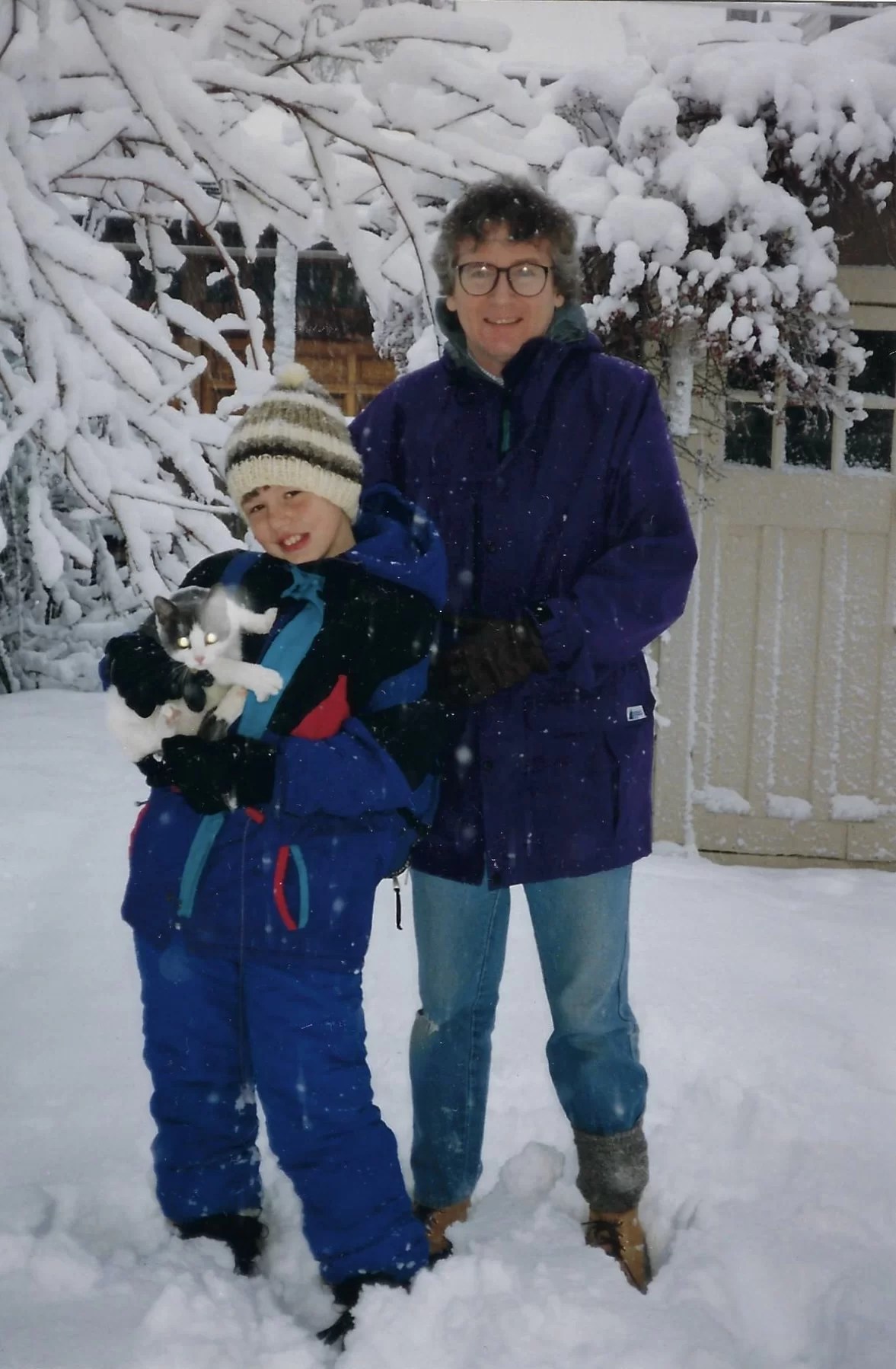 Paul and Gabe in Toronto, with Copernicus behind a snowflake. As usual, he was trying to get away.
But there came a time in Colombia shortly after the military had taken out a major drug trafficker in his mountain redoubt, a narco known as El Mexicano. The narco was Colombian, but he was famously a fan of everything Mexican. Hearing reports of his death, and receiving assurances that the army was patrolling the area, Paul and three other correspondents decided to drive into the mountains. They planned to talk to the residents of the village where he’d been based, asking what it had been like to live under the trafficker’s dominion.
They were about half an hour from the village when Paul suddenly thought, What the fuck am I doing? El Mexicano had only been killed two days before—presuming the reports of his death were reliable. He asked himself if some of the narco’s lieutenants might still be there. If he and his friends should have looked into the situation more thoroughly. But the other reporters were keen to do the story. He decided he was being irrational and kept quiet.
Everything was fine. El Mexicano was indeed ex, and some of the villagers told them he was a jerk while others liked the way he’d thrown money around. There were also an unusual number of Mexican restaurants in that little mountain town.
Yet this is when the romance began to leach out of Paul’s job, and the stress levels grow too high. Aside from anything else, the logistics were grueling. Getting to places he needed to go. Getting his stories out.
So we moved back to Toronto, and Gabe named his new cat Copernicus.
***
By the time we got home, people were starting to keep their cats indoors. We didn’t do that, not at first. Yet it soon grew clear that when Copernicus went out, he didn’t pencil a return date into his agenda. We’d had him neutered, but he was still a brawling tough guy. If he’d been human, he would have been a chancer, a mobster, a full-patch Hell’s Angel. That cat cost us a fortune in vet bills, returning scratched-up and bitten, incubating infections. He upset Gabe repeatedly, and we started trying to keep him inside.
But if you open the door carrying too many grocery bags, a cat can easily snake between your legs and make a run for it. Copernicus kept disappearing, although he always came back, usually a day or two later—until he didn’t.
“Copernicus! Copernicus!” Patrolling the streets.
A week passed. Two. No one responded to the posters we put up. This time he was gone, and I assumed he’d been hit by a car. We’d only had him for a couple of years as we’d settled back into Toronto. Still, Gabe was so upset he wouldn’t even go into the pet food aisle at the supermarket.
So we went back to the Humane Society and got another kitten.
WoodyWoody was one of those black-and-white cats you see all the time, but a particularly delicate and sweet one. We brought him home as middle age leaned in, that period when you’re juggling a young kid, multiple jobs, family obligations and a busy social life. It turned out that Woody had an instinct for finding the exact right time to jump up beside you on the sofa, reaching out a gentle paw to touch your hand. Yet he’s the cat I remember least, living out a quiet little life amid the family chaos.
The housing market was in bad shape when we got back, and instead of selling our rundown old house, we added to the chaos by undertaking a series of renovations. As old plaster walls came down, Paul spent a couple of years working in The Globe’s Toronto office. Then he got restless and went back on the foreign desk, based in Toronto but travelling to cover stories around the world. He flew from Nelson Mandela’s inauguration as president of South Africa to the U.N. general assembly in New York, where he excavated the subtexts of their coded and contentious meetings.
Meanwhile I published my first novel and started drafting the second, working as a freelance magazine journalist as our renovations went serially over budget. (Has any renovation ever gone under budget?) Our trips were scheduled so one of us was always at home, taking care of Gabe and feeding Woody.
There was something else going on, too. Given what we’d been through in Latin America, both Paul and I began volunteering for human rights groups. I was elected to the board of PEN Canada, driving to Ottawa to lobby the Canadian government on behalf of writers imprisoned abroad, flying off to international congresses and working on fundraising events in Toronto.
Gentle Woody was always there in the background, and as I look back on my human rights work, it occurs to me that this was something we had in common. I was in the background too, a barely-published writer finding myself moving among literary giants: listening, watching, trying to learn.
One time, I was one of a small group who met with Nobel Prize-winning novelist Nadine Gordimer as she passed through Toronto. Over coffee—I can still see the white cloth on a round table—Gordimer asked a series of incisive questions about the Canadian government approach to international human rights.
A couple of senior people fumbled out answers. To be fair, this wasn’t their department. They fundraised. They handled domestic issues.
Gordimer was visibly unimpressed. In the silence, I dared to lean forward and say a few words. This was actually my area, and as I answered, she saw that immediately and shut out the others, asking me more questions. Afterwards, she thought for a moment and nodded, then absent-mindedly whistled a few bars of an old song.
My Aunt Marg used to whistle like that. She and Nadine Gordimer were the only women I’ve ever met who did. They were about the same age, both of them petite and tart. A little of my fondness for my aunt attached itself to Gordimer, although the others seemed rather cowed.
Another time, I was charged with asking Turkish novelist Orhan Pamuk whether he would say a few words at a PEN Canada event. Pamuk would be awarded the Nobel Prize for Literature a decade later, in 2006. At the time, he was in town to read at the Toronto International Festival of Authors, and I going to interview him onstage.
It would be difficult—perhaps even dangerous—for Pamuk to speak at the PEN event, where the human rights record of Turkey’s government would be criticized, and consular officials would be in the audience. Someone must have decided to be kind. He would find it easier to turn me down than to refuse a request from, say, Margaret Atwood. I can still see panic passing briefly through his eyes. Then he raised his chin, firmed his lips, and accepted.
I have very interesting journals. I wrote everything down, recording the words of bold-face names as I slipped through the world like Woody. Like Woody Allen’s Zelig in the film of that name, a witness to fascinating moments in history, trying to learn from what I saw.
There was also the time I spent the evening of my 40th birthday driving Michael Ondaatje and Susan Sontag around Toronto. Sontag had flown here to join Ondaatje in headlining a PEN Canada benefit, this one to raise money for writers under siege in Sarajevo. After it ended, they wanted to find a bookstore that was open late, and I drove them from one closed store to another.
As I did, Sontag told Ondaatje about her most recent visit to Sarajevo, during which she’d smuggled in a money belt packed with 60,000 Deutschmarks, about $100,000, to help local writers buy food and medicine. She didn’t say it, but she could easily have been murdered, either by the Serbian army that was besieging Sarajevo or by a garden-variety thief. Sontag spoke extemporaneously, conversaionally, but in beautifully-composed sentences that formed complete paragraphs, her words trenchant, her voice a resonant alto. She often laughed. She could be very funny.
 Woody, pretending to be a Christmas present. That’s him at the top as a kitten.
Meanwhile, Michael Ondaatje asked her a series of questions, making quiet but equally fluent observations, casual and wry. He was clearly enjoying her company, and paying attention to a degree I would only understand later.
This was at a different event, when Ondaatje came up to me and said, “Hi, Lesley. How are things?”
He’d remembered my name when the other bold-face writers never did. I was so shocked I blurted, “I’m a little intimidated, frankly, by all the famous people in the room.”
Meeting his eyes, I felt like a complete idiot.
“Present company not excepted,” I said.
Ondaatje chuckled and answered, “One gets used to it.”
To a degree, I did. I stopped being so intimidated, but I never felt part of things, although I know I shouldn’t sell myself short. I’ve always been well-organized and hard-working, and I got things done. Aside from anything else, I published three books during this period with increasingly-established publishers, the third one with Penguin.
But we’re talking about Michael Ondaatje and Susan Sontag here.
Who, by the way, discovered during that car ride that they both liked to write in green ink.
***
So here’s the question. What did I learn during those chaotic and glamourous years? The power of green ink aside.
For one thing, rigor. Those great writers approached the world with rigor, always watching, always insisting on seeing what was there, no matter how inconvenient it might prove–something that grew unmistakeably clear after I flew to Prague as part of the Canadian delegation to an International PEN congress.
Another delegate was writer and translator Paul Wilson, who knew the city well. Wilson had moved to what was then Czechoslovakia in 1967. He’d got to know members of the anti-government underground, becoming the lead singer in the band, the Plastic People of the Universe, before being expelled from the country in 1977. Now, years later, he took our delegation to meet his friend, Czech President Václav Havel, in the presidential office.
Havel had been elected president of the former Czechoslovakia in 1989, and was then serving as the first president of the reconfigured Czech Republic, ultimately holding office from 1993 to 2003. As a playwright and dissident, he’d suffered through multiple incarcerations during the former communist regime. Now he was the leader of a democracy, the walls of his office painted with a humorous mural of life in the new republic.
As the others talked, I walked around enjoying the mural, pausing when I saw a photograph of U.S. President Bill Clinton taken in Havel’s office and hanging above a small table. The picture had been positioned so that when you looked at it, you stood exactly where Clinton had been standing.
Maybe Havel liked to see whether people picked up on that. When I glanced at him, I realized he’d been watching me. Now he smiled and beckoned me over. Wilson translated an introduction, after which I pointed out that the only writer in Havel’s mural was a spy, taking notes while he watched others.
Havel didn’t seem to like that. Then Paul Wilson added something in Czech, apparently making clear what I’d intended to say: that writers are spies, nosy, eavesdropping, rubber-necking other peoples’ behaviour and writing everything down. Now Havel was amused, and we continued to chat. He was a small man but a powerful presence, honorable and droll.
A few days later, at a PEN dinner, playwright Tom Stoppard stopped by the table where I was sitting. He knew the sister of one of the women at the table, an actress. Stoppard was even more dauntingly handsome in person than in photographs. He spoke gently, but remained laser-focused on the woman as he asked after her sister, shutting out everybody else the way Nadime Gordimer had done.
It was the congress of great playwrights. Arthur Miller stood nearby. Both he and Stoppard were very tall.
I watched them both, being a spy, as unnoticed and insignificant as Woody. Seeing Stoppard play the same game as Gordimer made me realize how intensely these great writers could concentrate, possessed of focus as well as rigor. They were also fending off unwanted attention, weren’t they? Add a coat of self-protection to the mix. Above all, they insisted on seeing what was really going on, acting as witnesses, even though it could get them thrown into jail like Havel, or worse.
Woody lived for ten years in calm counterpoint to this intriguing maelstrom, then spent his final year increasingly ill. He was a kidney cat like our old friend Pica, and no matter how conscientiously we adjusted his meds and changed his diet, the poor little guy grew gentler and quieter.
Finally the vet told us he was suffering; we had to let him go. We went into a quiet room at the back of her clinic, where Woody left our lives as gently as he’d come into them, may he rest in peace.
I’m going to break off now and write about the last two cats later.
Next time, I’ll post a review of The Feeling of Iron by Italian writer Giaime Alonge, which was translated into English by Clarissa Botsford. It’s an ambitious book with action moving from the concentration camps of the Second World War to the battlefront in Nicaragua in 1982, when the Contra guerrillas were fighting the left-wing Sandinista government, with U.S. backing.
A review, a surprise—it won’t be a surprise if I tell you what it is—and the story of the time my husband was kidnapped by the Contras.
To jump to part one of the cat story, please go here.
January 14, 2026
An autobiography in cats, from the dim to the dignified
Our old cat Archie died just before the holidays, aged almost 19. That’s him in the picture. His death got me thinking about the other cats in my life, and the different times they witnessed. It’s helped shut out the news, at least for a while. Maybe we all need a break.
BambiYes, my first cat’s name was Bambi. I was five years old and living in suburban North Vancouver when I asked for a kitten. Not that I can remember asking, although my father loved animals—we always had a dog—so it wouldn’t have been any problem to convince him, anyway.
I clearly remember sitting in the back seat of the old Pontiac, turning left off Edgemont Boulevard and pulling up at a ranch-style house. My parents had learned the people there were looking for homes for several eight-week-old kittens from their cat’s latest litter. I couldn’t keep still. I was that jittery with excitement.
Jump cut, and I was inside an early-1960s living room, entirely happy as I held a pretty little tortoiseshell. I named her Bambi after the fawn in the Disney movie, although family lore says my mother had to carry me out of the room screaming when I saw it on TV, maybe when Bambi’s mother is killed. My own mother had a strange relationship with trauma, being timid and fearful but also an emergency room nurse, a combination I never understood. Maybe she thought seeing Bambi would toughen me up. It made an impression, anyhow.
 Bambi in the 1960s, probably pregnant.
At the time, all cats were outdoor cats. Dogs ranged freely too, meaning that a couple of our cocker spaniels got killed when they were hit by cars. Bambi stayed clear of cars but was hit up by the neighbourhood tomcats. She had two litters of kittens a year for seven years before my mother said, “The poor thing,” and took her in to be spayed.
I loved that cat. She was a beautiful creature, elegant, skittish, slightly distant but strong: a feline Jackie Kennedy. I also adored her waves of kittens. First their eyes were closed as they nursed, and I could lie beside Bambi’s box watching them endlessly. Then their eyes opened and they stumbled around the rec room like the world’s cutest drunks. I didn’t care for dolls, but loved books and cats and the ravine around nearby Mosquito Creek, all of which make their way into my latest novel. I had no problem finding homes for the kittens in the growing suburb—49 of them before my mother stepped in. I suspect Vancouver is now populated with thousands of Bambi’s descendants.
Then I was 16 and starting university, driving overtown every day to the University of British Columbia in a used red Toyota that I’d bought with my babysitting money. It cost $400, although I’ve always wondered if my father paid more for it and didn’t tell me.
And here’s my first name-drop. One of my high school English teachers was Gabor Maté, who hadn’t yet gone to medical school and wasn’t long out of UBC himself. He and another teacher had taken a group of us there on a field trip. Since I was the editor of the high school student newspaper, Gabor took me and a couple of others to the office of The Ubyssey student paper so I would be ready to sign up in the fall. I suspect he mainly wanted to see his friends on the paper, but it worked. I went back in September, and since The Ubyssey came out three times a week, I basically camped there for four years, seldom seeing Bambi, especially after I moved out of my parent’s house.
She lived to be 21, still at home with my parents. Many years later, when my mother was 90 and on her deathbed, she woke up and asked, “Where’s Bambi?”
“You mean my old cat Bambi?” I asked. “Oh, Mum, she’s been gone for a long time.”
“Bambi was my cat.”
It was one of the last things she said, and after making her point, she fell back asleep.
The Great CatsbyToward the end of my first year at UBC, The Toronto Star sent an editor to Vancouver to interview student journalists for their summer student program. I got the job and flew to Toronto, eventually moving into a basement apartment in Cabbagetown that I shared with another student reporter.
The neighbourhood is now part of the city’s gentrified gay village, but it was pretty seedy back then. We had a living room window set in a well below street level that let in a little light. It also showed passing strangers up to waist level, and men would sometimes stand there masturbating.
My roommate wanted to get a kitten from the Humane Society. I was curious to see what it was like so I tagged along. She chose two kittens, and I was surprised when we got home to discover that one of them was mine. He was a little tabby, brownish, sort of striped. I named him The Great Catsby—Catsby to his friends—got him neutered and took him home to Vancouver in September.
Catsby and I moved into a house on West 12th with a group of student journalists, people who remain among my closest friends. In fact, my future husband Paul lived there, although he had a girlfriend at the time, and I was busy having crushes on a different boy every month, very few of whom were interested.
 The student house on West 12th. It hasn’t changed much outside, but its recent sales price was $2.8 million. Six of us collectively paid $350 a month rent in the early 1970s. My share was $50 a month. I know younger people hate that.
We had three cats in that rundown old house. There was Catsby, and my friend Jan’s ironically named Dare to Struggle, Dare to Win. (We’re talking the 1970s here.) Struggle was an enormous furry tabby who must have been part Maine coon cat. The other was Ichiro, who was born in Hiroshima and didn’t have proper eyelids. His owner, Gillie, was the one non-journalist in the house.
When a room came vacant, Gillie had answered an ad we’d put up. The housemate who interviewed Gillie thought she was quite hefty, but no one cared about that. She was a nice person. After she moved in, we were startled to hear a baby crying in the night. Gillie was actually slender, and had been carrying her daughter in a sling under her coat. None of us had noticed.
Ichiro was the other surprise. We all loved the baby, but Ichiro’s yowls could make your hair stand on end. We learned that Gillie had gone to Japan a couple of years before to become a Buddhist nun. One day, while she was meditating in a graveyard, she met a musician named Sumimoto playing the shakuhachi on his father’s grave. They fell in love and Gillie had the baby, but she decided to come back to Canada because she didn’t like the way women were treated in Japan. Sumimoto-san followed, but there weren’t a lot of jobs for shakuhachi players in Vancouver. He worked as a house painter, detested it, and went back to Japan. Gillie stayed, now with two daughters and a cat that lacked eyelids. Ichiro was kind of a jazz cat, skinny-shanked and elegant—his yowl aside—and Gillie doted on him.
At the end of the school year, we were evicted from the house on West 12th. My friend Sandy and I roomed together for a few months, then Catsby and I lived in a couple of other journalistic houses over the next few years. I was working for The Vancouver Sun by then, full-time in the summer and part-time during the school year.
Meanwhile, I started my first novel after dropping out of UBC’s creative writing program. I’d always said I was going to be a writer, and one time my father told me, “If you’re going to be a writer, you’d better train for another job. Writers don’t earn any money.” So I went into journalism to support myself, and soon found I liked it far better than the creative writing program, which at the time was full of self-important bad boys, by which I mean the professors.
Catsby was affectionate, but he was the dumbest cat I’ve ever had, acting as if he was stoned. He fit the era, anyhow. In one house, several of us watched him lose a battle with a leaf. A wind caught it, setting it twirling, and Catsby leapt two feet in the air.
Then I went away on a long trip, leaving Catsby with a friend. After a while, he went away too, leaving Catsby with several other people, including a man who fell in love with him. When a friend went over to get Catsby back, the man had a panic attack and stood on his hands to try to calm down. As a result, he got custody of Catsby, and later disappeared with him. Catsby would have been four years old. No one had any idea where the man went.
Gillie thought she might have seen Catsby a few years later hiding in a ditch. She tried to coax him out, but he bolted.
Pica, the well-travelled catAfter university, I worked full-time for a year at The Sun, then took my savings and travelled around Europe and Asia. I ended up in London, where I rented a bedsit in pre-gentrified Notting Hill, rented an electric typewriter, and set to work finishing my (dreadful) first novel.
One day in late spring, I was passing through the turnstile at the Notting Hill tube station when I met my former housemate Paul going through a turnstile in the opposite direction, heading home from a movie. He’d spent most of the year backpacking around as well, and he’d come to London to try to find a job on Fleet Street. Guess what happened.
Paul eventually got a job in Belfast, but I didn’t want to go there. Instead, I moved to Toronto to try to sell my novel to one of the big publishers, planning to get a journalism job to support myself until fame and fortune took care of, well, everything. (Ha!) So I went to work at CBC Radio as a chase producer on the current affairs show As It Happens, which was hosted at the time by Barbara Frum—who, by the way, sometimes made her teenage son David sit in the control room to do his homework, I have no idea why.
Meanwhile, the biggest names in Canadian publishing politely rejected my novel, although Anna Porter kindly suggested I write short stories to try to learn technique. By then, I’d rented a one-room apartment on the top floor of a house on Mutual Street next door to the CBC. After six months, Paul decided to leave Belfast, and wrote asking if he could stay with me until he found a job.
He’s never left.
Paul soon got his job, hired at The Globe and Mail. Not long afterward, life struck me as stable enough to get a cat. Paul’s mother didn’t like pets so he hadn’t grown up with them. But he was amenable when the announcer on As It Happens, Al Maitland, told people he had kittens available at his hobby farm east of Toronto. We drove out for a look, and in the loft of Al’s barn, we agreed that one kitten seemed particularly intelligent. We named him Pica, after a unit of measurement in typesetting.
 Pica on my lap at a family party in the early 1980s
Pica had such a beautiful steel-grey coat that people assumed was a purebred Russian Blue we’d bought from a breeder. He was a lap cat but dignified about it, self-contained and calm. He needed to be, since we moved him all over the Western Hemisphere. In that first top-floor apartment, Pica would climb out the open kitchen window and sit on the roof to survey the neighborhood. After a year, a one-bedroom apartment came open on the main floor, so we moved downstairs and let him out in the scruffy backyard. We weren’t worried, since he mainly wanted to watch: an observer, a journalistic cat.
Paul and I got married while we lived in that apartment, and were evicted the day after our wedding. Not because of the party, although it was loud. A woman had bought the place so she and her grown daughters could live together, each in her separate apartment. I wonder how well that worked out. We found a new apartment in the east end, and once we decided to have kids, we scraped together everything we had and bought a house not far away. Pica kept watch from windows and fences as we moved around. I got pregnant not long after we moved, and Pica graciously accepted our son when we brought him home from the hospital. I remember him walking slowly toward the baby carrier and giving Gabe a delicate sniff.
When Paul got a Nieman journalism fellowship to Harvard that fall, Pica moved with us to Cambridge. We had an apartment upstairs on Francis Avenue, just down the street from the pink clapboard house where John Kenneth Galbraith lived. We were introduced to him once as fellow Canadians, to which the great economist said, “My back hurts.” His whole front yard bloomed golden with daffodils in the spring, and a black cat hung around, although I don’t know if it was his.
After nine months at Harvard, we moved back to Toronto, then headed to Mexico City a year later when Paul was named The Globe’s Latin America correspondent. We rented a house in the hills beyond Chapultepec Park. It wasn’t that big, but it had been designed by a famous Mexican architect, and it was the most handsome place I’ve ever lived.
Pica liked sitting in the sun on the stone wall out front near a fall of magenta bougainvillea. He looked so cool he might have been wearing RayBans. He was also bigger than most Mexican cats and became a local attraction. Don Gato, people called him. Hola, Don Gato. Hi there, Sir Cat. There wasn’t any decent cat food in Mexico at the time, so he ate ground chicken. He was very good about allowing our son to play with him, indulging Gabe by chasing string, and letting him pillow his head on his soft grey coat.
After three years, Paul was posted to Brazil, where Pica took possession of the balcony of our apartment in Rio, from which you could hear gunfire over the hill. It didn’t seem to bother him. All this time, I’d been writing. It was my great good fortune that governments didn’t give working visas to the partners of fellows and correspondents unless they lobbied, and I was happy not to. So Pica often slept on the fold-out couch in my study, otherwise known as the guest room. I had plenty of time to spend with our son and to write, churning out short stories published in little magazines, then a book of stories, then what would become my first published novel.
Yet after a year in Rio, Pica developed kidney problems, and I often had to take him to the vet. He slept more, and sometimes seemed listless. Then one January—high summer in Rio—we went to visit friends in Chile, leaving the housekeeper and Paul’s assistant to keep an eye on Pica. His assistant, Heloïsa, was very fond of cats, and when she thought Pica looked ill, she took him to the vet.
The vet was unfair, scolding Heloïsa for not bringing Pica in a day earlier. Now he claimed there was nothing to be done, I’m not sure why. Heloïsa was terribly upset, and after the vet put him down, she buried Pica in her grandmother’s garden. So our lovely grey friend was born in a barn outside Toronto and died in Rio de Janeiro when he was 12 years old. He was a particularly excellent cat.
We had four cats after Pica died, but I’m going to break off for now, leaving us poised to return to Toronto in the early 1990s with an eight-year-old son and, temporarily, no cat.
My first cat, Bambi, is fictionalized in my latest novel, Far Creek Road. Well, she’s not so fictional, but the rest is.
The novel is set in 1962, and the main character is Tink Parker, a nosy and very funny nine-year-old living a happy suburban life.
Then the Cuban Missile Crisis hits, and things fall apart. You can get the novel here.
December 31, 2025
Happy 2026!
Best wishes for the coming year. May a new day dawn.