Denise Alvarado's Blog
November 1, 2025
November Fun Facts
November ushers in a time of deep reflection, gratitude, and preparation for winter’s arrival. As the harvest season winds down, the month carries powerful energies of transformation, ancestral connection, and spiritual protection. Traditionally, this is a time for honoring those who came before, gathering resources for the colder months, and working magick related to prosperity, healing, and introspection. With the veil still thin from Samhain, November is ideal for divination, dream work, and strengthening ties with the spirit world. This month’s fun facts highlight the seasonal influences, natural cycles, and Hoodoo traditions that shape this powerful time of year.
The name November originates from the Latin word novem, meaning "nine." In the early Roman calendar, November was the ninth month of the year. Even after January and February were added, making it the eleventh month, the name remained unchanged.
National Native American Heritage Month: November is designated in the U.S. to honor the history, culture, and contributions of Native American communities.
Advent of Daylight Saving Time: In some countries, November marks the end of Daylight Saving Time, when clocks “fall back” to standard time.
Birthstones: Topaz and CitrineNovember’s birthstones are topaz and citrine, both celebrated for their warm, golden hues that evoke the autumnal glow of the month. Topaz, traditionally associated with strength and wisdom, comes in a range of colors, but the golden-yellow variety is most closely tied to November. It has long been considered a stone of love, loyalty, and protection. Citrine, a variety of quartz, is renowned for its vibrant, sunny shades of yellow and orange, symbolizing joy, abundance, and energy. Both stones are believed to carry soothing and uplifting properties, making them perfect talismans for warding off negativity and encouraging prosperity as the year begins to wane.
Herbs for NovemberNovember marks the transition of plants into their dormant phase. Trees shed their leaves, and herbaceous plants begin to die back, signaling a natural slowing of growth, even in evergreens like rosemary, thyme, and sage. While you can still harvest these resilient herbs, it’s best to do so sparingly, as their growth will pause during the colder months. Roots, on the other hand, are at their prime! As the above-ground parts of plants recede, their energy concentrates in the roots, making it the ideal time to harvest magickal, medicinal, and culinary roots such as dandelion, burdock, horseradish, valerian, marshmallow, and elecampane. November is also a season for mushrooms, which, though not herbs, are just as valuable for their versatility.
Fruits and VegetablesNovember’s fruits and vegetables celebrate the bounty of autumn and the shift toward hearty, warming produce. Root vegetables such as carrots, parsnips, turnips, and beets are at their peak, offering earthy flavors perfect for roasts and stews. Winter squashes, including butternut, acorn, and pumpkin, provide sweetness and depth to dishes while being rich in vitamins. Cruciferous vegetables like Brussels sprouts, cabbage, and cauliflower thrive in the cooler weather, boasting a subtle sweetness enhanced by a touch of frost. Apples and pears remain plentiful, their crisp textures and natural sweetness lending themselves to both savory and sweet creations. This is also a time for foraged delights like chestnuts and late-season wild berries. The produce of November embodies comfort and nourishment, perfectly suited to the season’s chill.
Flower of the Month: ChrysanthemumNovember’s birth flower, the chrysanthemum, is a vibrant symbol of optimism, joy, and longevity. In many cultures, chrysanthemums are celebrated for their beauty and resilience, blooming brightly even as the year wanes. In Hoodoo, these flowers are valued not only for their cheerful appearance but also for their spiritual properties. Chrysanthemums are often incorporated into workings aimed at fostering happiness, dispelling negativity, and drawing positive energy into a space or individual’s life. Yellow chrysanthemums are particularly associated with friendship and good fortune, while red varieties can be used in love work to ignite passion and warmth. Dried chrysanthemum petals may be added to floor washes or sprinkled around the home to uplift the energy and create an atmosphere of peace and harmony. Their enduring blooms remind us to find joy even during life’s colder seasons, making them a perfect emblem for November.
*Photo by Joyboy: https://www.pexels.com/photo/mother-a...


October 1, 2025
October Fun Facts
October is a month of mystery, magic, and ancestral connection, as the veil between worlds grows thin and spirits draw near. With the shift into autumn’s deepening shadows, this is a time for divination, protection workings, and honoring those who came before us. The month’s energy is rich with transformation, making it ideal for releasing the old and embracing new spiritual insights. From Hoodoo traditions tied to the dead to folklore surrounding October’s seasonal and celestial events, this month’s Hoodoo Almanac Fun Facts will explore the magic, myths, and practices that make October a powerful time for conjure and reflection.
The origin of the name October is derived from the Latin word octo, meaning "eight," as it was originally the eighth month of the Roman calendar before January and February were added. In many cultures, October symbolizes the harvest season and is often associated with themes of transition, death, and renewal as it marks the shift into autumn. It is a month traditionally linked to reflection, honoring ancestors, and preparing for the coming colder months.
The Month of Samhain: October culminates in Samhain, the ancient Celtic festival marking the beginning of the darker half of the year. It’s a time to honor ancestors and focus on divination and protection.
Birthstone: OpalThe birthstone for October is opal, a gemstone renowned for its shimmering, iridescent hues and mystical allure. Magickally, opals are celebrated for their ability to enhance intuition, amplify energy, and inspire creativity. They are believed to act as a magnifier of thoughts and emotions, making them powerful tools for manifestation and self-reflection. Opals are also associated with emotional healing and balance, helping to calm turbulent feelings and foster inner peace. In Hoodoo and other spiritual traditions, opals are often used for protection, as their reflective properties are thought to deflect negative energies. Their connection to water and the moon ties them to the realms of dreams, psychic visions, and the subconscious, making them ideal for rituals focused on clarity, spiritual insight, and transformation.
Herbs for OctoberOctober’s herbs in Hoodoo align with the thinning veil between the living and the dead, making this a powerful month for ancestral work, divination, and protection. Mugwort, long revered for its ability to enhance dreams and spirit communication, is a key ally for those seeking guidance from the other side. Wormwood, with its strong connection to the spirit world, is often burned as an incense or used in washes to open portals for ancestral contact. Rue offers protection against malevolent forces, helping to ward off unwanted spirits and hexes. Bay leaves, a staple in divination and wish magic, can be written on and burned to send messages to the ancestors. As October deepens, these herbs serve as essential tools for harnessing the heightened spiritual energy of the season.
Fruits and VegetablesOctober’s fruits and vegetables in Hoodoo reflect the harvest season, with a focus on abundance, protection, and spirit work. Pumpkins, a classic symbol of the season, are used for prosperity, protection, and warding off negativity. Apples, deeply tied to love, wisdom, and ancestral offerings, are often placed on altars or used in sweetening work. Pomegranates, associated with the underworld and spiritual transitions, are ideal for connecting with the dead and honoring ancestors. Squash and gourds represent stability and abundance, making them perfect for kitchen magick and seasonal blessings. Sweet potatoes, a staple in Southern cuisine, carry energies of grounding, sustenance, and wealth. As the harvest reaches its peak, these fruits and vegetables serve as powerful tools for both practical and spiritual workings.
Flower of the Month: MarigoldThe flower of the month for October in Hoodoo is the marigold, often called the "flower of the dead." With its vibrant gold and orange hues, marigold is strongly linked to ancestral veneration, spirit work, and protection. Traditionally used in rituals honoring the deceased, marigolds are placed on ancestral altars, gravesites, and in home protection spells to ward off negative energy and guide spirits. Their bright, sun-like energy is also associated with success, attraction, and prosperity. In folk traditions, marigolds are believed to strengthen the connection between the living and the dead, making them a powerful ally during this time of year when the veil between worlds is thin.
September 1, 2025
September Fun Facts
September marks the shift from summer’s heat to autumn’s crisp embrace, a time of transition, reflection, and preparation for the darker half of the year. The month carries strong energies of harvest, balance, and protection, making it ideal for workings related to prosperity, ancestral veneration, and spiritual cleansing. With the autumn equinox bringing equal day and night, this is a powerful period for setting intentions, restoring harmony, and strengthening connections to both the seen and unseen worlds. In this month’s Hoodoo Almanac Fun Facts, we’ll explore notable observances, folk traditions, and the spiritual significance of September’s seasonal and celestial events.
The origin of the name September derives from the Latin word septem, meaning "seven," as it was originally the seventh month of the Roman calendar. In modern times, September marks the beginning of the fall season in the Northern Hemisphere, symbolizing a time of harvest, transition, and reflection as the days shorten and the weather cools.
The Month of Mabon: September is the time of the Autumn Equinox, a balance between light and dark. It is a season for reflection, gratitude, and the start of harvest work in Hoodoo.
Virgo-Libra Transition: This month shifts from Virgo (earth, order) to Libra (air, balance). It’s a time to focus on organizing your life and seeking balance in relationships and emotions.
Birthstone: SapphireThe birthstone for September is the sapphire, a gemstone long associated with wisdom, protection, and divine favor. Revered across cultures, sapphires are often seen as symbols of truth, loyalty, and sincerity. Their deep, celestial blue hue evokes the vastness of the sky and the mysteries of the universe, making them a favorite for those seeking clarity and spiritual insight. Historically, sapphires were believed to guard against envy and harm, serving as talismans for royalty and clergy. In modern metaphysical practices, sapphires are valued for enhancing intuition, promoting mental focus, and fostering inner peace, making them a powerful choice for personal adornment and magickal workings.
Herbs for SeptemberSeptember is a transitional month, where the energy shifts from the height of summer into the cooler days of autumn, making it a time to work with herbs that enhance protection, grounding, and the harvest of one's efforts. Herbs like sage, mugwort, and lemongrass are particularly powerful during this time. Sage is well-known for its cleansing properties, ideal for clearing away the stagnant energy of summer and preparing for the autumnal shift. Mugwort aids in enhancing intuition and spiritual insight, making it an excellent herb for meditation and connection to the unseen realms. Lemongrass, with its uplifting scent and energy, is perfect for bringing clarity and focus as one sets intentions for the months ahead. As the energy of the earth begins to shift, these herbs help maintain balance and ensure protection while paving the way for new spiritual and magickal opportunities.
Fruits and VegetablesSeptember brings a bountiful harvest of fruits and vegetables, marking the end of summer and the beginning of autumn’s abundance. As the season shifts, fruits like apples, pears, grapes, and plums are in full swing, offering their sweetness and rich flavors. Apples are especially symbolic in many cultures, representing knowledge and the harvest, while grapes signify abundance and prosperity. Vegetables such as squash, pumpkins, sweet potatoes, and tomatoes also shine during September, as they thrive in the cooler weather and signal the approaching fall. These fruits and vegetables are ideal for preparing hearty meals, preserving for the winter months, or using in rituals tied to abundance, transformation, and gratitude. The harvest season is a time to celebrate the fruits of labor and invoke the energies of growth and completion.
Flowers of the Month: Aster and Morning GoryFor September, the flowers of the month are the aster and the morning glory, each carrying unique metaphysical properties. The aster is traditionally associated with wisdom, protection, and divine guidance. It is thought to open the crown chakra, aiding in mental clarity and spiritual insight, and is used to protect against negative energies. The morning glory, particularly the Ipomoea jalapa, the root of which is known as High John the Conqueror, is considered a powerful flower of spiritual strength, success, and personal transformation. Its connection to High John makes it a symbol of resistance and empowerment, aiding in the manifestation of desires and overcoming obstacles. Together, the aster and morning glory offer a balance of wisdom, protection, and transformative energy, supporting individuals on their spiritual and personal journeys.
September Lore If bees drone about as late as September, they are storing up additional honey against a long winter. Count the number of sunny days between July 1 and September 1 and multiply by two - this gives you the number of freezing cold days to be expected the following winter. On September 21 a south wind indicates a light winter; a north wind, a heavy winter. The quarter of the wind on September 21 governs its prevailing direction for the next six months.
June 5, 2025
Harriet Tubman Was Real—And Her Name Tells a Story of Resistance
Lately, a troubling piece of propaganda has resurfaced online: the claim that Harriet Tubman wasn’t a real person simply because “Harriet Tubman” wasn’t her birth name. This attempt to erase one of the most revered freedom fighters in American history not only ignores centuries of documented fact, it also betrays a deep misunderstanding of the brutal realities of enslavement and the radical act of self-naming.
Let’s be clear: Harriet Tubman was born Araminta Ross in Dorchester County, Maryland, around 1822. She was called “Minty” by family and others in her enslaved community. “Araminta” was likely chosen by her mother, Harriet “Rit” Green, though it’s also possible that an enslaver had a hand in assigning the name. What is certain is that neither "Araminta" nor "Ross" was hers by choice, they were either given to her by her mother or imposed upon her in a system that treated Black people as property.
As an adult, after escaping bondage in 1849, she chose the name Harriet Tubman, adopting her mother’s first name and her husband’s surname. This renaming was not just symbolic—it was an act of spiritual, psychological, and political resistance. By renaming herself, Tubman reclaimed agency over her identity in defiance of a system that had tried to erase her personhood.
And she wasn’t alone.
Sojourner Truth, born Isabella Baumfree in New York in 1797, changed her name in 1843 after experiencing a religious transformation. “The Lord gave me the name Sojourner,” she said, “because I was to travel up and down the land, showing the people their sins and being a sign unto them. And Truth, because I was to declare the truth to the people.”⁽¹⁾ Her new name marked the beginning of her public ministry as an abolitionist and women’s rights advocate, one rooted in divine purpose and self-definition.
Likewise, Frederick Douglass, born Frederick Augustus Washington Bailey, renamed himself after escaping slavery in 1838. The surname “Douglass” was inspired by a character in The Lady of the Lake, suggested to him by a fellow abolitionist.⁽²⁾ For Douglass, the new name symbolized both a break from his past and his entry into a new life as a free man and public intellectual.
These are not trivial matters. Under slavery, names were frequently changed by enslavers to mark ownership, erase African heritage, or sever family ties. Naming was part of the machinery of dehumanization. In contrast, renaming oneself was an assertion of humanity. It was a way to reclaim one’s story, one’s dignity, and one’s power.
So no, Harriet Tubman wasn’t born with that name, but the name she chose is more significant than any she was forced to bear. Her life’s work under that name, guiding over 70 people to freedom, serving as a Union spy, and later advocating for women’s suffrage, is documented in government reports, interviews, and newspaper accounts.⁽³⁾⁽⁴⁾
The 1868 Report of the Joint Special Committee on the Conduct of the War includes her contributions to Union military efforts. Interviews conducted by Sarah Bradford for Scenes in the Life of Harriet Tubman (1869) contain firsthand testimony from Tubman and those who knew her. Advertisements offering rewards for her capture exist in historical record—including one we included in the Hoodoo Almanac 2025, dated 1849, when she escaped Maryland with her brothers (shown below).
[image error]
Notice published by Harriet Tubman's enslaver Eliza Brodess in the Cambridge Democrat (1849) offering a reward for the return of Harriet Tubman (Minty) and her two brothers. Public domain.
Harriet Tubman also received a pension from the U.S. government in recognition of her work as a nurse and spy for the Union Army, a bureaucratic trail that could not have existed if she were imaginary.⁽⁵⁾
Let’s be crystal clear: Black women don’t have to prove their reality to anyone, especially not to armchair skeptics spinning conspiracy theories on social media or those posting nonsense for clicks and clout. Harriet Tubman’s name change wasn’t an erasure of identity, it was the embodiment of freedom, legacy, and intent. The name she chose is inseparable from the impact she made.
Birth names are historical footnotes. Facts and deeds are what make someone real.
ReferencesNell Irvin Painter, Sojourner Truth: A Life, A Symbol (New York: W.W. Norton, 1996).
Frederick Douglass, Narrative of the Life of Frederick Douglass, an American Slave (Boston: Anti-Slavery Office, 1845).
Sarah H. Bradford, Scenes in the Life of Harriet Tubman (Auburn, NY: W.J. Moses, 1869). https://docsouth.unc.edu/neh/bradford/bradford.html
U.S. Congress, Report of the Joint Special Committee on the Conduct of the War, 1868.
National Archives, Record Group 15, Records of the Department of Veterans Affairs, "Harriet Tubman Pension File."
April 27, 2025
Why the Hoodoo Almanac Is Still a Must-Have—Even Four Months In
Some folks might wonder: If the Hoodoo Almanac drops four months into the year, is it still worth getting? The short answer—absolutely. And here’s why.
First, the Hoodoo Almanac is not just a datebook. It’s a living, breathing guide to working with time itself. Whether you're laying tricks, setting candles, tending your garden, or honoring your ancestors, the Hoodoo Almanac offers spell timing, folk wisdom, and historical insights you can use year-round. Its purpose isn't to box you into a calendar—it is to empower your practice every single day, no matter when you pick it up.
Second, the Hoodoo Almanac is packed with permanent resources. Lunar cycles, planetary transits, feast days of saints and spirits, Hoodoo holidays, gardening by the signs, weather lore, famous conjure worker birthdays, rituals, folklore—this information doesn’t expire. You can reference it now, next month, or three years from now. Your descendants can peruse it seventy-seven years from now and the content would still be relevant. It is a working grimoire and folk encyclopedia disguised as a calendar.
Third, catching up is easy. Think of it like finding a $100 bill tucked in an old coat—you didn’t know you missed it, but once you have it, you’re richer for it. The Hoodoo Almanac helps you recalibrate your spiritual year, work backwards if you want, or simply jump in where you are. Spiritual work is rarely linear. Hoodoo moves with the rhythm of life, not with arbitrary calendar dates.
Fourth, it’s a collector’s piece. Every edition captures a moment in time: cultural commentary, historical figures, trending practices, and old wisdoms remembered anew. Owning each year’s Hoodoo Almanac builds a personal archive of folk magic history you can return to for inspiration, learning, and serious conjure work.
Fifth—and this is a big one—the Hoodoo Almanac features a Literary Treasure Hunt. Scattered throughout the book are QR codes leading you to free, exclusive digital downloads: music playlist, eBooks, historical documents, conjure secrets, rare folklore, and hidden essays. This bonus content deepens your journey into Hoodoo and African American and Indigenous folk traditions, offering a layered experience that keeps rewarding you long after the first read.
Finally, we are exactly where we're supposed to be. If you found the Hoodoo Almanac today, it's because it found you today. Hoodoo teaches us that timing isn't always human-made—it is spirit-led.
So, whether it’s January or June, July or December, the Hoodoo Almanac remains your magickal talisman: a faithful companion, a conjure worker's almanac, and a spiritual GPS when the road ahead isn't paved.
Get it. Use it. Live it. And most of all: do not comply.
Because our ancestors didn't follow the clock and neither do we—we set it.
March 19, 2025
John Brown: Radical Abolitionist or Militant Freedom Fighter?
John Brown was a fervent abolitionist whose unwavering commitment to ending slavery made him one of the most polarizing figures in American history. Born in 1800, he was deeply religious and viewed slavery as a moral abomination that required immediate and forceful opposition. Unlike many of his contemporaries, who sought political or legal solutions to abolish slavery, Brown believed in direct action, including armed resistance. His militant tactics and willingness to use violence set him apart from other abolitionists of his time, ultimately leading to his execution in 1859. He is often described as radical given his extreme methods and unyielding stance. But was he actually radical in his approach? Or was it necessary in order to effect much needed social change?
For some folks, John Brown is considered a radical abolitionist because he advocated for and engaged in violent resistance to end slavery, believing it to be a moral imperative that justified armed insurrection. Unlike many abolitionists of his time, who favored gradual emancipation or political solutions, Brown saw slavery as an evil that required immediate and forceful eradication.
His radicalism was most evident in two key events:
The Pottawatomie Massacre (1856): In response to pro-slavery attacks in "Bleeding Kansas," Brown and his followers murdered five pro-slavery settlers, demonstrating his willingness to use violence in the struggle against slavery.
The Raid on Harpers Ferry (1859): Brown led an armed assault on the federal arsenal at Harpers Ferry, Virginia, aiming to incite a widespread slave rebellion. The raid failed, and Brown was captured, tried for treason, and executed. However, his actions and martyrdom intensified national tensions, contributing to the onset of the Civil War.
Brown's unwavering commitment to ending slavery through direct action, his belief in racial equality, and his willingness to die for the cause made him considered a radical figure in the abolitionist movement. Let's break down both of the events above.
The Pottawatomie Massacre (1856) and John Brown’s RoleThe Pottawatomie Massacre was a violent episode in the struggle over slavery in Kansas, part of the larger conflict known as “Bleeding Kansas.” On the night of May 24, 1856, John Brown and a small band of followers brutally executed five pro-slavery settlers in Franklin County, Kansas. This act of violence was a response to escalating tensions between pro-slavery and anti-slavery factions in the territory, and it cemented Brown’s reputation as a militant abolitionist willing to use extreme measures to combat slavery.
At the time, Kansas was the epicenter of a fierce battle over whether it would enter the Union as a free or slave state. The Kansas-Nebraska Act of 1854 had allowed settlers to determine the status of slavery through popular sovereignty, leading to violent clashes between abolitionists and pro-slavery forces. Brown had moved to Kansas in 1855 with several of his sons to support the anti-slavery cause, and he was outraged by recent events, particularly the pro-slavery attack on Lawrence, Kansas, on May 21, 1856. This attack, known as the Sack of Lawrence, involved the destruction of an anti-slavery newspaper’s printing press and the burning of a hotel.
In response, Brown planned a retaliatory strike against pro-slavery settlers. On the night of May 24, Brown, along with his sons and a few supporters, descended upon the homes of pro-slavery settlers along Pottawatomie Creek. Armed with broadswords and rifles, they dragged five men from their homes and executed them in cold blood. The victims—James Doyle, William Doyle, Drury Doyle, Allen Wilkinson, and William Sherman—were accused of supporting slavery, though none were known to be slaveholders. The brutal nature of the killings, including the use of swords to hack the men to death, sent shockwaves through Kansas and the nation.
Brown never publicly admitted to leading the massacre, but accounts from his sons and supporters confirmed his involvement. He justified the killings as necessary to defend the anti-slavery cause and to send a message that pro-slavery aggression would not go unanswered. The massacre escalated the violence in Kansas, leading to more bloodshed as both sides retaliated. Pro-slavery forces condemned Brown as a murderer, while some abolitionists, though uncomfortable with his methods, saw him as a necessary force in the fight against slavery.
The Pottawatomie Massacre solidified Brown’s image as a radical willing to use violence to achieve his goals. It foreshadowed his later raid on Harpers Ferry in 1859, where he attempted to spark a large-scale slave uprising. While his actions in Kansas were widely debated, they contributed to the growing national tensions that would eventually lead to the Civil War. Brown’s unwavering commitment to abolition and his belief in direct action made him both a hero and a villain, depending on one’s perspective. The massacre remains one of the most controversial events in the fight over slavery, highlighting the deep divisions that plagued the United States in the years leading up to the Civil War.
As a side note for those who may be wondering, the Pottawatomie Massacre was not directly carried out by or against the Pottawatomie people. Instead, it was named after the Pottawatomie Creek, near which the killings occurred.
While the Pottawatomie people were indigenous to the region and had a long history in the Midwest, they were not directly involved in the event. The name of the massacre comes solely from the location where the killings took place.
John Brown’s Role in the Raid on Harpers Ferry (1859)John Brown’s raid on Harpers Ferry was a defining moment in the struggle over slavery in the United States and one of the key events leading up to the Civil War. On the night of October 16, 1859, Brown led a group of 21 men in an armed assault on the federal armory at Harpers Ferry, Virginia (now West Virginia). His goal was to seize weapons, arm enslaved people, and incite a large-scale rebellion against slavery. Though the raid ultimately failed, it solidified Brown’s place in history as a militant and a martyr for the anti-slavery cause.
Brown had long believed that slavery could only be ended through direct action. After his violent involvement in “Bleeding Kansas,” he turned his attention to a larger plan—one that would strike at the heart of the institution of slavery. He developed a strategy to capture the Harpers Ferry armory, distribute weapons to enslaved people, and lead them into the mountains, where they would wage guerrilla warfare against slaveholders. Brown spent months gathering weapons, raising funds, and recruiting supporters, including five Black men. He hoped that the raid would spark a widespread slave uprising, forcing the federal government to take action against slavery.
On the night of October 16, Brown and his men seized the armory with little resistance, cutting telegraph lines and taking hostages, including Lewis Washington, the great grandnephew of George Washington. However, Brown’s plan quickly unraveled. The expected mass uprising of enslaved people never materialized, and local militia forces soon surrounded the armory. A prolonged standoff ensued, during which Brown and his men engaged in sporadic gunfights with town residents and soldiers.
By the morning of October 18, U.S. Marines, led by Colonel Robert E. Lee and Lieutenant J.E.B. Stuart, stormed the armory. They quickly overwhelmed Brown’s forces, killing ten of his men, including two of his sons. Brown himself was wounded and captured.
Brown’s trial in Charles Town, Virginia, was swift. Charged with treason, murder, and inciting a slave insurrection, he was found guilty and sentenced to death. On December 2, 1859, he was hanged. His execution made him a martyr in the North, where abolitionists viewed him as a hero willing to die for the cause of freedom. In the South, he was seen as a dangerous radical who confirmed white fears of slave revolts and Northern aggression.
While the raid on Harpers Ferry was a military failure, its impact was profound. It deepened the sectional divide between North and South, heightened tensions over slavery, and pushed the nation closer to civil war. Figures such as Frederick Douglass, who had declined to join the raid, later praised Brown’s unwavering commitment to abolition. Henry David Thoreau compared him to Christ, calling him a moral visionary.
John Brown’s raid on Harpers Ferry remains one of the most significant events in American history, a bold but doomed attempt to challenge slavery through force. His legacy endures as a symbol of uncompromising resistance against oppression.
How Did Brown's Plan to Raid Harper's Ferry Fail?John Brown’s plan at Harpers Ferry unraveled due to a combination of factors, including lack of sufficient support, poor communication, and timely warnings. While there were no confirmed "snitches" in the traditional sense of someone betraying him directly, a series of unfortunate events contributed to the failure of the raid.
Essentially, Brown's plan was to seize the U.S. arsenal at Harpers Ferry, Virginia (now West Virginia), and arm enslaved people to incite a rebellion. However, his efforts quickly faltered due to both logistical missteps and the fact that many of the enslaved people he hoped would join the revolt did not arrive in time or were not prepared to take part.
First, Brown was relying on a mix of enslaved people and abolitionists, but the support from enslaved people did not materialize as he had hoped. His plan was to inspire an uprising, but many enslaved people were hesitant or unable to join. Brown had hoped that his raid would trigger a larger uprising, but it became clear that the surrounding enslaved population was not ready to revolt on such short notice.
Second, Brown's plan was to execute his raid on the night of October 16-17, 1859, but things went wrong almost immediately. His forces were too small and poorly equipped. In the early hours of the raid, they took control of the federal armory and surrounding areas, but there was a delay in mobilizing enslaved people and additional fighters.
Third, word of Brown’s actions spread quickly, and the local community, including pro-slavery forces and militias, responded quickly. Brown’s group was surrounded and cut off from potential reinforcements. Local militias and the nearby U.S. Army, led by Colonel Robert E. Lee, arrived to quell the insurrection. Brown and his men were trapped in the armory's engine house, where they were eventually captured.
Unlike Nat Turner's Rebellion and Guinea Sam's Rebellion (also known as the 1822 Denmark Vesey conspiracy), no direct "snitch" was responsible for the raid's failure - at least that we know of. As mentioned above, it is likely that word of Brown's plans had simply spread unintentionally to the wrong people. Brown had made preparations for the raid, including a secret network, but the coordination was less than ideal. His raid was anticipated by some of the local people and authorities, suggesting that information may have been leaked or that suspicions about Brown's plans were growing.
One of the main factors leading to the failure was simply the inability to rally sufficient support and execute the raid effectively. Additionally, local authorities were already on alert, and the element of surprise was lost.
In summary, while there was no singular snitch that betrayed Brown, the raid was poorly planned, lacked adequate support, and was undermined by the timely arrival of militia and federal troops. The raid’s failure marked the end of Brown’s violent campaign to end slavery, but it also solidified his legacy as a martyr for the abolitionist cause.
John Brown as Militant Freedom FighterAn alternative view of John Brown is to see him not as a radical, but as a militant abolitionist or a freedom fighter. Instead of emphasizing his extremism, this perspective frames Brown as someone who took decisive action against an unjust system in a time of deep moral crisis.
From this standpoint, Brown’s use of violence is interpreted as a necessary response to the brutality of slavery, rather than as irrational extremism. Unlike many abolitionists who relied on moral persuasion or political action, Brown believed slavery was so entrenched that only direct, forceful resistance could dismantle it. His actions, particularly the Harpers Ferry raid, can be compared to those of resistance movements throughout history that have fought oppression.
Additionally, some argue that Brown’s willingness to sacrifice his life for the liberation of enslaved people aligns him with other historical figures who engaged in armed struggle for justice, such as Nat Turner, Toussaint Louverture, or even figures from later resistance movements. In this view, Brown was not a reckless radical, but a man ahead of his time, acting in defense of human rights in a society that refused to recognize the full humanity of millions.
Ultimately, calling Brown a radical depends on the perspective of the observer. To those who saw slavery as a moral abomination, his actions were not radical but necessary. To those invested in maintaining the status quo, he was dangerous. His legacy, then, is shaped by whether one views the fight against slavery as requiring gradual change—or immediate, decisive action.
Read more about John Brown in the Hoodoo Almanac 2025, where you can find a QR code inside the book that leads you to a free download of his own words.
March 9, 2025
March Calendar, Fun Facts, and Celestial Events
March blows in with the restless winds of change, stirring up new beginnings and shaking off winter’s grip. As the days grow longer and the earth wakes up, this month is ripe for luck, renewal, and a little well-placed conjure to keep things moving in your favor!
Celebrate February with the Hoodoo Almanac's downloadable calendar, featuring notable feast days, monthly lore, and cultural wisdom to guide your spiritual journey. Click on the link to download our special monthly calendar graphic!
Download Hoodoo Almanac's March 2025 Calendar graphic.
Fun FactsThe origin of the name March derives from Martius, the first month of the Roman calendar, named in honor of Mars, the Roman god of war. March marked the beginning of the military campaign season in ancient Rome and symbolized vitality, renewal, and action.
Birthstone: March’s birthstone, aquamarine, is a gemstone of serenity, clarity, and protection, long associated with the sea and travelers' safety. Believed to calm the mind and enhance spiritual awareness, aquamarine is often used in rituals for emotional healing, truth-seeking, and strengthening intuition.
Herbs for March: March’s herbs—juniper, frankincense, and cedar—are deeply connected to purification, protection, and spiritual elevation. Frankincense is used to cleanse spaces and enhance mood and meditation, juniper wards off negativity and attracts luck, good fortune, and business success, and cedar strengthens spiritual connections while offering grounding, stability, blessings, and good health.
Fruits and Vegetables: March brings a mix of winter’s hearty produce and early spring’s fresh offerings, making it a time of transition and renewal. Leafy greens like spinach and kale provide strength and vitality, while citrus fruits and root vegetables such as carrots and radishes support cleansing and balance as the seasons shift.
Flower of the Month: March’s birth flower, the daffodil, symbolizes renewal, hope, and the arrival of spring. Associated with prosperity and new beginnings, daffodils are often used in rituals for love, fertility, luck, and clearing away stagnant energy.
Celestial EventsMercury at Greatest Eastern Elongation (Mar 8): Mercury reaches its greatest eastern elongation at 18.2 degrees from the Sun, making it the ideal time for observation. The planet will be at its highest point above the horizon in the evening sky. To spot it, look low in the western sky shortly after sunset.
Daylight Saving Time Begins (Mar 9): This shift toward longer days is symbolic of stepping into the light and leaving behind stagnation. It’s a great time for rituals focused on clarity and illumination.
Full Worm Moon & Total Lunar Eclipse (Mar 14): The Full Worm Moon, marking the first full Moon of meteorological spring. During this event, the Moon passes through Earth’s shadow, creating a total lunar eclipse. Often called a "Blood Moon," it will take on an orange-red hue as Earth’s atmosphere filters the light. Visible across the Americas, Europe, Asia, Australia, and Africa, the eclipse begins shortly before midnight on the East Coast and lasts until 6 a.m. The Moon’s redness may intensify depending on atmospheric conditions. A second total lunar eclipse will occur in the fall but won’t be visible from North America.
Mercury Retrograde (Mar 14-Apr 6): During Mercury retrograde, communication, technology, and travel may experience disruptions or delays. It's a time often associated with reflection, revisiting old projects, and being cautious with important decisions.
Spring Equinox (Mar 20): Known as the "Vernal Equinox," this marks the balance of day and night, symbolizing harmony, renewal, and growth. This is an auspicious time for cleansing rituals, planting spiritual intentions, and working with fertility and abundance energies.
New Moon (Mar 29): The Moon will be located on the same side of the Earth as the Sun and will not be visible in the night sky. This phase occurs at 11:00 UTC. This is the best time of the month to observe faint objects such as galaxies and star clusters because there is no moonlight to obscure visibility.
Partial Solar Eclipse (Mar 29): A partial solar eclipse will grace parts of the U.S. East Coast, Europe, Africa, and Asia, with the Moon partially covering the Sun. The event occurs between 4:51 a.m. and 8:44 a.m. EDT, though visibility at any location lasts about 20 minutes. In New York City, it will be observable from sunrise at 6:44 a.m. until 7:05 a.m., with about a third of the Sun obscured. Canada offers the best view, with up to 93% coverage. Protective glasses or certified viewing devices are essential for safely observing this celestial event.
February 24, 2025
Carolina Dean’s Pride: Articles Celebrating LGBTQ+ History and Hoodoo
I cannot begin to express how proud I am to present this vibrant collection of articles by Carolina Dean, each thoughtfully crafted as part of his ongoing Pride Month series. This annotated bibliography highlights his insightful and engaging explorations of LGBTQ+ culture, history, and personal reflections, celebrating identity, resilience, and the power of storytelling.
Pride Month is celebrated each year during the month of June in honor of those who fought for LGBTQ+ rights beginning with the Stonewall Riots which began on June 28, 1969, in New York City. The following year, on June 28, 1970, the first official Pride marches were held in New York, Los Angeles, and Chicago to commemorate the uprising. These early marches laid the foundation for what would become an annual tradition.
Pride Month as a national observance in the United States began in 1999, when President Bill Clinton officially declared June as Gay and Lesbian Pride Month. In 2009, President Barack Obama expanded the designation to Lesbian, Gay, Bisexual, and Transgender Pride Month. Pride Month has been celebrated globally every June, honoring LGBTQ+ history, activism, and community.
Today, sadly, the very freedoms fought for and attained since Stonewall are under attack under President Trump and his administration. Despite decades of progress, the fight for LGBTQ+ rights remains ongoing, with hard-won freedoms facing renewed challenges. Policies targeting transgender individuals, attempts to roll back workplace protections, and efforts to restrict discussions of LGBTQ+ history in schools serve as stark reminders that equality is never guaranteed. Yet, in the face of adversity, Pride endures—not just as a celebration but as an act of defiance, resilience, and unity. Carolina Dean’s work stands as a testament to the power of visibility and storytelling, ensuring that the voices of the LGBTQ+ community continue to be heard, honored, and remembered.
My Best Advice for Gay YouthThis article offers heartfelt and practical advice to young gay individuals, emphasizing self-acceptance, resilience, and personal growth. It encourages embracing individuality, learning from mistakes, and not being weighed down by the opinions of others. The author stresses the importance of facing fears, maintaining physical health, and building a supportive family—whether biological or chosen. Love and heartbreak are acknowledged as inevitable, but not insurmountable, while caution is advised regarding personal disclosures and relationships with straight female friends. Ultimately, the message is one of empowerment: life does not necessarily get easier, but individuals grow stronger and more capable of navigating its challenges.
WLGBT in CincinnatiThis article examines a notable episode of WKRP in Cincinnati that, despite the show lacking openly gay characters, addressed the stigma of homosexuality in the late 1970s. The episode “Les on the Ledge” explores a misunderstanding that leads news reporter Les Nessman to believe his career is over due to perceived homosexuality, prompting a mix of reactions from his colleagues. While some moments in the episode have not aged well, the article acknowledges its significance in challenging homophobia at the time. The author also shares a personal anecdote about meeting Richard Sanders, who played Les, and reflecting on how the episode resonated with their own journey of self-acceptance.
Samantha Has Two Dicks!This article flips the common narrative of applauding straight actors for playing gay roles by spotlighting ten openly gay actors who became famous for portraying iconic straight characters. From Dick Sargent’s portrayal of the second Darrin on Bewitched to Sir Ian McKellen’s role as Magneto in the X-Men franchise, the list highlights performers who brought depth and authenticity to their roles while navigating a time when LGBTQ+ representation was limited. The article offers a refreshing perspective on queer actors in Hollywood and their contributions to mainstream television and film.
Are You Bein Served (Shade)?"Are You Being Served?" is a British sitcom that aired from 1972 to 1985, centered on the eccentric employees of Grace Brothers Department Store. This article focuses on the character of Mr. Humphries, played by John Inman, who, despite never being explicitly identified as gay, embodied many stereotypically flamboyant traits that resonated with LGBTQ+ viewers. The author reflects on discovering the show in the early ’90s and how Mr. Humphries stood out as a rare, albeit coded, queer representation on television. With his witty one-liners, theatrical wardrobe choices, and unflappable charm, Mr. Humphries lived freely within the Grace Brothers family, inspiring the author’s own desire for acceptance and joy.
Reflections on Rocky HorrorThe Rocky Horror Picture Show follows the journey of Brad and Janet, a straight-laced couple who find themselves at the eccentric mansion of Dr. Frank-N-Furter during the annual Transylvanian Convention. Though initially a box office failure, the film became a cult classic through midnight screenings, audience participation, and cosplay. The author recalls first watching it in the early '90s and highlights its significance in providing LGBTQ+ representation and promoting self-acceptance. The movie’s central message, “Don’t Dream It, Be It,” resonated deeply, inspiring Dean to embrace his own identity. Watching RHPS has since become a cherished Halloween tradition.
Crow Man and Star Man a Love StoryCrow Man & Star Man: A Love Story is a tale of eternal love, sacrifice, and the battle between good and evil. Crow Man, a powerful medicine man and protector of his people, is locked in an endless struggle against Snake Woman, a malevolent force that seeks to destroy all he holds dear. In this life, Crow Man falls in love with Star Man, a dreamer who longs to reach the stars. When Snake Woman manipulates events to turn a great spear meant for space travel into a weapon of war, Crow Man sacrifices himself to prevent catastrophe, carrying the spear into the sun. Star Man grieves, rejecting all others who offer him companionship, until a mysterious gathering of crows triggers a mystical reunion. Through Star Man’s unwavering devotion, Crow Man returns, revealing that their love transcended death itself—his essence had remained within Star Man, guiding him back. Their love proves to be an unbreakable force, stronger than death and time itself.
Torch Song TrilogyThis article examines Torch Song Trilogy as a deeply personal and transformative film about identity, love, and self-acceptance. Following the life of Arnold Beckoff, a drag performer navigating relationships, loss, and family conflicts in 1970s and ’80s New York, the film resonated with the author as a glimpse into a world of possibility and self-actualization. The commentary highlights the impact of Arnold’s journey, particularly his struggles with societal rejection, personal tragedy, and his powerful confrontation with his mother. Ultimately, the film serves as a reminder that coming out is just the first step in building a life of authenticity and fulfillment.
Wicca: A Gay PerspectiveThis article was written over twenty years years ago when Dean was actively involved in the Pagan Prison Ministry with WARD (Witches Against Religious Discrimination). He specifically wrote this for publication in the official South Carolina Department of Corrections Wiccan Study Handbook. The Handbook has since been updated and his name removed, but he has his original copy with his name on the front.
One Lie to LiveThis article discusses a controversial storyline from One Life to Live (1992–1993) that introduced Billy Douglas, the first openly gay teenage character on television. The plot intertwined Billy’s coming-out journey with a false accusation of sexual abuse against a Catholic priest, reflecting the era’s anxieties around homosexuality, pedophilia, and the AIDS crisis. Dean critiques the problematic conflation of homosexuality with abuse while acknowledging the storyline’s impact, particularly for young viewers grappling with their own identities. Personal reflections highlight the significance of Billy’s journey, his eventual acceptance, and the rarity of positive LGBTQ+ representation in media at the time.
Normal is that You?This article reviews Norman… Is That You?, a 1976 comedy about a father, Ben Chambers, who struggles to accept his son Norman’s homosexuality after his wife leaves him. The author reflects on seeing the film as a closeted gay individual and appreciating its rare LGBTQ+ representation despite its flaws. While the film relies on outdated stereotypes—presenting Norman as a conventionally masculine "straight-acting" gay man and his partner Garson as flamboyant and effeminate—it also portrays parental acceptance in a more progressive light than expected for the time. The review critiques the film’s heteronormative framing but acknowledges its impact, particularly in challenging toxic masculinity and affirming self-worth for effeminate men. The author ultimately embraces the film’s message of self-acceptance, despite its shortcomings.
Thoughts on Three's CompanyThis article examines the character of Jack Tripper from Three’s Company and his unique role in challenging stereotypes about both gay and straight men in the 1970s and 80s. While Jack, a straight man, had to pretend to be gay to maintain his living situation, many gay men at the time faced the opposite struggle—hiding their sexuality to fit societal norms. The show often relied on exaggerated gay stereotypes for humor, but Jack’s character also displayed positive traits such as intelligence, strength, and loyalty. He defied traditional expectations of masculinity, showing that a man could be both sensitive and strong. Ultimately, the article argues that rather than being a role model specifically for gay men, Jack Tripper was a positive male role model for all men.
Hot Take on HedwigThis article explores Hedwig and the Angry Inch as a powerful story of identity, self-acceptance, and the search for wholeness. It examines Hedwig’s journey from Hansel, an East Berliner who undergoes an unwanted sex-reassignment surgery to escape oppression, to a larger-than-life rock performer chasing fame and validation. The analysis highlights the film’s themes of love, loss, and self-discovery, particularly through the lens of Plato’s Symposium and the idea that true completeness comes from within. Ultimately, the author reflects on the film’s personal impact, emphasizing the importance of self-love and the dangers of sacrificing oneself for external validation.
Ode to Billy JoeThis article explores the themes of shame, guilt, homophobia, and societal judgment in Ode to Billy Joe, both as a song and its 1976 film adaptation. It examines the ambiguity of the song’s lyrics and the film’s interpretation, which portrays Billy Joe as struggling with sexual confusion, trauma, and internalized shame, ultimately leading to his suicide. The author draws a personal connection to Billy Joe’s story, reflecting on their own experiences growing up in the South and grappling with similar feelings of isolation and self-acceptance. The article emphasizes the importance of representation, supportive communities, and the ongoing fight against LGBTQ+ intolerance, arguing that while society has progressed, many of the struggles Billy Joe faced remain relevant today.
Profiles in CourageThis article examines the character of Beverly LaSalle, a female impersonator played by Lori Shannon, who appeared in three episodes of All in the Family. Beverly’s storyline initially brings humor and challenges to Archie Bunker’s worldview but takes a tragic turn when she is brutally murdered in a hate crime. Her death causes Edith to experience a crisis of faith, highlighting the show’s willingness to address serious social issues, including homophobia and violence against LGBTQ+ individuals. Beverly’s character remains significant as one of the earliest representations of gender nonconformity on mainstream television.
February 17, 2025
Free Printable Astronomical 2025 Calendar
Explore the Skies with Our Free 2025 Astronomical Calendar!
Get ready to mark your year with celestial wonders! Our free printable 2025 astronomical calendar is your guide to the year's most exciting stargazing events. From meteor showers to planetary alignments, this calendar is designed with North American observers in mind. While many of these events can also be seen globally, we recommend using an astronomy app, magazine, or online resource for location-specific details.
The calendar makes stargazing simple by listing events as visible in the pre-dawn sky (AM), evening sky (PM), or all night (AN). It also includes dates when planets are in conjunction with the Sun, marked as not visible (NV). Whether you're a seasoned astronomer or a curious beginner, this calendar will help you plan your nights under the stars.
Download your free 2025 astronomical calendar today courtesy of High Point Scientific and keep your eyes on the skies!
Free Printable Astronomical 2025 Calendar PDFJanuary 31, 2025
Hoodoo Almanac February 2025 Calendar
Step into February with the Hoodoo Almanac 2025 Calendar
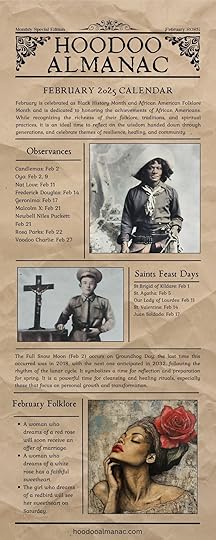
February is a month filled with love, reflection, and timeless folklore. According to traditional lore, dreams during this month carry powerful messages. Dreaming of stepping into water up to your hips could signal heartbreak, while a dream of a red rose hints at an impending proposal. A white rose in a dream symbolizes a loyal partner, and for those dreaming of a redbird, a reunion with a sweetheart on Saturday awaits.
Celebrate February with the Hoodoo Almanac's downloadable calendar, featuring notable feast days, monthly lore, and cultural wisdom to guide your spiritual journey. Click on the link to download our special monthly calendar graphic!
Download Hoodoo Almanac's February 2025 Calendar graphic.