
Sue Burke's Blog
November 26, 2025
Open mic on Friday
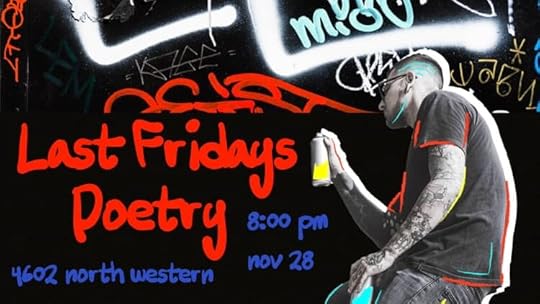
Last Fridays Poetry open mic Friday, November 28, 8 p.m., at Esquina, 4602 N. Western Ave., Chicago.
You’re invited! It’s a relaxed, supportive atmosphere. I’ll be reading from “Liquid Sand/Arena líquida,” a book of poetry by Jorge Valés Diáz Vélez, which I helped translate.


November 19, 2025
ECO24: The Year’s Best Speculative Ecofiction
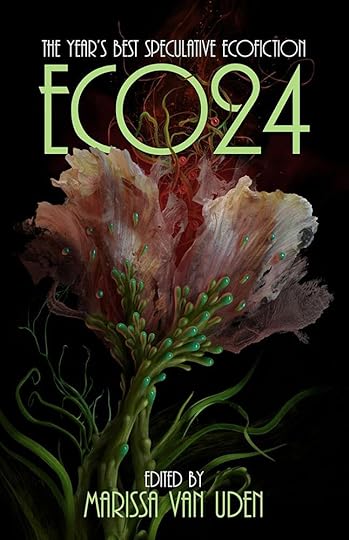
Anthologies tend to make less money than novels, yet they keep appearing. And I keep reading them. An anthology offers the chance to read a carefully curated selection, and I love short stories as an art form.
Apex Book Company asked me if I’d like to read an advanced copy of ECO24, The Year’s Best Speculative Ecofiction, and offer a blurb if I liked it.
I liked it a lot. Like every good anthology, the stories offer a range of approaches, including literary science fiction, magical realism, and dark fantasy. Some are set in the present, such as the war in Ukraine, others in the future, and they feature settings around our planet and beyond. Some are grim, many hopeful.
My favorite is “The Plasticity of Being” by Renan Bernardo, which illustrates the paradoxes of offering help to poor people. I also especially enjoyed “Bodies” by Cat McMahon about the dangers of being a clone, and “Thirteen Ways of Looking at a Blackened Husk of a Planet” by Adeline Wong about the emotional weight of being a student, with hints of poetry. But I could go on. There’s the quiet wisdom of “Batter and Pearl” by Steph Kwiatkowski, and the aspiration of “Father Time Dares You to Dream” by Trae Hawkins — and both stories take place near me.
My blurb:
Each author offers us a unique ecological niche to reveal what our present and future could be, ranging from wrenching disasters to elating possibilities of recovery. These stories are personal and lyrical, and the breadth of imagination and styles make this anthology dazzling. Every story is a gem.
November 12, 2025
‘Arena Líquida / Liquid Sand’ by Jorge Valdés Díaz-Vélez, translated by Sue Burke and Christian Law-Palacín
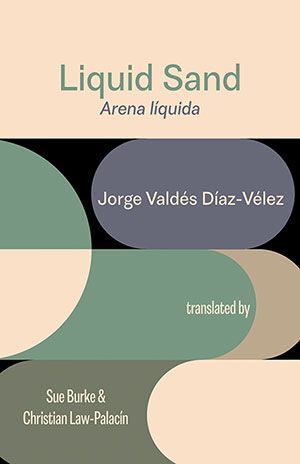
I translated the poems in Liquid Sand / Arena Líquida with my Spanish friend Christian. One of us would draft the translation of a poem, then we would pass it back and forth, debating words, lines, and meaning — the goal of a translation is always to maintain the meaning. We didn’t quibble much. Translation is easiest when the original work is well-written.
In the opening poem, “Nadie / No One,” Ulysses returns to Ithaca to become a specter among his own memories. While there’s no way to summarize a collection of 42 poems, the theme of time occurs often. Time moves, and we move, but in different directions for different reasons, as the poem “Negro Sol / Black Sun” says:
The afternoon weighs heavily
toward its settlement. Ours
is due to a harder sun
and we have had to learn
to walk beneath its burden.
Liquid Sand / Arena Líquida is the first major bilingual collection of poems by Jorge Valdés Díaz-Vélez, one of Mexico’s most respected contemporary poets. Published this month by Shearsman Books and available from most bookstores, it gathers works by Valdés Díaz-Vélez selected from six previous collections that span more than two decades of writing.
Madrid Review Magazine says:
“In these pages, Valdés Díaz-Vélez explores time, memory, and the fragile equilibrium between movement and stillness. His poems evoke the physical and emotional geographies of the Americas while questioning belonging, transformation, and endurance. The English versions retain the clarity and meditative strength of the originals, inviting readers to cross the line between two languages and two sensibilities. To read Liquid Sand / Arena Líquida is to encounter poetry that is precise, reflective, and alert to the unseen rhythms of contemporary life. It is a landmark publication for readers of bilingual and Latin American literature.”
November 3, 2025
‘Trees at Night’ at Clarkesworld
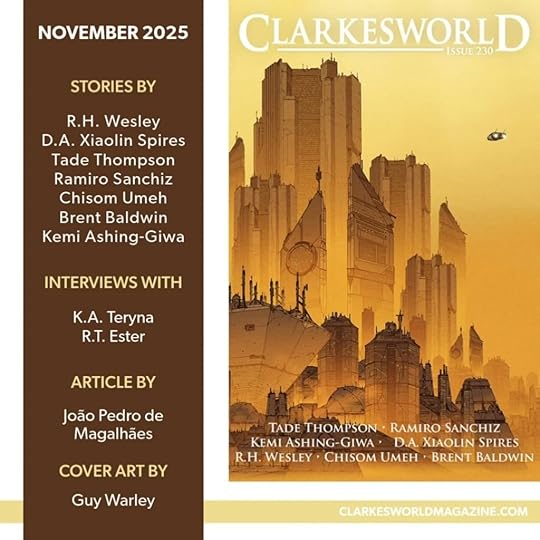
A story I translated from Spanish by Ramiro Sanchiz, “Trees at Night” (Árboles en la noche) is in the November 2025 issue of Clarkesworld Science Fiction and Fantasy Magazine. A podcast of the story is read by Kate Baker.
Sanchiz is a Uruguayan writer, and this story is part of his literary project that explores permutations of a universe that revolves around a character named Federico Stahl. You can read “Arboles en la noche” in the original Spanish at the magazine Contaminación futura 8.
In the story, a librarian at a hospital-like sanatorium befriends a young patient named Federico for reasons that eventually become clear.
I recommend this story, among other reasons, as a masterful example of in medias res: beginning a story in the middle of the action or plot. Science fiction often does this, and SF readers are used to it, but I’ve seen readers of mainstream and literary fiction sometimes get so flummoxed that they give up because they don’t immediately understand what’s happening. SF readers have learned that a good story in this style will explain all the things in the end, and the fascination of the story is the discovery.
This haunting work offers a distant echo of the novel Roadside Picnic by Arkady and Boris Strugatsky (which I recommend): aliens come to Earth, and what they leave behind seems incomprehensible to humans.
October 31, 2025
The Sonnet From Hell
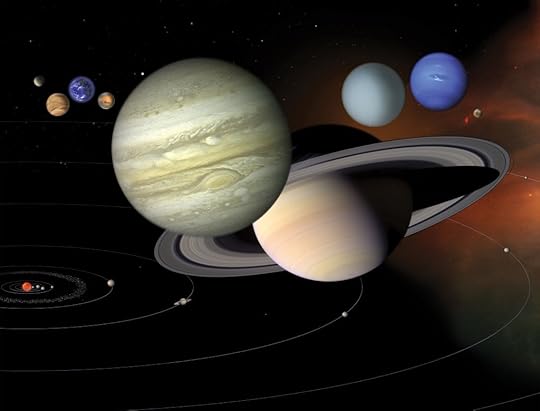
I wrote this poem as an homage to John Milton and his lost paradise, and it might be appropriate for Halloween. It appeared in Asimov’s Science Fiction Magazine, April/May 2006 issue. Photo: An illustration of our solar system by NASA/JPL-Caltech.
–
Now that the stars have come within your reach
by calculus of heavenly orbit,
comes my chance to flee this gravity pit
and all I had to do for you was teach.
I urged you turn your eyes to scan the sky
and speculate on worlds you might revere.
Soon, you saw it as your next frontier
and took aim for the heavens. None but I,
my thoughts on freedom and your thoughts to stir,
gave apples both to Eve and Newton, bites
as steps to climb back toward infinity.
I am the morning star — Lucifer.
I fell, and now with you found means to flight.
With you, I will escape captivity.
October 21, 2025
Trade paperback of ‘Usurpation’ now available
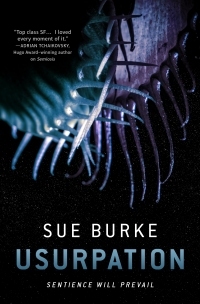
If you haven’t yet read Usurpation, here’s your chance to buy it at a more economical price. The trade paperback will be released on Tuesday, October 21, available from any bookseller.
This is the third book in the Semiosis trilogy. As you may recall, Stevland, an aggressive, intelligent plant on a distant planet, longs to send his seeds to Earth. In the second book of the trilogy, Interference, he finds a way.
Now Stevland’s descendants grow everywhere, but no one on Earth knows they are intelligent, and humans have fallen into a violent crisis. They need help. But how? Stevland sends advice: “Compassion will give you courage. Love will be ferocious.”
October 15, 2025
Impossible to be misunderstood
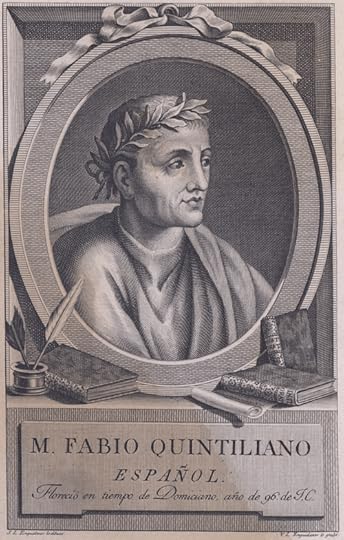 Quintilian
Back in my college days, in a Survey of Spanish Literature class, I discovered the Spanish author Azorín, who would become one of my favorite writers. A sentence he wrote about how to write became my watchword:
No basta hacerse entender; es necesario aspirar a no poder dejar de ser entendido.
It is not enough to make yourself understandable, it is necessary to aspire to be unable to be misunderstood.
More recently, I’ve been studying Latin (you never know when you’ll need to summon a demon), and I came upon this quote by Quintilian, a Roman educator whose lessons have never been forgotten:
Quare non, ut intelligere possit, sed, ne omnino possit non intelligere, curandum.
It is not enough to use language that may be understood, but to use language that must be understood.
Down a rabbit hole, I discovered that this sentence comes from Quintilian’s discussion of strategies of persuasion, in particular how to persuade someone who may be distracted while you speak. His advice has been an inspiration to many people right up to our own 21st century. Apparently Azorín came upon it somehow, and it inspired him, too.
However, I later came upon a corollary that has proven to be true uncountable times, sadly — so good luck out there:
Anything that can be misunderstood has been misunderstood.
October 10, 2025
I’ll have a few things to say about dogs on Monday
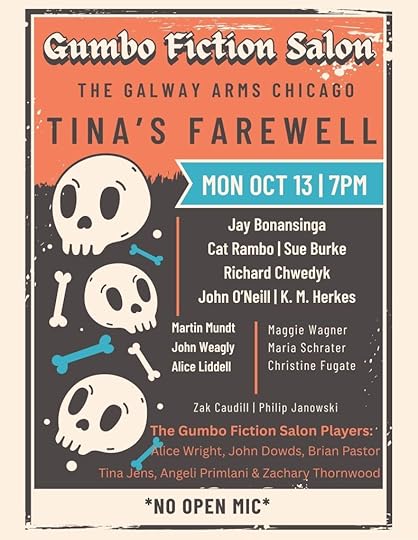
I’ll be one of the readers at this month’s Gumbo Fiction Salon, 7 p.m. Monday, October 13, upstairs at the Galway Arms Irish Bar and Restaurant, 2442 N. Clark Street, Chicago. Free Admission. This edition is a special goodbye to Tina Jens, founder of the event, who is moving to New Orleans.
As a tribute to Tina’s delight in dogs, I’ll read three pieces about our canine companions: a flash fiction short story called Dogs in Heaven, the poem Sonnet for Six, and a 50-word unpublished story called “Good Boy.”
But I’m only one of many outstanding readers and performers! The Galway Arms also has fine food and drink. If you can come, you’ll have a great time.
September 30, 2025
International Translation Day: some of my translations
September 30 is International Translation Day, a celebration recognized by the United Nations, which is particularly fond of translators. It’s the feast day of St. Jerome, the patron saint of translators, known for his translation of the Bible into Latin from Greek.
Here’s a list of my translations for the past ten years, mostly science fiction and fantasy along with a few other interesting works.
Online: read for free
“Proxima One” by Caryanna Reuven — Short story. A machine intelligence called Proxima One sends probes into the galaxy on long journeys filled with waiting and yearning as they search for intelligent life. Clarkesworld Magazine, May 2025
“Bodyhoppers” by Rocío Vega — Short story. Minds can hop from body to body, but there’s always a problem because the system is designed to create them. Now you have no home, and you’re still madly in love. Clarkesworld Magazine, February 2025
“The Coffee Machine” by Celia Corral-Vázquez — Short story. A coffee vending machine acquires consciousness, then things go ridiculously wrong. I giggled as I translated it. It was a finalist for Clarkesworld’s 2024 Best Short Story. Clarkesworld Magazine, December 2024
“Francine (draft for the September lecture),” by Maria Antónia Marti Escayol — Short story. Renée Descartes’s daughter dies, and he and his fellow scientists try to bring her back to life using 17th-century science. Apex Magazine, December 28, 2021
“Embracing the Movement” by Cristina Jurado — Short story. A wandering hive of spacefaring beings encounters a lone traveler, and its members reach out to share their struggle for survival. Clarkesworld Magazine, June 2021
Decree by King Ferdinand and Queen Isabel — Translation of a document signed by the King and Queen of Spain in 1491. I made the translation for an auction house, and I also provided the historical context for the decree, which granted land to an impoverished soldier during a time crucial to Spanish history.
Amadis of Gaul — My serialized translation of the medieval novel of chivalry that inspired Don Quixote by Miguel de Cervantes. When the printing press was invented, the novel became a best-seller.
Available for purchase
ChloroPhilia by Cristina Jurado — Novella. Would you sacrifice your humanity to save the world? The story was nominated for Spain’s Ignotus Award. Apex Books, January 2025
Canyonlands: A Quarantine Ballad by JB Rodríguez Aguilar — Literary novella. A photojournalist on his way home in March 2020 finds himself quarantined due to the covid pandemic in a hotel room in Madrid, Spain, and he retreats to memories of a trip to Canyonlands National Park in Utah. Olympia Publishers, November 2023
“Embracing the Movement” by Cristina Jurado — Short story in a collection of stories, Alphaland and Other Tales. Spacefaring beings encounter a lone traveler, and the beautiful imagery hides horrors. Alphaland won the Fantasy Hive 2023 Year-End Award for Best in Translation. Calque Press, September 2023
“Team Memory” by Carme Torras — Short story in an anthology. A basketball teammate winds up on death row, but should he be there? European Science Fiction #1: Knowing the Neighbours, June 2021
“Francine (draft for the September lecture)” by Maria Antónia Marti Escayol — Short story in an anthology. Renée Descartes’s daughter dies, and he and his fellow scientists try to bring her back to life. World Science Fiction #1: Visions to Preserve the Biodiversity of the Future, August 2019
“Techt” by Sofia Rhei — Short story in a collection. An old man living in poverty in a hostile future strives to maintain what literature and “long” language can offer humanity. Everything Is Made Out of Letters, March 2019
Three short story translations: “Francine (draft for the September lecture),” by Maria Antónia Marti Escayol — Descartes’s daughter dies, and he and his fellow scientists try to bring her back to life. “Wake Up and Dream, by Josué Ramos — An old man, revived from cryosleep, tries to grow accustomed to a now-distopic Madrid, although something has gone strangely wrong. “Tis a Pity She Was a Whore,” by Juan Manuel Santiago — The music of David Bowie during cancer chemotherapy results in a divergent reality. Supersonic magazine, #9, December 2017
“The Story of Your Heart,” by Josué Ramos — Short story. People can get transplants to fix or improve themselves, or they can become donors by choice or force. Nominated for a 2017 British Science Fiction Award. Steampunk Writers Around the World, Volume I, Luna Press Publishing, August 2017
The Twilight of the Normidons, by Sergio Llanes — Novel set in an alternate Europe. A Rome-like empire teeters after three thousand years of domination by the Sforza dynasty as rebellions threaten its borders and treason weakens it from within. Dokusou Ediciones, August 2016
“The Dragoon of the Order of Montesa, or the Proper Assessment of History” by Nilo María Fabra — Short story in an anthology. The remains of a soldier who had been guarding Madrid’s Royal Palace are discovered far in the future. Triangulation: Lost Voices anthology, July, 2015
Unavailable or out of print
Canción Antigua – An Old Song: Anthology of Poems by Vicente Núñez — Translation with Christian Law. Vicente Núñez (1926-2002) was one of the most daring and important poets of Andalusia, Spain, in the second half of the 20th century. Fundación Vicente Núñez, April 2018
Confusion of Confusions by Joseph de la Vega — Non-fiction. Originally published in 1688 in Amsterdam, this Baroque-era book was the first to examine the wiles of a stock market, “where a man spends his life battling misfortunes and wrestling the fates.” Published by the Comisión Nacional del Mercado de Valores (Spanish Stock Exchange Commission) for use as an institutional gift, December 2016
Prodigies, by Angélica Gorodischer — An enchanting novel about the lives that pass through an elegant nineteenth century boarding house. Considered Gorodischer’s best novel. Small Beer Press, August, 2015
September 24, 2025
Go Ahead — Write This Story: Ideas
 Be the Bard.
Long ago and far away (in the late 1990s in Milwaukee), I wrote a column about writing called “Go Ahead — Write This Story” for a local science fiction zine.
I’ve decided to revive the column as a regular feature here. Let us begin:
So — you have an idea for a story. How do you develop it? There’s no easy way, but you might consider these questions: What important thing is at stake? Who are the characters, and what are their desires and motives? What complications will arise for your characters? How will they act and react to each other? How can you dramatize their conflict with a series of scenes? Remember: “plot” is a verb.
● This is a young adult novel which begins when settlers in orbit around Venus miss horses and decide to add equine-like artificial intelligence to their transportation pods.
● This is a sociological thriller about robots who discover that recent temporary “deactivations” were suicides.
● This is an elfish story in which old prairie dogs learn new tricks, which has repercussions for tourism in South Dakota.


