Roberto Scarlato's Blog
July 7, 2025
The Everything Everywhere All At Once Approach

Photo by Irina Rybcko on Unsplash.com
July 10th, 11th and 12th.
That is the narrow window I have created in order for you to get all of my 20+ Kindle titles for free.
I know. It seems crazy. And it is.
But when was the last time you got 20 something odd books for free?
And it doesn't end there. After the giveaway, you'll still be able to get all of my books on Kindle Unlimited for free. All it costs is $11.99 per month. It's like having a Netflix subscription but for eBooks.
Plus, even if you don't take advantage of the Amazon giveaway or a Kindle Unlimited subscription, all my novels are 99 cents a piece. They will continue to be at this price point until the end of summer.
Now, you may be asking why would I do this. And I will tell you, honestly; I want more readers to find me.
Up until now, I've had pretty good luck when it comes to marketing my work as Audiobooks. But, for some reason, have not been able to crack the ebook code when it comes to Kindle sales. So I thought I'd try something different and wild. I'm going after binge-readers, slow readers and everyone in between. I write in a multitude of genres so there's always something for everyone.
But most importantly, I want my work to spread like a wildfire. The last time I ran an ebook giveaway I did it with only 3 titles simultaneously. I got a good response. About 200 to 300 people downloaded each book and then...crickets.
It wasn't a total loss. I got more exposure and I was able to get on more shelves. But back then I had 8 Kindle titles to my name. Not mention that now Amazon can pay you royalties "per-page-read."
So I'm excited for this 3 day experiment for you, the reader, to get a deep dive of my work through July 10th to the 12th. I will even share the numbers of downloads for each title because I don't recall any other author doing this. And even if I am not the first, I hope I won't be the last. I still have a lot of books in the hopper. So keep checking my author website
robertoscarlato.com to be updated on future title releases and future giveaways!


September 15, 2023
15 Things I've Learned From Writing Fiction For 20 Years...
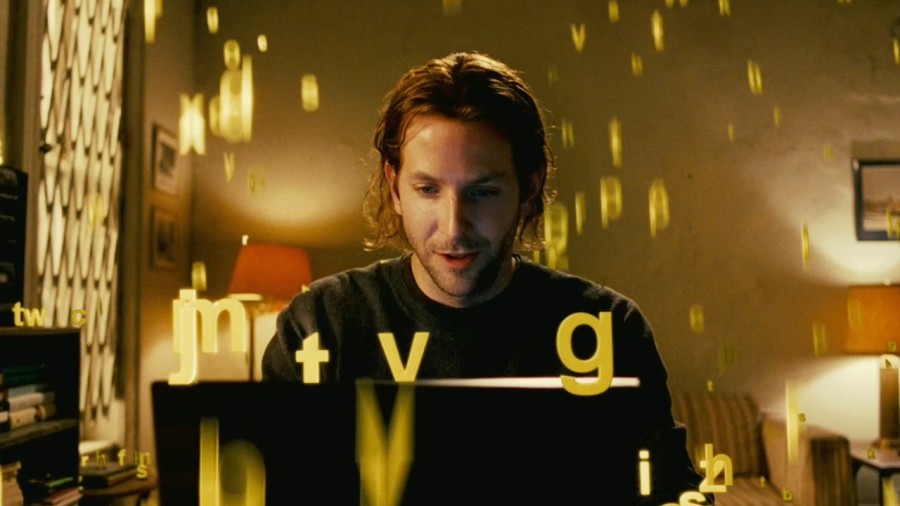
Since Summer 1999, I've been doing something nobody asked me to do. I've written books. I thought that writing one book was a huge undertaking. But, as it turns out, writing a series of books with crossover characters is an even bigger mountain to climb. Along the way, I've learned a few things that have kept me writing and, I hope, will keep you writing too.
1. The First Line Is Key: Let me put it to you this way - when I walk into a bookstore, how I browse is to take a copy of a book, flip to the first chapter and read the first line. It used to be that I'd give the author three paragraphs to hook me. But now I see that the beauty of writing is hooking them in with the very first line.
2. Keep the Chapters Slim: Each chapter is a scene. A scene that must advance the plot. Pack whatever pertinent information you need to and then move on to the next scene.
3. Keep it Simple: This piece of advice is interchanageable depending on how you write. If you like to write long, drawn out sentences with poetic prose, that's perfectly fine. But what I've found that keeps me engaged as a reader are short, simple sentences. No dressing required. If there are some clever nuggets of prose they should come naturally and not be forced. My style is somewhat of a balance between Stephen King, Charles Bukowski and Harlan Ellison. Or, at least, that's what I'd like for it to be.
4. Do Not Hold Back: Here's something that I've learned the hard way several times over. Do not hold back. Readers can tell and they will call you out on it. If something feels visceral and almost too intense, put it on paper. No one ever decided to play it safe when writing a novel. Writing a novel is a jump into the unkown, wondering if you have the strength to climb back out. If you pull punches, clean up your language or try to cater to only one section of the audience, you will lose all of them. For example - my characters curse. But they don't curse on every single page like it's a Tarantino movie. If my characters are at their breaking point, they don't shy away from a grunted cry of "Fuck!" or "Oh Goddamn It!"
5. Every Story Is The Film Behind Your Eyes: Before I picked up the pen, or laptop in my case, I wanted to be a filmmaker. Much like the writer Garrett Robinson. However, I knew nothing of how to cast actors, secure sets, acquire permits or props or even when to film. I just knew how to tell a good story. But I've found that filmmaking and writing go very much together. If you have a scene you want to write, you picture it in your head first. Let's say, for instance, that you have an opening scene where a man enters a hotel and rings the bell at the concierge desk. You know all the details. But the reader will get bogged down if you describe every stick of furniture in the lobby. Only you know which details to focus on in order for the reader to get an idea of where the scene is going yet don't give away too much. Is the man sweating? Is he carrying a secret? Is the hotel manager against him? Is he meeting someone in his room?
6. Write about what you don't know: They often say 'write what you know' but I'm a firm believer in that writing is a journey into the unknown. Sure, you can add some of your experiences and expertise. But always leave enough room for free will.
7. Don't let research intimidate you: Research should be the last thing on your mind. This isn't a term paper. If it is, I'm sorry. But if you want to write fiction, there may be some points along the way that you have to look up or google. Just don't do it while writing because it breaks the flow. Always leave it for the "look that thing up later" section of your brain.
8. Connect with your characters: If your characters do not have wants or needs then they have no soul. They don't have to like the same things you do. But they do need to be relatable and a reflection of the human condition. Allow them the space and opportunity to play.
9. Don't sweat the page count - the story will tell you when its done: If it's a handful of scenes, it's short. If it has three to four acts, it's a novella. If it is something that builds over time, it's a novel. No matter what - remember that the story will be done when the last line feels right.
10. Make every chapter a cliffhanger: I know you can't make every chapter someone literally hanging off the edge of a cliff. It is your reader that needs to be on the edge. Make it so that every setup builds to a payoff.
11. Play to your strengths, bury your weaknesses: When writing, I tend to get bogged down by overly descriptive phrases. So I cut them. I like my sentences nice and neat. You shouldn't overwrite a scene to where its 50 pages in and the characters are stuck in the Same Room. Bury the boring parts of your manuscript or they will bury you in unnecessary text.
12. Outline in your head: There are authors who are pantsers and plotters. Pantsers work by the seat of the pants, on the fly. Plotters map out every detail before they write one word in their manuscript. Let's face it, the outline is already in your head. It is condensed into twenty or so bullet points of what will eventually happen in your story. And if you know that, you can write everything in between.
13. Make it re-readable: One thing I love when reading is to go right back to the beginning chapter and reread the setup. Now that's a good book. You want to give the reader an experience. One that says, one of these days, I have to re-live those moments in the book again. They're too good to fade from my memory.
14. Let it cook: Like with any process, you need time away from your creation to come back to it with new eyes. See if things have marinated well. Does it still make sense? Does it still capture your imagination? Will it grab others? Does it resonate? Will this matter 20 years from now? I can tell you from experience, if you keep coming back to it, then it's a good idea that deserves the right amount of time to cook. However long that may be.
15. Leave the reader wanting more: An alright book will have you put it down and say to yourself, "Well, that was a pleasant distraction." But if you know what a reader wants and needs, you'll have them saying at the end of your story, "I wonder what those characters are up to right now."
January 11, 2022
Pushing Through Misery
A lot has changed in 18 months. And I find myself coming back to blogging.
The pandemic was slowing down here in the states. The lowest amount of cases in June of 2021 was a remarkable 5,000 for the entire country. Now we have had 1.35 Million cases just yesterday. The Beta Variant is gone. The Delta Variant is dwindling. It seems that the majority of cases of Omicron are less severe and come with an antibody response.
Many of my fellow narrator friends, family members, and old friends have lost a loved one due to Covid19 or Cancer or another illness.
My own father passed away from Cancer. A form called Gastrointestinal Stromal Tumors (GIST) on September 25th of 2021. (For more information on this rare disease, click here.)
We've lost heroes young and old. Quite recently we lost Betty White, Sidney Poitier and Bob Saget.
Here in Michigan, January has replaced December as an unforgiving month of bitter cold with temperatures in the single digits at night.
And while a lot has changed, you have to wonder: How does one power through trauma and misery in order to write another story?
Well, this blog is called Tales and Troubled Times of a Hungry Writer for a reason.
I am no stranger to Trauma.
Writing has always been therapeutic for me. My mother and father always encouraged my voracious appetite for reading and when I finally started penning my own stories, they gave me tremendous support. When I decided to self-publish my first book, they provided me with money to do so. They kept copies of my books in their bedroom on a nightstand within reach. Every time I told them I had another idea cooking they were both impressed and astonished by my productivity. But they were the ones who fed the fire that continues to burn within me.
Yes, it is easy to get bogged down. To have downtimes. To not even want to glance at a blank page. To regard storytelling as a fool's gambit when you are in the throes of great depression. But the blank page is always waiting. It remains neutral. The blank pages listen to your woes and tries to help you figure them out one sentence at a time.
And while the world seems to be changing rapidly, through peaks and valleys, sometimes grim and sometimes hopeful, I remain convinced and encouraged that better days are just ahead.
At least, that would be my father's outlook. He was always a man with infectious optimism. And I'd like to carry on that tradition.
The last gift I gave my father was a gold pocket watch. These days I find myself wishing we had more time together.
The last gift he and my mother gave me was a FreeWrite Traveler.
Even with all the bad news and daily struggle of sadness, I have found time to finish some stories.
I recently finished what I called THE BIG SCI-FI BOOK, which has been long-gestating. It finally has a cover and is available on Kindle, Nook, and Kobo now. I call it Skyways Of Tomorrow . I am currently halfway through recording the audiobook.
I have also finished a thriller Novella on the FreeWrite.
A story I am 90 percent finished with is a Christmas Novella that will hopefully be out soon. Maybe in February.
And, quite recently, I've decided to end every future story I publish with the words:
In Loving Memory Of Carmelo Scarlato
Life moves. Friendships are rekindled. Stories are still told.
Our strength as humans is not just in our multiple ways of expressing ourselves but also in that much-needed yearn to express our grief and to be vulnerable. This helps us untangle the wires in our minds. It helps us relate to one another. But it is a feature that is distinctly human.
So continue to write. Write about Sorrow. Write about Joys and Triumphs. Write about whatever your heart desires. Pour out your humanity on the page and it will heal you in turn.
Then you will find that you're not just pushing through misery. You are creating something new and beautiful which will make your loved ones proud.
I'm still writing stories, Papa. These yarns are for you.
June 26, 2020
The 2 Year Drought
Well, here we are again. It is amazing how many times I’ve come back to the blank page, thinking that nothing would come of it. I am often dismayed by crafting a story that is already formed inside my head. I sometimes obsess over questions that plant seeds of doubt.
Will the story translate well to the page?
Will people be moved by it?
Will people find this story entertaining?
Will I ever be able to write something this good again?
I’ve discovered that, for the most part, this happens to all writers. John Grisham takes six months to write a book, and he always starts on January 1st. John Irving writes the ending of each story first and tries to build a novel around it. Dean Koontz makes several drafts of each page before he moves on to the next one.
What I’ve found is that every writer has a process. But it is weird that I hadn’t figured out mine until just a few short weeks ago.
My process for writing is as follows:
1. Get an interesting “What If?” Idea. 2. Let the characters and plotlines gradually unwind in the mind.3. Write 30 to 60 perfect pages.4. Abandon the story for a while.5. Come back to the story, re-read what I wrote before.6. Let the characters drive7. Write the last 50 pages in a glorious fury
I once thought that this process was clunky and erratic and didn’t make much sense. But then again, a story is like that in its rawest form. It needs to be shaped, polished, molded. I used to buck against these 7 steps I would take, thinking that I wasn’t taking the craft of writing seriously. But now I find that as jumbled as this process seems to be it is still uniquely my own.
I still jump in and out of stories at my own pace. I still have hundreds of pages of half-finished stories. And I’m always mind writing; thinking of another line or plot point or character to put in a book as I continue on with my life. It has become a daily habit to think of a story and continue to shape it without having to write a word.
So imagine my surprise when I looked at my list of published works and found out that I had not released a new work in over two years! By all accounts, it would seem that the well had run dry, that the fairies and sprites of inspiration and imagination had left me for greener pastures. That I am experiencing a writer’s drought. But that is not the case.
I still plan on revisiting the world of Olde Country in Ye Olde Idea Shoppe. There are a few characters who get solo adventures that are tied to Pickpocket Frankie. There’s still a second part to mysterious Mr. Dead Eyes and there are even a few surprises in between. I still have novellas that are over the halfway mark. I still have a memoir or two. I am even trying out a book of poems.
So even though nothing has seen the light of day, I have still been working on writing in some capacity.
While my process is not entirely predictable I have now come to own it and take pride in it and realize that, well, that’s just the way my brain works.
So, at least for now, I have to go back and tend to my crops. They need watering. But keep a sharp eye and you just may see the fruits of my labors.
Click Here To Listen To My Audio Books
December 26, 2018
Da Works
Well, it’s winding down to the end of the year and I could not let the new year pass without saying a few things about my journey of writing and what I’ve learned.I meant what I said about writing novels now instead of novellas. And, like I always do, I am drifting between three separate novels. So here are my works in progress and my thinking behind them.
THE BIG SCI-FI BOOK – God, feels like this one has been going on forever and yet every time I come back to it, I am encouraged to time travel back to the 1940’s again and again. I’ve always wanted to write an immersive, exciting, mind-bender of a novel and I feel that this one is leaps and bounds better than what I’ve written in the past. I know its more ambitious because I’ve done a lot of research on it. But the main thread is to make the story enjoyable and not bogged down with facts. I’m trying to write it in such a way that once you’re done with the journey, you’ll want to read it again. (25,000 words in.)
WORKING WOES – This book is a memoir of my working life. The one I’ve always kept in the back of my mind and just now am I willing to brave the storm and write it. I say brave the storm because I’ve found that this is not just revisiting my work life from 2003-2014 but it has also become a poignant discovery of some extremely difficult times. I’m not very public with my feelings because I tend to be self-deprecating. I’m more willing to deal with depression or outright numbness through writing than to ask for help. Writing about my work life has become more therapeutic and cathartic than I ever imagined. It’s made me laugh at the fun times I had at jobs I liked and groan whenever I encountered an awkward situation or one of the many setbacks that were put in my way. I find myself barreling through and breaking new ground and happy to say that this process has really given me closure. And if that inspires a person to tread carefully when entering the workforce, then I am grateful. (14,000 words in)
THE HOUSE – With each novel, I try to do something different. But I also like to set some of my stories in the past for nostalgic purposes. This one is set in the seventies. It’s kind of my take on the classic movie The Old Dark House. But it goes much deeper. There are twists and turns galore. I wanted to tap into a horror that was both psychological and suspenseful. I have no idea when this title will see the light of day. But I’m encouraged to write more because this is one of the few novels that I have fully mapped out in my head. And that’s really saying something. (4,000 words in.)
2018 was a heavy workload kind of year. I've narrated some wonderful works from Shirleen Davies, Mark Cisper, Jamie Davis, Morgan Cole, Washington Irving, Lao Tzu, Leslie North and Brian Knight. My daughter is growing up and she really loves reading! My business is growing and I'm learning new things every day. The house is still be fixed up but its almost finished. I'm excited to see who I will be narrating for next and what new stories I'll be able to conjure up.
New year means new goals.
So, for 2019, my new year's resolution will be to write a chapter a day.
Thanks for reading.
February 1, 2018
Here it Goes: Novel or Nothing!
For the past few months, I’ve been really busy. It feels like two sides of me are organizing the year ahead when it comes to new projects. Writing has always been my go-to when finding inner peace or to unravel the concepts involved in life. While I am an avid consumer of entertainment, I strive to be a content creator. I’m here to entertain the masses.
But, as it turned out, I’ve really branched out when deciding to become a narrator. It gave me another outlet to express myself.
So that, understandably, has taken up a lot of my time. And I don’t mind. I love immersing myself in being a storyteller.
I now work for three companies: Acx , Bee Audio and Findaway Voices.
If all goes well, I should be quite busy this year when it comes to my full time job. But, my productivity has slowed significantly with writing.
So, for the new year, I’ve given myself a new goal. From this date forward, I am done working on Novellas and Short Stories.
There’s a couple of reasons why:
1. Short stories and Novellas are quick to produce and I want to challenge myself more and not just take a quick dip in and out of worlds.2. For the rest of the year I want to work on ONLY Novels. So that’s anything over 50,000 words in length.3. I have a backlog of novels that are screaming to be written.4. And I want to get at least 3 full novels done this year.
Currently, I’ve been taking my written works and have put them up on Audible. Three of the titles (Right Outta My Mouth, Village Americana, Pickpocket Frankie) are narrated by me. But the majority are narrated by other very talented people. The reason for this is two-fold.
First, I know I don’t have time to narrate everything I have written. Besides, there are some stories I’ve written where I have convinced myself that I am just not the right voice for it. Second, since I started narrating in 2014, Audible Acx has had a swell of new narrators. Thousands more people have gotten into this field. A lot of them are looking for their first book to narrate. I remember when I was looking for that chance to become the voice of somebody’s story, so now I’m offering that to people who are trying to break into the industry.
Also, I’ll be moving to a different house. Which will be a big change for me and my family. And since this seems like the year for big change I figured why not have big goals.
But, dear reader, there are more titles to come in the future.
I’m putting the final touches on two novellas.
One is called The Digital Novelist and the other is called The Loop . They’re both what I’ve come to know as Sci-Fi Horror.
And they are the final two stories I’m going to include in my newest collection titled Night of Novellas . (6 novellas in all with introductions, extras and behind the story segments)
The last novella I’ll be working on before I jump headfirst into novels will be a title I call The Transcriptionists . It’s a crime thriller that came to me one day.
But, after all that, it’s Novel or Nothing, folks.
I still have a list of titles that have been percolating long enough.
THE BIG SCI- FI BOOK is the one I’m most anxious to return to, as it also ties into another title I’ve written called Thief of The Gods: An Area 51 Confession .
I’d also like to return to Mr. Dead Eyes 2 . Because the audio book for the first book is in production now and it sounds great. It’s giving me new ideas of what I can put in the second installment.
I also have two spinoff sequels to Pickpocket Frankie . These two books don’t have the titular character Frankie in them. These are more focused on two big characters mentioned in the book. And those are both crime thrillers.
I also have another novel planned for the private investigator Thomas Wilker. But this will be set way before the events of Mr. Dead Eyes .
Add to that a behemoth novel I have planned that is in the genre of literary fiction. I don’t know how long it will be, but it will definitely have a large cast of characters.
So, yeah, it’s clear to me that the novels in my head are screaming for attention. And all I have to do is open the door. Why wait, right?
Remember, always set new goals for yourself every year.
And, as always, keep writing.
;)
September 10, 2017
When the Devil On Your Tail is Called Obscurity
Why do we write?
Y'know, I've asked that question a few times. An author friend of mine asked this of me. I can only tell you that when I first started writing it was harder than it needed to be. I wrote on a desktop computer handed down to me by my aunt. I used to play games on it whenever I visited her house. When it got turned over to me it was pretty much on its last leg. The thing would freeze up, become slow or would suddenly shut down. But I didn't let that stop me.
I became driven to write the one story I had, the one that kept nagging me.
Looking back, I see the mistakes I've made and have learned a lot since then.
For me, writing is a way of tapping into the human soul, the human condition.
It helps me release anxieties, keeps me sharp and puts me in a mode of relaxation.
My first book took me a few years to write.
Now it takes me a few months.
For the past year I've been on a mission, a mission to make my mark. All told I have 16 titles available on kindle. I'm expanding to other markets such as Barnes and Noble, Kobo and iBook.
Nobody ever told me, "Hey you, get writing."
I just decided to do it one day.
And that's what it comes down to.
Writing is a decision. Whether you pursue that decision is entirely up to you.
For instance, I take writing very seriously. Whenever I start a project, I need to know if it will stir something up inside a person before I even write it. Anger, hate, joy, envy, sadness, fear: these are the emotions I want to pull out of a person. In order to do that, I let the story cook for a while inside my head. In my daily life, I fill in the blanks. Whether I'm doing dishes, taking a walk with my daughter or even if I'm picking up groceries, I'm always writing inside my own head.
Once I have the beginning, middle and end, I pull out my laptop and start tapping the keys.
From there I share it with my wife and a few other people.
After some polish and an added detail here and there, I upload it and offer free copies for honest reviews.
I've even given myself deadlines to help move the inspiration along. It helps to give yourself a schedule.
I've been writing for close to two decades and I'm not stopping anytime soon.
Because another little thing they don't tell you is that when you've put out your first book, you become encouraged to write more. Becuase there is always a little devil nipping at your heels. And that devil is called obscurity.
I'd rather have written 100 books and know that I wrote that much and be broke than to have never written a word and wonder what might have been. I don't care if the whole world became illiterate overnight, I'd still write. I've got more than enough stories to write and I have something to say.
If that's the case with you then, well, what are you doing reading this blog. You could've pounded out a short story in the time it took you to read this blog post.
As always, keep writing.
Oh, and don't let that pesky devil catch up to you.
Check Out My Books By Clicking Here.
March 28, 2017
Thief of The Gods Audio book Edition - Narrated by T.W. Ashworth
Before I became a writer, I wanted to be many things; A filmmaker, a comedian, an actor. But being an actor always seemed the most appealing. In the end, I figured I had to pick one and not have an ever-growing list of dream occupations I wanted to fill. I thought that you had to pick just one.
However, I was happily proven wrong by one man.
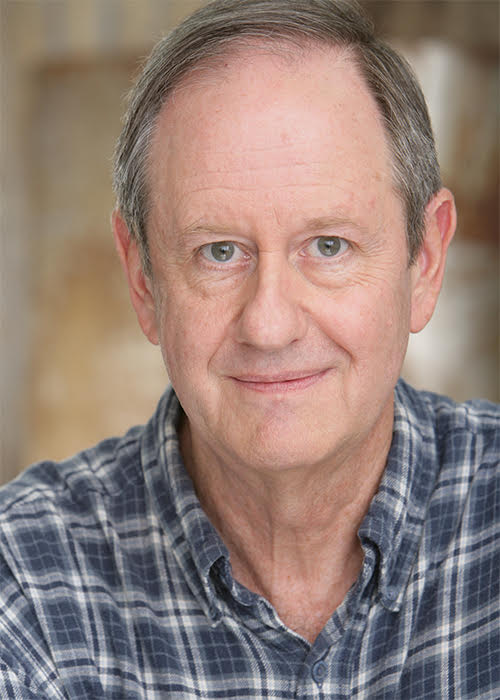
His name is TW Ashworth.
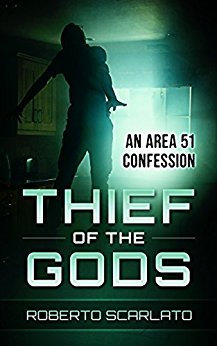
Today we’re sitting down with him because I sought him out to narrate one of my works. Thief of The Gods is a Novella about a Scientist working in Area 51. It took a bit of time to write the book but, as any author will tell you, that’s only half the work. What a story needs is to be told and by the right person.
TW Ashworth is a multi-talented man of many hats. He has acted in such hit shows as HOW TO GET AWAY WITH MURDER, SUPERSTORE, PRETTY LITTLE LIARS and CRIMINAL MINDS. He also starred in Justin Timberlake’s explosive music video “Can’t Stop The Feeling.” He paints, directs and is also a musician.(Banjo/Accordion)And now he’s launched himself into audiobooks.
Hi Tom, thanks for joining us.
So what drew you to acting in the beginning?
I was 17, in high school in Scottsdale, Arizona, and there was an audition for the play RHINOCEROS by Eugene Ionesco at my school. A friend dared me to audition. At the time I was a student body officer, a three-year letterman in track, a math wiz kid, etc. The audition was mostly improv and I got cast in a nice role. BAM, changed my life. We had a very strong arts, music, and theatre department at Coronado High School, and it just was home from the first day.
What did it feel like to get your first callback?
I really can't recall. I've always gotten a lot of callbacks. Obviously, it doesn't mean as much in school because it is not your source of income. I've always pursued commercials and with that part of the market, you audition a lot more because there is more work...so more callbacks.
What made you pursue audiobooks?
My wife, Christine Ashworth, is a writer. My recently passed father-in-law Chester Cunningham was a noted pulp fiction writer with over 300 published novels, many of his Westerns still available on Amazon. He wrote until a week before he died at the age of 88. So, lots of writers around. Christine's roommate bailed on an Independent Publishers conference in Southern California and asked me if I wanted to come. I went to the workshops she couldn't make and one of them was on finding the right audio book narrator. Suddenly I realized I had hundreds of contacts to pursue work, so off I went to learn how. This was last October mind you. I've been doing stage acting for over 40 years so I have a lot of vocal training, dialects, different voices, etc...so it was taking a well-trained instrument (I still take workshops & classes) and learning to play it a different way. I view it as a well trained classical violinist learning to be a Blue Grass fiddle player. You can't do it instantly but you can do it. I've done a lot of Shakespeare, and his writing really teaches you to suit the voice to the words.
Also, I get be the character of Bottom from Shakespeare's MIDSUMMER NIGHT'S DREAM. He wants to play all the parts, and as a narrator, guess what? I get to play all the parts. Some are easier than others, but it is always the harder ones that make it fun.
As far as the story goes, this was pretty heavy. It’s a first person POV throughout the entire book told in diary form. Was it difficult to get into that character?
No, it wasn't hard. As an actor first person POV is easier for me. The train of thoughts you don't say out loud on stage or in front of the camera you get to actually say. At this stage in my development, it's the novels with a lot of third person narrative that I find hard. Who is talking? The narration is a character with a point of view. The lead character is also a scientist. Math and science have always been things I've enjoyed and I still read about. Science and math matter to humankind, for good and for evil. Your book is very forward about that. The lead character is very ambivalent about those issues, making him very human and easier to play.
Do you do any warm ups before a performance?
I vocalize every day for at least a half hour, so yes. I just do it before I record. I also sing about a half dozen songs on the ukulele, guitar, banjo, etc., that are in the emotional feel of the novel. THIEF OF THE GODS got a lot of early Paul Simon, THE BOXER, SOUNDS OF SILENCE, I AM A ROCK, etc. Gets my articulation warmed up, and the emotional connection between voice, body, soul, and what you're reading going almost effortlessly.
What’s the best advice you’ve ever received from a director or an actor?
Since I've directed over 40 plays, I'll share something that I always do with my actors...the audience dreams of you being wonderful, so just enjoy yourself and be wonderful.
Even though I wrote the story, I really felt like this was a collaboration. You gave me two good notes that really made the story stronger. One of them was the fact that in the original story, the scientist is in a hotel room with a Television set. But, as you pointed out, there would be no television sets in hotel rooms in the 1940’s. Have you ever pointed out ways to make the character or story stronger when being cast in a show?
No, actors do not give other actors notes, period. There are exceptions to this of course if you have a different relationship with a fellow actor, but usually, it is a huge NO.In the development of a play or a screenplay, however, when the writer is there and you are reworking scenes, lines, etc., there is a lot of back and forth. I've belonged to several play development groups in Los Angeles and sometimes a writer will tailor the role to your talents. It varies on the situation.A director may call you aside and ask for feedback, but again that is not me volunteering it.
You brought many different emotions to this story. Do you ever find yourself getting sucked into a role that it begins to get harder to step away from that particular character?
Not overly...but again I'm very well trained. One of the techniques I'm trained in is called Alba, and it is a very physical approach to acting, also very effective for me as an ex-dancer. (Yes, I had a 20-year career as a professional ballet & musical theatre dancer.) After every workout in the Alba technique, you do a stepping out process which is basically telling your body to get back to neutral. Yes, some roles are harder to shake, but the step out helps. If you are doing it right, your body assumes the role, breathing patterns, posture, and returning to neutral by stepping out gets you back to the here and now. You are basically training yourself to let yourself go as deep as you can because you know you can come back in a matter of minutes. Plus, in narration, you are frequently multiple people on the same page so it's hard to get stuck on any one.
Since this book deals mainly with a conspiracy theory, what was the first conspiracy theory you had ever heard of UFO’s and Aliens and did you get drawn into the mystery of it?
The first conspiracy theory I read was a short story from an anthology I read in the early 60's, about earthlings meeting aliens on a distant planet and discovering we were the bad aliens that conquered and destroyed a major portion of the galaxy and they were terrified we'd show up again. We did. I love surprise endings, and this short story had it. Can't recall the name sadly.
In our conversations, when trading notes back and forth over ACX, you said that you briefly hated me because you were reading my story and had missed your stop on the train. Ha ha. Believe it or not, that’s the second time someone has told me that. What authors do you read frequently? Has that happened before with another book?
I read Haruki Murakami, Herman Hesse, Christine Ashworth, J.R.R. Tolkien, Barbara Tuchman, Kurt Vonnegut.
And usually on subways and buses in L.A. I read books that "I should read," such as William Makepeace Thackeray's VANITY FAIR or Tolstoy's WAR AND PEACE. These usually aren't page turners that take you away completely. Though Brady Udall's THE LONELY POLYGAMIST - which I found laying on a bench at a bus stop and didn't have anything to read, almost did. Very funny book. Yes, I take public transportation when I can in L.A., traffic is astoundingly bad then you have to find parking.
So what’s next for you?
Looking for work, that is what an actor does. Narration wise I'm doing a book on programming in LINUX, a really fun book called DEATH FALCON ZERO vs. THE ZOMBIE SLUG LORDS, and an audition for a Western trilogy.
Where else can people find you online?
www.thomaswashworth.com my personal website, or my IMDb page at http://www.imdb.me/thomaswashworth
Thanks for doing this Thomas. You’re welcome to come back on the blog anytime.
March 17, 2017
The Book That Doesn't Exist
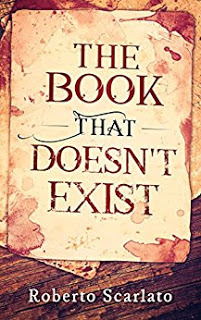 Click Here to Buy!We all have hopes and dreams. But what we seldom like to talk about are the fears and frustrations in between.
And that's what got me writing this novella. Originally, I just toyed with it while I was still busy on THE BIG SCI FI BOOK. That title still has a bit to go. 17,000 words in.
Lately, I've been going back to novellas because they serve a need within me to tell a good story that can be read in one sitting. I'm also expanding to make it an audiobook.
The seed of this story started as a dream.
I got this image of this guy leaving his basement apartment to join a few friends in his driveway who were tinkering with two cars. One was a Master Coach and the other was a pristine Studebaker. While they're chatting, the protagonist's friend reaches into this hidden compartment inside the Studebaker and pulls out a typewriter's carrying case. As he handed this item to the main character, the skies above were filled with thunderous clouds and a wind was picking up. As if this transaction was disturbing the natural order of things.
I woke up at around 6am, hopped out of bed, opened the laptop and just started writing as I was still waking up. It took me an hour and some change to get ten pages down. My wife and daughter woke up and joined me.
The story has changed a couple of times but the constant theme is frustration, of which I am familiar with.
I threw all the problems I had faced in life at the main character; juggling work and home life, fighting against poverty, finding your own voice as a writer, it was all right there. It kind of felt intimidating to write something that struck so close to home.
But the story continued to cook and after about two months, it was finally completed. At 52 pages long I can tell you that this has been the hardest one to write.
I labeled it a dark psychological thriller.
The next one that I'm planning to release, thankfully, is a much happier story. That one involves a writer too. That one involves a series of comical mishaps. I think I wrote it in 2010 but I just looked at it recently, polished it a bit, and think it will be ready soon.
I tell you all this because I don't want you to be afraid, as I was, to go to some dark places while you are writing. You may feel a connection to your characters. You may wish them not to come to harm. That's good. You care for them. That's relatable. But you have to let the story write itself and not try to save the characters yourself. Just sit back and see what happens. Be an observer, even when it is painful to do so. Because only then will your story hold something that rings true.
We all grapple with conflict, tough decisions, heartbreak, mania, doubt. If you completely exclude these concepts from your story, then you are holding back. And, as my wife always tells me when I'm working on a new story in progress, don't hold yourself back.
More importantly, write the book you would like to read. The one that you feel is missing on bookstore shelves.
Heck, write...the book that doesn't exist.
The Book That Doesn't Exist is being released on March 19th, 2017. It is now available for Pre-order. Just click the cover above to buy a copy.
As always, keep writing.
"Be a sadist. No matter how sweet and innocent your leading characters, make awful things happen to them—in order that the reader may see what they are made of." ~Kurt Vonnegut
December 29, 2016
The Joy of MindWriting
"Outlines are the last resource of bad fiction writers who wish to God they were writing masters' theses." ~ Stephen King
"And I don't want to begin something, I don't want to write that first sentence until all the important connections in the novel are known to me. As if the story has already taken place, and it's my responsibility to put it in the right order to tell it to you." ~ John Irving
"I learned never to empty the well of my writing, but always to stop when there was still something there in the deep part of the well, and let it refill at night from the springs that fed it." ~ Ernest Hemingway
Over the course of the last decade I must have read over fifty How-To-Write books. Everything from scripting every single word to writing one true sentence at a time. But a good chunk of those books expressed that the most important thing that a writer could do for their story was to outline, outline, outline.
I did that method for my first book.
I wrote out directions, dialogue, plot, and even tone and objective of each chapter before I even wrote the word Prologue.
I thought I had to be chained to this type of device. To color inside the lines for fear that any originality would be lost or escape.
What happened instead was something very encouraging.
Every single time I strayed from the outline, when I'd let my mind wander, the story got better, sharper, grew some fangs.
On my second book, I briefly outlined the story but this time around I was looking forward to abandoning certain aspects of the outline.
Then, on my third book, I only outlined six chapters. Where did the rest of the book come from? Daydreaming, letting my mind wander, meditating on the story.
And you know what happened?
Not only did all of the elements I wanted to put into the core of the story suddenly appear, but I also found connections and crossovers to my other stories and crisp, witty dialogue came out of nowhere.
This was when I realized I was what they called a 'Pantser.' I know, it sounds like something a bully would do. But it's actually a term for writers. Johhny B Truant and Sean Platt describe that each writer falls into one of two groups: The Plotters - The people who outline everything about their story ad nausem. And The Pantsers - The people who kind of make everything up by the seat of their pants.
I enjoy the latter category.
Especially, since I've started the practice of Mindwriting.
Right now, even while typing this, I'm working on seven different novels. That's right. I'm multitasking.
It used to be that I'd take some time out of my day to think about a story and where it's going. But now, I'm thinking about them constantly. I'll map out a scene in my head while running an errand, try several different takes of a scene while at a party, experiment with dialogue doing the dishes, plot devices, character development, etc. Sometimes my wife will ask me what I'm thinking about because I get that far away look and every time I'll say, "Stories. I'm working on a novel."
Our minds are capable of a lot of things. We can figure out complex issues, learn languages or memorize entire scripts. But one thing I've always used my brain for is storage. I've created a room inside my mind with stories in the process of being written. And each one can be pulled up at a moments notice. That way, whenever I feel that the story has cooked for long enough and is just right, only then do I pull out the laptop and actually do the work of transcribing whatever was in my head.
One of the benefits of mindwriting is that it has helped me become more organized. Before, I had boxes filled with notebooks, receipts, post-it's, little scraps of paper with ideas written down. Tracking them all down was way too time consuming. So now, I keep everything up in the old noggin.
So, if you are up to the task, I encourage you to use your brain to its fullest capacity and keep the outline in your mind, where it belongs.
In the meantime, I've got one book that is already nearing the 300 page mark.
In my mind, of course.