
Adam Graham's Blog: Christians and Superheroes - Posts Tagged "imaginary-tales"
Book Review: DC's Greatest Imaginary Stories: 11 Tales You Never Expected to See!
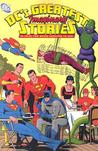 DC's Greatest Imaginary Stories: 11 Tales You Never Expected to See! by Otto Binder
My rating: 4 of 5 stars
During the Golden and Silver Age, most DC comics reset back to normal. Continuity existed, but on a very basic level that allowed villains to recall their last encounter. At the end of the day, you reset to Status Quo. No one got married, no one important died.
That's why Imaginary Stories were so powerful. While the results of the stories were said to be "imaginary" as far as impacting continuity, it was in Imaginary stories that readers got a chances to see actual plot changes and shake ups of the Status Quo or to imagine how things might be different. I'm going to divide my review of the stories by character:
Captain Marvel: This story from 1946 was actually from Fawcett for Captain Marvel (now known as Shazam, I guess) and it's a terrifying little tale as Captain Marvel encounters atomic war and for once Earth's mightiest mortal is essentially powerless to stop it. In one scene, he saves a woman from the blast only for her to die from the radiation. Powerful stuff and well-drawn and written.
Flash: The Flash tale included in here is a tad dumb. The Flash debated not wearing a mask as the Golden Age version hadn't (opting for a helmet that hid his hair. However, he had a daydream where that went wrong and it changed his mind. Really? Somebody spent 7 pages writing that?
Supergirl/Jimmy Olsen: As is typical for Jimmy Olsen tales, this is a comedy of errors. Supergirl gets amnesia, meets Jimmy Olsen and falls in love with him as her secret identity and then becomes convinced he has to woo him as Supergirl. Okay, but not great.
Batman: The Second Life of Batman (1959) asks what would have happened if Bruce's parents hadn't been killed. The results are somewhat dull. The second, "Batman's New Secret Identity" is a tale "by Alfred" imagining that Batman's secret identity is revealed so he established another one (for some reason instead of just being Batman all the time.) Despite the bad premise, the story plays out to be a solid adventure.
Superman has got the mother lode of imaginary stories and they're here and they are amazing. "Mr. and Mrs. Clark (Superman) Kent" is from Superman's girlfriend Lois Lane and is light comedy imagining what if she got her wish of marrying Superman by marrying Clark Kent. "The Death of Superman" from 1961 tells the tale of Superman's demise and it tells it with pathos and a lot of emotion even though its imaginary. "The Amazing Story of Superman Red and Superman Blue" is the type of story that would have ended the comic as Superman splits into two equally good halves, turns Earth into a Utopia free of evil, resolves all his relationship issues, and ends crime as we know it, and Lex Luthor even gets his hair back. It's wish fulfillment and the type of story that would end the comic and the DC Universe, but for happy endings you can't beat it.
"The Three Wives of Superman" takes a look at if Superman decided to marry and the resulting string of tragedies that occurred. Although, he could have prevented some of it by not proposing to his Second Wife Lana in the middle of her wedding to Lex Luthor thus leading Luthor to become evil again, but nobody's perfect. Finally, there's "The Fantastic Story of Superman's Sons" which avoids getting into the Lois/Lana debate by always keeping "mother" grayed out and we're introduced to sons "Kal El II" and "Jor El II." Kal doesn't have superpowers, while Jor El does leading to a friction and the boy's quest to find his place in the world. Again, a very emotionally satisfying tale.
The final tale features Superman and Batman in, "Superman and Batman-Brothers" from 1964. The story's premise was somewhat weak as inexplicably authorities in Gotham decided to give an orphaned Bruce Wayne to the Kents. However, it gets interesting with Clark observing Young Bruce at school and even feeling a bit jealous. The end does feel weak, but it's still worthwhile.
Overall, this is a nice book with some of the greatest imaginary stories (particularly the Superman ones) showing you SIlver Age heroes in a different way. While Marvel's What If and DC's new Elseworlds have surpassed these stories for complexity and variety, the ones in this book are still classics worth reading.
View all my reviews


Christians and Superheroes

I'm a Christian who writes superhero fiction (some parody and some serious.)
On this blog, we'll take a look at:
1) Superhero stories
2) Issues of faith in relation to Superhero stories
3) Writing Superhe ...more
On this blog, we'll take a look at:
1) Superhero stories
2) Issues of faith in relation to Superhero stories
3) Writing Superhe ...more
- Adam Graham's profile
- 69 followers

