
Ellie Roscher's Blog
December 12, 2013
Teachers Talking Writing
Below is a conversational interview between Andrew Barron, publisher at Avenida Books, and Ellie Roscher, editor of Keeping the Faith in Education. They discuss the book project, the state of education and the benefit of teachers choosing to write.
***
Andrew: I remember when we came up with the idea for our first book in this series, Keeping the Faith in Seminary. We wanted a book that got at faith struggles in a new light. We wanted a book that was both personal and academic, spiritual and intellectual. When we started working on the second book in the series, Keeping the Faith in Education, I knew we had set the bar high. How do you think the essays struck this personal-intellectual balance?
Ellie: It’s exciting to send prompt questions out around the country and really have no idea what essays and stories will come back. I remember feeling like I had an idea of what we would get from seminary students and graduates with our first book. When we were waiting for the submission deadline for Keeping the Faith in Education, however, I had no preconceived ideas about what was coming our way. Our vision was to strike a balance and live in the tension between personal and intellectual. I do think the teacher-writers wrote stunning essays from that middle space within the individual essays. I also think the book as a whole holds this same tension. It– this balance– is one reason I love publishing compilation books. Placing unique voices side by side encourages the conversation to continue to diversify. The market is saturated with how-to books on education, and we wanted to curate a book that presented a new conversation that is smart and intimate. I’m with Parker Palmer. We teach who we are. Telling our stories as teachers can connect us and bring a human element to the national conversation about education.
 Andrew: I think faith in education is hard, in part, because we are told by our own Constitution that religion must remain separate from public education. But, teachers don’t check their personal spirituality at the door. So much of what makes a good teacher good is that willingness to reflect on their practice from a deep place of contemplation. I think spirituality is so closely connected to teaching, I have sometimes wondered, is it possible to become a better teacher without becoming a better person? Or, put another way, in order to be a better teacher, I must become a better person. The work is so fast and so personal, could we really make changes to our practice without making changes to our whole selves? I have run this past a few of my colleagues, and it rings true for them. What do you think?
Ellie: I love listening to your questions so much that I don’t want to give an answer. I can speak for myself here. The work is so fast and so personal, yes, that I do think having a core, a quiet, an anchor, a center to act from helped me become a better teacher. For me this quickly becomes a semantics issue. Religion, spirituality, God, faith– these are all such loaded words now, and when put in the context of a classroom people get uncomfortable quickly. So then let’s talk about vulnerability, intimacy, presence and emotion. Teaching is an art, a powerful craft, that involves human messiness and requires absolute commitment to the present moment. The master teachers I have witnessed have found a groove that is fiercely personal. They know intellectually what works and are willing to show up with their entire selves open to new students each year. This requires a vulnerability and emotional stamina that I do believe is hard to maintain without working on the self.
Recently I was a guest teacher in a high school creative writing classroom. I prepared in the morning with the teacher and his student teacher. The teacher is phenomenal. He’s warm with his students while being in charge. He cares deeply for them and holds them to a high standard. And his pedagogy is right on. The student teacher is good, but not great. Yet. I believe he will make changes to his practice that will make him a better teacher. I also have a hunch that in making those practical changes, he himself will be changed. It’d be fun to find him in five years and watch him teach again. He’s clearly committed to his students and his craft, and that commitment requires an openness to change that cannot be quarantined to his head. Teaching grows the whole self.
For me, time of contemplation did make me a better teacher. I’m talking about everything from doing yoga and running to reading up and really engaging at inservices to sleeping long enough to dream on days school was cancelled due to a blizzard. My spirituality is active both in moments of deep, quiet reflection and moments of controlled chaos with students. I do bring my whole self to my teaching. I do believe as I become a better teacher I become a better person. And I love this book for being willing to create space to let teachers weigh in.
Andrew: Many of the essays deal with quitting or not quitting teaching. Lots of people change careers, but teachers seem to do more handwringing. Why is this?
 Ellie: I’m not sure, but I’m willing to wander around some ideas. Teaching is the hardest-best job in the world. Facilitating learning is the work of bringing dignity. It’s justice work. So few jobs today are so fulfilling, urgent, important, or mutually transformative. We rarely see results in a tangible way, but when we do it’s pure gold. Seeing one child make a breakthrough is stunning enough to bring us back for another school year. Teaching is heart-breaking. The students we don’t reach haunt us. Student hold a mirror up to us every day and search us for cracks. We have to grow and facilitate growth. We are asked to teach so many kids so much in such a short period of time. To put it simply, other jobs are easier and pay more.
One of the best teachers at our school left for a job that paid more simply because he wanted to provide more financial support to his growing family. He doesn’t like his new job nearly as much. He was forced to choose his own kids over his students. He doesn’t regret his decision, but it doesn’t feel like a win, either. There’s handwringing because there is so much sacrifice on both sides of the decision. Every June, we could just walk away.
If we walk away, we are probably walking toward a job that will not demand so much of us. It will probably pay us more, and give us more time to chew our lunch and go to the bathroom and sleep. It will also probably never bring us the same amount of joy. We feel like we are giving up on ourselves, our coworkers, our students, and our education system. But being part of a broken system also feels like we are giving up on ourselves. The brokenness is enraging because the kids are suffering and don’t always even see it. But we see it. And we are suffering, too. We want more kids to learn more and be set on fire with curiosity and become more alive. Where can we make the most change? In or out of the classroom? We have to choose, and the answer is never complete. The stakes are high. One lofty hope I have for the book is that it will inspire more people to work in the classroom and inspire more people to work outside of the classroom to lighten the burden for the hand-wringers.
Let me lean on Mark Edmundson here:
“Education is about finding out what form of work for you is close to being play– work you do so easily that it restores you as you….The student who eschews medical school to follow his gift for teaching small children spends his twenties in low-paying but pleasurable and soul-rewarding toil. He’s always behind on his student-loan payments; he still lives in a house with four other guys (not all of whom got proper instructions on how to clean a bathroom). He buys shirts from the Salvation Army, had intermittent Internet, and vacations where he can. But lo– he has the gift of teaching. He writes an essay about how to teach, then a book– which no one buys. But he writes another– in part out of a feeling of injured merit, maybe– and that one they do buy. Money is still a problem, but in a new sense. The world wants him to write more, lecture, travel more, and will pay him for his efforts, and he likes this a good deal. But he also likes staying around and showing up at school and figuring out how to get this or that little runny-nosed specimen to begin learning how to read. These are the kinds of problems that are worth having and if you advance, as Thoreau said, in the general direction of your dreams, you may have them. If you advance in the direction of someone else’s dreams– if you want to live someone else’s life rather than yours– then get a TV for every room, buy yourself a lifetime supply of your favorite quaff, crack up the porn channel, and groove away. But when we expend our energies in rightful ways, Robert Frost observed, we stay whole and vigorous and we don’t weary. “Strong spent,” the poet says, “is synonymous with kept.”
Andrew: One of the essayist in the book shared with me his feeling that writing and teaching were meant to go together. I know when I read a few of the essays I found myself nodding in agreement or even, once, tearing up at a solemn moment of recognition, a moment when I could say, “Me too. Me too.” So much of the reflection teachers do happens between their own ears, what is the advantage of seeing it on the printed page?
Ellie: Teaching can be horribly isolating. I even think some teachers feel abandoned by society, which adds to the isolation. We make countless micro-decisions every day in the classroom and hallway and parking lot that lead to real victories and real disasters with real consequences for us and our students. All of these moments are validated when they are shared. We want witnesses. We want to witness. We want comrades. By reading each others’ stories we can be witness to each other. We can validate each others’ work and feel less alone.
 Andrew: I can’t agree more. We do want witness, solidarity. So much of what we are learning about how great schools run is really about teachers working together, collaborating, bearing witness, and trusting each other.
Why this project and why now?
Ellie: Our children are not doing well. We all know it. It scares us and it hurts. When we are busy and scared, we quickly place blame so we can move on with our day. Teachers get blamed. Things that teachers don’t have any control over get blamed. I can say, then, this project is for the children, the young people, the learners. I think about John Lewis, who got sick of the older Civil Rights workers telling him and the other young activist to be more patient. We can’t embrace patience when it comes to education. But it’s easy to focus on the children and loose sight of the teachers who show up day in and day out and do the work while the macro struggles rage on. This project is for the teachers because they need to know right now that their work is appreciated. They are not alone. They matter.
After trying out the compilation structure in Keeping the Faith in Seminary, and seeing how it gave relief to some while challenging others, I think you and I both knew Keeping the Faith in Education had to be our next priority. We are both teachers and writers who care about creating forums outside the classroom for teachers to speak. I love that Avenida Books publishes practitioners who want to write about work life. It was rewarding to work with teachers individually on this project, helping them clarify their stories as teachers and see them claim their voices in the bigger conversation. They showed great courage and will to carve out time to write amidst the work of teaching. Now comes the moment when they see their essays in conversation with others. They get to share their stories in print with loved ones and strangers. We get to listen as others react and add. We get to watch hope swell.
Andrew: I like what you said about the teachers who “show up day in and day out and do the work while the macro struggles rage on.” I think it is the best representation of what we wanted to capture in this book. We wanted to hear from those teachers doing the daily work, we wanted to piece their stories together in a way that gets at the macro struggle.
We have heard some really positive reviews from people who have read this book, and I venture to guess that it is because there aren’t a lot of book about teaching that are about teachers. So much out there is about the actions rather than the people. They are about how to do the work but don’t ponder very much what the work is really about.
 Ellie: Absolutely. And books about the work don’t take into account a very specific context. There is the work of teaching, but the work doesn’t happen in a vacuum. Geographical location matters. The people in that geographical location matters. Instead of talking in generalities about education, asking teachers to bring their personhood and context into an essay brings the specificity needed that becomes universal. That’s why this book works. Teachers will resonate with the stories and bring their own stories to interact. It’s exciting.
Andrew: Thank you.
Ellie: Thank you!


November 30, 2013
Rich
A severely incomplete list of things I am grateful for in the last week alone (it’s almost too much to bear):
Eating Pie for breakfast with friends on Thanksgiving morning. 22 pies. One with bacon on top. Unapologetically, abundantly sweet.
The humbling nature of writing. The other day I read a piece I had written five years ago. It was so bad I curled up on my kitchen floor and cried a little bit. I am assuming a similar scene may happen five years from now with what I am currently writing. I’m thankful for Dan, my main man, for knowing just how to deal with such theatrics– a combination of affection, reassurance and not taking me too seriously. We were laughing at how bad it was in no time.
The kids in my life. Dan and I want kids of our own, but we don’t have them yet. I swear this triggers my uterus to give off some strange sort of fragrance that only adorable children can pick up on. I mean, what’s better than a kid running full speed across the room, past other people, to jump into your arms? They let me borrow them for a bit and show me unabashedly what grace looks like. William, Henry (x 2), Nadia, Britta, Greta, Carley, Zachary, Nora, Jack, Noah, Finley, Clare, Alice, Martin, Grady, Dezi, Eva…I LOVE YOU SO MUCH.
Mittens inside. When I edit, usually my mouse hand is frigid cold by about 1:00. Monday I started wearing a single fingerless mitten at my writing desk. Gold.
Milestones. So I’m at Republic Calhoun last week celebrating the release of Keeping the Faith in Education. My friends and family were there. Local writers and their friends and family were there. We’re all eating really yummy flatbread pizza and drinking Saga like I didn’t have to work the next morning (which I did). This is crazy to me. Yes, writing and editing is ridiculously isolating sometimes. Or as Mindy Kaling says, “writing, at its heart, is a solitary pursuit, designed to make people depressoids, drug addicts, misanthropes and antisocial weirdos (see every successful writer ever except Judy Blume).” So these release parties are really cool. When else do we throw people parties for the work they do? Everyone should get a good job at being good at your job work party every few years. If you want me to throw you one let me know.
I’m trying really hard to be grateful for the squirrel who lives in the alley trash can that jumps out at me every time I open the top to throw garbage in. So scary. I’m focusing on two points to build gratitude for the little bugger. 1) It’s not a rat. 2) It’s helping me cut back on my waste production.
My four siblings are the coolest people in the entire universe. Like I choose to hang out with them as much as possible. So holidays are fantastic.
But really, how cool is muscle memory? I went to Gustavus for an alumni gymnastics meet thinking I was altogether way too old to be seen in a leotard or go upside down ever again. After the meet, however, a few ladies from “my era” started playing around. The second I put wristbands on, my body– at the cellular level– went aflutter. I instantly felt like I could conquer the world like a total badass that I wasn’t anymore. For the first time in a decade, I did giants (strapped to the bar to be safe). Still got (a little bit of) it!
Yoga.
Students turned friends. Last week I went to St. Olaf College to promote the Urban Servant Corps. A match made in heaven, really. I just yelled, “Hey seniors, who wants to move to the mountains for a year?” That got ‘em close, and I followed up with, “and live with amazing people and do fulfilling work while getting your bills paid?” As if that wasn’t enough, all day, former students came by the table in the commons to say hi and check in. I felt like I was in an episode of This is Your Life. Six of these lovely human beings ate lunch at the table with me. We laughed so hard, being all nostalgic and they told me how cool they were becoming as adults.
Life is so good.
November 11, 2013
Hug a Teacher, But Don’t Stop There
Caring about kids means caring about education. And caring about education means caring for our teachers. I’m excited to introduce to you Keeping the Faith in Education.
When Avenida Books put out a call for submissions in the summer of 2012, I was hoping the compilation of work we would create could comfort and motivate educators. Teachers could read their favorite essay in the middle of the school year when energy is low. Maybe it could help teachers feel less isolated and more validated in the ever-difficult, ever-essential soul work of teaching. Now that the book is out, I think it will do that and more. I do think teachers will find the conversation created in the book is interesting, helpful and hopeful. But this is a book for us all.
Working with teachers on this project, I became even more aware of the challenges teachers face. Teachers need more time with students, less tests and bigger pay checks. The project also made me more hopeful about the future of education. It re-invigorated my desire to engage at the policy level so that these gifted practitioners can have more space to do their work. I hope you enjoy reading it as much as I enjoyed editing it.
Keeping the Faith in Education tackles problems in education from the angles of faith, hope, belief, and redemption. In a time when teachers are under attack, they tell the world why all of us should continue to believe in their soulful, worthy work. It is a collection of essays and poems written by teachers and students that will inspire and restore anyone who works in education. Each page serves as a reminder of how and why teachers bare their souls to help their students shine.
Buy it HERE.

November 5, 2013
The Gift of the Humble Walk
Last night, I had a remarkable experience of church.
Dan sent a google calendar invitation to a storytelling event at Shamrock’s bar that included music by John Hermanson. Shamrock’s is owned by my junior year prom date. I love storytelling and John Hermanson and beer. Plus we were meeting two amazing friends. Monday night date! I was a bit taken aback, then, when I realized the night was hosted by Humble Walk Church. They host Theology Pub and Beer & Hymn nights. The first person I interacted with was a server asking if she could get me a beer. I could get used to this.
It took one note coming out of John Hermonson’s throat to melt me into a puddle. His voice, we decided, is like John Denver’s– crisp and clear like a mountain river. Perfectly raw and controlled. Surprisingly vulnerable. So so beautiful. His voice has the power to bring me back over time and space to exceedingly happy memories of life in Denver, memories of Storyhill concerts, of my wedding, of road trips and quiet nights. To me he is better than John Denver because his music, his voice, has accompanied me in this life. While he covered a gorgeous song by Danny Schmidt, the two women in front of me reached for each other’s hand. It felt like home.
I saw friends from seminary I hadn’t seen in years. Friends who believe in working on Sundays and call themselves sinners and experiment with how to ask big questions. It felt like I belonged.
The theme was When the Sinners/Saints go marching in. I cried during all four stories. They were funny and sad and got at the stuff of life. They talked about death and aging and addiction and love. We nodded along with them. We’re all just hobbling along together in this life. This one messy, crazy fast life. As pastor Jodi Hogue wrote on their blog:
The best way to describe this event is that it’s an open-hearted thing. When you stand up in public and tell the truth about your life, not only are the listeners right there with you–but they are also making connections with their own lives. It opens up the room in a raw, insightful and often humorous way. The listeners feel as if they have received a gift. And then, we have the bonus of a guest singer/songwriter who give us stories and truth crafted into song. Sigh. It’s all so good.
A few people commented as they left. “This is the most Spirit-filled experience I have had in months.” Another said, “I feel like this unfroze my heart.” Ultimately, we leave the bar feeling not quite so alone in the world.
I, like so many people, have a complicated relationship with church. I often feel more comfortable in the religion classroom than in religious worship. I like studying theology as a discipline. I love teaching theology, too. And because I work with young people at a church, I don’t sit and bask in worship. I’m a professional Christian. I don’t get to take the chair in the back, close my eyes and be fed by the warmth of other people’s art and honesty. By their truth and their story. And cry at the goodness of it all. It was so good. It was church.
In the end I do believe.
October 25, 2013
That’s Me?
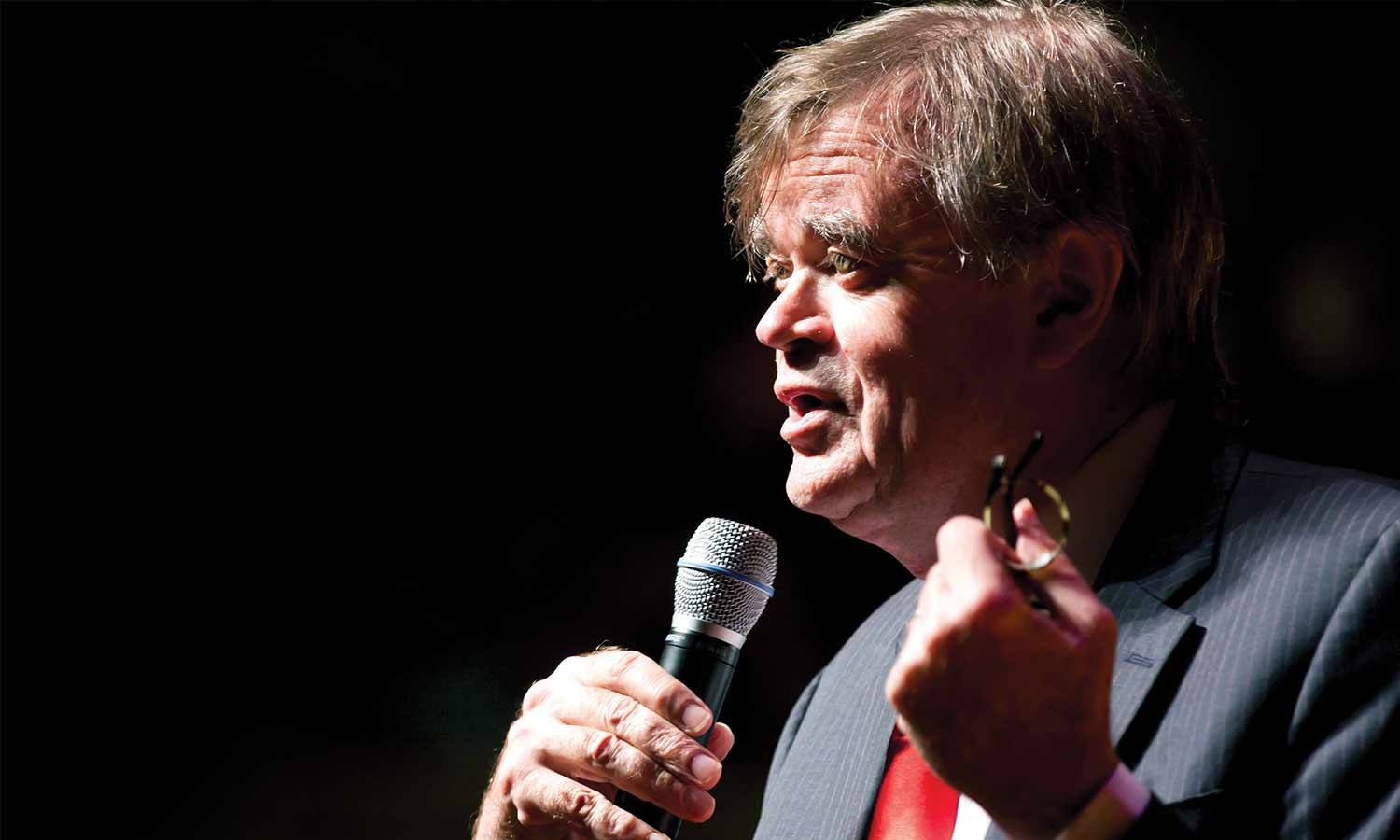 It struck me while listening to Garrison Keillor read from O, What a Luxury at The Fitzgerald Theater that maybe as we get older we become more ourselves. That is, if we’re living right. With age comes either the courage or the exhaustion necessary to sit in our true selves and relax a bit. Other people can either take it or leave it.
Keillor started out the evening telling stories about trying to write dark, mysterious, emotional poetry, trying to be someone else. It took him awhile to find his poetic stride– pithy, light verse that is both silly and profound. He and his poems are so unabashedly, so unapologetically him. His poems claim “I’m white, I’m Norwegian, I’m Minnesotan, I’m Lutheran. And I’m proud, gosh darn it.” I am in love with a man who shares many of Keillor’s qualities. A friend of mine once described Dan as “a stoic Norwegian with a quick wit.” So take, for example, Keillor’s Poem, “That’s Me,” which could also be titled, “That’s Dan:”
That’s Me
I’m a minimalist from Minnesota,
Don’t waste my time and I won’t waste yours.
You are the woman I love, of course.
I’m crazy about you and always have been.
And don’t make me say it again.
Cause I’m a minimalist from Minnesota,
A man of monumental brevity.
That’s me.
I also enjoyed Keillor’s candor because in my daily struggle to be anti-racist, I still baulk at being able to see, think about and claim my whiteness as a color. It was so refreshing, such a relief to laugh with Keillor about his particular brand of whiteness. Here was a crowd pleaser from the night:
Why I Live in Minnesota
Where the temp gets down to thirty below
And it’s perfectly flat, miles of snow,
And you ask why I live in this desolate spot.
Why? Because you do not.
You in loud clothes
With lacquered hair
And monster pickups
And not much upstairs,
Who whoop in church
And worship the Word,
For whom evolution
Has not yet occurred.
The men shoot gators
Out in the marsh,
While the women stay home
And hang up the warsh.
It’s all about rifles
And the second comin’
And wave the flag
And down with Gummint
And up with football
And the G.O.P.
Now what if those people
Lived next door to me?
And the only thing
That keeps them away
Is the fact it will hit
Minus thirty today?
Winter’s a challenge
But it can be faced
When you’re among people
With brains and good taste.
What? Can he say that? Yep, he can, and he did. We, the audience of mainly white Minnesotans laughed because the poem resonated with us and encouraged us to claim who we are. My family came from Ireland, was formed in the Catholic Church and decided to settle in Minnesota for a reason. I have a heritage and a story and genes that someday, I hope to be able to sit in more fully and write about like Garrison Keillor.
On our walk to the car, Dan, without losing stride, touched Keillor’s elbow and said, “Thank you,” to him while he was signing someone’s book. He wanted to acknowledge him without taking up too much of his time. Keillor looked up briefly and answered, “Thank you.” Oh, men of monumental brevity.
October 11, 2013
Malala’s World!
Malala is, as we say, blowing up. As she should be.
A few quick thoughts on her interview with Jon Stewart. Happy International Day of the Girl!
1. Malala mentions her father a few times. In my work with girls in Kibera, so many of the girls who are doing well have strong fathers who advocate for them. Girls can’t do this work on their own. Our boys will be fathers some day. We can’t forget about the boys. We are all wrapped up in this work.
2. Malala speaks poignantly about nonviolence, the work of taking violence and hatred into our very bodies, transforming it, and exuding it back into the world as truth, peace and light. Jesus did it. John Lewis did it. The work of nonviolence takes training and fierce commitment. It comes with a price. But it works.
3. Jon Stewart is overly sentimental with her. He uses the world “humbled” a bit too much for my liking. Is it her age? Her gender? Her nationality? She is incredible and awe inspiring, don’t get me wrong, but he doesn’t cover his mouth or tread so carefully with other guests. He is cute with her. I think it would be less demeaning to take her off her pedestal and treat her like an equal and the force that she is.
4. We need to be reminded that education really does come down to things like water and electricity. It is hard for us in the US to imagine sometimes, but we need to believe it, stop throwing around words like justice and peace and work with real, tangible things like latrines and rice and sanitary pads.
5. I would love to see the beautiful hometown that she speaks of. I have no schema in my brain for where she comes from, as Jon admits at the end as well. This is part of the problem. Quoting a former student at a massacre site in El Salvador, “Why do such ugly things happen in such beautiful places?”
6. Guns and God never go well together.
7. It shouldn’t be too much to ask to go to school and learn without worrying about being shot. More kids than we dare to admit are living this reality all over the world, the United States included. As Malala says, school teaches you about justice and how to talk and how to live and equality. Kids need to sit next to other kids who look different and think differently and worship differently as they are learning how to be people. History and chemistry are good, too.
8. In deciding to have children, deciding how much schooling I want, deciding how much I want to stay home and how much I want to be out in the world, I am so aware that these are decisions I have. She explains the four walls of her home as a prison. Mine is a palace. Not because it is bigger, but because I am choosing it.
9. Greg Mortenson’s Central Asia Institute has a horrible efficiency ratio. He didn’t handle the money well. True. And his books were not fact checked. True. And building school buildings does not mean that girls are going to school. True. But Malala shows us that Greg Mortenson was onto something. We can tear him down, yes, but let’s also join him in caring about education all over the world as a way to stop wars and empower girls, which will save us all.
10. The Taliban shot the wrong girl. Keep speaking truth to power Malala!
October 5, 2013
Kind Of Satisfied With Your Product And Then You Die
Louie C.K.is on to something here. It’s easier to be mean to people we see as other, and it’s easier to see people as other through a screen. Phone interaction is not the same as human interaction and the former is detracting from the latter, keeping us from facing full human emotion. Being able to sit still and be a little bored is part of being human. The phone is not at fault. The tool is great and should be continued to be used. We can use our tools with intentionality and integrity in a way that maximizes our humanity, but we have to work for it.
I’m an intimate extrovert with a high capacity for connection, friendship and empathy. I get tired at big parties, but leave a great lunch date inspired and stimulated. Needing intimacy, I’m aware and sensitive to the societal shifts away from human interaction toward virtual interaction. As addiction to our phones becomes more acceptable in society, I feel more lonely and tired. I like the art of conversation with uninterrupted momentum and true human, unadulterated presence. When my flip phone broke, dying a valiant death of a beer spill, I bought a smart phone and committed to my own code of ethics wherein I try not to treat my smart phone like a morphine drip. I keep it put away when there is potential of interacting with other people in the flesh, thus finding myself sitting more regularly watching people stare into the vortex of their phones. I am struggling more and more to keep to my code of ethics. But I do believe in building up my health and empathy skills through existing in the world of real social encounters.
This addiction to screens has real consequences. When I taught high school theology, I invited young people to unplug and practice human interaction. I paired them and forced them to have one-on-one conversations. We talked about attentive body language and what to do if there is a lull in the conversation. Young people actually have to practice this. I switched the pairs several times throughout class. Pushing through awkward silence, getting curious, asking follow up questions, and laughing, they talked to kids they weren’t supposed to, according to the unwritten rules of high school. They learned new things about their friends, too, and they seemed to sense intuitively that human connection is sacred. Every time they begged, “Ms. Roscher, when can we do this again?”
I replied, “You can do this at any moment of your day. All you’re doing is talking to each other.” But their normal is making it harder and harder for them to carve out time for genuine human interaction in a way that’s socially acceptable. They wanted me, an adult, to require them to talk to each other, to make them do the right thing. Kids need help creating new boundaries for the changing world. Kids want human interaction, but they need adults to hold us all to a higher standard. Our phones are tools that can be used or abused, meant to enhance our lives, not take them away. It’s the challenge we face in our quests to stay connected as human beings. Preach on, Louie.
Kind Of Okay With Your Product And Then You Die
Louie C.K.is on to something here. It’s easier to be mean to people we see as other, and it’s easier to see people as other through a screen. Phone interaction is not the same as human interaction and the former is detracting from the latter, keeping us from facing full human emotion. Being able to sit still and be a little bored is part of being human. The phone is not at fault. The tool is great and should be continued to be used. We can use our tools with intentionality and integrity in a way that maximizes our humanity, but we have to work for it.
I’m an intimate extrovert with a high capacity for connection, friendship and empathy. I get tired at big parties, but leave a great lunch date inspired and stimulated. Needing intimacy, I’m aware and sensitive to the societal shifts away from human interaction toward virtual interaction. As addiction to our phones becomes more acceptable in society, I feel more lonely and tired. I like the art of conversation with uninterrupted momentum and true human, unadulterated presence. When my flip phone broke, dying a valiant death of a beer spill, I bought a smart phone and committed to my own code of ethics wherein I try not to treat my smart phone like a morphine drip. I keep it put away when there is potential of interacting with other people in the flesh, thus finding myself sitting more regularly watching people stare into the vortex of their phones. I am struggling more and more to keep to my code of ethics. But I do believe in building up my health and empathy skills through existing in the world of real social encounters.
This addiction to screens has real consequences. When I taught high school theology, I invited young people to unplug and practice human interaction. I paired them and forced them to have one-on-one conversations. We talked about attentive body language and what to do if there is a lull in the conversation. Young people actually have to practice this. I switched the pairs several times throughout class. Pushing through awkward silence, getting curious, asking follow up questions, and laughing, they talked to kids they weren’t supposed to, according to the unwritten rules of high school. They learned new things about their friends, too, and they seemed to sense intuitively that human connection is sacred. Every time they begged, “Ms. Roscher, when can we do this again?”
I replied, “You can do this at any moment of your day. All you’re doing is talking to each other.” But their normal is making it harder and harder for them to carve out time for genuine human interaction in a way that’s socially acceptable. They wanted me, an adult, to require them to talk to each other, to make them do the right thing. Kids need help creating new boundaries for the changing world. Kids want human interaction, but they need adults to hold us all to a higher standard. Our phones are tools that can be used or abused, meant to enhance our lives, not take them away. It’s the challenge we face in our quests to stay connected as human beings. Preach on, Louie.
September 16, 2013
A Few Bold and Crazy Hopes
 At the end of August in 2011, Dan and I got in a Uhaul and started driving toward Hurricane Irene. New York was our destination. I would be starting an MFA program at Sarah Lawrence, a school I never visited. The only thing I knew about our life in New York was that my first workshop professor would be JoAnn Beard. I bought her book, Boys of my Youth, and Dan and I took turns reading it aloud to each other while the other drove. I adored it. This was going to be amazing.
It was. At the end of May of 2013, I was exhausted from finishing a psychologically rigorous program and stumbling through the thesis. Too thwarted for a lively celebration, I instead picked up JoAnn Beard’s In Zanesville and didn’t get off the couch until I turned the last page. I ate it like bread.
 I consider myself lucky to have JoAnn Beard bookend my Sarah Lawrence experience. She taught my first and last workshop. She authored the last book I read before I started the program and the first book I read after I finished. She is a Zen goddess, a master teacher, a lovely human being and a truly gifted writer. The very last assignment she gave us at Sarah Lawrence was to write about what contribution we wanted to make to the writing world. Yikes.
At the end of July in 2013, Dan and I packed up a Penske truck and started driving back toward Minnesota. Here I sit, transitioning into the life of writer without the support of a school program. There is no more homework, just work. I realize now even more than in May, what a gift that last JoAnn Beard writing assignment will be for me in the year to come. A bold, ridiculous, hopeful credo to come back to when I lack confidence or focus. It’s a document in progress, of course, but I want to share bits and pieces of it with you to witness and hold me to. Thanks for being with me on the journey.
Let’s talk about what happens when women like Ani DiFranco, Dar Williams, or Brandi Carlie take the stage. They create music that reverberates in my chest. I weep. They have the ability to fill an entire auditorium with their voices while singing to only me. There’s something about these empowered, graceful, fearlessly unfettered, wise artists that makes my heart whisper, “I want to do that.” I want to find words inside me that are true. I want to use my voice to share those words, to tell stories that dignify other people, that dignifies me. I want to encourage other women to stand up taller and be moved to find their voices, too, to add to the beautiful conversation.
I hope to write for myself in a way that lures me to a deeper appreciation of my consciousness, that invites me to be tender with my story and generous with my own spirit.
I hope to write stories that challenge us to keep dismantling limiting hierarchies that get between us and our own humanity. I spent last summer in a slum in Kenya at a free school for girls. One of those girls, Asha, was my intern, helping me with my research project. We became very close and continue to email back and forth. I read her writing and encourage her to keep going when slum life gets heavy. The day before I did a public talk to tell the story of the school that changed Asha’s life, she sent me a note. It said, “You will shake the world with your truth. They are ready to listen. Maybe, God willing, because of what you say, the world will be ready for me to take the stage and tell my story some day. Right now it’s your turn. One story at a time.” I want to take my turn and then watch Asha shine.
Truth does not lie in separation from but in deeper engagement with the universe. The world is filled, and filled with wonder. To see this is to be made free. I hope in my creative process to be able to convey the extraordinary that surrounds and embraces us. There is reverence in repetition. There is transformation in the beauty of the ordinary. The grace, the light of a brief encounter, of the greening weeping willow, of coffee brewing. There could have been nothing, but there is something, and that something is very good. There could have been nothing, but instead there is you, me, this. It is good. We forget that, in the drudgery of life. We forget to look around with the amazement of a child. We forget to be kind to each other and make apple pie and plant trees. I want to remember.
August 12, 2013
The Accidental Universe
 Alan Lightman wrote a fantastic essay for Harper’s Magazine that then got selected for The Best American Essays of 2012. It’s called “The Accidental Universe.” I highly recommend reading the whole essay, but I want to address it here. In the essay, Lightman talks about the history of science as recasting things once thought to be phenomena as explainable events necessary considering ever growing understanding of laws of nature. Things like the color of the sky or the temperature of boiling water were once miraculous and now easily explainable. “This long and appealing trend,” he writes, “may be coming to an end.”
Recent scientific developments are leading physicists to believe that our universe is one of several universes and that what we used to think of as necessary consequences of laws of nature are actually accidental. “Multiverse” is the term coined for the totality of universes. Theoretical physicists are uniquely distressed about the multiverse theory. Theoretical physicists work on explaining the why behind discoveries. They want to explain the properties of the universe in terms of fundamental principles. They believe in laws of nature that govern the behavior of matter. They want everything to make sense. Implied in their work is one universe with one set of rules. The fewer principles the better. Success is reached when every mystery is solved, when everything in our universe can be explained by scientific truth. If there are multiple universes with different properties, the work of theoretical physicists will never be the same again. The search for one set of answers may be coming to an end. “According to the current thinking of many physicists, we are living in one of a vast number of universes. We are living in an accidental universe. We are living in a a universe incalculable by science.”
To explain the shift in thought further, Lightman uses a fish analogy. It is like theoretical physicists are a group of fish who set out to prove that the entire cosmos needs to be filled with water to support life. The world they can see is the only one that must exist. If another world did exist, it too must be life in water. They are never quite able to prove it, and then some fish start imagining that maybe there are dry worlds where life exists, too. Some fish are relieved, some think their life work in proving the necessity of water a waste. Still other fish are concerned because there is no way for the fish to do research in the dry worlds to prove the theory. It remains a conjecture. “We must believe in what we cannot prove.”
This shift in thought has consequences for religion. Many people believe the multiverse theory does not leave room for a Designer. There are many universes, and ours happens to have the conditions that support life. We are here, so our universe permits the emergence of life. We are an accident. A benevolent creator does not necessarily fit in the story.
Or did God just get bigger in our minds? The multiverse theory is asking physicists to accept that there will always be mystery in the universes. “Theologians are accustomed to taking some beliefs on faith. Scientists are not.” What would it mean for our faith today if the multiverse theory is correct? There may be countless other universes out there. Some may have stars, others may not. Some may be infinite. We will never know. And for me, that feeds my faith and fills me with wonder and awe.


