Colin Wee's Blog
January 6, 2026
Okinawa Reflections
In October 2025, I travelled to Okinawa as part of my ongoing research for a historical fiction manuscript set in 19th‑century Ryukyu. My book project follows a group of bureaucrats navigating the political and cultural pressures of the Japanese annexation, and I knew I couldn’t write about that world responsibly without spending time there myself. Even though the book is historical fiction, I wanted to avoid grossly misrepresenting the people, the culture, or the context I was drawing from.
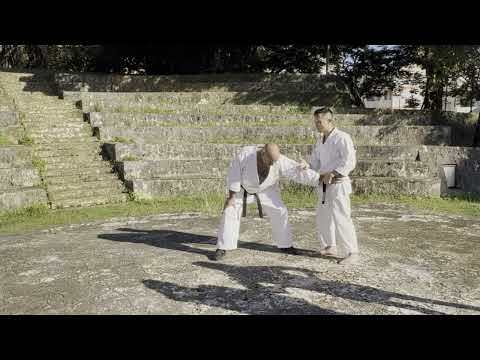
During the trip, I had the opportunity to teach at a Master Instructor Seminar held at Midorigaoka Park in Naha coordinated with Okinawa Karate Day. My session focused on Jion kata bunkai, using applications and tactical logic that tie into themes from the manuscript. The work blended structural mechanics, hard‑ and soft‑style concepts, and principle‑based interpretation. It was a good chance to share ideas in front of expert practitioners who enjoy the roots of these traditions as much as I do.
One of the moments that has stayed with me wasn’t from the seminar itself, but from a quiet visit I made with our small group to the graves of Matsumura Sōkon and Itosu Ankō. Standing there and speaking about their lives and contributions felt significant in a way that’s hard to articulate. It wasn’t about romanticising the past; it was simply to acknowledge the people whose work shaped so much of what we practise today. That experience grounded the rest of the trip for me.
Being in Okinawa helped me understand the environment, rhythms, and cultural texture I’m trying to represent in the manuscript. It also reminded me that martial arts is always connected to real people, real places, and real histories. That’s something I want to carry forward in both my writing and my teaching.
As I prepare for the American Karate and Taekwondo Organization’s 50th anniversary event next March, I’m looking at how to integrate insights from this research, the Jion applications I’ve been finessing, and material that aligns with AKATO’s lineage. My aim is the same as it has always been: to share what I can, as clearly and respectfully as possible, and to contribute in a way that allows us to celebrate the traditions we’ve inherited.
I’d love to hear what you think. Better yet, if you’re on Goodreads, drop a question there. What would you want to see in a historical fiction story about martial arts? What kind of character would speak to you?
—Colin Wee


September 19, 2025
A Conversation on The Lost Scrolls of Ryukyu
Back in May 2025, I sat down with my editor David Moore here in Perth to talk through a new project we’ve been working on. It’s called The Lost Scrolls of Ryukyu, and while the title hints at something ancient and mysterious, the real story is about Karate—how it evolved, how it was shaped in resistance to the Japanese Empire, and how we might retell that journey through historical fiction.
The snippet we filmed is twelve minutes long, but it captures both of us bouncing ideas, challenging each other, and trying to talk about a narrative that respects martial tradition while exploring new creative ground.
That week, apart from other things, we talked about:
What Breaking Through revealed about Bassai Dai kata and practical bunkaiThe strengths and contrasts between hard style and soft style martial artsHow concepts like chi energy, structure, and manipulation play into trainingWhy historical fiction might be the right vehicle to explore Karate’s origins in RyukyuThe challenge of building character arcs from real martial arts personalitiesAnd how tactical decisions—like stripping soft-style elements from a new hard style methodology—affects both story and philosophyThere’s also a bit of behind-the-scenes talk: photography, editing, manuscript prep. Just two people trying to make something meaningful.
If you’ve read Breaking Through, you’ll probably see the through-line. This new project builds on the same foundation—kata as a living document, tradition as a conversation, and martial arts as a lens for understanding human conflict and growth.
I’d love to hear what you think. Better yet, if you’re on Goodreads, drop a question there. What would you want to see in a historical fiction story about martial arts? What kind of character would speak to you?
—Colin Wee
March 23, 2025
The Last Samurai
The Satsuma Rebellion of 1877 was a final stand by the samurai class against the sweeping reforms of the Meiji government. The Meiji Restoration had ushered in modernization, military conscription, and the abolition of the samurai, dismantling the very social order that had defined Japan for centuries. Many samurai saw these reforms as a betrayal—of their status, their traditions, and their very way of life.
Yet, despite their resistance, Japan as a whole was focused on a singular goal: preventing colonization by foreign powers. The country’s rapid modernization was not just about progress—it was about survival.
The film The Last Samurai captures this tension through the fictional Nathan Algren (Tom Cruise), a tortured military officer drawn into Japan’s internal struggle. In one pivotal scene, he clashes with Omura, a self-serving official whose commercial interests were tied to Japan’s new capitalist economy. Omura sought to marginalize the samurai, ensuring they had no place in this modernizing world. Algren, repulsed by Omura’s disregard for the human cost of progress, would later find himself identifying with the samurai.
The historical reality was even more brutal. The samurai’s final stand culminated in The Battle of Shiroyama, where Saigō Takamori, once a leader of the Meiji Restoration himself, chose to die for principle rather than accept the new order. Outgunned and vastly outnumbered, his forces fought until their last breath. Saigō, wounded, committed seppuku on the battlefield, his death marking the end of an era.
“Yet, the Samurai had been swept aside by the very nation they wished to protect.”
—Colin Wee, Excerpt from “The Lost Scrolls of Ryūkyū” (Unpublished Manuscript, 2025)
Many misinterpret The Last Samurai—it was not about a foreigner becoming Japan’s last warrior but about a man who chose to stand alongside the last of the samurai, honoring their code, their discipline, and their sacrifice.
By the time the Meiji era ended in 1912, Japan had fully transitioned into a modern imperial power. The samurai were gone. The country was now a rising force in the global arena. But for its annexed territories, such as Okinawa, modernization brought no relief. Okinawans remained dispossessed, their hopes for autonomy growing ever dimmer.
Historical fiction novel The Lost Scrolls of Ryūkyū follows a small group of Okinawans in this era, advocating for the establishment of a new system of Karate—one that could survive the political upheaval around them and improve their cultural security. As Japan entered the Great War, and as militarism took hold of the nation, these men were forced to ask themselves:
Were they building a legacy that would protect people—or a tool that would serve the empire?
Ankō Itosu’s proposal to the Ministry of War included the following in his second precept:
“If children were to begin training naturally in military prowess while in elementary school, then they would be well suited for military service.”
While the visuals of Itosu’s proposal didn’t look all that great in regards to the training of Japanese soldiers, the question was about who it would eventually serve and what it would become.
The Japanese people, too, were being swept into an era they were not fully prepared for. Modernization had cost them their samurai, their stability, and their traditions. And despite Okinawa’s own suffering, its masters saw that their knowledge could help anyone struggling to find their place in a changing world.
The above is a behind-the-scenes look at Colin’s latest historical fiction novel titled “The Lost Scrolls of Ryūkyū.” While you stay tuned for further updates, perhaps you’d care to explore the Occupied Okinawa: A Documentary Film by Robert Kajiwara from Peace for Okinawa Coalition.
March 20, 2025
Bushi Matsumura and the Boxer Rebellion
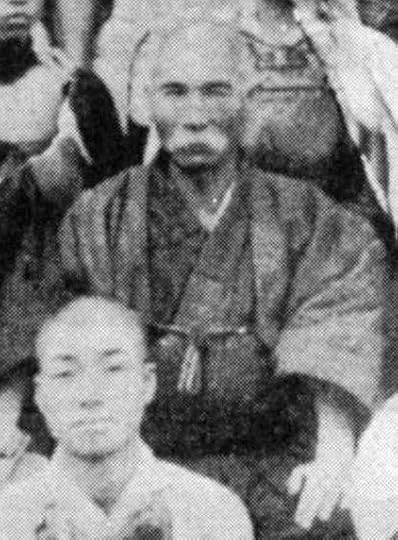
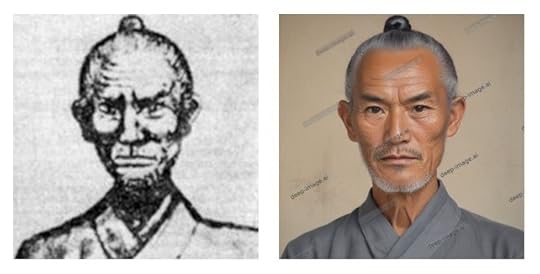 Bushi Matsumura Portrait Drawing on Left, and AI rendition from https://deep-image.ai/ on Right
“Recently, Ankō briefed us on the Boxer Rebellion in China, an uprising instigated by the Society of Righteous and Harmonious Fists … [who] were anti-foreign, anti-imperialist, anti-Christian, and ultra-violent. … the boxers believed an Eight Trigrams Society ritual … endowed them with spiritual protection, making them invulnerable to modern weapons. Hearing this, Sensei coughed out one of his rare laughs, startling the hell out of the two of us. Even Ankō, who had faced off samurai, pirates, a battalion of U.S. soldiers, local gangs, and his fair share of annoying bureaucrats was unnerved.”
– Colin Wee, Excerpt from “The Lost Scrolls of Ryūkyū” (Unpublished Manuscript 2025)
Historical fiction allows an author great liberty when working interpersonal relationships and exploring internal struggles which are both key in bringing a person to life. In saying this, a certain amount of effort has gone into “The Lost Scrolls of Ryūkyū” to present the history and people with care and fidelity.
There are two instances the book departs from this, and I’d like to talk about the one shared in the above excerpt. While I won’t give away too much, this is a scene between the legendary Matusumura Sōkon, Itosu Ankō, and Asato Ankō.
My eventual hope, of course, is a reader would pick up this book, get invested in the characters and their arcs, attempt independent research on the subject, and then discover the events and situations I have portrayed are indeed factual. Or, some would say, “real.”
When you drill into Matsumura’s backstory, however, you find his birth and death are wildly different dependent on the source you use. For instance, Wikipedia states Matsumura passes in 1899, which is the same year the Boxer Rebellion starts. Other sources list his passing in 1896 or 1901.
The Boxer Rebellion https://en.wikipedia.org/wiki/Boxer_Rebellion as explained in the excerpt was a violent uprising against what they saw was an increase in foreign invaders and collonialists in China. While the situation was explosive and complex, these sentiments mirrored sentiments of pre-Meiji era Japan. Elements of the Boxer Rebellion and the “mystical power” the boxers believed to have been granted by the Eight Trigrams Society ritual are featured in Jet Li’s Once Upon a Time in China movies (watch the first clip to the end, then see how their mudras fail them after getting a kick from Wong Fei Hong in the second clip 0:37).
Matsumura may have had an inkling of the foment happening in China leading up to the Boxer Rebellion. Up to his death, Ryūkyū Shimpo, the island’s newspaper, would have been in operation for 6+ years. The newspaper would have had experience by then covering the First Sino-Japanese war, the anti-Japanese sentiment, and the complex fractionated politics of Ryūkyū’s bid for independance.
Why I couldn’t resist bringing Matsumura and the Boxer Rebellion together was the huge contrast between the legendary Bushi Matsumura, his predilection for risk analysis, pragmatic combat, stategic preparation, and obsession with martial effectiveness, and the “Boxer fighters, [who were] convinced they were invulnerable to foreign weapons.”
In modern parlance, Bushi Matsumura would better be labelled as a RBSD or Reality Based Self Defense practitioner rather than a “Traditional Karate Master.” The face presented in the portrait above and the AI rendition on its right shows it all: a person who has spent a lifetime being the security advisor to the Ryūkyū Kingdom would be laser-focused on what works, avoiding any fantasy of being invulnerable to the weapons of the day.
We know this because Matsumura travelled extensively to acquire the skills and to refine knowledge that would make him a more formidable adversary. This is irrespective of Ryūkyū having been disarmed by their Satsuma overlords. Side note: for history buffs, Matsumura travelled to Foochow in 1860, and would have been a stone’s throw from the real Wong Fei Hong, who was the medical officer for the Black Flag Army in Guangzhou at the time.
So while facts may have been stretched, I felt the need to unfold the story this way to focus on the truths important to these masters. Readers may be interested to look into Matsumura’s makimono to understand the “true martial way” he described and the pitfalls he wanted all practitioners to avoid. These are relevant now as a warning against wishful thinking in martial arts as they were when they were written in 1882.
The above is a behind-the-scenes look at Colin’s latest historical fiction novel titled “The Lost Scrolls of Ryūkyū.” Stay tuned for further updates.
March 19, 2025
慈恩 Jion Temple Sound Kata
There’s something satisfying about peeling back the layers of a kata—tracing its roots, understanding why it evolved the way it did, and ultimately, figuring out what it’s trying to teach us. But it’s even better when you see how it all fits into the bigger picture.
Jion is one such kata. It’s a name that immediately conjures a certain kind of reverence—a sense of dignity, calmness, and restraint. But why? Where does it fit into our history?
If we go back to the years following the Ryūkyū Disposition, we find ourselves in a period of transformation. The old ways weren’t just under scrutiny—they were at risk of being lost altogether. The martial arts we had once trained in secret were now stepping into the public eye, and Itosu was the one leading the charge.
By the time Karate entered the Okinawan school system in 1901, Ankō had already been working on something new. Something scalable. Something that could be taught en masse without losing the essence of our training. It was during this time that the Pinan series was born, a structured set of forms designed to introduce students to the fundamentals in a way that could be replicated and standardized.
Jion was developed around this same time. Not a battlefield kata like some of the older ones, but one that embodied a shift in thinking—a kata designed not just for combat but for teaching control, poise, and an understanding of when not to fight.
Ankō himself had once explained it best:
“Jion doesn’t feel like a battlefield kata because it’s not meant to be. Not every fight starts with fists swinging. Some of the more dangerous conflicts I’ve been in were fought with words and gestures. Jion wasn’t about going for the win at all costs. It was about positioning, and choosing when—not if—you need to fight.”
This kata wasn’t simply a holdover from a bygone era—it was a message in a bottle, sealed with every lesson Ankō had fought to preserve.
The Shift from Tōde to KarateThis change didn’t sit well with everyone. Those who had trained in the old way, the way of Tōde, saw the modifications and scoffed. They thought the new curriculum was a dilution, a softening of what had once been fierce and raw.
This wasn’t about changing for the sake of change. It was about survival—not just of techniques, but of the culture itself. Karate couldn’t remain locked behind closed doors, taught in secret to a select few. It had to adapt, to become something that could outlast us.
Ankō understood this. When he asked Asato to document the names, addresses, and abilities of Okinawa’s martial artists, it wasn’t just about preserving the past—it was about securing the future. A future where the martial arts weren’t just practiced, but passed on.
That’s why Jion matters. Not just as a kata, but as a philosophy.
Jion, the Spirit of Karate, and JDK USA in Schenectady NYJDK’s Schenectady seminar 2024 was nothing short of electric—a fusion of sweat, skill, and strategy that brought the JDK Method to life. To everyone who participated, thank you. Your commitment, curiosity, and intensity turned this event into something truly special.
This seminar highlight both Bassai Dai and Jion, but wasn’t just about techniques—it was about training for the inevitable. It was about refining not just how we move, but why we move the way we do. For more information see joongdokwan.com.
Here are some key takeaways from the weekend:
 Beyond Technique: Anticipating the Opposition
JDK isn’t about collecting fancy techniques—it’s about preparing for the fight that’s coming. We train for opposition, contingencies, and workarounds. A technique is only useful if it accounts for resistance.
Unveiling the Hidden Layers of Tradition
Kata isn’t just choreography—it’s a tactical playbook. We dissected, tested, and pressure-checked movements to ensure they hold up under realistic conditions. This isn’t about abandoning tradition; it’s about making it functionally relevant in the modern world.
Shield or Springboard? Using the Enemy as a Tool
Sometimes, the attacker hands you an advantage—you just have to know how to take it. We explored how to redirect momentum, using an opponent’s own force as either a shield or a springboard to control the fight, create space, or set up a decisive counter.
Ground Force: Kinetic Chaining for Devastating Power
Striking isn’t about isolated limbs—it’s about harnessing the whole body. We trained to generate force from the ground up, connecting movements efficiently to maximize power. Imagine striking not just with your hand, but with the weight of the entire planet behind you.
This seminar wasn’t just about refining skills—it was about rethinking the way we approach martial arts. To everyone who attended, you now carry these lessons forward. Train hard, stay sharp, and keep pushing the boundaries of what you know.
See you at the next one!
The above is a behind-the-scenes look at Colin’s latest historical fiction novel titled “The Lost Scrolls of Ryūkyū.” Stay tuned for further updates.
Ryūkyū Awamori
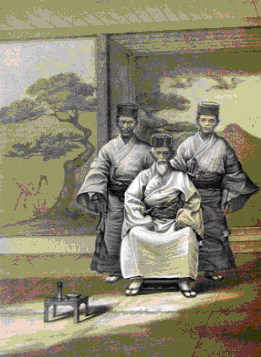 Lithograph of a photo taken by Commodore Matthew Perry of Ryukyuan Regent Sho Taimu, possibly flanked by Matsumura Sokon (left) and Itosu Ankō (right)
Shinzato Shuzo, established in 1846, is the oldest existing awamori distillery in Okinawa, and it’s known for its traditional techniques and the quality of its products, which includes the Ryukyu Classic and Shinzato 7 awamori.
At the time of its inception, Matsumura Sōkon aka Bushi Matsumura would have served the Shō government for just over a decade, and a young Ankō Itosu would have only begun training under Matsumura. It would take another four year until he became Secretary of Ryūkyū Kingdom.
Shinzato Shuzo indicated that when Commodore Matthew Perry and his black ships stopped in Ryūkyū in 1853, there were only three distilleries on the island sanctioned by the government.
Perry “landed two cannons and two companies of U.S. Marines … Along with 50 naval officers and two brass bands” at Naha port before he literally invaded Shuri Castle (Clayton, Shotokan’s Secret p77).
This means the awamori Perry may have enjoyed could very well have been from their distillery. If so, the lithograph on the left, taken by the Commodore, may show some of their awamori being served in the drinking cup in the lower left hand corner of the frame. For more information see The story of Commodore Matthew C. Perry’s trip to Shuri Castle in 1853.
Shinzato Shuzo is characterized by a deep richness and smell of awamori on the nose. On the palate, it is fruity and has refreshing drinkability. With aging, sweetness and umami are enhanced, resulting in a smooth and profound flavor.
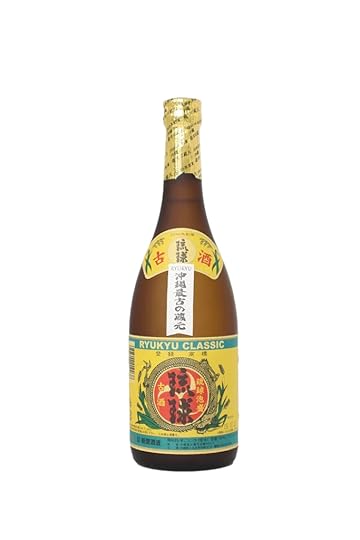 Ryūkyū Awamori Shinzato Classic
For those interested in trying what Matsumura Sokon, Itosu Ankō and Asato Ankō were drinking at the time, click on the image to the right. For those of you who are interested to find out more of this culture see The essence of awamori.
Shinzato Shuzo reel on their Awamori, Commodore Matthew Perry, and their manufacturing process: https://www.instagram.com/reel/DGp3XmjzuQw/?utm_source=ig_web_copy_link&igsh=MzRlODBiNWFlZA==
View this post on InstagramA post shared by Letsgokinawa (@letsgokinawa)
The above is behind-the-scenes research used for Colin’s latest historical fiction novel titled “The Lost Scrolls of Ryūkyū.” Stay tuned for further updates.
Itosu deals with Drunk and Disorderly Patron in Colin’s next Martial Arts Book
Historical fiction comes alive in Colin’s next martial art book. The following is inspired by the unfolding of an actual story within his manuscript.
“Indeed, Itosu was so well trained that his entire body seemed to be invulnerable. Once, as he was about to enter a restaurant in Naha’s amusement center, a sturdy young man attacked him from the rear, aiming a hearty blow at his side. But the latter, without even turning, hardened the muscle of his stomach so that the blow glanced off his the right wrist of his assailant. Still without turning his head, he calmly dragged the man inside the restaurant.
Funakoshi Gichin
(Funakoshi, Karate-do: my way of life: Funakoshi Gichin, 1975, p15)
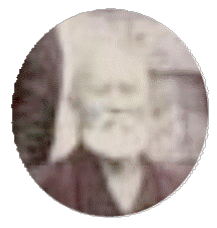 Anko Itosu in a group photo
Az said he had heard of this incident but wasn’t there that evening.
You’d be surprised how some strong, headstrong fellows behave. They feel the need to test themselves against someone well-known—sometimes as a drunken rite of passage, sometimes out of sheer arrogance. And let’s not forget the occasional grudge-holder who thought it was his duty to sneer at Shurite “parlor karate” or the new “empty hand shamisen” hacks.
Every time he heard that shamisen comparison he felt like hitting them with a real shamisen.
Anyway, this musclehead wasn’t looking for a fair fight, nor did he have the guts to come at Ankō from the front. He rushed in blindly, hoping to prove a point or end things quickly.
As for Ankō’s response? Exactly what we’d expect. We were always aware of our surroundings, even when relaxed. If the young man was making a scene, had poor footwork, or pulled back his arm before the strike, that would’ve been all the warning Ankō needed. He would brace his body, demonstrate the phenomenal conditioning he had acquired, and have the blow glance off without so much as a flinch.
Most men would have turned and retaliated. Ankō? He knew how to manage the optics. He calmly took control using soft power, dragged the attacker inside, and sat him down to sober him up. That’s the kind of man he was—no ego, and without the need for posturing. He knew he had nothing to prove. And by treating the fool with a little kindness, he landed the hardest hit of all.
The above is a behind-the-scenes look at Colin’s latest martial art book and historical fiction novel titled “The Lost Scrolls of Ryūkyū.” Stay tuned for further updates. If however, you’re here for ideas on what to do if you’re faced with a drunk and disorderly person, please see WA Mental Health Commission: Managing an intoxicated person.
Itosu deals with Drunk and Disorderly Patron
“Indeed, Itosu was so well trained that his entire body seemed to be invulnerable. Once, as he was about to enter a restaurant in Naha’s amusement center, a sturdy young man attacked him from the rear, aiming a hearty blow at his side. But the latter, without even turning, hardened the muscle of his stomach so that the blow glanced off his the right wrist of his assailant. Still without turning his head, he calmly dragged the man inside the restaurant.
Funakoshi Gichin
(Funakoshi, Karate-do: my way of life: Funakoshi Gichin, 1975, p15)
 Az said he had heard of this incident but wasn’t there that evening.
You’d be surprised how some strong, headstrong fellows behave. They feel the need to test themselves against someone well-known—sometimes as a drunken rite of passage, sometimes out of sheer arrogance. And let’s not forget the occasional grudge-holder who thought it was his duty to sneer at Shurite “parlor karate” or the new “empty hand shamisen” hacks.
Every time he heard that shamisen comparison he felt like hitting them with a real shamisen.
Anyway, this musclehead wasn’t looking for a fair fight, nor did he have the guts to come at Ankō from the front. He rushed in blindly, hoping to prove a point or end things quickly.
As for Ankō’s response? Exactly what we’d expect. We were always aware of our surroundings, even when relaxed. If the young man was making a scene, had poor footwork, or pulled back his arm before the strike, that would’ve been all the warning Ankō needed. He would brace his body, demonstrate the phenomenal conditioning he had acquired, and have the blow glance off without so much as a flinch.
Most men would have turned and retaliated. Ankō? He knew how to manage the optics. He calmly took control using soft power, dragged the attacker inside, and sat him down to sober him up. That’s the kind of man he was—no ego, and without the need for posturing. He knew he had nothing to prove. And by treating the fool with a little kindness, he landed the hardest hit of all.
The above is a behind-the-scenes look at Colin’s latest historical fiction novel titled “The Lost Scrolls of Ryūkyū.” Stay tuned for further updates. If however, you’re here for ideas on what to do if you’re faced with a drunk and disorderly person, please see WA Mental Health Commission: Managing an intoxicated person.
February 27, 2024
Exploring Past Your Comfort Zone: Colin’s Martial Arts Seminar in Schenectady, NY 2024
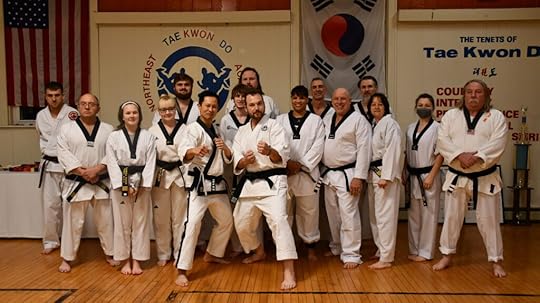 Participants at JDK;s Schenectady NY Seminar 2024
Beyond the Comfort Zone
A trip to Schenectady, New York, for a martial arts seminar in January 2024 pushed me outside my comfort zone. It followed a successful seminar and book launch in Dallas the previous year and presented unique challenges, from planning a seminar without much of a lead time, to navigating unfamiliar territory, and reaching out to martial art schools.
Stepping Outside the Comfort Zone
While Dallas 2023 resonated deeply, the upcoming seminar in New York felt daunting. It was uncharted territory, a stark contrast to the familiar warmth of Dallas. Yet, it presented an excellent opportunity to strengthen my working relationship with the host Master Will Just, who had connected with me five years prior, and was my demonstration partner in Dallas. He was captivated by our training methodology, particularly its emphasis on extracting practical applications from traditional forms. He even harbored the ambitious dream of establishing a branch of Joong Do Kwan (JDK) in New York.
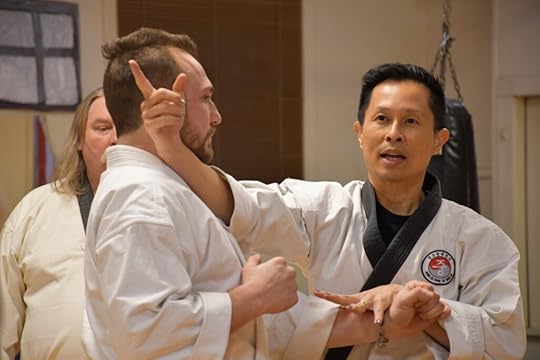 Colin demonstrates how a ‘receiving’ application can hit hard or soft on host Master Will Just
Fueling the Passion
Knowing his aspirations, I readily agreed to travel to New York when it coincided with my wife’s work trip. With her support, I encouraged Will to organize a seminar. However, the timing wasn’t ideal: the holidays and harsh winter weather presented significant hurdles. Undeterred by the challenges, Will, fueled by his positive experience in Dallas, mobilized his network, visited schools he wasn’t connected with, and promoted the event feverishly.
Commemorating and Moving Forward
As preparations progressed, a note of sadness shadowed our excitement. The trip reminded us all on the recent passing of my dear friend and book publisher, GM Mike Swope. His presence was deeply missed, and we spoke of him frequently throughout our time in New York, cherishing his friendship and guidance.
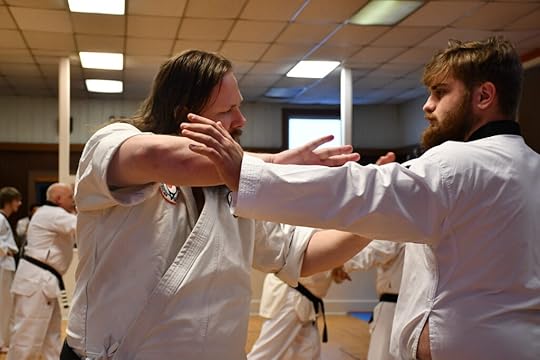 Jeff works a two-man application at Schenectady 2024
A Leap of Faith
Another unexpected encounter happened just days before the event. Jack Berry, the new editor of Taekwondo Times, reached out through FaceBook messenger. He was intrigued by our approach and expressed interest in me contributing articles. Stepping outside his comfort zone, just like myself was doing, Jack saw the Schenectady seminar as an opportunity for growth and exploration.
Mental Readiness
The long flight to New York offered the opportunity to delve into the seminar material through mental visualization. Isolated from distractions, I envisioned myself presenting, engaging the audience, working with my demonstration partner, and tackling any potential challenges. Landing in New York, despite the fatigue from the journey, I felt confident and well-prepared.
Beyond Lost Luggage and the Tribulations of Travel
The warmth and hospitality of the local martial arts community offered a sense of belonging, and the focus shifted to the training itself.
The seminar delved beyond the realm of “fancy moves” and flashy techniques. Our focus was on unlocking the hidden potential of traditional forms and exploring their practical applications in dynamic real-world scenarios. We emphasized the importance of anticipation, sensitivity to the opponent, adapting to the opposition, and even turning their aggression against them, like a water droplet navigating a powerful torrent.
A highlight was witnessing a Grandmaster seamlessly blend her police experience with the seminar material, demonstrating the inter-relatedness of tactical skill. We are all branches of the same tree!
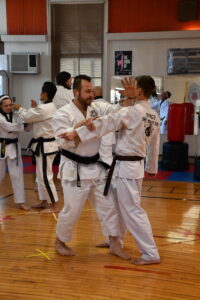 Master Will Just working a Knife Hand Strike on Taekwondo Times Editor Jack Berry at Schenectady 2024
Beyond Technique: Building Connections
Beyond the technical aspects, the trip fostered connections. Witnessing a passionate practitioner establish a new branch of my school in New York was incredibly rewarding. The genuine hospitality of the local martial arts community offered an unexpected sense of belonging.
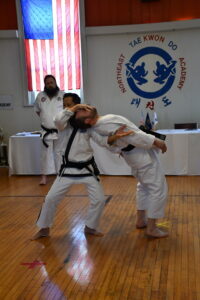 Colin Wee performs a number of unscripted skills, destabilizing Master Will Just off his base at Schenectady 2024
Beyond Expectations
This journey to Schenectady, far from being just another martial arts seminar, became a transformative experience. It reaffirmed the value of venturing outside comfort zones, embracing the unexpected, and fostering meaningful connections. It served as a reminder that growth often lies beyond familiar territory, and that stepping outside our comfort zones can open doors to new possibilities and enrich our lives in profound ways. This odyssey, filled with challenges and unexpected encounters, solidified my commitment to sharing my knowledge, fostering connections within the martial arts community, and continuing to learn and grow both as an instructor and an individual.
Note: A short reel on this seminar can be viewed at https://youtu.be/A_OeUdtNtM8?si=eCdgQrmOrfM9NEE4
Bio: Colin Wee is the Principal of Joong Do Kwan Tae Kwon Do in Perth, Western Australia, Author of Breaking Through: The Secrets of Bassai Dai Kata, and winner of the Best Indie Book Award for Non-fiction Martial Arts.
November 28, 2023
In Loving Memory: Honoring Mike Swope, Our Publisher, and Friend
With heavy hearts, we bid farewell to a cherished member of our community, Mike Swope, who, at 55, left us on October 1, 2023, after a motorcycle accident. Beyond a publisher, Mike was a beacon of light, etching an indelible mark on our hearts and the martial arts world.
Mike joined The Study of Taekwondo Facebook group in 2009, becoming an integral part of our community. His passion for martial arts resonated in every post, forging connections that transcended the digital realm.
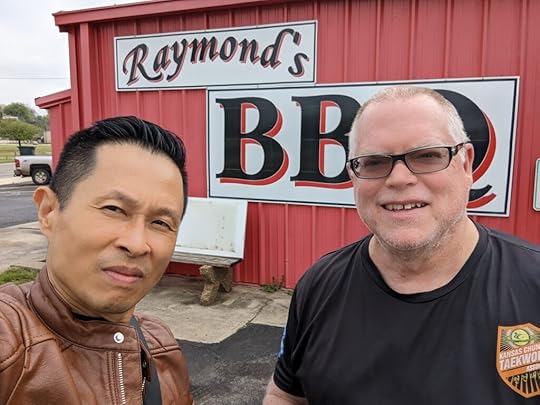 Colin Wee (left), and Mike Swope RIP (right) search out some amazing ribs during a lull in between launching the book and martial art seminars in March 2023.
In 2018, Mike’s talents as a writer and interviewer shone in Totally TaeKwonDo magazine. “An Interview with Sabumnim Colin Wee” showcased not just literary prowess but an understanding of camaraderie among high-level instructors. Little did we know, this marked the start of a beautiful collaboration.
In 2020, our paths crossed again with a manuscript. Entrusting Mike with “Breaking Through: The Secrets of Bassai Dai Kata” was an investment in a friendship that bloomed into something extraordinary.
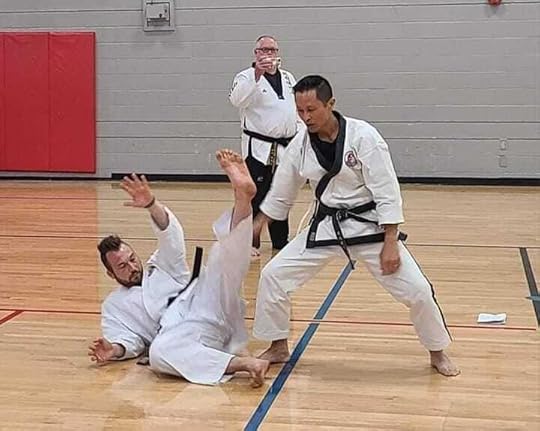 GM Mike Swope understood the power of the written word, but more importantly the visuals of a story.
Mike’s dedication was awe-inspiring. He saw beyond words, encouraging a rewrite to infuse more of “my voice.” A testament to his commitment, understanding of the interplay between words and illustration, and belief in authentic storytelling.
In March 2023, during a road trip around Dallas for the book launch, we met Mike in person. His warm smile mirrored the online friendship. Mike’s discreet contributions to our seminars showcased his humility and passion for martial arts.
Mike wasn’t just a publisher; he was a friend sharing our joys, challenges, and triumphs. His reviews reflected an authentic voice resonating with readers. His belief in our work fueled motivation during creative ups and downs.
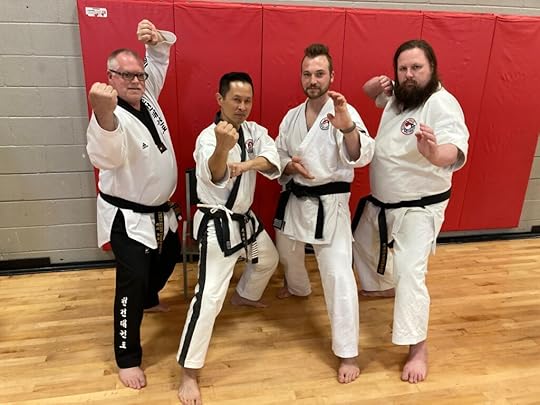 The Road Trippers 2023: GM Mike Swope, Colin Wee, Will Just, and Jeff Palm.
 Mike was a good friend, he will be missed.
As we grapple with Mike’s void, solace comes in tributes from the community. Phrases like “a stand-up guy” and “a great person who loved TKD” echo sentiments of many whose lives he touched.
Mike’s legacy transcends publishing. His passion for comic books, motorcycles, and sci-fi showcased the depth of his personality.
For condolences or Mike’s obituary, visit Mike Swope’s Obituary. As we navigate life without our friend and publisher, let’s cherish memories, shared wisdom, and the enduring impact of Mike Swope on our lives and the martial arts community.