M. Mark Miller's Blog
May 18, 2022
Under the Big M
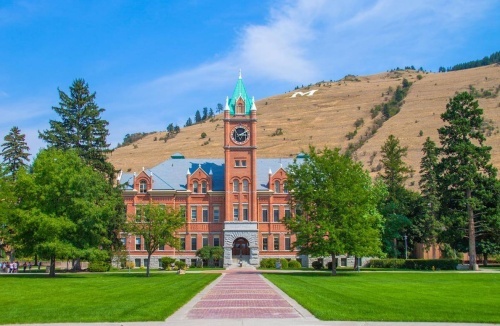 Looking across the Oval toward Main Hall, University of Montana
I’m working on a memoir about the four years I spent as a student at the University of Montana in the 1960s. You can see by glancing at the photo above why I titled it Under the Big M. I hope to capture the tenor of those turbulent times when I lived and grew there.
Even before I arrived in 1963, students were fighting in loco parentis, the idea that the University administration could — and should — make rules in place of parents. The onus fell mostly on women who were hemmed in by curfews and dress codes while men weren’t. The most absurd rule stipulated that women had to be in their dorms by 10 p.m. on weeknights — unless they had passed a swim test. Then they could sign out until 10:30. Apparently, the administration thought swimming had magical contraceptive properties for that half hour.
Things began to change after a thousand students marched on Main Hall to protest the Dean of Men suspending students for participating in a raucous snowball fight in front of a first-year women’s dorm. A dorm housemother, who must have heard about violent protests on other campuses, panicked and called police who were pelted by snowballs when they arrived and were bounced around by men jumping on their car bumpers. Police arrested three students.
The local newspaper described the incident as a “near riot.” Newspapers across Montana ran the story and wrote editorials about the need to control students. The university later determined that damages of the event totaled 37 cents for replacement of a cracked windowpane.
Students saw the obvious injustice of the suspension for participating in a snowball fight that ended quietly when women obeyed their curfew and retreated to their dorm rooms. Student activists organized a protest march and the campus newspaper endorsed it. The University president refused to come out when students approached the administration building. He left it to the Dean of Students to address them. The president did, however, appoint a student-faculty committee to look into the matter and eventually followed some ofits recommendations. The university set up a judicial review committee to examine administrative decisions on student conduct and to liberalize women’s hours. Meanwhile, suspensions were revoked and police charges against students all fizzled in court.
Before controversy over the snowball fight ended, another incident roiled newspapers across the state. After the student publications board ruled the student literary magazine could not publisha poem with “fuck” in it, the editor of the campus newspaper tried to publish it. The foremen of the university print shop refused to set the poem in type, so the newspaper editor distributed mimeographed copies in newspaper drop boxes across campus. I helped with that. Someone mailed a copy of the poem to the Montana governor’s wife and state newspapers were up in arms again.
About that time, university students across America were organizing against the Vietnam war and UM students joined them with teach-ins, marches and a draft card burning. I was at the first UM teach-in where a venerated philosophy professor quoted Jean Paul Sartre congratulating opponents of the war.
Activists’ early efforts sometimes were met with indifference and sometimes hostility. ROTC cadets called me a communist after I argued against the war in a classroom debate. Early anti-war marchers in Missoula were pelted with vegetables and pounded with sticks. Student opponents of the war were a small minority at UM in the mid-60s, but they became a majority soon.
In my memoir, I’m trying to braid events of the 60s with a descriptions of my personal adventures. During those years I watched my housemate cock his pistol and announce that he was going to kill a professor, got beat up by thugs who were looking for my gay housemates, and learned how to fake being crazy to avoid the draft. I also fell in love and got married. (After nearly 56 years, I think the marriage may take.)
I’ve been dredging through my recollections of those years and writing about them. I’ve also been going through the on-line files of the campus newspaper. It’s like playing whak-a-mole. Every time I begin to write about one thing, something else pops up. It’s been an endless trail of events and memories. I don’t know if I’ll ever get enough written to make a book, but I’m having fun trying. That’s the important thing.
∞§∞


April 16, 2022
Homework for National Park Week
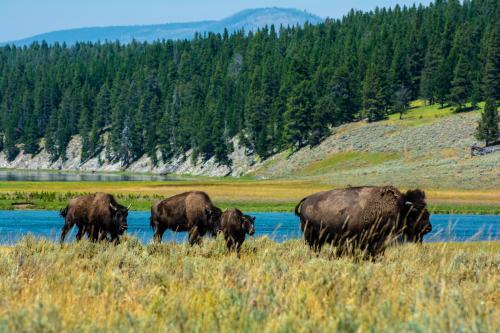 Yellowstone Bison along the Firehole River.
This year National Park Week begins on Saturday, April 16 and continues through Sunday, April 24. If your plans call for a trip to the world’s first national park, Yellowstone, which is officially 150 years old this year, I have some homework suggestions for you. You won’t be surprised that I’m recommending you read my books on park history. Let me add a little bit to the short descriptions to the right of this post or the longer description under the Book button above.
My latest book, Rediscovering Wonderland, describes the adventures of the trappers and prospectors who were the first Euro-Americans to see the area’s wonders. Their reports of a canyon a thousand feet deep, a lake 20 miles long at the top of the mountains, and boiling pools of water that spouted hundreds of feet into the air were often dismissed as tall tales. Rediscovering focuses on the adventures of the Washburn Expedition that explored the area in 1870. Members of the Expedition were prominent Montana businessmen and government officials whose accounts could not be doubted. They not only persuaded the public that Yellowstone’s wonders were real, but also lobbied the U.S. Congress for creation of the park.
The earliest explorers of the remarkable areas at the headwaters of the Yellowstone and Madison Rivers were men. But the ink on President Ulysses S. Grant’s signature on the document that created the park on March 1, 1872, was barely dry before women began visiting there. Sidesaddles and Geysers is a collection of stories by women who visited the park from the time when it was still a roadless wilderness through the dawn of the 20th Century when tourists sped through the park in comfortable carriages and stay in the most luxurious hotels in America.
Encounters in Yellowstone tells the stories of tourists who tangled with the Nez Perce in 1877 when the U.S. Army chased those Indians through Yellowstone Park. It tells the stories of Emma and George Cowan, a couple that planned to spend the second wedding anniversary in the park. Emma and her brother and sister were captured by the Nez Perce for days and then released in the middle of the park to find their way home. George Crawled for 10 miles trying to find help after the Indians shot him three times and left him for dead.
My first book, Adventures in Yellowstone, is a collection of a dozen classic stories like the ones you might hear in ranger talks when you visit Yellowstone Park. In addition to Emma Cowan’s account of her adventures mentioned above, you’ll read mountain man Osborne Russell’s descriptions of what he saw in the 1840s and learn about Eleanor Corthell’s trip in 1903 when she left her husband at home and took their seven children tour the park.
When I was signing copies of Adventures in Yellowstone at Old Faithful Inn, people kept asking for a book of campfire stories, that is, tales that could be read in one sitting. I accommodated them by compiling The Stories of Yellowstone, a collection of 72 anecdotes from 500 to 2,000 words long. Stories begins with a tale about John Colter, who is credited with being the first white man to see Yellowstone’s Wonders. It describes Colter’s being stripped naked by a Blackfeet warriors and ordered to run for his life. He escaped and made it to safety. The book ends with L. Louise Elliot’s hilarious story of getting even with an annoying travel companion by letting the air out of her pneumatic camp mattress.
After I finished my collections of Yellowstone travel stories, I discovered I hadl left-over adventures that didn’t stand on their own so I blended them together in a mid-grades novel. The result was Macon’s Perfect Shot, the story of a 14-year-old boy who takes a job assisting an artist who visits the park in the 1870s to earn money for his widowed mother. When Macon and his companion try to rescue a deer from a boiling geyser, the companion falls in. Macon has to grow up fast to figure out how to get is friend home. On the way, he encounters a vicious band of horse thieves and helps the sheriff bring them to justice.
Those are quick sketches of my books on early travel to Yellowstone Park. I guarantee that reading them will make your visit to Yellowstone Park more fun. In fact, I think you’ll find them fun even if you’re not planning a visit.
Ask for them from your favorite bookstore or order them on-line. Links for doing that are provided with the descriptions to the right of this post.
And celebrate National Park Week by visiting your favorite.
∞§∞
March 4, 2022
Revising a 30-Year-Old Manuscript
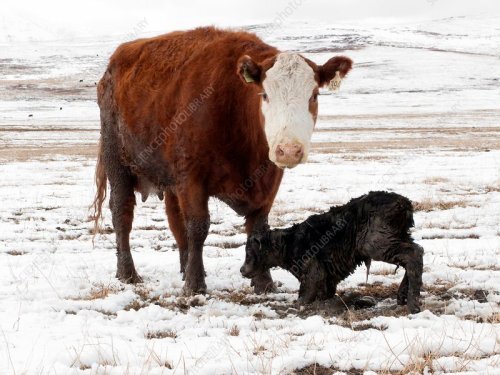 A crossbred cow with her newborn calf struggling to stand for the first time.
Last week I presented this poem to a writers group I belong to.
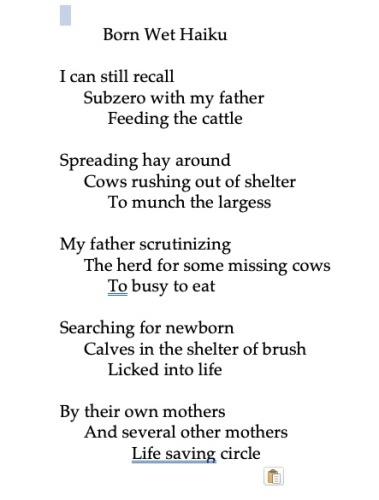
The group liked the poem, so I decided to share a short story that was inspired by the same incident. I wrote the story about 30 years ago so I figured it would need some revision. When I went to work on it, I discovered it needed a lot of revision.
I recalled something I used to do when I was a journalism professor at the University of Tennessee. I taught a beginning news writing class in a room with 20 workstations. At first students worked at typewriters because it was a long time ago, but before my teaching career ended they had computers.
That meant students worked on their own with no help from friends and under time pressure. It was good training for students who intended to have careers in today’s fast-paced news media.
One of the first assignments in the term was designed to teach students how to write traditional newspaper leads. The meant they had to write a single sentence would grab readers’ attention and focus them on the most important aspects of a story. Each student was given a set of 10 unorganized fact sheets and told to write as many lead sentences as they could in an hour.
When a student finished a lead, they raised their hand and I came around to approve or disapprove their effort. Most students could manage three or four approved leads before the deadline.
Late in the term I passed out a similar set of fact sheets and repeated the assignment. Most students finished the entire set of 10 in less than an hour. This, I told the students, demonstrated how much they had learned over the intervening weeks. (I’m sure my teacher evaluations improved on the question that asks how strongly they agreed with the statement, “I learned a lot in this class.”)
Like those exercises, my revision of the short story indicated how much I have learned in the 30 years that I wrote it. It was a lot.
I made a list of the changes I made while I was working on the story. When I went over the list, I discovered I was using the same kind of comments I made on student papers way back when.
The list is too long to duplicate, but here are some examples:
I’m embarrassed to report the list is too long to duplicate, but here are some examples.
Use strong active voice verbs.Use past, present or future verb tenses whenever possible. Avoid complex verb phrase such are “he would have been thinking” if “he thought” will work.Avoid adverbs. If you have a lot of words ending “ly,” you’re probably using the wrong verbs. Instead of “the vehicle hit the tree really hard” make it “the vehicle crashed into the tree.”And while you’re at it, use short concrete nouns that people can visualize. Make it, “The truck crashed into the oak tree.”Then you might add back some adjective and adverbs. “The dump truck crashed headlong into the hundred-foot oak tree.”I’m embarrassed to confess that I made such corrections — and others — repeatedly. The good news is that I’ve learned a lot in the last 30 years and the short story is much better. I hope the writers group likes it.
∞§∞
February 26, 2022
The Slough on the Ranch Where I Grew Up
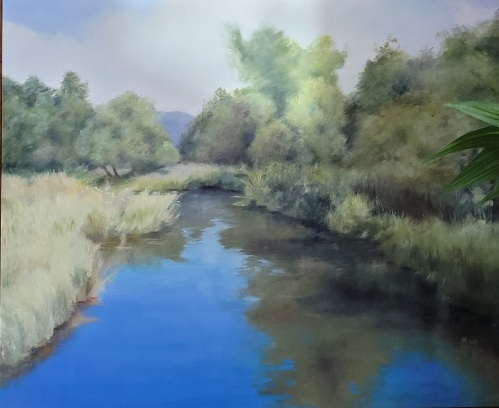
Last week I mentioned the slough on the ranch where I grew up in a poem that I shared. My eldest brother sent me the above painting of stream that wandered by about a quarter mile from the back door of our parents’ house. That got me thinking about the stream that meant so much to me growing up.
Sloughs are bogs or swamping area that form when rivers channels change. That’s what formed my slough. I grew up in the Jefferson River Valley in Southwest Montana and used to count myself lucky to live only a mile from the route of the Lewis and Clark Expedition. But it turns out that the Jefferson moved across the valley after the expedition passed by in 1804. What I call the slough was the main channel of the river back then.
Maps made right after Montana became a territory show the Jefferson in its current location, so it must have changed its course sometime between 1804 and 1864. Probably an ice jam blocked the river one spring blocking the slough route on the east side of the valley and creating a new channel on the west.
The banks of the slough are swampy and often have cattail bogs. Land there isn’t good for farming so it has never been cleared leaving a small band of cottonwood forest. I used to walk in that forest and watch for the creatures that lived there — birds, rabbits, squirrels, and deer. A walk like that was the subject of my poem.
My brother said the slough is smaller than it was when we were young, but I doubt that. He probably remembers when it flooded in spring and washed out the bridge on the way to Silver Star, the town where our parents picked up mail and bought groceries. When the bridge was out, we had to travel up the valley and circle around 10 miles to get to the town that was just a mile away.
After the flood waters went down our father opened a gate on each side of the stream so cars and trucks could splash through the shallow water. The crossing was open all summer until the county could build a new bridge.
When I was in high school, the U.S. Bureau of Reclamation built the Clark Canyon Reservoir 30 miles upstream on the Beaverhead River, a tributary of the Jefferson. The reservoir impounded spring runoff water for irrigation. The slough never flooded after that.
Also, when I was in high school, my father built a shed for fattening hogs on the east slough bank and washed their manure into the stream. The manure fertilized the slough and cattails sprung up on it banks. Floods that used to scour the stream bed every couple of years let the delicate growth remain making the slough look smaller.
The slough ambles to the south onto the ranch, then heads east and finally turns south again. At the last bend it tinkles over a gravel bar and runs into a placid pool. I used to sit for hours at that corner listen to the water and watch blackbirds that nested in a cattail-filled backwater. Mallards and teals also nested there. I had to be quiet to see the ducks, but sometimes they sailed silently on the still water.
Past the bend the slough spread into a pool 50 yards wide and 300 yards long. The water was deep enough for a good swimming hole and my brothers and I skinny-dipped there. One hot August day when my girl cousins were visiting, my mother dug scratchy wool bathing suits from her stash so we could all cool off.
In winter the pool would freeze over. My eldest brother remembers my father harvested blocks from ice that was a foot thick. Dad packed the blocks in sawdust in our icehouse for refrigeration before the government brought electricity to the valley in 1935.
Most winters wind swept off snow and polished ice on the pond making it a perfect place to skate. My parents kept a big box of skates in the basement. I remember one Thanksgiving after dinner with a passel of cousins we divvied up the skate and headed to the slough. There was a makeshift hockey game, and a cousin brother and sister tried their hand at figure skating pairs. We got cold when the sun set and headed to the house for hot chocolate and turkey sandwiches.
∞§∞
February 13, 2022
Book Launch
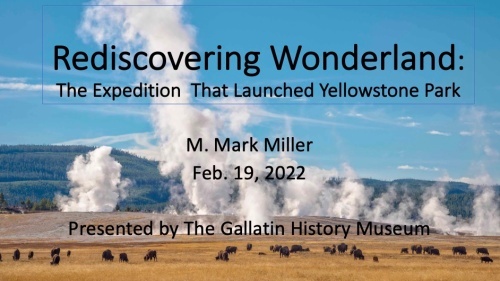 Request Your Zoom Link Here.
I’m getting ready for the official launch of my latest book, Rediscovering Wonderland, that will be at 10 a.m. (MST) on Saturday, February 10. The presentation will be under the auspices of the Gallatin History Museum where I was a volunteer for nearly 20 years. I’ve moved away from Bozeman so it will be via zoom. You can ask for a zoom link here.
The book was published to coincide with the 150th anniversary of the establishment of Yellowstone National Park. It tells the story of the Washburn Expedition a group of intrepid Montanans who explored the area in 1870 and then lobbied to get it declared the world’s first national in park in 1872.
I’m having fun reviewing a book that I finished writing nearly a year ago and haven’t looked at since. I’m finding a book I’m proud of. It’s brightly written and filled with high adventure and good humor and that makes it hard to choose excerpts to read. Here are some stories I could use:
A gambler down on his luck offers his hat for a target at 25 cents a shot to replenish his stake.A lost traveler climbs a tree to hide from a mountain lion that circles and growls below.The thin crust around starts to collapse under a man trying to collect specimens.Two men descend a thousand feet to the bottom of the Grand Canyon of the Yellowstone.An undersized pony turns summersaults as he tables down a canyon — and walks away.An angler catches a trout and cooks it in a hot spring without taking it off the hook.I’m not sure yet what I’ll read, but I’m sure I’ll have an interesting presentation. I hope you’ll zoom in for it.
∞§∞
January 22, 2022
Rediscovering Wonderland Available Now
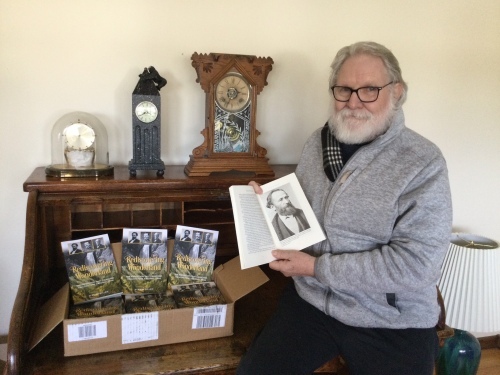
I just received advance copies of my next book, Rediscovering Wonderland: The Expedition That Launched Yellowstone National Park. You can order it now at your favorite bookstore bookseller or you can locate a bookstore near you at Indiebound. Also, you can get it from : Amazon, Barnes & Noble, Bookshop.Org, Books-A-Million, or Rowman & Littlefield.
Rediscovering Wonderland tells the story of the Washburn Expedition, a group of intrepid men who explored the area that became Yellowstone National Park in the summer of 1870. Fur trappers and gold prospectors had been talking about wonders in the region — boiling geysers, towering waterfalls, giant lakes, and deep canyons — for decades, but their stories were usually dismissed as “tall tales.” In the 1860s several efforts to have credible men explore and document what was surely there fizzled because they feared hostile Indians in the area.
Finally, an ambitious politician, Nathaniel P. Langford, decided to make his name by organizing an expedition and publicizing its activities. An army lieutenant named Gustavus Doane maneuvered to lead the expedition’s army escort for the same reason.
Langford organized the expedition, but Henry Dana Washburn, a distinguished Civil War officer and Surveyor General of Montana Territory, was elected to lead it. Washburn guided the party of 19 civilians and soldiers past Indian country and into the uncharted wilderness. Although the explorers had heard about the area’s wonders, they were still awed by the things they saw.
When Langford returned from the wilderness, he immediately began campaigning to have the U.S. Congress set the area aside as a National Park. Park advocates used the explorers published accounts of what they had seen to support their arguments. Rediscovering Wonderland brings together the words of these men, along with photos of them and the sights they saw, to provide historical context for the exploration and founding of America’s first national park.
∞§∞
About the photo by Amanda Blau: I’m sitting on the antique roll-top desk my father found at a mine office in the mountains near the family ranch where I grew up. The clocks are an anniversary clock that belonged to my wife’s grandparents, a King Kong clock that struck our fancy, and the Ansonia clock my great-great-grandmother brought to Montana in 1882.
January 17, 2022
Under the Big M
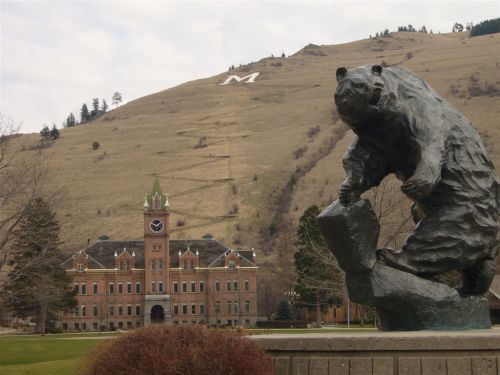 University of Montana view across the oval at the center of campus.
The University of Montana has a very pretty campus. One of its most remarkable features is the view from the west side of the oval with its giant bronze grizzly statue framing Main Hall and the “M” on the side of Mount Sentinel. That’s inspired me to choose Under the Big M as the title of a memoir I’m working on.
I was at UM from 1963 to 1967. Those were heady years there. The arts were alive with Avant Garde plays, painting, sculpture, and jazz. The English Department was headed by one of the top critics in the county, and the sciences had been jolted forward when the Soviets sent Sputnik into space.
The University was a cultural enclave of student activism more than a thousand miles from the hotbeds of protest like Berkeley and the University of Michigan. UM Students were going to the Deep South to register Black voters and were beginning to protest the Vietnam War.
A thousand students marched on Main Hall to protest the suspension of three men for participating in a snowball fight that newspapers called “a near riot.” Professors complained when students published their classmates’ evaluations of teaching. Women were chafing under university dress codes and curfews. Marijuana was becoming common. The Beetles and The Pill arrived.
When I arrived at the university, I was a naive ranch kid from a country of nearly 4,000 square miles and about that many people. Of those people, only one was Black. I had never known a person from another country, not even a Canadian. I had never heard live jazz or bought art from the person who produced it. I got a part in a major production of Macbeth and wrote a news story that Associated Press distributed across America.
I watched my housemate load is pistol and leave to shoot a professor. I was beaten up by gay bashers. I fell in love, got married, and lived in poverty. All Under the Big M.
So, please tell me: Do you think there’s an interesting book about my university years? Do I have a good title?
∞§∞
January 4, 2022
New House, New Place, New Beginning
 A photo of our new house (from the realtor listing).
Tam and I worked furiously for the last six weeks packing and getting ready to move to the Chicago suburbs where we could be close to our daughter and her family. After the moving van was loaded, we drove four days though freezing weather and brisk winds and arrived at our daughter’s house in time to spend Christmas with our grandchildren for the first time. What a treat to watch them tearing open their Christmas gifts with glee.
They enjoyed every gift, even the socks and underwear that often bore pictures of fanciful creatures. In fact, many gifts were mash-up creatures including a “Shorse” (a shark head on a horse body) and a “Doguine” (a dog head on a penguin body).
The van unloaded on Dec. 30, so we’ll greet the new year unpacking and organizing. As I arrange my new office, I’ll take time organize things and set priorities for the new year. I resolve to blog more often and to resume work on the project I mothballed for the move.
While packing and unpacking I noticed many things I could work on including an unfinished novel, a couple of magazine articles, and a new edition of For the Zen of It (my collection of haiku). I should also organize and annotate the boxes of family photos I inherited from my mother. (They date back to the 1800s.) I need to select and scan them to share with relatives.
I’m also resolved to post weekly to this blog.
We spent our first night in the new house on Jan. 2 and have been unpacking ever since. Things will be livable soon. Then it’s back to writing for me and fiber arts for Tam
I always say I’d rather die of exhaustion than of boredom. Looks like I’ll get my wish.
∞§∞
May 8, 2021
Blog/Webpage Update
I’ve been working to refurbish my Blog/Webpage at MMarkmiller.com. It’s been hard because my web management skills have atrophied or become obsolete. But after a lot of trial-and-error and creative cursing, I think I have things functioning well and looking good.
I know my content needs refinement, but that should be comparatively easy. All I have to do is figure out what I want to say and that’s easier than working with computer code.
So take a peek at my efforts and let me know what you think. I’m most interested in the way it looks and how easy it is to find things, but I’ll take any suggestions you may have. Thanks so much.
I’ll be posting another “Free Read” soon.
April 21, 2021
A Little Romance and A Lot of Fun
In 1913 L. Louise Elliott publish a book titled Six Weeks on Horseback Through Yellowstone Park. Elliott and her husband toured the park with a touring company that moved its camp from place to place. Most tourist at the time travelled between hotels or permanent camps where tents were put up early in the season and left up until Fall. Others had their own wagons and camping equipment and stayed anywhere they could find space. They were called “Sagebrushers” because sometimes the only places they could find were on undesirable sagebrush flats.
Elliott sent kept a detailed diary but when she tried to convert it into a book she decided a simple description of sights and activities needed a plot to 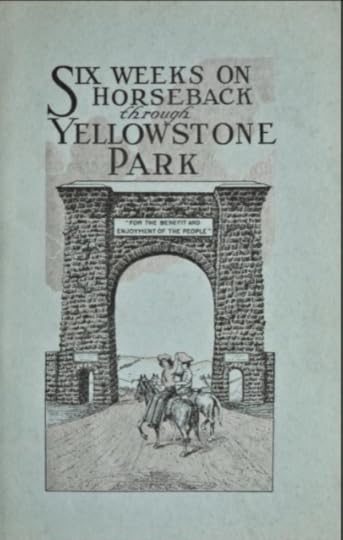 make things interesting. She created a fictional character, a young schoolteacher from Lander, Wyoming, who took a job as a camp assistant and wrote the book as letters from the teacher to her mother.
In her preface, Elliott confesses that she used several techniques that critics now might label “new journalism.” She created composite characters by combining traits of her camp companions, and made up a “little romance” for her protagonist.
We can forgive Elliott because she provided an explicit disclaimer—and an entertaining portrait of travel to Yellowstone Park in the early twentieth century. While her tales must be taken with the proverbial grain of salt, we probably can take her word that “the camp episodes and jokes, the weather and scenery, and the statistics” were all accurate descriptions copied from her diary.
Elliott gives interesting details of her trip—a cook who makes biscuits “charred on the outside and doughy in the middle,”—a guide who carries “the scratchiest flannels” to be worn by anyone who didn’t heed his warning to bring warm clothing—and, snobbish hotel guests who refuse to return the greetings of lowly campers.
I decided not to include Elliott’s book in my anthology, Sidesaddles and Geysers, for two reasons. First, I thought there was too much fiction in her account for it to be included in a book of “true” stories. Second, I thought Elliott’s descriptions of Native Americans would offend contemporary sensibilities. But I hope you can overlook these shortcomings and enjoy the descriptions of travel to Yellowstone Park in the early 1900s and the delightful stories.
You can see page images of Elliott’s book on the Internet Archive. If you’d like to see a sample first, take a peek at “Maud Gets Her Revenge,” which posted on my blog in 2010.
∞§∞