
Chris Atack's Blog: What next?
November 20, 2018
"I don't believe in ghosts, but..."
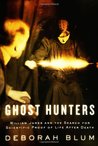 Ghost Hunters: William James and the Search for Scientific Proof of Life After Death by Deborah Blum
My rating: 5 of 5 stars
I have a lot of respect for William James, so I was interested to learn what he had to say about ghosts and what we now call "the paranormal." Turns out he, together with many other top scientists of the day, conducted extensive and painstaking studies of mediums, spiritualists and those who claimed to communicate with the dead or with spirits. While they uncovered and exposed many frauds and charlatans, there was a residual core of phenomena that they were unable to explain. The conclusion: there is something out there. We don't know what it is, or what the implications are, but something is going on. Which rather reinforces what I suspect is a common intuition. "I don't believe in ghosts -- but I'm scared of them." Well worth a read.
View all my reviews


June 29, 2017
If death had no dominion, would the wealthy inherit the Earth?
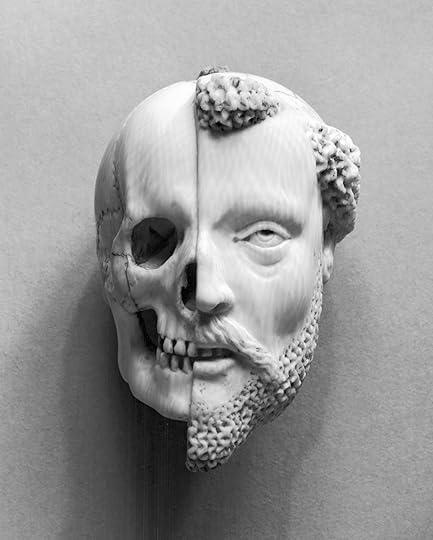
Most of us try not to think too much about the disasters that await us somewhere in the near or far future: pandemics, nuclear terrorism, snakes on the plane — whatever spikes our personal fear meter. No point worrying about what might happen tomorrow, or the day after. Unless, of course, you are a science fiction wonk.
Being a science fiction writer involves trying to predict what the future might hold, given where science and society are going. And where we seem to be going in the next few decades worries me exceedingly, for many reasons. Here’s one –in the near future, we may actually learn how to conquer death.
But isn’t that a great thing, you say? Defeating death has been humanity’s overriding goal, ever since we became self-aware. Death is horrible to us as individuals – a one-way voyage into a dark country, quite possibly into oblivion.
The upside of Death
But even death has an upside from a societal point of view. It is the one, true leveler. Rich or poor, King of Kings or lowliest peasant, you were going to die. Death is our species’ final safeguard against tyrants. Genghis Khan died, Stalin died, Pol Pot died — and the world breathed a sigh of relief. Now imagine a time in which the next Stalin or Pol Pot does not die but lives for centuries, thanks to advances in science. That time may not be far off.
If science does manage to find a way to confer immortality, or greatly extended lifespans to people – who will benefit? The obvious answer: the rich, the powerful, the well-connected. They will be the ones who can afford the treatments, the medications, the elixirs that grant immortality. And they will guard their privileges – their wealth, their power, their access to extended life – a thousand times more jealously than before, because they can enjoy those privileges for the indefinite future. Moreover, they will be nearly impossible to oppose, because they will have the accumulated wealth, education and experience of centuries at their disposal.
Far too many “ordinary folks?”
The result could be an entrenched ruling class the like of which we have never seen before – a small group of wealthy, cunning aristocrats who see the world in an entirely different way than the seething mass of ordinary folk – those who must die. How long before these aristocrats decide there are far too many “ordinary folk” to serve their needs? How long before they decide they would rather have parks than crime-ridden squalid cities, clean, pure rivers rather than sewers of filth? How long before they decide to cull their less-fortunate, short-lived inferiors? Roll on the Die Back, the engineered death of billions for the convenience of the new Lords of the Earth.
Is this a possible scenario? Yes. Is it likely? Who knows? The future has many paths and many windings. But in our headlong pursuit of knowledge, the thought that Death might have no dominion should give us pause. Because if Death has no dominion, then we could be looking at the tightest, most nearly unbreakable tyranny in human history, or indeed the end of human history as we knew it. “No-one here gets out alive,” Jim Morrison observed. Odd as it seems, maybe it’s better that way.
April 28, 2017
The Robopocalypse cometh, but it will be OK. (Maybe)
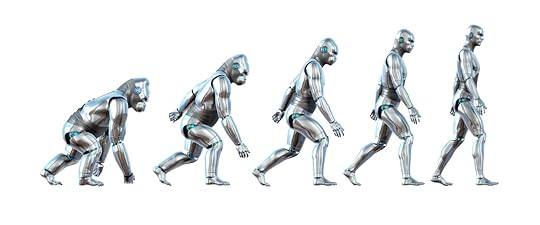
From the Temple of Technology comes yet another warning that robots, directed by artificial intelligence, are coming to take our jobs -- in a big, BIG way. According to IT celebrity Kai-Fu Lee, robots are poised to take 50 per cent -- yes, that is half -- of all jobs in the next decade.
Most of us are so numbed by predictions like this that we merely shrug and pass on. But if Lee is even in the ballpark, the world economy is standing at the edge of a very high cliff. What happens when a quarter, or a half of the work force finds itself unemployed and pretty much unemployable? How do families survive? When demand plummets because half the population suddenly has no income, what then? Are we not looking at a domino effect, where even more jobs disappear as consumer spending power evaporates?
Where's the robot repair guy?
Humble technopeasants like myself do not know the answers to these questions, but even so I venture to predict one thing -- if these scenarios are anywhere close to correct, it will not be pretty. Apologists for the coming Robopocalypse point out that, while many jobs will disappear, new ones will be created, notably in the areas of robot manufacture and maintenance. The snag, of course, is that not everyone will be able to make a smooth transition from, say, driving a forklift to doing robot repair or AI programming.
Not to worry, according to Lee -- the coming robolution will "create a huge amount of wealth for mankind and wipe out poverty." (Yeah, right.) The other soothing news -- apparently the human touch will still be required. Says Lee, "Touching one's heart with your heart is something that machines, I believe, will never be good at."
Will plutocrats dream of electric kittens?
Seriously? If AI-directed robots can do everything else, it is hard to see why they can't be designed to be ultra-warm and fuzzy as well as super-efficient. Would there not be, for example, a market for kindly robo-nurses? For electric versions of Mary Poppins or even little robo-kittens designed to charm and entertain? (Ooops, there goes the litterbox industry.) To say nothing of the possibilities inherent in the sex trades.
Truly, truly, we do live in interesting times. Stay tuned...
February 11, 2017
All I want for Christmas is a mind-controlled racing set!
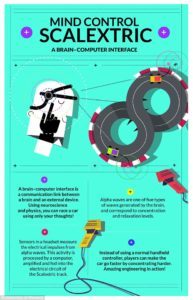 Just when you thought it couldn't get much weirder -- sure enough, it does. Just before Christmas this past year, a team of researchers from the UK's University of Warwick announced it had refined the technology used to control electronic devices using thought alone. “Whilst brain-computer interfaces already exist – there are already a few gaming headsets on the market – their functionality has been quite limited," said Professor Christopher James, Director of Warwick Engineering in Biomedicine at the School of Engineering.
His team's research is helping these headsets function more efficiently by obtaining cleaner and stronger signals than ever before. "This means stronger links to the toy, game or action thus making it a very immersive experience," he adds. "The exciting bit is what comes next –how long before we start unlocking the front door or answering the phone through brain-computer interfaces?”
January 28, 2017
The Fourth Industrial Revolution: leisure for all or one-way ticket to poverty?
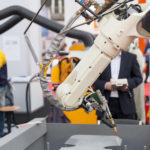
It's not exactly news that technology is reshaping the employment market. Over the last several decades, robots have slowly been replacing factory workers, banks have swapped tellers for ATMS and online stores have been shutting down bricks-and-mortar outlets, eradicating the jobs of countless sales clerks, managers and maintenance crews. But now, advances in artificial intelligence and new generations of robots have brought society to the edge of a really major revolution in the workplace -- a revolution which will put at least five million people in the world's most advanced economies out of work by 2020, according to a report (opens in new window) issued last year by The World Economic Forum (WEF).
You say you want a revolution?
Hardest hit will be people in administrative and office jobs, while those in IT, engineering and other "hard" disciplines actually stand to gain. These far reaching (and accelerating) changes in the labor market have been dubbed The Fourth Industrial Revolution. Like all revolutions, this one holds out the promise of a better, more leisurely life for many -- and the potential for widespread misery, huge social disruption or even violent conflict.
Brave new labor market
The WEF report paints a relatively rosy picture of the brave new labor market, with the majority of workers simply upgrading and changing their skill sets to stay gainfully employed. However, things may not be quite that simple or pleasant. Whole categories of employment, and especially less skilled employment, may well be on the edge of extinction. Professional drivers, for instance, will be largely eliminated as self-driving vehicles become the norm. Are the legions of unemployed truck and cab drivers likely to retrain as software engineers or robot repair specialists? Or again, will laid-off office workers return to the job market as software developers? Don't bet on it.
Creeping job loss, lower wages
More insidious is the creeping loss of jobs and downward pressure on wages, as low cost labor becomes more accessible thanks to the Web. Why hire a high-priced accountant in North America to do your tax return, when the same service is available at a fraction of the cost in places like India? Why pay a writer a handsome hourly wage, when the same outlay can purchase the services of a half-dozen writers in less prosperous countries, plus a recent graduate of a Western journalism school to edit their output? Ditto for legal research, software development and indeed any service job which does not require the service provider's physical presence.

Who wins and who loses?
For those on the right side of this revolution, things look rosy. Unreliable human workers are replaced by machines that do the job more efficiently, at a lower cost and without complaint. Result, higher productivity, fewer HR headaches. In an ideal world, this revolution would also eliminate many of the unpleasant and dangerous jobs humans must do -- and free up more time for leisure pursuits. But it is hard to enjoy leisure time when trying to put food on the table and keep a roof over one's head. Official" unemployment levels are down significantly from The Great Recession. These statistics, however, do not count the millions of people in developed nations who have simply stopped looking for work -- an estimated 95 workers in the U.S. alone. With population continuing to increase, and especially in areas where training in high-tech skills is not readily available, the potential for massive social unrest is very real. Welcome to the Fourth Industrial Revolution and to "interesting times!"
January 27, 2017
For those who think weird
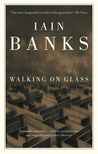 Walking on Glass by Iain Banks
My rating: 3 of 5 stars
Outrageously surreal and weird in parts. Three completely divergent stories which (are supposed to) converge at the end. Could be me, but the final convergence seemed pretty weak, which took away from my overall appreciation. If you like way-out images from a master, this is a book for you, especially the sections in "The Castle of Bequest."
View all my reviews
January 24, 2017
The Fat and the Thin
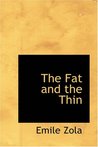 The Fat And The Thin by Émile Zola
My rating: 4 of 5 stars
A fascinating look at life in Les Halles, the major food market of Paris, in the mid 1800s. The characters are the people of Les Halles and the nearby food stores -- the fish wives, the vegetable and poultry sellers, the pork butchers of the area. At the heart of the story is an escaped convict, transported for his political views, who has managed to return to Paris. There, he secures a job in Les Halles. However, he soon finds it is not so easy to escape his past.
There is a heavy use of food symbolism -- too much for my taste (pun intended) at times, and some of the descriptions of meat preparation are enough to make kind-hearted readers entertain the idea of becoming vegetarian. The theme is the endless tug of war in society between the prosperous and the poor, the well-fed and the hungry, the aggressive and the unassertive, or as in the title of the book, The Fat and the Thin. A compelling description of a time and place. Of special interest for those who love Paris and/or food.
View all my reviews
January 13, 2017
The Magus: love it, but why?
 The Magus by John Fowles
My rating: 5 of 5 stars
One of my all-time favorite books -- and it is hard to say why exactly. Set on a Greek island a little after WW2, it walks a tightrope between matter-of-fact realism, weirdness and the (apparently) supernatural, without ever stumbling. When the protagonist (Nicholas) comes across a lovely ghost from the First World War, or is pursued by brutal German occupation troops from WW2 (in 1950-something) -- the reader asks, "what the heck is going on?" The answer is long, complicated, and unexpected.
On one level, it is a gripping love story, with lots of twists, turns, sadness, joy and suspense. Right up until the last page you're not sure whether things will work out or not -- or even if you want them to. Alison, the female lead, is a delightful, unaffected Australian girl. Has she been brainwashed, unintentionally damaged by those who are trying to help her? Nicholas is an egotistical bastard -- but he has so many redeeming qualities. Surely he could turn out to be a worthy person in the end? Or maybe not... The main characters are brilliantly drawn: flawed yet very likeable, sometimes mean and selfish, sometimes noble, ultimately mysterious.
The Magus is very much about free will, the freedom to make choices. Ironically, however, many of the life-changing choices the characters face must be made based on incomplete or deliberately falsified information, designed to send them speeding down the wrong track. (Sound like real life?)
The book evokes the early Sixties very strongly without being dated. On one level it can be seen as a retelling of The Tempest in the Cold War era, with the enigmatic millionaire Conchis (The Magus) as Prospero. On another, it is about a long and painful initiation into a mysterious group of illuminati. At the same time, it is very much an account of self discovery, of achieving a higher level of understanding.
Perhaps most of all, The Magus is about redemption. At one point, Nicholas is told: "Those who steal bread are innocent. Those who steal gold are guilty." Nicholas steals gold (metaphorically) -- but it is dangled before him, and he is encouraged to pilfer. Even so, he must redeem himself, and it is by no means certain that he will.
All in all, an intriguing, elusive and tantalizing book which I still revisit from time to time.
View all my reviews
Where are the aliens?
 The Eerie Silence: Renewing Our Search for Alien Intelligence by Paul Davies
My rating: 5 of 5 stars
The title tells the story -- we've been trying to establish contact with intelligent aliens for decades now, with no success. We call, no-one answers. Why not? The book looks at the SETI project, discusses ways in which "they" might get in touch with us, and considers some reasons why they haven't, despite our efforts to contact "them." A very worthwhile read for anyone interested in the search for intelligence beyond our home planet.
View all my reviews
Ban killer robots before it's too late (seriously!)
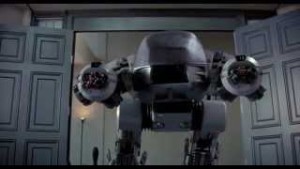
You might think this was a line from some 1950s B movie -- but actually it is the title of a report by Human Rights Watch, an international organization devoted to protecting human rights globally. According to the report, autonomous killer robots are already under development by major powers - and the threat they would pose is unthinkable.
These robots would have no legal or moral reason not to kill. As the report notes, they "could not show human compassion for their victims, and autocrats could abuse them by directing them against their own people."
And, of course, they might well have trouble distinguishing a child holding an ice cream cone from a terrorist toting a gun -- echoes of the horrendous boardroom scene in Robocop. Ah, progress.
What next?

Cool or strange science, the mess that is modern society, and the "art and sullen craft" of writing -- process, pitfalls, rewards. Plus reviews of my favourite books!
...more
- Chris Atack's profile
- 6 followers

