
Ted Conover's Blog
July 21, 2026
The Problem with Snitches
I wrote about Pamela Colloff’s, Catch the Devil: A True Story of Murder, Deception, and Injustice, for the New York Times Book Review.
The Snitch Who Put Four Men on Death Row
In “Catch the Devil,” Pamela Colloff vividly tells the true story of the con man who traded on other prisoners’ “confessions” for clemency.
July 13, 2026
[image error]
The serial con man Paul Skalnik, pictured at the Pinellas County Jail in Clearwater, Fla., in 1981, 1982, 1986 and 1988.
By Ted Conover
Though its subtitle suggests true crime, “Catch the Devil” is by no means your typical true-crime book. This devil is not wild-eyed or knife-wielding but, rather, “one of the most prolific, and most effective, jailhouse informants in American history.” Paul Skalnik, a slippery con man, repeatedly testified about what he’d supposedly heard while in lockup in order to reduce his own sentences. In his telling, Skalnik helped place “34 individuals in prison, including four on death row.”
The problem is that much, even most, of his testimony appears to have been invented, and some of those he helped to convict were almost certainly not guilty. “The consequences of snitch testimony can be catastrophic,” writes Pamela Colloff, a staff writer at The New York Times Magazine and a reporter for ProPublica.
“Catch the Devil” is about Skalnik, his victims and his enablers. It takes place in Florida and Texas, where Skalnik robbed and defrauded many people — including several of the nine women he was married to, sometimes simultaneously.
Skalnik was a convincing liar. He used several aliases, presenting himself variously as an executive at Southwest Airlines, a law student, a lawyer, an undercover F.B.I. informant, a fighter pilot who had been shot down over Vietnam and a terminally ill cancer patient, all in order to take advantage of others.
[image error]
He got into a groove: After being caught and convicted of crimes, which included grand larceny and the sexual abuse of a 12-year-old girl, he would reach out to investigators, offering to share incriminating information he had allegedly heard from fellow inmates, and testify under oath in exchange for leniency.
While Skalnik’s history of crime and snitching extends over roughly a decade, from 1978 to 1987, Colloff focuses on one particular case. Shelly Boggio, 14, was hitchhiking with a friend near Seminole, Fla., in 1985 when three men picked the girls up. Boggio’s naked body, stabbed 31 times, was found the next day. Two of the men were charged with killing her; the first to go to trial was found guilty and sentenced to life in prison — only to accuse his roommate, Jim Dailey, a 38-year-old Vietnam veteran, of being the actual killer.
Little evidence tied Dailey to the case, and so an investigator named Halliday visited the jail and started asking other inmates if Dailey might have confessed to them. “The word was out — Jim Dailey’s case needed a snitch,” Colloff writes. Soon after, jailers moved Dailey onto Skalnik’s floor and two days later “Skalnik got word to Halliday: Jim had confessed to him.”
Skalnik, Colloff writes, “was the state’s closer, the witness whose words moved jurors to choose death. Where there was room for doubt, Skalnik erased it.” His success, as Colloff demonstrates, lay partly in his preternatural ability to gin up colorful and damning details. “He said no jury would ever sentence him to the death chair,” Skalnik testified in one case, “because he’s 19 years old and because he’s got that little baby face.”
Skalnik claimed that a handyman named Freddie Gaines, charged with murder after stabbing a man in the heart, bragged that he should have been charged “with open-heart surgery.”
As for Jim Dailey, Skalnik wanted to convey that Shelly Boggio had suffered a slow, painful death. “No matter how many times I stabbed her,” Skalnik testified that Dailey told him, “she just wouldn’t die.” Dailey, now 80, remains on Florida’s death row to this day.
One of the fascinations here is Skalnik’s psychic makeup. Truman Capote’s “In Cold Blood,” a landmark treatment of true crime, is remembered for the effort he invested in getting to know the two murderers at the heart of the book. Colloff similarly works to understand Skalnik: The book’s prologue is a scene of her visiting a dying Skalnik in prison, where he evades her questions despite insisting, “This is a story that needs to be told, and I want to help you tell it.”
Lacking actual cooperation, Colloff instead deploys her prodigious investigative reporting skills. Building on the research of a lawyer named Laura Fernandez, then working to keep a defendant out of the electric chair, the author learns more about Skalnik’s trail of destruction in Florida and Texas, where he was born and to which he returned. She interviews his exes and combs through “thousands of pages of police reports, arrest records, jail logs, probation and parole records, and correspondence.”
Her doggedness appears to shock even Skalnik, whom she tracks down at book’s end in a rural Texas nursing home. “How on earth did you find me?” he asks. Colloff offers him one last opportunity to recant some of his false testimony, to possibly save the life of Jim Dailey or free Freddie Gaines, who was sentenced to life on Skalnik’s word.
Even knowing all she does, Colloff still hopes to find a flicker of a conscience in her subject. And for a moment it seems that Skalnik will indeed display some humanity — but then his tone shifts. “Whatever I testified to was fact,” he declares.
“My revulsion at that moment was not reserved for Skalnik, who had known he would be rewarded, all those years ago, for telling just the right story; it was for the entire apparatus that enabled and encouraged him,” Colloff writes, of detectives and prosecutors eager for convictions, the judges who allowed his testimony and, finally, “the appellate judges who rubber-stamped it all.”
Its unusual villain makes “Catch the Devil” an engrossing read; the public policy implications make it important. “Of the 367 DNA exonerations in the United States to date, jailhouse informants played a role in nearly one in five of the underlying wrongful convictions,” Colloff writes. Skalnik may be dead, but vigilance and reform are needed to truly stop this devil.
Ted Conover is the author of “Newjack: Guarding Sing Sing,” “Cheap Land Colorado,” and other books.
CATCH THE DEVIL: A True Story of Murder, Deception, and Injustice on the Gulf Coast | By Pamela Colloff | Knopf | 310 pp. | $32
The post The Problem with Snitches appeared first on Ted Conover.


July 30, 2025
Immigrants & Politics in Aurora
I wrote for the New York Times Magazine about immigration and politics in Aurora, Colorado—a suburb where years ago I worked as a newspaper intern. Back then, I wrote a feature about an “outstanding immigrant”—a senior citizen from Finland! These days Aurora is much more diverse. Colorado’s third-largest city, it’s about half non-white and the kids in its public schools speak 160 languages.
In Fall 2024, right before the presidential election, doorbell cam video from inside a rough apartment complex went viral. It featured a number of young men with guns, apparently hunting somebody—another immigrant they found and killed about ten minutes later. The left-leaning powers-that-be denied there could be a major gang problem, while right-leaning politicians, and a certain MAGA candidate, played it up as evidence of a “criminal invasion” of our cities. The truth, predictably, lay in the middle, but the way it all came down makes for a pretty fascinating story.

The post Immigrants & Politics in Aurora appeared first on Ted Conover.
June 20, 2025
Reconsidering My Weirdo Hero
I wrote an essay for The Common about a poet I first discovered in seventh grade English class. Richard Brautigan, in that poem, seemed to be speaking directly to me—that made me remember him, and when I saw that he had written a novel, In Watermelon Sugar, I devoured it. And kept on devouring, as he wrote new books.
Check out the essay if you’re a Brautigan fan, or even if you’ve revisited some writing that once enchanted you and later you think, hmmm … have I changed or has this changed, somehow?
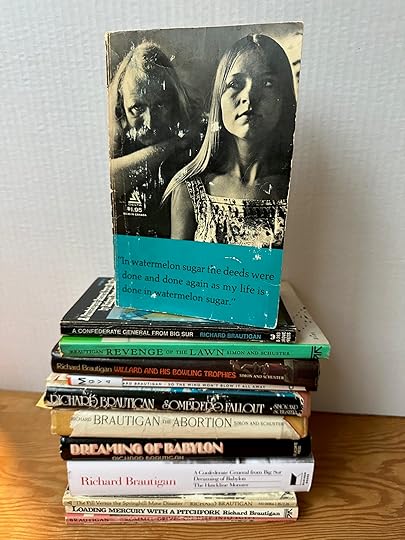
Books of Richard Brautigan
The post Reconsidering My Weirdo Hero appeared first on Ted Conover.
February 10, 2025
Going on a talk show in Barcelona
Writing a book is a little bit like having a kid … once it leaves home, you don’t know really where it will go. My book Newjack: Guarding Sing Sing, now 25 years old, recently was translated into Catalán, thanks to an enterprising publisher in Barcelona called Saldonar. A TV talk show there heard about it and brought me over for an interview in January. (Starts about 30 seconds in. Alternate link here—sorry about the ads.)
The post Going on a talk show in Barcelona appeared first on Ted Conover.
Visiting a talk show in Barcelona
Writing a book is a little bit like having a kid … once it leaves home, you don’t know really where it will go. My book Newjack: Guarding Sing Sing, now 25 years old, recently was translated into Catalán, thanks to an enterprising publisher in Barcelona called Saldonar. A TV talk show there heard about it and brought me over for an interview in January. (Starts about 30 seconds in. Alternate link here—sorry about the ads.)
The post Visiting a talk show in Barcelona appeared first on Ted Conover.
January 18, 2025
The new “Sing Sing” movie
My book Newjack: Guarding Sing Sing recounts the ten months I spent working in the famous prison as a corrections officer. British GQ called to ask my opinion of the movie, which follows a group of prisoners as they stage plays for the public. (Short answer: you should see it!) The article they wrote is here. More on Newjack is here.
The post The new “Sing Sing” movie appeared first on Ted Conover.
November 1, 2024
Open Book podcast episode
An esteemed publisher invited me to lunch with his staff in the Financial District to talk about what I do. David Steinberger and his team asked great questions and later asked if he could put the conversation online. I like the result, here or wherever you get your podcasts.
The post Open Book podcast episode appeared first on Ted Conover.
Good new podcast episode
An esteemed publisher invited me to lunch with his staff in the Financial District to talk about what I do. David Steinberger and his team asked great questions and later asked if he could put the conversation online. I like the result, here or wherever you get your podcasts.
The post Good new podcast episode appeared first on Ted Conover.
July 23, 2024
New paperback edition
The Vintage Books paperback edition of Cheap Land Colorado comes out on July 30, 2024. It features a new epilogue with updates on the main people in the book.
Here are the places I’m scheduled to read from and sign copies of this new edition:
Tuesday, July 30, 6:00pm
NARROW GAUGE BOOKS AT MILAGROS COFFEE HOUSE
529 Main Street
Alamosa, Colorado
Wednesday, July 31, 6:00pm
OLD FIREHOUSE BOOKS
232 Walnut Street
Fort Collins, Colorado
Thursday, August 1, 6:00pm
THE BOOKWORM OF EDWARDS
295 Main Street, C101
Edwards, Colorado
Friday, August 2, 2024, 5:30pm
PAONIA BOOKS
233 Grand Avenue
Paonia, Colorado
Saturday, August 3, 2024, 4:00pm
EXPLORE BOOKSELLERS
*in conversation with Paul Andersen*
221 East Main Street
Aspen, Colorado
Wednesday, October 2, 7:00pm
MAGIC CITY BOOKS LLC
221 E. Archer St.
Tulsa, Oklahoma
Wednesday, October 9
BOOK CLUB SALIDA
Venue: A Church, 419 D Street
Salida, Colorado
(doors open 5:30, talk/slides/Q&A at 6:30)
Note: ticketed event, info will be here
The post New paperback edition appeared first on Ted Conover.
February 22, 2024
A family tragedy off-grid
Talon Vance, 13, was taken by his mother and aunt from a suburban apartment to squat in a Colorado forest at 10,000 feet. The mom, frightened by conspiracy theories, wanted to keep him safe. I wrote about this puzzling tragedy for Outside magazine.

The post A family tragedy off-grid appeared first on Ted Conover.
Ted Conover's Blog

- Ted Conover's profile
- 262 followers
