
Hugh Howey's Blog
April 22, 2026
Silo Season Three!
Apple just announced the premiere date for Silo season three! The first of ten episodes drops on July 3rd. This is, by far, the best season yet. You all aren’t ready.
The post Silo Season Three! appeared first on Hugh Howey.


April 8, 2026
Before We Go
I dream about space a lot. I was obsessed with NASA as a kid. I used to build model rockets and see how far I could shoot them into the sky. My obsession with the cosmos in high school is the reason I majored in physics in college. Han Solo was my spirit animal — all I ever wanted was to explore the stars with my beater of a starship and a few friends.
The closest I could get to this was living on sailboats and traveling between islands, fixing every broken thing and immersing myself in alien cultures. It was this obsession and these boat adventures that led to my first book series about Molly Fyde, a young astronaut who travels the galaxy while getting into hijinx with her motley crew.
So you’d think I’d be excited about moon bases, cities on Mars, the expansion of humanity into outer space. I am. But not now. Like so many times in human history, we are doing things out of sequence — because we are powered by urges rather than our wits.
Humans have an insatiable urge to expand into unconquered territory. I’ve traveled to some of the most remote islands in the world, and there are almost always humans living there. We’ve covered the planet. There’s almost no place we don’t visit or have an outpost. The only places we don’t live permanently are places inhospitable to life (high altitudes, beneath the ocean’s surface, places devoid of rainfall). But even here, we like to visit and we dream of conquering.
That urge to spread out has us gazing at the heavens. Any place with gravity, we imagine stomping our feet. Any place with water, we imagine building a city. Any distant twinkle, and we wonder if the air there might sustain us. We do this automatically, from a place deep in our bones. The same place that makes us want to take what isn’t ours, to kill anything that offends, to rape anything fertile. It’s a primitive reflex of ego and id. And we don’t question it. In fact, we romanticize it.
Sailing to the New World, pushing into the American West, the voyages of the Pacific, and now our spacefaring goals. All are mythologized and accepted without question as objectively good. I believe there is room here for some skepticism. Place for pause. Let’s imagine a scenario where the outcome is known and certain:
You, dear reader, are a time traveler. Imagine that you’ve found yourself in Europe back in the 11th Century AD. The people of this place and time believe that you are from the future. Zero doubts. Your bonafides are established. They look to you for guidance and wisdom. Someone named Leif mentions their plans to sail west to find more land. You know very well what happens when Leif arrives in Newfoundland. Within generations, the diseases he carries will wipe out most humans in the Americas, turning cities of hundreds of thousands into fractured nomadic villages who are at war with one another. This will later lead to their annihilation at the hands of other settlers, which will lead to the slave trade that destroys millions of lives and families and causes incalculable human suffering.
You explain how things will proceed if they sail west. The cost. There are good and decent people in the crowd. They are curious about these people on another continent. Not to go indoctrinate them with religion, or saddle them with European thoughts and technology, but to know them. “Is there no way we could ever coexist?” they ask. “Can’t we trade with them? Talk to them? Share our poetry and art? Tell each other our stories?”
“Talking to them will kill most of them,” you say. You explain germ theory, and unlike in reality, where you are ignored and shamed for trying to save lives, in our scenario these good people believe you. They fully grasp that even with the best intentions, merely shaking hands with these people will lead to the deaths of millions.
“Is there no hope?” they ask.
“There is,” you say. You explain to them that if they are patient, in a thousand years, they will possess the medical know-how to make contact in a non-destructive manner. In a thousand years, slavery will be out of fashion and outlawed. Besides, new technology and economic models will make the practice unprofitable. You tell them that in twelve hundred years, humans will value cultures that are not like their own, seeking to preserve and respect rather than to change and dominate. You explain that through economic and cultural trade, every human on planet Earth will benefit greatly from waiting rather than rushing. “Let that continent mature before making a move on it,” you say. But what you really know is that these Europeans also need to mature before they embark on that voyage.
Now … if you, dear reader, are thinking, “Fuck that, go take that land for yourself, kill millions of innocent men, women, and children, get that slavery machine up and running, and create a hegemonic empire that will run for about 200 years before collapsing under its immorality, then congratulations. You have the mindset of the primitive people you are visiting. What’s more: you aren’t alone. A good portion of humanity today is just as barbaric and thoughtless. Just as greedy and malformed. Open space is a resource to be dominated, virgin territory treated like virgin flesh. Base impulses that are never questioned.
What if a time traveler arrived here today and established their bonafides? They reveal the solution to every math problem currently stumping the greatest minds and machines in our time. They present a cure to every cancer and disease. They have a pill that stops aging and ends natural deaths. Every prediction they make for the first dozen years they are here comes true, a new sealed envelope opened once a month that recounts current events. We know they aren’t lying when they tell us:
“You aren’t ready yet. Space is for the wise. Trust me. You’ll cause more harm and destruction than you are ready for.”
Now, like many in Europe in the 11th century, you might take offense. We have philosophy. We have the technology to do it. We understand the science. Of course we are ready. Heck, we are doing it to preserve the Earth. To preserve humanity. Some of the same reasons given by those who sailed the Atlantic and who pushed West through the Americas.
To which our time traveler points out that you still war with one another. You bomb schoolchildren. You rape and pillage. Millions die every year from violence. Drones and rockets bring destruction from the clouds. “Imagine a million of you living in space,” the time traveler says. “All any one of them needs to do is nudge an asteroid here, or de-orbit a space station there, and cities are flattened. Nukes are no longer a threat when anyone can drop a rock the size of Everest wherever they like. With altitude comes potential energy. That potential energy requires responsibility. You aren’t there yet, but you’ll get there in a thousand years.”
You balk at this. Even though you know the right thing to do in the 11th century is to urge caution and patience, and the people of that time thought they were ready when you knew they weren’t, now you are the one upset. You are the child being told you aren’t old enough. “What happens if I don’t listen to you?” you ask.
“Billions die. Most of you die. Civilization ends, because you went before you were ready. Yes, I know you think you are, but so does every generation. This is why space is so quiet: very few survive this moment. Almost no one evolves to this point because they moved slowly and respected the boundaries around them. Species get where you are today because they rush forward, always forward, never thinking, obeying every impulse. Just as you are now.”
“But how do billions die?” you ask. You still don’t believe them.
To this, the time traveler reveals a secret. “There are many technologies I haven’t given you, because you aren’t ready. The perfect battery, for instance. Charged once, and it provides energy forever. Unlimited energy. Like a magnet. Powered by the spontaneous creation of matter and antimatter in cosmic vacuum, destroying one another and creating pure power from nothing. The size of a pack of playing cards. Enough juice to propel a car.”
Marvelous, you say. You can think of so many applications. In fact, you’ve been working toward just such a dream device, but weren’t sure if it was even possible. This would save lives. It would generate incredible wealth. Why can’t you have it?
“Imagine being able to send drones from any location on earth to any other location with a bomb attached. Hundreds of thousands of miles if need-be. Swarms and swarms of grenades sent out to cause havoc and spread death. The number one killer of children in your greatest economy is guns, which require some kind of proximity. And you think you are ready for this?”
You are angry for being seen so clearly.
“Millions of humans in space, and all it takes is a few to kill more than your world wars. Before you go, there should be none amongst you who has such dark thoughts. You still have people in power who are actively killing innocents for monetary gain. You haven’t figured out how to house, feed, clothe, educate, keep all of your neighbors healthy. You haven’t learned to see an immigrant with all the humanity and potential with which you see a newborn, because the color of the skin is more important than the addition of a soul. You think economics is full of winners and losers, when true trade turns everyone into winners. You are superstitious and cruel. You are rash and ungrateful. You will not always be these things, but it will take a lot of time and effort to be worthy of the stars. And if you wait, it will be worth it.”
“How long will it take?” you ask.
“Here’s the thing,” the time traveler says. “You currently have enough wealth and all the technology you need to allow every human to prosper. You can automate the work that few want to do (and even allow those few to continue doing it). You can free up the hours for everyone to devote their lives to time spent with loved ones, education, art, science, tinkering. All of this is possible now, with the billions you waste on war, defense, fear, anger, jealousy, and greed. But you choose not to. You could be ready today, if you wanted. Or tomorrow. But the reality is that it will take you thousands of years at the rate you are going. Because you don’t even see the outcome of this journey as a possible destination. You just see virgin territory and you want to put your mark on it. So the answer is: it will take as long as it takes.”
“But we want to go now,” you say.
“Yes, because you are a child. Just as the children of the 11th and 15th centuries ignored the obvious and destroyed civilizations, demeaning their own legacies with genocide and slavery in the process, so will you ignore a lone adult who has proven to you that I am what I say I am and you are what I say you are. You’ll go anyway, before you are ready. Before you’ve taken care of the basics. Before you’ve taken care of yourselves and each other. You’ll go like a child squealing in delight, thinking yourself an intrepid explorer, as you kick over sand castles and crush life beneath your feet. It’s in your nature to go. Just as it’ll one day, many centuries from now, be in your nature to come back and warn others not to.”
The post Before We Go appeared first on Hugh Howey.
March 7, 2026
Book Ends
The first time I flew overseas was in high school. My mom chaperoned a school trip to England and France. We did all the tourist things, saw some cathedrals, ate strange food, walked around museums, had too much to drink for the first time. Traveling to Europe felt exotic. The only other times I’d left the country were trips to the Bahamas and a cruise that took us through Jamaica and Mexico.
When I moved onto my first boat in my early 20s, I started spending a lot more time in the Caribbean and Bahamas. My passport filled with stamps: Cuba, Columbia, Honduras, Nicaragua, Costa Rica, Barbados, Dominican Republic, St. Barths, BVIs, and a dozen others. I spent most of my years as a yacht captain living “abroad,” but it was really the islands not that far away. To me, the rest of the world was a mystery. I’d never been to Asia or Africa. I’d only seen glimpses of London and Paris as a teenager. The entire Southern Hemisphere was beyond my knowing.
Friends and family thought I was some kind of globe-trotter because of my yachting years, and it did feel like I’d had an adventurous life. By the age of 30, I’d visited dozens of countries, living in some of them for a year at a time. I’d become a professional vagabond. But by the age of 32, I was retired from yachting and living in the remote mountains of North Carolina, working at a small independent bookshop, and writing stories as a hobby. My income at the bookstore was $300 per week, before taxes. I lived in a 850 square foot house with my girlfriend and our dog. The idea of saving up enough money to fly to Europe was bonkers to me. My money was going toward paying off my student loans, the only debt I still had in life. Very slowly, I was building up an emergency savings fund a few dollars at a time.
I’d written five books by this point — the Molly Fyde trilogy, Half Way Home, and The Hurricane. I’d also published a novelette called The Plagiarist. Each was self-published, with my own terrible cover art. The seventh thing I tossed online was another novelette called WOOL. I charged 99 cents for the ebook and $4.99 for the print-on-demand paperback, which was just 60 pages long. I then went back to writing my next novel.
Within two months, the sales of that small seventh publication was bringing in more than my bookstore job. Another month after that, and WOOL was making more in a month than I would normally make in a year.
Things got weirder, quickly. After having long given up on landing a literary agent, I suddenly started hearing from them, begging me to be their client. One stood out among the rest: Kristin Nelson of Nelson Literary Agency. Working out of Denver, she had an outsiders’ view of the publishing world, but all the insider connections and knowledge of the best in the biz. She blew me away with her honesty. “You’re doing better without a publisher than you probably would with one,” she wrote in an email. “But I can help you close foreign deals you aren’t even thinking of, and I can hook you up with a Hollywood co-agent to help you option your work.”
Signing with Kristin was one of the best professional decisions of my entire life, up there with deciding to self-publish. While I continued to write and release my own works, Kristin started bringing in foreign offers for translation. I think Brazil was one of the first deals we made. The advance I got there was more than I dreamed of getting from a US publisher. I want to say it was in the $60,000 range. Insane income for someone who was making less than half that as a bookseller. Germany also came calling, another huge book market. This time with a six-figure deal. By this time, I was making six figures every month from my Amazon sales, so most of my income was from the self-publishing side of things. But Kristin was knocking home run after home run. And then, just as she’d promised, doors in Hollywood began to open up.
“Ridley Scott and Steve Zaillian are interested.”
Now, if you were a sci-fi author making a dream list of partners in Hollywood, this duo would be right up there at the top. WOOL was about to go out to auction, but Ridley and Steve wanted to prevent the price from getting too steep, so they issued an ultimatum: take their offer and don’t go to auction, or go to auction without them. There were other parties already in talks with us who assured me they would get this film made, and looking back at their track records now, I think they were right. A WOOL feature probably would’ve come out in 2014 or 2015 had I gone that route. I’m glad I didn’t.
Instead of taking a higher chance of getting something made, I went with the guarantee of having Ridely Scott’s name attached to my novel. I’d already hit the New York Times bestseller list, and now Kristin had that, plus a film deal with a living legend, to take to foreign markets. (We were getting offers from US publishers as well, but the amounts they were offering weren’t worth giving up the digital rights, and print-only deals were off the table, we were told).
After signing with Ridley and Steve, I had my first taste of corporate air travel. I’d never flown business class before, which I assume is the norm. Most people never do. I never thought I would. I was a fish-out-of-water. No idea what to do with the hot towel, no idea if the food or drinks were included, what to ask for, what to expect, how to operate the seat or the table or any of the little compartments. I watched in absolute horror as a gentleman in the first row immediately went to sleep, skipping the meal and what I soon learned were free drinks. How could you sleep through a once-in-a-lifetime experience like this, I naively thought to myself.
I was picked up at the airport by someone holding my name on a placard, like a scene from a movie. They took me to a hotel someone else had booked and paid for, and the next day I was on a real Hollywood studio lot, brushing past actors I recognized, meeting with the head of the studio, talking to producers. I never felt like I belonged there (I still don’t). I felt like a tourist. Even with all the sailing I’d done, the near-death experiences at sea, working for the rich and famous on mega-yachts, I have never lost the deep-rooted feeling of being a kid raised on a farm in North Carolina, chucking hay bales and climbing on top of grain silos. It’s my core identity, and I think it always will be.
It’s important for me to remind myself how unusual overseas travel is for most people, and should’ve been for me. Otherwise I might get inured to it. Especially as my social circle filled up with people who fly to Japan to go skiing for the weekend, or head to Ibiza every summer. That wasn’t me then, and it isn’t me now. Back in 2011, in my early 30s, I hadn’t been overseas since that high school field trip with my mom. So it was a big deal when I signed with a publisher in the UK and they wanted to fly me over for a book tour.
By now, Kristin and I had done deals with five or six foreign countries for translation. But signing with Random House in the UK was different. Besides some spelling changes and a round of suggestions from my new editor Jack Fogg, the book being published there was the one I’d written and self-published while working in a bookstore in North Carolina. I’d be able to do press without a translator. My novel was going to be not just shelved in bookstores, but featured in the windows. Tube stations were plastered with the amazing new cover art they’d created for the book, the iconic red one that would eventually grace a US edition and several other overseas editions.
That flight to London was the most pampered I’d ever felt in my life. British Airways business class. A seat that turned into a bed. Delicious food. A huge screen for watching movies. I got a little sleep, but I was too excited and didn’t want to miss anything. I wanted every course. Besides the flight home, I figured I’d never travel like this again. That’s been my attitude this entire adventure: today is the last time for any of this.
Arriving in London felt like the culmination of a very long journey of wanting to be an author someday — a dream I had when I was twelve. Hitting 30 without having finished my first novel, I’d almost given up. I was reviewing books as a side hustle, going to book fairs, interviewing authors, thinking this was as close as I’d ever get to my dream. But then Molly Fyde captured my imagination and I wrote a trilogy of books I remain proud of today. Then WOOL went viral against all odds. Now I was walking down the high streets of London and my book was being featured everywhere. I signed hundreds of copies. Queues of readers at every bookstore. I saw people reading the book in public. Little did I know that this wasn’t the end of my writing adventure there in London, but the beginning of something even bigger. The left side of a crazy London-based pair of bookends.
The foreign deals kept coming in. I think we’ve done deals with nearly 50 countries now, and for more than just WOOL. I was flown to Brazil, Germany, Taiwan, Italy, France, Spain, Australia, New Zealand, Japan, Finland, the Netherlands, Ireland, back to the UK, Poland, and a few I’m forgetting. Ridley and Steve had scripts written and directors attached, so I flew back to LA a few times. I flew to NY to meet with publishers and ended up doing the first print-only deal with a major publishing house, a deal that gave me the rights back after only a few years (we’ve since sold the rights two more times and will be able to get the rights back once again). I went on an exhilarating and exhausting US book tour. I even started sleeping through entire flights, finding a connection with that man I’d watched pass out over a year prior.
The feature film never materialized. Things looked good on the second round, but an actor broke his arm on another project, delaying that shoot, which meant the director search had to start from scratch. After five years of this, I asked for the rights back and was lucky to have a great relationship with the producers, who agreed to let it go. This almost never happens after a huge development investment. Were it not for their generosity, the deals with AMC and Apple may never have happened.
And this is where London reenters the picture. The first place I landed overseas as a teenager. The first place I saw WOOL featured in bookstores. After years of working on scripts, writers’ rooms, and miracle after miracle, a TV show based on that little novelette was about to start filming just north of London in the small town of Hoddesdon. Five years ago, I walked on the set of SILO for the first time. The stairs were still under construction, just a web of i-beams and the first few wooden treads installed. The cast was just starting to arrive and rehearse. The entire project vibrated with excitement, but also uncertainty. How would it all come together? How would it be received? Apple had already created some hits with Ted Lasso and The Morning Show, but it wasn’t known as the sci-fi powerhouse that we know it for today. Soon, all that would change, and SILO would be a large part of it.
Despite the pandemic and a writers’ strike, the first two seasons were a spectacular success, one of the most-viewed shows on AppleTV when they released. Shay and I came back to London for the premiere, one of the highlights of this adventure. With the success of the first two seasons, we got green lights to tell the rest of the story. Last year, season three wrapped. Today, I was on set for the final day of shooting for season four. The final day of filming for this series, period.
Harriet Walter shot her last scene as Walker, and as I sat behind the monitor and watched, tears streamed down my cheeks. Not just for her powerful performance — even though that was more than enough — but because of the journey she’s been on and has taken us on, all the cast and crew. I wasn’t the only one crying. Folks, this set was special. Everyone who worked on this show has said the same thing, over and over, effusively: it’s the best thing they’ve worked on. The tightest crew. The most incredible and gracious cast. Top to bottom, the most likable, lovable, ego-less people in the industry. It starts with Graham Yost and Rebecca Fergusson, two of the most beautiful souls I’ve ever had the pleasure to know, much less work with. Their spirit set the tone. And the people AMC and Apple assembled lived up to their standard and then some.
Over lunch we boogied in the rain to some live DJ-ing from a crew member, reminisced over the shared journey, and tried not to think about all of this ending in just a few hours. But then it was time for Rebecca’s final shot (these scenes were not shot in order, so no spoilers here about when Juliette’s journey might end). And it was during this scene that the mood behind the cameras became truly surreal. People began pouring in. Usually there’s a handful of people back there, but soon it was fifty or sixty. Cast members who had already wrapped earlier in the week. Common (Sims), Shane McRae (Knox), Remmie Milner (Shirley), and others. Executives from AMC and Apple showed up, none of whom had ever been to a series wrap before, despite making hit after hit over the years. They flew all the way from LA to be here. Together, we’d been on this journey the longest, back to doing initial deals, before writing rooms were even assembled.
Everyone kept asking me how I was feeling, and the honest truth is this: I still feel like a tourist. Like a visitor. This show is so much bigger than the books, than the initial ideas. It’s hundreds of creatives pouring their energies together, all pulling the same direction. It’s the fan reception making it one of Apple’s biggest hits. It’s the readers who powered this all from the beginning. It’s everyone who ever wrote a kind review or told a friend about this story. It’s my friends and family who believed in my weird little hobby from the beginning. It’s my mom who made books such a big part of my life and my sister who has poured love and faith into me for as long as we’ve been adults. It’s Kristin, my co-agents, and the producers and executives who saw something worthy in these works.
Fifteen years. That’s how long it’s been from the first film deal to wrapping the full story we wanted to tell here on sets spread across London. Most authors never get a chance like this, and I understand and appreciate that. If I could snap my finger, I’d make it so everyone got to experience this. I want that so badly, for every artist to get as lucky as I’ve been. Maybe that’s why I feel obligated to soak up every moment like it’s the last. To not appreciate this, to not be overcome with gratitude, would be to waste it all.
Even though this part of my adventure is coming to a close, wrapping on shooting is only part of it. We still have two seasons of Silo to look forward to watching together! I think the season three release date should be announced before too long. And the wait for season four will be the shortest interim so far for the show. Many more happy tears of gratitude to come. But for now, this has been the perfect bookend here in London, where my publishing journey took an unexpected turn thanks to Random House, and where the Silo stories truly came alive under the stewardship of AMC and Apple. A kid from North Carolina who never dreamt of half of this . . . and is overflowing with gratitude.
Thank you, all of you.
Now for a visual trip down memory lane…
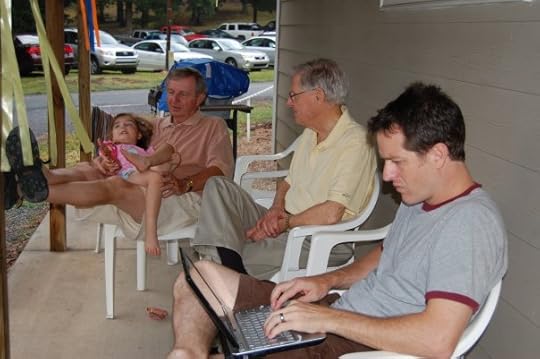 This is me working on one of my first novels. On the back porch of our small cabin at Pleasant Grove Campground.
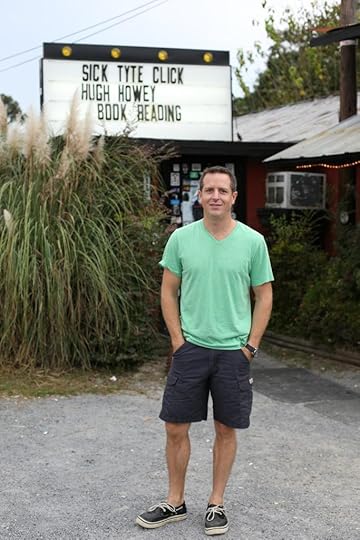 The first book event I ever had was a reading at my sister’s favorite bar in Charleston, SC. Opening for Sick Tyte Click (best band in the multi-verse, no kidding).
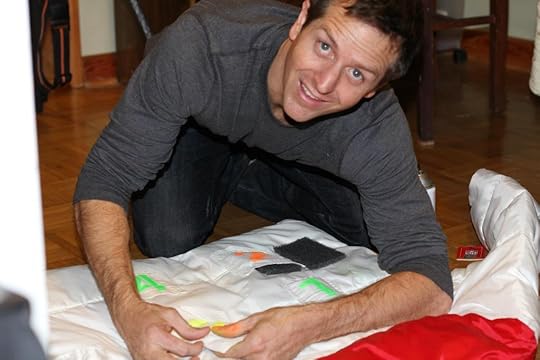 My cover art was usually some kind of practical effect that I then photographed. Here I’m working on WOOL Part 2.
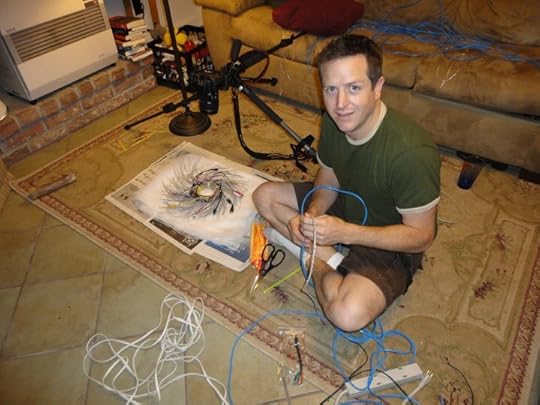 For the cover of The Hurricane, I made a storm out of wire and shot it from above. This was self-publishing back in the day, kids.
 Here I am taking orders from my website. I used to sign books and ship them to readers anywhere in the world. It started innocently enough, but quickly became a full-time job on top of all the writing duties.
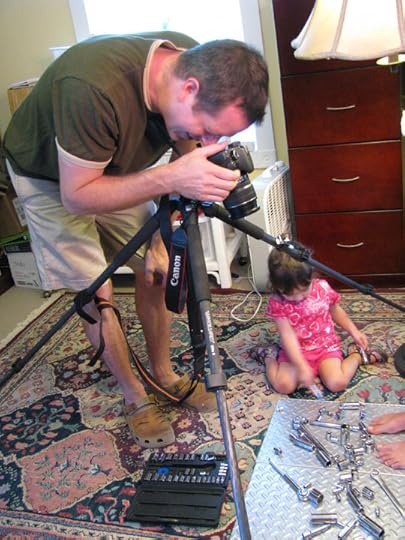 Shooting the original cover of Molly Fyde and the Fight for Peace.
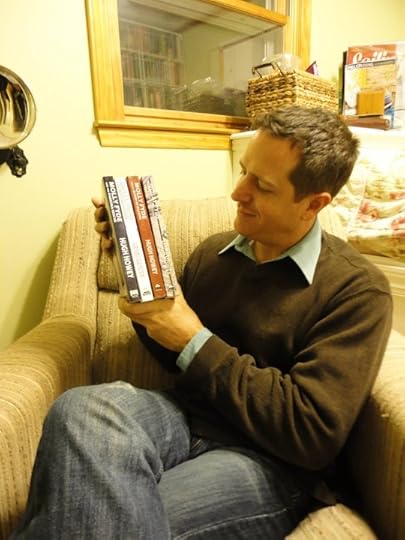 The Molly Fyde series remains one of my most ambitious and rewarding undertakings.
 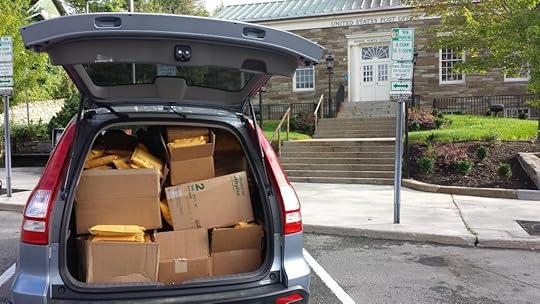 No joke, this was my USPS runs TWICE A WEEK! The ladies at the counter all knew me and went from dreading seeing me to fighting over who got to help me. It would take hours, and they said it really made the day go by faster. I’d sit at the counter and answer emails or even work on a novel.
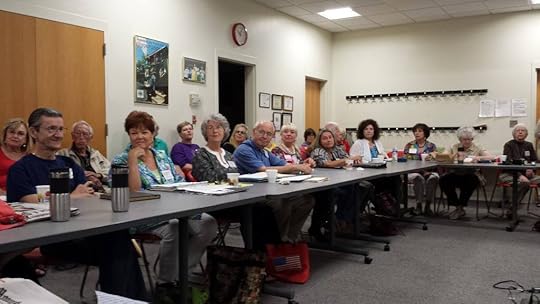 This was my writing group in North Carolina, the High Country Writers. I was the young whipersnapper. And the only sci-fi writer. Nobody liked my stuff, but they tolerated me pretty well.
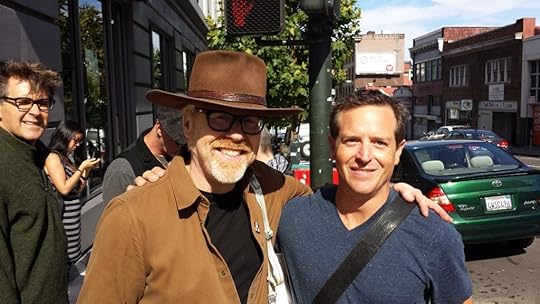 The best thing about writing sci-fi is you get invited to nerd-fests and meet the coolest people. If you don’t know, Adam Savage is the biggest-hearted and most lovely human imaginable.
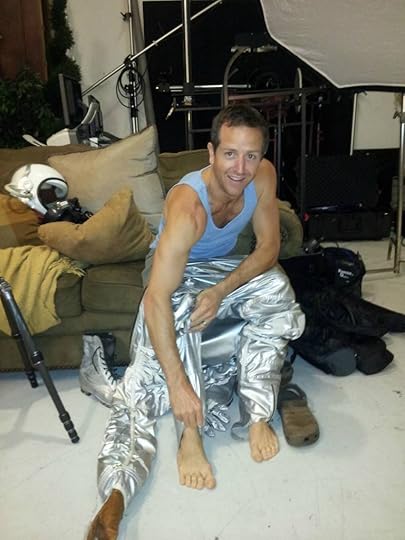 Donning a spacesuit for a cover shoot of my old college magazine.
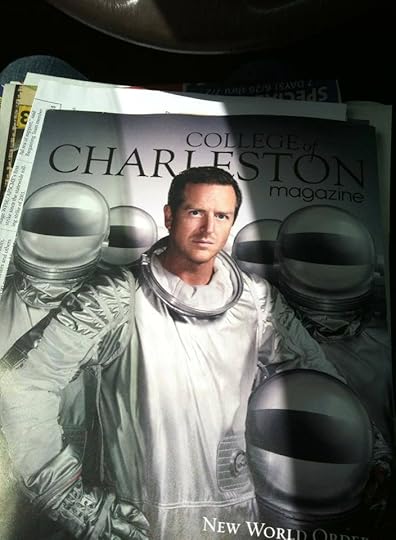 Pretty crazy to be celebrated by CofC, considering I still haven’t graduated. I think I’m six credits short!
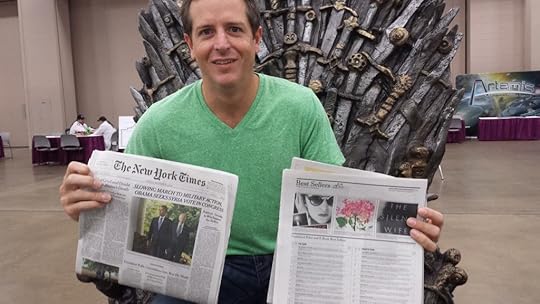 One of the times I hit the NYT bestseller list, I was at a big SFF book conference. I remember introducing myself to Scalzi in the lobby, and he was like, “I know who you are. You’re the Wool guy.” By the way, there’s only one Scalzi. The best of the best.
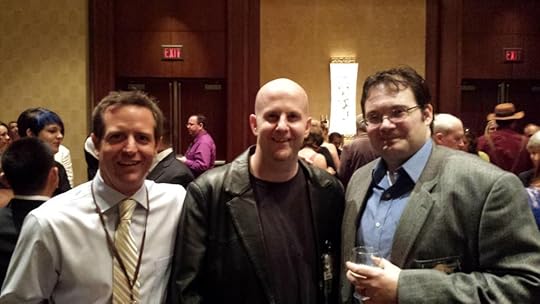 It was at ChiCon that I met John Joseph Adams for the first time; it would prove to be a very fruitful friendship and partnership. We’ve edited seven books together, and he’s published a ton of my short stories and acquired several of my novels for what is now Harper Collins. Here we are with some up-and-comer named Brandon Sanderson. (A note about Brandon: nobody, and I mean nobody, loves his fans more than this guy. He’s a jewel).
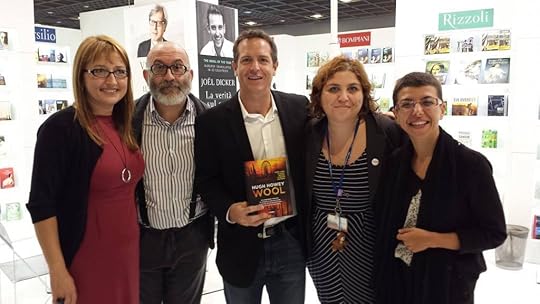 My Italian publishers! One of the joys of this adventure has been meeting book peeps all around the world. I have the best publishers in every market, no joke.
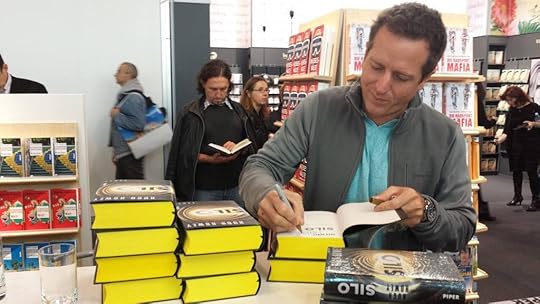 Signing the German editions for Piper, my German publisher.
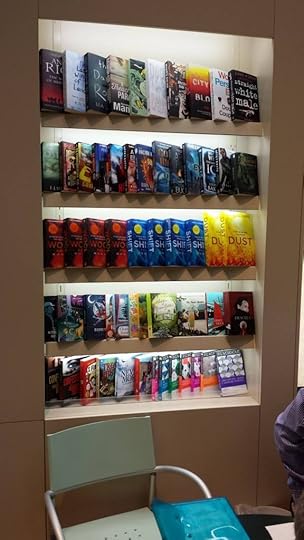 Random House UK created what quickly became an iconic set of covers, which we still pay homage to today with the most recent editions. They really set the standard.
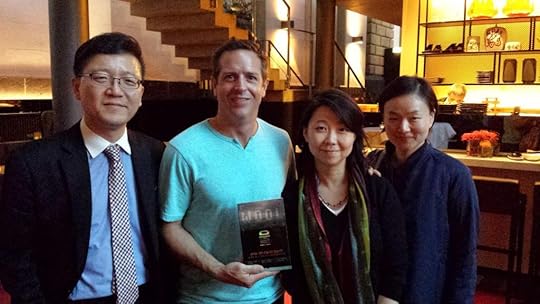 My Korean publishers! They make the most beautiful editions, inside and out.
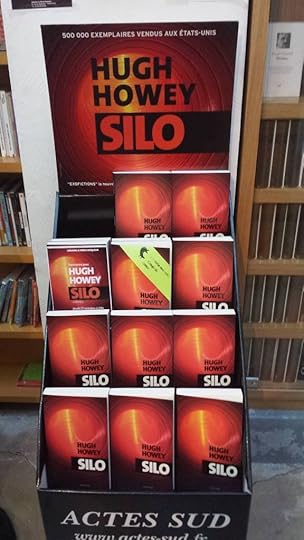 I love all my publishers, but Actes Sud in France has a very special place in my heart. They welcomed me like family and have treated these books like literature, rather than genre pulp. France is a special market for books. I owe them a lot.
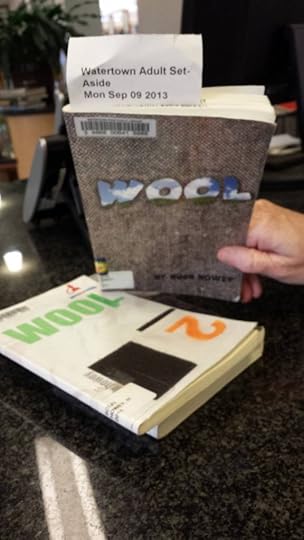 This is insane. The Watertown library was circulating the OG paperbacks, which can now sell for a thousand dollars. Readers had no idea and kept returning them. Uhhh, I would’ve paid the late fees.
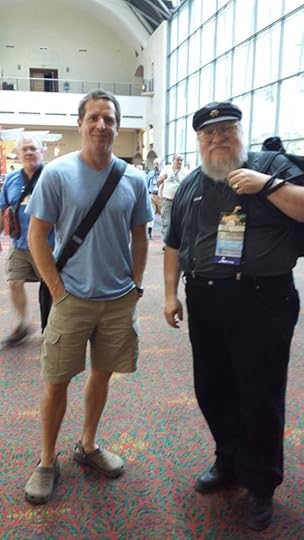 I’ve had the pleasure to spend some time with George at several conferences, and this man deserves every good thing the universe can throw at him. An absolute legend.
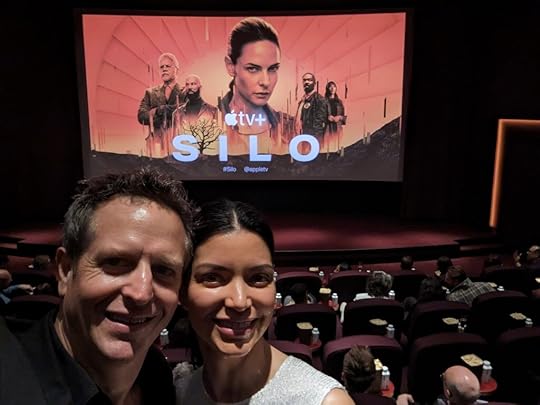 Shay and me at the Silo premiere in London. This remains one of the best days of my career.
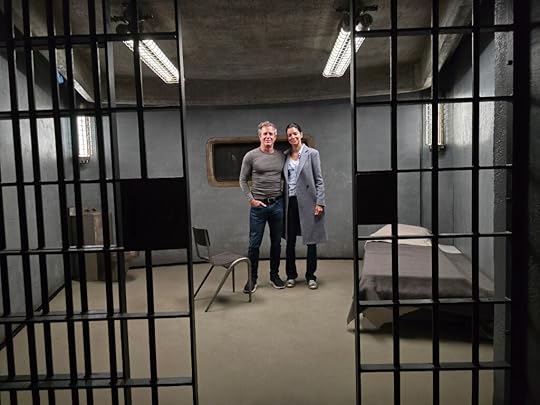 Getting ready to be sent out to clean. On the set for season 2.
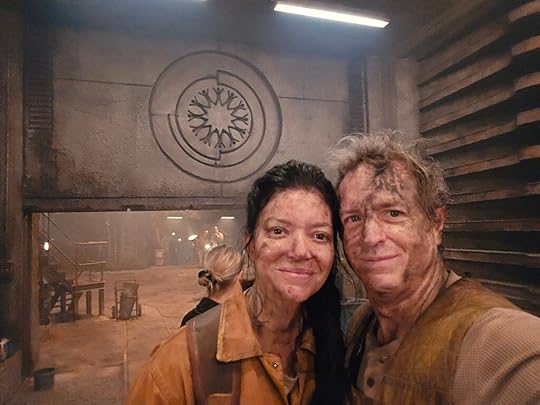 To be honest, life in the mines isn’t so bad. Dressing up for season 3.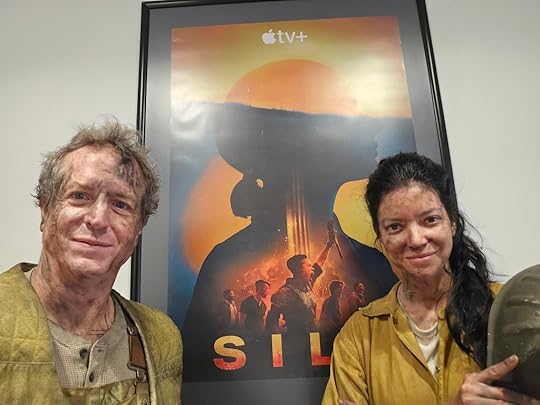
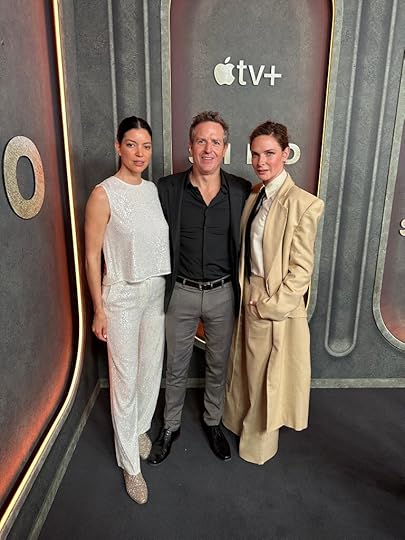 On the red carpet with two badass women.
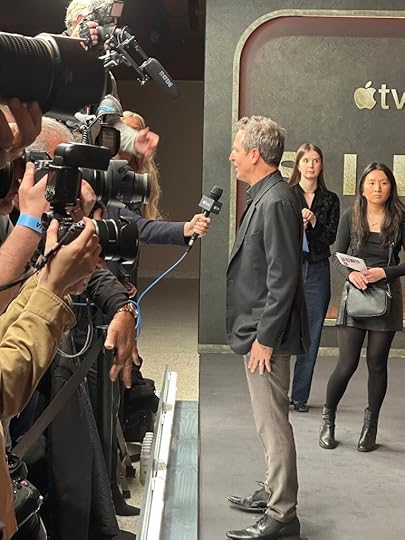 Making up answers to questions at the Silo premiere.
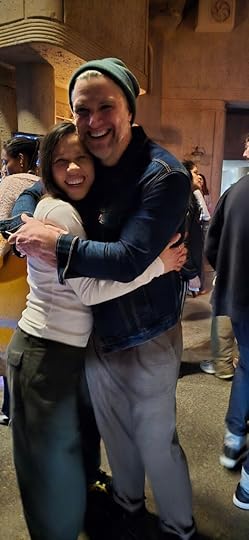 Knox and Shirley on the set for the season 4 wrap.
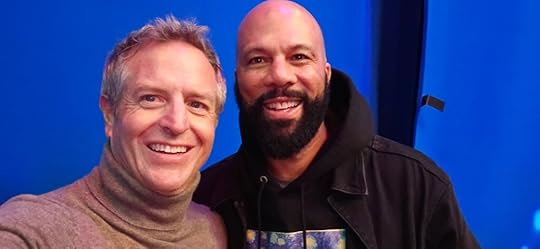 Common is seriously the coolest and most talented person I’ve ever known. Lyrics flow through him like it’s nothing. I’ll never be half the writer this man is, and he genuinely loves his fans like no other.
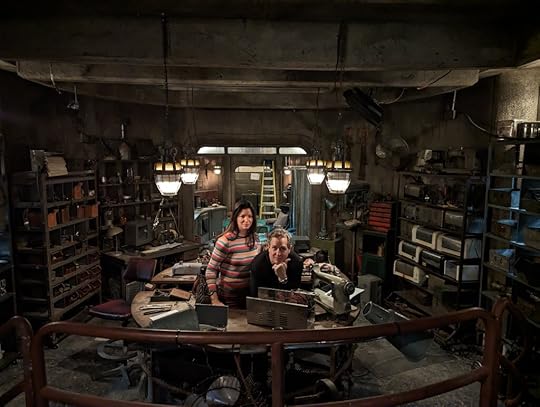 Walker’s workshop is one of the coolest sets ever.
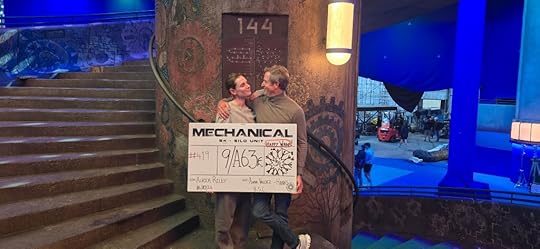 The greatest character I ever created played by one of the greatest humans I’ve ever known. Bex, thank you for everything.
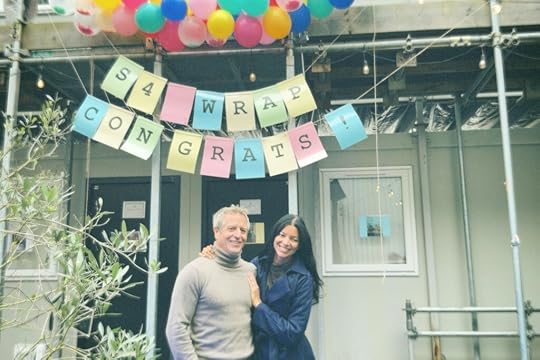 The last day of shooting for season 4. So lucky to have my soul mate in my life during this incredible ride. No one celebrates my wins quite like she does.
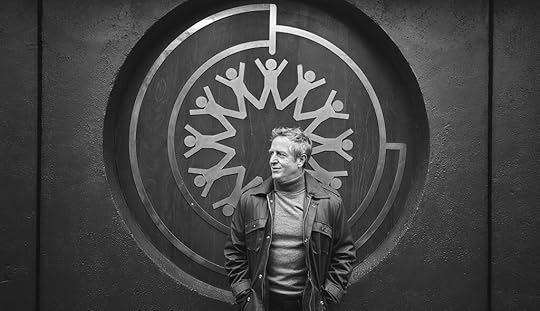 This place will be broken down. Something new will be built here. But what we created will live forever.
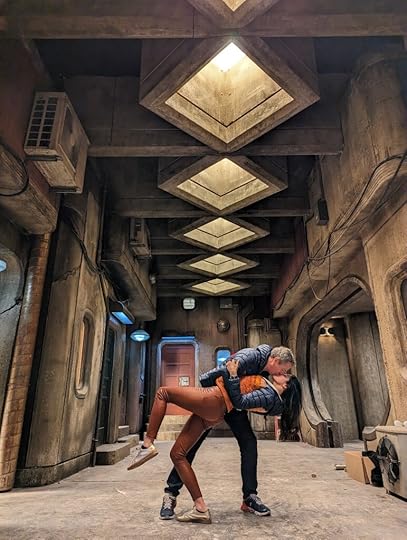 Then end. For now…
The post Book Ends appeared first on Hugh Howey.
March 1, 2026
Change is Okay
I grew up in the deep south, the buckle of the Bible Belt. My dad was a farmer and my mom was a schoolteacher. Everyone I knew was a Republican.
I was taught to pray so early that I don’t remember it happening. I just always said a prayer with my mom when I got in bed “Now I lay me down to sleep…” A terrifying nursery rhyme about the possibility of not waking up and hoping God would take my soul. I was four years old chanting this. It was one of the first things I ever memorized.
Prayer meant having someone to talk to in your head at all times. Big, important things like where do we go after we die? Silly, inconsequential things like, where did I leave my backpack? I remember praying for things as small as: “Dear Lord, if you help me find my notebook right now so I don’t miss the bus, I promise I’ll serve you for all eternity.” Constantly bartering. A one-sided conversation.
We went to Sunday school every week. And youth group after church. Part of youth group was church retreats, where we’d go serve food to the homeless, or ride a bus to a different state and help build homes after a natural disaster, or spend a week in the mountains at a rustic camp doing crafts, studying the Bible, and learning about Jesus and his works (and learning about the opposite sex once we got a little older).
A lot of kids have this upbringing, but we took it one step further. Once a year we spent ten days at the Pleasant Grove Campground living in a small cabin we called a “tent,” because that’s what they once were. These tents abut one another and form a huge square, probably six to ten football fields worth. In the middle was an open air arbor where we had church service every morning and evening. A good portion of the thousand-plus people there were cousins. We played on rope swings, congregated on the volleyball court, got in water balloon fights, and ate watermelons. My childhood was defined by this yearly event; my first time going I was just a few months old. I can’t remember a life without Pleasant Grove.
My father was one of the handful of people on the board of directors at Pleasant Grove. His grandfather or great-grandfather was a founder of the camp. The graveyard nearby was full of Howeys, signifying a long history here. I used to walk down the aisles with my dad taking up collection, a huge honor. We’d go into the church while hymns were sung and count out the money into stacks, tally the total, and put it all in locked money pouches. Church wasn’t a pastime for us, it was legacy, family, a critical part of our lives.
Part of growing up in the deep south was also learning that the north was evil. Cities were evil. We called them “yankees” and “carpetbaggers.” I learned before I was ten that people from the north liked to come down and steal things from us. It was in our DNA to think this. Passed down from reconstruction. In history class, we learned the basics of the Civil War, but from our parents and our friends, we learned that the war was all about States’ Rights (and what can be wrong with states having rights?!). It was also the “War of Northern Aggression,” and sure enough most of the battles took place in the South, so obviously the North was attacking us. It wasn’t ever about slavery. These were uncontested facts. You wouldn’t encounter anyone who disagreed with any of this.
God, The South, Family. In that order. I’m not kidding, and you really have to pause and wrap your mind around this. Being a Republican was part of your identity. Even today, you find people are more willing to walk away from their family than their political party. And forget walking away from God for any reason. The order above was seriously accurate, and more easily stated as: God, Politics, Family.
Politics eventually became religion, and that order would shift a little. I remember watching it happen like a frog in gradually boiling water. My father was my hero growing up. Of the three kids, I spent the most time with him. During the summer, I’d get up before dawn and spend all day on the farm with him. This started when I was three or four. My earliest memories of my dad are of me falling back asleep on the bathmat in my parent’s bathroom while he showered. I was like a puppy scared of being left behind. I’d sit on his lap and steer his pickup as we went from one plot of land to another, repaired the constantly-broken, checked in with his workers, ran errands, a neverending cycle of needing to weld something in the shop, run to the John Deere dealership, bounce our way across a rutted field, sit in a tractor that smelled of sweat and cigarette smoke while we took in wheat, stopped along the road in the middle of nowhere, get out, hop over a ditch, and peel back an ear of corn.
The radio was our constant companion. It started with daytime news and talk radio, local stuff from Matthews and Charlotte. My dad personally knew one of the top disk jockeys at the time, which was like him knowing Elvis. He could call him direct and request our favorite tune (Country Road), which we’d sing at the top of our lungs. He’d also call in to discuss politics, and I’d hear my dad’s voice through the truck radio, and now he was practically Elvis. Then Rush Limbaugh got on the air, and that’s all we listened to. Rush and whoever came before and after. All day long.
Rush Limbaugh and Fox News didn’t destroy my dad, they just finished what religion and the South had already started. Pushing him toward fear. My dad used to send me emails about how Muslims were having more babies and would take over the world. He thought Hillary Clinton was the most evil person who ever existed. The best Mexican restaurant in town became off-limits after Obama ate there once. My father had a good heart and was a decent man, but he began thinking and saying evil things. It was hard not to when that’s all you ever came in contact with.
It was a process that took place over decades, right alongside the general rot of political discourse in the United States. A good 30-40% of people still identify as Republicans, because they grew up that way. It’s an identity, not a belief system. The beliefs are handed to you, not arrived at through a process of reasoning. The North are the bad guys. Cities are disgusting. Democrats are evil. God is real.
I take no credit for the gradual transformation that I went through starting around age ten. But I’m proud of it nonetheless. I’m proud and I’m lucky. We are all born with a set of traits, personalities made of points on various spectrums. My friends with kids say they saw their personalities within the first year or two of being born. We are pretty set in our ways, which is why New Year’s resolutions are so difficult. Two of my luckiest traits are that peer pressure doesn’t work on me, not even a little. And I have an insatiable curiosity. I was the annoying “but why?” kid. And I felt no need to do whatever the cool kids were doing.
I drank too much alcohol twice, both on accident, and those were the two times I’ve been drunk in my life (one time I was 15 in London, and I threw back shots like I’d seen on TV. The other time I was 16 and in the Bahamas, and a bartender put me in a barber’s chair and poured alcohol right down my throat). I threw up both times and rarely drank afterwards. All through high school, I’d end up at parties where everyone was drinking beer and I’d sip on a Mountain Dew. Immunity to peer pressure helped me form a new identity, which I’d later learn is very difficult to do.
It started with religion. I asked a lot of questions when I was ten and eleven, both to my parents and my pastor. My dad and I would sit in the pickup in the middle of a field, having a honeybun and Dew for lunch, talking about heaven and what comes after death, the meaning of life, big topics like that. My notebooks in middle school were full of poetry about these topics, a stream-of-consciousness that captures the confusion of developing one’s own thoughts. We were Episcopalian, which meant going through the confirmation process. I was given a Bible with my name engraved on it, and so I started reading it from cover to cover.
I was twelve when I finished, and I was an atheist by the time I got to the end. I told my parents this, and they sent me off on a religious retreat where I’d spend the evenings on the porch of my preacher’s cabin. It was in conversations with him that I realized even he didn’t really believe in God, he just thought religion was important for people (he basically admitted as much). After that week, he told my parents it was probably okay that I stopped coming to church. But I didn’t stop going to youth group, or our volunteer trips, or Camp Meeting. I agreed with my preacher: religion was important. But the belief part wasn’t.
What’s wild is that I figured out God wasn’t real before I learned the South was the bad guys. Political party was more deeply rooted even than religion, a fact that is true today. The real order was and always has been: Party, God, Family. I was a voracious reader, and I got addicted to history books. I’d read a dozen books about a single war, or a narrow slice of time. What’s wild is how KNOWN it is that the Civil War was about slavery. It’s there in the articles of succession from several of the states. It’s in the letters they wrote to each other, their speeches and deliberations. The myth of the war being about anything else began only after the South lost and tried to save face. These are facts as measurable and clear as the fact that Earth is getting warmer. But the same crowd that doubts one doubts both. And here is the point of this blog post: facts don’t matter and never have. Belief and belonging are what’s critical to most people. Being like your parents. Like your friends. Like your spouse. Vilifying the other.
This tribalization is destroying the United States, just as it has destroyed other countries in the past (Ireland and the Middle East are familiar examples). The desire to shun the other has made for crazy bedfellows (Republicans and Russians) and insane mental gymnastics (divorce, cheating on wives, paying for sex, bribes, felonies, rape, are all okay when it’s our leader). Peer pressure and a lack of curiosity are the norms. Like I said, I was lucky to escape. I was born with a kind of mental teflon. But even with these advantages, it wasn’t easy.
I listened to Rush and Hannity even when I wasn’t with my father. I read Ann Coulter books. I thought Ayn Rand was a genius. I thought the South was better than the North and that cities were full of bad people. I would have voted for Bush Sr. had I been old enough. I distrusted the Clintons. The brainwashing is intense. I believed everything I was told to believe. Facts that contradicted these beliefs were not to be trusted.
In order to get out, I had to find several hidden escape hatches and crawl through each. One was stigma. I had the key to this hatch in my immunity to peer pressure. One night at Camp Meeting, I was up late in the kitchen with my step-sister Sarah. This was the first time I admitted to anyone that I didn’t believe in God anymore. It was a hazy, nebulous time in my move toward atheism. I was still talking to God in my head, a habit as difficult to kick as smoking cigarettes, but it was no longer prayer and blind obedience. It was outright challenges. My first taste of the courage that comes from thinking for yourself, consequences be damned.
What I found in Sarah was the same thing I found in my priest, about a year later: similar doubts. Hidden. Private. Never spoken. But there. It’s a pattern I would come to find over and over as I came out of the closet as an atheist. Most people didn’t really believe either. Which is why they still feared death. And acted immoral in private. And sinned in public. The belief was about belonging and the fear of being ostracized. It was ingrained habit. I would later find a similar pattern in politics. If I spoke to someone with their language and approached them from their value set, I would find that we agreed on basic things. But if you used any of the tribal language, conversations would derail. My father was always talking about how the weather was changing and what that meant for the crops. But mention global warming or climate change, and he’d get furious. There was a gospel, and you needed to learn the language.
Breaking free from these gospels was the beginning of my journey as a spiritual, happy, enlightened human being. Learning to use my brain and arrive at conclusions from first principles set me on a unique path, one where I find I can agree with AND disagree with almost anyone. None of us should have the exact same beliefs. It should be like a fingerprint. We should have our own identities. It’s not what society wants for us — it wants compliance and operates through coercion. But it’s what you should want for yourself. Even though it will be uncomfortable often and occasionally painful.
Letting go of God was the start of me becoming a more moral and ethical person. I got closer to Jesus when I stopped thinking he was the son of a god and more of a wise soul with something to teach us. Love our neighbors. Heal the sick. Don’t be obsessed with wealth. Kick over the money-changers’ tables. Revolt against the establishment. Sacrifice for what’s right. The most ethical people I know are atheists, because religion can’t convince them to do or think evil things. They have that dogma teflon. Always curious, looking for a better path.
The hardest part of this path is admitting you are wrong. Even worse, admitting you are the bad guy. Looking back, one of the greatest blessings in my life was being born in the South, thinking we were the good guys, and learning that we weren’t. Because what came next was transformative for me: I learned that it is OKAY that we were the bad guys. Most people back then were bad in a lot of ways. The North was full of racists, and not just to blacks. Italians were treated like a minority. Women were treated awfully. Kids were thrown into horrible work conditions. There were very few saints then, and there are very few saints now. Morally enlightened people today will be derided by future generations for eating meat, wearing leather, burning petrol, and a dozen things we aren’t even aware of.
Jesus tried to teach us this: we are all sinners. But forgiveness is possible. Most people live today with the opposite beliefs: Only the OTHER side are sinners, we are perfect and unquestionable. And I’ll never forgive those demon scum liberals. I wish they were all dead. That’s what we hear, what my dad absorbed through the radio and Fox news. The polar opposite of anything Jesus believed in.
Once I realized it was okay to admit we were the bad guys, it became okay to let go of my ego and rethink other things. The Vietnam war? Nothing noble about that at all. (Ever think about the fact that we lost that war, slinked home, and Vietnam turned out to be an amazing place today? We didn’t save them, because they didn’t need saving). Accepting this about the South had me look at religion and my old God from a different angle. If the version of that God was the one I’d been presented from my parents and community, then he was also the bad guy. He was against immigrants. He helped us murder the enemy when we went to war. The things people were praying for were evil. Admitting this and realizing it was better to stand up to that God and go to hell than fall in line was the first major leap of courage I made as a young man.
When I saw Braveheart for the first time, the final scene of the movie really hit me hard and brought me back to that struggle with God and the South. William Wallace is being tortured in public for not bowing down to an evil king. His intestines were literally being ripped out of him, and he was being asked to profess his devotion to that terrible king. Profess devotion and the suffering will end. Instead, he screams FREEDOM. Free to be on the side of righteousness and goodness. That was true courage. It was a courage I began to find when I told my step-sister I no longer blindly believed. It was a courage I found when I voted Democrat for the first time. It’s a courage I have today what will allow me to switch parties in an instant if the tides turn and a better option presents itself.
It’s okay that I had wrong beliefs. It’s okay that I was the bad guy. That doesn’t make me a bad person now, but only if I’m able to admit it and change. If I can’t, then I’ll remain a bad guy until I can.
Releasing this ego is the first step toward becoming your best self. It’s hard. Being born with a little peer-pressure teflon certainly helps, but anyone can do it. Change is okay. In fact, it’s a lot better than the alternative.
My father was capable of change, but he never quite escaped his upbringing and the toxic influence of Fox News and daytime talk radio. When he sailed across the Atlantic with me, he had a month away from those influences, a month in nature, in quiet, mostly just the two of us playing Gin Rummy and talking about life, topics big and small. By the end of the trip he told me he’d never felt happier. He admitted that not watching the news had cleared his mind. He told me before flying out of Antigua that he wasn’t going to go back to watching the news all day.
But he did. And the emails came flowing back about all the horrible things Muslims were doing. And Hillary came up every time we talked on the phone. My father died of cancer a few years later, but he had already died of a different cancer years prior. Most of his friends and much of our family thought of him as a good man. He could’ve been a good man, but it would’ve started with him realizing that we are the bad guys.
Today, the United States is a net negative on the world stage. We are siding with Russia over Ukraine. We are waging economic wars with longtime allies. We are withholding universal healthcare from our people and allowing guns to kill Americans needlessly. We aren’t allowing science to guide our use of vaccines, and we aren’t pivoting toward much more lucrative and sane forms of energy generation. We are breaking promises and accords just because of who wrote them, not because of what’s in them. Our President is a felon (34 times over), a rapist (found to be so in court and admitted by himself on a hot mic, not to mention over 30 accusers who all should be believed). He’s a pedophile, not just by being best friends with the most notorious pedo in modern times, but by fighting the release of files in which he’s mentioned more than anyone other than Epstein, and his threats to Republican colleagues over their release, but also his bizarre ownership of teen beauty pageants and comments he’s made over the years in interviews about seeing young girls naked. The guy is clearly a pedophile. The fact that we debate this as bizarre as debating what the Civil War was about and whether the Earth is warming.
But alas, that’s our struggle and perhaps our downfall. A lot of bad people are not interested in becoming better people, or seeing what it feels like when they allow themselves to change. What’s interesting to me is that the fear of even trying on a new set of thoughts is much like the fear of allowing Vietnam to try Communism on for a while. It’s not the fear that it will fail: it’s the fear that it will succeed. That the new thoughts will become a part of ourselves, and we may lose a connection to our current tribe. Or admit that we were wrong. Admit that we were, for a while there, not our best selves. And so we dig deep and double down and remain the worst version of ourselves to prevent any change from happening.
That’s most humans. That’s our biggest problem. And there’s no easy escape hatch, I’m afraid. Besides, I’ve got lots more to crawl through myself. Future generations will know a dozen ways that I’m being evil today, things we haven’t thought of or aren’t willing to admit. I’d rather explore those and try to change some more than convince myself that being right here, right now, is all I was ever meant to be.
Good luck. I’m rooting for all of us.
The post Change is Okay appeared first on Hugh Howey.
February 25, 2026
The AI Bubble is Bursting
A lot to unpack here, but first let me stress the difference between the AI investment bubble bursting, the AI hype train derailing, and any chance that AI is going to disappear from your life. All three are big questions and each has a very different answer. Working backwards:
AI is not going to disappear from your life. In fact, you’re gonna have a difficult time avoiding it. Software companies are going to keep jamming it into everything, and eventually it will make your life easier and better. But it’ll probably annoy you and mess things up along the way. Electricity was a lot like this. Intermittent and prone to setting things on fire, but the benefits were great enough that we pushed forward, refined the tools, and accepted it as a necessity. The internet went through similar growing pains.
So for those who hope AI will just go away, it won’t. And you might not believe this now, but in ten years you’ll wonder how we got by without it. Automated customer service without ever talking to a human and getting immediate and better results is just one thing worth looking forward to. Personalized travel agents who know what to book and handle all the details for you. Only ever seeing emails that need your personal attention (yes, your AI and another person’s AI will sort things out without your involvement). Guess what? Most executives have staff who do the same thing, and soon everyone will be able to afford that luxury. Your real estate agent needs a smoke detector form signed and notarized? Your AI will just make it happen. Anything electronic you don’t enjoy doing can be automated.
That’s what we have to look forward to. But right now, the tools are not living up to expectations. In fact…
… the AI hype train is derailing as I write this. AI will eventually lead to gains in productivity, but those gains are going to be marginal. That’s the optimistic take. Right now, there are practically zero gains. A study published just this month found that 80% of 6,000 firms polled showed no gains in productivity from their integration of AI. Forecasted gains of 1.4% over the next three years are expected, but that’s not the employment apocalypse many fear. And those are just guesses. We are just as likely to see a productivity paradox, where distraction from these tools and time spent double-checking their work takes as much time as doing it via human labor.
There are already cases of supposed AI turning out to be remote operations from cheap offshore labor mills. It even has a name that I absolutely loathe and because it annoys me, you’re going to have to live with it as well: Fauxtimation. The Nate example is one of the more egregious and fraudulent. But Google has done this with its Duplex service, Amazon was doing it with their cashier-less stores, and Tesla does it with their driverless taxis. There’s a lot more fake-it-until-you-make-it happening than actually making it. My personal experience with this was being at a tech conference where a robot was making and serving drinks, and me and a few friends followed a power cord to a curtained area, behind which was a human in VR controlling the robot manually. The magic of AI is currently a bunch of Wizards of Oz.
A few issues I foresee while we’re on the hype train. Two of the biggest problems are both summed up in the Pixar movie The Incredibles. Helen tells her son, “Everyone is special, Dash.” To which he replies: “That’s just another way of saying no one is.” The benefit of AI is the democratization of digital labor. The profit problem AI has is the democratization of digital labor. When everyone can make an app, there’s no profit in making apps.
This is a problem both on the macro and micro scales. On the micro scale, someone will tell you they vibe-coded an app to handle splitting dinner receipts among friends in a single day and launched it on the app store. The problem will be getting people to pay money for this app when their AI can handle this task for them already without the need for an app. It’s not just programming jobs that will get replaced, it’s the programs they were making that will no longer be needed. Instead of purpose built apps, you’ll have agents who can handle most tasks. Two historical examples that are similar: the smart phone replaced dozens of purpose-built devices all at once, and the internet browser replaced dozens of purpose-built apps that used to live on your desktop.
On the macro scale, the browser provides another good historical lesson. There was a similar level of panic and investment in silicon valley back during the “browser wars.” Microsoft’s antitrust problems stemmed from this era, as they tried to limit Windows customers from using rival browsers. The idea back then was whoever won the browser war would profit just like the companies who won the OS war. The problem is that customers weren’t willing to pay for a browser when free options worked just fine. It’s worth diving deeper into this to see why AI will follow the browser route and not the OS route.
Operating systems might have been free as well, with UNIX and Linux giving it their best shots. Power users back then (I was one of them), loved installing these distros and fiddling with all the dials. But most users just want something that works, without needing to troubleshoot anything. Simplicity always wins out over quality (see MP3 vs FLAC in the music space). Most of what a customer pays for when buying a computer is the hardware. The software is a fraction of the cost. So why pay $1,000 for a LINUX laptop that requires a computer engineering degree to operate when you can get a Windows for Mac laptop for $1,050 and it uses a uniform OS that you are already familiar with from the computers at work, the library, school, etc? Uniformity, familiarity, and simplicity win.
Once you were familiar with the OS that came with your PC or Mac, you were trapped in a upgrade cycle that cost money over time, upgrading from Windows 3.11 to Windows 95, to Windows ME (omfg), etc. Microsoft made lots of money without needing to make a product much better than the best Linux distribution (which got better and easier to use, but by then it was too late). The lesson here isn’t that Microsoft made a great tool that increased our productivity, the lesson is that Microsoft got lucky by being first and humans are lazy and set in their ways.
The first mover advantage was strong in those days. It’s less powerful now. OpenAI is not likely to survive the AI wars, because they need to copy someone’s profit engine and business model. But all other companies need to do is copy OpenAI’s training techniques. Which they already have. Chinese companies then copied those techniques, leading to models like DeepSeek that do most tasks for free just as well as paid-for models. And here’s where the browser wars have something to teach us: customers will not pay extra when free is good enough. A company like Google, which makes plenty of money, is going to let you use their AI for free, which will prevent a competitor like OpenAI from ever making enough profits to vie for Google’s ad marketshare. This is why Microsoft and Apple don’t charge for the use of Safari and Edge (Internet Explorer). Charging you money immediately creates a market for their competitors. If they ask $19.99 for Safari, Apple creates a market for Firefox to charge $9.99 for a much superior product. With the browser now the true user Operating System, that’s not worth the risk.
Now for the AI Investment Bubble. This is the one most people are talking about when they refer to a bubble, and the reason it’s currently popping is related to the comments above. The productivity gains are not evident, and any path toward profitability is currently unclear. The entire bubble is powered by a combination of techno-religious fervor from Silicon Valley and get-rich-quick-don’t-get-left-out insanity from Wall Street. The biggest tell that we’re in a goldrush is that Nvidia is the only company making real profits here, and they’re the ones selling pickaxes and bluejeans. But the cracks are already showing.
Datacenter construction projects are already seeing cancelations. Capex promises are being revised downwards. The comparisons to the tech bubble of the late 90s misses something crucial here. After the tech bubble popped, we still had miles of fiberoptic cables, network infrastructure, and trained technicians and engineers. When the AI investment bubble pops, we’re going to have warehouses full of GPUs which get outdated with every passing year and don’t have any other good use. Cloud computing doesn’t need this much compute. Serviceable LLMs already run just fine on your laptop or smartphone, without needing any cloud compute at all. And the amount of money being thrown around here is staggering, estimated to reach SEVEN TRILLION dollars by 2030. You’d get more productivity gains with that money if you gave people healthcare, high speed trains, and a functioning democracy. And that’s where the techno-religion comes in.
The justification for spending so much money is the race to reach AGI first. This isn’t conspiracy; AI CEOs admit as much proudly. The idea is whomever gets there first will “run the economy.” Winner take all. Destroy the competition. One person or company gets to rule the roost. And every other disgusting way you want to phrase this. Basically, betting the house because the CHANCE of winning is great enough that going bankrupt is a smart calculation. Meanwhile, most AI experts are telling us that existing LLM technology is not a path toward AGI. OpenAI itself released a paper saying hallucinations are an integral property of LLMs and can’t be avoided. So these tools will never be able to automate work without a human double-checking everything. And the cost of mistakes will only go up, especially when human lives are at risk.
The reason for the pullback from investors is pretty simple: ChatGPT 5 was a major disappointment. The gains seen in ChatGPT 3 and then 4 were not replicated. And every other model has seen a similar plateau. Investors were pouring money in thinking the gains would skyrocket, but it turns out that LLMs grabbed low-hanging fruit and can’t seem to reach much higher. This doesn’t make them useless, but it does make it pretty silly to divert a large percentage of the economy toward their further development. We might want to invest in other things as well.
Let’s zoom out for a second. The biggest companies on earth tend to extract value out of an enormous userbase by providing them with some value in return. Google gives great search results, so we spend a lot of time on their website, and our eyeballs and mouseclicks are valuable to advertisers. Amazon lets us shop in one place and delivers to our door, so we do a lot of our shopping there. Microsoft and Apple sell us hardware and software we can’t seem to live without, however much we loathe. Netflix gives us Love is Blind. Facebook lets us know which friends to stop talking to. All of them make money from hundreds of millions of customers.
What customers will a purely AI company have, and what service will they offer? The biggest use right now is creating images and videos, returning search results, and chatting. Existing players are already offering all of these for free or on the cheap, and the number of copycat models is just going to explode going forward. So what are they going to offer? How will they turn a profit? Or are they like Uber and AirBnB, which gave us value while the VC inflows were keeping them cheap but become hellscapes when they need to actually make money?
Microsoft and Amazon make a lot of their money now by offering tools and services to other companies. Is there a possibility for OpenAI and the like to do the same? I don’t see it. Google didn’t need to license OpenAI; it just built Gemini. Amazon is working on their own model. Apple licensed Gemini for now, but the cost of creating their own model is going down by the month (DeepSeek proved it doesn’t require billions to train a model as good as ChatGPT 5). To make back SEVEN TRILLION in capital expenditure, these companies are going to need to offer a compelling product that hundreds of millions of people are willing to pay for or spend their attention and clicks on. What could that be? Because I’ve got no idea. Our attention is already full. Population growth is going to slow and then reverse. Unlimited growth is not an option. Most of the consumers coming out of poverty and participating in the global market did so in the last two decades.
The last zoomed-out thought to consider here is that most consumer spending is accounted for, so your massive profits need to come at someone else’s expense. Google is getting advertising dollars that used to go to classified ads, newspapers, and magazines. Netflix is making money that used to go to Blockbuster, the cinema, and broadcast advertising. Amazon is making money that used to go to smaller retailers and other big-box stores (Circuit City, Toys-R-Us, and Borders are no longer with us). Apple is making money that used to go to Casio, Texas Instruments, music labels, broadcast radio, and others. Facebook is getting ad money from the same sources that Google is stealing it from. We have tech giants because of consolidation and a sudden rise in global affluence. Existing money and low-hanging fruit. So where’s the SEVEN TRILLION gonna come from?
If you think a small company is going to gobble up all the money that Google, Amazon, Facebook, and Apple are currently making, rather than these companies simply offering you AI services that eventually become helpful, I want some of what you’re smoking. When I zoom out, I see something different. I think AI is going to change your life for the better in ways you don’t expect, but it’s not going to change the lives of AI CEOs in the ways that they hope. Things will get a little easier for you, and they are about to get a lot poorer.
The post The AI Bubble is Bursting appeared first on Hugh Howey.
February 22, 2026
The Limits of AI
A year ago, I wrote a piece about the asymptotic nature of intelligence and the limits of AI. It’s long been my contention that intelligence is not boundless; it doesn’t shoot up an infinite curve to the stratosphere. Rather, there is an upper limit on what can be known and the inferences that can be made based on what’s known. That is: a complete understanding of the universe may theoretically be possible. It’s also possible that to simulate this amount of knowledge, you basically need to build a second universe in which to house it. (The old cartography joke is that the best map is a one-to-one representation).
What would it look like to approach the asymptote of intelligence? A whole lot like the last year. Before you read any further, I highly recommend watching the following video:
The video is about OpenAI and ChatGPT, but it would be about whatever company had seized the low-hanging fruit of LLM scaling, projected infinite scaling onwards, and believed their own hype. The AI bubble is about to pop, and it’s mostly going to pop because too many people in Silicon Valley believed Ray Kurzweil’s inane hypothesis that intelligence is infinite and we are going to blast right through human intelligence toward something alien and godlike. This became an unspoken religion, a race toward “singularity” and AGI. It has always been based on a supposition for which there is no evidence — but plenty of desire.
One of the comments on the YouTube video above summed it up nicely: TonyGrayCanada wrote: “Scaling LLMs to get to AGI is like using a ladder to get to heaven. The length of the ladder isn’t the problem.”
The length of the ladder isn’t the problem.
And the problem might not be that we simply need a different way to get there. The problem most likely is that there’s no such thing as heaven. No infinite intelligence. No alien mind that will usher us into the fabled singularity.
However … what’s coming and what’s here is amazing enough, and I think this point gets lost in the crazy hype curves. The human brain is ASTOUNDING. We evolved from single-celled organisms on a wet ball in the middle of the cosmos, and then one day we peered deep into the cell to discover the helix of DNA, the atoms that make up those helixes, the quarks that make up those atoms. We also gazed out into the infinite expanse and figured out black holes and neutron stars and came up with some decent guesses about what holds it all together.
THIS IS BONKERS and we don’t talk about it enough. A jiggling of atoms became self-replicating and later figured out a whole lot about quarks and the cosmos. If you look at our origin and where we are, and you assume a theoretical limit to what can be known, we are most likely closer to the limit than we are to complete ignorance. We’re most of the way there. We built cities out of mud, and all the miracles within them. Some hairless apes. It’s crazy.
And AI is getting crazy, because it speeds up all the amazing things that humans can do. Writing computer code is slow and laborious. AI is automating that. In the next few years, we will reach a point where you might not purchase an application to solve a problem, you’ll just create your own application. (Or, most likely, your AI agent will be aware of the dozens of free apps others have already made to solve this problem and suggest or tweak an existing one).
Some define AGI as human-level intelligence, in which case we are already there. It might be funny to point out a hallucination here, or a logical error there, but for every example of AI getting something wrong, another model gets it right or the wrong model has already improved. Humans get things wrong all the time. Optical illusions persist even after being told what’s happening. Superstition exists even with all our scientific progress. And we hallucinate constantly.
The LLMs of today are more than capable of replicating what the human brain does, which is miraculous enough. New breakthroughs in physics are now coming from AI systems. Brand new math proofs. New medicines from complex protein folding. These are all things humans can do and would eventually get to ourselves, but AI is speeding up cognition and helping us get there a bit faster. Silicon Valley is betting the farm on this. But most of humanity is asking, “So what?”
The “So what?” is critical and should not be ignored. An LLM can already devise a better system of governance which will bring the most good to the most number of people. It can do that today. Right now. In mere minutes. But so can we! The fact that we don’t and can’t has nothing to do with what’s possible in our technology and everything to do with what’s wrong in our biology. We are petty, insecure, jealous, superstitious animals. We are already at the point where we would be better off automating our decision-making with an LLM. If an LLM had control over me, it would eat healthier, exercise more regularly, make fewer mistakes, know a whole lot more about the universe, how to fix things, how to be witty, it would write this blog post better and do it in an eyeblink.
So what?
Computers are already better than me at chess, and yet I continue to play. They built a robot that can play billiards almost perfectly, and yet I love chalking up a cue and the crack of a ball knocking another into a leather pocket. There’s a human out there who is better than me at anything I can do, and yet it feels good to do many of those things. We are jiggling bundles of atoms with feelings and moods, and we’re going to keep indulging in them and falling prey to them.
Earlier I pointed out that there’s a finite limit to what can be known about the universe. But there is no upper limit to creativity. We can be weird and avant-garde in a way that physics can’t. Physics is a set of rules and a pattern of ordering matter. Understanding the universe is a quest to simplify those rules and to grasp all the possible states of matter. Creativity is a wild exploration of all the things that aren’t possible. It’s infinite because it comes from randomness. Knowledge is finite because it comes from order.
A perfect future, where humans and their technology reach a kind of symbiotic homeostasis, would be one in which machines handle all the order that humans aren’t interested in, freeing up more time to engage in randomness. That doesn’t mean an end to work, because what many of us do for play qualifies for work by some other person. At times, doing the dishes feels like play for me. My hands want to be there, getting wet, removing grime, deriving aesthetic pleasure from watching a thing become clean and dry, ready to use again. There is no end to play or creativity.
This perfect future would be full of enough robot doctors that any injury or illness is seen to immediately. It will also include lots of human doctors who are doing the same thing becasue for them it is play. It will be full of AI-written novels that readers enjoy, but also human authors who can’t stop writing for the pleasure of it. The income side of things will be solved, because everyone will have food, shelter, security, healthcare, and all the necessities. But some will have more than others, because we are still moody little bundles of atoms. And some will try to harm others for the same reasons. But things will get better and better for the vast majority of people.
That’s a future we could design and work towards right now, with existing technology and wealth. But … of course we won’t do that. We aren’t that far evolved, and we may never be far enough evolved. What’s more likely is that our societies will crumble because we couldn’t be human to one another. Men will continue to backslide into the barbarism from which we came, built on aggression and fear, and women will keep making the decision to have less to do with us and more to do with themselves and one-another. Population collapse will accelerate; we will reach a point where economies contract, leading to wars of aggression and aggrievance. Pockets of rationality will make progress again, much like the Greeks among the Romans, and that progress will be seized and used to build toward what we have today, where it will collapse again. The oscillations will speed up because lost knowledge will be rediscovered more quickly from the artifacts left behind. Eventually, one of these oscillations will stumble upon a technology that can put an end to us all, and one among us will deploy it immediately. Leaving the Earth for some future hairless ape to have a go at it.
The limit holding us back will never be the limits of AI, but rather the limits of our biology. Can we stop hurting ourselves and others? Can we expand our circles of empathy until they include every living thing and even most non-living things. Can we be satisfied with less than our neighbors if it means we all have the basic necessities of life? I’m an atheist, and the 10 commandments start off with some very weak sauce about fearing no other god and what not to believe, but even I can see that most of our problems would be solved if we lived by the rest of what’s there. No lying. No jealousy. No killing. We’ve had all the answers for thousands of years. We still can’t abide by them.
This is why OpenAI is in trouble, why the AI bubble will burst, and why AGI will not fix everything. We know what to do. How to live. How to solve all our problems. There’s no deficiency in our brains. The problem is and always has been our hearts.
The post The Limits of AI appeared first on Hugh Howey.
December 29, 2025
Art, Money, and AI
I wrote my first novel in 2009, fulfilling a lifelong dream. That dream was simply this: write a novel. It wasn’t to get a novel published. I wasn’t to get people to read the novel. I never dreamt of making money from my writing. I was just an avid reader from my Dr. Seuss days, fell in love with science fiction when I was eleven, and spent the next two decades dreaming of writing my own novel.
Having finally done it, I was presented with a colossal “now what?” There was a novel on my laptop that didn’t exist before. I went to Kinkos and printed it out, and now there was a book in a cardboard box that didn’t exist before. Also: it was a really good book, at least to me. I’d read it a dozen times while revising it, and I loved it more each time. The characters were interesting, the plot propulsive. The ending was both a shock but also logical and satisfying. And oh boy did I have a sneaky cliffhanger at the end!
A few friends and family members heard I’d written a book and were curious. So I emailed it around to folks. My cousin Lisa. My mom and my sister. A friend I only knew online. This is where things get a little warped, because the feedback I got wasn’t just “Hey, this is a good book from someone I only know as a computer nerd and a yacht captain,” it was: “Yo, this is better than the last few books I paid money for. You should publish it. How come Oprah isn’t talking about this? You should be a bestselling author. Where’s the sequel?”
I very clearly remember what it felt like to write my second book, Molly Fyde and the Land of Light. It was different from my first. For one thing, I now knew I could do it. I also had established characters and a universe to draw from. But the biggest difference is that I had an audience. I knew readers (only a handful, of course) who were waiting to read more. And this created a tension in my creative soul that I wrestle with to this day. It’s the tension between writing and authoring.
I wanted to write novels because I’ve always enjoyed writing, and I love novels. I’ve never wanted to become an author, which is probably why I still don’t think of myself as one. I just like writing. I’m enjoying writing this blog post right now. I have a general idea of what I want to say (I’ve been thinking about this blog post for several months), and I think I know how to arrange a sequence of events to lead you through my thoughts in a clear and engaging manner. It’s a puzzle, and my brain enjoys it.
But the tension between writing and authoring gets intense, so let me explain it a little. Writing is the hobby. Authoring is the profession. My mother is a gardener, but she doesn’t dream of becoming a farmer and taking baskets of goods to the market on Saturdays to supplement her income. My sister is a knitter, but she doesn’t dream of starting a clothing label and opening a pop-up. Most hobbies do not have a clear pathway to income, and so they remain pure hobbies for the vast majority of people who enjoy them.
Writing novels is not one of those hobbies, and the reason is pretty simple: duplication. If my mom grew a perfect tomato and could copy/paste it a billion times and send it to others through a strand of copper, she’d be a billionaire overnight. We are all looking for the perfect tomato. But they take time and aren’t easy to reproduce. The same goes for my sister knitting the best sweater ever. The work required to create enough sweaters to pay your bills is similar to other jobs. It’s a lot. And yarn ain’t cheap.
But sitting there, looking at a novel on a hard drive, knowing you can make infinite copies that weigh nothing and travel at the speed of light, gets you thinking. Hey, maybe I should do some authoring as well as some writing. Maybe I can make money at this. Maybe Oprah should know my name.
When I sit down to write, the only way I can stay in the writing zone and out of the authoring zone is to remind myself that nobody will ever read what I’m writing. I probably won’t publish it, I’ll keep it for myself (like the 5th Molly Fyde book, or thousands of blog posts over the years, all sitting in draft but fully realized and easily publishable). Often, I choose to write something in order to sabotage my career trajectory. A sequel to WOOL without the character people love most. A zombie book so revolting nobody can finish it. A romance novel about shell collecting. Anything that interests me and avoids the market.
But here’s the great contradiction that has guided my career as a writer: I’ve fought like mad over the years to make sure people on the authoring track get paid. A lot of time I could’ve spent writing the next formulaic sequel to make big bucks, I spent defending self-publishing in order to lower the stigma that was keeping more artists from sharing their works. And I spent gobs of time working with Data Guy on our Author Earnings project to show folks in this industry that self-publishing was a viable career choice. I’ve promoted other authors, edited anthologies, steered media away from myself and toward friends, all to try and help others get paid usually in lieu of me.
A couple of the more extreme examples of my lack of concern for the income-generating authoring side of things: when other writers asked if they could write Silo fan-fiction, I not only gave them my blessing, but I told them to self-publish the stories, charge money for them, and keep 100% of the profits. I also cut my agent into my self-publishing income for my most popular works, giving her 15% for something she didn’t help me publish, because she was supporting my decision to remain self-published when it was better for me. And so I figured it should also be more lucrative for her.
I didn’t do these things because I hate money. But I was able to do them because I don’t love money either. It’s not something to brag about, but I’ve lived a weirdly simple life. I moved onto a small sailboat in college that I paid ten grand for. It was my home for five years, often at anchor where I paid no rent (and also had no shower, no bathroom, no refrigeration, and no air conditioning). When I had enough money to buy a house, I bought a tiny one. Three of my homes over the next decade were right around 1,000 square feet. One was closer to 800 square feet. This was way before social media, van life hashtags, and “tiny homes.” I just didn’t want to be in a debt trap, and what others thought of me was never important. Shelter, food, health. In that order.
I think all of the above is necessary prelude to me saying: AI writing doesn’t bother me.
Will I use AI in my own writing? Never. I’ve been early and clear on this. I won’t even use it to look for typos or to suggest edits. Because I’m not creating a product, I’m doing something for my own pleasure, like working a crossword. I also don’t go to a website for the answer to the crossword and then put those answers into today’s puzzle. But I’m sure there’s someone out there who does. To each their own.
People are going to purchase AI-generated books and enjoy them. It’s already happening. Authors might claim their anger is over the theft of their works, but somehow I doubt that if AI models had been trained on works in the public domain, of which there are more than enough to get the same results, that magically all these angry authors would be totally cool with AI writing. “Oh, you didn’t sample any works currently protected by copyright? In that case, good luck with all your AI-generated books, and we wish you the best!” Yeah, I don’t think so. The anger is more visceral than that. It isn’t the theft that rankles, it’s the threat to future income.
The authoring brain goes nuts over AI generated writing. The writing brain goes: “what’s the point?”
The writing brain is bemused or ambivalent. It finds joy in writing and sees AI writing not as a threat but as something completely different, not the same game, not in the same universe. So there’s no threat. If a person wants to create a book entirely with AI, the most a writer brain might feel is the confusion over why someone would want to deprive themselves of the unique thrill of noodling it on their own. But an enlightened writer might realize that not everyone is looking for that thrill. Some people just want to read a book that doesn’t already exist, and however it gets created is not important to them. The book is the thing. Not the process.
The authoring mind sees a book where previously there hadn’t been a book, and now someone has robbed them of a sale. There’s money they would’ve made were it not for this existential threat to them making more money. It’s my mom getting mad that other people are growing tomatoes, my sister getting angry in her living room realizing someone else in another living room is also knitting. These are not healthy thoughts, and to be clear, my mother and my sister never think such things.
But oh, the same authors who were angry at me for self-publishing are now also angry at AI companies. The “tsunami of shit” from back in my day has become “AI slop” in this day. The threat is the same, and it’s an authoring threat. It’s not a writing threat. Nothing can ever stop anyone from writing except themselves.
Do I have a preference over a human writer making money vs a big tech company making money? Of course. I’m part of the Anthropic lawsuit. I think they should have used public domain works or generated their own training data (heck, pay authors to write sample chapters and books for less than the lawsuit is costing you). I’ve devoted quite a bit of my time and energy to helping human writers get paid, so my preference is impossible to doubt. But I also prefer books over TV and film, and I don’t make it my personality to deride others for however they get their entertainment.
The threat to book-reading has been social media for over a decade now. The threat to authors has often been publishers more than technology. The threat to writers has never existed and will never exist. Nothing is stopping you from growing vegetables or knitting a sweater. But something changes when you have that manuscript and suddenly words like money, bestselling, and Oprah pop into your head.
I have friends who make a living with their photography, and some of them have become all-consumed with their AI rage. Most of their social media posts are now lambasting those who generate images rather than going out to take them. The threat isn’t that someone is going to force them to use this new technology; the threat is that someone isn’t going to pay them for their art. All the complaints come in the guise of craft, but the source of the complaints is financial. It would be healthier for all of us if we were at least honest about that. Honest with ourselves, first and foremost.
The dream of becoming a full-time writer and supporting yourself with novels was always nearly impossible. And now it’s getting even harder. And that sucks, more than it’s always sucked. It’s difficult because not enough people (in my biased opinion as an avid reader) like to read books. It sucks because school unnecessarily teaches children to hate books at a young age (math, history, and science should not be taught from book-shaped things, and classics should be avoided until college). It sucks because publishers take too much of the cut and waste it on frivolous things. It sucks that healthcare isn’t even an option for successful, full-time writers. It sucks that a hobby that brings so much joy to so many people is so little rewarded. That’s not an AI thing. It’s always been this way and moving ever more that way.
There’s a near future where young readers will have stories created just for them. Where many people will read an individually-tailored book that no one else will ever read. And there will be a huge contingent of authoring minds out there who would vastly prefer that we all purchase the latest award-winning novel that nobody actually finishes rather than millions of people read and enjoy a one-off story written by a token-prediction machine.
I still don’t think of myself as an author, but I’ll always consider myself a writer and an avid reader. And for me, the millions of people reading AI stories late into the night when they have school the next day, or reading under their desks at the risk of having their device taken away by the teacher, are nearer and dearer to my heart than someone who is just in it for a buck. Writing for money is fine, I guess. I’ve fought for people to have that right. But if that’s the main goal, then the difference between that writer and the tech company is more similar than we’re willing to admit. It’s a pursuit of profits. We can stop pretending it’s about art at all.
The post Art, Money, and AI appeared first on Hugh Howey.
December 3, 2025
Life Update
24 36.644′ N
023 13.143′ W
Put that in your favorite maps site to see where we are as I write this. Roughly 400 nautical miles southwest of the Canary Islands and 2,200nm from the Caribbean.
How did we get here? Well, about two years ago, Shay started talking about us getting on a boat to sail around the world. Or at least, spend more time on the water. We were living in Manhattan at the time, loving the greatest city on Earth and lots of time with our amazing friends. NY was a perfect hub for our travels. Easy to get to family, and direct flights to London to check in on SILO. But we are two water babies, and Manhattan is an island very out-of-touch with the ocean.
So Shay had the idea of moving to Miami. We had a lot of friends there. I used to live and work in Miami and love South Florida for its boat culture, weather, and proximity to the Bahamas and Caribbean. Shay rented us an apartment without even seeing it, and we put the NY apartment on the market. In 2024, we loaded up our beloved Hyundai Kona and drove the length of the East Coast to start our Miami adventure.
I didn’t expect to love it quite as much as I did. I’ve been a happy person my whole life, and I’ve enjoyed every place I’ve ever lived, but in Miami I found a level of joy and satisfaction I’ve never felt anywhere else. It wasn’t the city … it was the tribe. One of our best friends in Miami introduced us to a gentleman who quickly became one of our new favorite people. He had surrounded himself with bright, active, talented, fun folks who welcomed us with open arms. It was a side of Miami that you could easily never stumble upon, a group all about elevating each other and learning from one another. Miami was supposed to be a stopover on the way to a grand adventure, but what we found there was a forever home.
While these relationships were deepening, we were looking at boats. I spent hours going through reviews, YouTube walkthroughs, checking in with builders I knew personally, weighing all our options. Maybe we’d get a small power boat and just do week-long trips in the Bahamas and Keys and stay in Miami. Or get a trawler and do the New England / Florida circuit for a few years. Or a smaller catamaran and use it like a second home. We toured some of all of these, driving up to Fort Lauderdale and flying to the Bahamas and going to boat shows.
At first the Bali 5.8 was just another interesting YouTube review in a very wide span of browser tabs so tiny you might X one out by trying to click on it. The walkthrough was from NautiStyles, one of my favorite review couples on YouTube. There was a lot to like, but I knew the Bali mostly as a charter cat, what we in the trade used to call “plastic fantastic” in a very pejorative way. In fact, Shay and I had chartered a Bali 4.5 the previous summer in New England. It was a magical trip, but the boat was run down and not very impressive. Still, I showed Shay the video and she was intrigued. On our way south from Orlando one day, I realized we were going to drive right past hull #2 of this brand new model (the only Bali 5.8 in the States at the time), so I reached out and set up an appointment.
This was probably the 20th boat we’d stepped on since moving to Miami and beginning our search, and it was the first time I saw Shay light up with a “this is our future home” look. The things she loved were things I was skeptical about from my decades of living on and captaining yachts and my own boats. There was a massive flybridge high off the water, which looked like an insane place to perch while crossing oceans. There was a SOLID foredeck rather than the traditional trampolines that made a catamaran a catamaran. The boat had no real aft cockpit, just a narrow bench facing INWARD toward the salon. Instead, the rear wall of the boat opened up, exposing the salon to the outside air. Oh, and the hulls were crazy wide. The master stateroom had a king size bed you could WALK AROUND, which seemed absurd to me, who had been taught that narrow = pace on the water.
There were a few things that stood out to me, though. One was the stepped hull, which basically meant the boat was narrower in the water and then jutted out above the water, so all that volume wasn’t necessarily going to kill performance. Another thing I noticed was the way the windows down the length of the hull created a channel, rather than being a flat wall. Years of experience told me that this would act like stringers giving the hull more stiffness than you might expect. And the rigging above the deck seemed solid. It also checked one of my big boxes, which is the ability to carry a large tender, which serves as your car while cruising. Without a large tender, you lose the ability to go on most of your fun adventures away from the boat.
The most important thing was Shay’s excitement. Her instincts are rarely wrong. Every life decision she’s steered us toward has been one of the best things that’s ever happened to me. And something I learned while living in the Bahamas on my 27′ sloop is that any boat can be the right boat. You all end up in the same harbor watching the same sunset. The important thing is to get what you can afford and just go.
We put hull #26 on hold. And it was a good thing we did, because the boat’s Miami debut was a sensation, selling a few more hulls just over the show. Instead of getting a boat sometime in 2026, we would have our boat hit the water in July of 2025. Our NY apartment sold in February. We put the down payment on the boat immediately after. Our Miami apartment became a staging ground for the things we would need on the boat. The transition began.
The logistics between that decision in February to sailing across the Atlantic Ocean right now boggle my brain. I won’t bore you with all the details, but the yard period alone was something else. The Bali 5.8 is a factory boat. You can check a few items on a spreadsheet, but it is what it is. My previous catamaran, WAYFINDER, was a custom build, fitted out with everything I chose. Knowing what goes on most factory boats, we declined as many things as possible on the Bali in order to supply our own. So we had our own sails made from Ullman Sails. We had our air-conditioning put in by Termodinamica, a team out of Italy. Numerous upgrades were made by Canet Premium Services in France, right in the harbor where Balis are built. We basically took the brilliant bones of the base Bali 5.8 and kitted it out for a circumnavigation.
A brief aside for future boat owners: Before buying the Bali 5.8, Shay and I very nearly purchased an Xquisite 60 Super Solar instead. For me, the Xquisite 60 is the best-built cruising catamaran right at the edge of what a couple can handle on their own. The after-sales support is unmatched. The engineering is top-notch. I don’t think you can buy a better 60′ catamaran anywhere. However, all that comes at a price. The Xquisite was more than I could feel comfortable paying. For less money, we could get a Bali and make the changes that bridged the gap between the two. So that’s what we did.
We doubled the Bali’s battery bank. We doubled the solar panels with a custom arch that looks like it always belonged there, rather than something tacked on. We upgraded the headsail rigging to electric furlers, so putting sails in and out is a breeze. The navigation equipment got an upgrade, with larger screens at the helm. Dozens and dozens of little changes like this that really turned it into a different boat. We will upload a video soon-ish to walk you through our new home and a separate video just to detail all these changes.
It was a lot of work, but it was also fun! We became great friends with the folks doing the work. Noel, who built our flybridge table and TV lift would greet us with a big hug. Christopher, who did all the electrical upgrades, practically moved aboard with us. And Adrien at Canet Premium Services basically became family (even to the point that his kids’ crayon art hangs on our fridge). The boat I’m sailing on right now is unlike any other on the water.
The most surprising thing, considering all the weight we’ve added in upgrades, is that she’s fast! We are averaging 200nm a day, which any sailor will tell you is an absolute dream. Off our starboard side, a full moon is settling down toward the horizon. A river of golden light like a highway across the sea. The faint glow of a new day off our port side. This is the end of our second day on the crossing, with another twelve or so days to go. Our voyage on “LUNA” has begun. I can’t wait to introduce you all to her.
The post Life Update appeared first on Hugh Howey.
September 9, 2025
State Surveillance
In 1949, George Orwell coined the term “Big Brother” in his (unfortunately) timeless novel 1984. The fear then — and now — was that mass surveillance would give totalitarian states even greater control over its people.
As prescient as Orwell was, here’s something he missed: surveillance works both ways. Bodycams have proven a nuisance for belligerent cops. Hot mics get politicians in hot water. And there’s a reason ICE agents are masking up.
But where Orwell thought the battle would be waged between people and state, the reality is that widespread surveillance mostly pits people against people. A cheating CEO and HR head on a Coldplay jumbotron brought the mirth and wrath of millions. A home-run-ball-crazed Phillies fan went from scowling at a kid to scanning the want ads in no time flat.
The power of the camera is that it can freeze a moment in time. And it might not be your best moment. A temporary lapse in judgement becomes a permanent stain on your reputation. Or (and this is more likely, in my opinion), a camera can capture and reveal truths about human nature that we try to conceal from others.
The CEO and HR head didn’t cheat for a second, and suddenly their lives fell apart. There were thousands of small and large dishonesties that led up to that moment. The Phillies fan didn’t lose her temper and become unreasonable for the first time in her life (she would go on to yell at another fan in his face and flip off the crowd after). Rather, the camera revealed with certainty something that she probably does a fair job of keeping under wraps.
The rise of the digital camera coincides with the fall of religious beliefs, and while there might not be anything causal in this, there might be a much-needed solution to a widening problem. For much of human history, there was a feeling that someone was watching us even in our most private moments and with our inner thoughts. I was raised in a very Christian household, and for the first twelve years of my life, I assumed God, Jesus, and all my dead relatives were watching everything I did. I like to think that even as I lost my religion, I retained some strengthened conscience from those years.
While religion has been on the decline, measures of conscientiousness have also been dropping. People are generally caring less and less for other people. And really, can you blame them? Have you met people?!
One of the studies covered in the fantastic book Why We Lie details grade-school kids cheating on a pop quiz. The findings are interesting because — when presented with a low-stakes situation with no one watching — every single kid elected to cheat. (It turns out, someone was watching: the folks doing the study). The pattern that emerged was this: no matter the gender or age, when a teacher left a solitary student alone in a classroom with a quiz, and the kid knew the answers were on the wall behind them, the ease with which they could turn their heads and ace the exam overrode their sense of right and wrong. They all looked.
But with a teacher in the room? None of them looked. The teacher is the ultimate conscience. It doesn’t require faith to believe in them. There they are.
Most people fear a surveillance state. Me? I fear the people who fear the surveillance state. I wish there were cameras everywhere watching everything and that we all had access to them. Because we are beginning to lose the behavioral feedback loop that kept us in line.
That feedback loop goes back to the tribal societies in which we were meant to live. You are adapted for a reality in which you would almost never encounter a stranger. The people you were born around would be the people you lived around and died around. If something went missing in a small band of people, the culprit would likely get caught. If a child misbehaved, the nearest adult would correct the behavior. If an adult misbehaved, ditto.
These days, we cut people off in a merging situation because we know we’ll never see them again and there will be no repercussions. Anonymity brings out the worst in us. Things are said behind online accounts that bring shame when we are doxxed and those same public outbursts are shown to employers, family, friends. We act like the surveillance and doxxing are the problem, rather than the behaviors. And that’s fucked up.
My wife and I just drove four hours each way on a road trip in France, and we didn’t see a single car pulled over by a cop. What we saw instead were the white flashes of light as speed cameras logged who was going too fast. Tickets show up in the mail with mugshots, license plates, amount due, and accepted forms of payment. It’s not only a more effective means of raising money and employing people’s time, it’s a great deterrent. During these speed traps, all the cars slow down and do the limit. Afterwards, they all go racing off like it’s the Autobahn. (Some places get around this by logging license plates between two zones, figuring out the average speed between those zones, and mailing a ticket).
An interesting experiment I’d love to see (and would gladly participate in) is to put a group of people under constant surveillance and see how they report their behavioral changes with and without the cameras. Give half the people dummy cameras. Maybe tell a third group about this experiment and give them no cameras, but have them log their own behavioral changes (to control for the effect of logging your behavior in a journal). For a fourth group, tell them that the cameras aren’t being watched by the researches, but rather that their friends and family have been given full access. Study the results.
This thought experiment led to an idea, which led to this blog post: what if we turned Big Brother’s cameras directly around and left them on 24/7? Imagine this scenario: Every elected official is made to wear a bodycam. Their offices are cammed up. Their homes. At any time you like, you can log in and watch them sleep, eat, poop, have a meeting, browse the web. You can watch them trade stocks. You can listen to them hash out deals. Everything. Zero privacy. No exceptions.
Will this make waging war more difficult? I hope so. Would 99% of today’s politicians opt out of this program? I hope so.
Who would opt in, you might ask? The very people you’d want in charge of things. The exact opposite of what we are stuck with today. Today, we have grifters and attention-seekers who profit from their private deals and inside knowledge. They have both anonymity and immunity. They should have neither.
The system we have today selects for people with no conscience. We should select for those with max conscience. There’s an easy way to do this. And hey, sell ads for the most-watched accounts and pay down some of our debt while you’re at it. Corporations would suddenly have a lot more to spend on advertising once the bribes are no longer viable.
Basically, we should turn the Surveillance State into State Surveillance. Watch what government is doing at all times. If anyone doesn’t like that, get a different job. See who is okay with their masks off.
The post State Surveillance appeared first on Hugh Howey.
August 16, 2025
Nobody Had Any Idea
“They had no idea,” Percy realized. And so he resolved to remedy this.
Percy Perceival Pierce lived in a time of miraculous inventions. There were computers to help design these inventions and robots to help build them. “Help” here is used the same sense that Thomas Jefferson “helped” tend his crops and build his home.
Realizing their ignorance, and how undesirable this was, Percy had three machines built. The first was a time machine, which was common enough in his day and as abused as you might expect (but don’t worry, Percy had grander ambitions than most).
The next was a device for cataloging all the miseries of the world as they were happening. He, of course, had no idea how this device worked. Let’s just say a mesh network of feather-covered drones with keen vision would later lead to a very observant conspiracy theory that there were no such things as “birds.”
The final device was most sinister, and until this moment — never in the history of Percy’s universe — had such a device been built or even conceived. Percy was outdoing himself, you see. For the third device was not a mind-reading one, but a mind-writing one. Its sole purpose was to place images and knowledge in the heads’ of others.
These three contraptions were all borne out of a single prompt to his digital agents: “They should know.”
And so Percy stepped back in time and began resolving what he thought to be a major problem with human history, a sort of antithesis to what Siddhartha would attempt to correct in his time. Percy realized — he was not the first nor certainly the last — that suffering was happening in the world without everyone being quite aware of it. And this could not be tolerated. For it was evil, in Percy’s mind, for there to be bad things that were not constantly being thought about.
After a visit to the far past, Cro-Magnon and Neanderthal alike were suddenly aware of men bludgeoning men to death. Of women being raped. Of children being eaten. These images filled their minds, drowning out the love they had been feeling, the excitement of a successful hunt, or even the fact that their cousin was bludgeoning their brother, their father raping their mother.
Instead, somewhere distant in the world, a bad thing was happening. And now those bad things filled their minds.
To the third century he went, making sure people knew of all the bad things everywhere. For if they didn’t know, and didn’t obsess, and didn’t contemplate, and didn’t discuss with one another, every little bad thing that was happening — how could any of these people be taken seriously? How could they not be morally perfect? To know suffering was to be enlightened. To see the worst across all humanity was to become the best humanity might offer.
A young couple on a first date in Rome were holding hands, thinking of their future, when suddenly they were aware of the horrors of the Mongol Hordes. A Mongol mother, holding her newborn to her breast, was made aware of every child then dying across the globe of myriad diseases, accidents, and evil. A Victorian physician was made aware of every murder then taking place. The young woman praying to her god was told of every child being molested by all the other gods (hers included).
Percy leapt from time to time, making sure people knew. Because those who didn’t know were somehow happy for not knowing, and this made them ignorant and evil. Being happy should not be possible — there were simply too many awful things happening in the world at any time. Being happy was an insult to those who were not happy. And of course, this should have compounding effects, should it not? For if someone was made unhappy, this should make another person even less happy, and that should knock on to make another person less happy.
For Percy, a smile was the mark of a dullard. To laugh was to cut with a sound. Joy was ignorance. Peace an abomination. He knew this. And so should everyone else.
It was a day of miracles, but not of unlimited resources, and by the time Percy got to the Twentieth Century, his device pushed up against its limits. There were so many people! My gods, what had happened during this time. So many people, so much bad happening, and not nearly enough awareness. His devices, not having the throughput and bandwidth for it all, employed a new device: The Local News. Later, it simply had humans build their own devices and made sure they were wired up appropriately. It had developed The Algorithm.
Percy saw that others now saw. The world was full of evil. Bad people were getting away with all kinds of crime. The downtrodden were being abused. Rape, pillage, murder, mayhem, were everywhere. Especially in people’s minds.
The one thing he forgot to tell anyone, in any of these times, was that however bad it seemed, in the future it would only get better. Hope like this could lead nowhere good. And so nobody had any idea.
The post Nobody Had Any Idea appeared first on Hugh Howey.


