
Dave Tabler's Blog: Creating Delaware History books
December 17, 2025
The Night Delaware Ran the Klan Out of Town
In the summer of 1923, the Ku Klux Klan staged a cross-burning at a farm outside New Castle. They expected the usual spectacle—hooded guards, circled automobiles, flames lighting up the night.
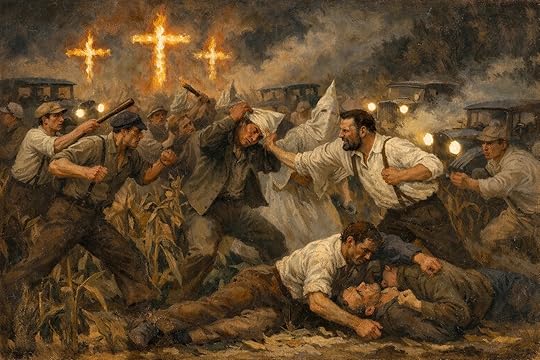
They didn't expect the Catholics to charge.
"All hell broke loose." Fifty people were injured. One Klansman drove his car into the crowd, then fled town that same night. According to local lore, nobody ever saw him again.
It was the beginning of the end for the Klan in Delaware.
"Delaware Behaving Badly: First State, True Crimes" drops January 1.
Read the full story here: https://tinyurl.com/KKK-riot
They didn't expect the Catholics to charge.
"All hell broke loose." Fifty people were injured. One Klansman drove his car into the crowd, then fled town that same night. According to local lore, nobody ever saw him again.
It was the beginning of the end for the Klan in Delaware.
"Delaware Behaving Badly: First State, True Crimes" drops January 1.
Read the full story here: https://tinyurl.com/KKK-riot


December 14, 2025
Another Taste of 'Delaware Behaving Badly'—Out Jan 1
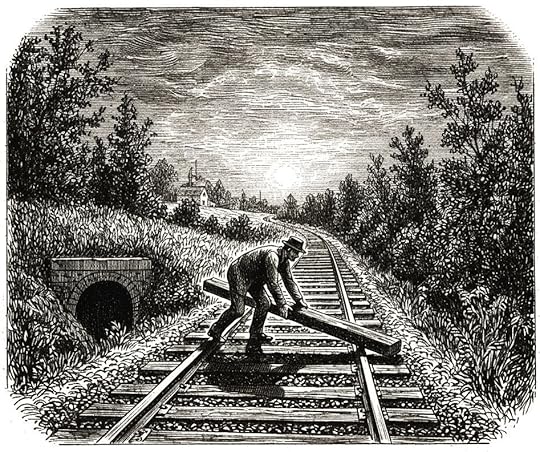
The Foolproof Plan That Killed Four Men
Harley G. Brown spent days analyzing his scheme. He tore it apart looking for defects, then assembled it again. It was foolproof, he thought.
The plan was simple: wedge a railroad tie across the tracks near Claymont station, wait for the local train to stop, then run toward it waving his arms frantically. He would tell a story of discovering the obstruction and trying desperately to remove it. The Philadelphia, Wilmington & Baltimore Railroad would hail him as a hero. They would offer him his old job back—or maybe something better.
On the warm night of June 29, 1878, Brown set his plan in motion. He found an old tie in a ditch and wedged it carefully across the rails at a spot just beyond a culvert, opposite the farmhouse of J. Edward Addicks. Then he waited.
What Brown didn't know was that a fast express ran between the scheduled local services.
When an unexpected whistle pierced the night, Brown's confidence curdled into horror. The express hurtled toward him at fifty miles per hour—far too fast to stop even if the crew spotted him waving his handkerchief in the darkness. His foolproof plan had a fatal defect after all.
The locomotive struck the obstruction and toppled from the tracks "like a toy." Flames began licking at the wreckage. Engineer George Babe died in the crash, along with his son George Jr., who had been firing the locomotive, and two men who had been stealing a ride between cars. A witness described the true horror: the engineer lay between the locomotive and tender, "badly crushed and completely disemboweled."
Behind the derailed engine sat two express cars, a baggage car, two passenger cars, and two sleeping cars—all mercifully still on the rails. If they had also derailed, fire might have consumed the wooden carriages and their seventy passengers.
In the aftermath, Brown approached the conductor, Samuel Phillips, tapped him on the shoulder, and asked if the wreck was bad. Then he added, "I did all in my power to stop her." Phillips, a sixteen-year railroad veteran, grew immediately suspicious. "A man ought to be almost able to get anything off a railroad track under such circumstances," he observed. Before Phillips could question him further, Brown vanished into the darkness.
He didn't stay hidden for long. Brown confessed, and by December 1878 he sat before the New Castle Court of Oyer and Terminer, charged with first-degree murder. The Delaware Gazette reported that he was "neatly dressed in a black suit" and "walked firmly and without hesitancy." But there were signs of inner turmoil: "a slight contraction of the eyebrows, a tremor of the lips, and a nervous twisting of his pocket handkerchief around his fingers."
How had a former model employee arrived at such a deranged scheme?
Brown had worked for the P.W. & B. for over a decade before leaving in 1875. The Smyrna Times reported that during those years he was "regarded as a faithful and efficient officer, prompt and willing in the performance of his duties, and an exemplary man in all respects." He was strictly temperate, avoiding both liquor and tobacco. When he resigned, he gave proper notice and trained his replacement.
But something had gone wrong inside Harley Brown's head—literally. In 1868, he suffered a severe accident while working on the railroad. Later came a near-fatal sunstroke. After leaving Delaware for Maine, where he joined his father and brother in a farming and forestry partnership, a falling tree limb knocked him unconscious. Blood oozed from his ear. He remained senseless for ten or fifteen minutes. Afterward, his mood darkened into deep melancholy.
The forestry work proved too demanding for his injured mind. Brown decided to return to Delaware and seek reinstatement with the railroad—steady employment, familiar routine. But when he arrived in Wilmington, he discovered his years of faithful service carried no weight. Someone had taken his old position, and the P.W. & B. refused to offer him another. Master machinist Stillman A. Hodgman recalled Brown's humiliated appeals: "He asked me for a job as fireman, and if I couldn't give him that give him anything we had to do." The rejection was absolute.
Brown's timing couldn't have been worse. Just a year earlier, the Great Railroad Strike of 1877 had erupted across the country. Workers blocked trains and clashed with militia forces. Federal troops killed dozens of strikers in Pittsburgh and Baltimore. The public increasingly viewed railroads as ruthless monopolies that discarded even their most loyal workers.
Brown's case struck a nerve precisely because he embodied this dysfunction. "There is a great amount of sympathy expressed for Harley G. Brown," noted The Daily Gazette. This sentiment reflected both pity for his mental state and deep-seated anger at a system that drove even its most dedicated employees to desperation.
His cousin Adolphus, who worked in the freight department, testified that Brown "seemed discouraged and dejected and talked as though his friends did not consult him enough to do anything for him." Neighbor William Brannon called him "flighty" and "a man not possessing good common sense." A member of the coroner's jury thought Brown acted "like a ten-year-old boy."
The jury deliberated for an hour and twenty minutes. They weighed three possibilities: murder, manslaughter, or complete acquittal based on insanity. In the end, they split the difference—not guilty of murder, but guilty of manslaughter. Brown's mental state had impaired his judgment without completely absolving him. He served five years in New Castle jail instead of facing the gallows.
After his release in 1883, Brown moved to Mount Holly, New Jersey, where he built a house on his father-in-law's farm and turned to agriculture—finding in farming the stability that railroading and forestry had denied him.
But nothing could undo what happened on that warm June night when a desperate man wedged a tie across the tracks and waited for the wrong train. His actions cost four innocent men their lives and forever marked him as the hero who never was.
——————————
This post is adapted from “Delaware Behaving Badly: First State, True Crimes,” arriving January 1.
December 13, 2025
‘Delaware Behaving Badly’ Hits Shelves Jan 1-Here’s a Taste
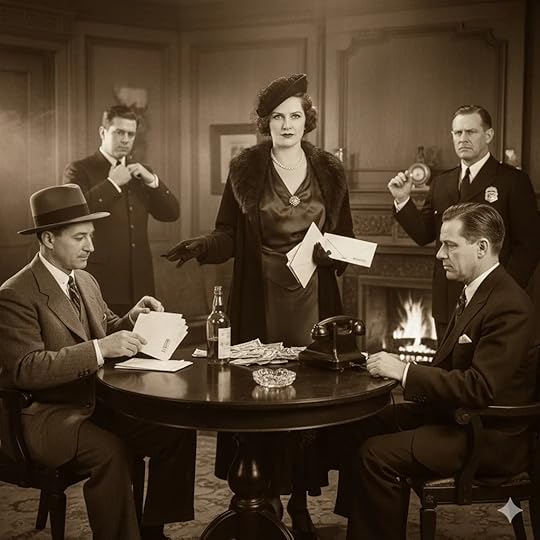
In 1936, a Wilmington madam walked into the Attorney General's office and exposed every cop on her payroll.
That's just one story in Delaware Behaving Badly: First State, True Crimes—out January 1.
Read the full account here
December 10, 2025
Grateful for Delaware's Indie Bookstores
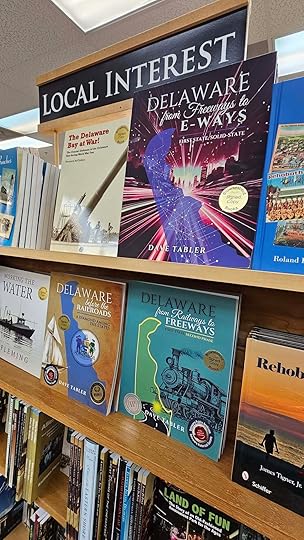
This Christmas season, I'm filled with gratitude for Delaware's indie bookstores. There's something special about walking into a local shop and seeing your work on the shelves—signed copies waiting to find their way into readers' hands.
A heartfelt thank you to Browseabout Books (shown here), Huxley & Hiro, Delaware Shoppes, Hockessin Book Shelf, and Bethany Beach Books for supporting local authors and keeping Delaware history alive in your communities.
These shops aren't just places to buy books—they're gathering spots, discovery zones, and the beating hearts of their neighborhoods. If you're still looking for holiday gifts, I hope you'll consider stopping by one of them.
(And yes, my books are also available on Amazon, Barnes & Noble, Powell's, and other online retailers if that's more convenient for you!)
📚 Happy holidays from one Delaware history nerd to another.
@BrowseaboutBooks @HockessinBookshelf @BethanyBeachBooks @HuxandHiro @DelawareShoppes
December 3, 2025
My First Audience
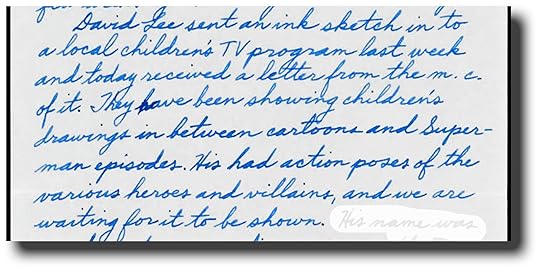
How an eight-year-old's ink sketch sparked a lifelong impulse to share stories
In September 1963, I was eight years old and apparently already thinking about reaching an audience. My mother wrote to my grandparents: "David Lee sent an ink sketch in to a local children's TV program last week and today received a letter from the m. c. of it. They have been showing children's drawings in between cartoons and Superman episodes. His had action poses of the various heroes and villains, and we are waiting for it to be shown."
I don't remember if my artwork ever made it onto the screen, but I remember the thrill of the possibility—that something I created with my own hands might be seen by people I'd never meet, in living rooms across the Washington, D.C. area. At eight, I was already discovering what would become a lifelong impulse: the desire to share stories and images with a wider world.
November 19, 2025
My First Publication Was a Letter to Santa
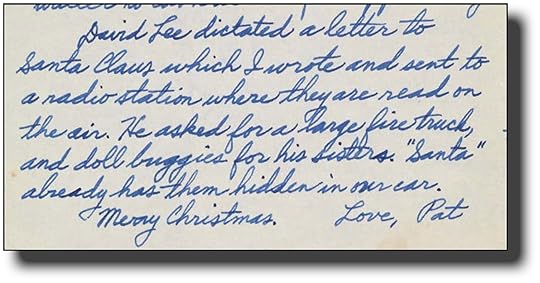
People often ask me when I started writing.
Well, here's a secret most of you don't know: my first published words went out over the airwaves in December 1958. I was three years old.
I dictated a letter to Santa Claus, which my mother dutifully transcribed and sent to a local radio station. And then—this is the part that still gives me chills—I heard a broadcaster read MY words on the air.
What did this future historian request? A large fire truck and doll buggies for my twin sisters. (Santa had already hidden them in our car, but I didn't know that yet.)
I don't remember the broadcaster's voice or which station it was. But my mother captured the moment in a letter to her parents, and now, decades later, I'm holding that evidence in my hands.
That radio broadcast was my first taste of what it feels like to put words out into the world and have strangers receive them. The medium has changed—from radio waves to printed pages to your screens right now—but that fundamental thrill? Still the same.
The three-year-old asking Santa for fire trucks had no idea he'd grow up to write 5 (so far) Delaware history books. But maybe, just maybe, that moment planted a seed.
November 5, 2025
An Evening with Dave Tabler at Huxley & Hiro
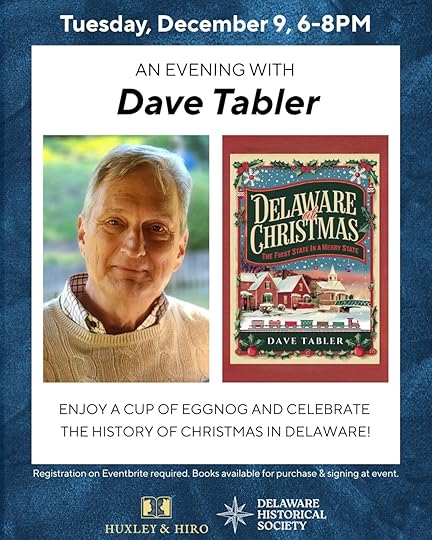
🎄 Join us for a festive celebration of Delaware history on Monday, December 9th, 6-8 PM!
Huxley & Hiro and the Delaware Historical Society are thrilled to host author Dave Tabler for a special conversation about his new book, Delaware at Christmas: The First State in a Merry State.
Discover the quirky, poignant, and often-overlooked ways Delawareans have celebrated the year's most cherished holiday — all while enjoying a complimentary cup of eggnog! 🥛
📚 Books will be available for purchase and signing at the event.
Details:
📍 Huxley & Hiro, 601 North Market Street, Wilmington, DE
🎟️ Free admission | All ages welcome
⚠️ Registration required, here: https://tinyurl.com/89bjkfv3
Don't miss this delightful evening of history, holiday cheer, and community!
November 4, 2025
Unwrapping History
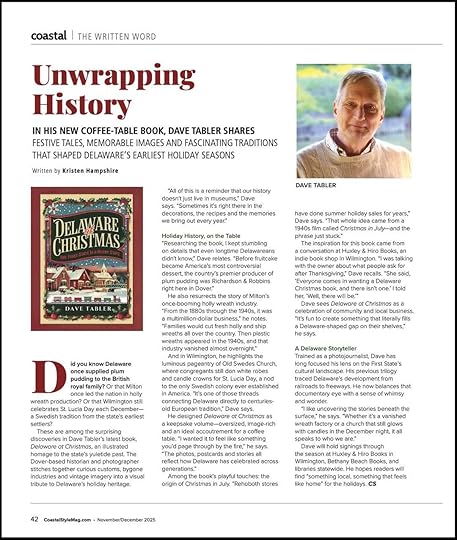
I'm thrilled to share that "Delaware at Christmas" is featured in the November/December issue of Coastal Style Magazine!
The piece explores fascinating holiday traditions—from Delaware's surprising role in supplying plum pudding to the British royal family, to Milton's once-booming holly wreath industry. As I told the magazine, "Our history doesn't just live in museums. Sometimes it's right there in the decorations, the recipes and the memories we bring out every year."
I'll be holding signings at Huxley & Hiro Books in Wilmington, Bethany Beach Books, and libraries statewide throughout the season.
Delaware at Christmas is available on Amazon (Kindle) and Barnes & Noble (paperback and hardback)—the perfect gift for any Delaware history lover!
📖 Four centuries of Delaware's holiday heritage, waiting to be unwrapped.
#DelawareAtChristmas #DelawareHistory #CoastalStyleMagazine
October 1, 2025
The Fourth-Grade Paper That Gave Me Away
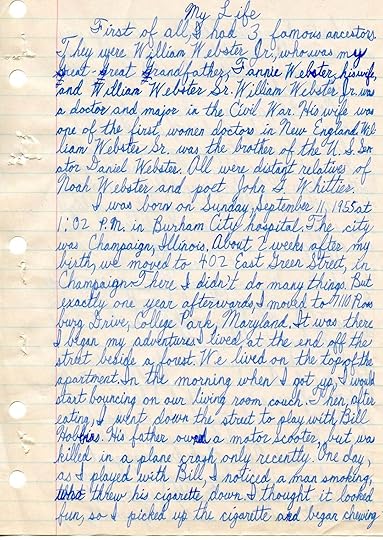
When I was 11, I wrote a school essay titled “My Life.” It’s filled with forts built in the woods, summer-camp battles, and a near-miss forest fire that almost caught our apartment. I even listed my Civil War ancestors and the exact streets we lived on, as if the details might vanish if I didn’t write them down.
Looking at it now, I can see what was already there: a fascination with memory, a love of quirky detail, and a habit of turning lived moments into stories. I wasn’t just playing at adventures — I was preserving them.
The essay closes with my plans for the future: maybe a botanist, maybe a chemist, maybe even a “nuclear physicist.” But in the end, I became something the essay had already hinted at: a storyteller intent on making sure history doesn’t get lost.
Sometimes your childhood writing knows you long before you do.
September 19, 2025
Virtual book tour for my new book
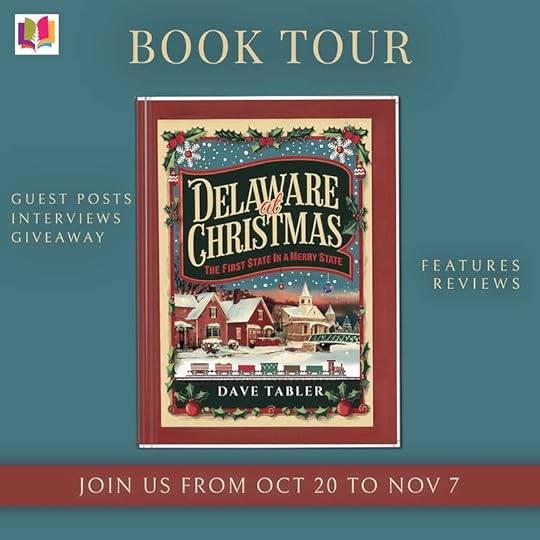
Exciting news! The virtual book tour for my new book, Delaware at Christmas / The First State in a Merry State, is running from October 20 to November 7, 2025.
Follow along as a wonderful group of bloggers, bookstagrammers, and reviewers share their thoughts on the book, including reviews, author interviews, and even some book giveaways! This book is a joyous journey through time, exploring the rich tapestry of holiday traditions that have shaped the First State's festive season.
Whether you're a history buff, a holiday enthusiast, or simply curious about Delaware's cultural heritage, I invite you to join us on the tour!
#Delaware #Christmas #BookTour #HolidayTraditions #History
Creating Delaware History books

The stories behind what made it into the books...and what didn't. If you think you know Delaware, think again!
...more
- Dave Tabler's profile
- 28 followers

