
Sharon Oard Warner's Blog: Occasional Writings on all Things Literary
April 6, 2022
Hawkmoths and Moonflowers: Facts of Nature
15 October 2019
Last Sunday, my husband and I ventured over to East Austin for brunch. As we walked down the sidewalk to a great little place called Cenote–honest-to-god, the applesauce pancakes are one of the best things I’ve ever put in my mouth–I spotted a large moonflower plant, and, then, even better, a hawkmoth caterpillar.
My fascination with hawkmoths led me to write an essay that interweaves information about these mysterious insects with the story of my older son’s addiction. Thankfully, (that word doesn’t begin to describe my gratitude) my son is clean and sober now.)
Here’s a relevant excerpt from the essay:
“In New Mexico, hawk moths pollinate the white trumpet flower of the sacred Datura plant. In this area, the Datura is most often referred to as jimson weed. Out in the bosque, these sprawling plants grow wild. My stepmother carefully cultivated a Texas specimen she called a moonflower, an apt name for the enormous blooms that open at dusk and glow in the celestial light. In the high desert, where so much of the landscape is tan, brown, and tannish brown, the flowers captivate. Georgia O’Keeffe captured their milky beauty in several of her paintings.
Not many people know that Datura is a known hallucinogen. Even the gray-green leaves are poisonous, lethally so. Hawkmoths are mostly immune to the toxin, but botanists have speculated that some unfortunates become “jimson weed junkies.” Observers have described the erratic behavior of intoxicated moths: some will nod off in the blossom and nap for hours. Once they do take to the air, they frequently lose direction or even fall to the ground.
Recently, I read that the larvae of certain hawk moths can tolerate high levels of toxins. The tobacco hornworm, for instance, can rapidly detoxify by excreting nicotine from its tissues. Whereas the nicotine in the tobacco plant leaf is toxic to most insects, the hornworm has evolved a special mechanism for selectively sequestering and secreting nicotine. Different moths metabolize toxins differently. Some cannot withstand what others are unfazed by. It’s a fact of nature.”
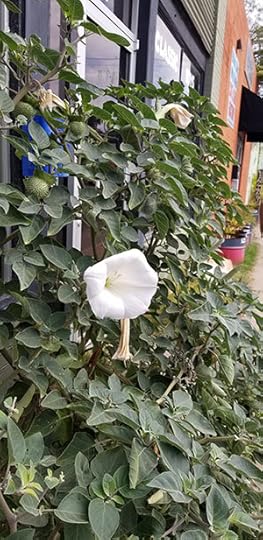 Jimson Weed
  Jimson Weed, Georgia O’Keeffe, 1931
 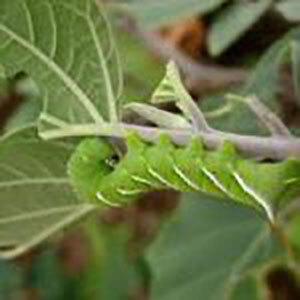 Caterpillar on Moonflower


Must-Read Novella in the Era of Trump
16 January 2018
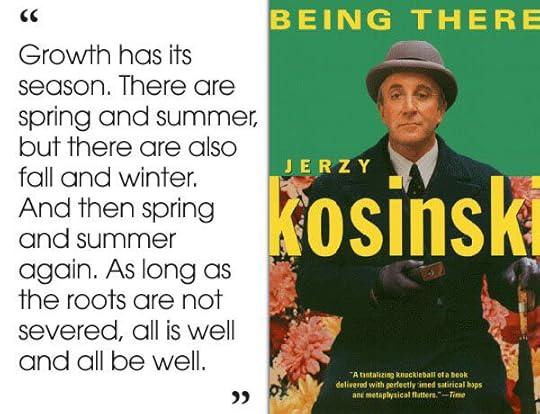
I will always remember the circumstances: I read Jerzy Kosinski‘s Being There at the Tides Bookstore in Sausalito, CA. (I am sorry to report that the Tides is closed now. )
This would have been 1971, when I was nineteen and living on my own in northern California. I didn’t have the money to purchase the book. (I was working as a live-in babysitter.) If I couldn’t walk to my destination, I hitchhiked. (Once, in Marin County, I got a lift from none other than Jerry Garcia.)
One Saturday, I hitchhiked to Sausalito for the express purpose of reading Being There, a 140-page novella that someone must have told me about.
I recall simply standing at the shelf and turning page after page. No one objected or complained. (In those days, bookstores didn’t provide chairs for customers.) When I reached the last page, I returned the book to the shelf and left the store, task completed.
By 1979, when the movie version starring Peter Sellers and Shirley MacLaine premiered, I was newly married and living in Austin. Teddy and I were paying customers at the film, a brilliant adaptation of this prescient book.
The protagonist of Being There is Chauncey Gardener, a simpleton who stumbles out of the garden and into the White House. He can’t read, but he is an avid television viewer. His vocabulary is limited, and his truisms, culled from television and his work as a gardener, are heard by the public as nuggets of wisdom.
Those who are astonished by the current state of affairs in Washington will find this story illuminating. Chauncey Gardener is something of an empty vessel, ready to be remade in the image of whomever he meets. Because he doesn’t have facts or explanations, he simply repeats the few things he’s learned from his work as a gardener: “As long as the roots are not severed, all is well and all will be well in the garden.”
Listening to Trump, I often think of Chauncey Gardener.
 Sausalito California
 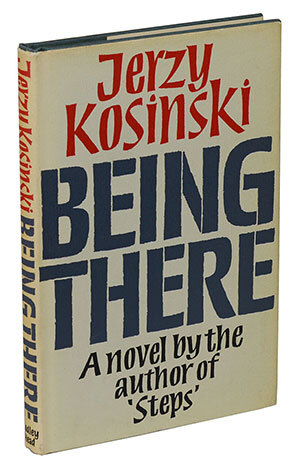 Jerzy Kosinski, Being There
 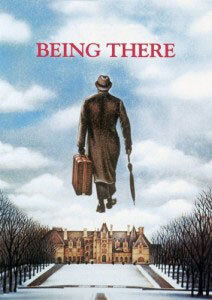 Being There, the movie poster
Teaching the Young the Value of the Past
27 January 2019
At the D. H. Lawrence Ranch Initiatives, we are working to impart the value and importance of the property we serve, not only to potential donors, University staff and faculty — but also to future generations.
On Friday, September 8th, 2017, a few days before Lawrence’s September 11th birthday, Ranch caretaker Ricardo Medina welcomed a group of first and second graders from Anasi Charter School in El Prado, NM.
The children and their teacher, Emily Ross, enjoyed an afternoon of sketching and poetry under the branches of the Lawrence Tree.
Lawrence began his career as a teacher, and though he gave up the classroom to regain his health and to pursue a writing career, he never forgot the importance of teaching. In the last months of his life, Lawrence mused in letters about returning to the Ranch to “make a bit of a thing with the young.” Maybe it’s time, he said to not worry so much about his own work and instead put his energies into teaching.
Perhaps Lawrence was thinking along these lines:
For children to understand the significance of a painting like O’Keeffe’s “The Lawrence Tree,” they need to experience the joy of creation. For children to value a structure that’s stood for hundreds of years, they need to stand in the doorway of a place like the Homesteader’s Cabin.
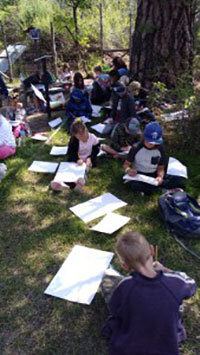 Writing at the D.H. Lawrence Ranch
 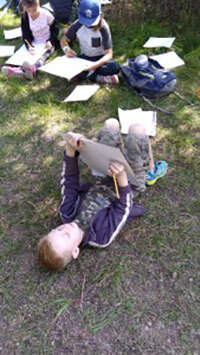 Concentrating on the task
 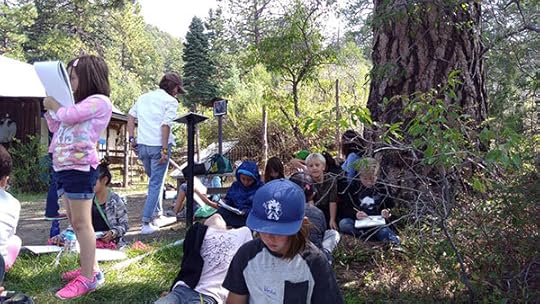 School children at the D.H. Lawrence Ranch
 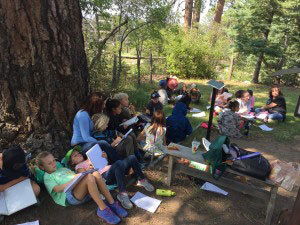 Learning at the DH Lawrence Ranch
April 4, 2022
Dr. Virginia Hyde: an Appreciation
27 January 2019
In January of 2004, the D. H. Lawrence Ranch was added to the National Register of Historic Places (NRHP) at the National level, which means the property is eligible for National Landmark Status.
This singular achievement was made possible by two scholars–Tina Ferris and Dr. Virginia Hyde. On January 2, 2019, we lost Dr. Hyde.
As many in the D. H. Lawrence literary community mourn her passing, I am taking this opportunity to do something long overdue—to recognize her important contribution to the history of the property.
The application process for the NHRP is arduous and time-consuming. The proposal took more than five years to complete and was complicated by the proximity of the two authors to the site. Neither lived anywhere near the D. H. Lawrence Ranch. Neither served as faculty at the University of New Mexico. Dr. Virginia Hyde worked from her office at Washington State University and Tina Ferris contributed from her home in the greater Los Angeles area. They worked not for recognition or recompense but simply to serve the greater good. And, so they have.
(BTW: I don’t believe Georgia O’Keeffe was frightened every moment. That’s the sort of hyperbole that the Misfit indulged in at the end of Flannery O’Connor’s story, “A Good Man Is Hard to Find.” Do you remember the concluding line of the story? The misfit has just shot the grandmother, and he speaks this line over her body:
The project began in 1998, in the early years of e‑mail. In fact, one of the oldest messages on my UNM e‑mail account is from Dr. Hyde. I looked it up earlier today and note that it was posted at 9:48 p.m. on a Sunday evening in July of 2000. Virginia wasn’t taking the summer off, the weekend off, or even the evening off. Instead, she was writing to enlist my help in completing the measurements for some of the historic buildings as well as the distances between them. This information was necessary for Section 7 of the narrative. (The proposal makes for fascinating reading and is available at the website for the D. H. Lawrence Society of North America.)
Virginia had been patient with me. This wasn’t her first message. I was overdue in sending her the necessary measurements. But in completing the task, I had met with all manner of obstacles. The caretaker for the Ranch, Mr. Al Bearce, was entirely opposed to the project. More than once, he threatened to call the Highway Patrol and have me booted off the property. But he wasn’t the only problem.
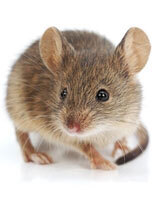
Virginia references another issue in her message: “We do very well understand some of the factors that make this work difficult, such as the mice that would certainly give me pause just as you say!”
Gently, she goes on to recommend a measuring tape that will speed up the job: “Sears sells a 100-ft.-reel tape for $16.00, and no doubt there are cheaper brands, too. We’d also suggest that it might be handy to print out this sheet and to write replies on the back.” I did as she asked and am proud to have made a tiny contribution to this large and lasting achievement. And, I am grateful that doing so brought me briefly into the life of Dr. Virginia Hyde.
She taught for 34 years in the English Department of Washington State University. She authored The Risen Adam: D. H. Lawrence’s Revisionist Typology (Penn State UP) and edited the Cambridge critical edition of Lawrence’s Mornings in Mexico and Other Essays (Cambridge UP, 2009). In total, she authored or edited six books, guest-edited literary journals, and published dozens of essays in journals and books, including the MLA “Teaching Authors” series.
She will be missed by many. But, at the D. H. Lawrence Ranch, the loftiest of the pines and the slightest of the mice whisper their gratitude and welcome her spirit.
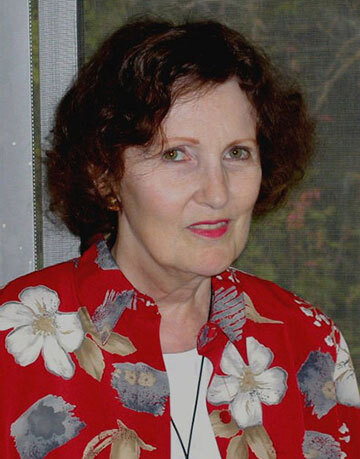 Dr. Virginia Hyde
 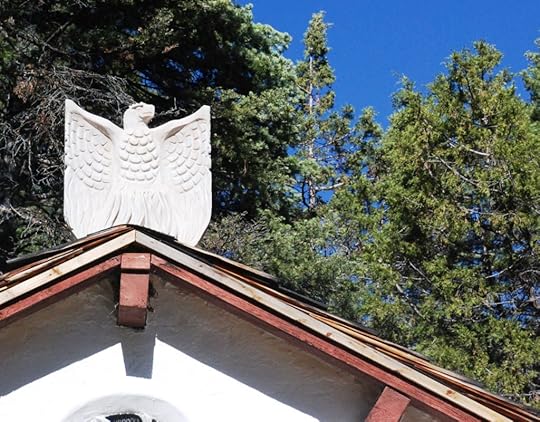 The phoenix atop the D.H. Lawrence memorial
 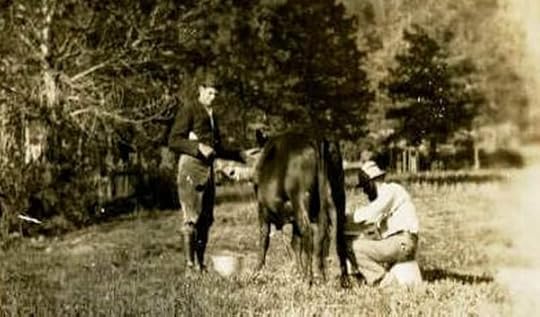 At the D.H. Lawrence Ranch outside Taos, New Mexico, Lawrence milking Susan, the cow
 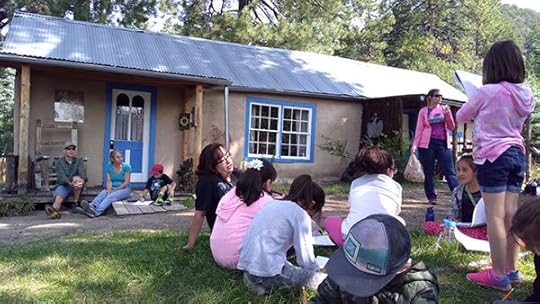 Visiting school children at the Homesteader’s Cabin
 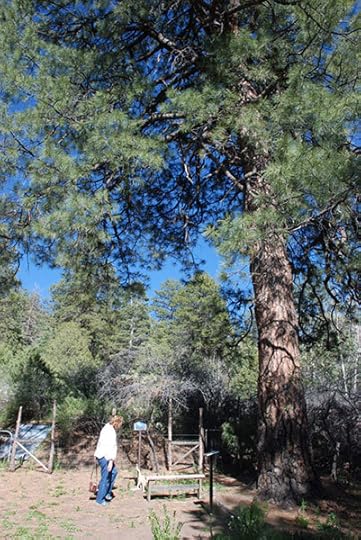 The author and resident cat under the Lawrence Tree
Georgia O’Keeffe and Fear
16 September 2016
“I’ve been absolutely terrified every moment of my life and I’ve never let it keep me from doing a single thing that I wanted to do.”
—Georgia O’Keeffe
This week, the Georgia O’Keeffe Research Center is sponsoring a forum on “Balancing Authenticity, Idealism, and Expectations at a Single-Focus Institutions.” This three-day event (Sept. 14–16) has drawn a number of museum directors, archivists, and independent scholars. As well as one English professor and novelist. That would be me. I am taking part on behalf of the D. H. Lawrence Ranch Initiatives.
Like Georgia O’Keeffe, I have often been frightened. Also like her, I have pushed myself to act in spite of my fear. Yes, I was a wee bit scared to attend the forum because, after all, what do I know about museums? (Shrug) I’ve wandered through quite a few of them.
Believing in yourself can be difficult, but believing in your cause, in this case the D. H. Lawrence Ranch, well, that’s not hard at all. The Ranch could be and should be a museum and it could be and should be a residency center for the arts.
(BTW: I don’t believe Georgia O’Keeffe was frightened every moment. That’s the sort of hyperbole that the Misfit indulged in at the end of Flannery O’Connor’s story, “A Good Man Is Hard to Find.” Do you remember the concluding line of the story? The misfit has just shot the grandmother, and he speaks this line over her body:
“She would have been a good woman,” The Misfit said, “if it had been somebody there to shoot her every minute of her life.”
But, as a result of my tour, I do know that Georgia O’Keeffe was certainly frightened during the Cuban Missile Crisis. Would you believe she had a bomb shelter built outside the bedroom of her Abiquiu home? The docent told us about the bomb shelter, which is built into the side of a hill, as well as all the supplies O’Keeffe ordered to be stored in the shelter. Once she was prepared for disaster, she went right on making art.
Seeing O’Keeffe’s home at Abiquiu is something I’ve dreamed of doing for years, and I am grateful to the Georgia O’Keeffe Research Center for the fascinating tour of both the Abiquiu and the Ghost Ranch homes.
In recent years, the caretakers for the Abiquiu house have restored the gardens where O’Keeffe grew most of her vegetables and fruit. History brought to life, quite literally.
While it’s true that Lawrence didn’t raise vegetables at the Ranch, he did have a cow named Susan, and he milked her whenever he could catch her.
In recent years, the Abiquiu and Ghost Ranch homes have been carefully preserved and lovingly tended, but such was not always the case. It’s up to those of us who care about an artist’s legacy to preserve it.
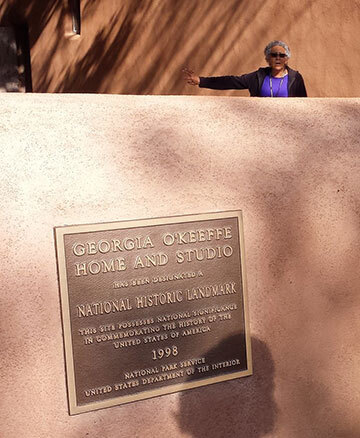 Foreground: The National Landmark Marker
Background: Barbara, our wonderful docent.
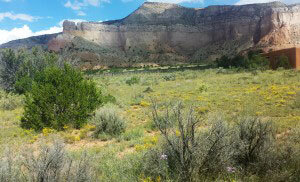 View from the Ghost Ranch
 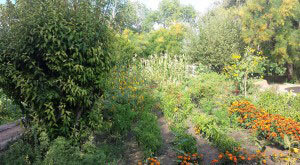 Restored garden
 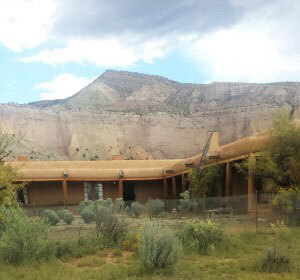 Back of the Ghost Ranch home At the D.H. Lawrence Ranch outside Taos, New Mexico, Lawrence milking Susan, the cow
Georgia O’Keeffe’s “Starry, Starry Night”
7 September 2014
This past Wednesday and Thursday, National Geographic photographers visited the D.H. Lawrence Ranch. Unlike most folks, who go to the Ranch during the daylight hours, these photographers trekked up to the Homesteader Cabin after nightfall, when nocturnal animals emerge under the cover of darkness.
The owls and coyotes must have been watching as the photographers set up their tripods around the Lawrence Tree and aimed their cameras skyward, through tangled tree limbs and toward the stars. Eighty-five years after Georgia O’Keeffe lay back on a carpenter’s bench and got lost in the stars, National Geographic photographers made the journey to see what she saw and record it for the rest of us.
To get a quick lesson and two minutes of splendor, visit this site, Khan Academy, “O’Keeffe: The Lawrence Tree.”
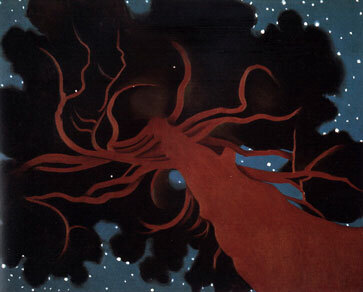 Georgia O’Keeffe, “Starry Starry Night”
March 24, 2021
Finding Your Way to the End
December 25, 2020
Occasional Writings on all Things Literary

- Sharon Oard Warner's profile
- 30 followers

