
Steve Addison's Blog
October 12, 2026
Sheep among Wolves

Some rough, unedited thoughts on the relationship between persecution and movements. The passage is (Matthew 9:35–10:42. The occasion is Jesus sending out the twelve.
'When he saw the crowds, he had compassion on them, because they were harassed and helpless, like sheep without a shepherd.’
A missionary movement from the heart of God.Matthew 9:36
The context for this lesson on persecution is Jesus’ mission and the part his disciples are to play in it.
Jesus has been going throughout Galilee, teaching, proclaiming, healing. As he goes, news spreads and large crowds come from Galilee, the Decapolis, Jerusalem, Judea and across the Jordan (Matt 4:23–25).
Jesus intends to go to every town and village in Israel, teaching, healing, casting out demons, forgiving sins and calling disciples to follow him and promising to teach them to fish for others.
Jesus is motivated by a “gut-wrenching compassion for harassed and helpless sheep. ‘Harassed and helpless’ means they are mangled and thrown down. That God’s people are sheep without a shepherd is a recurring Old Testament theme. Israel’s shepherds failed in the days of the prophets. Like wild beasts, they devoured the sheep. So God is rescuing his people in the person of Jesus.
In whose name? By what authority?Arising out of his compassion, Jesus launches a missionary movement.
He begins by instructing the twelve about their immediate mission (Matt 10: 5–16). Then Jesus widens the instructions to apply to the mission of his disciples that unfolds in Acts (Matt 10:17–22).
Until now Jesus has been pursuing his mission while his disciples watched on. Now he reminds them that when he called them, they were to follow him and he would teach them to fish for others (Matt 4:9). These disciples were among the first recipients of his ministry. Now they are to become its agents. Freely they received, now freely they will give.
Jesus sees a plentiful harvest. As the master in charge of hiring and firing workers, he urges the disciples to pray for laborers, then pushes them out into the harvest as the answer to their own prayers.
They are to start with the house of Israel, but Jesus envisions a wider mission to the whole world (Matt 24:14; 26:13; 28:19–20). These twelve ordinary men represent the twelve tribes, the new Israel. They don’t know it yet, but this is a movement that is going to the ends of the earth.
The rules of engagementJesus commands his disciples to go to Israel, preach the kingdom, call everyone to repent, perform miracles, give themselves freely, face persecution, move from town to town, face arrest, trial, flogging and violence. They have seen Jesus do everything he now asks them to do and he promises his presence as they go.
They go out with the same authority that Jesus has received from the Father. Their message is the same as that of John the Baptist and Jesus, ‘Repent, for the kingdom of heaven has come near. (Matt 3:2; 4:17; 10:7).
They must travel light, keep moving and expect God to provide food and shelter through those who welcome them and their message.
The offer of peace (shalom) is more than a traditional greeting; it is the offer of salvation, the offer of a restored relationship with God and others. Jesus makes this offer through his messengers. To receive them is to receive God’s salvation.
To reject them is to reject Jesus and remain under God’s judgment. In the face of rejection, the disciples are to leave and shake the dust from their feet.
When a Jew returned from Gentile territories, they would shake the dust off their feet and clothing. In shaking off the dust, Jesus’ disciples were declaring that a household or town that rejected his representatives was unclean and unworthy of the gospel of the kingdom. In the final judgment, it will be worse for those who reject Jesus’ messengers than for Sodom and Gomorrah.
Jesus impresses urgency upon them. Time is running out. When rejected, they are to flee to the next town. As in Acts, persecution ensures the Word always keeps advancing.
The dividing presence of Jesus.One’s eternal destiny depends on a relationship with Jesus through the messengers he sends. To reject his disciples is to reject Jesus. To reject Jesus is to reject God and remain under his wrath.
Jesus launches a movement and sets it on a collision course with the world. His presence leads to persecution. His disciples bring the presence and message of Christ; therefore, they will be persecuted.
The world hates them because they come in his name. Jesus tells them that persecution arises ‘because of me’ (Matt 10:18).
The union between Christ and God is extended to us, and we go out not just with Christ’s authority but with Christ in us.
We may think that the presence of Jesus will bring peace and prosperity, yet Jesus insisted that his mission will lead to dishonor and division.
Jesus the Good Shepherd is sending his sheep into a pack of wolves. They’ll be handed over to local Jewish councils and flogged. As the post-resurrection mission extends, so will the opposition. They will be brought before Gentile governors and kings.
In the face of hostility, they are to bear witness to Jesus before the authorities. They need not worry what to say; the Holy Spirit will speak through them.
Jesus’ predictions of persecution will be fulfilled in the church’s mission. In Acts, every crisis becomes an opportunity for the gospel to go out, for the strengthening of the disciples, and for planting new churches.
Jesus’ coming does not bring peace, but a sword that divides families. Jesus doesn’t say ‘if’ but ‘when’ you are persecuted. If you spread the gospel, you will be opposed by both family and authorities. Family members may hand you over to your death. This is your opportunity to bear witness to Jesus.
Count the cost. Know the Father’s love.Disciples must take up their cross and follow Jesus. Lose your life for his sake and you will find it. If they will acknowledge him before others, Jesus will acknowledge them before his Father. But to consistently deny Christ is to be disowned by Christ.
Peter denied his Lord, but later repented and was restored. But God will judge anyone, like Judas, who remained on a settled course of betrayal.
They must remain faithful by fearing God more than they fear their opponents. They must know how much their Father in heaven loves them.
Sparrows were the cheapest food available to the poor. If God cares for sparrows, how much more does he care for them? He knows and is concerned for every detail of their lives.
The instructions Jesus gave before the mission of the twelve are not just for them. Their witness is the foundation of a movement. All disciples receive the risen Lord’s authority. ‘All believers are included in the discourse, because all of God’s people are meant to be part of his mission.’ They are the ‘righteous’ and his ‘little ones’ (Matt ??).
ConclusionWhen Jesus rose from the dead he found his disciples huddled together behind locked doors, afraid. They were victims of persecution. They were a downtrodden religious minority. The resurrection changed all that.
Jesus forgave and restored them. Over forty days, he took them on a journey through the whole of the Scriptures, explaining why the Messiah had to die and rise again. He reminded them of the core missionary task — they must take the gospel of repentance for the forgiveness of sins to the ends of the earth, multiplying disciples and churches as they go. Finally, he promised the life-changing power of the Holy Spirit.
Their enemies were just as fierce and powerful as before. God had not removed them; instead, the disciples had changed. The presence of the risen Lord transformed them from victims to a missionary movement.


September 30, 2026
379-New Zealand Calling
A conversation with Caleb Lyon in New Zealand on the rollout of the 5 in 12 Strategy.
September 17, 2026
Remain in Me and Expect Trouble

Researching and writing up case studies for Everywhere opened my eyes to the stark realities of persecution. So I’m reading the Scriptures with new eyes, looking for what I’ve missed.
Here’s an example: the link between Jesus teaching on abiding in him (John 15:1–17) and his teaching on persecution (John 15:18–27).
We love to read the passage about abiding in Christ. But Jesus has some disturbing comments about the inevitability of persecution, as we make disciples in a world broken by sin.
Remain in me: John 15:1–17Their final meal was over. Judas had departed into the darkness. Jesus and his disciples were making their way to the garden of Gethsemane, where Jesus will pray and wait to be arrested. This is his last opportunity to instruct his disciples.
He knows that Peter and the disciples he has given his life to will fail him. Jesus will die alone, abandoned. It will seem like their opponents have won.
What will Jesus share with his inner circle to see them through this ordeal and prepare them to be restored and entrusted with their mission?
He tells them, I am the vine. My Father is the Gardener. You are the branches. The secret of fruitfulness is to remain in me.
Abiding means being loved by Jesus and loving him in return. As branches, his disciples receive life by being united to him. Being connected to the vine means Jesus’ life flows through his disciples, leading to fruitfulness.
Fruitfulness originates in the love the Father has for the Son. The Son shares that love with his disciples as they remain in him. The fruit of that love is our love for him, for one another in ever-widening circles throughout the world.
Fruitful disciples produce more disciples who are abiding in him.
The Father removes branches that bear no fruit and prunes fruitful branches so they produce even more fruit. Fruitfulness comes by remaining in him—obeying his Word, and knowing him through the Holy Spirit.
This is the proper response to persecution: remain united with Jesus. Not brash commitments like, ‘I’ll die for you.’ Not waving swords in the air, or curse-laden denials.
Expect Trouble: John 15:18-27Simon Peter was about to face his most severe pruning by the Father. Satan will sift him like wheat (Luke 22:31). Peter will deny his Lord. But Jesus prayed for Peter and knew he would turn back and strengthen his brothers. All the disciples will fail Jesus, but when they return, he will restore them.
This is what the Father taught him. Once they learn this, they are not just servants. They are his friends.
‘Jesus loves his disciples because they abide in him; the world hates them for the same reason.’ (Raymond Brown)
This context helps us understand persecution. The world is in rebellion against God. That’s why Jesus was hated and persecuted. That’s why his disciples are persecuted for his name. Disciples must be prepared for this, or they will fall away. If they remain silent about Jesus, they will not be persecuted. Their mission comes with a price tag. Jesus warns them and promises them his presence through the Holy Spirit as they proclaim his salvation throughout the world.
To prepare them for the onslaught, Jesus allows no illusions about the world’s animosity. Telling them, ‘They hated me and they will hate you. They will persecute you because of my name. They will try and kill you. But I will send the Holy Spirit who will testify to me through you.’
His presence provokes the persecution and sustains the disciples through it. Despite opposition, they can bear much fruit as they remain in him. They experience trouble, but Jesus has overcome the world.
At the heart of God’s mission is his presence, made possible through the Word and the Spirit. God is gathering his people throughout the world. His presence is both the key to achieving the mission and the goal of the mission.
September 9, 2026
378-Getting Started in South Asia

Somewhere in South Asia
After laboring in the United States for ten years, God called Tom and Nicole to somewhere in South Asia. We find out how their first year went.
September 3, 2026
A letter from the Middle East

The Kaaba in Mecca
This letter from a brother somewhere in the Middle East reveals how the Word grows and multiplies despite persecution. The Word advances but not without cost.
My dear brother Joshua
Grace and peace to you from our Lord Jesus Christ.
Thank you from the bottom of my heart for your message, your love, and your prayers. Your words touched me deeply, and I thank the Lord that you have not forgotten me, but have continued to carry me before Him during one of the hardest seasons of my life.
I thank God for you, my brother. From the beginning of the ministry here, you were among the first people who encouraged me and believed in what the Lord was doing. You were not simply a supporter, but a brother, a friend, and a partner in prayer and in the vision. I am truly grateful to God for you.
After my arrest, I spent eight months in prison, going through isolation, interrogations, and severe psychological and physical pressure. I came out with some health effects, but I also came out with a deeper faith, greater spiritual maturity, and a clearer understanding of the calling the Lord has placed before me.
In the midst of the pain, I experienced the faithfulness and presence of Christ in a way I will never forget.
My situation is still sensitive. I remain under surveillance, my movement is restricted, and I continue to face pressure and harassment because of my faith and ministry. Because of this, my ability to communicate with you directly is limited—not because I do not want to, but due to the circumstances and surveillance. In the coming season, I will try, with wisdom and at the right time, to find a safer way for us to communicate more personally.
Yet my heart is full of hope. I do not believe what happened was the end of the ministry. I believe the Lord is using this season to deepen its roots and prepare it for what is ahead. My vision remains the same: to see the church here continue to grow in faith and maturity. I’m trusting God to raise up a new generation of faithful leaders and servants, and to become more fruitful, impactful, and far-reaching for the glory of Christ. I believe what is ahead is not simply a return to what was, but a new and stronger season, led by the Lord in ways deeper than we can see right now.
Continue to pray for the brothers who are still in prison, some of whom are facing serious physical and psychological effects. Pray also for the church in this land, and for me—that the Lord would give me healing, wisdom, protection, and grace to lead faithfully in the season ahead.
Thank you, my brother, for your friendship, your love, and for standing with me throughout this journey. I am grateful to God that our paths have met in this calling. I believe that the One who began this work is faithful to complete it, and that one day we will see with joy and fruitfulness what we have sown with tears for His glory.
I love you in Christ,
Your brother Ahmed
Who are ‘the least of these my brothers’?

For I was hungry and you gave me something to eat,
I was thirsty and you gave me something to drink,
I was a stranger and you invited me in,
I needed clothes and you clothed me,
I was sick and you looked after me,
I was in prison and you came to visit me.
Jesus’ mission to Israel was completed, and it was his final week in Jerusalem. As he walked out of the temple for the last time, he announced its destruction.
In his final teaching, he focused on the coming of the glorious Son of Man, and the judgment of the nations at the end of the age.
Eternal life and eternal punishment will depend on how the nations care for the ‘least of his brothers’.
Many scholars understand the least of these brothers of mine to refer to all who are hungry, distressed, and needy. The basis of acceptance into the kingdom is deeds of mercy and compassion. They identify the least of Jesus’ brothers with anyone who is poor and needy.
It’s an important question because it goes to the heart of the missionary task.
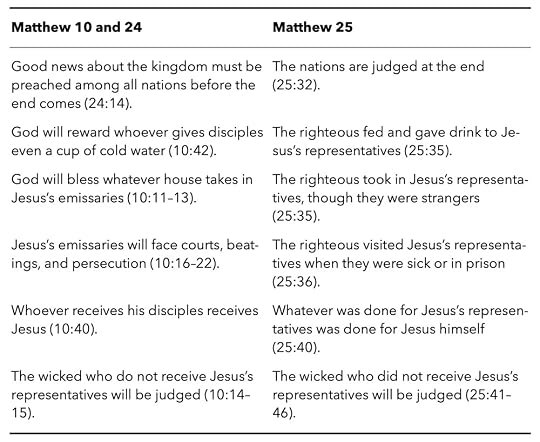
New Testament scholar Craig Keener disagrees—not with feeding the poor—but disagrees that that’s what Jesus is talking about here.. When Jesus says in Matthew 25:31–46, “the least of these my brothers” (and sisters) probably refers to those sent to spread the good news.
According to Keener, when others feed them and take them in, they are welcoming Jesus—just as with the apostles earlier sent out in Matthew 10:11–13, 40–42 (compare 2 Cor. 5:20; 6:13). Elsewhere in Matthew, Jesus’s true brothers (and sisters) always refer to his followers (Matt. 12:48–50; 23:8–9; 28:10).
Likewise, those who reject Jesus’s agents and face judgment in 25:41–46 sound like those who rejected Jesus’s agents in 10:13–15.
Notice again the conditions that may characterize Jesus’s agents as they labor for him in Matthew 25: “hungry . . . thirsty . . . needing a place to stay . . . poorly clothed . . . sick . . . imprisoned” (25:35–39, 42–44).
Suffering often occurs in the context of mission.
Craig Keener, Suffering: Its Meaning for the Spirit-Filled Life, 13.
The nations will be judged by how they treat the messengers Jesus sends. He goes with them. Whatever is done to them is being done to Jesus himself. That’s why on the Damascus road Jesus asked Saul, ‘Why do you persecute me?’
Three lessons:
The gospel will go to all nations through Jesus’ messengers.
They are to expect persecution, but Jesus goes with them.
How they are received will decide one’s fate on judgment day.
August 30, 2026
No Means No. Until It Doesn’t.
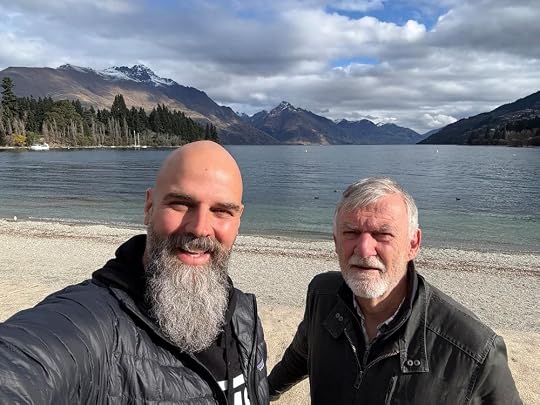
Troy Cooper, Steve Addison. Queenstown NZ.
I was just back from two months on the road promoting my latest book, Everywhere.
I wasn’t going anywhere. Pick up the dog and settle into home. Do some gardening. See the grandkids.
Then Troy Cooper rang. ‘ Steve, I want you to come to New Zealand.’
“No.”
Then he rang again.
No!’
And again.
No!!
Then he rang again.
I said, ‘Maybe.”
Then again.
‘Alright.’
I discovered that Troy loves you and has a wonderful plan for your life!
I’d seen it all before. I knew every element of the training they were rolling out in New Zealand.
The 411 (gospel conversations). The 4-Fields (components of a church planting movement). The 3-Thirds (reading the Bible for discipleship). All great stuff, but nothing new.
Troy had flown all the way from Greece and brought a “swarm team” of Europeans and Americans to run a one-day training session in two locations — Wellington and Queenstown — for 60 people.
Why all the fuss? The elements were the same. Yet the strategy was different.
Troy and the team were flying all the way to New Zealand five times over twelve months (5 in 12) to run the same training three times in multiple locations, picking up people as they went.
The goal wasn’t to run training events but to build a national movement of practitioner/trainers. Each training builds on the last — moving people from learning, to doing, to equipping others.
The bar for entry is low. A new trainer only needs to learn and memorize one 5–10 minute module. As they train, confidence builds and they experience a paradigm shift, and that momentum carries into training other trainers.
They had a simple MAWL approach — Model, Assist, Watch, Launch.
First they modeled how to train, then they helped the New Zealanders train. After three touches of training the New Zealanders were training 100% with coaching and support from Troy and the team.
People came along to the first event thinking, ‘Great, I can get equipped to share the gospel, make disciples and plant churches.’
They came back to a second event thinking, ‘Now I can learn to train others.’
They came back to the third event thinking, ‘I’m part of a movement with a vision for NoPlaceLeft New Zealand.’
The fourth touch is the 4-Fields Intensive, which lays the biblical foundation for movements.
The fifth touch is a Mid-level training that focuses on problem-solving and addressing barriers in the field.
During the first two training touches, teams went out to share the gospel. 482 people were engaged. 188 people received prayer. 101 people heard the gospel. That’s better than one in five New Zealanders open to hearing the gospel. Thirty of them shared contact details for follow-up.
For many of the trainees, it was the first time they’d ever shared with someone. After two touches of training, they know what to do and what to do when someone believes or wants to know more. They know how to train others.
The third touch of training is in October/November in multiple locations, all led by Kiwis. Troy and the team will be there watching.
More on the 5 in 12:August 27, 2026
377-Momentum Builds in New Zealand
Troy Cooper, Nick and Sarah Field discuss a NoPlaceLeft strategy for New Zealand: https://www.theway.co.nz/5in12
August 13, 2026
376-Houston’s Story
God told Houston to start a Bible study in his gym, what happened next is the topic of our conversation.
275-Houston’s Story
God told Houston to start a Bible study in his gym, what happened next is the topic of our conversation.

