
Stuart Millard's Blog
December 1, 2025
Tricked with No Treats: So Haunt Me
As a child into spooky shit, I sought it anywhere; Russ Abbot doing a Frankenstein sketch, the Devil showing up in Highway to Heaven, Count Duckula; the gorgeous pop-up book Haunted House by Jan Pienkowski, with skeletons and bathtub alligators revealed by pull-out tabs, which was so coveted, I still recall the glorious weekend I skipped home with it in my bag, having finally reached the top of its reserve list at the infants school library. With no older siblings to sneak me illicit viewings of a pirated Texas Chain Saw Massacre, I sat reading Shiver and Shake, tucking into a Fiendish Feet yoghurt, and making do with any and all telly which had a light dusting of horror.
There had of course been spookily-themed sitcoms, most famously the conjoined twin of the Munsters/Addams Family, but in 1992, British sitcom was in its MOR period, whose forays into the sinister extended to the terraced suburban horror of 2 Point 4 Children, which occasionally ventured into the gothic in a slightly less overt way than The Hilarious House of Frightenstein. Most things I stumbled across were doubly pleasing, combining the two things I loved the most, horror and comedy, and 1992’s So Haunt Me falls perfectly between the sort of Halloween fare from my Fright Bags, and the rubbishly bland television I’ve been looking at lately. Had I been born a decade later, this piece probably would’ve covered BBC Choice’s Ed Stone is Dead, whose titular ghost was played by Richard ‘Won’t Smith’ Blackwood.
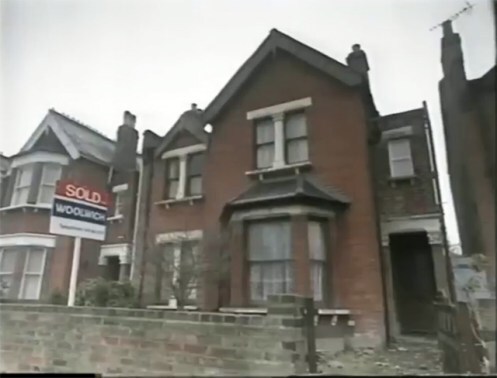
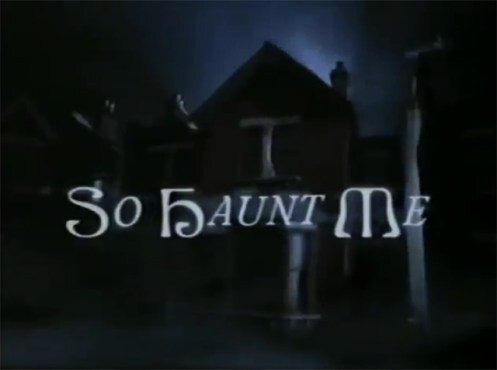
So Haunt Me was another hit from the mind which brought us Pigsty, My Hero and May to December, Paul Mendelson — an evil, one-man Galton and Simpson — and through it I discover producer Verity Lambert’s production company bears the exceptional pun Cinema Verity. The title font’s all wobbly and translucent, but the real scares come from its position as a 90’s recession piece, opening on moving day as we find the Rokebys downsizing into a more modest three-bedroom semi, when dad loses his job as a jingle writer at an ad firm and decides to go freelance. In 2025, supporting a whole family on one freelance writing salary would send you downsizing into a ditch, but this is 1992, baby, mortgages were about a fiver.
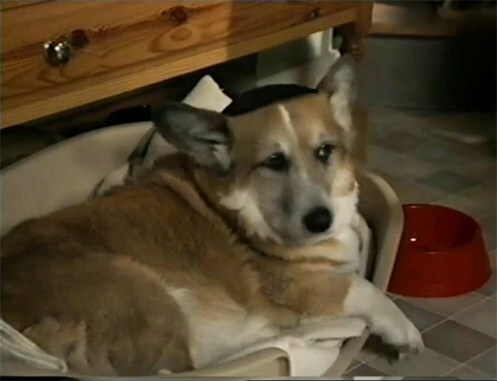
The Rokebys stand open-mouthed at the shithole they’ve found themselves in (at least 750k in today’s market), while removal men remark “my heart goes out to that family.” Poor Peter, this isn’t where he wanted to be at 39! Eff off. And those removal men are penned by someone who’s never met the working class, calling Peter “Mr. R,” and on finding he doesn’t just read all them books they were confounded to be lugging in from the van: “Gordon Bennett, you don’t write ’em as well do you, guv?!” Plus, in that trope of status-through-dog-name, the family corgi is called Hemingway, as opposed to say, Gnasher or Lottery Thug Michael Carroll, like wot a poor person would be chucking sticks for.
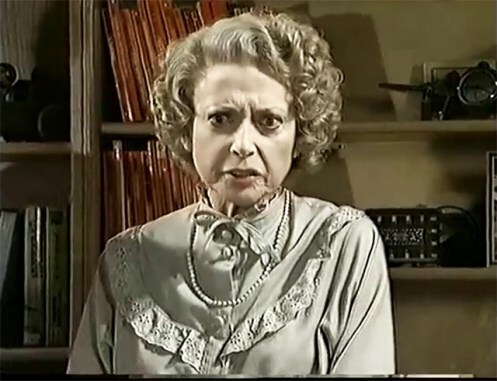
But as they enter the new home, mum Sally notices the upstairs curtain twitch, and when the daughter’s yacking on the phone, the lead pulls itself out of the socket. There’s ominous music as a spectral hand pokes about their photos, even catching a ball the young son’s bouncing off a wall, and Sally smells the whiff of chicken soup. Going downstairs after being woken by noises, she’s confronted with a g-g-g-ghost! Sally forms a crucifix out of two candlesticks, but to no avail. “If you could do the Star of David, then I’d be impressed,” and the ghost introduces herself as the late Yetta Feldman, dead 21 years.
Just as he’d taken his previous career at a law firm as inspiration for May to December (a show for which ‘inspiration’ is definitely too strong a word), Mendelson later worked as an advertising copyrighter, and during a pitch for Heinz Spaghetti with Don’t Look Now director Nicolas Roeg, dreamed up the conceit of So Haunt Me. Initially proposed as a novel; a culture-clash comedy using a ghost to bring the Jewish mother archetype into a family of gentiles; at the suggestion of Verity Lambert, it evolved into a sitcom. And what more classic sitcom format is there than ‘people who are different being forced to live together’? American telly’s still banging out fifty-odd pilots of that every year, it’s just that in this, one of them’s dead.
It’s a main cast of reliable hands, Peter played by George Costigan, beloved cheeky nonce from Rita, Sue and Bob Too, while Sally is Del Boy’s missus, Tessa Peake-Jones, and as Yetta, named after Mendelson’s own mother, Miriam Karlin. With a varied and celebrated career, most notably massively popular The Rag Trade, the Jewish Karlin lost family members to the death camps, and the ‘list of organisations’ bit in her Wiki bio is exceptional. The Royal Shakespeare Company, Equity, the British Humanist Association, and the Anti-Nazi League. Karlin’s moderately ghostly in appearance, though the sickly pale skin and sepia palette is standard for everyone in that era, barring rad surf dudes. She’s not so much comprised of ectoplasm as she is Jewish mother cliches, and half her dialogue’s demanding everyone “eat, eat!” because they’re all skin and bone, and letting out ghostly moans of “oy, oy, oyyyyy!”
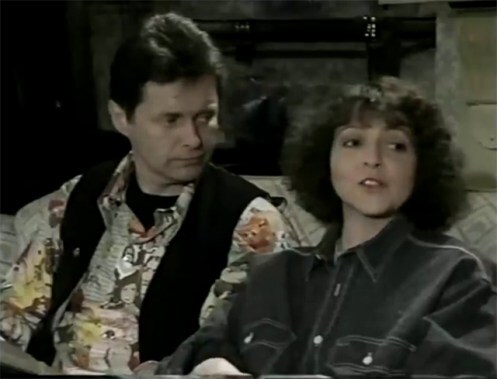
What’s happened here is I’ve taken the supernatural bait and been tricked into a bog-standard interfering-mother-in-law show. The audience don’t mind though, producing that exhausting tennis volley where every dreary line’s batted back with roars and titters. At least there’s a far higher gag-rate than M2D, it’s just that they’re rubbish, like when hearing those groans downstairs, Sally suggests Peter go and check for burglars. “Oh yeah, they groan a lot. Except cat burglars. They miaow.” And the serve is returned! Thankfully Karlin massively elevates the material, and through exposition we learn that her husband died young, and she disowned a daughter at 17 after she shacked up with a popstar, although “she could eat, oy, could she eat!” Every night, Yetta put a saucepan of chicken soup (“Jewish medicine”) on the boil in case the daughter returned, leading to her fatally choking on a chicken bone.
This daughter, spoken of frequently, is always referred to as “Carole with an e,” (the spelling, not Brian Harvey’s favourite snack) with that era-sitcom repetition of drilling things into your head so deep, they’re like when tree stumps swallow up rusty old bikes. For example, whenever I hear the name Roger, my brain autocompletes to “Roger the Lodger, the single man from next door!” I had to Google to find out where that’s from; No Place Like Home, a sitcom I don’t remember watching where William Gaunt’s adult children move back in. How many of those did I see to have this branded onto my frontal cortex? And how many more triggers lay dormant, ready to emerge with the right cue?
Newsreader: “Over two thousand people are missing feared dead after a devastating flood in…”
Me: “Miss Flood!!”
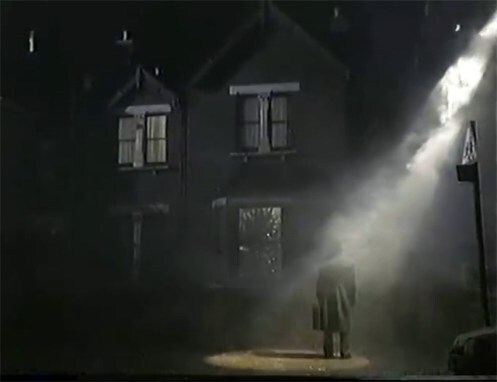
Anyway, Pete goes downstairs to find out who Sally’s been up half the night talking to, conversing with an empty chair like Clint Eastwood, presumably gone quite mad. Thankfully, they don’t persist in the tedious farce of him not believing what the audience knows is true, and pretty quickly Peter can hear (but not see) Yetta too. This is the Hell of dying and having to observe another family in your home, forced to watch as they announce they’re going to ‘christen the place’ before having a wank in every room, even the airing cupboard. “I died in there,” you tut, as they wipe the inside of the door with a towel. Not that that’s happening here, with Yetta suggesting they’re antisemitic for wanting her out of a Jewish house. “How can a house be Jewish? What did you do, chop six inches off the chimney pot?” Reader, I did laugh. The daughter can’t see or hear her, whereas their seven-year-old son is Oy Vey-ing within an hour of moving in.
Those kids are the show’s real low point, little David a sort of Milky Bar style ‘cute sitcom kid’, missing front teeth and all, with a running joke that Auntie Yetta’s influence is converting him, referring to toys as “bubula,” taking on Yiddish speech patterns and, shall we say, Jewish physical gestures. It’s a repulsively sickly performance, a simpering baby voice which could do with subtitles, and this is his only television credit. Post-Haunt Me, the daughter Tammy had a better time of it, with 46 episodes as John Nettles’ spawn in Midsomer Murders, but she’s given the most one-note sulky teen possible, phone-and-boy-obsessed, stomping around all dramatic over who’s getting off with who at school, and screaming “I’ll need a lifetime of therapy!” whenever her parents touch.
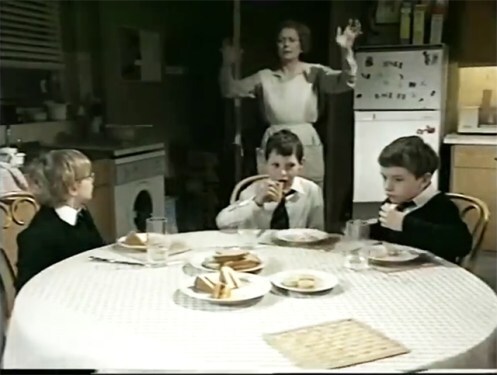
Already with Yetta winding up Peter and becoming surrogate mother to Sally, it’s only episode two when they go Double Mother-in-Law by bringing Sally’s actual mum in; a terrible cut-glass Hyacinth Bucket ‘don’t call me granny, call me Bunty’ type, who Yetta winds up by making paintings crooked and insta-killing a house-warming rubber plant when Bunty slags off the Jews. With all the chaos, and her spectrally turning down the hob when he tries to fry some bacon, Peter wants her gone, so she agrees to move on to Heaven, but only when they locate her daughter Carole with an e; with an additional promise not to go in the bedroom or toilet, so they can bang away and take big dumps in peace. I’m not a theological scholar, but the in-show afterlife keeps things simple, with Yetta travelling back and forth between Limbo (where she once met Lassie’s mum), and Heaven, located 12 steps away, waiting for when she finally decides to rest in peace.
Barring the pure sitcom elements, there’s a lot of this I’m not particularly qualified to be talking about, and Yetta’s character feels like, had the writer not been Jewish himself, the stereotyping might’ve been iffy. It’s a Jewish role served up by ChatGPT from every other telly character whose sole trait is their Jewishness, forever demanding everyone eat, dropping medical conditions and Yiddish surnames of family friends, often concurrently (“it’s like the Goldfarbes and their piles here, nobody sits still for a second”), and trying to convince girls to marry doctors. Karlin’s performance is really empathetic and likeable, but it’s far from the rounded portrayal of a Jewish mother of, say, a Friday Night Dinner. So Haunt Me was probably one of my earliest notions of what Jewishness even was, along with Felix the barber in EastEnders who got his butterfly collection smashed by yobs.
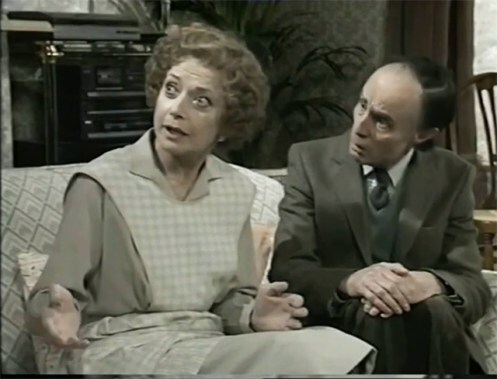
Episode three begins with Peter taunting Yetta by scoffing pork scratchings, and he’s finally got hired to write a jingle. But writer’s block on a short deadline isn’t helped by David bringing school chums round for tea to meet the ghost. The acting between these lads is exceptionally bad; almost ‘the teenage girl in 28 Days Later‘ level, with an American accent that’d make Dexter Fletcher cringe, as one exclaims “I’m a ninja turtle, where’s my pit-za?” It descends into pure panto as the ad execs show up just in time to find Peter running round with a sheet on his head, and Yetta puts on a Fantasia of a show, lights flashing, table spinning, before telling the children “eat, eat! An empty mouth is an unhappy mouth!” A weird aside to the episode is when the daughter rings up a talk radio agony aunt, David gets really excited that she swore on air. “Tammy said ‘dork’ on the radio! She said ‘dork’!” Was dork the C-word of its time?
By now, Peter’s obsessed with getting rid, as she’s “turned our seven-year-old into Topol!” and brings in a Rabbi to exorcise her, except Yetta remembers him as a younger man and they get on great. After a big row establishes that while Sally supports Peter, she needs support too, even if it’s from a ghost, they concede to lighting candles on Shabbat. Eventually they track down the popstar boyfriend of Carole with an e, lead singer of Jackdaw and the Sparrows; now plain Jack Dawlish, head of an A&R firm played by Trevor ‘Zig’ Byfiend. Byfield was one of the great guest actors, and probably best remembered as the guy who flips off Victor Meldrew with a middle finger window sticker, while Carole’s a young Julia Deakin, aka Jill from I’m Alan Partridge/Marsha from Spaced.
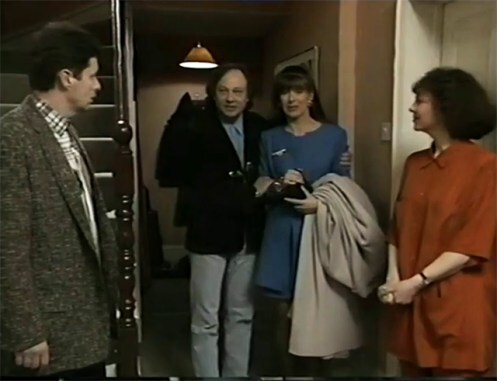
The reunion’s genuinely quite affecting, Yetta in her Shabbat best, stood in a dark corner, and turning to look upon her daughter who gasps in fright as Yetta phases through the sofa — “Carole, you’re scared.” Then she asks if she’s been eating properly and reels off a list of Jewish men with good jobs she could’ve married instead of Jack. But having promised to move onto Heaven, it turns out Carole (with an e) is pregnant (with a baby), so she’s gonna hang around to be a dead grandmother. “Oy vey!” says Peter, and for series one’s closing shot, the camera pans down to the dog, who’s now wearing a kippah.
“A Christmas tree in a Jewish house? I never thought I’d live to see it!”
“You didn’t.”
Those are the opening lines to an unexpected Christmas special, followed by the tree going dark and a menorah lighting in the window, as Yetta exclaims Happy Hanukkah. This is your standard Christmas special, as sitcoms evolve and add new characters; babies, partners, in-laws, to find themselves across the table in crepe crowns. This one’s centred around everyone saying Yetta’s new grandson looks like his father, and not the Jewish side of the family, so she calls Mrs Leibovitz and Mrs Goldfarbe down from Heaven to confirm (unheard and unseen) that he looks extremely Jewish and nothing like his dad. It’s the most Poltergeist display yet, flickering lights and swirling wind, ornaments and toys moving as if alive, and a piano playing itself. Later it turns out she faked the other ghosts, but there’s a happy ending, as David brings the baby in, telling everyone “he just said his first ‘oy’!” and the fairy on the tree turns into a Star of David with an exasperated “Mrs Feldman!!”
So Haunt Me would run for three series, pulling in audiences of fifteen million on Sunday nights, before One Foot in the Grave. Mendelson cites the popularity of the movie Ghost plus the Maureen Lipman BT ads where she played an interfering Jewish mother as helping boost its ratings, but it’s never been repeated on the BBC, not even during the heyday of Ghosts, nor gotten a physical release. As for the spook-fixated young me, perhaps at the time it felt a little dry, but at least here in 2025, the unlit, cramped dankness of a terraced house with peeling wallpaper gives a slight Enfield vibe. Still, they missed a trick not taking things into more culturally Jewish horror, say Peter buying a haunted dybbuk box, or exploring the attic to find Mike Reid guest starring as a golem. Feh, what can you do?
…
This piece first appeared on my Patreon, where subscribers could read it a month before it landed here. If you’d like to support me for as little as £1 a month, then click here to help provide the world with regular deep dives about weird-bad pop culture, early access to my videos, my podcast, and all kinds of other stuff.
There’s a ton of content, including exclusives that’ll never appear here on the free blog, such as 1970’s British variety-set horror novella, Jangle, and my latest novel, Men of the Loch. Please give my existing books a look too, or if you’re so inclined, sling me a Ko-fi or some PayPal cash.


Boon
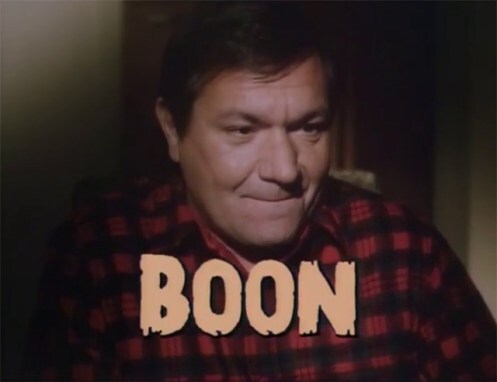
Stay Lucky made me appreciate an entire genre of television I’ve been missing out on; the casually-bewildering hour-long dramedy of the late 80’s. Like probably half the country, Boon — with its 11 million viewers — was on in my house, my mum one of millions of mums content to spend a precious hour of free time watching Michael Elphick huff about in a fringed leather jacket. A big bruiser of a man, Elphick’s best remembered by me for forcing a distressed Elephant Man to dance with Pauline Quirke, and perhaps the cultural zenith of a 30-plus-year career came in the final 18 months of it, with a role whose incestuous abuse would trigger EastEnders‘ iconic “You ain’t my muvva!” “Yes I am!” scene. If there is a comparison to be made with Dennis Waterman, it’s that he’s another you can’t imagine getting the same roles today, labelled as one of those ‘brilliant performer, but an alcoholic’ actors whose condition was, unfortunately, often physically apparent onscreen.
Boon ran from 1986 to ’92, with one further episode delayed and released as a one-off special in ’95. Let’s jump in at the beginning, with the scene-setting debut, titled Box 13. Gimmick here is that Ken Boon (brilliant name) is another man who likes American things, and opening titles have him sat forlornly at a desk crammed with books about the cowboys he idolises, plus a set of wind-up joke shop teeth for some reason. Boon’s fantasies of his motorbike as a horse and helmet a ten gallon hat play out over the theme; one of two I wrongly assumed as a child were sung by Tina Turner, along with that of Taggart. Alas, it’s actually Jim Diamond, with the quasi-reggae Hi-Ho Silver that’s been playing on an endless loop in my head since I thought “maybe I’ll write about Boon” rightly peaking at number five in the charts.
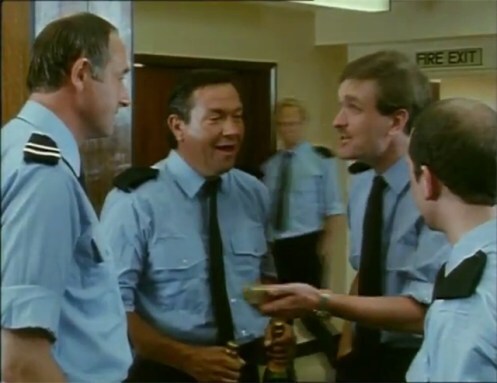
Boon’s a fireman, and the lads are celebrating his mate Harry’s retirement to Spain when they get a sudden call-out, and not to be cruel, but Elphick doesn’t look in any state to be going up and down ladders. You certainly wouldn’t want to be at the bottom when he’s sliding down the pole. 1986, you tell yourself, is recent history, yet the firemen’s big yellow helmets look like stag night costumes, and every car in street scenes might as well have a fucking crank handle on the front, as the sands of time fall away at an alarming pace. A house fire’s where Boon demonstrates his heroism, rushing in to save the owners as his colleagues scream “it’s gonna go up any second!” He gets lung damage for his trouble, meaning his fireman days are over, now stuck living in a caravan in a field, unable to even dig a hole without collapsing.
Then he’s woken by bailiffs — “who’s a naughty boy then and not paid his bills?” — and given until Friday to pay up or be homeless. The unattainable sum he spends the episode chasing, too large for anyone to loan him, is £300, which in modern terms is probably a week’s meagre groceries if you forget your club card. With Harry now back from Spain to run a hotel after his wife left him, Boon shows up to be mistaken for a removal man and brazenly stare at the arses of female staff. Every scene from here has the constant drinking and offering of cups of tea, to the point Boon feels like a psyop by PG Tips, and adds to the familiar brown colour palette of the era, so foul as if to encourage viewers to downgrade their licences back to black and white.
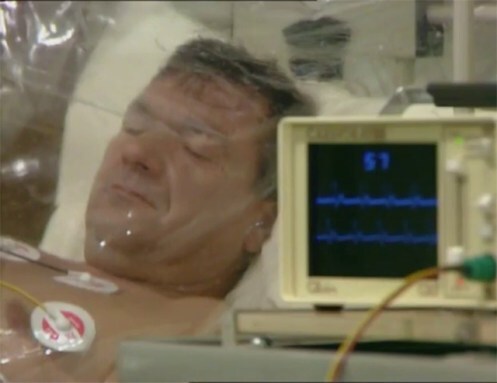
Everyone aware he’s down on his luck, Ken Boon is a proud man, moping about and refusing hand-outs, a life of scivvying now all “a dud man” is good for. Compared to Get Lucky, this is morose viewing about sad, empty men; Boon with bad lungs, Harry a broken heart, the pair endlessly sat round comparing miseries over cuppas. Come on, Ken, ride that bike over a ramp! It’s so under-edited and baggy, when Harry fills out a newspaper ad on behalf of his pal, he reads out the full credit card number. “Ex-fireman seeks interesting work, anything legal required, no job too small.” After screwing up the paper in anger, Boon concedes to give it a shot; “if we get any replies, nutters aside, I’ll eat my helmet.” Well, that’s one way to celebrate.
Sweetening the offer with a tenner in the envelope is a reply from Barney Spitz Promotions, aka John Sessions with a ducktail hairdo, quirkily eating a hamburger through the scene, which reeks of something Sessions brought to set — “I shall steal the show with some comedy chewing!” The manager of a band, he wants Boon to clamber up a gasometer and hang a banner promoting their single Inflammatory Statements. Boon backs out on the day as it’s not safe, causing the singer — leather jacket, skull earring — to climb up instead, snarling “I’ll do it myself, poofter!” Sessions calls the rocker a “wally” and true enough, he gets stuck up there, forcing Boon to mount a rescue in front of the local papers, ending up on the front page, and birthing a new career as a sweaty fixer.
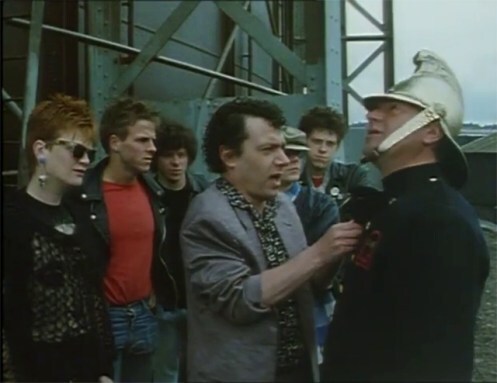
Ken Boon’s life really grew over the following series, expanding from the PO box into a motorcycle courier business, two concurrent detective agencies, and a security firm. Harry goes from one hotel to a pair of them, plus a country club and ballroom. After a dead boring first episode, the silliness kicked in pretty quickly, and a cursory glance through the history of Boon reveals classic hour-long dramady plots of insanity. By the third episode, he’s searching for the cat of a husband and wife circus act, and after that, it’s off to the races, with egg smugglers, porn barons, Hell’s Angels, and various dodgy businessmen and corrupt local politicians played by an anyone-who’s-anyone in British television, with the sort of on-point casting which sounds made-up. Go on, guess which one of these I’ve invented:
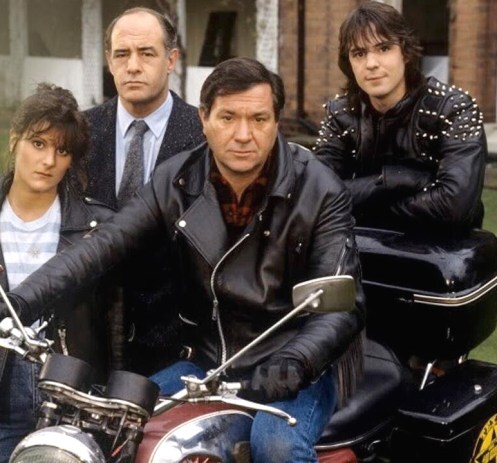
Stephen Rea as “a dishevelled Irishman.” Richard Griffiths as a businessman with amnesia. Peter Blake as a director of mucky movies. Tony Slattery as the Spanish boyfriend of Harry’s ex-wife. Two McGann brothers as Irish Gypsies. Matthew Kelly ‘as himself’. Hugh Paddick as a gangland boss. John Savident a restaurant critic. Robin Askwith “yobbish rock star Bograt,” whose agent is Karl Howman. Brian Blessed as Lambert Sampson, a Cumbrian sheep farmer. Dexter Fletcher a wild radio DJ. Tim Healy a washed-up comedian. John Hannah a Scottish footballer. Sophie Thompson a “mouthy feminist student.” Jane Horrocks a female snooker player. Christopher Eccleston a man who kills a doctor in a hit and run. Bill Nighy a radio DJ accused of sleeping with underage girls. Dennis Waterman as the robber of a lingerie factory. John Nettles a shady businessman. Brian Murphy an ex-cat burglar. The answer is of course, none; they are all featured in Boon.
But the best piece of casting is a regular who makes his debut in the second series, episode six of which, Wheels of Fortune, I also watched; Neil Morrissey as long-haired biker and comedy sidekick Rocky. New titles show Boon literally pumping his fists with excitement imagining himself in a cowboy film, though the wind-up teeth have sadly been written out. This one’s by Anthony Horowitz, last seen on here as writer of the creepy Dramarama mirror episode, and picked for its similarly spooky-leanings. Things begin with some neighbours calling an ambulance for an old lady who’s had a fall, but told they’ll have to drive her themselves, as the ambulances are on strike. Turns out, it’s Harry’s aunt Lil, and he and Boon arrive at the hospital (or as Boon calls it, the “NHSS”) to find a protest for fair pay and against government cuts. We’ve wandered into a Political Storyline.
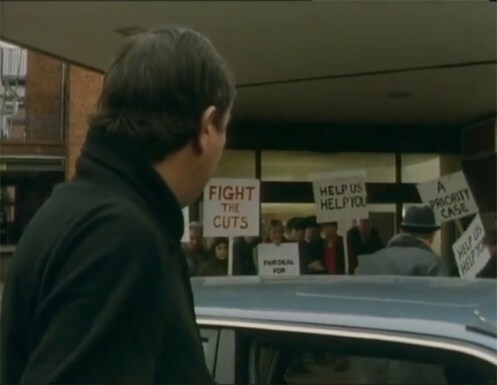
It takes a while to figure out which side the show’s on, as Harry moans about the trade unions “bumping up their pay packets,” and finds Aunt Lil’s bed empty, shunted off to another ward. Staff are half-arsed and short-tempered at every turn, like an eye-rolling nurse played by Sadie Frost doing the sort of Midlands accent your dad puts on when he’s moaning about Lenny Henry. It’s established Lil had a stroke because she didn’t get oxygen in time, which she would’ve in an ambulance, and it’s possible a young Wes Streeting was glued to the screen (liddle bid o’politics!) at such ineptitude. But Boon’s pro-union, and Harry gets put in his place by a female doctor eleven hours into a shift. “Look at this place, it’s a shambles!” “Yes it is, we’re overworked and understaffed.” The whole plot couldn’t feel more timely even if big Ken had wandered in to interrupt with “seen how old the Stranger Things kids look now? One of ’em’s got a beard!” as Harry tells the (Indian) doctor it’s alright for her, because “you people are used to it.” “By that,” she asks, “do you mean doctors, or Indians?” He learns that everyone’s suffering, his old aunt and the staff who rely on ambulances to transport blood, equipment and medicine, so as way of apology, offers up Boon’s riders to help out, free of charge.
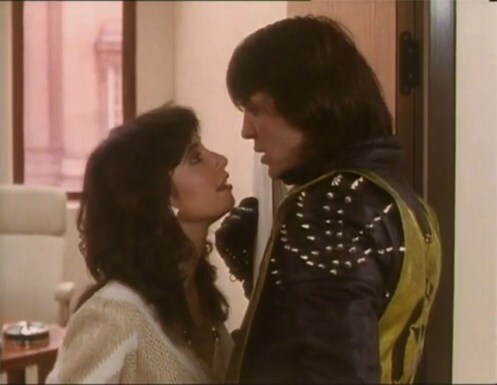
Speaking of, at the office of the (Birmingham-based) Texas Rangers, Ace of Spaces blares from the headphones of Rocky, sat on the desk reading The Sun, and being he’s Neil Morrissey, almost certainly admiring the Page 3 knockers. On a job, he argues with a traffic warden while again listening to Ace of Spaces — ol’ Rocky one-song — then flirts with a horned-up secretary, who tells him “I was hoping you’d got a package for me,” meaning the penis which would go on to break Les Dennis’s heart. She sucks on a biro and actually unzips his fly in the middle of the office, and as the camera doesn’t venture below waist height, we must assume it’s just hanging out for the rest of the scene. Meanwhile, someone’s pinched his bike, which he can’t report as it was untaxed and uninsured. The thief takes it to his big brother’s bike yard (or “brig brother” as the actor fumbles it), and gets called a prat.
But the third plot strand’s the one I tuned in for. Harry’s hotel is now booming, though confusingly, Barbara Durkin’s behind reception, possibly establishing Boon as a shared universe with Alan Partridge. They’ve a celebrity guest staying, the psychic Phyllis Nichols, who’s taken a room to write her autobiography. When Boon hands her the key, their skin contact triggers a vision — “some day, there will be tabloid stories about Barbara Windsor nixing your romantic storyline in Easties because having to kiss you made her feel ill, and a year later you will be dead at 56!” No, not that, but that he’ll have an accident on his bike; an accident we see a premonition of, in flashes of him tumbling across the road. “I saw blood, a great deal of blood,” and Boon lying on an operating table. That could be anything! He might be getting his tight foreskin fixed. Final vision is of a policeman bringing bad news to the hotel (“It’s Boon. I’m afraid he died during the operation to loosen his foreskin”). “I saw it,” she warns, “and it will happen.”
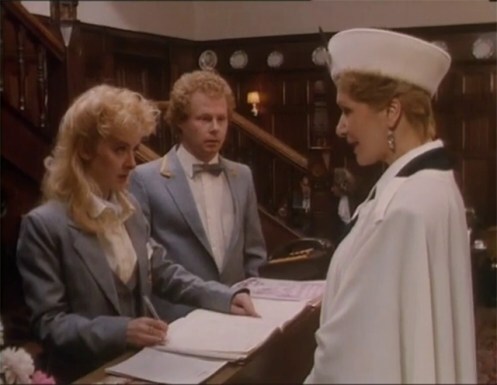
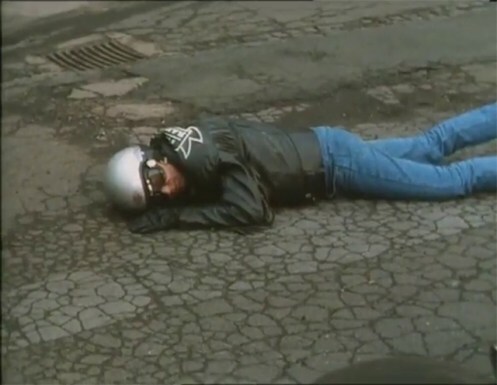
He’ll be lucky to get in a crash considering Boon‘s glacial pace, enlivened only briefly by Roy Kinnear as a grieving uncle, in the worst dialogue he’s ever had to perform, including Eskimo Nell. But the grim portent of Phyllis’s vision hangs over Boon as he rides out for delivery. It’s like Final Destination out there, potential hazards everywhere; pedestrians, speeding cars, a reversing truck; a foreskin surgeon with the shakes. Death is near as Boon swerves to avoid a car, boxes of fruit flying as he tumbles, left face down on the road. RIP Ken Boon, you died as you lived, unable to fully retract past the glans and with every erection causing discomfort. Back from an ad break, he’s perfectly fine, yet what of all the blood and operating table?
On another hospital run, he’s asked to consider giving blood, cos they’re low on donors, and someone’s just been brought in from a crash; coincidentally, the guy who stole Rocky’s bike. The prophecy comes true as Sadie Frost takes Boon’s blood, though thankfully he doesn’t have a wank on top of the bed like she did when hers got drained in Dracula. If only I’d had a prophetic dream about not watching Boon, which up until now existed on here as an infrequent funny reference, but in reality is sadly just inept and boring. It took twice as long to write and watch as the average old telly, and on the second draft, I had to edit the dozen times I’d instinctively typed his name as Ken Book. All I’ve got to show for it is Hi Ho Silver looping in my brain until whatever next terrible earworm takes the reigns.
…
This piece first appeared on my Patreon, where subscribers could read it a month before it landed here. If you’d like to support me for as little as £1 a month, then click here to help provide the world with regular deep dives about weird-bad pop culture, early access to my videos, my podcast, and all kinds of other stuff.
There’s a ton of content, including exclusives that’ll never appear here on the free blog, such as 1970’s British variety-set horror novella, Jangle, and my latest novel, Men of the Loch. Please give my existing books a look too, or if you’re so inclined, sling me a Ko-fi or some PayPal cash.
October 4, 2025
May to December and The MOR Comedy Childhood
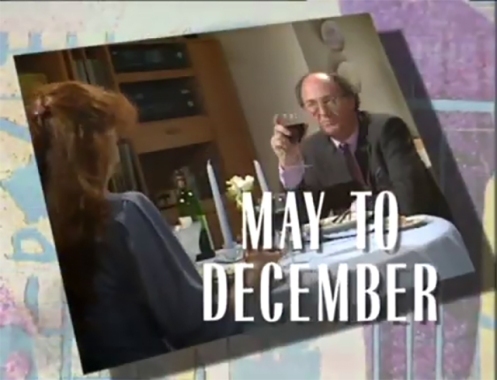
When I launched the Patreon, the very first thing I did was a series called Past Laugh Regression, revisiting the shows which made me laugh as a kid. But at that age, it wasn’t just the Davros and Abbots I loved, it was all comedy; any comedy, and I’ve written before about being ten years old, my cousin coming round of an evening, and both of us excitedly sitting down in front of May to December. The sitcom genre is split into two worlds. You’ve got the stuff like Fawlty Towers, Only Fools and Horses, Dad’s Army and so on; series which were watched and rewatched, filled with memorable moments and quotes; characters you can dress as for Halloween. Then there’s the Middle of the Road fare, half-hours traipsing by every week and leaving zero cultural mark; series even less remembered than The Upper Hand.
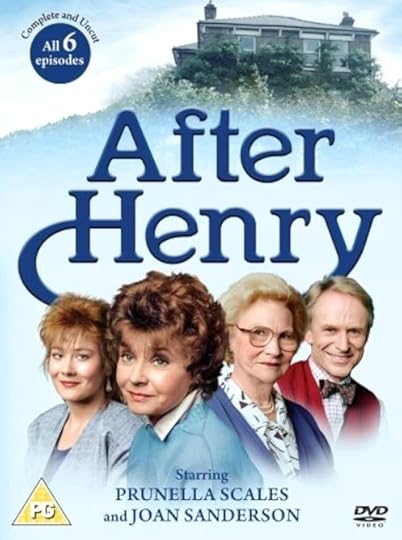
It’s these the young me would gobble up, in their peak era in the late-80s to early-90s, cross-legged on the floor and laughing at the bits I understood; funny voices and traits, reedy nerds from accounting and annoying neighbours; insults like “he comes from Hemel Hempstead” — brilliant!! Imagine coming from Hemel Hempstead! (where’s that??) Surgical Spirit, Up the Garden Path, So Haunt Me, Conjugal Rites, Home to Roost, Holding the Fort, Second Thoughts, Life Without George, Close to Home, Don’t Wait Up, Joint Account; the lives of the suburban middle-class and middle-aged, often working in an office, and either looking for love or attempting to rekindle a dwindling marriage. The trundling conveyor belt of mild amusement particularly stands out now, in a time of comparatively no sitcoms and endless panel shows, with a dozen faces who’ve got the same agent. Granted, there are occasional ‘starring vehicles’ for stand-ups, with all six episodes dumped straight on streaming, and Sky showing wall to wall repeats of shite American laugh-track shows, but park your bum of an evening and there are no Dad’s Armys, let alone After Henrys.
May to December seems the obvious one to go back to, with its decidedly too-dull-for-children set-up of an old solicitor finding romance, and hold a gun to anyone’s head, they couldn’t tell you a single thing that happened. There are no May to December dining experiences where an AmDram actor in a bald wig’s bringing you breadsticks in the style of Anton Rogers’ character. Rogers must be the king of the MOR sitcom, what with this, Fresh Fields and French Fields. M2D (as the kids are all calling it)’s most surprising trivia is it was created by the man who came up with distressing kids show Pigsty, along with So Haunt Me and My Hero. Incredibly, its theme, a cover of September Song, manages to out-dreary that of Birds of a Feather, and if a DJ was playing it, then suddenly switched to The Upper Hand‘s, the place would go fucking mental. Go on, I dare you to listen, and visibly watch the life-force ebbing from your body.
Opening titles portray Rogers as the fustiest old man ever, in the sort of big coat and hat you see on charity shop ‘grandad’s dead’ racks. His Alec Callender is Scottish, denoted by saying “och” constantly, with the quirk he’s obsessed with Perry Mason and has one-sided chats with a photo of him. This is straight out of creator Paul Mendelson’s bio, having studied law at King’s College, and citing Perry Mason as his influence during the interview. Similarly, he headed a family law department before eventually switching careers, and he’s a giant nepo baby, as his father was managing director for Disney UK. I wonder how close we were to having those horrible pigs walking round Eurodisney waving at kids?
Filling out the cast is son Jamie, meant to be a rebellious and leftie opposite to his dad, with messy hair and badges on his donkey jacket, even though he’s studying law at Cambridge. His daughter’s more conventional (“she’s more interested in stretch marks than Karl Marx”), a jolly hockey sticks posho married to a vicar. There’s also a pair of secretaries, with the older and straight laced Vera Flood (Frances White off I, Claudius), and ditzy young blonde, Hilary (Rebecca Lacey, daughter of old melty-head Toht off Raiders of the Lost Ark). I couldn’t figure out whether Hilary pre-dated the Philadelphia ads with their identical secretary characters, which became so inexplicably popular, it sort-of span off into a sitcom.
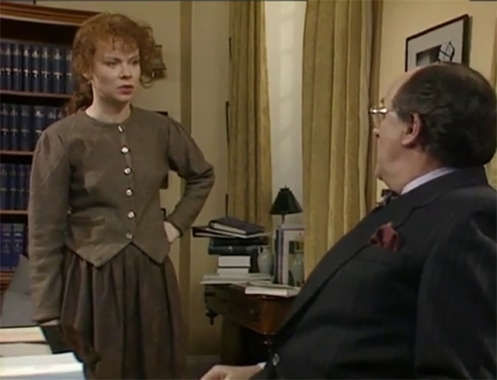
It’s wild how immediately familiar this feels, like pulling on a well-fitting if very musky and stained pair of trousers, suggesting I watched intently every week, with sense memories of Lacy’s whiny “Miss Flood…” pulling me down to the carpet of my childhood (and when raising the title of the show I was working on to my mum, the first thing out of her mouth was a note-perfect “Miss Flood…” Perhaps not so forgettable after all?) Straight in with the main plot, an appointment Alec assumes will be a “crinkly old biddy” turns out to be a much younger woman with red hair called Zoe Angell, with whom he forms an immediate connection, not over the extraneous letter L in their surnames, but a mutual love of Broadway musicals. She’s an ‘old soul’, see, so it’s not creepy when they get lost in chit-chat instead of litigating her divorce, even though he’s older than her dad. But it all goes wrong when he causes accidental offence and she storms out.
Not just spanning the divide of age, they’re a class apart too, her a PE teacher, and him a wealthy partner in a law firm. Like almost all the sitcoms named earlier, this is the extremely middle-class television which felt distant and unfamiliar to me as a child, watching from a council estate, everyone in the sort of nicely kept big house I’d never even stepped inside. This, I figured, was just how the adult world was; a world I’d enter when I became grown; huge settees and spare bedrooms and two cars in the drive. Spoilers: I didn’t, and when an angry YouTube comment recently described me as middle-class, I’ve never been so offended. I’m common as dirt! I can’t even drive!
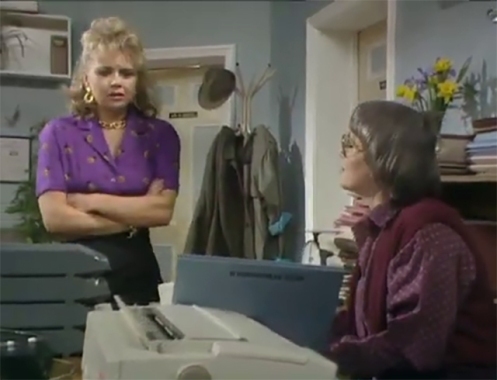
Jokes about stale cakes and brunch have the audience roaring, the sort of guffaws suggesting that if any of them looked out of the window and saw me walking past, they’d be straight on the phone to the filth. Alec’s partner is a lech, admiring Hilary’s arse as he walks in, and with “images whizzing round his head” at the thought of a gym mistress like Zoe, even at ten in the morning. “It’s always midnight in here,” he says darkly, pointing at his head, an accidentally brilliant line. After their bust-up, Alec and Zoe bump into each other and become friends again, but then she storms off once more after discovering the pervy partner’s representing her husband’s mistress. This tedious misunderstanding/apology structure is the backbone of the first of six series, with Zoe lumbered with a Welsh PE teacher situationship boyfriend who doesn’t get arts or the theatre; not like decrepit old Alec and his dusty cums, who loves them.
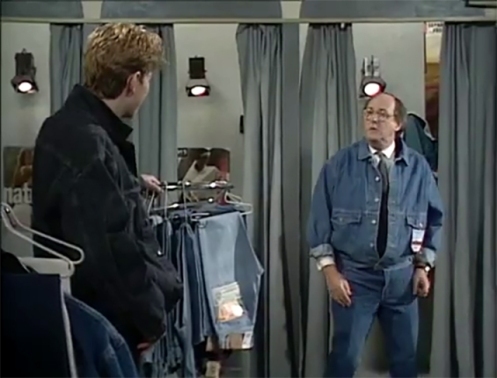
Alec and Jamie go to Sunday lunch at the daughters, where the writer reuses the one left wing point of reference he knows. “Even Karl Marx loved nothing more than his Yorkshire pudding. Dat’s capital, he used to say!” But the will they/won’t they subplot — always the worst device in anything it features in — is the entire show, viewers suffering through a long, dreary courtship. Every line’s meant to highlight how, despite his pubes going grey before she could ride a bike, they’re right for each other, unlike people their own age; Alec bored by a knitting old lady, Zoe forcing the PE teacher into an art gallery where he mucks about. And we’re never allowed to forget his proximity to the grave, with constant jokes about walking frames and Ovaltine, plus a scene where he prepares for a date with Zoe by buying ‘young people clothes’ from a shop where chart music blares from speakers, asking if they can pick all the designer labels off like a silly old man.
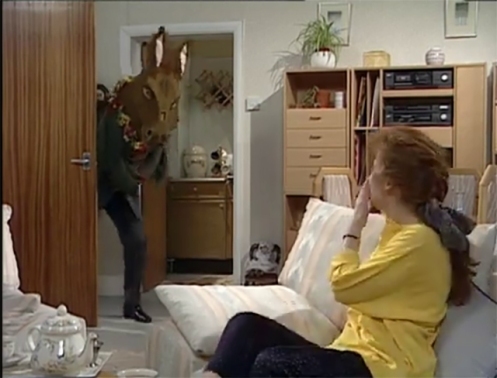
This is the most conventional sitcom scene yet, trying on far-too-tight jeans and a denim jacket, walking bow-legged out of the changing room only to caught by his son who’s inexplicably walked in. That’s it, lads, you’ve almost got it! Now put some jokes in! Later, as she misses their date (to a musical version of Midsummer Night’s Dream) with a twisted ankle, Alec shows up at her flat wearing a donkey’s head and singing highlights, right as her parents show up. Okay, maybe don’t just do that one bit over and over. Their ages are specified for the first time here, as 53 and 26, which Gen Z Tiktokers would absolutely implode over, accusing anyone in a relationship with someone who wasn’t born on the exact same day of being groomed/a groomer.
Jumping forwards to series two, they’re together now, kissing and cuddling and that, so we can get on with it. Look, an actual joke: “My PE reports used to say I had the body of an athlete.” “Are you sure it wasn’t just the foot?” Although this is followed by Alec being invited to imagine the tough life of a PE teacher, stuck in a changing room with two dozen sweaty 16-year-old girls. “Quiet,” he says, staring lustfully into the middle distance with a “I’m imagining.” But he upsets her by making a grand gesture of the decree absolute in full Scottish regalia, before they yet again make up. This is decidedly not a sitcom which builds to an ending where all the threads come together, or indeed, any type of ending, always just Alec saying something in his office then credits. Guys, I’m really struggling. I’m not someone who can nap during the day unless I’m in the bath, but I’m dry as a bone trying to find insight here, and genuinely dropped off a couple of times.
The dialogue’s padded with references to characters we don’t see; the sleazy partner’s wife who sculpts environmental awareness pieces, Hilary’s boyfriend Derek, Zoe’s ex-husband with the late 80’s comedy name and job of Kevin the Milkman, and Janice Grimwood, the flat-chested Lilo Lil style tart who stole him away. Alas we’re stuck with the onscreen cast, and jump forwards another year to series three, where Zoe’s been recast as Leslie Dunlop, which happened in the Christmas special between series. A show so beloved, they were like “the nation will riot if we don’t find a way to continue May to December!” and brought in a new lead. By now, they’ve been living together for a year, in her flat, presumably so they didn’t have to build a new set for Alec’s house, with Jamie sleeping on the sofa.
Plot-wise, it’s really of its time, and not in the blackface way, but in its point of tension being disagreements over what they want in a new house, like a pair of rich pricks on Escape to the Country. Alec casually sifts through listings; swimming pool, third of an acre; one of them’s got live-in staff. Eat the rich! Eat Anton Rogers! Bite into his bald head like an Easter egg! You couldn’t air this now. Not the massive age gap, just nobody wanting to see a solicitor unable to choose which four bedroom bastard-house he’s gonna buy like it’s fucking nothing. I can’t write about gags because their aren’t any. I really hate this. When it’s done, I’ll be singing Thank You Very Much like Anton did in Scrooge, dancing on top of the coffin and not caring if it’s me inside, just happy it’s all over. A trawl through the wiki summaries of future episodes reveals storylines comprised of various side characters’ relationship problems (with even Miss Flood becoming Mrs Tipple after marrying a man called Gerald), more jealousy when partners spend time with other people, and one where Alec won’t let Zoe work with a gay person.
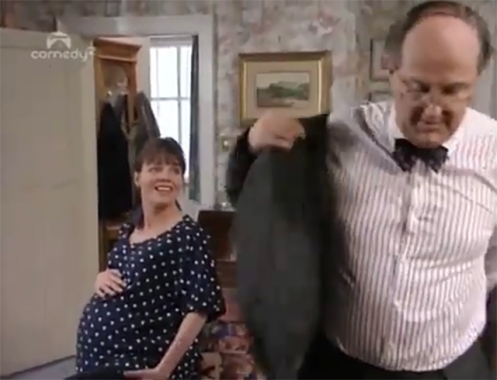
Onto series five, Zoe walks into the room massively pregnant. She’d previously got up the duff at the end of series three, but had a miscarriage in series four (classic sitcom plot!). This time, she will give birth, meaning the miscarriage wasn’t the show’s way of writing itself out of a ‘worried about being an old dad’ storyline, and rather, they must’ve just really wanted to include the loss of a baby for its guffawing audience. Though she does also go onto suffer from post-natal depression. Mentioning she’s as large as a sumo, Alec does a hearty “ah-so!” and the big dramatic tension is her desire for a water birth, which is far too modern and hippie dippy for a man whose last child must’ve been plopped out onto a sabretooth fur at the back of a cave, the ancient old sod. A last minute dash to the hospital ensues, and they sadly miss the comic potential of insinuating his sperm is old by having her give birth to a Benjamin Button.
Series six. The final episode. We’ve almost made it. It starts with a flashback, implying Zoe’s been cheating with a “hunky young bloke” over a shot of Alec dropping his flowers in heartbreak. And it’s all change, Jamie now a partner in the firm, married with his own baby on the way, and Hilary gone, as Rebecca Lacey was trying to crack Hollywood, replaced by Ashley Jensen off Extras. She’s established as zany via the time-honoured ‘calling people by the first letter of their surname.’ “Alreet, Mrs T?” Meanwhile, Miss Flood’s approaching her 30th anniversary at the firm, so they decide to throw a surprise This is Your Life party.
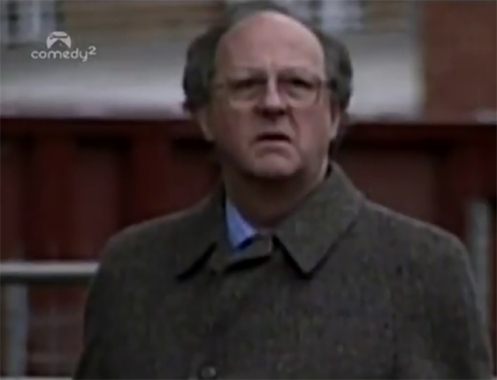
This young hunk, then. He’s a carpenter making a lectern for the Vicar brother-in-law’s birthday, and him and Zoe have been going for drinks. This isn’t a harmless misunderstanding, as she’s actually conflicted and furtive, and they have an uncomfortable moment in the kitchen, acknowledging the mutual attraction. As they’re just about to kiss, Alec catches them. It’s here May to December gives me my first laugh at the (not intentionally funny) moment a seething Alec describes the This is Your Life idea, through which the audience, shell-shocked at his troubled marriage, are completely silent.
Anton: “He (Jamie, organising it) thinks he’s Eammon Andrews.”
Leslie: “It’s Michael Aspel now, Eammon Andrews hasn’t done it for…”
Anton: “DOES IT BLOODY MATTER?! Sorry, I’m sorry…”
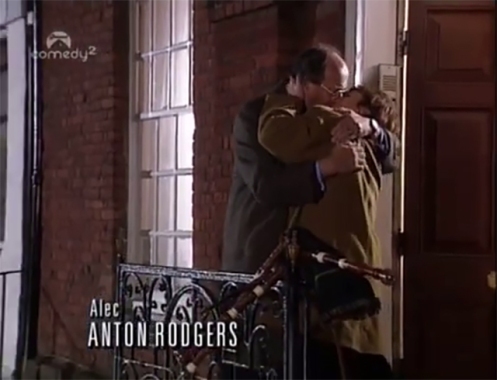
Then they get into a screaming match and he storms out and leaves her as she sobs. The This is Your Life involves bagpipes and a Scotsman called Big Mac, until Zoe hijacks the mic for an emotional plea, and then her and Alec go outside and make up with a kiss and everyone claps goodbye to May to December. Seriously they play the applause over the credits for almost a minute like it’s getting a standing ovation at Cannes. Honestly, sometimes I play up the ‘struggle’ of watching bad telly for a living, like I’m down t’pit, but this really was abominable. Above all else, rewatching as an adult makes me immensely sad for the young Millard, like a lab animal who’s never been outside and thinks a lightbulb is the sun, sat there watching Alec Callender opening the filing cabinet and chuckling away at the funny comedy on television. Miss Flood!!
…
This piece first appeared on my Patreon, where subscribers could read it a month before it landed here. If you’d like to support me for as little as £1 a month, then click here to help provide the world with regular deep dives about weird-bad pop culture, early access to my videos, my podcast, and all kinds of other stuff.
There’s a ton of content, including exclusives that’ll never appear here on the free blog, such as 1970’s British variety-set horror novella, Jangle, and my latest novel, Men of the Loch. Please give my existing books a look too, or if you’re so inclined, sling me a Ko-fi or some PayPal cash.
Broom Cupboard Breakout: Gordon and Edd Go Solo
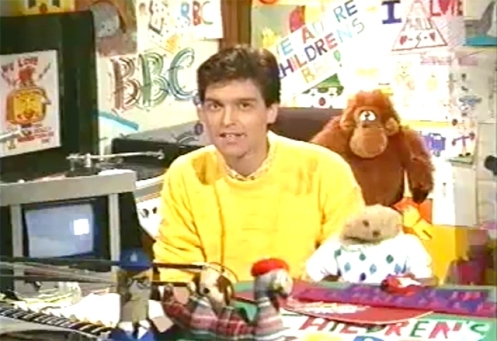
These days, puppets off kids TV say things like “we’re just normal men, we’re just innocent men,” but back in my childhood, they merely squeaked or quacked. For a period starting in the mid-80s, one small place was the hotbed of felt sidekicks; to puppets what 60’s Motown was to music; the CBBC Broom Cupboard. From here, the likes of Phillip Schofield, Andi/Andys Peters and Crane, and Simon Parkin (who, according to the song John Kettley is a Weatherman, is always larkin’), read out birthdays between Dogtanian and Grange Hill. But in this cramped, closet-like space, these lonely men began to yearn for interaction, beyond one-way chats with viewers they couldn’t hear, and like Tom Hanks slapping a bloody face onto a ball, they were forced to construct their own friends. To continue the musical metaphor, if there was an Elvis of the scene, it was Gordon the Gopher, who begun aiding Schofe in his presenting in 1985, following him to Going Live! two years later.
Gordon’s real-life origin is murky. Some sides claim he was discovered by Schofield’s auntie, while the man whose hand was up it will tell you he was sent in by a viewer, with long, dangling limbs which were snipped short with scissors. With the original quickly starting to wear out, the BBC props department then made their own in-house replacements. In spite, or perhaps because of Gordon’s limited vocals — one of those squeakers you find in a dog toy — from the very first appearance, his popularity exploded, and Schofield was shrewd enough to get the George Lucas deal, retaining all rights to merchandise, and making an absolute bundle. At his peak, Gordonmania was such that a local market stall round here survived for at least a year with a stock entirely comprised of bootleg Gordons of all colours, with the original long limbs and Velcro on the hands so they could hug you round the neck like Cheeky Monkey. It’s no exaggeration to say that every kid in town had one, and if Schofield had gotten a whiff, he’d have sent some heavies round to break the seller’s legs. One of my prevailing childhood memories is of going to my auntie and uncle’s house one Saturday morning to find my five cousins shrieking with laughter in the midst of a savage gopher fight, whipping each other with the many variant Gordons.
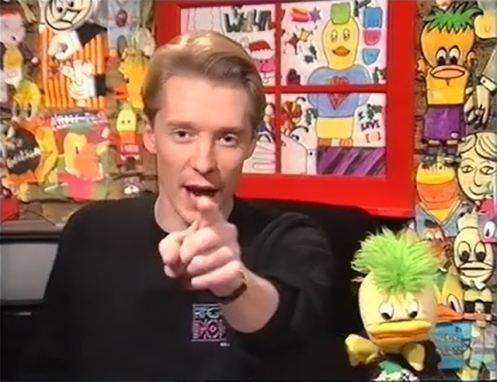
Less popular was Bobby the Banana, an inert and mute stuffed toy plantain being waved about beside Crane, who’d purposefully wanted to establish himself as sole presenter without any puppets. But then came Edd the Duck. Edd was operated by Christina Brown, assistant CBBC producer, who came across a stuffed yellow duck head in a Hong Kong street market and sewed it to a little body, which popped up behind the desk live on air as a joke on Crane. With his green mohawk, Edd had more punk ‘tude than Gordon, and was no less successful, with all manner of merchandise from toys and bubble bath to a computer game (and sequel), and even becoming official mascot for the British team at the 1992 Barcelona Olympics. Having learned their lesson with Schofield, this time the BBC controlled all rights. Edd would be joined by a second sidekick, Wilson the Butler, a silent pair of white gloves and black sleeves who’d reach into frame, and functioned as Edd’s nemesis.
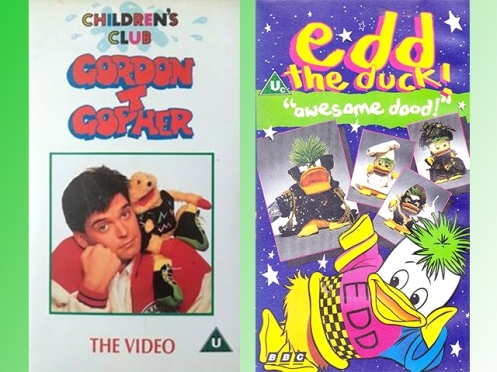
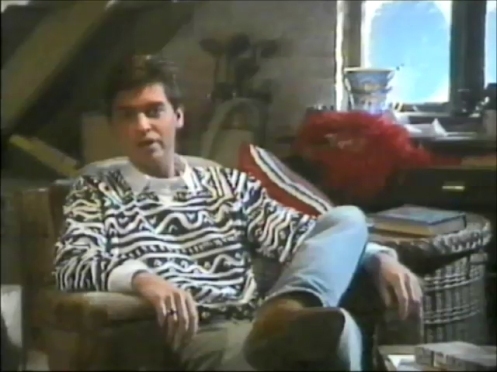
In 1990, amongst all the Gordon and Edd tat were a pair of solo spin-off VHS tapes. Gordon T. Gopher the Video starts with all the usual copyright infringement warnings, which presumably still stand and could see me in prison, and an upbeat synth intro, whose wordless melody clearly sounds out “Gordon the Gopher!” As his squeaks need to be translated, alongside is young Pip Schofield, who tells us Gordon can be irritating at times, “but you’ve got to like him!” True enough, it’s an undeniably cute design, and he’s the purest of all puppet forms, with a mouth that’s just a hand opening and closing; essentially a sock with eyes. Setting is a dingy attic packed with junk, purported to be Schofe’s actual loft, where Gordon conveniently sits inside a chest of drawers. Phil’s pointed towards a dusty book, and clambers into an armchair to begin reading aloud. The old Jackanory format, Schofield will tell tales of he and Gordon’s adventures in the fictional London enclave of Shepherd’s Hedge.
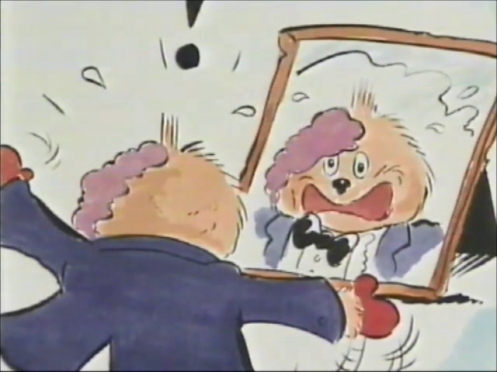
Our first is a “nautical mystery,” but in the telling, Phil recants he and Gordon’s conversations in perfect English, in which the translated GTG sounds like a middle-aged man. “’No’ said Gordon, ‘I’ve bought a boat, haven’t I? Second hand. Done it all up myself, painted it and everything. It’s moored on the river hedge, I thought you might like to come along for a little adventure?’” Classic Gordon! Do you reckon he and Sweep are speaking the same language? As Schofe’s not doing voices, it’s a lot of ‘I said’/’Gordon said’, told over illustrations by Phil Hunt, who did the Gordon comics in Fast Forward magazine, which appeared alongside strips for EastEnders and Bread. Bet those were a barrel of laughs, lovingly rendered sketches of the dole office. Imagine being tasked with drawing Freddie Boswell every week. Even though Phil features in all the stories, he’s never depicted; at least, not from the neck up.
Through these adventures we glean new canon information about Gordon’s life. He lives on his own in a burrow, gets about on a tricycle, suffers with very bad hayfever, and likes alfalfa sandwiches, crisps and the television show Hill Squeak Blues. We even get a look at his mum and dad, and in fitting with a prairie animal, his family appear South American. These stories are dumb as heck, and each meant to be told on a different day, but smelly old Phil’s always got the same clothes on. Phillip B.O.field, more like! One’s about Gordon getting into a practical joke war with arch enemy, Morris Mole, while in Gordon Meets His Match, a trendy female gopher called Glenda is unimpressed with his hygiene.
It’s only in Gordon of the Opera that we leave the attic, with Schofield — in a St. Moritz ski jumper — storytelling out on location, like Fat Tulip’s Garden. He takes Gordon to the opera for some culture, but Gordon gets bubblegum over half his face, wandering down to the bowels of the theatre and frightening some stage hands, which gives Phil a chance to do what he thinks is a working class voice, guv, before Gordon bumps into a real ghost. Running just under an hour, it’s a proper cash-in video, the cheap and lazy route of the storytelling bits from an Allsorts. Phil’s got the resources of the BBC at his disposal, and could’ve done a fun tape of Gordon palling around with some of Going Live!‘s celebrities, or hi-jinx on the set of other shows, but settled on something that was probably rattled off in an afternoon.
We’ve had the one what squeaks, now the one what quacks. Edd The Duck, Awesome Dood — which opening text proclaims the most awesome video in the whole wide world (they’ve clearly not seen Willie and Gary: Best of Friends) — starts on Andi Peters and Simon Parkin in the make-up chair, discussing Edd’s film work, with some atrocious punning. “Grem-Edds, Back to the Fute-Edd, and E-Double-D…” I know that last one’s meant to be a riff on ET, but you’re just describing massive tits. Apparently, Edd’s calling himself “Edd the Spielduck,” and I don’t think anyone there knows how puns work.
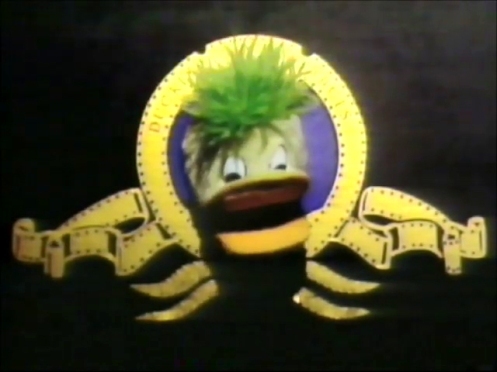
At least Edd, like Sweep, has a noise which can be interpreted as speech, with syllables and intonations, rather than Gordon’s smoke alarm peep-peep-peeps. However, he still requires a translator, and they’ve gone the proper route here, employing a selection of celebrity guests. First, in sketches filmed at Twicross Zoo, it’s zookeeper Bill Oddie, in what’s almost certainly the booking which triggered his depression. But this seemingly obvious, child-like set-up turns out to be one of the most anxiety inducing viewings I’ve ever had.
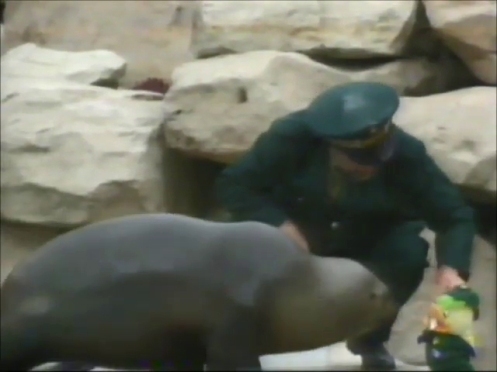
When using zoo animals as props, you can’t do much besides feed them. Sure, Bill chucks the sea lions some fish, that’s perfectly normal, but then he’s putting a fish into Edd’s beak, so he can feed one. When they’re rearing up at you, sea lions are fucking massive, like a huge wet Rottweiler, and Bill gets a nip at the hand when the fish falls out of Edd’s beak. Yet they persist, the animal which outweighs Bill bellowing at his beard as he tries to stuff a dead fish in the felt beak of a puppet whose operator is crouched between rocks above an artificial pool. Edd must’ve absolutely stank after. Finally taking the bait, the sea lion almost rips off Edd’s head/Christina Brown’s hand.
A sigh of relief when he’s chucking bits of hard boiled egg at otters, and holding up foliage for a giraffe. Nobody ever got mauled by one of those. They eat green things, Bill tells Edd. “Not like Bogeys, no,” he translates. But then into a scene with bad news written all over it, a tea party with Bill sat one side, Edd the other, and between them, a chimpanzee in a t-shirt eating custard with a spoon. I’m ultra wary of chimps, having made it clear in their attacks on humans they’re fully aware of the body parts we wish to lose the least, always straight in to gnaw off fingers, faces, and genitals. Edd’s quacking right into its ear. Strength of eight men, isn’t it? If he gets a hold of that thing, the poor woman’s gonna look like the Black Knight from Holy Grail.
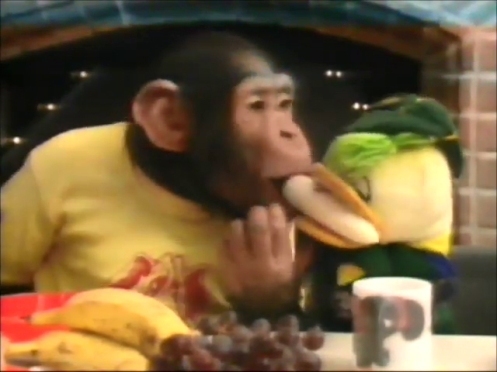
As Flynn the monkey gives the beak a taste, Edd starts spoon feeding him, and I’ve not been so tense since watching Sorcerer. Then Bill stuffs a banana precariously into Edd’s beak, and he gets right in the chimp’s face, aggressively quacking in a tone one can only translate as “TAKE IT THEN YOU CUNT!” An arm bends sideways as the chimp casually wrestles Edd down, and I dunno man, I feel like waving food right in front of a wild animal’s nose before snatching it away and giving it to a puppet is page one of the BBC health and safety handbook. In fact, in the list of ‘things not to do with a chimp’ I’d peg the top three to be:
Don’t tease it with food
Don’t have a puppet pretend to eat said food
Definitely don’t have the puppet hit it on a nose with a metal spoon while quacking wildly
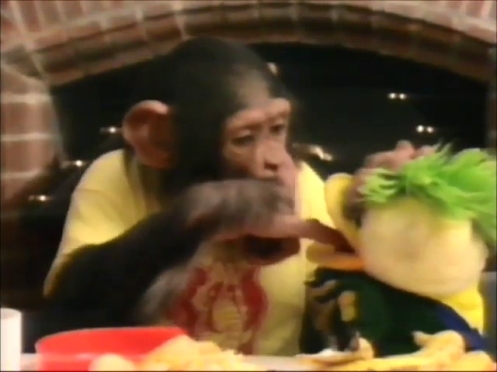
This is probably why Flynn tries to pull Edd’s fucking head off, as Bill Oddie chuckles “I think he likes you!” and the lady crouched under the table puffs frantically on the duck-kazoo. By now, the chimp’s fascinated with the puppet, wrenching open its beak, peering down the non-existent throat and sticking a finger in. Bill thinks “this isn’t nearly deranged enough!” and gives it a cup of tea, which the chimp pours into Edd’s beak while he scream-quacks. Then Bill flips Edd onto his back and arms the chimp with a spoon of blancmange to tip in, and it’s like watching evidence from the Abu Gharib trial.
Thankfully Edd makes it out alive for a skit in the kitchens of a London hotel, taught how to bake a cake by a French chef who’s clearly not an actor. It’s your classic mixing bowl slapstick, banging around a wooden spoon and being told “ahh, you are a very naughty duck!” Then Edd has tea and cake with the Queen, aka Jeannette Charles, who should’ve got the real gig when Paddington came for Big Liz. It’s interesting how later in life, Jeannette aged from being a Queen lookalike to a perfect Stanley Baxter as the Queen lookalike.
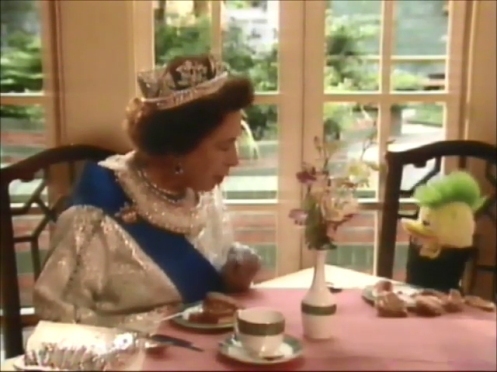
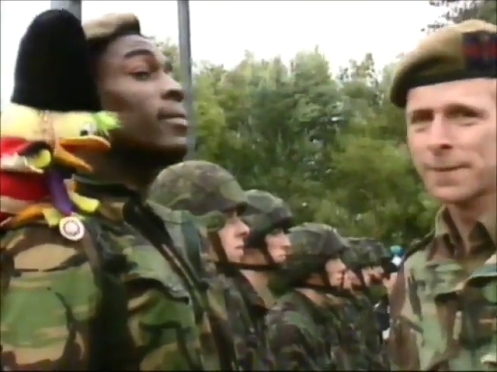
Wilson shows up, and the Queen treats him very poorly, admonishing his shaky-handed tea delivery with angry “how dare you!”s and telling Edd to bite him. It’s like an alternative timeline version of the Paddington sketch, and had this video sold more copies, Edd might’ve been our national icon of death instead. Next Edd’s doing an assault course with army men, and because it’s the 90s, Frank Bruno’s there. The soldiers are also not professional actors, corpsing when Frank introduces Edd as ‘Harry’, and over a soundtrack of When the Going Gets Tough, Edd’s slung over climbing walls and such, as a Sergeant yells “come on you horrible duck!” while Frank shouts a supportive “come on, ‘arry!”
High up a climbing frame, Frank begs “Sarge, I wanna go to the toilet!” and this is better than at least half the sketch shows from that decade. At the end, a very posh colonel gives Edd a medal, accidentally making split-second eye contact with the camera, with an expression which very obviously reads “I’ve killed people, you know, and now I am giving a medal to a puppet that’s sat on Frank Bruno’s shoulder.”
In terms of guest appearances on the stuff I’ve covered, perhaps the only one troubling Bruno’s total is Rene off ‘Allo ‘Allo, who’s in Paris with Edd, and a table of moustachioed Frenchmen in the background very amused at the stupid English film crew, Rene doing his accent, Edd in beret, stripey shirt and string of miniature onions. Bet their equivalent of Edd’s a naked human woman, and their Schofield’s… another naked human woman. As a random thought, for any European readers out there, what’s the British version of the ubiquitous accordion which backs any and all footage of France on our screens? In French shows when someone’s titting around in London, what’s the soundtrack? Quasi-Beatles guitars? Honky tonk Chas ‘n’ Dave? Inquiring minds want to know!
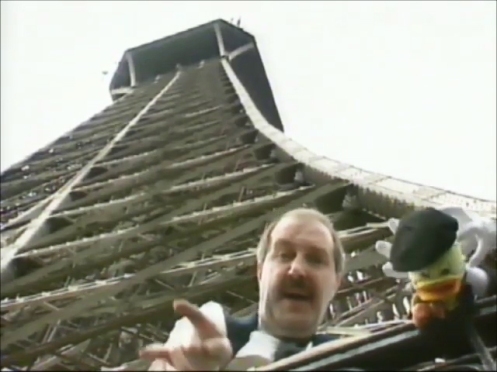
After Edd paints a hunchbacked Rene outside Notre Dame and desecrates the Mona Lisa with a tash (“you stuuupid duck!”), the tape ends with the video for his single, Awesome Dood, which peaked at 95 in the charts. The standard thing here would be vocals handled by session singers, and Edd chiming in with occasional quacks during the chorus — “quack quack quack-quack-quack (I’m an awesome dood)”? But what they actually do is inexplicably have him rap with a human voice; a cool, American (and black-sounding) one, with rhymes like “so rap with me to this cool ballad, I’m telling you now I’m one funky mallard!” Even though Edd’s credited as one of the songwriters, the lyrics seem out of character too. “I’m nasty, I’m cruel, bein’ bad is my only rule!” It’s lucky for Roland Rat he’d fallen out of the limelight, or we could’ve had a bloodier rap feud than Biggie vs. Tupac. Many years on from the videos, both past their peak, Edd and Gordon are still fondly remembered, and while Edd pops up for the odd panto, Gordon’s association with Schofield means we’re unlikely to see him again, removed from history like the Savile episodes of Top of the Pops. That old market trader’s never gonna shift his surplus now.
…
This piece first appeared on my Patreon, where subscribers could read it a month before it landed here. If you’d like to support me for as little as £1 a month, then click here to help provide the world with regular deep dives about weird-bad pop culture, early access to my videos, my podcast, and all kinds of other stuff.
There’s a ton of content, including exclusives that’ll never appear here on the free blog, such as 1970’s British variety-set horror novella, Jangle, and my latest novel, Men of the Loch. Please give my existing books a look too, or if you’re so inclined, sling me a Ko-fi or some PayPal cash.
August 19, 2025
Stay Lucky
Dennis Waterman is an iconic figure; a lean slab of ham topped with rusty hair, wrapped in a brown leather jacket, and secure enough in his masculinity to let loose both wolves which dwell inside every man; punching wrong’uns and grabbing the mic for a bloody good sing-song. Nostalgic trawls through his body of work place him as real throwback, not of performance but of casting. A bloke like Waterman would never get those roles now, like the way you stick on Die Hard in 2025, well aware a man with a body like that (a body, by any standards, in good shape) wouldn’t even get an audition for John McClaine today. Get some veins on it! Learn to love the needle! Similarly, in the world of modern television, even a prime Waterman would never land the hunk or hardman roles that were his bread and butter.
Not particularly charismatic, he’s so lacking in identifiable traits, you’d be hard pushed to do an impression. Yet Waterman persisted, one of Britain’s most recognisable faces, with the Sweeney to Minder pipeline cementing him as a tough nut through decades of consistent work, until the day he was brown bread. In a long career, there’s many things one could focus on, such as the fantastically weird title for his first album, Downwind of Angels. “Cor, Gabriel, you let one go, son?” Instead, we shall look upon something suggested by one of my beloved Patrons, namely Yorkshire Television’s Stay Lucky, which ran for 27 hour-long episodes between 1989 and 1993.
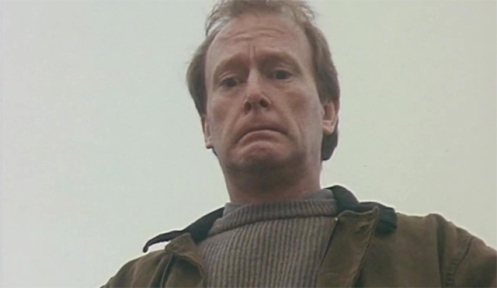
I get sent a lot of links, but the opening five minutes had me pinned to the screen. In those 300 seconds, Waterman topples out of frame clinging to a drainpipe while escaping an angry husband; the husband of a much younger Chinese woman picked up at a night club while Hot Stuff blares in the background. Hubby’s a Triad, causing Waterman to flee London, slo-mo leaping onto a moving boat in the Thames, into the opening credits, where a 1989 CGI skeleton roly-polys across the titles under Waterman singing the feem toon — “I’m out on the road, and the going is tough, they’re after me and I need a friend, but who can you trust?”
We’re at episode one, titled A1 Rain Dancer, and immediately aware this represents a very specific genre from a very specific point in time. Old style telly, before the Golden Age, no past traumas will be unpicked here; no promo shots with characters stood in a line in jackets looking grim. There will be zero moody montages under needle drops of Spotify bangers, no long dialogue scenes or monologues; instead being raced from scene to scene like Den’s got us by the scruff of the neck. Absolutely filled with stuff, none of which is of any consequence, it’s the simplistic storytelling of yore, in a world where each criminal underling is bumbling and harmless, each mob boss a scenery chewing panto villain, and where Dennis Waterman is every woman’s dream and every man’s nightmare. More succinctly, it’s the kind of stuff my mum would binge through on ITVX in a couple of sittings.

Though half the episodes were written by creator Geoff McQueen, who also created The Bill and wrote for both of Jim Davidson’s sitcoms, Stephen Moffat’s name crops up once, and the series 3 premiere’s directed by Lawrence Gordon Clark, who created A Ghost Story at Christmas. There’s similar pedigree in its enormous cast list, featuring every stalwart face you’d expect in 90’s television, from Julie T. Wallace to Tom Wilkinson, and dozens of ‘it’s them off that thing’ types — Belinda Lang making two appearances as Lady Winderscale; Roy Evans off EastEnders as simply ‘morris dancer’. Absolutely standard TV fare of the time. And by ‘standard’ I mean ‘weird as shit’.
On the lam, Waterman’s hitching a ride to ‘the north’ and getting splashed by lorries, pleading to the Gods “someone give us a bleedin’ lift!” Inside a posh jaguar speeding past, Jan Francis off Just Good Friends retorts (though neither can hear each other) “sorry, dickhead, not today.” Thankfully, a very accommodating rugged Scottish trucker called Angus lets him dry his wet trousers on the heater and gives him a Mars Bar. “I’m famished,” says Angus, “d’ya fancy something hot inside yer?” With the promise of a service cafe up ahead, he nods down at Waterman’s crotch. “Gis a wee look, I’ll spring for the grub. Come on, gis a look, that’s all I wan’, just a look.” Feel bad for him actually, so starved of intimacy on the road, he’s begging for a glimpse of Dennis Waterman’s phallus. Must resemble a piglet’s trotter in a clump of wire wool.
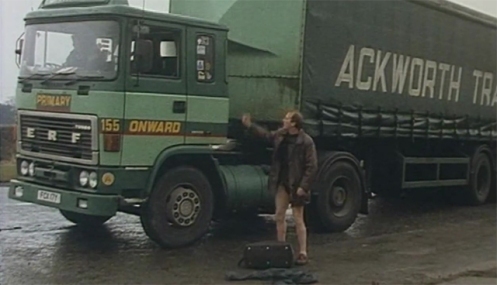
Cut to him hurriedly getting out — “on your bike, bleedin’ shirtlifter!” — at an A1 service station where Jan Francis has broken down. Trousers in hand, he tries to charm her by tap-dancing in a puddle (hence the episode title), before uttering those eight little words which immediately put all women at ease, “I’m not a lunatic or a perv, honest.” One thing audiences of the late-80s loved was the bickering ‘posh totty/bit of rough’ dynamic, and that’s Stay Lucky‘s primary selling point, two characters who clearly despise each other, needling back and forth with insults and folded arms, yet fated to end up doing sin in a bed. He fixes her car in exchange for a lift to Leeds, and they bid final angry farewell; “Right stroppy bird. Last time I saw a mouth like yours, it had a hook in it!” I’m sure that will be the last time they see each other.
But he’ll discover she actually dropped him 40 miles shy of Leeds, instead where she lives in a houseboat, which has just been ransacked. He gets a proper lift to Leeds in the Reliant Robin of an Italian juggler with a Super Mario accent and loose toupee, who he meets in a cafe, firmly establishing this as the comedy-drama genre, not funny enough to be a sitcom, and too far-fetched to slot alongside similar-timeslot fare like Cracker, Taggart, or Morse, whose horny gay trucker characters would be revealed as serial killers, glove compartments absolutely chocker with severed nobs. Speaking of baddies, our subplot sees a man called Studs rifling through Francis’s underwear drawer, taking a big whiff of her knickers and rubbing them all over his face. Tight-fitting punk jeans, leather jacket, buzzed haircut, earring, and fingerless leather gloves; like the finest wines, this tough guy look has only gotten camper with each passing year.
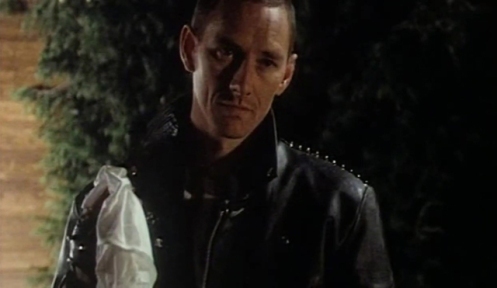
As we’ll (eventually) learn in drip-drip exposition, Studs is working for a man called Ken, who’s seeking a little black book owned by Francis’s dead husband, whose heart gave out mid-sex with a mistress — Ken’s wife! The widow and the scarlet woman bump into each other graveside, Francis given the book, which contains the mysterious key to a painting, which only “Old Cecil at the junk shop” knows more about. Cecil’s not in, but he’s got a Benny from Crossroads style assistant in a woolly hat, continuing the time honoured tradition of slow-witted characters referring to people by the first letter of their surname — “Hallo, Mrs. H!” Not-Benny sends her off to a boozer in Harrowgate after Cecil, coincidentally exactly where Dennis Waterman’s headed to! As she walks away, the Benny makes a lustful face, implying he too is in love with her, or at least “she make my worm go all funny, so she does; makes him stand bolt upright in me britches thy knows!”
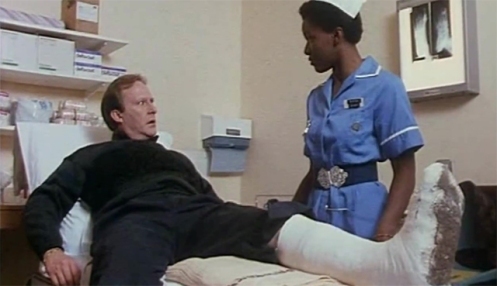
Also clearly in love with her is a mate with a little ponytail played by Eric Catchpole off Lovejoy, but we’ll get to that. Built on improbable coincidences, she’s almost kidnapped by Studs outside the pub, but Waterman’s there to spot her escape as she runs over his foot. Feeling bad, she gives him a lift to the hospital. Now on crutches and in a cast, he’s allowed to stay on the houseboat sofa, where the “dickhead” count rises to four. Most improbably is that thing everyone does in films, laying straight under a blanket for a kip and not doing a piss before bed. Mate, always reset the bladder before sleep.
The next day, he finds out the foot’s only bruised and not broken, and the nurse put a cast on cos she was “just playing safe.” No wonder the NHS is losing so much money. Cue Waterman so jittery in front of a lady at the chemists, she thinks he wants rubber johnnies for his heavily-freckled willy, but he’s after bandages and a plaster of Paris to make a fake cast around a Wellington boot, so the posh bird won’t turf him out. Roger the Dodger ass scheme. This weird veering between drama and 1970’s sitcom continues as Waterman and Catchpole get into a fight where the weapon of choice is wet fish — “I’ll batter you!” — and Waterman’s fish is comically small, implying Angus would’ve have had to switched the overhead light on to see anything. Waterman calls him a wilf, like he’s hosting Runaround, and a gink, before Jane Francis walks in, with a fifth “dickhead.”
Francis gets in her car to find Studs waiting in the back like Michael Myers, and Ken wants the black book, or else he’ll “let this animal do what he wants.” The way he’s dressed, that means get some poppers up his hooter to be Serving in the front row at G.A.Y. where three of S Club 7 are doing a midnight appearance. He shakes the book out of her handbag, returning the knickers while cackling like the Green Goblin, but the mystery of the black book is not resolved, so we have no way of knowing what happens (besides watching episode two, but I shan’t be doing that.)
Of course, Waterman and Lady Muck’s last goodbye turns into the long-simmering kiss, and as she goes off to bed, he warns, quite matter-of-factly, “I think you’d better lock your door,” I guess joking that he might do a rape? When he hears it actually lock, he lets out a disappointed “oh, shit” as we cut to credits. He’s not the only one let down, as the skeleton from the opening never makes an appearance, unless it’s meant to be Dennis’, and if so, technically it’s in every scene, but a rather arbitrary choice. Why not have CG recreations of his appendix or vas deferens rolling around instead? It’s gone by series two, one of which I have also sampled, selected by having the coolest title, The Devil Wept in Leeds, which with a late October airdate, suggests a spooky Halloween episode.
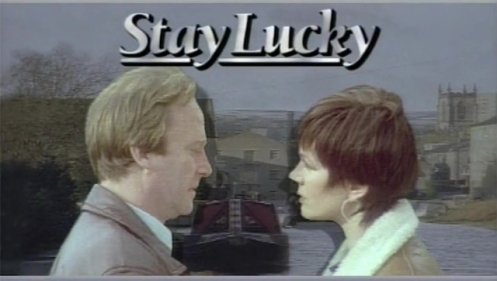
It’s not, and this is the Moffat episode. I’m not familiar with his most famous work, Sherlock and Who, I just know he’s got a lovely perm, and should’ve been locked up in writer’s jail for how blatantly Chalk was just Fawlty Towers in a school. Biggest shock is the change in feem toon, indicating a shift in Big Red’s circumstances, no longer a man on his own with a price on his head, and duetting with a female singer (not Jan Francis, despite the fact they’re together now). They sing boat-based puns, “I’ll be the captain — no you’ll be the mate,” and advise us, “the feeling’s getting stronger, stay lucky and free!” with Waterman’s gravelly voice painting a vivid mental picture of him stood in the recording booth in his jeans.
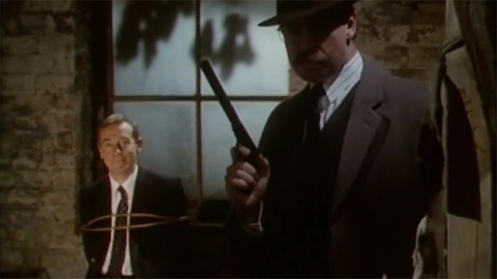
We open on a very calm Michael Jayston with half a dozen guns on him in a warehouse, feet literally in a concrete block, and Dennis Lill dressed like a 1920’s gangster from Chicago warning “dying is easy, Valentine, it’s the waiting that kills you,” then Lill’s goons are distracted by boxes of of novelty alarm clocks going off. Elsewhere, Waterman and Francis are bickering as he drives to pick up some… novelty alarm clocks, and walk in to have guns pointed at them. Where episode one had the captain from Red Dwarf as an American heavy, among today’s henchmen, we’ve the landlord of the Queen Vic who got murdered by Nick Cotton. Dialogue between Lill and Jayston is the height of 1990 comedy bants.
“What would you say if I told you I don’t know?”
“I’d say I don’t believe you.”
“I don’t know.”
“I don’t believe you.”
“Yep, you were right!”
Through contrivances, the pair help Valentine escape, taking out bumbling goons who either shoot each other by mistake, or get flattened when the concrete-footed Valentine falls through a wooden staircase. Dickhead count during this sequence: one. Turns out, Valentine’s the deadliest hitman in Europe, and insisting on paying them for their troubles, decides the best thank you would be to whack the “tub of lard” local councillor who keeps denying them planning permission. What follows is a farce of trying to stop him, which has Valentine, then Waterman, and finally Lill all enter the councillor’s office pretending to be window cleaners. There’s a horrible scene Emma Wray off Watching interrupts their boat-sex, where Waterman won’t leave the bedroom to talk to her because — its implied — he’s waiting for his solid penis to deflate, plus some hijinx with a remote controlled sniper rifle, before everything converges at a charity show, where the councillor will be making an appearance.
Incidentally, the houseboat which smells of sex with Dennis Waterman has an unintentional Tardis quality, about three times as wide as it appears from the outside. Its interior wears the same colour pallet as the rest of the 1990 world, horrid brown, everyone and everything looking absolutely awful; Jan Francis in jumpers and a massive Jon Motson football coat, and unruly haircuts which all look like wigs. Maybe the brownness was a deliberate choice to disguise all the dog mucks everywhere before they brought fines in.
With Valentine watching through a sniper scope in the lighting box, the big show’s compared by Bobby Knutt, and we can pick out but two words from his routine over the squabbling of our leads — “Japanese whaling.” But that’s preferable to Francis’s line about a “clever tongue,” Waterman’s response to which forces the audience to picture him engaged in cunnilingus, no doubt saying things like “I’m giving your Jack and Danny a right bleedin’ nosh down here!” I figured the councillor would be handing out a big cheque, but no, he’s doing a magic routine, “from the Magic East!” If he gets the linking rings out, I’ll whack him myself. As Waterman rushes the stage to block Valentine’s shot with bits of scenery, notable is a cut to the laughing audience, where the featured background artist’s face is a young Dave Chapman from Dick and Dom in Da Bungalow/Andor.
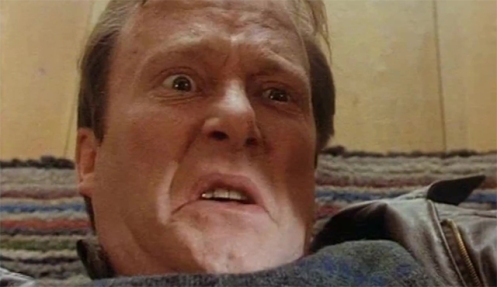
Waterman’s thrown out by security, while Francis simply calls the cops on ‘The Devil’ Valentine, who’s arrested. And that’s the end of that chapter! Simpler times, when the only thing we had to worry about was if the posh lady and earthy fella who argued all the time might not interconnect genitals. It seems the entire ‘diametrically opposed man and woman get into scrapes’ set-up is a dead genre nowadays, and with Waterman also in the ground, sadly we’ll never get that gruff-romantic-fixer dramedy crossover with a team-up between Thomas Gynn (that’s his name in this, I forgot to say), Boon, and Lovejoy.
…
This piece first appeared on my Patreon, where subscribers could read it a month before it landed here. If you’d like to support me for as little as £1 a month, then click here to help provide the world with regular deep dives about weird-bad pop culture, early access to my videos, my podcast, and all kinds of other stuff.
There’s a ton of content, including exclusives that’ll never appear here on the free blog, such as 1970’s British variety-set horror novella, Jangle, and my latest novel, Men of the Loch. Please give my existing books a look too, or if you’re so inclined, sling me a Ko-fi or some PayPal cash.
July 1, 2025
Big Night Out
“Seen Millard’s new post? He’s finally tackling Big Night Out.”
“Ooh, Vic and Bob?”
“No, not that Big Night.”
“I think you’d better sit down.”
One of the legendary showbiz heckles was said to have livened up a performance by Mike Winters, at the moment Bernie poked his head round the curtain, inciting a withering cat-call of “Oh Christ, there’s two of ’em!” As regulars here will know, one Winters brother is more than enough, and in my unending sift through of random old telly, Bernie has become my nemesis; the analogue ghost in the VHS machine. With decade-spanning unexpected appearances in anything and everything, there’s truly no safe space from Bernie randomly showing up like a fucking bailiff to go “ehhhhh!” ATV’s Big Night Out aired on Saturday nights between 1960 and 1965, so pre-dates the ‘I’ve got a big dog!’ era, with Bernie still speaking to, and more importantly, performing with, big brother Mike, as co-hosts for an hour-long variety show.
There’s something quite freeing about not having to prepare for the jump scare of Bernie suddenly lurching from the wings, as he’ll be in plain sight, on camera and doing his… thing for multiple hours, over the course of five episodes from the third series. I believe this is the oldest thing I’ve covered, and much of it’s out of my cultural wheelhouse, leaving me mostly flying blind. Episode one aired on June 29th of 1963, six years before the Manson murders. If he’d have watched it, cheeky Charlie would’ve escaped from prison especially to do them early. Though not included in the shows I’m watching, later in the run, the Beatles would mime some songs and partake in skits, and a contemporary comment under said performance by an American remarks of Bernie: “Wow, the guy on the left reminds me of Steve Carell!” God, some sick bastard’s going to AI him into The Office one day aren’t they?
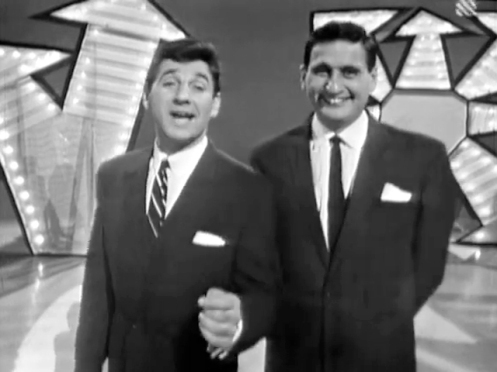
We open with the pair comically bickering, Mike breaking a prop bottle over Bernie’s head and smashing a chair over him, as is every boy (called Millard)’s dream. Bernie’s in a stripy spiv suit, and though it’s in black and white, you can just tell it’s a horrible colour. Shame it’s not a black screen. Less than a minute in, we get a “you gorn potty or summink?” from Bernie, the gormless gutter presentation of which made me laugh so much when he did it in my 3-2-1 video, I physically could not stop rewatching it. You can all thank ITV’s voracious thirst for copyright that “you gorn potty or summink?!” hasn’t appeared in every video since.
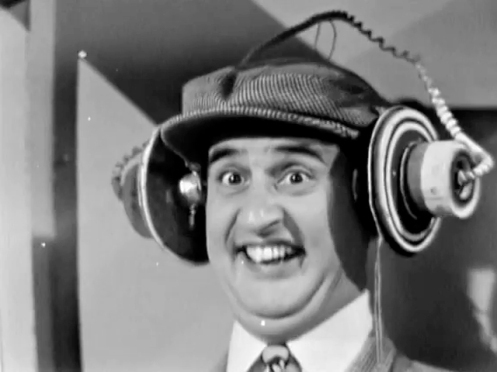
As a double act, it’s not quite the expected joker/straight man, where Bernie’s interrupting like Bobby or Eddie, but more like Mike’s been lumbered with his oafish brother in an Of Mice and Men scenario, parents forcing him to take Bernie along to the studio, cos the last time he was left alone he let the bath overflow and it fell through the ceiling. Mike’s got both the look and mannerisms of someone who’s playing a showbiz agent in a film, while Bernie’s in his prime, a handsome, energetic young performer. Only joking. One thing you can say about him is he realises he’s been born with a funny mug, and is never not pulling a stupid face, biting into his top lip to showcase the buck teeth, like a bloke with a big cock who keeps taking it out. One of the real cultural ‘what if?’ questions is to imagine a world where Bernie Winters wasn’t born with big gnashers, so never made it onto television. Like Dexter Fletcher, a freeze frame of any moment will land on a grotesque gurn.
Thankfully it’s not All Winters, All The Time, but like every ‘variety’ show, the bill is eighty percent singers; Craig Douglas and Dickie Valentine and Matt Monro; the latter doing I Get a Kick Out Of You, a classic big band number which very casually has a verse about cocaine being boring. Ronnie Hilton puts on a Jamaican accent to sing a calypso about future Indoor League presenter Freddie Trueman. I’m having a real old man “all modern singers look the same!!” crisis with the parade of neat chaps in suits and bow ties crooning away, each approaching the camera with the overfamiliar confidence of someone about to talk me into setting up a direct debit. None of them dance, but they all click their fingers. Maybe it’s a joke and it’s just one singer introduced with a new name for each song. Adding to the sense we’re merely watching a parody sketch set in the 1960s, this is an era before the old standards got written; almost every song here about break ups that you can Google the lyrics for and come up empty handed. Though I do recognise Gulf Aid‘s Gerry Marsden, him and the Pacemakers so boyish and clean cut, his guitar’s virtually up by his chin, not like those low-slung punk rockers lurking around the next decade.
The female singers are easier to discern. Petula Clarke, Susan Maughan (with hair like those apps that turn your photo into a silly 1950s yearbook picture), the Peters Sisters from America. I was shaking with excitement when I went to their Wiki page in the hopes one would be called Andi, but alas. Still, that beats the Kaye Sisters, who despite appearances here, turn out not to even be bloody related, like the Undertaker and Kane. Gulf Aid’s Vera Lynn pops in, and it’s absolutely mental to see her doing something other than We’ll Meet Again, especially as this is decades closer to WW2 than, well, every performance since. Evidently, each passing year shoved her further into the box of Force’s Sweetheart. Three numbers she gets, none of which even remotely allude to Hitler’s hi-jinks. I’m this close to throwing rotten fruit at the screen for such flagrant disrespect to our troops.
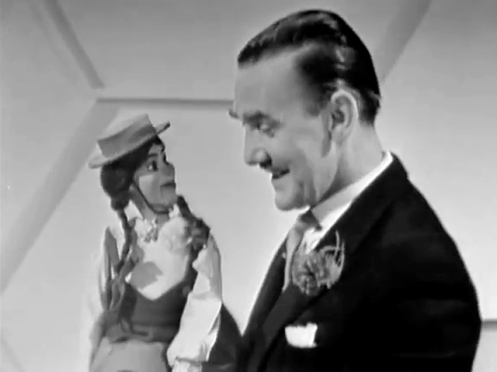
As we all know, there are two genres of variety; singer and ventriloquist, and Big Night Out‘s got plenty of the latter too. Saveen’s your classic top hatted toff with a common as muck alcoholic dummy, whose disproportionately small legs hang down Polio-limp. But it’s Daisy May who made his name. A pigtailed girl, she’s much smaller than your regular puppet, requiring Saveen to put his face right next to hers, both their voices down to whispers, in a routine where a middle-aged man seduces a baby-sized child puppet. She asks him for a kiss, but he refuses. “I do want to, but not now, I can’t kiss you in front of all these ladies and gentlemen.” A third puppet, pulled from a bird cage, appears to be made from an actual taxidermied parrot, and what a fate, to have your corpse reanimated to make jokes for the Brothers Winters. What must the parrot’s ghost think if he’s watching from the afterlife? Please, nobody manipulate my dead body when I’m gone, not if Stephen Mulhern’s hosting.
Another vent, Dennis Spicer puppets a moth-eaten, one-eared chimp which looks like it came from a jumble sale, before an honestly very funny routine using two audience members to ‘sing’ in silly voices. But I wish we’d seen the act he’d perform a year later at the Royal Variety, with a dummy which came to life played by Kenny Baker. Two weeks after that, Spicer was killed crashing his sports car, with the actual Queen sending a tribute to the funeral. His dummy, in the back seat during the accident, was (suspiciously) completely unscathed. Perhaps there’s a Big Night Out curse, as comic Don Arrol — a surname which can only be said in an Albert Steptoe voice — would be dead four years after his spot here. Even though he’s being ironic, he does a bit of string magic, and a final song celebrating livin’ life, which has a line about “places to go,” where the pianist plays a, shall we say, Eastern riff, and Arrol makes his eyes go all slitty.
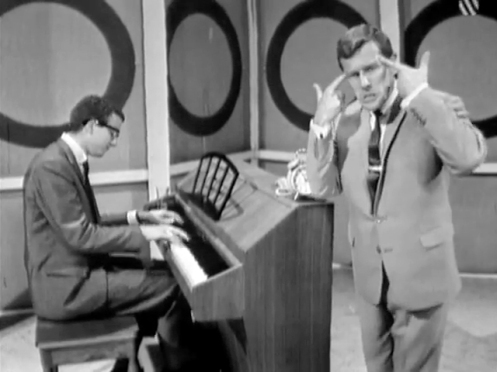
But sandwiching all these guest acts is the comedy, song ‘n’ dance of Mike and Bernie. For a Who Wants to Be a Millionaire?, their dance routine’s like what kids at a birthday party make the parents watch after five minutes choreography in the garden. If it’s true you can tell what someone’s like at sex by the way they dance, I think Bernie Winters somehow accidentally puts it up his own arse. The sketches are even worse, Bernie’s gurning amped up to max, teeth out for the lay jehmen. A Noddy (Bernie) and Big Ears (Mike) is so lazy, Big Ears doesn’t even have big ears, with a beard made from individual cotton balls glued to his cheeks. “Have you got a fairy godfather?” “No, but I’ve got an uncle I’m not sure of!”
A weekly sports reporter sketch casts Bernie as various figures; a female tennis star, a race driver who’s not wearing any trousers; Cassius Clay. For that, Bernie’s doing the voice but not blacked up, and delivers an actual good joke about Clay’s tricky new left hook. Why is it so tricky? “Cos I deliver it with my right hand!” When he’s a ballet dancer, praise be for low-res standard definition, as we don’t have to see what he’s packing. I don’t think I could live with myself if Bernie Winters was really slinging some meat. He ends up doing the Twist — “You heard of Chubby Checker? I’m his brother, Double Decker.” That’s not how surnames work! It’s all exactly what you’d expect from sketches by these two, but does provide one unexpected moment, when Bernie loses everything on a game show, pulling a gun from his pocket and shooting himself right in the head. Violence on television is having a terrible influence on our kids! (in 1963) Distressingly; and fittingly, as he’s always going on about birds; one sketch shows Bernie (in a Scrooge sleep-hat) sleeping in a bed with two women. Bernie Winters is in a throuple, and I can’t even get a text back. I’m kidding, I never text anyone.
Bernie’s performance style is that of a child given one line in a school play and deciding he’ll steal the show, and there’s a sense, like Jimmy Fallon on SNL, that when he starts laughing, it’s a deliberate act to draw the attention onto himself. Thankfully, we get the breather of a commercial break where a woman with impeccable posture and one of those 1960’s bras so pointy, her boobs resemble that He-Man toy with a drill for a head, sells us a hoover. Another ad has the PG Tips chimps out for a drive, one of ’em dressed like a copper, and presumably all their teeth pulled out, just in case. If they’d have done that with Bernie, he’d have been in trouble. Incidentally, for someone whose catchphrase is threatening to smash people’s faces in, how’d we think he’d have fared in the UFC? First port of call for anyone with a time machine, surely. One episode starts with Bernie’s silhouette for a Hitchcock gag, and he must be the only man whose teeth are visible on a shadow.
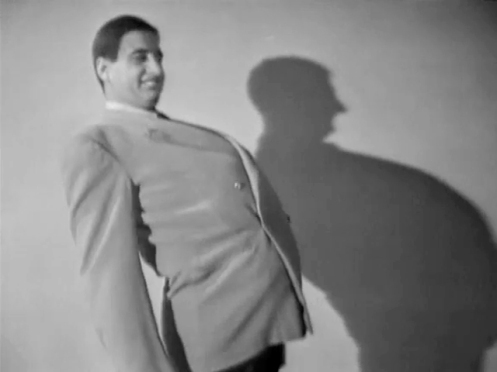
Thankfully, those seeking laffs don’t have to settle on the stylings of the Winters, with various guest comics too. Freddie Frinton does his ‘dishevelled old drunk’ routine, top hat, broken cigarette wobbling; basically the sort of thing Steve McFadden does in Easties. On a global scale, Frinton’s best known for the Dinner for One sketch, shot later this very year, which to this day is traditional New Year’s Eve viewing in much of central Europe. In my house it’s Ghostbusters II. Comedian Al Reed starts off by complaining how bad things have gotten. Buddy, you have no idea, up in your cultural sanctuary, a good twenty years from the emergence of Bobby Davro. This old fashioned observational comedy watched from the future always has real ‘cut to:’ energy. “With your motor car, I mean, where can you park ’em?” Yeah mate, I bet there’s nowhere to park in 1963. Do a bit about how expensive gas and electric are next. But a good thing about looking back is the Eye-Spy game of witnessing a real use of a bit which long-since fell into cliché or parody, and there’s a rush of excitement when Reed produces a very genuine “take my wife; please!” He’ll be recommending the veal next! Though it’s far from a classic, when Bernie’s in a school uniform sucking on a lollipop, we get a “Charlie Chan’s a different man since he backed into an electric fan” which would later come out of Brian Connelly’s mouth on The Keith Harris Show.
As stock monuments of comedy go, there’s few greater than Max Wall. This isn’t Freddie Starr as Max Wall, or Eddie Large or Wolf from Gladiators, but the proper Max. After the last seven years of Patreon, all and sundry marching about in a too-small dinner jacket and wig, it’s like seeing King Arthur in person. But this is not the Max Wall everyone does; the Max who so frightened me as a boy; a prancing elfin Child Catcher. That jet black Hulk Hogan hair has been cropped short and hidden beneath a hat, like when KISS took off their make-up, and the legs are standing still, not flailing. What a swizz! Imagine buying tickets to see Gervais and he doesn’t do any transphobic stuff.
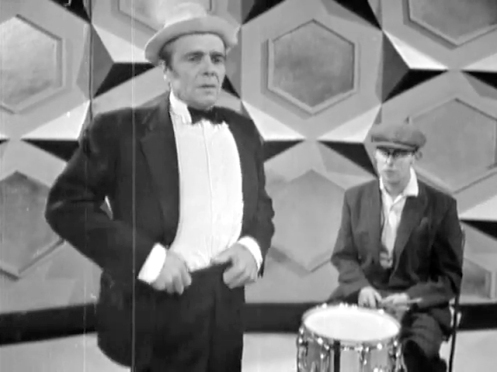
Like I said, I’m out of my wheelhouse here, and it seems like this is Wall’s post-modern period, deconstructing his act as the band come in too early on A Nightingale Sang in Berkeley Square. “That was funny, wasn’t it?” he remarks. “The orchestra all loud and quick. Everything went wrong!” Near the end, he announces “I am now going to do the walking up and down bit,” and then, the arse juts and out come the crazy legs. He’s got a hat on, but we can see the white of his socks. “There it is again, look!” Sure, Metallica are in their LOAD era, all eyeliner and grade fours, but they just played the shit out of Battery.
Personal favourite act are The Three Monarchs, a trio of mouth-organ wielding fellas in dinner jackets, one a big doofus with an extremely 1999 goatee on the point of his chin, like he plays bass for Papa Roach. There’s a use of the word ‘pussy’ before it meant fannies, a nice bit of business with a moving spotlight, which gets smaller as it’s swept away with a broom, and some good lines. “I was born with a beard, my mum was tickled to death.” I note one gag down as a future comeback to any youths making loud speaker-phone calls on the bus: “Talk, talk, talk, that’s all you do. I think you must’ve been vaccinated with a gramophone needle.” I’ll enjoy the last words I hear being “what the fuck is a gramophone?” as I lay there getting my head kicked in. Also, in this time period, spaghetti bolognese is such a new and exciting dish, it plays as one of those ‘misunderstood word’ jokes. “Do you like it?” “Only when it’s played by Mantovani.” That said, well into the millennium, spaghetti bolognese, along with pizza and pasta, was still categorised by my grandad as ‘foreign muck’.
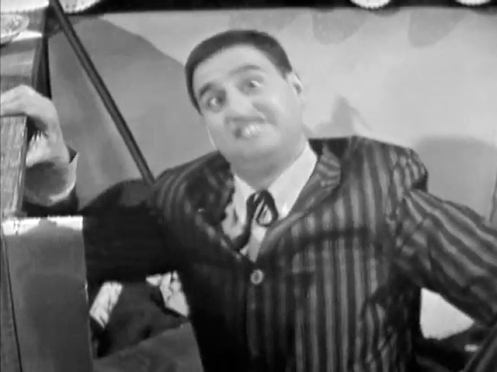
In another highlight, you know I love a dance troupe named after their choreographer, well, try and top The Lionel Blair Dancers, with young Lionel right alongside kicking and jiving with four ladies, while looking disconcertingly like the sinister doctor from Chris Morris’s Jam. Everything takes place on a minimalist stage with a really retro feel — oh right, it’s the real past, back when they’d stick one prop lamp post on a empty studio floor and pretend it was a street, and dancing girls jazzed up their routines by holding a sparkler. Annoyingly, a Richard III sketch steals the “Winters of my discontent” line I was going to use to sum up the dreadful nature of what’s unfolding, with a massive theme of the series being ‘cor, women just nag on all the bleedin’ time, don’t they?!’ say, Bernie in a hospital bed, Mike as his doctor. “How’s that pain in the neck?” “She’s gone to live with my mother!” Unfortunately, sitting through this lot hasn’t exorcised my Bernie Winters demons one blasted bit, even though I’ve now seen he’s capable of slightly more than just feeding his dog then waiting for applause. If anything, it’s given me a greater understanding of why Mike pissed off to America so he wouldn’t have to see him ever again. Lucky swine.
…
This piece first appeared on my Patreon, where subscribers could read it a month before it landed here. If you’d like to support me for as little as £1 a month, then click here to help provide the world with regular deep dives about weird-bad pop culture, early access to my videos, my podcast, and all kinds of other stuff.
There’s a ton of content, including exclusives that’ll never appear here on the free blog, such as 1970’s British variety-set horror novella, Jangle, and my latest novel, Men of the Loch. Please give my existing books a look too, or if you’re so inclined, sling me a Ko-fi or some PayPal cash.
May 18, 2025
A Black Country Night Out

Britain is so weird. I don’t mean Page 3 or the inexplicable rise of Paddy McGuinness, but specifically that it’s a tiny country with no two places you couldn’t drive between in a day, yet inside its imaginary borders, a vast variation of accents, language, and culture. Look at that response-farming meme which crops up on the socials every other week, asking ‘where you’re from, what do you call this?’ under a picture of a bread roll. Or bap. Or cob. Or Davro buttock. Scousers, Brummies, Mancs, Scots, Essex Girls/Lads. Dozens of little enclaves, where everyone’s exactly the same as the people from the other ones, yet also different, in the way they say their vowels or describe the small doughy product you’d shove a burger in. Or what they laugh at.
I always felt removed from regional tribalism. What is a Sussex accent? I speak it, but it’s nothing you’d ever hear as an impression. We don’t even have any good regional slang. There’s a place called Dogshit Alley, does that count? Perhaps we’re too far south to cultivate much of a specific identity, as local pride gets more intense the further north you go (note: London is the North), with constant talk about ‘Northern hospitality’ that you’d never hear from an inhospitable Southerner. Most fascinating to me in these self-contained pockets of culture is the comedy. As a kid, my entire knowledge of Wales came from the covers of mum’s Max Boyce LPs, him clad in a rugby shirt and brandishing an enormous leek. In my mid-teens, I went on a coach holiday to Scotland, with long highland drives soundtracked by the albums of Irish comic Hal Roach, driver laughing along to jokes he’d been listening to weekly for years. “Write it down,” Hal would advise after every gag, “it’s a good one!”
Hal never rang the doorbell on Noel’s House Party, but had a successful career of packed houses all the same, holding the world record for longest running engagement at a single venue, with 26 years at a Dublin hotel. This brings us to A Black Country Night Out, a mere sample of a live show which ran for over twenty years. Beginning in 1971 as a charity night in the Robin Hood pub, its roster of local comics, folk singers and spoon players even toured Spain and Vancouver, releasing a number of live albums, and eventually, this VHS. Though ‘Black Country’ is the kind of thing Farage cries out while tossing and turning in a nightmare, it refers to an area of the West Midlands, taking in places like Dudley and wherever the Peaky Blinders are walking round in slow-motion.
The pub comedy equivalent of Boyhood, opening titles inform us this was filmed at the Swan Theatre Midlands on 8th April 1982 and the Grand Theatre Wolverhampton 8th March 1992. There’s a strong sense it was sold out of car boots by men who cum real ale, and the British equivalent of those American Blue Collar Comedy tours — “you might be a redneck if…” But quickly it will become clear that, as someone who can see France if the weather’s right, I’m an outsider here. I don’t even speak the language. We open on the night’s performers lined up for a folk song; “If you’re friendly and true, you’re welcome to stay, to sup and to drink any time of the day.” I’m not particularly friendly, so you may have to have me removed. Judging by the next line, they’d have no trouble dragging me out – “strong in the arm and strong in the head, Black Country born and Black Country bred.” Settle down, tough guy! The song segues into an introduction for each act – “from Jon and young Tom, a message we giveth…” It’s like the bloody Wu-Tang Clan! Given the ages of the participants, every one of them is now dead.
The show is “a mixture of Black Country songs and humour,” and a perfect example of things solely powered by regional pride. There’s nobody like us Black Country folk; we’ve got our own rules, our own language! First act Tommy Mundon’s introduction is a lesson in itself. “He’s a railien(?), or he’s a boster, meaning he’s a good ‘un.” I can’t speak to his goodness, but Mundon’s certainly a weird ‘un. Long-limbed with a small head, he’s like Slenderman cosplaying as Mr. Rogers. “Halesowen police are looking for a tall handsome man for raping women. If the money’s good, I might apply for the job myself!” This is an uncharacteristically tart opener, as Mundon’s otherwise toothless and family friendly, in classic The Comedians definition of a stand-up, reeling off jokes everyone knows. His philosophy of “the little gags that don’t tax the brain always go down the best” is proven by doing the old Two Ronnies ‘stolen toilets/the police have nothing to go on’.
He’s an energetic stage presence, leaping up and down, arms windmilling, gob agape like the Mouth of Sauron and literally buckled at every punchline. He does earn it, with my old favourite about the man who’s regular as clockwork, half-six every morning — “trouble is, I don’t get up until nine!” Our next act has a unique talent of “conjuring very beautiful words from the complex dialect of the Black Country.” It is of course the Bard of the Black Country, Harry Harrison. Anyone taking a pound every time they say Black Country will be out-earning Musk within the hour.
Harrison’s your note-perfect 1982 man in his sixties. Flat cap, beige Sunday best, trousers hitched so high, if you opened his flies you’d be greeted by his navel. I can understand maybe half of what he says, accent turning it into a Rowley Birkin sketch. Something about putting a dog’s tail in a mangle? Harrison’s one of those whose entire personality is ‘I am from a place’, and cranks up the regionalness to max volume. Shopping’s for nancy-boy Southerners; proper Black Country folk go “shapping” in those new-fangled supermarkets. Evidently, even in 1982, this is such a new experience in the BC, it requires a poem about shin-pads for the “dodgem games” with trolleys and L plates on the baskets. “These supermarkets, them like motorways, with a need for speed on shapping days.” The audience are silent throughout.
Next is a man originally from Wales (a filthy outsider!), folk singer Jon Raven. Great opener, asking the men in attendence if they ever considered getting rid of their wives, cos in the good old days, you could just tie a brick round her neck and chuck her in the canal, or put her up for auction. His song Wife for Sale invites us to imagine “you’re in Bilston, and the year, 1827.” I’ll try my best! These are sing-a-longs, though his cue of “it’s ding-a-dong ding-a-dong ooh arr ooh arr — all together!” precedes a gander at the miserable looking audience, reserved and mumbling, decidedly not doing it all together. One absolutely superb cut shows a very serious older gentleman joining in with all the vigour of a Richard Dawkins ‘amen’ when his family say grace at Christmas dinner.
“At two o’clock certain, the sale begin, so yow as want splicin’, be there with your tin!” You fuckin’ wot, mate? The next act is so unique, her (not his like you were thinking, Andrew Tate) introduction asks “how often do you find a stand-up comedienne?” Queen of Black Country Comedy, Dolly Allen is wearing black gloves, a handbag, and a hat with a great big turkey feather and plastic poppy. She’d have been 76 here, and working as a comic since the 1950s, fiddling with the pockets of her cardie, disconcertingly staring off at a single point in the audience, unblinking. She’s got a more modern, storytelling style; at least I think she does, as a simple Southern boy like me can’t understand what she’s saying either. I do pick out jokes about vacuum cleaners and a husband who puts his work boots in the oven, before a very earnest, acapella rendition of You Need Hands, which is both quite sweet, and very ‘gran’s had a sherry’, hat coming off at the final word to signal applause. When Allen died in 1990, a blue plaque was installed in her honour at Brierley Hill Civic Hall.
Visually, Brian Clift can be added to the long list of Sutcliffes, thickly bearded, and with strings poking out of his guitar like unkempt pubes. He’s big into community spirit, hard times and good neighbours, specifically, “the lady in question was my old gran (starts singing), her was the salt of the earth, so folks used to say.” Literally just a song about his gran, it’s sadly lacking observational comedy about farts or racism. “Her was one of the owd sort, her had a heart of gold, and brought up we kids, just to do what we was told…” Yeah, well my gran hated Mr. Fuji from the WWF because he was Japanese, so write a song about that! Old Clift’s gran helped a “wench” down the street who was having a baby, fetching “hot wetter and towels,” and mate just speak properly! Stop mispronouncing stuff to sound interesting! The song ends on a downbeat note, opining that times — in 1982 — have changed, and “where am them now?” You’re just taking the piss now, Brian.
Big closer sees the cast singing It’s a Long Way to Tipperary for some reason. The whole thing feels like a joke I’m not in on, but then it’s not meant for me (let alone a me over four decades in the future, when everyone in that building is bones). Credits for the 1982 section reveal it originally aired on BBC Midlands. As we move into the 1992 half, all sound comes from the in-built mic of the camcorder, filming from up on a tripod far away, leaving me to contend with fuzzy voices reverbing round the theatre as well as accents. Our host opens with the old staple “you can’t see shit up in the balcony!” which gets a massive laugh from an incredibly rowdy crowd, primed to piss themselves. Lucky for them, Mundon’s back! Times have certainly changed in the intervening decade, as he’s throwing around the bloodys, and even a punchline about urine. Thank goodness Dolly’s not alive to see this!
The glasses hanging round his neck swing to and fro with his gesticulations, as he asks for no photos during his act for security reasons — “social security reasons.” Good gag. The glasses go on, inferring he needs them cos of too much fiddling with his penis; “it’s my initials, TW Mundon, Thomas Wanker,” forcing you to imagine him flailing about, long limbs thrashing, maw open, room left like the end of Bugsy Malone. But he is absolutely storming it, inciting chaotic laughs one feels would go on forever if he didn’t interrupt them with another joke. Anyone hearing the sound of the audience would assume he was the funniest man alive; every gag bridged by fifteen seconds of absolute hysteria.
The glasses, incidentally, went on so he could read his material off a piece of paper, made odder by repeating one from the first video — Tories bringing down unemployment by raising the school leaving age to 47 — though the fact it still works after a decade is a political point in itself. There’s a joke about an amateur ventriloquist (“gollocks”), one about a woman mugged by two “queers… one pinned her down, the other one did her hair!” and I’m pretty sure he does a racist one, but the only words I can understand are “black man” and the gales of laughter which follow.
The camcorder mic picks up audience members repeating lines as they cackle, and there’s a genuinely cracking line about his luckless father: “he had a kidney transplant off a bedwetter.” As anyone who watches my videos knows, piss is a rich vein, Mundon reminiscing about sharing a bed with many siblings, with so much pissing “we used to have a bloody rainbow over the bed. And we was that poor, even that was in black and white.” Absolutely lovely stuff! But alas, Munden’s time is over. I’ve seen some tonal shifts over the years, and few compare to what’s experienced here when old Jon Raven walks out again. He begins with the Song of the Staffordshire Man, “in forge and kiln and mine,” and I think he’s confused Staffordshire men with fantasy dwarves?
I’ll be honest, there are few warnings in life I’ve ever taken seriously, and occasionally, there’s a hard lesson to be learned. Ah yes, this is an electric fence, and now my urethra hurts. One such warning’s doled out by Raven: he’ll be singing songs about canals, not exactly putting my mind at rest with the promise “it’s not as bad as it may seem though, there are light moments so to speak.” I’m not too worried. How many songs about canals can there be? Fucking loads, pal. Sing songs about canals he does, and the audience, wild during Mundon’s set, are silent as the dead, having passed away through respect for their Midlands canals. The intro itself, explaining the canal songs, goes on for some minutes, during which the number of times in my life I’ve heard the word canals increases 5000%. “Fol-dee-ry-day, it’s the song they’re all singing down Brammagen Way!” Their wi-fi must be down. In a small piece of trivia, Jon’s son is Paul Raven, bassist with Killing Joke, Ministry and Prong.

The guitar gets swapped for a bodhrán for a song called The Bold Navvies which, again, is about the canals, with lyrics about “choosing your own tool,” “strip off our jackets,” “drive our poles,” and “he who comes last” leaving me pig-sick imagining the suggestive faces Munden would’ve pulled. Deadly serious canal-talk, Raven would never disrespect the waters with allusions to willies. Someone next to the camera blows their nose, and the first restless coughs are heard as we get our third canal song about “gongoozles.” Is this a test? Anyone who sticks through this gets to see the strippers? Proper stout Black Country lasses with fannies like doormats? If only. It’s literally just canal songs about canals.
I’m trying to understand the mentality of anyone who’d equally enjoy the raucous antics of Tommy Mundon and Jon Raven’s downbeat, heartfelt odes to waterways. “Which one was your favourite?” “Oh I couldn’t possibly choose!” Sick bastards. “Oh the Thames, Severn, Trent and the Avon, our countrymen frequently rave on…” Please stop. “…the banks of the ray, the banks of the ray, ever gay!” The coughing increases, spreading across the audience like a plague pit, over a lengthy explanation for a fourth song about canals. I wish I was dead. He’s not even playing an instrument now. Acapella canals. Canals. C’anal. Cuh, anal.
Then there’s a fifth one. Fuck me. A cheery ditty titled “poor old horse,” which mourns for the canal horses “taken down to the knackers yard, turned into glue, and salted down for sailors’ use.” He cues everyone for upcoming lyrics like Barry Manilow so we can sing along, a theatre-full giving a choir of “we said oh mam, that horse will die, oh poor old horse…” Poor horse? Poor me!
Oh you’ve got another one have you, mate? Canal song number six. Sure, go for it. A cover of a song by the Dudley Canal Preservation Society, where we can all join in with the “push, boys, push!” The only canal pushing I yearn for is from C. J. de Mooi. I want to taste those sweet, black waters. There’s two minutes left on the tape when he introduces the next artist, meaning this can’t be, as titled, a full show. As an intro, he reads out some Black Country Humour about a district nurse eating a pea which an old lady has already defecated, doing all the voices. But no, it is a complete video release, which they chose to end with the intro for an act who never appears, before a surprising copyright showing the year of release as 1999. Limp Bizkit and Y2K and Britney, and Black Country Night Out. If this is Black Country culture, just leave me with Dogshit Alley, thanks.
…
This piece first appeared on my Patreon, where subscribers could read it a month before it landed here. If you’d like to support me for as little as £1 a month, then click here to help provide the world with regular deep dives about weird-bad pop culture, early access to my videos, my podcast, and all kinds of other stuff.
There’s a ton of content, including exclusives that’ll never appear here on the free blog, such as 1970’s British variety-set horror novella, Jangle, and my latest novel, Men of the Loch. Please give my existing books a look too, or if you’re so inclined, sling me a Ko-fi or some PayPal cash.
Into the Heart of Darkness: Little and Large Series 1
…
This video first appeared on my Patreon, where subscribers could watch it a month before it landed here. If you’d like to support me for as little as £1 a month, then click here to help provide the world with regular deep dives about weird-bad pop culture, early access to my podcast and videos, and all kinds of other stuff.
There’s over 775,000 words of content, including exclusives that’ll never appear here on the free blog, such as 1970’s British variety-set horror novella, Jangle, and my latest novel, Men of the Loch. Please give my existing books a look too, or if you’re so inclined, sling me a Ko-fi or some PayPal cash.
Danny Baker After All: He Likes American Things!
…
This video first appeared on my Patreon, where subscribers could watch it a month before it landed here. If you’d like to support me for as little as £1 a month, then click here to help provide the world with regular deep dives about weird-bad pop culture, early access to my podcast and videos, and all kinds of other stuff.
There’s over 775,000 words of content, including exclusives that’ll never appear here on the free blog, such as 1970’s British variety-set horror novella, Jangle, and my latest novel, Men of the Loch. Please give my existing books a look too, or if you’re so inclined, sling me a Ko-fi or some PayPal cash.
April 27, 2025
Owt Good On, Mam? – Rude Videos
For anyone who grew up in the pre-internet days, there were few forbidden thrills like that of the rude cartoon. Have you seen Fritz the Cat?! He takes it out! The Magic Roundabout were all on drugs! If either literally or just mentally of school age, the novelty of swears and mucky behaviour in a children’s medium is a magical combination, which is why the famed ‘rude Rainbow‘ clip persists, and why South Park became so big so fast. Historically, one of the most notable is infamous underground comic Air Pirates, whose parody strip had Mickey and chums indulging in drug-fuelled orgies, over which Disney immediately sued. But a lesser-known lawsuit came in 1992, when Russell Church, publisher of Zit magazine, sued Spit magazine, for attempting to pass itself off as the former. Church lost, getting saddled with £32,000 in legal fees, and soon after was back in court, being sued by Anne Diamond after printing a joke about her child’s recent cot death.
The absolute bare-faced cheek of that first lawsuit is breathtaking, considering Zit was an unapologetic (and infinitely lower quality) imitation of Viz. In recent years, Viz has rightly been re-evaluated as one of our nation’s foundational texts, an institution of filth, silliness and classic British pathos. As such, it spawned a cottage industry of dreadful imposters, with Zit at the front of a very long, very stinky queue. An appalling low-rent copy, Zit‘s roster of strips included Bad Beth the Smelly Student (“she’s fuckin’ rancid”), Brian Damage, Peter Pooh Eater, Postman Pot (starring Shaun Ryder), and the honestly-pretty-funny-title Brookside’s Ron Dixon and his Unfathomable Obsession for Excrement. Revelling solely in scatological shock with none of Viz‘s humour, covers bragged ‘The Comic That Puts a Shine on Your Bell-End,’ with written features like ‘Are You A Fucking Poof Or What?‘ To emulate Viz even further, after characters like Roger Melly and the Fat Slags made their way onto Channel 4 in animated form, in 1993, Zit released their own cartoon on VHS.
Mercifully, Zit the Video is a scant 33 minutes, including plenty of padding, with lengthy, looping title sequences for each segment. It’s so poorly drawn, its logo is unreadable, and the opening blurb warns off squares and softies for what’s coming. “Close the curtains, blindfold the budgie and send Grandma to the shops, Zit the Video is here! After three years of hilarious on-page lunacy all your favourite Zit characters are now right here between the plastics in their very own pucker video.” First sketch presents their case fully, with Sam and Ella’s Motorway Snack Bar; their names a massively overused pun in the wake of Edwina Curry’s egg scandal. And we’re straight in; a rabbit run over into mush, scraped into a bucket and tipped onto the grill, which a trucker eats then vomits over the screen, spilling a payload of nuclear waste and mutating Sam and Ella into having two heads and about twenty tits.

This thing is barely animated, mouths going up and down if you’re lucky, and often moving when nobody’s speaking. By some distance, the worst artwork to ever be professionally released, Zit’s animation was produced on an Amiga, using Photon Paint. And with a mouse by the look of it. It does nail down the precise feel of the comics me and my pals were making in junior school, down to the same big eyes/noses/overbites style which was popular at the time, all knobbly knees and elbows. Incredibly, the voice acting may be of lower quality than the art, audio either blown out or muffled, with maybe a third of dialogue audible under the music. Often, you can hear the reverb of the small room it was recorded in, even when characters are outside. The music is both loud and repetitive, comprised of recognisable melodies with a couple of notes switched, and plonked out on a Casio keyboard, all of which is fitting for an adaptation of what’s essentially a fanzine, but I doubt they sought to ape that by being deliberately shit.
Skits run a few minutes apiece; The Man Who Collects Eyeballs (hits people on the back of a head with a hammer, catches their eyes in a jar), Lamb Brusco the Alcoholic Sheep (keeps messing up suicide attempts), and Frank the Filthy Flower, “he’s very rude indeed” (a potted plant who tells old ladies to fuck off, turning to camera at the end to bid us “and you can fuck off too!”) Longest are Acid Head Arnie, a droopy-lidded raver trying to pull in a club, which has more vomiting, and Dave Beef. The one bit that almost works for me, Beef follows a joke format I’m fond of; the pushing of a small idea all the way to its logical conclusion. Beef’s a brutish wannabe doorman, taking it upon himself to bounce outside of shops, not letting customers in without a bow tie, etc. Then he’s launching his own wardrobe out of the bedroom window because “I said no jeans,” causing his wife to cut his nose off with a pair of shears, and accidentally starting a fire in his house. As his children cry for help from an upstairs window, he refuses the firemen entry as they’re not in the right shoes, and it ends with him letting a burglar in to nick his telly, as they are wearing a tie.
After Billy No Mates gets pissed on by a dog, the tape ends with an ad for the comic, “available in all good newsagents and a lot of shit ones as well!” Credits are topped by a ‘Storys [sic] Produced for Zit Ltd by‘ for Ged Backland, who’d go onto head Hallmark’s ‘humour division’ and create the bafflingly popular Auntie Acid webcomic and range of tat, which has 11m followers on Facebook, for its comical wisdom from a drawing of an old Scouse lady — “I’ve just discovered the world doesn’t revolve around me. I’m shocked and upset!” He could buy us all twenty times over. A few years after this, Zit director Keith Bateman was one of the architects of the alien autopsy hoax, and along with Gary Shoefield, producer of Michaela Strachan’s Birthday Video, the Roswell lads were propping up the straight-to-VHS novelty market.
From Zit we move to something far more mainstream, filling the shelves of the nation’s bookshops. The Wicked Willie series was a range of humorous cartoons based around the observations of a talking penis, playing up the cliché that men are beholden to the whims of their bell. Legitimate best sellers, they can be categorised as 80’s saucy stocking fillers; like ‘rude’ card games and wind-up dicks in seaside arcades. Conservatives always harp on about our delicate minds being warped by porn, but if anything, people back then were warped by the lack of instantly available grot; brains addled into thinking stuff like this was naughty and thus worthwhile. Back when it was illegal to show it going in and out, starved of proper sexual content, Wicked Willie was your only recourse. For a brief period, Willie was our Mickey Mouse, and when a schoolfriend owed me a quid, instead of paying it back, he swore to bring a stuffed Willie back from a Spanish holiday, teasing me in the weeks leading up with cries of “Wicked Wiiii-llie!” Had he kept his promise, it would’ve gone on to join what I assume were multitude Willies crammed into charity shops, occupying the space taken up today by the tomes of Clarkson and Moyles. (Another pair of talking dicks, right readers?! (that’s enough – Ed))
As you might expect from such a layered concept as ‘a nob what speaks’, Willie was co-created by two men. One is its illustrator Gray Jolliffe — a man you’ve never heard of — the other is Peter Mayle, Willie’s writer. Mayle’s much better known as the author and subject of A Year in Provence, the memoir adapted as both a TV series and film, with Mayle respectively played by John Thaw and Russell Crowe. We’re crying out for a sequel where Crowe gets rich inventing a talking dick. “Are you not entertained… by this little penis in a bow tie?!” But I’m afraid I’ve read this quote regarding Willie’s conception, so now you have to too. “Jolliffe has said that the idea for Wicked Willie came to him one day while he was in the bath.” Just say you were fiddling with yourself and be done with it.
Willie span off into multiple animated videos, the first of which was 1987’s Hello Willie. Directing duties fell to Bob Godfrey, whose work straddled the camps of children’s shows like Roobarb and Custard, and comically mucky stuff about blow-up dolls with massive nipples, or the Academy Award nominated short Kama Sutra Rides Again, which was shown in UK cinemas as the lead-in to A Clockwork Orange. Willie’s art style showcases both too much effort and not enough, utilising Godfrey’s trademark gappy lines, as seen in Henry’s Cat, but filled in with watercolour, leaving the audience aware some poor sod was leant over all day with a paintbrush, colouring a horrid smug-faced penis. All the characters have massive noses and exactly the same face, only differentiated by the woman having long hair and their boobs out. The titular Willie doesn’t have a scrotal sack, so was his owner born with Anorchia, or surgically castrated? Either way, why does he worry about getting ladies pregnant? (“Vasectomy is never having to say oops!”) What Willie does have are horrible tufts of pubic hair at the base, though they’ve not gone so far to give him a glans; all-foreskin all the time, suggesting he suffers from chronic phimosis.

Wacky circus type music over a title credit for ‘BEST OF BRITISH CARTOONS presents‘, as a cartoon penis gets closer to the screen. You heard it — this is the best, as a nation, that we have to offer. Willie’s voiced, like many things, by Enn Reitel, finally giving an answer to the perennial question ‘what would a penis sound like?’ — a bit like Michael Caine. The human he’s attached to is played by Andrew ‘Sweaty/Cacky Raphael’ Burt aka the original Jack Sugden off Emmerdale, with female voices by Kate Robbins and Susie Blake. Boycie off Only Fools did one of the later videos — “Marleeeene! A bleedin’ dick’s talking at me!”
What we have is a series of vignettes, with a framing device of Willie doing a stand-up routine. The content is that battle of the sexes observational comedy which outs the writer as a bit of a pig, trading off hoary old stereotypes like “For women, going shopping is a big part of foreplay,” and “Women get headaches when they don’t want sex, men get headaches when they don’t get sex!” We like footie, they like dresses, and we only pretend to listen while they witter on cos we wanna see their honkers! When one of the un-named man’s conquests starts talking marriage and kids, Willie’s packing a little suitcase and making his escape. He uses the pronoun ‘we’ when describing himself and the man whose groin he lives on, adding to the vibe of a schoolyard Tom Hardy Venom film.
Willie’s origin — indeed the origin of all willies — occurs in the Garden of Eden, where an Attenborough voice posits the real bad guy is “a different kind of snake, the trouser snake.” God sends him a topless lady, who’s less interested in the apple than she is Willie, about to put it in her mouth, before a cut to a pissed off God. From a technical standpoint, this is the biggest disaster I’ve ever sat through, with almost no dialogue fitting the mouth movements. Maybe the file was out of sync, but then all the sound effects (like honks when breasts are squeezed) are fine? Either way, it’s never clear who’s meant to be speaking. Voices either chatter from immobile faces, or mouths move to no sound; or over that of the narrator, giving female characters a gruff male voice. Audio often trails from one scene into the next, adding to an already discombobulating watch; who’s saying this, the talking penis, or is the talking penis’s voice coming out of that naked woman’s mouth?
Everything’s just so manky. The unending pink of flesh, the little pubes. Occasionally (when depressed or tired) the flaccid cock will lay across the man’s thighs with a downcast expression. It’s an mp4 of an old cartoon, but somehow I can smell it. In a scene when he stands next to a ruler, it’s confirmed that Willie is six and a half inches, but at times he seems about three feet long. In a holiday section, ‘Willie’s Away‘, it’s a shame they don’t show what a sentient penis puts in his little suitcase. On the plane, Willie orders the man to squeeze a stewardess’s bottom, and they’re thrown off mid-flight, with Willie having his own parachute. The guy’s clearly a massive pest, always with his cock hanging out. Fair enough, when it starts coughing at the doctors, that’s a normal place to expose your length, but when it leans forwards to kiss the hand of a duchess, not so much.

His very nature asks a lot of questions. What happens when the man goes to the toilet? Mercifully, we’re not shown Willie vomiting up wee or cum. Is this a world where all nobs and fannies are alive? Is Willie really self-aware, or is it all in the man’s head? If imagined, the truth of every scene is even worse. In one section, a bored Willie leans on the windowsill gazing out at the rain. But if he’s a Tyler Durden, any passers-by will look up to see some bloke sticking his cock out of the window. Similarly, when Willie peeks through the letterbox of a door labelled MANAGING DIRECTOR at a secretary’s arse, the reality of what’s happening is far more sinister. And when a grandad’s Willie blows out the candles on a birthday cake, one’s heart bleeds for what must be happening behind the frame; distraught family accepting there’s no option but to put him in a home.
A section about star signs is one giant missed opportunity for a Russell Grant cameo with his own talking winkle. Matching jumper, very curly pubes; it could’ve been gold! Something which really speaks of the era is the inclusion of an ecological section, ‘Willie Goes Green,’ where we’re lectured on global warming and acid rain by a horrible speaking dick. Although according to this, the biggest danger of the latter is it melting the leaves off a model dressed as Eve, exposing her fanny and tits. “If that’s acid rain,” says Willie holding an umbrella, “let’s have a downpour!” Always something so dejecting about these late-80’s eco warnings to change things now, so the world won’t be uninhabitable, watched forty years later when all the big corporations just decided fuck it.
Though it’s some consolation to know that when the fires and floods come, all remaining copies of Hello Willie will be destroyed. Never again will anyone have to see a ghastly little penis in a hot dog bun, or with a condom put upon his head like Scrooge’s sleep hat. A fat movie producer offers a big-breasted aspiring actress “a small part” as his own Willie pops up to give her a scare; a flashback has a topless woman ask “what on Earth are you doing?!” as the inexperienced man furiously licks a cat. You really feel for grown-ups of the eighties, that this was intended as a saucy video couples sat down and watched together when the kids had gone to their grandparents. It’s also a prime example of the twee way sex was reduced to ‘bonking with our dangly bits!!’, referred to here as “the horizontal cha-cha-cha” and “hide the salami,” and with an earnest use of the phrase “a twinkle in his winkle.”
Aside from Mayle, the biggest names involved are the composers behind the synth sax-heavy soundtrack; a jingle writer who penned “only the crumbliest, flakiest chocolate…” and the iconic KwikFit Fitters song, and Dave Arch, now musical director for Strictly. Also among the credits, additional material by Ashley Sidaway, who a decade later would co-write the film Rainbow, which centres on four children and a dog taking a magical journey on a rainbow, directed by — and I promise I’m not lying, look it up yourselves — Bob Hoskins. A movie, incidentally, which Sidaway wrote with his father, Robert, producer of Hello Willie. Imagine having to have meetings with your dad about a cartoon nob
Capping off the rough ‘ages of man’ story, Willie shows his now-elderly owner a picture of a topless lady, triggering a fatal heart attack. At the graveside, Willie pops up in a pram, saying (over the goo goos of a baby) “thank God for reincarnation, wonder who this is?” before the very distressing onscreen threat ‘to be continued…‘ And continue it would, with many more books, and a wide range of merchandise, including a fruit machine where you could ‘hold your willies’, and a board game, essentially a cock-based Game of Life, where the goal was to “make hay while the sun shines during adolescence and middle age,” I suppose before erectile dysfunction hits, complete with the Jail mechanic from Monopoly, here renamed The Clinic. 1987 even saw a vinyl release, titled Record Size Willie. You what?! 7-Inch Willie was right there! Seeming to be a record of rude jokes, the track listing consists of ‘An Evening with Wicked Willie and Friends‘. Like who, an anus and perineum?
Though the official Willie website is now defunct, a DVD titled The Complete Willie was released as recently as 2010. Notable here is the frightening amount of special features, which include a ‘Where’s Willie?’ game and trivia quiz about penises and semen, a guide (drawn by Joliffe) from Dr. Willie on how to examine your testicles for lumps, and ‘Willie on the Street,’ described as “a series of interviews with people on the street asking if they recognise Willie and if they have any embarrassing willie experiences.” The disc also claimed to contain five t-shirts, but these were just pictures viewers were expected to get on a shirt themselves. “Hello, is that Snappy Snaps? Yes I’ve an image here of a watercolour penis I need to get on a hoodie. Can you make this happen? By the way, it’s 2010.”
…
This piece first appeared on my Patreon, where subscribers could read it a month before it landed here. If you’d like to support me for as little as £1 a month, then click here to help provide the world with regular deep dives about weird-bad pop culture, early access to my videos, my podcast, and all kinds of other stuff.
There’s a ton of content, including exclusives that’ll never appear here on the free blog, such as 1970’s British variety-set horror novella, Jangle, and my latest novel, Men of the Loch. Please give my existing books a look too, or if you’re so inclined, sling me a Ko-fi or some PayPal cash.

