
Jon Armstrong's Blog
November 14, 2011
Thinking about 3D Looms
The future will be woven.


November 11, 2011
Preview of Something with Hussein Chalayan
This season Chalayan collaborated with The Creators Project on the SS12 Show in Paris. The Creators Project documented the process, here is the trailer of the documentary.
Anything with Hussein Chalayan is worth checking out.
November 1, 2011
Researchers Create Transistors from Natural Cotton Fibers
Smarter, more functional clothing incorporating electronics may be possible in the near future, according to a study co-authored by Cornell fiber scientist Juan Hinestroza.
Hinestroza, associate professor of fiber science, was part of an international team that developed transistors using natural cotton fibers.
"Creating transistors from cotton fibers brings a new perspective to the seamless integration of electronics and textiles, enabling the creation of wearable electronic devices," Hinestroza said.
Read the rest at Cornell.edu.
Pretty cool stuff. But I feel some concern about the Jockey people electrifying my shorts.
October 24, 2011
"Fashioning the Apocalypse" or "Handbags from Hell"

Armor, is a handbag that transforms into a couture gas mask in case of a bio-terror attack.
Parsons' students Alvaro Soto, John Paul Rangel, Justin Blanc take on the subject of how luxury brands can intelligently respond to emergencies or catastrophic events.
See more at: http://www.fashioningtech.com.
October 23, 2011
Using Viruses to Dye Fabric
People who still rely on public laundromats live in terror of bleach. If one person spills their bleach over a counter, or overloads the machine, an entire wardrobe is wiped out. But someday clothing could be entirely bleach-resistant. It won't be dyed with pigments. It will be dyed with viruses.
Most modern clothing is dyed using a simple system. Pigments are made, either from natural ingredients or during a manufacturing process. The pigments absorb certain types of light, and reflect others. The reflected shades are the pigment's official 'colors'. The clothes are then soaked in, or selectively exposed to, these pigments. They then take on the pigment's light-reflective qualities, and are officially dyed. Bleach breaks the chemical bonds of the pigments, and changes their light-reflective qualities, changing the color of the clothes.
The light absorption and reflection in molecules isn't the only way to change the color of a substance. There are also structural colors. The silver and gold beetles of Costa Rica have exoskeletons of collagen, which is a boring brown in cockroaches. The beetles layer cells of the substance to manipulate incoming lightwaves, causing the surface of beetle to appear to be as shiny as a chromed bumper. This color isn't added with small pieces of pigment, but built into the structure of the substance.
Via @JPWickwire
October 10, 2011
Showcase of Fashion Illustrations
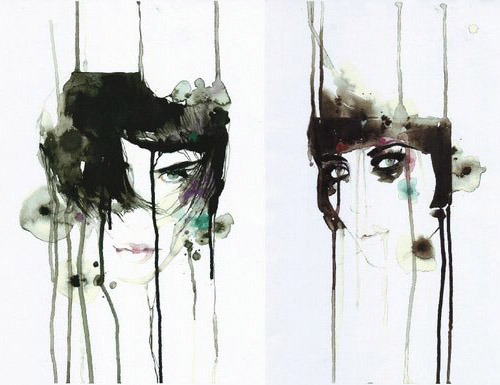 If a picture is worth a thousand words, illustrations are easily nine thousand.
http://www.hongkiat.com/blog/showcase-of-beautiful-fashion-illustrations/
via MetaFilter
September 27, 2011
Finally a New Podcast of If You're Just Joining Us
Jon Armstrong and Chris Moriarty Talk About Magic In Their Magic and Their Writing on If You're Just Joining Us
I didn't mean to take a vacation for more than two weeks, but once I was out of the rhythm of making show, it was much harder to get it back.
Today I recorded with David Anthony Durham for the next!
Changing Race by Changing Clothes? Stereotypes and Status Symbols Impact If a Face Is Viewed as Black or White
An interdisciplinary team of researchers from Tufts University, Stanford University and the University of California, Irvine has found that the perception of race can be altered by cues to social status as simple as the clothes a person wears.
From ScienceDaily
September 23, 2011
Why An Exciting Book Is Just As Thrilling As A Hair-Raising Movie
ScienceDaily (Aug. 18, 2008) — Watching Keanu Reeves walk along the ledge of a skyscraper and lose his footing in The Matrix can make us skip a heartbeat or sweat, as if we were risking our own life. This sharing of other people's emotions in movies has been shown to depend on the fact that observers the same brain regions are activated in the observers when they feel an emotion and when they see someone else experience a similar emotion.
We all know, however, that reading a book describing the same scene can be similarly gripping. This week, in a paper published in the online, open-access journal PLoS ONE, Mbemba Jabbi, Jojanneke Bastiaansen and Christian Keysers show us why.
http://www.sciencedaily.com/releases/2008/08/080812213812.htm
September 22, 2011
Another Mention of Yarn!
I am seriously loving the futuristic world it paints of high fashion techno-cities.


