
Eva Golinger's Blog
January 21, 2015
Desperate to Save His Legacy, Obama Chooses Cuba

The announcement came as a welcome surprise to millions around the world who have long awaited a major change in US policy towards Cuba. In simultaneous broadcasts, presidents Raul Castro and Barack Obama bridged the painful, unjustified and well-outdated gap that has tormented both nations for over half a century. In a matter of sentences, relief came to the many Cubans, at home and abroad, Latin Americans region-wide, and people across the US and world who cheered at the declared thaw in US-Cuba relations. After more than 50 years, the heads of state of both countries spoke on the telephone and agreed to reestablish diplomatic ties. The US would open its Embassy in Havana, and Cuba would do the same in Washington. It was a major breakthrough, to say the least.
It was Castro who was quick to remind his fellow citizens that, while applauding the decision of the first standing US president to actually improve ties with Cuba, the vicious blockade imposed against his nation by Washington still remains. Obama was also cautious to mention that though there were concrete actions he could take towards normalizing relations with Cuba, it was the US Congress that had the authority to end the blockade, and not him. He did urge Congress to take those steps, while lashing out a few patronizing admonitions at Castro regarding democracy and human rights.
Without a doubt, one of the most important victories of the deal was the release of the three remaining Cuban citizens, Gerardo Hernández, Ramón Labañino and Antonio Guerrero, unjustly held in US prisons for 16 years on charges of espionage and other crimes. Even the United Nations Commission on Human Rights had condemned their trial as arbitrary and unfair, their due process and fundamental rights severely violated. These men were finally able to return home to a hero’s welcome, after an agreement was brokered between the two governments that also saw the return of a USAID subcontractor convicted on charges of subversion in Cuba, Alan Gross, and a Cuban citizen and former intelligence officer, Rolando Sarraff Trujillo, jailed for working as a double agent for the US Central Intelligence Agency.
There is no question that this event marks a profound change in US-Cuba relations and US relations with Latin America. And it is a major victory for the Cuban Revolution, Fidel and Raul Castro and the Cuban people. Over the past fifteen years, Washington has lost its influence in Latin America and the region has shifted significantly towards the left with socialist presidents in a majority of countries and new regional organizations that exclude the United States and Canada. With the Union of South American Nations (UNASUR), the Bolivarian Alliance of the Peoples of Our America (ALBA) and the Community of Latin American and Caribbean States (CELAC), Latin America has become more integrated, sovereign, independent and powerful than ever before. The region has forged relations with China, Russia, Iran and other sovereign states with strong markets and technological know-how. Development has excelled and with few exceptions, Latin American economies are on the rise. All this has been achieved without the United States.
In response, Washington amped up its interference in the region, supporting coups and attempted coups against democratically-elected presidents in Venezuela, Haiti, Bolivia, Honduras, Ecuador and Paraguay, increasing its military presence in the hemisphere and intensifying subversive efforts to undermine Latin American governments through multimillion-dollar funding of opposition movements. Those actions isolated Washington even more in the region and were rejected unanimously by all Latin American governments, even those on the right. A growing sentiment of “Patria Grande” (The Great Homeland) has taken root in the region and only appears to get stronger every year.
When Obama was elected president and first attended a Summit of the Americas regional gathering in Trinidad in 2009, he promised a new relationship with Latin America, based on regaining US influence in the region. He either ignored or ignorantly misunderstood the changes that had taken place throughout Latin America and had the gall to stand before 33 heads of state and high-level representatives of regional governments and tell them to “forget the past” and move forward together with the United States towards new relations. His arrogant rhetoric reminded the people of Latin America the importance of consolidating and advancing their sovereignty and integration on their own terms. At that summit, a majority of nations, with the exception of the US and Canada, condemned the fact that Cuba continued to be excluded from the Organization of American States solely because of Washington’s influence. In 2012, at the next Summit of the Americas, President Rafael Correa of Ecuador refused to attend in a sign of solidarity with Cuba. “Ecuador won’t be a part of these summits until Cuba is included”, he made clear.
A few months ago, well before Obama and Castro announced efforts to normalize relations, the government of Panama had made public that Cuba would be invited to the 2015 Summit of the Americas, which it will host. Cuba has indicated it would attend. This decision was clearly a sign that Washington’s influence no longer reigned in Latin America – even the regional organization created by Washington to dominate and control the region was now rendered irrelevant.
Nevertheless, Obama’s move on Cuba was not without immediate consequence. While there is no question that the decision to reestablish diplomatic relations, along with the release of the remaining three of the five unjustly detained Cubans, is an enormous, historical victory for the Cuban Revolution, and a tribute to the resistance, dignity and solidarity of the Cuban people, Obama’s motives are not pure.The day after a well-crafted presidential speech on how US policy has failed in Cuba, which acknowledged the blockade and economic embargo of Cuba had been a fiasco, Obama signed bills imposing sanctions on both Venezuela and Russia. There is little doubt that the sanctions bill against Venezuela, an absurd law titled the Venezuela Defense of Human Rights and Civil Society Act of 2014, was signed by Obama to appease the small, but influential group of rabidly anti-Castro, anti-Chavez and anti-Maduro politicians and constituents in Miami who were steaming with rage from the shift on Cuba.
The Venezuelan sanctions bill is rather ludicrous. It purports to punish officials in Venezuela who allegedly violated the human rights of anti-government protestors in demonstrations that took place in February 2014. Considering that the majority of those protests were extremely violent and protestors directly caused the deaths of over 40 individuals, most of whom were government supporters, bystanders and state security forces, imposing sanctions on state officials who exercised their duty to protect civilians is illogical. Even more ironic is the passage of this bill while hundreds of protestors against police brutality and racism are being detained and having their rights violated in the United States, at the hands of US authorities. Not to mention that the same Senate that promoted this bill just released an in depth report on torture and grave human rights violations committed by CIA and US military officers.
The sanctions bill against Venezuela goes beyond freezing the assets of a few Venezuelan government officials and revoking their visas. It reaffirms the US government commitment to supporting – financially and politically – the anti-government movement in Venezuela which acts beyond a democratic framework, and it authorizes the preparation of a full-on propaganda war against the Venezuelan government. All of this is reminiscent of the very same failed policy on Cuba that Obama just renounced. So why impose the same on Venezuela?
Appeasing the community in Miami is a major reason. But Obama also needs the change in Cuba policy to save his withering legacy. As the first black president in the United States, Obama expected his legacy to be the end of racial tensions and institutionalized racism in the country. However, the opposite has occurred during his administration. Racial tensions are at an all-time high. Mass protests have erupted nationwide against police brutality in black communities and the injustice blacks face in the US legal system. Racial crimes have increased and people are angry. The “change” Obama promised hasn’t come and he won’t be forgiven for his failure to deliver.
Obama’s healthcare reform has made a mediocre impact and still faces serious threats from a Republican Congress, which has returned to power in full force, winning majorities in both houses thanks to a disgruntled democratic base. While making some executive decisions on immigration, Obama has failed to pass sweeping immigration reform and probably never will after losing democrat seats in the legislature. Though he did withdraw US troops from Iraq as promised, another terrorist group took over significant parts of that country, rendering US operations and billion-dollar investment in bringing democracy to Iraq practically useless. As for Afghanistan, Obama increased US military presence and brought the total war budget well over one billion dollars, making it the longest US military conflict and one of the most costly. He’s brought more war to Pakistan, Yemen and Africa, and destroyed Libya, while later funding and arming warlords and terrorists in Syria to demolish that country too. And to top it all off, Obama has rekindled the Cold War with Russia.
Overall, Obama’s legacy leaves nothing to be desired. He’s failed at home and brought havoc abroad, and Cuba is his savior. Now Obama will be remembered in history as the president who ended the most dysfunctional, damaging and pointless US foreign policy ever. He’ll be recalled for bridging ties not just with Cuba, but with all of Latin America, which would be very noble and legacy-worthy if it were true.
Cuba hasn’t been a real threat to the United States – if it ever was – for a very long time. But Venezuela, because of its vast oil reserves, is. The US needs to control Venezuela’s 300 billion barrels of oil in order to guarantee its long-term survival, and without a subservient government in power, that’s not possible. US policy on Venezuela has been the same since Hugo Chavez was first elected in 1998 and refused to bow to US interests: destroy the Bolivarian Revolution and remove him from power. The same policy is in effect against the government of Nicolas Maduro.
By attempting to isolate both Venezuela and Russia with sanctions and cripple their economies, Washington believes it will succeed in stifling Russia’s expanding relations with Latin America and neutralize Venezuela’s regional influence. The plan is to step in and fill the void with US financial and political clout. And Washington thinks that by reaching out to Cuba, the rest of Latin America will be seduced enough to welcome back US domination.
Cuba may be Obama’s lifejacket, but the ship has sailed. Latin American nations have overwhelmingly condemned US sanctions on Venezuela and called for them to be rolled back. Obama may think he can sacrifice Venezuela in order to save his legacy by engaging with Cuba and closing ranks in the hemisphere, but he’s wrong. The same solidarity that Latin American nations expressed to Cuba for over 50 years is also present for Venezuela. La Patria Grande won’t be fooled by US double standards anymore. Latin America has long expressed its desire for a mature, respectful relationship with Washington. Will the US ever be capable of the same?


August 23, 2014
A Defiant Ecuador Seeks Solutions in Assange Case
By Eva GolingerAugust 2014Telesur English
Two years ago, one of the most controversial figures of the age of cyberspace appeared on the doorstep of the Ecuadorian Embassy in London. On the verge of losing an appeal in the British courts that could open the door to his extradition to Sweden and then later, the United States, where a secret Grand Jury had convened to indict him, Julian Assange sought refuge in Ecuador’s modest Embassy flat. During the following two months, the Ecuadorian government studiously reviewed his case, calling in experts to discuss and debate the duties and risks Ecuador faced in granting the asylum petition.
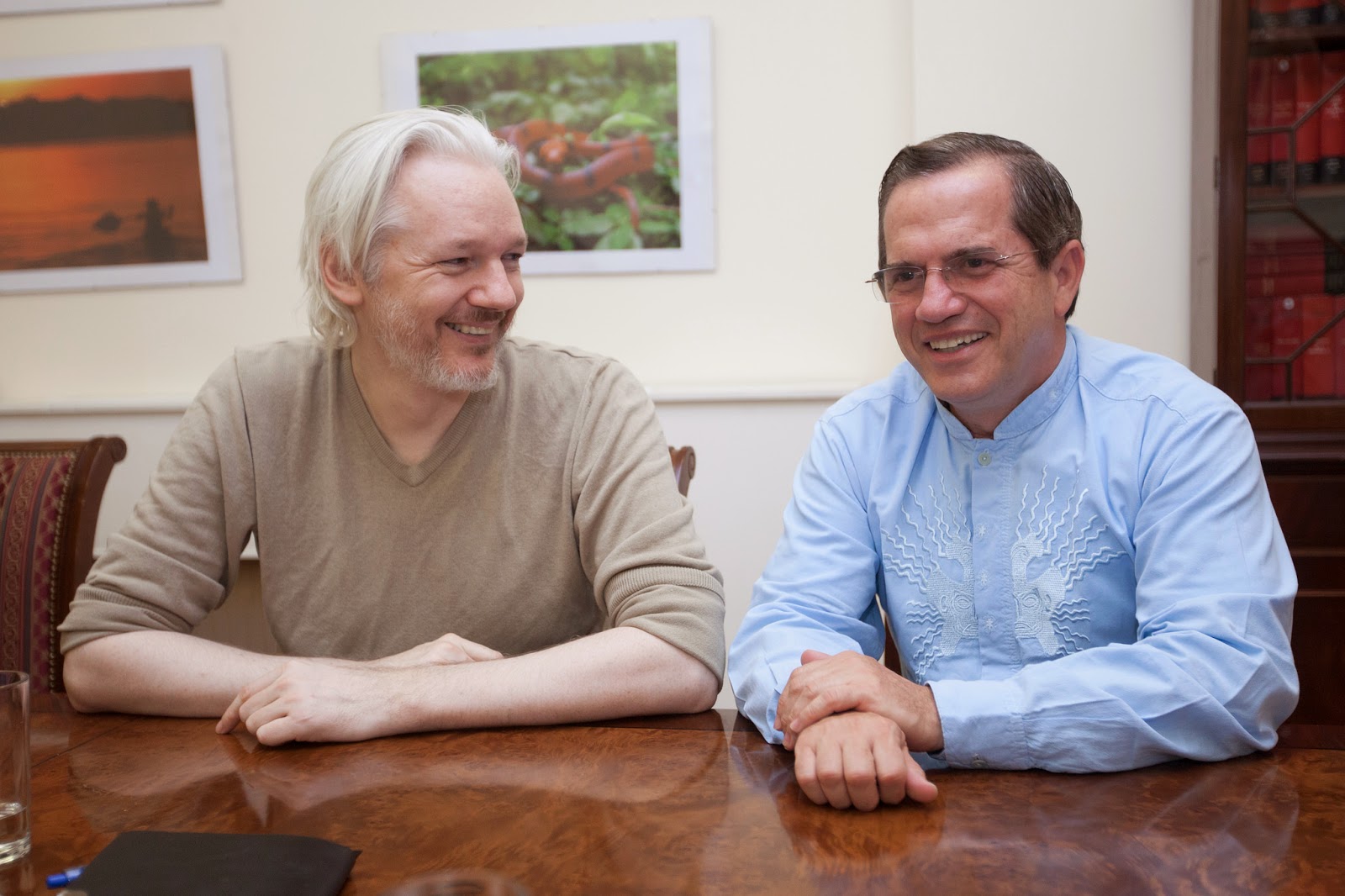
On August 16, 2012, Ecuador’s Foreign Minister, Ricardo Patiño, announced that his country would grant Assange diplomatic asylum, a concept enshrined in the Convention on Diplomatic Asylum of 1954, also known as the Convention of Caracas. The British government refused to recognize this status and initially threatened to violate Ecuador’s sovereignty by entering into the Embassy and arresting Assange. After strong protest from the Ecuadorian government and outcry from Latin American nations, England refrained from causing an international uproar by forcing entry into the Embassy, and instead chose to maintain a prominent police presence surrounding the building, impeding Assange’s escape.
Two years later, the Assange case is at a standstill. Despite his legal team’s efforts to end the unsubstantiated persecution against him from Sweden, where no formal charges have materialized, an extradition request still remains to bring him to Stockholm for “questioning”. The British government has made clear it would extradite Assange to Sweden if they could detain him. While no public extradition request has been issued from the United States to Sweden for Assange, sufficient evidence exists to demonstrate that a Grand Jury may have already indicted him in a US court, on charges, including espionage and/or aiding and abetting the enemy, that could result in his long-term imprisonment were he subjected to a trial. This well-founded fear of political persecution has reinforced Ecuador’s decision to maintain his political asylum.
In 2013, when Foreign Minister Patiño visited Assange in the Embassy on the one-year anniversary of his confinement, Ecuador initiated an effort to create a bilateral working group with the British government to find a solution to the situation. To date, no movement has been made in the group and England has refused to discuss the matter further. Recently, during Foreign Minister Patiño’s second visit to see Assange on August 16, 2014, the British Foreign Office issued a statement claiming they were “committed to finding solution”, yet only according to their vision of the outcome: "We remain as committed as ever to reaching a diplomatic solution to this situation. We are clear that our laws must be followed and Mr Assange should be extradited to Sweden. As ever we look to Ecuador to help bring this difficult, and costly, residence to an end." In other words, the British government sees no other solution than Assange’s extradition. Their unwavering, rigid position leaves no opportunity for diplomacy or creative problem-solving, which is what this case needs.
The Ecuadorian government has reiterated its support for Assange and has made clear that their country is bound by international law to maintain his asylum. As Minister Patiño has affirmed, there is no return policy on asylees who are still subjected to exactly the same conditions as when the asylum was granted. The persecution remains, and there are still no charges of any kind against Assange. Ecuador, a small nation of 15 million inhabitants with bananas and beautiful roses as its main exports, has remained defiant in the face of pressure from England, Sweden and their biggest ally, the United States.
Two years enclosed in the Ecuadorian Embassy, a narrow flat with just a handful of rooms, has taken its toll on Julian Assange. While he continues to work from his small space inside the Embassy, and his organization Wikileaks has not ceased publishing important documents exposing the abuses and illegal acts of powerful interests, the lack of sunlight, fresh air and regular exercise have obviously decreased his quality of life and impacted his health. Despite his confinement and separation from close friends and family, his spirits remain high, as was apparent during the visit with Minister Patiño, and he is optimistic about changes to a law in the UK that potentially could lead to his freedom.
Known within political circles as the “Assange Act”, an amendment was made in early 2014 to the Extradition Act 2003 in the British parliament. Resulting from discontent and discomfort over the legal limbo Julian has been in for the past four years – even two years before receiving asylum from Ecuador, Assange had been on house arrest in England, pending potential extradition to Sweden - several British MPs began debating a substantive change to the law that would impede a future Assange situation from happening to someone else.
The amendment is included in the Anti-social Behaviour, Crime and Policing Act 2014 (not the most socially-friendly name), in Chapter 12, Part 12. It specifically states that “Extradition is barred if no prosecution decision has been made in the requesting territory”, as in Assange’s situation. If the country requesting extradition has not yet charged or decided to try the individual being requested, than the United Kingdom will not extradite. This is exactly the case of Julian Assange. The Swedish prosecution has not decided to try him yet or even formally charge him, and the extradition request is merely based on the desire to “question” him about certain allegations he may or may not be involved in.
In the parliamentary debates in the House of Commons leading up to the passage of the extradition act amendment, specific references to Assange’s case were made. According to the parliamentarians, the new clause, amending the extradition act of 2003, “seeks to ensure that people are not extradited when it is not certain they will be charged, so that they do not sit in a prison for months on end”. Reference was also made to the case of a British citizen, Andrew Symeou, who was extradited to Greece for questioning and remained in inhumane prison conditions for over ten months with no charges against him. In Julian Assange’s case, the debate concluded, “where a decision to charge and try is not taken, extradition cannot take place. People will not be left in limbo...”
Julian’s legal team will need to challenge this law in order for it to be applied to his case, since at present it does not appear to be retroactive. But there is no denying that this change in the law would impede Assange from being extradited to Sweden were it to have been in place previously. Ecuador’s Foreign Minister made reference to the amended law as a potential opening for dialogue with the UK government in the case. Ecuador has also offered to allow Swedish authorities question Assange inside the Embassy, or via videoconference, all to no avail. It seems as though the only parties interested in finding a solution to this situation are the government of Ecuador and Julian Assange. The Brits and the Swedes have done everything possible to stall and stonewall the case.
Foreign Minister Patiño has stated previously that Ecuador could bring the case before the International Court of Justice in the Hague, or the United Nations. The affronts to Ecuador’s sovereignty, the failure to recognize the asylum granted to Julian Assange and the refusal to provide him with safe passage to Ecuadorian territory are all violations of international law. Julian’s human rights are also affected. The inability to fully enjoy his right to asylum and the confining conditions he has been forced to remain in for two years, under threat by arrest by British authorities right outside the Embassy doors and windows, have subjected him to cruel and inhumane punishment. Were he to experience a medical emergency and need hospital attention, the British government has already made clear it would arrest him.
Both Julian Assange and Ecuador have taken on the most powerful world interests, despite the dangers, threats and consequences of their actions. Foreign Minister Ricardo Patiño and President Rafael Correa have made clear that Ecuador will stand strong in its decision to grant Assange asylum under international law, and they will not bow to pressure and intimidation from anyone. The Assange case goes beyond just simple political asylum and issues of sovereignty. It is matter of principle in a time in which information and secrecy have become ever more the tools of the most powerful. Justice must be done for those who have sacrified their liberties to warn us of these dangers.
April 23, 2014
The Dirty Hand of the National Endowment for Democracy (NED) in Venezuela
By Eva Golinger
(aquí en español)
Anti-government protests in Venezuela that seek regime change have been led by several individuals and organizations with close ties to the US government. Leopoldo Lopez and Maria Corina Machado- two of the public leaders behind the violent protests that started in February – have long histories as collaborators, grantees and agents of Washington. The National Endowment for Democracy “NED” and the US Agency for International Development (USAID) have channeled multi-million dollar funding to Lopez’s political parties Primero Justicia and Voluntad Popular, and Machado’s NGO Sumate and her electoral campaigns.
These Washington agencies have also filtered more than $14 million to opposition groups in Venezuela between 2013 and 2014, including funding for their political campaigns in 2013 and for the current anti-government protests in 2014. This continues the pattern of financing from the US government to anti-Chavez groups in Venezuela since 2001, when millions of dollars were given to organizations from so-called “civil society” to execute a coup d’etat against President Chavez in April 2002. After their failure days later, USAID opened an Office of Transition Initiatives (OTI) in Caracas to, together with the NED, inject more than $100 million in efforts to undermine the Chavez government and reinforce the opposition during the following 8 years.
At the beginning of 2011, after being publically exposed for its grave violations of Venezuelan law and sovereignty, the OTI closed its doors inVenezuela and USAID operations were transferred to its offices in the US. The flow of money to anti-government groups didn’t stop, despite the enactment by Venezuela’s National Assembly of the Law of Political Sovereignty and NationalSelf-Determination at the end of 2010, which outright prohibits foreign funding of political groups in the country. US agencies and the Venezuelan groups that receive their money continue to violate the law with impunity. In the Obama Administration’s Foreign Operations Budgets, between $5-6 million have been included to fund opposition groups in Venezuela through USAID since 2012.
The NED, a “foundation” created by Congress in 1983 to essentially do the CIA’s work overtly, has been one of the principal financiers of destabilization in Venezuela throughout the Chavez administration and now against President Maduro. According to NED’s 2013 annual report, the agency channeled more than $2.3 million to Venezuelan opposition groups and projects. Within that figure, $1,787,300 went directly to anti-government groups within Venezuela, while another $590,000 was distributed to regional organizations that work with and fund the Venezuelan opposition. More than $300,000 was directed towards efforts to develop a new generation of youth leaders to oppose Maduro’s government politically.
One of the groups funded by NED to specifically work with youth is FORMA (http://www.forma.org.ve), an organization led by Cesar Briceño and tied to Venezuelan banker Oscar Garcia Mendoza. Garcia Mendoza runs the Banco Venezolano de Credito, a Venezuelan bank that has served as the filter for the flow of dollars from NED and USAID to opposition groups in Venezuela, including Sumate, CEDICE, Sin Mordaza, Observatorio Venezolano de Prisiones and FORMA, amongst others.
Another significant part of NED funds in Venezuela from 2013-2014 was given to groups and initiatives that work in media and run the campaign to discredit the government of President Maduro. Some of the more active media organizations outwardly opposed to Maduro and receiving NED funds include Espacio Publico, Instituto Prensa y Sociedad (IPYS), Sin Mordaza and GALI. Throughout the past year, an unprecedented media war has been waged against the Venezuelan government and President Maduro directly, which has intensified during the past few months of protests.
In direct violation of Venezuelan law, NED also funded the opposition coalition, the Democratic Unity Table (MUD), via the US International Republican Institute (IRI), with $100,000 to “share lessons learned with [anti-government groups] in Nicaragua, Argentina and Bolivia...and allow for the adaption of the Venezuelan experience in these countries”. Regarding this initiative, the NED 2013 annual report specifically states its aim: “To develop the ability of political and civil society actors from Nicaragua, Argentina and Bolivia to work on national, issue-based agendas for their respective countries using lessons learned and best practices from successful Venezuelan counterparts. The Institute will facilitate an exchange of experiences between the Venezuelan Democratic Unity Roundtable and counterparts in Bolivia, Nicaragua and Argentina. IRI will bring these actors together through a series of tailored activities that will allow for the adaptation of the Venezuelan experience in these countries.”
IRI has helped to build right-wing opposition parties Primero Justicia and Voluntad Popular, and has worked with the anti-government coaltion in Venezuela since before the 2002 coup d’etat against Chavez. In fact, IRI’s president at that time, George Folsom, outwardly applauded the coup and celebrated IRI’s role in a pressrelease claiming, “The Institute has served as a bridge between the nation’s political parties and all civil society groups to help Venezuelans forge a new democratic future…”
Detailed in a report published by the Spanish institute FRIDE in 2010, international agencies that fund the Venezuelan opposition violate currency control laws in order to get their dollars to the recipients. Also confirmed in the FRIDE report was the fact that the majority of international agencies, with the exception of the European Commission, are bringing in foreign money and changing it on the black market, in clear violation of Venezuelan law. In some cases, as the FRIDE analysis reports, the agencies open bank accounts abroad for the Venezuelan groups or they bring them the money in hard cash. The US Embassy in Caracas could also use the diplomatic pouch to bring large quantities of unaccounted dollars and euros into the country that are later handed over illegally to anti-government groups in Venezuela.
What is clear is that the US government continues to feed efforts to destabilize Venezuela in clear violation of law. Stronger legal measures and enforcement may be necessary to ensure the sovereignty and defense of Venezuela’s democracy.
March 6, 2014
A TRIBUTE --- CHAVEZ: A Giant Under the Moon

(Aquí en español)
By Eva Golinger
A year has passed since the physical parting of Hugo Chavez and it’s still impossible to accept. His voice was a constant in revolutionary Venezuela, his discourse was a school in continuous development. A humble man with a noble soul, Chavez had the courage of warriors and a heart filled with patriotism. He defied the most powerful interests without ever flinching. His hand never trembled, he never bowed down, he was always firm with serenity and conviction, ready to confront the most powerful threats. His value was immense, a soldier of the people, a giant of centuries. Knowing him was a privilege and a priceless treasure.
Chavez had an impact on the world, leaving his fingerprint in struggles and dreams of social justice, from north to south. His legacy is transcontinental, without borders. “Chavez” translates to a symbol of dignity in all languages.
I had the honor of accompanying him on several of his international trips. I witnessed the massive support he received on almost every continent. His mere presence inspired millions. He represented the dreams of so many struggles, so many commitments to humanity, and he proved that another world is possible.
All around the world people ran to see him up close, anxious to hear his words full of hope, simple yet full of profound intimacy. Chavez breathed love, and although millions received him with open arms, there were always dangerous threats around him. He was unpredictable, always a step ahead. Washington called him a “wise competitor”, and coming from the US government that wasn’t only a compliment, but evidenced his grandeur. Not even the empire could control him.
In May 2006 I was on a book tour in Europe with the publication of the German and Italian editions of my first book, The Chavez Code. While finishing up my events in Germany, I had the luck of coinciding with President Chavez’s visit to Vienna, Austria for the Latin America-European Union summit.
I arrived at the hotel where the presidential delegation was staying and after greeting familiar faces in the lobby, I went to my room to rest. An hour later, I went downstairs to see what was going on and to find out the president’s schedule. When I entered the lobby, the friendly presidential protocol officer informed me we would be leaving in a few moments. He asked me to join them in the caravan. I hadn’t yet seen the president but I assumed we were heading out before him to an event, so I got in the car with the delegation.
They took us to a place in the center of Vienna. When we arrived, we saw an enormous amount of people, mainly young, who were both outside and inside the venue. “What is this place?”, I asked. “It’s a popular cultural center here called Arena”, I was told.
We got out of the car and saw thousands of people around the place. There was an event that evening with none other than President Hugo Chavez, leader of the Bolivarian Revolution. A while later, when we had entered the venue to see the impressive amount of people there, I was approached and told that I would be speaking at the event that night, there in front of the European crowd. “What an honor”, I thought, to participate in a public event in Vienna alongside Chavez.
The evening air was brisk and so many people kept arriving that they didn’t fit in the venue. The organizers decided they had to change the event from inside, where only 500 people fit, to right outside in a public square, where thousands could arrive. Never before had there been a phenomenon like this in Vienna. Thousands of European youth had gathered outdoors in a Viennese square to listen to a Latin American head of state. The quantity of people present was spectacular. Chavez wasn’t just a Latin American leader, he was an international sensation.
Time went by and the President didn’t arrive. People were getting anxious waiting for so long – punctuality in Austria was strict and they weren’t used to waiting. A while later, the presidential protocol folks asked me to go on stage with the rest of the delegation. We had to do something, they said, the people were waiting for too long to just leave them in limbo. I went to talk to the other members of the delegation, which included Nicolas Maduro, then President of the National Assembly, legislator Juan Barreto and Planning and Development Minister Jorge Giordani. “They president is not coming”, they told me. “So what are we going to do now?”, I asked. “We can’t just go out there when they are expecting Chavez”.
Two hours had passed from the start time of the event and the public was restless. We went to talk to the organizers, a group of friendly European activists. We told them about the possibility that Chavez wouldn’t come. He was tired and already resting in the hotel, preparing for the heads of state summit the following day.
The news hit them like a rock. It wasn’t possible, they said. Never before in history had so many people come out to a public place to hear a head of state from anywhere. We had to understand the historic importance of the moment.
We understood clearly that under no circumstances could we replace President Chavez before that crowd. It was Chavez or nothing, or better yet, it had to be Chavez, period. We took footage of the venue and thousands present, and we sent it with the Presidential Guard and the President’s assistants, asking them to please convey the importance of the event to him so he would come.
Two hours went by and it was now nighttime, but no one had left. People actually kept arriving. They stayed alert singing “Uh Ah, Chávez no se va” in Spanish and in German, “Chávez geht nicht”.
After four hours under the beautiful full moon of Vienna, anxious for the arrival of the Comandante of the XXI century, there was movement. Chavez had seen the images and he understood the magnitud of the moment and the importance of speaking before European youth. Despite his fatigue and lack of sleep, he appeared, radiant, smiling as he looked upon the young crowd.
The arrival of the President was met with an impressive applause from the public around 10pm. The brilliant light of the moon reflected on the awe and intensity of the faces in the crowd. Everyone was completely attentive, listening hard to the Venezuelan leader. And President Chavez was inspired by the attention and dedication of the Viennese youth, and there outside “Arena”, he launched into a master class about building an international revolutionary movement. He talked about “The Triangle of Victory”, comprised of three principle factors: political objectives, strategy and power framed within conscientiousness, commitment and organization. Everyone stayed during the two hours that Chavez spoke, listening carefully to every detail about the international revolutionary project, showing their support and approval in applause, chants and smiles. “They accuse us of wanting to build an atomic bomb”, exclaimed Chavez. “But we aren’t interested in having atomic bombs. The empire can have all the atomic bombs. We don’t need an arsenal of bombs to save the world. We are the atomic bombs! And above all, youth of the world, you are the atomic bombs...bombs of love, passion, ideas, strength, organization”.
Sixty-four European media outlets covered that historic event in Vienna. “The Che Guevara of the XXI century”, they called him, fascinated with what had happened that night under the full moon. Never before had a head of state gone out to the streets to speak with the people. Never before had so many people spontaneously gathered outdoors in Vienna to hear a head of state speak, let alone one from Latin America. Chavez brought the love and sincerity of the Venezuelan people to Austria, and the people of Vienna received him with open arms.
“You are going to save the world”, he affirmed. “Know that you are not alone here. Know that youth all around the world, who speak different languages, who are bathed in other colors, have the same calling as you...In Latin America, in Africa, in Asia...Youth of the world awaken, workers of the world rise up, women rise up, students rise up. Let’s go together on the path of revolution!”
When he ended his speech, Chavez looked at the glorious full moon that had illuminated the event. “Ah...”, he said. “That full moon, so beautiful, makes me want to grab a guitar and go with you all to the Danub river to sing until dawn”. The glimmer in his eyes gave away his sincerity. It was a special moment, those that occur only once in a lifetime. It seemed like an intimate gathering amongst friends, although most of us didn’t know each other. But, we shared a love for justice and a dream for a better world. Chavez was just another brother in the fight for that dream.
Years later, Chavez’s international influence turned him into the number one enemy of Washington. Someone of his humility, sincerity, courage and conviction was not common, especially as the president of the country with the largest oil reserves on the planet. The threats against Chavez were constant, attempts against his life never ceased. There was a systematic aggression against his government from the most powerful interests in the world, together with their agents in Venezuela. They gave their all against Chavez. A leader of his stature, influence, strength and dignity, with an immense capacity for love, was dangerous for the imperial agenda. They did what they could to neutralize him.
We may never know if his death was provoked or not, although enough evidence exists to investigate. What we do know is that his mortal departure was not a goodbye. Men like Chavez don’t disappear, though some wish they would. Chavez’s legacy lives today and grows beyond the Bolivarian Revolution. His voice is present in every cry for freedom, his gaze is seen in brave young people who defy powerful and dangerous interests to expose truths. His love is present in the solidarity and heartfelt commitment that millions feel for revolutionary Venezuela. His strength and dignity guide the defense of the Patria Grande, today under threat again from those who seek to erase us from history.
Chavez will never disappear. His presence will continue to grow and multiply in every soldier of peace, every warrior for justice. Smiling, with a heart of gold, Chavez will always be a giant under the moon.
February 20, 2014
Venezuela Beyond the Protests: The Revolution is Here to Stay
By Eva GolingerFebruary 20, 2014
For those of you unfamiliar with Venezuelan issues, don’t let the title of this article fool you. The revolution referred to is not what most media outlets are showing taking place today in Caracas, with protestors calling for the ouster of Venezuelan President Nicolas Maduro. The revolution that is here to stay is the Bolivarian Revolution, which began in 1998 when Hugo Chavez was first elected president and has subsequently transformed the mega oil producing nation into a socially-focused, progressive country with a grassroots government. Demonstrations taking place over the past few days in Venezuela are attempts to undermine and destroy that transformation in order to return power to the hands of the elite who ruled the nation previously for over 40 years.
Those protesting do not represent Venezuela’s vast working class majority that struggled to overcome the oppressive exclusion they were subjected to during administrations before Chavez. The youth taking to the streets today in Caracas and other cities throughout the country, hiding their faces behind masks and balaclavas, destroying public buildings, vehicles, burning garbage, violently blocking transit and throwing rocks and molotov cocktails at security forces are being driven by extremist right-wing interests from Venezuela’s wealthiest sector. Led by hardline neoconservatives, Leopoldo Lopez, Henrique Capriles and Maria Corina Machado – who come from three of the wealthiest families in Venezuela, the 1% of the 1% - the protesters seek not to revindicate their basic fundamental rights, or gain access to free healthcare or education, all of which are guaranteed by the state, thanks to Chavez, but rather are attempting to spiral the country into a state of ungovernability that would justify an international intervention leading to regime change.
Before Chavez was elected in 1998, Venezuela was in a very dark, difficult period with a dangerously eroded democracy. During the early 1990s, poverty swelled at around 80%, the economy was in a sinkhole, the nation’s vast middle class was disappearing with millions falling into economic dispair, constitutional rights were suspended, a national curfew was imposed and corruption was rampant. Those who protested the actions of the government were brutally repressed and often killed. In fact, during the period of so-called “representative democracy” in Venezuela from 1958-1998, before the nation’s transformation into a participatory democracy under Chavez, thousands of Venezuelans were disappeared, tortured, persecuted and assassinated by state security forces. None of their rights were guaranteed and no one, except the majority excluded poor, seemed to care. International Human Rights organizations showed little interest in Venezuela during that time, despite clear and systematic violations taking place against the people.
Those in power during that period, also referred to in Venezuela as the “Fourth Republic”, represented an elite minority – families that held the nation’s wealth and profited heavily from the lucrative oil reserves. Millions of dollars from oil profits belonging to the state (oil was nationalized in Venezuela in 1976) were embezzled out of the country into the bloated bank accounts of wealthy Venezuelans and corrupt public officials who had homes in Miami, New York and the Dominican Republic and lived the high life off the backs of an impoverished majority.
Hugo Chavez’s electoral victory in 1998 shattered the opulent banquet the Venezuelan elite had enjoyed for decades, while they ran the country into the ground. He was elected precisely to break the hold on power those groups had harnessed for so many years, and Chavez’s promise was revolution – complete transformation of the economic, social and political system in the country. His electoral victories were solid, year after year, each time rising in popularity as more and more Venezuelans became motivated to participate in their governance and the construction of a new, inclusive, nation with social justice as its banner.
Chavez’s election was a huge blow to Washington and the powerful interests in the United States that wanted control over Venezuela’s oil reserves – the largest on the planet. In April 2002, the Bush administration backed a coup d’etat to overthrow Chavez, led by the very same elite that had been in power before. The coup involved mass marches in the streets of Caracas, composed of the wealthy and middle classes, calling for Chavez’s ouster. Snipers were used to shoot on those in the marches, creating violence and chaos that was immediately blamed on Chavez. Television, radio and newspapers in Venezuela all joined in the coup efforts, manipulating images and distorting facts to justify Chavez’s overthrow. He became the villian, the evil dictator, the brutal murderer in the eyes of international media, though in reality those overthrowing him and their backers in Washington were responsible for the death and destruction caused. After Chavez was kidnapped on April 11, 2002 and set to be assassinated, the wealthy businessmen behind the coup took power and imposed a dictatorship. All democratic institutions were dissolved, including the legistature and the supreme court.
The majority who had voted for Chavez and had finally become protagonists in their own governance were determined to defend their democracy and took to the streets demanding return of their president. Forty-eight hours later, Chavez was rescued by millions of supporters and loyal armed forces. The coup was defeated and the revolution survived, but the threats continued.
A subsequent economic sabotage attemped to bring down the oil industry. 18,000 high level technical and managerial workers at the state-owned company, PDVSA, walked off the job, sabotaging equipment and causing nearly $20 billion in damages to the Venezuelan economy. After 64 days of strikes, barren supermarket shelves due to intentional hoarding to create panic, and a brutal media war in which every private station broadcast opposition propaganda 24/7, Venezuelans were fed up with the opposition. Chavez’s popularity soared. A year and a half later, when the opposition tried to oust him through a recall referendum, he won a 60-40 landslide victory.
Leading efforts to overthrow Chavez were the very same three who today call for their supporters to take to the streets to force current President Nicolas Maduro from power. Leopoldo Lopez and Henrique Capriles were both mayors of two of Caracas’ wealthiest municipalities during the 2002 coup – Chacao and Baruta, while Maria Corina Machado was a close ally of Pedro Carmona, the wealthy businessman who proclaimed himself dictator during Chavez’s brief ouster. Lopez and Machado signed the infamous “Carmona Decree” dissolving Venezuela’s democratic institutions, trashing the constitution. Both Capriles and Lopez were also responsible for persecuting and violently detaining members of Chavez’s government during the coup, including allowing some of them to be publicly beaten, such as Ramon Rodriguez Chacin, former Minister of Interior in 2002.
All three have been major recipients of US funding and political support for their endeavors to overthrow Chavez, and now Maduro. The US National Endowment for Democracy (NED) and its offshoots, the International Republican Institute (IRI) and the National Democratic Institute (NDI) provided start-up funds for Machado’s NGO Sumate, and Capriles’ and Lopez’s right-wing party Primero Justicia. When Lopez split from Primero Justicia in 2010 to form his own party, Voluntad Popular, it was bankrolled by US dollars.
Over the ten year period, from 2000-2010, US agencies, including the US Agency for International Development (USAID) and its Office for Transition Initiatives (OTI), set up in Caracas in 2002, channeled more than $100 million dollars to opposition groups in Venezuela. The overall objective was regime change.
When Chavez was reelected in 2006 with an even larger margen of victory, nearly 64% of the vote, the US shifted its support from the traditional opposition political parties and NGOs in order to create new ones with youthful, fresh faces. Over one third of US funding, nearly $15 million annually by 2007, was directed towards youth and student groups, including training in the use of social networks to mobilize political activism. Student leaders were sent to the US for workshops and conferences on Internet activism and media networking. They were formed in tactics to promote regime change via street riots and strategic use of media to portray the government as repressive.
In 2007, these student groups, funded and trained by US agencies, took to the streets of Caracas to demand Chavez’s ouster after the government chose not to renew the public concession of RCTV, a popular private television station known for its seedy soap operas. The protests were composed of mainly middle and upper class youth and opposition politicians, defending corporate media and a station also known for its direct involvement in the April 2002 coup. Though their protests failed to achieve their objective, the “students” had earned their credentials as a solid fixture in the opposition. Later that year, their organizing helped to narrowly defeat a constitutional reform package Chavez had proposed in a national referendum.
After President Chavez passed away in March 2013 following a brutal battle with cancer, the opposition saw an opportunity to snatch power back from his supporters. Elections were held on April 14, 2013 in an extremely tense and volatile environment. Nicolas Maduro, Chavez’s chosen successor, ran against Henrique Capriles, who months earlier in October 2012 had lost the presidential election to Chavez by 11 points. This time, however, the results were much narrower with Maduro winning by a slim margen of just under 2 points. Capriles refused to accept the results and called his supporters to take to the streets in protest, to “get all their rage out”. During the two days after the elections, 11 government supporters were killed by Capriles’ followers. It was a bloodbath that received no attention in international media, the victims just weren’t glamorous enough, and were on the wrong side.
As 2013 wore on, the economic crisis in the country intensified and the old strategy of hoarding products to provoke shortages and panic amongst the population was back again. Basic consumer products disappeared from the shelves – toilet paper, cooking oil, powdered milk, corn flour – staples needed for everyday life in Venezuela. Inflation began to rise and speculation, price hikes, were rampant. While some of this was related to government controls on foreign currency exchange to prevent capital flight, a lot had to do with sabotage. A full economic war was underway against Maduro’s government.
Problems persisted throughout the year and discontent grew. But as the electoral period came around again in December, for mayors, the United Socialist Party of Venezuela (PSUV) had sweeping victories. 242 out of 317 mayoralties were won by the PSUV, showing a solid majority of the country still supported the government’s party.
Maduro called opposition governors and newly-elected mayors to a meeting at the presidential palace in late December in an attempt to dialogue and create a space to work together to improve the situation in country. The meeting was generously received by a majority of Venezuelans. Nevertheless, extremists, such as Machado and Lopez, saw the meeting as a threat to their goal of ousting Maduro well before his term ended in 2019. Once again they began to call for street protests and other actions against his government.
In January 2014, as Venezuelans arrived back from their Christmas vacations, economic difficulties continued. Maduro began cracking down on businesses violating newly-enacted laws on price controls and speculation. Towards the end of January, new measures were announced regarding access to foreign exchange that many perceived as a devaluing of the national currency, the bolivar. Sentiment built amongst opposition groups rejecting the new measures and calls for Maduro’s resignation increased. By February, small pockets of protests popped up around the country, mainly confined to middle and upper class neighborhoods.
During the celebration of National Youth Day on February 12, while thousands marched peacefully to commemorate the historic achievements of youth in the nation’s independence, another group sought a different agenda. Opposition youth, “students”, led an agressive march calling for Maduro’s resignation that ended in a violent confrontation with authorities after the protestors destroyed building façades, including the Attorney General’s office, threw objects at police and national guard and used molotov cocktails to burn property and block transit. The clashes caused three deaths and multiple injuries.
The leader of the violent protest, Leopoldo Lopez, went into hiding following the confrontation and a warrant was issued for his arrest due to his role in the deadly events and his public calls to oust the president. Days later, after a lengthy show including videos from a “clandestine” location, Lopez convened another march and used the event to publicly turn himself over to authorities. He was taken into custody and held for questioning, all his rights guaranteed by the state.
Lopez became the rallying point for the violent protests, which have continued to date, causing several additional deaths, dozens of injuries and the destruction of public property. Relatively small, violent groups of protestors have blocked transit in wealthier zones of Caracas, causing traffic delays and terrorizing residents. Several deaths have resulted because protestors refused to let ambulences through to take patients to the emergency room.
Ironically, international media have been portraying these protestors as peaceful victims of state repression. Even celebrities, such as Cher and Paris Hilton have been drawn into a false hysteria, calling for freedom for Venezuelans from a “brutal dictatorship”. The reality is quite different. While there is no doubt that a significant number of protestors in the larger marches that have taken place have demonstrated peacefully their legitimate concerns, the driving force behind those protests is a violent plan to overthrow a democratic government. Lopez, who has publicly stated his pride for his role in the April 2002 coup against Hugo Chavez, continues to call on his supporters to rally against the Venezuelan “dictatorship”.
While dozens of governments and international organizations, including UNASUR and Mercosur have expressed their clear support and solidarity for the Venezuelan government and President Maduro, Washington was quick to back the opposition protestors and demand the government release all those detained during the demonstrations. The Obama administration went so far as to threaten President Maduro with international consequences if Leopoldo Lopez were to be detained. In the aftermath of the first wave of violent protests, Maduro expelled three US diplomats from the US Embassy in Caracas, accusing them of conspiring to recruit students in Venezuela to engage in destabilization.
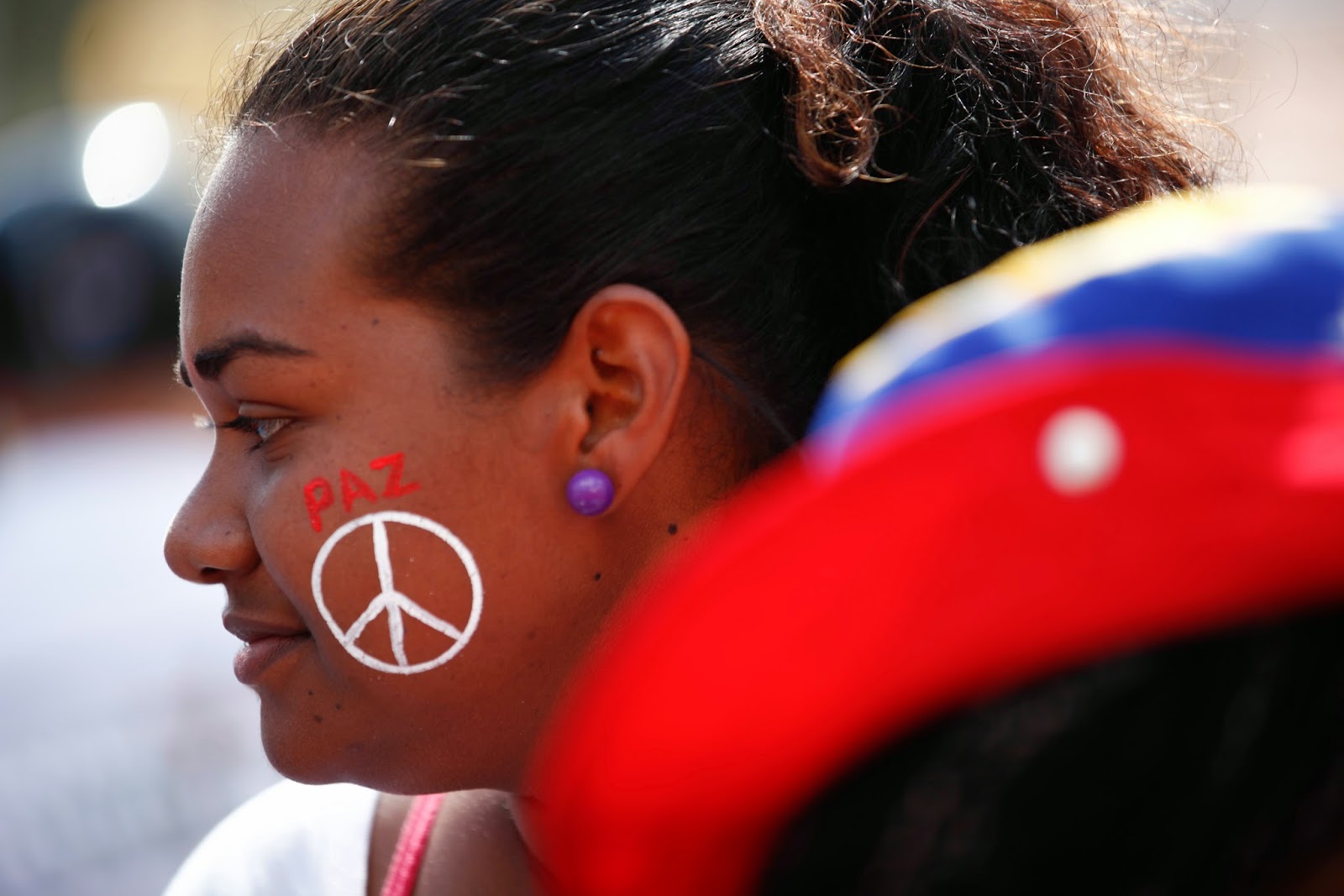
As the violence continues in some areas around the country, Maduro has made widespread calls for peace. A movement for peace was launched last week, led by artists, athletes and cultural figures, together with organized communities seeking to end not just the current chaotic situation, but also the high crime levels that have plagued the country over the past few years.
Most Venezuelans want peace in their country and a majority continue to support the current government. The opposition has failed to present an alternative platform or agenda beyond regime change, and their continued dependence on US funding and support – even this year Obama included $5 million in the 2014 Foreign Operations Budget for opposition groups in Venezuela – is a ongoing sign of their weakness. As a State Department cable from the US Embassy in Caracas, published by Wikileaks, explained in March 2009, “Without our continued assistance, it is possible that the organizations we helped create...could be forced to close...Our funding will provide those organizations a much-needed lifeline”.
During the past decade in Venezuela, poverty has been reduced by over 50%, healthcare has become free and accessible to all, as has quality education from primary through graduate school. State subsidies provide affordable food and housing for those who need it, as well as job training programs and worker placement. Media outlets, especially community media, have expanded nationwide, giving more space for the expression of diverse voices. Internet access has increased significantly and the state also built hundreds of public infocenters with free computer and Internet access throughout the country. Students are given free laptops and tablets to use for their studies. The government has raised minimum wage by 10-20% each year leading Venezuela to have one of the highest minimum wages in Latin America. Pensions are guaranteed after only 25 years of work and those who work in the informal economy are still guaranteed a pension from the state.
While problems persist in the country, as they do every where, most Venezuelans are wary of giving up the immense social and political gains they have made in the past fourteen years. An opposition with nothing to offer except foreign intervention and uncertainty does not appeal to the majority. Unfortunately, media fail to see this reality, or choose not to portray it in order to advance a political agenda. In Venezuela, the revolution is here to stay and the interests of the 1% are not going to overcome those of the 99% already in power.
November 6, 2013
Document Evidences Destabilization Plan Against Venezuela

During the past few months, the Venezuelan government led by President Nicolas Maduro has denounced multiple incidents of sabotage against the country’s electrical infrastructure along with an ongoing campaign to undermine the nation’s economy. A majority of international media, together with private media in Venezuela, have ridiculed the Venezuelan President’s accusations, and have instead attempted to pin responsibility on the government for the instability and harm caused to the country by these actions. Nevertheless, an internal document authored by three organizations from Colombia and the United States, evidences a sinister plan against the Venezuelan state to provoke violence – even death – with the intention of justifying an international intervention in anticipation of municipal elections scheduled for next December 8.
The document, titled “Strategic Venezuelan Plan”, was prepared by the Democratic Internationalism Foundation (http://fidauv.org), headed by ex Colombian president Alvaro Uribe, together with the First Colombia Think Tank (http://www.pensamientocolombia.org) and the US Consulting firm, FTI Consulting (http://www.fticonsulting.com). Dated June 13, 2013, the plan was developed during a meeting between representatives from these three organizations, leaders of the Venezuelan opposicion, including Maria Corina Machado, Julio Borges and Ramon Guillermo Avelado, expert in psychological operations J.J. Rendon and the Director of the US Agency for International Development (USAID) for Latin America, Mark Feierstein.
The strategic plan to destabilize Venezuela has the primary goal of debilitating the government before the December 8 municipal elections, as revealed in the document: “The objectives put forth in the present plan are essentially geared towards the municipal elections set for December 8, while at the same time including the accelerated deterioration of the government, facilitating an opposition victory for this event...” Though the text states further, “...but if it could be done beforehand, that would be even better”.
The document also details the strategy to sabotage the electrical system in Venezuela, with the objective of blaming the government for a weak infrastructure and therefore projecting an image of crisis in Venezuela on an international level. As part of the plan, the authors propose, “To maintain and increase the sabotages that affect public services, particularly the electrical system, that will enable responsibility to be placed on the government for supposed inefficiencies and negligence”. For the past few months, blackouts and other electrical shortages have affected different regions throughout Venezuela, causing general discontent and reflecting negatively on the government. Just weeks ago, Venezuelan authorities detained various individuals involved in sabotaging the electrical system and at the end of September, President Maduro expelled three US diplomats from the US Embassy in Caracas for their alleged role in destabilization plans against the state.
In the section labeled “Actions”, the authors of the document detail their next steps to undermine the Venezuelan government. In addition to “Perfecting the confrontational discourse of Henrique Capriles”, the opposition candidate who lost to Maduro in April’s presidential elections, they also talk of “Generating emotion with short messages that reach the largest quantity of people and emphasize social problems, provoking social discontent. Increase problems with supply of basic consumer products”.
Throughout the year, Venezuela has experienced problems with the supply of basic products, such as toilet paper, sugar, milk, oil, butter, flour and other food staples. Venezuelan authorities have confiscated tons of these products illegally held inside warehouses belonging to opposition businesses. They have also captured large quantities of these items on the border with Colombia, where they are sold as contraband.
According to the document, “The Strategic Venezuelan Plan, agreed upon by representatives from the opposition to the government of Nicolas Maduro, is oriented towards these objectives with the strong and constant support of various world figures who aim to return Venezuela to the true democracy and independence, which has been kidnapped for more than 14 years”.
During the 14 years of President Hugo Chavez’s democratic governance, threats against his administration were abundant and destabilization plans never ceased. After the failure of the 2002 coup d’etat against Chavez, which was defeated by his millions of supporters and was organized by the US government, there were numerous attempts to oust him through economic sabotages, electoral interventions, assassination plots, psychological warfare, multimillion-dollar funding to opposition groups from US agencies and a plan to isolate Venezuela on an international level, that never had success.
One of the most visible faces of attempts to subvert Chavez’s government was ex Colombian president Alvaro Uribe. The former Colombian head of state ended his presidency in 2010 calling for international intervention in Venezuela in order to destroy Chavez and his Bolivarian Revolution. Uribe has dedicated himself since then to difame Chavez and his legacy, as well as strengthen his ties to anti-Chavez groups inside and outside Venezuela.
The death of Preisdent Chavez in March 2013 didn’t stop Uribe from continuing his actions against Venezuela. With the election of Nicolas Maduro to the presidency and the continuation of the socialist process initiated by Chavez, Uribe has mantained his agressive agenda against Venezuela.
Now this internal document, a product of a meeting between the extreme right-wing in Colombia and Venezuela, together with representatives from the US government, proves the active destabilization plans against Maduro.
As part of this dangerous plot against Venezuela, the authors propose to “Create situations of crisis in the streets that will facilitate US intervention, as well as NATO forces, with the support of the Colombian government. Whenever possible, the violence should result in deaths or injuries”.
Venezuelans, representatives of the opposition, are working together with foreign interests to generate deaths of innocent citizens in their own country, with the objective of justifying a military invasion in their nation. This represents a grave threat – and a vile crime – against the sovereignty of Venezuela.
Furthermore, in addition to promoting an international campaign to marginalize, discredit and tarnish the Maduro government, the document recommends “a military insurrection” against the Venezuelan state. They propose, “contacting active military groups and those in retirement to amplify the campaign to discredit the government inside the Armed Forces...It’s vital to prepare military forces so that during a scenario of crisis and social conflict, they lead an insurrection against the government, or at least support a foreign intervention or civil uprising”.
This document evidences and confirms the veracity – and the severity – of the accusations made by President Nicolas Maduro. Venezuela is under attack, as it has been throughout the past 14 years since the beginning of the Bolivarian Revolution and the recovery of Venezuela’s sovereignty, independence and dignity. Let us not forget that Venezuela has the largest oil reserves on the planet. The powerful interests that seek control of those resources will not stop until they attain their objective.
T/ Eva Golinger
Artículo en español con documento original aquí
March 6, 2013
Hugo Chavez, Dream Maker

By Eva Golinger
Most of what you read or hear in mass media about President Hugo Chavez is always negative, his faults exaggerated, his discourse distorted and his achievements ignored. The reality is quite different.
Hugo Chavez was beloved by millions around the world. He changed the course of a continent and led a collective awakening of a people once silenced, once exploited and ignored. Chavez was a grandiose visionary and a maker of dreams.
An honest man from a humble background who lived in a mud hut as a child and sold candies on the streets to make money for his family, Chavez dreamed of building a strong, sovereign nation, independent of foreign influence and dignified on the world scene. He dreamed of improving the lives of his people, of eradicating the misery of poverty and of offering everyone the chance of a better life – the “good life” (el buenvivir), as he called it.
President Chavez made those dreams come true. During his nearly fourteen years of governance, elected to three full six-year terms but only serving two due to his untimely death, Chavez’s policies reduced extreme poverty in Venezuela by more than 75%, from 25% to less than 7% in a decade. Overall poverty was reduced by more than 50%, from 60% in 1998 when Chavez first won office to 27% by 2008. This is not just numbers, this translates into profound changes in the lives of millions of Venezuelans who today eat three meals a day, own their homes and have jobs or access to financial aid.
But the dreams don’t stop there. Chavez dreamt of a nation filled with educated, healthy people, and so he established free, quality public education from preschool through doctoral studies, accessible to all. In fact, for those in remote areas or places without educational facilities, schools were built and mobile educational facilities were created to bring education to the people. Chavez also created a national public health system offering universal, free health care to all, with the help and solidarity of Cuba, which sent thousands of doctors and medical workers to provide quality services to the Venezuelan people, many who had never received medical care in their lives.
To strengthen and empower communities, Chavez propelled policies of inclusion and participatory governance, giving voice to those previously excluded from politics. He created grassroots community councils and networks to attend to local needs in neighborhoods across the nation, placing the power to govern in the joint hands of community groups. His vision of diversifying his nation and developing its full potential transformed into railways, new industries, satellite cities and innovative transport, such as MetroCable Cars soaring high into the mountains of Caracas to connect people with their steep hillside homes and the bustling city.
The centuries-old dream of Independence hero Simon Bolivar to build a unified “Patria Grande” (Grand Homeland) in South America became Chavez’s guiding light and he held it high, illuminating the path he paved. Chavez was a driving force in unifying Latin America, creating new regional organizations like the Union of South American Nations (UNASUR), the Bolivarian Alliance for the Peoples of Our America (ALBA) and the Community of Latin American and Caribbean States (CELAC). These entities have embraced integration, cooperation and solidarity as their principal method of exchange, rejecting competition, exploitation and domination, the main principles of US and western foreign policy.
Chavez inspired a twenty-first century world to fight for justice, to stand with dignity before bullying powers that seek to impose their will on others. He raised his voice when no others would and had no fear of consequence, because he knew that truth was on his side.
Chavez was a maker of dreams. He recognized the rights of the disabled, of indigenous peoples, all genders and sexualities. He broke down barriers of racism and classism and declared himself a socialist feminist. He not only made his own dreams come true, but he inspired us all to achieve our fullest potential.
Don’t get me wrong, things are not perfect in Venezuela by any stretch, but no one can honestly deny that they are much better than before Hugo Chavez became President. And no one could deny that President Hugo Chavez was larger than life.
The first time I flew on President Chavez’s airplane he invited me to breakfast in his private room. It was just me and him. I was nervous and felt anxious and rushed to tell him about the results of my investigations into the United States government role in the coup d’etat against him in 2002. After all, that’s why I was on the plane in the first place. I had been invited to participate in his regular Sunday television show, Alo Presidente (Hello Mr. President) to present the hundreds of declassified documents I had obtained from US government agencies through the Freedom of Information Act (FOIA) that exposed US funding of coup participants. The date was April 11, 2004, exactly two years after the coup that nearly killed him and sent the nation into spiraling chaos.
As I began pulling out papers and spreading documents on the table that separated us, he stopped me. “Have you had breakfast yet”, he asked. “No”, I said, and continued fiddling with the revealing paper before me. “We can discuss that later”, he said, “for now, tell me about yourself”. “How is your mother”, he asked me, as though we were old friends.
A flight attendant came through the door of his private room with two trays and placed them on the table. I quickly gathered up the documents. “Let’s eat”, he said. I started to protest, trying to explain that his time was so limited I wanted to take advantage of every minute. He stopped me and said, “This is a humble breakfast, a breakfast from the barracks, what I most love”. I looked at the tray for the first time. On it was a small plate with an arepa, a typical Venezuelan corn patty, a few shreads of white cheese, a couple of pieces of canteloupe and some anchovies. Beside the plate was a small cup of black coffee. No frills and not what you would expect on a presidential airplane.
“After all, I am just a soldier”, he added. Yes, Chavez, you are a soldier, a glorious soldier of a dignified, proud and kind people. And you are a maker of dreams for millions around the world.
December 12, 2012
CHÁVEZ

The first time I met Hugo Chavez was at the United Nations in New York in January 2003. He asked me my name, as if we were chatting between friends just getting to know each other. When I told him “Eva”, he responded “Eva, really?”He appeared. Chavez, who even underestimated himself.
This man appeared, larger than life, with an immense heart full of his people, pueblo, beating with homeland, patria. A human being appeared, with a great capacity to persist and stand defiantly in the face of the most powerful obstacles.
Hugo Chavez dreamed the impossible and achieved it. He assumed responsibility for the grandiose and difficult tasks that remained undone from the time of independence, those that Simon Bolivar couldn’t attain due to the adverse forces against him. Chavez fulfilled those goals, turning them into reality. The Bolivarian Revolution, the recovery of Venezuelan dignity, social justice, the visibility and power of the people, Latin American integration, national and regional sovereignty, true independence, the realization of the dream of the Patria Grande, and much, much more. These are Chavez’s achievements, the man who appeared just like that.
There are millions of people around the world who are inspired by Hugo Chavez. Chavez raises his voice without trembling before the most powerful, he says the truth – what others are afraid of saying –, he kneels before no one, he walks with firm dignity, head held high, with the people, el pueblo, guiding him and a dream of a prosperous, just and fulfilled nation. Chavez has given us the collective strength to fight inequality, injustice, to build nations and to believe that a better world isn’t just a dream, it’s an achievable reality.
Chavez, a man who could spend time in the company of the world’s richest and most powerful, prefers to be with those most in need, feeling their pain, embracing them and finding ways to improve their lives.
Chavez once told us a story, or told it many times as he often does. He was driving in his motorcade, out in the Venezuelan plains, los llanos, on those long roads that seem to continue infinitely. A dog suddenly appeared at the side of the road, limping with a wounded leg. Chavez ordered the motorcade to stop and went out to get the dog. He hugged the wounded animal, saying it had to be taken to the vet. “How can we leave it here alone and wounded”, he asked. “It’s a being, it’s a life, it needs to be cared for”, he said, demonstrating his sensitivity. “How can we call ourselves socialists without the lives of others mattering? We need to love, we need to care for all, including animals, which are innocent beings. We can turn our backs on no one”, he recalled.
When he told that story I cried. I cried because of my love for animals and the widespread mistreatment they suffer, and how necessary it was for someone like him, Chavez, to say something like that to awaken consciousness about the need to care for those who share our planet. But I also cried because Chavez confirmed something in that moment that I already knew, something I felt in my heart, but was unsure of in my mind. Chavez confirmed his simplicity, his sensitivity and his capacity to love. He confirmed he is a man whose heart feels pain when he sees a wounded animal. A man who not only feels, but acts. That’s who he is.
When Chavez assumed the presidency of Venezuela, the country was limping. He had seen its wounds and knew that he had to do all he could to help. He took Venezuela into his arms, embracing it closely, soothing and seeking how to make it better. He gave everything he had in him - his sweat, soul, strength, energy, intelligence and love – to change Venezuela with dignity, growth, sovereignty, and nation-building. He looked after it day and night, never leaving it alone. He found its beauty, its strength, its potential and its greatness. He helped it to grow strong, beautiful, visible and happy. He led its rebirth and filled its pulse with force and passion, with people’s power and a dignified homeland.
Chavez has given everything of himself and asked for nothing in return. Today, Venezuela grows and flourishes, thanks to his commitment and vision, thanks to his dedication and determination, thanks to his love.
Thank goodness you appeared, Chavez.
- Eva Golinger
July 19, 2012
Venezuela: A Threat to Washington?

From the first time Hugo Chavez was elected President of Venezuela in 1998, Washington and its allies have been trying to undermine his government. When Chavez was just a presidential candidate, the US State Department denied his visa to participate in television interviews in Miami. Later, when he won the presidential elections, Ambassador John Maisto called him personally to congratulate him and offer him a visa. The following months were filled with attempts to “buy” the newly elected President of Venezuela. Businessmen, politicians and heads of state from Washington and Spain pressured him to submit to their agendas. “Come with us”, urged Spanish Prime Minister Jose Maria Aznar, trying to seduce him with offers of wealth and luxury in turn for obeying orders.
When Chavez refused to be bought, he was ousted in a coup d’etat April 11, 2002, funded and planned by Washington. When the coup failed and Chavez’s supporters rescued their democracy and president in less than 48 hours, attempts to destabilize his government continued. “We must make it difficult for him to govern”, said former US State Department chief Lawrence Eagleberger.
Soon, Venezuela was overrun with economic sabotage, oil industry strikes, chaos in the streets and a brutal media war that distorted the reality of the country on a national and international level. A plan to assassinate Chavez with Colombian paramilitaries in May 2004 was impeded by state security forces. Months later, the US-backed opposition tried to revoke his mandate in a recall referendum, but again, the people saved him in a 60-40 landslide victory.
The more popular Chavez became, the more millions of dollars flowed from US agencies to anti-Chavez groups to destabilize, descredit, delegitimize, overthrow, assassinate or remove him from power by any means possible. In December 2006, Chavez was reelected president with 64% of the vote. His approval rating grew in Venezuela and throughout Latin America. New governments in Argentina, Brazil, Bolivia, Ecuador, Honduras, Nicaragua, Uruguay and several Caribbean nations joined regional initiatives of integration, cooperation, sovereignty and unity, encouraged by Caracas. Washington began to lose its influence and control over its former “backyard”.
The Bolivarian Alliance for the Peoples of Our Americas (ALBA), the Union of South American Nations (UNASUR), PetroCaribe, PetroSur, TeleSUR, Bank of ALBA, Bank of the South and the Community of Latin American and Caribbean States (CELAC) were created. Washington isn’t included in any of these organizations, nor is the elite that previously dominated the region.
In January 2005, Secretary of State Condoleezza Rice said Chavez was a “negative force” in the region. In March, the Central Intelligence Agency (CIA) placed Venezuela on their list of “Top 5 Hot Spots”. A few months later, Reverend Pat Robertson publicly called for the assassination of Chavez, claiming it would cost less than “a $2 billion war”. That same year, when Venezuela suspended cooperation with the US Drug Enforcement Administration (DEA) because it was found committing acts of espionage and sabotage, Washington classified Venezuela as a nation “not cooperating with counter-narcotics” efforts. No evidence was presented to show alleged Venezuelan government ties to drug trafficking.
In February 2006, Director of National Intelligence John Negroponte referred to Venezuela as a “dangerous threat” to the US. Secretary of Defense Donald Rumsfled compared Chavez to Hitler. That same year, Washington created a special intelligence mission dedicated to Venezuela and Cuba, increasing resources for operations against them. In June 2006, the White House placed Venezuela on a list of countries “not cooperating sufficiently with the war on terror”. The classification included a sanction prohibiting the sale of military and defense equipment from the US and US companies or those using US technology to Venezuela. No evidence was ever shown to back such serious claims.
In 2008, the Pentagon reactivated its Fourth Fleet, the regional command in charge of Latin America and the Caribbean. It had been deactivated in 1950 and hadn’t functioned since then, until Washington decided it was necessary to increase its presence and “force” in the region. In 2010, the US established an agreement with Colombia to set up 7 military bases in its territory. An official US Air Force document justified the budget increase for these bases in order to counter the “threat from anti-American governments in the region”.
International media call Chavez a dictator, tyrant, authoritarian, narco, anti-American, terrorist, but they never present proof for such dangerous titles. They have converted the image of Venezuela into violence, insecurity, crime, corruption and chaos, failing to mention the incredible achievements and social advances during the last decade, or the causes of the social inequalities left behind from previous governments.
For years, a group of US congress members - democrats and republicans - have tried to place Venezuela on their list of “state sponors of terrorism”. They claim the relationships between Venezuela and Iran, Venezuela and Cuba, and even Venezuela and China evidence the “grave threat” represented by the South American nation to Washington.
They say again and again that Venezuela and Chavez are threats to the US. “He must be stopped”, they say, before he “launches Iranian bombs against us”.
In an interview a few days ago, President Barack Obama said Chavez was not a threat to US security. Republican presidential candidate Mitt Romney said he was. The ire of the Miami Cuban-Venezuelan community came down upon Obama. But they shouldn’t worry, because Obama increased funding to anti-Chavez groups this year. More than $20 million in US taxpayer dollars have been channelled from US agencies to help fund the opposition’s campaign in Venezuela.
Is Venezuela a threat to Washington? In Venezuela, the only “terrorists” are the groups trying to destabilize the country, the majority with political and financial support from the US. The drug traffickers are in Colombia, where the production and transit of drugs has increased during the US invasion disguised as Plan Colombia. Relations with Iran, Cuba, China, Russia and the rest of the world are normal bilateral – and multilateral – ties between countries. There are no bombs, no attack plans, no sinister secrets.
No, Venezuela is not that kind of threat to Washington.
Poverty has been reduced by more than 50% since Chavez came to power in 1998. The inclusionary policies of his government have created a society with mass participation in economic, political and social decisions. His social programs – called missions – have guaranteed free medical care and education, from basic to advanced levels, and provided basic food items at affordable costs, along with tools to create and maintain cooperatives, small and medium businesses, community organizations and communes. Venezuelan culture has been rescued and treasured, recovering national pride and identity, and creating a sentiment of dignity instead of inferiority. Communication media have proliferated during the last decade, assuring spaces for the expression of all.
The oil industry, nationalized in 1976 but operating as a private company, has been recuperated for the benefit of the country, and not for multinationals and the elite. Over 60% of the annual budget is dedicated to social programs in the country, with the principal focus on eradicating poverty.
Caracas, the capital, has been beautified. Parks and plazas have turned into spaces for gatherings, enjoyment and safety for visitors. There’s music in the streets, art on the walls and a rich debate of ideas amongst inhabitants. The new communal police works with neighborhoods to battle crime and violence, addressing problems from the root cause.
The awakening in Venezuela has expanded throughout the continent and northward into the Caribbean. The sensation of sovereignty, independence and union in the region has buried the shadow of subdevelopment and subordination imposed by colonial powers during centuries past.
No, Venezuela is not a threat to US security. Venezuela is an example of how a rising people, facing the most difficult obstacles and the brutal force of empire, can build a model where social justice reigns, and human prosperity is cherished above economic wealth. Venezuela is a country where millions once invisible are today, visible. Today they have a voice and the power to decide the future of their country, without being strangled by foreign hands. Today, thanks to the revolution led by President Chavez, Venezuela is one of the happiest countries in the world.
That is the threat Chavez and Venezuela represent to Washington: The threat of a good example.
- Eva Golinger

May 31, 2012
Qué vergüenza, Dan Rather

Difusión de información falsa de Dan Rather sobre Venezuela y el presidente Hugo Chávez
Por Eva Golinger
Desde que al presidente venezolano, Hugo Chávez, le diagnosticaron cáncer y le extirparan un tumor maligno de su región pélvica en junio pasado, ha circulado todo tipo de rumores, mentiras y especulaciones sobre su estado de salud. La mayor parte del despliegue exagerado ha venido de conocidos medios de comunicación antichavistas, tales como el Miami Herald y varios blogs en línea administrados por extremistas de derecha como el ex subsecretario de Estado de Bush, Roger Noriega, quien ha estado obsesionado con Chávez desde hace años. Todos citan fuentes anónimas que dicen que tienen "información privilegiada" sobre la salud del Mandatario venezolano.
No es de sorprender que esos medios de comunicación, conocidos por sus distorsiones de la realidad de Venezuela durante diez años, publiquen falsedades e historias morbosas sobre el presidente Chávez. Pero que un veterano periodista de investigación serio como Dan Rather, caiga en la narración de historias necrofílicas sobre el Presidente venezolano es verdaderamente decepcionante.
Rather, quien ahora dirige su propio show (Dan Rather Reports) en HDNet, publicó una información el miércoles 30 de mayo que afirmaba que la salud del presidente Chávez está "grave" y ha "entrado en la etapa terminal". Rather también afirma que su fuente anónima de "alto nivel", que según él es cercana al Presidente de Venezuela, le dijo que Chávez no va a vivir "más que un par de meses como máximo".
En la breve información que difundió, y a la que califica de “exclusiva”, Rather también participa con su lenguaje sesgado llamando "dictador" al presidente democráticamente electo de Venezuela.
¿Qué impulsó a Dan Rather a escribir esta diatriba? ¿Por qué iba a engrosar las filas de Roger Noriega, de la desgracia del The Miami Herald y de un montón de pseudo-periodistas que se babean con sus sueños húmedos morbosos sobre el “decadente” estado de salud del presidente Chávez?
Lo evidente es que Rather se apresuró en apretar el gatillo para "disparar" su historia "exclusiva". Justo el día antes, el presidente Chávez encabezó un Consejo de Ministros transmitido en directo por televisión y que duró más de cuatro horas. El Jefe de Estado venezolano apareció lleno de energía, optimismo y se centró en sus funciones, e incluso cantó un par de canciones como es la costumbre del ecléctico y carismático Chávez. Reafirmó su candidatura para las elecciones presidenciales del 7 octubre. (¡Sí, Venezuela es una democracia!) Eso dista mucho de estar en su "lecho de muerte", como Rather implica.
El presidente Chávez sí tiene cáncer. Fue el primero en informar sobre su estado de salud, y ha sido abierto sobre su tratamiento y recuperación desde su primera operación en junio pasado para extirpar el tumor inicial. Chávez luego se sometió a cinco sesiones de quimioterapia, cuatro de las cuales fueron realizadas en Cuba. Estaba recuperándose bien e incluso fue el anfitrión de una cumbre histórica importante en Caracas en diciembre pasado para inaugurar la recién creada Comunidad de Estados Latinoamericanos y Caribeños (CELAC), en la que las 33 naciones de la región están representadas.
Pero a principios de febrero, Chávez anunció que un segundo tumor, más pequeño, se había detectado en la misma área en su región pélvica, y tuvo que ser extirpado. De nuevo volvió a Cuba para la cirugía, y posteriormente recibió varias sesiones de radioterapia. Según Chávez, no había metástasis, y ninguno de sus órganos resultó afectado. El 11 de mayo, regresó a Venezuela después de completar el tratamiento y expresó su optimismo por su recuperación: "Ya en el avión... Rumbo a la Patria venezolana. Con más optimismo que nunca! Viviremos y venceremos!", dijo Chávez ese día en un mensaje en Twitter.
Desde entonces, el Presidente venezolano ha participado en varias reuniones televisadas y llamado a varios programas de noticias para discutir sus políticas y proporcionar información actualizada sobre su estado de salud. Ha admitido que ya no puede ser el "caballo de trabajo" que era antes, y que ahora debe limitarse a una jornada de 8 horas, asegurándose de mantener su dieta y dormir bajo control. Pero antes de su problema de salud, Chávez era un súperpresidente, que aparecía en la televisión en actos públicos durante horas - a veces hasta ocho horas - y participaba en tres o cuatro actividades diarias, a menudo en diferentes partes del país. Apenas dormía y bebía cantidades excesivas de café negro con azúcar. Trabajaba hasta la madrugada escuchando todas las voces y atendiendo todas las solicitudes. Su nivel de energía era extremo, como era su ansiedad y compromiso de continuar la reconstrucción de Venezuela, y asegurar que sus políticas redujeran la pobreza y atendieran a los más necesitados.
Ahora, Chávez es candidato presidencial para un tercer periodo, y su ritmo ya no es extremo, pero sin duda está a la par o por encima de sus homólogos. Incluso durante su tratamiento de cáncer, el presidente Chávez estuvo a la altura de sus funciones, informando al público a través de la televisión y de Twitter acerca de las cuestiones presupuestarias y de los nuevos proyectos en marcha. Nunca dejó caer la pelota, a pesar de la gravedad de su situación.
Chávez tiene cáncer, y está combatiéndolo duro, con la misma fuerza que ha utilizado para impulsar su nación hacia adelante, y a menudo contra los obstáculos más difíciles. Pero el presidente Chávez no está "fuera del juego", como Dan Rather implica con morbosidad. Las encuestas lo muestran con ventaja de dos dígitos sobre el candidato presidencial de la oposición, Henrique Capriles Radonski, un neoconservador conocido por su papel violento en el golpe de estado contra Chávez en abril de 2002. La mayoría de los venezolanos conocemos - y amamos - al presidente Chávez por su inmensa humanidad y su apasionado compromiso con el mejoramiento de sus vidas. Y van a votar por él otra vez.
Dan Rather, siempre ha insistido en la necesidad de tener "valor" a la hora de reportar, sin embargo, demuestra cobardía y ambición descuidada apresurándose a publicar información no confirmada sobre la salud del presidente Chávez, y revendiendo epítetos difamatorios para describir al Jefe de Estado venezolano. También demuestra una completa falta de respeto a la humanidad del presidente Chávez perpetuando rumores terribles sobre su mortalidad. El señor Rather parece haber olvidado su ética y principios periodísticos, y ha elegido - por lo menos en este caso - ser un peón del periodismo amarillista.

Eva Golinger's Blog

- Eva Golinger's profile
- 9 followers
Eva Golinger isn't a Goodreads Author
(yet),
but they
do have a blog,
so here are some recent posts imported from
their feed.

