
Brian Patrick Mitchell's Blog
February 24, 2026
What Tucker didn’t say but should have
Tucker Carlson could have made a much better case against Mike Huckabee’s unChristian and unbiblical Zionism. The Khazar hypothesis is no longer credible, and from a Christian standpoint, genetics is irrelevant to both the old and the new covenants. What matters has always been the faith of Abraham, not his genes or keeping the Law. Most of the Old Testament is a story of how the Hebrews/Israelites/Jews lacked the faith to keep their covenant, so a “new covenant” was made and a “new name” given to those who kept it.
Thus the prophet Jeremiah says: “Behold, the days come, saith the Lord, that I will make a new covenant with the house of Israel and with the house of Judah, not according to the covenant that I made with their fathers in the day that I took them by the hand to bring them out of the land of Egypt, which covenant they broke, although I was a husband unto them, saith the Lord” (31:31–32 Masoretic, 38 LXX). “Which covenant they broke”—Tucker should have read that to Huckabee.
Thus also the prophet Isaiah says: “For ye shall leave your name for a loathing to my chosen, and the Lord shall destroy you: but my servants shall be called by a new name, which shall be blessed on the earth; for they shall bless the true God; and they that swear in the earth shall swear by the true God; because the former troubles are forgotten, and because they are hid from mine eyes” (65:15–16). And of course that new name is “Christian.”
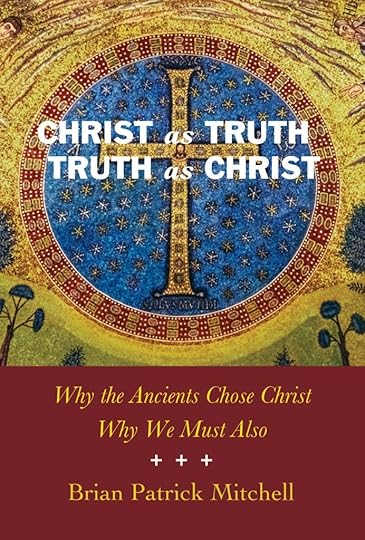
All this is explained in chapter 4 of my latest book Christ as Truth, Truth as Christ, which also includes a contrasting of Christianity, Judaism, Buddhism, and Islam in its last chapter. Please share if you dare. Christians should often dare to tell the truth.


November 1, 2025
50% off now through November!
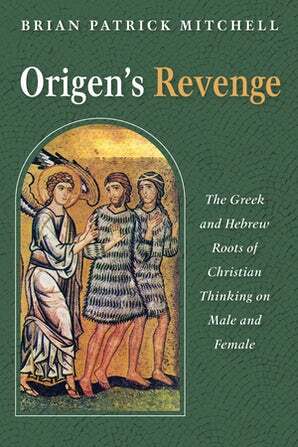
Origen’s Revenge is now 50% off through November. So instead of $53 for the hardback, you’ll pay just $26.50. Or instead of $38 for the paperback, you’ll pay just $19.00. Quite a discount.
Buy now for Christmas. Use promo code CONFSHIP at checkout. Shipping is free if you select “Media Mail.” Click on image to order:
October 28, 2025
Self-Giving or Other-Enabling? What’s a Husband Supposed to Do?
This past Saturday I was honored to speak at the second annual meeting of the Orthodox Canon Law Society of North America (OCLSNA) on the campus of Hellenic College near Boston, Massachusetts. I was scheduled to give the same talk at the society’s first annual meeting last October, but, alas, that was the week my dear wife Joanna fell asleep in the Lord.
My wife and I spent our wedding night in Boston and returned there once for an anniversary. We had intended to go again for our 40th anniversary, but by then she was too sick to travel. My trip to Boston this year was therefore somewhat sad but also somewhat encouraging, as an opportunity to remember our wonderful life together.
My talk attracted a lot of attention and comment afterwards and was very well received by many who heard it, including many seminarians and a surprising number of women in attendance. I focused on the problem of understanding the Orthodox Church’s canons pertaining to women without a sound understanding of what it means to be male or female.
I offered a theological understanding of male and female based on self-giving and thanksgiving, the two fundamental modes of love demonstrated by the Father and the Son. Men and women are also meant to relate in this way, as are clergy and laity, with clergy taking the Christlike “archic” role of the “good shepherd” who “giveth his life for the sheep.” And this is why women cannot be clergy, because the woman is ordained to take the Christlike “eucharistic” role toward the man. (The full text of my talk with footnotes is available here on my Articles page.)
In the Q&A, a young man asked, what if a woman spends her life in self-giving for the parish? Why can she not be honored as a member of the clergy?
I must admit to being caught off guard by the question, momentarily confused by the question’s inherent confusion. The question ignored all that I had just said in explaining the “archic” self-giving of the Father to the Son, of Christ to us, of husbands to wives, and of priests to their people. In each of those relationships, the self-giving is done by the person acting as the “head.” The Greek word kephalē meaning “head” (as in 1 Cor 11) is often a synonym for archē meaning “beginning, source, or origin.” The Septuagint, in fact, uses both words to translate the Hebrew word rōsh as in Rōsh Hashanah, the “head of the year.” It even uses archē in Isaiah 9:15 to explain kephalē in Isaiah 9:14.
I didn’t mention the Septuagint in my talk or my answer, but I did explain archē and kephalē in my talk, and in my answer to the question I did get around to explaining that not all self-giving is archic, some is instead eucharistic, being a grateful response to the archic self-giving of others.
But something still bothered me about the question. Could I be clearer in explaining the difference? Yes, of course, I could, with a little more thought.
Archic self-giving is not just doing things for other people; it is sharing who you are with them—your own sense of meaning, purpose, and direction. In military terms, it is the difference between leading and commanding. A commander gives orders expecting to be obeyed; a leader inspires others with the desire to do what the leader directs, sharing the leader’s sense of meaning and purpose.
This point is made in my book (and doctoral dissertation) Origen’s Revenge: The Greek and Hebrew Roots of Christian Thinking on Male and Female (Pickwick, 2021). In the last chapter, in offering a scripturally and patristically based understanding of male and female, I write:
Ideally, we would imitate Christ in all our dealings with others, taking either the archic or the eucharistic role so as to be one the way God is one, sharing the same life, the same will, and the same interests equally. The Fall, however, has destroyed our original unity and set us at odds with each other over unequal conditions, differing interests, and conflicting wills, making unity all but impossible without subordinating some people to others—by force, by law, or by inequality, on the basis of which we may distinguish three forms of subordination. [211–212]
The three forms are:
Hierarchy, based on inequalities of nature, condition, or circumstance.Subjection, based on a customary or lawful order obliging equals to submit one to another for the good of all.Subjugation, based on the use of force, whereby some people impose their will on others.I also distinguished three distinct forms of submission to one’s subordination:
Obedience, when one does what one is told to do by another in authority.Deference, when one person graciously defers to another person out of kindness, saying, “You choose” or “You go first.” Condescension, when a person of rank accedes to the wish of someone below him, as when Abraham condescended to beget a child by Hagar to please Sarah, and when Our Lord condescended to turn water into wine to please His Mother.I then write that, on account of the Fall, most organizations function as hierarchies, subjections, or subjugations, but ideally they would function as “archical unions more or less mirroring the relationship of the Father and the Son,” in which there is no inequality, no difference of will, and no imposition of will by one person upon another person, providing the following example:
Even military units are ideally archical within themselves. They function best when this is all they are. They become hierarchical only when inequalities of competence must be accommodated. They become subjections only when men disagree and leaders are obliged to “pull rank.” They become subjugations only when force must be used to restrain bad behavior. Not all units become thus degraded. Some small, elite units can function merely archically, with no inequality of competence and no need to pull rank or use force. But take away their archical arrangement and they cease to be “units.” To function as one, they must have one of their number to begin things, to give direction, to lead the way, and to commit himself to responsibility for the whole and give his life for it if necessary. That is the essence of archē. [212]
This is the role that God has assigned to men toward women and not women toward men. Unfortunately, too many men, deprived of their God-given headship by our feminized world, love their wives only by enabling them to live as they please, like a servant or house boy. In doing so, they deprive their wives of the best part of themselves, the part that is most manly.
So a very pious, Christlike woman may live her life in the service of others, giving of herself archicly toward children but only eucharisticly toward men, not taking the man’s place but allowing and even enabling men to live up their own calling as the archic “head” of the woman—the one responsible for inspiring, directing, and leading.
For more on how male and female relates to the image of God and to ordination, read my remarks in Boston.
For much more on the general subject, read Origen’s Revenge. You’ll be surprised, as many reviewers were, by how much is in it. In the words of one reviewer, the last chapter alone is “worth the price of admission.”
September 25, 2025
The Evils of Modern Feminism
Here’s my recent interview by Rafael Flores of the Orthodox Pill Podcast. Rafael is a very bright young fellow with a natural talent for interviewing guests about difficult topics. We covered a lot of ground in this interview, including the new/old thinking on marriage that is now challenging common feminist assumptions about how husbands and wives should live together. Men and women really are very different psychologically, and the new/old thinking takes account of that. Please like and share, and let me know what you think. More interviews coming soon.
September 1, 2025
Give this book to your sons and daughters before they go away to college, so some godless professor doesn’t destroy their faith.
I wrote Christ as Truth, Truth as Christ for my own children when they were in their teens, and it worked. They are all still faithful Orthodox Christians married to other Orthodox Christians and in church every week.
But it’s not just for teens; it’s for anyone needing a deeper understanding of what it means to believe in Jesus Christ.
I’ve never said this about any of my other books, but this book is one everyone should read. I guarantee it will give you either a better understanding of the Christian Gospel or a better way to explain the Gospel to others.
Not all religions respect the truth. Christ as Truth contrasts Christianity with three of them: Islam, Buddhism, and Judaism. It also explains why the early Church was so insistent in council after council that Christ was both fully God and fully man. (And no, it wasn’t to pay the debt of our sin.)
Please like and share.
August 6, 2025
Origenism in the Service of Feminism à la Larchet
Jean-Claude Larchet has a new book out entitled Renewing Gender: An Orthodox Perspective. It is not a very Orthodox book, however. How can you be Orthodox and publicly accuse the Orthodox Church of having been wrong all along, even now, in denying women complete equality with men?
Larchet does that, accusing the Apostles and Fathers of imitating the ancient world in its “asymmetrical” gender relations. They only did this, he says, to “render unto Caesar” so as not to be dismissed by the world as too radical. The Orthodox have a name for that these days: It is called Sergianism, after Patriarch Sergius of Moscow, who in 1927 called on his flock to be “faithful citizens of the Soviet Union, loyal to the Soviet government” such that “Any blow directed at the Union . . . is recognized by us as a blow directed at us.”
In making his case against “asymmetry” and for “transfiguring gender,” Larchet leans heavily on St. Gregory of Nyssa and St. Maximus the Confessor. No surprise there. Feminists in the Orthodox Church have been doing that for decades, and Larchet has always been a devoted Maximian. The only surprises in the book are the extremes to which he goes to dismiss and ignore the “ambiguities and contradictions” in the Apostles and Fathers that are inconsistent with his old-fashioned, different-but-equal feminism.
My full review of Larchet’s book has been published in two parts by the Union of Orthodox Journalists. The first part can be found here. Please like and share. The faithful need to know.
July 8, 2025
New Article: “The Image of God in Male and Female”
Are men more like God than women are? That is the implication of many arguments against ordaining women as bishops, priests, or deacons. Whether the argument is that priests “icon” Christ in the Divine Liturgy, acting in persona Christi; or that fatherhood is especially priestly and more priestly than motherhood; or that the order of clergy and laity is like the order of Creator and creature, heaven and earth, or soul and body, the implication is that men and women are not equal: Men are outrank women in the hierarchy of being.
Inequality is inherent in the very concept of hierarchy. As originally defined and still commonly understood, hierarchy is all about mediation between highers and lowers, superiors and inferiors, the more godlike and the less godlike. And yet the first to define the concept—the sixth-century philosopher who wrote in the guise of the first-century St. Dionysius the Areopagite—did not attribute hierarchy to men and women. Neither did he attribute hierarchy to the Father, Son, and Holy Spirit.
In the Trinity, we therefore have a paradigm for interpersonal relations that are equal yet ordered—a taxis without hierarchia. How might such an order explain the exclusion of women from the clergy? That is the question to be answered here by outlining a theological difference between male and female—theological in that it relates male and female to the Persons of the Trinity.
January 29, 2025
“I married a genius!”

A Crown of Life would never have been published had it not been for my dear wife, who fell asleep in the Lord last October. She loved the first draft of the book, completed in 2001, and kept after me to get it published. I had made a half-hearted attempt to publish it then, but I was happy just to have finished it and couldn’t believe anyone would pay to read an epic 200,000-word Byzantine romance.
Actually, it’s not so much Byzantine as Roman, and people who read Roman novels are by and large only interested in ruthless pagan Romans, not persecuted Christian Romans. Oh, sure, you can interest a few Evangelical readers in Roman Christians but only if they are Evangelicals in togas who never think of sex. I learned that lesson when I tried to get the book published in 2001, after which I stowed it away in my basement, where it gathered dust for over a decade, while I returned to writing nonfiction.
My wife never showed the slightest interest in my nonfiction works, but she loved my novel and would not let me forget it. Just before Christmas of 2013, she plotted with our dear friends and kum Jim and Kathy Jatras to corner me on the matter over eggnog. Jim and Kathy had also read the book and were just as enthusiastic as my wife was. I tried to laugh off the assault but eventually gave in to at least another look at the manuscript.
When I read it again, after nearly twelve years with nary a thought of it, the first thing I noticed was how much I had forgotten—characters, scenes, plot twists. It was as if I were reading a book by someone else. The second thing I noticed is that there were some exceptionally good characters, scenes, and plot twists. I hadn’t remembered the book being as good as it was. I had remembered my early struggle in writing it, the bad scenes written and then rewritten over and over again. I had not remembered the result of all that rewriting.
There were just a few rough spots that needed reworking, and I did that for my own satisfaction, still not expecting much. The payoff came when I walked in one day to find my wife, sitting at our dining-room table, reading over the final manuscript, eagerly turning pages, and then saying, without looking up, “I married a genius!” Golden words for any husband.
The book was self-published. That was part of the argument made by my wife and friends: Novels find their own market today online; no need to pursue prudish publishers. (There aren’t really any sex scenes in the book, but there are two seduction scenes and an attempted rape.) I still worried about its length, but when I mentioned this to Jim, he wouldn’t hear of it. “Don’t change a thing!” he said, more than once.
A Crown of Life is not everybody’s cup of tea, but then no book is. It’s also not high-brow literature, but then I don’t like high-brow literature. I have a degree in literature and enjoy many classics, but I find today’s high-brow fiction overwrought and pretentious—novelists pretending to be mystics. What I want from novelists is not mysticism but common sense, Christian faith, a sane understanding of men and women, and a good story. A Crown of Life has all that.
Thank God for the woman who saved it from oblivion! May her memory be eternal.
June 25, 2024
Handy Resources on Deaconesses
There is quite a lot on this blog about deaconesses. This post makes the most useful resources easily accessible.
1. All you might ever need to know, and the only item you have to pay for, but you don’t have to pay much:
The Disappearing Deaconess: Why the Church Once Had Deaconesses and Then Stopped Having Them
2. Talking points on deaconesses, free:
Talking Points on Deaconesses
3. Slide presentation on deaconesses (read here or download the pdf for free):
Downloads
4. Africa’s new “deaconess”:
Africa’s New Deaconess: What’s the Bother?
5. Were deaconesses really Apostolic?
Were Deaconesses Really Apostolic?
6. A Public Statement on Deaconesses by Concerned Clergy and Scholars:
A Public Statement on Deaconesses
7. A review of Carrie Frost’s 2023 book Church of Our Granddaughters, the Mein Kampf of Orthodox feminism. What does Frost want? Everything up to and including a “conversation” about women as priests and bishops:
Book Review: Church of Whose Granddaughters?
May 8, 2024
Africa’s New Deaconess: What’s the Bother?
Maybe you’ve heard the old Bolshevik saying, “The worse things get, the better things are.” It makes sense for revolutionaries intent on overthrowing the existing order: The worse things get, the more dissatisfied people will be with things as they are, and the more open they will be to revolutionary change.
In our case, as Orthodox Christians, we can at least say, “The worse things get, the clearer things are.” Sometimes things get so bad the choice of good or evil becomes all too obvious and impossible to ignore. (The Jews in Jerusalem were offered such a choice by Pontius Pilate: Good man, bad man, pick one.)
We are seeing things get worse and yet clearer a lot these days. That explains why people are suddenly flocking to the Orthodox Church. It also explains why I am rather more relieved than distressed by last week’s news from Africa.
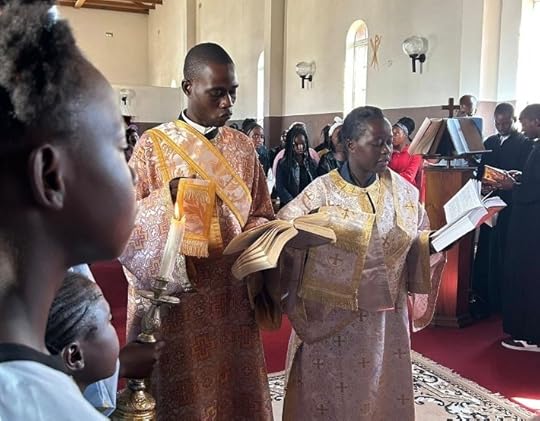
If you haven’t heard, a Greek bishop has just made a woman a deacon, complete with sticharion, orarion, and cuffs. Photos show her distributing communion and leading litanies, bareheaded, in a parish church. “She is going to do what the deacon is doing in the Liturgy and in all the sacraments in our Orthodox services,” the ordaining bishop, Metropolitan Seraphim of Zimbabwe, is quoted as saying. (Did I mention that he is Greek? Yet another white man teaching the natives modern Western ways.)
Other than sex and name, there is little about this new deaconess common to ancient deaconesses. Ancient deaconesses always covered their heads in church, in accordance with apostolic tradition (1 Cor 11:3–16). They were not given sticharia or cuffs, and they wore their orars not over the shoulder as deacons do, but around the neck, under their maphoria, with both ends hanging down in front. They had no vocal role in public worship besides singing the hymns and responses of the people (sometimes as a separate choir, but never taking the clergy’s parts). They didn’t lead litanies or read the Gospel or Epistle, and they never communed anyone anywhere in the presence of a bishop, priest, or deacon. (Read all about it here.)
So this new deaconess is a new creation in defiance of Holy Tradition, not just in what it teaches us about deaconesses but in what it teaches us about men and women.
Why am I not much bothered by it? Three reasons:
1. We’ve known all along that this is where things would go, despite assurances that they wouldn’t. Now it’s plain for all to see, so plain and so extreme that it moves the issue of deaconesses from the level of economía (Are they needed? What trouble might they cause? Should we have them now in some form or maybe later?) to the level of outright heresy. By making no distinction at all between male and female deacons, this bishop has forsaken all the Church has ever taught about the natural and economic order of male and female, setting women over men in the hierarchy of the Church.
2. I’m in ROCOR, and there’s just no chance of that happening here. As far as I can tell, the general sentiment among the clergy in ROCOR is: “Fine. Let the Greeks go full woke. It will show the world that they are no longer the Orthodox Church and move the faithful more in the right direction.” There is also now less chance of deaconesses happening in Russia, where the faithful are known to react very strongly against even reasonable innovations (like the new calendar) when made by the faithless for the wrong reasons.
3. There is also quite a lot of resistance to deaconesses among the faithful in other jurisdictions, as seen in the conclusions drawn by the makers of the documentary aired in January by Ancient Faith Radio and by the efforts by others to make a case against deaconesses that might win broad acceptance. These arguments don’t go as far as they should, inhibited as they are by the fear of offending women, but they show greater awareness of what deaconesses were and were not in the past as well as surprising certainty that we should not have deaconesses now.
My only concern is that other jurisdictions will be pressured to compromise in some way, not so much by making deaconesses of a less innovative sort, but by weakly trying to appease feminists with altar girls and other roles for women. Such attempts only accustom people to thinking the Church has indeed been wrong all along in denying women an equal role in worship, just as Carrie Frost charges over and over again in her book (which you can read about here).
What’s needed is the opposite: a formal repudiation of feminism as a heresy, with appropriate liturgical reminders of the proper regard for male and female, like churching boys but not girls through the altar. That custom is a demonstration of a truth about male and female and a teaching opportunity for pastors. By abandoning it, pastors teach the opposite: The Church was wrong, women should do everything men do, male and female doesn’t matter. (Read more about male and female here.)
Brian Patrick Mitchell's Blog

- Brian Patrick Mitchell's profile
- 2 followers
