Vicky Lettmann's Blog
May 2, 2022
Listening to Chopin Late at Night
My new collection of poems, Listening to Chopin Late at Night, has been out for a couple of months. So it is time to tell you, my dear readers, a little more about it.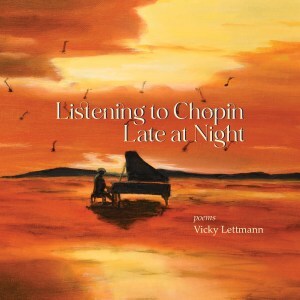
These are poems that I’ve written over the years. Some when my now teen-age granddaughters were still little girls who used to enjoy sleep-overs at our house. Those days are long gone (except I have two grandsons, under the age of five, so maybe sleep-overs are still a possibility.) Many of the poems grew our of Deborah Keenan’s wonderful “assignments,” as she calls her prompts or suggestions for possible poems we might write. During our Monday morning poetry class, Deborah will read a poem and give us an idea. For example, in a Sandra Simonds poem entitled, “‘When you think about it, a cage is air–‘”, Deborah suggested that we try to use a quote as a title. “It can be a quote or maybe something anyone said,” she told us. Then off I go with a bit of writing that might relate to something someone said.
So these poems didn’t come from thin air. Many owe their existence to other poets via Deborah’s inspiration.
Yet in a way they did come from air, the air that exists between a piece of music and my hand moving across the page of my notebook–the air filled with the notes of a Chopin nocturne or ballade and my mind in a semi-dream state where notes and words take on a new life.
I love Chopin. And since I’ve been studying piano for several years now under the kind and patient tutelage of Matt Dorland, my piano teacher, I’ve learned to play many of Chopin’s easier pieces. My hands attempt to shape notes and phrases into the meaning Chopin might have intended when he, so many years ago, put those notes on paper. When I play or listen to his music, Chopin is not very far away. While not all the poems were written while listening to Chopin, the connection to his music, to poems by others, to the events of my life–all of this comes together as I write–sometimes late at night in my chair by the window.
The poems are now in the world and in the hands of many readers, some of whom have written me lovely notes. Thank you to all my writing friends, to Deborah Keenan, to Chopin–and all who have supported my work over the years.
___________________________________
Writing Idea: Settle into a comfortable chair and play Chopin or some other composer on one of your devices. (I say to Alexa: “Play Chopin.” And she does.) Take out your notebook and record the events of the day or whatever you’re thinking about. Or as you listen to the music, find a line of poetry to use as a starter. See where the music and/or the poetry takes you.
___________________________________
“After one has played a vast quantity of notes and more notes, it is simplicity that emerges as the crowning reward of art.” –Frederic Chopin
The post Listening to Chopin Late at Night first appeared on The Joy of Writing.


April 14, 2021
News! The Farm and Other True Stories
Hello, Everyone,
It’s been a while, but I want you to know I’m back and plan to continue posting on my website. I’ve missed hearing from all of you who follow “The Joy of Writing” and Turtle House Ink, and I hope you will continue to stay tuned.
It has been a crazy year for all of us, but I was still able to conduct my Sanibel “Joy of Writing” workshop on Zoom through BIG Arts here on the Sanibel Island. We had a wonderful class of writers who wrote and read together for six weeks during January and February.
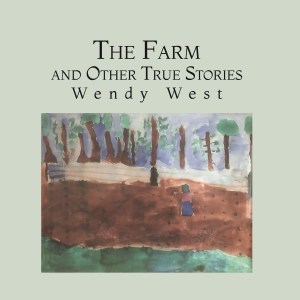
The Farm and Other True Stories
I’ve been working with my friend and fellow writer, Wendy West, to publish her book, The Farm and Other True Stories, through my Turtle House Ink imprint. It’s now hot off the press and looks great. Here is the back cover blurb:
In these well-told stories, Wendy West enlightens and charms her readers with narratives about the sustenance farm she and her husband, Roddy, built as a newly married couple in the early seventies. We learn of the arduous task of building the house, growing food, raising animals—while surviving a devastating turn of events. In other true stories, Wendy entertains readers with many delightful, humorous anecdotes of life in Minnesota. Her stores reflect lessons learned and moments enjoyed within an unforgettable prism of time. You will enjoy this glimpse into the life and adventures of Wendy West.
Wendy has received great reviews from those who have read and enjoyed her book.
in a note to Wendy, poet and writer Joyce Kennedy had this to say:
I thoroughly enjoyed The Farm and Other True Stories. It is beautiful from cover to cover. . . .I am impressed with the skills you developed and used during your farm years! I can’t imagine building a “shabin” or doing the things you did to create a home. . . .”The “Other True Stories” part of your book was appealing, too. I liked those brief glimpses into events. You have a good variety of well-told, charming stories in that section.Please see the publications page for ordering information. Congratulations, Wendy!
Wendy West
The post News! The Farm and Other True Stories first appeared on The Joy of Writing.
April 27, 2019
Libraries and Iguanas
“I have always imagined that Paradise will be a kind of library.”
― Jorge Luis Borges
After a winter in Sanibel, we’re home in Minnesota now. While others might miss Florida sun, the beach, and golf, I’m going to miss the library. What, you say, the library?
[image error]
Sanibel Library
I’ve always loved libraries. My first was the one on Market Street in Wilmington, N. C., where my mother took me when I was a young girl. Maybe she dropped me off or perhaps I was older because I remember being on my own in this wonderful old building where I first discovered my love of books and reading.
You entered through a big wooden door guarded on the outside steps by two huge sleeping lions. A shaft of sunlight fell across the wood floor from a high window. And there was that certain library smell—maybe musty cellulose. But still enticing, interesting, complex.
The librarian sat behind her desk to your left carrying out the ritual of stamping cards and inserting the due-date card in the pocket of every book that left her domain. To the right was a reading room with long mahogany tables, hanging maps, newspapers, and lots of large red encyclopedias, atlases, and other reference books.
Beside the librarian’s desk, in its formidable wooden cabinet of small drawers was the card catalogue. Every book in the library had its own card with identifying Dewey Decimal numbers and information about the book. There were no computers or electronic databases in those days. Everything was done by hand.
My favorite place in the library was the stacks. At the end of the hallway was a large room with rows and rows of metal shelves lined with books that stretched way over my head. There were ladders and step stools to reach them. The fun of the stacks was in the discovery. Even if I went in search of one certain book, it was often all those around it that most fascinated me.
I don’t remember a children’s room, but somehow, maybe on a certain shelf or two, I found Nancy Drew and Sue Barton. Over the years, I read mysteries and then later novels and adventure stories like Thor Heyerdahl’s Kon-Tiki. I still remember my tears as I turned the final pages of Black Beauty.
In the completely renovated Sanibel Library, I can look out large windows onto a small brackish river. A reading porch overlooks the water. As I sat on the porch a few days before we left, two iguanas, a large bright orange and brown one and a smaller green one, munched away on the grass below until they heard voices and scurried toward the water. The week before, an osprey settled in the tree above looking for fish.
[image error]
Sanibel Library
Puzzle Corner
I can easily be distracted from my writing and reading here. I might stop to chat with someone working on a jigsaw puzzle. Beside a shelf of books sit two chess boards all set up and waiting for players. There are no stacks to settle into in order to avoid distractions. In this library, low open shelves, some on rollers, sit next to comfortable reading chairs.
A few days ago, in the downstairs meeting room, I dropped in on a talk by Duane Shaffer, one of the librarians and a World War II historian. He brought to life the 1941 sinking of two WWII battleships: the Bismarck and the HMS Prince of Wales. I didn’t know that battleships could be so interesting—another example of the joy of discovery to be found in libraries.
Of course, not all libraries are like this one on a Florida island. Some metropolitan public libraries have become gathering places for the homeless. Many libraries today struggle with inadequate funding and the challenges of digitalization.
Yet libraries remain free and open, truly democratic places where anyone can sit and read–and maybe, if they’re lucky, even see an iguana.
_____________________________
Writing Prompt: Take yourself to a library near you. Write and observe. Make a list of all the libraries you can remember. Then free-write for ten-minutes to see where you can go as you reflect on libraries. Maybe you will create an essay or build a story or spin out a poem about a library.
_____________________________
Here are five wonderful poems about libraries for inspiration.
Also see Susan Orlean’s new book, The Library Book, for an extended work of creative investigation as she explores the role of libraries in her life and delves into the story of the fire that destroyed the Los Angeles Central Library in 1986. Neil Gaiman’s essay on libraries is also worth a look.[image error]
March 31, 2019
How Far?
Some days as I struggle with excuses for not sitting down to write, I think of June 2006 when I traveled to Russia to attend the Summer Literary Seminar (SLS) in St. Petersburg—all in the name of writing!
It would be a two-week sojourn in a city that, at that time, wasn’t on my short list of places to visit. I would be traveling with my friend and fellow writer, Marge Barrett. We were co-teaching a Chekhov class and shared a desire to know more about Russia and its incredible literary history.
The seminar offered a feast for writers: morning workshops with our writer of choice (Gina Ochsner, Padgett Powell, Jayne Anne Phillips, Ann Lauterbach and others); fascinating literary walks (Dostoevsky Walk, Pushkin Duel Walk, Mad Monk Walk); and lectures with Russian scholars and contemporary writers. We would stay at the Herzen Inn in the heart of St. Petersburg only blocks from the Hermitage. We would visit neighboring villages and see the palaces of the tsars. We would eat our fill of borsch with ice-cold vodka chasers while chatting affably with fellow writers in delightful Russian cafes.
[image error]
Church of Our Savior on Spilled Blood
And so I was swept up into the exotic glamour of it all. How starry-eyed we become when we fantasize about the heady pleasures of being a writer: imaginative soaring, writer soul mates, new details to fill the pages of notebooks, a time to focus on writing for two solid weeks.
Then reality!
Visa: At that time, you didn’t just go to Russia, you had to be invited and this involved a lengthy application process and a cryptic visa application. Then we waited and waited, with the visa showing up a day or two before we were to leave.
Packing: Did they really want us to bring a fan all the way to Russia? We decided: No. Better to bring our books. So our suitcases were full of heavy literary tomes and a few clothes that could be washed in the sink. No hair dryers. All decisions to be regretted later.
Travel: “What do you mean you’re going to fly Aeroflot?” said our friends. We arrived in Moscow blurry eyed. Marge’s brown leather bag was lost. We found out that the terminal to St. Petersburg required a bus ride to another terminal several miles away, and we negotiated the transfer without being able to decipher a single sign in the Cyrillic alphabet.
Accommodations and Classrooms: The Herzen Inn on the main drag of Nevsky Prospekt turned out to be an upgraded hostel. The heat was unbearable in our room. One night we decided to leave the door of our tiny refrigerator open all night as a mini-air conditioner. We learned why the manual said, “Bring a fan.” The classrooms where we met were sad reminders of a not-too-distant Russian past. The dust and mold set off an allergy attack.
Fellow Travelers: The lack of sleep (no one sleeps during the White Nights of July because it never gets dark) inflamed the irritations that buzzed around a bunch of writers in a distant land. Insecurities surfaced: why did I choose this story for the workshop? why did I say that about another writer’s work? Then add in the pressure of lurking in the shadows of Dostoevsky, Anna Akhmatova, and Joseph Brodsky.
The heat, the lack of sleep, no hot water, don’t drink the water, sore feet, a horrible cold, lost, tired, sick, alone—the grim realities of the dark, yet often comic, complexities of the writing life were intensified in Russia.
Yet in the middle of all this, we were afforded moments of intense beauty. We stood on Griffon Bridge on Griboyedov Canal (one of the many canals that make this city the “Venice of the North”) and saw the remarkable view of the Church of the Savior on Spilt Blood. We huddled under a ledge on the steps of the Winter Palace with Russian couples and families waiting out an afternoon rainstorm and looked out over a glistening courtyard where Russian history unfolded to see a rainbow fill the sky. We wrote haiku in the Summer Gardens and hunted through an antique store for Russian postcards to serve as inspiration for a short story. We met other writers who were sharing our ecstasies and agonies. Our friendship grew deeper. Marge listened to me cough and blow my nose for a solid week without killing me. We found the Internet café and sent frantic e-mails home. We read our work to each other in our shabby-shabby room. We discovered an Albanian restaurant down the street. We laughed and appreciated our little refrigerator because it held our bottle of vodka. (“Is it time for our vodka yet?” I asked in the middle of a long lecture.)
Filled with memories of the enigma of Russia, I returned to the solid ground of home. I stood at the bottom of the stairs leading up to my study and said to myself, “If I can go all the way to Russia for my writing, surely I can climb these stairs to my office and sit down at my desk and turn on my computer to begin a new story.”
Like Russia, the Muse does invite me in but not always as quickly or as easily as I might wish. I often don’t have what I think I need for the trip—more ideas, fewer doubts. The irritating buzz of everyday life will not disappear, yet I’m not alone. I can call a friend who knows what it means to go as far as Russia for writing. And I know there will be laughter and beauty along the way. And maybe even a new story.
_______________
About Summer Literary Seminars (SLS): These renowned writing seminars are no longer held in St. Petersburg, Russia, but continue on three continents: North America (Montreal, Quebec, Canada), Europe (Tbilisi, Georgia), and Africa (Nairobi-Lamu, Kenya). About the seminars, George Saunders, a participant when I attended, said: “SLS is one of the most exciting and important intellectual venues in the world right now; absolutely the most important seminar of its kind… SLS is at the center of a discussion I am hearing more and more in the US, about the moral role of fiction… well, what I’ve heard students say is that they have never felt more artistically alive, more convinced of their own potential to find the beauty in life and write about it… The beauty of the program is that it makes for a kind of two-way diplomacy.”
[contact-form]
March 3, 2019
You Can’t
Play Chopin’s Polonaise
Like Horowitz you can’t
Say that and not remember
It was my idea you can’t
Eat those kisses you can’t
Leave all the letters
You can’t hide
You can’t forget me
[image error]
Poem’s first appearance in my journal with my tattered copy of Ueland’s book.
I can’t forgive you
No never
You can’t explain that
Or solve that equation
You can’t know what I’m thinking
You can’t shoot like LeBron James
You can’t trust certain people
Who stand in corners
They can’t be noticed at first
Shadowy they are caught
In the glow of Dante’s Inferno
Where they assumed
They might be trapped forever
They turn their backs
When you enter the room
They eat popcorn noisily
In movie theaters
But I do that you say
Does that mean I can’t be trusted
Not necessarily
Certain traits build on one another
Watch Shaun Livingston on the court
Listen to Martha Argerich play Liszt
About this poem:
This poem started with a riff on “you can’t.” At one point I dedicated it to Siah Armajani, a conceptual artist who created many amazing pieces. Others might have said to him: “You can’t do that.”
As I was working on the poem, I ran across a sports commentator’s YouTube video. “You can’t be LeBron James, but you can be Shaun Livingston,” the commentator said. I’m not a big basketball fan, but I do know that LeBron James is 6’8” and considered to be the best basketball player in the world. I found that Shaun Livingston (6’7”) is highly efficient at mid-range and plays good defense. He may not be the star, but he’s there and can be trusted to help his team.
Likewise Horowitz and Argerich—both are amazing pianists. Horowitz was a great soloist, but watch Martha Argerich play Liszt’s Piano Concerto No. 1 in E Flat Major with a full orchestra.
I wanted the poem to have both a dark and a light side. I hope the reader puzzles over who can and can’t be trusted, and also what we can or can’t accomplish, as well as the way the word can’t sometimes comes to dominate our thinking.
___________________
Writing Suggestion:
During the last six-weeks of our “Joy of Writing” workshop here in Sanibel, Florida, we used Brenda Ueland’s If You Want to Write as inspiration in our exploration of creativity. “I want to assure you,” she writes, “that no writing is a waste of time–no creative work. With every sentence you write, you have learned something. It has done you good. It has stretched your understanding.”
Often we tie our writing to some standard of perfection and forget that by letting our words go out there, then, and only then, can we create something new. Perhaps we place too much weight on the judgement of others, and not enough on the divine spark within us. “Everybody is talented, original, and has something important to say,” says Ueland.
So with that in mind, pull out your notebook and let it rip. Trust yourself. Write about your day. Write about what you can or can’t do. Write about the way the light looks coming through your window. Write about sports or music. Go for three pages or ten minutes. Just write. You can write.
April 20, 2018
Blossoms: Consider the Lilies
It’s time to head back to Minnesota. The snows are over, so they say. The ice is melting. It’s mid-April, after all. About time!
Here in Sanibel, I look out the window on a brilliantly sunny day. Our amaryllis has surprised us with eight huge blossoms. Who knew that the ugly bulb I had totally forgotten about and left for months hidden under a palm tree in the shade could produce such amazing blooms out of nothing? Even the orchids that I tied to the trees have bloomed, thriving on air and humidity. I’m amazed that those scrawny plants that I had long ago written off have survived on nothing but air—especially considering how I had fussed over them when they tried to live in the house. Sometimes it is good to just let things be.
[image error]
Who knew these were hidden in that brown bulb?
And so we will leave Sanibel, Florida, and let it be for the next six months. I’ll leave my friends, who will head back to their respective homes too. We come here and take on new lives. No one seems to care who we were before we landed on this small island.
My “Joy of Writing” class this year was wonderful. So many writers willing to open their notebooks, uncap their pens, and write! I hope that whatever we started in the class will continue and that more blossoms (stories, poems, essays) will come. Sometimes it seems we try too hard to make things happen when all along within our bodies, minds, souls something quiet and alive is at work and just waiting for the right time to show itself.
As I write this, I’m remembering some of the writers who read their work during the last class. Molly Downing wrote about crossing the causeway bridge to Sanibel.
As I ascend the arc of the bridge to its sun-beamed zenith, I feel a palpable lightening of body and spirits. I inhale deeply the sea-sweetened air. Gentle warmth relaxes my shoulders, my neck, my face. An osprey soars overhead, flaunting the fish in his talons with loud proud whistles. Below, palm and pine lined white sand beaches offer previews of delights to come.
From “What is Paradise?” by Molly Downing
Wendy West told a childhood story about a time when she and her sister crashed a large funeral for an exotic Romany visitor to her Minnesota town.
I had never been to a wake or a funeral. I did see a dead priest once. My father had dropped me off early at school, and we had to go to mass every morning. As second graders, we sat right up in the front. The mass was going to be a funeral for the priest. I sat in the pew and looked over at the open coffin. He looked alive! I was all by myself. I stared at him for a long time and was sure I had seen him blink his eyes. What if he was still alive? Would they bury him anyway?
From “The Queen of the Gypsies” by Wendy West
Kathi Straubing’s essay, “Let It Be,” was about how so many words, sometimes meaningless, crowd our lives.
We write words. Embellish words. Impress with words. Delight with words. Dismantle with words. Curse with words. Accuse with words. Amuse with words. We read all night, rise with a crossword puzzle, talk all day, text forever. We never stop long enough to listen, to just . . .Let it be. Just let it be!
From “Let It Be” by Kathi Straubing
Speaking of words, My St. John wrote about how the single-word question What? is so prevalent among those of us who are now hearing impaired. She ends her piece with this funny anecdote:
Just the other night, I was sitting next to my friend Clare at a yacht club dinner, and I asked her who the man was at the other end of the table. I thought she said that he was an ex-convict.
“How exciting!” I whispered, “What did he do?”
Her answer, “What do you think ex-commodores do?”
This morning, I made an appointment with my ENT doctor.
From “What?” by My St. John
And so, the time has come to leave the island and our friends here. While I’m ready to go back to life in a metropolitan area, I’ll miss Sanibel, my friends, and the blossoms that surprise and inspire me.
[image error]
Free to bloom on a tree
___________________________
Writing Idea: During the Joy of Writing class, we use writing envelopes to jump-start our practice. Each person has her own envelope. Into the envelopes, we put slips of paper with a phrase, a quote, or a topic that could serve as a prompt to get us started. The idea is to pull out one or two slips and, without over-thinking, use the prompt to free write for ten minutes or to fill two pages. For example, in the envelope for this session, one slips says: Write about pretending to like a certain food. Another says: Write about a childhood game that went bad. Another: Write about each decade of your life (or someone else’s) using clothes. The writing that comes from these can become fiction, poetry, or memoir. Anything.
Try it. Whatever happens, just let it be. Who knows what blossoms might emerge?
___________________________
“The nature of This Flower is to bloom.” Alice Walker
“Consider the lilies how they grow: they toil not, they spin not…” Luke 12: 27
[image error]
On its own…bougainvillea
July 22, 2017
On Practice and Patience
For over a year now, I’ve been trying to learn Claude Debussy’s “Arabesque No. 1.”
I took piano lessons from age ten into my teens and college years, and then off and on as adult when my children were taking lessons. I can’t say that I have much natural musical talent, but I’ve always enjoyed the challenge of playing the piano. So for the last three years or more, I’ve been taking lessons again with a gifted and patient teacher, Matt Dorland. Little did I know that Mr. Debussy’s piece would take me so long to master—well, not really master, because that is a wishful dream. But at least I wanted to be able to play from the beginning to the final note without stopping, which, hallelujah, I managed to accomplish today.
[image error]
But today, since my goal was to finish my study of this piece by the end of the month, I played the entire piece from beginning to end. With a lot of mistakes throughout, I made it through without stopping—as Matt sat nearby looking at his phone. I liked that he said nothing when I finished. He moved back to the chair by the piano. “Well, how did that feel?” he asked. “Scary,” I said, staring at the music. “I messed up the ending. And some of the usual spots too.”
There are several sections in the piece that I always have trouble with and have practiced over and over again. Hands apart. Slowly. Try not to look at my hands. Just the music. Feel where my fingers should go. Keep the triplets smooth. Add the quarter notes in the left hand, so they work with the triplets. This last part, triplets in the right hand and quarter notes in the left, took me months to even begin to understand.
[image error]
Why did I stick with this piece? There were many times when I wanted to quit. “I need a break from Mr. Debussy,” I would tell Matt. But the next week, I was back to the piece. Not able to let it go. Maybe I’m just stubborn. I had started it and I would finish it.
This doesn’t always happen with writing. There are many unfinished writing projects buried in my computer. It does help to have to be accountable to someone, my piano teacher, every week. Without his patient guidance, I would have drifted away.
I remember talking with Matt one time about how writing a poem or a story differs from playing notes someone else has written. Which is more creative: writing or playing the piano?
“Well, no two people will ever play the piece the same,” he answered.
That is certainly true. My creative rendition of “Arabesque No. 1” doesn’t even come close to the ones I hear on You Tube. But it represents my own appreciation of the challenges presented by this incredibly beautiful piece of music–tonal shifts, difficult rhythms, key shifts, arpeggios.
Thank you, Mr. Debussy, for your genius.
Thank you, Mr. Dorland, for your lack of judgment, your talent, your insightful tips on how to learn a difficult piece—and most of all, for your patience.
_____________________________
Writing Connection:
In Writing Down the Bones, Natalie Goldberg says: “This is the practice school of writing. The more you do it, the better you get. . . . You practice whether you want to or not.” She compares writing to a run. “You just do it. And in the middle of the run, you love it.” She says, “That’s how writing is, too. Once you’re deep into it, you wonder what took you so long to finally settle down at the desk.” So if your writing practice has lapsed, pull out your notebook and go. Write about anything.
Here’s a prompt to get you started:
[image error]
Explore a challenge involving music. Or what do you have to say about patience? Go. For ten minutes. Think of it as practice. Is there anyone listening, it doesn’t matter. Good. No one is listening. Not even Lucy!
_______________________________
“ The word patience means the willingness to stay where we are and live the situation out to the full in the belief that something hidden there will manifest itself to us.” ― Henri J.M. Nouwen
“I beg you, to have patience with everything unresolved in your heart and to try to love the questions themselves as if they were locked rooms or books written in a very foreign language. Don’t search for the answers, which could not be given to you now, because you would not be able to live them. And the point is to live everything. Live the questions now. Perhaps then, someday far in the future, you will gradually, without even noticing it, live your way into the answer.” ― Rainer Maria Rilke, Letters to a Young Poet
____________________________________
March 4, 2017
“I Write Because” by Kathi Straubing
And so it began, that voice that nudges me to pick up pen and paper and write. It became relentless—that voice that demands time and space. And so I began.
I write because—because—?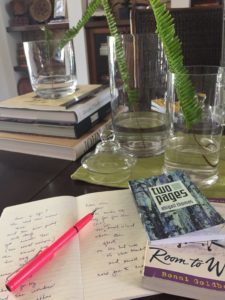
“Why? Why do you write?” The voice would not let go!
I don’t know. I write because—because I have to!
I write because I have to!
I write because I want to understand life, my life and yours.
I write because I need to know my purpose and how dreams take wing and fly.
I write because I want to know where I came from and where I’m going.
I write because I want to know what lies beneath and what lies around and through and above. And is there a heaven? Filled with light?
I write because I feel the grass under my bare feet and, well, why is it soft and green? And why does the tree grow tall and straight?
I write because the bird’s song astonishes me. And I want to know how does a bird know how to choose a mate? And how to build a nest? And when is it time to fly away? And how does it know where the cat lurks?
I write because I want to know where God is and what God is. God is everywhere, in everything—or so they say, and how is that possible?
I write because I want to hear the voice of Spirit. Because I want to know its touch. Because Spirit must be one with poems and prayers and blessings. Oh yes! And in kind words spoken gently.
I write because I want to make sense of confusion, of madness. The world does seem maddening, chaotic some days—when simplicity would be so easy. Or not.
I write because words can be so quiet, and life can be so loud. And why are people afraid to touch or be touched? Why is everyone running so fast?
I write because I want to know why fear is so easy, and love can be so hard, since that’s what we want the most—love.
I write because I want to know how we ask for what we need. Why that scares us so! Knowing that you might say, “No!” because you may not understand my need.
I write because I want to know why it is so difficult to lay down judgment and criticism and just breathe for a minute or two—together.
I write because I want to untangle the knots of unknowing, of misguidance, and reweave the yarns into a tapestry of hope.
I write because I want to know, because I need to know. Don’t you? Because I have so many questions and, regrettably, so few answers. And because life is so damned short and what does it all mean anyway?
I write because I need to know that it is okay to be afraid sometimes, to not know the answer, let alone the right question.
I write because I want to meet my hunger, my thirst for life and love, for joy and beauty, and to begin to satisfy them.
I write because I believe—because I believe, that somewhere out there God is listening—that someone, somewhere feels my words, my longing—to be.
I write. I write because I have to! Because it is like breathing air. And so, I write.
______________________________________
Kathi Straubing, the guest author for this post, has been a participant in my “Joy of Writing” class here on Sanibel these past six weeks. Kathi read this piece during our final class, and I asked her if she would be willing to share it on this blog. Thanks, Kathi.
______________________________________
Writing Idea: Using Kathi’s writing for inspiration, how would you answer the question: “Why do I write?” Or take one line from her writing and use it as a prompt for a ten-minute free writing to explore a story from your own life. For example, write about a time you tried to “untangle the knots of unknowing” or why “fear is so easy and love can be so hard.” These big, universal questions are often the ones that hover around and above our writing and bring us to the page.
______________________________________
“Why do I write? It’s not that I want people to think I am smart, or even that I am a good writer. I write because I want to end my loneliness.” Jonathan Safran Foer
“I write because I don’t know what I think until I read what I say.” Flannery O’Connor
______________________________________
January 5, 2017
Starting All Over: Spiders, Webs, and a New Year
Here we are ready to start again. A new day, a new calendar, a new year. A few months from now we will have forgotten how fresh our world seems today, but for right now all is well.
One of my friends sends out a poem every Monday. I particularly like the one she sent this past Monday, January 1, 2017.
Let other mornings honor the miraculous.
Eternity has festivals enough.
This is the feast of our mortality. . . .
The new year always brings us what we want
Simply by bringing us along—to see
A calendar with every day uncrossed,
A field of snow without a single footprint.
As the new year begins, we see “a calendar with every day uncrossed/ A field of snow without a single footprint.”
My January calendar already has a few prospective footprints. In a few days, my friend Mary and I will head to Key West for the much-anticipated writer’s workshops, sponsored by the Key West Literary Seminar. Mary will be working with the poet, Rowan Ricardo Phillips; and I, with Dani Shapiro, who has written novels and several memoirs. I’m hoping to take a few small steps toward the completion of a collection of short prose pieces I’ve written over the years.
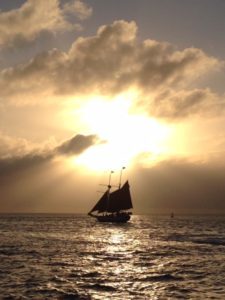
Key West Schooner
While we will be going to Key West for the workshops, we will also stroll along Duval Street, eat fresh fish in our favorite restaurants, enjoy the people we always meet at the Key West Bed and Breakfast, watch spectacular sunsets, sail on a schooner, and maybe even leave a few footprints in the sand. Going to Key West is truly “a feast of our mortality”–a carpe-diem sort of place.
_______________________
On another carpe diem note, I’ve resolved not to watch (and read) so much news this year. Alain de Botton concludes his 2014 book, The News: A User’s Manual (a serendipitous find yesterday at the Sanibel Library book sale) with these words:
We should at times forgo our own news in order to pick up on the far stranger, more wondrous headlines of those less eloquent species that surround us: kestrels and snow geese, spider beetles and black-faced leafhoppers, lemurs and small children–all creatures usefully uninterested in our own melodramas, counterweights to our anxieties and self-absorption.
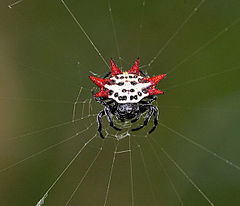
Our Spider: Crab-Like Spiny Orb Weaver (Wikipedia)
His words make me think of the spider I have been watching build her sturdy web across the corner of our deck here on Sanibel. The web is an engineering marvel spanning a five-foot corner. It has withstood rain, wind, and my sometimes awkward maneuvers to water the plant that anchors one of her filaments. I accidentally knocked it down a couple of weeks ago, but the next day she started all over–swinging on her almost invisible silk threads, like a tiny, skirted acrobat in mid-air.
And there are our five grandchildren: each one a delight–any day spent with one of them is the best day ever. They help me see an ordinary spider web and lots of other small (and large) wonders I might not notice. With them I also do things I wouldn’t ordinarily do, like trying to fly a kite with Lucia in Dalkey, Ireland, on a cold, not-so-windy December day.
________________________________
On Writing: Here’s hoping that you will find new life and happiness in the words you spin in the coming year. You never know what you might catch. An idea you didn’t know you had? A moment easily forgotten? A story to hold onto? A sense of your own self? Maybe we can forget the news for a little while each day and settle into a chair with a notebook and a good book. Or take a walk in a park. Or by the beach. Or watch a spider. Or talk with a child. And then come back and write about it.
_______________________________
“Do you understand how there could be any writing in a spider’s web?”
“Oh, no,” said Dr. Dorian. “I don’t understand it. But for that matter I don’t understand how a spider learned to spin a web in the first place. When the words appeared, everyone said they were a miracle. But nobody pointed out that the web itself is a miracle.”
“What’s miraculous about a spider’s web?” said Mrs. Arable. “I don’t see why you say a web is a miracle-it’s just a web.”
“Ever try to spin one?” asked Dr. Dorian.”
― E.B. White, Charlotte’s Web
_________________________________
November 8, 2016
Sachiko: A Story of Hope and Peace
I recently had a conversation with Caren Stelson, the author of Sachiko: A Nagasaki Bomb Survivor’s Story (Carolrhoda Books, 2016). We had just learned that her book was on the longlist for the National Book Award for Young People’s Literature. “I’m flabbergasted,” said Caren when I offered my congratulations. “This is so affirming.”
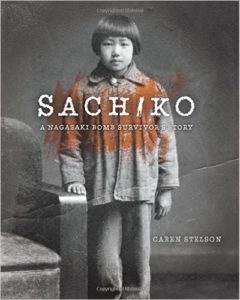
We met in a Minneapolis suburb at a Panera restaurant amid the big box stores of Home Depot and Costco, a place far away from Nagasaki and Sachiko Yasui. Yet as Caren and I talked, the incredible story of Sachiko began to come alive for me. It was almost as if Sachiko herself were the third person at our small table.
Sachiko, who is now 78, was six years old on August 9, 1945, the day the United States dropped an atomic bomb on Nagasaki. Because she was a child on that day, she wants children everywhere to know her story. “I think it must be very hard for you to feel what happened because you are so very young,” she said to the children of a sixth grade class, “but I’ll try to speak about how strong you can be as a human being when you encounter difficulties in the future.”
Sachiko’s story is told in short chapters that cover fifty years of her life from the day of the bombing, when she went out to play with friends, to the 50th anniversary of the bombing when, at age 56, she was invited to speak to a sixth grade class about her experience as a hibakusha (“explosion-affected people”). Between Sachiko’s chapters are interspersed sections of supplemental material about such topics as the history of World War II, the bombing of Japan, and the long-term effects of radiation.
The writing is straightforward, never preachy, with quick, punchy sentences appropriate to the reading level of young people, yet not condescending, as readers of all levels can appreciate the concrete details that bring the story to life. Camphor trees, cicadas, and Sachiko’s grandmother’s green bowl found in the ruins of their home work as recurring motifs and metaphors to illuminate connections to nature, the past, and re-birth. They also serve as touchstones for the reader to navigate through a fifty-year time span.
The arc of this story takes readers on a journey from great sorrow and massive tragedy to incredible hope and the wish for peace. The story is personal and yet universal as Sachiko, who was inspired not only by her parents, but also by Helen Keller, Gandhi, and Martin Luther King, comes to find forgiveness and the courage to tell others about the power of healing. Her talk on the 50th anniversary of the bombing was the beginning of many years of telling her story and advocating for peace. “What happened to me must never happen to you,” she said.
As Sachiko stood before the children on that day, she was reminded of her three brothers and sister. Toshi died the day of the bombing; her brothers Aki and Ichiro, who suffered from extensive radiation injuries, died shortly thereafter; and her sister, Misa, some years later from leukemia. Sachiko herself battled thyroid cancer that took her voice until she fought to regain it. Both her mother and father were gone. She alone had survived.
“This is an important day to talk about peace,” she said. “I hope to give you something to move your heart, to make you think of our peace for the future by telling you about the real misery that happened in the past. To make it happen, I have to share my heart . . . with you.” And so she told the children her story. It began the way this book opens with a six-year-old girl who was hungry because of the long war, who waited for the family hen to lay an egg, and then went out to play with her friends. Above them, the children heard the sound of a B-29. At 11:02 when the bomb exploded, they were just half a mile from the hypocenter. Her world was demolished. “Roaring winds ripped the bark off the camphor trees and split their trunks . . . .Dust erased the lines of the earth. Day turned to night.”
Sochiko lay under the rubble until her uncle found her and pulled her out. That evening the family buried her four friends. Sachiko’s little brother, Toshi, who was killed by a sharp stick to his head, was dead in her mother’s arms. He also was buried near the four friends.
During our conversation, I learned that Caren was inspired to write about Sachiko after hearing her speak at a Minneapolis ceremony to commemorate the 60th anniversary of the bombing of Hiroshima and Nagasaki. We talked about Caren’s five trips to Nagasaki to interview Sachiko and her extensive research (evident by the notes and bibliography in the back of the book). Sachiko came to find her own voice because of what she learned from Helen Keller, Gandhi, and Martin Luther King—and her father, who said to her, “This is the only world we live in, Sachiko. Never say evil words; otherwise, we’ll not see peace. Hate only produces hate.”
It has been a long time since I’ve been so moved by a story. The book, although written for young people, helped me to better understand a war I was born into. I would have been about the same age as Sachiko’s little brother, Toshi, when the atomic bombs exploded on Hiroshima and Nagasaki.
When we began our conversation, Caren said she had learned how much we don’t know or remember about that horrible day and how the national narrative we are told is not the only one to examine. “We have to be careful,” she said, “about the way we read our history because there is much controversy over the dropping of the bombs. It is relevant today. We must choose our leaders carefully.” By focusing on the story of one person, Sachiko, a habakusha who was shunned, Caren said she could explore how a child of war finds her way to peace.
“How does one get there?” she said. “How can this help our young people? I had to find the layers. What was happening in her life, the world, the war? I had to explore all the ways one person came to tell this story.” She paused and continued, “I don’t want this to be an apocalyptic story. I want it to be about a child, a story of hope. ”
One of my questions for Caren related to the name of this blog, “The Joy of Writing.” “Since I call my blog “The Joy of Writing,” what have been the joys (or not) of writing this book?” I wondered. Our time together ran out before we could talk about my question, but later Caren sent me this note:
It was a pleasure to meet you this afternoon to talk about SACHIKO. I never really answered your question about the joy of writing SACHIKO. The real joy of writing SACHIKO is connecting with others in friendship. I thoroughly enJOYed being with you this afternoon.
Then she added:
I forgot to say—now we have a child’s voice rising up through the three darkest holes of World War II. We have Germany’s Anne Frank and her diary. We have Hiroshima’s Sadako and her thousand paper cranes. And now we have Nagasaki’s Sachiko and her story. I feel in my bones if Anne Frank and Sadako had been allowed to grow to adulthood, they would have become wise peacemakers, like Sachiko, sharing love and hope with the world.
Thank you, Caren Stelson, for bringing Sachiko’s story, this beautiful book of forgiveness and peace, to us.
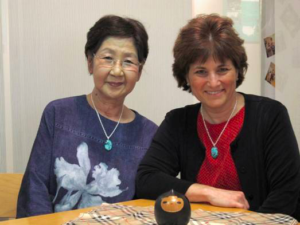
Sachiko Yasui and Caren Stelson at their first meeting. Nagasaki, 2010
______________________________________
Writing Idea: No matter what your writing project, try doing research or interviews to connect your story or subject to a larger historical perspective. Another idea: how would you write the story of a difficult time in your life (or another person’s life) for a child you know?
______________________________________
“When you grow up, remember to tell my story.” Sachiko Yasui
“Darkness cannot drive out darkness: only light can do that. Hate cannot drive out hate: only love can do that.”
― Martin Luther King Jr., A Testament of Hope: The Essential Writings and Speeches
_______________________________________