Dawn Shaw's Blog
June 30, 2017
Facial Disfigurement: Hollywood’s Shortcut to Villainy (Dr. Poison in Wonder Woman)
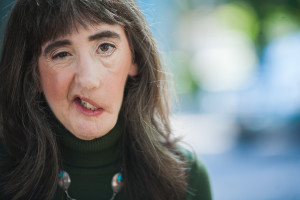
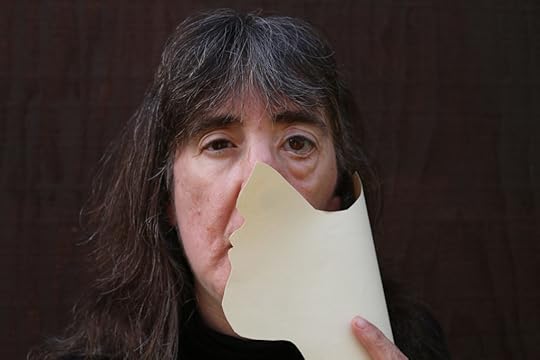 As someone with a facial difference (I grew up with a face half-paralyzed by the removal of a tumor shortly after birth and I refuse to call it “facial disfigurement), I am baffled by the treatment of the villain Dr. Maru, aka Dr. Poison in the recent Wonder Woman movie. We know something is up with her face because she wears a primitive prosthetic. At the end of the film, we see her mask blown off and her scarred face revealed…but that’s it. We have no back story to explain it except a passing mention of perhaps some sort of lab accident. When Dr. Maru’s face is revealed, instead of crushing her as she has the other supreme villains, Diana (“Wonder Woman”) spares her out of what seems to be pity.
As if the tragedy of her facial scarring excuses her murderous actions.
As if we need no other explanation for her heinous acts than “Oh, look at her face! Surely that is punishment enough!” If I went on a killing spree, would my appearance get me off scot free? I doubt it; nor do I plan to test it.
That being said, lots of people with facial differences (or to use a term I despise, “disfigurements”) are able to adjust. Those that have a harder time adjusting tend to isolate themselves. Regardless, the overwhelming majority of us with facial differences, whether we’ve had them from birth or they are acquired, generally don’t turn evil and homicidal just because our face is scarred, paralyzed or altered in some undesirable way.
Yes, I get that it’s World War I. People with facial differences confront many challenges in modern day society. I have no idea how it would have been for a woman with a facial difference in the early 1900’s.
Sure, I can make a few guesses as to what motivated Dr. Maru’s destructive choices. Perhaps she worked for General Ludendorff because he was nice to her- regardless of his motives. Perhaps she delighted in taking revenge on men because of how she’d been treated by them after her accident. Or perhaps she was so obsessed with the success of her work that people became dehumanized- in which case, her appearance would be irrelevant. Maybe it’s a combination of these. Or none.
We don’t know, because the narrative doesn’t tell us.
And what DID happen to her face? (To echo a question I hear often in my presence.) There is nothing to explain that type of scarring, which seemed to be created by CG rather than prosthetics or make-up.
And why does Hollywood have to use facial scarring as a motivator for villainy? Hollywood’s best villains are driven by their story- by believing that what they are doing is right. Ironically, in the same film Ares is an excellent example of a motivated villain.
Yet maiming the would-be villain seems to have become a standard Hollywood shortcut. As if the writers and producers are saying “We don’t have time to tell Dr. Maru’s story, so we’ll just disfigure her face. That will explain everything.”
No. No, it won’t. Or more to the point: No, no it SHOULDN’T.
The post Facial Disfigurement: Hollywood’s Shortcut to Villainy (Dr. Poison in Wonder Woman) appeared first on Facing Up To It | Author and Speaker Dawn Shaw's Official Website.


April 12, 2017
Finding Your Tribe
We all want to belong. We seek people we have things in common with. But sometimes, finding your tribe pushes you outside of your comfort zone.
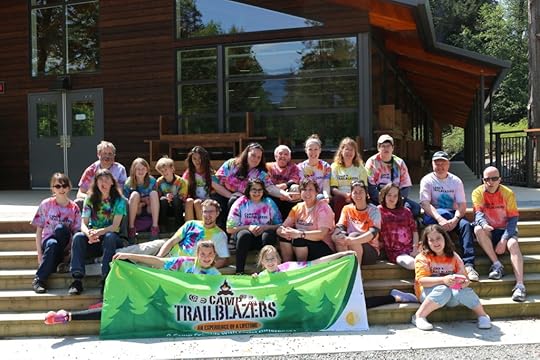
Finding my tribe at Camp Trailblazers in Vancouver, British Columbia, Canada.
It was a long drive from my house to the meeting location for Camp Trailblazers. I had to take a ferry crossing, an international border crossing, and Vancouver, British Columbia Friday afternoon traffic into consideration. Then I had to figure out where to park my car and how to pay to leave it for two days. I couldn’t be late, because we were meeting up to catch a passenger-only ferry to the island where camp was to be held. But getting the travel schedule right wasn’t the only thing on my mind.
I was nervous. For the first time in my life, I would be part of an assembly of people that all had one thing in common. Facial difference.
The event I had chosen to attend, Camp Trailblazers, is a family camp organized by AboutFace. AboutFace is a non-profit organization based in Canada that provides support and community for people with facial differences across the US and Canada. The camp is designed around youth and their families, so not only do young people with facial differences attend, but parents and siblings as well. Even though the focus is on youth, because there is nothing else like it in the region, a number of adults with facial differences opt to attend as well.
The opportunity to meet other adults, including some that I had only “met” online, as well as demonstrating to young people that it is possible to live a full and happy life despite having a facial difference, were what compelled me to attend.
Even so, I confess that I had reservations. People who meet me often believe me to be outgoing, but the reality is, I have introverted tendencies. This means I can be hesitant about meeting new people, and may not be the first to say something.
It’s not that I’m afraid to meet other people with facial differences. I’ve driven miles out of my way during vacation trips to meet up with individuals I’d developed connections with on line but had never met, but usually only one or two at a time. There was something daunting about meeting an entire group all at once.
How would you feel if you had the opportunity to be in a group with which you had something unique in common with? Elated? Threatened? Insecure? Empowered?
If you have already found your tribe, how did you feel about meeting them for the first time?
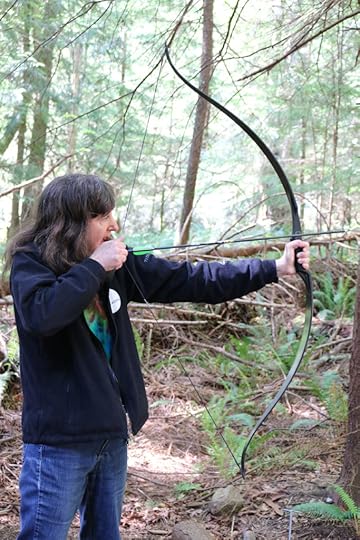
The camp offered some pretty amazing opportunities.
It may sound odd, but I was afraid of losing my uniqueness. For most of my life, I didn’t have opportunities to interact with other people that have facial differences. Because I have a degree of confidence and acceptance regarding my appearance, I am comfortable with the fact that my face helps me to stand out. I like to be unique and don’t mind being recognizable. In fact, I use it to my advantage when I can. It wasn’t until I became active on social media that I discovered entire communities of people with different faces for a whole variety of reasons.
In a group made up entirely of people with non-standard visages, however, I feared that an important aspect of my uniqueness would be taken away. I didn’t want to be “just like everyone else.”
After our group had assembled, we boarded the foot-ferry to the island where camp was being held. At first, I stuck closely to those few I knew previously. But once we got to camp and we all started to interact, I felt increasingly like I was coming home.
There are experiences we share in our day to day lives that most other people simply cannot identify with, and this automatically helps to create an incredible sense of community. Instead of being among strangers, I began to feel like I had found my tribe.
By the end of the weekend, I had partaken in some wonderful conversations, fun activities, and most importantly, I’d made new friends. I also knew I would never feel awkward going to a similar event in the future, even if I didn’t know anyone else there.
Who is your tribe? If you haven’t already, don’t be afraid to go find them. The rewards, and sense of community, are worth the effort.
The post Finding Your Tribe appeared first on Facing Up To It | Author and Speaker Dawn Shaw's Official Website.
January 2, 2017
The Emotional Process of My TEDx
What is a TEDx talk? TED is a national organization whose letters stands for Technology, Entertainment, Design, and their focus is on presenting “ideas worth spreading.” The “x” indicates that the event is independently organized and sponsored. To view my talk, titled Beauty Is an Inside Job (“What if how others see us depended more on our choices, actions and words rather than on how we look?”), scroll to the end or click HERE.
 I applied and was accepted into the Sno-Isle Libraries TEDx program.
Much has been written about the technical and organizational aspects of doing a TED or TEDx talk. Since those writers and coaches likely understand that process better than I do, I’ll leave that to them. What I’m exploring here is my emotional experience. Some of these feelings were also felt by others in the group I presented with, so they are common within the process. Such emotions could also crop up during the process of writing any speech or written work that incorporates personal stories and experiences to help get your point across.
I felt very fortunate to be accepted into a professionally run program that included coaching. I had one primary coach, yet I was fortunate to have input from several other coaches. However, getting input from several sources can be overwhelming and sometimes contradictory. There was one occasion in which I had so much input all at once that I seriously questioned if I was qualified to do this, but Anna Rohrbough, my primary coach, did a great job of helping me sort out and process the information so I could use the feedback effectively.
One of the biggest challenges for me was focusing on a single through-line. There were so many things I wanted to say; so many things I’ve learned from having a facial difference that I wanted to share. But not only would this be way too much information that would make the speech too long and overwhelm the audience, but it would also leave them scratching their head wondering what the speech was actually about.
Yet even knowing this, sometimes it was hard to let go of certain points that were particularly important to me. But I had to trust myself. Even though I was attached to certain points, the niggling voice in the back of my head said “maybe it doesn’t quite fit here, for this speech.” But none of my feedback suggested cutting them, so I left them in. Eventually, as my coach(es) and I focused the speech more and more, these things did get cut because the niggling voice had been right all along…they didn’t follow the through-line.
Sometimes I had trouble remembering part of my speech as I rehearsed, which made me question if maybe that part really didn’t belong. Alternatively, it could have meant that my transitions weren’t good enough. Once I had my through-line and all my transitions were good, it was very easy to remember because it flowed naturally from one point to the next.
Another huge challenge, and something I learned about myself during this process, is that I sometimes have trouble getting in touch with WHY a certain story has meaning to me- the “feel” behind the story. Some parts of my stories would cause me to choke up as I rehearsed them, so they obviously had deep meaning to me. Understanding the “why” is how we make a connection with the audience, so I kept having to dig deeper into myself to find those answers. Or, my coach would tell me what she thought the “why” was, and suddenly it was like yeah, of course, it seems so obvious now!
My greatest frustration was when I didn’t understanding what the coaches were asking me to do, even after a tête-à-tête with Anna. Sometimes I had to sleep on it, start to rewrite that section, or even say aloud what they were suggesting in order for it to “click.”
On the plus side, if a suggestion made sense and resonated within the context of the presentation, incorporating it into my narrative was easy for me to do. I didn’t have to “memorize” a whole new concept.
I was pushed. I wanted to be pushed, because I strive always to make a good thing better. Yet sometimes I didn’t particularly enjoy being pushed, so I resisted. I came to understand that this resistance was built on confusion- a lack of understanding of what was being suggested. I’m one of those people who needs processing time, yet before the processing is complete, I tend to push back. This is where having a compatible coach who understands this and didn’t mind the pushback became really important. Once I processed all the input, I was able to better develop my idea and really focus my message.
There were times that I questioned whether any of what I was saying made any sense. But this wasn’t a major hurdle for me because I went through phases with each of the three books I’ve written, deciding at one point or another that the content was terrible and experiencing a mild anxiety attack because of it. I knew the phase would pass, and I trusted the coaches. They wouldn’t let me produce a substandard speech. As the process neared it’s end, I had confidence that what I was producing was not just good, but exceptionally good, possibly even great.
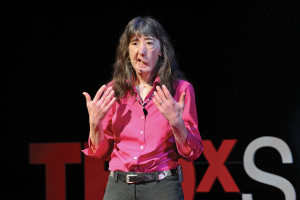 Prior to any event, I tend to be fine until the night before or the morning of. However, in this case, the nerves started to hit the Monday before, four days prior to the scheduled event. I attribute this to my perceived importance of doing a TEDx; deciding in my mind that this could be a turning point in my speaking career. Thankfully, with a little help from the Sno-Isle support staff, I was able to quell the nerves enough so that I didn’t have to go four days without eating or sleeping. I convinced myself that I could do this, that it was OK to be excited about it, I knew my speech really well, and that it was good.
My biggest fear by far was that I’d forget part of my speech on stage. In fact, we were given tips on what to do if that happened- hints to get back on track. I gave the talk in front of a live audience at the Edmonds Center for the Arts on Friday November 18th. While my delivery was not flawless, I am relieved to say that my memory didn’t blank.
When it was over, after I’d unmiked and went back to the greenroom and sat down, it was like a weight had been lifted. It was done. I was free. But there were times in the hours after that I shook from the slow release of stored up adrenaline.
That night, I got to sleep just fine, but awoke at 4 am.
I must have cried half a dozen times between Friday evening (as I was driving home) through Saturday afternoon. I attribute my tears to joy, for having been so well received; grief, for having to let go of all that intense focus and purpose; and possibly, as Anna pointed out, the combination of anticipation and fear that accompanies glimpsing my true potential.
I watched the live stream, which had still been available after-the-fact, and I felt better. Usually I don’t like to watch myself, but I must have needed to.
Finally, I am filled with gratitude. I am grateful for this opportunity to fulfill my goal of being on stage presenting a TED or TEDx talk. I hadn’t imagined it would happen this soon. I am especially grateful to all involved for helping through this process, especially Anna, Ken Harvey (Communications Director and TEDx coordinator with Sno-Isle Libraries) and private speaking coach extraordinaire Michelle Mazure. I know that all the coaching and support gave me a much better end product than I could have done on my own.
One last thing I’d like to emphasize- always be true to your message and to your style and voice. Ultimately it’s you up there on that stage and it’s your message being spread, so if you feel strongly enough about an aspect of your content, there is no niggling voice telling you it doesn’t belong, and you’ve considered carefully any arguments to the contrary, it’s on you to make that final decision.
For those who haven’t seen it, here is my TEDx talk, titled Beauty Is an Inside Job.
The post The Emotional Process of My TEDx appeared first on Facing Up To It | Author and Speaker Dawn Shaw's Official Website.
December 20, 2016
Different Face in a Different Place; Traveling with a Facial Difference
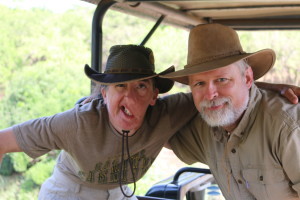
In the safari vehicle at Zulu Nyala.
I enjoy traveling. In fact, my husband Ian and I recently returned from an epic trip to South Africa.
Good thing I am not afraid to show this face to the world.
However, I understand that some people with physical differences are afraid. Afraid of sideways glances, comments, stares, assumptions, questions…afraid of unwanted attention. I am not immune to these things- they do happen to me on occasion- but I have chosen not to allow them to interfere with my ability to experience and enjoy what life has to offer.
My facial paralysis has been with me all my life. Perhaps this gives me an advantage, as I know nothing different.
Another advantage may be that I am no stranger to traveling. I went with my parents and siblings on many a family trip from a very young age- trips that criss-crossed these great United States. This early exposure got me used to the reactions of others, and the fact that my parents didn’t hide me away taught me that I had value.
I was also instilled with a sense of independence. When I was 19, I spent a university term visiting Italy and England as part of a College of Fine and Performing Arts tour, which required participating students to visit art museums and attend theatrical and musical performances. After that life-changing experience, armed with a BritRail pass, I took off completely on my own for two weeks to northern England and Scotland before returning home.
During my European travels, I have no recollection of being treated any differently because of my appearance. In fact, I remember that fellow travelers were very helpful, especially when I was on my own.
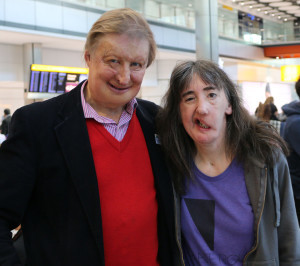
Me with James Partridge of Changing Faces.
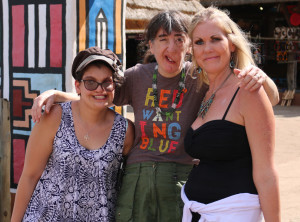
Aneesa, Vanessa and I at the Lesedi Cultural Village. This is the first time we’d met in person.
Nowadays, whenever I travel, if the opportunity lends itself, I’ll meet people in person I would otherwise have only known via the internet or social media. For me, it is often people from the facial difference community. In this digital age, there is still no substitute for a handshake, an in-person conversation, and a hug. The South Africa trip was no exception. I was honored that James Partridge of Changing Faces took the time to meet us at the airport in Heathrow during our long layover. In Johannesburg, I had the pleasure of meeting social media and fellow facial difference community friends Vanessa and Aneesa.
Did my different face receive unwanted attention during this journey? Sure.
Since my face is now tied in with my profession, it is possible that I am more aware of being noticed than I used to be.
I got a few looks from the group of men in a large party seated near us in a restaurant in Cape Town. But very quickly their own topics of conversation became much more interesting than my appearance. Admittedly, we were just as curious about them- what would bring this rather large group of middle-aged and older men together? I eventually asked one of them, and was informed that they were a group of opera-lovers who met monthly. They had selected the restaurant for this particular meeting because they were marking a special occasion.
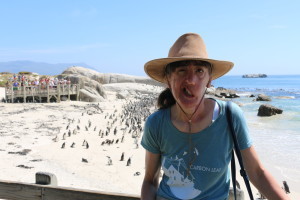
Penguins at Boulder Beach.
There was the woman at Zulu Nyala, the private reserve/resort where we did our safari excursions, who took a good long look at me, even after I’d noticed her. I thought maybe she was European and it might be a cultural thing to not have the sort of boundaries that would cause her to look away after I’d caught her staring. However, I found out the next day that she was American!
And there was the guy wearing a kilt who asked Ian about my face while I was shopping in the gift shop. When Ian told me this, saying that the guy was a retired anesthesiologist citing “professional curiosity,” my initial reaction was he could have asked ME! I was, after all, standing 15 feet away. As a medical professional you’d think he’d know better, But…they don’t. (That’s a whole other topic, and as a speaker, I would love to address the medical profession about this.)
Any of these things could have happened near my home town. In fact, similar incidences have.
For some, the next town is too far. Heck, for some people, their front door forms a significant barrier between them and the world.
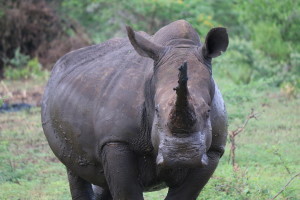
The creatures we encountered grouped me in with all other humans. Nothing special about me.
The majority of people I came into contact with, including our drivers and guides, treated me with professional respect. I’m sure they noticed my difference and were probably curious, but they neither asked about it nor betrayed it in their expression. Frankly, what they thought of me initially didn’t matter. I really didn’t care. I cared that they treated me professionally and helped me have a good experience. And they did.
Yet this is a sticking point for a lot of people- being afraid of what others think. This is something we have no control over, yet we all too often allow it to affect our choices and actions. What we are doing in these cases is giving others control over us.
If you are one of those people for whom traveling to a foreign country is too big of a step, then take smaller steps. Go with a friend or relative rather than going alone. Engage in an activity that occupies your mind. If you’re worried about unwanted attention, try to concentrate on what you’re there to do or see rather than those around you.
Keep pushing your comfort zone. If you become a victim of unwanted attention, process the experience and move on, but don’t allow it to force you into hiding. No one should be allowed to have that sort of control over you. Besides, usually they mean no harm.
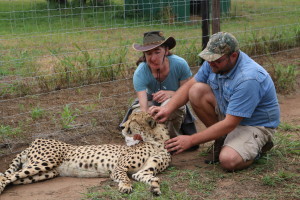
Scratching the chin of a purring cheetah.
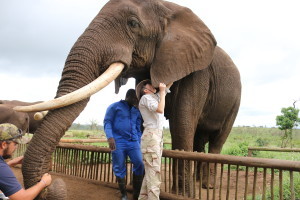
If I was afraid to venture out, think of all the stuff I’d miss out on. Like feeling the inside of an elephant’s ear. Or petting a cheetah. The opportunity to do these things are a direct result of the choices I’ve made. This includes the choice to NOT let my facial paralysis or worrying about what others think stop me from getting out and experiencing the world.
You, too, have a choice. Face your fear. Own your life. Choose freedom.
The post Different Face in a Different Place; Traveling with a Facial Difference appeared first on Facing Up To It | Author and Speaker Dawn Shaw's Official Website.
December 8, 2016
The Surgery Experiment
 I did this periodically with cotton candy. I loved it’s sweet sticky mouth-staining goodness when I was a kid, but when I got older I appreciated it much less. In fact, it became rather abhorrent. But about once a decade, I would feel compelled to give it a try to remind myself that indeed, it no longer fit my culinary tastes. The last time I was probably in my thirties, and that was convincing enough that I now consider myself cured of ever needing to try it again.
I recently did something similar with elective facial surgery. You may think that’s a little more extreme than cotton candy, and you’d be right! However, this was a smaller procedure that I believed might actually improve a quality of life issue- it was important that any procedure I agreed to address a quality of life issue, and not just be cosmetic.
The surgeon had also suggested a much more extensive procedure, but I deemed it to be unnecessary and far too invasive. You can read the details on the one I didn’t do in a previous blog titled Facial Reconstructive Surgery; Improvement or Not?
Since movement on the left side of my face is limited, my left eye doesn’t blink on its own. This leaves it open and susceptible to drying out, and subsequently watering, dripping tears down my face at inopportune moments.
The procedure I opted for was designed to help the eye close more easily, which would decrease the drying surface and help it maintain lubrication. It would accomplish this by using a tendon from my wrist like a sling to pull up the lower lid while inserting a small gold weight into my eyelid to help it come down.

Surgery in the modern age: computer monitors and LED lights.
It was my first surgery I’d allowed on my face in 29 years. My memories of what it was like to have surgery were a little behind the times. When I was wheeled into the operating room, all the monitors struck me as being more like a sports bar than a medical facility. Basically, surgery had entered the digital age.
One aspect I appreciated was that instead of just covering you in warm blankets, they pumped warm air all around you. Between nerves and a chilled environment, I tended to shiver, and this definitely helped. They also thought more about my comfort, putting a pillow under my knees to help my back.
What wasn’t new is that needles still hurt, the IV needles are still very long, and the anesthesia is just as quick to put me under. Yet I was also impressed at how quickly I recovered once I woke up. I had a friendly volunteer there to greet me with a smile and a genuine interest in my well-being.
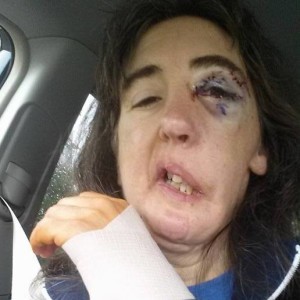
This was taken on the way home from surgery. It had been a outpatient procedure.
The surgery itself went fine. I had three new scars to add to my collection: on my left wrist where they’d removed the tendon; a small one below my left eyebrow marking the attachment point of the tendon; and my eyelid which bulged out due to the addition of the gold weight.
I was reminded that pain still hurts, scars still itch, and areas go numb as the nerves rebel. (The nerves generally recover in time, but not always.)
In terms of healing, my wrist became usable far faster than I expected- in fact they encouraged me to use it. My eyelid was swollen and droopy- more droopy than I preferred- but I decide to see how it looked once it had healed.
About a month later, two out of the three incision areas were looking great. My post-op appointment had gone fine, but then I started to notice something odd when I looked in the mirror. Was that a glint of…? No, couldn’t be.
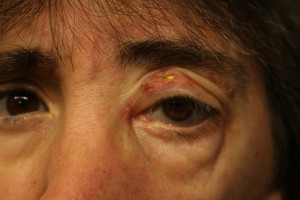
Just call me Golden Eye. In this case, all that glitters actually WAS gold.
But finally I could deny it no longer. The mirror displayed an unmistakable glint of gold. The incision had failed to close properly. I took a selfie and sent it to my doctor (another advantage of the digital age), and an appointment was set up to have it removed.
This turned out to be quite the chore. It was an in-office procedure, and the surgeon basically grabbed on and pulled. It was stuck- tied in by sutures that were supposed to have dissolved. The local anesthetic did nothing the numb the area, so I got to feel the full force of the effort. They even denied me whiskey! (The nerve!)
I was told that I could have the gold insert put back in 3 months once the healing was complete.
No, thank you. I’ll pass. I don’t want to put myself through that again, and besides, the eyelid had been much droopier than I’d anticipated. Had it healed properly and stayed like that, I might have opted for it’s removal anyway!
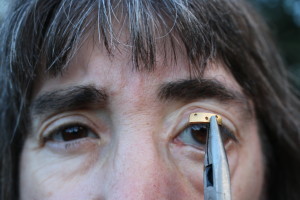
Here is the insert on the outside of my eyelid to give you a idea of scale.
I hadn’t realized until I actually saw the insert just how big it was. (Yes, I kept it. I paid for it, after all.)
It just figures that something would go wrong.
I’ve not been a huge advocate for surgery as a solution for facial differences (except when improved function and/or comfort are concerned), and this latest procedure reminded me of why I feel that way. It’s not a cure for insecurity, vanity and low self-esteem.
Besides, surgery seems to require a constant rearrangement of body parts, and I really didn’t need the extra scars.
I don’t blame my surgeon- he and his staff were very professional- but that’s just it. There are always SO many things that can go wrong. This is my fourth surgery that involved a complication that I am aware of, and the third in which something that was done had to be undone.
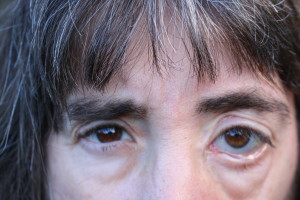
How I look now.
People ask me all the time “did it help?” For a long time I had no answer. I needed to wait until things had healed.
Was it a cure for the watering eye? No. But I now use eye drops at my ophthalmologist’s recommendation to stave off problems associated with dry eye. Aside from that, it is possible that maybe my eye waters less often, but it’s difficult to make a before/after comparison.
People also ask me “Are you happy with the results?” Though I am happy with the lower lid “lift,” knowing what I know now, I likely would not have done the procedure. It needed to have more than a cosmetic result to be helpful for me, and I’m still not completely satisfied that it has achieved a reduction in tearing. That being said, despite everything, I have no regrets. If this had worked as intended it might have been really helpful, and I couldn’t know if I hadn’t tried.
I own this decision- it was mine alone and I’d deemed it worth a try.
However, curiosity satisfied, it may be another 30 years before I allow another surgeon to touch my face again. Or like cotton candy, I may be over it once and for all.
The post The Surgery Experiment appeared first on Facing Up To It | Author and Speaker Dawn Shaw's Official Website.
February 27, 2016
Taking a Risk; The Story of an Icelandic Horse
But I did pay for him. $500. I decided he was worth taking a risk. Besides, he needed me, or at least he needed someone like me.
And I needed him, or at least I needed a horse like him. I run Lone Cedar Icelandic Horses, small Icelandic horse farm where I do a little breeding and a little training, but mostly I just enjoy my horses. In 2015, I sold six horses, leaving me with 6 mares and 1 lovely black stallion named Sindri. Sounds like a fun situation for Sindri, right? But I can’t leave him in with mares all the time, as much as he’d prefer I do. And since I don’t believe in keeping horses alone because they are a herd animal, I decided to keep an eye out for an inexpensive gelding to keep Sindri company.
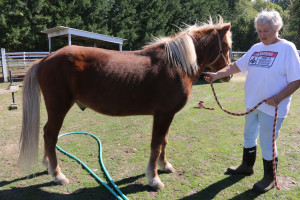
Rosti on September 28th when I picked him up from my friend Karen, who is holding him.
I created the Icelandic Horse Rescue and Registration group on Facebook, so I got notification right away when someone shared the Craigslist ad for the Icelandic gelding Rosti. He was 23, trained to ride, registered, imported from Iceland…and underweight. The ad stated that he had issues that prevented him from digesting hay and needed to be given senior feed. The ad stated that they didn’t use him enough to justify the extra expense for the feed, so they’d decided to sell him instead. To the owner’s credit, they portrayed this horse as honestly as possible. For example, they said he’d had his teeth floated earlier that year, and I believed them. It also turned out that a friend of mine had been the one who’d imported Rosti from Iceland. She’d sold him to this family about a year later, and they’d had him for 15 years. He was friendly, personable, and a bit spoiled from being handled a lot by children.
But I was worried about what the owners may not know. What might be hidden inside the horse’s fragile digestive system? With reservations, I sent the money to the owner via PayPal and he became mine.
My friend, the same one who’d originally imported him, picked him up for me from the owner’s farm. I was grateful to her as it would save me about four hours of additional driving, plus she knew the owners and knew right where to go. He was thin but not emaciated, yet he was wobbly and she was worried about him during the trailer ride back to her farm in Battleground, Washington. By the time I picked him up 2 days later, he had perked up considerably. My friend was feeding him well and he was eating well. This was encouraging.
And yes, he was rude and pushy, but I could deal with that in due time.
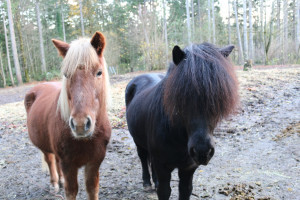
I am grateful that Rosti gets along with my stallion Sindri. Photo from 11-19-2015
Not only was I taking a risk regarding his health, but I also wasn’t sure how he would get along with Sindri. I’d had problems with my other geldings being a bit rough with my 20-year-old, non-aggressive black stallion. I hit the jackpot there and breathed a big sigh of relief- Rosti and Sindri got along famously, and still do.
Shortly after I brought him home, Rosti was standing in his pen sweating. It wasn’t especially warm. In horses, this is a distinct sign of distress. He kept kicking at his sheath, and my friend Susan, who happened to be over visiting, asked if maybe he had a “bean” that was giving him trouble. (A bean is made up of dirt and excretions that hardens inside the penis and can actually cause blockage if allowed to get big enough.) I wasn’t sure how Rosti would react, but he was quite receptive to having me feel around “down there,” and sure enough, I squeezed out a bean about the size of my thumb. The results were almost immediate- he stopped sweating, though he was still kicking at himself.
A few days later, I pulled another one out about half the size of the original.
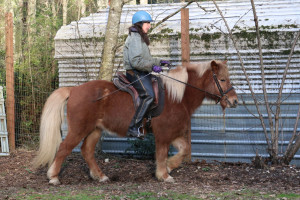
Riding Rosti for the first time on 2-22-2016.
I also put him on Omeprezole almost immediately. This is a human medication designed for ulcer relief. It’s available over the counter at Costco. I can’t imagine what the checkers think when we walk out with a whole stack, because I needed to dose him at about 9 pills per day for a minimum of 30 days. But at a cost of approximately $120, it’s way cheaper than a vet’s diagnosis and it won’t do any harm. I became a believer in Omeprazole after giving it to Sindri. I’d had Sindri for about a year and had trouble putting weight on him. A fellow horse person suggested he might have ulcers and that Omeprazole was an inexpensive, low risk way to treat them. A couple of months after completing the 30-day cycle, Sindri gained weight and I would consider him plump.
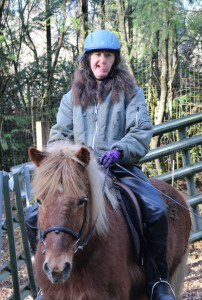
How is Rosti to ride? My expression says it all.
I was told that Rosti was a brat to ride; that he wanted his own way. I chalked that up to being ridden by children. But when I finally rode him for the first time a few days ago, I was pleasantly surprised. He did everything I asked, no problems. I had body work done on him about a month after I brought him home, and there had been a lot of things out of alignment. Add to that the possibility that he’d had discomfort from ulcers, and who knows how long that bean in his penis had been a painful issue. When a horse is in pain, of course they are going to act up. When I rode him on the trail the next day, he expressed his opinion a couple of times, but otherwise
behaved perfectly. He has an energetic walk that is pleasant to ride. I did have trouble pushing him into anything faster than a walk, but when I did, he offered tölt (the smooth, four-beat gait unique to the Icelandic horse), even if it was a bit slow. But I also have to consider this is an older horse who is very out of shape and lacking muscle.
As for all that feed I was supposed to have to be giving him, because of his weight gain, I’ve cut him back to just hay with a vitamin supplement, and so far he’s doing just fine.
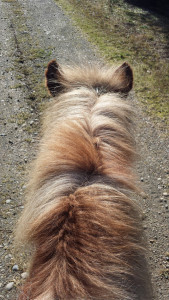
The view from Rosti’s back during our first ride out.
His previous owners did the right thing by finding him another home. I just happened to have the right set of experiences to be successful with him. If he’d had other issues, he might not have done so well here.
A horse I was reluctant to pay for so far has turned out to be a bargain. I’d weighed the possibilities, realizing I may be paying $500 for a horse I’d then have to put down. I’m grateful it didn’t come to that. I now have an older, somewhat opinionated gentleman who is a great companion for my stallion and is turning out to be a safe riding horse. Sometimes it’s worth taking a risk.
I hope that the surgery I’m having next week is a risk worth taking as well!
[DISCLAIMER: I am not a veterinarian and the suggestions I’ve made are not meant to be taken as medical advice. I have merely shared what has worked for me and my horses in their situations and make no guarantee they will work in all similar situations.]
The post Taking a Risk; The Story of an Icelandic Horse appeared first on Facing Up To It | Author and Speaker Dawn Shaw's Official Website.
February 18, 2016
Facial Reconstructive Surgery- Improvement or Not?
When the producer of Body Bizarre, the show that shot a segment about me to air later this year, asked me if I’d be willing to do a consultation with a surgeon regarding facial reconstructive surgery, I was reluctant. But curiosity quickly got the better of me.
A little back story: I was born with a benign but fast growing tumor that threatened my airway. It was deeply embedded, so removing it meant taking out bone, nerve and muscle as well, leaving the left half of my face paralyzed. I had a number of reconstructive and cosmetic surgeries during my youth.
It’s been 29 years since my last facial reconstructive surgery. I quit having them because when I was 21 the one I had went terribly wrong. I woke up in intensive care with a tube down my throat that was holding my airway open so it wouldn’t swell shut. After that horrific experience, I determined that the infinitesimal improvements made by each procedure did not justify the physical and emotional cost. Therefore, I needed to accept my appearance as it was and move on with my life. Over the intervening years, I’ve learned to not only accept but to embrace how I look.
But medical science has advanced and I am always open to discussion, so at the behest of the TV show, the appointment was set up. The producer had done some research, and the surgeon I was to see came highly recommended.
There were six of us in the tiny examining room that day: me, my husband Ian, the surgeon, his associate, their intern, and the videographer from the TV show. After some poking and prodding, demonstrations of movement (or lack thereof) in my face and shoulders, and a lot of discussion, the surgeon made his recommendations.
His first option involved a pretty major procedure.
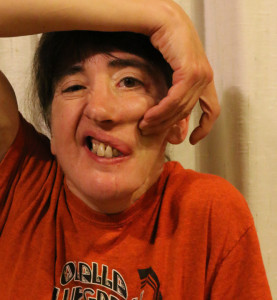
You’re saying I’d have to shrug my shoulders to smile? Well, at first, yes.
[Paraphrasing] “We would take a muscle from your thigh and transplant it to the left side of your face.”
I was quick to interject. “Well, you’d have to take it from the right thigh because they’ve already taken one from the left thigh. But then at least both sides would match!”
“We’d have to connect it to a working muscle in order to animate it,” he continued, “and since the masseter muscle on that side is missing, we would have to use one in either your neck or shoulder.”
“Um, so what you’re saying is that I’d have to shrug my shoulders to smile?“
“At first, yes, but by doing exercises and training the muscle over time most of our patients are able to activate it automatically. They no longer have to consciously shrug- it becomes more involuntary. Here, let me show you what it would look like.”
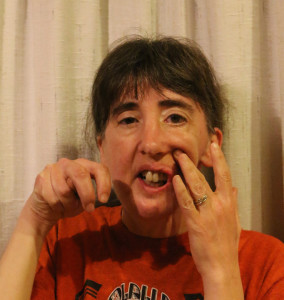
I’ll look like a woodchuck! (She’s got TEETH!)
With that, he positioned me in front of a mirror, stood behind me, and gently pulled up the left lip. It made my mouth rounder in its relaxed state, but all I could see were that my front teeth were fully exposed and prominent.
I did not say this aloud, but I thought to myself:
So basically there would be a gaping hole in my right thigh, I’d have to shrug my shoulders to smile, and I’d look like a woodchuck.
Plus it is a 6-hour procedure and would keep me in the hospital for approximately four days. Add to that a significant recovery time with limited ability to take care of my horses, let alone ride.
“I really think it would be a great improvement for you,” the surgeon insisted. “It would not only improve symmetry, but would really improve your speech and your ability to eat.”
My speech is fine…and I really don’t get how it will improve my eating since it won’t add teeth or improve connectivity on the left side.
But that’s just it. The surgeon has the ideology that lots of people seem to have- that any improvement is better than no improvement. If it can be done, then it should be done, and he sincerely believes that he’d be doing great things for me. I’ve had a number of people suggest to me that additional surgery can really “help” me, sometimes even giving me the name of a surgeon I should contact. As stated in my new book Facial Shift, Adjusting to an Altered Appearance, people don’t understand that it takes just an infinitesimal amount of asymmetry for it to noticeable that someone is “different.” The degree of difference matters little.
I’ve opted out of this particular procedure. It’s too invasive, and the outcome too nebulous. Most significantly, the thought of it fills me with dread, not optimism. If I were 16, I might well go for it. In fact, up until the surgery at age 21, I went along with doing surgeries because I understood that this was the thing to do. Until the one nearly killed me, I never gave much thought to stopping.
Now, however, as I near age 50, I’m used to this face in the mirror. I don’t want to look in the mirror and not see me, or worse yet, a face that looks worse, not better.
It’s not like I can just say “please put it all back” if I am unhappy with the result.
I am not opposed to the concept surgery, especially if it can improve something that causes discomfort or fixes something that might cause potential problems in the future. In fact, I have elected to go ahead with the surgeon’s second option, which is a much less extensive procedure. My left eye doesn’t close all the way, so it gets dry and irritated. It tears up, often dripping down my face. While I do not seem to have a problem with eye infections, that is certainly a possibility, increasingly so as I get older.
The tendon would pull up the sagging lower lid and the gold would weigh down the upper lid, increasing their ability to meet.
The surgeon will take a tendon from my wrist and use that to pull up the sagging lid below my left eye. He will then insert a gold weight in my upper eyelid. When I expressed concern that it would pull my eyelid down, he said that the muscle that keeps the eye open is working, so that won’t be an issue. The hope is that by bringing the lower lid up and weighing the upper lid down, the two would more effectively meet, allowing more protection for the eye. What it will not do is restore my ability to blink that eye.
It helped my decision that this is a two hour outpatient procedure. The worst part will likely be the incision in my wrist, for which I’ll have to lay off horse handling and horse chores for 2-3 weeks.
I hope it works, but after all the surgeries that failed to meet expectations, I’m not overly emotionally invested. But I figured if it makes my eye more comfortable and causes less irritation and dripping, it’s worth a shot.
My takeaway is that it’s OK to be OK with who you are and how you look. Anything you do undertake should be for yourself and no one else.
The procedure involving my eye may slightly improve my appearance. But I don’t really care about that.
The post Facial Reconstructive Surgery- Improvement or Not? appeared first on Facing Up To It | Author and Speaker Dawn Shaw's Official Website.
December 14, 2015
Back Again to the Mandolin
Have you had an activity or hobby that you do for awhile, then other priorities take over, but then something happens and you get sucked back in? That seems to be my relationship with the mandolin.

Somehow, someway, the mandolin keeps drawing me back.
I took up mandolin a number of years ago for a couple of reasons. Primarily, my husband Ian is an avid guitar player, so playing an instrument provided another activity that we could do together. I chose mandolin because I wanted to play a stringed instument other than guitar, and I was inspired by the artistic playing of Carter Gravatt of Carbon Leaf. Ian bought me an inexpensive instrument, I found an instructor through an online search and diligently started taking lessons.
I’ve always been more consistent when I’ve been working for a specific goal, and my goal evolved from picking tunes (which I could never seem to do fast enough) to learning chords so I could participate in jam sessions. For awhile, Ian and I attended some organized public bluegrass jams moderated by Bremerton musician Terry Enyeart, my third and most recent instructor. We also started regular private jams with Dave Magnenat, a close friend who had recently taken an interest in mandolin himself.
The public jams and the more intimate sessions with Dave were fun and gave me some incentive to practice. But then Dave was diagnosed with Leukemia, and he spent long periods in the hospital for treatment. We played together when we could; one time we played and sang in the conference room down the hall from his hospital room. But there would be long stretches when he wasn’t allowed visitors, and times he was too weak to sing and play. My interest in mandolin waned, so it got set aside for a period of months.
On December 3, 2014, complications from Leukemia treatment ended Dave’s life, but from that tragedy emerged new a new incentive to play. We bought Dave’s mandolin from his widow, and I was determined to play it at his celebration of life party the following month. Dave had requested that if there was any kind of a party, that someone needed to play the old bluegrass tune “Rollin’ in My Sweet Baby’s Arms.” Since Dave had taken a couple of lessons from Terry and been to a few of the public jams, I asked if Terry would be willing to play and sing lead. Terry readily agreed. Terry and Ian played guitar, and I played Dave’s mandolin. I even sang along.
But then, the incentive over, I set the mandolin down. I may have picked it up once or twice, but I got busy with other things and there it sat silently for many months.
Then, I was contacted by Discovery/TLC about doing a segment about me in one of their shows. (You can read about that in a previous blog post: Why I Said Yes to Body Bizarre.) To accompany my interview, in which I talk about my life with a facial difference, they wanted footage of activities I regularly do and enjoy, so I suggested live music since it is such an important aspect of my life. What I had in mind was going to see a band, but during our very limited shooting window not only were none of the many bands I follow in the area, but it was slim pickings for any sort of live music that I was remotely interested in. On a whim, I contacted Terry to ask if he knew about anything in the area, because he is a member of at least four bands and is well-connected in the community. He didn’t know of any concerts, but he did mention that he was moderating a bluegrass jam on one of the two scheduled shooting nights. I instantly recognized what a great idea that was.
I’m not sure why I thought it was such a great idea. This was about 10 days before the scheduled shoot, and it had probably been at least 9 months since I’d picked up my instrument.
Ian and I rehearsed a few times, and I was amazed at how quickly it came back to me. But what I know is limited. I am not an expert player- heck, I’m not even an average player- and when we did the jam with the Discovery videographer I was pretty lost most of the time. However, I did play and sing one song I know well, which was captured on camera. I guess we’ll see how it turned out sometime in 2016 when the episode airs.
It’s not that I don’t love the mandolin. I enjoy the instrument, but I recognize it is not my passion. It is highly unlikely that I will ever play professionally, and nor is that even one of my goals. But it seems to be one of those activities that draws me back again and again, and one that I enjoy enough to choose not to resist.
The post Back Again to the Mandolin appeared first on Facing Up To It | Author and Speaker Dawn Shaw's Official Website.
November 24, 2015
Why I Said Yes to Body Bizarre
When I was contacted via email by a producer from TLC/Discovery’s show Body Bizarre about featuring me in a segment, I took a day to think about it, even though I pretty much knew from the outset that my answer would be “yes.”
The press on Body Bizarre reads as follows: “Body Bizarre criss-crosses the globe in search of extraordinary individuals living with some of the planet’s most mysterious, unusual and thought-provoking medical anomalies that have even puzzled the world’s best doctors and experts. From India to Indonesia, China to Ethiopia, the Dominican Republic, Hawaii, the United Kingdom, Texas and more, BODY BIZARRE uncovers the real human stories behind the headlines and brings to light what life is genuinely like for these remarkable people whose lives have been afflicted by physically and emotionally horrifying syndromes.” (Inquirer.net)
This does make it sound rather exploitative.
And then there’s the show’s title. My contact didn’t even tell me the title in her initial email. She admitted that the title was “challenging,” but insisted that it was the intention of the show to educate and to share inspirational stories, even if the title fed into sensationalism. She sent me a link to a segment, and I watched it. I was impressed at how they handled the woman’s story, so I decided to trust them with mine.
I’ve been wanting to get my message out to more people. One way to do that is via media exposure, and this opportunity had just dropped in my lap.

My face is different, but my body is not bizarre.
I understand that a show with a title and subject matter like “Body Bizarre” might attract voyeuristic viewers. As a concerned friend bluntly pointed out, it could be considered a “freak of the week” show, and he was worried that I might become an object for ridicule. I appreciate his concern. I know that doing a show like this is a risk, but the more I thought about it, the more I realized that it was a risk worth taking.
No one can control viewer motivations or reactions. However, if people want to point, laugh and make fun of me, I’m all over the internet via my web page and my Friending the Mirror webinar series, so they have plenty of opportunities. I’m not afraid to be on camera. In fact, I welcome it. That’s why I do webinars instead of podcasts- because I feel that the visual is just as important as the audio.
Then, a few weeks after I sent the email agreeing to appear, I saw a link to a blog from someone else who had been asked to do a segment for the show. Her blog was about why she said “no.” After reading her blog, I began to second-guess myself. Then, after more thought, I stood by my reasons to go ahead with it. I do not have the name of the blogger nor do I have the link, so I can only focus from memory on the points that stood out to me.
The blogger had been concerned about losing control of her message, since she would have no say over the copy for the voice-over narration or how the segment would be edited. Coming from a background of having worked in video production and editing, I am aware of how shows are put together and of the power of editing. That is out of my hands. But there are things I do have control over. I have control over what I say during the interview. I have control over how I behave and how I present myself. I have control over my attitude. I also helped select the sorts of activities we’ll be shooting, so it will be a fair representation of my life. We’ll be including my Icelandic horses, the making of a webinar, and live music. My husband Ian is going to appear on the show with me, demonstrating that people with a facial difference can find long term, loving relationships with “normal” looking people.
The blogger was also concerned about being the representative for her particular condition. She didn’t want to be responsible for how it was portrayed. Since I was born with a very rare form of tumor, the removal of which left my face half paralyzed, my case is fairly unique. I don’t have to worry about what other people with teratomas might think about how I represented them. Not that it would matter. Each person has a unique story, and I can only present my own.
I am hopeful that the exposure might garner interest in having me come speak to schools and groups about resilience and accepting differences. But I can’t count on that.
The best I can hope for is that by putting myself out there and being a role model for self-acceptance and facing the world with confidence, I can inspire and motivate someone who is less secure about their appearance to face their insecurities, go out into the world and live a happier and more productive life.
If I can help change even one life for the better without bringing significant negative attention on myself, it’ll have been worth it.
And besides, I’m kind of a ham. I wanted to do the show because I thought it might be fun.
Shooting takes place December 1st and 2nd (2015). Despite my confidence and resolve to do this to the best of my ability and my determination to have a good time, I am still holding my breath, hoping for a good result.
The post Why I Said Yes to Body Bizarre appeared first on Facing Up To It | Author and Speaker Dawn Shaw's Official Website.
October 4, 2015
Belonging

Holding the author’s proof of my memoir Facing Up to It- written with no clear theme in mind. Thankfully it still turned out well.
I wrote my memoir Facing Up to It backwards. This doesn’t mean I started at the end and wrote until I got to the beginning. What it means is that I started by writing it. I had no ideal reader, no outline, and no theme. I just wrote. After years of writing, long periods of not writing, more writing, hiring an editor, another long period of rewriting, and finding an indy publisher to help me with the design details, I ended up with a published book. While thankfully I am a good writer and it turned out well, it could have been better if I’d had had a theme and an ideal reader in mind when I wrote it.
One theme that emerges over and over in the text is the importance of belonging. I didn’t realize how important that was to me until after I’d read my own book.
As social creatures, it is natural for human beings to want to feel they are an accepted part of a group or community. Usually these are based on commonalities.
Growing up, I never had any connection with other people who have facial differences. Now, thanks to social media, I am connected with others worldwide. I have joined that community, and I feel like I belong. We share common experiences, such as being stared at and having to have surgery, as well as similar emotions such as doubt- temporary or long term- about our ability to find a romantic partner.
In college, I found a sense of belonging when I joined the Science Fiction/Fantasy Club, and again when I started hanging out with the Theater crowd. When I spent six weeks in Iceland on a horse farm, I was afraid I’d be the outsider because I was considerably older than the other working students and I was American rather than European. But our common experience and goals as well as all of our open and accepting personalities made me one of them. When you’re that far from home, it was important for me to belong.
You need only look at the success of discussion groups on Facebook to see how important a sense of community is to humankind. We gravitate toward people with similar interests, backgrounds, beliefs, experiences, physical appearance, vocation- we formulate our identity in a variety of ways. For example, my communities include authors, Icelandic horse owners/enthusiasts, music lovers, professional speakers, and other people with facial differences. When I can do projects that merge two or more of these passions, so much the better.

Friends I’ve made in the facial difference community.
I think communities are great, and I’ve made a lot of new friends and acquaintances. However, I do have one caution. People sometimes identify with a certain community so strongly that it becomes an “us vs them” mentality. While it’s great when someone finds people who share experiences and are like-minded, identity with a community should not be at the exclusion of all else. I certainly do not agree with everything that is expressed by other members of the facial difference community, especially when it comes to terminology. But our disagreement comes from a place of understanding and respect rather than being adversarial. As for the Icelandic horse community, there are as many differing opinions as there are people who own horses.
As much as I emphasize with that desire to belong, I encourage people to keep an open mind and maintain their autonomy. Identity need not equal conformity. After all, it is our combination of experiences that truly make us individual, and that is how we complement each other. So find your people. Enjoy that sense of community; of belonging. Just maintain your individuality.
The post Belonging appeared first on Facing Up To It | Author and Speaker Dawn Shaw's Official Website.