
Doug Lemov's Blog
October 20, 2025
The Room Seemed to Ache with Loneliness: Jaime Johnson’s Formative Writing Routine

The room seemed to ache with loneliness… and an ardent desire to participate…
One of the most powerful things we can do in classrooms is to allow for frequent formative writing… and in fact to make formative writing a routine for students. Especially when we make it a routine to write formatively in response to rich content.
I want to share a beautiful video of the why and how of that idea from Jaime Johnson’s classroom at Bay Creek Middle School in Gwinnett County, Georgia.
But first let me define the term ‘formative writing.’
Formative writing is where students use writing to discover and develop what they think. You might think of it in contrast to “summative writing” in which students explain what they think. The key difference is that in formative writing, you don’t know for sure before you start writing. The purpose of the writing is to discover, to think slowly and deeply about an idea you’ve just encountered.
If we can do that frequently—throughout class in short bursts—we can cause students to think expand and deepen their own nascent ideas.
In this video, then, it’s important that the writing happens in the midst of reading.
Jaime is reading Grace Lin’s Where the Mountain Meets the Moon with her students.
“Suddenly,” the passage reads, describing the protagonist’s Minli’s point of view “the room seemed to ache with loneliness.”
Jaime’s pauses. “Will you take about 60 seconds,” she says just after they read this line, “Silent solo….everybody writing… Why might she feel this way?”
There are a couple of really important details to observe here.
The writing is midstream. Just a few seconds after they’ve been immersed in the story everyone is reflecting on it in writing. The speed of this transition is important because all of the thoughts in students’ working memory as they read remain available to them as they begin writing. It takes just 15-20 seconds for the typical person to lose ideas that are in working memory. So writing right away, before those 15-20 seconds have elapsed, is important to harvest the richest thinking. Jaime does that brilliantly here.For this reason it’s critical that this process be a habit. They do this over and over—Jaime cues the routine… reminds her students that this is a familiar procedure by calling it “Silent Solo.” Again this ensures that everyone is writing within seconds with their full array of thoughts still available to them.Jaimie lowers the stakes beautifully to make it safe to think in writing. She asks why Minli might feel as she does. That word might is so powerful! Students don’t need to know for sure. It is enough for now merely reflect on the possibilities. And Jaime’s tone of voice–thoughtful, inquisitive, slow—intimates the sort of thinking environment she wants.
And off they go…
Well, almost everyone. A+ to Jaime for spotting one student a little slow to start. He’s ding something else at first. “DJ,” she whispers and offers a nonverbal reminder. Within a second or two, he too is writing away. (You can read more about the power of whisper corrections in this recent post).
After a minute or so Jaime asks for responses. Again her demeanor is open, exploratory. “We don’t need to know for sure yet” she seems to say. There are lots of hands but in a lovely detail, she calls first on DJ, to whom she gave the reminder, and he thoughtfully begins his reflection on the question.
Hats off to Jaime who’s built and installed a powerful routine to cause students to engage in brief bouts of reflective writing while they read. This will enrich the experience for them bringing it depth and making it safe for them to think deeply in a range of ways.
The post The Room Seemed to Ache with Loneliness: Jaime Johnson’s Formative Writing Routine appeared first on Teach Like a Champion.


October 1, 2025
TLAC’s Own Back to School: Part 2 (Importance of Student Participation)

Subopitmal
In a follow up to our last post on the Yerkes Dodson curve, TLAC CAO Erica Woolway reflects on a recent study that has important implications for the start of the school year.
This study came out of the Czech Republic in 2023 by Klara Sedova and Martin Sedlacek.
The researchers used two data streams to categorize over 600 9th grade students into groups – their internal motivation to perform well in their Czech Language class, self-reported on a survey, and the frequency of course-related vocal contributions they made in class. They used this information to create different groupings of students and then collected their performance data on the final assessments in the class. As expected, the group called “eager,” those who reported high internal motivation and spoke frequently in class, performed best. Also unsurprisingly, the group called “aloof,” or those who reported low internal motivation and who did not speak in class, performed the worst on the standardized assessment. Perhaps you’re thinking about students in your classes who match each of these profiles right now. What did surprise the authors were the ‘diligent’ and ‘chatty’ groups. The ‘diligent’ profile was of students who reported high internal motivation but who did NOT contribute vocally to class. Think of your students who seem to be attentive at all times, complete every assignment you give, but they do not volunteer. The profile of student affectionately coined ‘chatty’ were the opposite of diligent – those who say they were not internally motivated but who spoke quite often in class. Think about the student who perhaps rarely completes their assignments but DOES love to talk (about the content). The ‘chatty’ students actually outperformed the ‘diligent’ students on the final assessment.
A direct quote from the study: “Internal behavioral engagement does not sufficiently guarantee good school performance. Inequalities in student talk can create uneven learning opportunities.” What they found is that even though the chatty students were less motivated, they outperformed their more motivated students.
The authors continue, “Our study also identifies students who are internally behaviorally engaged but stay silent as being at risk…The task for the teacher is to help these students to raise their voices and thus improve their learning opportunities.” This bears out in the data: highly motivated but largely silent students lag in achievement.
To echo our last post on this topic, this makes the use of Cold Call practically a moral imperative for us as teachers. If we only rely on students who are inclined to participate, we are enacting the Matthew Effect in our classrooms where the rich get richer and the poor get poorer. Cold Call ensures that we are asking ALL students to vocally participate and contribute in our classes, regardless of their internal motivation. It’s also critical that we set this expectation for Cold Calling early in the year – ideally from the first few days or weeks of school*.
We’ve long seen this phenomenon play out in our workshops – that those who participate in the most actively get the most out of our workshops. And once we Cold Call a participant (always giving them a chance to write their thoughts first and then using what they’ve written as an invitation to participate – “James, I love what you’ve jotted about X, do you mind kicking off the conversation for us?”), that participant is then much more likely to participate multiple times throughout the workshop. This is born out in the research as well, most notably in this study, where researchers at Northeastern found that more Cold Calling caused students to answer more questions voluntarily than in classrooms with low rates of Cold Calling.”
We’ve long cited the work of Atul Gawande in this area whose work became a key component of the World Health Organization’s Checklist and is captured in his book Better: A Surgeon’s Notes on Performance. He found that having doctors and nurses introduce themselves during a pre-surgery briefing significantly reduced deaths and complications during surgery by more than half. The act of team members introducing themselves, though seemingly simple, had a powerful effect on team dynamics in the operating room. Gawande called this the “activation phenomenon” and it gave junior team members a voice, making them more likely to speak up later if they spotted an error. The same can be true in the classroom – we need to signal to students that their voice matters and encourage them to use their voice early and often in each class period and throughout the school year.
When we introduce Cold Calling in our workshops, we describe it as an invaluable tool for building “voice equity” in the classroom. The work of Sedova and Sedlacek confirm that this isn’t just about voice equity, but about educational equity as well.
Want to study Cold Call and other techniques with us? Join us in Miami on December 4-5th at our Engaging Academics Workshop!
*One potential mis-reading of this post would be that we don’t think silence is valuable in class. As Carl Hendrick has recently discussed, being able to cause a classroom to be silent for a period of time for the purposes of thinking is immensely valuable. We are not argue for the adage that “a noisy classroom is a learning classroom.” We are arguing that the learning environment must at times cause students to externalize their thinking via speaking or writing at the discretion of the teacher… and also to be silent at times.
The post TLAC’s Own Back to School: Part 2 (Importance of Student Participation) appeared first on Teach Like a Champion.
September 24, 2025
Make FASE Reading a Priority This Year: Results from Our FASE Reading Cohort

This past year TLAC’s reading team partnered with a group of Reading Reconsidered Curriculum teachers and leaders from across the country to study reading fluency. Fluency – as we share in our new book, The TLAC Guide to the Science of Reading – is an overlooked prerequisite to comprehension. It is defined, most simply, as “the ability to read at the speed of sight.” It consists of three parts: accuracy, automaticity, and prosody. Studies find that about half of demonstrated reading comprehension is predicted by reading fluency. This is due in big part to the fact that fluent readers have to use less of their working memory to think about what the words they are reading say or how they are linked together so they can better attend to comprehension. When you can read effortlessly, you are free to consider the meaning of the text or perceive details within it. TLAC Director of Strategy of Curriculum and School Support Jaimie Brillante shared this reflection on the power of FASE Reading to build student fluency.
When students read with prosody and hear prosodic reading, the words begin to sound like spoken language and students build a more engaged internal reading “voice,” which supports comprehension during independent reading. In other words, as Doug recently shared in the Knowledge Matters Podcast, “We can change a student’s reading habits from the outside in.” So, even though it is not widely practiced, it is imperative that middle school students get ample opportunities with oral reading, including both reading aloud and hearing fluent reading, making FASE Reading an important technique for reading classrooms, even – and perhaps especially – for our most reluctant readers.
With this in mind, the TLAC Reading team worked closely with a small group of teachers and leaders on the successful implementation of FASE (Fluent, Accountable, Social, and Engaged) over the 2024-2025 school year. Our FASE Reading cohort engaged in remote workshops studying FASE Reading classroom routines, planning to proactively support readers of all levels, and practicing techniques for effective prompting when students struggle. Each teacher recorded themselves and their students using FASE reading at multiple points across the year, applying their new learnings. The cohort then came together to study each other’s video in what we call a Video Collaborative where we reflected on what worked and what we might try next time.
Consistently planning FASE Reading and attending to accuracy, automaticity, and prosody pays off. We asked our FASE Cohort to do a beginning and end of year assessment, a basic Dibels fluency assessment that measures oral reading fluency – or number of words students can read correctly in one minute – and accuracy, the percentage of words students read correctly. Both oral reading fluency and accuracy improved across the group regardless of grade level. In one school, the percentage of fluent fifth grade readers grew by a whopping 26% while accuracy increased an average of 12%.
The group of students who were dysfluent at the start of the year (defined as reading less than 110 words correct per minute or WCPM) increased their oral reading fluency by 43 WCPM. In fact, in all 5 schools, the classes with the highest number of struggling readers showed the greatest growth in oral reading fluency. Fluency practice doesn’t just help our struggling readers. In another cohort school, eighth graders started the year with 80% of students reading fluently. Students in this eighth-grade class still improved by an average of 17 WCPM.
Through this cycle of learning, practice, and analysis we learned a few best practices that we think are worth sharing as you roll out your FASE Reading systems this school year.
Plan FASE Reading as you prepare your lesson: Choose unpredictable starting and stopping points paired with student readers. Strategically plan where you will bridge by reading aloud yourself (perhaps after a struggling reader to re-establish pacing or during a poignant plot point to emphasize expressiveness), and anticipate moments of struggle. All these decisions can easily overwhelm the working memory of a teacher if made in the moment, however, when planned in advance, the teacher can focus on being responsive to the student who is reading. Check out some sample FASE reading planning here.Microbridge: When a student struggles with wooden reading, one effective approach is microbridging, where the teacher reads a short burst of text (one sentence or less) to model prosody or tricky sentence structure and then directs the student to reread imitating the teacher’s model. This is more effective than simply prompting students to “read with more expression.” Click here to watch Nicaury Villar from Baychester Middle School microbridge as she and her students read The Outsiders.
Intervene at Point of Error: When students struggle with accuracy, respond with quick simple consistent intervention at the point of error. This might sound like a simple rule drop, “Try that with a long a” or you might mark the spot by rereading the sentence until the point of error allowing the student to pick up and try again. To watch Jessica Bracey: Circle of Gold using this technique, click here . You can also check out our Supplemental Promoting Guide for additional ways to support students with accuracy.
Positive and Safe Culture: Creating a positive culture of reading with lots of FASE Reading requires students to feel safe and successful when doing so. It requires teachers to roll out and implement the system with intentionality. Teachers must create a strong culture of error where students know that making errors while reading is normal and a valuable part of the learning process. This means providing consistent and brief prompts to address inaccuracy, ignored words, poor pronunciations, or dropped endings each time an error is made. This messages to students that reading accurately matters and that everyone makes mistakes from time to time – not just struggling readers.
Fluency growth cannot happen if students are not getting frequent and supportive opportunities to practice reading aloud. This school year we encourage you to double down on FASE Reading. Build the routine and make it a daily practice in all literacy-based classes. You can also learn more about FASE reading in our FASE Plug and Play or in an module on TLAC Online. Want to learn more about reading instruction alongside our team? Check out our upcoming workshops at https://teachlikeachampion.org/training/workshops/ – we’ll be studying FASE at our March workshop in Memphis.
Special thank you to our FASE Reading Data Cohort participants, Alma Del Mar Charter Schools in Massachusetts, Milwaukee College Prep Charter Schools in Wisconsin, Tulsa Honor Academies in Oklahoma, Elmwood Village Charter School in New York, and Nashville Classical Charter Schools in Tennessee.
To learn more about Teach Like A Champion’s ELA curriculum, Reading Reconsidered, click here.
The post Make FASE Reading a Priority This Year: Results from Our FASE Reading Cohort appeared first on Teach Like a Champion.
September 15, 2025
TLAC’s Own Back to School, Part 1: How Much “Stress” in Learning
We recently had our own bit of “back to school” on team TLAC. We have Content Development Meeting every Monday as a way of building our own knowledge and understanding of what makes great teaching and also so that we can build our capacity as facilitators. TLAC CAO and President Erica Woolway offered this reflection.
In last Monday’s session, we discussed the Yerkes-Dodson Curve (pictured below), which describes the relationship between learning and “stress.” Stress is a dirty word for many of us that can mean different things to different people, so as you’ll see in the graphic below, we sometimes to use the words “pressure” or “challenge.”
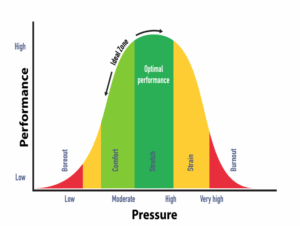
The graphic captures the phenomenon in the classroom that when there is very low challenge (or stress)–that’s the red on the far left on the graph–student performance, or learning is also quite low.
As we increase the level of challenge and stress in the classroom the level of learning also increases. A bit of pressure causes you to work harder, to think harder, to talk about your ideas.
While too much stress can be detrimental (as we see on the far right in red), if there is not enough stress, student learning also is not optimized.
This reminds us that when we increase challenge in the classroom, we must do so carefully and with intentionality in a warm and supportive atmosphere – because if we incorporate too much challenge, too fast, and without support, then we could create a learning environment that is unproductive.
But we do need to be attentive to creating just the right amount of benign, productive stress because it focuses attention and supports learning. (“Stress* increases general alertness and promotes attentional control in selective attention processes,” Qi and Gao 2020).
We have a responsibility as educators to create a kind of learning tension, a benign and caring version of stress that will help young people focus, grow and thrive.
Side note: If you want to hear about this and a lot more of the science behind learning stright from the horse’s (i.e. Doug’s) mouth, join us in NYC on Nov 7 for a full day Science of Learning workshop!
What our team reflected on and practiced was how to share this graphic with teachers as framing and to guide them in how to use some of our techniques that optimize student learning like Cold Call, Culture of Error, FASE reading and Means of Participation optimally. For example by letting students prepare before a Cold Call perhaps with a Turn and Talk, and smiling as you ask your question, and framing the question in a low stakes way: “Can you get us started thinking about the first steps in solving, Kevin.” Just the right amount of caring and thoughtful pressure…or “stress.”
As we discussed this, I was reminded of a clip that I showed in a training this summer that seemed to change the hearts and minds of teachers who were initially reluctant to use Cold Call. This clip is of Casey Clementson, a 6th grade music teacher at Rosemount Middle School in Rosemount, MN.
In it, she rolls out Cold Call and Means of Participation to her students with clear rationale as to why she uses it. First, she is clear about raising hands on the first day of school “So if I ask a question, I don’t want you to shout out the answer because your first answer might not be your best answer or you might talk faster than somebody else who needs a little bit more time to think through the answer and you don’t want to take that thinking time away from somebody else.” She then transitions to what it will look like to use Cold Call in her classroom. She frames it as “just a way to make sure that we’re hearing all of the voices of the students in the room because sometimes the person who raises their hand first is just a really fast processor and sometimes we need a little bit more time to think.” She then gives students the chance to practice what it’s like to be Cold Called.
Casey does a beautiful job of briefly sharing why she Cold Calls in the classroom. In doing so, she lowers the stakes (and stress) for students and then gives them an immediate chance to practice what it’s like to be Cold Called. As soon as students experience it, they realize how positive it feels to have your voice included in the classroom (the stress is taken down another notch). With her brief rollout using universal language (“we’re hearing all the voices in the room”), she clearly introduces how she will use Cold Call to build a culture of loving accountability in the classroom – helping her to optimize student performance by increasing the amount of pressure that students might feel in order to increase learning.
Stay tuned for our next post in which we share additional research on why this is so incredibly important….
The post TLAC’s Own Back to School, Part 1: How Much “Stress” in Learning appeared first on Teach Like a Champion.
September 5, 2025
Sarah Stackhouse Uses Whisper Correction and the What To Do Cycle To Build Positive Classroom Habits
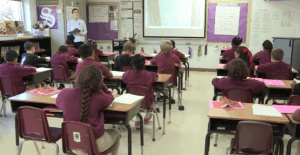
I’ve got 23 amazingly useful seconds of video to share with teachers starting the year and wanting to build positive, orderly, productive classroom habits.
Our teacher here is Sarah Stackhouse, a third grade teacher at Nashville Classical Charter School in Nashville, TN.
In the video we can see Sarah nail something we call the What To Do Cycle and then add a bit of subtle, next-level technique with her use of whisper corrections.
1) The What To Do Cycle is a a set of consistent teacher moves that help make a habit of students following through on directions.
It starts with clear, concrete observable directions for a task. Sarah’s directions here are, first, “Pencil on ‘R.'” [The first letter in the paragraph they are reading] And then “Eyes in” [Meaning to begin tracking the text as they read].
They are simple and crisp and, critically, observable.
Sarah can see right away whether students have followed-through … and therefore she can manage this fact. Notice that here she separates the two steps in her direction, looking for follow through on the first before she gives the second. That’s great for early stage habit-building. Later on, as the habit is more familiar, she will be able to give a series of directions in rapid sequence [eg books open to page six, pencils out and pointing to the letter “R”] But here she is working to build follow through of each step.
It’s pretty clear to me that Sarah has planned her directions in advance and rehearsed them a bit so she’s sure of their clarity and economy of language. She’ll probably use almost exactly the same words each time she asks students to get ready as consistent directions used to cue a procedure or routine ultimately become part of said routine.
The second step in the What To Do Cycle is to look intentionally for follow-through. Notice that Sarah stands in the corner of her classroom. Standing in this spot–a spot TLAC devotees call Pastore’s Perch–does two things. First it is efficient. From the corner Sarah can see more easily and clearly whether students have done as she’s asked because she only has to scan 90 degrees of classroom. If she stood in front of the room she’d have twice as much real estate to look at to ensure students were with her.
But standing in the Perch is also a teacher-facing habit. If, whenever she gives a direction, Sarah stands in Pastore’s Perch it reminds her that she is standing there to make it easy to look carefully for follow through and therefore she is more likely to remember her desired behavior an actually look. The place where she stands cues the habit.
Notice how clearly she scans the room… you can see her very clearly looking at everyone. She perhaps even exaggerates this fact to make it obvious to students that she is looking and that she cares that they follow-directions. This is always a great move–we cal it Be Seen Looking and it refers to the actions teachers take to exaggerate and make obvious to students that they are looking.
Sarah also uses the next step in the What To Do Cycle–Narrate the Positive–very effectively. After she says “Pencil on ‘R'” she starts to narrate back to students the normalcy of follow-through. “Just like row 1. Just like row 3.” This lets students know that she sees and appreciates when they follow directions quickly. But it also “amplifies” a positive norm. That is, by narrating the normalcy of quick and diligent follow-through she makes it more obvious to students that this is what typically happens among the great majority of students in Ms. Stackhouse’s class. It’s the norm. And norms are extremely powerful in shaping indivdual behavior.
Of course we’ve all seen teachers who go blithely along narrating the positive when a few students are clearly not following directions. Narrating the positive only helps when students are doing the right thing! The solution when students are slow to follow-through is not to ignore or pretend to ignore but to make a non-invasive correction–a quick reminder.
That’s where Sarah’s really elegant use of the Whisper Correction comes in. “Max” is a bit slow to meet the expectation. She needs to build a habit of quick and diligent direction following so she needs to use a gentle correction. But she’s also standing at the front of the room and that makes it tricky. So Sarah drops her voice to a stage whisper: “Max, pencil.” She’s lightning quick is reminding him of what he needs to do and there’s no animus in her voice. She’s not mad at him she’s helping him to make sure he’s on task promptly. But the whisper! The whisper is a thing of beauty. It reminds Max, in case he was wondering, that she is not trying to call him out in public. She’s doing everything she can to keep it private. To not broadcast his moment of imperfection. It does this even though everyone can hear it. The whisper changes the dynamic by showing that she is doing everything she can to make her reminder to him as private as possible. She is helping him to succeed and holding him accountable at the same time as she is reminding him that she cares about his feelings and is trying to preserve his privacy.
So we’ve got brilliant What To Do Cycle directions back-stopped by a lovely example of the Whisper Correction… and you can perhaps imagine all the additional times and places you might apply this idea… that simply dropping your voice into a stage whisper when you give a student a reminder about a task gives you the best of both worlds. You ensure diligent follow-through and time on task for the class while also remind students that you care about their feelings.
Thanks to Sarah and her class and all the brilliant folks at Nashville Classical for sharing this video!
The post Sarah Stackhouse Uses Whisper Correction and the What To Do Cycle To Build Positive Classroom Habits appeared first on Teach Like a Champion.
June 3, 2025
Summer Ready: Our Book-Based Curriculum is Primed to Support Students and Teachers this Summer
Summer is just around the corner and for both remedial and enrichment programs, we humbly think single book units from our Reading Reconsidered curriculum are an ideal match. Our Associate Director of Curriculum and School Support Alonte Johnson-James, explains why:
Summer school and enrichment programs share a common goal of improving and advancing the knowledge and skills of students. They also provide a great chance for the teachers invested in their success to be able try out high quality curricula and newer, more research-backed approaches.
When considering a curriculum that best serves students and teachers, we believe the novel-based, modular units of the Reading Reconsidered curriculum provide the opportunity to support students with building knowledge and practice retrieving this knowledge throughout the unit.
Even more exciting is the “one-stop-shop” benefit of high-quality instructional materials that support the training and development of new and veteran teachers alike.
Here are some of the attributes of the Reading Reconsidered Curriculum that make it ideal for summer programs:
Novel-based:
With summer programs roughly spanning 5 to 6 weeks, our novel-based units are a hit! Leaders and teachers may select any of our 36 novel-based units based on their knowledge of their students. Using novel-based units affords summer school students the opportunity to immerse themselves in a good book and read it cover-to-cover. To support with choosing the best fit text, we provide a scope and sequence for text selection based on the time of year. Consider choosing a recommended beginning of year unit for supporting students through remediation or choose a mid-year or end-of-year unit to advance learning or prepare students for the upcoming school year.

Either way, choosing a unit with students in mind can increase investment and engagement in the novel. One teacher shared that the Lord of the Flies unit allowed students to be “immersed in deep concepts and look at things in a different light, that they would not normally think of. It helps get them involved in the plot of the novel and feel part of it.”
Knowledge and Retrieval:
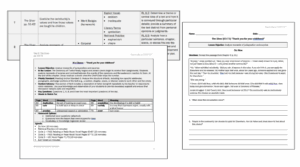
As previously mentioned, Our student-facing materials provide students with the knowledge-building tools needed to see success in these novel-based units. A knowledge organizer makes the end of unit understandings transparent from the launch of the unit. Daily lesson handouts include a Do Now, Vocabulary Practice, Retrieval Practice and all essential knowledge students will need to access the reading and learning for the day. Additionally, materials also include embedded non-fiction and light embellishments to support teachers and students with key background knowledge needed to access pivotal moments of the text without spending valuable learning time with front-loading content. Including these knowledge-building moments at the “just right” moment allows students to build genuine connections between the non-fiction and the fictional text at the center of the class and deepen their learning and connection to the text.
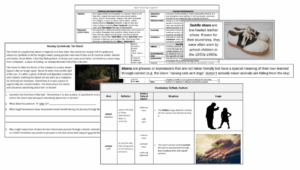
Teachers will be better able to assess and respond to students’ understandings with the recursive practice embedded throughout units. Vocabulary lessons include recursive practice that revisits key literary and content-specific terms students will need to access the day’s materials and encode into their long-term memory for future study and application. Retrieval practice also assesses students’ understanding and retention of key knowledge and skills taught throughout the unit. Additionally, daily lessons include recursive practice of newly taught and previously learned content from the Do Now to the Exit Ticket. Teachers can leverage various portions of each lesson to gather data and best plan for how to respond to this data using the provided lesson materials.
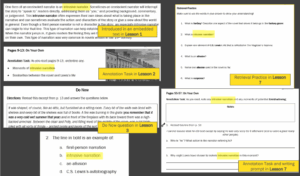
One school leader had this to share about the retrieval practice:
I love the vocabulary boxes for exposure and how these are embedded words in the text. I also appreciate the periodic review of terms. The retrieval practices are a great quick check for where students are at and to emphasize what key details students need to retain.
One-Stop Shop:
The book-based Reading Reconsidered curriculum is highly regarded by school leaders and teachers because of its rigor, its accessibility and the embedded teacher support. Teachers are provided with unit and lesson plans that outline essential unit understandings as well as the standards that are practiced and assessed throughout the unit. The lesson plans serve as guides for teachers to ensure effective implementation with suggestions for how to approach the day’s reading and plans for engaging students in the learning, and an additional benefit to having printable daily lesson plans and student packets is it simplifies planning and allows teachers to focus on assessing and responding to student work with intentional considerations for adaptations and differentiation to tailor lessons based on students’ abilities and needs. Ultimately, the Reading Reconsidered curriculum lowers the planning lift for summer school teachers and makes the curriculum well-poised to serve as a training and development tool for more novice teachers. What’s even better? All materials are shared in Word form for easy formatting, adapting, and printing.
If you are looking for a literacy curriculum for this summer, choose Reading Reconsidered for its:
Novel-based, modular unit structure to best select rigorous and engaging text that invest students in the novel and their learning Consistent recursive practice that reviews key knowledge students will need to master the unit’s content and provides teachers with consistent data to inform data-driven instruction “One-stop” approach to essential teacher and student facing materials that support implementation and differentiationEmail us at ReadingCurriculum@teachlikeachampion.org if you’d like to learn more and click here to see additional sample materials .
The post Summer Ready: Our Book-Based Curriculum is Primed to Support Students and Teachers this Summer appeared first on Teach Like a Champion.
May 21, 2025
Ben Katcher: Exam Review & Partner Retrieval Practice
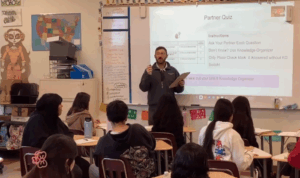
Actually, please do try this at home…
Ben Katcher was a Teach Like A Champion Fellow from 2023-24. For his final project, he focused on developing a knowledge-rich AP US History curriculum. Ben discussed knowledge organizers with Doug on the Sweat the Technique podcast (here). Sign up for his free newsletter about how to apply the science of learning in the classroom here. He can be reached at KnowledgeFirstHistory@gmail.com. He reflects here on teaching students to be more effective in using retrieval practice to review for exams.
In my AP US History class, it’s vital that my students develop study skills that can help them learn and use a lot of content knowledge. Research tells us that most people (including adults!) are not very good at studying, spending too much time reviewing information and too little time retrieving information. Information becomes far more durable and better encoded in our long-term memory when we are quizzed on it, or when we quiz ourselves on it. With this in mind, partner quizzing has become an important system for retrieval practice in my classroom.
Partner quizzing can be a powerful way to help students speak and listen to each other, develop their ideas, and prepare to participate in whole-group discussions or construct thoughtful ideas in writing. But partner work can suffer from some common pitfalls, including:
One partner dominating the discussionStudents struggling to identify the resources they need to participate fullyThe teacher struggling to monitor multiple, simultaneous conversations, leaving misconceptions unaddressed
I am excited to share one activity I use in my classroom that maximizes the benefits and minimizes the risks of partner work.
This activity is a partner Retrieval Practice drill. I use this activity toward the end of a unit of study, before students take a quiz on key terms and dates associated with that unit. The goals of this activity are to help students encode knowledge, practice effective study techniques in advance of the quiz, and self-assess their understanding.
To prepare for the activity in the video below, I took all of the key terms and dates from my Unit 8 Knowledge Organizer and turned them into question form, placing a checkbox next to each question (see a portion of both my Unit 8 Knowledge Organizer and partner quiz below).
As you can see in the video, I begin the activity by reviewing the expectations. I instruct Partner #1 to ask Partner #2 each retrieval practice question. I instruct Partner #2 to attempt to answer each question without their knowledge organizer. If Partner #2 is able to answer the question, then Partner #1 will place a check next to the term on the handout that belongs to Partner #2. If Partner #2 is unable to answer the question, then they are expected to look at their Knowledge Organizer and read the answer. In that case, Partner #1 will not place a check next to the term.
As students begin asking and answering the questions, I circulate throughout the class with a copy of the student handout on my clipboard. As I circulate, I listen to student conversations, but this only gets me a limited amount of information. I only have the opportunity to hear each student ask and answer 1-2 questions. Therefore, my main focus is looking at the students’ handouts to note which terms have check marks next to them, indicating that they have been answered correctly. I then tally the terms that do not have check marks. By the end of the seven minutes, I have reliable, student-generated data that indicates the most common gaps in knowledge.
After seven minutes, the timer goes off, indicating that it is time for students’ to switch roles. But before we do that, I take the opportunity to review common misconceptions. During this lesson, my formative assessment data indicated that common misconceptions included the Truman Doctrine and the Military-Industrial Complex, so I reviewed these terms with all students.
By the end of the activity, students have generated for themselves a personalized study guide that indicates which terms they know well and which terms they need to study in more depth before the assessment. I instruct students to focus their study time on the terms that their partner did not check off for them. And I instruct them to study in exactly the way they did in class; ask themselves the questions and see if they can answer without the Knowledge Organizer. If they can, then check off the answer for themselves.
Through this activity, my students have practiced a more effective study method than simply rereading information and prepared to study effectively on their own.
The post Ben Katcher: Exam Review & Partner Retrieval Practice appeared first on Teach Like a Champion.
May 19, 2025
A Beautiful Example of FASE Reading from Jessica Sliman’s Classroom

The joy of reading together…
I’m really excited to share our newest video clip–a great example of of one of the most important techniques in the TLAC library, FASE Reading. FASE Reading is a technique that supports student fluency and engagement in reading, topics we discuss extensively in the forthcoming TLAC Guide to the Science of Reading.
The clip comes to us from Jessica Sliman’s 4th grade classroom in Whitefish, MT. It shows 3 and a half minutes of Jessica and her students reading aloud from Lois Lowry’s Number the Stars.
I suspect you will love it as much as everyone on Team TLAC did.
First, here’s the clip:
Now some things we loved:
We love her initial framing, “I want you guys to notice moments of suspense.” This shapes student attention. Learning always starts with attention and directing students to attend to a ‘most important’ thing is one of the most important things a teacher can do. Jessica does a simple and elegant job of it here
Then they’re off reading. Jessica goes first. Her reading is beautifully expressive. She’s bringing the story to life modeling how to read meaningfully so that students will copy her. This will them to build the habit of infusing their reading with expression. Research suggests that this assists with meaning and is likely to translate into better and more expressive silent reading for students.
Izzy is the first student to read. she does a really nice job but Jessica pushes her to bring a bit more expression to her reading in a lighthearted and positive way: “How would she say that?” She’s making a norm of expressive reading that models her own. And happily this just increases her students’ enjoyment. Their laughter at Izzy’s portrayal underscores this.
Hadrian goes next. THere’s a great moment where Jessica drops in a quick definition of the word “prolong”–she’s recognized that students may not know the word and that it’s important. She provides the key knowledge without distracting from the story.
Hadrian is a pretty good reader but he’s also still developing his expressiveness. So it’s lovely the way she praises him for his “extra expression on “very very frightened.” Again the key is to cause students to practice reading aloud with expression and in so doing improve their fluency and infuse maximum meaning into their reading. She builds that culture intentionally.
Next Jessica reads again- moving the story along a bit, keeping it alive and fresh with her own expressive reading–she is after all, the best reader in the class–and modeling again for students how to express meaning as you read. Notice that she’s reading slightly more slowly than her natural rate might be. She’s reminding her class that fast reading isn’t good reading. Expressive reading is.
Steven reads next. Notice by the way that she calls on students unpredictably to read and that every student she’s called on is ready to read right away. This tells her something critical. Her leverage is high–meaning that she knows now that her students are not just listening but reading along.
Steven does something really interesting. He self-corrects, re-reading a sentence of his own volition not because he read it wrong but because he didn’t express its meaning as well as he could have. It’s a very meta-cognitive moment. “Oh, i didn’t capture that quite right.” Interestingly, Jessica doesn’t have to ask him whether he understands this passage. the way that he reads it SHOWS her this. So they can simply keep reading.
But what a statement about the culture of error Jessica has created! Students willingly and unselfconsciously improve their reading as they go.
Weston is next. We love the rhythm of the reading she’s established. Burst of reading are just long enough to allow students to take real pleasure in expressing the text but short enough to allow them to read with maximum success and attention. The switching feels lively but not disruptive. It balances the need to keep students on their toes–I might be next!--and locked in to the story. Beautiful.
Gracefully, Jessica steps in on the word cautiously and reads through to the end herself, again with beautiful expression.
It’s pretty clear that this reading–and that of her students–has had a real effect of her class since they plead to keep reading at the end. “We have to read the next chapter!” one student says urgently. They don’t want to stop!
A quick side note: I sent Jessica an email asking her a few questions about her classroom culture. She was incredible humble and gracious.
Example:
Me: “I was struck by the fact that several students spontaneously self-corrected… they read a sentence—not even wrong just non-expressively—and then went back and re-read it unprompted. I was wondering if you had done anything to make them more comfortable with doing that or more cognizant of its value?”
Jessica: “Looking back, I do not know why they chose to reread. I have been working on reading with prosody and expression with some other materials. My gut says they wanted to show off as they knew they were being recorded.”
Jessica also added perhaps the most important takeaway:
“We are basically technology free in my classroom….and in most of our school. I’d say it’s another reason why the kids are so attentive and engaged.”
The post A Beautiful Example of FASE Reading from Jessica Sliman’s Classroom appeared first on Teach Like a Champion.
May 13, 2025
Coming Soon: Knowledge-Rich, Book-Centered High School Reading Curriculum

As many readers probably know, we have written and published a middle school reading curriculum built around the science of reading.
And now we’re writing a high school curriculum as well!
We think this is a hugely important project. There’s very little high-quality curriculum out there for high school English teachers that supports them with knowledge-rich and adaptable lessons to ensure deep study of important books.
Having been working on this project for a year or so, we’re excited to share some of the work we’ve done.
Let us start by telling you about two foundations of the high school curriculum—both of which will be familiar to those who know our middle school work.
First, our HS curriculum is book based. Statistics show that the amount of time kids spend reading at home doesn’t amount to the time they should be reading to develop and maintain their reading comprehension, according to research. To address this, we seek to build students’ love of books by centering units on full texts, not excerpts or selections, so students have time to engage deeply with the protagonist’s plight and with an author’s writing style. Additionally, we build students’ fluency by ensuring that class time (even in high school!) includes shared reading, so students read aloud and hear text pages come to life.
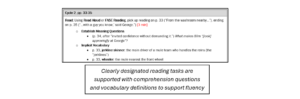
Second, the curriculum is knowledge-driven. As research shows, reading comprehension is directly tied to knowledge, so knowledge is infused throughout the unit where it most supports comprehension. Thinking well requires facts, and nonfiction readings and explicitly-taught vocabulary words help students unlock the deeper meanings in the anchor text. As in our middle school curriculum, dedicated retrieval practice helps students encode vocabulary, text details, and unit knowledge to strengthen their analysis of the text.
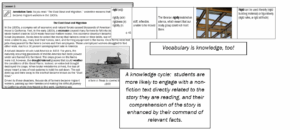
emphasis on books and knowledge is crucial for students across all grades, we recognize that there are some specific needs of high school students as they develop maturity and independence. And so a few aspects of our high school curriculum are new and different.
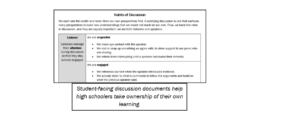
One hallmark of maturity is the ability to grapple with “big ideas,” those questions and issues that have reverberated through time, so in addition to daily discussion questions, the high school curriculum also includes opportunities for more extended and student-driven discussions. We’ve designed specific lesson plan formats that help teachers confidently run extended Discussion Seminars over the course of the unit, and developed and included supporting documents for teachers and students that outline the purpose and some best practices for leading and participating in discussions.
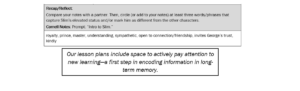
All that rich thinking and learning from discussion needs to be captured–so our curriculum supports teachers and students in intentional note taking, using the Cornell notes method. Lesson plans include spaces throughout the lesson where students can pause to recap class discussion or reflect on their learning in ways that intentionally support note taking and using notes more effectively.
Our first unit, John Steinbeck’s Mice and Men, is ready for purchase, and we’ll keep you informed as additional units are planned. In the meantime email us at ReadingCurriculum@teachlikeachampion.org if you’d like to know more and click here to see some samples from the unit.
The post Coming Soon: Knowledge-Rich, Book-Centered High School Reading Curriculum appeared first on Teach Like a Champion.
May 9, 2025
Teacher Appreciation Week
The Teach Like a Champion team had a dilemma. Too many team members wanted to write our blog post in honor of Teacher Appreciation Week!
So we decided to share the mic and asked the whole team to contribute. It’s resulted in one of the longest and most enthusiastic posts of all time and still doesn’t come close to capturing how grateful we are all of you who spend your days in the most important space there is: the classroom. We consider ourselves, collectively, the luckiest to spend our time learning from your brilliance and passion. Thank you!
“Teaching is the hardest, yet best, work in the world because it is a gift of service – a gift of the heart. And there are few greater gifts a child can have than the love and care from an educator who knows their work is not simply to teach, but to reach and inspire their same passion and pursuit of greater knowledge in their students. Thank you all for giving your time, energy and hearts to students all over!”
– Alonte Johnson-James
Associate Director of Curriculum and School Support
“…I would gift to all teachers TIME: there are a million different reasons why: teachers need time to get to know all their students as people–to learn about their students’ passions and gifts, to learn about their challenges and needs (both in and out of the classroom), to learn about how best to reach them to help them succeed and grow. Then, teachers need time to implement best practices to serve their students: to study, practice, and reflect on research and techniques to make their classrooms amazing. Finally, teachers need time for themselves to recharge their own batteries, to connect with their own friends and family, so they can re-enter their classrooms as the best version of themselves to continue to shine for their students. ”
– Beth Verrilli
Senior Associate Director of Curriculum and School Support
“If I could wave a magic wand, I would give teachers the gift of time. Time to plan and collaborate with intention, time to reflect and grow professionally, and just as importantly, time to rest, recharge, and be present with the people they love. Too often, the demands of teaching stretch far beyond the school day, leaving little room for balance. I’d want every teacher to feel they could show up for their students without having to sacrifice their own well-being or the needs of their families. Because when teachers are supported both personally and professionally, everyone in the school community benefits.”
– Brittany Hargrove
Director of Advocacy and Partnerships
“Teaching is both the hardest job in the world because you are expected to meet or exceed the needs of 100% of your ‘clients’ every year – something no other profession even attempts. But by meeting the needs of the entire classroom, you form relationships that last a lifetime, and all the great work you do with your students increases exponentially as they continue their learning the following year.”
– Christian Sparling
Senior Director of Operations
“I wish we could celebrate Teacher Appreciation week by opening the doors to Staples for unlimited access to post-its, Flair pens, and stickers–the things you can’t live without; installing bottomless vats of Starbucks in every teachers lounge to fuel the endless and joyful energy you bring to your students; and with choirs following you around, singing your praises for doing the hardest, most important work in the world. Teachers, thank you for showing up every day to guide, inspire, and educate. “
– Colleen Driggs
Managing Director of Curriculum and School Support
“Thank you for seeing, valuing, and loving on our students each and every day. Teaching is hard work – but just like any obstacle or task done well, both the process and the outcome yield greater satisfaction. Our world is stronger, more vibrant, and a lot smarter because of the transformative impact of educators. We are forever indebted to you.”
– Denarius Frazier
Senior Advisor, Consulting & Partnerships Team
“I wish we could celebrate Teacher Appreciation Week by having the time and resources to give our teachers a week of doing what most fills their cup. Each week, teachers fill the cups, the minds, the hearts of so many students both in their classroom and in the hallways. It is the absolute best and most rewarding job – but also the hardest job in the world and requires endless patience, practice, decision-making, and more. While we know that Teacher Appreciate Week isn’t spent outside of schools, I hope it is a moment to fill your own cup and to feel the gratitude that exists from students, from parents, from us, and from society! The work you do is unmatched!”
– Dillon Fisher
Senior Associate Director of Partnerships
“If I could wave a magic wand, I would gift to all teachers unlimited books and supplies (because too many teachers have to dip into their pockets), time (for themselves and for their students), peace of mind and unlimited admiration and respect from because the work that they do is truly the hardest and most important in the whole world.”
– Erica Woolway
President and Chief Academic Officer
“If I could wave a magic wand, I would gift all teachers more time in front of their students because it is the most precious resource we have– to make academic impact, to forge lasting relationships, and to learn what helps them most. It is truly incredible how much teachers accomplish with students in just one 180 day school year, one tiny moment in time, and here’s to all of the teachers who maximize that moment with their students every day. Thank you all for your incredible work!”
– Jack Vuylsteke
Senior Director of Partnerships
“If I could wave a magic wand, I would gift all teachers a society that honors and respects teachers for the incredible contributions they make to our communities and along with it a salary that reflects that impact because there is no profession that influences our future as deeply as teachers. “
– Jaimie Brillante
Director of Strategy of Curriculum and School Support
“You are content experts, attentive listeners, role models, diligent planners, creative problem-solvers, meticulous multi-taskers, guiding lights, and helping hands; you are teachers, and we appreciate you!”
– Jen Rugani
Director of Curriculum and School Support
“Thank you ALL for being the exceptional teachers that you are! Your continued dedication and devotion does not go unnoticed. Your guidance and support will make a difference in your students’ future.”
– Michelle Wagner
Associate Project Manager
“You juggle lesson plans, life advice, and lost pencils like a superhero, only with more coffee and fewer capes. Beneath all that multitasking is a heart that gives endlessly, reminding every student they matter and that every challenge is worth it. Thank you for all you do!”
– Patrick Pastore
Associate Director of Curriculum Development and School Support
“If I could wave a magic wand, I would gift to all teachers more respect and support for all the tireless hours of heroic work you put into making sure your students get the best instruction every single day.”
– Rob Richard
Chief Video Officer
“If I could wave a magic wand, I would gift teachers an inexhaustible well of respect, empathy, and recognition. Teachers make the world go around their daily lives should reflect that truth.”
– Sarah Engstrom
Associate Director of Curriculum and School Support
“If I could wave a magic wand, I would gift to all teachers the time, resources, and respect they deserve—because they shape the future every day, often with too little support and too much asked of them.”
-Teneicesia White
Senior Associate Director of Partnerships
“I wish we could celebrate Teacher Appreciation YEAR! Thank you for inspiring and empowering our youth!”
– Tracey Koren
Associate Director of Operations
The post Teacher Appreciation Week appeared first on Teach Like a Champion.
Doug Lemov's Blog

- Doug Lemov's profile
- 112 followers

