Daniel Lambert's Blog
January 11, 2023
An Optimistic Product of the Pandemic
The Inspirational Value of Professor Rosalyn Kahn’s A Message for Tomorrow’s Leaders
It has been said that every cloud has a silver lining. The COVID-19 Pandemic, which emerged in 2019 and began to affect the US in 2020, is one such cloud. In my English classes, I have prompted my students to reflect on the good and the bad of COVID. As a result, I have read numerous accounts – one more tragic than the last – of sick, dying, or dead loved ones. The silver linings come in the form of unanticipated consequences, such as the student who developed a better relationship with her mother after quarantining with her for months.
Professor Rosalyn Kahn’s 2020 book, A Message for Tomorrow’s Leaders (available from Amazon.com), is a silver lining that emerged from the COVID Pandemic. The book also emerged from Professor Kahn’s career as an instructor of college-level Speech Communication. Rosalyn could have certainly written this book before or after the emergence of the Pandemic, but the book’s arrival at such an uncertain time was fortuitous. This is the kind of hopeful book the world needed (and still needs). The title of Kahn’s book is a misnomer because this is more than a message to tomorrow’s leaders: It is a collection of diverse messages culled from Kahn’s friends, colleagues, and guest speakers from her classes. The book reveals as much about Kahn’s dynamic teaching style as it does about these optimistic messages from religious leaders, business leaders, and community leaders.
Kahn explains in her introduction that A Message for Tomorrow’s Leaders was originally written to motivate young people to “stay in school.” Like Kahn, I am a community college instructor who works in some of Southern California’s most economically disadvantaged and under-served communities. “Stay in school” seems like a fairly rudimentary message, but educators understand just how challenging it can be for a student to complete the educational journey they have started. From unsupportive friends and family members who just don’t “get” the necessity of a college education to challenges related to transportation, health, and finances, going to college and completing a degree program can feel like a mine field to any student.
Kahn’s book is a guide to navigating this mine field. When most American college classes switched to a 100%-online modality due to COVID, numerous students who were technologically and economically unprepared for online classes came to the sad end of their journeys. The COVID-19 Pandemic was like a lethal hand grenade tossed into an already-hazardous battleground. In her book, Kahn gives her collaborators opportunities to help students mitigate this treacherous landscape. For example, attorney Jonathan Lightman uses his opportunity to tell Kahn’s readers about his battle with pancreatic cancer. In 2006, Lightman was given a 6% chance of survival. He beat the odds, and while some of his friends and family members called him “lucky,” he points out that his survival “all boiled down to perspective.” In fact, according to Lightman, “perspective is the only thing we can control.” This sense of perspective is a skill that not enough college students are taught: Don’t waste your time trying to control the uncontrollable; focus on those aspects of life you can control. Lightman reminds the reader that “the world does not revolve around us.” However, the global community – of which we are a part – “requires our participation and engagement.”
Lightman’s message is both unique and typical of the messages Kahn chose to include in her book. Kahn is an inspiring and optimistic person, and the “guests” she invited to share their stories in A Message for Tomorrow’s Leaders reveal their own optimism through their words. COVID-19 is one of the many challenges that people face on a daily basis. However, Kahn reminds us that we, as a species, are blessed with two powerful forces: first, a young generation who will, someday soon, become our leaders. Second, we are blessed with a wise and generous population who are willing and able to share their advice. Whether you decide to read Professor Rosalyn Kahn’s book yourself, purchase it for the future leader in your life, or both, you will benefit from its lessons and help to make the world a bit better.
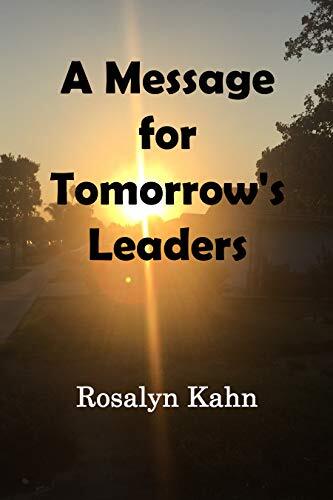 A Message for Tomorrow’s Leaders
  Professor Rosalyn Kahn


November 26, 2020
Giving Thanks for Aunt Mickey
I lost my Aunt Mickey on a Sunday: November 15th, 2020. She was 83 years of age. When she was born in McKeesport, Pennsylvania in 1937, her birth certificate read “Rose Claire Emery.” However, nearly everyone in her life called her by her nickname: “Mickey.”
It is ironic that Aunt Mickey left us in the month of Thanksgiving. Why? Because I am truly thankful for this wonderful, strong, generous, kind, and funny woman.
Aunt Mickey helped me in ways I could never repay.
I remember being an 18-year-old child of divorce and high school dropout with a vague concept of my future plans (but no clear path to putting those plans into motion). Aunt Mickey knew from talking with me that my two choices were to (A) join the United States Air Force, or to (B) attend college.
In my discussions with Aunt Mickey, I told her I preferred option (B), but asked her “How can I be accepted by a college without a high school diploma or an SAT score?”
Aunt Mickey, having already done the research, said “You don’t need either to enroll at El Camino College. You only need to be 18 years old.”
I enrolled at El Camino College (a wonderful educational institution in the city of Torrance) in 1985.
Aunt Mickey had provided an educational spark that ignited a fire in me. The fire burned for the next ten years: After graduating from El Camino with an A.A. in History in 1988, I moved on to Loyola Marymount University. I graduated from LMU with a B.A. in History in 1990 and an M.A. in English three years later. (In 2011, after teaching college-level English for 14 years, I took care of unfinished business and earned my high school diploma.)
Aunt Mickey gave me countless happy memories. One such memory reminds me not only of how much fun she was, but it also reminds me of how much she loved her family.
About fifteen years ago, I came across an Internet advertisement for an upcoming concert by Cher at Caesars’ Palace in Las Vegas. Knowing that my cousins Danielle and Claire were huge fans of Cher, I emailed Aunt Mickey and asked her to pass the information on to them.
I was surprised when Aunt Mickey replied that she would like me and her to fly to Las Vegas to attend the Cher concert. I took her up on the offer, and we had a great time at the concert.
In the Caesars’ Palace lobby, I took a photo of Aunt Mickey with a ten-foot tall marble statue of legendary boxer Joe Louis. When we got home, I published the photo on my Facebook feed. Aunt Mickey called me to ask if I could combine the photo of her with a photo of her two grandchildren, Liam and Bellah. I said “of course,” and used the Microsoft Paint app to add a photo of Liam and Bellah to the corner of the photo taken at Caesars’ Palace.
Liam and Bellah hadn’t accompanied me and Aunt Mickey on our Las Vegas trip. But asking me to combine the two photos, Aunt Mickey could still go online to enjoy her Las Vegas memory and her beloved grandchildren at the same time.
I replaced the original photo on Facebook with this new, “hybrid” photo. Aunt Mickey posted a “thank you” message to me under the photo, which is still on my Facebook feed.
This photo reminds me of how proud Aunt Mickey was of her family. It also reminds me of how truly blessed I am to have had Aunt Mickey in my life.
Be thankful for the friends and family members who have made a positive difference in your lives. They are more precious than gold.
Thank you, Aunt Mickey.
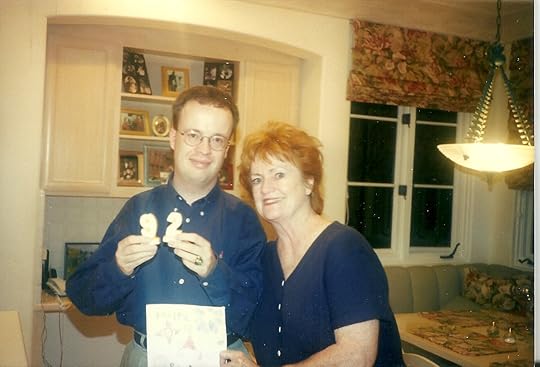
Me and Aunt Mickey on my 29th birthday.
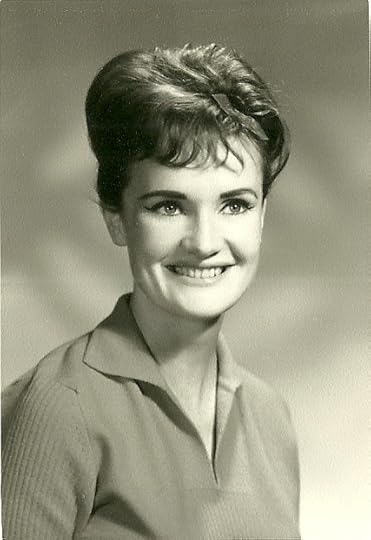
Aunt Mickey.
November 11, 2018
A Lynchian Evening with Rebekah Del Rio
David Lynch fans know singer-songwriter Rebekah Del Rio as the singer who performs “Llorando” (the Spanish version of Roy Orbison’s “Crying”) in the film Mulholland Drive.
Del Rio’s infectious affability is so far removed from the swooning singer in the film that fans will be surprised upon seeing her live. She is anything but a sad songstress with tears emblazoned upon her cheek.
To promote her Baja Basement Records CD All My Life (Toda Mi Vida), Del Rio performed an acoustic set in Hollywood, California on Saturday, December 4, 2004. The venue was the two-story Virgin Megastore, a huge retail outlet on Sunset Boulevard. The store is, ironically, not far from the real Mulholland Drive.
Poured into a red dress with a Mexican pattern in front, and wearing a matching red flower in her hair, Del Rio captivated the audience with songs from her CD. Highlights of the show included her Spanish version of Al Green’s “Always and Forever,” and her paean to love gone wrong, “A Long Goodbye.”
Del Rio wrapped up the set at four in the afternoon, with the show-stopping “Llorando.” She prefaced the song three ways: by explaining how she came to appear in Mulholland Drive (Lynch heard her sing and fell in love); asking the audience for “silencio”; and thanking actor Gino Silva, who made a surprise appearance in the crowd halfway through the show. As the mysterious “Cookie,” Silva introduces Del Rio onstage in the film.
Seeing and hearing Del Rio in Hollywood brought to mind the first time I saw her live. It was in Studio City, California, on the evening of December 17, 2003.
The La Ve Lee restaurant, on Ventura Boulevard in the San Fernando Valley, is a far cry from the dark, cavernous Club Silencio we see in the film. La Ve Lee is a small eatery and bar featuring live music on a nightly basis.
Just in time for Del Rio’s 8:30 P.M. show, my friend Robert Loye (Los Angeles’s “Dark Poet”) and myself found a small table near the bar. We were surprised to find John Neff (the other half of David Lynch’s duo Blue Bob) sitting at the next table.
Del Rio took the stage at 8:30, to wild applause from the intimate audience. Dressed in a black skirt and blouse, with the signature flower in her hair (white this time), Del Rio was a lively and smiling presence.
Del Rio’s band, consisting of a flutist, drummer, guitarist, percussionist, and base player, kept time as she launched into her CD’s title song, “All My Life.”
Del Rio introduced her bilingual version of The Carpenters’ “Superstar” by explaining: “My parents would not allow me to listen to rock and roll when I was growing up. But I could listen to the Carpenters! That’s how I developed a love for the Carpenters and Karen Carpenter’s music.”
The highlight of the show was “Llorando.” Silva was on hand to introduce the song, repeating his Mulholland Drive dialogue word-for-word. For fans of the film, this was a special treat: a re-enactment of a memorable scene.
Thanks to Rebekah Del Rio’s beautiful voice and powerful stage presence, I will not soon forget my afternoon at the Virgin Megastore, or my night at the La Ve Lee.
Aliens Invade the Human Psyche in “Dreamcatcher”
TITLE: Dreamcatcher
DIRECTOR: Lawrence Kasdan
PRODUCERS: Lawrence Kasdan and Charles Okun
RATING: “R”
LENGTH: 2 hours, 16 minutes
YEAR: 2003
STUDIO: Castle Rock Entertainment
SCREENPLAY: William Goldman and Lawrence Kasdan
Horror author Stephen King has described his writing as “the literary equivalent of a Big Mac and fries.” Director Lawrence (“The Big Chill”) Kasdan’s adaptation of King’s 2001 novel “Dreamcatcher” confirms the validity of this description. The film is like “E.T.” meets “The Deer Hunter,” depicting an extraterrestrial assault on four hunters sequestered in a remote cabin.
Casual fans of King’s work are routinely surprised to know that “Stand By Me” and “The Shawshank Redemption” germinated in the dark recesses of his brain, but serious fans know that King does one thing very well: Characters. From the physically- and emotionally-crippled novelist in “Misery” to the abused wife in “Rose Madder,” King is keenly aware of what makes his characters tick. One of King’s literary idols, H.P. Lovecraft, stated that “the oldest and strongest emotion of mankind is fear.” King ropes his readers in because he knows what scares us.
“Dreamcatcher’s” foursome of childhood buddies consists of Jonesy (Damian Lewis), Henry (Thomas Jane), Pete (Timothy Olyphant), and Beaver (Jason Lee). As children, these four friends rescue a Down syndrome afflicted boy named Duddits (Donnie Wahlberg), a character whom is not at all what he seems. Duddits gifts each of his benefactors with a unique psionic ability.
Morgan Freeman and Tom Sizemore are underused as Colonel Abraham Curtis and Owen Underhill, real-life Men in Black whose years of defending Earth from invaders have wearied (and possibly corrupted) their souls. Curtis and Underhill are largely detached from the main storyline, as they battle the aliens not with their wits, but with the tools Donald Rumsfeld would use: bombs and missiles.
The most interesting character here is Jonesy, who is brilliantly portrayed by British actor Lewis (HBO’s “Band of Brothers”) as a car accident victim whose mind is invaded by an alien intelligence. Jonesy can only watch in horror as the alien manipulates his body, and uses it in an attempt to sterilize Earth of its human inhabitants.
Lewis, looking like a young Steve McQueen, reverts to a pompous British accent when the alien speaks through him. This device seems lame on paper, but Lewis’s understated acting brings authenticity to both his character’s dilemma and his attacker’s malevolence. King is dramatizing the universal fear of madness and loss of control: What if you were forced to watch helplessly as your physical form went on a bloody rampage?
Some of the film’s most brilliant scenes literally take place in Jonesy’s mind. King depicts the human mind as a vast library of information, and Kasdan expertly brings this metaphor to life on the screen. It is frightening to witness Jonesy sequester himself in a small corner of his mind, while the alien rummages through the library of his memories and darkest secrets.
King’s best stories, when stripped of their gory trappings, are allegories of human behavior. At its core, “Dreamcatcher” is about faith and the resilience of the human heart. It lacks the sincerity of “The Green Mile” and the grittiness of “Misery,” but it comes close. Whether you get off on existential hidden meaning or slimy aliens, there’s something for you in “Dreamcatcher.”
Now, if only someone would adapt King’s ass-kicking abused wife story, “Rose Madder,” to the big screen, all would be right with the world.
The Antichrist Made Him Do It: Dispatches From Michael York
Acclaimed British actor and author Michael York chatted with members of the Southwest Manuscripters about his life and profession on Friday, February 15, 2002.
York’s resume is exhaustive, but he is perhaps best-known for the title performance in the 1970’s science-fiction film Logan’s Run. He is an alumnus of the National Youth Theatre and Oxford University, and serves as Chairman of the California Youth Theatre. He has authored two autobiographical books, Accidentally on Purpose and A Shakespearian Actor Prepares. He has also written one memoir in the form of a diary, Dispatches From Armageddon: Making the Movie ‘Megiddo.’
York takes his hat off to writers, because he himself has written ever since he was taught Anglo-Saxon at Oxford by J.R.R. Tolkien’s son. He pursued acting because he did not want to go through life realizing he never dared to undertake the vocation he loved. He feels that working in theatre and movies is a literary pursuit, and he considers himself lucky to have worked in plays authored by greats such as Tom Stoppard.
A British publishing company once asked York to pen an autobiography, but he was reluctant, feeling that he was too young. When Simon and Schuster asked him to write Accidentally on Purpose, he decided to “follow the signs” and write the book. The title refers to the often-illogical but destiny-driven nature of an actor’s life. York finds biographical writing to be a progressively-simple task: “One memory gives way to another.”
A Shakespearean Actor Prepares is based on the notion that Shakespeare provides clues as to how actors should perform his work, in the plays themselves. Shakespeare suggests ways to play his characters, but never dictates to the actor. This is why there is no such thing as a “definitive” Shakespeare performance. The Bard’s “sympathy for human nature” keeps the work alive.
A producer from the Trinity Broadcasting Network, the largest Christian broadcasting organization in the world, approached York to star (as the Antichrist) in their Book of Revelations-inspired film, The Omega Code. York was reluctant to say “yes” at first, believing the terms “Christian” and “entertainment” to be contradictions in terms. The Omega Code, a “millennial thriller” shot on location in Jerusalem and Rome, was very well-received by critics and audiences alike.
Megiddo, the sequel to The Omega Code, is based on Armageddon: the final battle between good and evil. The filmmakers found their Megiddo in California, and the filming experience (coupled with York’s love of the diary form) inspired York to write Dispatches From Armageddon.
York sees intriguing real-life parallels between media moguls such as Rupert Murdoch and Stone Alexander, the fictional mogul he portrays in The Omega Code and Megiddo. York enjoyed playing an evil character, finding his filmic “good guy” characters too often “boring by comparison.” On Dispatches From Armageddon’s cover photo, York grins from between the fingers of a taloned hand. This photo is further proof that York relished sinking his acting teeth into such a juicy role. Director Bob Fosse once told York to play “a mean dick,” and York believes the Antichrist to be “the meanest dick” of all.
Despite his love of colorful roles such as Stone Alexander, York prefers not to be typecast: he would rather be counted among such “faceless” actors as Sir Alec Guinness. York prefers to “plunge in” to risky and outrageous roles (such as Basil in the Austin Powers comedies) rather than “testing the waters” first. He would rather sin by commission than omission.
York is most proud of his role in the musical version of Lost Horizon, because he had the chance to work with one of his favorite actors, Sir John Gielgud. York also enjoyed making the numerous French films he has appeared in, but he prefers to come back to mainstream films to strengthen his resume. He laments the fact that the “business” end of “show business” still drives the film industry.
On the subject of spirituality, York likens himself to George Bernard Shaw’s comparative religion student, who exclaims: “The trouble is, I believe every one of them!” He considers it a privilege to be a member of a profession that takes him to such countries as Israel. When York finds himself in such sacred places, he prefers to think of himself as a student, not a tourist.
York’s future literary projects include a book on directing from an actor’s point-of-view (what York calls “the receiving end.”) York would also love to write a novel. York’s future acting plans? He aspires to the acting longevity of Sir John Gielgud. York called Gielgud on his 96th birthday, and found Sir John not resting, but rehearsing for a Samuel Beckett play. York is pleased with his choice of profession, because it offers him an opportunity to do what he enjoys for the rest of his life: “The plus side is that you can go on doing it as long as you have your wits and your health.”
Mr. York impressed us with his charm and eloquence. The Southwest Manuscripters thanks him for taking the time to talk with us.
Icy Smith Takes Manuscripters on Historical Journey
(April 2005 Southwest Manuscripters Speaker Notes)
Author and publisher Icy Smith explains her memorable name like this: “My Chinese name is ‘Bing,’ which means ‘ice.’ My last name, ‘Smith,’ comes from my husband.”
Smith spoke to the Southwest Manuscripters on April 15, 2005. Her subject was the history of Chinese immigrants in Los Angeles over the past 150 years. This is also the subject of Smith’s book, The Lonely Queue: The Forgotten History of the Courageous Chinese Americans in Los Angeles. “The ‘queue’ is the traditional pony tail worn by Chinese men,” Smith says. “The United States forced Chinese prisoners to cut off their queue. Upon returning to China, men without their queue were sentenced to execution by the Manchu government.”
The Lonely Queue is available through Smith’s own publishing company, East West Discovery Press. Smith’s publishing house also offers Voices of Healing: Spirit and Unity After 9/11 in the Asian American and Pacific Islander Community, a book on the effects of 9/11 on Asian-Americans that she edited.
The history of Chinese immigration to the United States, as presented by Smith, is a history of discrimination and brutal mistreatment. Chinese-Americans completed the last ten miles of the Central Pacific Railroad. When Smith visited the Golden Spike Visitors Center in Utah, she found no photos commemorating the Chinese-Americans who labored to finish the railroad.
Aided by her charming daughter, Smith distributed five pages of handouts to supplement her slideshow presentation on Chinese immigrants. Since the mid-nineteenth century, when Chinese laborers began arriving in America, they have been curtailed by discriminatory legislation. The 1850 Foreign Miner’s Tax required Chinese miners to purchase a monthly license rate of $20.00. California’s anti-miscegenation law of 1880 prohibited the marriage of a Caucasian person to an Asian or African-American. The Alien Land Law of 1913 denied aliens ineligible to citizenship the right to buy or own land.
Throughout the late 1800’s, Chinese laborers arriving in Los Angeles were resented by Caucasians fearful of having their jobs taken away from them. Whites committed horrific crimes against Chinese immigrants, including lynchings, shootings, and immolation. Chinese workers were typically used as scapegoats for unfortunate events, such as when one was blamed for starting a devastating fire in Los Angeles. Despite a lack of evidence, all Chinese-Americans were ordered to leave Los Angeles within 24 hours after the fire was put out.
Smith’s slide show featured images of Chinese-Americans plying the trades in which they excelled, including fishing, farming, mining, and entertainment. In 1934, China City was constructed near Olvera Street in Los Angeles. China City was a place where Chinese actors, dancers, and other entertainers could perform for tourists. Before it was destroyed by fire in 1949, China City was a place where Americans could experience the true nature of Chinese culture, untainted by the murky lens of racism. Chinese-American actors such as Emily Wong continued to achieve success well into the 1930’s.
When the Second World War came along in the 1940’s, it provided Chinese-Americans with an opportunity to “become part of United States society and be naturalized citizens.” One out of every five Chinese-Americans ended up serving in the military during World War Two.
Smith’s publishing house may be contacted via the World Wide Web at www.eastwestdiscovery.com. Thank you, Icy Smith, for taking the Southwest Manuscripters on a fascinating historical journey.
The Miracle Worker Revisited
The film The Miracle Worker (United Artists, 1962) is based on the true story of Helen Keller, a woman who successfully overcame the two physical challenges of blindness and deafness. Helen is played by Patty Duke, who also played the role on Broadway prior to the film’s production.
The film takes place during Helen’s childhood, following her from the age of 19 months, when an illness leaves young Helen both blind and deaf. Helen’s parents, Captain Arthur H. Keller (Victor Jory) and Kate Adams Keller (Inga Swenson), react with horror to the news that their daughter is blind and deaf. Helen does not have the rights of other citizens, because her family chooses how to deal with her disabilities without her input. For example, later in the film, Annie describes the horrors she experienced in a lunatic asylum. The family was close to putting Helen in such a place before Annie's arrival. As an adult, Helen had the rights of other citizens, but the child portrayed in the film has limited rights at best.
Helen’s older brother, James (Andrew Prine) is incredulous that Helen will ever live like a “normal” child, and even refers to her as a “monkey.” Captain Keller and Helen’s Aunt Ey (Kathleen Comegys) feel that Helen should be placed in an institution, but Kate balks at the idea, and works with Helen to develop crude methods of non-verbal communication.
Helen's relationship with her family is a chaotic one. The differing opinions on how best to help Helen communicate with the outside world dominate her family life. Helen’s family constantly argues over how best to cope with her situation. Chaos reigns supreme in the Keller household, as Helen gropes around with her hands, trying to learn more about her environment. The inherent danger of this situation is demonstrated when Helen mistakenly dumps her baby sibling from the cradle to the floor.
This household dynamic changes with the arrival of Helen’s teacher, Annie Sullivan (played by Anne Bancroft). Annie’s help is enlisted by Helen’s mother. Only twenty years old and suffering from impaired eyesight, Annie faces her own dual challenge: She must help Helen to communicate, and also convince Helen’s cynical family that she is up to the task.
Helen's portrayal in the film underlines her strengths. Helen is portrayed here as a highly-intelligent girl, but someone who needs Annie’s help to free her “beautiful mind” (to steal from another film’s title) from the prison of her disabilities. Helen’s blindness and deafness have effectively cut her off from the outside world. Helen is clever, too: Unaccustomed to Annie’s strict tutelage, the girl plots to get her young teacher fired before instruction can even begin. Helen cleverly manages to lock Annie in an upstairs room of the Keller house, making the young teacher appear incompetent to the rest of the family. When Annie manages to free herself, she tells the unhearing child (rhetorically): “You’re not getting rid of me that easily.”
Helen has limited opportunities to make choices regarding important life decisions. As a little girl, her parents made many of these decisions. However, she does make the important decision to accept Annie's lessons, and to learn from them. Theses early lessons allowed Helen to become an important community leader later in life. In the film, Helen decides to acquiesce to Annie's desire to teach her to sit at the dinner table to eat. This decision to "give in" to Annie's teachings is an important act for Helen.
The film climaxes with Helen’s mastery of the deaf alphabet. Annie’s main goal is to teach the girl to differentiate between the elements of her environment (including objects, people, and emotions), and to understand that each element has a name. For example, Annie comes to the Keller home with a doll, but will not let Helen keep it until the girl is able to spell the word “doll” with her hands, using the deaf alphabet. Annie teaches Helen the names of several items in this manner, reminding the girl each time that “it has a name!”
One particularly-compelling scene involves Annie’s efforts to teach Helen how to eat a meal using a spoon. Helen’s family “deal” with her handicaps by allowing her to hand-feed herself from each family member’s plates during meals. Captain Keller and James, for instance, prefer to discuss the Civil War rather than attending to Helen. By contrast, Annie insists on teaching Helen to sit at the dinner table and eat from her own plate, using utensils rather than her hands.
This scene underlines another of Helen’s strengths: a strong will. Annie battles with the strong-willed and spoiled Helen before the lesson finally ends, handing her spoon after spoon, only to have Helen fling them across the room. Helen finally relents, and learns an important lesson: Her handicaps do not entitle her to “special” treatment. When Annie reports the success of this lesson to Mrs. Keller, Helen’s mother is amazed: “Did Helen really fold her napkin?” she asks.
“The room’s a wreck,” Annie responds, “but Helen folded her napkin.”
Helen contributes to the lives of her family through her successes in overcoming her handicaps. When she finally "gets it" and realizes that everything around her can be identified by its name, this revelation is a source of joy and inspiration to Helen's family, especially her mother. In addition, Helen contributes to Annie's life by providing her with a challenging situation to deal with. At the end of the film, Annie's confidence in her own teaching ability is reinforced through her work with Helen.
The Miracle Worker presents a portrait of a deaf and blind child who responds to careful instruction and respect, not pity. This is a touching and memorable film about a personal bond between a teacher and a student. Helen Keller is a classic example of the “handi-capable” rather than the handicapped: a girl who took advantage of the opportunity to succeed in life, despite her physical challenges. Seeing this film allows the viewer to have a better attitude about people with disabilies. After seeing this film, all people's problems seem minor in comparison with Helen’s. To quote Helen Keller, "Although the world is full of suffering, it is also full of the overcoming of it."
The Miracle Worker is available on DVD from MGM Classics.
February 1, 2018
Quiana Beco Inspires Fellow Writers with Her Poetry
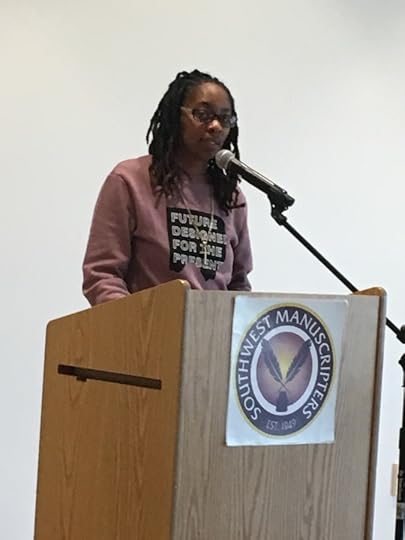
January 6th, 2018 -- It was a beautiful, warm afternoon at the Peninsula Library. Ms. Quiana Beco, the author of the poetry collection Day to Day Dealings (available from Amazon.com) was there to share her poetry with the Southwest Manuscripters writers’ club. Quiana was born in New Orleans, Louisiana and raised in the city of Inglewood, California. She graduated from Inglewood High School. Her poetry is based upon her own life as well as real-life stories from her friends and family members. Quiana writes about love, happiness, joy, jealousy, and the daily events (“day-to-day dealings”) that challenge and exhilarate us. The Palos Verdes Library’s upcoming poetry anthology, PV Voices, features her work.
“But We’re Sisters,” the first poem Quiana shared with us that evening, is a two-part piece about a sister who takes her younger sister’s true love away from her. The poem is based on a first-hand account of betrayal that Quiana heard at the shop where she gets her fingernails done. The poem’s protagonist (the younger sister) is a woman who is willing to forgive: “She loved her sister with all the blood in her heart…” “Shameless Love” is another poem based on real-life events, but Quiana wrote this piece about her own experiences. It is about “a woman who sees no way out.”
Quiana’s poems are therapeutic: she likes to open people’s hearts and souls with her poetry. In 2005, she was working a security job and listening to rapper 50 Cent’s lyrics, when she realized she too could write. She wrote 12 poems but did nothing with them. One year ago, she started writing again. She ended up with 41 poems and 11 quotations, which became her book Day to Day Dealings. Quiana used the subsidy publisher Xlibris for her first book because the company helped Mathew Knowles (the musical artist Beyoncé’s father) publish his book, The DNA of Achievers. However, Quiana was not happy with their editing services: in fact, she had to correct 15 poems after Xlibris “proofread” them. After paying them nearly three thousand dollars for a publishing package, Quiana realized the publishing company actually added errors that were not there to begin with. She is now working on her second book, but does not plan to use Xlibris again.
Quiana’s poem “Floaters in Their Love” was inspired by a painting she created at a Valentine’s Day wine tasting event. The poem evokes an idyllic scene of two people in love: “Above them are the stars as they sit in a canoe of their love…” In her two-part prose poem “They Pushed Her Away,” Quiana tells the true story of a family embroiled in the bitter fruit of abuse and addiction. Not unlike the protagonist of “But We’re Sisters,” the heroine in this poem is a woman who grows stronger through the process of forgiveness. In her prose poem “Hurricane Harvey,” Quiana reflects on the way people of all races and ethnicities came together to save their community from a natural disaster: “The water is deeper than the racism that exists.”
In addition to poetry, Quiana also writes short epigraphs that ring with the wisdom of the ages, such as: “Bend not your knee to fools that can’t see your efforts of help and advice.” Out of all of her poems, Quiana has only memorized two. She recited one of them for us. Its title is “Torn Ace of Spades.” The poem is about a woman whose heart is broken, but becomes a stronger person at the end of her ordeal: “She was taken away by that dark love / that poisonous flower….” Quiana’s Christian faith plays a major role in her poetry: she attends the City of Refuge Church in Los Angeles. The pastor at her aunt’s church in New Orleans often reads her poem “The Enemy Keeps Testing Me” to the congregation. The poem’s persona asks: “Oh why, oh why does the enemy keep testing me?” This poem is a testament to Quiana’s faith, as the persona realizes she can climb any mountain with the help of “my Heavenly Father, the King.”
Thank you to Quiana Beco for sharing your inspiring and heartfelt poetry with the Southwest Manuscripters. Quiana enjoys telling the stories of “those who can’t speak.” She looks forward to becoming “the next Maya Angelou.” Quiana has had several careers (including security, collections, and Lyft driving), but her vocation is writing. We look forward to Quiana’s second book of poetry!
August 10, 2017
Storyteller Carol Sperling Regales Manuscripters with Family Tales
How many literary families can you think of? The Joad family in The Grapes of Wrath, the Bucket family in Charlie and the Chocolate Factory, and even the corrupt Corleone family in The Godfather were characters who added vitality and realism to their authors’ fictional worlds. Whether you write fiction or nonfiction, your family is a helpful resource. Whether your own family is traditional, avant-garde, or just plain dysfunctional, they are always there to provide ideas for your writing.
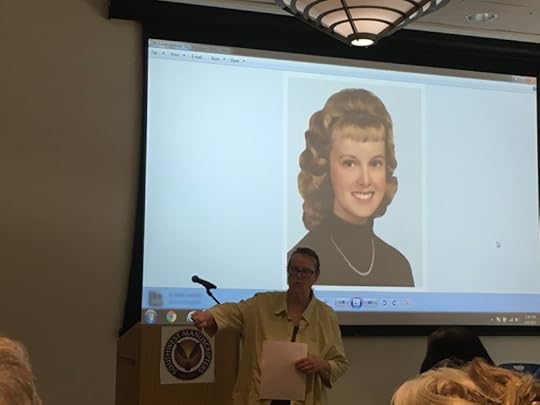
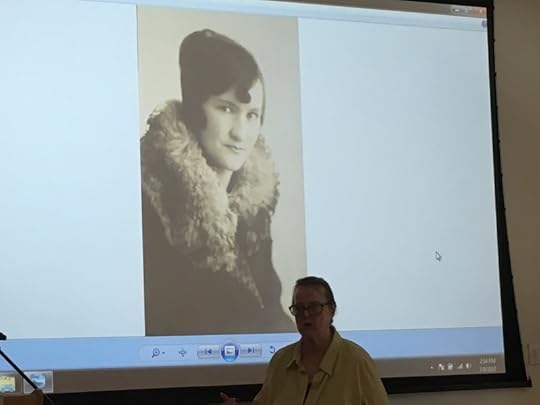
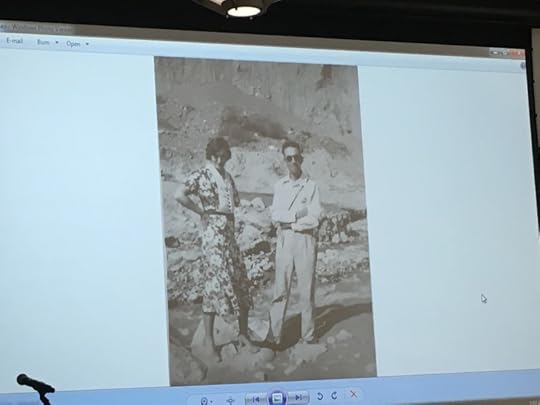
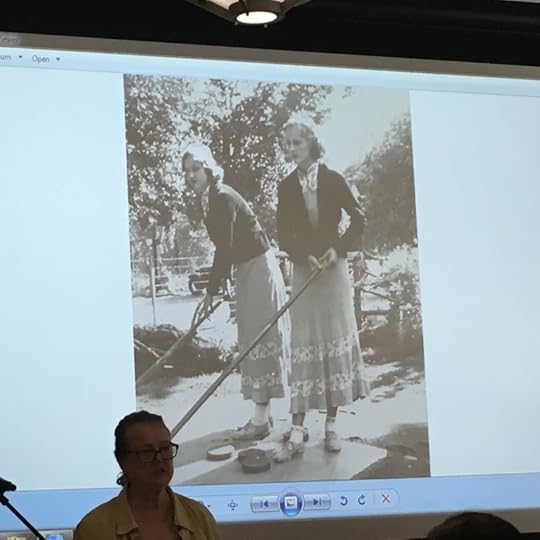
Carol Sperling wore three proverbial hats at the Saturday, July 8 meeting of the Southwest Manuscripters writers' club. She is our club President, but she also served as our three-minute reader as well as our guest speaker. For her three-minute piece, Carol told us about recent travails and incidents in her life and her family’s life. For her guest speaker presentation, Carol shared family stories from the days of the Wild West up to the 21st century. She enhanced her presentation with slides, vintage photos, and artifacts that made us feel like we were stepping back in time.
This is the second year Carol has spoken to the Southwest Manuscripters, and each year she adds new stories from her family that range in tone from humorous to tragic. Several of Carol’s stories (such as the one about her being confined to an “iron lung”: a medical device that seems more like an instrument of torture) have found their way into the pages of our club newsletter, The Write Stuff! However, it was nice to hear these stories from Carol in-person.
Carol called her grandmother (whose original name was Alice May Smith) “Nana.” Nana’s name was later legally changed to Alyce Mae Smith because she thought her name was “too plain.” She married Chester Phillip Falk, whose name was shortened at Ellis Island from “Von Falkenhausen.” He was descended from the falconers to the Baltic kings in Germany. Carol’s mother (Elsie Louise Falk) was a twin who joined an annual Twin’s Parade in Huntington Beach, California, with her sister, Phyllis Pearl Falk. At the parade, the twins met many other sets of twins, including the famous Doublemint Twins of television advertising fame. The twins worked in Hollywood after being discovered at the parade.
Psychic phenomena are a big part of Carol’s family. For example, Carol’s mother often asked her to answer the phone. Carol said, “But Mom, the phone isn’t ringing.” A second later, the phone started ringing, and Carol’s aunt was on the other end. On another occasion, Carol’s mom would say “I wish my sister would call,” and Carol’s aunt would call a minute later.
Carol’s parents met when they were both singing in Hollywood for radio commercials. Carol’s mother had Obsessive-Compulsive Disorder (OCD), and believed no one appreciated the work she did around the house, so she kept diaries of all the housework she did. Even after Carol grew up, her mother would call her to tell her about the housework she did. Carol’s mom often threatened to commit suicide. One day, she called Carol and said “I am going to drown myself in the swimming pool.” Carol called her mom’s doctor, who assured her that her mom could not drown herself, because the human body has a built-in survival mechanism that causes the person to swim to the surface and fill his or her lungs with air.
Later that day, Carol’s father called to tell her that her mother had drowned in the swimming pool. Carol immediately felt guilty, thinking her mother had succeeded in killing herself. An investigation later found the death to be an accident: Carol’s mom was home alone when the phone rang. She rushed to answer it, slipped, fell into the swimming pool, hit her head, and drowned. Carol’s Aunt Phyllis and Uncle Carl had begun a two-week vacation to Big Sur, but Carol’s Aunt told her husband “Something’s wrong. We have to go back.” Due to her intuition, Carol’s Aunt Phyllis was able to attend her sister’s funeral.
Many years later, Carol’s sister Paula decided to visit a famed psychic to contact her deceased brother Larry, who was born with a congenital heart valve defect. Carol’s sister decided to test the psychic by asking her three intimate questions that no one outside the family would know. Before Carol’s sister could even ask them, the psychic immediately provided the correct answers to all three questions.
One day, Carol’s extended family went camping at Camp Switzerland near Lake Arrowhead, California. Her two sons, Robert and Franko, went off on their own. As the boys straddled a small stream, a deadly rattlesnake came up between one of the boys’ legs. Fortunately, a Park Ranger saw what was happening and killed the snake with a forked stick. Later, the Ranger showed the boys how to skin the snake and make a hatband out of it.
When Carol’s grandfather was ten years old, he approached a saloon with a set of old-fashioned swinging doors. He could see a cloud of dust as a man rode up on a horse. The rider asked Carol’s grandfather to keep an eye on his horse while he went into the saloon to have a drink. When the rider emerged from the saloon, he tossed Carol’s grandfather a 25-cent piece. The rider turned out to be the infamous Billy the Kid.
Carol has had a number of extraordinary jobs throughout her life. She showed us a slide of a cute “tow-head” girl (Carol) who was a child actor with Hal Roach Studios. Carol even had her own Screen Actors Guild (SAG) card. She remembers the huge soundstage doors reminding her of the huge doors built by the island natives in the film King Kong. As a mom herself, Carol and her daughter Sharon acted together in community theater, starring in hit musicals such as South Pacific. Later, Carol was the publications reference librarian for the Los Angeles Air Force Station, where she catalogued reports and drawings of UFOs and extraterrestrials from witnesses. This information came in from NASA’s Project Blue Book. This information could be the basis for a book in and of itself, except for one problem: the data is classified.
Not only did Carol get to cut the ribbon at the ceremony to unveil the new Atlas missile at the Los Angeles Air Force Station, but she moonlighted as a Go-Go dancer. Carol was once cited for wearing skirts that were too short and too tight. (Talk about taking all the fun out of life!) Thank you to Carol Sperling for once again taking us back in time and giving us a window into her family history. You have inspired the Southwest Manuscripters to draw on our own families for stories and story ideas.
March 17, 2017
Adventures Through Time and Space with Mel Gilden
Mel began his presentation by recalling the first time he attended a meeting of the Blustering Gales from the South-West (the Sherlock Holmes club that our President, Carol Sperling, helms as our “Diaboli”). Mel was invited to a Gales meeting by Mike Hodel (his co-host of the science fiction radio show Hour 25). The guest speaker at that meeting was Frankie Thomas, the actor who starred in the television show Tom Corbett: Space Cadet. Hodel had promised to buy Mel’s dinner that night, should he not enjoy the Gales meeting. Fortunately, Mel loved every minute of it.
Mel was inspired by Carol’s story of driving in the fog to tell his own “fog story.” One night, after a meeting of the Los Angeles Science Fantasy Society, Mel volunteered to drive a young lady home from the LASFS clubhouse. When they reached the 20th Century Fox studios, Mel realized that (because of the fog) he had driven in the opposite direction from the lady’s home and became thoroughly lost. He was eventually able to take her home safely. Mel commented on Manuscripter Robert Reed’s story (which had won an award in our short fiction contest before Mel’s presentation) about an eagle who volunteers to protect defenseless chickens from other eagles. The story reminded Mel of the classic Walt Disney short film Lambert the Sheepish Lion, about a lion who is raised by sheep and saves his flock from wolves. “It must be a very old story,” Mel said.
I asked Mel the same question I asked him back in 1988, when I was enrolled in a Literature of Science Fiction class at El Camino College, taught by author and English Professor Sheila Finch: “How has Daniel M. Pinkwater influenced your writing?” Mel discovered Pinkwater’s work when he was working for the Los Angeles Times. An Hour 25 listener sent Mel a copy of Pinkwater’s humorous young adult adventure novel The Snarkout Boys and the Avocado of Death. Mel loved his books and even had the chance to interview Pinkwater on the radio. Mel’s young adult novel The Return of Captain Conquer is (in part) inspired by Pinkwater’s work. Mel learned that “writing funny is really hard.” Mel suggests that beginning writers retype passages from their favorite author to get a sense of how the author uses words and punctuation. Mel tried this technique with one of his favorite books: Lonesome Dove by western author Larry McMurtry.
Mel had a wonderful childhood, and worried that this would not engender enough inspiration for good stories. Mel asked science fiction author Harlan Ellison what he should do, and Ellison told Mel to “write what you know.” As a result, Mel wrote the horror story “The Bridge is Out. You’ll Have to Spend the Night,” which is based on Mel’s relationship with his little brother. Mel followed up this story with a story inspired by The Twilight Zone that he sent to a potential publisher. Then he waited for a reply. “There is a lot of waiting involved if you are a freelance author,” Mel says. Finally, Mel received a letter announcing the magazine he sent the story to had gone out of business. Mel’s reaction was “oh my gosh, I murdered a magazine!” Mel’s first professional sale was the short story “What About Us Grils?” (which he wrote at the Clarion Science Fiction Writers workshop in Pennsylvania). The story is about an alien species with four genders. Mel has had interesting encounters with his fellow science fiction writers. One day, Mel visited the Santa Monica Public Library and saw a man wearing shorts and sitting on a wall. The man was legendary science fiction author Ray Bradbury. Ellison and Kate Wilhelm were two of Mel’s instructors at the Clarion workshop. Ellison is “not the easiest guy to get along with,” but Mel has a good relationship with him: “There are a lot of things you can get away with if he likes you and trusts you.” Mel once visited the home of Bob Burns, a collector of science fiction film memorabilia. Burns invited Mel to sit in the time machine prop from the film The Time Machine (based on H. G. Wells’ novel). A photo of Mel in the time machine appears on his website ( www.melgilden.com ) and on the dust jacket for Mel’s novel The Pumpkins of Time.
Mystery writer Lawrence Block said “Not just any clown can write a novel. It takes the right kind of clown.” Mel believes there is some truth in those words. At a party sponsored by the Los Angeles Science Fantasy Society, Mel met a fellow writer who complained about starting several novels, but not finishing them. “I didn’t want to be that guy,” Mel says. “The next time I started writing a novel, I finished it.” After visiting the Jack London room in the Oakland Public Library and finding a glass case filled with hundreds of rejection letters sent to London by potential publishers, Mel realized that the professional writer must accept rejection. After writing several additional novels, Mel began to search for a literary agent. How does a writer get the attention of an agent? “Wave twenty-dollar bills at them,” Mel says. After writing The Return of Captain Conquer and selling it to publisher Houghton Mifflin, Mel’s longtime agent agreed to take him on as a client.
Mel uses his childhood memories to inspire his stories. Mel comes from a Jewish background, and sold a story based on Jewish folklore to The Magazine of Fantasy and Science Fiction. His novel Harry Newberry and the Raiders of the Red Drink is based on the fruity red drink that his mother served his family at dinner. When the drink was nearly depleted, his mother would replenish the pitcher with more red drink. Mel’s novel is based on the idea that the mysterious red drink has the power to grant super powers. Mel could always trust his mother to render an honest opinion about his writing: “She would let me know what she liked or didn’t like about my work.” Thank you to Mel Gilden for letting the Southwest Manuscripters come along on your writing journey through time and space. Live Long and Prosper!