Alma Alexander's Blog
October 22, 2020
Want more Alexander stories...?
I am planning a book of Fractured Fairy Tales - some new, some old, some retrold - next year, in April, as tribute to Hans Christian Andersen on the anniversary of his birthday. It's currently up as a crowdfund project - and please do mosey on past the site, and support hte project if you are able and so inclined! I would appreciate any word-of-mouth to friends who might be interested in such a thing, too, if you are willing to share the information in any way you can. You can see more here: https://www.kickstarter.com/projects/...
I hope to see you amongst the supporters on the fairy tale project - make it a Happy Ever After!
I hope to see you amongst the supporters on the fairy tale project - make it a Happy Ever After!


October 9, 2020
For those of you who might be in the market for a new Alexander -
I'm doing a story collection next year and it's a Kickstarter project, here: https://www.kickstarter.com/projects/...
Consider backing the project for some truly luminous stories that can be had because that's what fairy tales are, they're primal sparks from the storyteller fire, they're some of the first things that makes us love stories as children and for some of us the love of them is enduring and never goes away...
Come join me. Come BACK with me. Return to the beginning of everything, and remember why you love story, reading, language, by sipping from the source, the spring of it all.
Help make it happen.
Consider backing the project for some truly luminous stories that can be had because that's what fairy tales are, they're primal sparks from the storyteller fire, they're some of the first things that makes us love stories as children and for some of us the love of them is enduring and never goes away...
Come join me. Come BACK with me. Return to the beginning of everything, and remember why you love story, reading, language, by sipping from the source, the spring of it all.
Help make it happen.
August 6, 2020
My interview by The Fantasy Hive
I was just interviewed by The Fantasy Hive and it was a fun experience. One question was:
Q: Dazzle us with an elevator pitch? Why should readers check out your work? (If you aren't familiar with the jargon, 'elevator pitch' means a very short summary - something you can blurt out before the elevator doors open)
ME: "Go from hall to hall and be amazed at how Alma Alexander’s Bibliography House changes – from high fantasy to historical fantasy to contemporary fantasy to philosophy to YA to science fantasy to science fiction. A reviewer once said, she never writes the same book twice."
Another Q&A:
Can you tell us a little something about your current work(s) in progress?
The current work in progress is very young – it’s barely begun – but what I AM doing that’s unusual is… inventing an entire alien language, from scratch, grammar and all. You have to realize I am bilingual in English and Serb. I can have a decent conversation (albeit probably a slow one) in French. I can understand (but not respond in) two more languages, and I know a goodly number of Klingon phrases. I also took Irish Gaelic classes once, for fun.
So I’m a language nerd, and I am having an absolute ball with this. Once I have the language nailed down I will begin to glimpse more strongly the culture it has shaped, and once I have that down my next novel is well on the way.
Read the whole interview HERE
image: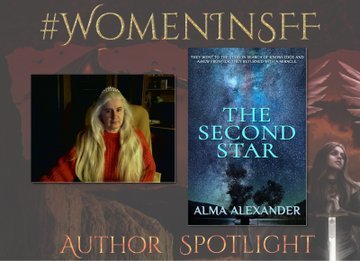
Q: Dazzle us with an elevator pitch? Why should readers check out your work? (If you aren't familiar with the jargon, 'elevator pitch' means a very short summary - something you can blurt out before the elevator doors open)
ME: "Go from hall to hall and be amazed at how Alma Alexander’s Bibliography House changes – from high fantasy to historical fantasy to contemporary fantasy to philosophy to YA to science fantasy to science fiction. A reviewer once said, she never writes the same book twice."
Another Q&A:
Can you tell us a little something about your current work(s) in progress?
The current work in progress is very young – it’s barely begun – but what I AM doing that’s unusual is… inventing an entire alien language, from scratch, grammar and all. You have to realize I am bilingual in English and Serb. I can have a decent conversation (albeit probably a slow one) in French. I can understand (but not respond in) two more languages, and I know a goodly number of Klingon phrases. I also took Irish Gaelic classes once, for fun.
So I’m a language nerd, and I am having an absolute ball with this. Once I have the language nailed down I will begin to glimpse more strongly the culture it has shaped, and once I have that down my next novel is well on the way.
Read the whole interview HERE
image:
July 15, 2020
Help save the Worldweavers series
I first wrote the Worldweavers series as a YA trilogy published by Harper Collins in the days a certain boy wizard ruled the world.
It told the story of a girl who was a bitter disappointment because she couldn't do any magic at all despite a heritage that should have meant she would be brilliant at it.
Yet, over the course of the series, this American girl grew up to be the greatest wizard who had ever lived.
The HC editions were beautiful – hardcover and paperback, amazing art - but they happened during the publishing “Bloodbath of 2008". I lost two editors and four publicists within a year, including a very senior editor who had been a strong advocate for these books.
After the editors and publicists were gone, the trilogy withered on the vine. The third book never even made it out of hardcover into a paperback edition.
The rights eventually reverted to me, and I gave the trilogy to a small press - along with a fourth book which tied up the whole story line into a neat little package.
The cover for the fourth book was great, the first three less so, and the formatting, publicity and distribution were ... a little lackluster.
Original Covers
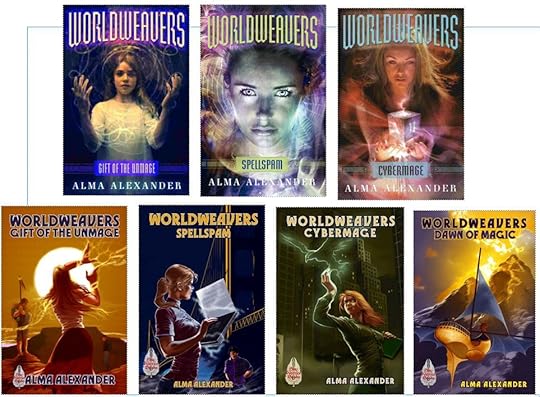
The rights eventually reverted to me again from that small press, Now I want to reissue the whole series in a PERMANENTLY-IN-PRINT format with covers that they deserve. I have a vision for this - and it's going to be EPIC. I've talked to a few artists but it isn't going to be cheap. So I need your help.
These books are a Schrodinger's YA fantasy series; critics said that they were both utterly original, and at the same time enough like that certain boy wizard that VOYA said: “For readers suffering Harry Potter withdrawal, this series might just suffice.”
Whether you love HP, or don't; whether you read YA , or don't; whether you just like the stuff I write and want to keep it out there - please consider supporting the fundraiser that will produce these covers and let these books come back to life.
Here's what you'll be contributing towards. I am envisaging a set of four covers which "flow into one another" so that if you put the books end to end you end up with one large "big picture", flowing from Book 1 to Book 4, highlighting individual things from the individual books.
For instance, the second cover (for Spellspam) would feature a combination of a hint of location (San Francisco) and a hint of the book's content (a computer keyboard or screen.)
I need to discuss the details of this with the artist I choose, but if you have any questions - or even suggestions about what you think should appear on each cover - please let me know!
How to help:
If you're on Facebook, you can do it directly through the FB Fundraiser page
If Facebook isn’t your thing, you can go through my PayPal/ Just type in the amount you want to contribute.
One more option: You can join my my Patreon
at $5/month and commit to at least 1 year
I'd appreciate any help you can give. Thank you.
~~~
It told the story of a girl who was a bitter disappointment because she couldn't do any magic at all despite a heritage that should have meant she would be brilliant at it.
Yet, over the course of the series, this American girl grew up to be the greatest wizard who had ever lived.
The HC editions were beautiful – hardcover and paperback, amazing art - but they happened during the publishing “Bloodbath of 2008". I lost two editors and four publicists within a year, including a very senior editor who had been a strong advocate for these books.
After the editors and publicists were gone, the trilogy withered on the vine. The third book never even made it out of hardcover into a paperback edition.
The rights eventually reverted to me, and I gave the trilogy to a small press - along with a fourth book which tied up the whole story line into a neat little package.
The cover for the fourth book was great, the first three less so, and the formatting, publicity and distribution were ... a little lackluster.
Original Covers
The rights eventually reverted to me again from that small press, Now I want to reissue the whole series in a PERMANENTLY-IN-PRINT format with covers that they deserve. I have a vision for this - and it's going to be EPIC. I've talked to a few artists but it isn't going to be cheap. So I need your help.
These books are a Schrodinger's YA fantasy series; critics said that they were both utterly original, and at the same time enough like that certain boy wizard that VOYA said: “For readers suffering Harry Potter withdrawal, this series might just suffice.”
Whether you love HP, or don't; whether you read YA , or don't; whether you just like the stuff I write and want to keep it out there - please consider supporting the fundraiser that will produce these covers and let these books come back to life.
Here's what you'll be contributing towards. I am envisaging a set of four covers which "flow into one another" so that if you put the books end to end you end up with one large "big picture", flowing from Book 1 to Book 4, highlighting individual things from the individual books.
For instance, the second cover (for Spellspam) would feature a combination of a hint of location (San Francisco) and a hint of the book's content (a computer keyboard or screen.)
I need to discuss the details of this with the artist I choose, but if you have any questions - or even suggestions about what you think should appear on each cover - please let me know!
How to help:
If you're on Facebook, you can do it directly through the FB Fundraiser page
If Facebook isn’t your thing, you can go through my PayPal/ Just type in the amount you want to contribute.
One more option: You can join my my Patreon
at $5/month and commit to at least 1 year
I'd appreciate any help you can give. Thank you.
~~~
July 12, 2020
New Book, New World, New Language
I have spent most of the last month or so doing a Publicity Push for my new science fiction novel, 'The Second Star', but now it’s been shoved out into the middle of the pond and it’s on its own.
What does a writer do in a moment like this…?
Well, start a new book, of course.
So here I am sitting at my computer and doing… something huge -- creating a new language
I am literally creating an alien language. Yes, from scratch. Yes, grammar and everything. Yes, I am marginally insane. I don’t want to shoot my wad here by telling you the details but let me give you some sweet little hints about it.
One, it is a language that changes with the development of the entities who speak it. It’s mostly spoken in the early stages, but there is a telepathic component to it which increases with age until the massively old do not speak at all – they communicate only mind to mind.
When these folk encounter us, the human who first trips over one of them gets an inkling of this and names the two languages, the Language of Light and the Language of Shadow. In her own vernacular, because she’s Italian, that’s “della luce” and “dell’ombra”.
Obviously mind-to-mind communication erases grammatical obstacles as such. But the “della luce” language IS grammatical and that means learning the rules. Let me get back to that in a minute. Let me digress just a little into one of those delicious “rules”.
Making the rules
This is a language with several variants of a future tense, indicated by a prefix to the sentence being uttered.
One – the IMMEDIATE future (as in, this thing I am speaking about is already in the process of happening, and this is what will occur when it finishes happening – but it’s already in process, and inevitable, and immutable).
Two – the LONG TERM (FIRM) PREDICTIVE future (as in if THIS happens then THIS will happen, as a consequence – it’s an empirically provable future, one where there are dots between “now” and “then” and the dots are connectable in a unique and highly specific manner).
Three – the LONG-TERM POTENTIAL future (as in, if THIS then MAYBE THAT – something that isn’t a given, something that can be altered by circumstance or context, indicating a high degree of uncertainty).
Four – the FUTURE NEGATIVE (another very empirically specific one, as in, if THIS then NEVER THAT and it’s something you can bet on).
As you can begin to get a glimmer of, this is a language that both shapes and is shaped by a particular mindset, a particular alien culture. I am building a world, from scratch, and it rests on the foundations of language because I am a language nerd and I roll like that. I am both enjoying myself immensely and banging my head against a brick wall, because… well… let’s circle back to that thing I said we would return to.
No Rosetta stone
This is an alien species with its own language which WE HUMANS DO NOT KNOW. There is NO Rosetta stone here that we can rely on. And yet I have to create one because these two species, whose stories entwine in this book, need to, well, communicate – because without talking to each other and conveying important information the story quickly grinds to a halt because nobody knows what anyone is thinking or doing and the two stories of the two entities involved continue running on parallel tracks which ne’er will meet and there is little purpose to following these parallel tracks to the horizon because only one half of the story I am telling is visible to anyone on either track.
Which means that I have to figure out a way to make these two species without a common language… bridge this communication gulf somehow. I have to do it early enough for there to be room left in the story to tell the actual STORY as opposed to telling the story of how the language problem was solved, and I have to do it LATE enough for the whole thing not to be dismissed as deus-ex-machina legerdemain handwavium, something that happens because the author waves a god-like hand in exasperation and simply says, well, OKAY, they can damn well TALK to each other now, let’s get on with it.
See my problem?
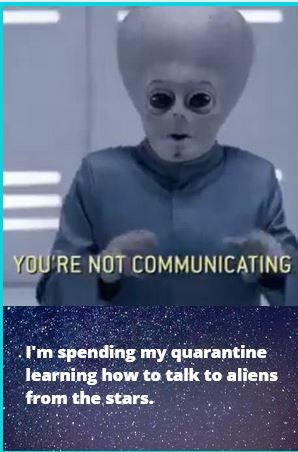
I’m spending my quarantine learning how to talk to aliens. I hope to convey my findings to all y’all in due time in a reasonably coherent fashion.
Why? What else did you think I would be doing?
~~~
What does a writer do in a moment like this…?
Well, start a new book, of course.
So here I am sitting at my computer and doing… something huge -- creating a new language
I am literally creating an alien language. Yes, from scratch. Yes, grammar and everything. Yes, I am marginally insane. I don’t want to shoot my wad here by telling you the details but let me give you some sweet little hints about it.
One, it is a language that changes with the development of the entities who speak it. It’s mostly spoken in the early stages, but there is a telepathic component to it which increases with age until the massively old do not speak at all – they communicate only mind to mind.
When these folk encounter us, the human who first trips over one of them gets an inkling of this and names the two languages, the Language of Light and the Language of Shadow. In her own vernacular, because she’s Italian, that’s “della luce” and “dell’ombra”.
Obviously mind-to-mind communication erases grammatical obstacles as such. But the “della luce” language IS grammatical and that means learning the rules. Let me get back to that in a minute. Let me digress just a little into one of those delicious “rules”.
Making the rules
This is a language with several variants of a future tense, indicated by a prefix to the sentence being uttered.
One – the IMMEDIATE future (as in, this thing I am speaking about is already in the process of happening, and this is what will occur when it finishes happening – but it’s already in process, and inevitable, and immutable).
Two – the LONG TERM (FIRM) PREDICTIVE future (as in if THIS happens then THIS will happen, as a consequence – it’s an empirically provable future, one where there are dots between “now” and “then” and the dots are connectable in a unique and highly specific manner).
Three – the LONG-TERM POTENTIAL future (as in, if THIS then MAYBE THAT – something that isn’t a given, something that can be altered by circumstance or context, indicating a high degree of uncertainty).
Four – the FUTURE NEGATIVE (another very empirically specific one, as in, if THIS then NEVER THAT and it’s something you can bet on).
As you can begin to get a glimmer of, this is a language that both shapes and is shaped by a particular mindset, a particular alien culture. I am building a world, from scratch, and it rests on the foundations of language because I am a language nerd and I roll like that. I am both enjoying myself immensely and banging my head against a brick wall, because… well… let’s circle back to that thing I said we would return to.
No Rosetta stone
This is an alien species with its own language which WE HUMANS DO NOT KNOW. There is NO Rosetta stone here that we can rely on. And yet I have to create one because these two species, whose stories entwine in this book, need to, well, communicate – because without talking to each other and conveying important information the story quickly grinds to a halt because nobody knows what anyone is thinking or doing and the two stories of the two entities involved continue running on parallel tracks which ne’er will meet and there is little purpose to following these parallel tracks to the horizon because only one half of the story I am telling is visible to anyone on either track.
Which means that I have to figure out a way to make these two species without a common language… bridge this communication gulf somehow. I have to do it early enough for there to be room left in the story to tell the actual STORY as opposed to telling the story of how the language problem was solved, and I have to do it LATE enough for the whole thing not to be dismissed as deus-ex-machina legerdemain handwavium, something that happens because the author waves a god-like hand in exasperation and simply says, well, OKAY, they can damn well TALK to each other now, let’s get on with it.
See my problem?
I’m spending my quarantine learning how to talk to aliens. I hope to convey my findings to all y’all in due time in a reasonably coherent fashion.
Why? What else did you think I would be doing?
~~~
June 10, 2020
New blog interview of me
Fantasy author David B. Coe asked in a blog interview what was the hardest part of writing my new book about starfarers who became several people. Good question!!!
Read the interview HERE
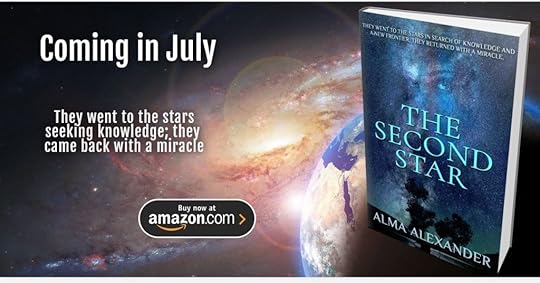
My new book will be launched July 1. Preorders are available at amazon.
Read the interview HERE
My new book will be launched July 1. Preorders are available at amazon.
May 29, 2020
Coming July 1: The Second Star
In the publishing world, there’s a thing called an elevator pitch. It’s what you would say to someone to describe your book in terms of other things that might be familiar and illustrative, and you have only a couple of minutes of an elevator ride to say it.
It’s got to be short, sharp, pithy, and extremely enlightening; it’s a lot to ask of a breathless sentence.
It’s mostly something that ends up describing your book in terms of “X meets Y”, where X and Y are well known, giving your target a quick and dirty idea about whether they’d be interested in picking your book up and what to expect if they did.
When it came to my own new novel, due out in the summer, my elevator pitch for ‘The Second Star’ is:
“Matt Ruff’s ‘Set This House in Order’ meets Carl Sagan’s ‘Contact’ meets Mary Doria Russell’s ‘The Sparrow’.”
Warning: major spoilers ahead
TORTURED SOULS
Let me unpack that for you.
I have admired Matt Ruff ever since I read his immortal and effortlessly brilliant novel ‘Fool on the Hill’. But the extraordinary book of his I invoke in my elevator pitch is ‘Set This House in Order.’ It is a multiple personality book, with a main character who isn’t so much as a main character, singular, as an entire cast of main characters all of whom are personalities living inside a single mind and body. It is luminous, it is technically masterful, and it is a damnably difficult thing to pull off. And he did it flawlessly.
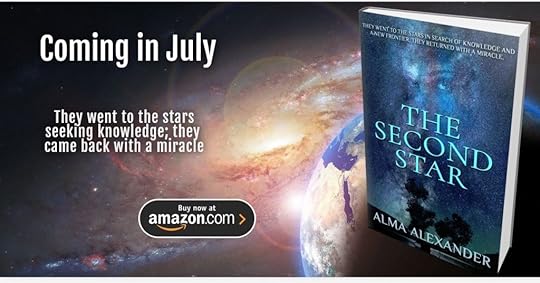
The operative comparison here is the multiple personality aspect of it, because that is central to the story line of ‘The Second Star’, the exploration of what happens when a human psyche shatters under an unbearable strain and splinters into many different ‘people’. I had a great respect for what Matt Ruff did when I tackled my own character like this, a character whose identity can literally change in the blink of an eye and who has to be shown to have changed through a change in voice or how they present themselves physically. It is a hard one to get a real handle on. It’s like trying to catch fish with your bare hands while standing in a fast-flowing river threatening to sweep you off your feet. But I didn’t just have ONE such character, I had SIX.
As another character says, early in the book, “Six people went out to the stars. More than seventy came back.”
That is a fundamental part of this book – the mystery behind that event, why the shattering happened, how it is affecting the human minds and spirits which are being afflicted by it, is it possible to ‘reintegrate’ these fragments and if they are sufficiently self-aware as their own individual selves if they would even wish for such a thing.
FIRST CONTACT
To make things more interesting, this isn’t JUST a story of multiple personality disorder and the many new souls which have come into existence because of it. It’s a story of First Contact; our six splintered protagonists aren’t just any six human beings. They are the crew of the Earth’s first starship, and whatever happened to them out there was what precipitated their current psychological fracture. Our mystery… does not have a terrestrial origin.
The more our psychologist protagonist, Stella, discovers about the matter, the more difficult it is for her to come to terms with what she has been called in to deal with. She has a deeply felt responsibility to the six crew members – but she also has to incorporate those people’s responsibility to one another, and to the thing that they touched out there among the stars.
Stella, caught between her empathy and her duty, is trapped in a difficult place, where truth needs to be told slant, and where it is important just who hears that truth… or consequences could be dire. And much like the protagonist of Carl Sagan’s ‘Contact’, the truth that has to be told… is difficult, and hard to state, and impossible to believe, and the stakes are very very high.
When a Jesuit gets involved
‘Contact’ is a novel of a clash of science and faith, too, and so is ‘Second Star’ – and the third of my triptych, Mary Doria Russell’s ‘The Sparrow’ completes that particular aspect of my own book. A while ago I wrote in a review:
“Twenty years ago, a Jesuit priest broke my heart.
Twenty years later, on this re-read, he did it again.
Emilio Sandoz stands as one of the most memorable characters I have ever encountered in the world of literature. I mean, I put MY characters through hell – but this poor man went to hell, and back, twice. …I loved this man, I suffered with him, I raged at what was being done to him, I fell into his epiphanies and stood breathlessly beside him after he fought his battles and claimed his ragged victories and stared defeat into the face again and again and yet still stood up and fought once more. He was described as a “small man” but in my mind he was a giant – someone who strode through the stars and scattered them in his wake, someone who lived, who suffered, who dreamed, who failed, who transcended, who lost, who dreamed.”
When I created Father Philip Carter and sent him in to do battle in ‘The Second Star’, his existence owed so very much to Russell’s luminous man of God – I instinctively made Father Carter a Jesuit. And the question of faith, explored in my novel, becomes his own question – becomes his being forced to look into a terrible mirror, and confront things that had the power to completely destroy him if he dared to look at them.
And yet he looked them in the eye.
I don’t make it easy – on him, or on the reader who battles through all of this with him. In my review of ‘The Sparrow’ that I quote above, I go on to say:
“These are books that ask some tough questions, and they don’t even pretend that there are easy answers. These are not easy books to read. They ask a lot from you. They demand that you step away from the sidelines and take responsibility. That is why Sandoz broke my heart – because his was broken, and I could not but offer mine up in a solidarity of sacrifice. These might be novels concerned with questions of faith, but it isn’t the kind of gentle candlelight vigil faith that simply gives you solace and absolution. These books will ask you what you think God is, who you think God is, and whether God knows (or has ever known, or even cares) what he is doing, or what is being done in his name. You have to think. These are books that make you feel, and make you think.
These are books which … may be a required re-read. Once every decade, at least. Just to see if your moral clock is still ticking along, and to give a litmus test on how your convictions, sensibilities and beliefs might have changed and altered as life and living pile higher and higher upon your soul.”
And I can almost guarantee that whatever the answer to that is, Emilio Sandoz will once again break your heart.”
I hope Father Philip Carter breaks my readers’ hearts. Just a little. I hope he is as vivid and bright and memorable as Emilio Sandoz was to me. I hope his dark night of the soul, his own difficult questions, shine some light into the shadows that those who discover him in these pages might not even know that they share with him.
I set out to write – as always – a story that was utterly organic, as every story I have ever written down has been. It turned into a complex and intricate novel, a book about the big and eternal questions – about who, or what, God is; about our own immortal souls and their salvation; about what it really means to be human, and where the boundaries of that lie; about whether it is possible to go out into the wilderness where the monsters dwell and ever expect to really come home again unchanged.
It is also about the tiniest of details, about choices that need to be made because of extremely personal convictions, about defying things that you believe to be bad and fighting for things you believe to be good, about friendship, about establishing a connection, about making decisions based on purely selfish concerns as opposed to letting go of those and working for the good of others.
Readers will find what they might seek in the pages of this book, and different readers will no doubt follow the map I have laid out to some very different destinations – my only hope here is those who choose to step into the light of ‘The Second Star’ with me will find something of value in the journey. That somewhere, somehow, somebody will find a scrap of treasure in this story – a shard of light, to take along into their own lives long after they have closed this book and left it behind. Like my six starfarers, this is a book which has many different personalities. I hope you meet them, that you consider at least one of them worthy of keeping as a companion.
This is a story of how humans meet the stars, and find themselves there.
In a world that may be incomprehensibly difficult and rich and strange… I hope that the eyes looking back at you out of this tale are warm, and familiar. Ask your own questions, find your own answers… but come, share the light.
It’s got to be short, sharp, pithy, and extremely enlightening; it’s a lot to ask of a breathless sentence.
It’s mostly something that ends up describing your book in terms of “X meets Y”, where X and Y are well known, giving your target a quick and dirty idea about whether they’d be interested in picking your book up and what to expect if they did.
When it came to my own new novel, due out in the summer, my elevator pitch for ‘The Second Star’ is:
“Matt Ruff’s ‘Set This House in Order’ meets Carl Sagan’s ‘Contact’ meets Mary Doria Russell’s ‘The Sparrow’.”
Warning: major spoilers ahead
TORTURED SOULS
Let me unpack that for you.
I have admired Matt Ruff ever since I read his immortal and effortlessly brilliant novel ‘Fool on the Hill’. But the extraordinary book of his I invoke in my elevator pitch is ‘Set This House in Order.’ It is a multiple personality book, with a main character who isn’t so much as a main character, singular, as an entire cast of main characters all of whom are personalities living inside a single mind and body. It is luminous, it is technically masterful, and it is a damnably difficult thing to pull off. And he did it flawlessly.
The operative comparison here is the multiple personality aspect of it, because that is central to the story line of ‘The Second Star’, the exploration of what happens when a human psyche shatters under an unbearable strain and splinters into many different ‘people’. I had a great respect for what Matt Ruff did when I tackled my own character like this, a character whose identity can literally change in the blink of an eye and who has to be shown to have changed through a change in voice or how they present themselves physically. It is a hard one to get a real handle on. It’s like trying to catch fish with your bare hands while standing in a fast-flowing river threatening to sweep you off your feet. But I didn’t just have ONE such character, I had SIX.
As another character says, early in the book, “Six people went out to the stars. More than seventy came back.”
That is a fundamental part of this book – the mystery behind that event, why the shattering happened, how it is affecting the human minds and spirits which are being afflicted by it, is it possible to ‘reintegrate’ these fragments and if they are sufficiently self-aware as their own individual selves if they would even wish for such a thing.
FIRST CONTACT
To make things more interesting, this isn’t JUST a story of multiple personality disorder and the many new souls which have come into existence because of it. It’s a story of First Contact; our six splintered protagonists aren’t just any six human beings. They are the crew of the Earth’s first starship, and whatever happened to them out there was what precipitated their current psychological fracture. Our mystery… does not have a terrestrial origin.
The more our psychologist protagonist, Stella, discovers about the matter, the more difficult it is for her to come to terms with what she has been called in to deal with. She has a deeply felt responsibility to the six crew members – but she also has to incorporate those people’s responsibility to one another, and to the thing that they touched out there among the stars.
Stella, caught between her empathy and her duty, is trapped in a difficult place, where truth needs to be told slant, and where it is important just who hears that truth… or consequences could be dire. And much like the protagonist of Carl Sagan’s ‘Contact’, the truth that has to be told… is difficult, and hard to state, and impossible to believe, and the stakes are very very high.
When a Jesuit gets involved
‘Contact’ is a novel of a clash of science and faith, too, and so is ‘Second Star’ – and the third of my triptych, Mary Doria Russell’s ‘The Sparrow’ completes that particular aspect of my own book. A while ago I wrote in a review:
“Twenty years ago, a Jesuit priest broke my heart.
Twenty years later, on this re-read, he did it again.
Emilio Sandoz stands as one of the most memorable characters I have ever encountered in the world of literature. I mean, I put MY characters through hell – but this poor man went to hell, and back, twice. …I loved this man, I suffered with him, I raged at what was being done to him, I fell into his epiphanies and stood breathlessly beside him after he fought his battles and claimed his ragged victories and stared defeat into the face again and again and yet still stood up and fought once more. He was described as a “small man” but in my mind he was a giant – someone who strode through the stars and scattered them in his wake, someone who lived, who suffered, who dreamed, who failed, who transcended, who lost, who dreamed.”
When I created Father Philip Carter and sent him in to do battle in ‘The Second Star’, his existence owed so very much to Russell’s luminous man of God – I instinctively made Father Carter a Jesuit. And the question of faith, explored in my novel, becomes his own question – becomes his being forced to look into a terrible mirror, and confront things that had the power to completely destroy him if he dared to look at them.
And yet he looked them in the eye.
I don’t make it easy – on him, or on the reader who battles through all of this with him. In my review of ‘The Sparrow’ that I quote above, I go on to say:
“These are books that ask some tough questions, and they don’t even pretend that there are easy answers. These are not easy books to read. They ask a lot from you. They demand that you step away from the sidelines and take responsibility. That is why Sandoz broke my heart – because his was broken, and I could not but offer mine up in a solidarity of sacrifice. These might be novels concerned with questions of faith, but it isn’t the kind of gentle candlelight vigil faith that simply gives you solace and absolution. These books will ask you what you think God is, who you think God is, and whether God knows (or has ever known, or even cares) what he is doing, or what is being done in his name. You have to think. These are books that make you feel, and make you think.
These are books which … may be a required re-read. Once every decade, at least. Just to see if your moral clock is still ticking along, and to give a litmus test on how your convictions, sensibilities and beliefs might have changed and altered as life and living pile higher and higher upon your soul.”
And I can almost guarantee that whatever the answer to that is, Emilio Sandoz will once again break your heart.”
I hope Father Philip Carter breaks my readers’ hearts. Just a little. I hope he is as vivid and bright and memorable as Emilio Sandoz was to me. I hope his dark night of the soul, his own difficult questions, shine some light into the shadows that those who discover him in these pages might not even know that they share with him.
I set out to write – as always – a story that was utterly organic, as every story I have ever written down has been. It turned into a complex and intricate novel, a book about the big and eternal questions – about who, or what, God is; about our own immortal souls and their salvation; about what it really means to be human, and where the boundaries of that lie; about whether it is possible to go out into the wilderness where the monsters dwell and ever expect to really come home again unchanged.
It is also about the tiniest of details, about choices that need to be made because of extremely personal convictions, about defying things that you believe to be bad and fighting for things you believe to be good, about friendship, about establishing a connection, about making decisions based on purely selfish concerns as opposed to letting go of those and working for the good of others.
Readers will find what they might seek in the pages of this book, and different readers will no doubt follow the map I have laid out to some very different destinations – my only hope here is those who choose to step into the light of ‘The Second Star’ with me will find something of value in the journey. That somewhere, somehow, somebody will find a scrap of treasure in this story – a shard of light, to take along into their own lives long after they have closed this book and left it behind. Like my six starfarers, this is a book which has many different personalities. I hope you meet them, that you consider at least one of them worthy of keeping as a companion.
This is a story of how humans meet the stars, and find themselves there.
In a world that may be incomprehensibly difficult and rich and strange… I hope that the eyes looking back at you out of this tale are warm, and familiar. Ask your own questions, find your own answers… but come, share the light.
May 22, 2020
Only a few books are perfect; This is one of them.
A couple of years and a couple of novels after "Fool on the Hill", I read a new Matt Ruff novel, "Set This House in Order: A romance of souls".
I knew very little about it when I began to read it - but by this stage Matt Ruff had become one of the handful of novelists whose new book I just BUY, no questions asked, when t comes out because I know I am going to be rewarded for it.
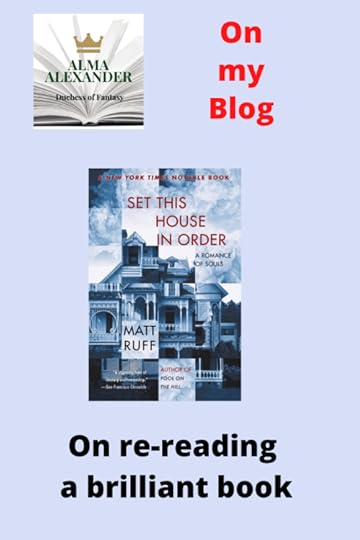 It has not one, but TWO protagonists with Multiple Personality Disorder, and the sheer difficulty, some might call it impossibility, of getting into those heads, into the multiplicities that live inside those heads, I don't know where he found the courage to do it. But I am oh so glad that he did.
This is a novel that is brimming with poignancy, with understanding, with sympathy, with helplessness, with sheer humanity. It has two protagonists - but each protagonist is fractured into smithereens and so each protagonist has individual sub-protagonists. What that means, craft-wise, is that the writer has MANY people who are on stage all the time and they all have speaking parts and they have to have individual and distinguishable voices and personalities of their own.
Andrew Gage - one of the protagonists - is literally (as and of his own actual existence) a handful of years old (his BODY is in its twenties). But inside him live Aaron, Adam, Aunt Sam, Jake, Seferis, Gideon, Simon, Angel, Rhea..and more. One of these people is an artistic woman who smokes.
One of them is five years old. One is a teenager. One is a fit and dangerous warrior who exists in order to protect the body when it is in danger. One of them is the Bad Guy.
Think about that for a second. Just living with this is going to be catastraphically complicated, sometimes. Writing about someone who is living with it? And keeping it "sane"? This is something that Matt Ruff accomplishes with almost ridiculous aplomb.
The other main protag, Penny, is even more chaotic - while the Gage multiples have organized themselves into a somewhat tenable situation where things can be kept (just barely) under control, Penny has no such restraints. Her life is utter and complete chaos where any of her hidden personalities can basically wrestle the others down and grab control of the body they all share - and everyone else "loses time" and can wake up in places they have no memory of having gone to sleep in.
Penny lives with a catastrophically damaged girl called Mouse, a chronicler named Thread, protectors Maledicta and Malefica, a borderline nymphomaniac named Loins, and any number of other splinters many of which she doesn't even have names for.
It's Penny's search for sanity and identity and Andrew Gage's search for truth and closure that form the backbone of this book, and it is a masterpiece from a writer who is writing from his full powers. Rarely will you read a book which grips from the beginning, which (despite its inherent improbabilities which you, the reader, are struggling to come to terms with from the very beginning) refuses to let go of you - while you're reading, and then, afterwards, indelibly remaining behind in the archives of your mind.
Matt Ruff finds the improbable, makes it the necessary and the obvious, and leaves you with the inevitable. Reading this book frequently left me breathless. Thinking about it after I finished reading it sharpened my mind and deepened my empathy.
I don't know how much more you can possibly ask of a novel.
This probably remains the most inherently powerful book of Matt Ruff's that I have read. It is the book which took the promise of the brash young genius kid who wrote "Fool on the Hill" and solidified it into a towering, confident talent who is fully aware of the difficulties of his subject matter and remains undaunted by them and undefeated by them.
As close to perfect as I know how to describe a book.
An absolute tour de force and one to which I return to glory in it, to sink into, to learn - both about what makes my fellow man tick, and how to write about it with the power of a literary angel.
~~~
Quote: If one cannot enjoy reading a book over and over again there is really no use to read it at all. -- Oscar Wilde
I knew very little about it when I began to read it - but by this stage Matt Ruff had become one of the handful of novelists whose new book I just BUY, no questions asked, when t comes out because I know I am going to be rewarded for it.
It has not one, but TWO protagonists with Multiple Personality Disorder, and the sheer difficulty, some might call it impossibility, of getting into those heads, into the multiplicities that live inside those heads, I don't know where he found the courage to do it. But I am oh so glad that he did. This is a novel that is brimming with poignancy, with understanding, with sympathy, with helplessness, with sheer humanity. It has two protagonists - but each protagonist is fractured into smithereens and so each protagonist has individual sub-protagonists. What that means, craft-wise, is that the writer has MANY people who are on stage all the time and they all have speaking parts and they have to have individual and distinguishable voices and personalities of their own.
Andrew Gage - one of the protagonists - is literally (as and of his own actual existence) a handful of years old (his BODY is in its twenties). But inside him live Aaron, Adam, Aunt Sam, Jake, Seferis, Gideon, Simon, Angel, Rhea..and more. One of these people is an artistic woman who smokes.
One of them is five years old. One is a teenager. One is a fit and dangerous warrior who exists in order to protect the body when it is in danger. One of them is the Bad Guy.
Think about that for a second. Just living with this is going to be catastraphically complicated, sometimes. Writing about someone who is living with it? And keeping it "sane"? This is something that Matt Ruff accomplishes with almost ridiculous aplomb.
The other main protag, Penny, is even more chaotic - while the Gage multiples have organized themselves into a somewhat tenable situation where things can be kept (just barely) under control, Penny has no such restraints. Her life is utter and complete chaos where any of her hidden personalities can basically wrestle the others down and grab control of the body they all share - and everyone else "loses time" and can wake up in places they have no memory of having gone to sleep in.
Penny lives with a catastrophically damaged girl called Mouse, a chronicler named Thread, protectors Maledicta and Malefica, a borderline nymphomaniac named Loins, and any number of other splinters many of which she doesn't even have names for.
It's Penny's search for sanity and identity and Andrew Gage's search for truth and closure that form the backbone of this book, and it is a masterpiece from a writer who is writing from his full powers. Rarely will you read a book which grips from the beginning, which (despite its inherent improbabilities which you, the reader, are struggling to come to terms with from the very beginning) refuses to let go of you - while you're reading, and then, afterwards, indelibly remaining behind in the archives of your mind.
Matt Ruff finds the improbable, makes it the necessary and the obvious, and leaves you with the inevitable. Reading this book frequently left me breathless. Thinking about it after I finished reading it sharpened my mind and deepened my empathy.
I don't know how much more you can possibly ask of a novel.
This probably remains the most inherently powerful book of Matt Ruff's that I have read. It is the book which took the promise of the brash young genius kid who wrote "Fool on the Hill" and solidified it into a towering, confident talent who is fully aware of the difficulties of his subject matter and remains undaunted by them and undefeated by them.
As close to perfect as I know how to describe a book.
An absolute tour de force and one to which I return to glory in it, to sink into, to learn - both about what makes my fellow man tick, and how to write about it with the power of a literary angel.
~~~
Quote: If one cannot enjoy reading a book over and over again there is really no use to read it at all. -- Oscar Wilde
May 7, 2020
Homes of the dreamers, the tellers of tales
A writer’s house which has been turned into a museum is almost irresistible for me.
In homage and for inspiration I go to look at the books on their shelves, to look out of the same window they looked out of, to wander down the hallways they walked. I look at things they might have owned or touched or that might have inspired some particularly beloved character or incident from a novel I know well.
I go to see their quill pens and their ancient typewriters and to wonder how any novel at all was ever written before the computer, True, I started in longhand myself, but once I got a computer, I have never looked back.
Yes, I know that writing can be done anywhere, and that some of the modern writers might have to have a city tour for a museum instead of a single house, incorporating various coffee shops where they once pecked at the keyboard of their laptop (I am thinking, in particular, about a certain café which, by repute, was the birthplace of some character called… oh… Harry Potter.) But all the same …
Some places don’t care much for such stuff. The house in Bloemfontein, South Africa, where J R R Tolkien was born, has long been torn down to make space for a shopping mall. I did visit the home of Jane Austen and saw letters and music books transcribed in her own hand, Austen’s writing table, and an actual patchwork quilt made for Jane by her mother and which she might have slept under.
image: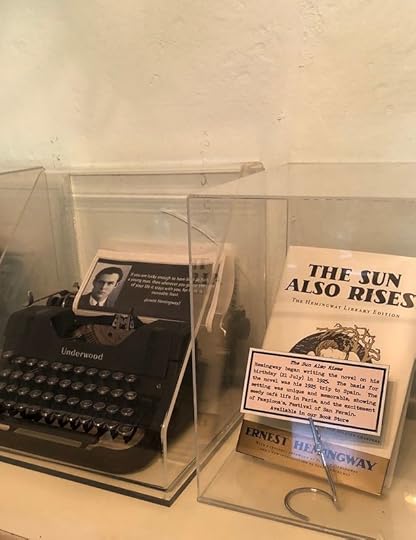
I’ve been to the house of Ernest Hemingway in Key West, where one of the large numbers of the Hemingway Cats, well, their descendants. One of them was, disconcertingly, the first thing we saw, sitting confidently in solitary splendor in the ticket booth. Another, a large orange tom, chose to follow my Hemingway-bearded husband from room to room looking curious and expectant as though Papa might reincarnate any minute.
Out by the pool, preserved by a small square of clear plastic set into the paving, is a single penny. The story goes that during one of her husband’s absences, Mrs. Hemingway decided to amuse herself by making a swimming pool at the house. This proved to be a greater and far more expensive challenge than initially believed because it turned out that the place where the pool was to go required excavating it out of solid rock. Hemingway, upon his return and being presented with the substantial bill, reputedly reached into his pocket and took out a penny, and said “Here, have my last cent!” His wife took it and enshrined it.
I’ve been to the Charles Dickens House – which declares that it will be OPEN AT CHRISTMAS – and really, how could it not be, with the man who wrote classics like “David Copperfield” and “Oliver Twist” and “Little Nell”, with which schoolchildren have been tortured in English Lit classes for generations, being the most famous of all for a little something called… “The Christmas Carol”…? And God BLESS us, every one!
The homes of the creators. The dreamers. The tellers of tales.
I never managed to visit the house of Anne Frank, in Amsterdam, for the same reasons that I missed out on the Egyptian Queen in Berlin – we were in Amsterdam for a short time, and our window of opportunity failed to coincide with the museum’s opening hours. I have a photo of the house, from the street, though. I read the book, of course, when I was still a girl – and it had left an impression.
I remember gazing up at the narrow Dutch house and trying to picture it, trying to imagine what a spirited teenager must have felt, suspended between life and death here, counting her heartbeats, waiting for it all to end… until it finally did, of course, and badly. The house has an aura for me, and that’s without my ever having gone inside – the ghost of a young girl who might have been all sorts of things had she been allowed to grow up and grow old but became, instead, an iconic face for one of the most appalling acts that humanity has ever committed. Anne is both writer and character, a protagonist in her own story, mixed up until the edges between the two blur – and in some ways perhaps it is easier to approach this place if you think of her story as Story, as Meta-narrative, as Pseudo-fiction, someone telling a tale – perhaps about their own life, to be sure, but still, a story.
But the unnerving little aftertaste of bitterness remains, the taste of truth, the thing you cannot ever forget once you felt it burn on your tongue, sear its way down your throat, settle into your gut.
That’s what a museum is for. To make you think. To make you remember. To make you understand.
There are also the wholly fictional characters who rate a museum of their own, too – characters so iconic that it is easier to believe that they MIGHT have existed than that they were just the figments of their creators’ imaginations.
One of the most famous addresses in London is, and will always remain, 221B Baker Street, the Sherlock Holmes museum. This place is like… a game of Cluedo. You go in with a mental checklist and you tick items off as you spot them. Sherlock’s violin – check. A pipe –check. A doctor’s bag – check. A deerstalker hat – check. Any number of tiny – insignificant for some – details from the stories, from the mysteries, spilling out of drawers, over the mantelpiece, on the bookshelves.
You go hunting, for literary clues, for the little hooks which you can use to attach yourself to the tale where you first encountered these things, trying to recapture – oh, to quote Browning – that “fine, careless rapture”.
Stories. Museums are there to hold stories.
Some are real; some are marginal; some are frankly fake (but so beloved that you can overlook that small inconvenience).
We are all part of a much larger story, interweaving with so many others – but every so often we’ll pick up some small thread of it and follow its shining lure into some other world, see that world through some other person’s eyes.
asks a young character named Wart in a great and glorious book called The Once and Future King.
The wizard whom all the world knows, called Merlin, replies to the future King Arthur, “The best thing for being sad… is to learn something.”
Get thee to a museum. Go look at art made by a stranger’s hand, or an artefact once used by a human being who lived at the dawn of our civilization, or a presentation on how the first electric light bulb was lit in a house thus bringing the gas age to a halt, or a wonderful old book, or something of deep cultural significance to a culture not your own thus learning more about your species, or a painstakingly recreated room from another age taking you back in time, or a painstakingly recreated bridge from a starship that never existed taking you into an imagined future.
In homage and for inspiration I go to look at the books on their shelves, to look out of the same window they looked out of, to wander down the hallways they walked. I look at things they might have owned or touched or that might have inspired some particularly beloved character or incident from a novel I know well.
I go to see their quill pens and their ancient typewriters and to wonder how any novel at all was ever written before the computer, True, I started in longhand myself, but once I got a computer, I have never looked back.
Yes, I know that writing can be done anywhere, and that some of the modern writers might have to have a city tour for a museum instead of a single house, incorporating various coffee shops where they once pecked at the keyboard of their laptop (I am thinking, in particular, about a certain café which, by repute, was the birthplace of some character called… oh… Harry Potter.) But all the same …
Some places don’t care much for such stuff. The house in Bloemfontein, South Africa, where J R R Tolkien was born, has long been torn down to make space for a shopping mall. I did visit the home of Jane Austen and saw letters and music books transcribed in her own hand, Austen’s writing table, and an actual patchwork quilt made for Jane by her mother and which she might have slept under.
image:
I’ve been to the house of Ernest Hemingway in Key West, where one of the large numbers of the Hemingway Cats, well, their descendants. One of them was, disconcertingly, the first thing we saw, sitting confidently in solitary splendor in the ticket booth. Another, a large orange tom, chose to follow my Hemingway-bearded husband from room to room looking curious and expectant as though Papa might reincarnate any minute.
Out by the pool, preserved by a small square of clear plastic set into the paving, is a single penny. The story goes that during one of her husband’s absences, Mrs. Hemingway decided to amuse herself by making a swimming pool at the house. This proved to be a greater and far more expensive challenge than initially believed because it turned out that the place where the pool was to go required excavating it out of solid rock. Hemingway, upon his return and being presented with the substantial bill, reputedly reached into his pocket and took out a penny, and said “Here, have my last cent!” His wife took it and enshrined it.
I’ve been to the Charles Dickens House – which declares that it will be OPEN AT CHRISTMAS – and really, how could it not be, with the man who wrote classics like “David Copperfield” and “Oliver Twist” and “Little Nell”, with which schoolchildren have been tortured in English Lit classes for generations, being the most famous of all for a little something called… “The Christmas Carol”…? And God BLESS us, every one!
The homes of the creators. The dreamers. The tellers of tales.
I never managed to visit the house of Anne Frank, in Amsterdam, for the same reasons that I missed out on the Egyptian Queen in Berlin – we were in Amsterdam for a short time, and our window of opportunity failed to coincide with the museum’s opening hours. I have a photo of the house, from the street, though. I read the book, of course, when I was still a girl – and it had left an impression.
I remember gazing up at the narrow Dutch house and trying to picture it, trying to imagine what a spirited teenager must have felt, suspended between life and death here, counting her heartbeats, waiting for it all to end… until it finally did, of course, and badly. The house has an aura for me, and that’s without my ever having gone inside – the ghost of a young girl who might have been all sorts of things had she been allowed to grow up and grow old but became, instead, an iconic face for one of the most appalling acts that humanity has ever committed. Anne is both writer and character, a protagonist in her own story, mixed up until the edges between the two blur – and in some ways perhaps it is easier to approach this place if you think of her story as Story, as Meta-narrative, as Pseudo-fiction, someone telling a tale – perhaps about their own life, to be sure, but still, a story.
But the unnerving little aftertaste of bitterness remains, the taste of truth, the thing you cannot ever forget once you felt it burn on your tongue, sear its way down your throat, settle into your gut.
That’s what a museum is for. To make you think. To make you remember. To make you understand.
There are also the wholly fictional characters who rate a museum of their own, too – characters so iconic that it is easier to believe that they MIGHT have existed than that they were just the figments of their creators’ imaginations.
One of the most famous addresses in London is, and will always remain, 221B Baker Street, the Sherlock Holmes museum. This place is like… a game of Cluedo. You go in with a mental checklist and you tick items off as you spot them. Sherlock’s violin – check. A pipe –check. A doctor’s bag – check. A deerstalker hat – check. Any number of tiny – insignificant for some – details from the stories, from the mysteries, spilling out of drawers, over the mantelpiece, on the bookshelves.
You go hunting, for literary clues, for the little hooks which you can use to attach yourself to the tale where you first encountered these things, trying to recapture – oh, to quote Browning – that “fine, careless rapture”.
Stories. Museums are there to hold stories.
Some are real; some are marginal; some are frankly fake (but so beloved that you can overlook that small inconvenience).
We are all part of a much larger story, interweaving with so many others – but every so often we’ll pick up some small thread of it and follow its shining lure into some other world, see that world through some other person’s eyes.
asks a young character named Wart in a great and glorious book called The Once and Future King.
The wizard whom all the world knows, called Merlin, replies to the future King Arthur, “The best thing for being sad… is to learn something.”
Get thee to a museum. Go look at art made by a stranger’s hand, or an artefact once used by a human being who lived at the dawn of our civilization, or a presentation on how the first electric light bulb was lit in a house thus bringing the gas age to a halt, or a wonderful old book, or something of deep cultural significance to a culture not your own thus learning more about your species, or a painstakingly recreated room from another age taking you back in time, or a painstakingly recreated bridge from a starship that never existed taking you into an imagined future.
April 30, 2020
Gentleman Jack, ever and unflinchingly herself
Last Christmas, I got a load of books about remarkable women. One was someone I first tripped over in a TV series called “Gentleman Jack”.
That is how I first crossed paths with Anne Lister of Shibden Hall.
Her claim to fame were meticulous diaries, some written in a crypto hand which needed to be decoded. And what was hiding behind those encrypted screens shocked and galvanized the world. Anne was a lesbian. She was a lesbian who wrote about her sexual encounters explicitly (albeit in cryptohand…)
Anne was also an heiress, a landowner, a businesswoman, a landlord, and someone who seemed to be acutely vulnerable underneath the hard outer exoskeleton that a woman like her had to wear in a world like hers.
I was entertained, riveted, fascinated, and educated by the TV series. Actress Suranne Jones, who brought her to life, REALLY brought her to life – the show took a dangerous decision to deliberately break the fourth wall and every now and then a loosely striding (oh that was a joy to watch) Suranne/Anne would turn to the camera and share something directly with the audience and it worked beautifully because after all the basis for the series was DIARIES and there is nothing more personal or intimate than that.

Long before the series ended, I had placed more book orders on Amazon: “Secret Diaries of Miss Anne Lister” (Ed. Helena Whitbread) – the direct source material for all of this (or so I thought but more on that anon); another was “Gentleman Jack: The Real Anne Lister” (Anne Choma) – based directly on the series I had just watched; and “Gentleman Jack: A Biography of Anne Lister (Angela Steidele) – a more comprehensive biographical work stretching over Anne’s lifetime and not just the window shown by the TV series.
“The Secret Diaries” turns out to be less than fascinating. For a start, it doesn’t even cover the period in which I first “met’ Anne Lister – the diaries chronicled in this book date from 1816 to 1824, which was almost ten years before the episode with Ann Walker, the subject of the TV series that introduced Anne Lister to me.
While indubitably a marvelous glimpse through a glass darkly into a life and lifestyle of (now) more than 200 years ago, Anne Lister’s diaries, in addition to giving salacious hints about lesbian lovemaking, are exactly that, meticulous DIARIES, and those… can be excruciatingly boring to read. Anne does not stint on detail. One example:
Friday 30 August [1822]
Had a couple of cups of coffee & a glass of cold water & cold bread & butter & made a tolerable breakfast… the mail unusually late… I had my eyes shut but did not sleep musing on one thing or another. [insert description of a leaking inkwell and detailed descriptions on how a fix was made] On board the steam packet at 9:25 & weighed at (:40. Ordered breakfast & 9 of us sat down at 10. Bad Butter. Bread & muffins tolerable. No coffee on board…Eleven of the passengers have just dined close to my elbow & are paying 1/9 each for dinner & 9d. per bottle of porter and 1d. per biscuit. They are giving the woman waiter 2d. each… 2 hot roast-fowls, done by steam of course, at top, 2 ducks done at the bottom, a large cold ham & piece of cold roast beef at the bottom, potatoes & some sort of vegetable. Strong smell of onions… Landed at 7. Immediately came here (Shakespeare Tavern, Humber St. Hull), took our rooms… a very secondary sort of house.”
From the diary, I began to get a glimpse of an Anne I very much could not bring myself to like.
The diary – aside from her absolutely finicky daily details – also contains other stuff, of course, and part of that is Anne’s social relationships. As the resident, and heiress, of Shibden Hall she is something of a minor local aristocrat and somehow the social circles available to her locally appear to be… considered… beneath her. She is a little sniffy about her social opportunities. It starts with her own family – her sister Marian and her father –
“Marian, poor girl, is no society for me & I am thoroughly ashamed of my father’s vulgarity.”
Then it escalates, and “vulgar” seems to be rather a favorite word, particularly about a woman named Emma Saltmarshe, whom Anne Lister calls on socially but really doesn’t seem to like all that much.
Anne Lister… was a snob. This wasn’t something that endeared her to me.
I ploughed through the “Secret Diaries” and reached for the “Gentleman Jack: the Real Anne Lister” by Anne Choma.
This book follows closely the events covered by the series I watched, so I was a little more directly familiar with the subject matter. This book does state that Anne, who did present herself in a masculine manner which was thought odd by her society, was often “called names and jeered at by people who she would refer to as ‘vulgar’ or common.”.
Ah, okay, so maybe it was a little piece of social armor, then. Still. It comes across as terribly snotty.
It is explicitly stated that she wished to transform the ageing and rather rustic Shibden Hall into something “Far grander, and “more befitting a woman like her, with designs on extensive (and expensive) foreign travel, and on moving within the higher echelons of Georgian society”.
Armor or not, Anne Lister still appeared to be something of a social climber and a society wannabe. She saw herself as better than those she was forced to live with on a daily basis.
This was the Ann Walker era of Anne Lister’s life.
The TV series hinted at a lot more than it actually showed, and it also romanticized the relationship quite a bit – because although Anne Lister appeared to have a genuine affection for Ann Walker, in the series, there seems to have been a considerable amount of cold hard financial calculus applied as well.
In this book, Ann Walker is described as a “shy woman who had the courage to make a conspicuous commitment to the woman she was so dazzled by” – but that commitment didn’t come easily, or quickly – and Ann Walker appears to have been, at least at SOME points in her relationship with Anne Lister, a bit of a basket case with which Lister didn’t seem to know how to deal with.
There was patience and there was kindness but there was also resentment and annoyance and while the series stops at a heart-stoppingly romantic moment of that mutual commitment and the ‘marriage’ the two women entered into it didn’t follow it into the aftermath. Well, like most marriages it was difficult at times – and there WAS a distinct hint that Anne was at least partly interested in Ann Walker for her money.
That, at least, is tackled a bit more closely in the third book, Angela Steidele’s “Gentleman Jack: a biography of Anne Lister”.
This was the book that I might have been looking for in the first place, Anne’s life portrayed in chapters headed by the names of her (lesbian) partners – and here, at last, you can catch the glimpses of those explicit and encrypted lesbian diaries which so scandalized people when they were first discovered. Anne’s first forays into loving the fairer sex – her initial commitment to Mariana Belcombe who married Charles Lawton and then dangled Anne Lister as a backup plan for many years.
Other women crossed Anne’s path right until she met with Ann Walker and made the grand bargain that sealed the lifestyle she wanted. Ann Walker wasn’t titled or connected but she DID bring in the money that Anne needed for Shibden Hall, her coal mining ventures, and her beloved foreign travel in the style to which she wished to become accustomed.
Anne’s wide academic interests, as well as her almost obsessive need to catalogue the minutiae of her days. She literally ended up having to index her diaries.
She insisted on the minutiae – on recording again and again the exact time it took her to walk from her home to Church for services, and of course the meticulous and often judgmental comments on her food, her lodgings, her horses, her carriages and the people she ‘called on’ during her social rounds.
There was literally one person of overwhelming importance in Anne Lister’s life and that was herself. Steidele writes in her book: “None of the women prepared to marry her ever seemed good enough. Anne Lister’s great love was herself. She lavished her entire attention on her ego, her being, her body, and her world. The ego was the reason that she wrote…. Her lovers knew that too. Every one of them was jealous of her journal, her great love letter to herself.”
Much has been made of Anne Lister’s being the first modern or open lesbian – but it simply has to be said that in what we consider to be the “prudish” pre-Victorian and Victorian eras there didn’t really seem to have been any great risk or consequence to women’s relationships with other women. Girls routinely shared rooms, and beds, and went on to marry apparently untouched by scandal. It was not illegal in the manner that a relationship between two men – partly because it was difficult for the men who made the laws to wrap their heads around just what two women would do with one another, sexually.
That said, the Lister/Walker partnership was clearly overt and in the open and it did take some courage to stamp that on the matter.
Anne Lister lived her life without fear. This was a woman who was almost preternaturally self-aware – the fact that she was capable of self-delusion too does not take anything away from that. She knew what she wanted, and she worked to get it – and she got most of it, in the end. She might have, eventually, chafed at her bonds to Ann Walker but they also freed her to do what she wanted to do, which was travel, explore, blaze new paths.
It was on such a journey – never before undertaken by a woman – through Russia and over the Caucasus mountains, in the teeth of winter – that her body finally failed her, and she returned to England in a coffin, aged only 49.
She didn’t live out her half-century, but what a half-century she made it.
She was intelligent, smart, opinionated, obstinate, sharp, brilliant, and difficult. She was probably a tough person to like. But – well – let Angela Steidele sum it up:
“I have had a similar experience with Anne Lister as all the women in her life – first she seduced me, then she betrayed me. W first seeded hat I liked even more than Anne Lister’s astoundingly open way of speaking about her desire was her certainty of herself; her desire was an expression of her nature, and that was that.”
I take away… a bittersweet experience. First, she seduced me, and then she betrayed me, and perhaps I should not be surprised or disappointed to find her human, and as fallible as the next person. Still. I wanted to her to be more than that. I don’t know that we should have been friends – she might, after all, have thought me ‘vulgar’… but even knowing the flaws, I raise my hat to “Gentleman Jack”.
She was unique. In a world of clones, she was ever and unflinchingly herself.
That is how I first crossed paths with Anne Lister of Shibden Hall.
Her claim to fame were meticulous diaries, some written in a crypto hand which needed to be decoded. And what was hiding behind those encrypted screens shocked and galvanized the world. Anne was a lesbian. She was a lesbian who wrote about her sexual encounters explicitly (albeit in cryptohand…)
Anne was also an heiress, a landowner, a businesswoman, a landlord, and someone who seemed to be acutely vulnerable underneath the hard outer exoskeleton that a woman like her had to wear in a world like hers.
I was entertained, riveted, fascinated, and educated by the TV series. Actress Suranne Jones, who brought her to life, REALLY brought her to life – the show took a dangerous decision to deliberately break the fourth wall and every now and then a loosely striding (oh that was a joy to watch) Suranne/Anne would turn to the camera and share something directly with the audience and it worked beautifully because after all the basis for the series was DIARIES and there is nothing more personal or intimate than that.
Long before the series ended, I had placed more book orders on Amazon: “Secret Diaries of Miss Anne Lister” (Ed. Helena Whitbread) – the direct source material for all of this (or so I thought but more on that anon); another was “Gentleman Jack: The Real Anne Lister” (Anne Choma) – based directly on the series I had just watched; and “Gentleman Jack: A Biography of Anne Lister (Angela Steidele) – a more comprehensive biographical work stretching over Anne’s lifetime and not just the window shown by the TV series.
“The Secret Diaries” turns out to be less than fascinating. For a start, it doesn’t even cover the period in which I first “met’ Anne Lister – the diaries chronicled in this book date from 1816 to 1824, which was almost ten years before the episode with Ann Walker, the subject of the TV series that introduced Anne Lister to me.
While indubitably a marvelous glimpse through a glass darkly into a life and lifestyle of (now) more than 200 years ago, Anne Lister’s diaries, in addition to giving salacious hints about lesbian lovemaking, are exactly that, meticulous DIARIES, and those… can be excruciatingly boring to read. Anne does not stint on detail. One example:
Friday 30 August [1822]
Had a couple of cups of coffee & a glass of cold water & cold bread & butter & made a tolerable breakfast… the mail unusually late… I had my eyes shut but did not sleep musing on one thing or another. [insert description of a leaking inkwell and detailed descriptions on how a fix was made] On board the steam packet at 9:25 & weighed at (:40. Ordered breakfast & 9 of us sat down at 10. Bad Butter. Bread & muffins tolerable. No coffee on board…Eleven of the passengers have just dined close to my elbow & are paying 1/9 each for dinner & 9d. per bottle of porter and 1d. per biscuit. They are giving the woman waiter 2d. each… 2 hot roast-fowls, done by steam of course, at top, 2 ducks done at the bottom, a large cold ham & piece of cold roast beef at the bottom, potatoes & some sort of vegetable. Strong smell of onions… Landed at 7. Immediately came here (Shakespeare Tavern, Humber St. Hull), took our rooms… a very secondary sort of house.”
From the diary, I began to get a glimpse of an Anne I very much could not bring myself to like.
The diary – aside from her absolutely finicky daily details – also contains other stuff, of course, and part of that is Anne’s social relationships. As the resident, and heiress, of Shibden Hall she is something of a minor local aristocrat and somehow the social circles available to her locally appear to be… considered… beneath her. She is a little sniffy about her social opportunities. It starts with her own family – her sister Marian and her father –
“Marian, poor girl, is no society for me & I am thoroughly ashamed of my father’s vulgarity.”
Then it escalates, and “vulgar” seems to be rather a favorite word, particularly about a woman named Emma Saltmarshe, whom Anne Lister calls on socially but really doesn’t seem to like all that much.
Anne Lister… was a snob. This wasn’t something that endeared her to me.
I ploughed through the “Secret Diaries” and reached for the “Gentleman Jack: the Real Anne Lister” by Anne Choma.
This book follows closely the events covered by the series I watched, so I was a little more directly familiar with the subject matter. This book does state that Anne, who did present herself in a masculine manner which was thought odd by her society, was often “called names and jeered at by people who she would refer to as ‘vulgar’ or common.”.
Ah, okay, so maybe it was a little piece of social armor, then. Still. It comes across as terribly snotty.
It is explicitly stated that she wished to transform the ageing and rather rustic Shibden Hall into something “Far grander, and “more befitting a woman like her, with designs on extensive (and expensive) foreign travel, and on moving within the higher echelons of Georgian society”.
Armor or not, Anne Lister still appeared to be something of a social climber and a society wannabe. She saw herself as better than those she was forced to live with on a daily basis.
This was the Ann Walker era of Anne Lister’s life.
The TV series hinted at a lot more than it actually showed, and it also romanticized the relationship quite a bit – because although Anne Lister appeared to have a genuine affection for Ann Walker, in the series, there seems to have been a considerable amount of cold hard financial calculus applied as well.
In this book, Ann Walker is described as a “shy woman who had the courage to make a conspicuous commitment to the woman she was so dazzled by” – but that commitment didn’t come easily, or quickly – and Ann Walker appears to have been, at least at SOME points in her relationship with Anne Lister, a bit of a basket case with which Lister didn’t seem to know how to deal with.
There was patience and there was kindness but there was also resentment and annoyance and while the series stops at a heart-stoppingly romantic moment of that mutual commitment and the ‘marriage’ the two women entered into it didn’t follow it into the aftermath. Well, like most marriages it was difficult at times – and there WAS a distinct hint that Anne was at least partly interested in Ann Walker for her money.
That, at least, is tackled a bit more closely in the third book, Angela Steidele’s “Gentleman Jack: a biography of Anne Lister”.
This was the book that I might have been looking for in the first place, Anne’s life portrayed in chapters headed by the names of her (lesbian) partners – and here, at last, you can catch the glimpses of those explicit and encrypted lesbian diaries which so scandalized people when they were first discovered. Anne’s first forays into loving the fairer sex – her initial commitment to Mariana Belcombe who married Charles Lawton and then dangled Anne Lister as a backup plan for many years.
Other women crossed Anne’s path right until she met with Ann Walker and made the grand bargain that sealed the lifestyle she wanted. Ann Walker wasn’t titled or connected but she DID bring in the money that Anne needed for Shibden Hall, her coal mining ventures, and her beloved foreign travel in the style to which she wished to become accustomed.
Anne’s wide academic interests, as well as her almost obsessive need to catalogue the minutiae of her days. She literally ended up having to index her diaries.
She insisted on the minutiae – on recording again and again the exact time it took her to walk from her home to Church for services, and of course the meticulous and often judgmental comments on her food, her lodgings, her horses, her carriages and the people she ‘called on’ during her social rounds.
There was literally one person of overwhelming importance in Anne Lister’s life and that was herself. Steidele writes in her book: “None of the women prepared to marry her ever seemed good enough. Anne Lister’s great love was herself. She lavished her entire attention on her ego, her being, her body, and her world. The ego was the reason that she wrote…. Her lovers knew that too. Every one of them was jealous of her journal, her great love letter to herself.”
Much has been made of Anne Lister’s being the first modern or open lesbian – but it simply has to be said that in what we consider to be the “prudish” pre-Victorian and Victorian eras there didn’t really seem to have been any great risk or consequence to women’s relationships with other women. Girls routinely shared rooms, and beds, and went on to marry apparently untouched by scandal. It was not illegal in the manner that a relationship between two men – partly because it was difficult for the men who made the laws to wrap their heads around just what two women would do with one another, sexually.
That said, the Lister/Walker partnership was clearly overt and in the open and it did take some courage to stamp that on the matter.
Anne Lister lived her life without fear. This was a woman who was almost preternaturally self-aware – the fact that she was capable of self-delusion too does not take anything away from that. She knew what she wanted, and she worked to get it – and she got most of it, in the end. She might have, eventually, chafed at her bonds to Ann Walker but they also freed her to do what she wanted to do, which was travel, explore, blaze new paths.
It was on such a journey – never before undertaken by a woman – through Russia and over the Caucasus mountains, in the teeth of winter – that her body finally failed her, and she returned to England in a coffin, aged only 49.
She didn’t live out her half-century, but what a half-century she made it.
She was intelligent, smart, opinionated, obstinate, sharp, brilliant, and difficult. She was probably a tough person to like. But – well – let Angela Steidele sum it up:
“I have had a similar experience with Anne Lister as all the women in her life – first she seduced me, then she betrayed me. W first seeded hat I liked even more than Anne Lister’s astoundingly open way of speaking about her desire was her certainty of herself; her desire was an expression of her nature, and that was that.”
I take away… a bittersweet experience. First, she seduced me, and then she betrayed me, and perhaps I should not be surprised or disappointed to find her human, and as fallible as the next person. Still. I wanted to her to be more than that. I don’t know that we should have been friends – she might, after all, have thought me ‘vulgar’… but even knowing the flaws, I raise my hat to “Gentleman Jack”.
She was unique. In a world of clones, she was ever and unflinchingly herself.