
Ryan Hyatt's Blog: The La-La Lander
November 22, 2025
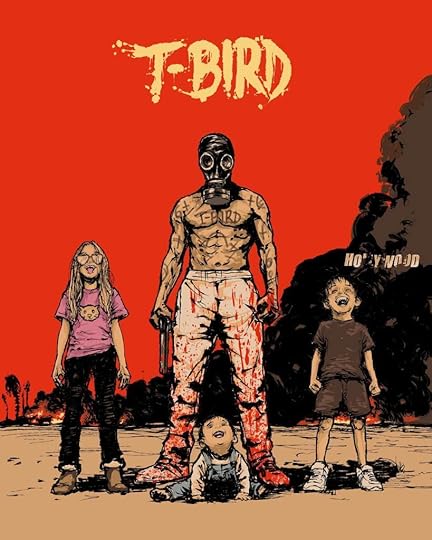
Into a Hollywood heart of darkness: uncovering Trevor Simms and ‘T Bird’
Many are called, few are chosen. So goes a Marine Corps advertising slogan—also what I think of the talented transplants who flock from across the United States and rest of the world to make Los Angeles their home.
A creative individual needs to be confident, even reckless, to pursue their dreams for a living.
Moving to the big city is no joke, especially now. Even before the 2023 writers’ strike and 2025 Palisades fire, the migration of the entertainment industry was already in reverse, shifting to cheaper locations across the continent and the globe. My wife, a customer who dresses actors for a living, said only 30 percent of her union worked this year.
I’m not sure what to think of the artists still trying to make a living in Los Angeles after so many setbacks.
Tinseltown is at a crossroads, and it takes a visionary soldier to trudge through these streets of half-broken dreams—one more confident and reckless than ever.
Trevor Simms, auteur, is a captain among them.

Auteur is no amateur
Adrenochrome (2017), Trevor’s first film, is a brutal and surreal tale about an ex-Marine who becomes embroiled with a gang of Venice Beach psychos that kill people to extract a psychedelic compound from their victims’ adrenal glands.
A quintessential B-movie, sure, and a gonzo classic.
I lived in Venice when Adrenochrome was filmed. With its trippy action, flawed characters, and unlikely hero—it struck me as a relatable yet fresh alternative to the formulaic action movies common on screen. My review:
A young American veteran finds the horrors of war eager to revisit him among big-breasted bikini babes, murderous drug gangs, aspiring cult leaders and divine surfer music in the hard-partying peacenik enclave of Venice Beach, California. This high-octane psychonaut action thriller revels in the excesses and failures of hippy-dippy plant power culture and the war-mongering state, providing the viewer with an equal dose of style and revulsion. This beautifully horrific mash-up of our nation’s most contradictory values amounts to a visceral and laughable feast filled with thought-provoking debauchery, carnage and pseudo-justifiable intrigue. For those ready for a rollicking satire to celebrate an American Dream torn asunder, Adrenochrome is the right nightmare for you.
It wasn’t long after I posted this review that Trevor contacted me, grateful that I understood his film. Many reviewers, apparently, were less gracious about his debut.
Soon, a friendship formed between us thanks to our mutual appreciation of the late Hunter S. Thompson, our love of the great outdoors, and our desire to disrupt the entertainment industrial complex.
 Trevor with his dogs
 Trevor with Tom Sizemore
 Trevor filming T Bird
 Trevor being cool
Departure from the coast
I told Trevor about my novel, Stay Younger Longer (2015), which I was interested in being produced as a film or TV series (duh, of course!).
We agreed to meet and discuss aboard his fishing boat/home, docked in the Marina. I think we were both hoping for a payday, and we were mutually disappointed when we realized the most we would be able to offer each other was cheap booze and a laugh.
I went on to toil in a regular job for a large organization, publishing a steady stream of novels and stories on the side (and grateful to at least have a job when so many of my artist friends were unemployed and losing their minds). Trevor continued to act (horror movies made in Eastern Europe). He also organized film festivals, something he had done since moving to L.A. One, Filmchilla, settled favorably out of court when organizers of Coachella sued him for alleged trademark infringement.
Arrival at the ranch
Besides catching up at Trevor’s annual film festivals, we had little contact. COVID hit. I was promoted and bought a house for my family in Santa Clarita, north of Los Angeles. This extended my train commute to four hours a day. When I wasn’t working, I was sleeping, or trying to sleep. Or hanging out with my wife and daughter. Or exercising. Or writing.
Trevor, however, managed to extend his American dream in a manner truer to his art and preferred lifestyle. The native of Kentucky, raised on a farm, used earnings from his acting gigs to buy land on a discount during the pandemic, flip it for a profit, and secure several acres in the Sierra foothills.
A video he posted on Instagram showed his oversized fishing boat/home being towed by a pick-up truck along a dirt road to parts unknown.
It wasn’t long after that I received an invitation to his latest film festival, to be held at his new ranch, for those brave enough to make the trek.
My wife and I decided to make it a date.
T Bird and beyond
We drove north for two hours, each mile closer to the supposed destination making us feel like we were only closer to death. A tour in pitch blackness on a bumpy, windy road along canyon walls that eventually led to a starry valley with no other lights, or landmarks, in sight.
Even our GPS was wrong—it was surrounded by a blank screen, leading us nowhere. We parked in the middle of nothing, unable to see a foot in front of us, desperate.
“Some date this turned out to be,” my wife said. “Let’s turn around and go home.”
I rolled down my window and hollered into the darkness, “Trevor?!”
“You made it!” a voice hollered back.
My eyes began to focus on a bonfire. A bunch of dudes with gleaming eyes grinning at me.
Trevor lived in a cabin he built by hand on a hill overlooking his sprawling property inhabited by dogs, cats, cows, and chickens.
He drank water raised by a well.
His boat was beached against a boulder. A gigantic movie screen was propped up next to the boat.
Trevor had created his own drive-in theater.
The films were eclectic, as usual. My favorite from the show was Mike Caravella’s Astral Plane Drifter (2022). Highly recommended.

Through Instagram, I learned about Trevor’s new project. A video was posted of him fighting a homeless man. Then, another of him getting popped in the ass by a cop with a rubber bullet during a lockdown protest. Then, another of him challenging UFC champion Conor McGregor to a match, presumably to raise money to produce his new film … about bum fights?
It all seemed strange, even for Trevor.
He texted me to see if I would be willing to play a part as a cop in his new movie. The plan was to film on Saturday amid sweltering summer heat on a blacktop in Lancaster.
Such an idea, after a long week of work, sounded exhausting. I had grown too soft and bougie.
I texted him back:
How much will you pay me?
He didn’t respond.
At least we had finally returned to those philosophical questions about art and profit that brought us together in the first place.
Since the release of T Bird (2025), I wish I had taken him up on the opportunity.
Film for the ages
There is nothing entertaining about child trafficking—a notorious, underground industry often concentrated in coastal cities. An estimated 50 percent of human trafficking victims are children. In Los Angeles, the average age for a child trafficked is 12 to 14 years old.
That said, Trevor pulls off something uniquely compelling with T Bird—a brazen, sunburnt, and seemingly bonkers action-packed spoof on the youth-crazed, under-exposed, dark side of his adopted hometown.
If toxic masculinity is a disease that permeates American culture, as some would have us believe, Trevor’s starring role as T Bird, a homeless man who exposes a child trafficking ring, represents a possible remedy, bringing balance and humility to the archetype of today’s action hero.
T Bird, underappreciated in many ways, turns out to be a victim of child trafficking himself. This experience spurs the character’s trauma and serves as the impetus for his homelessness and inability to function in day-to-day society.
T Bird’s quest to overcome his mental damage—by saving a new generation of youngsters from the perils of child trafficking—drives the story. Getting his name from the Thunderbird automobile in which he was exploited as a boy, T Bird is challenged to do good in a world where it is easier to inflict harm. Vindication as a character, as well as payoff for the audience, comes from him moving beyond his shortcomings.
With Trevor serving as star, director, and co-writer, and Wyatt Denny as co-writer, the journey is worthwhile. A cast of talented Hollywood outliers also add to the story’s gritty cache. Tom Sizemore plays his final role as John, Bas Rutten as Boss the RV, and Andy Dick as himself.
I’m not sure when Trevor’s next film festival will be, but I’m glad I had a chance to check out T Bird and reminisce about what makes Tinseltown tick beneath the glitz and glam: the magic of transforming angst into art.
Ryan Hyatt, November 23, 2025
National Human Trafficking Hotline toll-free hotline at 1-888-373-7888: Anti-Trafficking Hotline Advocates are available at all times to take reports of potential human trafficking.


April 14, 2024
‘Retro Thrifter’ eyes big retail wallet

HOLLYWOOD – A long-time costumer for TV and film, spurned by the lack of production work available for the past year, has applied her fashion sense beyond the celebrities she used to dress for hit shows and movies, to create a successful line of vintage clothing she has acquired through time travel.
Chloe Linda, owner of Retro Thrifter, an online boutique that sells used wardrobes, is set to net $1 billion in sales during her first year in business. Linda’s repurposed clothing line is out-performing other retailers, including Vanishingforest.com, within the niche industry of sustainable fashionwear.
Linda, 47, attributes her recent fortune to what she describes as a ‘time portal’ discovered inside her walk-in closet, filled with an assorted array of blouses, dresses, handbags, jackets, shawls, sweaters, and shoes accumulated over the last three decades, she revealed during a press conference announcing her company’s initial public offering on the New York Stock Exchange.
“A lot of people, if given the opportunity, would probably travel back in time so they could invest in an online retailer like Vanishingforest.com that would make them rich,” Linda shared with a throng of reporters. “As Americans, you see, our motivation tends to be very predictable—and boring. My experience was different. When the strikes started a year ago, sifting through my overstuffed closet, depressed, allowed me the chance to begin to rebrand myself. Selling vintage wear kept me connected to the fashion world I love during the entertainment industry’s downturn. The fact that doing so has made me rich has been an unexpected perk from a hobby I started just to keep me sane.”
Linda, who wore a 1990 Fugees T-shirt and acid washed jeans during her press conference, spent years shopping for actors as a member of one of Hollywood’s many craft unions responsible for the bulk of behind-the-scenes production work. Although the writers’ and actors’ strikes settled in late 2023, TV and film production remains down by 75 percent.
That’s because the studios are producing more shows and movies in other countries that have cheaper labor agreements. Meanwhile, American entertainment industry workers, many of whom who have not been employed for a year, are likely to be as desperate as possible during contract negotiations that are currently underway, according to Linda.
“People think that now that the writers and actors have settled, it’s back to business,” Linda explained to journalists. “The media—you—have done little to report otherwise. The truth is, craft unions make up most industry workers but are the lowest of the Hollywood hierarchy, so the studios are holding off on producing new shows and movies, so we are more likely to accept whatever deal they offer. Lucky for me, I have a walk-in closet that takes me back to better times, where clothes were cooler and better made, sometimes locally—like Hollywood used to be.”
Studio representatives were not available for comment about their current union negotiation strategy nor the quality of the clothing now available nationwide for most celebrities and members of the public.
For the past year, Linda has used her time portal to travel to the 1980s, 1990s, and 2000s to stockpile vintage wear that she then resales in 2024.
“The idea was to sell repurposed clothes to help get by during this dark time in the industry,” Linda said. “Once I started using the dining room table and living room couch to store inventory, however, my husband insisted I rent a warehouse.”
Linda began to sell her merchandise through Shopify, and since then there’s been no looking back.
“We live in a society in which we create lots of waste,” Linda said. “There is huge disparity between rich and poor, and the problem is only getting worse. My merchandise aims to level the playing field by providing all people with the opportunity to look cool and feel good with the clothes that are most reflective of their personalities and favorite eras. Retro Thrifter is for the experienced shopper who has the wisdom to appreciate that when it comes to style, older is sometimes better.”
Elizabeth Taphouse, April 15, 2024
December 15, 2023
Persona Cracked: Mike Sauve

Persona Cracked is a series that explores the intersection of artists, their work, and social media. My next guest, Mike Sauve, is author of five novels whose work contains strong elements of literary experimentation, social commentary, and humor. I first become acquainted with Sauve’s work after reading I Ain’t Got No Home in This World No More, which Publisher’s Weekly in its starred review described as a “time travel farce” that “reads like a Philip K. Dick plot as channeled by a delirious Hunter S. Thompson.” My own review can be read here. Sauve’s latest novel, How to Market Your Grief Blog, is set for a Dec. 19th release through Montag Press. Sauve lives in Toronto where he sells brassiers at La Senza.
When I read and reviewed I Ain’t Got No Home in This World No More, I was struck by the power of your prose while telling an amusing, modern story of time travel involving Sam McQuiggan, a thirty-something bachelor who works at a gym and extols his insights about the world while paining away about the one who got away. In How to Market Your Grief Blog, the protagonist, David Astaire, also suffers a loss, the death of his sister Catherine. To what extent do the conditions of your protagonists motivate your stories and you as the author who write about them?
“I am the protagonist.” –the guy pulling the marionette strings outside of time at the end of TENET.
My initial impetus was the drear old Will to Validation driving all of we whom Michael Shermer, President of the Pseudoskeptical Stage Magicians Society, denigrates as “pattern-seeking, story-telling animals” to collect our thoughts in patterns of mixed preening: Myself, Andre ‘Dinner’s on me,’ Gregory, Friedrich Nietzsche, but then too his sister Elisabeth Förster-Nietzsche, and then on to her husband Bernhard, until soon enough Bernard’s work friend Adolph Hitler collects his own thoughts and elbows his eager path to the podium.
While I Ain’t Got No Home in This World No More is a straightforward tale told in a non-linear manner about a man trying to reconcile his past, the story of How to Market Your Grief Blog is conveyed in a series of blog posts with comments provided by an online community. Unlike blog posts in real life, however, in which narrators tend to use common, accessible language, David Astaire is fond of writing itemized advice guides that imbed philosophy, science, and theology, that when taken in sum reads more like a literary diary and manifesto. Take, for example, this early entry in the novel, Some Tips Towards the Monetization of a Grief Blog:
One: Avoid what is known as direct marketing. Do not Facebook message an acquaintance to ask if they count themselves among the stricken. Do not ghoulishly troll the obits.
Two: Be yourself. Do not emulate grief bloggers who have already achieved traffic and remuneration. The stricken will smell a rat. Avoid books like Chicken Soup for the Grieving Soul lest you imitate the tepid style therein, a style that has already oversaturated the grief marketplace.
Three: If Eisenstein wrote in The Structure of the Film: “There is no such thing as grief ‘in general.’ Grief is concrete; it is always attached to something; it has consumers,” means you must avoid wishy-washy tenses. Employ the imperative tense! When necessary, employ the counterfactual.
Four: Like and share other grief bloggers. Unbecoming as it often feels, sharing ten consecutive articles from Grievin’ Gary’s Grief Refuge will capture Grievin’ Gary’s attention. Sharing one will not. Sharing one will make you no more estimable in Grievin’ Gary’s eyes than some grief-stricken mark.
Five: Don’t put too much pressure on yourself. As Daniel Johnston famously sang, “Millions and millions of people have already died.” Thousands will die today. To say nothing of pets, catastrophic brain injurees, and those enduring a type of living death due to opiate dependence. Among the scant few not yet grieving, you can count on anticipatory grief, e.g. ‘father ridden with cancer.’ There is also a sort of nameless dread: a fatalistic grief for the unknown sorrows to come, such as the prospect of worldwide pandemic, a new Philovirus, for example.

Satire as a genre often produces characters that are interesting but not necessarily compelling. In this excerpt, you begin to establish David Astaire as a folksy narrator who can be believed and embraced by his audience (i.e., his simple reminder to ‘be yourself’). You also start to show how his repository of knowledge may not be of interest to his readers and thus, perhaps, he may lack some market awareness or does not truly qualify to be the voice of reason/perpetuator of sound advice he presumes (i.e., his tangential aside, ‘Thousands will die today. To say nothing of pets, catastrophic brain injurees, and those enduring a type of living death due to opiate dependence …’ is David talking in general, or about himself?). Considering that this duality between the believable versus false narrator plays throughout the story, what is the best attitude for the reader (of the novel, not the blog) to have to enjoy and gain the most insight from this tale? Besides the fact that David Astaire has a way with words, why should readers care what happens to him? Or should his sheer eccentricities along with the overall structure and format of the novel, be enough to keep readers vested?
Lines like “Be yourself!” satirize what I consider the unclean language of blogs, social media, and marketing. The imperative tense grants a false authority undermined by the conditional tenses where the protases (ifs) and apodoses (outcomes) obviously only apply to David’s increasingly-pathetic world, e.g., “If nothing less than human sacrifice is required to maintain an accord with the Infernal Serpent, ask Ronald Majthenyi to “Keep a lid on it in front of the Uber driver will ya? Think of my rating.”
A Ricouerant problem with writing Oneself as Another is publishers and readers harumphing in their seance of authority, “I didn’t relate to the characters!” to which I try to occlude my rejection sensitivity dysphoria by splurging out, “H-had hoped you would not, Tracey, for nor do I relate to your Submission Call’s claim that you “champion unique voices” when that claim is contrasted against your actual publishing output of Tiffani Amber Thiessen’s second book on how best to reheat one’s leftovers.” I am not trying to denigrate Tiffani Amber Thiessen. I am denigrating a mealy-mouthed industry claiming to be about literature or even stories but their only re(t)a(i)l going concern is selling pillows, reading socks, and Fahrenheit 451 bedroom sets inflagrante at Indigo in the market called (arbitrarily as the Richard Ford novel) Canada or at Burns and Noble in the southern 50 states.
Consequently I’ve come to wonder how vested I even want these putative readers to be. It may be that, seeing how #cozy they’ve grown in their reading socks, I want them divested if not gorily degloved.
I am amazed at your willingness to explore forms as a writer, not only in How to Market Your Grief Blog, but also samples you’ve shown me from your works in progress and on your substack, The Causal Tentacle . At a time in which publishing is geared toward sales, is risk-averse, and very much caters to an audience’s expectations, you are playing with structure and tropes in ways that force readers to think, conjecture, and investigate everything from the vocabulary that is being used to the obscure informational references woven into your tales. (Luckily, there is this wonderful thing called Google that keeps me informed of your story’s most astute allusions). Considering the breadth and depth of your own interests in philosophy, science, and theology—and are timeless topics of interest to others besides yourself—what will it take for your books to reach their intended audience? Do you see your audience growing over time? Would you consider adjusting your writing’s format in the future if it guaranteed you a larger readership? In other words, what is your intent with your own body of work? Who is it you are trying to reach?
To cleanse the palate after the crankery of that last response, I try not to complain that the market doesn’t reward quality writing because if George Saunders can top the best seller list then it can be done, and if it can be done, then one can outwork his rival pillow case salesmen. Unfortunately, however, even those “who’ve selected their vocations for the express purpose of apprehending perfection,” to quote William T. Vollmann, can work all their lives and never “rocket us heavenward,” might never write so much as the first sentence of Copernicus’ Six Books Concerning the Revolutions of the Heavenly Orbs, “What could be more beautiful than the heavens which contain all beautiful things?” and that is a Cosmic Shame.
And so instead I’ve deigned to do only what I want, alienating readers hither and yon until “I’ve found all the mysteries and lost all the meaning” as Tom Stoppard writes in Arcadia, so that I can “be alone, on an empty shore” which is ironic, because the whole writerly enterprise is fundamentally not about being but about being liked.
How have I adjusted my format? The basic premise of The Introductions, then: a doomsday cult hosts a film festival to convince people the looming intersection of AGI, computer brain interfaces, and quantum computing will puncture linear temporality along with all the causal certainty we’ve grown so fond of. The narrative plays out through the titular film Introductions, allowing for the films themselves to carry much of the ideological weight. I needn’t spell out how A Clockwork Orange is about the dangers of impinging upon the mind and free will, as that’s self-evident to those who’s seen it. From there, there’s a nesting of references from film, literature, wrestling, philosophy, and elsewhere.
Here’s an example:

And now the fun part of the reading experience: the droning explication! ERAS and SWIFTness should be familiar to the reader of popular culture, but then SWIFT is also the Society for Worldwide Interbank Financial Telecommunications. Collapse is the title of Jared Diamond’s book subtitled How Societies Choose to Fail or Succeed. Wired for War is similarly subtitled—The Robotics Revolution and Conflict in the 21st Century, but also references an issue of Wired with The Future of Reality as the theme on the cover promising a feature asking the new MATRIX film’s star about his memories of the franchise. First-remover voisinage is a multi-lingual pun on first-mover advantage, with voisinage meaning both “in the vicinity of” and also “neighbourly proximity.” First-remover speaks to the character Ron Q.’s role as a Temporal Auditor responsible for collating TIME CRIMES so that causal revisions can be instantiated with sober second thought before and after The Date of Anticipated Reality Collapse.
Exhausting right? And yet, to return to Arcadia, “It makes me so happy. To be at the beginning again, knowing almost nothing….”
Perhaps the worst fate to befall me was finding a copy of Finnegans Wake early in the process, and getting a sense of just what could be done with portmanteaux, nested references, and other aspects of Joycean brinksmanship. The problem is I am not James Joyce, neither in terms of talent or acclaim. So there is not exactly a cottage industry of academics waiting to Skeleton Key all this stuff out for the reader. The absurd gamble I have undertaken, which may well prove to be the end of me, is that I can make the book good enough that such skeletons emerge from their closets. And nor will I be hanging around to break all this down for everyone. The hope is that the novel teaches you how to read it well enough that its reader(s?) intuit some of the more densely-layered meanings.
Since the increasingly baroque Font System I’d be happy to send you my pamphlet on—which allows me to make dozens of references per page without requiring endless italics and quotations to indicate what is a book title (Book Antiqua) or a line from Finnegans Wake (Arial MT Rounded Bold)—doesn’t translate to the web, I use links when I post excerpts on Substack. I can see what links are clicked in Dashboard, and so with that same appalling SWIFTness it becomes clear that very few are clicking the links, let alone Googling anything themselves. So to answer your question: my ideal reader is someone who wants to put such a capriciously-constructed puzzle together.
What are you looking forward to in the near future, besides publication of How to Market Your Grief Blog?
I’ve been doing more editing with Montag Press and have launched my own imprint there called ghosTTruth which has just started publishing books at the intersection of conspiracy, philosophy, and epistemics. There’s a Zoom launch at 7 p.m. Eastern Time on Tuesday, Dec. 9 for its first two books, my own Grief Blog as well as Andrew Brenza’s Pod. I’ve always had a lot of conceptual ideas for books but neither the resources or the impetus to write them. So projects like the forthcoming anthology of philosophy and fiction, Time and Propinquity, that I co-edited with Dr. David Mathew, or a high-concept book I’ve been planning to edit on Nietzsche’s thought of eternal recurrence are good ways to keep me grounded in reality. Also, I’ve been working on a screenplay for a director/producer team with a laudable track record, so that might offer me an entrypoint into the world of film, and ideally bring my novels to a larger audience, though I’ve had d’alliances with film and television before and know better than to get my hopes up.
Writers nowadays face the odd challenge of desiring private, sometimes introverted lives while being compelled to act as extroverts publicly promoting themselves and their work. Can you tell us a little about your own love-hate relationship with social media?
I was logomanic long before I was graphomanic, and so I learned early how easily everyone is wearied by the bloviational speaker. So, essentially, I took my bile and went home.
Regarding social media, I used to be quite hurt with how literally unliked I was. There’s nothing worse than the best line you’re capable of writing receiving less than 1 percent of the likes earned by a more relatable person’s (Tiffani Amber Thiessen’s) Tweet containing what she must consider the mot juste describing her pork tenderloin au jus smoothie. So then it’s like “Okay, I’ll work really hard to build a home for these unliked sentences of mine.” I’ll spend some time (a year on the early books; going on 4 L with The Introductions) building this home, but then tragically, because I’m not out there beating the drum, when the book is finished, I’m all set at the vestibule with the pork-flavoured champagne, but only a small percentage of even the low number of the original Liekerts scale the increasingly inhospitable gates to check out my reflecting pool’s abysall twilight blue (to paraphrase Heidegger describing the poetry of Georg Trakl, another secret to my popularity!) So what was the purpose? Rather than resort to hopelessness, I will defer here to Andrei Tarkovsky’s father, the poet Arseny Tarkovsky,
If you live in a house – the house will not fall.
I’ll summon any of the centuries,
Then enter one and build a house in it.
[…]
The future is being accomplished now[.]
Though again, this is not advice I’d give the subject of Tenacious D’s Cosmic Shame…who wouldn’t be me, right, not if I so vehemently tell myself that I must be some kind of meaningful protagonist?
Thank you for sharing your story!
Ryan Hyatt, December 15, 2023

November 18, 2022
Persona Cracked: Brian Asman

Persona Cracked is a series that explores the intersection of artists, their work, and social media. My next guest, Brian Asman , is a writer, actor, director, and producer whose stories often blur the line between horror and humor. He is author of five novels, including the self-published sensation, Man, Fuck This House , recently acquired by Blackstone and optioned for TV/film. His latest release, Return of the Living Elves (Nov. 29), is a holiday horror mash-up. Although Brian lives in San Diego, he often appears in photos on Twitter with fellow scribe, Kathryn McGee, where he doles out hot takes on writing and pop culture.
What are five things only those people who went to high school with you would know about you?
Five? I mean that was a really long time ago. Umm okay—I played Tiresias the Seer in a production of Antigone, earned my Eagle Scout badge, worked the night shift at Lee District Rec Center and used to let people sneak in to smoke weed in the hot tub, framed my friend for setting fire to the football field so he could get out of taking a test, and broke my nose at two punk shows.
Judging by the length of your beard, writing is a long game. Man, Fuck This House put your name on the map, but if it hadn’t, what would you be doing right now?
Same thing! As you said, writing is a long game. Most books don’t hit, there are no guarantees. I love the actual act of writing, if something is a hit that’s just a bonus, so I’m sure I’ll be doing this in some capacity for the rest of my life.
Tell us about your first encounter with your spirit animal.
Don’t have a spirit animal. I do have a shirt that says “Glenn Danzig is My Spirit Animal” but I haven’t met him. I guess my first encounter with the shirt is when my friend Erik gave it to me for my birthday.
Regarding your upcoming story collection and werewolf novel, Good Dogs, Blackstone Editor Brendan Deneen referred to you as “one of the most unique horror voices I’ve ever seen.” What sets you apart from the pack?
When I write, I just swing for the fences. It doesn’t always work, but those books stay in drawers.
One of the best pieces of writing advice I’ve heard is to write the book you want to read. That’s really all I’m doing, and luckily a bunch of other people want to read these books too. And one thing I guarantee—love it or hate it, every book I write is going to be different from anything else out there.
You can have three people, living or dead, over for dinner. Who are they and what’s your night together like?
That honestly sounds like a lot of pressure. Can I just order pizza and watch some movies? No? Okay, fine. I’ll go with all dead people though to see what I could learn from them:
Elizabeth Short, aka The Black Dahlia—there’s no mystery I’m more obsessed over than who killed her. I just hope she’s not like “IDK, some guy?”Jack Ruby—again, I’d just be like “c’mon, who made you wax Oswald? Somebody told you to do that shit.”Bradley Nowell from Sublime. That was my favorite band growing up and I’d love to see him play live.Is writing a career, a passion, or a hobby?
I guess the first two, since 1 and 3 are kind of mutually exclusive. But #2, yes, always.
Who’s a villain people don’t love enough?
Pizzaface from TMNT. It’s my dream to write a Pizzaface one-shot for IDW. I love the idea of people who have these mundane jobs in a city where there’s mutants and ninjas and extradimensional brain-people running all over place, how it’s got to be annoying but you get used to it. Kind of like living in a flood zone or something.
You’re stranded on a tropical island that has clean water, food, and shelter. You have one duffel bag. What’s in it?
Laptop and unlimited power source. Time to get some fucking writing done.
What’s the next big writing and/or existential challenge you face?
My current WIP! Every new book is a challenge in its own way, because I’m always trying to do something a little different than what I’ve done before.
For your dog, what’s the difference between heaven and hell?
Belly rubs or the absence thereof.
Thank you for sharing your story!
Ryan Hyatt , Nov. 28, 2022
October 24, 2022
CEO: Scrolling social media site increases I.Q.
 Idris Frank’s logo for his new app, which he promises will revolutionize social media.
SANTA CLARITA — A father who has struggled with his teenage daughter’s addiction to social media has created a web site to compete with YouTube and TikTok and that he claims will increase the intelligence of viewers.
Idris Frank, a 46-year-old software developer and chief executive officer of utok!, announced at a press conference Monday that his company’s platform provides the same dopamine release viewers often experience perusing popular social media sites, but that it also contains ‘patented features’ that raise the intelligent quotient of viewers and turns them into geniuses.
utok!, according to Frank, incorporates mental enhancement technology that puts viewers into an alpha-wave state that allows knowledge to be dumped into their brains through subliminal messaging without their conscious awareness. The result, said the CEO, is the equivalent of an hour of intense study gained for every minute scrolling the web site.
“This is a game-changer,” Frank announced to reporters gathered in the driveway of his suburban home, which also serves as utok!’s current headquarters. “The era of kids mindlessly plugged into devices, living an augmented reality at risk to their own development—and for the profit of big tech—has come to an end. From now on, whenever your child languishes on the couch, sifting through influencer-created content—advice posts, cat clips, student bloopers—you will begin to notice a dramatic increase in your offspring’s knowledge and skills.”
Frank pointed out a new drip system he recently installed on his lawn, and then he proclaimed to reporters, “I say bring on the endless zombie-like web-scrolling, because a new generation of savants is about to rise out of the virtual ether and unleash themselves on our four-dimensional universe!”
Economists predicted that utok!’s stock will be the largest initial public offering in history next week, many of them projecting it will surpass the $22 billion record set earlier this year by Chinese retail tech firm Aibaba Group Holding Limited.
“I appreciate the enthusiasm and support parents around the world have expressed for my app,” said the CEO as he adjusted the settings on his garden hose. “I look forward to upgrading our company offices to something more suitable for a megacorporation than this meager family home. Finally, I am very excited about being able to afford the top-notch Ivy League education my daughter’s countless hours scrolling anime fan fiction and dog videos has earned her.”
Frank’s intelligence revolution explodes
Frank turned on the garden hose and regaled reporters with the origin story of utok!. He said the idea occurred to him after an argument he had with his child, Shari.
“As a little girl, Shari loved to draw, sing, and write, but that changed during the COVID-19 pandemic, when we allowed her to play video games online to connect with her friends,” he said as he watered a row of drought-resistant rainbow chrysanthemums. “Soon, my little girl started to go through puberty, and she closed herself off in her bedroom, playing these games by herself long after her friends quit and went to sleep. She gave up all creative pursuits.”
Frank claimed that playing video games such as Minecraft and Roblox became the pathway through which Shari’ started to get hooked on passive online activities.
“By the time the pandemic ended, Shari was a teenager who spent her days outside of school locked in her bedroom, scrolling YouTube and TikTok. The beautiful child was no more, replaced by a moody social-media fiend.”
 Shari, upset that her father took her tablet, expresses her feelings through art.
Frank said he and his wife, Tara, tried to intervene in Shari’s addiction but with little success.
“If we restricted her use of her device, she played along with whatever activity we planned instead—a board game, bike ride, beach day—going through the motions until she was back in her room and getting her next online fix.”
Finally, one Sunday after Shari refused to join Frank and Tara for lunch, Frank stormed into her bedroom and took away her tablet. He fended off Shari’s flailing arms and kicks and placed the device in a kitchen drawer.
Then, he went outside to mow the lawn.
“When I returned to the kitchen, I opened the drawer and looked for the tablet, to give it back to Shari, but it was gone. In its place was a folded piece of paper. I opened it, half-expecting an apology, but instead found a hand-drawn picture of Shari flipping me off.”
Frank shut off the garden hose and turned to the reporters. “From that moment on, I swore revenge against big tech for the damage inflicted on my daughter’s impressionable brain, and that’s when I seized a big idea.”
Users sign off and level up
Partnering with neuroscientists and psychologists at universities across Southern California, Frank started to develop his app. When it was ready to be tested, he began incorporating beta versions of the software on Shari’s device, which led to surprising results.
All he needed was a name for his breakthrough platform.
 Shari’s schematic of a sustainable yard is one example of utok!’s potential to enhance the intelligence of social media users.
“On a more recent Sunday afternoon, after Shari spent hours sifting through relationship advice and disaster videos on the site—which subliminally blasted evolutionary-psychology theorems and climate-engineering formulas into her mind—she emerged from her bedroom and handed me a blueprint for a xeriscape lawn she designed that would reduce water usage in our yard by 70 percent. The blueprint included a more efficient foliage layout and sprinkler system as well as a colorful slew of drought-resistant flowers Shari wanted me to plant. She said, ‘Here, Dad, this is what you need to do to maximize the lawn’s performance.’”
“You talk?” Frank asked, stunned. “And with that,” he told reporters as he wrapped up his garden hose, “I knew what I wanted to call my new site.”
Veronica Diaz, October 25, 2022
September 28, 2022
Persona Cracked: Lucy Leitner

Persona Cracked is a series that explores the intersection of artists, their work, and social media. My next guest, Lucy Leitner , is author of three novels and writer of transgressive fiction whose work contains strong elements of horror and satire. Her latest book, Bad Vibrations , is set for release October 19th and has the subtitle: Yoga, Sex, Blood. Lucy works in advertising and lives in Pittsburgh with her boyfriend and punk-rock drummer/vocalist, Benj.
What is transgressive fiction and how do you think your work typifies or pushes this label?
To me, it’s work that challenges norms and pushes boundaries — both of cultural conventions and the medium. I like to blend genres and experiment with form while also challenging the way people may think about a topic using horror and pretty dark humor.
Some have been broadly applying the term to anything taboo, gross-out, shock value books, etc., but that’s not how I think of it. To me, comedians like George Carlin and Bill Hicks and musicians like John Lydon, Mike Patton, and Amanda Palmer are transgressive. Think of a song like “Missed Me” by the Dresden Dolls. If you don’t know it, go stream it somewhere. To me, the form and the content are the definition of transgressive.
Most of the art I love — from music to movies to literature — blurs boundaries in some way. How do you define the music of Sturgill Simpson? Psychedelic country? You can’t define it because as soon as you put a label on it, he goes and records some distorted rock album with Japanese influences. In literature, it’s why I love what Max Brooks and Paul Tremblay are doing as well as early Chuck Palahniuk books (pre-Haunted). They are tough to categorize. Hunter Thompson’s Gonzo journalism inspired me to become a writer 20 years ago. If there was anyone that played with the medium, it was him.
For me, stand-up comedy and music are just as great, if not greater, influences on my writing than other authors.
After publishing Working Stiffs , you spent 10 years writing and revising before releasing your follow-up novel, Outrage: Level 10 . Why did it take that long, and what else were you doing during that time?
I’d step away from Outrage for years at a time. I wrote the first draft in 2013, revised in 2015 then again in 2017. I wasn’t happy with it but didn’t know why. Finally, in 2019, I sent it to Dave Barnett at Necro, who published my first book. He sent some insightful feedback that was exactly what I needed to be satisfied with the book, and what he needed to publish it in 2021.
During that time, I also wrote another novel, which will be the first in a series of three about a unique punk rock private investigator. I also co-authored a book with my dad, which we will be releasing soon.
I was getting my career outside of horror writing on track as well. Prior to Working Stiffs, I had a hard time securing reliable employment as a writer. It was partially due to the dearth of jobs during the Recession as well as my lack of experience out of college. Oddly, being the copywriter candidate with the funny zombies-in-the-office book made me memorable to the hiring managers. I finally got a chance and it’s been — mostly — up from there.
Since the publication of Outrage: Level 10, you have been making a name for yourself within the horror community. Your work has been featured on Godless Horrors, and your new publisher, Blood Bound Books, is set to release your latest work, Bad Vibrations, which took you less than a year to write and set loose upon the world. What is inspiring this burst of creative output?
I actually started Bad Vibrations in 2020. The idea of a horror story set on a wellness cult compound came to me in a conversation with one of the guys at the gym where I coached in February of that year. I formed the plot enough in my head to start writing the first draft by hand right when the pandemic hit.
I think I’ve finally found my little niche in horror. I’ve been inspired by many observations and have felt much more comfortable experimenting recently. It’s also been helpful working with Blood Bound as S.C. Mendes and I have a great collaboration going and I know when I complete my stories, they will have a good home.
Your stories often experiment with form as much as content. I’m thinking in particular about your Instagram-Live presentation of “Get Me Out of This Shimmering Oasis,” and the multi-media mimicry employed in “Puritea,” both of which I enjoyed immensely. Is there anything unexpected we should expect with Bad Vibrations?
Not to the extent of either of the two titles you referenced, but there is a bit of experimentation with story structure in Bad Vibrations. There’s also a character in the book included solely as a challenge to myself to write without using any pronouns.
Writing is one thing, marketing is another. You’ve pioneered experiments with social media to make you and your work known. The bio you provided on Facebook last year was a hoot. You co-host a podcast, Horror Business, with S.C. Mendes , and you turned yourself into a popular voice for all-things horror on TikTok. Finally, your story, “They Say The Sky Is Full Of Snakewolves,” part of the Blood Bank Charity anthology , has been adapted into an audio narrative that is available on YouTube . What has your recent writing-related business taught you about the business of writing?
There are certain things that will always limit me in the writing business. The big one is prioritization. Publishing at the rapid-fire pace of some other authors will just never happen for me. Hitting the gym 4–5 days a week is more important to me. Balance in my life is more important. Baking with my parents over FaceTime every Sunday, spending time with Benj and my friends in Pittsburgh, watching horror shows over Messenger with my sister and my friend Jake every Thursday night — these are also more important than achieving great success as a horror author.
So, I prioritize my marketing efforts. For social media, most of my focus is TikTok because there is a massive community there that is interested in indie horror books and is easier to reach. The Snakewolves reading on YouTube was a major opportunity facilitated by Drew Stepek from Godless, so I took it. For me, in writing and marketing, it’s about doing less, but doing it better.
In addition to writing, you like to cook, exercise, and paint. What do these pursuits do for you that writing does not.
Those activities are more fun. I love writing, but publishing is usually more stressful than it is rewarding. It’s volatile and your success is not always dictated by the quality of the book you put out there. So many factors determine the fate of your book.
The things you mentioned are under my control.
Training CrossFit is extremely fulfilling. For one, it’s like meditation. For an hour every day, I can go somewhere and challenge myself physically alongside some of the coolest people I know and totally escape everything else going on. And it’s better than meditation because I’m getting stronger or learning a new skill (which is as good for long-term cognitive health as it is the body), not just sitting.
Art I do just for fun. I’ve been painting and drawing my entire life and I was an art major in college. I only sit down to paint now if I have an idea that is forcing me to pick up the brush. That’s actually the same thing with fiction writing. It’s why you’ll never hear me complain about writer’s block or a lack of ideas. If I’m inspired, I’ll write or paint. If not, I’ll go to the gym or read or something.
What are you looking forward to in the near future, besides publication of Bad Vibrations ?
Halloween! I’m visiting a Halloween-obsessed friend in Philly to kick off October. On the 5th, I’m releasing an experimental short story Xorcize.Me on Godless. Then I have tickets to the Electric Six (another transgressive band)/Supersuckers show back in Pittsburgh, followed by Evil Dead: The Musical two days later. My also Halloween-obsessed little sister is visiting right before Bad Vibrations is released, so my October is filling up fast. Soon after, I’ll be looking forward to seeing my family on Thanksgiving.
Thank you for sharing your story!
Ryan Hyatt, September 28, 2022
September 23, 2022
Music maker becomes social shaker

Review: Song of Kitaba
Mark Everglade, 252 pages
Revolutions are messy.
They are not, as often depicted in fiction, neatly conceived tales with pre-ordained plots that follow an assured path to victory. In real life, revolutions are conceived in struggle, their course erratic, with failure often the closest ally and end result.
My favorite aspect of Song of Kitaba, marketed as a ‘hopepunk’ novel by author Mark Everglade, is that it not only entertains us readers with its hero, conflicts, and stakes, but it also enlightens us with an organic tale of political transformation fraught with triumphs, setbacks, and disappointments.
Kitaba Mahahara, a musician who goes by ‘Kit,’ escapes from her mountain village where writing (free expression) is prohibited by the chief. After her beloved Auran is executed for breaking the law (his bloodstream filled with ink), Kit flees to the tech-saturated city of Catonis seeking supporters for her revolution against her people’s oppression.
There, Kit finds recruits for her quest, but she is also recruited by monks to help them undermine the political structure of the city, because its citizens, like Kit’s villagers, also suffer from oppression. In Catonis, people’s thoughts are shared on ‘senti-screens,’ paved into roads and framed into buildings, policed by government Enforcers. In time, dissenters of the regime are imprisoned, punished, and/or killed by these thought police.
Although the means of social control differ between the story’s rural and urban settings (public censoring versus public shaming), the justification for government overreach, to preserve peace and security, are the same. Everglade uses this compare-and-contrast approach toward both societies as a means to deftly highlight a common problem of civilization: too often, ‘progress’ is motivated by fear, and the vision he provides over the course of the story alludes to what a more spiritually inclined culture might look like, motivated by love.
As such, Song of Kitaba is not so much a suspenseful page-turner intended to manipulate us with its intrigues and reversals, but an honest immersion into a believable world filled with flawed but well-intended characters who grapple with their selves as much as their surroundings. Kit is a passionate yet stubborn protagonist, aware of her shortcomings, and she is more endearing because of it. The misfit friends she makes along the way are very human, sometimes deceitful to themselves and others, in their efforts to change the world.
While the novel rings true to its ‘hopepunk’ ethos, with violence often implied or occurring offstage, there is no shortage of fascinating scenes and social commentary to make us cringe. A good example is when Kit enters the Catonis spy center and finds legless old men sitting in wheelchairs along a table, their faces planted into viewing screens, wires jammed into the back of their heads as they analyze everyone else’s thoughts in the city, looking for traitors.
Kit empathizes with their slavery and wants to free them, but her partner explains that it’s no use because, “… they’re too fried to contemplate freedom.”
Such characters remind me of what I secretly fear most as a modern-day office-dweller: evolving alongside my cubicle to become a hunched-over spreadsheet-gazer whom, due to my own lack of activity, am no longer are able to use my own limbs.
These stand-out scenes in the book, and there are many, provide the fodder for thoughtful reading that dance around the premise of a corrupt surveillance state. There are even violas used for hang-gliding and electrifying braids of hair used as whips that Everglade skillfully writes into the story in a way that is cool.
The artful descriptions and Eastern wisdom, shared page after page, indicate a level of genre science fiction writing that has a strong literary bent, and the language and insight support the candid, and ultimately optimistic, tale of revolution:
The river was no longer a gentle lover but a cold, concrete block she struggled to swim through.
His kind created a society where men held the door open for women but couldn’t construct a door with basic carpentry skills.
His hands rose to encase her face, neck, shoulders, his fingers dangling like keychains that would unlock all the right places.
Reading Song of Kitaba has been a pleasant and reflective respite, leaving me wondering about the machinations that often interfere with our species’ individual and collective plight to achieve our greatest aspirations.
Well played, Everglade.
Ryan Hyatt, Sept. 23, 2022
July 29, 2022
Love is a Cosmic Telephone Booth

Review: We Can Never Go Back
Daron Kappauff, 30 pages
I don’t read much horror.
I commute on the train to and from downtown L.A., so I already know about hell and how dark, scary, and violent the world can be.
If I need to side-step troubled individuals talking to themselves on the subway, just to pay my bills, why should I seek out fictional stories involving characters possessed by demons that do the same?
I think the answer, in part, is that horror presents an opportunity to explore that side of life which life itself tries to prevent us from exploring. When I see two people arguing in the street, for example, I take another street to avoid them: I don’t entangle myself in the conflict. No such luck in fiction.
With a definitive move toward shadows and despair, there are plenty of chances for an adrenaline rush. That’s what I experienced, anyway, reading Daron Kappauff’s “We Can Never Go Back,” won in a random giveaway.
The story is a thoughtful ride into an exhilarating abyss. The plot involves an abandoned telephone booth in the woods and a young woman, Cass, frustrated with her romantic relationship with Gavin. Worse yet, she soon has reason to believe she will be the next victim in a spat of neighborhood killings.
Daron’s prose is precise and vivid, his storytelling inhabited with characters who seem as real and visceral as you and me (except maybe his swear more). The tale contains elements of fantasy that flexes the imagination, but it is anchored in day-to-day reality in a way that makes for a disturbing plunge:
“You thought I’d been mind-fucked by some ridiculous creature stuck in the 80s.” He sat up, reached for me to help him to his feet.
“Go fuck yourself, Gavin.” I slapped his hand away and stomped down the trail. “‘Cause I sure as hell won’t be doing it.”
“What the hell, Cass?”
While I’m not sure how much I could stomach only reading horror, like many of my friends do, I did enjoy allowing Daron’s tale to deliver me to those nightmarish realms that are easier to shy away from.
In the end, “We Can Never Go Back” is an excellent reminder of the insanity that can fester in unsatisfying relationships.
Ryan Hyatt, July 29, 2022
June 24, 2022
Persona Cracked: Mark Everglade
 [image error]
Persona Cracked is a series that explores the intersection of artists, their work, and social media. My next guest, Mark Everglade, is the pen name of an author of three science-fiction novels, Hemispheres, Song of Kitaba, and the forthcoming, Inertia, as well as several short stories. While Everglade’s work and literary interests resound solidly within the sub-genre of cyberpunk, his activist orientation as a writer has prompted him to recently explore newer, emerging sub-genres within science fiction, including solar- and hope- punk. Everglade holds a master’s degree in Sociological Conflict Theory and resides in Florida with his wife and four children.
Why do you use a pen name? And why is there no autobiographical information about you on Amazon or Goodreads? Are you too cool for big tech?
I write under a pseudonym because free speech is under fire, among other reasons. For instance, a certain state recently passed the “Don’t Say Gay” bill in a controversial move that gained national attention. The bill has far reaching impacts for suppressing free speech ranging from health education communications to education, and is a targeted mechanism to promote shaming, requiring teachers to report to children’s parents anytime they even suspect a child might be gay, subjecting that child to abuse and disownment, which encourages toxic masculinity as a defense mechanism against the state.
An equally concerning example from that state is the new constitutionally-violating House Bill HB7, “Individual Freedom.” The bill prevents any discussion of one race being oppressive towards another currently or historically. It makes it illegal to defend affirmative action in education or to discuss slavery reparations in school, providing strict penalties for doing so. Teachers and other individuals can now be charged for discrimination for talking about White privilege or anything inducing Whites to feel “guilt or anguish,” as the bill puts it. Considering that the Federal Government owes 12 trillion in reparations for slave labor, of which a minimum of 4 trillion is needed to make a significant impact, this bill is ill-disposed, a reversal of societal progress, and a perversion of everything decent. But notice I still am reluctant – even under a pen name – to directly call out the state in question due to my associations with it.
Bills are often named things like ‘freedom’ when they are suppressing it. If you can prime the interpretation, you can get people to cheer for chains. Bills also carry threats far beyond their wording, and set precedence.
Dr. Martin Luther King Jr. talked about two types of peace – the type that comes from quieting dissent, and the type that comes from truly addressing the underlying issues. We have never experienced that second type in our nation as a unified whole.
(As far as author info on Amazon, they’ve been slow to resolve an issue on providing me access to the account my publisher created to edit it.)
Your Twitter profile mentions that you are neurodivergent, and according to your web site, “I was born a simple boy, simpler than the complex people around me. I studied them to reduce that complexity, becoming more complex myself in the process.” What is the nature of your neurodivergence, how has it impacted your worldview, and what strengths and challenges does it bring to your writing?
I was diagnosed with autism of a greater than average severity. I also have narcissist tendencies I must control. When the Jungian shadow self isn’t acknowledged, it just becomes stronger. There’s a movement in psychology gaining some momentum to view narcissism as a pervasive developmental disorder like autism, which would be interesting if upheld in the way we view many celebrities and politicians.
There is an interesting relationship between simplicity and complexity. Systems develop complexity to reduce their complexity, becoming more complex in the process. Example: a social norm is violated repeatedly in hundreds of different ways making it difficult to determine what a punishment should be, so a law is created which simplifies the adjudication. But that law requires a whole industry of lawyers, judges, and paralegals to interpret it, adding to social complexity. I feel like I was the same way, trying to simplify all the complex social norms by coming up with what I call workflows through trial and error, but applying them to a variety of situations becomes a challenging interpretation for some people on the spectrum.
A workflow might be as simple as saying goodbye when someone says it to you. But applying it becomes complex at times. For instance, if you say goodbye and return to that person later and leave again, do you owe a second goodbye upon the second departure, and how long does the first goodbye last, and how many feet constitutes vicinity of presence? So yeah, I offend people sometimes amidst the calculations.
When writing, it took decades before I could write dialogue, though other elements like systematic plot flows came naturally. For years, I wrote never describing anyone’s body language. If you see body language in my writing such as “he nodded, while leaning forward,” it was added after the fact. Autism does make it challenging to know how much detail to provide the reader to ground them in the scene as well, but give me a complicated article on planetary rotation and boom, I’ve mastered the content enough to base a novel on it in no time. Granted, if you’ve met one person on the spectrum, you’ve only met one person on the spectrum, as we’re all quite different, and it’s just a label.
Autism impacted my worldview because it allowed me to study society in a systematic manner without personal experiences and emotions biasing my judgment too much, allowing for branching logic to extend in myriad directions simultaneously across an almost visual field. That’s not to say autistic people have no emotions, as the stereotype maintains; many are the most emotional people I’ve known.
You seem to be every bit a scholar of science fiction as you are a writer of it. In this interview/article, “Is Cyberpunk Dead?” , you speak with Bruce Bethke, who coined the term ‘cyberpunk’ in a story about teenage hackers published in 1980. You also use Google analytics to help determine the current popularity of the genre. Finally, the article leads to a discussion thread on Hacker News related to this overarching question, which currently has more than 155 comments. How does your tech savvy, marketing skill, and formal and informal education inform your role as a writer and scholar of science fiction?
I often wonder if it’s important for writers to be writers at all. I’ve watched masterful works like T.K. Young’s Chawlgirl Rising get relatively little attention while “see Spot run” type books sell off the shelves. Ninety percent of the work isn’t writing, its graphics and marketing, advertising and editing, running analytics, compiling budget proposals etc. Basically, everything one would do to run a business. From a numbers standpoint, you’re better off being a great businessperson and a mediocre author than the other way around.
As a sociologist, I’ve been interested in the research on how dystopian literature impacts people’s perceptions, in addition to studying the level of violence in cyberpunk literature. There are many positive impacts that any literature that challenges the status quo have been documented to have. The most interesting discussion recently was with a social psychologist from Australia who asked me for feedback on the definition of science fiction used in psychological research, and that involved everything from studying the Aristotelian commentary on techne, to reviewing how the genre term is used in common vernacular.
Part of what drives my curiosity is that I want to know my work is doing more good than harm, and any time we write a violent scene we need to be cognizant of that.

Below is the opening paragraph from your first novel, Hemispheres , in which the synopsis begins with the descriptor “light is currency:”

How can the use of figurative language create atmosphere in fiction writing, and what advice would you give storytellers whose prose appears tone-deaf, to help them improve the reading quality of their tales?
My advice is to understand your genre’s conventions. In science fiction, I received some complaints that my early prose like Hemispheres, which contains chapters I wrote 25 years ago, was too metaphorical. In sci-fi anything goes, so metaphor can often be mistaken for truth.
Example, in a beta version of one novel I was asked to review read, “He stepped onto the train and was in another world.” The author meant to show the character being unfamiliar with the homeless lifestyle that was present on the train, but when you’re reading sci-fi you don’t know if he actually went through a portal!
Metaphor isn’t usually an issue though unless the metaphors slow the reader down. It’s common to see 20 metaphors in the same paragraph, but we skim over them if they’re familiar. Statements like his paycheck vanished into thin air after receiving the bill are metaphorical, but so trite that you can read them with ease. Unusual metaphors should be used only a couple times per page, though in fantasy readers do seem to appreciate a much more eloquent, classical writing style full of the rich imagery metaphors provide, so know your genre.
Regarding being tone-deaf, if I understand your use of the term correctly, writers want to be famous, and so they aren’t speaking of political issues in their writing or social media posts to avoid alienating their fanbase. The larger the author, the stronger this effect is. This is why most cyberpunk written by the big publishers reads like privileged, poser nonsense, and why you gotta get underground in the indie community to get the real shit.
Your June 14th Twitter post regarding the recent release of your novel, Song of Kitaba , in which a woman must grapple with a government that strips thoughts from people’s minds and makes them public, was promoted online as an example of ‘hopepunk’ and gained wide attention with more than 210 retweets 668 likes. Why do you think this post has been so popular, and what does it say about your own brand of science fiction and hopes of contributing to the larger pantheon of this genre?
Posts are going viral nowadays across the board but no one can figure out how or why. It’s almost random. Many economists have retired early, unable to provide proper advice in a market where a tweet about GameStop and AMC theaters results in sudden thousand-fold gains, or where dog-headed currency impacts markets. It’s chaos. Let me offer my tweet as an example of this randomness. Yes, the post advising the book was coming out that Friday went viral, earning about 40,000 impressions and generating tons of excitement. But the actual book posts that Friday with the purchase link earned maybe five retweets. Random.
Regarding hopepunk, people like to be on the forefront of something new, but there’s little new under the sun and I worry these subgenres are diluting the presence of dystopian fiction, but I do play it up on the marketing side. All marketing is based on the illusion of novelty and the disservice that somehow you’re incomplete without an external way to define your ego (Kitaba calls this out in one of my ads).

You next novel, Inertia , scheduled for release later this summer, is described on your web site as containing elements of both cyberpunk and solarpunk. In the story, a father and daughter must solve an ecological crisis using technology. In our current age, driven by a climate crisis and economic and social insecurity, is it sufficient for sci-fi writers to churn out dystopian tales without providing a mechanism for optimism and change? In your opinion, how much ‘hard’ sci-fi, based on real scientific and technological solutions, should be gracing our speculative fiction nowadays?
With COVID, everyone talked about lessening the curve, taking active measures to buy us time and disperse the disease’s impact over a wider timeframe. With global warming we must do the same, combining both action with getting the word out through our fiction. Unfortunately, a single corporation has more impact in this regard than entire cities. For inspiration, each person must act as if what they do is what Kant called a maxim for all things. Just assume if you do something like recycle that everyone in the world will. Assume if you litter that everyone else is doing the same thing. And actively solicit your politicians to enforce regulations upon these industries, to invest in research, and to promote telework and other fuel-saving options.
However, the challenge is when even 69,040 studies, according to Steven Pinker, have confirmed global warming is happening, but people still deny the problem exists. In sociology we discuss the socially constructed definition of the situation; if you can control what is termed to be, and not be, a problem, you can get people to ignore anything you like.
Jurgen Habermas, one of the ten most influential intellectuals alive, showed that this is part of a crisis of science’s legitimization that naturally flows from economic crises like rising inequality. When people stop believing in science, then the government’s legitimization is the next to go, which we saw on January 6th in D.C. and with the “drain the swamp” rhetoric. This all ends according to his Crisis Theory in a crisis of motivation that’s currently represented by the Great Resignation. So all these things, global warming, inequality, a misogynist, diabolical dictator taking U.S. office, we know they’re connected, but our voices aren’t heard. So yeah, we try to reinforce the message with art. If art is for anything other than promoting social change, it’s vanity, and I think Habermas’ old associate Theodore Adorno at the Frankfurt School would have thoroughly agreed.
As for technological solutions, I generally prefer they’re written by scientists who can pose plausible solutions, though that does sound a bit elitist. When such scientists write sci-fi, however, the writing is often so dry and devoid of characterization that it makes the genre as lifeless as the barren planets it describes.
Are the gods, old or new, with us or against us? How do you know?
Like Buddha, I will write off the question respectfully as having no relevance. The true question isn’t a metaphysical one, it’s psychological. Why do we care? If there’s gods or no gods, for or against, it’s speculative and makes little difference. What’s certain is that we fear mortality, want greater meaning in life, need a rest to look forward to, want reassurances and to know what to expect, and don’t want our suffering to be in vain. That’s what makes us question the gods, and those are things that we can work on.
With that said, I believe in a oneness that I call Tao but which has many names in many faiths. It is beyond all dichotomies, neither for nor against, for everything is ultimately one. There are many drops of water in an ocean that may rise into epiphenomenal waves of experience, but that doesn’t change that they’re part of a single body of water. Realizing this, we place aside our ego and national identities and work to protect this oneness, starting with the weakest in society, just as water flows to the lowest quarters giving life as Lao Tzu wrote.
No society is richer than the poorest person in it. If I can capture that idea in my fiction, then that discourse is hopefully half the battle.
Thanks for the thoughtful questions!
Thank you for sharing your story!
Ryan Hyatt , May 27, 2022
June 21, 2022
Persona Cracked: Jon Bassoff

Persona Cracked is a series that explores the intersection of artists, their work, and social media. My next guest, Jon Bassoff, is author of nine novels. He was born in New York City in 1974 and lives in Longmont, Colorado where he teaches high school English. Jon’s work is described on his web site as ‘gothic-noir.’ His latest tale of existential torment, Beneath Cruel Waters , a mystery involving what a man discovers after returning home to his mother’s funeral, releases in June.
I’m a high school student in your English class. I want to be a writer when I grow up. What do you tell me? What do you tell your students about your work?
First of all, I apologize that you have to be in my class as it is filled with layers of turmoil and torment. Beyond that, I have remained amazingly uncynical about writing and the creative process and I would encourage you to follow that dream, understanding that it might not be a great business decision, but it is a great decision for your soul. We live in a society of consumption—food, booze, drugs, media—and we desperately need more creators. But allow yourself to write badly for some time without the pressure of creating the great American novel. As far as my own work, I have to tiptoe around it a bit, since it’s not exactly teenager appropriate. But I think that students are impressed that their English teacher doesn’t just talk the talk, and quite a few have dug up copies of my work and read. This one incredibly sweet and innocent girl read one of my more violent novels and approached me after finishing and said, “Mr. Bassoff, I’ll never be able to look at you the same way again.” I took it as a great compliment.
Your posts on social media are rife with self-deprecating humor: a pic on Instagram of you hugging nobody, your ‘biggest fan;’ a Tweet about you having ‘two dozen restraining orders pending in Colorado’ but also ‘the best-selling book in Boulder;’ a post on Facebook about you keeping your mind ‘sharp’ by completing a seven-piece puzzle, and so on. While your books are also often laced with humor (and sometimes drowning in it), such as the absurdity and irony of your last novel, Captain Clive’s Dreamworld, that novel itself—in which a sheriff’s deputy must come to terms with his own depraved past—is pretty damn bleak. What do you believe is the relationship between humor and melancholia? What should a reader understand about your worldview that may better help them prepare for and appreciate the experience of your novels?
I’m assuming that my publisher would prefer if my online persona was more in keeping with the mysterious nature of my novels, but the truth is that I’m a pretty goofy guy who happens to write bleak novels. We all know people who take themselves a bit too seriously, and I don’t want to be that guy. My debut novel, The Disassembled Man, was twisted as hell but was also filled with plenty of ridiculous humor. The other novels have moments of absurdity but darkness tends to win out. So maybe I don’t take myself very seriously but I do take my novels seriously? It’s managing those contradictions. On the one hand, it’s crucial for us to recognize how important our life is, our world is. It’s crucial for us to live each day with great importance, to strive for monumental results. But on the other hand, at some point we need to be able to stop and mock our great expectations. We need to be able to say, “Damn, dude, it’s only life.”
Beneath Cruel Waters is being released on the heels of major back-to-back mass shootings in Buffalo, New York and Uvalde, Texas. What do stories such as yours, which explore violence in such an intimate way, say, reflect, or suggest about a society as violent as ours? Is there any peace that comes from reading twisted tales about our twisted American life?
I’ve always avoided writing stories in response to societal ills. Instead, I aim to tell stories about the characters and places that have haunted my own dreams. That being said, we’re all influenced by the world around us, and I’m no exception. I don’t think my novels glorify violence but they’re also not meant to be moralistic statements. I try to write novels that stay away from the simplistic good guy vs. bad guy that some thriller novels ascribe to. The NRA has used its talking point that the only way to stop a bad guy with a gun is a good guy with a gun, but after Uvalde, we saw how simplistic and faulty that philosophy was. There were plenty of “good guys” with guns, but they stood outside while a slaughter happened. So maybe it has less to do with good and bad and more to do with the circumstances presented. While novels and art can provide some comfort and help develop a sense of empathy, they certainly don’t provide peace with the backdrop of these American slaughters. But then nothing can.

What do you love about Beneath Cruel Waters?
This is my first book that’s primarily about family. Not a family friendly book exactly, but about families. It’s also about memory and blind faith and mental illness and violence. Gabriel Garcia Marquez once wrote that everyone has three lives: a public life, a private life, and a secret life. This novel is about those lives and the chaos that ensues when those lives interact. But I also worked on creating a mood. You know, the sound of a distant train in the wee small hours of the morning or the way branches look like skeletal hands in the moonlight. I wrote this book so we could see the world not only without clothes but without skin.
Sometimes I think you get your inspiration by sleeping at the bottom of a lake. But, honestly, where do your stories come from?
Some stories come to me whole, presenting themselves as a fedora-wearing dwarf holding a machete and ready to whisper a lyrical 320-page novel into my ear and not wanting even a mention in the acknowledgements. That doesn’t happen too often. Other stories are temptresses, and it’s only once you start writing them that you realize they were unfaithful and only aimed to suck your soul through some twisty straws. But most of my stories come in pieces. You go to the junkyard and find a bowling ball and a table leg and a Shangri-Las album and ball of rubber bands and you have to figure out a way to put them together. And most of the time you have to force the pieces to fit even though the table leg is screaming and the rubber bands are moaning. In other words, it’s a damn torturous process and it’s my favorite thing in the world.
Is there a realm within fiction you have yet to explore, and you would like to do so?
Well, I just finished a novel called The Memory Ward. You might call this one science fiction, but I’ll leave it to the marketing people to decide. But there are definitely some echoes of Philip K. Dick, down to the paranoia and disorientation. I’m hoping this book sees the light of day because I like it a lot. It’s different than everything I’ve ever done. It was either that or a werewolf coming-of-age romance with lots of werewolf sex. Now that I think of it, I should have written that one.
What are your inspirations/the writers you appreciate who have taught and helped you to develop your own style?
The book that made me want to be a writer was The Killer Inside Me by Jim Thompson. I’d never read anything like it. I was used to reading about likable protagonists, but Lou Ford was a complete psychopath. That got my attention. After reading that book, I tried writing my own version of The Killer Inside Me. It was a complete rip-off and about 1/100 of a percent as good. But it got me writing. Since then I’ve been influenced by a lot of writers and musicians. Old crime writers like James M. Cain and Dashiell Hammett. Southern gothic writers like William Faulkner and Flannery O’Connor. Brilliant novelists like Ralph Ellison and Toni Morrison. Songwriters like Bruce Springsteen, Tom Waits, and Leonard Cohen. And in some way, I tried imitating all of them. And my imitations were so poor that I ended up developing my own style. Whatever that style is.
Any summer plans, besides promoting your books?
We’re going to Singapore and Dublin and Machu Picchu. Maybe stop in Prague and Moscow for a bit. Just joking. Mainly running errands at Target and Home Depot. And then driving around in my car, chasing after the neighborhood kids, throwing darts at them. The usual.
Thank you for sharing your story!
Ryan Hyatt, June 21, 2022


