
Susan McKay's Blog
June 1, 2022
A panicked DUP flounders as Northern Ireland embraces change
Northern Ireland has changed – and unionism has been left behind. But if the party can’t dominate, it won’t participate
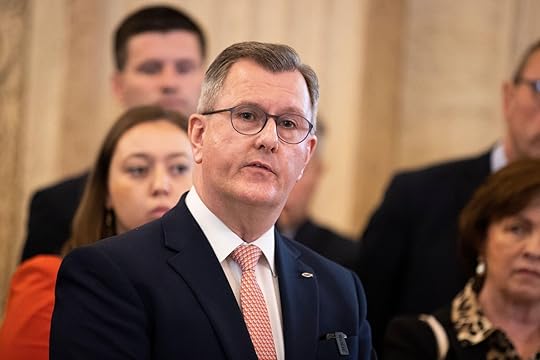
What will a unionist never do? Bend the knee. What will he never give? An inch. When will he change? Never, never, never. What will he do when his back is against the wall? Fight. What will he say when asked to compromise? No surrender.
If these are the unionist stereotypes, DUP leader Jeffrey Donaldson seems determined to conform to every one.
A week after a historic election that saw Sinn Féin outpoll the DUP and win the right to nominate Michelle O’Neill as first minister of Northern Ireland, and a surge of support for the Alliance Party, the DUP’s reaction has been to shut the devolved administration down.
Having refused to nominate a deputy first minister, thus ensuring that no executive decisions of any import can be made at Stormont, the party has now also refused to nominate a speaker, meaning that even the Assembly cannot function. Senior party figures have said there will have to be another election. It is now clear that if unionism cannot dominate, it will not participate.
Donaldson himself has abandoned the Assembly seat he won and scurried back to the comfortable exile of Westminster, where he is enabling Boris Johnson to use Northern Ireland to provoke a trade war with the EU.
Northern Ireland, already one of the poorest regions of the UK, is left without a government at a time when there is a cost of living crisis and a health crisis. This is not to mention the war in Ukraine, which ought to be the focus of EU and British political attention.
Election results show that the ground is shifting in Scotland, Wales and Northern Ireland. But the future of the UK is still up for grabs
Ostensibly, Donaldson is taking a stand against the Brexit protocol, which unionists call the ‘border in the Irish Sea’. He claims Northern Irish shoppers now have to pay more than their counterparts in the rest of the UK – and that this is causing hardship and costing the local economy £2.5m per day. In reality, research shared by Stormont’s Department of Economy suggests the total grocery cost is currently 8% lower in Northern Ireland than the rest of the UK, while the NI economy is outperforming the UK’s.
By keeping NI in the EU single market, the protocol gives it a distinct trading advantage, which has attracted considerable international interest. Local business leaders have been making the protocol work for them. It is, in fact, mitigating the worst impacts of Brexit. And remember, a majority in NI voted to remain in the EU.
Yet British businessman and former Brexit party MEP Ben Habib has claimed the protocol must be ditched because it posed “an existential threat to the union”. Oddly, two years ago he was insisting “Northern Ireland should embrace” the protocol because it offered an “opportunity to become a Tiger economy”.
The DUP is always falling for charlatans. It infamously showed the British public what its much-vaunted commitment to loyalty meant in 2019, when it shafted the then-prime minister, Theresa May in favour of Boris Johnson. The latter had promised a harder Brexit – which the DUP fondly assumed meant the return of a hard border across Ireland – but once he’d used the party to take power, he dropped it. The prime minister who negotiated the protocol now claims, without evidence, that it does not comply with the Good Friday Agreement (GFA).
May, meanwhile, became suddenly popular in Ireland this week when she used the House of Commons’ Queen Speech debate to urge the UK government not to breach the Brexit treaty, thereby breaking international law. She yielded to Donaldson, who said the most important thing was to protect the Good Friday Agreement. She then took the floor again to remind him that the Brexit deal she had put before Parliament did not include a border in the Irish Sea and also protected the GFA by not reinstating a hard border across Ireland. “Sadly,” she said, “the DUP and others across the House chose to reject that.”
The DUP’s declared devotion to the Good Friday Agreement is new and transparently insincere. Donaldson left the Ulster Unionist Party in 2003 to join the anti-agreement DUP. In the run-up to the 5 May elections, he shared platforms at loyalist rallies with people who are explicitly opposed to the agreement. Like them, he asserts against all the evidence that it has served only to make unionists second-class citizens. The rallies attracted thuggish elements, which threatened a violent response if unionism did not get its way. The DUP has also been boycotting meetings of the North-South bodies that are intrinsic to the agreement.
The DUP’s declared devotion to the Good Friday Agreement is new and transparently insincere
All of this is incoherent and indicative of panic. The DUP is clearly floundering. Its vote has fallen by almost 7%, with some going to the sectarian hardliners it courted during an election campaign based on the old tactic (scaring protestants into voting unionist to save Ulster) and to Alliance, which includes many former unionists who reject the DUP’s intransigence and fundamentalism.
Now, it finds itself threatened on both sides. Sinn Féin is on the rise, and, having surged to become the third-largest party, Alliance wants the definition of powersharing changed to give equal weight to those who are neither unionists nor nationalists. Under the Good Friday Agreement parties must designate as unionist, nationalist and other, but when ‘cross-community support’ is required for controversial decisions, only the unionist and nationalist blocs count.
The DUP has not even begun to imagine what equality means, but it fears it. “If you feed a crocodile it keeps coming back for more,” former party leader Arlene Foster infamously said of Sinn Féin demands in 2017. The nationalist anger provoked by her comments damaged the DUP at its next election. Crocodiles danced as Sinn Féin reaped votes. But the DUP is a party that considers paranoia sensible, makes a virtue of intransigence and does not learn from history. It also has a Trumpish willingness to brazen out obvious lies.
It yearns for a strong, manly unionism, united behind the Orange Order, just like in the days before 1972, when a Tory government prorogued Stormont and introduced direct rule.
Historically, British governments have ‘played the Orange card’ to protect unionism and disempower nationalism. Now, the DUP is left watching Johnson wave that card to threaten the EU, knowing he will play it only if it suits him. The Irish government has indicated that its relationship with the UK is at a breaking point. The EU will not abandon its commitment to the Good Friday Agreement. Nor will the US.
Northern Ireland has changed. It is a pluralist society now in which people expect to exercise their rights. The DUP can frustrate democracy for now, but the tide has already turned against it. People are talking about other options, like a united Ireland within the EU.


May 8, 2022
With Sinn Féin’s victory, tectonic plates have shifted in Northern Ireland
The Irish taoiseach, Micheál Martin, put it politely. It would be “undemocratic” for the Democratic Unionist party to refuse to form an executive in Belfast after the elections, he said. But the DUP will refuse to enter an executive, now that Sinn Féin has massively outpolled it, and a majority of Northern Ireland’s people has voted to have as first minister a republican whose party wants a united Ireland. Sinn Féin gained an astonishing 29% of first preference votes in Thursday’s assembly elections. The DUP got 21.3%, a drop of 6.7% on its last performance.
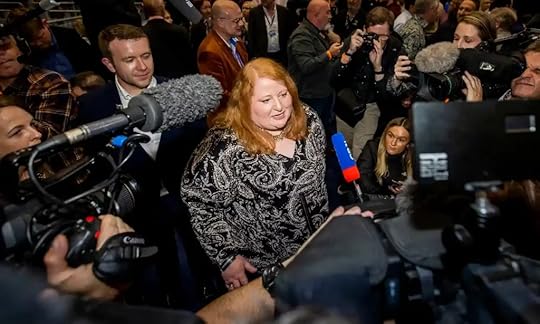
Alliance party leader Naomi Long: ‘Confident and progressive leadership.’ Photograph: Liam McBurney/PA
That refusal, ostensibly a protest over the Northern Ireland protocol, will be even further good news for an already jubilant Sinn Féin, because it proves definitively to its voters that Northern Ireland, set up 101 years ago to be an exclusively unionist state, is incapable of becoming a pluralist one and must therefore be brought to an end. No wonder Sinn Féin’s president, Mary Lou McDonald, has already said that preparations for a border poll should begin immediately and that it could be held within five years.
Northern Ireland is one of the poorest regions in the UK and many of those who work with its most disadvantaged citizens are pointing out evidence that a growing number of people are living in what is defined as destitution. They cannot meet the basic needs of their families. This is not a good time to refuse to govern.
Under threat from the reality of change, unionism has hardened. During the election campaign, Jeffrey Donaldson, leader of the DUP, aligned himself with those extremists opposed not only to the protocol but to the Good Friday agreement and power-sharing. This was madness – the 1998 agreement protected unionist rights, whatever the constitutional future might hold. Donaldson’s support has worked not for his own party but for the hard-right Traditional Unionist Voice party, which increased its vote, though as far as seats are concerned it remains a one-man band. It will maintain its grip on the DUP. Its leader, Jim Allister, who is fiercely articulate in his aggressive nostalgia for the days of unionist dominance, has already begun to jibe at Donaldson about his post-election choices. He demanded to know if the DUP was now willing to be bridesmaid to Sinn Féin, with its MLAs as page boys and page girls.
Donaldson looks increasingly like Miss Havisham, sitting abandoned amid the mouldering ruins of the wedding feast. There is, we all know, no prospect that Boris Johnson will cease to be a cad. He casually let his suave best man Brandon Lewis reveal on Wednesday night that even his most recent promise would be broken. There would be nothing in the Queen’s speech about ditching the protocol, nothing to make it look like he even noticed the dilemma of the party that shafted Theresa May and got him into power. If it suits Johnson to use the DUP in its Brexit standoff with the EU, he’ll use it. Otherwise, his response to the DUP’s neediness is Rhett Butler’s to Scarlett O’Hara: “Frankly, my dear, I don’t give a damn.”
Donaldson would far rather stay at Westminster than return to Stormont. Another of Johnson’s broken promises (allowing double jobbing) means he must choose. Paul Givan, the first minister ousted when Donaldson pulled down the executive earlier this year, said last night the party leader should be at Stormont, more evidence that the party is still bitterly divided. This election has simplified the political landscape, while also making it more interesting, not least because of the massive success of Alliance, which has emerged as the third largest party. It takes no position on the constitutional question and draws voters from unionist, nationalist and other backgrounds. Alliance used to be the party that “nice” unionists said they voted for when they didn’t want to admit they voted for the Reverend Ian Paisley. Under the confident and progressive leadership of Naomi Long, it has attracted a broad range of people, including many young people from the Protestant community who have rejected the DUP’s fundamentalism and intransigence.
At Stormont, under the power-sharing arrangements established under the Good Friday agreement, parties must designate as unionist, nationalist or other. Alliance is “other”. It has surpassed even its own highest expectations, taking 13.5% of first preference votes and gaining numerous seats through transferred votes. The Social Democratic and Labour party and the Ulster Unionist party suffered devastating losses, even in their heartlands. The Green party lost its seat.
Long has been campaigning for a change in the power-sharing arrangements that recognises that the old binary no longer represents political reality and that her voters cannot be treated as lesser citizens whose representatives are not called upon when “cross-community support” is being measured. The success of Alliance will ensure that Sinn Féin and the DUP, should they form an executive office together, must represent the interests of a diverse society.
The lines by Yeats about the Easter Rising in 1916 and its aftermath are overused but in this case are apt. “All changed, changed utterly.” Northern Ireland has had a transformative election.
February 1, 2022
Eiléan Ní Chuilleanáin – 2022 Global Irish Festival
Susan McKay talks to Eiléan Ní Chuilleanáin about her career as a poet, translator and teacher as part of the 2022 Global Irish Festival
January 30, 2022
It’s 50 years since Bloody Sunday, but sectarian tensions are running high
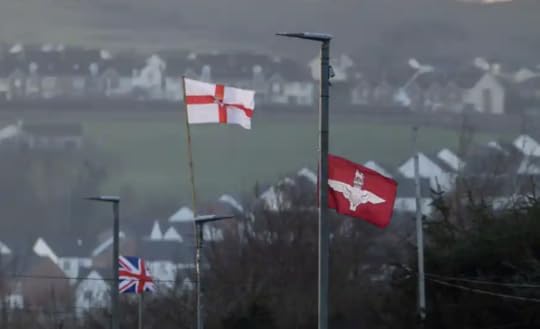
The road I grew up on in Drumahoe, on the outskirts of Derry, has been on the news lately, and not in a way that makes me proud. Journalists stand at its junction with the main road from Belfast, pointing up at the purple flag of the Parachute Regiment fluttering high on a lamp-post. They explain its significance at this time of year: it was paratroopers who killed 13 unarmed civil rights marchers in the city on Bloody Sunday in January 1972. Family members of those killed have talked about the pain the flying of these flags causes them. Politicians, including some unionists, and even the Parachute Regiment itself have called it “unacceptable”.
The flag flies because there are some in the unionist community who want to show that not everybody is mourning the dead of Bloody Sunday as its 50th anniversary is marked in Derry this weekend. It is a show of disrespect. Drumahoe has been flying this flag for years, as has the village of Newbuildings on the main road into Derry from Dublin. I saw one that had a sign pinned underneath it featuring the crosshairs of a gun – a warning to anyone tempted to remove it. In Drumahoe there are always union flags and Ulster flags flying, and sometimes there are also Scottish, Israeli and paramilitary flags. They stand like a weird forest. After the Anglo-Irish agreement in 1985, “Drumahoe Says No” was daubed on a wall along the main road behind our house, the white ghosts of its letters lingering on the red brick for years after it was painted over.
Houses in Drumahoe are in demand. Lately a few developments have been built of the kind described as “exclusive”, which in estate agent language means expensive. Once the earth is cut for the foundations, however, flags appear and put a different slant on “exclusive”. Their message is: houses for Protestants. When we sold our old family home last year, someone plastered an Ulster Defence Association bulldog sticker on the for sale sign.
A woman who lives in one flag-festooned estate near Derry told me that her area is actually quite “mixed”, meaning people from both Protestant and Catholic backgrounds live there. She said most did not want the flags but they remain because everyone knew the men who put them up. They were aggressive and had paramilitary connections.
Some people simply cease to notice these territorial markings. My mother once took a photo of my daughter in her garden. She was up a tree with a large union flag on a lamp-post behind her, apparently sprouting from her head. When I said it was a pity about the flag, my mother said, “What flag?”
It used to be called triumphalism, this flaunting of Northern Ireland’s Britishness. Now it looks more like desperation. When the state was set up in 1921, unionists felt secure. But the Good Friday agreement is based on power-sharing, and unionism has lost its majority at Stormont. A census to be published this year is expected to show that there are more Catholics than Protestants – this is already so among young people. The May election could see Sinn Féin take the first minister role.
Under the old unionist regime, the nationalist majority in Derry was disenfranchised – now it is reflected in local and UK political institutions. The old binary is breaking down anyway. Young musicians who play in loyalist bands by day go to gigs in republican areas at night – music is the shared passion, not division. While some unionists are still militant about calling the city Londonderry, and some nationalists insist on Derry, for the most part people are amiably willing to use either or both. Long, hard cross-community work on parading has taken much of the strife out of the annual burning of the effigy of “Lundy the traitor”. (He was a governor of Derry who wanted to surrender the city to Catholic King James in 1689 rather than endure a siege.)
The campaign for truth and justice for those who died on Bloody Sunday led to the Saville inquiry. Its finding that those killed on Bloody Sunday were innocent, and the prime minister’s apology in 2010, led to attempts to prosecute some of the paratroopers for murder. Soldier F, as he was known, was to be tried in Derry. In 2019 senior DUP figures, including Gregory Campbell, who lives in Drumahoe and is MP for East Londonderry, along with local Northern Ireland assembly member Gary Middleton, posed under a banner that had the Parachute Regiment’s insignia on it along with the claim that loyalist Derry is “still under siege” and the slogan “No surrender”. The Soldier F case collapsed in 2021. This year, Middleton saw sense and called for the Parachute Regiment’s flags to be taken down.
The commemorations for Bloody Sunday this year included plays, exhibitions, debates and concerts. The Irish taoiseach attended. It has been gracious and dignified. People from all communities were invited to join a walk along the original route of the march on Sunday. Unionist leaders were also invited, but none came. It looks bad.
Last week Colum Eastwood, the SDLP leader and MP for the constituency, called at Westminster for an apology from the British army for coming to Derry to “murder” civilians. He was heckled by the DUP MP Sammy Wilson. That looked bad, too. As a Stormont election looms, the DUP, humiliated by the Brexit debacle and by the prime minister, is poking at the deep old roots of sectarianism.
Those who put up the Parachute Regiment’s flag are full of incoherent rage. They believe Protestant civilians killed by the IRA have not been given the same attention as those who died on Bloody Sunday. They want recognition for “the exodus” that saw many Protestants effectively driven out of the city side of Derry by the IRA during the conflict. They feel betrayed and neglected by unionist leaders who have taken their support for granted and done little to improve their lives. One man told me that those responsible are “giving two fingers” to everyone else. “They’re saying – we can do this and you can’t stop us,” he said.
January 28, 2022
Beattie faces long road to redemption after offensive tweets emerge
In The Strange Case of Dr Jekyll and Mr Hyde, Robert Louis Stevenson’s Gothic tale, the civilised Jekyll, fascinated by the duality of his personality, manages to embody his evil side in the depraved Hyde, then finds he cannot control the transition between the two. Hyde runs amok. That’s Doug Beattie’s twitter account, firing out messages full of attitudes and prejudices that the Jekyll side of Beattie, the man attempting to modernise the Ulster Unionist Party, claims he never had. (for the Irish Times)
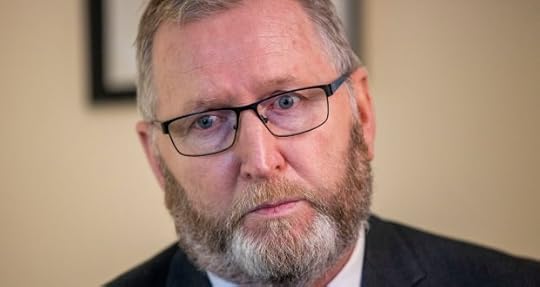
Doug Beattie: In a statement, now pinned to his twitter feed, Beattie acknowledged and apologised for misogyny, said he was ashamed and embarrassed, and vowed to do better. Photograph: Liam McBurney/PA
Last Saturday, Beattie was all over the front pages with a beaming photo, the only party leader to get a good rating in the new opinion poll. He was in soaring form. “They couldn’t have picked a smugger picture,” he tweeted, with laugh-till-you-cry emojis. That night, still buoyant, he tweeted the now infamous joke that has led to him being sued by the Democratic Unionist Party’s former leader, Edwin Poots. It involved the wives of unionist party leaders, brothels and bodily odours, and many who read it recoiled, then told him it was awful.
Jekyll Beattie responded: ‘Awful, just awful… I’m ashamed… I can’t justify that… horrendous, horrific… I’ve no excuse…’
Beattie took it down, apologised, said he had not meant to cause offence. But the truffle hunters of twitter had a scent. Soon they had snuffled out a haul of Beattie tweets that paraded every offensive stereotype in the charge book. Most dated back to the years 2011-2014, when he was a British army captain in his 40s.
Most were meant to be funny but could only have amused sexists, racists or those indifferent to people not exactly like them. Some were salacious, though more 1960s Benny Hill creepy than 2018 Belfast rape trial nasty. They featured schoolgirls’ skirts, “hookers”, randy, drunken Gurkhas, and humourless feminists with hairy chins. Other tweets held forth on the inability of women, foreigners and people from minority ethnic groups to do things properly. Leave it to the white man.
The next photos of Beattie to appear were of a man humiliated and almost broken. In a statement, now pinned to his twitter feed, he acknowledged and apologised for misogyny, said he was ashamed and embarrassed, and vowed to do better. He embarked on a series of media interviews. He was alone. No press officers, no advisors. He told BBC Northern Ireland’s Stephen Nolan, “My confidence is gone.” But there was something strange about his penance. He was contrite, though he did keep trying to consign Hyde Beattie to history, even though he had sallied forth just last weekend. Nolan read out the tweets. Jekyll Beattie responded: “Awful, just awful… I’m ashamed… I can’t justify that… horrendous, horrific… I’ve no excuse…” But he also professed bewilderment: “I am not the person who was portrayed in those tweets… it’s not me… even ten years ago it is not who I was.” He was adamant that he was “no racist”.
Offence is not the worst outcome of misogyny and racism. These prejudices inform behaviours that cause real and profound harm
When Nolan offered his distraught interviewee the option of pleading post-traumatic stress given his military postings to war zones in Afghanistan and elsewhere, Beattie allowed that on returning from environments in which there was “toxic testosterone”, “you decompress, you desensitise”. He spoke of using “dark humour” which was not, he said, meant to cause offence. But offence is not the worst outcome of misogyny and racism. These prejudices inform behaviours that cause real and profound harm. A climate is created, and denied. It is disempowering. People have to waste energy fighting it, energy that others use to thrive.
Put Captain Beattie’s jokes in context. In 2009 a young black man joined the British army. He was awarded best recruit in his year and had high ambitions. But in 2013, after serving four years in Afghanistan, he quit. He had put up with a lot of “dark humour”, he said, but what started as banter had intensified into outright racism. Raising it with a superior officer made matters worse. “If you talked,” he said, “your career was screwed.” He was persuaded not to cite racial discrimination as his reason for leaving, and put down health reasons instead. In 2015 a young woman in the British navy reported a more senior officer for repeatedly groping her. She was ostracised and nothing was done. Another discovered in the course of leadership training that a male armoured commander would not take orders from her on the radio, “because I am a girl”. Women and black and minority ethnic personnel are under-represented in the British forces, and are repeatedly found to have been subjected to more bullying and harassment at work than white men.
On a BBC NI discussion last week the People Before Profit MLA Fiona Ferguson said that misogyny was institutionalised in Northern Ireland. It was rampant and faced by women on a daily basis. She mentioned bodily autonomy – the Ulster Unionist Party’s health minister continues to thwart implementation of the abortion law. She asked why women were consistently responsible for most caring roles, why they received lower pay than men. UUP veteran Chris McGimpsey said she was exaggerating. She accused him of mansplaining.
With 90 per cent of its MLAs men, it is no exaggeration to say the UUP is a male-dominated party. Beattie pointed to the work he has done to bring in progressive young women. In truth, he needs them to grow his party among those unionists who reject the hopelessly sexist and homophobic fundamentalism of the DUP. These women stood by him last week with more than the grim, stoical smiles of wives of public men who have done them wrong and been found out. But Beattie’s commitment to equality is also undermined on another front. He claims he supports the Belfast Agreement but refuses to declare whether or not he would work in an executive with a Sinn Féin first minister. Dr Jekyll has a lot of work to do.
November 16, 2021
Traditional unionism is incoherent and broken
For young unionists, Irish unity is ‘just another issue’ alongside many others
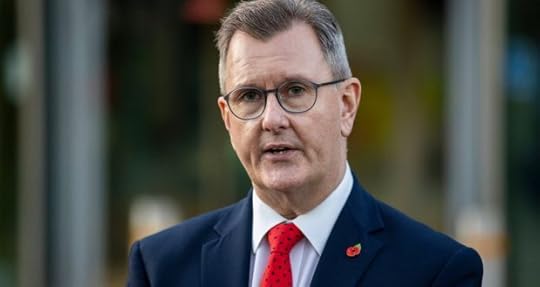
Jeffrey Donaldson ‘was meant to have been the sensible choice as DUP leader, but his position is riddled with contradictions’. Photograph: Liam McBurney/PA Wire
The artist Dermot Seymour once explained why his paintings often featured headless men: if you are a Protestant in the North you are not allowed to think for yourself, because “you might talk sense and that threatens their insecurities”.
Your neck, he said, would be twisted until you had no head. The twisters were those “stiff with rhetoric” leaders who spoke with “bleak afflatus” and rejected the need to “understand and forgive”. They are depicted by Derek Mahon in his poem Ecclesiastes. The poet tells himself: “this is your/ country, close one eye and be king.”
Joel Keyes, a 20-year-old aspiring unionist politician, got a visit from the police last week. They came to his house in Belfast in the middle of the night to tell him they had received information concerning threats against him, and that “the use of firearms cannot be ruled out”.
Jeffrey Donaldson, MP, who does not even have a seat at Stormont, was meant to have been the sensible choice as DUP leader, but his position is riddled with contradictions
The PSNI provides no information about the sources of such threats, and no organisation has claimed responsibility. However, it seems likely it was loyalists of some extreme stripe.
The warning came just after Joel wrote on social media that he found it fascinating that people he knows think “United Ireland” refers to Northern Ireland being annexed by the Republic. This had been his own impression too, until recently, he wrote, adding: “Perhaps a better term to use is “New Ireland”.
Joel recently took part in a Shared Ireland podcast. His interview was warmly received by people who want a Border poll and support unification.
Violence
Keyes says he does not understand unionism’s fear of a Border poll, or its outcome: “If the people of the country come back and say we want to join the Republic of Ireland, why would I want to stop a democratic vote?”
However, when he gave evidence last May on behalf of the Loyalist Communities Council (LCC) to the Northern Ireland Affairs Committee at Westminster, he said that he could not “rule violence on or off the table” for loyalists, albeit as “an absolute last resort”.
When outcry followed, the LCC immediately sprang to his defence, condemning his “vilification”. It is a different story now. Loyalists and their many organisations have largely remained silent about the threats to Keyes. He says he was confused, but that, “With our side you are very limited in what you can say. There’s a bit of paranoia.”
There certainly is. Unionism is in a state of incoherence and the extent of its disarray is on full view.
The UUP’s position is complicated
Jeffrey Donaldson, MP, who does not even have a seat at Stormont, was meant to have been the sensible choice as DUP leader, but his position is riddled with contradictions. He denounced those who have been out burning buses and getting children to riot in some of the poorest parts of the North. Yet they did so to mark a deadline he had solemnly and with some pomp set for potentially collapsing the regime at Stormont.
What is more, he relies on being able to cite these manifestations of what is meant to look like community rage (but doesn’t and isn’t), to make his case that the protocol is intolerable to unionists.
Polls and statements from business leaders have ripped this to shreds. The DUP illegally boycotts North-South meetings – an intrinsic part of the Belfast Agreement – while claiming outrage that the protocol is damaging the agreement, and that it definitely isn’t Brexit that is the problem. For the bus burners the posters that declare “the deal is dead” are about the protocol, the agreement and deals, in general, with Catholics and foreigners.
The PUP leader Billy Hutchinson’s midweek statement only went to show how far that party has fallen. Once it was exciting – now it is irrelevant. Hutchinson left listeners puzzled as he fended off interviewers with increasingly crabby variations of “No, that’s not what I’m saying.”
Unelectable extremists
The TUV’s Jim Allister is in the happy position of holding the DUP as his craven and miserable hostage, of having unlimited airtime on BBC NI, and of gaining traction in opinion polls.
e is in the unhappy position of being the leader of a party in which he is the sole MLA, a trail of disaffected and fundamentally unelectable extremists of one kind or another having come and gone over the years.
The UUP’s position is complicated. Doug Beattie is the best leader the once dominant party has had for many years, but he is trapped between the need to hold on to the conservative men in suits, the UUP’s stalwarts, and his need to attract young voters who are repelled by unionism’s narrow-mindedness on social issues.
They have other options – chiefly Alliance – and many of them put their energy into community activism. The UUP’s health minister has alienated feminists by refusing to commission abortion services, thereby breaching UK law. But the suits are leaving anyway.
Keyes has not lost his head. He remains “100 per cent hopeful” that Northern Ireland can change. He told me that young people in the unionist community – by which he means those his age and teenagers – are starting to take an interest in politics. They may have views on the constitutional question, but they are not talking about it along traditional orange and green lines. It is “just another issue” along with all the others, like health, education and poverty. “And that’s a good thing,” he says.
November 4, 2021
North’s politicians unite to keep abortion border in Irish Sea
Parties which claim to uphold human rights have abandoned women
It was quite the “manel” on display last week when the leaders of the North’s main Christian churches, and their Council of Churches, gathered in the Church of Ireland’s cathedral in Armagh to mark the centenary of partition. Most quoted in the extensive news coverage was the head of the Catholic Church in Ireland, Archbishop Eamon Martin, who said he had to “face the difficult truth that, perhaps, we in the churches could have done more . . . to bring healing and peace to our divided and wounded communities”.
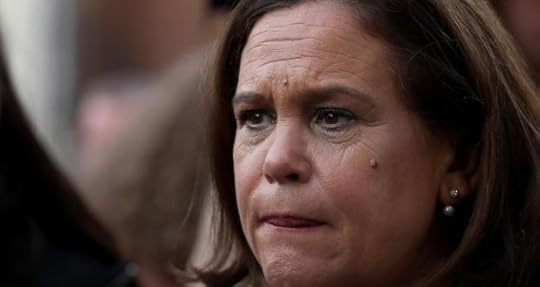
Sinn Féin leader Mary Lou McDonald has said she would “fail as a legislator” if she did not “have an answer for all of those hard cases”. She has failed. Photograph: Brian Lawless/PA
The last time I recall these men joining forces to opine was in 2019 when they wrote to political leaders at Stormont urging them to recall the then suspended executive and stop the decriminalisation of abortion via legislation voted in at Westminster.
By coincidence the church service took place on the second anniversary of the North’s getting a British pro-choice law which is one of the most humane in Europe. But feminists marked the occasion with a protest in Belfast, because the law is not being implemented. One placard read, “Girls just want to have fun-damental human rights.”
The North’s Minister for Health, Robert Swan of the UUP, has not commissioned the abortion services required under the law and, throughout the pandemic, women still had to travel for abortions or go through with crisis pregnancies or take unregulated pills. Earlier this month, Belfast’s high court ruled in a case brought by the NI Human Rights Commission that the British secretary of state had failed to comply with his duty to ensure that abortion services were provided “expeditiously”.
Foetal abnormality
While the church service was taking place in Armagh, Stormont’s health committee voted in favour of a DUP Bill which would effectively deny women their legal rights in some of the worst situations imaginable. The Bill seeks to amend the law to remove the right to abortion in cases of “severe foetal abnormality”. The law currently allows for abortion after 24 weeks’ gestation in such cases, as well as if there is a fatal foetal abnormality. In reality, tests may only indicate the presence of such abnormalities at about 20 weeks, and medical diagnosis of the difference between severe and fatal is not always possible.
The amendment would force some women to rush an inevitably fraught decision in order to have a termination in the North. Others would have to travel to England. Some, unable to do either, would be forced to carry their pregnancy to full term, or to the point when the foetus dies in their womb.
The Bill’s author is the current First Minister, Paul Givan, who believes that life begins at conception. The DUP has fought to maintain that particular border in the Irish Sea. The two DUP committee members voted for the Bill. The UUP’s one committee member also supported it, dashing any hopes that the party’s new leader, Doug Beattie, would stand up for women’s reproductive rights. The only two members who voted against the Bill were from People Before Profit and Alliance. The SDLP’s one member and Sinn Féin’s three members all abstained. (read the full article at the Irish Times)
On the far side of borders, a new Ireland is taking shape
A powerful new play has just opened at Belfast’s Lyric theatre. The Border Game, by Michael Patrick and Oisín Kearney, is a fractured love story and a sharp political satire about the legacy of partition. Its setting is an abandoned customs hut on boggy ground beside a broken barbed-wire fence that marks the border between Northern Ireland, where Henry lives, and the Republic, where Sinead lives. The play is moving, honourable, and just a little bit messy. You get the impression the ending might change in the course of its run. But somehow this rawness at the edges seems quite befitting.
The former lovers, who still appear to be in love, attempt to tell each other why they separated, each of them wounded by the conviction that it was the choice of the other. They have survived, but they are haunted by the proximity of others who did not. There is a ruinous sense of responsibility to the dead. Resorting to desperate hilarity, they come up with a word: “Borderfucked. Twelve letters. The condition of being fucked economically, socially and psychologically due to the stroke of a pen. Common in Ireland, the Middle East, and all over the fucking world.”
The border in Ireland, Patrick and Kearney suggest, is misunderstood. “To Dublin it is a no man’s land, to Belfast it is a bog of culchies. To London, it is a place of bandits and criminals.” To the likes of Sinead and Henry it is home. Partition was anything but a clean break.
Brexit has ravaged unionism. A Protestant businessman from the border region told me recently: “The DUP didn’t want a deal. They wanted a border.” They got a border, but it wasn’t the one they wanted. Unionism’s leaders, all men again, gathered last week at the behest of the Orange Order on the steps of Stormont in a show of unity against the border in the Irish Sea. The unionist family lineup included a former loyalist paramilitary – Billy Hutchinson – alongside the leader of the Traditional Unionist Voice party, which berates the DUP for sharing power with Sinn Féin because that party includes former terrorists.
At the Tory party conference, the DUP talked tough at fringe events. Jeffrey Donaldson, the party’s leader, intimated again that if the government did not act, he could collapse the devolved institutions at Stormont. The DUP likes the sound of “triggering article 16”, but everyone knows the Brexit deal relies upon some version of the protocol surviving the months or years of wrangling that would follow. So unperturbed was Boris Johnson that he did not even mention the protocol in his speech. The EU is offering what it says are transformational changes. Meanwhile, the business sector wants stability.
Back home, the lord mayor of Belfast turned off all the lights at the City Hall this week to demonstrate disgust at the cruelty of the cut to universal credit. Northern Ireland’s NHS is teetering on the brink of collapse. Evidence is accumulating that Northern Ireland is failing and the British government does not care. Inevitably, nationalists, republicans and a growing number of others are looking to the prospect of a different kind of constitutional future. There is talk about the potential for a border poll that could bring the North out of the UK and into a new union with the Republic and within the EU, which a majority of Northern Irish voters never wanted to leave.
Referendums would be required in both jurisdictions on the island of Ireland. An Observer poll in August found that among Northerners, 49% would vote to remain in the UK, 42% would vote for a united Ireland, and 9% were undecided. Other polls show variations. Crucially, among those aged under 45 there is overwhelming support for unity.
In the North, several civil society organisations are advocating for a new Ireland. They hold public meetings, publish research, debate the merits of citizens’ assemblies, look at international models and consider timeframes. The debacle of the rushed Brexit vote stands as a warning. There is an emphasis on inclusiveness, and the approach taken is non-confrontational. For the most part, people are treading carefully.
There’s a ballad depicting the provinces of Ireland as four green fields, one of them stolen by strangers, and plenty of belligerent songs about the imperative to seize back those six Ulster counties, to make Ireland “a nation once again”. (read the full article at The Guardian)
August 16, 2021
Would Troubles amnesty suit Government?
The sole survivor of the the IRA’s Kingsmill massacre has accused the Irish Government of hypocrisy and of “speaking out of both sides of its mouth” over its attitude to the legacy of the conflict in the North. Alan Black said the Government had spoken out last month against the British government’s decision to “draw a line” under the past by halting all investigations, yet it had itself failed to co-operate with the inquest into the 1976 sectarian atrocity that nearly cost him his life. Ten men died in a hail of gunfire after the IRA ambushed their work minibus along a South Armagh roadside. No one was ever convicted of their murders.
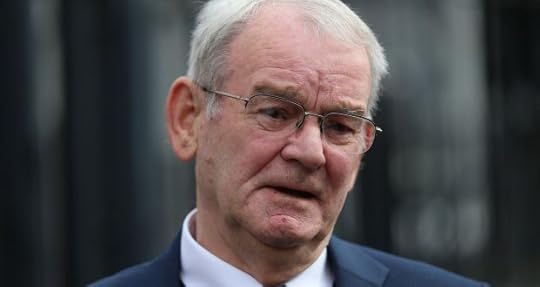
Alan Black, the sole survivor of a sectarian massacre in 1976 near the Co Armagh village of Kingsmill: concludes the authorities both sides of the Border must be protecting security force agents and ‘can’t allow their dirty tricks to be found out’. Photograph: Niall Carson/PA Wire
“It would suit the Irish Government down to the ground if the British go ahead with this,” he told me. Mr Black said he had been forced to conclude that the authorities on both sides of the Border must be protecting security force agents and that they “can’t allow their dirty tricks to be found out”. These are shocking allegations and the Government must address them, coming as they do from a man of integrity.
They come hard on the heels of a ruling in Belfast’s high court that there was plausible evidence that the 1998 Omagh bombing carried out by the Real IRA could have been prevented. Mr Justice Mark Horner recommended that both the Irish and British governments should undertake human rights-compliant investigations into that atrocity, in which 29 people died, given “the consideration of terrorist activity on both sides of the Border”. Several republican gunmen are believed to have been involved in both of the massacres, spanning 22 years, as well as in dozens of other killings. They include Michael McKevitt who was a senior figure in the IRA and then, having rejected the peace process, went on to found the Real IRA. He died earlier this year.
(read the full article at the Irish Times)
August 6, 2021
The Irish language can give us all a sense of home – if we save it from sectarianism
A campaign to stop Belfast’s first Irish-language preschool shows how dysfunctional unionist politics has become.
(Susan McKay for The Guardian)
The hard men of Ulster loyalism are adept at spotting Trojan horses. Belfast’s first Irish-language preschool, planned to open in September, wouldn’t get past them without a fight. This weekend, as the school announced it would look for another location, they celebrated victory over Irish republican insurgents disguised as tiny two- and three-year-old children. After the incursion was abandoned, one of the leaders of the rout addressed “the loyal residents” of the area via a social media post: “STAY STRONG AND PROUD … THE DAYS OF LOYALISTS QUIETLY ROLLING OVER, FOR THE SAKE OF PEACE AT ANY PRICE … ARE OVER.” It was, in reality, a disgraceful episode of intimidation led by a few paranoid and sectarian individuals against a lovely, educational and life-enhancing project for 16 preschool children.
It is a mark of the current dysfunctional volatility within unionist politics in Northern Ireland that this crazed campaign gained enough traction to convince those behind the project to look for premises elsewhere. These situations can escalate. In 2001 loyalists in another part of Belfast hurled abuse and bags of urine at small children and their parents on their way into school during what became known as the Holy Cross dispute. The cause? The alleged taking down of a flag.
In Northern Ireland’s largely segregated education system, Irish is taught in Catholic schools and not taught in Protestant ones. The naíscoil – nursery school – was all set to start up in September. It would sit in a spare prefab on the corner of the playground at the big redbrick primary school in the heart of the Braniel housing estate. It was set up by a committee established by a group of parents and supported by the education authorities. One of the instigators is Linda Ervine, a brilliant educationist who has run Irish language classes for adults in mainly working-class Protestant areas for several years now. She works for an organisation called Turas, which also teaches about how Irish was an intrinsic part of Protestant identity until recent years. Ervine lives in east Belfast.
The idea of Naíscoil na Seolta was to provide a religiously and ethnically integrated group of toddlers access to the Irish language through the medium of play. Funds had been raised, teachers appointed, walls brightly painted, toys propped up on shelves, tiny sofas and chairs installed. But as excitement built, those opposed to the project were launching a campaign to have it stopped. They set up social media accounts, circulated a petition and put up posters in the area, in which Ervine’s face is superimposed so that she appears to be standing among Sinn Féin leaders as an election candidate. Keyboard warriors piled in claiming that the community was concerned and “key stakeholders” should have been consulted about this contentious and “devious imposition”.
The head teacher at Braniel primary school, Diane Dawson, a vibrant woman with spiky blond hair, has been a champion for the project. When approached, she gladly rented out the prefab, which is owned by the education authority. She is passionate about the way multilingualism improves learning skills in the very young. Her unionism is not in doubt. She grew up in the minority Protestant community in South Armagh, marched in Orange Order parades, taught the flute to members of the Redrock Purple Heroes band, and while her politics have changed somewhat she still loves the boom of a Lambeg drum. She spoke out on BBC Radio Ulster. No word of Irish spoken in her school, she declared, posed any threat to her identity. Just two parents had expressed concern to her about the naíscoil. The petition which purported to represent the opposition of local residents was, she pointed out, signed by people from all over the United Kingdom.
She told me that “Braniel” comes from the Irish and means “bright slope of the O’Neill”, and that the red hand of Ulster, which is now the adopted symbol of loyalism, originated with the Irish chieftain. Her school has nearly 500 students. She has already introduced Irish along with Spanish and sign language as part of her post-Covid recovery curriculum, and parents and children are overwhelmingly delighted. There is also a short course in Ulster Scots – short, Dawson pointed out, because it is not really a language. She showed me emails and messages from parents backing her stand, which also has the full support of her board of governors. She showed me inside the prefab. There had already been an induction day and a whiteboard had Irish words on it. They were, in English, “children together”, “I am at school”, “happy” and “An Ghaeilge” – the Irish language.
Susan McKay's Blog

- Susan McKay's profile
- 9 followers

