
Peter Troy's Blog
June 20, 2015
Take Down That Flag
The recent Charleston Massacre has brought attention once again to the issue of the Confederate flag. If the title of this piece was not a clear enough indicator, then let me say this: the Confederate flag does not belong on any public building, its design should not be included in any segment of a government symbol, and those who choose to fly it proudly should at last open their eyes to what they are doing in reality, whatever their intentions may be.
The design we see today was not the original one for the flag of the Confederate States of America. No, for the first two years of the Civil War, the official Confederate flag was the Stars and Bars, comprised of two horizontal red stripes and one white one, with a blue field decorated with white stars in the upper left hand corner.
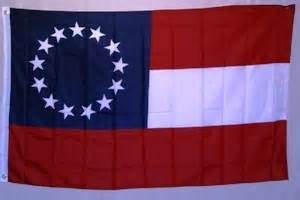
Look a little familiar? It certainly did to many Southerners, far too similar to the United States flag that they saw as representing emancipation and racial mixing, among other things. So the flag was replaced with the basic design we see today, two blue stripes in an elongated "X", with white stars running the length of each emblazoned across a red background. That is the flag that was carried by Confederate troops for the last two years of the war, a war that never would have been fought if not for the issue of slavery.
Proponents of the flag will argue that the vast majority of Confederate soldiers did not own slaves. Very true. But they fought for a government that was hell-bent on preserving, indeed expanding, that very institution. Every effort to wrap up the southern cause in "State's Rights," or to label it "The War of Northern Aggression," is simply an effort to bypass or downgrade the real issue, slavery. The war was about a great many things, but none of them greater than the issue of slavery and its future.
With the war concluded, the flag endured. It became a symbol of racial attitudes - both North and South - that would turn a blind eye to Jim Crow segregation in the south for an entire century. It was sanitized to some degree by a wave of glorification of the Ante-bellum South, ranging from the seemingly harmless "Gone With the Wind" to the horrific "Birth of a Nation." And it re-emerged in stark public view during the Civil Rights movement of the 1950's and 60's, not as a symbol of "Southern Heritage" or even a tribute to Civil War troops who fought for a cause, but now as the banner of segregation.
Somehow such vile connections are easily dismissed. Walk into thousands of gift shops in the South today and the image of the Confederate flag can be found on t-shirts, bumper stickers, and bandanas. Drive across the rural areas of the North and find the same flag draped across a garage door or even hanging from a pole mounted by the mailbox. Is it that a proud southerner lives there? Or is it more likely a person with racial attitudes and beliefs more amenable to previous centuries?
The "Southern Heritage" argument is a valid one. It is indeed a part of the South's history. It was a flag that represented those states that seceded from the United States of America because Abraham Lincoln, a known opponent to the expansion of slavery into the western territories, was elected president. It was a flag that was carried to the bitter end of that struggle, a flag of a government that sought to continue to subjugate millions of human beings, and was willing to sacrifice its resources, its cities and its young men for such a cause.
Understand, I do not support the banning of the flag itself. If a person wants to fly it on their own property, they should be allowed to. But as it is a symbol of the enslavement of millions of Americans, it should not, it can not, be flown from government institutions anywhere in this land. And for those who would choose to fly it on their property, as I'm sure this wave of public debate will inspire some to do, know that you fly a symbol of intolerance and hatred when you do so. Know that it was created as an act of rebellion against the flag of the United States of America and was carried into battle against it, just as the German Swastika and the Japanese Rising Sun were nearly a century later, just as the Jihadist banners of Al Qaeda and ISIS are today.
It is time to finally take that next step in our nation's evolution and remove that flag from every statehouse, courtroom and classroom in the country. It has no place other than as a relic to be viewed beneath the display case glass of a museum...alongside so many other remnants of the past.
The design we see today was not the original one for the flag of the Confederate States of America. No, for the first two years of the Civil War, the official Confederate flag was the Stars and Bars, comprised of two horizontal red stripes and one white one, with a blue field decorated with white stars in the upper left hand corner.
Look a little familiar? It certainly did to many Southerners, far too similar to the United States flag that they saw as representing emancipation and racial mixing, among other things. So the flag was replaced with the basic design we see today, two blue stripes in an elongated "X", with white stars running the length of each emblazoned across a red background. That is the flag that was carried by Confederate troops for the last two years of the war, a war that never would have been fought if not for the issue of slavery.
Proponents of the flag will argue that the vast majority of Confederate soldiers did not own slaves. Very true. But they fought for a government that was hell-bent on preserving, indeed expanding, that very institution. Every effort to wrap up the southern cause in "State's Rights," or to label it "The War of Northern Aggression," is simply an effort to bypass or downgrade the real issue, slavery. The war was about a great many things, but none of them greater than the issue of slavery and its future.
With the war concluded, the flag endured. It became a symbol of racial attitudes - both North and South - that would turn a blind eye to Jim Crow segregation in the south for an entire century. It was sanitized to some degree by a wave of glorification of the Ante-bellum South, ranging from the seemingly harmless "Gone With the Wind" to the horrific "Birth of a Nation." And it re-emerged in stark public view during the Civil Rights movement of the 1950's and 60's, not as a symbol of "Southern Heritage" or even a tribute to Civil War troops who fought for a cause, but now as the banner of segregation.
Somehow such vile connections are easily dismissed. Walk into thousands of gift shops in the South today and the image of the Confederate flag can be found on t-shirts, bumper stickers, and bandanas. Drive across the rural areas of the North and find the same flag draped across a garage door or even hanging from a pole mounted by the mailbox. Is it that a proud southerner lives there? Or is it more likely a person with racial attitudes and beliefs more amenable to previous centuries?
The "Southern Heritage" argument is a valid one. It is indeed a part of the South's history. It was a flag that represented those states that seceded from the United States of America because Abraham Lincoln, a known opponent to the expansion of slavery into the western territories, was elected president. It was a flag that was carried to the bitter end of that struggle, a flag of a government that sought to continue to subjugate millions of human beings, and was willing to sacrifice its resources, its cities and its young men for such a cause.
Understand, I do not support the banning of the flag itself. If a person wants to fly it on their own property, they should be allowed to. But as it is a symbol of the enslavement of millions of Americans, it should not, it can not, be flown from government institutions anywhere in this land. And for those who would choose to fly it on their property, as I'm sure this wave of public debate will inspire some to do, know that you fly a symbol of intolerance and hatred when you do so. Know that it was created as an act of rebellion against the flag of the United States of America and was carried into battle against it, just as the German Swastika and the Japanese Rising Sun were nearly a century later, just as the Jihadist banners of Al Qaeda and ISIS are today.
It is time to finally take that next step in our nation's evolution and remove that flag from every statehouse, courtroom and classroom in the country. It has no place other than as a relic to be viewed beneath the display case glass of a museum...alongside so many other remnants of the past.


November 22, 2013
Michael Shaara Prize Acceptance Speech
I was recently honored to recieve the Michael Shaara Prize for Excellence in Civil War Fiction. Here is the acceptance speech I gave: It is my great privilege to accept this award, named in honor of his father Michael, from Mr. Jeff Shaara. My love of history was instilled in me by my own father. We were both high school history teachers, students of the Civil War, and great fans of Killer Angels as well as Gods and Generals and The Last Full Measure. We read them all, discussed them all at length, sometimes quoted them in random every day conversations…often to the befuddlement of those around us. When the movie Gettysburg came out, we went to see it on the first Saturday afternoon. The young man selling the tickets issued a warning to us before collecting the money. “Just so you know,” he said, “the movie’s like four and a half hours long and has an intermission.” We just smiled and nodded. Told him it would be fine. “Kid’s obviously not a history buff,” my father said as we walked inside.
Now the next Saturday we went back to see it again, and there was the same young man at the ticket booth. “Just so you know, “ he began, “the movie’s like four and a…wait…weren’t you guys here last week?”
The rest of the transaction was conducted with eyebrows raised as he handed us our tickets with a look of disbelief. Now the THIRD Saturday…there was no effort to deliver the warning, he just stood there, mouth agape, offering a bewildered sort of, “Ahhh, enjoy the show?” as he handed us our tickets. Different strokes, for different folks, we figured. We decided not to go back on the fourth Saturday, lest there be a stroke of a different kind.
My father passed away in 2010. But he lived to see my book sold at least, if not published. He would have loved to have been here today, for so many reasons. He was one of the very few people who didn’t think it was a completely absurd idea for me to leave teaching, if only temporarily, in order to write that novel I’d been meaning to get around to since I was in college. Or at least if he did, he never said it out loud. I made that leap in 2007, living off my 401K savings as I wrote full time. I had two characters, the first a Civil War photographer who would take a picture of Lincoln delivering the Gettysburg Address, but rather than develop it, in his war-weariness, he would preserve the negative and store it away, not telling a soul about it. Some 160 years later it would be discovered in an attic by the second main character, who would share it with the world. For a year and a half, or so, I worked on filling in the story over that century and a half, developing the characters and broader themes, until, 700 single-spaced pages later, I realized I had a trilogy on my hands. Only then did the first part of it, May the Road Rise Up to Meet You, truly take form.
To be honest, I think it was only then that I discovered that each of the now four principle characters in this first book had one main thing in common. There was Ethan, a poor immigrant who comes to America to escape the Irish Potato Famine; Marcella, a society girl from Spain who emigrates with her family, and Micah and Mary, two slaves separated from their families early in life. Each of them faced, in varying degrees, the oppression of a society that defined them only by the simplest of terms, as mere functionaries of the larger, far more important economic system around them. That could have been, should have been, their prison cell. And yet each of them, endowed with great talent and most importantly, ASPIRATION, somehow went beyond those constrictions. All of them thus became heroic in their own right, in their own small lives, even amidst the conflagration of world events all around them. I would like to say that I created them that way from the start, but I didn’t. I think instead they were the reflection of an attitude, an aspiration that had been instilled in me from childhood. These characters are fictional – as I sometimes have to be reminded - but I would hope they are inspirational, particularly in today’s society. As a teacher for fourteen years, I can say that at times it felt like swimming against the seemingly unstoppable tide of our modern society, the tide that would reduce learning to its simplest terms, valuing functionality alone. The liberal arts, the creative arts are too readily cast aside in favor of greater focus on technology and economic expediency. And the cost is a society that increasingly worships fame for fame’s sake alone, while devaluing knowledge for knowledge’s sake alone.
I think the greatest influence my father had on me was his love for learning, a love which only grewwith age rather than fading away. In my teaching days I tried to inspire that same love of learning in my students. “Will that be on the test?” was the only question not permitted in my class. And so, I suppose it would be inevitable that I would write characters like these. For them, knowledge was hope. Knowledge was joy. For them, as for us, Knowledge was and is, LIBERATION. My mother and father were each the first ones in their extended families to graduate from high school. That was an accomplishment in and of itself, but not enough to quench their aspiration, and so, well into their forties after their children had already begun college or even graduated, they went back to school themselves. On the brink of fifty, they emerged as newly certified teachers and spent the next twenty three years inspiring their students as they had done their children. I dedicate this award, I OWE this award, to that example of courage, commitment, and most importantly, the love of learning.
Thank you.
March 13, 2013
A scene from May the Road Rise Up to Meet You that didn't make the final cut - The 1863 Draft Riots
This is a scene from May the Road Rise Up to Meet You that was part of the original story but was excluded from the final draft. It is an important part of the history of this period, so I share it here. Ethan has returned to New York (without Marcella) after having the confrontation with Harry at Gettysburg (rather than Fredericksburg as I later made it). He is bruised and dazed from a barroom fight he got into with two gravediggers in Gettysburg...a sort of flashback to Aislinn's funeral triggering his rage. And when he returns to New York, this:
July 13th, 1863
New York
Your head still throbs from eight hours on the train and all you want is to get to Seanny’s house to get some rest and let the bruises go down a bit, now that the bleeding’s stopped, so you don’t have to see Marcella this way. But soon as you tell the taxi driver to take you to Fahrteenth an’ Broadway it’s like he’s identified you as his long lost cousin from th’Old Country and he starts in right away about th’mischief goin’ on down in the Points. Mischief, you think, when’s there ever notmischief goin’ on down in the Points? But this is different he says, th’Mob’s already torched a few shanties on Baxter Street, chasin' the darkies outta their homes. He seems particularly pleased about that, sayin’ th’crowd turned on th’darkies right off, once dey got a snootful an’ decided it was toime t’do somethin’ about this goddamned Draft. He tells you he’s a few years off the boat himself, did his ninety day bit early on, asks if you was fool enough as him t’serve…an’ when you just say The Sixty-Ninth…it’s like he figures you know all about it, all about the war and the mischief goin’ on in the Points.
Did my nointy day bit early on too, not wit’ th’Sixty Noint’, but did my bit all th’same. Didn’t see much action, but still…so you an’ me bowt’ know about dis Rich Man’s war. An’ the’lads down in th’Points’re all fired up ‘bout dat t’ree hunnerd dollar exemption. Rich Man’s war, wit’ th’poor men doin’ th’foightin’, an’ all fer th’darkies. And when you don’t say anything in response, he assumes you feel the same way he does about it all. If ya ask me, dis here’s been brewin’ a long toime. Dropped a fella down along Eight’ Street not an hour ago an’ ya could hear th’Mob stirrin’ from that far away. If ya ask me, won’t be a darkie left anywhere near th’Points when th’Mob gets t’rough wit’ ‘em.
And you know there’ll be no resting at Seanny’s. You know he’s down there in the Points, tryin’ to do what he can to put an end to the foolishness. But he’d always said that th’Points were a powder keg waitin’ on a spark, Tammany doin’ what it could to keep the sparks away. Seanny’d be down there now for sure, so you tell the driver to take you there, to the Points. And Irish camaraderie doesn’t do a damn thing to get you there, but a twenty does.
There’s more smoke than usual, and you can hear the clamoring of th’Mob down near Pell Street, so you continue south on Bowery, feeling your head throbbing more than ever from the exertion, not willing to stop, feelin’ somehow that you have a place here, that there’s something you can do along with Seanny….to help end the foolishness. But its foggier now, your thinking is, so that when you turn right on Pell street, and see th’Mob gathered at the far end of the block, stones and bricks flyin’ from their midst towards the buildings, you wonder just what you thought you might do. A few dozen policemen come running towards th’Mob, brandishing billy clubs and blowin’ whistles, the sound like pins jabbing at your temples. They hurl themselves into the crowd with the sort of ruthless fury reserved for the battlefields, but th’Mob will not be moved so easily, needing a few minutes of hand to hand, before they’re on their way and the street is cleared.
It’s instinctive in you now, this walking towards the scene of the next clash, past several policemen who yell at you to be on your way. There’s an old Negro woman being carried from the building by the policemen, and you can see her head is bloodied from a brick or stone that struck her. The next several buildings in a row have not a single window intact, and there’s smoke coming from one of them, a Negro man swatting at the flames with a blanket. And you don’t see the point of attacking these people who have nothing to do with the draft boards or the rich men getting their three hundred dollar exemptions. You want to help the man try and put out the fire, but then he gives up, surrendering to the inevitable, grabbing a few things before running out of the building, joinin’ several others watching their homes go up in flames.
The noise of th’Mob draws you down Mott Street, to Park, and then up Baxter where they’ve joined another Mob attacking more buildings. There’re dozens of police already there and the ones you just left on Pell Street come runnin’ breathlessly past you. One of them bumps your shoulder and the jerk of your head makes you weak on your feet, so you stop walking and lean against a streetlamp, watching as the police pour into th’Mob just as they had before, only now th’Mob giving as good as they get. It’s maybe half an hour before the scene is finally cleared, the remnants of the clash in the form of battered men, both police and civilians, lying prone on the street, cursing each other with what energy they can muster. The Negro tenants look out of their windows with the fear that comes from knowing they’re completely surrounded within the Points, outnumbered at least ten or fifteen to one, trapped inside their homes until th’Mob passes far enough away so they can maybe slip out to Brooklyn and something like safety.
The senselessness of it staggers you. Go uptown, you want to tell them. Go to Wall Street. Go to City Hall. They’re the enemy. But you say nothing of course, remembering instead how your Da had described the Points to you the first time you saw it. All th’most desperate people, th’ones at da bottom, grabbin’ an’ kickin’ at one anudder t’keep from going under demselves, was what he’d said, and you always remembered it just that way. And as it comes back to you now, you realize that it’s a force far greater than anything you can hope to stop. Disgusted, you stand up and begin to walk, dazed, thinking you’re goin’ back uptown but walking south instead. You don’t realize your mistake until you reach the corner of Park Street, where another Mob has assembled, larger than the previous two, reinforced by people from outside the Points and lubricated with whiskey and rum and beer. When the police arrive, they don’t budge th’Mob at first and are forced to retreat, then regroup, and enter the fray again. Once more unto the breach, you think, bitterly.
Not far from the edge of the battle you see a Negro man slip out a side window of one of the buildings under attack and make a dash up Park Street away from the crowd and towards you. Then two men coming from the opposite direction block his path and knock him hard to the ground, as several others catch up with him from behind and begin to kick and punch him. The police don’t see any of this, too involved with the main mob, so you begin to run up the street to help. It’s only a dash of thirty or forty yards, but it takes all the coherence from you. When you reach them, you shout something even you don’t comprehend, then strike one of them a glancing blow across the temple, your elbow striking another man’s shoulder and spinnin’ you just enough to send you tumbling to the ground beside the Negro man.
Everything freezes for a moment, and you brace yourself for a beating far worse than the one you took yesterday. But then the men who’d been kicking and stomping begin to laugh hysterically at you, believing that you meant to join them, of course, since you’re one of them, but were just too drunk to do much good. Even the man you hit seems to believe this, and he’s laughin’ hardest of all. Then a roar comes from down the street and you can see flames bursting forth from one of the buildings, and they turn and run back towards th’Mob again. The man lying on the ground next to you has cuts along his face and a terrified expression to match them. He forces himself to his feet and looks at you confused, as if wondering whether maybe you had come to help him, but he doesn’t deliberate for long before takin’ off up Park Street and away from th’Mob. And you’re left there, in the fog, but none the worse for a beating. Still, you close your eyes for just a while, giving in to the fog, resting, garnering what strength you can before trying anything so ambitious as finding your way back to Seanny’s house, deciding right them that you’ve had enough of the Points, and enough of the desperate people grabbing and clawing at each other for….for what? This place makes less sense to you now than it did to that twelve year old boy who saw it with his Da all those years ago.
July 13th, 1863
New York
Your head still throbs from eight hours on the train and all you want is to get to Seanny’s house to get some rest and let the bruises go down a bit, now that the bleeding’s stopped, so you don’t have to see Marcella this way. But soon as you tell the taxi driver to take you to Fahrteenth an’ Broadway it’s like he’s identified you as his long lost cousin from th’Old Country and he starts in right away about th’mischief goin’ on down in the Points. Mischief, you think, when’s there ever notmischief goin’ on down in the Points? But this is different he says, th’Mob’s already torched a few shanties on Baxter Street, chasin' the darkies outta their homes. He seems particularly pleased about that, sayin’ th’crowd turned on th’darkies right off, once dey got a snootful an’ decided it was toime t’do somethin’ about this goddamned Draft. He tells you he’s a few years off the boat himself, did his ninety day bit early on, asks if you was fool enough as him t’serve…an’ when you just say The Sixty-Ninth…it’s like he figures you know all about it, all about the war and the mischief goin’ on in the Points.
Did my nointy day bit early on too, not wit’ th’Sixty Noint’, but did my bit all th’same. Didn’t see much action, but still…so you an’ me bowt’ know about dis Rich Man’s war. An’ the’lads down in th’Points’re all fired up ‘bout dat t’ree hunnerd dollar exemption. Rich Man’s war, wit’ th’poor men doin’ th’foightin’, an’ all fer th’darkies. And when you don’t say anything in response, he assumes you feel the same way he does about it all. If ya ask me, dis here’s been brewin’ a long toime. Dropped a fella down along Eight’ Street not an hour ago an’ ya could hear th’Mob stirrin’ from that far away. If ya ask me, won’t be a darkie left anywhere near th’Points when th’Mob gets t’rough wit’ ‘em.
And you know there’ll be no resting at Seanny’s. You know he’s down there in the Points, tryin’ to do what he can to put an end to the foolishness. But he’d always said that th’Points were a powder keg waitin’ on a spark, Tammany doin’ what it could to keep the sparks away. Seanny’d be down there now for sure, so you tell the driver to take you there, to the Points. And Irish camaraderie doesn’t do a damn thing to get you there, but a twenty does.
There’s more smoke than usual, and you can hear the clamoring of th’Mob down near Pell Street, so you continue south on Bowery, feeling your head throbbing more than ever from the exertion, not willing to stop, feelin’ somehow that you have a place here, that there’s something you can do along with Seanny….to help end the foolishness. But its foggier now, your thinking is, so that when you turn right on Pell street, and see th’Mob gathered at the far end of the block, stones and bricks flyin’ from their midst towards the buildings, you wonder just what you thought you might do. A few dozen policemen come running towards th’Mob, brandishing billy clubs and blowin’ whistles, the sound like pins jabbing at your temples. They hurl themselves into the crowd with the sort of ruthless fury reserved for the battlefields, but th’Mob will not be moved so easily, needing a few minutes of hand to hand, before they’re on their way and the street is cleared.
It’s instinctive in you now, this walking towards the scene of the next clash, past several policemen who yell at you to be on your way. There’s an old Negro woman being carried from the building by the policemen, and you can see her head is bloodied from a brick or stone that struck her. The next several buildings in a row have not a single window intact, and there’s smoke coming from one of them, a Negro man swatting at the flames with a blanket. And you don’t see the point of attacking these people who have nothing to do with the draft boards or the rich men getting their three hundred dollar exemptions. You want to help the man try and put out the fire, but then he gives up, surrendering to the inevitable, grabbing a few things before running out of the building, joinin’ several others watching their homes go up in flames.
The noise of th’Mob draws you down Mott Street, to Park, and then up Baxter where they’ve joined another Mob attacking more buildings. There’re dozens of police already there and the ones you just left on Pell Street come runnin’ breathlessly past you. One of them bumps your shoulder and the jerk of your head makes you weak on your feet, so you stop walking and lean against a streetlamp, watching as the police pour into th’Mob just as they had before, only now th’Mob giving as good as they get. It’s maybe half an hour before the scene is finally cleared, the remnants of the clash in the form of battered men, both police and civilians, lying prone on the street, cursing each other with what energy they can muster. The Negro tenants look out of their windows with the fear that comes from knowing they’re completely surrounded within the Points, outnumbered at least ten or fifteen to one, trapped inside their homes until th’Mob passes far enough away so they can maybe slip out to Brooklyn and something like safety.
The senselessness of it staggers you. Go uptown, you want to tell them. Go to Wall Street. Go to City Hall. They’re the enemy. But you say nothing of course, remembering instead how your Da had described the Points to you the first time you saw it. All th’most desperate people, th’ones at da bottom, grabbin’ an’ kickin’ at one anudder t’keep from going under demselves, was what he’d said, and you always remembered it just that way. And as it comes back to you now, you realize that it’s a force far greater than anything you can hope to stop. Disgusted, you stand up and begin to walk, dazed, thinking you’re goin’ back uptown but walking south instead. You don’t realize your mistake until you reach the corner of Park Street, where another Mob has assembled, larger than the previous two, reinforced by people from outside the Points and lubricated with whiskey and rum and beer. When the police arrive, they don’t budge th’Mob at first and are forced to retreat, then regroup, and enter the fray again. Once more unto the breach, you think, bitterly.
Not far from the edge of the battle you see a Negro man slip out a side window of one of the buildings under attack and make a dash up Park Street away from the crowd and towards you. Then two men coming from the opposite direction block his path and knock him hard to the ground, as several others catch up with him from behind and begin to kick and punch him. The police don’t see any of this, too involved with the main mob, so you begin to run up the street to help. It’s only a dash of thirty or forty yards, but it takes all the coherence from you. When you reach them, you shout something even you don’t comprehend, then strike one of them a glancing blow across the temple, your elbow striking another man’s shoulder and spinnin’ you just enough to send you tumbling to the ground beside the Negro man.
Everything freezes for a moment, and you brace yourself for a beating far worse than the one you took yesterday. But then the men who’d been kicking and stomping begin to laugh hysterically at you, believing that you meant to join them, of course, since you’re one of them, but were just too drunk to do much good. Even the man you hit seems to believe this, and he’s laughin’ hardest of all. Then a roar comes from down the street and you can see flames bursting forth from one of the buildings, and they turn and run back towards th’Mob again. The man lying on the ground next to you has cuts along his face and a terrified expression to match them. He forces himself to his feet and looks at you confused, as if wondering whether maybe you had come to help him, but he doesn’t deliberate for long before takin’ off up Park Street and away from th’Mob. And you’re left there, in the fog, but none the worse for a beating. Still, you close your eyes for just a while, giving in to the fog, resting, garnering what strength you can before trying anything so ambitious as finding your way back to Seanny’s house, deciding right them that you’ve had enough of the Points, and enough of the desperate people grabbing and clawing at each other for….for what? This place makes less sense to you now than it did to that twelve year old boy who saw it with his Da all those years ago.
January 23, 2013
A tribute to my Father, on what would have been his 76th birthday
This is the eulogy I delivered for my father, a great and humble man...
Peter James Troy(1937-2010)
To begin with, my father was not a man for many tears or lamentations and if anyone needs reassurance that this is a joyful moment just think of the man you knew, whether as Peter, Mr. Troy, Dad, Uncle Pete or Papa, and imagine him hovering somewhere above us, as he most surely is. Here we are, this whole congregation, gathered to celebrate his life, and talk about him, with him right at the center of such a thing, and if you knew my father even just a little, you know that he’s LOVING every minute of this. So yes, this is a joyful moment.
This is when we place the frame around the great picture that is his life. We allweave together unique and seemingly disconnected threads to form our own life’s picture, but my father, with more than just a little of the eccentric in him, placed particular emphasis on the uniquepart of that formula. He was one of a kind, to be sure. An old family friend, Fr. Kohli, once described him as a man who would be “equally comfortable amidst kings and paupers”. What a wonderful thing that must have been to be like, and who amongst us would not wish the same to be said of ourselves?
But I don’t think my father was born with this trait, or even came about it easily. I believe instead that it was the product of a conscious effort. And not the “Forty Days to a Better You,” approach to self-improvement, but instead a life-long journey, to delve evermore deeply into this gift, that is life. A man on such a journey, if he is true, can be best understood by the simplest, and most seemingly uneventful moments of his life, better even than his triumphs. And that was my father.A driving force in his journey was his thirst for knowledge, wherever it might be found, and whatever the source. And for me, that was never more evident than on a family ski trip to Pennsylvania, when I was just twelve years old. My father and I were both complete novices to skiing, and were licking our wounds after a disastrous first attempt at the bunny slope, when a little boy, maybe six or seven at most, came zipping down towards us. He had no ski poles, wore goggles that wrapped halfway around the back of his head since they were so big on him, and his skis looked like somebody had sawed the last two feet off the end of them. Still, he stopped himself on a dime just a few feet from my father and me and had the audacity to tell me that I was doing the snowplow all wrong. Now, I was practically an adult, being twelve and well on my way to thirteen, and I wasn’t about to listen to some kid half my age tell me how to ski.
But my father was more than willing to listen. For the next twenty minutes or so, he picked that kid’s brain for all it was worth, not a patronizing sort of thing, but really intent on learning, you see. I wish I’d been smart enough to stick around and listen, but I took the more manly and dignified approach, tumbling, literally, down the bunny slope a few more times....while in the meantime my father actually learnedhow to ski. From a seven year old. And why not, since every voice was given equal bearing with him.
Now, lucky for me, he saw knowledge as a thing to be spread even to the stubborn or just plain stupid, so I eventually learned to snowplow as well, from him...with what he’d learned from that annoying little seven year old. And I look at that moment I have always remembered, as my first lesson that the distance between our starting point in life, and our finishing point in life, is mostly defined by our willingness to be humble, so that we may be lifted up. Now, inquisitiveness may have driven my father on his journey, but it was integrity that did the steering. And again, the simplest of moments in his life tell volumes about what a man he was.
I was perhaps nine or ten for this one, and walked outside on an early summer morning to see if my friend Johnny from across the street was ready to play wiffleball. Johnny was already outside, helping his father collect the trash cans from the street in front of their house. These were the days when trash cans were made of tin and aluminum and registered every bruise like they were over-ripe bananas being knocked against the edges of sanitation trucks and then tossed back to the curb. And Johnny’s father was quite a frugal man, so their trash cans, though still mostly functional, resembled something that had fallen off an orbiting satellite and crashed to earth, then been dragged behind a sanitation truck for a few days, before finding a home across the street from us. And as Johnny took the last of them to the side of their house, his father began to walk back to their front door. That’s when my father pulled up.
I was surprised to see him, since he had left for work about half an hour earlier. He said nothing to me or Johnny, just called after Johnny’s father, then got out of the car and walked to the back of our green Plymouth station wagon, and took out a brand new trash can, the likes of which did not exist anywhere on our block. It was silver and perfectly ruffled, reflecting the brilliant sun in a dozen directions all at once. This can had its lid intact, not like the ones we used as shields during winter snowball fights, or as bases on the street during the summer. It was among the most beautiful things I’d seen to that point in my life, and I was excited at the idea that we were moving up in the world, to own such a trash can. But then my father carried that can right up to Johnny’s father and handed it to him, explaining that he had bumped into one of their cans as he backed out of the driveway on his way to work. Johnny’s father told him that it wasn’t necessary, that he hadn’t even noticed the fresh dent and so on, but in the end he accepted it like the trophy that it was. And after the dust had cleared and my father was back on his way to work, Johnny asked me why my father had done such a thing, especially since his father hadn’t even noticed that there was more damage to the can. I was nine, or maybe ten, and more than a little jealous of the brilliant new trash can Johnny would now get to carry back and forth from the curb, so I simply shrugged my shoulders and left it at that. But if I had the chance to answer Johnny’s question today I could do it with a single word...a word to most assuredly describe my father.....integrity.
Now, my father, having driven the family station wagon halfway up and down the East Coast on many a family vacation, knew that the most essential ingredient to any successful journey was without a doubt, a sense of humor. Greater than the joy he found in his own laughter was the joy he found in seeing other people laugh, and never more so than when he had provided the reason for it. For his students it might take the form of the now-famous Karl Marx song, performed to the melody of the theme song from the Beverly Hillbillies, and passed on from year to year...because learning is supposed to be joyful, he’d say.
Friends and colleagues knew him as a man quick to offer a song or an offbeat saying at any random moment. He was never too busy for a song, or especially a laugh.And his family knew his humor daily, in all the same ways his students and colleagues did, only manifest in Christmas Eve’s and ordinary Thursday mornings and Sunday afternoon drives to nowhere in particular, so long as there was ice cream somewhere along the way. And oh, how we treasured his very presence among us...always, you see.
Now, throughout these recollections, some of you have nodded your heads, smiling, perhaps nudging each other as if to say, ‘Mmmm-hmmm, that was him’. But these are mostly the small moments, the little bits left over after the weddings and births and graduations all get talked about. So why is my father so easilyrecognizable in these small moments, told to people who knew him in so many different capacities? I don’t think it is because he wore his heart on his sleeve, but rather, because he wore his soul on his sleeve. Everyvoice heard with equal resonance, everyperson treated with dignity and respect. And that’s a thing to make a man at home with kings and paupers alike, a great and dangerous thing to be sure, for what a bar it is to set for oneself. And yet, that’s what he did. Day to day, along the course of this beautiful life. And surely that would make a man great in even the smallest of moments.So we do the work of framing his life, hoping we can summon together all those unique threads into one image. But it is for our purposes only, you know – for the image of him we will hang on the walls of our memory is but a speck of who he was in the eyes of our Lord. Still, we do what we can, limited as we are in all the ways my father no longer is....no longer limited by the minuteness of our frames, or powerless to see the threads being sewn together.
And then, finally, there is only to firmly establish the joyous nature of this occasion, and to do so, I must relay one more story from his life. It occurred when he and my mother had returned to school well into their forties, and found themselves full-time undergraduate college students with classmates younger than some of their own children. It was a philosophy final they were taking at the end of the semester, and the test consisted of ten possible essay topics, of which they were supposed to answer any three of their choosing. The first nine were of the standard fare....what did Descartes have to say about this.....and describe Plato’s ideas on that....and so on....all nine of them, just what you’d expect on any Philosophy 201 final in any college, anywhere in the country. But then there was that tenth question, written by their professor who had, perhaps, just a little bit of the eccentric in him too, the way my father had. That tenth essay topic was simply.....“What is?”
Guess who was the only one in the entireclass to choose essay topic number ten?My mother told us this story with fatigued humor...after all she was the one who had waited for my father for more than an hour in the hallway outside the classroom, and this after the rest of the class had finished the exam and gone on their way. One hour. Beyond the two and a half hours already allotted for the entire test, until finally, even the Professor grew tired and had my father wrap up, pleased as punch that someone would take the bait, but, come on...enough already.
I don’t recall what my father said in his answer to that essay question. But we talked about it. He talked about that question all the time, not the experience of answering the question on that test, as much as in his very manner. Of seeking the answer to it...daily...since it was the essence of every other question he ever asked of another...his colleagues...his family...his students...God. What is?
With him aaall the while thirsting for the answer. And so now there is only this to tell us the joy that is this moment. For now....he knows.
Peter James Troy(1937-2010)
To begin with, my father was not a man for many tears or lamentations and if anyone needs reassurance that this is a joyful moment just think of the man you knew, whether as Peter, Mr. Troy, Dad, Uncle Pete or Papa, and imagine him hovering somewhere above us, as he most surely is. Here we are, this whole congregation, gathered to celebrate his life, and talk about him, with him right at the center of such a thing, and if you knew my father even just a little, you know that he’s LOVING every minute of this. So yes, this is a joyful moment.
This is when we place the frame around the great picture that is his life. We allweave together unique and seemingly disconnected threads to form our own life’s picture, but my father, with more than just a little of the eccentric in him, placed particular emphasis on the uniquepart of that formula. He was one of a kind, to be sure. An old family friend, Fr. Kohli, once described him as a man who would be “equally comfortable amidst kings and paupers”. What a wonderful thing that must have been to be like, and who amongst us would not wish the same to be said of ourselves?
But I don’t think my father was born with this trait, or even came about it easily. I believe instead that it was the product of a conscious effort. And not the “Forty Days to a Better You,” approach to self-improvement, but instead a life-long journey, to delve evermore deeply into this gift, that is life. A man on such a journey, if he is true, can be best understood by the simplest, and most seemingly uneventful moments of his life, better even than his triumphs. And that was my father.A driving force in his journey was his thirst for knowledge, wherever it might be found, and whatever the source. And for me, that was never more evident than on a family ski trip to Pennsylvania, when I was just twelve years old. My father and I were both complete novices to skiing, and were licking our wounds after a disastrous first attempt at the bunny slope, when a little boy, maybe six or seven at most, came zipping down towards us. He had no ski poles, wore goggles that wrapped halfway around the back of his head since they were so big on him, and his skis looked like somebody had sawed the last two feet off the end of them. Still, he stopped himself on a dime just a few feet from my father and me and had the audacity to tell me that I was doing the snowplow all wrong. Now, I was practically an adult, being twelve and well on my way to thirteen, and I wasn’t about to listen to some kid half my age tell me how to ski.
But my father was more than willing to listen. For the next twenty minutes or so, he picked that kid’s brain for all it was worth, not a patronizing sort of thing, but really intent on learning, you see. I wish I’d been smart enough to stick around and listen, but I took the more manly and dignified approach, tumbling, literally, down the bunny slope a few more times....while in the meantime my father actually learnedhow to ski. From a seven year old. And why not, since every voice was given equal bearing with him.
Now, lucky for me, he saw knowledge as a thing to be spread even to the stubborn or just plain stupid, so I eventually learned to snowplow as well, from him...with what he’d learned from that annoying little seven year old. And I look at that moment I have always remembered, as my first lesson that the distance between our starting point in life, and our finishing point in life, is mostly defined by our willingness to be humble, so that we may be lifted up. Now, inquisitiveness may have driven my father on his journey, but it was integrity that did the steering. And again, the simplest of moments in his life tell volumes about what a man he was.
I was perhaps nine or ten for this one, and walked outside on an early summer morning to see if my friend Johnny from across the street was ready to play wiffleball. Johnny was already outside, helping his father collect the trash cans from the street in front of their house. These were the days when trash cans were made of tin and aluminum and registered every bruise like they were over-ripe bananas being knocked against the edges of sanitation trucks and then tossed back to the curb. And Johnny’s father was quite a frugal man, so their trash cans, though still mostly functional, resembled something that had fallen off an orbiting satellite and crashed to earth, then been dragged behind a sanitation truck for a few days, before finding a home across the street from us. And as Johnny took the last of them to the side of their house, his father began to walk back to their front door. That’s when my father pulled up.
I was surprised to see him, since he had left for work about half an hour earlier. He said nothing to me or Johnny, just called after Johnny’s father, then got out of the car and walked to the back of our green Plymouth station wagon, and took out a brand new trash can, the likes of which did not exist anywhere on our block. It was silver and perfectly ruffled, reflecting the brilliant sun in a dozen directions all at once. This can had its lid intact, not like the ones we used as shields during winter snowball fights, or as bases on the street during the summer. It was among the most beautiful things I’d seen to that point in my life, and I was excited at the idea that we were moving up in the world, to own such a trash can. But then my father carried that can right up to Johnny’s father and handed it to him, explaining that he had bumped into one of their cans as he backed out of the driveway on his way to work. Johnny’s father told him that it wasn’t necessary, that he hadn’t even noticed the fresh dent and so on, but in the end he accepted it like the trophy that it was. And after the dust had cleared and my father was back on his way to work, Johnny asked me why my father had done such a thing, especially since his father hadn’t even noticed that there was more damage to the can. I was nine, or maybe ten, and more than a little jealous of the brilliant new trash can Johnny would now get to carry back and forth from the curb, so I simply shrugged my shoulders and left it at that. But if I had the chance to answer Johnny’s question today I could do it with a single word...a word to most assuredly describe my father.....integrity.
Now, my father, having driven the family station wagon halfway up and down the East Coast on many a family vacation, knew that the most essential ingredient to any successful journey was without a doubt, a sense of humor. Greater than the joy he found in his own laughter was the joy he found in seeing other people laugh, and never more so than when he had provided the reason for it. For his students it might take the form of the now-famous Karl Marx song, performed to the melody of the theme song from the Beverly Hillbillies, and passed on from year to year...because learning is supposed to be joyful, he’d say.
Friends and colleagues knew him as a man quick to offer a song or an offbeat saying at any random moment. He was never too busy for a song, or especially a laugh.And his family knew his humor daily, in all the same ways his students and colleagues did, only manifest in Christmas Eve’s and ordinary Thursday mornings and Sunday afternoon drives to nowhere in particular, so long as there was ice cream somewhere along the way. And oh, how we treasured his very presence among us...always, you see.
Now, throughout these recollections, some of you have nodded your heads, smiling, perhaps nudging each other as if to say, ‘Mmmm-hmmm, that was him’. But these are mostly the small moments, the little bits left over after the weddings and births and graduations all get talked about. So why is my father so easilyrecognizable in these small moments, told to people who knew him in so many different capacities? I don’t think it is because he wore his heart on his sleeve, but rather, because he wore his soul on his sleeve. Everyvoice heard with equal resonance, everyperson treated with dignity and respect. And that’s a thing to make a man at home with kings and paupers alike, a great and dangerous thing to be sure, for what a bar it is to set for oneself. And yet, that’s what he did. Day to day, along the course of this beautiful life. And surely that would make a man great in even the smallest of moments.So we do the work of framing his life, hoping we can summon together all those unique threads into one image. But it is for our purposes only, you know – for the image of him we will hang on the walls of our memory is but a speck of who he was in the eyes of our Lord. Still, we do what we can, limited as we are in all the ways my father no longer is....no longer limited by the minuteness of our frames, or powerless to see the threads being sewn together.
And then, finally, there is only to firmly establish the joyous nature of this occasion, and to do so, I must relay one more story from his life. It occurred when he and my mother had returned to school well into their forties, and found themselves full-time undergraduate college students with classmates younger than some of their own children. It was a philosophy final they were taking at the end of the semester, and the test consisted of ten possible essay topics, of which they were supposed to answer any three of their choosing. The first nine were of the standard fare....what did Descartes have to say about this.....and describe Plato’s ideas on that....and so on....all nine of them, just what you’d expect on any Philosophy 201 final in any college, anywhere in the country. But then there was that tenth question, written by their professor who had, perhaps, just a little bit of the eccentric in him too, the way my father had. That tenth essay topic was simply.....“What is?”
Guess who was the only one in the entireclass to choose essay topic number ten?My mother told us this story with fatigued humor...after all she was the one who had waited for my father for more than an hour in the hallway outside the classroom, and this after the rest of the class had finished the exam and gone on their way. One hour. Beyond the two and a half hours already allotted for the entire test, until finally, even the Professor grew tired and had my father wrap up, pleased as punch that someone would take the bait, but, come on...enough already.
I don’t recall what my father said in his answer to that essay question. But we talked about it. He talked about that question all the time, not the experience of answering the question on that test, as much as in his very manner. Of seeking the answer to it...daily...since it was the essence of every other question he ever asked of another...his colleagues...his family...his students...God. What is?
With him aaall the while thirsting for the answer. And so now there is only this to tell us the joy that is this moment. For now....he knows.
December 16, 2012
A Tale of Two Countries, and One Very Outdated Amendment
Unfortunately, we have seen this before. The horrific massacre at Sandy Hook Elementary School represents only the escalation of gun violence in this country to a previously unimaginable level. The faces of the teenage and young adult victims at Columbine and Virginia Tech have now been replaced by those of five and six year olds. But the rest of it is all too familiar: families shattered, a school forever to be haunted by memories of the tragic day, a community left to pay for the sins of omission of an entire nation.
Once the spotlight of national media attention has faded from this most recent slaughter – probably five minutes after the last storyline has been exhaustingly explored – what will come from it all? The National Rifle Association will emerge from its public relations moratorium and start spouting the same nonsense. The Second Amendment will be hailed as sacred, once again. The video game manufacturers will claim that there is no evidence their product desensitizes their customers to violence. Some fool will stand in front of a television camera or sit behind a keyboard and spout the nonsense that “guns are tools”, that restricting the law-abiding public’s access to weapons will ensure that only the bad guys have them.
Well, unfortunately, there is a “case study” on all this.
On March 13, 1996, a man named Thomas Hamilton walked into the Dunblane Primary School in Dunblane, Scotland. He was armed with four hand guns, all legally purchased, and 743 rounds of ammunition. When he was done with his lunacy, fifteen five and six year old children were dead, along with their teacher, along with Hamilton, whose last shot was directed at himself. But, in the outrage that followed, enough political pressure was placed upon government officials that the next year the Conservative-controlled Parliament passed sweeping gun control laws that were soon thereafter made stricter by the newly elected Labour-controlled Parliament the very same year. In other words, the United Kingdom’s equivalents of our Republican and Democratic parties had the courage to act on a controversial issue.
The result? In 2009, the U.K.’s per capita rate of homicides by handgun was less than one-fortieth that of the United States. And no, that’s not a typo….less than 1/40ththe rate of the United States. We’re not talking about Bora Bora here, or even some old style police state. We’re talking about the United Kingdom, our special friend and closest ally, the nation from whom we inherited our language and system of laws. If there is one country we can most closely compare ourselves to, it is the U.K.
The Second Amendment of the U.S. Constitution was born largely out of the English Bill of Rights and subsequent legislation that sought to preserve the citizenry’s right to bear arms. Of course, the English origin of that right was a product of the tumultuous 17th century, when they were torn apart by a Civil War, by kings and nobility who sought to oppress either Catholics or Protestants, depending on their own religious beliefs. It has no pertinence to their present state, a fact they clearly recognized some fifteen years ago.
Similarly, the right to bear arms in the United States legal tradition was born out of the necessity of having an armed citizenry in the absence of any sort of standing army. Read the wording of the actual amendment: “A well-regulated militia, being necessary to the security of a free state, the right of the people to keep and bear Arms, shall not be infringed.” That militia had been instrumental in defeating the British in the Revolutionary War. It was a necessity in 1789, considering the powerful potential enemies poised on a fledgling nation’s doorstep. In present times, the term militia can only signify the gravest of threats to the nation, the equivalent of terrorist sleeper cells within our own borders clinging to their guns and their paranoid delusions.
In other words, the second amendment is today as antiquated as the parchment paper upon which it was first printed. And no amount of gun lobby propaganda can change the truth of that.
God bless the victims of Sandy Hook. May we have the courage to make their deaths not have been in vain.
November 18, 2012
Five Influential Works
One of the great challenges in writing May the Road Rise Up to Meet You was to find the narrative voice and perspective of four quite diverse main characters. I sought, to borrow a phrase from James Joyce, a “portal of discovery” into each of them, linking my own passion, heartbreak and triumph to theirs through great and small characteristics alike. But even then, my own life’s experience could provide only so much insight, only so much inspiration. Reading provided the invaluable bridge between my life and theirs, and these five works were particularly influential in the writing of May the Road Rise Up to Meet You, as well as in forming my own vision of the world.
1. Invisible Man by Ralph Ellison
This master work of fiction was profoundly influential to me in writing the character of Micah and I can think of no novel I have read in my life that was more of a revelation to me at the time I read it. Mr. Ellison’s protagonist embarks on a journey from the segregated south to New York City, finding that, despite outward appearances, the inherent racism and exploitation in both worlds is essentially the same. Similar to the unnamed narrator in Invisible Man, Micah would go through various stages in his search for liberation, first working “within the system” and through the proper channels afforded to him, then becoming broken, tamed, by the soul-crushing realities of slavery. As he plots his own dash for freedom, his view of his fellow slaves and the complacency among them so cheaply bought by their slave masters is very much informed by Mr. Ellison’s main character.
2. Trinity by Leon Uris
This epic novel was an awakening for me, an introduction into my Irish heritage that three generations of Americanization had diluted down to corned beef and cabbage every March 17. Spanning the period from the Great Hunger to the Easter Uprising of 1916, the struggle and spirit of a people oppressed by colonial masters was brought to life in a way that made me feel like I had lost a dear friend when the story came to an end. The intended psychological impact of an inherently unfair social and political system was not unlike that experienced by the main character in Invisible Man, and the seed of the relationship between Ethan and Micah was planted within me after having read these two novels.
3. The Color Purple by Alice Walker
This wonderful novel was influential in writing the character of Mary both in terms of style and spirit. The protagonist of The Color Purple, Celie, faces a childhood of separation and traumatizing abuse and, though beaten down by life, manages to endure through her correspondence with God and then her lost sister through letters she secretly writes. Some of that experience is formative in Mary’s struggle, and her correspondence with Gertie, consisting of prayer-like whispers answered in the form of her dreams, is similarly a source of relief and instruction.
4. Walden by Henry David Thoreau
I knew from the beginning that I would seek to write characters that were imbued with a sense of hard won self-reliance. Indeed, all four of them are self-made in one way or another, defying stereotypes and the constraining roles that society would appoint them. My own belief in our ability “to affect the quality of the day” was first planted by reading Thoreau’s Walden, a transcendentalist manual on living deeply and with purpose. It is part epic poem, part philosophical guidebook, and as meaningful a read as I have ever known.
5. i thank you God for this most amazing by e e cummings
Each of the four main characters in May the Road Rise Up to Meet You is an artist in some way, possessing the unique ability to see life through a deeper and more meaningful prism than the “realists” surrounding them. Indeed, the metaphor of the entire book, expressed in Gertie’s “frontsways” story in the prologue, speaks to the gift of seeing life for all that it represents, all the tragedy and beauty somehow stitched together in the final picture that will be all that was our lives and all that we will leave behind. The poetry of e e cummings, and particularly “i thank you God for this most amazing” was inspirational and instructional in seeing not only my characters lives, but my own, through the eyes of gratitude.

October 24, 2012
Disco(urse) is Dead!
Pardon the pun in the title revealing where I stood on the 1970's music scene, even as a pre-teen. This is not an essay about music, after all, but politics. Really, it is not about politics either, because what passes for such in this age of elected officials, pundits, bloggers and even late night talk show hosts preaching to their own particular choirs is not politics so much as it is ratings-driven demagoguery. This is, I suppose, little more than the rant of a modern-day lunatic…otherwise known as a true Independent.
By way of full disclosure I should reveal that I have both voted for and volunteered for Democrats and Republicans alike over the course of more than twenty five years as an eligible voter, so to some of you I may bear the Scarlet ‘D’ or ‘R’ depending on your affiliation. See, I am one of those people both sides come courting every four years when they want to garner enough votes to get them elected. They attempt to sway us with promises of change, then forget all about us when it comes to governing, running back to their “base” again, and assuring that folks like myself will never seriously consider changing our official party registration to anything other than ‘I’. Four years later we get to do the same dance all over again.
It would be easier if I just surrendered to one side or the other, focusing on those issues from their party line with which I agree and simply ignoring those with which I do not. An old friend of mine, a self-proclaimed Independent as well, has been spouting his vehement support for one side in the coming election via social media. It gets him a great deal of ‘likes’, I have seen. And I am not a natural contrarian, you know. I’d like to get lots of ‘likes’, too. But the truth is, I’m still thinking. I’m allowed to do that, am I not? They haven’t moved the election up without telling me, have they?
But you see, just a few days ago that same friend, whose opinion I have always valued, told me (in colloquial terms I will not use here) that until I picked a side in this election I essentially had no place in the political debate. He used the phrase ‘Devil’s advocate’ as if it was a call for widespread anarchy rather than the path of true discernment. And really, in this modern-day political climate, he almost has a point.
This is an age of forced conformity like none other we have known. True debate has been replaced by attempts to simply shout down or outspend the opposition…or even to deny the opposition the right to their opinion, whether they can voice it or not. The vitriol coming from the far Left and far Right has served to lower the bar of the public discourse to its lowest levels since the days of the Vietnam War. And there is no Walter Cronkite to report the goings on either, but rather we are left with what amounts to “journalism” these days, with two major news networks so unabashedly partisan in their coverage of things political that they are just a few shades of objectivity from Al-Jazeera.
When the televised “debates” between the presidential and vice-presidential candidates are evaluated like prize fights - the commentary almost exclusively focused on who spoke louder, who spoke more firmly, who was the aggressor and who was not - something is terribly wrong. When the prevalence of social media fills the airwaves with little more than zingers these days, it makes the days of sound-bites seem almost idyllic by comparison. And when intelligent people begin to see no room at the political table for those who have not vowed allegiance to one side or the other, well…we’re in trouble folks.
At any rate, I’m still thinking. And I will continue to do so for some time yet. So there.
By way of full disclosure I should reveal that I have both voted for and volunteered for Democrats and Republicans alike over the course of more than twenty five years as an eligible voter, so to some of you I may bear the Scarlet ‘D’ or ‘R’ depending on your affiliation. See, I am one of those people both sides come courting every four years when they want to garner enough votes to get them elected. They attempt to sway us with promises of change, then forget all about us when it comes to governing, running back to their “base” again, and assuring that folks like myself will never seriously consider changing our official party registration to anything other than ‘I’. Four years later we get to do the same dance all over again.
It would be easier if I just surrendered to one side or the other, focusing on those issues from their party line with which I agree and simply ignoring those with which I do not. An old friend of mine, a self-proclaimed Independent as well, has been spouting his vehement support for one side in the coming election via social media. It gets him a great deal of ‘likes’, I have seen. And I am not a natural contrarian, you know. I’d like to get lots of ‘likes’, too. But the truth is, I’m still thinking. I’m allowed to do that, am I not? They haven’t moved the election up without telling me, have they?
But you see, just a few days ago that same friend, whose opinion I have always valued, told me (in colloquial terms I will not use here) that until I picked a side in this election I essentially had no place in the political debate. He used the phrase ‘Devil’s advocate’ as if it was a call for widespread anarchy rather than the path of true discernment. And really, in this modern-day political climate, he almost has a point.
This is an age of forced conformity like none other we have known. True debate has been replaced by attempts to simply shout down or outspend the opposition…or even to deny the opposition the right to their opinion, whether they can voice it or not. The vitriol coming from the far Left and far Right has served to lower the bar of the public discourse to its lowest levels since the days of the Vietnam War. And there is no Walter Cronkite to report the goings on either, but rather we are left with what amounts to “journalism” these days, with two major news networks so unabashedly partisan in their coverage of things political that they are just a few shades of objectivity from Al-Jazeera.
When the televised “debates” between the presidential and vice-presidential candidates are evaluated like prize fights - the commentary almost exclusively focused on who spoke louder, who spoke more firmly, who was the aggressor and who was not - something is terribly wrong. When the prevalence of social media fills the airwaves with little more than zingers these days, it makes the days of sound-bites seem almost idyllic by comparison. And when intelligent people begin to see no room at the political table for those who have not vowed allegiance to one side or the other, well…we’re in trouble folks.
At any rate, I’m still thinking. And I will continue to do so for some time yet. So there.
July 31, 2012
Big Brother Isn't Just Watching Anymore
This just in from the Czar, er…Mayor of New York City, His Honor Michael Bloomberg:
The newly proposed program called “Latch On NYC” will require city health officials to keep tabs on the number of bottles of baby formula that participating hospitals stock and use. While new mothers won’t be completely denied access to baby formula, it will be stored in “out-of-the-way secure storerooms or in locked boxes like those used to dispense and track medications,” the NY Post reports. With each bottle a mother requests and receives, she’ll be lectured on why breastfeeding is a better choice, and hospital staff will be asked to cite a medical reason for the dispensation of formula. And then what…the new mother will be branded with a Scarlet F?
This isn’t anything new for the Mayor of the largest city in the nation. He’s working on making law a plan to ban the sale of sugary soft drinks in quantities greater than sixteen ounces. But it is not just Mayor Bloomberg pushing the envelope of bigger and more intrusive government. In San Francisco, the Metropolitan Transportation Commission will be voting on whether to conduct a feasibility study on a tax on every mile people drive in their cars. A GPS tracking device would be installed in each vehicle in order to assess the miles driven each tax period.
We are well past the Orwellian days of Big Brother watching our every move. For years now, there has hardly been a street corner or inch of public space in any decent-sized town or city that has not been covered by surveillance cameras. We’ve grown accustomed to that in quick enough order. Now government is moving past the realm of Big Brother. Government is becoming Big Daddy. And Daddy knows best.
The arguments in favor of these measures are all quite similar, and certainly not without merit. Numerous studies have shown that breastfeeding a newborn is better for the child’s immune system than a formula-only diet. The availability of forty ounce containers of sugar water certainly isn’t doing much for the health of the nation. And global pollution and local traffic are worse than ever.
But the real issue is actually none of these issues at all. The real issue is how the vanguard of big government, under the guise of watching out for its citizens and society’s well being, has intruded deeper and deeper into our lives, our communities, our homes. It is certainly not the first time government has taken on greater authority to be wielded under its own discretion. Abraham Lincoln suspended the right of Habeas Corpus during the Civil War. F.D.R. pushed through Congress one massive spending project after another during the Depression, pushing the country closer to true Socialism than at any time in its history. And the Patriot Act passed by Congress after September 11, 2001 certainly has wrung the Bill of Rights dry of some of its protective juice. But the difference in each of these cases is that they occurred in times of grave national emergency. Like them or not, they were (and are, in the case of the Patriot Act), reactive and intended to be temporary.
The measures proposed by Bloomberg and the San Francisco MTC are part of a proactive and far more permanent expansion of government, one that will surely be just the first step in greater and greater intrusions into our lives. This is just the vanguard, after all, and the vanguard operates decades ahead of popular consensus. Plain and simple, this is not social policy, but social engineering.
Want an idea of where it is all headed? Look to New York City again, where just a few months ago the Department of Education published an expanded list of words to be banned from its periodic assessment tests. This was not the usual politically correct fare. It was, to quote a department spokesperson: "standard language that has been used by test publishers for many years". Included in the list of banned words and references: birthdays (possibly offensive to Jehovah's Witnesses); dinosaurs (suggesting evolution); divorce; death; Halloween; crime; homes with swimming pools or computers (offensive/distracting to students without one); any reference to religious and cultural celebrations and holidays; any reference to politics; war; references to specific cultural foods such as pepperoni (possibly offensive to those who do not partake)...and so on. The Department of Education later retreated from this official stance, but as the spokesperson said, this is a language ban that publishers have been using for years. And we didn't even know it.
So what is the vanguard of bigger, more authoritative government pushing for at the most fundamental levels, instructing the next generations to march forward with as the lens through which they view society and the world? It is not diversity and the acceptance of all cultures, races, religions, etc. It is a world without cultures, races, religions. At the end of that educational arc is not equality, but sameness. Conformity. The loss of individual identity.
With Big Daddy knowing what is best for us all.

July 20, 2012
Penn State: If it Was Really "All About the Victims"...
The airwaves of sports talk radio, ESPN, even the news oriented programming have been littered with commentary on the Penn State scandal of late. Again. Sports columnists, legal analysts, football coaches and ordinary citizens have voiced their opinions on the various issues connected with the scandal, most of them prefacing their comments with the obligatory, "Our thoughts and prayers are with the victims..." Again.
And then the debate/discussion begins. How best to handle the matter? How best to punish those involved in the cover-up without harming the innocent? What has this done to the legacy of those involved, particularly Joe Paterno?
Usually, I can listen to the banter for three or four minutes before I inevitably shake my head and change the station. I can count on one hand (and have fingers left over) the number of people who have, in my opinion, really struck at the heart of the matter.
"You have to perform at a consistently higher level than others. That's the mark of a true professional."
That is one of many Joe Paterno quotes that spoke to his players, his program, holding them to a higher standard than others. Winning the right way, with honor, and within the rules...that was the Penn State way, as scores of reporters in lockstep repeated the mantra. But now we know that the man whose statue has become a matter of great controversy sought to cover up and ignore the reality of the heinous crimes being committed by one of the standard bearers of his program. And as a result of his colossal failure to hold himself to the standard of a merely decent human being - let alone the higher standard he demanded of others - he became complicit in the irreversible scarring of other innocent boys. And while we don't know his specific thought process on the matter, and probably never will, we can safely presume that one of the primary motivating factors in the cover-up was the damage he knew it would do to his reputation and the reputation of Penn State football.
The things we men do in the name of sports glory. For shame. And I still believe that had there been just one woman in that cover-up chain of command, this would likely have been ended a long time ago.
But it is not just Paterno and the administration members who are responsible here. This is a campus, a town, a state, a society at large, run amok in the sort of "cult of personality" that comes with winning games. This was an atmosphere where grown men: a janitor, an assistant coach, an athletic director, administrators of a university, all deferred to the legend they'd helped create, if only by their compliance and their own inability to stand up and be simply decent human beings amidst the horrors of what was going on under their very noses.
Let's at least answer a few questions with unmitigated truth.
Why was Joe Paterno the most revered man in the state, let alone on campus?
Answer: Because we have our priorities all wrong.
Why did the students riot the night he was fired?
Answer: Because we have our priorities all wrong. Because we have raised the next generation to be as blind as we are to what really matters.
Why is it so hard for some people to imagine an institution of higher learning such as Penn State without a season's worth of football?
Answer: Because we have our priorities all wrong. Because we have raised the next generation to be as blind as we are to what really matters. Because of the money.
But if this was really "All about the victims..." the way so many commentators and critics would have us believe, then we would cut right to the chase. Truth be told, it is not unlike any other major institution that competes on the highest level of sports. This could have happened at dozens, perhaps hundreds, of other schools...quite possibly it already has. But Penn State has become the epicenter of the mess we've all created. And the chance to hit the reset button, in some small way, to spend an autumn's worth of Saturdays thinking about how such a culture could grow so great as to blind so many to what really matters.
That's what we'd all be calling for.
If this was REALLY, "All about the victims..."

And then the debate/discussion begins. How best to handle the matter? How best to punish those involved in the cover-up without harming the innocent? What has this done to the legacy of those involved, particularly Joe Paterno?
Usually, I can listen to the banter for three or four minutes before I inevitably shake my head and change the station. I can count on one hand (and have fingers left over) the number of people who have, in my opinion, really struck at the heart of the matter.
"You have to perform at a consistently higher level than others. That's the mark of a true professional."
That is one of many Joe Paterno quotes that spoke to his players, his program, holding them to a higher standard than others. Winning the right way, with honor, and within the rules...that was the Penn State way, as scores of reporters in lockstep repeated the mantra. But now we know that the man whose statue has become a matter of great controversy sought to cover up and ignore the reality of the heinous crimes being committed by one of the standard bearers of his program. And as a result of his colossal failure to hold himself to the standard of a merely decent human being - let alone the higher standard he demanded of others - he became complicit in the irreversible scarring of other innocent boys. And while we don't know his specific thought process on the matter, and probably never will, we can safely presume that one of the primary motivating factors in the cover-up was the damage he knew it would do to his reputation and the reputation of Penn State football.
The things we men do in the name of sports glory. For shame. And I still believe that had there been just one woman in that cover-up chain of command, this would likely have been ended a long time ago.
But it is not just Paterno and the administration members who are responsible here. This is a campus, a town, a state, a society at large, run amok in the sort of "cult of personality" that comes with winning games. This was an atmosphere where grown men: a janitor, an assistant coach, an athletic director, administrators of a university, all deferred to the legend they'd helped create, if only by their compliance and their own inability to stand up and be simply decent human beings amidst the horrors of what was going on under their very noses.
Let's at least answer a few questions with unmitigated truth.
Why was Joe Paterno the most revered man in the state, let alone on campus?
Answer: Because we have our priorities all wrong.
Why did the students riot the night he was fired?
Answer: Because we have our priorities all wrong. Because we have raised the next generation to be as blind as we are to what really matters.
Why is it so hard for some people to imagine an institution of higher learning such as Penn State without a season's worth of football?
Answer: Because we have our priorities all wrong. Because we have raised the next generation to be as blind as we are to what really matters. Because of the money.
But if this was really "All about the victims..." the way so many commentators and critics would have us believe, then we would cut right to the chase. Truth be told, it is not unlike any other major institution that competes on the highest level of sports. This could have happened at dozens, perhaps hundreds, of other schools...quite possibly it already has. But Penn State has become the epicenter of the mess we've all created. And the chance to hit the reset button, in some small way, to spend an autumn's worth of Saturdays thinking about how such a culture could grow so great as to blind so many to what really matters.
That's what we'd all be calling for.
If this was REALLY, "All about the victims..."
July 14, 2012
Where Have You Gone, Joe DiMaggio?
Saw this the other day in line at the store. Two aisles over, phone rings, a woman, perhaps 75 or so, takes said phone out of her purse and looks at the screen as the phone continues ringing. "Which one do I press again?" she asks of her grandson, I imagine, a young man of maybe fifteen, or so. "Top left," he answers, not really disrespectfully (especially by today's standards), but with some attitude,let's just say. But the woman doesn't press the button in time and the ringing stops. Still she holds the phone to her ear and speaks into it.
Over the course of the next minute or two, her grandson tells her that the call went to voicemail, then explains what voicemail is, explains that the new sound she then hears is telling her that she has a voicemail and that no, it isn't another call, tells her to hit the center button to listen to the voicemail, then takes the phone from her when she stares at the front of it for too long (maybe five seconds), hits the center button, then presses in her password and places the phone to her ear saying (more attitude now), "Hear, listen." When the brief message is done and she asks what to do now, there is some rolling of eyes and pronounced exhaling and...well, you can imagine the scenario, I'm sure.
This is not a rant against the youth of today. This is not a rant against the tide of technological advancement. This is not a rant, but rather, an observation.
Somewhere in our not too distant past, we, as a society, came to despise age and glorify youth, and since "Never trust anyone over thirty," was something of the mantra of the Baby-Boomers of the Sixties, it's not too hard to pinpoint when that happened. The Boomers borrowed the notion (perhaps unwittingly) from Thoreau, who spoke of age as not being a better instructor than youth. Of course, Thoreau was only thirty himself at the time, and began from the standpoint that most men lived "lives of quiet desperation," so, even the great H.D.T. was more than a little biased when it came to this assertion.
At any rate, the problem is not in the sentiment that youthful enthusiasm and idealism offer something of value in the public discourse. Past thirty myself now, I still believe this to be true. But there is a problem with how this elevating of youth has manifest itself in modern society. The Boomers who once revered that youthful idealism now revere Botox. They reacted so strongly against the "Father Knows Best" culture that they helped create the "my kids are my best friends" culture. They don't just want to be part of their kids' world, they want to be their kids. And the march of technology hasn't helped matters at all, to be sure of it.
As soon as little Johnny becomes aware that Granddad has never sent an email, isn't on Facebook, thinks a tweet is Elmer Fudd's description of a candy bar, well, think there's any chance little Johnny will grow up thinking he's got a whole lot to learn from Granddad? Simply connect the dots from there.
Of course, there is no stopping technology...and in most cases, no reason to want to, reality T.V. aside. And Botox will only be replaced by something more effective, I'm sure. Someday soon there will be better tanning machines and new surgical procedures and we can all look like Joan Rivers or Bruce Jenner well into our eighties, if we choose.
Funny thing is, Thoreau was quite the rebel for his day. A century ahead of his time, you might say. But to be truly like Thoreau now would be to cast aside so much of what the last forty years has created in our culture, to value wisdom as much as vigor, knowledge as much as optimism...in short, to age with grace. And to raise a generation that understands the difference between knowing how to use a cell phone and knowing what life is really all about.

Peter Troy's Blog

- Peter Troy's profile
- 45 followers
Peter Troy isn't a Goodreads Author
(yet),
but they
do have a blog,
so here are some recent posts imported from
their feed.

