
Russ Colson's Blog: RoadWriter Blog
April 8, 2026
Education, Science Fiction, McCarthyism and AI
Of what value is the smart, creative thinker in the modern world? Are we needed about as much as hostlers and fountain pen repair technicians? After my prior comments on AI (A Creative’s Capitulation to Generative AI, or How I Became Darth Vader), I feel compelled to write about it once more, especially since Mary and I are on the road again and so it’s time for a new blog post!
Education and AIAfter wonderful visits with our grown children in Wisconsin and Florida, we are now heading for Knoxville to visit grad-school friends and perhaps walk around the University of Tennessee campus where Mary and I met and began our journeys in life all those years ago. In pondering my own education, I can’t help but think about how education has changed since then, from the go-go years of everyone should get a college degree until today when people wonder if higher education is even worth it at all; from the years when the best preparation to compete with machines in the workplace was to strengthen your creative thinking skills until today when AI seems to threaten every creative job from writing to research.
AI is certainly transforming self-publishing. The true problem with AI is not that it is terrible and produces garbage that will flood the world with AI produced stories and art. No, the true problem with AI art and writing is that it is already, even in its infancy, so threateningly, terrifyingly good. And so pervasive. I know first hand that Microsoft, Adobe, and Meta are actively pushing AI products and you have to be really diligent and aware to avoid embedding them into your work inadvertently. This web site where I publish my blog will push really hard for me to let it “improve” my writing with AI, especially to shorten my sentences, paragraphs, and text sections. As I’ve written before, I have no interest in reading AI literature or viewing AI art. But would I even know it if I were?
There are a lot of people out there who are comforting themselves with the false belief that they can “tell” AI work. What wishful thinking. Even if they can recognize it now (which most of them can’t), they won’t be able to soon. Let me tell you about two little experiments with the primitive “baby” AI already available in the past year.
I was talking with my 14-year-old grandson about AI art this past winter, and he expressed the confidence that he could “easily” recognize AI generated book covers and art. I felt a bit skeptical of that claim, so we arranged a challenge: I sent him 28 pieces of art and book covers, some AI generated and some not, for him to identify. His challenge was to clearly do better than random guessing (which meant getting 8 or fewer wrong). Sadly, he got 12 wrong, a little under half. Not better than random guessing. My grandson took it like a true scholar, “Welp,” he said ,“Live and learn.” Not everyone is so quick to learn, unfortunately, continuing to believe they can do it even as it becomes ever harder to do.
I did another challenge with a subset of my TYGRCOF proofreading team. Our goal was to write a 100-word or so story opening and post it for feedback from the group. Everyone suggested a strongest and weakest point for each opening and then picked their favorite two openings to provide a bit more feedback. Secretly, I added ChatGPT as one of the writers (yes, I did have to beg my Team for forgiveness).
Can you guess which story opening got the most “Likes?” Yup. ChatGPT’s. It also did pretty good at offering on-target feedback, albeit perhaps focused a bit more on standard “good-writing” tropes than a human would offer. Here’s a touch of black humor from the activity: ChatGPT criticized one opening on the grounds that it felt generic and not like the author’s own voice—ChatGPT generously offered changes that would make it sound more like the author’s voice! Isn’t that ironically, horrifyingly, funny!?
In retrospect, did the ChatGPT story opening lack a special “something?” I think so. I thought the writing was too vapidly engaging, stirring high-stakes interest with a flurry of words that, on examination, said little. Another writer participating in the challenge found the AI work to read a bit too “commercial,” feeling more like a cover blurb than an authentic opening. Regardless, the AI piece hit all the right buttons for emotional engagement, high stakes, compelling tension, forward momentum, exciting action, and even a SF mystery.
Maybe experts can still tell AI art and literature from human work, but not for long. And if the masses can’t tell them apart, and even prefer the AI, where does that leave the future of creativity? How can I encourage young people to strive and struggle toward creative achievements when an AI can do it nearly as well, or even better by some measures, in seconds? Where does that leave the future of the traditional “liberal arts and sciences” education that encourages creative and evaluative thinking?
Science Fiction, McCarthyism and AIThere is a great deal of opposition to AI in the science fiction community at the present time—for example, many ARC readers that I have solicited to review my work declare that they will not read anything with AI contamination. There is good reason to be concerned about AI in my view, but a cancel culture approach may not be the best route to take to express our concern. Cancel culture is not a new thing—it has existed for as long as there have been humans. I’m using “cancel culture” here to mean activity where large masses of people make judgments without true trial (so the innocent can get caught as well as the guilty), where extremity of guilt is not considered (so mild infractions get the same response as severe crimes), and where opportunity for redemption is largely absent (so the guilty have no real incentive to change). For example, the McCarthyism of the late 1950s was a type of cancel culture, ruining lives by mere accusation of something that some people found objectionable on political, economic, or moral grounds. There was nothing wrong with people having concerns about the particular form of communism that was spreading around the world at that time. The problem was that many of the participants in McCarthyism never really recognized the self-serving nature of it (benefitting Senator McCarthy) or its moral wrongness (guilt by accusation that ruined lives with no room for defense, redemption, or even meaningful conversation about which aspects of communism were objectionable and why). This is not unlike the modern AI cancel culture within the SF community. I myself have been caught up by it, with people dissing one of my book covers because they considered it AI generated (it was not). This kind of “activism” offers little meaningful opposition to AI since it is applied so indiscriminately. An educator friend at my church once said “It’s not the things we don’t know that are a problem—it’s the things we DO KNOW that are WRONG!
Always an OptimistMy greatest concern with AI is not its power to stir McCarthyism, or its environmental impact due to high energy use, or the disruption of jobs, or even the challenge of re-configuring our long-standing models for wealth distribution if economic production by AI vastly outstrips human productivity. My concern is that art, including literature and film, is more than entertainment—it is an essential mode of communication. Even “escapist writing and film” are, in fact, packed with perceptions of identity, purpose, values, and meaning of life. I don’t want to read AI regurgitations of human thought even if it is technically better writing, or even more entertaining—I want to read human thought. I suspect—and hope—that others feel the same.
Maybe, indeed, AI will soon be engaged in solving the interesting and challenging creative problems of the world, doing art, literature, science, music, medicine, economics, and engineering, on our behalf. Maybe humans will only be needed for task related work that the AI find uninteresting: welding bridges, laying electric lines, cleaning toilets, all important work but not necessarily the work that attracts many creative thinkers. But even if that is true, I still encourage young people to think, create, and strive toward a life lived in the pursuit of excellence. Even when the professional ball player can play softball better than us, should we stop playing? Even when the star musicians can make better music, should we stop singing? Even when the world is flooded by books and ideas as good or better than ours, should we stop writing or thinking? It is in the struggle to do better that true creativity is born, not in rearranging words to sound good and appeal to the masses. It is in conceiving ideas of our own and sharing our inner experiences that we join the long tradition of human thought, not just in creating ideas that are commercially successful. It is what we do ourselves that makes us human, not merely the consumption of material created by others. And maybe, just maybe, if we give it all we’ve got, we will be able to compete effectively with AI after all. Remember, no AI can ever experience being human, and that gives us a big advantage!
The post Education, Science Fiction, McCarthyism and AI appeared first on Road Writer Blogs.


November 15, 2025
Life Adventures: Personal or Political? (with pictures!)
Mary and I have had a delightful season of campervanning this year, with me writing as we travel and her learning to play the violin (see pictures!). We’ve made trips to see family in Pennsylvania and Utah, a 40th anniversary excursion to explore geology and attend the WorldCon in WA, and now we are on the road to Kansas for perhaps our last excursion of the season to attend the funeral of a dear friend’s mom. This last excursion has gotten me to thinking about what is most important in the adventure of life and how that importance should be reflected in art, music, and literature.
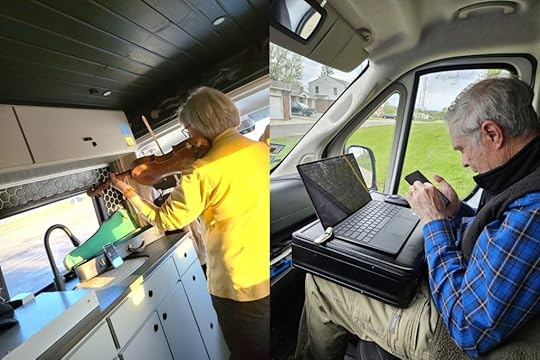
Some thirty years ago I read a commentary by a well-known musician (I have forgotten who), who said that any art, to be worth its salt, must be political in nature because it is only in political conversation that we really make a difference in life. I didn’t agree back then, and I still don’t agree.
For me, art should be personal and any ancillary political aspects should emerge from that personal engagement. Political issues arise out of the moral and ethical choice of millions of individuals, and so it is personal morality that lies at the root of all politics, not the other way around. It is in addressing personal morality and ethics that any hope for healing of political oppression or conflict must lie. Who really thinks, in this era of political polarization and ideological entrenchment, that we need more attention on the politics of our angry people group and less on the examination of our own soul?
I try to argue for the importance of the personal over political in the introduction to my SF short story collection that I plan to publish in February 2026, Mindful Science Fiction. In the Introduction for that book, I make the following argument:
“Science fiction, to live up to its potential, should include less analytical exactness of technological innovation and more ethical and moral examination. Those ethics and morals, in turn, should transcend society-level issues like authoritarianism and social justice to include the individual morality and motivations on which meaningful society-level transformations must be founded.”
Now, I know what you’re thinking, that my recently-published SF novel The Arasmith Certainty Principle, has its share of political intrigue and commentary on the tyranny of leaders who think they know what’s best for everyone despite having limited ability to listen to them. But none of that story is based on current politics (I wrote the story some 25 years ago!). Rather (I would hope) the story is based on personal morality, ethics, and choices that transcend any particular political situation or time.
So, what elements of the personal most influence my writing? That is best illustrated by a few of my experiences over the past two months since my last posting, including my current journey to the funeral of my friend’s mom. Three things come to mind.
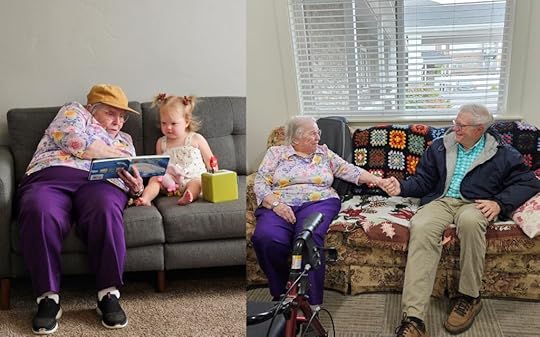
1: Life is all about relationships, and relationships transcend politics. Sure, you have your individual life, and the goals that you set, and the legacy and value you hope to leave behind when your existence in this world ends. But, it is in relationship, not merely independent existence and action, that that legacy and value gain meaning. A philosophical SF book that I read last month (Unfettered Journey by Gary Bengier), even concludes that relationship, in some way, underpins the very nature of existence and free will. Thus, my trip to a funeral for a dear friend’s mom ties me to real meaning, as does all of my campervan travels to see family with Mary, such as my visit with my 92-year-old mother and her great-granddaughter this past year. Can’t you see meaning simply radiating from the pictures below?
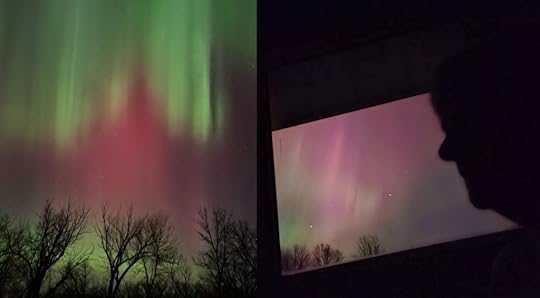
2) No life is full, or appropriately humble, without a pervasive sense of wonder at the astonishing existence in which we find ourselves. This week, up in NW Minnesota, an exceptional light show descended on us for two nights running. The “naked eye” reds in the northern lights were among the brightest that I’ve seen for quite a few years. Wonder at existence is also a type of relationship—with God and the natural universe. Check out the pictures below taken from our bedroom window!
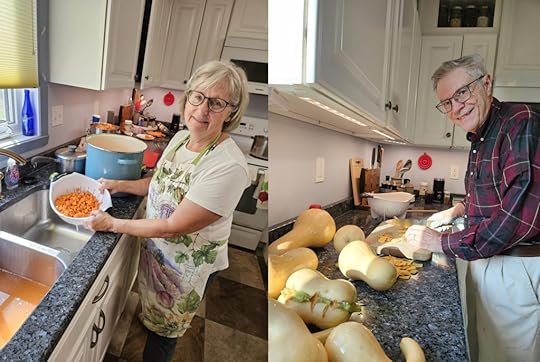
3) Finally, the joy and journey of life shared is an essential element to finding personal meaning and nurturing the soul. This fall, Mary and I put up lots of garden produce together, including carrots and a first try at canning squash, seen in the pictures below. The visceral experience of the outdoor garden, planting and watching things grow and putting food up for the winter, places us squarely in the adventure of life together, a relationship like no other, as I mention in my Little Book of Gardening in Northwest Minnesota!
So, should art and literature pursue first the personal or the political? For me, pointing out private political preferences for everyone who agrees to agree (gaining adoring fans?) and everyone else to dismiss feels less significant than pursuing personal growth. Recognize that it is in personal growth of many individuals that we can find the foundation for a good political system, and that all politics, in the end, is about relationship with all other people. That is a type of personal that both encompasses and subsumes the political!
The post Life Adventures: Personal or Political? (with pictures!) appeared first on Road Writer Blogs.
September 5, 2025
A Creative’s Capitulation to Generative AI, or How I Became Darth Vader
I may be turning to the dark side.
Let me explain.
Generative AI has exploded into our world, and, as a writer and philosopher, I have significant concern about how it will impact my creative contributions. I work hard at my writing, including short stories, novels, and essays, grappling with wording, flow, and content. The whole point of writing is that the ideas are my gift to the world, the words are mine, even the connection from one thought to another is mine. I DO NOT WANT my thoughts contaminated by an AI, because it is my thoughts, not AI thoughts, that I have to give away!
I even reject the use of MSWord grammar check when writing my novels, and will no-doubt ignore the corrections suggested by my host server’s AIs concerning this very post (yes, I know it is coming) telling me that my sentences are too long (80% of your sentences contain more than 25 words, which is more than the recommended 25%), that my paragraphs and topical segments are likewise too long, and that my key phrase is not repeated sufficiently frequently or evenly throughout my essay. No doubt I’m turning away readers right and left, but, by golly, the words and style are mine (and you can know they are not AI because AI don’t make those mistakes!)
However, it takes me a year to write and edit a novel.
What if an AI can do it in minutes, and, because it’s been trained on the most popular and successful stories of all time, it will do a better job, or at least a job that far more people prefer?
Now extend that to art, music, science, and basically all creative innovation. Humans can just sit around on the beach drinking Piña Coladas (non-alcoholic of course), and living the good life, right?
I would hate such a world even if humanity were able to solve the problem of wealth distribution that such a world would create. I want to have creative input into my world, and generative AI has the potential to make that unneeded. That terrifies me.
We aren’t there yet. Right now, you have to nurture the AI along, tell it what you want and help it focus when it goes in the wrong direction. But for how long?
A Hugo winner at the Seattle Worldcon that I just attended commented that her field of book cover art is undergoing existential terror. Yeah.
But, at the same time, my niece, an artist well known in the fanfiction community, tells me that she likes AI for its potential to extend and expand her artistic abilities.
So, will generative AI increase or decrease human creativity?
The answer to the question, of course, is ‘yes.’ Generative AI will decrease (usurp?) human creativity in some areas, but make new opportunities in other areas (true at least for the current state of AI capability). But will the new areas outweigh the loss of the old? I don’t know.
Turning to the Dark SideSo, given all of my reservations, why in the world would such a noble Jedi as me turn to the dark side?
Because, I have just discovered that generative AI allows me to create art, and better art, than I would be able to otherwise do. I have always created my own book covers for my self-published “contemplative writings” work (Ordinary Man Books). Mostly I use my own photos, and the covers are fairly simple. Recently, I began work on the covers for a couple of contemplative short story collections and realized that my vision for creating scenes from my own stories exceeded my artistic abilities. So, I played around with Adobe Firefly, combined with some other image editing tools, just to see what I could do. It allowed me to implement my artistic vision when I would not have been able to do so otherwise. I really liked the result! Suddenly, with a little help from Firefly, I can imagine scenes from my stories and bring them to life!
I haven’t decided yet whether to use my book cover efforts or not. Although I really like the result, I’m an amateur at book cover design, so what would I know? Also, AI cover art Is held in very low esteem in the science fiction community, and, although Firefly was trained on licensed and paid-for artwork (unlike some generative AI trained on work without permission), and my effort deprives no artist of work since I was going to create my own covers regardless, the negative attitude in the SF community doesn’t really take any of that into account.
I have other reasons for hesitation. Yeah, maybe I’m ok with allowing generative AI to help me implement a vision for a piece of artwork that I lack the artistic skill to otherwise create. However, I can imagine that someone else might feel the same way about writing—that they have a vision for a story but not the writing chops to implement that vision and AI can help them. I’m quite uncomfortable with AI input into writing.
The message of a story is carried in the writing, not just an overall vision. It is through the writing itself that I communicate with the reader. My contribution to writing is in the line-by-line way that I tie ideas, characters, and philosophies together, making it truly my step-by-step thoughts, not merely some grand vision of a story. I don’t want my writing polluted by AI and, what’s more, I don’t want to read stuff that is coming from an AI that has simply been trained (perhaps without compensation to creators) on all the writing that came before it! Even if technically very skilled at writing, an AI is still just a machine, regurgitating, in some way, what it’s been fed.
But wait! Although it’s true that an AI bases its creative generation on work that came before it, that’s no different from me! As I ponder how to write an acknowledgement for a novel, I realize that my own contribution is not solely my own but is influenced by every book I’ve ever read and every person whose life has crossed mine, including parents, siblings, teachers, friends, colleagues. Even strangers.
So I, too, have learned from both the masters and the common folks who came before me.
Out of the BottleThe AI genie is out of the bottle. We can’t go back, however much this old-codger heart might want to. But I think we should be very careful and thoughtful in going forward, and not simply be driven by the economic need to move faster than the other giant tech companies. Such reckless progress could be both dangerous and unjust.
However, the economic drivers of AI advancement are also out of the bottle, aren’t they?
The post A Creative’s Capitulation to Generative AI, or How I Became Darth Vader appeared first on Road Writer Blogs.
August 10, 2025
40th Anniversary Adventures in the Campervan!
Mary and I are off on another adventure, this one for our 40th anniversary together! Our primary objective is to explore the Channeled Scablands, a spectacular geology feature of Washington State formed when a glacial ice dam broke in Montana and spilled a million billion gallons of water across the landscape of Washington toward the Pacific Ocean. After that, we plan to head on to the World Science Fiction Convention in Seattle. However, while enroute, we’ve also stumbled upon a few other wonders, like the wind-formed loess hills of the Palouse, gold with wheat ready for harvest!
Mary and I have shared so many adventures over 40 years together, canoeing, hiking, bicycling, camping, raising a family, writing books, gardening, doing research, and of course puzzling over every mysterious geology feature we came across in our travels, whether in Washington, Ireland, France or even in our own home state of Minnesota.
What a romance!
Some people seem to think (in fiction at least) that “romance” is code for sexual activity. How limiting! In my marriage, and also in my fictional stories, “romance” is code for shared adventure! That is why Mary’s and my current adventures together have inspired a breakthrough in my efforts to chart-out book three of my Quelly Clary science fiction adventure series. Falling in love is not enough for a romance. Anyone can fall in love anywhere, anytime. But true love grows from shared adventures with puzzles to solve, dangers to face, and stories of life to share! My heroes, Quelly and Barry (“Barn”) McAdams, will find all of that together as they journey across the forsaken landscape of future Earth, pursued by the alien gods trying to kill them before they can transform human destiny forever!
But, let’s get back to my current romance of 40 years, the ongoing adventure of life shared with my one true love! What are some of our adventures in the Channeled Scablands of Washington and do they stand up the spectacular tales of 40 years together? Of course! We found canyons in the middle of the wheat-covered Palouse hills, a waterfall in a basalt amphitheater, another truly gigantic waterfall with the water long vanished, river potholes of unimaginable size, caves cut in basalt by ancient turbulence, current ripples thirty feet tall, and much more! Check out the pictures below!
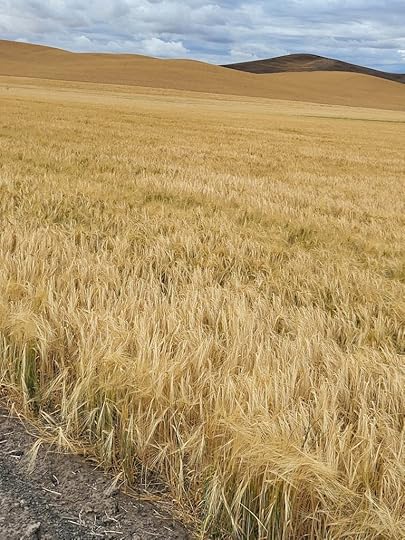
Above: Fields of wheat ready for harvest have painted the hills gold just east of the Channeled Scablands.
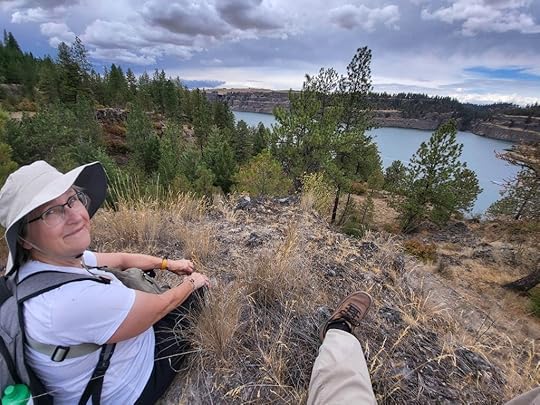
Above: Mary on our 6-mile hike to Rock Lake in the Cheney-Palouse tract on the Eastern Edge of the Channeled Scablands of Washington. This lake is in a deep channel carved by the raging floodwaters that formed when Glacial Lake Missoula spilled out of Montana, crossed Idaho, and headed across Washington toward the Pacific Ocean.
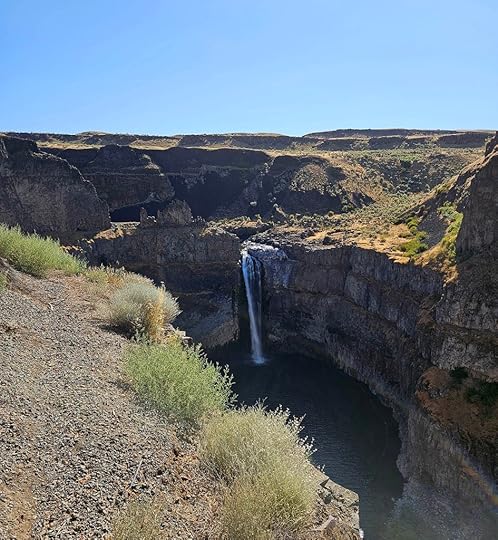
Above: Palouse Falls, one of the former channels of the great ice age floods that tore across much of Washington, now host to just a tiny little stream!
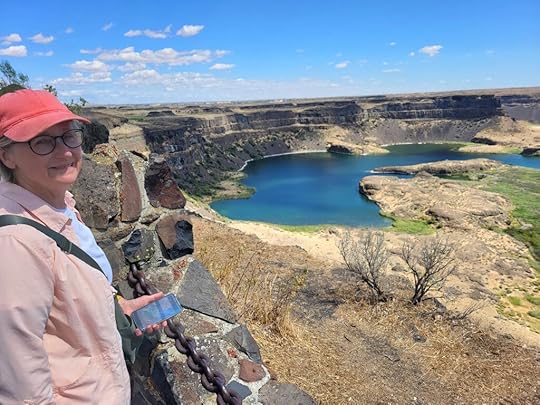
Above: Mary at Dry Falls, once one of the greatest waterfalls on Earth when the glacial dam in Montana broke and the entire contents of Glacial Lake Missoula spilled westward toward the Pacific Ocean in torrents that towered hundreds of feet above the top of the modern waterfall scarp!
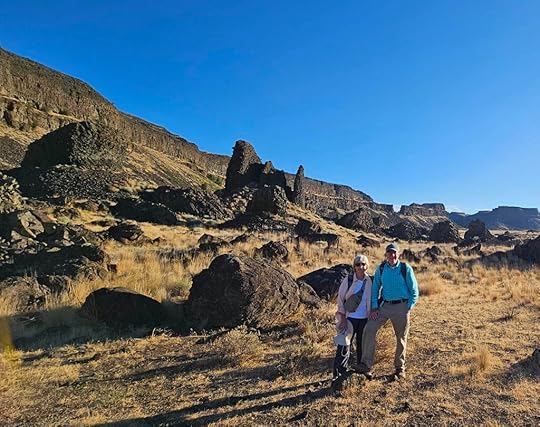
Above: Mary and Russ in a science fiction landscape left by the raging torrent of the ice age floods as they tore across the landscape on the way to the sea.
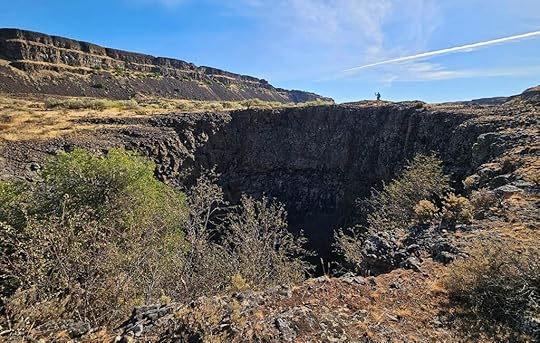
Above: Russ at a Mega Pothole, carved by “tornadoes” of water (kolks) formed in the channel of the ice age floodwater that ripped the basalt columns out like matchsticks!
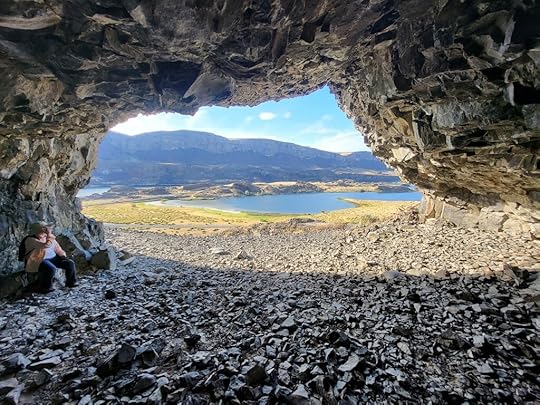
Above: Mary in a basalt cave formed as the torrent of water plucked rock from the walls surrounding the Grand Coulee. I (Russ) once told a student who claimed to have seen a non-lava-tube basalt cave, that “no, I don’t know how a cave would form in basalt without it being a lava tube.” What I didn’t know!–it only takes a few unimaginably giant ice age megafloods!
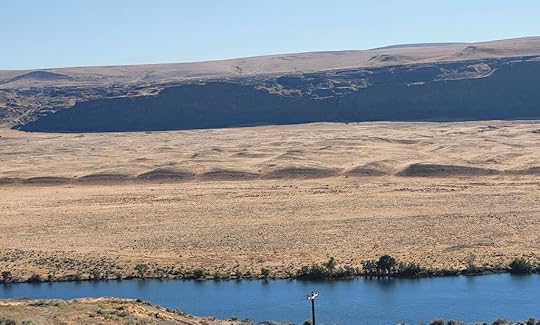
Above: Giant Mega Ripples, formed when vast mountains of floodwater poured over them on its way to the Pacific Ocean (pictures is a bit fuzzy due to distance, but with temperatures in the shade reaching 100 degrees, we decided not to get closer!)
Learn more at Ice Age Floods’ Geologist|Bruce Bjornstad!
The post 40th Anniversary Adventures in the Campervan! appeared first on Road Writer Blogs.
July 12, 2025
Wishing for Something to Give Away
There is always some impetus that drives or beckons a person to do what they do. For some people, that might be hunger, literal or metaphorical. For others it might be attention, or influence, or power. For some, perhaps wealth or comfort of living.
Me? I have always hoped to give something away that others truly want. Sadly, I am quite awful at giving gifts. However, I’ve tried to give other things. I spent my life as a professor trying to give away understanding of the nature of our world (some of my students might have wanted it!). I wrote (and still write) science fiction stories that I hope can bring joy or insight or wonder. Sadly, so far, it isn’t clear anyone wants them! My daughter tells me that it doesn’t matter if you sell your work for a lot of money, but rather if even one person reads and enjoys it, that counts. I agree. Her words sound like my uncle from some three decades earlier. He had spent his life trying to break into the country music industry, without success. In the end, he said “When I was young, I was terrified someone would steal my music. Later on, I just wished that someone would.”
Yeah, having just one person who truly wants my stories might be enough. The problem is, in the modern world where getting attention is the primary currency of life, if a story gets no traction, then that small fraction of people who might truly want to read it won’t ever even know that it exists. Even my grandchildren probably won’t read it unless it rises higher in their attention!
As I emerged from thoracic surgery after a cancer scare a couple of years ago, I realized that I would like to have something more tangible than stories to give my grandchildren. Not just money or stuff, but something with meaning. Like the beautiful wedding quilts with embroidered birds that my grandmother made for my brother and I with her own hands.
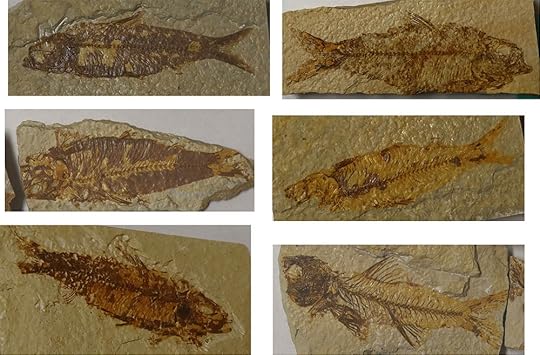
I came upon the idea of putting together sets of rocks and fossils, along with notes about the stories that each tells of the earth. I built six equivalent sets (optimistically preparing for grandchildren not yet born!), choosing mostly hand-sized samples rather than the tiny kiddie-set samples you can buy online or at stores. Samples ranged from quartz crystals that I collected in Arkansas on my first geology field trip as an undergraduate at the University of Kansas to dinosaur bones that Mary and I collected on a joint research project at a Cretaceous bone bed in South Dakota. We added a few items like trilobites on recent campervan trips and had to pick up some samples I’d left back at my old home place in Kansas (another campervan trip in July of 2024). I bought forty-two satchels in six different colors to hold the sets, reserving one last spot in each of the collections for a fossil fish from the world-famous Green River Formation—a fossil that I had never collected but had always longed to.
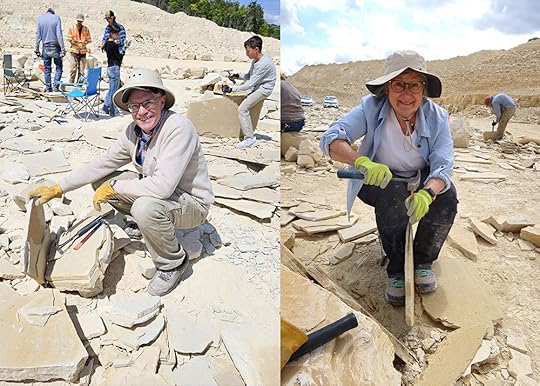
Thus, this past June, Mary and I stopped in southwest Wyoming near Kemmerer on a campervan trip to visit with family in Utah and paid real money for the privilege of breaking rocks with hammers for eight hours in the hot sun! It’s such a delight when a rock splits open to reveal a fish that lived millions of years ago that no human eye has ever seen!
We had to get six fossils of course, for the six sets, and I think we got samples that were reasonably equivalent. Here they are!
The post Wishing for Something to Give Away appeared first on Road Writer Blogs.
May 27, 2025
Time in Minnesota
Isn’t time interesting? We don’t really know what time is or where it comes from, but, as we grow older, we start to feel its irreversibility. What’s more, we humans love to write and read stories that play with time, perhaps more commonly than any other science-fictiony idea.
Mary and I encountered time on our maiden 2025 campervan voyage over Memorial weekend. We first traveled south to the Cleveland area to visit with dear friends of some decades back. They were perhaps our first close friends when we moved to Minnesota over thirty years ago. We were all young together back in those days. We explored ideas, faith, and life together. When we got together again, it felt like we stepped back into that friendship. Of course, we first had to share with each other the passing of the years: the children who have grown up and begun their own lives, the careers that have bloomed, and faded, and bloomed again, the joys and the challenges.
Time is so full of life and remembrance.
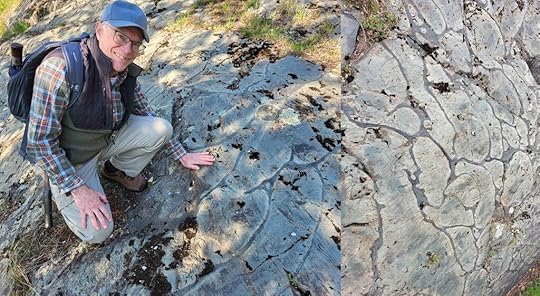
Then we headed into northern Minnesota to prep for a science teacher workshop we plan to offer in July. We stopped at an outcrop in Gilbert MN to look at a world-famous pillow basalt flow (ok, so only world-famous to geologists). Check it out in the picture. The black lines around the pillows are the formerly-glassy areas where the emerging lava froze in contact with the deep ocean water.
Whoa! Volcanoes erupting deep beneath an ocean…in Minnesota? What wonders time has wrought!
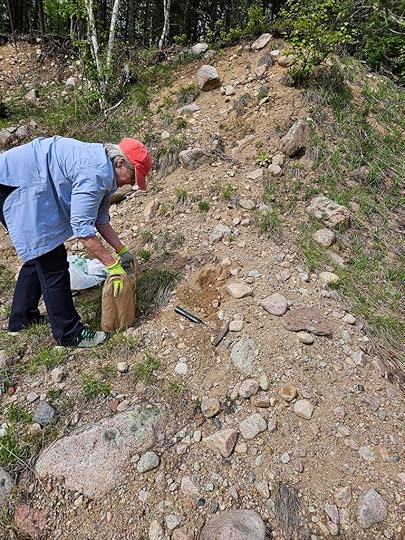
Later, we stopped at a borrow pit and checked out the glacial sediments (see picture), telling us that mountains of ice had replaced the former ocean at some point in the past. And in-between those two points in time lay iron deposits that could only form in a world with limited oxygen, mountain ranges that rose and eroded away, vast sand plains traversed by winding rivers, a continental rift that featured new volcanoes (not under an ocean this time), the coming and going of more oceans including a final sea that crept into Minnesota during the age of the dinosaurs.
Such a span of time seems greater than the little human brain can comprehend. The Grand Canyon, famous for its stories of vast time, records just a portion of the time that can be read in the rocks of Minnesota.
Time is so humbling and majestic.
While we’ve travelled, I’ve been working through editorial revisions for my novel in progress, A People Joined Asunder. My protagonist, a self-taught geologist, is trying to figure out the meaning of mysterious stratigraphic records on board a vast ship that may hold the key to surviving a coming alien attack. Perhaps those records also hold the secret to the meaning of time.
Isn’t time interesting? Thousands of science fiction stories on time, and I still want to read (and write) more. That’s because we still don’t know what time is or where it comes from, and we marvel at how it transforms us and our world.
If you really love time and geology, you can check out some of my online ‘field trips’ through Minnesota geology (for science teachers and others) at Selected Geology Stories from Minnesota-Part 1 and Selected Geology Stories from Minnesota-Part 2.
The post Time in Minnesota appeared first on Road Writer Blogs.
May 18, 2025
Even More on Finding Truth in a Post-Truth World: Spiritual Truth
In reading my series on finding Truth in a post-truth world, you might think, Wait! What about spiritual truth? All your essays seem to address scientific evidence and reasoning, but isn’t spiritual truth more about revelation and faith than evidence?
Well, some might think so, but I am not convinced. I can’t speak to the evidential foundation for other faiths, but for my own Christian faith, scripture is full of the ideas of testing and reasoning. I argue that blind belief is not faith at all, and, in fact, has been the source of much darkness and evil in the history of faith. No, true faith has been tested and made subject to reasoning. As the book of Hebrews states, faith is the substance of things hoped for and the evidence of things not seen. The Greek word translated as ‘substance’ means to set under or support. The Greek word translated as ‘evidence’ means proof or evidence. Reasoned evidence and supporting substance are the foundations of scientific investigation, making faith not unlike science in this way, and much more than simply the belief in things hoped for or not seen!
To have true faith, we must have substantive evidence that persuades us. Paul the Apostle speaks often of being persuaded (not simply told or inspired). In 2Ti 1:22 he is persuaded (Greek=convinced by argument) that Christ is able to keep that which has been committed to Him. In Ro 8:38 he is persuaded that nothing can keep us from the love of God. In Rom 14:14 he is persuaded that nothing is unclean of itself. Repeatedly in Christian scriptures we are admonished to test ideas (not just accept, believe, or trust). 1 John 4:1 says to not believe every breath of air, but to “test the spirits whether they are from God.” 1 Thessalonians 5:21 says to “test all things and hold on to what is good.” And again, in Deuteronomy 18:22, “If what a prophet proclaims in the name of the Lord does not take place or come true, that is a message the Lord has not spoken.” Testing and comparing claims to observable reality are the foundations for investigative thought, not unlike scientific investigation, making faith and science far better aligned than some people might think.
Consider the odd phrasing of I Corinthians 8:20, which might be taken to mean that our search for spiritual truth should be ongoing and open to new understanding, not unlike the approach to truth in science. The passage reads “Whoever knows anything knows nothing yet as he ought to know it.” What can this contradictory statement mean but that we should not remain complacent in the presumption that we already know something but rather continue to pursue better understanding through ongoing investigation and thought?
Finally, let’s consider the famous “armor of God” passages in Ephesian chapter 6, metaphorically speaking of our spiritual walk as a battle against forces of darkness. Isn’t it interesting that the only offensive weapon cited, a sword of the spirit, is identified as the Word of God, perhaps suggesting that our approach to battle against evil in the world should be viewed as more like persuasion than physical conquest?
You might have anticipated that this essay would explore my own ‘reasons to believe’ in my pursuit of spiritual truth. Many people over the ages have offered their version of ‘proof’ of their spiritual beliefs, creating an entire field of theology with its own name: apologetics. I have, indeed, thought about these things, although I’m not going to share my own internal arguments here. I do want to suggest to you that faith must be tested to be true faith, and that evidence and reasoning are as important in our walk of faith as in our walk of science. Untested beliefs become little more than wishful thinking (and sometimes dangerous or destructive wishful thinking at that) and are no different from any of the other “fake news” of our post-truth society. A need to test beliefs, in both science and faith, means that “truth” is something deeper, and more permanent, than simply the belief of the majority, a factor easily manipulated by wishful thinking, favored propaganda, or authoritative edict.
The post Even More on Finding Truth in a Post-Truth World: Spiritual Truth appeared first on Road Writer Blogs.
April 18, 2025
Evolution, Social Media, and the Fruit of the Spirit
Fruit of the spirit includes behaviors like patience, kindness, gentleness, and self-control. That sure makes one think about social media and politics, right?
Not.
The survival-of-the-fittest search for attention and influence on social media, or in politics, is a microcosm of evolution. Those who rise above a certain threshold win the day, winner take all. Quite like the survival of the fittest in biological evolution—those who can secure the resources and overcome their adversaries win. The rest, well, we can still dig up their fossils.
In social media, and the political world, we like to attach ourselves to powerful people, the gobblers-of-resources, the bullies, hoping we can survive and thrive with them. In such a harsh and competitive environment, can the social media world ever evolve to become more sedate, contemplative, and kind?
Maybe.
Below I offer an edited snippet from my Work in Progress (WIP), A Little Book of Becoming, a reflection on how science informs my faith. Maybe you can find in it some hope. Or perhaps, more likely, a warning.
____________________
Scripture speaks well of characteristics that seem contrary to that which would maximize the survival chances of the individual, saying for example that strength is made perfect in weakness, that the meek shall inherit the earth, that we should turn the other cheek and offer kindness and hospitality to strangers. It claims that there is no law against love, joy, peace, patience, kindness, goodness, faithfulness, gentleness, and self-control. It offers core ideals of purity, peace-lovingness, consideration, submissiveness, mercy, and good fruits. It encourages us to be impartial, sincere, compassionate, kind, humble, gentle, patient, long suffering, and slow to anger…
Yet, the testimony of science would seem to be quite different. It is the strong, the self-interested, that are most fit to survive. The weak, the meek, even the unfortunate victim of chance calamity, has no opportunity to pass on thoughts or genes…
How can these be reconciled?
Take note that self-interest does not equal selfishness. Selfishness begins when self-interest overrides the interest of the larger purpose or entity. When one acts without concern for—or equal valuing of—others, that becomes selfish…In both civil and moral law, it is clearly seen that we already possess the nascent ideals of selflessness, but they are easily tipped over when we are greedy (valuing our own prosperity more than that of others) or when we are afraid (perceiving the ‘other’ as an enemy). Then, we will torment those in our power, take for ourselves what we want at the expense of others, and empower monsters to lead us so as to gain what we want without personal guilt.
Seeing, then, that the impetus of short-term evolution favors the selfish, and that our nascent ideals are easily overrun, how can we avoid the problem that selfish interest can be chosen by natural selection, at least in the short term, at the expense of the meek and selfless?
The answer might be time. Even science reveals that in the longer term there is survival advantage to becoming altruistic, otherwise how can we explain the existence of altruism in ourselves or other creatures? Consider, for example, the ants who often act almost without self-concern in defense of their hill, or who offer their bodies as a bridge for the colony across a torrent even if they themselves are lost. Also, we see that many humans, although not all, routinely act with kindness to strangers, fight for the downtrodden, and provide help for the poor.
So, a trend toward altruism is seen in the nature of our world, but it requires the passage of time to overcome the short-term benefits of selfishness…We stand now at the threshold of transformative becoming and soon will have the power to edit who we become through manipulation of genes and introduction of technologies. This puts our becoming centered in the arena of ideas and choice since we will have to decide, collectively, what we become…
_____________________
As suggested in my snippet above, maybe the history of biological evolution offers a possible template for ultimate victory of contemplation and kindness. Natural selection has, over vast times, sometimes selected the submissive altruistic over the powerful bully. My daughter commented recently that generosity of spirit and acceptance of diversity is one of the greatest of human traits, providing a kinder, gentler life, a greater chance of group survival, and the irony that it is tolerance for diversity that allows the oppressors and bullies to survive at all!
Let’s hope and plan so that the core of kind gentleness can survive our tolerance for the lack of it, and that our choices going forward are wise ones.
The post Evolution, Social Media, and the Fruit of the Spirit appeared first on Road Writer Blogs.
March 15, 2025
Science Fiction and the RoadWriter Life, Part 2: Abandoned barge canals and lost civilizations
What stirs reader imagination or exploratory longings more than a good adventure story about a lost civilization?! Your starship lands on a primitive world where you discover mysterious structures half buried in the jungle that hint at forgotten technological prowess. (Star Trek, anyone?). Floating down the river on your noble quest, your fellowship of travelers passes through a portal guarded by towering statues of forgotten beings —what lies beyond? (Lord of the Rings, anyone)? As you pursue your doctorate in geology, your excavations uncover what looks like a giant spaceship imbedded for untold years in solid rock—what does it mean? (Babylon Five, anyone)?
Whoa! That’s the kind of story I want to read!
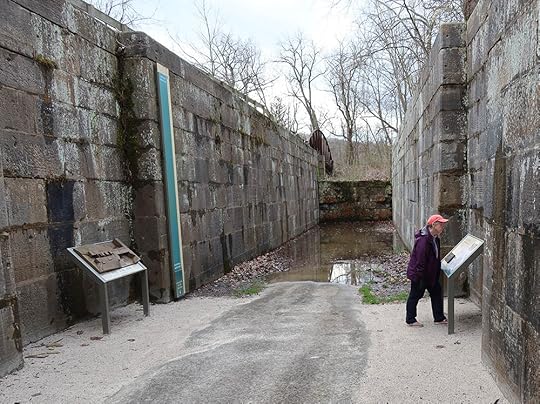
If I want to write stories like that, I need to engage in that kind of discovery! While travelling in our campervan toward Erie Pennsylvania to visit family and watch the total solar eclipse (my second) last spring, Mary and I stumbled upon a wonderful camping spot in Cuyahoga Valley National Park. When we awoke the next morning, we took some of the trails through the surrounding woods, and found decayed locks for the Ohio and Erie Canalway (picture above) built a hundred years before, as well as the remnants of the canal along the old Towpath, now-abandoned and emerging from the moss and leaves like the statues of ancient beings, telling of ways of life, and mighty deeds, from another time.
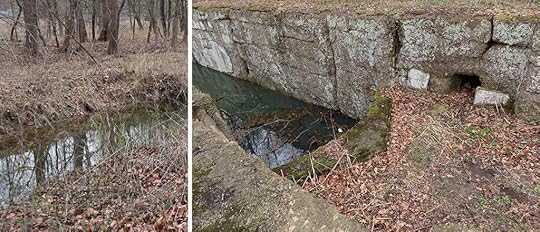 Tow Path features of the Abandoned Ohio and Erie Barge Canal
How did they build it with such precision so as to maintain proper water flow for hundreds of miles through the forest? How did they manage to circumvent the waterfalls and cataracts along the river? How did they do it with only horses and humans? Mysterious, inspiring, imagination-stirring!
To write the unexpected, I have to be out in the world, hunting for the unexpected! What a delightful discovery for this plains-boy, to find, unexpectedly, such evidence of past achievement half hidden in the forest “back east”.
Be sure to check out Science Fiction and the RoadWriter Life, Part 1: Finding Trilobites.
The post Science Fiction and the RoadWriter Life, Part 2: Abandoned barge canals and lost civilizations appeared first on Road Writer Blogs.
March 1, 2025
More Thoughts on Finding Truth: You have to actually want to find it!
Honestly looking for truth is nothing at all like honestly wanting to be right. Wanting to be right encourages people to shout loudly and try to undermine the credibility of others. It discourages reconsidering your thinking because that might mean that you were wrong. In contrast, looking for truth involves lots of watching and listening. And changing your mind.
A few years back I encountered a survey in the news that addressed a question for which there could be no supporting evidence, yet lots of people had opinions on it! Sadly, although I tucked this into my mind at the time as a watershed learning event for me, I failed to document the survey and so I’ve lost track of its details, but it was a subject for which it seemed clear to me that, not only were no data available, but there could be no data that bore on it. Yet 80% of respondents had firm opinions, about half one way and half another. Only twenty percent had no view. Twenty percent. That is the percentage of people, I realized, that were actually thinking about the question and not just choosing an answer that fit their political or cultural inclinations. Shortly after I read this survey, a bunch of studies came out (during COVID times) about how evidence does not sway people one way or another because they are too deeply entrenched in the views of their people groups (“tribes” they were called). Only changing their people group could change them, and so arguing from evidence is pointless. The message was, forget reasoning and evidence, you should be out there on social media trying to change the world through a tidal wave of cultural influence.
Aaaarghhhhh!
Argument and reason is the only superpower that I have! It’s what I devoted my career to doing and where my natural inclinations lie. And now you’re telling me that it is useless because evidence and reason have no power to persuade? What about science—isn’t it all about evidence and reasoning? And what about science fiction, which can support that link to evidence and reasoning as I argue in a previous blog: Assigning Blame for Public Science Skepticism.
Ok, maybe it’s true that the 80% are not swayed by evidence and reason. But what about that twenty percent who are actually thinking and looking for what is true? How can I talk to them?
More importantly, how can I become part of that group? Or maybe to state it better, how can I be part of that group a larger percentage of the time? Is that group out there pushing their views on social media? Or are they spending most of their time in silence so they can actually listen and think?
Hmmm. Perhaps I need to cut this blog short and go think about it for a while.
The post More Thoughts on Finding Truth: You have to actually want to find it! appeared first on Road Writer Blogs.
RoadWriter Blog

- Russ Colson's profile
- 5 followers
