Lenore Skomal's Blog
January 29, 2013
Welcome to synopsis hell
I’ve been playing with the back cover text of Third Willow on and off for the past two months. The cover is done, thanks to Mallory Rock, the world’s best book designer. (Scroll down to see the cover of Third Willow.)
Writing back cover text is tantamount to writing Shakespearean prose. Not only does it take real talent and a touch of brilliance to do it right, it also requires diligence; namely diligence over not relying on cliched or overused text. So much back cover text out there sounds the same.
The tricky part, for me anyway, is to walk the fine line between great writing and solid marketing. Often times, the back cover text (as well as synopsis that appears online at retail venues such as Amazon, Barnes and Noble and all of the other websites used to promote books) is all readers have to decide whether or not what’s in between the book covers is worth their time.
What many readers don’t know is that traditional publishers don’t require their authors to write back cover text much less supply them with marketing materials. Self-published authors and some independents have no other choice. There’s no one else to do it, unless you hire someone.
I used to hate that–primarily because all of the promotional materials including synopses and back cover blurbs for my books that I had published the conventional way were not done by me. BLUFF was the first book I had to actually write the back cover text for. And after many failed attempts and frustrating beatings on my computer mouse, I came up with the one you read today. And I’m damned proud of it.
I think it not only gives readers a sample of my writing style. It also effectively works as a marketing tool to sell the book.
Now I’m faced with the same challenge for Third Willow, my coming-of-age novel that comes out later this year. I took great care in writing this novel. Well, not that I didn’t with my first novel, but this one…well, it’s a delicate soul, unlike BLUFF, which is a survivor. I want everything having to do with Third Willow to be perfect. It has to have the best chance coming out into this world. And in order to ensure that, I need to take my time to create an engaging, authentic and touching synopsis.
So, here I sit, in synopsis hell until that happens. I’ll keep you posted.


December 11, 2012
Characters come alive in book clubs!
I love book clubs! Not just the one I belong to locally, but all those I get to entertain when I am asked to come discuss BLUFF.
I just came off of several book club talks, you know, where I show up and field questions about the intricate inner workings and plotting that went into writing BLUFF. And it’s absolutely mind blowing how these characters that came straight out of my mind are now real.
Not they haven’t always been real to me. Hell, I gave birth to them. But the simple fact that they are real to everyone else is tantamount to someone actually seeing the same ghosts I do. I love it. Much of the discussion–and there’s always lots of it–surround what is going to happen to the characters that everyone has come to either love or hate. Either way, they are engaged in their lives and have come to not just care about them, but to want to fix them. I heard that verb a lot over the course of the last few weeks. My readers have a lot of compassion–much more than I do–for the lives of those who come together to make up the storyline in BLUFF. Many of them–mostly women–want to help. And in the course of that discussion, they asked many questions about the facts that aren’t in the novel. Questions such as this: Didn’t Jude have anyone she could talk to as a child such as an adult or caring teacher who could have helped guide her?
Well, the simple answer is, I don’t rightly know. It’s a novel, and the way I wrote it, I wanted to leave a lot of areas unexplored so that readers could make their own conjecture, color the pasts of the characters the way they wanted to, and allow for their interpretation of that which went undefined. In allowing that, I was amazed to hear just how many different interpretations there are.
As tragic as Jude was/is, readers in general didn’t dislike her at the beginning of the book as I had predicted they would. Many truly felt sorry for her, to the point that they even forgave her before her character turned around in the second half of the book. Same is true with Mary Shannon. I continue to be floored by the number of readers who actually really liked her from the get-go. These were two characters that I could have sworn wouldn’t have a fan base.
But they do. And as I go forward with the sequel to BLUFF–title as of now still undetermined–I am reminded that I can’t neglect any of my characters and my readers. And I want to thank all the book clubs for keeping reading alive and well in this country.
December 10, 2012
Another great review from an independent book reviewer for BLUFF!
Please go to her website to read the whole post and to enter to win prizes!
Bluff by Lenore Skomal
December 10, 2012 By Tracy Riva
Bluff
By Lenore Skomal
Bluff by Lenore Skomal is not light reading. It is a deep. meaty, sink your teeth into and get you thinking kind of book – and it just might change some of your perspectives; It changed some of mine.
Jude Black is a gay woman who is pregnant. She takes a life-threatening fall off the bluff near her house. Was it an accident, a suicide or foul play? And how did Jude, who is far from thrilled at the thought of being pregnant get that way? Who is the baby’s father? And when does, or should, life end? These are all questions addressed by Bluff, and Skomal does a wonderful job of telling Jude’s story, as well as that of many of her characters.
I don’t think I have read a book as complex as this one or one that challenged what I thought to be true as much as this one did. From the moment I began the book I had to keep on reading. At times the tension was unbearable and the story is heartbreaking on so many different levels.
Skomal is a master of voice and characterization. Her story is peppered with real people you care about, not cardboard cut outs and they are so rich and so well-developed. Each character is rich and multi-faceted. Their stories are complex. Their challenges are real ones and Skomal’s talent in bringing this story together in such a realistic way is amazing.
Bluff tears at your heart and mind on some many levels. It is both an extremely intellectually story as well as an emotional story that deals with multiple societal and ethical issues that are woven effortlessly together in a seamless whole that will captivate you from the first pages. It is a stellar work of fiction and I highly recommend it.
This is part on my month-long blog tour. Check out each stop on Novel Publicity for the month of December!
For the full post, click here.
November 30, 2012
Characters come alive!
So I just came off of several book club talks, you know, where I show up and field questions about the intricate inner workings and plotting that went into writing BLUFF. And it’s absolutely mind blowing how these characters that came straight out of my mind are now real.
Not they haven’t always been real to me. Hell, I gave birth to them. But the simple fact that they are real to everyone else is tantamount to someone actually seeing the same ghosts I do. I love it. Much of the discussion–and there’s always lots of it–surround what is going to happen to the characters that everyone has come to either love or hate. Either way, they are engaged in their lives and have come to not just care about them, but to want to fix them. I heard that verb a lot over the course of the last few weeks. My readers have a lot of compassion–much more than I do–for the lives of those who come together to make up the storyline in BLUFF. Many of them–mostly women–want to help. And in the course of that discussion, they asked many questions about the facts that aren’t in the novel. Questions such as this: Didn’t Jude have anyone she could talk to as a child such as an adult or caring teacher who could have helped guide her?
Well, the simple answer is, I don’t rightly know. It’s a novel, and the way I wrote it, I wanted to leave a lot of areas unexplored so that readers could make their own conjecture, color the pasts of the characters the way they wanted to, and allow for their interpretation of that which went undefined. In allowing that, I was amazed to hear just how many different interpretations there are.
As tragic as Jude was/is, readers in general didn’t dislike her at the beginning of the book as I had predicted they would. Many truly felt sorry for her, to the point that they even forgave her before her character turned around in the second half of the book. Same is true with Mary Shannon. I continue to be floored by the number of readers who actually really liked her from the get-go. These were two characters that I could have sworn wouldn’t have a fan base.
But they do. And as I go forward with the sequel to BLUFF–title as of now still undetermined–I am reminded that I can’t neglect any of my characters and my readers.
November 19, 2012
Question and Answer with Laura Lee, author of Angel

Once in a while, I like to host other authors on my blog. Today, Laura Lee, author of Angel, a new novel, has stopped by. Here’s a description of her new book:
Since the loss of his wife to cancer six years before, minister Paul Tobit has been operating on autopilot, performing his church duties by rote. Everything changes the day he enters the church lobby and encounters a radiant, luminous being lit from behind, breathtakingly beautiful and glowing with life. An angel. For a moment Paul is so taken by his vision that he is tempted to fall on his knees and pray. Even after he regains his focus and realizes that he has only seen a flesh-and-blood young man, Paul cannot shake his sense of awe and wonder. He feels an instant and overwhelming attraction to the young man, which puzzles him even as it fills his thoughts and fires his feelings. Paul has no doubt that God has spoken to him through the vision and he must figure out what God is asking him to do. Thus begins a journey that will inspire Paul’s ministry, but will put him at odds with the church he loves as he is forced to examine his deeply held beliefs about himself, his community and the nature of love.
LS: What was your primary motivation in writing Angel?
Laura Lee: I wanted to write a good novel. I wanted to put all of my literary ability toward telling a story worth telling.
LS: You include a precede (epigram) at the beginning of each chapter, such as the one below. Please share your thoughts on why you chose to do that.
“I summited Mount Rainier.” Words are inadequate to the experience. All of the preparation, every single step, the times you think you can’t go on, the cold, the thin air—all that it means to accomplish that feat—it‟s lost to everyone but the individual who undertakes the journey.”
Laura Lee: Some people love the epigrams and some people hate them. I have no problem with anyone skipping over them. They don’t change the story. The novel Angel was inspired by Mount Rainier in Seattle. The mountain provides the spiritual center of the story. It was the image that I kept going back to in order to find the right feel for the events I was narrating. The mountain informed the story for me from the beginning and infuses every aspect of the story. It is the breath of the story. So I wanted it to remain a poetic presence. In the body of the narrative itself, however, I didn’t want to constantly refer to the mountain. Ian and Paul’s story is their story, not a metaphor. The epigrams at the beginning of the chapter, however, ask the reader to back up for a moment and view the intimate and personal events of the story in light of universal truths, the types of truths that are difficult to articulate, but which can be discovered and felt by contemplating nature. It asks the reader to connect the specific to something that is, like Mount Rainier, larger than the story and its characters.
LS: What actors would you choose to play the roles of Paul, Ian and Sara?
Laura Lee: I tend to prefer it when a movie is cast with excellent but not well known actors. When you see a famous face there is this recognition and associations with other roles to be overcome. I would love to see Sara cast by someone who was not conventionally beautiful or model-esque but who could exude a warm spirit. Hollywood tends to find it hard to cast like that. Ian could be played by a young actor-model. Physical beauty is important for his character. Ian has a bit of an androgynous quality to his looks (but not his behavior). So it would be important to preserve that. He is the kind of man who is always described as “pretty” not “handsome.” In the past I’ve said that I would cast Michael Emerson (Ben from “Lost”) as Paul. He is actually not quite the right age and doesn’t match the description I gave of Paul the book, but he has that everyman quality as well as emotional expressiveness. So he could do a good job with the part. I could see him doing a bang up job as an internally-conflicted minister.
LS: Explain from your perspective as the author the meaning behind Paul’s internal thought: “I’m not gay, but my boyfriend is.”
Laura Lee: Paul is not exclusively, or even primarily, oriented toward men. I left it a bit open as to what kinds of attractions he’s had in the past. There is one line about Paul having had a variety of sexual fantasies in the past. Some readers have taken that to mean Paul always had attractions for men. Maybe he even willfully ignored them. I find that most readers, though, tend to want to think of Paul has having been completely shocked and startled by his attraction to Ian.
My take on Paul (and you don’t have to agree with me just because I’m the author) is that he has probably “tried on” some homosexual fantasies in the past, in the abstract as a thought experiment. I don’t imagine him as ever having focused romantically or sexually on a particular man. The fantasies were never a big enough part of his psyche to make him question his identity as a straight man. I am sure a lot of straight men try on a gay fantasy from time to time and don’t think of themselves as being homosexual because of it. Paul didn’t feel driven to be with a man. Had he not had a mystical experience involving Ian he might never have examined this potential. Part of the reason that it is so important to us to pin down which “side” someone is on is that sexual orientation isn’t just a feeling or behavior but a social category. The other people in our community want to know how to define us.
We tend to have this “one drop” theory when it comes to sexual orientation. So once Paul became involved with Ian he, essentially, became gay. He must have been lying to himself about his attraction for his wife, or he is lying to himself about his attraction to Ian. You’re in love with a man, you’re gay. Period. Paul doesn’t feel as though his internal nature has changed at all. He did not become gay. He is still what he was before. Ian is oriented only toward men. He is a gay man. Paul is something else. We would probably call him bisexual, but Paul doesn’t feel that word does a good job of explaining the nuances of what he feels.
LS: There is an obvious lack of graphic sex scenes. Can you explain why you made that choice?
Laura Lee: To be honest, I think the sexual act is subjectively beautiful and objectively goofy. I described sexuality subjectively, in terms of how it made Paul feel, rather than objectively in terms of who touched who where because to me it is sexier. Adult readers know what goes on in bed. I have nothing against erotica, but turning readers on was not my purpose. I didn’t feel vivid sex would add much information in terms of understanding the character’s relationship. Beyond that, there is a perception among a lot of people that same-sex relationships are all about the sex. It was important to present them as fully sexual beings without focusing too much on the sex itself. I also wanted to be able to reach readers who might not be as comfortable with the idea of men being in love. I wouldn’t be too successful reaching those readers if I had pages and pages of hot man-on-minister action in the book. The focus of the story is on the spiritual and social dimensions of their relationship, not on their bedroom antics. Unfortunately, the book consistently gets labeled as “erotica” anyway. It bothers me to see it labeled that way. It is misleading and false.
LS: What is your interpretation of the mountain analogy that you use repeatedly in the epigrams?
Laura Lee: The mountain was an image that I could go back to as I was writing. It helps me to have some kind of image or concept. So when I am a little bit stalled, I can go back and do some writing that has nothing to do with the plot. I think “how does this relate to the mountain?” I write about the mountain until it brings me back to the characters. Almost none of that writing ended up in the final book.
The mountain symbolizes the church and is tied into an internal church debate about whether or not to repair a crumbling steeple. The steeple is a man-made mountain, designed to remind us of our smallness and humility in relation to divine forces. It is also a symbol of natural forces that are of a scope that does not allow them be controlled through human will (as is the attraction the character Paul feels toward Ian). The mountain also symbolizes the relationship of the protagonists. I consciously thought of Ian and Paul as being like the mountain, where heaven and earth meet, so Ian is earthy and Paul has his head a bit in the clouds. This shaped the characters and what makes them compatible.
The mountain symbolizes beauty and the fear that sometimes accompanies our experience of beauty as well as the inevitability of loss that beauty implies (a New Year’s Eve scene discusses that idea of beauty and loss). As Paul discovers his attraction to Ian’s natural beauty, he is forced to face his fears. And like the dormant volcano that is Mount Rainier, the relationship has the potential to be destructive in the future.
The cycle of destruction and renewal that a volcano represents also ties into a theme of resurrection that is a subtext of the novel. It comes into the novel through Paul’s discussion of the mass with Ian, Ian’s participation in communion, and the new life direction that each finds through his relation to the other. (At the cost of the death of a previous way of existence.)
Finally, a volcano, so seemingly solid, is a reminder that everything beautiful is transitory and therefore we should remember to cherish it. That is what the mountain symbol meant to me.
LS: Did Paul really love Ian and vice versa? Or did they just fill certain needs in their lives?
Laura Lee: I don’t really know how to answer that because I don’t know that there is this one objective thing called “love” that you can measure emotions against. What does anyone mean by that word? Big “L” love usually involves some element of sexual desire, but you can have sexual desire without love. You can also have romantic love without sex. Paul and Ian loved each other as friends but there is something about consenting to be lovers that transforms that into romantic love. People who are married have moments when they wonder why they are together. Is deciding to go through those times and remain together the definition of love? If it is, if the couple breaks up, does it mean they were never really “in love” to begin with? Are anyone’s motivations for being with another person ever that clear or unambiguous? No one’s love lives up to the Platonic ideal. Every love is made up of individual moments of being drawn to each other, confused by each other, annoyed by each other. Mutually agreeing to fill one another’s needs is probably not a bad definition for love. Do they do this perfectly? Of course not, but what human being does? I would say that permanence is not necessary for something to be called love. No love is really permanent because no life is permanent. The way to get a love story with a happy ending is to stop narrating at a point of happiness.
LS: Are you planning a sequel?
Laura Lee: I’ve written a sequel, as it happens. Angel was written over ten years, the sequel has taken about three. I haven’t decided whether or not to publish it.
You can purchase Angel here.
Curious about Laura Lee? Here’s how she describes herself:
“I’m getting tired of my biographical blurb that appears everywhere.
I’m mostly known for my non-fiction such as Broke is Beautiful and The Pocket Encyclopedia of Aggravation.
The novel that I am hoping will be my next also has a Seattle connection, and I’m not sure why this is as I grew up mostly in the Detroit area.
I began my career working in radio. I always wanted to get a job at an alternative rock station but I was on the air at oldies, light rock and country stations.
I have a degree in theater and thought I wanted to be an actress.
As a speech writer I have written for high level international politicians and I have also worked as a professional mime and shopping mall Easter Bunny.
I divide my time between writing and touring the U.S. with a Russian ballet dancer to teach classical ballet technique to American kids. This keeps me on the road half the year.
I’m still waiting for my financial ship to come in.”
Find out more about this honest, fun author, click here.
November 18, 2012
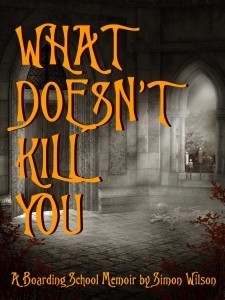
Meet Simon Wilson, author of “What doesn’t kill you”
Tell us about your first love
by Simon Wilson
My years at preparatory school from the age of eight until thirteen were fraught with love problems from the moment I realised at eleven that there was more to girls than just pulling their hair.
My first foray into dating the opposite sex began when I sat opposite Heather Wilcox in the forth form. She had shortish black hair and the brownest eyes I’d ever seen. Even in the drab greys that were our school uniform she exuded an energy that captivated me. I wasn’t sure why it hadn’t been there last term or exactly what this new quality was – but it was there now and I couldn’t take my eyes off her.
I’ve never been great at making first moves and given that this was my first first move, so to speak, it was weeks before I acted upon it. In the meantime I carried out as much research as possible in order to better my chances of success. In reality the research consisted of asking my best friend Mike Bradshaw over and over again ‘Should I ask her?’ I’m surprised we remained friends, the amount of mental pain I must have put him through. But it was so important and I had to get the initial approach just right. After asking a few of the more experienced ‘older boys’ in the years above me and getting nothing but ridicule and chubbies (pinched cheeks until your skin turned blue) I elected to write Heather a letter.
Now this letter had to be perfect and after a week or more of screwing up paper and starting again, I had it down to a ‘t’. It read:
Dear Heather,
I love you.
Simon XXXXXXX
I kept it in my pocket for another three days before I summoned the courage to finally give it to her. Well not exactly, I summoned up the courage to give it to Bradshaw to give it to her. Almost the same! The handing over of the letter had to happen whilst I was out of sight and so I hid myself in my dormitory and waited. An hour later the ever reliable Bradshaw brought me a perfumed letter with Heather’s response. My heart was beating like on a Christmas morning before opening my first present. It read:
Dear Simon,
I love you too.
Heather XXXXXXX
We were an item. Perhaps we’d marry, I didn’t know. It was early days. I couldn’t have felt better. My life was perfect. As I read the letter over and over, Bradshaw walked off in disgust. He didn’t understand.
For three days Heather and I could not be parted. We were in love, and although I couldn’t yet find the courage to attempt to kiss her, I was confident that in the next few weeks or at least by next term, I would be ready to take that leap.
Unfortunately, James Nelson, of the fifth form had no such problems in kissing her and being a year older also came with the added cool that I could not provide. The letter read:
Dear Simon,
It’s over.
Heather.
I cried a bit – make that a lot. She was my first love and I’ll never forget her.
Buy Now @ Amazon
Genre – Memoir
Rating – PG
More details about the book
Connect with Simon Wilson on Facebook
November 5, 2012
Writing the sequel to BLUFF
And this is the month to do it. November is also known as National Novel Writing Month, and to accomplish that goal, many authors, old and new, young and weathered are accomplishing the task. There’s even a website devoted to it.
For veterans like me, it gives a permanent deadline and motivation to get that rough draft down on paper. While I have worked on and off on the sequel to BLUFF, title not to be revealed yet, I have not really gotten past the 14,000 word mark. I keep changing and editing–something that can be suicide for a novelist.
When I realized that NaNoWriMo was coming up, I jumped on the chance to sign up, knowing that it would give me something that I respond to well in the way of motivation: a deadline. The former journalist in me just can’t resist meeting a challenging deadline. And meeting it well.
Of course, now that it’s Day Five, I am cringing at that last sentence. I am only 700 words toward meeting the 50,000 word requirement, thanks to prior social plans that virtually ate up the weekend. And my usual sporadic sleeping patterns, which would have normally aided me in this writing endeavor by giving me hours of open time in the wee hours of the morning, also failed me. I’ve been sleeping through the night. Drat!
But today is a new day. And one of the beauties of NaNoWriMo is that you can always catch up. And that’s what I plan to do.
Rest assured, while you’re waiting to find out what happened to those characters you have grown to love and possibly hate, so am I.
October 29, 2012
Living through Hurricane Sandy
I’m sitting at my girlfriend’s kitchen table as Sandy whips the bay and the wind threatens the windows. I have lived through plenty of storms on Lake Erie, experienced 50 mile per hour winds and honestly, loved every minute of it.
Now that I’m in actual hurricane, it’s a horse of a different color. I think it has to do with the word “hurricane.” Even though it feels exactly the same as the lake effect storms at my own house, they are not hurricanes.
There’s a level of stress connected to a hurricane. And if you don’t feel it naturally, the constant media reminders will amp things up for you. Updates will be everywhere. Panic ensues. And if that’s not enough, just check your cell phone. Family members and friends will be texting asking how you’re doing, to the point that if you’re not worried about your safety, you will be.
It cracks me up actually. Because if I were really in harm’s way, I wouldn’t be concerned about tapping out a text message. I’d be running for my life. So as the hurricane rages, if you don’t hear from me, just assume that no news is good news.
October 10, 2012
Writing the second novel
I was fortunate, though at the time I didn’t think so. Here’s the back story.
It was several years ago, and I was hawking BLUFF to literary agents.
When I finally got someone to look at the MS, I was thrilled. But she came back and told me that, while she loved the first part, she hated the second. She suggested that I give it a “drastic haircut.” And rethink some of the subplots. I had already given in a several haircuts and had it professionally edited and then proofread. Twice.
The second literary agent I approached told me I was destined to be a “big talent” but he personally didn’t love the book. Correction: he loved the second part, but hated the first part. But he recognized my potential as a blockbuster writer and wanted to work with me on a second novel. I asked him if this was standard operating procedure for a literary agent. He said he liked to work hands-on with authors. And since he produced at least one Pulitzer Prizing winning author–Kenneth Follett– who was I to say no?
His guidance to me was this: Write the book you always wanted to write.
So I did. I wrote “Third Willow” under his tutelage. Six months from that April, we had a finished, edited novel. For this one, I actually wrote out chapter synopses, outlines, character development and arcs, and much more. I had never done that before, but he insisted. And because of his creds and his rep in the industry, I obliged. And learned a lot in the process.
The novel never sold–my agent cut back his hours thanks to pending retirement–and he reverted the rights back to me. Now I had two unsold novels instead of one, wondering what in the world I was expected to do now.
I abandoned the idea of a savior for my books, I launched into self publishing last year. And here’s why I call myself fortunate. I’ve been told that the best way to promote your current book is to have your next book ready to launch.
And now that’s the case. Third Willow is a structurally beautiful work of literary fiction with, of course, deep themes. How could it not? I wrote it.
October 2, 2012
The Importance of Labeling
by Pavarti K Tyler
The Young Adult Revolution is underway! There are so many books targeted to this demographic it gets hard to know which ones are worth reading. It’s exciting though, when I was a teenager there was nothing like this available. It was Roald Dahl or Lord of the Rings, there was no in-between.
The problem though is that no one seems to be monitoring what is labeled YA and what isn’t. Thanks to the popularity of Twilight and The Hunger Games, more and more adults are choosing YA books than ever before. Unfortunately the result of that is Authors are writing to appeal to the adults reading YA.
My daughter is nine and reads well above grade level. When she wants a new book from the library or we’re in a bookstore the appropriate place for her to look is the YA section. Most bookstores don’t have a Middle Grade section, although I think they should. Her current favorites are The Red Pyramid and The Sisters Grimm.
I wish I could let her just browse and flip through books and loose herself in the glory of finding a new fantastic tome. But I can’t. I can’t because she’s just as likely to come upon some Vampire psudo-sex scene as she is to read Mr. Popper’s Penguins!
Especially in the Self-Publishing World, more and more authors are taking some serious liberties with the definition of YA. Everyone certainly gets to have their own opinion but to me, if it’s YA there should be no explicit descriptions of genitalia.
This is why in the marketing of my new serial novel Two Moons of Sera, I have decidednotto list it as a YA book. The first part definitely reads like YA but I know what is coming and for me, its material more geared toward adults or teens who can handle adult themes, and therefore adult novels. I’m not one to censor and would never say a teen shouldn’t read it, but I think it’s only fair for them to know what they’re getting into.
So the tagline I’ve adopted for 2MOSis “All the fun of YA written for Adults.” Hopefully that will entice readers more than just having it shelved next to Twilight.
*****
Pavarti K Tyler is an artist, wife, mother and number-cruncher who has been committed to causing trouble since her first moment on this Earth. Her eclectic career has flirted with Broadway, Teaching, Law Firms and the IRS.
Pavarti K Tyler’s novel Two Moons of Sera is a Fantasy/Romance and is being released in a serial format. Her next novel Shadow on the Wall is scheduled for release early 2012. Shadow on the Wall is the saga of Recai Osman — businessman, philosopher, Muslim and . . . superhero.
Buy Now Vol. 1 to 3 @ Amazon Kindle
Genre – Fantasy Romance
Rating – PG13 to R
Connect with Pavarti Tyler on Twitter & Facebook