Jason Mashak's Blog
October 25, 2023
THE MOST FAMOUS VANS
Vincent (& Theo) Van GoghEddie (& Alex) Van HalenVan HelsingVan de Kamp chickenTownes Van ZandtDick (& Paul) Van DykCamper Van BeethovenGus Van SantLudwig Van BeethovenRip Van WinkleMartin Van BurenVan MorrisonVan Nuys, CAJean-Claude Van DammeVan WilderRicky Van Shelton


Family Roots – Finding Great-Grandma’s Transcarpathian Origins
Countless hours of genealogical research over the years led me to so many dead ends, but I have finally discovered – via Facebook of all places – that multiple place names that were used across various documents are actually all references to THE SAME VILLAGE, which was once part of Hungary, then Czechoslovakia, and now Ukraine.
This is where my dad’s maternal grandmother Helena (Ilona) Straus came from, when she arrived to Ellis Island – and eventually Chicago – in 1911. I learned recently from my uncle that her parents wanted her to marry someone whom she did not want to marry, and so she fled to America.
In Chicago, she married Joseph Tikal, a Slovak who left a neighboring Transcarpathian village for Chicago seven years earlier, in 1904.
English translations below are via Facebook.
*
#історіяСвалява #Свалявськийрайон
Ervindorf - Neudorf with New Selo (New Suskovo), гадки: 1856: Ervinfalu, 1882: Ervinfalva, Szuszkó újfalu, 1895: Szuszkó-Ujfalu, 1910: Szuskóújfalu, Erwinsdorf, 1913: Szuszkóújfalu, 1925: Susko Nové Selo, Novo Selo, 1930: Selo Nové, 1944: Szuszkóújfalu, Сусково
The history of the village begins from 1850. His other name is New Suskovo, and at the times of the prosperity of the Austrian community, the settlement was called Neudorf and Erwinsdorf.
Because it was Erwin Schoenborn in 1856 that brought 12 families of colonists from German lands of the Czech Republic here to work in the forest. As Roman Catholics, the villagers belonged to the Drachyn parish. The immigrants held onto their language, their faith.
After World War II, many Germans were repressed. The church is on fire. Her remains were dismantled in the second half of the 1970s. A wooden cross was installed at the site of the church.
The Roman Catholic Church of St. Mary Wendelina in the village. New Village. A piece of historical knowledge. Anton Muller. Carpathian Ruthenia. Throwback (script). Ludwigsburg, 1954, s. 139-140.
Recorded in Novi Sela 1991 from the words of Maria Venk (1905 r. n)
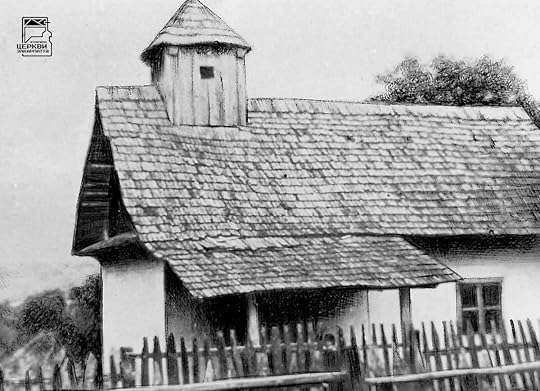
Source: https://www.facebook.com/groups/972655726636505/permalink/1306109296624478/
*
#MissingVillagesTranscarpathia - villages that no longer exist
301. Ervindorf
Ervindorf is a former village in Ukraine, in the Transcarpathian region.
United with the village of Suskovo
Сегадки: 1856: Ervinfalu, 1882: Ervinfalva, Suszkó new village, 1895: Szuszkó-Ujfalu, 1910: Szuskóújfalu, Erwinsdorf, 1913: Szzkóújfamu, 1925: Susko Nové Selo, Novo Selo, 1930: Selo Nové, 1944: Szusko New Village, Сусково
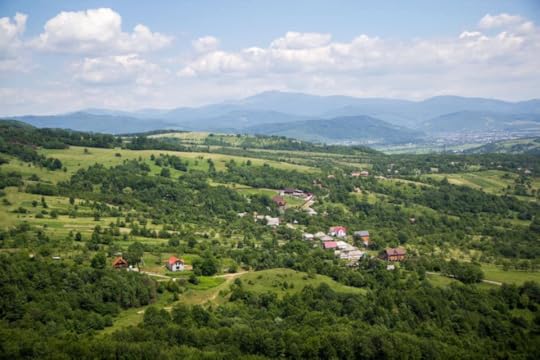
Source: https://m.facebook.com/story.php?story_fbid=pfbid0ELT6xJap9E7QYZUAs5GfnCUoniNBCeJHqJ8Ux9sYzkSTeD1XXJP2DiuU12KejtvUl&id=100003579045232
*
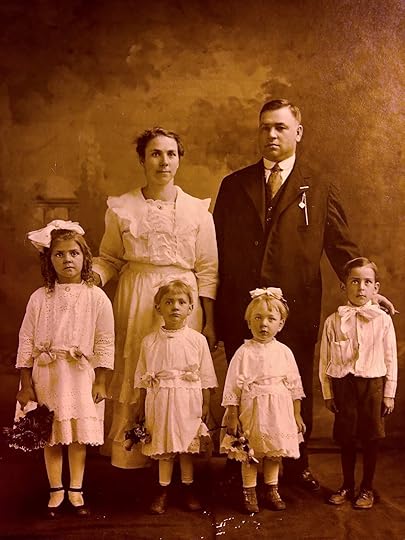
Photo of Helena Straus and Josef Tikal with their children in Chicago. My grandma is on the far left.
August 9, 2023
If You’re Going to Genealogy, Then Genealogy
What’s with DNA matches on genealogy sites that say “[Name] appears in a family tree with 5 people…”
So that person built a tree with him/her self, 2 parents, and only 2 grandparents… and then gave up and took a DNA test?
Do people even know how to do research anymore?
Here’s a good one, can’t even be bothered to add grandparents.

If DNA results via genealogy sites were more accurate:
“Great-grandmother’s 1st cousin 3 times removed… cut off from the family, sent into exile, and finally 86’d with the body dumped somewhere in the back 40.”
* * *
In my case, by researching and filling branches of the tree I’ve discovered real family connections I would’ve never known about otherwise.
The most remarkable to date are two connections in Germany to my great-grandmother Helena Straus, who migrated to Chicago from a small farming settlement in Transcarpathia, which at that time was part of Hungary, then Czechoslovakia, now Ukraine. She was a dead end, information-wise, but I now have contacts to both her father’s Strauss lineage and her mother’s Baumann lineage.
I’ve also found matches for my maternal grandfather’s relatives in Denmark and my paternal side in Poland… and my maternal grandma’s family I can now trace back to arrivals to North America as far back as the 1600s, with multiple ancestors fighting in the Revolutionary War – including later-arriving German Hessian mercenaries who arrived circa 1776 as reinforcements for the British forces, then gambled big by turning against their British employers for a chance at a new life in America (my how times have changed – for my chance at a better life I’ve migrated back to Europe).
* * *
Yeah, this is an old blog and I’m dusting it off now.
Greetings from Brno, #GreatMoravia.
Jason
January 7, 2016
Simple Colored Dots Explain Social Media Flaws
If you're into social media in any way, either as a general user or as a community manager for a company's social pages, I highly recommend reading this:
I drew a bunch of dots to explain why social media is broken.
February 23, 2014
It's Complicated: Relationships in 2014
First, an Atlantic article showing how Facebook can predict who will be in a relationship -- perhaps before the couple themselves are even aware of it.
Second, a Guardian reprint of a New York Times piece titled "Does equality kill sex?" -- with the result being that men who do only 'manly' things and don't try to 'help around the house' have sex more frequently and with partners who report greater sexual satisfaction.
And third, a short Independent article suggesting that polyamory may be the key to a longer, happier marriage -- that is, 'outsourcing' a few needs, as the needs couples place on each other are allegedly increasing over time.
*
After reading all three articles, I started to get the feeling, however, that there may not be anything 'new' to any of these studies. Of course two people will increase their communications before 'hooking up', of course male/female gender roles are adequately hardwired no matter how much we may try to reprogram them, and throughout all human history, of course, it seems to have been too much for one person to fulfill all of another person's emotional, intellectual, spiritual, and physical needs. It seems that the old saying "The more things change, the more they stay the same" has struck again, despite whatever 'newness' researchers try to attach to their data. Human relationships are just... complicated.
September 5, 2012
New Jason Mashak poems en route
Earlier this year (2012), I had work published in Unshod Quills (as featured poet!) and some poems that appeared earlier in a printed volume, in both English and Czech translation, reprinted on the web edition of Kumquat Poetry.
*
UPDATE: You can read my poems in Amsterdam Quarterly here:
"Bratislava Airport""Prague Metro, 2 June 2009"
Enjoy!
June 8, 2012
Portland, Oregon's Orange Lining Art Project
I’m pleased to announce that a line from my book Salty as a Lip has been chosen “for potential use” for an art installation that will accompany a new light-rail (metro) extension deep into SE Portland, Oregon.
Other authors include people I’ve read with in Portland (e.g. Hurricane Katrina Benefit, Wordstock/Poetland) or whose work and professionalism I’ve admired over the years, and I’m honored to be listed among them:
Anatoly Molotkov, David Abel, Jules Boykoff, Kaia Sand, Laura Winter, Paulann Petersen, B.T. Shaw, and David Biespiel.
More info: http://orangelining.net/
March 26, 2011
April, the Kindest Month
On the poetic front, I'll be reading at the U.S. Embassy's American Center here in Prague, along with legendary Czech underground writer/musician/artist Pavel Zajíček and the notorious American fiction writer Brad Vice, to celebrate the release of a new Czech-English anthology (with a theme akin to 'self-exile') recently compiled and translated by poet-professors Matthew Sweney and Bob Hýsek.


February 12, 2011
Small Towns and Bombs
After attending Cirque de Glace today in Prague, which turned out to be a bit of a bomb but at least my daughter loved it (I would've preferred Cirque Erotique a la Plage), we headed home a different way to avoid the traffic that we were stuck in for far too long on the way to the event, and we ended up in the Czech town of Melnik, where we had dinner at a pizzeria and then stopped by TESCO (like a British Wal-Mart chain) on our way home.
We'd been there about 10 minutes when employees and a couple police officers began guiding everyone to the front, along with the news that there'd been a bomb threat.
In the US, a message like this would have sent shoppers running in a panic... but not here in old Bohemia -- no, Czechs being the infamous skeptics that they are, people just looked pissed off and slowly trudged along toward the front, many even stopping to buy smokes on the way out. I too doubted the reality of the threat, but I quickly got my daughter outside (just in case).
Afterward, I sent an sms to a friend who lives not far from there and mentioned sarcastically that "Melnik seems to be a hotbed of Muslim activity" (actually, probably the only extremist group anywhere near there would be Czech neo-Nazis), to which he reminded me that Czechs did invent Semtex.
January 1, 2011
2010 in Literary Terms
GRASP Journal the Rakish Angel Poetry Pamphlet Seriesthe Czech issue of Ekleksographia (which I edited)The Return of Kral Majales: Prague's International Literary Renaissance 1990-2010 anthologyVLAK Magazineand many other notable publications I am currently forgetting.Czech Literature Portal interviewed me (in English) early in the year (Czech-language version of the interview here), followed by a an interview with Black Heart Magazine at summer's end.
 Haggard & Halloo Publications (Austin, Texas, USA) released the first printing of my own first book, Salty as a Lip, which SOLD OUT by the end of the year!
After various readings during the year at Shakespeare & Sons (Rakish Angel and Prague Microfest), Globe Books (GRASP), Anglo-American University (AAU Library - Spring Series), and Radost (Kral Majales launch), I was invited to read at Ostrovy bez hranic (Islands Without Borders festival, in conjunction with Palacky University), in the Moravian city of Olomouc (eastern Czech Republic), an experience that has turned out to be loosely connected with my poetry starting to be published in Czech (e.g., January 2011 issue of KAM v Brně, as well as an upcoming dual-language anthology of "self-exiled" poets in Czech Republic). Hopefully, my work will eventually make its way also into Slovak and Polish.