V. N. Alexander's Blog
April 22, 2026
Third Paradigm with Tereza Coraggio
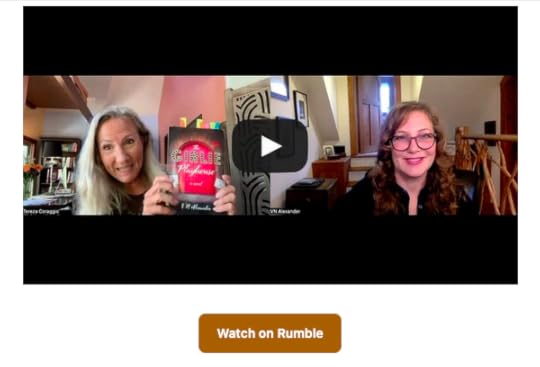
Tereza Corragio: I interview VN Alexander on her book, The Girlie Playhouse, about the changing dynamic of a stripper club that becomes more transaction and less expression. It tells the story of one dancer through the voice of another, who narrates with insight and complexity. Tori and I explore anthropology, sexuality, jealousy, shyness, possession, power and beta males. The reader is left creatively disturbed, with questions raised and left unanswered. Beyond well written and nuanced story-telling from the point of view of an introspective nude dancer, this book is an important allegory for our age–the loss of spontaneity and joy, the theft of naked innocence.


April 8, 2026
Salt Lake Dirt Podcast
 VN Alexander in conversation with Kyler Bingham, host of Salt Lake Dirt:
“Today I had the chance to sit down with V.N. Alexander to talk about her new novel, The Girlie Playhouse (Heresy Press) I completely devoured this book. It’s a first-person account narrated by a dancer named Pixie, who is trying to make sense of her world and the memory of her mother. What really pulled me in wasn’t just the setting of the cabaret, but the way Alexander handles the internal lives of these women. They aren’t characters to feel sorry for; they are people with incredible agency who just happen to be working in a world that the rest of the public often treats like a caricature…”
Note: in the middle of the podcast from 19:49-22:44 I struggled to find the paragraph I wanted to read from my book. You will hear silence, then some swearing, and the host reassuring me that he could edit that bit out. Oops. He forgot. No big deal, but when you hit that part, fast forward because it it took me a full three minutes to find the bookmarked page!
March 18, 2026
What’s Obama Reading?
 I am interested in the literary fiction sub-genre “weird girl lit” because my new novel The Girlie Playhouse fits that category. I looked up the 2025 best weird girl lit books and found Katie Kitamura’s Audition was near the top of the list. Audition also made it to President Obama’s 2025 favorite books list. Would Obama also like The Girlie Playhouse?
The picture above is not real. I read Audition. Here’s what I thought.
The Girlie Playhouse will be released on April 7th! Available for pre-order from Amazon, Barnes & Noble, Bookshop, Books-a-Million and wherever else books are sold.
March 14, 2026
Truth in Fiction: The Girlie Playhouse
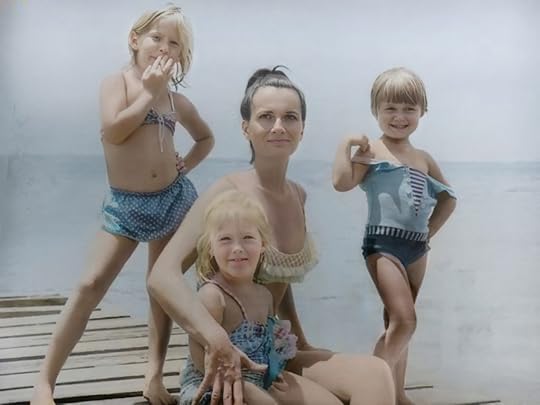
My mother, my sisters (Valerie and Heather), and I. I am the littlest one seated by my mom.
Readers often want to know if my novels are based on my real life. The Girlie Playhouse is my new novel, coming out by Heresy Press in April.
One’s earliest experiences can leave indelible impressions. The above photo shows my mother, my sisters (Valerie and Heather), and I at the end of a fishing dock at Log Cabin Estates Lake in Gun Barrel City, Texas. Shortly after this photo was taken, my parent were held up at gunpoint when they walked back to our cabin from the lake. They were not harmed because my dad acted fast and heroically, kicking the gun away and telling my mom to run. My sisters and I were terrified when she came running down the dirt driveway, without our dad, screaming about a gunman.
The trauma burned the memories into my brain. I couldn’t have been more than three or four.
The narrator of The Girlie Playhouse is called “Pixie.” I imagine her to be the kind of person I seem to be in this photo, a little frightened, nervous, very naive. In Chapter 20, at the dead center of the book, Pixie describes her backstory, the day her mother, who was a cabaret dancer,
was shot in the stomach on a Sunday as we walked home from the general store. She bled to death under the noonday sun on dusty, lime-coated Farm Road 7 while mad swarms of cicadas screamed in the old gnarled oaks.
My imagination must have come up with the details of the terrible scene by ransacking my memories, distorting them, much in the way any brain does when it dreams. Here is the opening scene in Chapter 20, loosely based on details that I remember from that summer,
The lake near Runaway Stay was artificial. It had an abbreviated shoreline of imported sand surrounded by gray-green live oaks, huge rough trees over a hundred years old with low wide-spread canopies. There was a fishing dock—about the length and width of a good strip club runway—where drowsy, beer-bellied men in floppy hats nodded at the water. Mom walked to the end with a proud, lewd swing in her hips. Knock-kneed, I waited with my inner tube and sand pail on the shore, admiring her. My soul, she was something. As I stood watching, what I felt, even at that age, was a little more than awe, something like envy. She wore a ruffled bikini, like mine, low on her hips. She had a white, straw sunhat on her pale head, hair loosely tied and trailing down her tawny back. She wore lamé sandals with high heels of stacked gold. We hadn’t found any in my size (Mom had asked the useless clerk), so I went barefoot, which was every bit as sexy, Mom consoled, in its own way.
At the end of the dock, she stopped and looked at the horizon, shading her eyes with one hand, and, strangely, standing on her tiptoes. Then she returned, twisting the soles of her feet on the wooden planks with each step; big painted mouth smiling at the sound of a half dozen cat-call whistles…
In the photo, my sassy sisters are posing like cabaret dancers. Valerie is pretending to smoke a cigarette. Heather has what we called a “pixie” haircut. My mother, Tricia, is serene in her beauty. The main heroine of the novel is a dark-haired cabaret dancer called Trixie. I didn’t create these echoes on purpose. The details emerged unconsciously and got shuffled as I invented the scene. I only realized that my novel was based on my memories later when I happened upon this old photo.
The answer to the question, Is the novel based on your own life? is never simple.
The audiobook for The Girlie Playhouse is now available for pre-order. Here’s a sample read by Hannah Church.
March 6, 2026
A Libertarian Walks into a Topless Bar
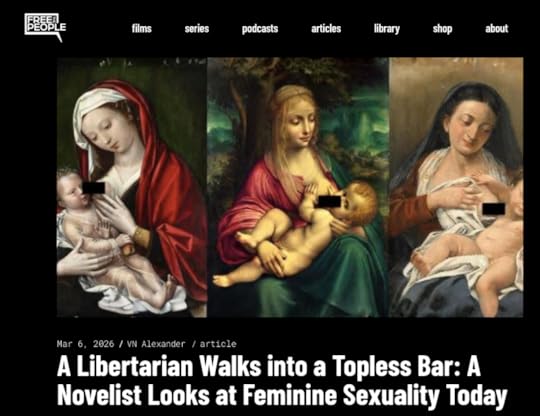
Libertarians defend the deregulation of “sex work” based on the principle that government should not interfere in transactions between consenting adults. Prostitution, like drug dealing, should be left to the free market. Those who provide bad services will lose customers, which should result in better quality and increased safety.
I’m kidding. That’s how Bernie Sanders thinks Libertarians think. We understand that potentially exploitative situations and addictions complicate matters. It’s not because I’m heartless that I don’t think it’s government’s job to protect people from themselves. I’ve just come to realize that government intervention tends to make a bigger mess of messy situations. Continue reading on Free the People
March 1, 2026
VN Alexander on the Ripple Effect Podcast
Over the course of a 2+ hour interview with Ricky Varandas on the Ripple Effect podcast last week, we discussed:
The effect that AI might have on the arts (my Substack The Posthumous Style is dedicated to critiquing AI and transhumanism).
The fact that Jeffrey Epstein funded the Santa Fe Institute before I was there in the early naughts and why he was ultimately disappointed in the research there. My book The Biologist Mistress was written at SFI. That convo starts around :30.
Close to the hour mark, we talk about how conspiracy theories are becoming mainstream due to the partial Epstein file release, my 9/11 truth novel Locus Amoenus, and about solutions to the current political mess.
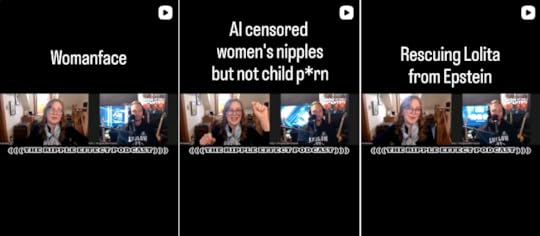
Near the end, we discuss The Girlie Playhouse, Nabokov, who was my biggest influence for that book, and how female sexuality is censored while child porn is not. Here are three 3-minute clips that feature The Girlie Playhouse:
Full interview:
VIDEO on Your Tube
AUDIO on Podomatic
February 18, 2026
A Precise Review of The Girlie Playhouse
Hello! I want to share with you a wonderfully precise review of my latest novel, The Girlie Playhouse (available for pre-order) by Charles Holdefer in Exacting Clam. It’s also favorable. I love this review. Holdefer gets all the implied meanings and noticed more than a thing or two that only a great writer, like himself, might notice. Also check out Holdefer’s latest novel, Don’t Look at Me.
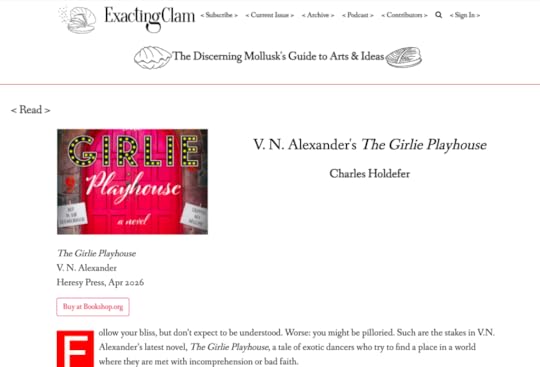
Follow your bliss, but don’t expect to be understood. Worse: you might be pilloried. Such are the stakes in V.N. Alexander’s latest novel, The Girlie Playhouse, a tale of exotic dancers who try to find a place in a world where they are met with incomprehension or bad faith.
The title refers to a cabaret where the narrator, Pixie, dances nude. The story centers on another dancer, Trixie, whose appearance and performances fascinate Pixie. She avows, “My entire life has been an expression of my peculiar love for girls with meretricious charms.”
The story opens with the cabaret under attack by outsiders who want to close it down. The Gideon Angels, a feminist group of Carrie Nationesque killjoys, inspire protests by “misguided, albeit well-meaning” student activists from the local university’s “Oppression Studies Department.”
Thus the battle lines are drawn. At first blush, the above description, putting apparently infantilized “girlies” with cheesy names on one side, and dour moral enforcers on the other, seems to promise a broad satire. And that is, in fact, one feature of the novel. At the same time, however, The Girlie Playhouse raises more complicated questions about performance and personal autonomy.
Alexander pushes back at received images of dance venues as merely tawdry or exploitive, grim places for desperate women with nowhere else to go. Pixie’s story is not devoid of risks—violence against women figures in the plot—but these characters assert agency. Pixie says that her method “is to complicate the issue rather than clarify,” which is a sentiment that implicitly reflects the author’s approach, too. The male gaze, she claims, can also serve her purposes: “while the breath of the men constantly threatens to extinguish, it actually feeds my flame.”
Exotic dancing, for Pixie, is not just a job, but a need. She’ll dance naked on her porch under the gaze of a blackbird on a maple tree because, for her, “Any pair of eyes will do.” This aspect of self announced itself early. She recollects being scolded by her auntie, when she was only six years old:
“Stop that prancing around like a little harlot, you gypsy girl. Where is your modesty?” [. . .]
I stamped my tiny foot and demanded, “What was I doing wrong?”
“It’s not what you’re doing. It’s what everyone’ll think.”
“I don’t care what they think.”
This pattern persists into her adult life, and is corroborated by her friend Trixie, in the context of Trixie’s relationship with her boyfriend Max. Max is a regular customer at the Girlie Playhouse. He recently won the lottery, thereby freeing him of financial worry. He’s hopelessly smitten with Trixie, and his good luck continues when Trixie returns his affections. What more could he want?
As it turns out, a lot more: namely, control. He challenges the need for Trixie to continue dancing.
“Don’t tell me you want to be a stripper. I thought it was just the money.”
Trixie looked at him with bitterness. “You’re not making sense.”
“You’re the one who’s not making sense. You don’t have to strip anymore.”
“I never had to before,” she said.
“What do you get, Trixie, what do you get out of being at a strip club that you couldn’t get dancing somewhere else?”
“I like it.”
The ensuing discussion, in which Pixie participates, addresses the question that hovers over much of the story. Why? Why does she like it? Max defensively poses the question in reference to another man:
“Why do you need to dance for him?”
“It’s not for him,” replied Trixie, groping for her point. “It’s at him.”
“Oh, I see at him. Well, that makes perfect sense.” Max laughed, tickled with the idea that her argument was weak. “Pixie, now you tell me, do you dance at or for your customers?”
I hesitated for a few minutes, biting my thumbnail, considering this delicate point.
“Through,” I said finally. “Through.”
This conversation does indeed complicate the issue. A reader could parse this as a sad testimony to how much the patriarchal gaze has colonized the female psyche, resulting in a socio-sexual “captive mind.” Or a reader can conclude that dancing through the gaze of others is an empowering move, surfing across a liminal space on a wave of desire. Or a reader, particularly a reader weary of theorizing, can conclude that our pleasures are polymorphous—yes indeed—so enough said. Sometimes a cigar is just a mirror ball.
I found these ambiguities interesting. Elsewhere, Pixie says up front: “there is a phenomenal pattern in the hazy chaos of events, one that cannot be explained entirely by psychological factors.”
In any event, realistic convention isn’t a priority here. When not dancing at the Girlie Playhouse, Pixie lives quietly by herself in a snug garden cottage, tending wildflowers. She leads a pastoral, fairy-tale life, where money isn’t an issue.
Sex, when it occurs (not that often) is also refracted. Alexander’s satirical strategy is to describe it with somewhat prim or florid language, the opposite of a striptease reveal. For instance, in a voyeuristic scene, Pixie watches Trixie as Max “resolutely possessed the coquette.”
For all its playfulness, the emotional core of the novel—its ideology, if you must—seems to be to a concern about the ills that arise when someone decides for someone else. I’ll avoid spoilers, but the novel is tenacious on that point. Full of surprises, The Girlie Playhouse subverts cliché. V.N. Alexander is a serious stylist who is not afraid to ruffle feathers.
Charles Holdefer lives in Brussels. His latest novel is Don’t Look at Me (Sagging Meniscus, 2022).
January 11, 2026
Animism, story co-authored with Michael Levin, published in Interconnections
 After completing my (yet unpublished) short story collection, Chance that Mimics Choice, I contacted Tufts biologist Michael Levin, who enthusiastically agreed to write a foreword. The collection explores the idea that all of nature is capable of mind-like poetic interpretations, which is similar to the kinds of research questions Mike pursues. He told me that he believes strongly in the power of fiction to sketch out suggestions for scientific investigations. Later, we decided to write sci-fi together. We’ve written four so far. Mike suggests the plot and I provide the details.
I am very excited to announce that our first story has been published. “Animism,” appears in Interconnections: a Journal of Posthumanism.
The first several stories in my collection, Chance that Mimics Choice, feature an eccentric scientist named Meno. (Two of these stories were featured on The Strange Recital podcast.) I brought back the Meno character again in “Animism.” The story is set in a future when all of our devices will be talking to us and there will be no place to be alone with our thoughts.
Michael Levin is a developmental and synthetic biologist at Tufts University and director of the Allen Discovery Center. His research explores how cells communicate to build complex biological forms, focusing on bioelectric signaling as a key regulator of growth, regeneration, and pattern formation. Levin’s lab studies how organisms such as planaria, frogs, and salamanders regenerate limbs and organs, and how collective cellular intelligence guides morphology. Levin’s work bridges biology, cognition, and philosophy of mind.
December 10, 2025
Naked Singularity on The Strange Recital
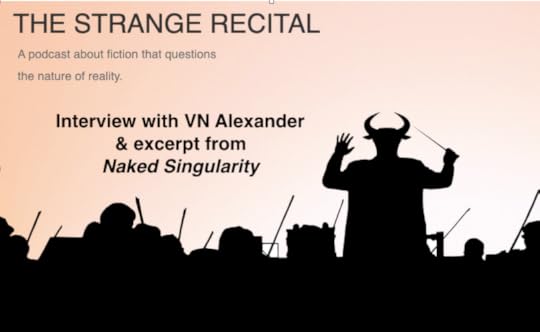 VN Alexander reads the opening of her novel Naked Singularity on The Strange Recital podcast. Afterwards she sits down to talk with hosts Brent Robison and Tom Newton.
Listen now. Here’s snippet of the interview.
BR: I imagine most listeners will have the same question I do – how much of this story is autobiographical? And it’s completely acceptable if your answer is that it’s irrelevant because this is fiction. In fact, in the fiction arena, does so-called “truth” even matter?
VA: Well, I suppose the statute of limitations has run out? My father did die of cancer. He did ask me to help him die. But the cast of characters is completely different.
TN: Both of my parents have departed, and I know that’s true for Brent as well. This is natural when we reach such advanced ages. You’re much younger, of course. But anyway, people disappear, the queue shuffles forward, and soon we find ourselves at the head of the line. Any thoughts about that?
VA: That’s one of the reasons losing a parent is so tough. It says “you’re next!” There should be lots of readers for this story. Everyone goes through this and when they do many start obsessing about their own mortality and want to share the experiences of others.
September 15, 2025
Webinar: We Are Not Machines
Bimonthly presentations by VN Alexander critiquing the claim that Artificial Intelligence will soon deliver sentient computers; that Brain-Machine Interfaces will enable mind reading; or that Biotech can reprogram our genes to cure illness or give us superhuman abilities.
Live Online Classes begin Friday, September 19, from 1:00 – 2:00 PM ET and will be held the first and third Fridays in October, November, and December 2025.
For more information see, https://ipak-edu.org/registration/e/W...