Michael Neal Morris's Blog
January 7, 2021
How Students (and Teachers) Can Use Feedback
Every semester, usually just after midterm, I get an email or have an office visit from a student that includes one of the following questions:
“Why do I keep making Cs on my papers?”
“What am I doing wrong?”
“How can I improve my grades?”
In nearly every case, I have to return a question for a question: Have you read the feedback? Almost all say they have, but the ensuing discussion usually demonstrates they either have not or have only understood a fraction of what they have been told.
Few students are aware of how much time and energy is spent reading and responding to written work. Of course, the time it takes to grade a piece of writing varies depending on the course the assignment is composed for and the complexity expected in the writing. Most English teachers I know tell me they spend an average of twenty minutes per complete essay. However, I would guess most students do not spend more than twenty seconds reading anything on the paper, usually a cursory glance at the grade and no more.
This discrepancy is important to point out, not to shame students, but to illustrate the difference between what instructors and students see as the “work” of a class. For most teachers, grading papers is the hardest, and perhaps most significant, work they do, because the feedback is an essential part of learning. This work is not about what one does “wrong,” but the multifaceted ways to improve one’s writing. For many students, the work is over once the essay has been handed in (or submitted online), and notes are just red letters to indicate a certain level of failure.
Why students generally do not read feedback from their teachers is a subject well worth exploring, because it could shed light valuable light for students about making good choices in their education, but teachers at all levels and all subjects need some ideas for modifying their own grading process so they can best help students. I am not talking about holistic scoring versus what one of my colleagues calls “death by a thousand minus ones.” Teachers in all subjects need to periodically fine-tune how they approach responding to students if they want better results.
One problem regarding feedback is its complexity. When a student turns in an essay, the paper is a lot of rows of letters in the same font and size as all the other letters. When the student gets it back, there are arrows, abbreviations, and disapprobations, all often in red ink. For even good students, reading such markings (even online) is an adventure in the translation of texts of dubious value. Teachers know that information has value. Students usually have to learn by very hard experience to prize that knowledge.
Rarely do people have the kind of experience where one is learning how to write via another person standing over the shoulder to guide the way. Generally, we do not have coaches blowing a whistle at mistakes or clapping our backs when we perform well. Even if you attend a face-to-face class, feedback is a kind of distance learning encounter. If you are a student who wants to get the most out of feedback so that you improve, you will have to change the way you look at it.
There are three main categories of notes that teachers make on student writing, and within those categories are several divisions. The categories are:
Content
Organization
Language
These are based on different elements in the reading experience. That is, these are different ways that the information gets to the reader. Content is essentially the message the writer is presenting and the material or information used to deliver it. Organization, as you might have guessed, is the order of material, and it includes the arrangement of paragraphs and the order of sentences within a paragraph. Language issues include corrective notes about grammar and punctuation errors on one hand and style choices on the other. (In my own classes, I add categories of research and documentation for writing that require them, as these are different elements for different projects.)
When students have papers returned to them, they are likely to see all three kinds of notes, and it can be very confusing. Sometimes instructors help students by providing them with a useful rubric to help them ferret out which notes fall into which categories. Some teachers are even creative about notes, using a color-coding system to help differentiate. However, often a student is left to figure it out with little more than an unopened handbook and the offer to come by during office hours.
Too often, teachers painstakingly mark essays and then present a kind of “The information is there if you want it” approach that is not helpful, especially to the student who is making efforts to get something from feedback. Too often, students will look at the grade, make assumptions about what that grade means, and avoid learning. Both need to change.
There a certainly a number of ways to pull the notes apart and make sense of them. For several years, I have recommended students use a kind of grid system that can be quickly put on a sheet of paper or made from a spreadsheet program. On the side, the student can write the words Content, Organization, and Language. Across the top, the student lists the notes. Here is a rough example:
 Empty feedback grid
It is possible to substitute some parts of the grid with words or phrases that indicate divisions of the categories or expectations for the assignment. For example, one could note key words in the directions or the number of quotes expected in the essay and where they should come from. But for now, let’s keep things simple.
Now look at the same grid with notes added by the students after reading feedback:
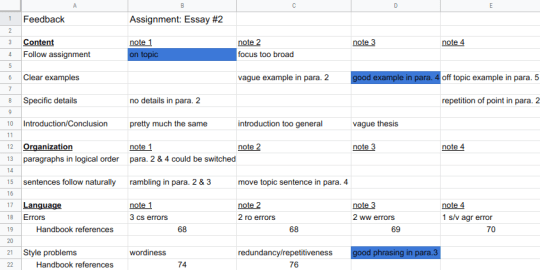 Feedback with notes
Note that the student has added information in the Language section to indicate pages in the assigned handbook where they can locate information about problems noted. Notice also that three areas have been highlighted where the student has received positive feedback.
Placing notes into categories and separating them by type, helps the student writer in a number of ways. First, notes can be transformed from overwhelming scribbles to manageable data. Doing so takes much of the emotion out of the learning process so each issue can be addressed one part at a time. Second, the student writer can actually see where their work succeeded, or partially succeeded, instead of thinking of feedback as a conglomeration of wrong moves. The student will certainly want to replicate what went well.
Because the student’s notes are text-specific, that is, focused on the precise material of the essay, the student also has material to work with in conferences or correspondences with the instructor and tutoring sessions. Frequently I have had students send me an email with a generic request, “Please explain what’s wrong with my paper” or “I don’t know what I did wrong.” While I understand the feelings of frustration or confusion, particularly when the student feels they have worked hard and earned a less than stellar grade, it then takes some time for me to help them get at the heart of what should have been learned from the experience of writing an essay. When the student refers to specific notes in a specific places, it is much easier to find helpful ways to explain what I said and what they can do to improve.
It is very hard for both students and teachers to change habits of grading and interpreting feedback. However, if education is to have any value, people in both groups have to commit to evolving and adjusting. Feedback is certainly tied to the grade for any assignment, but it should do more than provide a checklist justifying a score. It should be a diagnostic tool: for the student, as an indication of what needs work and what needs to be applied in the future; for the teacher, as sign of where communication can be improved.
The post How Students (and Teachers) Can Use Feedback appeared first on Two Cents On....


August 23, 2020
Two Mediocre Stories Delivered Poorly
Review of Sea Wall by Simon Steven and A Life by Nick Payne
The stories here were okay, and may have seemed better to me had I read them in print. Hard to say.
“Sea Wall” felt like the ramblings of a drunk who can’t help but make the most important event of his life sound dull. The narrator is a dick, which is okay but he couldn’t even ben an interesting one.
“A Life” was a bit more enjoyable though trying to address a common trope (death and birth intertwined) by leaping back and forth between two narratives. The plot is a little confusing at times, but the story resolves satisfactorily.
The two good actors reading here may have hurt the delivery of the stories, but that might be a matter of direction. I don’t know. What I do know is that I did not enjoy either of these stories as much as I think I should have. At this point, I certainly have no interest in re-experiencing either.
The post Two Mediocre Stories Delivered Poorly appeared first on Two Cents On....
August 19, 2020
Notified
When my grandsons are watching videos on their mother’s phone or playing games on my iPad, they display intense concentration, which is not really surprising. We have all seen such things when young people hold screens in their hands.
What amazes me is how they so easily dispense of notifications. They seem to have accepted that when using someone else’s device a little bar will pop up telling the owner of the machine about some email that has been added to the inbox or that an acquaintance has posted on Facebook. Both kids are able to merely swipe the notification away with a touch so deft the maneuver appears to be merely a part of what they have on the screen.
I am thinking of this today because I covet such concentration. I have been relearning how to meditate, adding the practice to my time of morning reading and reflection. Conventional wisdom is that when a thought comes to compete with the process of meditation (or any form of prayer), one should sweep it away without judging it good or bad, returning to the mantra as best as one can.
Such actions are easier said than done, as anyone born since the internet came into our lives can attest. Reading a book or doing work on my computer, I may see a notification that my turn has come in a game of Words With Friends or that someone has commented on my recent Instagram post, and I have to struggle to withhold the tap or click that takes me away from what I need to concentrate on.
Dear readers, I know some of you are saying, “There are ways to work around distractions,” followed by all your suggestions. I know, and I employ many of them. And some of you are thinking, “Of course your grandsons are fully focused on what is on the screen. That’s the effect of screens on people so used to them.” However, when those same boys play with Legos or reading quietly, they easily brush away the noises around them: baby sister crying in the other room, Dad speaking to an employee on the phone, Mom calling them for supper.
What impresses me is their amazing ability to center on their activities, whether on or off devices. It is something that is perhaps wired in the brains of children that we adults, with our worries and to-do lists, manage to erode over time. But I am reminded of Christ saying, “unless you turn and become like children, you will never enter the kingdom of heaven.” Part of the kingdom may well be the peace should result from prayer or meditation.
At least for today, this is the notification I am trying to tap.
The post Notified appeared first on Two Cents On....
August 3, 2020
Winning a New Name (Meditation 71)
Then he said, “Your name shall no longer be called Jacob, but Israel, for you have striven with God and with men, and have prevailed.” Genesis 32:28
We live in a dualistic culture where it seems everything is a competition and our only purpose is winning. Worse, when we do not win, whatever that actually means, we are losers. It is expected that we conquer everything, even conversation. The definition of “winning,” it seems to be not merely to do better than an opponent, but to leave the opponent with nothing. Losing, even to many believers, is a grave sin.
It seems we need to change our ideas of what winning and losing are, and maybe we need to rethink the notion of competition. Jacob wrestles all night with God and we are told he prevailed. Other translations state that he struggled “with God and men” and won. Has Jacob beaten God or annihilated people? No. No one has or will beat God. The wrestler has not even come out of the night unscathed, but the next day limps into town because of the wound to his hip.
Instead, let’s consider what Jacob has gained. He came out of his “battle” (not a good word, but the word many would assign) with a blessing and a new name. Jacob did not conquer God, but was changed by God. He was given a new identity, one that would become the identity of God’s people. Remember Israel means “strives with God” or “God contended.”
We are like Jacob. We fight with God, sometimes through nights that seem to never end. We do not usually realize we are contending or recognize our opponent, because His face is hidden from us. We do not even realize that what we labor against is not an enemy. But to gain the blessing, we do not have to crush or destroy the contestant, but last until the day. And when we do, we will be changed.
Lord God, the conqueror of our souls, let us encounter You today knowing that we are never strongest than when we are weak with You, and never more equipped for the challenges of the day than when we have spent the night being wounded by You. In the Name of our strong deliverer, Jesus Christ. Amen.
The post appeared first on Two Cents On....
July 28, 2020
An Unhelpful History of Mathematics
Only Tony Shalub’s voice saves the audiobook of W. Rouse Bell’s A Short Account of Mathematics from being truly awful.
Let’s start with the book’s lack of understanding of audience. The author includes several example equations, purportedly to illustrate math concepts. Those are not clear to readers/listeners who are unfamiliar with the concepts in the first place. That is, for the less initiated, the connections are not clear. So much space is taken up with these examples, that the concept of a “history” is lost. I suppose that since this book is in the “sleep” area of Audible’s selections, that the purpose of these examples is to induce drowsiness.
Second, each time the author mentions religion, he points out that the mathematician is WRONG, not really showing the same emphasis for being incorrect on secular mathematicians. I’ll trust that the author is accurate, but the writing implies wrongness because of a connection to religion or faith, instead of pointing out the context of such errors or that several believing mathematicians may have accepted the error and improved upon it. This is what rational thought is supposed to do: correct mistakes and build upon what has been learned. The author does not appear to allow for this possibility.
The post An Unhelpful History of Mathematics appeared first on Two Cents On....
July 22, 2020
Enduring Love Grown Cold (Meditation 70)
And because of the increase of lawlessness, the love of many will grow cold. But the one who endures to the end will be saved. Matthew 24:12-13
It seems that when cataclysmic events happen, some preacher or self-proclaimed prophet points to the more apocalyptic parts of the Bible, connects a handful of loosely related dots, and declares that the world was living through “the end times.” Maybe we were when awfulness occurred in the past. Maybe we are now. God does not measure time as we do.
This verse, caught in the middle of one such section of the gospels, does not seem to get much notice. At least I do not remember any sermons or devotional dedicated to it. There is a lot of rhetoric about tribulations and “rumors of wars” and betrayals and “brother against brother.”
I am interested in the connection between the two phrases. Let’s start with the first: “because of the increase in lawlessness.” We often deceive ourselves into believing that the present age is more lawless not because there is more of what we have decided is “lawless,” but because of the fantasy that the past was good. There were bad people in all our golden ages. We just are convinced that the demarcation was clear then and not now.
No. As we get older, if we gain wisdom, we realize that except in movies, there are few clearly evil and fewer fully good people. (And we are too certain we know who they are!)
“The love of many will grow cold,” Christ told us. Sure there are the institutions that have not only failed to address the evils of their and our ages, but have been openly hostile, or worse, indifferent. But most adults have also known — not just felt– the coldness of family, friends, coworkers, and fellow church members. This may have come because those once close humans have become entangled in some great sin. It may be because we have.
However, it is more likely that someone (or each of us) has been distracted, over time with the sinfulness that seems so small we cannot, without grace and constant communion with God, see as “lawless,” but perhaps “less law.” I am not saying that we should become neurotic and beat our breasts over every thought and action. I am saying that if we wish to “endure until the end,” we are best to stay as close as possible to the One who knows — and redeems! — every “insignificant” rebellion.
Holy Spirit, loving and mighty, we cannot know ourselves as you do. We can comprehend neither your love nor our failure to live up to it. Guide us to right repentance, and also to your graceful, forgiving, and strengthening arms. In the name of our Lord Christ, Amen.
The post Enduring Love Grown Cold (Meditation 70) appeared first on Two Cents On....
June 8, 2020
Wisdom Vision (Meditation 69)
Do not say, “Why were the former days better than these?” For it is not from wisdom that you ask this. Ecclesiastes 7:10
At funerals, we usually say nice things. By general social convention, we have decided that it is wrong to “speak ill of the dead,” even if we feel poorly towards them. We selectively remember the good things the deceased said and did, and generally keep the bad to ourselves. Most of us even speak civilly to people we don’t like, and from the outside, it would appear that old animosities have been forgotten.
In a world dying from its sin, it is easy to think of the past too kindly, as if everything was “better,” and what was not good was easy to reckon with. It is also easy, I have found, to do the opposite: to focus so much on one terrible part of the past that we see it as the only thing which has shaped what is appalling in the present, a horror we cannot escape.
We cannot have a healthy sense of the present or a large vision of the future unless we are honest about the past. We must draw wisdom from what we have seen and experienced if we hope to experience joy now or have peace tomorrow.
Lord of all time, place our hearts at rest, that we may not romanticize or vilify the past, but see where Your grace has been present, as it is now and will be always. In the name of Christ Jesus, Amen.
 Noah looking out at the lake.
The post Wisdom Vision (Meditation 69) appeared first on Two Cents On....
May 25, 2020
A Hidden Reward (Meditation 68)
And whenever you pray, do not be like the hypocrites; for they love to stand and pray in the synagogues and at the street corners, so that they may be seen by others. Truly I tell you, they have received their reward. Matthew 6:5
It is human not only to desire acknowledgment but to feel it is necessary. We work hard, and it seems natural to expect not only the compensation that is due but to have others praise us for it. People are often unhappy in their jobs and personal lives because the labor, sacrifices, and extra time they bring to those relationships have not been recognized.
One reason people seek recognition is that it is a marker, at least emotionally, that they have been heard. We want to know that what we say, think, and feel matters to someone else. Some can take rejection of their ideas or contributions better than others. Few of us can easily take being ignored.
We also live in a culture that measures winning and losing at life on how many people pay attention to what, in God’s reality, is insignificant: how many likes did our Instagram photos get? What comments did our Facebook posts receive? How many people patted us on the back after that presentation at work? What people were nodding their heads as I added my pithy commentary in Sunday School?
Intellectually, we may be able to accept that what people say or think of us has no bearing on our worth. We may even understand that God values us even when others do not. But when the Pharisees and self-aggrandizing leaders of this world sweep glory into their own laps, it is difficult to not let the devil of thought enter, the lie that God only sees us when we fail.
Five times in the sixth chapter of Matthew’s gospel, we hear Jesus say. “they have received their reward.” We must remember that God hears us no matter how loud anyone else is.
Father of all love, who listens to broken and inarticulate hearts, thank You for hearing us. Give us the Holy Spirit today to comfort us when we feel alone and unheard, and to give us the vision of your heavenly reward. Amen.
The post A Hidden Reward (Meditation 68) appeared first on Two Cents On....
April 28, 2020
Al Di Meola + Beatles = Excellent Listening
Jazz giant Al Di Meola has released a number of interesting projects in recent years that should prove to listeners that he isn’t just a guy with fast fingers who made Return to Forever more than a showcase for Chick Corea’s electronics. On both acoustic and electric guitars, Di Meola has flavored his live and studio recordings with classical, flamenco, and world music seasonings.
Across the Universe is Di Meola’s second album of all Beatles tunes. If you are looking for the standard play the melody and get out of the way tribute, then you will be disappointed. Each track contains the expressive guitarist’s unique stamp. Beatles fans will recognize the tunes, but it may take a few listens to get comfortable. I believe Di Meola’s playing here demonstrates both the longevity of Beatles melodies and the improvisational chops of a performer who shows no signs of slowing down at 65.
Stand out cuts are “Norwegian Wood” and “Strawberry Fields Forever,” but every tune has something remarkable to discover on repeated listenings.
The post Al Di Meola + Beatles = Excellent Listening appeared first on Two Cents On....
April 20, 2020
Learning the Way (Meditation 67)
You are good and do good; teach me your statutes. (Psalm 119:66)
I sincerely wish that everyone could have the experience of learning from at least one great teacher. Not the cool teacher or the nice teacher, but one who awakened a thirst for knowledge beyond facts, and quenched that thirst with more than wise words well said. I wish everyone could know someone whose goodness taught as much or more than the lessons that students would drink as from a clean, cool stream.
I was blessed to have one such instructor in high school and a few in college. These were people I wanted to talk to outside of class and get to know because their lives seemed connected to the great ideas I encountered through them, and I wanted to be good (often in a secular sense, but sometimes in a spiritual one) because they led me to believe I could, and the universe would be better with even the attempt.
Jesus taught his disciples (and us if we are willing) in such a way that they (and we), once awakened, could not desire anything but to sit at His feet. But, He was frequently telling them, He had to go to His Father. And of course, they were baffled, just as we are baffled when we find ourselves in deserts and wildernesses, seemingly alone, clinging to the words, our inner beings yearning for the Holy Spirit to connect all the disparate dots in front of us.
Jesus told his disciples, “you know the way where I am going.” Thomas asked what the rest of the class, as it were, wanted to know: How could we know how to get there if we don’t know the place? And Our Lord’s answer is perhaps as famous as it may have been cryptic: “I am the way, and the truth, and the life.” I can imagine some of the disciples writing this down, shaking his head, and trying to gather the courage to ask if this would be on the test.
Our Great Teacher was telling his students that they knew more than they realized, and had learned what they needed. He told them, in the same discourse, that the Holy Spirit would help them, not only to remember to live what He taught. They (and so often we) were looking for a map. Christ said that the map is the life, a life of love so great it meant giving up oneself to sojourn in the joy of the Father.
O Great Master, so fill us with the Holy Spirit that you love may always be present in our hearts as it is in all things, and may we be so full of your teaching that we overflow, and give your Way, starting with those we touch, to all humankind. In the holy and precious name of Jesus, Amen.
The post Learning the Way (Meditation 67) appeared first on Two Cents On....