Jerry Hatchett's Blog
March 13, 2020
Two out of twenty-six is a crazy ratio!
Being a dedicated introvert, I stopped going to grocery stores a couple years ago when InstaCart started servicing my area. I eventually switched to Shipt, which provides better service in my opinion, but the glorious result is the same: I place an order online via my browser and an hour or two later, my shopper shows up at my door with groceries. Greatest service ever, right? (Right!)
Today I placed an order and about an hour later one of my favorite Shipt shoppers, Edwin, messaged me to let me know that out of the twenty-six items on my grocery list, HEB had exactly two of them in stock. Two. Out of twenty-six. He offered up a few substitutes that were available but in the end I told him to bring my sugar-free Popsicles and Tillamook cheese snacks and forget looking for the other things.
When he got here, Edwin described a scene of mayhem at the grocery store. People instantly grabbing all the meat that had just been put out, piling it into their carts as if they were solely responsible for feeding their entire neighborhoods. Same with other types of products. An entire produce section in a huge grocery store standing bare. Aisles of empty shelving everywhere.
Such is life in the early days of the CoronaVirus Panic of 2020. No big deal. I have plenty of food here at home, both for me and my furry friends, so we'll be fine. When it comes to in-the-flesh interaction, social distancing is sort of my default, so little adjustment is required. I love interacting with online friends and fans, and that shouldn't take much of a hit at all.
What I'm doing with my time is working hard on PROJECTIONIST. Some of you will remember this one, which I started years ago as a serial novel which I was releasing a chapter at a time right here on my StoryFreak blog. That approach didn't work out well. Too complex a story for a week-to-week approach, so it eventually got back-burnered. That hiatus has ended and I'm shooting for a release date of May 15 for this quirky tale. This book, which features some parallel-world and other interesting elements, along with romance and some other content, is way outside my typical wheelhouse, but it's also one that generated a lot of interest here on the blog and elsewhere from the fans who stay in touch. Stay tuned for more specifics.
As soon as PROJECTIONIST is on the market, my initial plan was to quickly release the third book in the Sam Flatt series, which started with UNALLOCATED SPACE and most recently continued via FAKE NEWS. That was before I looked at a couple factors. First, I've gotten a lot of negative feedback on the title of FAKE NEWS. To my surprise, it seems a great number of people see the title and the cover and instantly interpret it as a non-fiction book on politics. Not good. I'm going to fix that with a new title and a new cover that are more in keeping with thriller norms and more congruous with the cover of the first book in the Sam Flatt series, Unallocated Space. Stay tuned for more specifics on that.
The second factor I looked at with regard to post-PROJECTIONIST plans was fan reaction to my previous books across the board. I looked at initial sales, longevity of sales, reviews, and contact from fans regarding the various books. This analysis led to what was a momentous decision for me. Instead of the third book in the Sam Flatt series, the next book out (later this year) after PROJECTIONIST, will be a sequel to SEVEN UNHOLY DAYS.
Yup, Matt Decker returns! It will be a technothriller, of course, and will continue in the same vein as SEVEN UNHOLY DAYS in that Matt will face high-stakes issues that are global in scope, with the potential to be apocalyptic in severity. And you can expect to see some intersection between the worlds of Matt Decker and Sam Flatt. I can't say more on that right now, since I consider spoilers to be the Eighth Deadly Sin, but can tell you that it will be big and exciting, and it will also lead naturally into the next in the Sam Flatt series.
Bottom line? Stay tuned! Lots of thrills lie in the not-distant future. There will be no more multi-year gaps between books. I'm now writing hard and fast and will be producing new books much more frequently going forward.
On the more immediate front, stay safe and well out there, my friends. These are anxious times but I fervently believe we'll pull through this season and be stronger than ever.
Keep reading!
Jerry
PS: Stay in touch! I absolutely love hearing from you guys and it's easier to do than ever via any of the methods below:
Subscribe to my monthly newsletter (It's fun and not spammy).
Like my Facebook fan page and post there to engage with other like-minded readers.
Follow me on BookBub, where I'm trying to post more recommendations for great books from other authors.
Today I placed an order and about an hour later one of my favorite Shipt shoppers, Edwin, messaged me to let me know that out of the twenty-six items on my grocery list, HEB had exactly two of them in stock. Two. Out of twenty-six. He offered up a few substitutes that were available but in the end I told him to bring my sugar-free Popsicles and Tillamook cheese snacks and forget looking for the other things.
When he got here, Edwin described a scene of mayhem at the grocery store. People instantly grabbing all the meat that had just been put out, piling it into their carts as if they were solely responsible for feeding their entire neighborhoods. Same with other types of products. An entire produce section in a huge grocery store standing bare. Aisles of empty shelving everywhere.
Such is life in the early days of the CoronaVirus Panic of 2020. No big deal. I have plenty of food here at home, both for me and my furry friends, so we'll be fine. When it comes to in-the-flesh interaction, social distancing is sort of my default, so little adjustment is required. I love interacting with online friends and fans, and that shouldn't take much of a hit at all.
What I'm doing with my time is working hard on PROJECTIONIST. Some of you will remember this one, which I started years ago as a serial novel which I was releasing a chapter at a time right here on my StoryFreak blog. That approach didn't work out well. Too complex a story for a week-to-week approach, so it eventually got back-burnered. That hiatus has ended and I'm shooting for a release date of May 15 for this quirky tale. This book, which features some parallel-world and other interesting elements, along with romance and some other content, is way outside my typical wheelhouse, but it's also one that generated a lot of interest here on the blog and elsewhere from the fans who stay in touch. Stay tuned for more specifics.
As soon as PROJECTIONIST is on the market, my initial plan was to quickly release the third book in the Sam Flatt series, which started with UNALLOCATED SPACE and most recently continued via FAKE NEWS. That was before I looked at a couple factors. First, I've gotten a lot of negative feedback on the title of FAKE NEWS. To my surprise, it seems a great number of people see the title and the cover and instantly interpret it as a non-fiction book on politics. Not good. I'm going to fix that with a new title and a new cover that are more in keeping with thriller norms and more congruous with the cover of the first book in the Sam Flatt series, Unallocated Space. Stay tuned for more specifics on that.
The second factor I looked at with regard to post-PROJECTIONIST plans was fan reaction to my previous books across the board. I looked at initial sales, longevity of sales, reviews, and contact from fans regarding the various books. This analysis led to what was a momentous decision for me. Instead of the third book in the Sam Flatt series, the next book out (later this year) after PROJECTIONIST, will be a sequel to SEVEN UNHOLY DAYS.
Yup, Matt Decker returns! It will be a technothriller, of course, and will continue in the same vein as SEVEN UNHOLY DAYS in that Matt will face high-stakes issues that are global in scope, with the potential to be apocalyptic in severity. And you can expect to see some intersection between the worlds of Matt Decker and Sam Flatt. I can't say more on that right now, since I consider spoilers to be the Eighth Deadly Sin, but can tell you that it will be big and exciting, and it will also lead naturally into the next in the Sam Flatt series.
Bottom line? Stay tuned! Lots of thrills lie in the not-distant future. There will be no more multi-year gaps between books. I'm now writing hard and fast and will be producing new books much more frequently going forward.
On the more immediate front, stay safe and well out there, my friends. These are anxious times but I fervently believe we'll pull through this season and be stronger than ever.
Keep reading!
Jerry
PS: Stay in touch! I absolutely love hearing from you guys and it's easier to do than ever via any of the methods below:
Subscribe to my monthly newsletter (It's fun and not spammy).
Like my Facebook fan page and post there to engage with other like-minded readers.
Follow me on BookBub, where I'm trying to post more recommendations for great books from other authors.


December 31, 2019
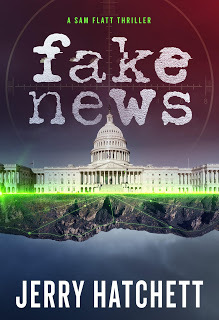
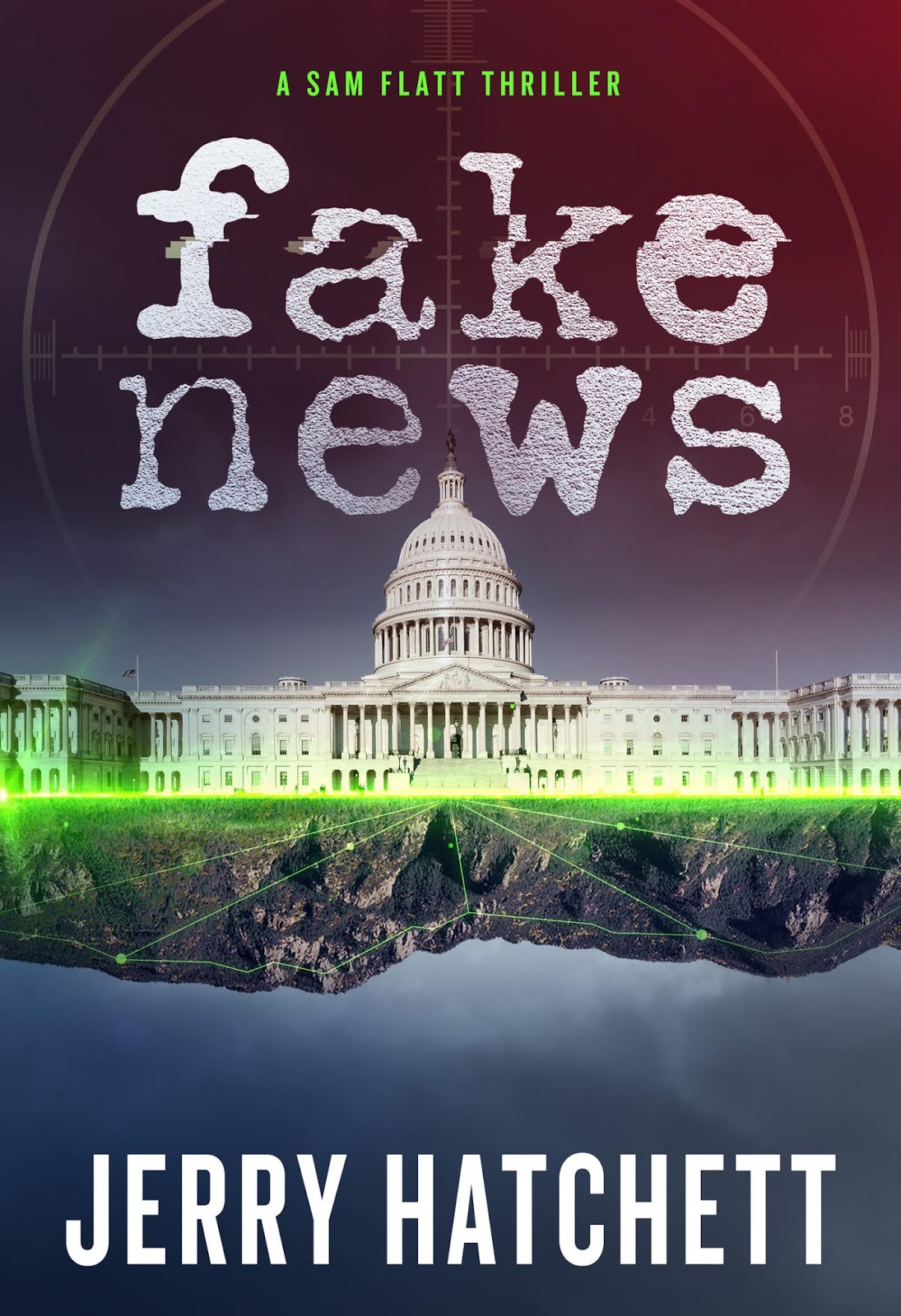
It was a long time coming but FAKE NEWS is almost here!
FAKE NEWS, my newest novel and the second installment in the Sam Flatt series, is almost here! Yes, it took a while. Four years, to be precise, but I'll be delivering books in more timely fashion going forward. Promise!
Here's the descriptive blurb: High-profile Washington politicos are vanishing. No trace. No ransom demands. Are they dead? Why were they chosen? Digital forensic sleuth Sam Flatt is dragged back into his black-ops past to answer those questions, but no one is ready for what he discovers. Discover a character in the mold of Mitch Rapp and Jack Reacher in this unputdownable thriller.
Pre-Order the Kindle Edition Here
Pre-Order the Paperback Here
Here's the descriptive blurb: High-profile Washington politicos are vanishing. No trace. No ransom demands. Are they dead? Why were they chosen? Digital forensic sleuth Sam Flatt is dragged back into his black-ops past to answer those questions, but no one is ready for what he discovers. Discover a character in the mold of Mitch Rapp and Jack Reacher in this unputdownable thriller.
Pre-Order the Kindle Edition Here
Pre-Order the Paperback Here
June 3, 2017
Global warming. Climate change. Paris Climate Accord. And your lying eyes?
Some of my friends call me anti-science because I'm convinced the entire global warming/climate change/whatever movement is a massive hoax. Maybe I should call them anti-math? Nah, calling my friends names accomplishes nothing.
Take a look at the simple graphic:
#1 - In 1989, that era's same esteemed government scientists released their findings on temp change from 1895 to 1989. The article from the NY Times, which I screenshot from nytimes.com today, is pretty straightforward.
#2 - A chart of the temperature anomalies (warming or cooling) covering 1991-2001, that came straight from a highly distributed climate paper that IMHO served as something of a launching pad for the whole global warming hysteria. The data behind the chart was from the same NASA dataset that powers virtually everything we're shown and told. Note the irrefutably straight line showing no global warming in the 1990s. (That paper went on to predict massive warming in the next decade, that did not happen, eventually leading to the name change of "global warming" to "climate change.")
#3 - A chart of the same temperature anomaly data, again from 1991-2001, the very data behind the chart in #2, that I personally downloaded from NASA less than an hour ago.
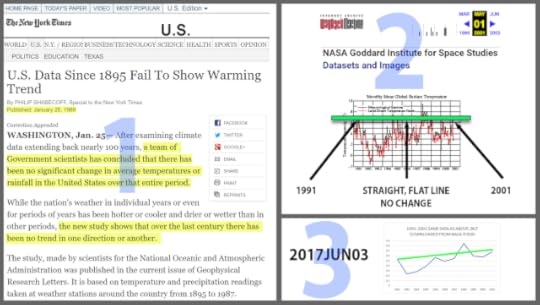
How does a straight, no-change line suddenly become a climbing, global warming line? They "adjusted" the data.
As someone who works as an expert in digital forensics, I well understand the implications of "adjusting" data; doing so in a logical manner is often necessary. When I'm doing a forensic exam in Houston of a computer on which the time zone was set in California, a two-hour adjustment may be necessary in order to properly analyze the data. I do it in a logical and defensible way so my work holds up in court. I do it based on the known and simple fact that it's two hours later on a clock in Houston than on a clock in California.
On the climate data adjustments, however, the dead opposite of logical is being done. For example, let's say there's a weather station that's been sitting in the same place for a hundred years. Let's say that place is Houston. A hundred years ago the location was completely rural. Today it's dead in the middle of Houston's (butt-ugly) urban sprawl.
Common sense says that today's temps being recorded by that station are being affected by the masses of people, cars, factories, buildings, and such that are now nearby and generating heat. So to make today's readings comparable in a valid way to the readings from a hundred years ago, today's readings should have the urban effect removed; you'd lower it just a bit (determining how much by observation and experimentation) so you're sure you're measuring the temperature of the local climate, and not the temperature as affected (raised) by the 2000 18-wheelers passing by the station every day, right? That's not how the adjustments have been carried out, however.
They've been done in the opposite manner. The readings in urban areas have been adjusted up from their already artificially-influenced state. Even more mind boggling, the temps from many decades ago are being adjusted down, even though the station was sitting in a rural area and there's absolutely nothing to suggest it needed adjustment at all. Except for the fact that if you lower the temp that was actually recorded in 1939, wow, you'll find that it has gotten hotter since 1939. Oh man, global warming.
When they're caught tampering with the data like this, they of course respond with a big paper explaining how they suddenly realized that thousands of weather stations were all wrong for 75 years and had to be retroactively adjusted to account for this and that and BOOM, their newly adjusted data just happens to perfectly support their claims. Then the #mediahyenas dutifully regurgitate the claims and ridicule any contrarians into silence.
This is a bit oversimplified but a deadly accurate portrayal of what's been going on. And that's just one of several ways the data has been blatantly manipulated to match the agenda. There is no meaningful temperature change when real data is used. It's almost like this planet was made for people to live on.
Take a look at the simple graphic:
#1 - In 1989, that era's same esteemed government scientists released their findings on temp change from 1895 to 1989. The article from the NY Times, which I screenshot from nytimes.com today, is pretty straightforward.
#2 - A chart of the temperature anomalies (warming or cooling) covering 1991-2001, that came straight from a highly distributed climate paper that IMHO served as something of a launching pad for the whole global warming hysteria. The data behind the chart was from the same NASA dataset that powers virtually everything we're shown and told. Note the irrefutably straight line showing no global warming in the 1990s. (That paper went on to predict massive warming in the next decade, that did not happen, eventually leading to the name change of "global warming" to "climate change.")
#3 - A chart of the same temperature anomaly data, again from 1991-2001, the very data behind the chart in #2, that I personally downloaded from NASA less than an hour ago.
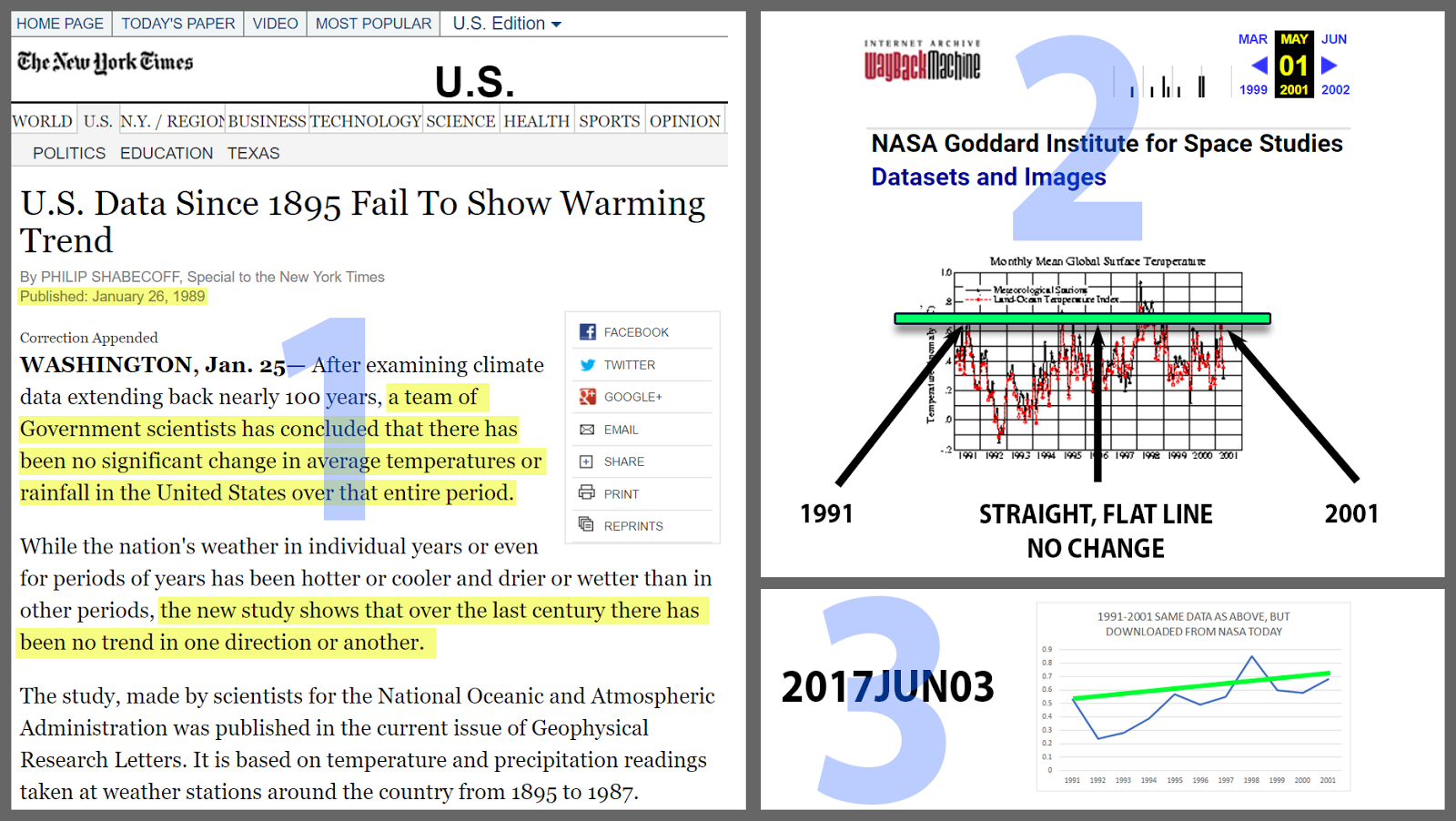
How does a straight, no-change line suddenly become a climbing, global warming line? They "adjusted" the data.
As someone who works as an expert in digital forensics, I well understand the implications of "adjusting" data; doing so in a logical manner is often necessary. When I'm doing a forensic exam in Houston of a computer on which the time zone was set in California, a two-hour adjustment may be necessary in order to properly analyze the data. I do it in a logical and defensible way so my work holds up in court. I do it based on the known and simple fact that it's two hours later on a clock in Houston than on a clock in California.
On the climate data adjustments, however, the dead opposite of logical is being done. For example, let's say there's a weather station that's been sitting in the same place for a hundred years. Let's say that place is Houston. A hundred years ago the location was completely rural. Today it's dead in the middle of Houston's (butt-ugly) urban sprawl.
Common sense says that today's temps being recorded by that station are being affected by the masses of people, cars, factories, buildings, and such that are now nearby and generating heat. So to make today's readings comparable in a valid way to the readings from a hundred years ago, today's readings should have the urban effect removed; you'd lower it just a bit (determining how much by observation and experimentation) so you're sure you're measuring the temperature of the local climate, and not the temperature as affected (raised) by the 2000 18-wheelers passing by the station every day, right? That's not how the adjustments have been carried out, however.
They've been done in the opposite manner. The readings in urban areas have been adjusted up from their already artificially-influenced state. Even more mind boggling, the temps from many decades ago are being adjusted down, even though the station was sitting in a rural area and there's absolutely nothing to suggest it needed adjustment at all. Except for the fact that if you lower the temp that was actually recorded in 1939, wow, you'll find that it has gotten hotter since 1939. Oh man, global warming.
When they're caught tampering with the data like this, they of course respond with a big paper explaining how they suddenly realized that thousands of weather stations were all wrong for 75 years and had to be retroactively adjusted to account for this and that and BOOM, their newly adjusted data just happens to perfectly support their claims. Then the #mediahyenas dutifully regurgitate the claims and ridicule any contrarians into silence.
This is a bit oversimplified but a deadly accurate portrayal of what's been going on. And that's just one of several ways the data has been blatantly manipulated to match the agenda. There is no meaningful temperature change when real data is used. It's almost like this planet was made for people to live on.
August 24, 2015
Crowdfunding: Is anyone really looking out for the buyer?

To my faithful blog readers: This entry has little to do with writing, but as members of the online community, we all have a vested interest in the topic. Please give it a read.
Crowdfunding is all the rage, allowing innovators to bring exciting new products to market in a way that has never before been possible. A long time ago, I invented a product myself. And while I did successfully get it to market in a pretty big way, had crowdfunding been around in the mid-nineties, my process might have looked very different. It's exciting to see the little guys have an opportunity to reach the masses with product ideas and generate real results if the idea catches the crowdfunding public's fancy.
But there are problems. In the past, you typically had to have more than an idea. If you wanted to take an idea from daydream to market, you had to do a lot of work in between. You had to turn your idea into something tangible; in inventors' parlance, you started with a working model, something that proved your idea would actually work in the real world. From there you moved on to prototypes, more polished versions of the working model that more closely resembled the final product that you wanted to sell to the public. If all that worked out, you finally moved on to either licensing the product to an existing manufacturer, or went about the fundraising process to make and sell the product yourself.
All that has changed. Thanks to the ready availability of 3D modeling and rendering tools, along with countless people skilled in using them, it's easy to create a "product" in the virtual world that looks real, sounds real, and is accompanied by tantalizing descriptions of how it's going to change your life. More to the point, it's now easy to do all this without ever having proven that the idea works in the physical world. And you can take that purely virtual creation to Kickstarter or Indiegogo and present it to the masses and ask those masses to fork over tons of cash to you for it.
Many times, the process works as promised. You spend your money and you get a product in return. That often doesn't happen within the promised timeframe, but you eventually get something for your cash. There are a lot of people using the system honestly and ethically, and nothing in this post should be seen as disparaging to those operators.
But what if the "product" doesn't work? Case in point: The Body Dryer. Although I should have known better, I saw the slick renderings of this device and signed up right away. (I loved the idea of stepping out of the shower onto a little platform that encircled me with warm air that dried me without the need for a towel, and I was the second backer overall in its crowdfunding campaign.) The campaign was a success (more than $304,000 raised) and hundreds of thousands of dollars were turned over to the people behind the invention. There was only one big, huge, mammoth issue. In the real world, it didn't work. The projected delivery date came and went. And time passed. And more time passed. And more time. Eventually, the sad but inevitable news came in an email to those of us who had bought into the campaign: "Sorry, our idea didn't work out." (That's of course a paraphrased summary.)
 The Body Dryer as shown on its Indiegogo campaign page
I'll give credit to the guys who were trying to invent the Body Dryer. I believe their intentions were pure, and when they eventually had to throw in the towel, they did make arrangements to return to the backers what cash hadn't been spent. Looks like I'll get back about $45 of the $125 plus shipping that I forked over. Pure intentions or not, however, this campaign highlights the troubling problem that people are able to sell something to the public that doesn't really exist, and may never exist.
So who's looking out for the buyer in the crowdfunding world? I'm not talking about complying with the legal minutiae we agree to when we participate in crowdfunding. I'm sure the fine print at Indiegogo and Kickstarter spells out the fact that we understand we may be spending our money for nothing. But in a simpler sense of right and wrong, who has the public's back? I'm a huge believer in personal responsibility. I'm technical and mechanical enough that I should have been able to look at what was being promised in the Body Dryer and know that it wouldn't work. It's on me.
But that doesn't alleviate the seller, or the facilitators, of responsibility. When these crowdfunding companies collect thousands, or hundreds of thousands, or even millions of dollars from the public in a campaign, then take their cut and hand the remainder over to the "idea guys," don't they have at least a moral, ethical burden to take a look at what's being promised and determine that the promises are at least realistic?
To be certain, both Kickstarter and Indiegogo tout their oversight and their careful examination of campaigns for problems. But is that translating into serious protection of backers' interests, or is caveat emptor their real underlying mode of operation?
There are many, many articles out there from major publications detailing high-profile crowdfunding failures and problems. Click here for a look. I'm not here to delve into the stats and such that others with far more resources have already covered. My big question and concern is just what I posted in the preceding paragraph: Are the crowdfunding companies serious about looking out for backers, or at the end of the day is their cut of a huge campaign irresistible even when significant problems and challenges should be obvious?
There's one campaign in particular that has driven me to ask this question. I, along with about 18,000,000 fellow Americans, suffer from sleep apnea. The most common treatment is a CPAP (continuous positive airway pressure) device that keeps us breathing through the night. An oversimplified explanation of CPAP is that it blows a steady stream of air into your nose (and/or mouth depending on the configuration) that is of significant pressure to keep the throat inflated and the oxygen flowing.
While I and countless others consider CPAP a blessing, the technology is cumbersome, uncomfortable, and restrictive. It takes quite a bit of air pressure to keep the human airway inflated and open, and maintaining that pressure requires not only something to generate the air pressure, but also a hose to deliver the air from the device to the mask, a mask that straps to your face tightly enough to maintain a perfect pressure seal.
So the idea of something tiny and unobtrusive to replace today's CPAP devices is very appealing. Very. Meet Airing, an Indiegogo campaign that as of this writing has generated over a million dollars in pledges. In case you're not familiar with the Indiegogo process, when you pledge to "back" a product, you give your credit card information up front in exchange for the promised "perk" that's supposed to be delivered at some future date. When the fundraising campaign ends and the goal has been met, Indiegogo charges the credit cards of all backers, takes out 4% of the total for themselves, then gives the remainder to the campaign owner.

Airing looks like a miracle device to those of us who go to sleep every night with a CPAP mask strapped to our faces. It's tiny. No hoses to string from the CPAP device to your face. No claustrophobia-inducing apparatus. No strap and mask grooves etched into your skin when you wake up. A miracle. This comparison photo from the Airing campaign page on Indiegogo makes a pretty dramatic statement.

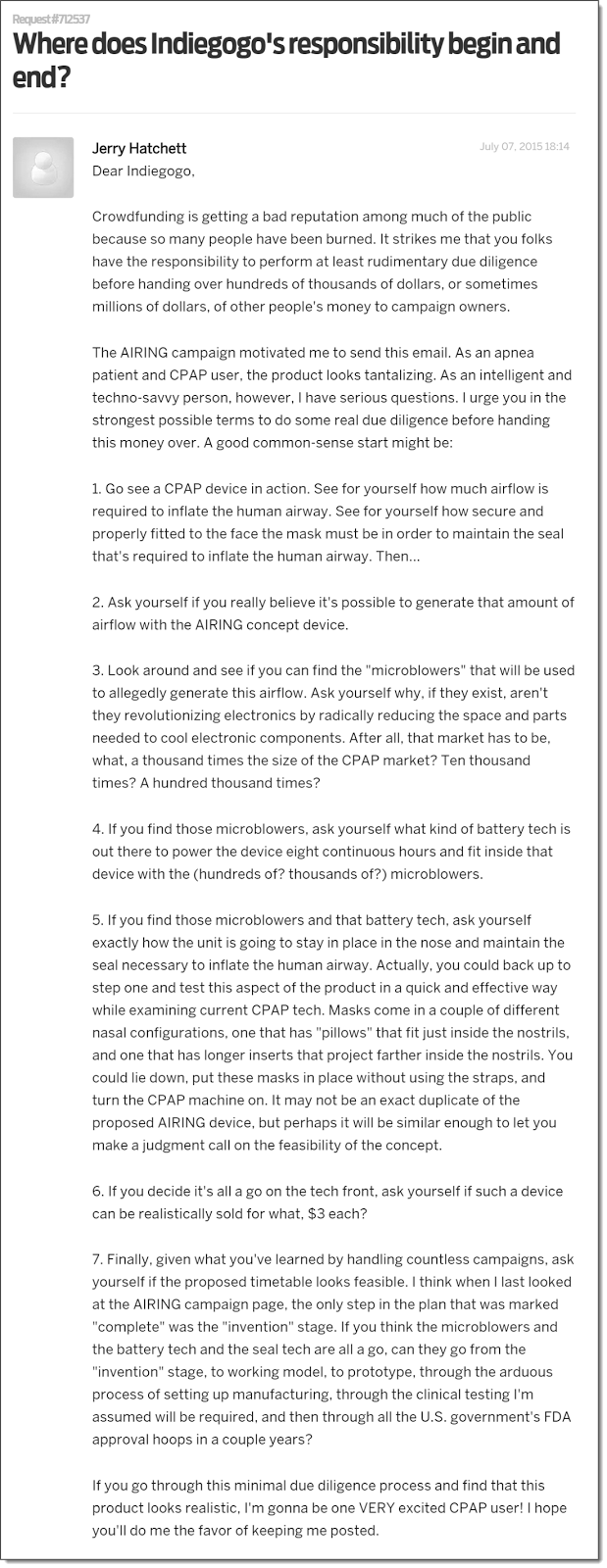
My instant emotional response was to sign up for this miracle. Then I remembered the Body Dryer and started really examining the Airing concept and claims. After some time pondering it, I was bothered enough by the campaign that I decided to contact Indiegogo. I sent the following to their Customer Happiness Team (not kidding) on July 7, 2015.
Although the site said I would hear back from them in 24 hours, it actually took a week for this form response to arrive.
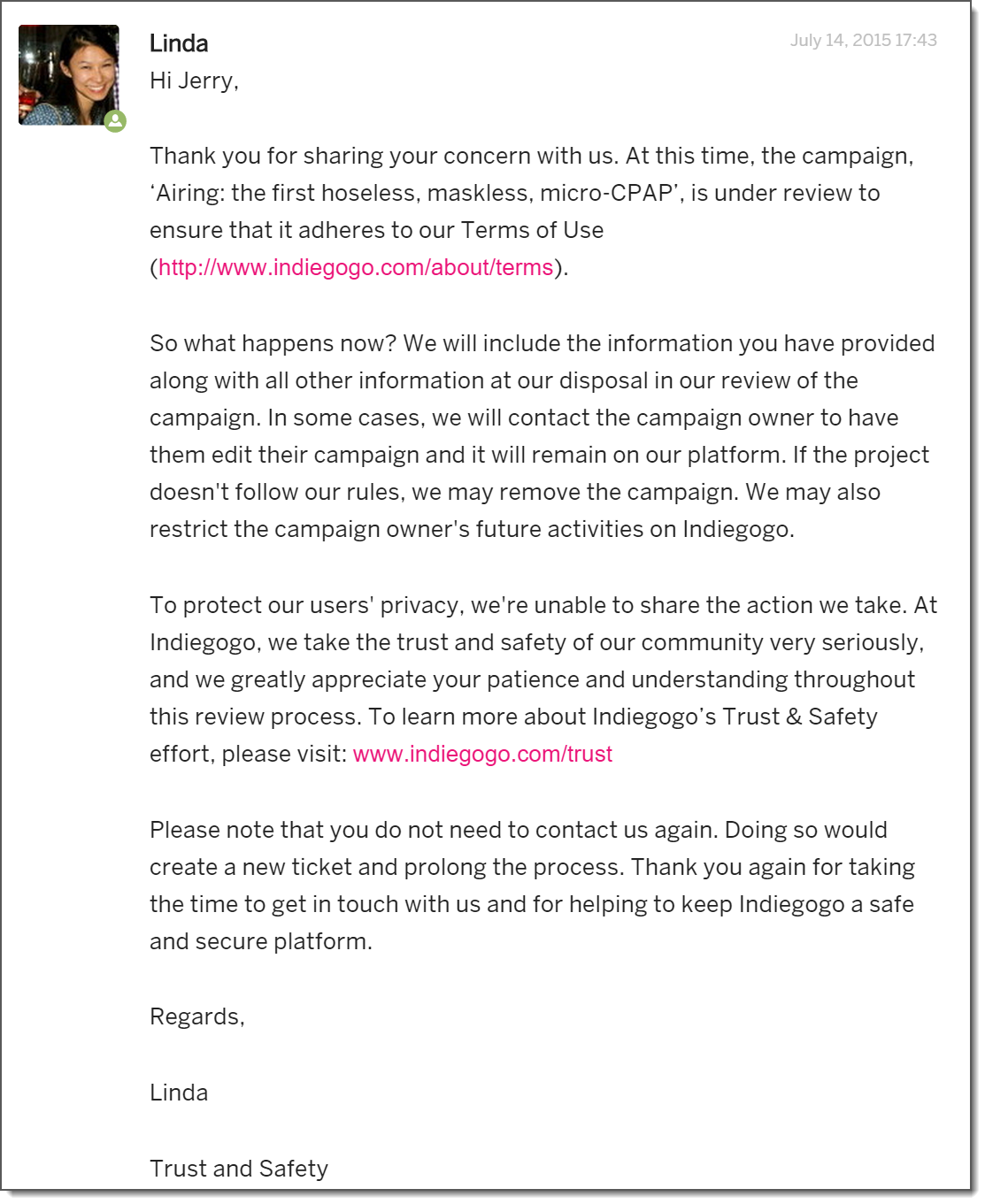
Tell me if I'm wrong but it reads like a blow-off response to me, and given that well over a month has passed since this exchange and Airing is still live on the Indiegogo site, I can only assume they found nothing troubling about the campaign.
Although I'm technical and mechanical, I'm absolutely not an engineer. For that reason, I'd love to hear from any engineers out there who are proficient in the relevant fields. If I'm wrong, please tell me, but to my mind, this "invention" looks completely impossible in today's state of technology. I laid out a lot of my concerns in the letter pictured above, but for starters I don't believe microblowers exist that can possibly move the necessary air in the space available in this device. (I see that the campaign page now talks about using the money to develop these microblowers. It's possible I'm misremembering, but my memory is that a couple months ago, the page was presenting the microblowers as something that already exists; and I still get that same impression when I watch the main video on the campaign page.)
I also can't fathom any battery tech that's going to fit into that device along with "hundreds of microblowers" and provide continuous power for eight hours. Finally, even if you deliver the necessary airflow and the electrical power required, how is the pictured device going to stay in the nose and provide the pressure seal required? Are we to believe that the manufacturers of today's CPAP devices include the plethora of straps and such just for fun? If it were possible to maintain such a seal with a couple of nosebuds, I suspect that style of mask would have been introduced a long time ago.

Wrapping up, this one campaign makes my point about the glaring problem with today's crowdfunding apparatus. While making clear that I'd be delighted to be proven wrong, I think this campaign is cashing in on the desperation of apnea sufferers by promising a product that cannot possibly be produced and delivered. I think Indiegogo has a duty to seek out those with relevant expertise and ask if they think the device is possible with today's level of technology. But from where I'm sitting, it seems to me that Indiegogo is more concerned about their cut than they are about protecting those who pledge their money.
July 12, 2015
For Fellow Writers, and Readers Who Like to Peek Behind the Curtain
As an author, I'm very reader-centric, so I rarely post entries geared toward other writers. Every now and then, however, I get the urge. Like today. This little missive started out as a response to a question I saw on a Facebook group but by the end, it had grown enough to qualify as a blog post, so here we are.
The author asked for input on getting established, finding a fan base as a new author: How do you do it? What works? What doesn't?
These questions get asked a lot. I'm not yet to the point that I consider myself established, but having been published a couple years now, I'm making substantive progress. Most of the time my books are well ranked in multiple categories. I have a steady stream of email coming in from kind and excited readers. My fan base is growing steadily and there's a real clamor for the return of Sam Flatt . (Huge thanks to my readers!) So while I'm not yet where I want to be, I'm making real progress and I do have some observations that I hope new authors will take to heart.
There is no magic bullet, but there is an indispensable foundation: You must have the talent, honed craft, and stamina to write books that people want to read. If you don't have that, all the rest is meaningless. Be sure this is taken care of, and accept that this is a years-long process the overwhelming majority of the time. Ignore the stories about such and such whose first book sold a million copies, because those are extreme outliers. Chasing that is literally and exactly like chasing a lottery win.
I could literally whip out a dozen blog posts elaborating on the details of the above paragraph, but I shan't. There's a staggering amount of info already out there that will help you build that foundation. Use it. I do recommend starting with the greatest book I've found on the craft of writing, Stein on Writing .
.
Once you've shored up the foundation described above, you really do move into no-magic-bullet land, but here are some of my observations:
1. If you've written a book that people will want to read, repeat that process as soon and as often as possible. If you please a reader, the very first thing they do when they finish your book is look to see what other books you have available. Write more books that people will want to read. You don't have to be as impossibly prolific as my friend Russell Blake , who spits out exciting thrillers that lots of people want to read at the the rate of about one a month, but you do need to always be seriously working on the next book.
2. Do everything you can to score BookBub promos. I've been a businessman my entire adult life and have spent countless dollars on marketing and advertising, and I've never once seen anything remotely like BookBub. The notion of an ad venue consistently returning a profit in the very short term is unheard of, but that's what BookBub does. (Readers, I highly recommend you check out BookBub, too. They generate great exposure for authors because they take care of their readers. They're very selective in what they promote and this has led to a whole lot of readers who trust them to find good books.)
3. Never, ever stop honing your craft, and write more books that people will want to read.
4. Understand that social media is...well... social. It's not called "commerce media" or "ad media" or "marketing media." If you want results from social media, be social. Make friends, not customers. Talk to those friends as friends, not as potential customers. Talk about life, about sad things, funny things, frustrating things, good things, bad things. Get to know people. Care about them. If you build real relationships, these people will care on the rare occasion you have something meaningful to share about your books. You wouldn't go to a party or a football game or to church and walk around screaming, "BUY MY BOOK!" Would you? (If your answer is 'yes,' I'm guessing you don't get invited to a lot of social gatherings.)
5. Never, ever stop honing your craft, and write more books that people will want to read.
6. Do exactly what the author did in the Facebook group I mentioned up top: Ask those who have gone before for insight, and pay attention to what they say.
7. Do not get caught up in the vortex of endlessly analyzing Amazon algorithms and looking for a way to exploit them. Those algos will change, because Amazon is in endless pursuit of being the most customer-centric business ever formed. How do you please customers who read? You provide books they want to read, and *that* is what Amazon will keep evolving toward. Be ahead of the algos by continually honing your craft and writing more books that people will want to read.
I try to avoid cliches, but sometimes they're the best way to communicate an idea, so I'll wrap this up with one: This is a marathon, not a sprint. Never forget that.
Until next time!
The author asked for input on getting established, finding a fan base as a new author: How do you do it? What works? What doesn't?
These questions get asked a lot. I'm not yet to the point that I consider myself established, but having been published a couple years now, I'm making substantive progress. Most of the time my books are well ranked in multiple categories. I have a steady stream of email coming in from kind and excited readers. My fan base is growing steadily and there's a real clamor for the return of Sam Flatt
. (Huge thanks to my readers!) So while I'm not yet where I want to be, I'm making real progress and I do have some observations that I hope new authors will take to heart.There is no magic bullet, but there is an indispensable foundation: You must have the talent, honed craft, and stamina to write books that people want to read. If you don't have that, all the rest is meaningless. Be sure this is taken care of, and accept that this is a years-long process the overwhelming majority of the time. Ignore the stories about such and such whose first book sold a million copies, because those are extreme outliers. Chasing that is literally and exactly like chasing a lottery win.
I could literally whip out a dozen blog posts elaborating on the details of the above paragraph, but I shan't. There's a staggering amount of info already out there that will help you build that foundation. Use it. I do recommend starting with the greatest book I've found on the craft of writing, Stein on Writing
.Once you've shored up the foundation described above, you really do move into no-magic-bullet land, but here are some of my observations:
1. If you've written a book that people will want to read, repeat that process as soon and as often as possible. If you please a reader, the very first thing they do when they finish your book is look to see what other books you have available. Write more books that people will want to read. You don't have to be as impossibly prolific as my friend Russell Blake
, who spits out exciting thrillers that lots of people want to read at the the rate of about one a month, but you do need to always be seriously working on the next book.2. Do everything you can to score BookBub promos. I've been a businessman my entire adult life and have spent countless dollars on marketing and advertising, and I've never once seen anything remotely like BookBub. The notion of an ad venue consistently returning a profit in the very short term is unheard of, but that's what BookBub does. (Readers, I highly recommend you check out BookBub, too. They generate great exposure for authors because they take care of their readers. They're very selective in what they promote and this has led to a whole lot of readers who trust them to find good books.)
3. Never, ever stop honing your craft, and write more books that people will want to read.
4. Understand that social media is...well... social. It's not called "commerce media" or "ad media" or "marketing media." If you want results from social media, be social. Make friends, not customers. Talk to those friends as friends, not as potential customers. Talk about life, about sad things, funny things, frustrating things, good things, bad things. Get to know people. Care about them. If you build real relationships, these people will care on the rare occasion you have something meaningful to share about your books. You wouldn't go to a party or a football game or to church and walk around screaming, "BUY MY BOOK!" Would you? (If your answer is 'yes,' I'm guessing you don't get invited to a lot of social gatherings.)
5. Never, ever stop honing your craft, and write more books that people will want to read.
6. Do exactly what the author did in the Facebook group I mentioned up top: Ask those who have gone before for insight, and pay attention to what they say.
7. Do not get caught up in the vortex of endlessly analyzing Amazon algorithms and looking for a way to exploit them. Those algos will change, because Amazon is in endless pursuit of being the most customer-centric business ever formed. How do you please customers who read? You provide books they want to read, and *that* is what Amazon will keep evolving toward. Be ahead of the algos by continually honing your craft and writing more books that people will want to read.
I try to avoid cliches, but sometimes they're the best way to communicate an idea, so I'll wrap this up with one: This is a marathon, not a sprint. Never forget that.
Until next time!

February 23, 2015
SPACE: An Old Frontier?
Circa 2008 I did the "VIP" tour here at NASA. ("Here" = Houston. Anyone can take this tour; you just pay something like $80 for the tour instead of the normal $15 or whatever it is.) You get a lot more access, see a lot of the real work going on behind the scenes, eat with the engineers and astronauts, go inside the old mission control room made famous in Apollo 13, where you can sit and play at the same consoles, etc.
We were lucky in that a shuttle was in space while we were there. We were watching the mission control guys do their thing and I noticed among the wall of monitors a smallish area with a black screen and green hex characters. It looked a lot like the picture below.
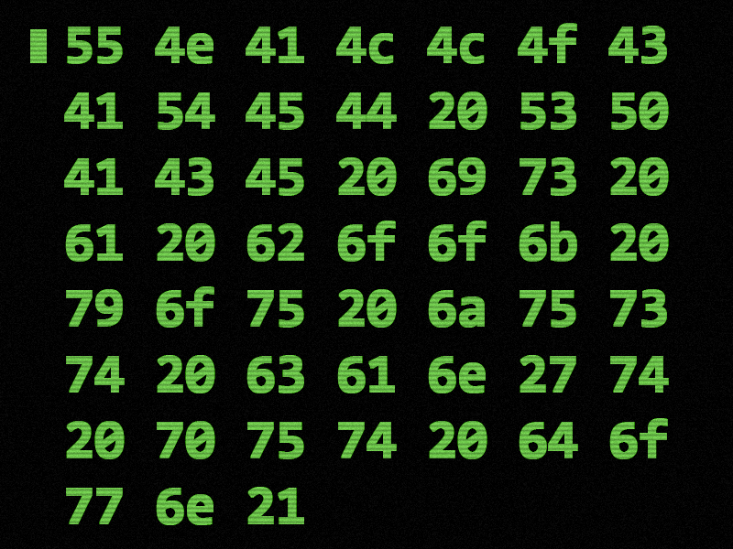
I asked what it was and the guy said, "We call that the scratch pad. It's a live mirror of the terminal on the shuttle. When the astronauts enter a command, we watch and double-check it before they press Enter."
"But why is it in hex?" I said. (After all, even the vast majority of multi-decade nerds like me have never needed to enter any kind of computer command in hex, aka hexadecimal. Yes, digital forensicators of course still encounter these strange looking building blocks of data, but way behind the scenes where the non-nerds dare not tread. Not as a way to tell a computer to PRINT, for example, or COPY something. We were beyond all that a long time ago.)
"They enter the commands in hex," the NASA guy said.
"For what system?"
"The main flight computer."
"Sorry, we're still not communicating, because I know we don't have astronauts up there entering flight commands in hex. So what--"
"Yes, we do."
"As in the flight computer? You're telling me that if shuttle astronauts need to change something in their flight plan, they're doing it on the fly, in hex?"
"Yes."
"Uh... why ?"
"We still use the Apollo flight control software."
I laughed. "No, you don't. You're pulling my leg."
"Yes. We. Do." The look on Mr. Man's face made it clear that he pulls no legs.
After taking a few moments to compose myself (close my mouth that was hanging open), I said, "That's unbelievable. Why would we still be using forty-year-old software?"
"Because it's the greatest and most stable piece of software ever written, to this day."
Later in the tour, we got to see a cutout of part of a shuttle, the part that contained the racks of computer equipment. They looked ancient because, you guessed it, it was Apollo-era equipment. Racks stacked with row after row after row of big clunky metal boxes and contraptions. Looking at an array of gear perhaps six feet long and four feet high, I learned that this was the still-in-use configuration of "memory." I don't recall the exact amount of memory this conglomeration of iron contained, but it was something stunning, like eight megabytes. (That smartphone in your hand or your pocket contains hundreds of times that amount of memory.)
Yes, this is a true story. And no, I'm not misremembering my decades. It was almost certainly 2008, but definitely no earlier than 2007. I still find the idea of using such antiquated technology to have been a strange approach to flying around space so many years after the Apollo era. But there's probably also a good life lesson tucked in there about the so-called greatness of our knowledge today as compared to years past. The guys who wrote that software in the 1960s were using slide rules, not pre-written libraries of code like we have today. They were the giants upon whose shoulders today's software geniuses stand. Even if they don't know it.
* * *
Speaking of space (ahem!), have you gotten your copy of Unallocated Space yet? It's made a bunch of the good lists at Amazon already, but it will be doing even better if you go get your copy right now! You can grab the Kindle edition right now for just $2.99. The print edition is literally days away from shipping, and the Audible edition is in production. It's being voiced by the same stellar narrator who did Seven Unholy Days, William Salyers, a major talent in the world of people with great voices. As a teaser, check out the first chapter below. It's gonna be good!
February 10, 2015
It finally happened!
It finally happened: Unallocated Space is now available in Kindle Edition on Amazon. The print version is coming very soon. I'm very proud of this one and think it's my finest work yet. Please check it out. If you read it and like it, please leave a review and help spread the word. I've said it often, but in today's publishing world, you the reader hold all the power, more than ever before. Thanks for reading!
Unallocated Space on Amazon
Unallocated Space on Amazon

SPACE. It's not just the glitziest casino ever built; it's the largest man-made structure in history. The scale and technology of this futuristic wonderland have captivated Las Vegas and the world, but beneath the shiny surface, something old lurks and festers.
The casino's state-of-the-art gaming machines have been hacked; it's costing the company millions, and eccentric digital forensics expert Sam Flatt is brought in to find and fix the problem. But when Flatt stumbles onto the source of the technical trouble, he unearths massive financial fraud--and something far darker.
UNALLOCATED SPACE is a thriller that delves beneath the surface and into the darkest recesses of humanity's capability for cruelty. It's a place where wealth and power can buy anything, and gamble for any stakes imaginable. And unimaginable.
May 11, 2014
Book Thoughts: Buried Secrets by Joseph Finder
For my fellow thriller readers and authors: I recently finished Joseph Finder's Buried Secrets and have to dole out some praise and a hearty recommendation. It grabs your attention early and never lets go. Well written. Finder finds that elusive balance between HypoInfo and HyperInfo; he gives you enough info to figure out what's going on or what something means, but doesn't insult by spoonfeeding an explanation for absolutely every point, as if you're too simple to figure it out on your own. He writes what I like to call "thinking thrillers" without becoming in the least bit arcane and pretentious.
I give this one 4.75 stars. Although he didn't fill it with a bunch of cybernonsense or magic guns, there were a handful of errors on computer and firearm issues. Not many, mind you, just enough to glitch the read on occasion. I also thought the ending was a little anti-climactic; felt like he was tired and wanted to wrap it up.
Whether you're a reader, a writer, or both (like me), there's a lot to like here. Grab a copy.


I give this one 4.75 stars. Although he didn't fill it with a bunch of cybernonsense or magic guns, there were a handful of errors on computer and firearm issues. Not many, mind you, just enough to glitch the read on occasion. I also thought the ending was a little anti-climactic; felt like he was tired and wanted to wrap it up.
Whether you're a reader, a writer, or both (like me), there's a lot to like here. Grab a copy.
April 14, 2014
The Writing Process: Some Questions, Some Answers
The Writing Process (a blog tour)
My dear friend and awesome writer, Dora Machado, author of The Curse Giver, passed me the baton for the Writing Process Blog Tour. This means I have to answer four questions about my work. Here are my answers:
What are you working on?A new thriller, of course! It's called Unallocated Space, and I think it will be my best book so far, filled with great characters, exciting technology, and a story that keeps you on the edge of your seat.
How does your work differ from others in its genre?There are a lot of great thriller authors out there, and to stand out you really need to create stories that are distinctive, so I put an enormous amount of thought into coming up with story ideas that are truly fresh. Second, my "signature" as an author is a storytelling style that readers find hard to put down.
Why do you write what you write?That's easy. I write stories I'd love to read myself.
What is your writing process?I sit down and start writing, and that's not a glib answer. I've tried outlining and planning the story in great detail, but that doesn't work for me. It feels like painting by numbers, and it robs my work of the energy of spontaneity. Naturally, I have the broad story in mind before I start, but the details are created on the fly. It makes writing a lot more fun for me.
I’m passing the baton to:
Catherine Lea - My friend and fellow thrillerist, Catherine Lea, is a great writer who pens exciting tales filled with deep, memorable characters. She's an even more remarkable woman who lives and writes from New Zealand.
Brooke Monroe - My beautiful daughter Brooke has finished her first novel, a gripping YA fantasy that's gonna turn a lot of heads when it hits the market. She (thankfully) lives near me here in the Houston area.
Lea Ryan - This friend has one of the most amazing gifts for language I've ever run across. The words in her paranormal fantasy stories are almost melodic. She also has a really cool blog where she reviews the latest movies she and her family watched.
My dear friend and awesome writer, Dora Machado, author of The Curse Giver, passed me the baton for the Writing Process Blog Tour. This means I have to answer four questions about my work. Here are my answers:
What are you working on?A new thriller, of course! It's called Unallocated Space, and I think it will be my best book so far, filled with great characters, exciting technology, and a story that keeps you on the edge of your seat.
How does your work differ from others in its genre?There are a lot of great thriller authors out there, and to stand out you really need to create stories that are distinctive, so I put an enormous amount of thought into coming up with story ideas that are truly fresh. Second, my "signature" as an author is a storytelling style that readers find hard to put down.
Why do you write what you write?That's easy. I write stories I'd love to read myself.
What is your writing process?I sit down and start writing, and that's not a glib answer. I've tried outlining and planning the story in great detail, but that doesn't work for me. It feels like painting by numbers, and it robs my work of the energy of spontaneity. Naturally, I have the broad story in mind before I start, but the details are created on the fly. It makes writing a lot more fun for me.
I’m passing the baton to:
Catherine Lea - My friend and fellow thrillerist, Catherine Lea, is a great writer who pens exciting tales filled with deep, memorable characters. She's an even more remarkable woman who lives and writes from New Zealand.
Brooke Monroe - My beautiful daughter Brooke has finished her first novel, a gripping YA fantasy that's gonna turn a lot of heads when it hits the market. She (thankfully) lives near me here in the Houston area.
Lea Ryan - This friend has one of the most amazing gifts for language I've ever run across. The words in her paranormal fantasy stories are almost melodic. She also has a really cool blog where she reviews the latest movies she and her family watched.
April 11, 2014
The Projectionist: Chapter 17
Chapter 18
Porter opened his eyes—correction—he tried to open his eyes, but they were matted shut. He used a thumb and index finger to gently unstick them, then opened them. Then wished he hadn't. The light pouring through his bedroom window hit them like needles, hot needles that went straight through the eyeballs and pierced his brain. What the hell was wrong with him? He turned to look at the old Big Ben wind-up alarm clock on the nightstand. It said eleven-fifteen, which couldn't be right. Porter Hamlin woke up at 6 AM, day after day after day. The alarm was set for 6:05, but it was never needed, hadn't been for fifty years. Turning his head made the pain worse, if that was possible. (Yes, definitely possible.) He rolled over on his side, buried the left side of his face in the pillow, and looked at the sunlit window, gradually opening his eyes to admit more of the soft light that powered through the blue curtain.
After a couple minutes it started coming back, little flashes at first, then more and more. He had gotten drunk. Very, very drunk. He had started at Harold's bar and after that…what? He closed his eyes, tried to concentrate. He remembered Harold refusing to serve him another drink, remembered it pissing him off, but what—oh crap, now he remembered: Debra. His sister-in-law who didn't exist. Debra, with the beautiful feminine hands. (The rest of her wasn't bad, either.) The stories she told. The book she showed him. A book that looked older than him, older than Alice, but had their picture in it. Cripes, if the book was really that old, it had a picture of a movie theater that was created before movies were even invented. How was any of that possible?
The phone rang in the kitchen. He had wanted to install more phones in other rooms of the house, but Alice refused because she hated phones, didn't even want to see them any more than necessary. Yes, she got her way on that, like she got her way on most things. Why was that? Why hadn't he been more assert—
Another ring yanked him from his mental meandering. He rolled out of the bed, stretched, then gave a start when he realized he was naked. Porter Hamlin was a pajamas man, thank you very much, content to see as little of his aging body as possible. The blasted ringing continued, each strike of the old clapper on the old bell in the old phone a direct strike on his brain. He turned to head toward the kitchen and nearly jumped out of his saggy old naked skin. Lying in the bed, his bed—his and Alice's bed—tucked into the covers with a sweet little sleep-smile on her face, was Debra. His mind ceased to work in any meaningful way. He covered his privates with his hands until he could tiptoe to the door and retrieve his bathrobe from its hook. (He had picked up the tiptoe thing when he was a kid; his bedroom had tile floors that were always ice cold on his bare feet. Talk about old habits dying hard.)
Safely wrapped in the robe, he stumbled his way to the kitchen, where the phone continued its assault on his senses. He yanked the receiver off the hook and stuck it to his ear. "Who is it and what the hell do you want?"
After a moment of silence, Larry Walker's slickish lawyer voice said, "Uh, Porter?"
"Yes, Larry. What is it?"
"Are you okay?"
"I'm…fine. What is it?"
"Need you to drop by the office sometime this afternoon."
"Why?"
"I have a letter I'm required to read to you today."
"Wait, what day is this?"
"It's Sunday. And no, I normally don't work on Sunday, but I have to make an exception for this. What time can you come?"
"How about two?"
"Perfect. See you then."
Porter hung the receiver back on its hook, stood there a moment, then turned to go back to the bedroom and see if perhaps he was really still asleep and this was all a dream. There was no need.
Debra stood in the doorway to the bedroom. Naked as a jaybird. She smiled and said, "Hey, sweetie. Who was on the phone?"
Porter's senses swirled, then faded to gray on their way to black as he crumpled to the floor.