
Janet K. Halfyard's Blog
June 19, 2017
Wonder Woman
So then, Wonder Woman. Where do I start? Well let’s start by saying alleluia, and see where we go from there.Somewhere around 2008 I wrote the first version of what ended up in 2013 as Cue the Big Theme? The Sound of the Superhero, essentially a little requiem for the demise of thematically-driven superhero scoring in the era of CGI. I contrasted how the two big superhero scores of the pre-CGI era, Williams’ Superman (1978) and Elfman’s Batman (1989) used their themes to construct their hero’s identity, Williams’ Great Big Optimist and Elfman’s complex, troubled Gadget Man. I have a particular love of Elfman’s approach, where he only really composes one five note motif for Batman and then constantly reinvents and varies it to provide the music for all aspects of Our Hero, whether that is the action hero, the genius detective, the terrifyingly powerful horror-film figure, the troubled soul, the bereft child or the man in love (which I wrote about at some length here). And then along come a) CGI and b) Hans Zimmer and the musical landscape changed. The music no longer had to work so hard to convince us that the polystyrene boulders that Superman was hauling around were heavy, or that Batman’s car was going really fast, and so it shifted away from action and toward psychology, and in doing so rather abandoned all those marvelous themes. Sing me the theme from Batman Begins, anyone? And while I have always been an advocate of the ‘different does not actually mean worse, it just means different’ school of thought, I missed the themes, and I especially missed the cleverness with which a composer like Elfman could take one musical idea and make it mean so many things.And so, alleluia, Wonder Woman, scored by Rupert Gregson-Williams, younger brother of the better-known Harry. RGW is mostly known, until very recently, for scoring comedy and the lighter end of film (highlights include the 2014 Postman Pat: The Movie). I do so like it when you get a composer basically new to a genre, who therefore has not become what Elfman was by the end of the 1990s, namely was Sick to Death of Superheroes. Anyway, RGW writes an absolute blinder for Wonder Woman; and he does my favourite thing, which is have one musical idea that he uses to generate all his musical ideas about her. I am going to resist the temptation to sit here and throw musical examples at you, so some of this you are going to have to take my word for.On the face if it, it looks like she has two distinct themes: a lyrical, extended anthem (which I will come back to) and the one we already knew from Batman v. Superman (and therefore written by Hans Zimmer/ Junkie XL). This one has driving drums, wailing electric cello (which could easily be mistaken for an electric guitar), both the instrumentation and the whole shape of the theme breaking every expectation of what ‘female’ music sounds like. My good friend (actually, never met him, but love his work) Phillip Tagg would point to the fact that both the ascending melodic line and the use of the electric guitaresque cello and drums point to masculine musical codes – the ladies are properly scored with nice flutes and pianos, yes with cellos, but nice tuneful cellos; and with gently curved melodies (up and back down; or down and back up). WW’s big theme does not do this. Oh my word, no it does not (nor does Ms Buffy Summers’ theme tune, of course).OK, music: the theme goes rapidly up a broken chord (E – G – B, so outlining the triad and rising up from the tonic to the great heroic interval, the perfect fifth) and then it wails; it undulates from the B to the B flat a semitone below and then back to the B again (want a score example? Go here). So, strip away the banshee ululation, and the basic shape is B – B flat – B. We are in the key of E minor, so the B is our heroic perfect fifth; the B flat, meanwhile, is the tritone, the diabolus in musica, the interval associated most often with evil, danger and dysfunction. What the heck is it doing here? Well, Batman’s scoring (1989) also uses lots of tritones – that’s part of how Elfman makes him complex and ‘dark’ in comparison to Williams’ sunny Superman. But Diana is not dark – she is much more like Superman in many respects. And she clearly is not evil - but oh, the number of bad women in film music history with tritones in their (usually jazzy) scoring to symbolize how very naughty they are, from the tritones all over the place in Franz Waxman’s 1941 score for the sexy, threatening and entirely absent eponymous anti-heroine in
Rebecca
to those in both Bellatrix Lestrangeand Dolores Umbridge’sthemes in the Harry Potter scores (links are to youtube examples)…. So why the tritone here, given that Diana is clearly not one of those women?Well, let’s think of this tritone as the equivalent of the word ‘bitch’, a word we so often find applied to women of power from Hillary Clinton to any woman on social media who has taken a stand against mysongynistic attitudes; a word that would also describe all those bad, bad women in film who deceive and betray good men, because that is what bad women in film are normally guilty of. This tritone, used here for Diana, is an appropriation, a reclamation, a rehabilitation of a term of musical abuse used to score women who would dare to be powerful. It traditionally constructs such women as evil. Here, it constructs Diana as a goddess. This makes me very happy.In the already familiar form of that strident (Harpy! Banshee! Bitch!) wailing electronic guitarish cello that is clearly taking no prisoners, this is the theme that RGW uses for Diana in some of her most obviously powerful moments of pure action. We get it, very understated, near the start of the film as she stands on the clifftop contemplating her wrists after that first extraordinary moment when her divine power was suddenly unleashed (here at 1:03); we then have to wait until after she has crossed No Man’s Land and descends upon the German’s in the town of Veld like – well, like an avenging god (here at 3:24); and again in her showdown with Ludendorf; but it is missing from her battle with Ares and we don’t hear it again until the closing seconds of the film where it confirms her power rather than scoring any specific action on screen. To understand why her theme of godly power is missing from the battle with Ares, we need to look at her second theme, the heroic anthem. Right at the start of the film, still in the production credits (here from the start to 0:35), we hear first a muted, distant version of the Power theme and then, shortly afterwards, a four note rising theme (E – F sharp – G – G) . This four note theme then develops later both in the opening scene and throughout the film to give us a much more traditionally heroic theme in the Batman/ Superman mold. It is characterized by sequences of short phrases – phrases that keep on rising, taking us higher: this is a classic heroic musical gesture, the idea of ascent, of the hero’s power in the ascendant. [This theme also tends to do some lovely mediant shifts in the harmony that, along with these ascending melodies, point to restlessness, the quest, the impetus and momentum of the hero’s journey, but I shall leave that for another occasionThere’s an additional element to this theme which is a motif that is clearly part of it but used less frequently and has in it some really emotive minor sixth leaps and falls (big intervals tend to give us big emotions) – we hear this part of the theme at the point that Diana looks at the photo of Steve when she opens the ‘gift’ from Bruce Wayne at the start of the film. Again, an important musical element for scenes that need just a bit more of an emotional kick, but too much for today].So: the rising ‘anthem’ theme. It is actually derived from the Power theme, which is revealed in its second phrase: sorry, I said I wouldn’t throw musical examples at you, I lied. This is done using some of the basic techniques of thematic transformation (which include intervallic or rhythmic diminution and augmentation, transposition, inversion, retrograding and other fun things)So, remember the power theme:E – G – B – B flat – B. Let’s divide this into two partsMotif 1: E – G – B [the broken chord on E minor]Motif 2: B – B flat – BSo the first two phrases of the ‘anthem’ (here at 2:20) go:E – F sharp – G - G ---------- G – B – D - D ----------- [ a broken chord starting on G]The first phrase is therefore a melodic compression of motif 1 (the intervals made smaller); the second phrase restores the original intervals but are a transpositionof motif 1 (the intervals made larger again, but all shifted up a third, whilst staying in the key E minor). So there we have the reinvention of the first motif. Later in this ‘new’ theme, the music shifts into a new key (here at 2:42) and brings in another idea that comes back a lot in later cues:F – C – B flat – CThis is an augmentation and transposition of motif 2: the semitone ‘bend’ from B to B flat and back again (a semitone) becomes a more lyrical bend of a slightly larger interval (a whole tone). So, this second theme is the musical child of the first: much more lyrical, much more varied and developed, but with its musical material derived from the Power theme.The No Man’s Land Scene uses this second theme for Diana’s crossing – it starts out with just the underlying harmony, no obvious melody (but you can actually sing the melody of the theme along to it if you want!) but the melody comes in later on. This, to me, is the theme of Diana’s heroic compassion, the theme of Diana as Amazon, pursuing the Amazon mission to save humankind. The Power theme is Diana as God: and this is why it is the Heroic theme rather than the Power theme that we hear in her final battle with Ares. She does not battle him as Diana the goddess, a war between gods for pre-eminence, but as Diana the champion of humanity; and so, just as when her compassion leads her to cross No Man’s Land to liberate the people of Veld we hear her Heroic theme, so too we hear it as she finally employs the full scope of her power to liberate the world from Ares – same mission on a larger scale. It is her compassion, not her innate power, that makes her the superhero that I now love most in the whole universe of superheroes.And it is a brilliant, brilliant score that never compromises her power. She has a lovely love theme that is an inversion of her heroic theme (Batman’s love theme was also a variation of his hero theme), which casts her love for Steve as something connected with and embedded in her heroic identity – not in conflict with it, but an aspect of her as a fully rounded person that (quite literally, in musical terms) just allows it to go in another direction – the only time that her scoring has a predominantly descending shape rather than an ascending one (here at 4:00).Two other characters get themes: Ludendorf has a fabulous (oh joy!) octatonic theme that musically means he is operating in a completely different musical territory to everyone else - if you are unfamiliar with the octatonic, it’s a strange scale/ mode that was ‘invented’ in the late 19thcentury and has some very odd properties, one of which is that it is full of my much love little tritones; and likewise, Ares’ music is octatonic. He has a nasty little three mote motif F – A flat – E and an octatonic ostinato/ repeating figure (F – G – A flat – F – B - A flat - E) that places him and Ludendorf in the same musical territory – but it’s the octatonic character of the music rather than the tritones as such that group them as the bad guys, leaving the tritone itself simply as a carrier of power in this score, one can be used for good or evil.However, the Zimmer/ Junkie XL theme from the earlier film was a potential problem: it’s a very odd theme, and I recognize that they were trying to write something which sounded different from the darkly brooding, strangely restrained themes that have been written for most superheroes over the last decade or so; but it is so un-restrained and all that electronica is so timbrally at odds with the classic superhero orchestral sound that it could have resulted in a score that was big on quirky and unusual, with its crazy-woman Banshee wail (I have discovered in the course of writing this that they were genuinely trying to evoke a Banshee wail) and not so hot on superheroic. RGW gets it absolute right: he reinvents the key elements of the Power theme for his heroic orchestral music, uses the Power theme in muted versions in the first hour or so of the film, and saves the Power theme for a tiny number of key moments in the second half of the film where the scale of the action is such that its introduction just raise the stakes a few notches even higher than they already were. And in this underused form, the timbral difference works constructively: we are thrown out of the familiar orchestral textures into this musically other place of electronica and pounding drums – we hear her other nature as God, her awesome Otherness in these moments. So we get it all: the big compassionately heroic score that humanizes her, allows us to identify with her; and we get the theme of her unutterable difference and power that can leave no one in any doubt that this woman is truly a hero. I shall go and have a little weep now, I’m all overcome.


March 2, 2017
La La Land
So, then: La La Land. I liked it, I didn’t love it, I confess to having got a bit bored in places – I do think that sometimes people get so thrilled just by the fact that something is a musical that they lose a portion of their critical judgement (e.g. the Xena: Warrior Princess musical is really very patchy at a musical level but the fans just adored it simply because it was ooo, a musical). Nonetheless, I forgave La La Land its moments of ‘oh get on with it’ and its rather dubious privileging of the white boy over the black boy as the authentic exponent of jazz because of the first and last seven minutes of the film, two sequences which frame it as a musical in a way that seem to refer back in a very self-conscious way to everything the classical Hollywood musical of the 1930s and ‘40s was; and in the act of doing this position the film both as a classic film musical and as a commentary on the nature of such musicals in relation to what life is really like. OK, I am going to do theory in a blog, something I generally avoid, but here goes. When I was writing my chapter on TV musicals for
Sounds of Fear andWonder
, I came across a really useful idea from Richard Dyer about the way that the classical musical provides a Utopian solution to the social tensions within our day to day lives, which I present below in a wee table:
‘Real Life’ Utopian Dystopian Scarcity (poverty, unequal distribution of wealth) Abundance Excess Exhaustion (work, labour, pressures of life) Energy (work = play) Over-exuberance; inappropriate playfulness or cheerfulness Dreariness (monotony, predictability) Intensity (excitement, drama) Danger, anxiety, crisis Manipulation (advertising, bourgeois democracy, sex roles) Transparency (open, spontaneous and honest communication and relationships) Excessive honesty, involuntary spontaneity, incomprehensibility Fragmentation (job mobility, high rise flats, legislation against collective activity) Community (togetherness, collective activity) Isolation, illusion of community, insincerity
Adapted from: Richard Dyer, (1981). ‘Entertainment and Utopia’. In Rick Altman (ed) Genre, The Musical: A Reader. London and Boston: Routledge and Kegan Paul. 175–89.
In my chapter, I extended this to look at how TV musicals tend to explore dystopian solutions (the third column); and actually if you look at Chicago, the most successful film musical of recent times before La La Land, that too offers a dystopian solution to social tensions in its celebration of murder, awash with inappropriate playfulness, a great deal of excessive honesty and the illusion of community in the prison among the merry murderesses (something I have been having enormous fun exploring recently with one of my final year undergrads in her project on Chicago and Assassins).But La La Land does not go down that route, and instead balances itself quite finally between ideas of real life and their possible Utopian solutions, right from the word go. In many ways, this is absolutely a classic ‘backstage’ musical in the model of 42ndStreet and Singin’ in the Rain: the central characters are performers desperate for success, persuing their drams of becoming stars; and after various set backs, they succeed. But the twist in La La Land is the compromised happy ending – the Utopian solution of the classic musical would dictate that the lovers must both achieve their dreams and end up together, but La La Land denies us this resolution and instead presents us with the much more realistic ending, that they have both achieved their dreams but only by accepting that scarcity sometimes prevails over abundance: we rarely get to ‘have it all’ and some things (in this case, the relationship) must be sacrificed in order to have others. The film frames itself with two fantastic (meant in both senses of the word) sequences that present us with a specific and overt movement between the real world and the Utopian version of the musical. The opening sequence starts out completely rooted in the real: cars stationary in blazing heat on the freeway. We pan past different cars – each occupant is listening to their own music, each one isolated from the others. This is social fragmentation; this is exhaustion and dreariness. And then we linger on one woman who starts to sing along to her radio, and then gets out of her car and starts dancing as well as singing. In the real world, everyone would think she had gone a little crazy in the heat and would either start filming her on their phone or desperately try not to catch her eye in case she’s about turn dangerous. But no, we have made a move into the Utopian world of the musical, and the music instead acts to turn these strangers into a community of energetic performers, their cars into a set on and around which they dance in perfect coordination – this is the perfect musical moment in which we actually witness the moment that our own real, dreary and uncomfortable world is transformed into an exuberant theatre of playfulness in which all occasions conspire to support the abundance of performative energy, perhaps at its most intense in the moment that a truck door is raised to reveal a band inside, already playing along (rather than dead from heat stroke).At the end of the song, everyone returns to their cars, life returns to normal and indeed nothing has changed – the couple who we know (because we’ve seen the trailers, the publicity, the TV interviews) are going to be the stars of this show have an annoyed altercation with each other: no one has come out of the fantastic moment any less isolated than they went in, but the alternative mode of existence possible in this narrative has been very clearly established.
To some extent, the rest of the film proceeds by exploring the balancing act between the Utopian and the real, with the real increasingly winning through toward the end of the film: the lovers want Utopia, but it cannot be sustained and in the end they part – we see the moment before the decision is made and then cut several years to the end of the film, the point where Mia is now a star and Sebastian has his jazz club, but they have not seen each other in the intervening time. And here, the film closes the frame with a second fantastic sequence in which the entire film is replayed as a music and dance sequence in which the purely Utopian version of the story (very An American in Paris) is played out before our eyes from their first encounter to the happy ending where they are married and have a child; every real-life decision and event which conspired to pull them apart is reworked with the happier outcome to produce the ending the musical shouldhave had. And we are seduced, because that is what we want from musicals – we want happy endings. I sat there in the cinema, and started crying in this sequence because I knew it wasn’t true, and that knowledge kind of broke my heart because I really wanted them to get the happy ending a musical should have given them. And although, as I have said, I liked rather than loved this film, I cannot help but respect what it did in taking the genre of the musical, understanding what a Hollywood film musical is to its very core, and then denying us the ultimate Utopian pleasure that we want from it, reminding us that life just isn’t like that. I shall go and have a little weep now.
‘Real Life’ Utopian Dystopian Scarcity (poverty, unequal distribution of wealth) Abundance Excess Exhaustion (work, labour, pressures of life) Energy (work = play) Over-exuberance; inappropriate playfulness or cheerfulness Dreariness (monotony, predictability) Intensity (excitement, drama) Danger, anxiety, crisis Manipulation (advertising, bourgeois democracy, sex roles) Transparency (open, spontaneous and honest communication and relationships) Excessive honesty, involuntary spontaneity, incomprehensibility Fragmentation (job mobility, high rise flats, legislation against collective activity) Community (togetherness, collective activity) Isolation, illusion of community, insincerity
Adapted from: Richard Dyer, (1981). ‘Entertainment and Utopia’. In Rick Altman (ed) Genre, The Musical: A Reader. London and Boston: Routledge and Kegan Paul. 175–89.
In my chapter, I extended this to look at how TV musicals tend to explore dystopian solutions (the third column); and actually if you look at Chicago, the most successful film musical of recent times before La La Land, that too offers a dystopian solution to social tensions in its celebration of murder, awash with inappropriate playfulness, a great deal of excessive honesty and the illusion of community in the prison among the merry murderesses (something I have been having enormous fun exploring recently with one of my final year undergrads in her project on Chicago and Assassins).But La La Land does not go down that route, and instead balances itself quite finally between ideas of real life and their possible Utopian solutions, right from the word go. In many ways, this is absolutely a classic ‘backstage’ musical in the model of 42ndStreet and Singin’ in the Rain: the central characters are performers desperate for success, persuing their drams of becoming stars; and after various set backs, they succeed. But the twist in La La Land is the compromised happy ending – the Utopian solution of the classic musical would dictate that the lovers must both achieve their dreams and end up together, but La La Land denies us this resolution and instead presents us with the much more realistic ending, that they have both achieved their dreams but only by accepting that scarcity sometimes prevails over abundance: we rarely get to ‘have it all’ and some things (in this case, the relationship) must be sacrificed in order to have others. The film frames itself with two fantastic (meant in both senses of the word) sequences that present us with a specific and overt movement between the real world and the Utopian version of the musical. The opening sequence starts out completely rooted in the real: cars stationary in blazing heat on the freeway. We pan past different cars – each occupant is listening to their own music, each one isolated from the others. This is social fragmentation; this is exhaustion and dreariness. And then we linger on one woman who starts to sing along to her radio, and then gets out of her car and starts dancing as well as singing. In the real world, everyone would think she had gone a little crazy in the heat and would either start filming her on their phone or desperately try not to catch her eye in case she’s about turn dangerous. But no, we have made a move into the Utopian world of the musical, and the music instead acts to turn these strangers into a community of energetic performers, their cars into a set on and around which they dance in perfect coordination – this is the perfect musical moment in which we actually witness the moment that our own real, dreary and uncomfortable world is transformed into an exuberant theatre of playfulness in which all occasions conspire to support the abundance of performative energy, perhaps at its most intense in the moment that a truck door is raised to reveal a band inside, already playing along (rather than dead from heat stroke).At the end of the song, everyone returns to their cars, life returns to normal and indeed nothing has changed – the couple who we know (because we’ve seen the trailers, the publicity, the TV interviews) are going to be the stars of this show have an annoyed altercation with each other: no one has come out of the fantastic moment any less isolated than they went in, but the alternative mode of existence possible in this narrative has been very clearly established.
To some extent, the rest of the film proceeds by exploring the balancing act between the Utopian and the real, with the real increasingly winning through toward the end of the film: the lovers want Utopia, but it cannot be sustained and in the end they part – we see the moment before the decision is made and then cut several years to the end of the film, the point where Mia is now a star and Sebastian has his jazz club, but they have not seen each other in the intervening time. And here, the film closes the frame with a second fantastic sequence in which the entire film is replayed as a music and dance sequence in which the purely Utopian version of the story (very An American in Paris) is played out before our eyes from their first encounter to the happy ending where they are married and have a child; every real-life decision and event which conspired to pull them apart is reworked with the happier outcome to produce the ending the musical shouldhave had. And we are seduced, because that is what we want from musicals – we want happy endings. I sat there in the cinema, and started crying in this sequence because I knew it wasn’t true, and that knowledge kind of broke my heart because I really wanted them to get the happy ending a musical should have given them. And although, as I have said, I liked rather than loved this film, I cannot help but respect what it did in taking the genre of the musical, understanding what a Hollywood film musical is to its very core, and then denying us the ultimate Utopian pleasure that we want from it, reminding us that life just isn’t like that. I shall go and have a little weep now.
April 3, 2016
Batman v. Superman: Dawn of Justice
Hold onto your hats, folks, this one is going to be long! And I'm just going to say spoilers, spoilers, spoilers: do not read this if you don't know and don't want to know what happens, especially at the end of the film.
There has been a fair amount of negativity about this film: others are entitled to their opinions and I to mine, and I enjoyed this film. OK, I'm coming at it more from what I think of the score and I am not for a second going to claim this it is perfect or even great. Yes, it has problems, not least some weird gaps in its logic and the fact that Wonder Woman needed about ten times the amount of screen time she got. On the other hand, I like the central idea of exploring what happens when you get two superheroes fundamentally distrusting the other's methods and motives, and although the movie's biggest problem is that it does not offer a remotely convincing explanation of how that problem is resolved, I thought the problem itself was well set up in the first part of the film. Also, I would happily watch Ben Affleck bagging groceries, so I have no issue with watching him being Batman; and even though I think Henry Cavill is funny looking, I continue to like his Superman.
Anyway, I enjoyed it and found it entertaining: I did not go to watch it to have my world view either confirmed or denied, and that is just as well, but I liked it enough to watch it twice in order to start getting to grips with the music. Alas, twice is clearly not enough as there is loads going on and I already know, despite having sworn I was done writing about superhero movies, that I am going to have to sit down with both Man of Steel and this one when it comes out on DVD and write something a bit more formal. And even longer.
Why do I like it? Because I'm an old fashioned girl and I like a nice theme, and this has bucketloads of them, intertwined and inventive and oh my goodness, just occasionally (and perhaps significantly, especially when he shares the composer credit with someone else as he did on Batman Begins) Hans Zimmer writes a good score. BB, he co-wrote with James Newton Howard, this one with someone bearing the improbable name Junkie XL. Says the woman called Steve Halfyard.
So, themes. Well, actually, let's start with a joke because another thing I like are musical jokes. When Bruce Wayne and Clark Kent meet for the first time at Lex Luthor's party, the music playing and being sung in the background is Cole Porter's "Night and Day". Cute, huh?
Other fun stuff: Bruce Wayne, especially his nightmarish visions/dreams (oh, we are so being set up for a sequel!) is haunted by the sound of the World Engine that nearly destroyed Metropolis in the climax of Man of Steel. It reverberates through the sound design and score (again, I like the way that Zimmer and his team often make it difficult to tell which is which) at the edges of the visions, reminding us of why he hates Superman so violently. and considers him such a threat. Nice touch, gentlemen.
So, themes. Superman retains his themes from Man of Steel, or rather his theme group: several themes that all start with a rising perfect fifth, the interval of the (Super) hero as defined by - well, I was going to say John Williams but actually Beethoven got in there long before him. The group includes his emotional theme (used for his parents and for Lois) which starts with the fifth, almost always on a soft piano, and then falls back downward, a gentle little musical sigh; and his big hero theme, where the fifth is then expanded with a series of wider leaps to major sixth and seventh and finally, when he is particularly successful, to a rather beautiful octave in different harmonizations.The sense of striving and the way 'arrival' at the final musical goal is emotionally transformative as we shift into a new harmony (hurrah for the mediant shift is all I can say, and if that makes no sense to you, buy my book and read the section on Dexter in the penultimate chapter!) is my favourite part of this theme, but it also plays to the thing that many of this film's detractors do not like and which they seem to have noticed less in Man of Steel: the theme makes it clear that everything is hard for Superman. It takes effort to haul that note ever upwards, like Sisyphus and his rock, striving and yearning for the goal. Williams's Superman theme positively bounced up to its goal notes, effortless and optimistic: this one makes it hard, and the goal uncertain, especially as another theme in this group does not rise at all, but sinks from a rising fifth to a rising fourth, and does not make it to the top of the musical mountain poor old Clark is always having to climb.
There is also a member of his theme group that involves a high, aching series of minor seconds/ falling and rising semitones, usually heard on brass and high strings, heard at moments of particular stress and conflict. This is one of the ones I have not yet fully got to grips with and need to track its use through both films in more detail; but it is important because this is the interval that connects him to the themes of his allies in the film, Batman (eventually) and Wonder Woman (oh, hurrah, again) both of whom have themes involving prominent rising and or falling semitones.
Wonder Woman gets the most kick-ass theme of the film that then provides the bedrock of the final battle scene with the Zod-beast, or whatever it is officially called. So, she is an ancient Amazon warrior woman, and part of her theme is a 'primitive' driving drum riff of epic proportions in its volume and ferocity. You go girl, so to speak. But she is also able to present herself as thoroughly modern woman and hero, so over the top of this is a contrastingly modern but no less ferocious electric guitar riff that combines elements from Batman's group (rising minor key broken chord - tonic, minor third, perfect fifth) and Superman's semitone motif, as the broken chord is followed by a big, loud, long lean onto the tritone (so a fall of a semitone from the perfect fifth) and back up again. The timbre of the drums and guitar make this theme absolutely and unmistakably hers, but the melodic elements place her as a bridge between Batman and Superman (something that made me laugh, second time round, at the exchange at the start of the battle when Supe asks Bat "is she with you?" and Batty replies "I thought she was with you". The answer the music gives is simultaneously "yes, she is", and "no, she's with her").
So, to the Batman. He, too, has a group of themes, although his are distinct rather than interlinked the way Superman's are.This an old Batman; and this is not entirely the Christopher Nolan Batman, either so, even though Zimmer wrote the music for those films, it does not reappear here and instead Bruce/ Batman's music almost literally takes it cue from an old Batman score. At the start of the film, which turns out to be a combination of memory and dream, young Bruce is seen being lifted out of the well into which he fell by the flight of hundreds of bats around him; and as he is lifted into the light, we hear a theme so close to Danny Elfman's Bat-theme from 1989 that I refuse to believe for one second that the allusion is not intentional. One of the things that Elfman did with his five note motif was to create multiple variations of it, and the theme used in this new film is the version we hear in the 1989 film a) when Batman terrifies poor Vicki Vale in the Batcave after rescuing her from the Joker and b) in the triumphant finale. This is the version with a rising minor broken chord (see WW above), ending with a semitone rise to a minor sixth (so a semitone in the opposite direction to WW). But to anyone who knows the 1989 film well, it is unmistakably an allusion to the oldest of our film Batmans. Batmen. Hmm.
So, this is his 'character' theme; but he has two others. Firstly we have his agency theme, a three note motif (the tonic/ root in the bass, with the melody over this as minor sixth falling to minor third, rising to perfect fifth) that takes key intervals from the character theme and reorders them - but note, the minor sixth/ perfect fifth combo in both character and agency theme give us that prominent semitone interval that connects his music Superman and Wonder Woman. The agency theme is, as my name for it suggests, the theme we hear when Batman is actually doing stuff: and for most of the film, that is plotting to kill Superman, so it initially presents more as a "Batman's vendetta" theme. However, after his change of heart (of which more in a second) it continues for his participation in the battle to defeat the Zod-beast, so its meaning shifts to a more encompassing idea of Batman as man of action.
Batman's third theme is actually some of the first music we hear, a theme for the loss of his parents that has a fair amount in common with Zimmer's music for Batman Begins, especially in the use of a high voice (soprano rather than boy treble this time, I think) as a marker of innocence, loss and longing. We only hear it twice, once at the start of the film and then it is recalled at the crucial moment when Batman has the opportunity to kill Superman, but is deflected from this by Superman's revelation that if he dies, Martha will die too. This is the most problematic moment of the film, in that up to this point, both superheroes have been convinced that the other is a danger that needs to be contained and/or destroyed; and Batman's sudden decision to come over to Superman's side seems rushed and unconvincing, relying on the fact that both of them have mother's called Martha and that by inadvertently invoking Batman's mother, suddenly Batman decides Superman is a good guy after all. Huh? How does his mother's name stop him and his god-like powers from being a potential totalitarian threat? Interestingly, on my second watching, when I was listening to the music much more actively, the sequence worked far better and more convincingly, as this theme that was first used as young Bruce watched his parents die is revisited at length alongside shots from that earlier scene; but that, alas, is not really good enough. Whilst I am all for films where you get more out of them on rewatching, that is not quite the same as a film where a gap in the logic seems less pronounced second time through - we perhaps needed some revelatory moment where they both realise that they are being manipulated by Luther and can therefore unite behind the idea that he is the true enemy, and that simple does not happen. Nonetheless, being more aware of the music second time did genuinely help this seem more logical than the first time. Alas, the same cannot be said for the process by which Lex makes the Zod-beast, but that's another story.
So, we have all out heroes' themes set up and the final battle is a marvellous melange of Wonder Woman, Batman and Superman motifs dancing around each other as the three bring down the Zod-beast together.
Superman is apparently dead at the end (didn't buy it for a second, and the final coffin shot supports that thesis) but this gives us a fabulous cue for his death at the hands of the Zod-monster, which also dies in the process. Because, of course, we have been here before: Superman is killing Zod for the second time. The cue revisits the music from Man of Steel for when Superman battles and eventually kills Zod the first time round (if you are interested, it's the cue "If you love these people" on the OST for Man of Steel and "This is my world" on Batman v. Superman). Both times, killing Zod is tragic: the first time because Superman has to kill the only other remaining member of his race, the second time because he has to kill himself too, both times to save humankind.
It is also the music that links him most strongly to previous filmic versions of Batman. There are several motifs and melodies in this cue: one harks back to the "big theme", almost never heard, from Batman Begins, with huge, almost unsingable leaps over a strangely baroque ground bass (read all about that here, if you wish: Link to Cue the Big theme). Another is a five note motif that is note-for-note identical to Elfman's principal Bat-theme from 1989 (if you want to recall that, just sing the first five notes of Irving Berlins's "Let's face the music and dance" specifically the ones to the words "There may be trouble [ahead]" - there is something about these five notes which seemed to speak of troubled times in darkness). It's differently harmonised and places its emphasis on the final note, where Elfman places it on the fourth one, but I just throw it out there as perhaps the archetypal motif - the museme, if you will - of the tragic, troubled (in this case, dying) superhero being superheroic nonetheless. Connecting Superman to Batman this way (not as a specific gesture of this film but revisiting one from the previous film) humanises him: he suffers, he feels pain, he sacrifices. All of which puts him a long way from the infallible and endlessly optimistic figure of John Willams' Superman but hey, we of the 21st century live in apocalyptic times (as several people, not least the endlessly brilliant Stacey Abbott, pointed out at a conference on the 21st century horror Film at Sheffield Hallam this weekend) and our superheroes reflect that.
So: to my surprise, a rather good score. Way too much of it, of course: the ears were profoundly grateful for the relatively rare moments of musical silence, but that is the price you pay for films obsessed with spectacle over plot and character development. But that, again, is another story.
There has been a fair amount of negativity about this film: others are entitled to their opinions and I to mine, and I enjoyed this film. OK, I'm coming at it more from what I think of the score and I am not for a second going to claim this it is perfect or even great. Yes, it has problems, not least some weird gaps in its logic and the fact that Wonder Woman needed about ten times the amount of screen time she got. On the other hand, I like the central idea of exploring what happens when you get two superheroes fundamentally distrusting the other's methods and motives, and although the movie's biggest problem is that it does not offer a remotely convincing explanation of how that problem is resolved, I thought the problem itself was well set up in the first part of the film. Also, I would happily watch Ben Affleck bagging groceries, so I have no issue with watching him being Batman; and even though I think Henry Cavill is funny looking, I continue to like his Superman.
Anyway, I enjoyed it and found it entertaining: I did not go to watch it to have my world view either confirmed or denied, and that is just as well, but I liked it enough to watch it twice in order to start getting to grips with the music. Alas, twice is clearly not enough as there is loads going on and I already know, despite having sworn I was done writing about superhero movies, that I am going to have to sit down with both Man of Steel and this one when it comes out on DVD and write something a bit more formal. And even longer.
Why do I like it? Because I'm an old fashioned girl and I like a nice theme, and this has bucketloads of them, intertwined and inventive and oh my goodness, just occasionally (and perhaps significantly, especially when he shares the composer credit with someone else as he did on Batman Begins) Hans Zimmer writes a good score. BB, he co-wrote with James Newton Howard, this one with someone bearing the improbable name Junkie XL. Says the woman called Steve Halfyard.
So, themes. Well, actually, let's start with a joke because another thing I like are musical jokes. When Bruce Wayne and Clark Kent meet for the first time at Lex Luthor's party, the music playing and being sung in the background is Cole Porter's "Night and Day". Cute, huh?
Other fun stuff: Bruce Wayne, especially his nightmarish visions/dreams (oh, we are so being set up for a sequel!) is haunted by the sound of the World Engine that nearly destroyed Metropolis in the climax of Man of Steel. It reverberates through the sound design and score (again, I like the way that Zimmer and his team often make it difficult to tell which is which) at the edges of the visions, reminding us of why he hates Superman so violently. and considers him such a threat. Nice touch, gentlemen.
So, themes. Superman retains his themes from Man of Steel, or rather his theme group: several themes that all start with a rising perfect fifth, the interval of the (Super) hero as defined by - well, I was going to say John Williams but actually Beethoven got in there long before him. The group includes his emotional theme (used for his parents and for Lois) which starts with the fifth, almost always on a soft piano, and then falls back downward, a gentle little musical sigh; and his big hero theme, where the fifth is then expanded with a series of wider leaps to major sixth and seventh and finally, when he is particularly successful, to a rather beautiful octave in different harmonizations.The sense of striving and the way 'arrival' at the final musical goal is emotionally transformative as we shift into a new harmony (hurrah for the mediant shift is all I can say, and if that makes no sense to you, buy my book and read the section on Dexter in the penultimate chapter!) is my favourite part of this theme, but it also plays to the thing that many of this film's detractors do not like and which they seem to have noticed less in Man of Steel: the theme makes it clear that everything is hard for Superman. It takes effort to haul that note ever upwards, like Sisyphus and his rock, striving and yearning for the goal. Williams's Superman theme positively bounced up to its goal notes, effortless and optimistic: this one makes it hard, and the goal uncertain, especially as another theme in this group does not rise at all, but sinks from a rising fifth to a rising fourth, and does not make it to the top of the musical mountain poor old Clark is always having to climb.
There is also a member of his theme group that involves a high, aching series of minor seconds/ falling and rising semitones, usually heard on brass and high strings, heard at moments of particular stress and conflict. This is one of the ones I have not yet fully got to grips with and need to track its use through both films in more detail; but it is important because this is the interval that connects him to the themes of his allies in the film, Batman (eventually) and Wonder Woman (oh, hurrah, again) both of whom have themes involving prominent rising and or falling semitones.
Wonder Woman gets the most kick-ass theme of the film that then provides the bedrock of the final battle scene with the Zod-beast, or whatever it is officially called. So, she is an ancient Amazon warrior woman, and part of her theme is a 'primitive' driving drum riff of epic proportions in its volume and ferocity. You go girl, so to speak. But she is also able to present herself as thoroughly modern woman and hero, so over the top of this is a contrastingly modern but no less ferocious electric guitar riff that combines elements from Batman's group (rising minor key broken chord - tonic, minor third, perfect fifth) and Superman's semitone motif, as the broken chord is followed by a big, loud, long lean onto the tritone (so a fall of a semitone from the perfect fifth) and back up again. The timbre of the drums and guitar make this theme absolutely and unmistakably hers, but the melodic elements place her as a bridge between Batman and Superman (something that made me laugh, second time round, at the exchange at the start of the battle when Supe asks Bat "is she with you?" and Batty replies "I thought she was with you". The answer the music gives is simultaneously "yes, she is", and "no, she's with her").
So, to the Batman. He, too, has a group of themes, although his are distinct rather than interlinked the way Superman's are.This an old Batman; and this is not entirely the Christopher Nolan Batman, either so, even though Zimmer wrote the music for those films, it does not reappear here and instead Bruce/ Batman's music almost literally takes it cue from an old Batman score. At the start of the film, which turns out to be a combination of memory and dream, young Bruce is seen being lifted out of the well into which he fell by the flight of hundreds of bats around him; and as he is lifted into the light, we hear a theme so close to Danny Elfman's Bat-theme from 1989 that I refuse to believe for one second that the allusion is not intentional. One of the things that Elfman did with his five note motif was to create multiple variations of it, and the theme used in this new film is the version we hear in the 1989 film a) when Batman terrifies poor Vicki Vale in the Batcave after rescuing her from the Joker and b) in the triumphant finale. This is the version with a rising minor broken chord (see WW above), ending with a semitone rise to a minor sixth (so a semitone in the opposite direction to WW). But to anyone who knows the 1989 film well, it is unmistakably an allusion to the oldest of our film Batmans. Batmen. Hmm.
So, this is his 'character' theme; but he has two others. Firstly we have his agency theme, a three note motif (the tonic/ root in the bass, with the melody over this as minor sixth falling to minor third, rising to perfect fifth) that takes key intervals from the character theme and reorders them - but note, the minor sixth/ perfect fifth combo in both character and agency theme give us that prominent semitone interval that connects his music Superman and Wonder Woman. The agency theme is, as my name for it suggests, the theme we hear when Batman is actually doing stuff: and for most of the film, that is plotting to kill Superman, so it initially presents more as a "Batman's vendetta" theme. However, after his change of heart (of which more in a second) it continues for his participation in the battle to defeat the Zod-beast, so its meaning shifts to a more encompassing idea of Batman as man of action.
Batman's third theme is actually some of the first music we hear, a theme for the loss of his parents that has a fair amount in common with Zimmer's music for Batman Begins, especially in the use of a high voice (soprano rather than boy treble this time, I think) as a marker of innocence, loss and longing. We only hear it twice, once at the start of the film and then it is recalled at the crucial moment when Batman has the opportunity to kill Superman, but is deflected from this by Superman's revelation that if he dies, Martha will die too. This is the most problematic moment of the film, in that up to this point, both superheroes have been convinced that the other is a danger that needs to be contained and/or destroyed; and Batman's sudden decision to come over to Superman's side seems rushed and unconvincing, relying on the fact that both of them have mother's called Martha and that by inadvertently invoking Batman's mother, suddenly Batman decides Superman is a good guy after all. Huh? How does his mother's name stop him and his god-like powers from being a potential totalitarian threat? Interestingly, on my second watching, when I was listening to the music much more actively, the sequence worked far better and more convincingly, as this theme that was first used as young Bruce watched his parents die is revisited at length alongside shots from that earlier scene; but that, alas, is not really good enough. Whilst I am all for films where you get more out of them on rewatching, that is not quite the same as a film where a gap in the logic seems less pronounced second time through - we perhaps needed some revelatory moment where they both realise that they are being manipulated by Luther and can therefore unite behind the idea that he is the true enemy, and that simple does not happen. Nonetheless, being more aware of the music second time did genuinely help this seem more logical than the first time. Alas, the same cannot be said for the process by which Lex makes the Zod-beast, but that's another story.
So, we have all out heroes' themes set up and the final battle is a marvellous melange of Wonder Woman, Batman and Superman motifs dancing around each other as the three bring down the Zod-beast together.
Superman is apparently dead at the end (didn't buy it for a second, and the final coffin shot supports that thesis) but this gives us a fabulous cue for his death at the hands of the Zod-monster, which also dies in the process. Because, of course, we have been here before: Superman is killing Zod for the second time. The cue revisits the music from Man of Steel for when Superman battles and eventually kills Zod the first time round (if you are interested, it's the cue "If you love these people" on the OST for Man of Steel and "This is my world" on Batman v. Superman). Both times, killing Zod is tragic: the first time because Superman has to kill the only other remaining member of his race, the second time because he has to kill himself too, both times to save humankind.
It is also the music that links him most strongly to previous filmic versions of Batman. There are several motifs and melodies in this cue: one harks back to the "big theme", almost never heard, from Batman Begins, with huge, almost unsingable leaps over a strangely baroque ground bass (read all about that here, if you wish: Link to Cue the Big theme). Another is a five note motif that is note-for-note identical to Elfman's principal Bat-theme from 1989 (if you want to recall that, just sing the first five notes of Irving Berlins's "Let's face the music and dance" specifically the ones to the words "There may be trouble [ahead]" - there is something about these five notes which seemed to speak of troubled times in darkness). It's differently harmonised and places its emphasis on the final note, where Elfman places it on the fourth one, but I just throw it out there as perhaps the archetypal motif - the museme, if you will - of the tragic, troubled (in this case, dying) superhero being superheroic nonetheless. Connecting Superman to Batman this way (not as a specific gesture of this film but revisiting one from the previous film) humanises him: he suffers, he feels pain, he sacrifices. All of which puts him a long way from the infallible and endlessly optimistic figure of John Willams' Superman but hey, we of the 21st century live in apocalyptic times (as several people, not least the endlessly brilliant Stacey Abbott, pointed out at a conference on the 21st century horror Film at Sheffield Hallam this weekend) and our superheroes reflect that.
So: to my surprise, a rather good score. Way too much of it, of course: the ears were profoundly grateful for the relatively rare moments of musical silence, but that is the price you pay for films obsessed with spectacle over plot and character development. But that, again, is another story.
March 12, 2016
Music in Cult TV: an introductionHurrah - well, it's fina...
Music in Cult TV: an introduction
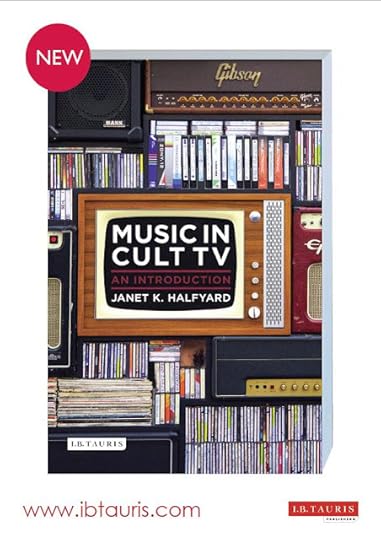 Hurrah - well, it's finally happening: my book on music in cult tv is coming out next month and is currently available to preorder via Amazon. It's all a bit useless at the moment as they both have the blurb I wrote as part of the proposal about 5 years ago and the book has changed significantly since then, not least because Hannibal aired whilst I was writing and utterly blew me away. Oh, and the U.K. site cannot spell music.....! So the actual blurb is below, and these are the links to the two sites. Currently half the price ($14 rather than $28) in the US than it will be after publication, no idea why!
US site: http://www.amazon.com/Music-Cult-TV-An-Introduction/dp/1784530298
UK site: http://www.amazon.co.uk/gp/product/1784530298
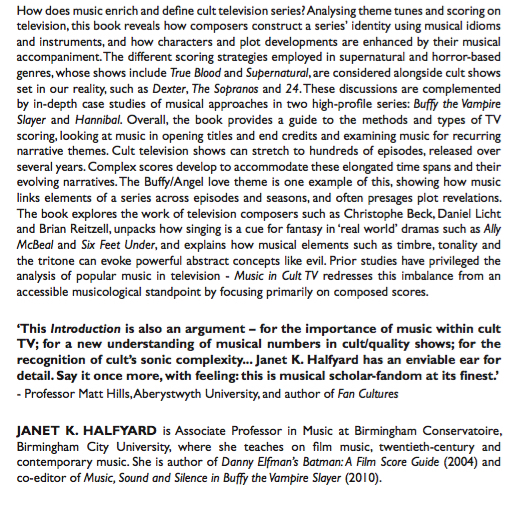
 Hurrah - well, it's finally happening: my book on music in cult tv is coming out next month and is currently available to preorder via Amazon. It's all a bit useless at the moment as they both have the blurb I wrote as part of the proposal about 5 years ago and the book has changed significantly since then, not least because Hannibal aired whilst I was writing and utterly blew me away. Oh, and the U.K. site cannot spell music.....! So the actual blurb is below, and these are the links to the two sites. Currently half the price ($14 rather than $28) in the US than it will be after publication, no idea why!
US site: http://www.amazon.com/Music-Cult-TV-An-Introduction/dp/1784530298
UK site: http://www.amazon.co.uk/gp/product/1784530298

January 8, 2016
Star Wars VII: The Force Awakens
Star Wars VII: The Force AwakensComposer: oh, who do you think, John Williams, of course!
So, the bad news is that I have suddenly come down with a cold and feel absolutely blinking awful. The good news is that this week I finally saw Star Wars VII: The Force Awakens, a film I can happily admit to loving with a fiery passion. In fact, I saw it twice, and musically speaking, that was an interesting experience in and of itself. Spoilers ahead: for crying out loud, why are you reading this if you haven’t seen the film already? Do you know how much time I have spent avoiding on the internet since December 17th?At my first viewing, I failed to notice a single new theme (and there are three big significant ones for Rey, Kylo Ren and the Alliance, as well as various smaller others). All I noticed, musically, was the old themes: The Luke/ main title theme; the ‘triumph’ chords that so often punctuate action in the original trilogy; the Force theme; Leia’s theme, and the Leia/Han love theme. Each one jumped out at me and my ears greeted it like a long-lost, much-loved friend, starting with the main title (grin the size of a slice of watermelon on my face), then the triumph chords as we see the Millenium Falcon for the first time (hello, Millenium Falcon!), the Force theme as Han remembers Luke, the Leia theme as we see the lovely General for the first time, transforming into the Han/Leia version as they talk to each other; even a quick blast of Darth Vadar’s Imperial March as we see the remains of his ruined mask on Kylo Ren’s little altar. Oh, my lovelies, how I’ve missed you! But new themes utterly passed me by: I was aware of the recurrence of these themes throughout but otherwise, was just too busy watching the film.Second time round, out they started popping, as well as other things, such as the first time we get the Luke/ main title theme in the score is when Finn makes the decision that effectively sets the narrative rolling and tells Poe Dameron that he is going to help him escape – some of Luke’s agency in that moment seems to be passed on to Finn, a fascinating character who has had rather less attention as the first major black character of the franchise (do not get me started on Lando Calrissian) than its first female hero, Rey. However, I am going to focus in particular on Rey and Kylo Ren or we’ll be here forever.
Kylo Ren’s themehttps://www.youtube.com/watch?v=UzP7D2Yjkd8Kylo Ren has a classic ‘label’ theme of the type that Adorno and Eisler detested, seeing it as the musical lackey announcing the person we can all very well see is there. But the general stasis of this five note motif which we repeatedly hear in basically identical form throughout the film actually does quite a lot of work. It’s short and unchanging – this unchanging nature reflects his rigidity, his desire to hold to his path and I could make a possibly slightly fanciful argument about this being how he hears himself, the aural image of what he wants to be, sternly foreboding, a musical anchor that pulls him back to the dark side from that oh so tempting path of light. The motif is angular and chromatic – sorry, my notation software is up the spout, so I shall have to do it by description. Five notes: G, F sharp, C , E flat, G again, an octave down from where it started. So, we start with a falling minor second (G to F sharp), which then falls to the tritone (F sharp to C) symbol of musical evil, the diablous in musica – no villain is a proper villain without a nice tritone in his theme; then rising by a minor third (C to E flat) before dropping down a minor sixth (E flat to C). It is almost entirely descending and therefore a theme for the dark side: heroic themes, by contrast, tend to be primarily ascending, constantly pushing upwards towards ever higher goals (e.g. the Luke/ main title theme and indeed the Force theme: nice bit of analysis here that demonstrates the idea well: http://www.filmmusicnotes.com/john-williams-themes-part-1-the-force-theme/). All the intervals in KR’s theme are either minor or chromatic – again, culturally coded towards the negative end of the spectrum, compared to the major key and unchromatic Main title and Force themes.
Rey’s themehttps://youtu.be/nTmP0iBQUkARey, by contrast, has a very long theme made up of several motifs; the opening rapid figure is derived from the (as you will learn!) all-important last three notes of the melody of the main motif. That main motif (6 notes in all) is the opening of a long winding melody that meanders all over the place, shifting and slipping into different keys, the melody becoming submerged in the textures and then re-emerging again: note already, therefore, the extreme contrast to the rigid brevity of Kylo Ren’s theme. Rey is unfixed, unformed at this point: unawakened!Rey’s motif appears in so many different keys that I’m going to give it here in the version that best makes my point about its relationship with Kylo Ren’s. This gives us a theme that goes: C, E flat, G, C, F, G . [C up to E flat, down to G, back up to C, then up again to F and G]. So: the last three notes of KR’s theme are the first three of Rey’s; where his sinks down to the low G at the end, her’s rises up to the high one; where his motif starts with a chromatic fall from G to F sharp that in turn produces the tritone, her’s ends with the rising, non-chromatic F natural to G. There is both a reversal of the order of phrases and of the direction of the two notes at the start of KR’s and the end of Rey’s, which means that where his theme has only one ascending interval, her’s has only one descending one. These motifs are so astoundingly mirrored around each other that I do not believe for a second that its just one of those coincidences, because our John is altogether rather too clever for that.
The lack of chromaticism and the primarily ascending contour give Rey’s motif much more potential as a heroic signifier. However, at the start of the film, it just ain’t heroic: its actually pretty softy-sweetie-girlie, in terms of its Hollywood cultural musical coding. Lots of woodwind and strings, nice overall sense of up-and-back down phrase shaping in the cue as a whole, smooth, legato feel – all things that good ol’ Philip Tagg (where would I be without him) identified as female coded musical characteristics in his 1987 study, which you can find here if you have never read it: http://tagg.org/articles/xpdfs/tvanthro.pdfBut her motif has potential to be heroic: its has the kind of open intervals around tonic and dominant (the C and G) that are commonly found in Williams’ hero themes; it is ascending; and it is strongly linked (as I am not the first to notice) to the force theme, in that it has identical harmonic movement and several similar intervals (he actually juxtaposes them in the final minute of the end credits cue, just in case you hadn’t noticed, something that brought another watermelon grin to my face as I stood by the exit door to let the poor ushers clean the cinema! Having working in one, I am acutely aware that people who stay to the end of the credits are pretty annoying for the ushers). The identical harmonic movement means that in the more extended Rey theme (going beyond her first six notes into the second part of the theme) both this and the Force theme move from a minor tonic chord to the major subdominant (so here, from C minor to F major). Technically, in C minor, the subdominant should be F minor, so the brightening of the shift into a major chord gives it a sense of hope (A New Hope! The Force Awakens! Woohoo!) that again pushes this toward the heroic. And that latent heroism and the force awakening in Rey gets its musical realization in the final battle scene between her and KR, which you can hear here: https://www.youtube.com/watch?v=YnvaA984uIcI will confess that I was getting mightly frustrated by the end of the film: we got the Force theme with the heroic bras (solo horn) mostly when people were talking about Luke - when it was used for Rey, back came the strings and woodwinds; and her own motif also kept on coming back on strings and woodwind. For crying out loud, John (I was thinking) when are you going to let her be a hero? And then, hurrah, in this cue, we finally get both the Force theme and her motif transformed into a properly brass-led heroism as she comes into her own and takes down KR. I may have cried a little at the sound of massed brass around 2.40 in the above clip.
And so, to the crazy speculation. Why do Rey and KR essentially share a (mirrored) theme? Why is the very first thing Leia does when she meets Rey is to clasp her in a fierce embrace? Could they all be – gasp – related??? I seriously do not know how I am going to get through a year and nine months without knowing the answers to these questions.
So, the bad news is that I have suddenly come down with a cold and feel absolutely blinking awful. The good news is that this week I finally saw Star Wars VII: The Force Awakens, a film I can happily admit to loving with a fiery passion. In fact, I saw it twice, and musically speaking, that was an interesting experience in and of itself. Spoilers ahead: for crying out loud, why are you reading this if you haven’t seen the film already? Do you know how much time I have spent avoiding on the internet since December 17th?At my first viewing, I failed to notice a single new theme (and there are three big significant ones for Rey, Kylo Ren and the Alliance, as well as various smaller others). All I noticed, musically, was the old themes: The Luke/ main title theme; the ‘triumph’ chords that so often punctuate action in the original trilogy; the Force theme; Leia’s theme, and the Leia/Han love theme. Each one jumped out at me and my ears greeted it like a long-lost, much-loved friend, starting with the main title (grin the size of a slice of watermelon on my face), then the triumph chords as we see the Millenium Falcon for the first time (hello, Millenium Falcon!), the Force theme as Han remembers Luke, the Leia theme as we see the lovely General for the first time, transforming into the Han/Leia version as they talk to each other; even a quick blast of Darth Vadar’s Imperial March as we see the remains of his ruined mask on Kylo Ren’s little altar. Oh, my lovelies, how I’ve missed you! But new themes utterly passed me by: I was aware of the recurrence of these themes throughout but otherwise, was just too busy watching the film.Second time round, out they started popping, as well as other things, such as the first time we get the Luke/ main title theme in the score is when Finn makes the decision that effectively sets the narrative rolling and tells Poe Dameron that he is going to help him escape – some of Luke’s agency in that moment seems to be passed on to Finn, a fascinating character who has had rather less attention as the first major black character of the franchise (do not get me started on Lando Calrissian) than its first female hero, Rey. However, I am going to focus in particular on Rey and Kylo Ren or we’ll be here forever.
Kylo Ren’s themehttps://www.youtube.com/watch?v=UzP7D2Yjkd8Kylo Ren has a classic ‘label’ theme of the type that Adorno and Eisler detested, seeing it as the musical lackey announcing the person we can all very well see is there. But the general stasis of this five note motif which we repeatedly hear in basically identical form throughout the film actually does quite a lot of work. It’s short and unchanging – this unchanging nature reflects his rigidity, his desire to hold to his path and I could make a possibly slightly fanciful argument about this being how he hears himself, the aural image of what he wants to be, sternly foreboding, a musical anchor that pulls him back to the dark side from that oh so tempting path of light. The motif is angular and chromatic – sorry, my notation software is up the spout, so I shall have to do it by description. Five notes: G, F sharp, C , E flat, G again, an octave down from where it started. So, we start with a falling minor second (G to F sharp), which then falls to the tritone (F sharp to C) symbol of musical evil, the diablous in musica – no villain is a proper villain without a nice tritone in his theme; then rising by a minor third (C to E flat) before dropping down a minor sixth (E flat to C). It is almost entirely descending and therefore a theme for the dark side: heroic themes, by contrast, tend to be primarily ascending, constantly pushing upwards towards ever higher goals (e.g. the Luke/ main title theme and indeed the Force theme: nice bit of analysis here that demonstrates the idea well: http://www.filmmusicnotes.com/john-williams-themes-part-1-the-force-theme/). All the intervals in KR’s theme are either minor or chromatic – again, culturally coded towards the negative end of the spectrum, compared to the major key and unchromatic Main title and Force themes.
Rey’s themehttps://youtu.be/nTmP0iBQUkARey, by contrast, has a very long theme made up of several motifs; the opening rapid figure is derived from the (as you will learn!) all-important last three notes of the melody of the main motif. That main motif (6 notes in all) is the opening of a long winding melody that meanders all over the place, shifting and slipping into different keys, the melody becoming submerged in the textures and then re-emerging again: note already, therefore, the extreme contrast to the rigid brevity of Kylo Ren’s theme. Rey is unfixed, unformed at this point: unawakened!Rey’s motif appears in so many different keys that I’m going to give it here in the version that best makes my point about its relationship with Kylo Ren’s. This gives us a theme that goes: C, E flat, G, C, F, G . [C up to E flat, down to G, back up to C, then up again to F and G]. So: the last three notes of KR’s theme are the first three of Rey’s; where his sinks down to the low G at the end, her’s rises up to the high one; where his motif starts with a chromatic fall from G to F sharp that in turn produces the tritone, her’s ends with the rising, non-chromatic F natural to G. There is both a reversal of the order of phrases and of the direction of the two notes at the start of KR’s and the end of Rey’s, which means that where his theme has only one ascending interval, her’s has only one descending one. These motifs are so astoundingly mirrored around each other that I do not believe for a second that its just one of those coincidences, because our John is altogether rather too clever for that.
The lack of chromaticism and the primarily ascending contour give Rey’s motif much more potential as a heroic signifier. However, at the start of the film, it just ain’t heroic: its actually pretty softy-sweetie-girlie, in terms of its Hollywood cultural musical coding. Lots of woodwind and strings, nice overall sense of up-and-back down phrase shaping in the cue as a whole, smooth, legato feel – all things that good ol’ Philip Tagg (where would I be without him) identified as female coded musical characteristics in his 1987 study, which you can find here if you have never read it: http://tagg.org/articles/xpdfs/tvanthro.pdfBut her motif has potential to be heroic: its has the kind of open intervals around tonic and dominant (the C and G) that are commonly found in Williams’ hero themes; it is ascending; and it is strongly linked (as I am not the first to notice) to the force theme, in that it has identical harmonic movement and several similar intervals (he actually juxtaposes them in the final minute of the end credits cue, just in case you hadn’t noticed, something that brought another watermelon grin to my face as I stood by the exit door to let the poor ushers clean the cinema! Having working in one, I am acutely aware that people who stay to the end of the credits are pretty annoying for the ushers). The identical harmonic movement means that in the more extended Rey theme (going beyond her first six notes into the second part of the theme) both this and the Force theme move from a minor tonic chord to the major subdominant (so here, from C minor to F major). Technically, in C minor, the subdominant should be F minor, so the brightening of the shift into a major chord gives it a sense of hope (A New Hope! The Force Awakens! Woohoo!) that again pushes this toward the heroic. And that latent heroism and the force awakening in Rey gets its musical realization in the final battle scene between her and KR, which you can hear here: https://www.youtube.com/watch?v=YnvaA984uIcI will confess that I was getting mightly frustrated by the end of the film: we got the Force theme with the heroic bras (solo horn) mostly when people were talking about Luke - when it was used for Rey, back came the strings and woodwinds; and her own motif also kept on coming back on strings and woodwind. For crying out loud, John (I was thinking) when are you going to let her be a hero? And then, hurrah, in this cue, we finally get both the Force theme and her motif transformed into a properly brass-led heroism as she comes into her own and takes down KR. I may have cried a little at the sound of massed brass around 2.40 in the above clip.
And so, to the crazy speculation. Why do Rey and KR essentially share a (mirrored) theme? Why is the very first thing Leia does when she meets Rey is to clasp her in a fierce embrace? Could they all be – gasp – related??? I seriously do not know how I am going to get through a year and nine months without knowing the answers to these questions.
November 6, 2015
The MartianI am clearly on a roll: second post in the sam...
The MartianI am clearly on a roll: second post in the same week!
I'm afraid I'm going to be really rather picky about this film because I really liked but it was not quite as good a film as it might have been on the musical front. Matt Damon turns in an impressive and engaging performance as the guy accidentally left for dead on Mars, reminding me of just what a jolly fine actor he is, and which he needs to be as a lot of the film is just him and his potatoes and a lot of red dust. The film starts with some semi-subtle allusions to 2001: A Space Odyssey, with a planetary sunrise set to some low drones sounds that recall, perhaps, some of the Ligeti in Kubrik's compilation score; and then the first obviously musical sounds we hear are a rising open fifth, à la Strauss Thus Spake Zarathustra, but then the music and visuals leave that particularly vision of space behind (and undoubtedly a good thing too, but I enjoyed the nod).Things start out promisingly musically, and after Mark, our hero, is abandoned, the music and sound design initially do a good job constructing his subjective experience as the only man on Mars. In particular, the sound design gives a range of slightly disconcerting hums, some evidently ambient, some more ambiguous; a lovely little tinnitus moment when Mark more or less blows himself up in the process of trying to grow his potatoes; plus there is some fabulously incongruous disco music which is the only music he has access to, a fact that causes him at one point to declare that he is definitely go to die here if he has to keep listening to this. The fact that he does keep listening to it suggests, probably quite rightly, that when you are completely alone on a planet, 100s of 1000s of miles and potentially four years from anyone else, any music is better than nothing. But here in lie the seeds of the problem. By my calculations, Mark is actually on his own for about two years, and by the end he is definitely starting to go a little crazy, but the underscore music rather undermines this by being pretty much wall to wall through most of the film. The film's makers might have chosen to use musical silence and sound design to help us understand his isolation and the constant threat of death that he is under, and to encourage us to see the ways in which Mark starts to fall apart, a process that begins when his crops are destroyed. Damon is acting his socks off but the music actually makes his performance of a man holding on to his sanity by his fingertips toward the end seem kinda cute, and that seems to me to do his acting a disservice both here and elsewhere: the music does too much work for us in glossing his emotions into something generally simple and easy to identify with, whereas the situation is astoundingly complex and not something I imagine most of us can begin to think ourselves into. The sounds design is, frankly, also acting its socks off: the sounds of the various storms and the sense of the habitat pods being under constant threat of destruction really begs for more musical silence in which to make itself felt, but instead I cannot remember the last time I was so conscious of being emotionally manipulated by a score (Oo, will he die? Hurrah, he's ok! Can he make it work? yes, he can! He's so plucky - cue the Kleenex). I am not blaming the composer: Harry Gregson Williams will have written music for where he was told to write it, doing what he was told to make it do; but the film ended up too cosy for me, like a revisiting of Apollo 13 as a fun adventure film, or Mission to Mars with a happier ending. He's complete alone on a planet and is an odds-on favourite to perish! It is genuinely scary! A wee bit more silence now and then, a dose of the uncanny, would have made this an altogether less comfortable and frankly better film. It's a good film; it has great acting; but the musical strategy plays it too safe in how it directs the audience toward emotion and away from allowing them to glimpse how completely terrible it would be for someone to spend two years on their own on Mars with no guarantee at all of rescue.
I'm afraid I'm going to be really rather picky about this film because I really liked but it was not quite as good a film as it might have been on the musical front. Matt Damon turns in an impressive and engaging performance as the guy accidentally left for dead on Mars, reminding me of just what a jolly fine actor he is, and which he needs to be as a lot of the film is just him and his potatoes and a lot of red dust. The film starts with some semi-subtle allusions to 2001: A Space Odyssey, with a planetary sunrise set to some low drones sounds that recall, perhaps, some of the Ligeti in Kubrik's compilation score; and then the first obviously musical sounds we hear are a rising open fifth, à la Strauss Thus Spake Zarathustra, but then the music and visuals leave that particularly vision of space behind (and undoubtedly a good thing too, but I enjoyed the nod).Things start out promisingly musically, and after Mark, our hero, is abandoned, the music and sound design initially do a good job constructing his subjective experience as the only man on Mars. In particular, the sound design gives a range of slightly disconcerting hums, some evidently ambient, some more ambiguous; a lovely little tinnitus moment when Mark more or less blows himself up in the process of trying to grow his potatoes; plus there is some fabulously incongruous disco music which is the only music he has access to, a fact that causes him at one point to declare that he is definitely go to die here if he has to keep listening to this. The fact that he does keep listening to it suggests, probably quite rightly, that when you are completely alone on a planet, 100s of 1000s of miles and potentially four years from anyone else, any music is better than nothing. But here in lie the seeds of the problem. By my calculations, Mark is actually on his own for about two years, and by the end he is definitely starting to go a little crazy, but the underscore music rather undermines this by being pretty much wall to wall through most of the film. The film's makers might have chosen to use musical silence and sound design to help us understand his isolation and the constant threat of death that he is under, and to encourage us to see the ways in which Mark starts to fall apart, a process that begins when his crops are destroyed. Damon is acting his socks off but the music actually makes his performance of a man holding on to his sanity by his fingertips toward the end seem kinda cute, and that seems to me to do his acting a disservice both here and elsewhere: the music does too much work for us in glossing his emotions into something generally simple and easy to identify with, whereas the situation is astoundingly complex and not something I imagine most of us can begin to think ourselves into. The sounds design is, frankly, also acting its socks off: the sounds of the various storms and the sense of the habitat pods being under constant threat of destruction really begs for more musical silence in which to make itself felt, but instead I cannot remember the last time I was so conscious of being emotionally manipulated by a score (Oo, will he die? Hurrah, he's ok! Can he make it work? yes, he can! He's so plucky - cue the Kleenex). I am not blaming the composer: Harry Gregson Williams will have written music for where he was told to write it, doing what he was told to make it do; but the film ended up too cosy for me, like a revisiting of Apollo 13 as a fun adventure film, or Mission to Mars with a happier ending. He's complete alone on a planet and is an odds-on favourite to perish! It is genuinely scary! A wee bit more silence now and then, a dose of the uncanny, would have made this an altogether less comfortable and frankly better film. It's a good film; it has great acting; but the musical strategy plays it too safe in how it directs the audience toward emotion and away from allowing them to glimpse how completely terrible it would be for someone to spend two years on their own on Mars with no guarantee at all of rescue.
November 3, 2015
Crimson Peak (2015)
Director: Guillermo del ToroMusic: Fernado VelazquezSound design: Randy Thom
It is an incredibly long time (literally, years) since I blogged about film music but today, in celebration of finishing the proofing on my cult TV book, I went to see Crimson Peak and for the first time in a very long time I am inspired to write. Not much has inspired me in film music of late. Crimson Peak is a marvellous gothic romp of a film, with ghosts literally coming out of the woodwork (and the floorboards) and more blood than you can shake a stick at: even the opening titles are drenched in a wash of red, and the film takes its name from the fact that the red clay of the hill on which haunted house is built turns the snow bright red in winter. The titles are accompanied by the sound of a child's voice singing an unaccompanied, haunting and slightly creepy song amidst massive electronically manipulated reverberation. Immediately, we are pointed toward horror: children's voices often feature in horror soundtracks where the film concerns a child in danger, so that the sound of a child singing from the soundtrack paradoxically indicates the threatening evil as much as the innocent child victim. Here, it's an interesting double bluff: in the first scene after the title we meet our heroine, Edith, as a ten year old at her mother's funeral, so the winsome child's voice is, we might suppose, Edith herself, the girl in peril at the centre of the narrative. But no, it's cleverer than that - oh, I do so love a clever score! Spoilers ahead. Much later in the film, we hear the same melody being played as a Chopinesque piano fantasia by Lucille, Edith's new sister in law, who turns out to be the agent behind the evil and the horror driving the narrative. Lucille reveals that the melody is a lullaby she used to sing to her brother (now Edith's husband) when they were children; and near the end we learn that as a child, Lucille murdered their mother with a gigantic cleaver she has kept ever since as a memento of that happy occasion. The child's voice we hear in the titles is therefore arguably Lucille's and rather than the voice representing Edith, the child in danger that it usually does (for example, Alien 3, Sleepy Hollow), we belatedly discover that it is the voice of evil itself, the voice of Lucille as a child.
The other really interesting thing about the music of this film is that we effectively have two scores. On the one hand we have a sumptuous orchestral score that represents all things to do with the real world and the living, no matter how horrible, and the lullaby slips from diegetic to non-diegetic music throughout. On the other hand, we have sound design operating as music, using electronic sounds and electronically manipulated noises (drips, knocking sounds) to represent the Otherness of the many and various ghosts. The first appearance of this other sound world, when Edith's mother returns after the funeral to warn her about Crimson Peak (unfortunately, she should have warned her about Allerdale Hall as Crimson Peak is just a local nickname and Edith has already married and moved in before she hears it for the first time). In this first haunting, the sound design is at its most overtly composed, with very little obviously real sounds, and lots of electronics, but it establishes the extreme difference of the ghostly soundworld. In other haunting sequences, the boundary between sound design and musical composition is much less clearly defined, and the sound operates both as the sound of the ghosts themselves as they bump and slither around the house, and as a musical atmosphere and ambience for their presence. There is even, in the credits, a member of sound design team credited with "atmospheric sound design". This duality in the scoring strategy is itself a marvellously gothic construction: if the classic gothic castle is a site of decadent domesticity above with dank and dangerous cellars below in which God alone knows what lurks, then here the orchestral music presents us with the sumptuous world of the living 'above' and the noisy, unnatural and manipulated sound design of the dead 'below'. I really enjoyed this film: it's silly, over the top, quite revolting in places and having rather too much fun with itself at times but Mia Wasikowska as Edith does a knock up job of not just being a victim in need of being rescued (and turns out to be handy with shovel) and I could happily watch Tom Hiddleston reading the telephone directory, so watching him being tragic, bad and tormented all at the same time is a joy. And the music/ sound was deeply satisfying: inventive, interesting and rewarding to listen to. Hurrah!
It is an incredibly long time (literally, years) since I blogged about film music but today, in celebration of finishing the proofing on my cult TV book, I went to see Crimson Peak and for the first time in a very long time I am inspired to write. Not much has inspired me in film music of late. Crimson Peak is a marvellous gothic romp of a film, with ghosts literally coming out of the woodwork (and the floorboards) and more blood than you can shake a stick at: even the opening titles are drenched in a wash of red, and the film takes its name from the fact that the red clay of the hill on which haunted house is built turns the snow bright red in winter. The titles are accompanied by the sound of a child's voice singing an unaccompanied, haunting and slightly creepy song amidst massive electronically manipulated reverberation. Immediately, we are pointed toward horror: children's voices often feature in horror soundtracks where the film concerns a child in danger, so that the sound of a child singing from the soundtrack paradoxically indicates the threatening evil as much as the innocent child victim. Here, it's an interesting double bluff: in the first scene after the title we meet our heroine, Edith, as a ten year old at her mother's funeral, so the winsome child's voice is, we might suppose, Edith herself, the girl in peril at the centre of the narrative. But no, it's cleverer than that - oh, I do so love a clever score! Spoilers ahead. Much later in the film, we hear the same melody being played as a Chopinesque piano fantasia by Lucille, Edith's new sister in law, who turns out to be the agent behind the evil and the horror driving the narrative. Lucille reveals that the melody is a lullaby she used to sing to her brother (now Edith's husband) when they were children; and near the end we learn that as a child, Lucille murdered their mother with a gigantic cleaver she has kept ever since as a memento of that happy occasion. The child's voice we hear in the titles is therefore arguably Lucille's and rather than the voice representing Edith, the child in danger that it usually does (for example, Alien 3, Sleepy Hollow), we belatedly discover that it is the voice of evil itself, the voice of Lucille as a child.
The other really interesting thing about the music of this film is that we effectively have two scores. On the one hand we have a sumptuous orchestral score that represents all things to do with the real world and the living, no matter how horrible, and the lullaby slips from diegetic to non-diegetic music throughout. On the other hand, we have sound design operating as music, using electronic sounds and electronically manipulated noises (drips, knocking sounds) to represent the Otherness of the many and various ghosts. The first appearance of this other sound world, when Edith's mother returns after the funeral to warn her about Crimson Peak (unfortunately, she should have warned her about Allerdale Hall as Crimson Peak is just a local nickname and Edith has already married and moved in before she hears it for the first time). In this first haunting, the sound design is at its most overtly composed, with very little obviously real sounds, and lots of electronics, but it establishes the extreme difference of the ghostly soundworld. In other haunting sequences, the boundary between sound design and musical composition is much less clearly defined, and the sound operates both as the sound of the ghosts themselves as they bump and slither around the house, and as a musical atmosphere and ambience for their presence. There is even, in the credits, a member of sound design team credited with "atmospheric sound design". This duality in the scoring strategy is itself a marvellously gothic construction: if the classic gothic castle is a site of decadent domesticity above with dank and dangerous cellars below in which God alone knows what lurks, then here the orchestral music presents us with the sumptuous world of the living 'above' and the noisy, unnatural and manipulated sound design of the dead 'below'. I really enjoyed this film: it's silly, over the top, quite revolting in places and having rather too much fun with itself at times but Mia Wasikowska as Edith does a knock up job of not just being a victim in need of being rescued (and turns out to be handy with shovel) and I could happily watch Tom Hiddleston reading the telephone directory, so watching him being tragic, bad and tormented all at the same time is a joy. And the music/ sound was deeply satisfying: inventive, interesting and rewarding to listen to. Hurrah!
October 4, 2012
Anna Karenina http://www.imdb.com/title/tt1781769/Y..., ...
Anna Karenina
http://www.imdb.com/title/tt1781769/
Yikes, it’s been a while: sometimes, life just catches up and there’s no time for thinking about it. Which I supposed (caution: glib segue ahead!) is Anna Karenina’s problem. I am having mixed feelings about this film overall: mostly, I liked it very much, but it looses its way at the end and (I don’t often say this) probably needed to be about 20 minutes longer. One minute, Anna has left her husband and is living with Vronsky; there is some vague mention of her wanting a divorce; within about 10 minutes, she’s addicted to morphine, become a raving paranoiac and suddenly throws herself under a train for no clear reason. And poor old Vronsky is a bit of an empty space: he’s very pretty but one doesn’t have a clue if there is anything going on between his ears, nor what he actually feels for Anna – his love for her is oddly unconvincing. So, sorry Mr Stoppard, but somewhere between what you wrote and whatever happened to your script in the edit, characters got a little thin and plot got a little rushed.But the thing you cannot get away from is the beauty of the production. The majority of the action is filmed in a 19th century theatre, which they constantly redress to provide us with various people’s homes, workplaces, ballrooms, streets, railway stations, tea rooms, ice rink, even a race-course at one point. Oh, and every now and then it gets to be a theatre. It’s very Brechtian, especially at the start, the stage machinery quite literally revealed, with the result that we are very aware that we are watching a narrative, a story told by actors, the self-conscious artifice of it keeping us at an emotional distance – it’s a game, a process, a story with a very visible frame (sometimes, literally, the proscenium arch of the theatre). And the music works as part of this as well. There are two basic types of music in the film: dance music, which draws attention to itself, and more conventional underscore, although the two cross over in significant places. The dance music predominates at the start – it’s quirky, hints of the Shostakovich jazz suites, self-consciously stylized in the same way that the action is at the start. As one scene ends, we make a transition from this, set in Anna’s brother’s offices, to him and his friend Konstantin going to dinner in a restaurant. The office workers strip off the top players of their clothing, and are transformed into waiters; the actors move scenery and props out of the way and bring in screens to create the restaurant; the camera, in a long tracking shot, follows all this as we move from one side of the theatre space to another (or do we just go around in a circle?) and as the camera tracks, so various musicians – a clarinettist, a tuba player, a singer, pass in and out of view, making clear that the music we are hearing is not simply underscore but is also within the scene as well. It is overtly theatrical: I spent the first 15 minutes of the film wondering why they’d bothered to make a film at all, rather than doing this on stage. The music by Joe Wright’s usual composer, Dario Marianelli) has a very Brechtian role in defining and drawing attention to the narrative space: later, after Konstantin has made his failed proposal to Princess Kitty (yes, that really is what she is called), he leaves her salon, where a ball is beginning, and climbs up onto the gantries above the stage: this is the ‘street’, outside the salon which occupies the stage. The music follows him: in the salon, the violin melody was that of a somewhat vibrato-heavy waltz; as he climbs to the catwalks, populated by the common people, it is transformed into something folkish, Klezmerish. From the catwalk, he looks back down into the salon, and as the camera follows his gaze, the violin seamlessly moves back to the elegant waltz. And then the music stops for a while, and we have a series of scenes, in which we first meet Anna, where there is a great deal of conversation and musical silence, as if to try and say “OK, we have established that, for budgetary reasons, we are shooting this whole damn thing in a theatre rather than on location, and it’s all very arch and camp, sorry about that, but we had to make the theatre thing work somehow; but now we want to get on with the real story and get you emotionally engaged with it so no more music, let’s have some proper acting”. And I am in two minds whether it really works: the Brechtian distancing that arises from spending a lot of our time visibly in a theatre makes it a little difficult to really engage with the story, to start seeing the characters rather than the actors. It is apparent that we ‘see’ the theatre and its machinery much less clearly in the scenes involving Anna, Karenin and Vronsky on their own – there is a definite attempt to avoid distracting (alienating) us with the frame when we are with these characters. Musically, the central theme is the waltz heard at the fateful ball where Vronsky dances with Anna and throws over Kitty. Here, obviously, the music is diegetic – everyone is dancing to it so obviously they can hear it, although there is no visible sign of the orchestra. But here again, they play a lot of games with theatrical artifice: when Vronksy persuades Anna to dance with him, all the other dancers freeze as they take to the floor, and only come back to life as the couple pass them; and the dancing itself is gorgeous and bizarre, made up of languidly nonsensical hand and arm gestures more than anything else, as if the dancers are becoming physically entwined, tied in knots that they weave and then extricate themselves from – it is graceful yet suggests an underlying anxiety, a highly stylized, abstracted set of gestures that might have started out as some kind of fight. The waltz theme then becomes the love theme for Anna and Vronsky, sliding from ‘real’ diegetic music at the ball into the nondiegetic undescore; and seems to suggest that their tale is, like the choreography, a convoluted, anxious, elegant but unsettled dance that we know will not have a happy ending.The only happy ending is the one for Kitty and Konstantin, who do finally get married and go to live in the countryside. They are also the only ones who ever seem to escape the theatre into the real world: Konstantin at one point literally walks out of the theatre onto a snow covered landscape, and pretty much all the location work concerns him - he has an actual house (rather than a home created out of a corner of the theatre); and he and Kitty also have proper non-diegetic underscore, as if they are the only conventionally 'real' people in the whole film - they do not want to be part of the performance, but to get on with life away from the labyrinthine workings of the theatre that Anna singularly fails to escape.
http://www.imdb.com/title/tt1781769/
Yikes, it’s been a while: sometimes, life just catches up and there’s no time for thinking about it. Which I supposed (caution: glib segue ahead!) is Anna Karenina’s problem. I am having mixed feelings about this film overall: mostly, I liked it very much, but it looses its way at the end and (I don’t often say this) probably needed to be about 20 minutes longer. One minute, Anna has left her husband and is living with Vronsky; there is some vague mention of her wanting a divorce; within about 10 minutes, she’s addicted to morphine, become a raving paranoiac and suddenly throws herself under a train for no clear reason. And poor old Vronsky is a bit of an empty space: he’s very pretty but one doesn’t have a clue if there is anything going on between his ears, nor what he actually feels for Anna – his love for her is oddly unconvincing. So, sorry Mr Stoppard, but somewhere between what you wrote and whatever happened to your script in the edit, characters got a little thin and plot got a little rushed.But the thing you cannot get away from is the beauty of the production. The majority of the action is filmed in a 19th century theatre, which they constantly redress to provide us with various people’s homes, workplaces, ballrooms, streets, railway stations, tea rooms, ice rink, even a race-course at one point. Oh, and every now and then it gets to be a theatre. It’s very Brechtian, especially at the start, the stage machinery quite literally revealed, with the result that we are very aware that we are watching a narrative, a story told by actors, the self-conscious artifice of it keeping us at an emotional distance – it’s a game, a process, a story with a very visible frame (sometimes, literally, the proscenium arch of the theatre). And the music works as part of this as well. There are two basic types of music in the film: dance music, which draws attention to itself, and more conventional underscore, although the two cross over in significant places. The dance music predominates at the start – it’s quirky, hints of the Shostakovich jazz suites, self-consciously stylized in the same way that the action is at the start. As one scene ends, we make a transition from this, set in Anna’s brother’s offices, to him and his friend Konstantin going to dinner in a restaurant. The office workers strip off the top players of their clothing, and are transformed into waiters; the actors move scenery and props out of the way and bring in screens to create the restaurant; the camera, in a long tracking shot, follows all this as we move from one side of the theatre space to another (or do we just go around in a circle?) and as the camera tracks, so various musicians – a clarinettist, a tuba player, a singer, pass in and out of view, making clear that the music we are hearing is not simply underscore but is also within the scene as well. It is overtly theatrical: I spent the first 15 minutes of the film wondering why they’d bothered to make a film at all, rather than doing this on stage. The music by Joe Wright’s usual composer, Dario Marianelli) has a very Brechtian role in defining and drawing attention to the narrative space: later, after Konstantin has made his failed proposal to Princess Kitty (yes, that really is what she is called), he leaves her salon, where a ball is beginning, and climbs up onto the gantries above the stage: this is the ‘street’, outside the salon which occupies the stage. The music follows him: in the salon, the violin melody was that of a somewhat vibrato-heavy waltz; as he climbs to the catwalks, populated by the common people, it is transformed into something folkish, Klezmerish. From the catwalk, he looks back down into the salon, and as the camera follows his gaze, the violin seamlessly moves back to the elegant waltz. And then the music stops for a while, and we have a series of scenes, in which we first meet Anna, where there is a great deal of conversation and musical silence, as if to try and say “OK, we have established that, for budgetary reasons, we are shooting this whole damn thing in a theatre rather than on location, and it’s all very arch and camp, sorry about that, but we had to make the theatre thing work somehow; but now we want to get on with the real story and get you emotionally engaged with it so no more music, let’s have some proper acting”. And I am in two minds whether it really works: the Brechtian distancing that arises from spending a lot of our time visibly in a theatre makes it a little difficult to really engage with the story, to start seeing the characters rather than the actors. It is apparent that we ‘see’ the theatre and its machinery much less clearly in the scenes involving Anna, Karenin and Vronsky on their own – there is a definite attempt to avoid distracting (alienating) us with the frame when we are with these characters. Musically, the central theme is the waltz heard at the fateful ball where Vronsky dances with Anna and throws over Kitty. Here, obviously, the music is diegetic – everyone is dancing to it so obviously they can hear it, although there is no visible sign of the orchestra. But here again, they play a lot of games with theatrical artifice: when Vronksy persuades Anna to dance with him, all the other dancers freeze as they take to the floor, and only come back to life as the couple pass them; and the dancing itself is gorgeous and bizarre, made up of languidly nonsensical hand and arm gestures more than anything else, as if the dancers are becoming physically entwined, tied in knots that they weave and then extricate themselves from – it is graceful yet suggests an underlying anxiety, a highly stylized, abstracted set of gestures that might have started out as some kind of fight. The waltz theme then becomes the love theme for Anna and Vronsky, sliding from ‘real’ diegetic music at the ball into the nondiegetic undescore; and seems to suggest that their tale is, like the choreography, a convoluted, anxious, elegant but unsettled dance that we know will not have a happy ending.The only happy ending is the one for Kitty and Konstantin, who do finally get married and go to live in the countryside. They are also the only ones who ever seem to escape the theatre into the real world: Konstantin at one point literally walks out of the theatre onto a snow covered landscape, and pretty much all the location work concerns him - he has an actual house (rather than a home created out of a corner of the theatre); and he and Kitty also have proper non-diegetic underscore, as if they are the only conventionally 'real' people in the whole film - they do not want to be part of the performance, but to get on with life away from the labyrinthine workings of the theatre that Anna singularly fails to escape.
July 9, 2012
Well, I was kidding myself if I ever thought I'd post any...
Well, I was kidding myself if I ever thought I'd post anything in May or June, the two busiest months of my year. However, have managed to see a few films, several of which I have enjoyed very much (Avengers, Cabin in the Woods, even Abraham Lincoln, Vampire Hunter) and some of which I have not (Snow White and the Huntsman, Red Lights). The Abraham Lincoln film was on one level enjoyable hokum and on another rather distasteful (it's fine that all the confederate troops were slaughtered at Gettysburg because they weren't actually men at all, you see, they were naughty vampires trying to take over America). Musically, nothing much has grabbed my attention in a big way (The Hunger Games rather spoilt me, raised my expectations too high). Nice little love theme for Abe and his missus, which is then picked up near the end for the Union troops getting killed on the first day at Gettysburg, which worked rather well, and a rollicking hero theme for Abe swinging his axe at the vampires. The Avengers has another lovely hero theme from Alan Silvestri, working very much with the classical trope with its rising open fifth, and in the minor key as tends to be the norm these days (superheroes can't afford to be too happy, you know: this superheroing tends to leave you all moody and conflicted); and it was a damn fine film with some killer dialogue (Doth mother know thou wearest her drapes?) that had the audience in stitches both times I saw it. Cabin in the Woods had fantastically forgettable music for the most part, although there was a lovely little sequence where the scary old loner from the gas station was on the phone to the scientist techies in the underground bunker, speaking in dark and menacing tones of doom and sacrifice with suitably ominous music, which suddenly cuts as he says "am I on speaker phone?" (which he is, and the three scientist are all cracking up listening to him). They apologise, tell him he's off speakerphone, and he continues his monologue, the music resuming: and then it cuts again as he says "I'm still on speakerphone, aren't I?", which of course he is. Anyway, that made me laugh. The whole film made me laugh, as well as making me feeling rather ill (I don't do slasher horror well, not even Joss Whedon's postmodernly funny slasher horror). Snow White was turgid and paint-dryingly dull at times, and Bella Swan (or whatever the girl's name is) CANNOT ACT. The final scene was horrific: her coronation, where she stood in her pretty dress holding a symbolically flowering tree branch (i.e. large twig) and the expression on her face mostly seemed to be "I feel ridiculous". And she looked it, too. Struth. And just don't get me started on Red Lights: killer cast, diabolically bad film. Anyway, I have a summer of superheroes ahead of me: more Batman, more Spider-Man, I'm happy. Having been quite disappointed with the music of The Dark Knight after the fabulous score for Batman Begins, I am only dimly hopeful that Mr Zimmer will have bothered to do more than phone in his score for the last film, but you never know. The all new Spider-Man (didn't we just have one of those?) has a James Horner score which means it might be interesting (he has not done a big superhero franchise score before, although he's done lots of fantasy and lots of hero scores) - I shall just have to find out later on this afternoon! And then I'm off to the utter joy that is the biennial conference of the Whedon Studies Association, where I will be delivering a paper on the music of Dollhouse. Whoop whoop!
April 13, 2012
The Hunger Games
The Hunger Games
http://www.imdb.com/title/tt1392170/
Let's just start by saying no, I haven't read the books and I appreciate there are a lot of people out there who have who are really disappointed by the film to which I would just say a film is not a book and there simply is not time in the scale of a film to deal with the discursive level of commentary and critique underlying the narrative of books set in dystopian alternate realities that you all seem to be so miffed about not being properly addressed in the movie. You have to do things differently, and that sometimes leaves things feeling too compressed, too much missing from the much-loved book. A film is not book. This was a very good film. It did not need to discuss the poverty and oppression of the districts: we could see it - and that general point could be made about many of the other criticisms I have read from disappointed fans. Films are primarily visual: the basic rule of film and TV is "show, don't tell". And this film showed very well. Fantastic cast, well drawn characters, and a particularly credible and marvellous heroine.And really good music! The score is by James Newton Howard who has always been 'steady' and essentially interesting (liked his work on The Sixth Sense and Batman films) but has never really set my world alight before. This, however, is a very intelligent score. The film has three environments. We start in district 12, Catniss Everdeene's home, a poor rural mining community surround by forest where Catniss hunts for squirrels and the occasional deer. We then move the capital city, a wealthy, hi-tech enclave of privilege; and from there to the arena in which the Hunger Games are conducted, which is also a forest but not an entirely real one - it is controlled and fabricated by the Gamemakers. The music responds to these environments, but most of it belongs to Catniss. At the start of the film, in district 12, the music has a distinctly folkish feel to is, voices and strings; and then Catniss goes to the forest to hunt. As she retrieves her bow from its hiding place in a tree, the folk music is punctuated by a single harp note, a monotone that repeats at the beginning of each musical phrase. In scoring Catniss, JNH hits on a sublimely simple and lovely metaphor, connecting the idea of Catniss's bow with its single string to plucked strings which we hear in various guises throughout the score in her music, whether it's the monotone harp underneath other textures, or the use of plectrum dulcimer, guitar or banjo - all manner of plucked string instruments are heard in the score. But her bow can operate on a second level of musical metaphor, because although the archery bow is 'plucked' the musical bow is used to play the other string instruments, so the strings that characterize the folk music of district 12, and Catniss's own music, are therefore also potentially part of the same extended metaphor that places Catniss and her bow at the heart of the narrative.The music of the capital city initially intrudes diegetically into district 12 as the music accompanying the promotional film that the inhabitants of 12 are made to watch before the two tributes are selected. This is classic film score music: a full orchestral score in a quasi late romantic idiom - it could have been written by John Williams on his day off. We hear exactly the same music during the tributes parade, confirming its function as a piece of source music associated by the Capitol with the games. Other than the contrast of folk strings with orchestra between these two music, the important difference is also one of drive. The music of Catniss and district 12 is thoughtful, sombre, subdued and utterly lacking in rhythmic drive; that of the Capitol is grandiose, overblown by contrast with the quieter folk music of district 12, and typically has an obvious drum beat under it, and so the sense of moving from one environment to another is captured in the contrasting tone and feel of the rural and urban spaces sonically as well as visual.When we get into the arena where the hunger games are conducted, we are in a hybrid space: it looks like Catniss's much loved forest, but is in fact created and controlled by the city, so both types of music - the folkish and the pulse driven - are found here: but the sense of contrast as we move into the new environment is achieved through a slightly bizarre use of a piece of music by the composer Steve Reich, and extract from his Three Movements for Orchestra (1986). I say bizarre because for me it was a "who let Steve Reich in here" moment, the music simply too recognizable to sit comfortably within the film, shocking me back out into my own reality for a second, but I realize I am probably in a minority.... and in fact, the extreme tonal difference has that same effect of letting us know that we are somewhere quite other than before: it has the pulse driven element of the city music, but the woody percussion of the marimbas is a completely new timbre, perhaps evoking the forest, but certainly achieving that same shifting of tone for the new environment. But perhaps the thing I loved most about this film was its use of silence. One of the criticisms (as well as one of the main functions) of mainstream Hollywood scoring is the way it can evoke fairly specific emotions in the audience: the music can tell you how to feel, which is why directors often use it so much, as it can impose an interpretation on a scene that might otherwise be ambivalent, or heighten the emotion in a scene that otherwise lacks the emotional punch it needs to have. Without music, audiences tend to have to work harder to understand what is going on, and silence can also be unsettling and make one too aware of things around you in the cinema other than the film - the result is that a lot of mainstream films have huge amounts of music in them, and it becomes like wallpaper, pleasantly ignorable (as Satie would say) and is so busy filling up the gaps between the car chases and explosions that it never gets a chance to do anything particularly interesting . But not this film: part of the strength of the score is connected to the fact that most of the film's intense and emotionally charged moments are allowed to play without music chipping in to tell us what to feel, although the musically silent scenes are no less affecting for it. The result is a kind of stripped down emotional rawness: the acting, the scripting and the shooting are all sufficiently good that we don't need music to tell us how to feel and this very 'difficult' narrative (let's get kids to murder each other and turn it into a game show) has a stark emotional honesty as a result. Film music can easily become devalued by being overused, lazily used: I love it when a film doesn't (literally) overplay the music - it leaves both film and score stronger. Played without music, the choices that Catniss is forced into remain terrible and painful: they do not suffer the sentimentalizing gloss that music is often asked to bring to difficult situations in film. And that is something that the people who loved the book should take comfort from - those silences speak volumes for the seriousness with which this film has taken its story.
Janet K. Halfyard's Blog

- Janet K. Halfyard's profile
- 1 follower
Janet K. Halfyard isn't a Goodreads Author
(yet),
but they
do have a blog,
so here are some recent posts imported from
their feed.

