Nick Armstrong's Blog
April 14, 2026
What’s keeping you up at night?
I’m gonna share some stats with you and I wanna know if it sounds like you. And if it does, then I have some very small homework for you at the end of the post, but stick around until then.
Two thirds of you say that survival mode or feeling stretched is a daily occurrence. And in order to get out of that mode, 40% of you say that you want clearer strategies or templates or tools.
Hi. My name is Nick Armstrong. It’s been a while.
17 years ago, I became the Geek-in-Chief of WTF Marketing on a mission to help you rediscover what makes your work worth doing and to help you build the systems, the community, and the confidence to keep doing it.
Over the last 10 years, I’ve been experimenting and learning and theorizing as the Executive Director of a local nonprofit, Howdy Neighbor Events. Alongside an amazing team of geeks, we built out Fort Collins Comic Con and Founded in FoCo, two of our community’s largest events.
Founded in FoCo and FoCo Comic Con have an annual combined economic impact of over $1 million dollars. The systems that lead to that growth and impact didn’t just happen by accident. They were the result of years of purposeful testing and experimenting and learning.
I want to share what we learned with you.
You might have lost the freedom to leave your business or your nonprofit even for a weekend. Now you’re probably trying to desperately outrun AI and burning out in the process. And you might have even forgotten to put in place the functions or systems that led to profitability and market connection in the first place.
It’s not sustainable. You cannot keep going like that. And I want to help you.
I want to help you get a clearer strategy and find new audiences and help stabilize your revenue so you can breathe and take a break and leave for a weekend without the fear of it all burning down.
You need clear strategy and templates. You need to get out of survival mode. You need help finding new sources of revenue. Cool. You’re not alone.
62% of your peers are feeling exactly the same way. And I’m here to help.
WTF has been quiet for a while, but we’re back in action to help you get out of survival mode. Every blog post and video is going to help you learn something for free that you can immediately put into action.
I’m also going to have courses that you can take and learn step by step the actions that you need in order to succeed or get out of the mode that you’re in. And you’re going to have my help every step of the way.
For the first time in 10 years, I am taking on new clients to help work alongside you on whatever is keeping you up at night. You are not alone. Let’s do this together.
If those stats at the beginning of the video sounded like you, I want you to take the first step right now:
Leave a comment or send me an email with your goal for this quarter and whatever it is that’s keeping you up.
Hopefully what’s keeping you up is not your partner snoring, I can’t fix that, but… the business thing that is keeping you up and stopping you from getting that goal done, I want to hear about that.
Then we’re gonna have a virtual coffee meeting to hash it out.
You’re not alone. Let’s do this work together.
The post What’s keeping you up at night? first appeared on WTF Marketing.
The post What’s keeping you up at night? appeared first on WTF Marketing.


April 18, 2022
The #1 Avoidable Headache For Small Business Owners: Website Woes
 Did you know WTF Marketing has a new podcast?
Wait! Before you roll your eyes at the idea of yet-another-thing to distract you from binge-watching the next season of Ted Lasso, chill: the WTF Marketing podcast is bite-sized (10 minutes or less) with actionable tips in each episode so you know exactly what to do next with what you’ve heard. It’s a show dedicated to making you a better business owner and more informed marketer one episode at a time.
Most of my marketing advice is delivered in the form of fun-yet-novel-length rants and I know that while the very depths of your soul long to cozy up with some tea and your iPad, lovingly absorbing my insights on the WTF Marketing blog, nobody has the fucking time to do that. I barely have time to write it! (I’m still gonna, though, cuz it’s fun.)
The WTF Marketing Podcast frees you up to both learn from me AND commute/clean the toilets/fire off that extra-salty email to fuckface George in accounting. You know, the important day-to-day stuff of running your business. Each episode will be accompanied by a transcription blog post like this one, so you can absorb the info in whatever way makes you most happy.
Today’s episode is all about the single most avoidable category of headaches for small business owners: website woes.
Website issues are the biggest mistakes I see costing small business owners money, the most prevalent of these is not knowing where your website is at.
Not in the “It’s 3am: do you know where your website is?!” kind of way like it’s on the back of a milk carton or something like that. What I mean is: being unclear about the details of your technical life:
where your website is at,how its hosted,what the technology is behind it,where your domain name is registered, etc.If you’re like most business owners, you may be breaking out in a cold sweat right now because you don’t have a good handle on those details. And that’s something that needs to change, right now.
Step 1: Get all of your information in one place.If you don’t know:
where your website is hosted?where your domain name is registered?how often it renews?how much it costs you? how often you pay the bills?which bills to pay? what types of plugins are you using?what type of web software are you’re using (whether that’s WordPress, Wix, Google Sites, SquareSpace, or something else)?is your domain name hosted with the same people who are hosting your website is your registrar somewhere else?when does your domain name renew? is your domain set to auto-renew? whose credit card is it running on?Any one of these questions can lead to disaster when one little thing goes wrong: usually the expiration of a credit card.
Without knowing when your website renews, where it’s hosted, which credit cards are being used for what, who’s paying for it, and so on, you end up paying more than you would otherwise when it breaks. And in most of those cases, beyond the bummer of having your website down, you can lose emails, you can lose your domain, and you can even lose your entire website (including any customer and order data stored there). It’s a totally avoidable catastrophe.
Step 2: Consolidate your accounts.Make it really simple to know:
where your website is at and how often you pay for it and howwhere your domain name is at and how often you pay for it and howwhat technology your website is inwho built your website and who works on your website when you are experiencing an issue or you need plugin updates or you need regular attention to update your SEO or your contentKnowing these things can help save you a ton of money and avoid emergency fees.
When things happen to your website, like your website goes down, and you don’t know where or what your logins and passwords are, that’s extra time that you are paying for out of pocket for somebody like me to go in and figure that stuff out. We don’t need to spend that money as a small business owner, we can have that information at the ready in a spreadsheet, or in our password manager, or somewhere else that is super easy for us to access and share with the relevant professional.
Depending on the technical setup of your website, either you or your web person might have had your website and your domain in two different types of accounts or in two different places. Most modern providers can actually enable you to manage your domain name and your website all in the same account. This is really convenient for things like billing updates, but most entrepreneurs weren’t lucky enough to start out like that. For most of us, myself included, when we came up with the next great idea for our business or a cool project or something else, we might have used multiple registrars or web hosts or both – whichever one was our tool of choice when the idea came.
I cannot overstate how much the process is worth to consolidate your domains into one registrar today, or as soon as possible. It does cost a little bit of money to do this (somewhere between $12 and $20 per domain). When you transfer a domain to a new registrar, it extends the registration for a year.
This simple swap allows you to have one place that you need to go in order to update your domain billing. You can repeat this process with web hosting – consolidate where your sites are, most hosts have the ability to have multiple websites with different domains on the same account.
Step 3: Update your billing and contact information (especially email address).While you’re checking out your billing, also make sure that all of your contact details including your email address and your phone number are up to date so that if your domain name nears its expiration date and your credit card has expired, that you are easy to get in touch with.
It’s really helpful to have a spreadsheet to know when your domain names expire, if they are not on auto-renew. If they are on auto-renew, it’s still helpful to have this information because your credit card could expire, and having reminders can help you save your domain name in time before you lose it.
It’s also useful to know who is paying for your domain name (you, your web person, a random stranger), what schedule that payment happens on, and how often it renews. It’s usually an annual thing for domains and either monthly or annually for hosting. Sometimes you can renew your domain name for multiple years, which makes the whole “expired credit card” thing a lot more likely and a lot more problematic if you don’t remember your logins and your contact info is out of date.
Step 4: Review who has access to your website, domain, and other accounts.Along with having proper billing details and knowing where to log in, knowing who has access to your domain name is really important too.
It could be a former web designer.
It could be an old business partner.
It could be somebody that you used to live with your roommates, or your cousin who had some technical knowledge that you needed help with at the time. Make sure that your passwords are updated regularly. A password manager helps with this.
This can seem trivial, but know that if a former web person is sitting out there with access to your domain names, mistakes can happen. Every extra hand in the cookie jar can create chaos. I’ve seen this happen. It’s not very often that this happens, but it does happen.
With some registrars and web hosts, you can even delegate access as needed. You can allow for just technical access (and not billing) so a web person can help you solve a problem, and then remove that technical access afterward. Many modern tools like Google domains, GoDaddy, WordPress.com, and SquareSpace allow you to do this.
Step 5: Don’t forget about all the connected accounts (like your email address).Picture this: you lose your domain name because your credit card is expired, the service gets cancelled, your website is down, and you suddenly can’t access your business email. From there, you probably can’t access your business’s Square/PayPal, your social media accounts, your productivity tools, and on and on and on. This nightmare *can and does happen*. It’s stupidly catastrophic and can end most small businesses very quickly, unless you budgeted for something like an emergency rebrand.
Know where your email addresses are sitting. You might have a domain-specific email like you@yourdomain.com that you pay for, typically through a service provider like Zoho, Microsoft, or Gmail.
If your domain goes away, access to your email can be hindered as well and there’s no way to recover lost email while your domain is down.
Step 6: Line up help before you call for help.It helps to know what to troubleshoot as well as who to call when it’s time to ask for more help.
I typically tell my clients to keep a list of 2-3 professionals who can help with emergencies and I recommend them so that they know who to call in advance. You can DIY this research or get referrals from other small business owners – just make sure to have the list in advance. If you have time, you can also check availability and timing for emergency service work.
Step 7: Learn basic troubleshooting and maintenance for your website.Knowing how to troubleshoot your own website can also help save you a ton of money and time and frustration.
Knowing the difference between a hosting, WordPress, or domain settings issue can be tricky. I typically walk clients through basic troubleshooting with the caveat that they can call me and don’t need to absorb 20 years of web design experience in a 30-minute meeting.
Still, it’s sort of like knowing basic maintenance tasks on your car. If you know your domain isn’t expired, then that eliminates time required to check it. Checking first if what you’re seeing is a local issue by way of DownForEveryoneOrJustMe.com, checking the status of your domain settings with MXToolbox.com, and knowing if your host is having some downtime issues via a status indicator page (most major tools have these, here’s WordPress.com’s) can save you frustration and time required for an expert to help you.
There are tons of different errors that can befall a modern website, but also knowing generally what’s up can help reduce money and time required for expert consultant to help you. For instance, if you know that your website goes down regularly at a certain time, or that errors come up when you do a certain task or a type of activity on your website, or if you just launched a sale and you know that there’s a ton of traffic on your website at the moment, and it’s currently down… information like this is helpful to experts to narrow down the issue.
Step 8: Do this work before it becomes a headache.Websites can be a tremendous headache. If I can help, or if you just need a double-check with your web person, I am happy to do that. In the meantime, I hope these tips get you started on the right path to saving you frustration and money on your website when the odd emergency does come up.
The post The #1 Avoidable Headache For Small Business Owners: Website Woes appeared first on WTF Marketing.
March 25, 2020
Marketing Effectively in a Crisis
Connecting communities and people together is more important now than ever.
We’ve all lost our “third place” – that place that isn’t either work or home. Hell, most of us have lost our “second place” in layoffs or office closures – and if this is you, you need to read last week’s post on surviving working from home.
For many of us, there’s only ONE place now – home – and unless we do the work to establish new routines for ourselves, cabin fever will rapidly ensue.
People, doing their personal best to keep their own lives together in this situation, look to leaders and for examples of surviving and thriving… and that can be you.
Unsurprisingly, many owners are struggling with this crisis. Curiously, a good bit of the struggle is self-inflicted. I’m hearing 3 things on a near-infinite loop from friends and clients:
I don’t know how to market well right now.
I don’t know if I SHOULD market right now.
I have so many things I can focus on, I’m not sure which ones I should focus on.
Here’s what to do about all three:
First: Understand the Difference Between Utility and Value
There’s a HUGE difference between the utility of a product or service and the value of that product or service.
Utility: the tangible thing you get from a product or services. Accountants do your taxes. Doing TaeKwonDo improves your cardiovascular health and flexibility. Legos allow you to model something.
Value: the “big picture” holistic view of what benefits you receive from a product or service. Accountants know things about how taxes work so you can save money, time, and stress over how you spend every dollar. TaeKwonDo helps you learn self-defense, concentration, confidence, and is more fun than lifting weights and running – you gain access to a community, a mentor, and friends. Legos allow you to take things from your imagination and manifest them into the physical world one brick at a time.
Mull that over for a minute in connection to the idea that most of us have lost our second and third places. In that situation, wouldn’t you be more likely to seek out the comfort of things that bring structure, purpose, and escape to your day?
So, what, you want your customers to sit idle and eat junk food? Or mope around in their back yards twiddling their thumbs? Or Netflix and Chilling to death?
Stop that. Your customers fucking NEED you to lead. Your business has value beyond your utility and the faster you recognize that, the sooner you can get back to serving your customers and getting back to business.
This is not to say that you should be ramping up every service offering you have and throwing yourself full-on into your business while neglecting your own mental health, family, or community.
Instead, focus on something you do that can bring people together around something, give people purpose or a purposeful escape, or add value to their lives in new and unexpected ways.
Doing business with honest intent in a crisis doesn’t mean that you’re trading on fear. Provide free resources where you can and show clear boundaries for things that aren’t free. It’s generally understood that everybody’s gotta eat – but in showcasing your free stuff alongside your not-so-free stuff, you can still be valuable and show up for those who aren’t able to pay for anything beyond the basics right now.
Second: Understand Community and Connectedness is Rooted in Identity and Agency
Heady word alert! What do I mean by “Agency”?
Agency means equipping people with the ability to make their own choices. Agency, in the context of a community and connectedness, also means giving folks the ability to be useful, resourceful, and connected through purposeful choices.
Before the crisis, folks had favorite coffee shops, blogs, podcasts, authors, businesses to frequent, restaurants to visit, etc. We felt good about our choices because they felt purposeful and meaningful. Our choices, where we shopped, who we read, what we supported, became part of our identity.
Now that we can’t physically be in those spaces, our agency in interacting with those places changes, and so will our personal identities.
You have the ability to enable purposeful engagement with your business to offer your true value – leverage identity and agency to provide purpose against uncertainty. Prioritize agency and identity over distraction (not to say that whatever campaigns you implement right now can’t be fun!)
Third: Understand the Pernicious Effects of Content Buffets
A recent post from a mental health expert pegged our ennui and restlessness as latent grief over the near-total upheaval of our daily lives.
This latent grief is further complicated by our tendency to quickly fill in gaps where we’ve got interruptions in an attempt to resume normalcy.
Being on Zoom call after Zoom call, streaming Frozen 2 and Onward immediately from Disney+, joining Mo Willems every day to doodle, watching the Met’s operas online, attending storytimes and virtual sessions offered by your gym, and whatever else: all these things happened quickly and without much of a filter for us to pick and choose.
We’re in a ramp-up period where everybody and their mom learns Zoom and hosts a webinar about how to namaste your way to peace, prosperity, and homebrew hand sanitizer.
The buffet of content is looming large. Folks are loading up their plates. The subsequent loose-belted waddle-of-shame is going to come fast and furious because wasting time in a time of crisis is fucking abhorrent.
Consuming too much junk food (or even just way too much of the right stuff in too short a timeframe) is harmful in any context and we’re all about to learn that with the incredible array of growing options available to indulge in now.
Discerning good content from bad is going to be increasingly difficult for a while – but here’s an easy cheat sheet for you to decide which things to participate in when there’s a massive glut of content:
Does this content empower me to do something new, something better, or something unique?
Will I have enough time and bandwidth to properly incorporate this new content into my life – and more importantly, do something with what I’ve learned?
Does this content provide me with enough of a purposeful escape, useful skill, or connectivity to my community that I should postpone or cancel the things I could be doing otherwise?
Help your customers make better choices. Narrow your focus if you need to, but focus on things that provide agency and identity over a distraction.
Fourth: Be Intentional with How You Show Up
Like it or not, as a business owner, you’re a de facto leader. If you do the work to make yourself and your brand visible, people will look to you.
Be intentional with how you show up. If you rush through the creation of services and products right now, you’re going to look and seem harried. Emotions are catching… which means in broadcasting harried, anxious, decidedly un-calm content in whatever form, you are indicating that your audience/customers/clients should also feel harried, anxious, and decidedly un-calm.
Knock that shit off, OK?
Meditate, take vocal lessons, do some remote toastmasters work, Skype with your favorite people, whatever it takes… but calm the hell down and then figure out what you want to say with strategy and tact.
Kindness and relevant information are the order of the day – you don’t need to provide hope, inspiration, or anything else. Just kindness and relevant information. Your audience/customers/clients will do the rest on their own.
Everyone’s more attuned to danger signals in times of crisis than in times of stability, so facial expressions matter, tone of voice matters, word choice matters. When the mental health of your community is adjusted by your presence, let them know that they can depend on you to be a calm, centered resource. Lead by example.
Finally: Communicate Like a Human
Avoid buzzwords. Avoid jargon. Avoid worrying about your SEO keywords. Communicate to people as a person.
Conduct a needs assessment with your audience (if it’s relevant). Now is not the time to broadcast more nonsense into the void.
Now is the time to be purposeful, graceful, and communicative.
Now is the time to lead, provide purpose, agency, and identity.
Go forth and do business with honest intent.
The post Marketing Effectively in a Crisis appeared first on WTF Marketing.
March 19, 2020
How to Survive Working at Home
Howdy! It took a global pandemic for me to start blogging again, so there’s that. Over the last two years of not blogging, I’ve been doing a deep-dive in lead organizing Fort Collins Comic Con and Fort Collins Startup Week, along with a lot of course building for small businesses on Skillshare.
This week I’m going to be writing you more often than you’re used to because times are weird and I’ve learned some helpful things during my time in the event-marketing-wilderness that should help serve you well.
Today’s post is all about how to survive working from home when you haven’t had to do it before (or for an extended period). Tomorrow’s post will have resources on some things you can do to bring your business online if you’re mostly focused on face-to-face interactions.
A quick note before we dive in: you will see links to products I like. These are not affiliate links and I make no commission on recommending them to you – I just like the products because they work for my workflow. You might have your own favs, please let me know in the comments.
#1: Be Human
Support structures like coffee breaks and coworkers and morning meetings help us mark time throughout the day. At home, these things seem less important vs the more “urgent” work you can tackle. It’s a trap.
Urgent things will never stop. There are always new inputs. You will never hit a satisfying “done” point. You. are. not. a. robot. Stop working like one.
I struggle with this daily. It’s no joke.
Distractions from shiny, fun, new projects crop up with each email and make it difficult to commit to maintenance tasks or longer-term projects where the hard work has surfaced. Here’s how I cope:
Newbie:
Be Human. Make sure you do basic human tasks like shower, shave, brush your teeth, get dressed, etc.
Get Dressed. In Real Clothes. Actually get dressed in attire your boss, coworkers, or clients would expect to see you in. Do I wear sport coats at home? Hell yes, especially when I need to be in badass business mode.
Pause For Meals. Do not eat at your desk. Especially when things are stressful, you need to give yourself time.
Sleep. It’s tempting to binge-watch all the things. And it’s easy to lose control on video games or whatever else when work is “done”, especially if you haven’t done the previous step of making sure work is “done”.
Advanced:
Prep Your Space. A physical workplace is important – ideally, this should be a space away from children and loud noises, where you can sit ergonomically (that is, not sprawled out on the couch), not be distracted by television or other nonsense, and where you can spread out your work materials to suit your flow. Having just ONE spot is probably not a good bet; I vary my workspaces depending on what season it is.
Teach Your Kids To Raise Their Hands. Parentpreneurs, this is probably the best gift you can ever give yourself. I’m making some pretty heavy assumptions here that you either have childcare or a supportive partner who can watch the kiddos while you get business done. Interruptions are killer, especially if they occur in the middle of your fifth Zoom meeting of the day, so instead, teach your kiddos to raise their hands politely and wait their turn until you can mute yourself. If you figure out how to train your cat to do the same thing, congrats, you’ve just figured out how to become a billionaire.
Exercise and Get Outside. Why is this in the moderate category? Because in the face of client calls, urgent projects, or playing email tag, convincing yourself that it’s OK to step away to go look at a tree and breathe for thirty minutes seems really silly. I really appreciate my Apple Watch because it gives me a visual indicator if I’m being a lazy ass.
Group Your Meetings. It’s stupidly easy to get caught in a never-ending chain of meetings, calls, etc. I use Calendly to bunch/group my meetings around specific days and times.
Pro:
Check-In With Yourself At Regular Intervals. This is in the pro category because it’s really hard to do unless you physically set a timer to go off every 2 hours or so. Mindfulness resources abound, so pick your favorite and study up – but whenever I find myself task-switching more than 2-3 times in an hour, I know I’m off-track.
Connect with Friends and Family. Yes, even now, in the age of social distancing. Make time for calls with friends and family, make sure they know you’re still here. This is hard because other things always seem important. Maybe even virtual co-working via Zoom, not talking, just… present.
#2: Arm Yourself With Software
Newbie:
Build a To-Do List Grouped by Client and Projects. The one part of the GTD (Getting Things Done) methodology that I love is getting complex projects boiled down to actionable steps and out of your head. My current favorite deceptively simple ToDo list manager is ToDoist.
Chunk Your Workflow. Use the Pomodoro Technique (or my recommended mod: The Stargate Technique ) to chunk productive tasks together around a common project or app.
Get To Know Virtual Meeting Software. All of Them. Also: Virtual meetings make it easy to turn off your camera and/or forget your facial expressions/body language/tone of voice. Practice being intentional with how you show up, what you look like, and how you show you’re listening during these meetings.
Get Your Docs Synced With Dropbox. Google Drive is a good alternative, but Dropbox syncs locally across multiple computers and makes things easy to share.
Advanced:
Track Your Time. Use RescueTime to map out how you’re spending your day/week. This is not a one-and-done thing, you have to invest a bit of time into setup (especially if you’re in marketing and/or spend time on social apps for work).
Track Your Work. If you don’t have yourself set up in Airtable or Monday.com or something similar that can give you an at-a-glance dashboard that you can easily keep up-to-date on your own projects, you’re doing your business a major disservice, especially if you have coworkers or sub-contractors.
Find and Use Software That Builds Leverage. Google Analytics is great, but if you have to check it individually for 50 different clients, that’s a lot of overhead time. Give yourself leverage by finding tools that give you leverage (a unified stats dashboard, for instance – there are too many to link to). Scheduling social media posts can be fun, but doing them natively is a recipe for a slog. CoSchedule, Hootsuite, or other social media management tools can help you accelerate your workflow. Whatever your day-to-day looks like, it’s almost guaranteed someone has found a way to make it easier to do.
Pro:
When Required – Shut Off Everything. Everything. WiFi, texts, calls, whatever. If the work can be done offline, do it offline.
Be Picky About Devices/Software with Multitasking. Switch devices to a minimalized work surface (e.g. iPad or something else with JUST the basics or Word’s focus features). Using RescueTime’s FocusTime functionality can help with this as well.
#3: Consistency Is Critical
Newbie:
Regularly Check-In with Clients. Building a methodology and regularly scheduled time to connect with your clients and/or boss is essential. Make it a habit and do more with the meeting than just talk deliverables – make the first 5-10 minutes a social call.
Regularly Check-In with Your Team and Partners. They need love, too. You might discover you’re working on the same or similar things, or that resources are being duplicated, or that there’s a gap that you didn’t know about that you can solve.
Advanced:
Review Goals and Progress Quarterly (at a minimum). Airtable, Monday.com, or the unified stats dashboard make this pretty easy. I like to break things into SMART goals for clients and then review them to see if we hit the mark (or if we need to adjust).
Celebrate Small Wins. Seriously, reward yourself with a victory lap and/or celebrate team wins – never, ever underestimate the power of a kind word or virtual high-five.
Make Time To Learn. Skillshare, Udemy, MIT Online, your local library – so many places have amazing classes right now. Be open to learning new skills, especially those that tangentially or even totally do not relate to your work. Having a swath of new skills at the ready makes you more creative and useful.
Pro:
Send Isolation Gifts, Birthday/Work Anniversary Reminders. Gift cards are great for the local economy right now, but also – they can serve to remind your clients that you appreciate them for more than the paycheck – especially if you remembered that one time during a call your client mentioned their favorite restaurant and/or coffee shop.
Understand the Perception of Information. Big, nebulous, scary things are easily imagined when there’s confusion, misinformation, or a feeling that unknowns outnumber knowns. Timely sharing of information with clients to pre-load conversations with options, artificially limiting choices, or even doing a deep-dive on subjects of interest to your client/company can keep you two steps ahead of the game. Be the resource in the room, not the person who has to look it up (but if you are the person who has to look it up,
Do Not Outsource Overhead To Other People. Some things are OK to outsource – overhead is not one of them. The best people I’ve ever worked with are those people who take the time to try things out for themselves before they ask for help (and only once they REALLY get stuck and have Googled for at least 5-10 minutes do they ping me). Add to that group of awesome people those that understand the overhead of their request and pre-load some of the work for me (that is: “I need an edit on this page to say this…” is a fine request, but it’s even better when they link me directly to the page and/or paragraph, take a screenshot, or whatever else).
Don’t make other people incur overhead for your requests – that’s called an externality. I’ll rephrase, because it’s the. most. important. business. lesson. I. know:
When asking a client, co-worker, or boss for something, every minute of overhead you make them do makes them dislike you for an equal number of days.
Overhead that takes 30 minutes? You’re in the doghouse for a month.
Everyone is busy. Don’t discount the importance of the things that are making other people busy.
A Final Note About Honest Intent
When stress is high, it’s best to assume honest intent. The little things can very quickly escalate into big things when you’re dodging a virus. The normal day-to-day stress folks normally carry is multiplied.
As an expert, a business owner, a leader, or even just someone who may have a bit more capacity to handle the state of things, you can lead by having grace with others when they don’t have that capacity.
You can and should be very, very intentional about how you show up for people (even on Zoom). Give yourself 5 minutes to breathe and start fresh with each interaction.
Finally, be kind to yourself. This is a crazy-ass time, but that doesn’t mean we have to rush through everything or beat ourselves up for not adapting quickly enough. Take the time to focus on what’s important and give yourself both the space and grace to adapt.
If your business is struggling during this time, I’m scheduling no-cost strategy and listening sessions. Please let me know how I can help.
The post How to Survive Working at Home appeared first on WTF Marketing.
May 19, 2016
Don’t Be Afraid To Call Out The Bullshit
“That’s bullshit,” I looked up and everybody was staring. I’d said it out loud.
“Oh, looks like I’m about to get kicked out of another meetup group.”
Someone at the meetup had just described using the shitshow known as Instagress to promote their product on Instagram. Basically, this nonsense piece of social media wonkware automatically likes and comments on Instagram posts with particular hashtags – quickly and without your intervention. It’s social on social media, so you don’t have to be.
If their landing/sales page doesn’t make you vomit a little, you’re probably reading the wrong blog.
Within a minute, I outlined why Instagress is bullshit and about 3 different campaigns I thought would have a better shot of landing sales. See, it’s not that the marketer in this case was bad, just lured to the dark side by quick and easy. There are no end of smarmy, self-inflating tactics and tools out there – every flashy marketing sales person out there promising to “teach you their secrets in 30 minutes or less” for a fee and a small portion of your soul.
Marketing isn’t a pizza; you can’t get something delivered in 30 minutes or less that will make you feel anything other than bloated and regretful.
I wasn’t kicked out this time, but I was kicked from a totally different group several years ago. It wasn’t the first time candor had gotten me “in trouble”.
What got me kicked out? I’d called out the tactics of a jackass real estate agent. This self-proclaimed marketing guru would buy up domains, Facebook pages, and Twitter accounts that had keywords for real estate in cities across the country, and then pump them full of “local” content (by way of yet another douchey automated tool). In doing so, he’d snag a decent portion of that city’s SEO for real estate. He’d then auction these web properties to real estate agents who actually lived in those cities – encouraging a bidding war, and if a minimum wasn’t met, he’d hold the domain hostage. He bragged that the real estate agents usually didn’t hold out long before paying up.
On the spot, I called him a shady, money-grabbing douchebag and was kicked out.
There are no end of “shortcuts”. There are no end of workarounds. There are no end of feel-good, but ultimately vapid social media techniques. Don’t be afraid to call ’em as you see ’em: that’s fucking bullshit is a legitimate response to asshats filling up our useful tools with noise, spam, and abuse.
Make no mistake: if a business you follow uses these shortcuts, they are abusing your attention. You’re trusting them to be, you know, social, on social media.
Call them out on it when they’re not. Anything else is bullshit.
The post Don’t Be Afraid To Call Out The Bullshit appeared first on WTF Marketing.
February 1, 2016
Share a drink with me this Thursday
I’ve been a fan of Halley Gray from Evolve and Succeed for a long time. And then she went and started Drunk Webinars and I was all:

I’m co-hosting Drunk Webinars with Halley on February 4th at 4PM Mountain . I want you to be there. Halley is a marketing strategist and creator of Be Booked Out so this is going to go horribly right or devastatingly wrong. (So so wrong.) Either way, it’s gonna be this much fun:

I can count the number of times I’ve been plastered on one hand, but each one has a good story and this was too good an opportunity to pass up.
For instance, back when I was an aspiring programmer in college, I was about 2 weeks behind on my final coding project to finish my CIS degree. The damn thing didn’t run and I was super stressed, it was due the next day. In short, I was screwed and I wasn’t able to dig myself out of it. This was me:

I couldn’t solve the coding problem with my normal frame of mind. I kept thinking about that Einstein quote: “We cannot solve our problems with the same thinking we used when we created them.”
So I… er… altered my thinking. I got wicked drunk.
It’s not a good thing to make a habit of, but in this case, it worked.

I solved the problem and got my program to work. I got an A-.
It probably should have been a hint that I didn’t like programming as much as I thought I did, but it took another 2 years and an appendix mutiny for me to learn that lesson.
Now, even though I’ll probably look like this the day after the webinar:

I think we’re all gonna learn a lot about marketing and each other. Probably awkward things.

Almost definitely awkward things.
Like 90%/10%.
OK, you will have blackmail material.
Anyway, Halley hit on this awesome idea and me, Clay Hebert, Tim Paige, Ash Ambirge, Marie Poulin, Kelly James, Monique Malcolm, and Emily & Kathleen of #beingbosspodcast are in the line-up so it’s a smorgasbord of helpful marketing hilarity.
Click here to register for my Drunk Webinar with Halley on February 4th @ 6pm EST (4PM Mountain) plus, you’ll find out about the other Drunk Webinars with other awesome brains, too.
If you ever wondered what it’d be like to chill with me, now is the time to find out. Hint: it’s mostly awkward and there are a lot of Trek references. Either way, it’ll be fun to watch and I’ll be answering your questions with a Q&A at the end.
Business buddies who drink together, succeed together (after the hangover goes). See you there!
The post Share a drink with me this Thursday appeared first on WTF Marketing.
January 29, 2016
Fuck “Fake It Till You Make It”

Hello, there. Been a while, huh?
I screwed the pooch by leaving you hanging after I dropped the bomb that Most Marketing is Total Bullshit.
Why? I lost my mind when it came to working, work-life balance, and the like.
Newsflash: work-life balance is a fucking myth. It doesn’t exist.
Yes, you theoretically can “balance” work and personal time.
Until you forget that creative work is still work and time spent is not directly correlated with value (either entertainment or monetary). That’s a fancy-as-fuck way of saying: don’t binge-watch your life away while you “work” on your novel.
Solving a tough client problem and drafting up the first copy of your book take the same kind of energy – you just tend to enjoy one more than the other.
If you’re lucky and consider work fun (like me), you’ll still get out-of-whack: you have to recover energy somehow.
Ash Ambirge wrote a brilliant post about how knowing yourself and your end-game makes it easy to figure out what you want and should do next.
If you’re aiming high, you often have to do things that you haven’t figured out how to do yet. Most of the advice you’ll see is, “Fake it ’til you make it.”
And that’s fucking nonsense.
You can’t fake the important things that constitute work worth doing.
It might apply to shallow work you can pick up quickly enough so whomever you have duped doesn’t catch on (or, at best, with someone sufficiently gracious to allow you to learn on their dime).
But deep work? Nah.
My buddy Paul recommended the book Creativity, Inc. in which Ed Catmull, President at Pixar, says: “Early on, all Pixar movies suck.”
Ed and the folks at Pixar and Disney work relentlessly to figure out how to make the movie not suck.
You can’t fake competence in directing films while making the movie. Skill and vision are essential components to ensure it either sucks or doesn’t.
What’s the secret sauce, then? If Pixar’s directors are not faking competence to make movies, what elevates first-draft suckery into Oscar-winning gold? If you’ll allow me to coin a phrase:
Do It Till You Prove It.
Ed Catmull also dropped this bomb on us: “when you distil a complex idea into a T-shirt slogan, you risk giving the illusion of understanding – and, in the process, of sapping the idea of its power.”
Allow me to deconstruct my T-Shirt Slogan for you: dishonesty is the pre-req to fake it till you make it.
Honesty is a crucial component of creativity – in effort, criticism, and limitations. Dishonesty is antithetical to creativity. Creativity is required to solve problems (as when doing work worth doing).
You have to lie about your skills in a feeble attempt to fake it till you make it.
We tout this axiom like it’s a badge of honor, like the kid who wrote “Age of 18” on a piece of paper, stuck it in his shoe, and went to the recruitment station so he wouldn’t technically be lying when they asked him if he was over the age of 18.
It’s not. Nine times out of 10, the kid gets himself and his whole unit killed. His equivalent is the assclown who didn’t pull his weight on that group project you hated.
A boatload of honest work toward a goal, seeking honest criticism, and honesty about your limitations will get you a lot closer to your goal than half-assed fakery or resting on your laurels.
Detrimental creative catchphrases like, “Do work that scares you” and “No pain, no gain”, without context, make you do stupid shit, like take on projects way beyond your ken.
Work that matters demands that you apply yourself, to do the work. You can’t fake it, there’s no hiding. The truth will out.
What goals can you accomplish without a metric fuckton of applied, honest work?
That’s why I wasn’t blogging.
Around May 2015, I became determined to finish my first children’s book.
The work-life balance thing means I read bedtime stories most nights with my son. I love it. I love reading to him and seeing him turn the pages and point to characters he knows. I wanted to give him his own characters, things unique to our family. I’d wanted to do this for him before he turned 1.
That didn’t happen.
I had this vision of becoming a children’s book author. I had the same sort of vision when I was turning 25 and wanted to be an author. I tore chunks out of my site Psychotic Resumes, which I’d spent the previous two years writing and re-writing (here’s that metric fuckton of work part), stayed up 2 or 3 nights in a row, and busted out my manuscript.
I handed it to my friend, who knew how to do the Kindle and graphics thing, and wound up with my very first book in time for my 25th birthday.
Here I was, about to turn 30. I hadn’t published the five books I’d wanted to write. I hadn’t written the sci-fi epic worthy of John Hodgman’s hypnotic narration (after listening to Year Zero in 2014, I made it one of my life’s goals – this year will be the year). But damned if I wasn’t going to have my son’s book ready in time.
A whole slew of weird limitations stood in my way:
I wanted to, and then didn’t want to, pay a professional designer to illustrate my 25-page kids book (quotes ranged from $500 to $3,500)
I didn’t know how to draw it myself, and learning how seemed like it would take a lot of time and special equipment (it did – here’s the full story)
I didn’t know how to lay out the book, so I had to teach myself Amazon CreateSpace (not hard to learn)
I had no idea what to do about the ISBN or other documentation about the book (also not hard to learn) * I – despite being a marketer – had no idea how to market a kid’s book (still figuring this out)
Each step of the process was arduous, time-intensive, and potholed with knowledge gaps. I got my shit together and learned what I needed to – there was no faking it, it still wouldn’t be done otherwise.
I’d swapped one creative endeavor for another – I’d totally engrossed myself in figuring out how to self-publish a children’s book, fully off-balance. I’d written, illustrated, and self-published Mess Hunter, my blog was totally fallow – and it was totally worth it.
Fuck fake it ’till you make it. Go all in: do it ’till you prove it.
The post Fuck “Fake It Till You Make It” appeared first on WTF Marketing.
April 29, 2015
Most marketing is total bullshit.

It’s true.
Between clients who (having been inundated by the latest guru’s advice) insist on pushing nonsense on a customer that’s not interested – not the right demographic, not the right target market, not the right messaging – and clients who insist on chasing the wrong metrics – numbers that have no tie to business ROI, sales, or anything other than digital popularity (ie: likes) – most marketers give. the. fuck. up.
“Fine,” they’ll say. “If the client insists on marketing micromanagement douchebaggery, then bullshit stats and unfocused, ineffective shotgun marketing is exactly what we’ll do. Gotta pay them bills.”
So you get these marketing companies run by perfectly competent people doing stupid shit like chasing likes with nonsense contests and businesses flailing wildly at target markets who are not a good fit (or at least, might be a good fit if they weren’t so underdeveloped).
They continue to do this until they get a reputation like that guy who seems just a little too shady at the bar to sit next to. They’ll do this even when the client isn’t micromanaging them into poor choices – because they know the second they go back to trying worthwhile work, the client will raise hell again.
And most marketing becomes total bullshit because someone who knows better doesn’t feel like they can speak up.
It’s not just in marketing; across all industries there are people (customers, supervisors, budget mongers, etc) whose sole job it is to try to get you to cut your corners. To try to get you to lower your standards, just this once. And then again. And again. And again after that. Because to do it once – that’s a little soul crushing. But to dedicate to that habit time after time after time is a direct route to mediocre work.
It doesn’t have to be that way. I was guilty of it too, once upon a time. That struggle between “the bills must get paid” and “Goddammit I’m the expert” is constant – but that doesn’t mean you have to pay the bills by compromising your professionalism, it just means you have to get better about pushing back.
This month’s Word Carnival topic is “Secret Ingredients”. Things that make your business tick. Things that, when missing, make the whole thing less fun.
My secret ingredient is Humor.
There’s no better way to tell a wayward client they’re full of shit than to literally tell them they’re full of shit. And you have to do it with a sense of humor, otherwise they’ll think you’re being mean or disrespectful.
I love my clients to death. We’ve carefully honed a well-maintained bullshit prevention system that’s completely based around being able to joke with each other. It allows me to guide their marketing in a way that respects my expertise and their wishes, without blatant compromise. If you can’t be honest with your clients (especially when they’re wrong), you shouldn’t be working with them.
I don’t always get it right. Sometimes my humor is off-putting, like that time a reader chastised me via email for railing against my (non-existent) ex-wife when I was actually trying to teach people about plagiarism.
Isn’t occasionally offending some people worth doing great work? I’d argue yes.
The results speak for themselves. Honest intent is why our working relationship with clients allows us to do things like increase city-wide Library card usage by 12% in Fort Collins. It’s why there’s going to be a Fort Collins Comic Con. It’s why there’s a self-sustaining Ignite Fort Collins (funded almost entirely off the back of the After Dark event, featuring racier, more offensive, and typically funnier topics). It’s why I’m teaching cooking classes (both my wife and her sister literally LOL’d when I told them, they’ve both been victims to some of my failed dishes) and why I also wrote a cookbook called: Men in Kitchens – A Good Day to Dine Hard to encourage more men to step up in the kitchen, especially when they might have no clue what they’re doing.
Honest intent flows freely where there’s well-intentioned humor.
Is your method for getting to honest intent different? Lemme know in the comments!
This post is part of the Word Carnival. This month’s topic: Secret Ingredients. Favorite book, pack of Oreos, lucky rabbit’s foot, four leaf clover, a kick-ass CRM and project management system. We all have our own must-have accessories to complement our day-to-day activities and get to the next level. Here’s a rundown of my favorite bloggers’ things we can’t do without in our businesses.
The post Most marketing is total bullshit. appeared first on WTF Marketing.
February 17, 2015
7 cost-effective alternatives to that popular online program

It’s that time of year again. Soon you’re going to see all sorts of affiliate ads floating around for a certain business marketing class with a huuuuuuuuge price tag. You won’t see it on my blog. I hate that affiliate nonsense.
I’ve been there, though. I know that terrible pull; the drive of curiosity to know the one secret that will unlock your personal fortune, right?
It’s bullshit. I’ve got over 200 freaking ebooks/courses/videos on my hard drive collecting digital dust. I’ve completed 3, total. Those 3 were marginally worth the price of admission. I’m totally culpable, here. See, you and I, we’re conditionally lazy.
The thing that makes high school and university work for so many is the threat of future colossal failure. Ecourses have a fundamental hurdle in that, right now – things are pretty decent. If they weren’t, you wouldn’t have extra cash to buy the fucking ecourse rather than food or duct tape for your broken car window. If you don’t finish an ecourse bought with bonus cash, well, gee willikers, besides a tinge of guilt when you see the file on your desktop, things keep on being pretty decent. Meanwhile, if you fail high school or college, you’re living in a van down by the river, right?
There are some great elearning packages out there and Tea Silvestre has some great ideas for how to save up for big programs if you’re flat broke, those are great for things you really, truly believe you need.
The rest? Hmm. It’s hard to know which courses and programs are worth it, sight unseen, with hundreds or thousands of dollars on the line. Worse, if everybody’s on the take through an affiliate program, you can’t trust them to be honest.
Here’s a low-pressure alternative: DIY education. Free to $100 at a time. My top picks, containing zero affiliate links:
Khan Academy: $0. Entrepreneurship 101 – interviews with successful entrepreneurs. Seriously priceless.
Seth Godin’s Blog: $0. If you spent a whole day reading, writing down, and memorizing key insights from Seth’s blog, you’d have the foundations of a degree in marketing.
Seth Godin’s Startup School Podcast: $0. From zero to funded in the span of 15 episodes.
Carol Lynn and Ralph Rivera’s Web.Search.Social Podcast: $0. Interviews with small business owners on a variety of business/marketing topics.
Skillshare: $10/mo. Whether you wanna learn how to freelance, how to write a contract, or how to get productive – world-class, unlimited self-paced learning. I used this to teach myself Illustrator so I can make a children’s book for my son. Awesome, right?
Word Carnival: $0. My favorite bloggers all in one place (myself included, haha). The archives have all sorts of different takes on business and marketing topics.
Hire a geek to vet your processes: $25-150/hr. A graphic designer, a bookkeeper, a marketer… you name it. Whatever kind of geek that is where you feel you could use improvement. Have them watch you work for 30 minutes and give you hints and suggestions as you go on how to be better/more efficient/whatever.
Finally, before you buy anything, stop and consider: A) will I be able to implement and keep using this knowledge, B) does this thing contain enough value that it’s worth more than I’m paying in, and C) in 3 days, will I feel the same way about this thing, or am I being pressured by manufactured scarcity?
What other resources exist out there? Anything I missed that you’d recommend? Let me know in the comments.
The post 7 cost-effective alternatives to that popular online program appeared first on WTF Marketing.
February 13, 2015
Social Media ROI’s not hard to track, you’re just asking the wrong questions
A quick note:
I was recently published in 2 books by Tea Silvestre of Story Bistro. One is free on Amazon today:

– 30 Ways to Bloom Your Online Relationships
– Butter and Beast: Inspirational Stories & Recipes to Feed the Entrepreneurial Mind, Body & Soul
[/box]
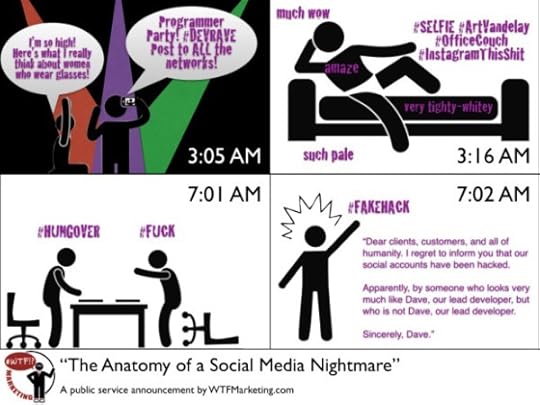
A pervasive myth among newbie social media managers that “the ROI of social media is hard to track.”
I’ll admit that even I used to say it – back when social media was a new thing. It’s so pervasive it’s seconded only by “We were hacked!” after a nude selfie, party pics, or a socially unacceptable post surfaces.
Hard-to-track ROI?
Nonsense, my good fellow! Frankly, total bullshit. It is mostly an excuse by well-intentioned marketers who are hired to do social media, but don’t have the clout with their clients to pull more business logic levers.
Social media ROI is only hard to prove in two situations:
if you’re intentionally being lazy, or
if you’re just asking the wrong questions
Last blog, I bitchslapped horrible marketing advice: boost all the Facebook posts. The TL;DR version is: only boost if you have a legitimate business ROI for doing so. Otherwise, write better content that’s worth sharing.
What is a legitimate business ROI? It comes down to asking 4 questions:
What is the business metric we want to change? (sales, butts-in-seats, volunteerism, sentiment improvement)
To what degree do we want to change it?
What levers will we pull to change it?
How will we know if we were successful?
That’s it. Four questions. Four fucking questions give you social media ROI.
Roadblock: social media managers who don’t have power over business logic levers, or can’t influence company policy, or aren’t empowered to make a difference will have a really hard time generating ROI. If that’s you, my heart goes out to you. Unless social media is treated as an equal-opportunity player in the marketing mix, ROI is hard to come by.
How do you pick a good business metric?
The two different kinds of metrics are Hard Metrics (bow chica bow wow) and Soft Metrics.
Soft metrics – things like sentiment, top-of-mindedness, awareness, likelihood to refer a friend, etc. Things you can’t easily put a number on, but can see on a good customer survey.
Hard metrics – things like bounce rate, visits, likes, products sold, coupons used, etc. Almost always automatically tracked by whatever tool you’re using (analytics, insights, whatever).
Got it? Now, here’s the trick: any single metric on its own means next to nothing. You only get a complete picture by looking at how two metrics combine/interact/work together/work against each other. This is called meta-analytics.
Why?
Think of it this way: say your friend David wants you to draw a portrait of his cat. He’ll pay you only for a perfect picture of his beloved Fluffy. You can try as many times as you want, but the rules stay the same each time.
One hitch, though – David is a douchebag and requires that you draw the picture while blindfolded, having never seen the cat, from his verbal description only – his fetid hummus breath fogging up your ear throughout.
Gross, right?
So, fucking stop trying to prove your social media campaign was successful because it got a “ton of likes”. You don’t know what the cat looks like. That you were able to keep pencil to paper the whole time is virtually meaningless if you drew three blobs and not a cat, got it?
While I’m on this – a “Like” on Facebook is tantamount to slightly-more-than-outright-boredom from whatever random soul happened to see your stupid update. Can you even remember even 5 things you “liked” on Facebook from last week without looking at your activity feed?
I’ll wait.
So, if a Like isn’t the end-all-be-all of social media ROI, what is? Let’s break down this ROI measurement a little bit:
Step 1 – to vet ROI, we need to know: what is our goal? (What is the business metric we want to change?)
Let’s explore a specific business case: a Cider Maker.
The Cider Maker needs to put butts in seats to sell cider.
That means: put new butts in seats and keep the existing butts already occupying seats. In business jargon: positive growth rate of customers over time, likelihood to repeat visit in the same period, and likelihood to refer.
Growth rate of customers is pretty easy to track. It gets a little murky if you only track unique credit cards vs say, subscribers to your mailing list. But you can get the rough number.
How about likelihood to repeat a visit? What metrics would we use? Maybe a customer survey. Maybe a Facebook survey. Maybe tracking the number of times a superfan comments after posting that night’s specials.
But, I hear some of you complaining, knowing if someone will actually come in or not based on a social media comment is next to impossible to track…
Social is probably the most visible medium for Word of Mouth, but don’t forget how much conversation happens offline. Only about 7% of word of mouth happens online. Doing a fabulous job on engaging social posts? Just don’t neglect generating and tracking those offline conversations. Create something you can track.
Post a shot of your new, secret dish with your new, secret cider, ask visitors to order it with a specific phrase or password to try it out (even if it’s not rare or limited) and you have just invented the very metric you needed to answer your ROI question. You could even do unique variations for Instagram and Pinterest if you wanted to break it down by network!
Likelihood to refer can be a few different metrics depending on your setup.
It could be an on-site comment card. It could be how many first-time visitors leave a Yelp or Facebook or FourSquare review after asked to by the server. It could be just getting the review in the first place. It could be number of reviews each week vs customer growth rate.
Long story short: when the metric you need doesn’t exist or isn’t tracked, don’t get lazy just because tracking Likes is easy. Figure out how to create and track the metric you want.
Step 2 – figure out to what degree you want to change that metric.
S.M.A.R.T. goals are key. “I want more butts in seats,” isn’t a measurable outcome. “I want 20% more butts in seats month over month for a three month period starting in March, 2015 and ending May 31, 2015.”
Specific ROI goals eliminate nebulous marketing “goals” that aren’t aligned with the actual goals of the business (like profit).
Once we have those two bits answered, we can move on.
Step 3 – What levers will we pull to change the metric?
In other words: how does a customer interact with our brand to contribute to the goal? What behavior are we trying to influence? How can we influence it?
Action is at the root of any metric. A visitor has to visit. An engager has to like, comment, click, or share. A purchaser has to purchase.
Figure out what action is associated with achieving the goal you’re after. Retaining customer dollars? They’d better know how to buy, think to shop, and actually get an ask letter to come in once in a while (and maybe click a trackable link through to a tracked landing page after opening a “Hey, How Are You?” email).
Maybe you’re creating a new email campaign. Or a YouTube video campaign. Or an Instagram photo contest. Or a write-in-letter contest. Or… you get the picture. It could even be as simple as “blog one more time per week” or “post 2 more times on Facebook each day”. The “lever” is a campaign – an executed series of events with a step-by-step process to try and influence the customer to do something.
Step 4 – How will we know if we were successful?
If you know steps 1-3 – what’s the metric, how much do we want to tweak it, what will we do/try to tweak it – then you know step 4 by default. You’ve created your boundaries and can easily play in them now. You’ll know if you succeeded because you outlined the goal, the timeline, the exact metric, the exact amount, and what you’d be doing to try and change the metric.
How cool is that? Nebulous ROI no more!
There is a step 5 – and this is what I get paid by my clients to help them figure out – What’s Next?
Win, lose, or draw – you have to know what’s next. That’s not so much an ROI question as a marketing strategy question. Did your campaign totally bomb? Cool. How do you modify it to perform better in the future, or should you abandon it and try something new? Did you totally oversell your product and land in hot water because the marketing was too good? Whoops. How can you structure the sales process next time to avoid embarrassment?
Did I miss something? Let me know in the comments.
The post Social Media ROI’s not hard to track, you’re just asking the wrong questions appeared first on WTF Marketing.