
Rog's Blog: Pulp In My Veins
November 24, 2012
The Gutter and the Grave by Ed McBain (Evan Hunter)
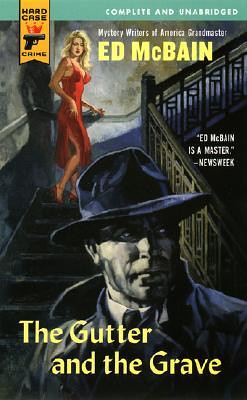 Cover Painting by R B FarrellMatt Cordell was a private detective until the day that he found one of his employees in bed with his wife and whipped him with a gun. Now his wife has gone, he’s lost his license as a result of the pistol-whipping, and spends most of his time in the Bowery in close communion with a bottle. At least that’s how it is until Johnny Bridges tracks him down and asks a favour. Johnny is a tailor and suspects that his new partner Dom Archese is dipping into the till. Won’t Matt at least take a look around the place for an old friend? But when Matt and Johnny visit the tailor’s shop, Dom is already there, shot dead.
 Evan Hunter pictured 2001
a.k.a. Ed McBain
a.k.a. Curt Cannon
(1926 - 2005)There are a lot of blondes in this one and they’re all trouble. Christine Archese is Dom’s widow, but Matt learns they’ve been separated six months. So who’s she sleeping with now? Larainne Marsh is Christine’s twenty-four year-old younger sister who works in a five and ten store but sings with a band and just could have the talent to make it to the top. And ever present for Matt is the phantom presence of Toni McAllister, his former wife.
When the police find that Matt is involved, Lieutenant Miskler puts a tail on him, the wonderfully named Albert de Ponce detective 3rd/Grade. Matt’s treatment of women here is rough even by the standards of the old Manhunt magazine (where Matt Cordell first appeared). Extra-marital relationships are rife in this book, and another murder is on the cards before the end. But what really causes the trouble is that everyone – everyone – is lying. This is real noir, great noir, the pace is breathtaking and I was hooked from the start.
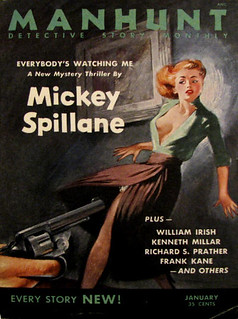 The first issue of Manhunt
including Die Hard by Curt Cannon
January 1953The first Cordell short story Die Hard written under the pseudonym ‘Curt Cannon’ appeared in the first issue of Manhunt magazine, January 1953. The Gutter and the Grave was originally published as I’m Cannon – For Hire under that pseudonym (the title was one that Evan Hunter hated, according to Booklist). Charles Ardai, editor of Hard Case Crime writes of the character’s name “Cannon was a name foisted upon McBain by the editor’s at Gold Medal; the character’s original name in his magazine appearances was Matt Cordell. When McBain decided to let us reprint the book, he asked us to change the character’s name back to what it had originally been.”
Ardai’s – and Lawrence Block’s comments can be found here:
Vintage Sleaze Paperbacks
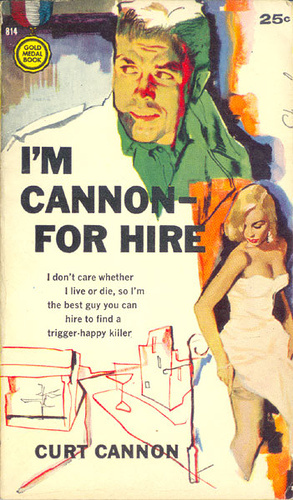 Gold Medal 1958 edition
Another useful page is: Thrilling Detective Website
Three episodes of Mickey Spillane’s Mike Hammer were based on Hunter’s stories (as Curt Cannon). Evan Hunter had just finished proofing the galleys of the Hard Case Crime reprint of The Gutter and the Grave when he died of laryngeal cancer July 6th, 2005.


November 18, 2012
The Cocktail Waitress by James M Cain (2012)
 James M Cain's posthumously
published novel
Hard Case Crime (Titan), 2012
Cover by Michael KoelschOne of Cain’s tentative working titles for this novel was American Beauty. The book reads like a romantic melodrama, but for readers over a certain age who will remember the significance of a drug Joan is given by a friend while she’s on honeymoon, the novel takes on an added dimension. This is a horror story.
Most of the details given here come only from the first 11 pages. The story opens at a funeral where twenty-one year-old mother Joan Medford is burying her husband Ron. Joan hasn’t lost much sleep over Ron’s death; he’d always resented the marriage he felt forced into when Joan became pregnant, and even as his coffin is being lowered into his grave, Joan and Tad are both still recovering from his last beating. The last time he’d come home drunk Joan had sent him packing and he’d driven a borrowed car into a culvert wall at 70mph.
His sister Ethel makes it clear she believes Joan deliberately sent him to his death. Joan has to bite her tongue as she has to depend on Ethel to take care of her small boy Tad, while she looks for work. Ethel is only too pleased to have Tad in her care; she and her husband Jack Lucas are childless, she’s recently had a hysterectomy, and it’s clear she’s going to have a problem letting go of the boy.
 James Mallahan Cain
 (July 1 1892 - October 27 1977)
Photo by William L Klender
(1970)Also at the funeral is Tom Barclay who’s standing in for another cab-driver and is strongly taken by a glimpse at the young widow’s legs.
When Joan gets home, she’s visited by Sergeant Young and Private Church, who advise her that someone has been attempting to blacken her name by spreading rumours about her. The officers had previously met Joan when informing her of her husband’s death; now Joan guesses that Ethel is spreading rumours, attempting to have her declared an ‘unfit mother’ for Tad. Learning that she’ll have to seek work, Sergeant Young suggests she try waitressing at The Garden of Roses restaurant.
Joan quickly makes new friends there, and her looks make her popular with the customers. Two of these are Earl K White the III, a wealthy investor in his sixties, and the young and attractive Tom Barclay. Very quickly this develops into a romantic triangle, with Joan having to decide between an elderly and wealthy investor with a heart condition, who physically revolts her, and an attractive but penniless young man.
Whether the story has the same impact on readers will depend largely on whether the reader is familiar with the name of a drug introduced in the late 1950s and banned in the early 1960s. Some won't get it, though many will continue to read James Ardai’s enlightening afterword. This has all the elements of a detective story as Ardai reveals how he learned of Cain’s unpublished novel, the search for it, the discovery that it existed in more than one version, and gives some details of what must have been an agonizing editorial process of collating and refining numerous pieces of a literary jig-saw until the novel had (hopefully) reached a state that it’s author would have been satisfied with.
November 11, 2012
The Iron Gates (Taste of Fears) (1940) by Margaret Millar
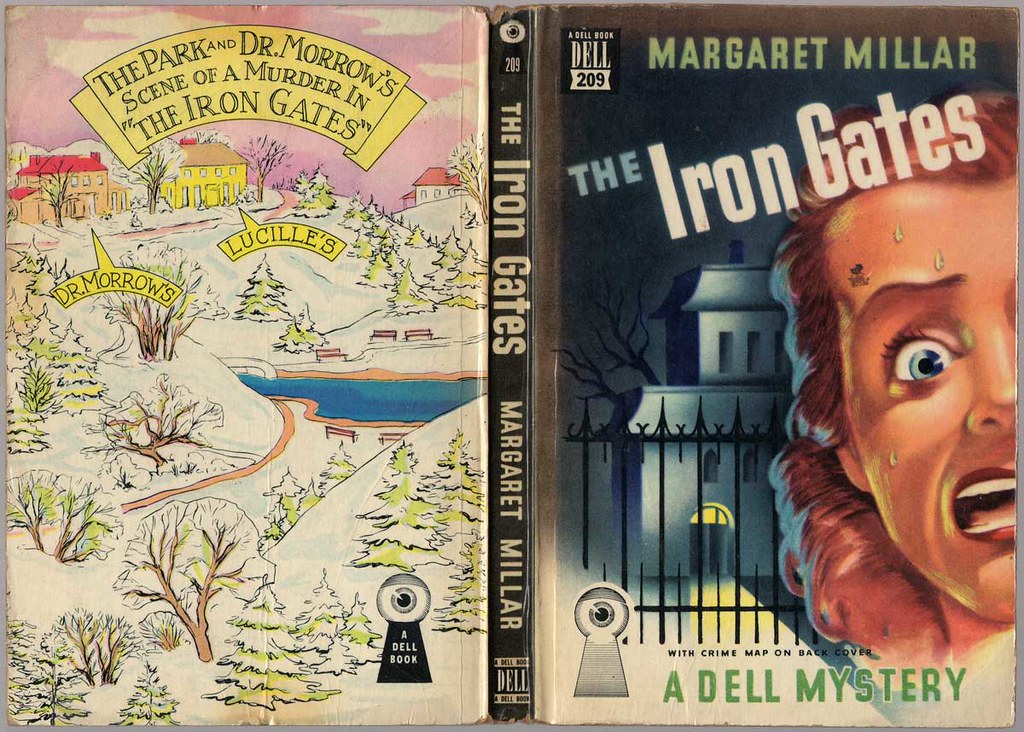 Dell Mapback #209 (1948)
Cover art by Gerald GreggThe novel opens with a dream – it is immediately obvious that it’s a dream – in which Lucille Morrow sees her husband Andrew’s dead wife Mildred leaving the house to walk in the park at night, despite the thick snow – and the hideous wound in the back of her skull.
Although Lucille is happy with her marriage, it quickly becomes obvious that her step-children Polly and Martin are hostile toward her, and Polly hates her father for having married again after her mother’s death. Mildred was murdered one night in the snowbound park, and although there are stories of a figure with an axe seen in the neighbourhood at that time, her killer has never been caught. Although the children have never accepted her, Lucille is a calm and organised person, and is valued as such by Andrew and his unmarried sister Edith.
 Margaret Millar
(1915 - 1994)Polly is about to marry Lieutenant Giles Frome. When she goes with Andrew and Martin to bring him to the house for his leave, the return journey is interrupted when they happen on a major rail crash and stop to help with the injured and dead. Giles is disturbed both by the sight of so much death and the family’s apparent calm in its presence.
The next day a shabby-looking stranger visits the house to deliver a box to Lucille. A housemaid hears a scream from her room, and later that day the family discover that she’s disappeared. Lucille is eventually found in a hotel room, but she is now in an unresponsive state, and is placed in the Pentree nursing home under the care of Dr Goodrich. The mysterious box remains undiscovered.
The case is taken up by Inspector Sands, who soon connects Lucille with another murder and reopens the investigation into Mildred’s murder; an investigation he believes was badly mishandled by another member of the force, years before.
 Margaret Millar’s story explores the motivations of complex characters in intensely structured environments; the iron gates of the title refer to the gates of the Pentree asylum, which isn’t far removed either geographically or in nature to the Morrow family’s house at the edge of the park. The first acts of violence strike outside of these environments, the strangely tranquil snowbound park or the squalid city backstreets. The dream with which the novel opens sets the mood for the rest of the book, this at its most intense in the chapters dealing with Lucille’s residence in the asylum, when her deranged state is conveyed through disturbing stream-of-conscious passages (and James Joyce is name-checked here). Millar’s husband John Ross Macdonald sometimes introduced gothic motifs in his novels, and here there’s a similar suggestion of something fossilised or corrupt at the heart of a romanticised setting, the house in the frozen waste of the park.
My copy of The Iron Gates (UK title Taste of Fears ) was included in a paperback volume, Alfred Hitchcock presents Stories for Late at Night part 2 (this volume actually edited by Robert Arthur), published by Pan 1965. Millar wrote one other Inspector Sands novel, Wall of Eyes (1943).
View all my reviews

November 10, 2012
Hollywood and LeVine by Andrew Bergman (1975)
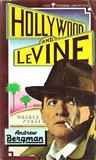
I really enjoyed this, but I'd probably enjoy any story that concluded with Humphrey Bogart at the wheel of a speeding car. Set in Hollywood in the 'Forties. LeVine, to use his own words, is a balding, overweight private eye. An old friend in the screen writing business calls him to Hollywood to work on a case, but Le Vine gets there only to find his client swinging from a gallows on the Warners studio lot.
 Andrew BergmanLeVine Guesses that more is going on here than mere artistic conflict, and soon stumbles onto a CIA scheme to uncover Communist infiltration into the Hollywood movie system. There are numerous appearances by celebrities of the time (including a very young congressman, Richard Nixon). And if this book has pressed the right buttons for you so far, you'll probably love the car chase at the end (the best since the one in Richard Brautigan's Dreaming of Babylon) with none other than Humphrey Bogart at the wheel. Leave your serious face at the door and enjoy.
 This is the second in Andrew Bergman's Jack LeVine trilogy, the others being The Big Kiss-Off of 1944 (1974), and Tender is LeVine (2001).
Very short write-up this time, mainly because my review was scanned from stuff written in the days I used a steam typewriter. But God, overall I wrote more in those days before the net!
View all my reviews

November 8, 2012
They Don't Dance Much by James Ross (1940)
 Harrap's 1986 UK edition of
 James Ross's
They Don't Dance Much (1940)
(Cover design not credited)The story is set in a North Carolina backwoods town, in the Depression years, and as the story opens, the narrator Jack Macdonald, has just lost his farm through non-payment of taxes.
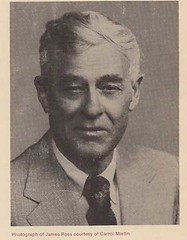 James Ross (1911-1990)
Said by William Gay to be
“the man who invented Southern noir.” Jack spends a lot of his time hanging around the garage and roadside store run by his friend Smuts Milligan. Smuts has some big plans for the store, and soon Jack is working for him as Smuts expands his business into a roadside diner and dance hall.
But business turns out not to be as good as Smuts had hoped and soon he's looking for alternative sources of income. The novel'scurious idyllic backwoods charm is interrupted by a harrowing torture and murder as Smuts tries to learn the secret of an old recluse's hoard.
It’s a novel of rare brilliance. Raymond Chandler described it as “a sleazy, corrupt but completely believable story of a North Carolina town.”
 Signet #913, abridged edition, April 1952
When Daniel Woodrell reviewed Joe R Lansdale’s Mucho Mojo (1994) in The New York Times, he cited as Lansdale’s predecessors James M. Cain, Erskine Caldwell and Jim Thompson, but went on to say: “James Ross is scarcely ever mentioned, though his one novel, They Don’t Dance Much (1940), might be the finest of the lot.”
And in that last sentence lies the rub. James Ross only wrote one novel. Which somehow makes it all the more important that you read it.
The photograph of James Ross shown here was found as part of the fascinating essay My Search for James Ross, One-Hit Wonder, by Anthony Hatcher, who obtained the photo at Elon University, North Carolina. I recommend the essay to any who wish a more detailed account of this novel and its author.
November 5, 2012
Murder Always Gathers Momentum by Cornell Woolrich
Years ago Richard Paine had deferred half his wages to help his employer Ben Burroughs through hard times; but now, after Burroughs has declared himself bankrupt and cancelled his company’s debts, he’s been left comfortably well-off, while Paine is unemployed and he and his wife face eviction. Paine decides it’s time to ask Burroughs for the money he owes and goes to visit him by night. Through a window he sees Burroughs opening a safe, and, not believing that the old man will honour the debt, he decides to rob him. Things go wrong and Paine is precipitated into a chain of events which lead to him escaping across the city, leaving a trail of corpses in his wake.
This is not a favourite Woolrich story of mine. This story of a frightened man in desperate times has an air of doomed inevitability about it from the start; almost from the first lines we know that no good is going to come out of Richard Paine’s night journey to Burroughs’ home.
As a portrayal of a man trapped in intolerable circumstances, it’s powerful stuff. Francis M Nevins wrote in his book Cornell Woolrich: First You Dream, Then You Die : “When it comes to putting us in the skin of a frightened little guy in a miserable little apartment with a hungry wife and children and no money and no job and fear of tomorrow eating him like a cancer, Woolrich has no peers. There is more of the anguish of the thirties in stories like Murder Always Gathers Momentum than in volumes of social history.”
Yes, and it’s interesting that the editor of Detective Fiction Weekly decided to publish this story in a time (December 1940) when its readers had not long emerged from the Great Depression and the world was slipping back into war, a time when most would surely have preferred to read more escapist stuff than being reminded they were themselves living in such desperate times. As social comment the story is a valid document, while as fiction, criticizing Woolrich can be likened to throwing rocks at the moon. Let’s face it, we read Woolrich for his bleak worldview. But this one’s so remorselessly downbeat, and the final lines which reveal too late that the whole mess only began because Paine and his wife didn't communicate enough, left me with a flat and disappointed feeling. The problem wasn't the Great Depression, it was just a couple who should have talked more. And people say Americans don’t understand irony?
Below is a link to a free download of the 27th October 1949 broadcast of Woolrich's Momentum, an episode of Suspense scripted by E Jack Neuman and starring Victor Mature and Lurene Tuttle. Details differ from Woolrich's original story.
Woolrich's 'Momentum' broadcast in Suspense

October 30, 2012
THE IVORY GRIN by John Ross Macdonald.
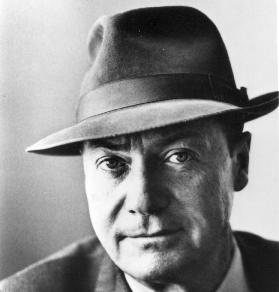 John Ross Macdonald (Kenneth Millar)
1915 - 1983
 Was this splendid Pan 1957 cover
art the work of John Edwin Keay
(better known as Jack Keay)
Or could it be John R Keay?Sometimes you pick up a book and immediately get that certain feeling, which was what happened when I started this one - which just happened to be my first John Ross Macdonald thriller. That was back in 1988. On the back cover I found some connections with other authors. ‘John Ross Macdonald’, the cover blurb informed me, was a pen name used by Kenneth Millar who had written several thrillers under his own name and whose wife Margaret was no slouch herself when it came to tapping out an occasional mystery. Like The Iron Gates? I hardly needed further encouragement, and anyway, the plot had already got its claws into me and wasn’t letting go.
The plot: Lew Archer is hired by the butch Una Larkinto find a former employee, a young coloured girl who has run out on her. Archer doesn't like Una and only half-believes the reasons she's given for wanting to trace her former employee, when the girl turns up dead. Archer wants to know why, and by this time he’s changed his employer and has begun searching for a missing man.His new search takes him to a Gothic mansion, an insane mobster and a doctor who has lost all self-respect in his obsessive fixation with a faithless wife. Beside the quirky gothic touches, Macdonald conveys a brilliant picture of small town nineteen-fifties America which Ray Bradbury would have liked (and probably did).The cover is graced with a positively luminous cover painting by 'Keay'. At first glance it's a fairly typical late nineteen-fifties cover. But the near-photo-realism is unusual and also the luminosity of the colours. The picture of the grey-suited detective sitting on the edge of a desk as he questions a suspect while a policeman in the background stands in the horizontal shadows of a Venetian blind, combines to creates a brilliantly time locked image redolent of countless American TV cop shows or noirmovies. It’s no wonder that the presenter of a BBC series about the tough women who featured in so many noir films delivered her chats years later sitting in front of this image.
Now does anyone remember the name of that series?
October 29, 2012
The Night I Died by Cornell Woolrich (1936)
 Detective Fiction Weekly
 for August 8th 1936,
showing the story as an
anonymous publication
“The Point about me is that I should stay on the right side of the fence all those years, and then when I did go over, go over heart and soul like I did – all in the space of one night. In one hour, you might say.”
I’ve no idea how many noir stories pivot on the idea that a man’s life can change in an instant (usually for the worst), but I’d guess lots. Usually in these stories it’s the man’s life which changes; the woman is the one who’ll make the changes happen because she’s got into some mess, been kidnapped maybe, or is being blackmailed, so he has to rescue her or get her out of trouble. Or she’s a Machiavellian scheming bitch that any man with sense would run a mile from, but we just know he’s got such a bad case of the hots they’re going to end up swinging together.
There are some things that a man in a noir story should never do. He should never let his wife take out life insurance for him. And he should never never go home early to give her a surprise. You just know if he does that, the one in for the real surprise will be him.
So when Ben Cook goes home earlier than usual with a bag of toffees for Thelma, he probably deserves all he’ll get and, as he goes into the house, we’re not the least surprised that he hears voices. Or that the voices are those of Thelma and a man he doesn't know. And the next thing he knows, he hears the two of them plotting his death.
With the advantage of surprise on his side, Ben takes control of the situation and Thelma’s scheme now undergoes some fundamental restructuring as Ben drops out of sight in order that the world will believe he’s dead and that that all-important insurance claim will be paid – initially, at least – to Thelma.
But we have a fair way to go before we’re at the end, and the path is likely to get a mite bloody.
This story was first published in Detective Fiction Weekly, August 8th, 1936. Happily I've been able to locate the cover of that issue at The Fiction Mags Index. And look closely at that cover. Did he really publish this story anonymously? I read the story in Four Novellas of Fear , 2010, A J Cornell. Publications.

Thin Air by Robert B Parker
 Thin air is what Lisa St Claire has vanished into, at least that’s how it seems to her husband, Boston cop Frank Belson. But then, Lisa is young and very pretty, and poor old Frank’s getting on in years, so what can he expect?
Private Eye Spenser knows Frank and Lisa and isn't convinced by the poor old Frank school of thought, and when someone takes a shot at Frank, Spenser becomes even more convinced that there’s some other reason for Lisa’s disappearance. In fact the reader knows there is another reason; because we've witnessed her abduction on page one, though we’re not sure who’s responsible or why, or exactly what’s going on.
Spenser’s investigation into Lisa’s past, before her marriage, takes him deep into a history of abuse, alcoholism and prostitution and ultimately to a barrio fortress in a Massachusetts mill town which has become the hub of a power struggle.
 In the closing chapters, a battle taking place in the streets surrounding the fortress moves into the crumbling walls of the stronghold itself.
This was my first Robert B Parker novel, and damned if Parker didn't die in January 2010. This keeps happening. I try to keep up with authors while they’re still around, but I guess most of them had been working at their writing a lifetime before they became well-known enough for any of us to find them.
Parker’s writing has been described as Chandleresque, sometimes to the point of self-parody. It is Chandleresque; I didn’t notice any parody myself, but this is the first Parker book I've read. Maybe you need to read a lot to notice it. I thought his writing had quite a light touch; in this one he seemed to be marrying elements of detective thriller and Western adventure, and I was quite happy to be along for the ride.
Detail: Spenser is spelled with an s as in Edmond Spenser, the writer of The Faerie Queen (what?); and the character has no known first name. Probably I will read another one of these.

October 28, 2012
Free Fall in Crimson by John D MacDonald (1981)
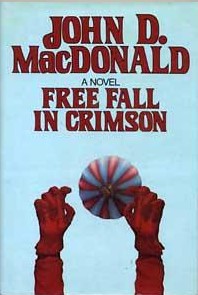 Free Fall in Crimson, Collins 1981
UK First EditionTravis McGee is approached by a young artist whose millionaire father was beaten to death in a lay-by a couple of years before. The old man had been dying of cancer, with only a couple of months left to him, and there’s a suspicion that he might have stopped in the lay-by to buy illicit drugs to help him through his last weeks. Travis is hired to find out the truth.
His search takes him into the world of motorcycle gangs, and to a film director who made a couple of cheap cult biker movies years before and is now engaged on a seemingly doomed project making a film about hot air balloons.
 Actually John had a beard in the
photo on the back of this book
but this looks cool anyway.Travis spends a lot of time weaving between bikers, druggies and a long-clawed Hollywoodsex-kitten; and a new lady comes into his life in the shape of the lovely Anne Renzetti. We don’t see too much of Meyer after the opening chapters, but there’s a lot going on here all the same, and the final confrontation with the killer is truly frightening. I liked it.

Pulp In My Veins

Celebrating a life long love of pulp, whether R Murray Gilchrist's gothic stories from Aubrey Beardsley's Yellow Book or Cornell Woolrich's thrillers from Dime Detective or Black Mask Magazine.
...more
- Rog's profile
- 3 followers

