Jennifer Hancock's Blog
November 14, 2025
Why Do We Want Money? A Socratic Dialogue on Real Needs
A Humanistic and Socratic exploration of why we chase money, what our true needs are, and how to think critically about both personal and societal systems that shape that chase.

Socrates: Tell me, my friend, why do you want money?
Student: Because I need to pay my bills.
Socrates: And why do you need to pay your bills?
Student: Because if I don’t, I’ll lose my home, my food, my health care.
Socrates: And why would that be a problem?
Student: Because without those things, I could die.
Socrates: So what you truly need is not money itself, but food, water, shelter, and health.
Student: I suppose that’s true.
Socrates: Then why do you focus so much on money?
Student: Because that’s how I get those things.
Socrates: Is it the only way?
This is where Socratic questioning gets interesting.
When we take time to “go Socratic on ourselves,” we begin to separate real needs from proxy problems — the things we chase because we think they’ll solve the real problem.
Money is a proxy. It’s a means to an end, not the end itself.
When we forget that, we risk optimizing our lives around the wrong goal.
When we ask why enough times, we eventually reach bedrock — our core human needs: survival, safety, belonging, purpose. Once we know what those needs really are, we can start thinking more creatively about how to meet them.
For example:
If the goal is water for your field, what can you do?
You could pray for rain.
You could irrigate the field.
You could do both.
But if you only pray and take no action, you leave the outcome to fate — and that is not the Humanist way. Humanism is about taking responsibility for outcomes through reason, compassion, and evidence-based action. We don't care if you pray - as long as you also take action to fix your problems, whatever they are.
Thinking Beyond the IndividualOnce you apply this kind of questioning to your personal life, it’s natural to extend it to society.
Why do people lose their health care when they lose their jobs?
Because our system ties health care to employment.
Why do we tie health care to employment?
Because we’ve decided that’s how it should work.
Can we decide differently?
Yes.
That’s the power of Socratic questioning — it helps us see that many of our systems are not inevitable. They are choices we made, and we can make different ones.
This is just an example. My main point is that we need to know we have options if we are to seek those options out. Will those options be better than what we have now? I don't know. This is about exploring options and using critical thinking to help us think outside the box of the here and now to propose possible futures.
The Humanist LessonIf you want to become more effective in your life — and as a citizen — practice this:
Ask why.
Why are you working on this problem? Why did you answer the way you did? Keep asking why until you identify what you are really trying to do and why you are trying to do it. You can stop when you get to the - if I don't do this - bad things will happen. That's when you've identified your real problem.
Follow the logic to its roots.
Identify your real need.
And then, take reasoned action to meet it.
The more we do this — individually and collectively — the better we get at solving real problems instead of chasing proxies. I use this method as a way to teach people the critical thinking skills they need to be more effective and strategic in their actions.
Critical thinking isn't just about making sure you are being logical and using science, though that is important. It is also the practice of self interrogation, so you can be more effective by helping focusing on your real problems
When we think critically and act compassionately, we don’t just survive — we thrive.
LEARN MOREI teach the Socratic method as part of my courses on critical thinking and reality based decision making.
If you want to learn more about reality based decision making and all the critical thinking skills that can help you be more effective - take this course: https://humanistlearning.com/realitybaseddecisionmaking/
I also have a course about the socratic method as a way to win arguments without arguing. But this is one of those - it's way deeper than just - winning arguments sorts of courses. https://humanistlearning.com/socratic-jujitsu/
Finally - if you want to learn more about how to control your responses, like triggered responses so you can choose to respond strategically, take this course. https://humanistlearning.com/mastering-the-five-managerial-superpowers/
Learn more at https://humanistlearning.com

October 17, 2025
Why Be a Good Person (Even When It Feels Hard)
Compassion is an important part of my practice as a Humanist. But when I talk about the importance of responding with compassion to people who are struggling with difficult situations, the most common concern people raise is this:

“But if you’re compassionate, won’t bad people just take advantage of you?”
I get it. On the surface, it can feel like being a good person just paints a big target on your back. Why bother? What’s in it for you?
Here’s the reality: being a bad person doesn’t protect you from bad people either. Bad people take advantage of bad people all the time. In fact, bad people are often each other’s favorite targets. So the idea that being mean, tough, or selfish shields you from harm just isn’t true.
That means the real question isn’t, “Will being good protect me?” It’s “Who do I want to be?”
I choose to be good because it’s who I want to be. My values matter to me. Being good doesn’t mean rolling over and letting people walk all over you. It means defending yourself without abandoning your principles. It means setting boundaries without becoming cruel. Most of the time, it means walking away. And when I do have to take action, I act from my values—not from anger or frustration.
Another concern I hear a lot is: “What if I want to be a good person, but I work in a place where others aren’t? How do I manage that?”
My answer is always the same: you don’t need anyone’s permission to be a good person. Yes, it’s harder when you are surrounded by unethical colleagues or leadership. But it’s still worth it. Compassion and empathy help you hold on to your humanity. They allow you to maintain your own standards—even in the toughest environments.
Being good isn’t about being naïve. It’s about being intentional. It’s about choosing to live in alignment with your values no matter what.
If this resonates with you and you want tools to help you stay compassionate, ethical, and resilient—especially when faced with bullying or unethical behavior—I’ve created resources to help. You can find my books and courses on my website https://humanistlearning.com I have courses, books, audio books and other materials designed to give you practical skills to stay the kind of person you aspire to be, even when the world around you makes it difficult.
So, why be good? Because in the end, that’s who you decide to be. And if you need a selfish reason to be good, it's because your life is made easier when you are surrounded by good people. And good people, do not give their time to bad people. Want to be surrounded by good people? Be a good person yourself.
Learn more at https://humanistlearning.comOctober 13, 2025
Exciting News: My Blog Named a Top Humanist Blog!
I’m honored to share that my blog has been named one of the Top 15 Humanist Blogs by Feedspot—and I came in at number 8!

For those who are new here, my writing focuses on applying humanism—the philosophy of living ethically without religion—to everyday challenges. Whether I’m exploring questions like “what is humanism?” or sharing practical strategies for how to live as a compassionate, responsible humanist, my goal is always the same: to help people define and live their values in real, tangible ways.
Being included on this list alongside so many other thoughtful writers in the humanist community is truly exciting. If you’re curious to explore more perspectives on defining humanism, the meaning of being a humanist, or how humanism shapes the way we live and work, I encourage you to check out the full list here: Top 15 Humanist Blogs.
Of course, I’ll keep writing and sharing insights here about compassion, ethics, behavioral science, and how we can use humanist principles to create a better world. But I also believe part of being a humanist is learning from one another—so I hope you’ll take a little time to read and support the other blogs on this list.
Thank you for being part of this journey with me. Your support makes it possible for me to keep sharing these ideas and to continue showing how
Learn more at https://humanistlearning.comSeptember 12, 2025
How to Get Better at Doing New Things: Successive Approximation, Not Perfection
When we set out to learn something new, most of us fall into the same trap: expecting ourselves to be perfect right away. Whether it’s a new skill at work, a leadership practice, or even a new habit at home, we demand too much, too soon. And when perfection doesn’t happen, we get discouraged, give up, or label ourselves as “bad” at it.
Behavioral science offers us a much better model: successive approximation.
 Jennifer training a dolphin in Hawaii while in collegeWhat Dolphins Can Teach Us About Learning
When I was training dolphins, we used an approach to training new behaviors called successive approximation. Which basically means, you reward approximations of the wanted behavior and over time, fine tune it. We aren't rewarding perfect behavior. We are rewarding approximations of the behavior we want.
When trainers teach a dolphin a new trick, we don’t expect the animal to leap out of the water and spin on day one. That’s never going to happen. Why? Because dolphins don't speak human. If we want them to do something, we can't just say - please jump out of the water. We instead, have to help them figure out what we are asking for by both showing and rewarding behavior that is closer to what we want.
We reward small steps that move the dolphin closer to the final behavior. These are called approximations. If the dolphin swims near the right spot—reinforcement. If it jumps a little—reinforcement. If it starts to spin—reinforcement.
Each attempt doesn’t have to be perfect. It just has to be a little closer to the desired behavior. Over time, those approximations add up and lead to the behavior we have been working towards them learning.
And ... I'm going to let you in on a little secret. Dolphins never do any behavior perfectly. They may do something reliably (like - more often than less often when given the signal). But perfection is not something any animal trainer expects from their animals. It's just not a realistic goal.
Humans work the same way.
Stop Chasing Perfection. Start Rewarding Progress.The key insight is this: no behavior is ever truly perfect. We’re always refining, always improving. The healthiest mindset shift you can make is to stop expecting perfection from yourself and instead aim for incremental successive progress.
Did you do a little better than last time? That’s success.
Did you move one step closer to your goal? That’s success.
Did you learn something useful—even from failure? That’s success too.
By celebrating small wins, you create momentum. By focusing on improvement instead of perfection, you unlock resilience.
If you are a leader - please apply this to your team! Reward them for improvement. Don't punish them for not being perfect.
Break it down. Don’t aim for the whole behavior at once. What’s the next small step you can take or learn?
Track progress, not perfection. Keep your eye on improvement over time, not flawless performance.
Reinforce the attempt. Acknowledge and celebrate your effort, even if the result wasn’t ideal.
Never “finish” learning. Even once you’re skilled, you can keep refining. Improvement never stops.
This approach doesn’t just reduce stress—it makes learning stick. You’re rewiring your brain through practice, repetition, and reinforcement.
A Humanistic Shift in PerspectiveInstead of saying, “I failed because I wasn’t perfect,” you begin to say, “I’m succeeding because I’m improving.”
That’s a radical, freeing shift. And it’s not just about learning new tricks—it’s about how you approach leadership, relationships, and life itself.
Want to Learn How to Apply This in Practice? I teach these techniques in my course,
Mastering the Five Managerial Superpowers
. It’s all about using behavioral psychology to hack your brain, improve your leadership skills, and create lasting change—not by aiming for perfection, but by practicing better.
I teach these techniques in my course,
Mastering the Five Managerial Superpowers
. It’s all about using behavioral psychology to hack your brain, improve your leadership skills, and create lasting change—not by aiming for perfection, but by practicing better.Because the goal isn’t to be perfect. The goal is to improve.
Learn more at https://humanistlearning.comAugust 8, 2025
Give Your Best 75%: A Humanist Approach to Sustainable Success
In a recent conversation with a friend, I said something offhand that stuck with me: “I got about 75% of my to-do list done today—and I feel really good about that.”
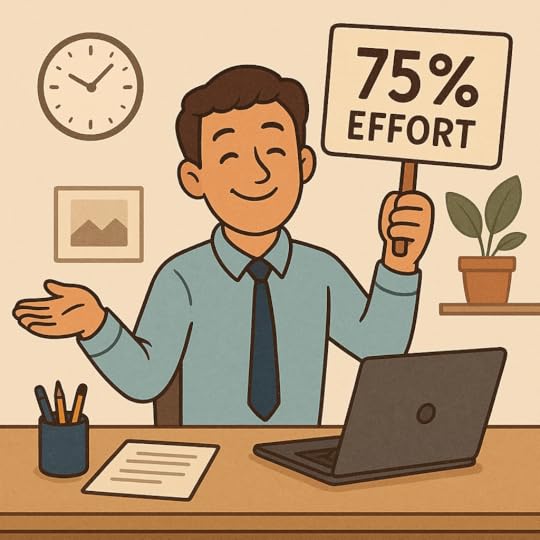
That simple statement captures a core lesson I’ve learned as a humanistic business leader: you don’t have to do everything to be successful. In fact, trying to do everything is a recipe for burnout—not just for you, but for your relationships, your community, and even your business. Giving your best 75% might just be the most productive and sustainable thing you can do.
The Myth of 100%There’s a lot of pressure in the business world to give “110%” all the time. Hustle harder. Sleep less. Achieve more. But human beings aren’t machines—and when we treat ourselves like we are, we break down. Constant overdrive isn’t sustainable. And it’s not actually necessary.
Some of the most important things I do in a day—like making a healthy meal, having quality time with my family, playing a video game, or chatting with a friend—don’t show up on a productivity chart. But they make me a better business leader, a better thinker, and a more grounded human. They help me show up better for the 75% of work I do choose to tackle.
Working Sustainably Is Working StrategicallyI work for myself. I have no boss threatening to fire me if I don’t check off every item on my list. That freedom has taught me something powerful: Many tasks simply don’t need to be done. Ever. Some can wait. Others vanish entirely when left alone for a few days.
The real trick is learning to discern. Every morning, I look at my task list—not to ask what I can cram into the day, but to decide what I’m not going to do. I pare it down to what’s truly meaningful and manageable, based on the time, energy, and obligations I have that day. That includes making time for myself and others, not just my business.
This is how I avoid burnout. It’s also how I do higher-quality work.
Systems That Support, Not ControlI’m still organized. I keep lists, use task trackers, and make sure nothing truly important gets forgotten. But those systems exist to support my work—not to guilt me into overworking.
I’ve also learned to say no. To projects. To requests. To distractions that don’t align with my priorities or capacity. Saying no isn’t failure. It’s focus. It’s choosing what matters most.
The 75% RuleSo here’s my philosophy: Give your best 75%. Be intentional. Be kind to yourself. Prioritize rest, relationships, and joy alongside business goals. You may leave some money on the table. But you’ll gain something far more valuable—your health, your clarity, your creativity, your sustainability.
And you’ll be better not just for your business, but for your family, your community (I volunteer at the zoo!), and the world around you.
You don’t have to do it all. Just do what matters—and do it well. You can thrive if you don't burn out. Save 25% - for joy.
#WorkLifeBalance #HumanisticLeadership #SustainableSuccess #AvoidBurnout #TimeManagement #DoLessBetter #HumanismInBusiness #MindfulProductivity
Learn more at https://humanistlearning.comJuly 10, 2025
Stop Sabotage with Science: The Behavioral Approach to Real Inclusion
Inclusion doesn’t fail because people disagree with it. It fails because it gets quietly sabotaged.

You’ve probably seen it — the subtle resistance. The eye-rolls. The “concerns” cloaked in civility. The way momentum dies, not with confrontation, but with passive-aggression. The result? Good people give up, culture stays the same, and real inclusion never takes hold.
This isn’t just a messaging problem. It’s a behavioral problem.
And that means it has a behavioral solution.
The Real Barrier: Sabotage Is BehaviorWhen it comes to diversity and inclusion, we focus a lot on values — and that’s important. But values don’t change behavior unless we understand how behavior works.
The truth is: many people who sabotage inclusion efforts do it subtly. They exploit group dynamics, use manipulation tactics, and rely on the fact that most people don’t know how to push back effectively without escalating conflict.
That’s where behavioral science comes in.
Why Behavioral Science WorksI teach behavior-shaping methods grounded in reinforcement psychology — the same science used to train dolphins, raise resilient kids, and build new habits in adults.
The core principle is simple:
👉 What gets reinforced, continues. What gets ignored and not reinforced, extinguishes over time.
This isn’t theoretical. It’s practical. You can train your workplace culture to resist sabotage. You can teach your team how to respond strategically, not emotionally. And you can stop bullying and manipulation before it takes root.
Learn the Tools. Change the Culture.At Humanist Learning Systems, my online courses combine ethics, compassion, and science to teach you and your team:
✅ How to stop bullying and harassment using behavioral tools
✅ How to identify and neutralize passive-aggressive sabotage
✅ How to reinforce inclusive norms — and make them stick
✅ How to build cultures rooted in dignity and humanism
Inclusion can’t thrive if you’re fighting behavior with good intentions alone.
You need strategy. You need tools. You need science.
Explore my online courses at Humanist Learning Systems.
Let’s stop the sabotage — and build the future of work with purpose, clarity, and compassion.
Learn more at https://humanistlearning.com
June 13, 2025
Reclaiming Inclusion: Advancing Equity Without Saying ‘Diversity
Introduction:
In today’s climate, even the word “diversity” has become politically charged. In some sectors, using it openly may result in backlash—or even legal consequences. But inclusion isn’t optional. Organizations still need to harness the full spectrum of human potential to thrive, adapt, and solve complex problems. Inclusion is about ensuring people can contribute without being excluded, sabotaged, or harassed. And that remains vital, regardless of what we call it.
 1. Inclusion Is the Goal—Not the Word
The pushback against DEI often centers on terminology. But let’s be clear: we don’t need a word to keep doing the work. Inclusion means making sure everyone—regardless of background, identity, or lived experience—can contribute meaningfully. If the word “diversity” becomes a political lightning rod, we can use other framing—like representation, belonging, psychological safety, or inclusive leadership—without losing the essence.
2. The Real Threat to Inclusion? Sabotage and HarassmentTip: Reframe your goals around “effective team participation,” “broadening access,” or “removing participation barriers.”
The biggest threats to inclusion don’t come from regulations—they come from inside. Passive-aggressive saboteurs, workplace bullies, and gatekeepers can quietly undo inclusive efforts. They withhold information, sideline new hires, or harass people into quitting—all without ever breaking an official policy.
Inclusion fails not when we stop using the word, but when we let toxic behaviors fester.
Organizations need strategies rooted in behavioral psychology to recognize and stop these patterns. It’s not about training people to “be nice”—it’s about changing the reinforcement systems that allow bullying and exclusion to persist so that bullies can't exclude people from the work group anymore.
3. Why Inclusion Still Pays OffInclusive teams don’t just feel better—they perform better. Research shows that when people from different backgrounds are truly allowed to collaborate, they identify risks faster, innovate more, and solve problems more effectively. But that only happens when team members feel safe speaking up—and that means rooting out behaviors that silence or sideline differing viewpoints.
4. How to Protect Your Inclusion Initiatives in a Politicized WorldIf you’re hiring for talent, you need to protect that talent from saboteurs.
You can protect inclusion efforts without waving a DEI banner:
Embed it into leadership values: Talk about fairness, safety, and performance, not identity politics.
Use data, not slogans: Focus on participation metrics, attrition rates, and engagement scores.
Train your managers in behavioral techniques: Give them tools to shut down sabotage and ensure new ideas aren’t ignored or punished.
Make inclusion a performance issue: If someone is undermining a team member’s ability to contribute, it’s a leadership failure—not a personality clash.
5. Next Steps: Train for Real InclusionStopping harassment and sabotage requires more than good intentions—it takes skills. My courses are designed to teach exactly that, using proven behavioral psychology techniques to:
Stop variably reinforced harassment
Create reinforcement systems that protect inclusion
Identify and neutralize saboteurs of inclusive culture
Whether you call it “diversity,” “belonging,” or “collaborative team culture,” the goal is the same: make sure everyone is included and no one on your team is being sabotaged.
Learn more at https://humanistlearning.comLearn how to stop harassment using behavioral psychology →https://humanistlearning.com/programsoffered/#bullying
Learn how to safeguard your inclusion initiatives →https://humanistlearning.com/safeguarding-diversity-and-inclusion-unmasking-saboteurs/
May 7, 2025
Understanding and Retraining Conditioned Reflexes: The Toilet Trigger
Have you ever walked past a restroom, thought you might need to go, and then the second you opened the door, it was like your bladder hit the panic button? You went from "maybe I could pee" to "I need to pee NOW!" in a matter of seconds. If you're nodding your head, you're not alone. This isn’t just a quirk of aging—this is your brain doing exactly what you accidentally trained it to do.

The Toilet Trigger: A Case of Classical Conditioning
What’s happening here is a form of classical conditioning. Just like Pavlov's dogs began to salivate at the sound of a bell, our brains associate certain environments or stimuli with specific responses. In this case, the sight of the bathroom (or even the door) becomes a trigger for your body to prepare for urination. Your brain has learned: bathroom = time to pee. The reaction is automatic. It bypasses conscious thought.
The good news? If your brain was trained into this pattern, it can also be retrained out of it.
How to Retrain Your BrainRetraining your brain takes intentional practice. If you want to stop the near-accident urgency that hits when you see a toilet, you can.
Here’s how:
Awareness – Recognize that this is a reflex, not a true emergency. You have more control than it feels like.
Delay the response – When you feel that strong urge upon seeing the toilet, pause. Take a breath. Wait a few seconds. You’re teaching your body that the trigger doesn’t need to equal immediate action.
Gradual desensitization – Practice walking into the bathroom without immediately going. Do something else for a moment. Over time, this helps break the tight link between stimulus and response.
Consistency – Like any habit, retraining takes time—typically around 30 days of consistent effort. So practice.
Why This Skill MattersThis isn't just about bladder control. This is about brain control. Once you understand how your brain is constantly reacting to triggers around you—often without your permission—you can begin to take your power back.
Your emotional responses to stress? Conditioned.Your defensiveness in conflict? Conditioned.Your impulse reactions when things go wrong? Conditioned.
Just like the bathroom example, all of these responses can be retrained.
This Is What My Book Is All AboutIn Mastering the Five Managerial Superpowers, I walk you through exactly how to retrain your brain to respond more strategically to the world around you. The foundational skills of self-awareness, compassion, and self-control allow you to stop reacting automatically and start choosing your responses with intention.
Whether you’re leading a team or just trying to lead a more centered life, understanding how to rewire your reflexes is a superpower worth mastering.
So the next time your bladder tries to boss you around, remember: it’s not magic. It’s just conditioning. And you can hack it.
Ready to learn how? Check out Mastering the Five Managerial Superpowers and start hacking your brain today. https://humanistlearning.com/mastering-the-five-managerial-superpowers/
Learn more at https://humanistlearning.comApril 11, 2025
Hack Your Brain: Mastering the 5 Managerial Superpowers
What if I told you that your brain is running on autopilot most of the time? That your reactions, decisions, and even conflicts are often driven by deeply ingrained habits rather than conscious thought? The good news is that you can take control. You can hack your brain, reprogram it for success, and become the leader—or simply the person—you want to be.

That’s exactly what my book and course, Mastering the 5 Managerial Superpowers, are designed to teach. Using behavioral science, I guide you through the process of rewiring your brain to manage yourself, your responses, and ultimately, your interactions with others more effectively. Here’s how:
Step 1: Build Your Foundation – Self-Awareness & CompassionBefore you can change anything, you need to understand how your brain works. Most of us operate on autopilot, reacting to situations based on past experiences and deeply ingrained patterns. Developing self-awareness allows you to recognize these patterns. Pairing that with compassion—for yourself and others—creates the space for real change.
Once you’re aware of how you react, you can begin to practice self-control. This is the key to breaking automatic responses and gaining the ability to choose how you respond instead of letting emotions or old habits take over.
Step 2: Hack Your Brain Using Behavioral ScienceThe science of change is clear: small, intentional shifts create lasting transformation. Your brain thrives on reinforcement and repetition. This means that with deliberate practice, you can create new neural pathways that make strategic thinking your default instead of knee-jerk reactions.
This is where behavioral science techniques come into play. By understanding how habits form and how reinforcement works, you can train your brain to make better choices automatically. The result? You become more effective in managing yourself, your work, and your relationships.
Step 3: Manage Conflict by Managing Your ResponseConflict is inevitable—but how you respond to it determines the outcome. The difference between escalating a conflict and resolving it effectively comes down to one thing: your response.
When you learn to pause, assess, and choose your response strategically, you take control of the situation rather than letting it control you. This shift empowers you to handle even the most difficult interactions with confidence and clarity.
Your Superpower AwaitsMastering these skills isn’t just about leadership—it’s about harnessing the power of your own mind to create the outcomes you want. When you learn to control your responses, you gain the ultimate superpower: the ability to shape your own reality.
Ready to start hacking your brain for success? Check out Mastering the 5 Managerial Superpowers and unlock the skills that will change the way you lead, work, and live.
Learn more at https://humanistlearning.comMarch 14, 2025
Leading Like a Dancer: The Art of Courteous Leadership
I recently joined a new contra dance community and have been dancing lead quite a bit. It’s been an eye-opening experience, not just for my dancing, but also for how I think about leadership.

But first a primer on Contra Dancing. Contra Dance is a social folk dance with roots in English, Scottish, and French traditions, popular in the U.S. since the colonial era. It involves long lines of dancers who move through a series of repeating figures, guided by a caller who prompts the moves in time with live music. Even though you dance with a partner, everyone interact with everyone else in the set as part of the dance. This creates a dynamic, fun and communal experience.
While callers historically used gendered roles (“gents” and “ladies”) to describe the roles in the dance patterns, many modern communities use the more inclusive terms “leader” and “follower” as they better reflect the roles being played by the dancers in a set. This is not done to erase gender, it's more that it isn't uncommon for people of the same gender to dance together. This is, after all, a social dance. Friends dance with friends, and you dance with everyone. Also, there are sometimes gender imbalances at a dance meaning too few women or too few men. If you still want to dance a set, you dance with whoever else wants to dance.
In my new dance community, women outnumber men two to one. If we ladies want to dance and there is no available gent, we dance with each other and since it's silly to refer to ladies as gents and gents as ladies and because we can't both follow, one of us needs to be the leader and the other the follower. This change has made the dancing so much more fun! Sometimes even if it is a gent and a lady dancing, the gent will request to dance as a follower and allow the lady to lead. The dance is gender neutral, the roles of follower and leader are what matter to the patterns we are dancing, and the point is to have fun, while dancing.
Having spent decades dancing as a lady, I'm used to dancing the follower role. And I'm quite good at it. I know how to take a lead. It’s why my grandfather loved dancing with me—I could read his signals and respond smoothly to them. But leading? Leading is something I've only recently started doing, and I’ve come to love it!
In social dance, the leader’s job isn’t to dominate or control or even to show off. It’s to ensure the follower has a good experience. In old-school terms, the “gent” wanted the “lady” to like him, so he led with courtesy and care. His role was to make sure his partner enjoys the dance—because if they don’t, why would they want to dance with him again?
When I dance as a leader, I pay attention to what my partner enjoys. Do they love spins? Great! Prefer to keep things simple? Perfect! The goal isn’t to impose my vision of how we should dance, it’s to guide them in a way that makes the experience enjoyable for both of us.
Leadership as CourtesyWhile most contra dances are equal, meaning leaders and followers dance the same patterns, there are some elements where the leader and follower have different moves.
One of these moves is the courtesy turn. In this move, the follower takes center stage. They are the star. They dance across the set to either their partner or their neighbor, often with a flourish. The leader’s role is stand in place and be ready to accept the momentum of the follower, and provide balance and guidance to help them gently turn around, so they can re-enter the dance smoothly.
The follower needs this help because their momentum is taking them in one direction and they need help to turn around in time with the music. This is the job of the leader. To help them turn around by giving them something to balance against.
And this the key to understanding the leaders role. A courtesy turn is called a courtesy turn for a reason. It’s a courtesy you do for your partner/follower.
I’ve danced with people who don’t know how to lead, and when they don’t provide that gentle guidance or courtesy, it throws everything off and can be dangerous for the follower. A follower spinning and twirling without a leader’s support can lose their place in the dance, flung into uncertainty. A good leader provides balance, guidance, and a clear but gentle path forward.
The leader doesn't just help guide the follower in turning them around to face back into the dance - the great leaders also help guide them into their next position. And they do this gently and with courtesy so that it is fun and not - violent.
This principle applies beyond the dance floor.
Leadership in the WorkplaceGood workplace leadership mirrors good dance leadership. Employees are the stars—the ones doing the actual work. The leader’s role is to guide, support, and ensure they’re moving in the right direction.
Just like in dance, you cannot lead effectively by being harsh, dictatorial, or forceful. It’s not just ineffective—it’s harmful. If a dance leader yanks, shoves, or demands their partner do something. They don't just risk injuring their partner, they risk alienating them. If the partner doesn't have a good time, or is scared by the leader, they won’t want to dance with them again.
The same is true in the workplace. Employees aren’t tools to be manipulated or forced into compliance. They’re human beings with choices.
If you don’t lead with courtesy—if you don’t guide, support, and respect your followers, they will find another person to dance with.
The TakeawayWhether on the dance floor or in the workplace, great leadership is about courtesy, guidance, and ensuring a good experience for those who follow you. If you do it well, people will not only follow—you’ll create something beautiful together.
So, the next time you think about leadership, ask yourself: Are you leading like a dancer?
Learn more at https://humanistlearning.com