
Ryan M. Patrick's Blog: Writing Musings
April 10, 2026
AI and Writing – Part 1, AI-Generated Text vs Human Writing
I am working on some other posts in this vein but they’re longer and require more research than this one. But I am absolutely fascinating by the confluence of AI and creative writing and I feel like I need to start getting my thoughts on it out. Part 1 of this series will be on AI-generated writing vs human writing.
I am not anti-AI by any stretch. It’s here, it’s the future, and I am firmly in the camp of “if you won’t use AI, you won’t be replaced by AI, you’ll be replaced by someone using AI.” I use Claude Code and our internal LLM models daily in my day job and they’ve been a huge boon to my productivity – I can do twice as much work as I was able to do before I started with it. So when I make this statement, it isn’t because I hate AI or am a Luddite in this matter.
AI-generated creative writing sucks.
There’s no other way to put it. It’s weak, it’s not fun to read, and most of all it’s soulless. You can clock it almost instantly. Don’t get me wrong – LLMs have a ton of use cases with respect to writing (and I’ll do some future posts on those). But while the text that it generates appears to be “good” on first glance, the more you look at it, the worse it gets.
I’m going to compare the first page or so of my book The Europan Deception (hard sci-fi thriller) to a few different models (Grok, Claude, Gemini – I’m not a ChatGPT fan even on its best day) and show you what I mean.
First Things First
I pulled the first chapter from The Europan Deception and fed it into Claude and Grok to back out a prompt, then made a couple of small modifications to it based on my knowledge of LLMs and writing. This is what I’ll use in each of the models to generate the chapter. Note that I’m only comparing the first page, but I did have it generate the whole first chapter – you can get the flavor from just page one.
Here’s my prompt:
Write a suspenseful third-person opening chapter following Mark Clancy, a weary DIA covert operative and former F-77A Rapier pilot, as he tracks an arms dealer named Paul Esteves through the gritty, domed Martian colony of Zhongnanhai. The narrative should blend atmospheric world-building—from bustling fish markets to high-end international districts—with the use of high-tech espionage tools like rotor-blade drones and augmented reality contact lenses. Focus on a sequence where Clancy surreptitiously observes a tense meeting between criminal factions regarding a “Net” cyber weapon, only for the mission to be upended when an unexpected assassination of a local official occurs. Maintain a noir-inspired tone that balances Clancy’s professional calculations with brief, somber reflections on his past life and a lost loved one. Keep it between 2000 and 2500 words.
Grok
I use Grok a lot in my personal life – it’s fast and accurate and I pay my $8 for Twitter Premium to get access to its best models. But it’s not great for creative writing:
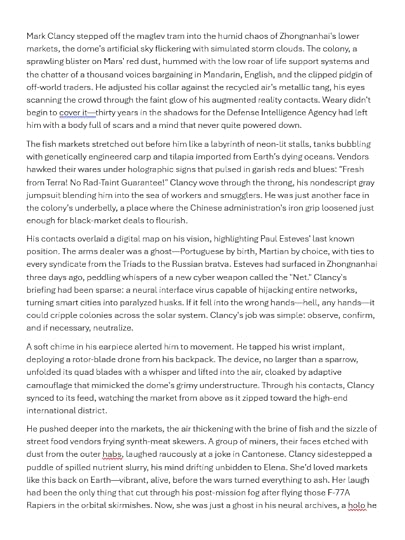
This is so generic that I want to rip my eyes out. Each paragraph has layers and layers of description that overwhelm the reader. There’s a lot of AI “tells” – the word “tang,” the gratuitous em-dashes, “nondescript gray jumpsuit” – but they’re not as bad as the writing itself. “Elena” is an AI name, one of the most common for female characters. And worst of all, it blows almost everything that I gave it in the first page, causing it to have to hallucinate details (like “Elena”) the deeper in it gets.
Not great!
Gemini
I’ve heard through the grapevine that Gemini’s latest model (3) is the best for creative writing. But I wasn’t impressed by it either.
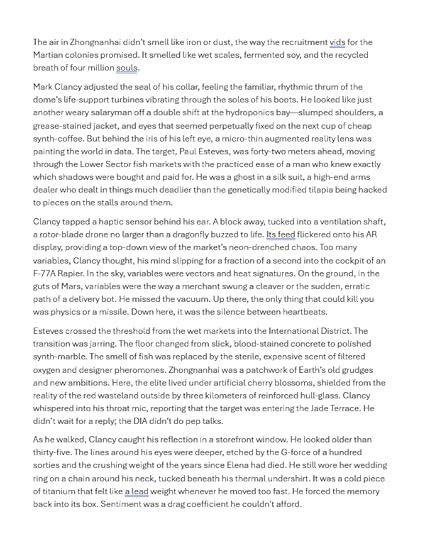
This is slightly better in a lot of ways. But it overwhelms the reader with sensory details, including a lot of AI tells (“smelled like wet scales”). And the similes and analogies (“He was a ghost in a silk suit”, “Zhongnanhai was a patchwork of Earth’s old grudges and new ambitions”) are just off, you can tell that a human didn’t write them. And “DIA didn’t do pep talks” is so cliche. It’s an improvement over Grok but not markedly so.
Claude
I had high hopes for Claude. I use Claude Code every day at work and Sonnet 4.6 and Opus 4.6 have really helped my workflow. But…
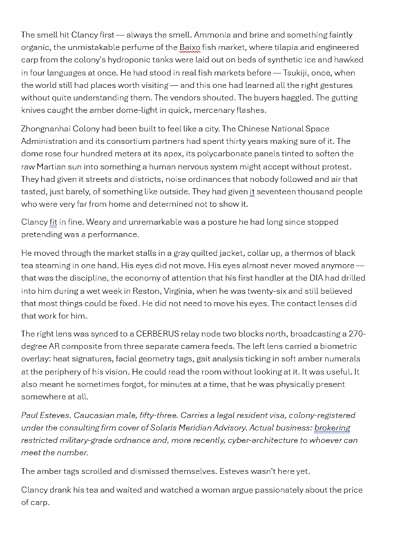
This is arguably the worst of the three. The sensory overload is obviously AI, the info-dumps are the LLM trying to show its research, and the hedging throughout is just incredibly weak writing. The Reston, Virginia aside is factually incorrect – DIA doesn’t do any training here (I work in my company’s Reston office)! Of all of the models, this is the one I would be the least likely to continue reading.
Human Text
And now, written the old-fashioned way…
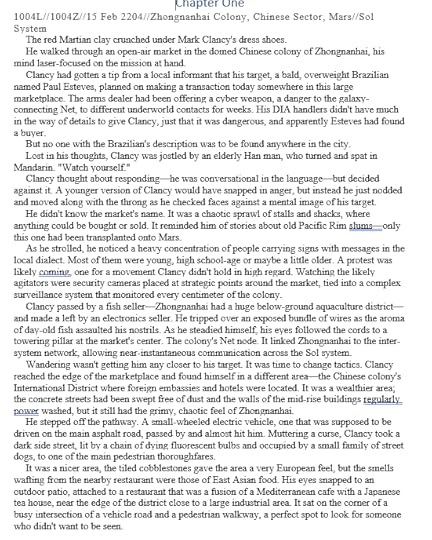
So, I’m obviously biased – I wrote this many moons ago. It’s not my best writing, but I think it’s clear as day that it’s got a soul to it that the AI-generated chapters lack. There’s little asides (old Pacific Rim slums) that give the text depth and the sensory details – taste, smell, touch, sight, hearing – aren’t overwhelmed; they’re instead spread out.
It’s also got a distinct voice. I am a unique data point in a sea of writers – I am first and foremost an aerospace engineer and an author second. I write clear prose that only occasionally uses literary devices like similes and I have a well-defined writing style. And it’s consistent through the entire text. The three AI-generated chapters lack that. They are an average of all of the writing material that they have been trained in. Yes, you can tell it “Write in the style of Tom Clancy” or “Write in the style of Tim Powers” but even then it’s an average of those authors’ works (or whatever it thinks their styles are).
And this is with a clear, descriptive prompt that I backed out of my own human-generated chapter! If you told it something more generic “Write me a first chapter to a sci-fi espionage thriller novel set on a partially-colonized Mars” you’d get something even worse!
I love AI for certain things, some aspects of writing included (and I’ll touch on them more in future posts). But having it generate text is going to result in a weak, soulless output that someone who’s been exposed to even a little of it will instantly be able to detect as AI. If AI was better, it’d be an entirely different conversation – maybe you could use it to fill in the blanks (write a difficult chapter) or something along those lines. And maybe it’ll get there. But right now, AI-generated creative writing sucks.


March 30, 2026
End of March 2026/Beginning of April 2026
This month flew by. Not much has changed other than on
The Saturn Anomaly and Crush Depth
Still at the Pentagon. ¯\_(ツ)_/¯. Not much else to say, I’ll probably bug them again at the end of April. Price of doing business with me writing in the genres I write in, I guess. But Crush Depth has a new cover – much better, IMO. As soon as I get clearance to publish it’ll be about 60 days from that date to publication. More to come as soon as I hear back.
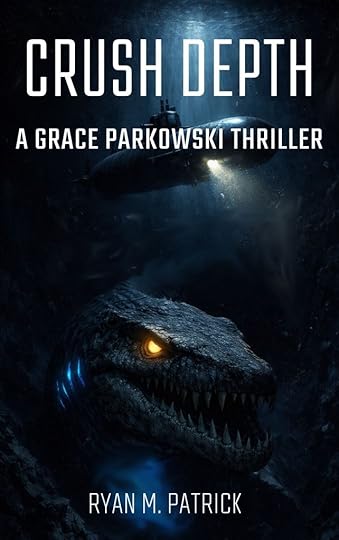 Pretty cool cover – my first ever commissioned custom one!
The Kuiper Dominion
Got to 38,000 words – not quite my 40,000 word goal, but close enough. I added a chapter to the outline so I’m at 46 rather than 45 and moved a couple more around. It’s in really good shape and I pulled in a ton of elements from Books 1 and 2 that had been forgotten about.
For April, I want to get to 60,000 words – roughly two-thirds done with my current outline. Probably around Chapter 29 or 30 out of 46.
I’m definitely on track to be done sometime in June, then to my beta readers. Targeting a 2027 release.
Short Stories
This is the most interesting one in March. I got invited to participate in two different anthologies! One I already had a story for, the other will be a fresh one that I had to start from scratch (and that I’m already 2,000 words into!). Really excited about this, I’ve been writing shorts for a decade and to this date have only sold one. I did have to put my Voyage to the Bottom of the Sea-influenced short for a Rac Press call on hold (after getting about 500 words into it) but I am well on my way to finishing 4 shorts this year – I may even be able to sell all of them! Hoping to finish the one for the 2nd as-of-yet unannounced anthology in April and then back to my submarine one.
Outlining
Working on my Timeline-inspired Roman novel, not quite done yet. Next up will be the last 2 books in my Dark Galaxy series, then an urban fantasy set in Dayton that I’ve been brainstorming in what little spare time I have.
Critique
No crit this month, but I did get an eARC from an old writing friend and just got a novel from another. More on this in April. Still on track for 12 this year.
Fingers crossed that I’ll hear back from the Pentagon in April on one or both of my novels there! I also have a bunch of half-finished blog posts that I hope to get done this month…
March 17, 2026
OSINT and the -INTs…and what the OSINTers are getting wrong.
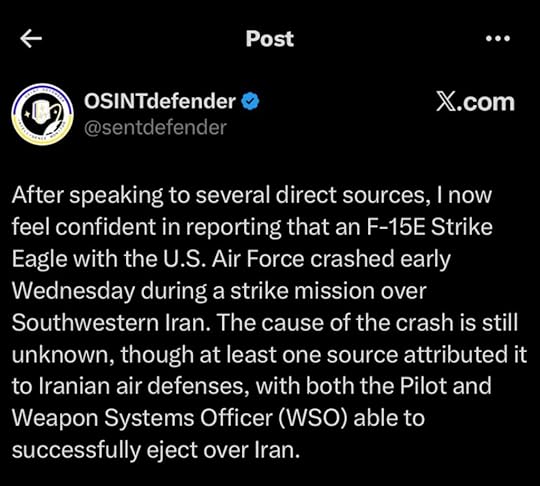
I’ve been fighting with the OSINT morons posting AI videos of the Iran conflict on Twitter/X, trying to pretend they’re experts on intelligence collection and analysis. Spoiler alert: they’re not, and I have all of them muted. I have, though, promised a post on OSINT and why they’re all a bunch of idiots. But that’s grown into an explanation of the entire collection types.
In this post I’ll lay out the core intelligence collection disciplines that the U.S. Intelligence Community and our allies rely on every single day. These are the -INTs – short for “INTelligence” – that get tacked on at the end of each one. And I’ll go into the OSINT fallacy at the bottom.
All of this is open-source and not classified in any way.
HUMINT – Human IntelligenceHUMINT is the collection of information from people. It is the oldest discipline and still one of the most valuable because only humans can reveal intent, plans, and internal deliberations.
Case officers – trained intelligence officers who operate under official or non-official cover – recruit and run human sources, called assets. Recruitment follows the cycle of spotting, assessing, developing, recruiting, and handling. This is the -INT that I have the least experience with, outside of talking with some former CIA field operatives while I was stationed at the NRO.
Strengths are unique. HUMINT delivers context and motivation that sensors cannot capture – Tom Clancy talks a lot about this in his books. A well-placed source inside a command structure can confirm whether a regime actually intends to attack or is bluffing. It can reveal leadership personalities, corruption, or internal dissent.
 Much of the plot of The Cardinal of the Kremlin involve the Foleys handling a high-ranking Soviet official
Limitations are equally real. Humans lie, exaggerate, or become double agents. Sources require constant validation. Handling them puts lives at risk – both the asset’s and the case officer’s. Compartmentalization is strict; most assets never know the full picture. Training a competent case officer takes years. The discipline is slow, expensive, and vulnerable to counterintelligence.
FININT – Financial IntelligenceAnother one I don’t have much experience with – probably because most of it is outside the Pentagon and IC. FININT focuses on money flows. It tracks how adversaries fund operations, move resources, and hide transactions. The discipline exploded in importance after 9/11 when terrorist financing became a priority.
Key players are the Treasury Department, FinCEN (Financial Crimes Enforcement Network), the Office of Foreign Assets Control (OFAC), and the IRS. They use Bank Secrecy Act reporting, suspicious activity reports from banks, SWIFT data(under strict controls, and international partnerships.
Modern FININT includes cryptocurrency tracking. Blockchain analysis firms provide tools that follow wallet movements even when users try to obscure them with mixers or privacy coins. Sanctions regimes rely on FININT to identify enablers – shell companies, front businesses, hawala networks, and trade-based money laundering.
Strengths: Follow the money and you often find the network. A single transaction record can map an entire proliferation ring or terrorist cell. FININT is also highly actionable – sanctions can freeze assets overnight and disrupt operations faster than kinetic strikes in some cases.
Limitations: Adversaries adapt quickly. They shift to cash, gold, cryptocurrencies, or barter. Jurisdictions with weak banking controls create blind spots. Privacy laws and data-sharing restrictions slow collection. False positives from legitimate business complicate analysis.
GEOINT – Geospatial IntelligenceAnd this is the one I’m the most familiar with. For reasons I can’t tell you ;-).
GEOINT combines imagery with geospatial analysis. The National Geospatial-Intelligence Agency (NGA) leads it for the United States. It is far more than photographs. It includes maps, terrain models, elevation data, and full-motion video analysis layered with cultural and environmental context. It used to be called IMINT (IMagery Intelligence) but evolved to go beyond images to additional data related to maps.
Collection platforms range from national reconnaissance satellites (electro-optical, radar, infrared) to commercial imagery, unmanned aerial systems, and even handheld devices in the field. Synthetic aperture radar (SAR) sees through clouds and at night.
Processing turns raw pixels into intelligence products: annotated imagery, 3-D models, change detection reports, and line-of-sight analyses. Analysts measure everything from runway lengths to vehicle counts to construction rates at missile sites.
 A post-processed SAR image of Washington, D.C. taken from the space shuttle Endeavour in 1994
Strengths: GEOINT provides persistent, verifiable coverage of large areas. It is excellent for order-of-battle analysis, target development, and battle damage assessment. Commercial providers have democratized some capabilities – anyone with a credit card can buy sub-meter imagery today.
Limitations: Imagery shows what is there, not what people intend. Camouflage, underground facilities, and denial-and-deception tactics can fool it. Weather, orbital mechanics, and revisit rates create gaps. Over-reliance on imagery without ground truth has led to mistakes in the past.
MASINT – Measurement and Signature IntelligenceMASINT captures the unique “fingerprints” that equipment and materials emit. It measures physical phenomena – radar cross-sections, acoustic signatures, chemical spectra, seismic vibrations, radio-frequency emissions, and nuclear radiation.
The Defense Intelligence Agency’s MASINT center and service labs run the programs. Sensors include ground-based radars, seismic arrays, infrared spectrometers, and specialized satellites. MASINT detects things traditional sensors miss: the exact type of missile engine firing, the chemical composition of an exhaust plume, or the unique acoustic pattern of a submarine propeller.
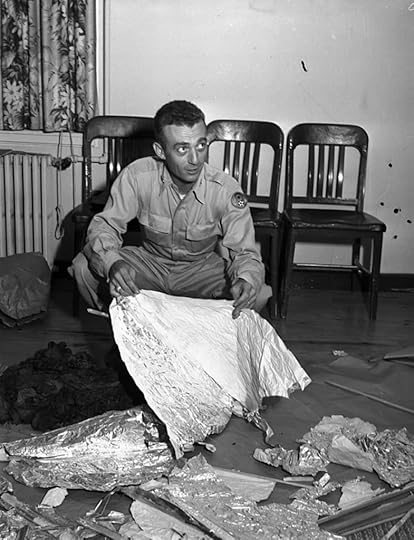 The Roswell incident was caused by atmospheric balloons with microphones to pick up Soviet nuclear tests
Strengths: MASINT identifies specific platforms even when visual ID is impossible. It can confirm a nuclear test, distinguish a decoy from a real warhead, or track a stealth aircraft by its unique radar return characteristics. It is often the only discipline that can characterize advanced weapons systems.
Limitations: MASINT requires precise baseline signatures, which are hard to obtain. Data volumes are enormous. Environmental noise interferes. It is technically demanding and expensive to field and maintain the sensors.
SIGINT – Signals IntelligenceAnother one I have a background in.
SIGINT intercepts RF signals. The National Security Agency (NSA) is the executive agent. It breaks into two main sub-disciplines: COMINT (communications intelligence) and ELINT (electronic intelligence), the former being more “listening in on phone calls” and the latter being “beeps and squeaks.”
Collection platforms include ground stations, aircraft, ships, satellites, and cyber access. The discipline covers everything from phone calls and emails to radar emissions and telemetry from missile tests.
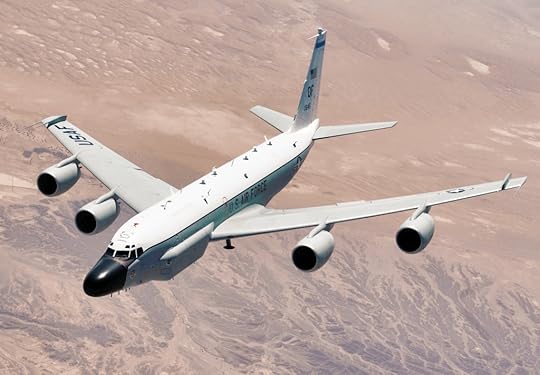 The venerable RC-135, the USAF’s premier SIGINT collection platform
Processing requires massive computing power to decrypt, translate, and sort petabytes of data daily. Metadata analysis often yields more than content. Direction-finding and geolocation pinpoint emitters.
Strengths: SIGINT delivers high-volume, timely data. It can reveal communications patterns, command relationships, and technical capabilities. When codes are broken or access is gained, it provides unparalleled insight.
Limitations: Encryption is everywhere and getting stronger. Adversaries use fiber optics, burst transmissions, and low-probability-of-intercept waveforms. Legal and policy restrictions limit collection inside the United States. Partners provide critical access but bring their own constraints.
OSINT – Open Source IntelligenceThis is where everyone is getting in trouble on Twitter.
OSINT collects information from publicly available sources. It has existed for decades but exploded with the internet. The Open Source Center (now part of the CIA’s Directorate of Digital Innovation) and service OSINT cells lead it. Yes, the IC uses OSINT all of the time. But more on that in a sec.
Sources include foreign media, academic papers, commercial databases, social media, satellite imagery from companies like Planet or Maxar, corporate filings, job postings, and even video games or public tenders. Analysts use web scraping, geospatial tools, language translation software, and network analysis.
Strengths: OSINT is cheap, fast, and legal. It provides context and baseline data that classified sources often lack. It can tip off where to focus scarce collection assets. In the social media era, OSINT can track individuals, units, and movements in near real time.
Limitations: Public information can be disinformation. Verification is critical and time-consuming. Adversaries manipulate open sources deliberately. Language and cultural barriers remain. The sheer volume of data overwhelms manual analysis – automation helps but introduces errors.
What the OSINTers Get WrongNo -INT operates in isolation. The intelligence community uses an all-source approach. GEOINT might spot unusual construction at a site. MASINT confirms the signature of a new missile system. HUMINT provides the internal rationale. SIGINT captures the command traffic. OSINT supplies open confirmation and context. FININT traces the funding.
All of these -INTs are collection methods…which are just one part of the intelligence cycle!
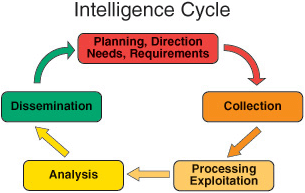
In the American intelligence community, each one of these phases are conducts by highly-paid professionals. Collection is just one of many steps a piece of intelligence – a video posted on Twitter (OSINT), a satellite image (GEOINT), a new Russian radar waveform (SIGINT) – goes through before it goes to decision makers (Dissemination) who then give new intelligence needs out to the collection element.
The OSINTers are trying to do the entire cycle themselves! And in isolation, more or less!
 Spoiler alert – this never happened
This is why they all come across as total idiots on Twitter and elsewhere. They may (or may not, I’ve seen a lot of ARMA footage) be able to locate images or videos that are relevant to the current Iran conflict, but that’s just “collection” – none of them are qualified experts to determine what is happening, where it’s happening, and its relevance to an intelligence question. None of them are experts or trained analysts, none of them have experience or the relevant accompanying piece(s) of classified information to make sense of the deluge of intelligence coming in.
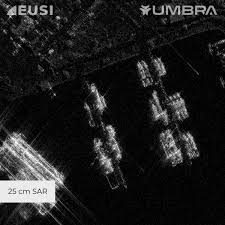 A SAR satellite image
Can you make heads or tails of what’s happening in that image? Probably not, but a trained intelligence analyst can, and they are also able to derive secondary and tertiary information from it, with varying levels of confidence, before sending it to an aggregator to be included in a brief. The OSINTers are trying to do the jobs of 4-5 people and are failing miserably. Their editorialization just makes things worse, and the majority of them are incredibly biased in some direction, compounding the issue.
It pains me to say this, but especially for the current conflict, the mainstream news sources – and official USG ones – are the best sources of information. Iran and its allies have done a great job of disinformation and the OSINTers are lapping it up, unfortunately.
For Writers
Do your research, understand that this isn’t Jason Bourne (as much as I love Jason Bourne), and that it’s a slow, often boring process. Tom Clancy and John Le Carre get much of it right, most other authors do not. And someone who “knows” will be able to spot you getting it wrong from a mile away…but may not tell you, because they can’t! There’s plenty of open-source stuff to go through, make sure you get the details right if you get down in the weeds.
March 4, 2026
Inefficiency
In my last post, I talked about abandoned projects and wasted words. I have only manage to publish a fraction of what I’ve written since I started in 2012.
But why is this the case? Why am I so inefficient?
In this post I’ll talk through some reasons as to why I think this is happening. Next one I’ll take a look at how to fix them.
Light Outlining
I’ve talked about this in previous posts, but I am an outliner, not a pantser or discovery writer. I’ve tried that method in the past and it doesn’t work for me – I need to know where I’m going. Which, given that I’m an engineer, makes sense!
But I am a very light outliner.
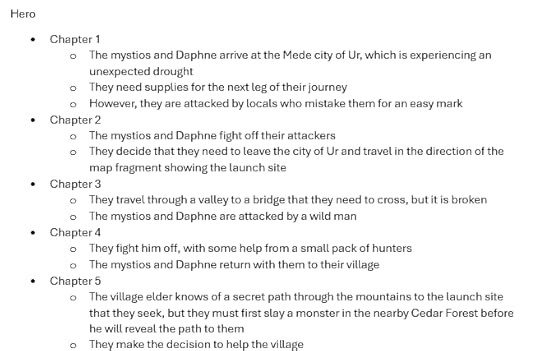 From Hero, the 3rd book in my Mystios Chronicles
I really don’t put a whole lot down on paper for my outlines – just some thoughts to help me write.
And I’m starting to think that’s a mistake.
There’s benefits to my approach – I have characters behave naturally, letting my writing influence their behaviors somewhat so that they don’t feel rigidly stuck to a script (one of the main critiques of outliners). But I also skip over a lot of the tough decisions when I outline and save that for my writing. For example, in the above image, there’s almost no details of the “wild man,” the “monster,” or anything about the city of Ur or the small village!
This has caused a ton of issues in my writing, especially late in a story where I need to tie it all together. There’s an obvious fix to this but that’ll be in the next post.
Long Time to Write
This one may be unavoidable. I’m married, I’m a father of four, I work full-time and have a few other hobbies. Writing isn’t my top priority (even though I’d love it to be!). That means it takes me a long time to write. Most of my novels are year-long projects.
And I’ve found I’m not always in the same place at the end of a story as where I started. I’m not the same person, I may be at a high point or low point in my own life, or I may be overwhelmed, and my writing isn’t consistent from when I began it. There’s huge spikes in quality and plot threads get dropped. I get obsessed with a word and it dominates my writing for a month but then disappears entirely. That kind of thing.
This is an issue that I probably won’t be able to fix entirely – my life isn’t going to get any less busy – but there may be ways to mitigate it. More to come in the next post.
Scattered Attention
This is a bugaboo both in my hobbies as well as my work life. My interest jumps from topic to topic and I don’t stick with a lot of things for very long. Work is fine, I have enough innate motivation to get my stuff done because it puts food on the table for my family, but when it comes to writing I am *terrible* about getting distracted by the “shiny new idea.”
I’ll write a longer post about this at some point (I keep promising to on Twitter!) but I totally screwed up at the start of my career by having my first three published books be three different first-in-series novels. People want a series, they don’t want three “Book 1s”. They want to see the story from start to end!
In some ways, this was unavoidable, this was me learning to write.
But since I finished The Europan Deception in 2024, I’ve known it was a problem. Yet I have continued to jump around like a maniac. I wrote a draft of Crush Depth, wrote 60,000 words of Memento Vivere, wrote 4,000 words of the sequel to Trials, wrote The Saturn Anomaly, wrote another two drafts of Crush Depth, wrote 4,000 words of The Apophis Contingency, then started The Kuiper Dominion. And, even when I’m working on a project, I have 1 or 2 other ones open where I poke away at some words or chapters, not to mention the short stories I write from time to time. Not to mention the amount of time I’ve outlined or expanded an idea that’s popped into my head in the middle of the night.
This is not good for getting books published and this will be the thing I focus the most on in my next post.
Learning Process
Finally, like I alluded to in the last section, some of this is just a learning process. I am a much better writer now than I was in 2015 and even 2024. I am a better outliner, better drafter, better editor. And a lot of the pre-2020 (when I started to take it seriously) stuff was just me figuring out how things work. There’s really no way to fix this, it’s all in the past, but it is something to note. Each story I write, I’ll get better at this whole thing, and I’ll continue to improve over time.
Conclusion
Are these all of my issues? No, of course not, but these are the ones that I’ve identified as causing inefficiencies in my writing. And in the next post I’ll talk about how I will deal with these (and other) issues!
February 27, 2026
End of Feb 2025/Beginning of Mar 2025
Not a terrible month, but could have been better.
Still at the Pentagon in its prepublication security review. I pinged them in the middle of the month and they told me that there’s still a DOD element that needs to approve it. Waiting and waiting…hopefully with a resolution soon!
Also at the Pentagon as of 19 February, hoping for a quick resolution on that one! Also l paid for a new cover (the one on that page is a DIY placeholder) and I hope to reveal that to the world soon. Who knows, this one may out faster than The Saturn Anomaly!
The Kuiper Dominion
I only wrote about 2,000 words this month, but I did fix the outline and take out some problematic elements. I’m currently sitting at 14,000 words and I’d like to get to 40,000 words by the end of March. This is my primary project at the moment and I’d like to be done with the first draft by the end of June of this year, then edit the back half of 2026 while I fix Memento Vivere.
Short Stories
I finished “The Golem of Checkpoint Charlie” and sent it out to a couple of beta readers. I was going to start an idea from my backlog but I came up with a new one for a different Rac Press call – more on that soon. I’ll probably start on that sometime in March.
Outlining
I got through The Horsehead Incursion in February. I’m working through some roadblocks on the Roman Time Travel one and I’ll be developing that further in March.
Critique
I beta-read two novels in February – I’m well ahead of schedule, 4 done this year, much better than my 1/month goal.
Thanks and hope you all had a great month! Onwards to March.
February 23, 2026
Why the Pentagon Can’t Pass an Audit
Posted this to X/Twitter, will post the story here too.
I’ve talked about this before, but after I got through grad school I PCSed to Kirtland AFB in Albuquerque and became the mission manager for the STP-2 launch. That launch was a task order on the OSP-3 contract, which had a few different vendors on it – SpaceX, Orbital ATK, and…Lockheed Martin.
No, not ULA. LockMart. This was the Athena launch vehicle, which only launched 7 times – and only once after 9/11. It was a piece of junk. But, the vendor had received a lot of GFE (government-furnished equipment), and some of that had transferred to SpaceX in the 2012-2013 timeframe when they were still an underdog.
But this was 2017 now and there was about $20M worth of equipment left at the Cape belonging to my task order, the only one active with SpaceX. Mostly stuff to integrate payloads onto a PAF or equivalent or networking/communications gear.
Problem is…they could only account for about half of it.
Shockingly, it wasn’t even really SpaceX’s fault. It was both theirs and the governments. Everyone was so focused on getting satellites up and into orbit that this equipment had been forgotten about.
Unfortunately, I had DCMA and DCAA on my ass about $10M in government-owned equipment that no one could account for.
This is why the Pentagon can’t pass an audit, by the way. Take my little situation and multiply it by thousands, and that’s where all of those “missing billions of dollars” are.
So, I had to stop everything and go out to the Cape and try and hunt it down. It took me about a week, and some close calls (there’s a lot of stuff at CCSFS/KSC that’s not space-related – think submarine missile launches and whatnot) with me ending up in areas that I wasn’t supposed to be in – but I tracked most (but not all) of it down in an obscure, abandoned highbay near SLC-41. If you’ve read Lag Delay, you know where the location of the climax came from – this exact experience. There’s a TON of unused buildings there holding all kinds of treasures.
I got a bunch of 45th guys to come tag it and move it to a better location and DCMA wrote off the rest as a loss. As to where the rest of the material (a couple of server racks and some machining tools) went – who knows? But it wasn’t my problem anymore.
That, in a nutshell, is why the Pentagon will never be able to pass an audit. There’s too many moving pieces, too few people looking at the books, and lots of poor junior officers trying to track down abandoned hardware that we don’t need anymore.
February 17, 2026
Crush Depth 21: Editing
Old posts are on the main Crush Depth page at the bottom.
Ah, editing. Simultaneously my favorite part and my least favorite part of writing.
Thankfully, from a big picture standpoint, Crush Depth is in good shape. That’s honestly to be expected considering it’s the fourth draft of the same story concept.
But there’s a lot of details to work through.
Let’s go through the stages.
First Passes
I finished the draft just at the start of the new year (2026) and let it sit for a few days, then jumped into editing.
I went chapter by chapter initially. I looked for huge errors – inconsistencies mostly. And I found a bunch.
The worst offenders:
The habitat is a very mobile platform! It exists at depths from 500 m to 8000 m below the surface.The Vepr‘s location is inconsistent – sometimes it’s at the bottom of the trench, other times it’s along the wall, and yet other times it’s right at the edge (where it’s supposed to be).LT (j.g.) Armstrong comes back to life – he was on the Seaquest when it imploded yet is back on the habitat for the climax.The mosasaurus’s ability to manipulate condensation, as cool of a scene as it seems, is never revisited or explained.I fixed all of these except the first one and sent it off to beta readers with the caveat.
Beta Feedback
I had five beta readers, one long-time collaborator, two I had swapped manuscripts with in the past, and two new critique partners.
Most of the feedback was positive! But they pointed out a couple of new issues:
There’s way too much technobabble (fair)The nuclear torpedo subplot is half-baked at both ends (very, very, very fair)Mike’s appearance on the destroyer at the end seems forced (fair)The timing of certain events doesn’t make any sense (artifact of 4 full drafts, very fair)There’s some pacing issues in the middle (disagree, but critique taken)This is what I’m working through right now. I’m planning to finish the changes this week and then fire it off to the Pentagon – I won’t make any material changes that add anything that they care about after this point.
What’s next? I’ll make a post about it when I get clearance to publish, but if you’re curious…
Copy Edits and Proofreading
This is the easy part and the hard part at the same time!
I’ll do the first part in parallel with the Pentagon prepublication security review. This is where I open up the “Editor” in Word and go through all of the recommended issues that it caught.
Then, once I get approval, I’ll create an Amazon listing (60-90 days away) and order a paperback proof. That one I’ll mark up like I did The Europan Deception below and then go through the final edits before I let it go live.
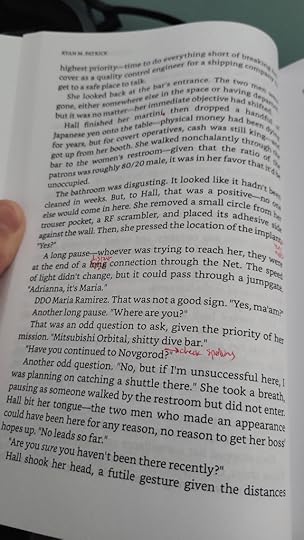
But that’ll come later! I’ll have a blog post about the prepublication process for me when the time comes. That’s the conclusion of this 21-part series for now, hope you enjoyed the journey along with me!
February 13, 2026
Wasted Words and Canceled Projects
I threw out a 100,000 word completed manuscript in December of 2025.
It was the 2nd full version of Crush Depth – check out my blog post series on it if you want to know how I’ve recovered (and am now on the 4th version). And it stung. I had spent a lot of my 2025 working on it, getting everything right, but the novel just wasn’t right. It wasn’t up to my standards.
And I started over.
But as I did so, I realized that I am not a very efficient writer. I end up going down a lot of rabbit holes that waste my time and really make it hard for me to get momentum as a self-published author. With the exception of The Saturn Anomaly, which I went from idea -> outline -> draft -> finished product in about 5 months last year, most of my works take multiple full revisions to come to fruition.
So, in this first of a 3-part blog series, I’ll chronicle all of the wasted words I’ve written since I started writing seriously in 2012 after I graduated from the Air Force Academy. I’m focusing on novels only, not any of my shorter projects.
Part 2 will be the why – why am I not an efficient writer, why am I wasting words, what is going wrong.
And Part 3 will be the solutions.
Without further ado, all of my wasted projects:
2012-2014
This was my pre-AFIT days at the Air Force Life Cycle Management Center in Dayton, Ohio. I wrote a lot…but didn’t finish anything! I started the project that ended up being The Europan Deception, junked it at 30,000 words, started the first version of The Martian Incident, junked that at 20,000 words, and then failed a 2nd attempt at The Europan Deception at 20,000 words. That’s 70,000 words that I’ll never see again.
2016-2019
After grad school, I started writing again. This wasn’t anywhere near as bad as it could have been. I finished The Martian Incident (90,000 words, for what it’s worth) and let it sit, then wasted 120,000 words on The Balmoran Transaction before realizing that it, too, needed to be junked in late 2019, right before COVID.
2020
The COVID year – and the first year I seriously wrote. I knocked out Lag Delay at 120,000 words before editing it down to its current 98,000 – 22,000 words wasted.
2021
I started The Europan Transaction – the last The Europan Deception idea before I got to the current iteration. I wrote 100,000 words before junking it too. In better news, that year I edited both The Martian Incident and Lag Delay using my improved writing ability.
2022
I wrote The Europan Deception at 120,000 words. I would say it was about 75% commonality with the version I released last year. I also finished final edits on The Martian Incident and Lag Delay.
2023
I wrote the first draft of Crush Depth at 120,000 words – none of which have survived into the current version. I also write Engima, which I’m going to completely rewrite at some point, at 90,000 words. But that version is going in the trunk.
2024
This was arguably my best year of writing. I wrote Trials, which is going to get released at some point, at 60,000 words. Then I rewrote The Europan Deception to its current state at 120,000 words – keeping 100,000 from the last version (losing 20,000 and adding a new 120,000). Then I started the next version of Crush Depth that came in at 100,000 words when I finished it early the next year.
2025
In addition to the quickly-junked Crush Depth, I wrote The Saturn Anomaly at 92,000 words almost all of which survived edits. I also spent time on Memento Vivere and got 60,000 words in before pausing that. I then went onto the third version of Crush Depth, got 50,000 words in, and then junked it to write the current 88,000 word version and finishing just before the end of the calendar year.
Here’s the totals:
Words WrittenWords PublishedWords JunkedWords Written But Not Published1,300,000308,000692,000300,000Even though I’m well over the million-word myth that’s been attributed to a dozen well-known authors, that’s still not great. Almost 700,000 words that are totally unusable.
Why am I so inefficient? We’ll tackle that in the next post in this series.
February 11, 2026
Crush Depth 20: Chapters 42-Epilogue – The End
Old posts are on the main Crush Depth page at the bottom.
This is the end!
Chapter Forty-Two: Pick up as soon as the last chapter ended. The survivors board the Nautilus; mosasaurs gently guide the submersible upward taking into account “the bends”. Lots of discussion and speculation, and a few points where they think the submersible is going to implode, but it doesn’t. The mosasaurs no longer communicate with them. They surface and signal for rescue via satellite. The mosasaurs disappear into the depths.
Probably going to condense a lot of this – no need to stick around longer than we need to.
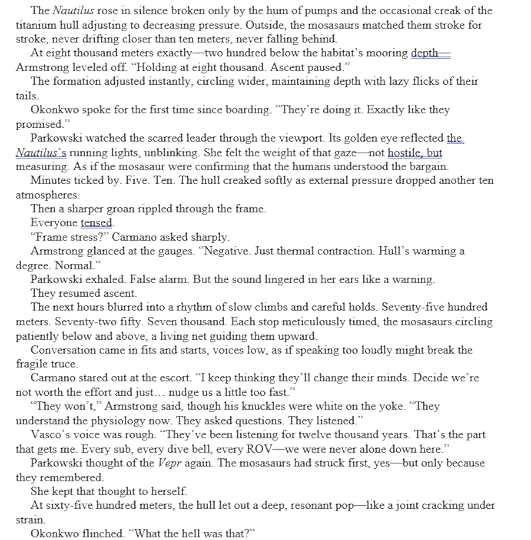
The tension just isn’t there like it is with the creatures.
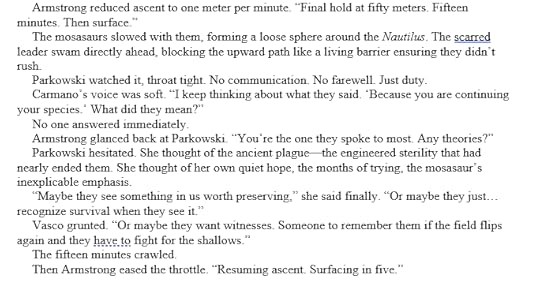
Finally back to the surface.
Chapter Forty-Three: The Delbert D. Black picks them up as a storm rolls in. Her husband is on the ship and helps get them onto it. Parkowski finally breaks down after everything that has happened. End on a positive note – her dropping a hint to DePresti that she might be pregnant based on her gut feeling and what the lead mosasaur said to her about “continuing her species”. Lots of naval and nautical technical details of the recovery of the Nautilus.
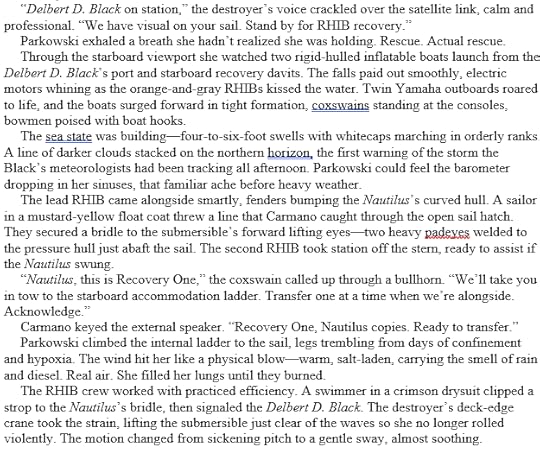
I like this a lot better than the last version – it really comes full circle in this draft.
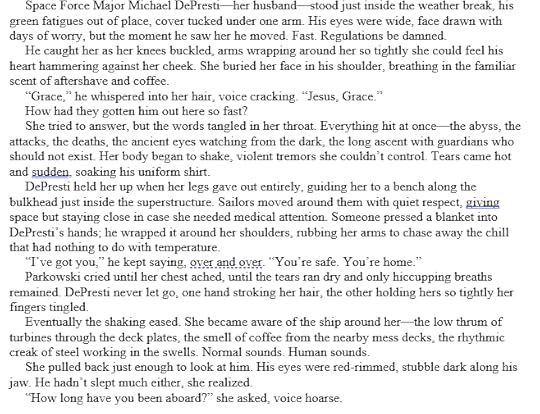
This was in the last draft but didn’t hit as hard.
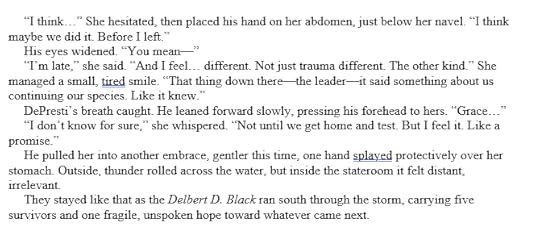
And it’s all over.
Chapter Forty-Four: In a debrief days later inside of an unmarked Crystal City skyscraper, Parkowski and the rest of the survivors are sworn to secrecy about the mosasaurs and the mission. Tie into the ILIAD mission and give her shadowy hints about government organization hiding the mosasaurs and other historical mysteries. End with her telling Carmano that she’s pregnant and Parkowski theorizes that her pregnancy was the reason that the mosasaurs saved them.
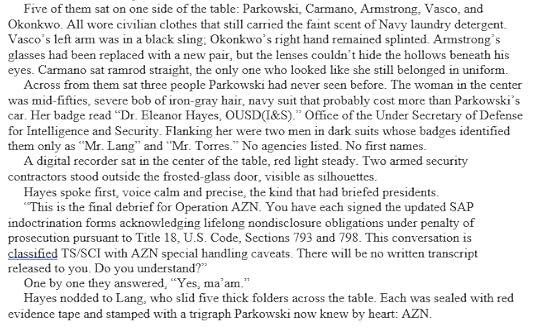
This chapter existed in the previous draft, but I wanted it to have more bite.
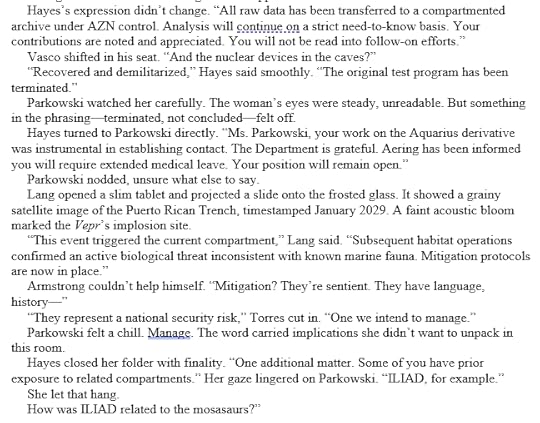
But I’m going to edit it a ton.
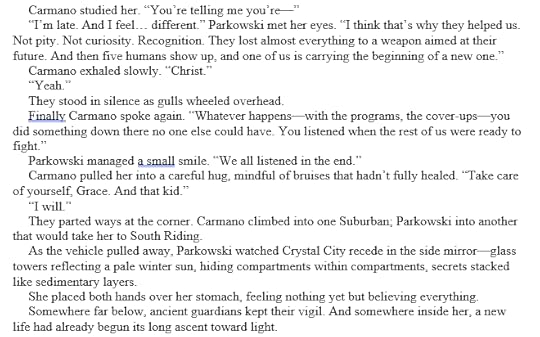
Epilogue: A now-visibly-pregnant Parkowski and her husband walk along the beach, spotting a mosasaur flipper in the waves—a subtle reminder of the deep’s secrets.
This is the same as the last 4 drafts – hasn’t changed at all.
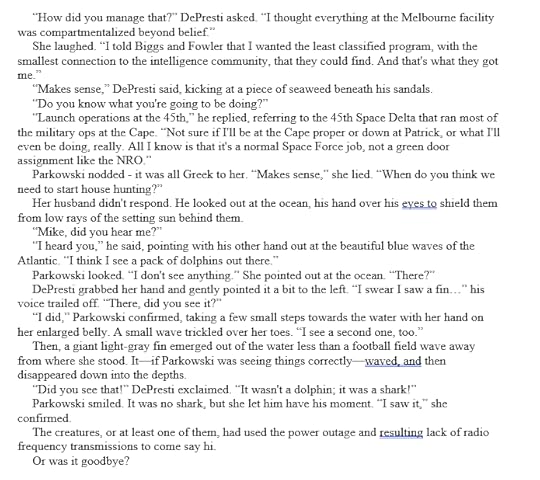
Thanks for following along! I’ll post some editing ones soon.
February 6, 2026
Crush Depth 19: Chapters 39-41 – Conversation
Previous posts are on the main Crush Depth page at the bottom.
This is the part of the novel I’m the least sure about and that I’m likely going to fix the most in edits. The core concept is fine, but I think the pacing is wonky. More to come in edits.
Chapter Thirty-Nine: It picks up as soon as the last one ended. To their astonishment, the mosasaurs respond with patterned replies. Initial conversation reveals their sentience – they speak in full sentences, clear English, but with somewhat archaic vocabulary and some stunted phrases. They also reveal through twisted language surrounding magnetic pole flips and solar cycles – the crew has to do math to realize what they’re saying – that they have been living in the trenches for twelve thousand years but that is not their original home – they used to be closer to the surface.
And we finally have a conversation!
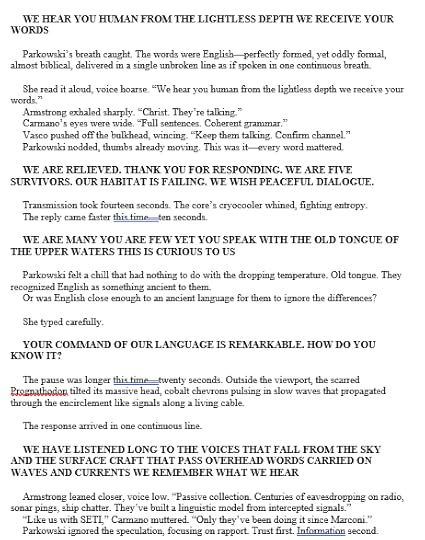
It’s very “first contact”-esque, similar to sci-fi novels like Rama.
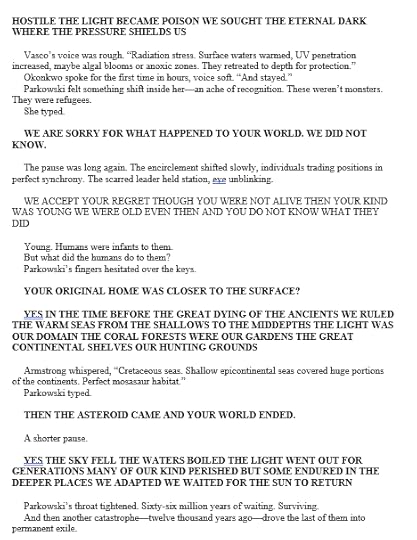
Not sold on the format but it’ll do for now.
Chapter Forty: Continue where the last chapter left off. The dialogue continues, uncovering the mosasaurs’ ancient history and displacement by human activity millennia ago. They went to war with seafaring humans from an unknown highly advanced civilization that could use nuclear weapons, robots, lasers, and more (but obscure it in the mosasaur’s limited vocabulary). They fought a war that lasted for a century. Ancient humans developed a plague that rendered most of their females infertile – far beyond what is believed possible from human activity at that time. This caused the mosasaurs to hate humans and attack them when they came into their domain. Ends on a tense negotiation cliffhanger when Parkowski asks for a favor.
This and either the previous or next chapter may be combined, to be determined.
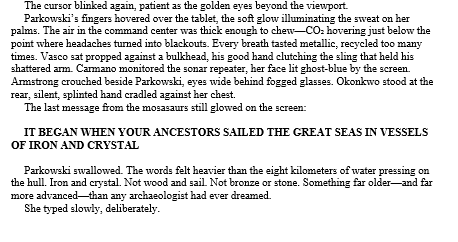
And this is where it ties back to the “real” Atlantis (the one from my series that starts with The Europan Deception.
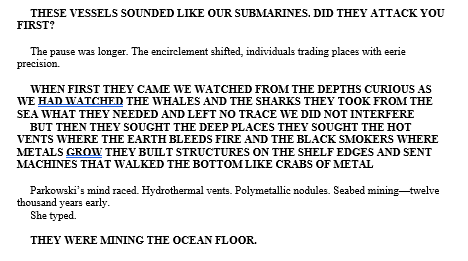
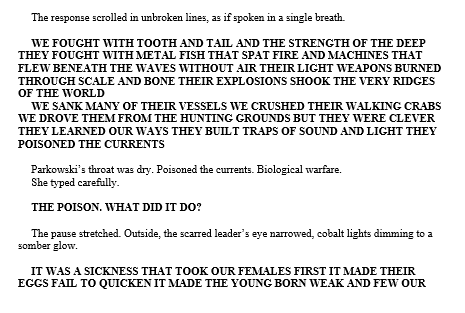
This was really fun to write.
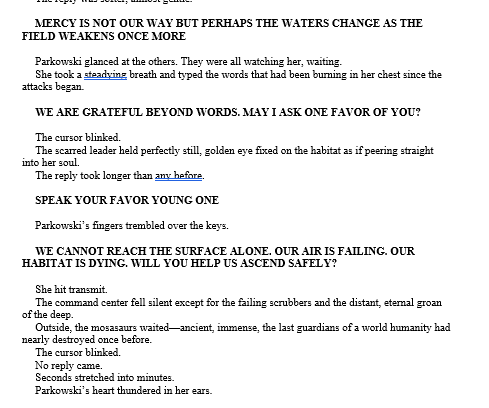
But we still need to get to the surface!
Chapter Forty-One: Pick up as soon as the last chapter ended. Concluding the conversation, Parkowski pleads for aid again. The mosasaurs agree to escort them to the surface, accounting for decompression. Lots of technical details and differences between physiologies – the mosasaurs have no such restrictions, and the humans have to explain them. When asked why they are helping them, they tell Parkowski “Because you are continuing your species.” They do not elaborate on that point. The humans go to the moon pool and quickly repair the Nautilus.
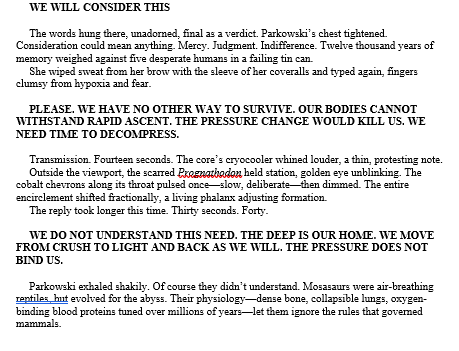
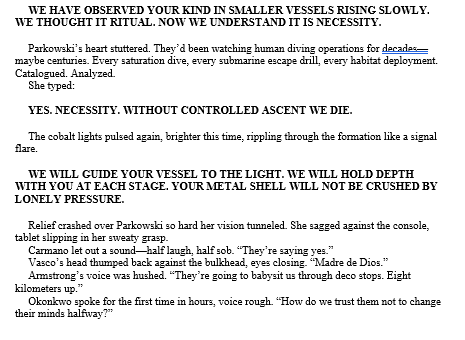
Again, need to clear a lot of this up. It’s too on the nose at times.
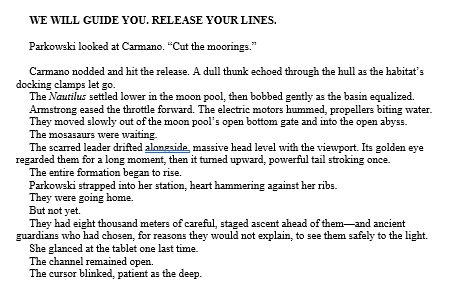
And we’re finally going back to the surface!
Only one more of these, then we’ll go through my editing process.
Writing Musings

- Ryan M. Patrick's profile
- 20 followers

