Tim Arthur's Blog
December 13, 2014
Let's do another chapter draft
Again, remember that this is all unedited. I’m giving it to you raw. It’s a little sneak preview into what I’m working on for book Beta, like the two chapters I posted before this.
Anyhow, enjoy :)
—————
Conquest
Warsaw, Poland. June 12th, 2354
"Blow that fucker up! The one right there! No, you don’t have to use your sights, you can see him with your naked eye. Do you know your fucking job, or do I have to do it for you?"
As the supreme commander of the Coalition barked orders to the crew of his tank by shouting down the commander hatch, Thomas Haas huffed and panted to keep up on foot. The floor, if the rubble-strewn streets of Warsaw could be called that, was open to questions from the press, but the glory-hunting Are Nylund had no desire to stop his advance to accomodate them.
Thomas had initially thought it spite directed at journalism, forcing reporters to risk their necks out on the field of battle just so they could do the job they were hired to do. But the more time he spent with the Nylund’s First and Foremost, as the man had named the regiment that, rather unconventionally, fell under his direct command, the more Thomas had come around to the opposite view. Not all generals lead from the front line, after all, and certainly none of the ones who did lead the charge aboard their own tank. The steel monster’s six-mach railgun hummed as it powered up, glowing a bright blue along its barrel, then discharged with a sharp hiss like fire being quenched. A building blew up in the distance, showering debris across the street. Blonde-haired, blue-eyed, and in the prime of his life, Nylund turned with a grin to face the legion of journalists trailing him.
Indeed, this was a carefully crafted persona. The man wanted to be known as a hero, as a saviour, someone who could describe the sights and sounds of battle. The world had to known him as standing at the eye of the storm, not as someone who sat idly behind a desk, answering dull questions with poorly masked disinterest. No, Are Nylund meant to be the face of resurgent mankind, and the sort of hero who made winning look easy.
“That,” he said, pointing at the destruction to his back, “was a ferran sniper nest. You’ll find that they are expert marksmen, talented enough to put a bullet through the head of a man from that distance with as little as a side arm. We can’t have them putting my people down from safety, least of all innocent reporters. Howard Alexander would have my head!”
Thomas supposed that ‘the floor being open to questions’ was a loose definition of what was truly going on. Most press events were defined by dialogue, a back-and-forth between the audience and the speaker. But Nylund only said whatever it was that he wanted to say, leaving no opportunity unused for self-promotion, and never leaving a window for reporters to ask their own questions. Before anyone could speak, two tanks rolled up from behind the group and took up position on either side of their commander. Humming and hissing ensued, and entire rows of old apartment buildings came apart under their combined barrage. Blue streaks of rail fire cut through the air ripping holes through all they touched. Thomas could make out ferrans running away behind distant windows, buying themselves what little extra time they could to live.
Jets soared overhead and launched a volley of rockets into enforced positions behind the next block of buildings. Tall pillars of fire climbed up over rooftops, curling upward into mushrooms and transforming into thick clouds of smoke. The crisp smell of incineration assaulted Thomas’s senses, and he felt scattered ash sting his skin.
Nylund looked again at the group, but this time someone beat him to the first word. “Sir, do you ever feel like you risk yourself needlessly?”
“No,” came the brisk answer.
The reporter pressed his advantage, now that he’d gotten a foot in the door. “Then do you not believe that the Coalition is ignoring opportunities for diplomacy with the enemy? Your troops have conquered a lot of ground throughout the last few weeks, but no attempts have been—”
“Also no,” Nylund snapped. His eyes narrowed as he scanned the group. “let there be no mistake, ladies and getlemen. The machines are the enemy. We are not in the business of talking with them, we are in the business of killing them. You want talk, you go to Chelyabinsk and ask that clown Berenkov what he thinks.”
Evgeny Berenkov, the one human ally of the nation that called itself Ferra. Thomas had heard the man’s name drop before. Supposedly, a new generation of machines had set out from their Altaian holdout to come to his city’s aid. He wasn’t sure what to make of it. It seemed as unlikely a tale as they came, yet Nylund’s anger at Berenkov’s allegiance was genuine.
“Will Berenkov have to make a choice, one day?” asked another reporter.
Nylund laughed. “Forget one day. He has to make it now. As Warsaw falls, so will Minsk, Moscow, and every city between us and him. When we come knocking on his door, he better have his mind made up.”
The armoured column slowly rolled onto Warsaw’s central square, where the fighting was thickest. Surrounded by the blackened husks of old ofice buildings, soaring towers that had once been gleaming walls of glass, stood the old Palace of Culture and Science. Ferrans had reinforced each wing of the building also known as Stalin’s Cake, and muzzles flashed from behind windows and the fortifications surrounding the bottom floors. Thomas looked to his left and saw streams of blue railgun fire shoot out from the city’s old central station, the tunnels of which had been combed clean as part of an underground advance simultaneous with the surface offensive.
Squat, six-legged walker units lumbered out from behind a line of buildings to the right. They bore double-barrelled rail cannons that spat out volleys of shots at a rate that no tank could match. Advancing under the cover of the armour plating on their front legs, they were mobile bunkers, designed to desintegrate enemy lines by pressing ever closer without sacrificing lethality. They were the next generation of armour, few in number now, but soon the face of any Coalition offensive.
Thomas watched their shots cut through an entire ground-level floor. Rockets strike their flanks as the enemy returned fire, but did little to overcome their resilience.
In the walkers’ wake came another wave of infantry, their distinct white uniforms clear to see, the signature V-shape visors on their helmets giving the an aggressive appearance. It was a new kind of body armour they wore, supported on the inside by a lightweight exoskeleton that enhanced the soldier’s maneuverability and strength, and made them a better match for ferran combatants in close quarters.
“Sir,” Thomas called out over the noise, as he made well sure that he remained in cover behind the tank and out of sight of the enemy. “What’s your position on these recent technical innovations that we’ve made? Is there not a danger in returning to the technology that betrayed us once before?”
Nylund turned away from directing the battle, and gave him a sharp look. “We’ve picked up where the old world left off, Mr. Haas, but we do so responsibly. None of the machines you see us use are intelligent. None of the devices we use work without us. It’s human operators that helm our walkers and our tanks, it’s humans operators that fly our planes, and human operators that provide us with intel. The sin is not in using modern technology to accomplish our goals. It never was. The sin is in letting it do so autonomously, without human interference. I’ve submitted what I call the Protocol of Ability to Lord Alexander, a piece of law that will guard us against this slippery slope. This is a war won on all fronts, Mr. Haas. Legislative and martial.”
Another squadron of jets soared overhead, and came down on a strafing run towards the legacy of Joseph Stalin. Incendiary rounds carved into the side of the structure until a fire caught on and billowing flame engulfed it. Supports on the building’s southwestern face snapped, and slowly but surely the top half of the structure began to topple over. Soldiers looked for cover and hid behind the legs of walkers and the plating of tanks. Thousands of tonnes of stone and steel came crashing down on enemy positions, debris raining as dust engulfed the great square.
When the noise died down, blue lights once again began to zap, illuminating the fog.
Green eyes dimmed in the distance.
When the dust cleared, Nylund stood atop his vehicle, a widelegged stance with his arms in his sides. Artillery began to pound the banks of the Vistula river to his back, framing him with fire and destruction. It was a filmic shot, one that the man had no doubt anticipated. Cameras flashed as his grin grew ever wider.
“It’s out with the old and in with the new,” he said. “We are on a mission to destroy these machines. It’s the only way for mankind to achieve the greatness that awaits it.”


December 10, 2014
tomofthewode:
Warm up sketch and fanart from today of...
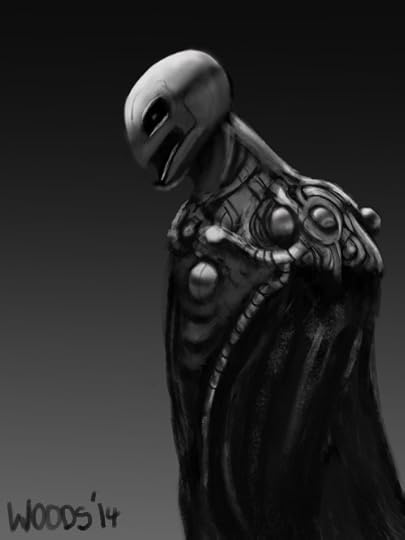
Warm up sketch and fanart from today of Griffith/Femto from Berserk. Little over an hour.
Wow, that’s some proper improvement. Bit foggy around the shoulders, but the lighting on the head is solid.
On movie adaptations of novels and modern technology
The more time goes by, the happier I am that I chose the title that I did for my Synthesis series. Not only does it perfectly capture the spirit of the story that I’ve written, but as a word it’s also exceedingly applicable to the time we live in.
Let me give you a bit of background information on where I come from, so that you can frame what I’m about to talk about. I was born and raised in an IT household, son to a father who remembers working with computers big enough to walk through (literally). He’s been there from the late 70’s and early 80’s all the way up until now, keeping track of techological developments and how these relate to his business and livelihood.
If there was one thing that he was always particularly good at, it was predicting the future direction of technology. Unlike many of his peers and colleagues, my father never thought of technological innovation as the constant invention of new things, but rather as the synthesising of existing ones. Indeed, even back in the 90’s he anticipated the integration of our communication and media services, and today the smartphone embodies exactly that. Everything is interconnected, and everyone who didn’t see it coming is now worse off for it.
Integration is the key word of modern civilisation, and streamlining the description of how we make it happen. Why have separate devices for individual purposes when you can blend everything together into a single application that does not only the same, but does it better?
As a writer, this seemed for a long time a process limited strictly to the field of science and technology, both of which act as major sources of inspiration for the genre of my choice, science fiction. But the more I think about it, the more I realise the synthesis that holds for both these fields is just as relevant to the creative arts as a whole, and now with the new Hobbit movie hitting the theatres, this discussion seems more relevant than ever. After all, is the movie adaptation of a novel not also an example of integrating two different mediums, ie synthesis? And let’s not forget, never is there a more vehement protest against the movie adaptations of books than when it’s Tolkien’s books that are getting adapted.
Art is also technology, if you can interpret the word art as being a shortening of artifice, or skill. Just as a machine requires parts and components, so too does a story, or a painting, or a song. These elements must be skillfully put together, lest some artistic abomination is what ensues, an abomination that’s defined by its lacking functionality, just as a machine is discarded as broken when it doesn’t fulfill its intended purpose. In fact, an even stronger case for art as technology can be made when we look at the Greek root words for technology, ie têchne and logos, which translates as ability/skill, and mind/study respectively. Technology as a term could easily be interpreted as the study of skill, and there are few artists out there who dare boast that they never examined the virtues of their own craft.
So if we’re talking about the movie adaptation of a book, then we’re talking about two distinctly different technologies, ones that may not necessarily blend as well as people naturally expect. “It’s just a story, how hard is it to do exactly the thing that’s written on the pages” is an oft heard objection, and the answer is a simple one: moviemaking adheres to different rules than novel writing. If we want to synthesise the two, we have to concede to finding common ground and, indeed, streamlining the process.
What common ground, you ask?
Well, the story of course.
Just as communications devices get integrated not based on their exact mechanical design, but on the same general function they fulfill, so too does the telling of a story define the same general function of books and movies. That the two adhere to different mechanical rules is only natural, and as such one medium can hardly be faulted for not being the other.
People give Peter Jackson a hard time for the liberties he took with the story of the Hobbit, moreso perhaps than they did when he interpreted the Lord of the Rings. Granted, the liberties he took this time were substantially greater than before, but its the story itself that he adapted, the story remains the same despite the additions made. “Why can’t it be one book for one movie?” is also often said. “Three movies for one book is just milking the subject matter for cash.” Eh, perhaps. But who ever decide that a single book must always become a single movie in the first place? Who said the translation from one medium to another is that 1:1?
To be honest, if I were to try and imagine a movie adaptation of Synthesis Alpha, I’d have trouble seeing how a screenwriter is going to stuff the battles for Panama, Shanghai and Elysium all into a single two and a half hour showing. It wouldn’t work. The narrative structure works for a novel, but it would never work on the big screen. Some creative license is going to be necessary, and as a novel writer it seems only logical that I would rush to the support of the studio adapting my work rather than the fans who doggedly insists that things be done the way they want. With all due respect to them, because their support and fandom is after all what legitimises me, but adaptations are a matter of artificers and craftsmen, ie the people who build the technology rather than the ones who simply use it. I would no more expect to tell a car mechanic what to do, for instance.
It’s unfortunate that Tolkien is not alive to defend these adaptations, and it’s even more unfortunate that his family are being so uptight about the whole affair. Then again, they seem to me to be a bunch of folk rather stuck in the past, just as the ones who declared my father an idiot when he said that the essence of technological advancement is integration, not just invention.
We live in a time where movies and books, even games, are simply all expressions of the same thing, ie storytelling. They came into life as separate entities, but times evolve and as studios develop the means to picture the vivid imaginations of novelists, the desire to adopt good stories instead of come up with poor ones is only logical.
So next time a novel you like gets adapted, and you don’t like what the moviemakers have done with it, realise that the moving picture was never meant to supercede the written word. The story is only made to exist in a plurality of forms, and it’s up to you, the fan, to decide which one you like most.
December 8, 2014
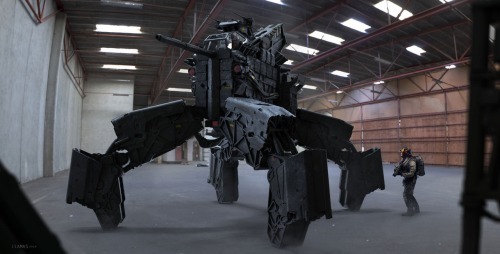
Mechanical Death by Santiago Betancur. This is absolutely...
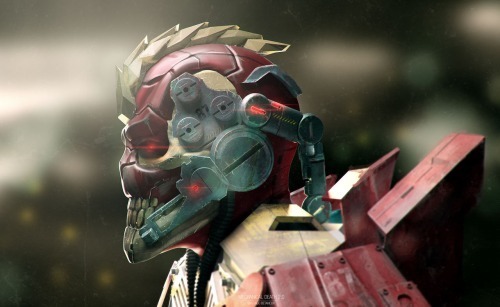
Mechanical Death by Santiago Betancur. This is absolutely killer. If I’d asked this guy to design a ferran for my Synthesis universe it would’ve looked like this.
writing-questions-answered:
Anonymous asked: Why do I hate everything I write? I’ve been told by...
Anonymous asked: Why do I hate everything I write? I’ve been told by the few amount of people that read what I write and hear my ideas say it’s good. But I hate it. And I get stiffled because I can analyze and form great sentences and such, but then it’s just. Blah
Frustrated with Writing Quality
I can give you a direct answer on this, and it’s to do with confidence. Take your problem into any context and you’ll see the solution staring you in the face. Everyone keeps telling you you’re pretty, but you only see an ugly person? Low self-esteem, lacking confidence. People tell you you’re an amazing driver, but all you see are the mistakes you make on the road? Again, lacking confidence.
One of the most important qualities an author can possess is a healthy assessment of one’s own abilities. It took a while for me to get past this as well. The first drafts I put out for my novels were genuinely bad, but by the time I’d been writing for a year I was putting out passable material. When I look back at it now, most of it hailing from 2012, I think that it reads alright. Had you asked me the same question then I would’ve told you that it sucked. But the text didn’t change, so what did?
I did.
You keep looking at your own work as you. That’s why it’s important that you keep writing, so that projects naturally become a matter of history, and you spend enough time away from them working on new material to return to old stuff later and appreciate it objectively.
Michio Kaku's Inspiring Thoughts
“A hundred years ago, Auguste Compte, … a great philosopher, said that humans will never be able to visit the stars, that we will never know what stars are made out of, that that’s the one thing that science will never ever understand, because they’re so far away. And then, just a few years…