Brad Feld's Blog
November 25, 2025
Give First Available in Audiobook Format

Give First is now available to pre-order in Audiobook format (it will be officially released on 12/2/26).
I’m the reader, so if you are an audiobook person, you’ll have to listen to me for a few hours. It was fun doing the recording (I’ve done the audio recording for two other books – Venture Deals (Jason and I alternated chapters) and Startup Life.
Give First Audiobook on Amazon
Give First Audiobook on Audible
Give First Audiobook on Apple
Other links via RBmedia
The post Give First Available in Audiobook Format appeared first on Feld Thoughts.


November 21, 2025
Enshitification
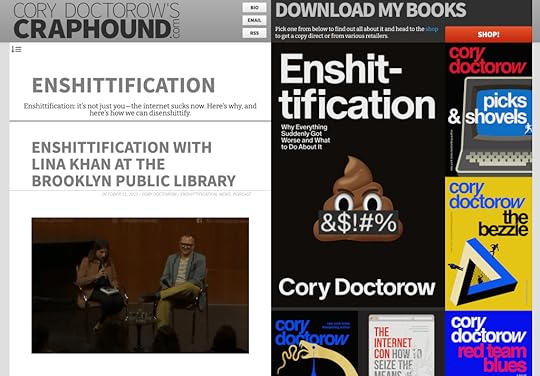
I’ve been a long-time Cory Doctorow fan. His new book Enshitification is delicious. Yup – I understand that a shit emoji doesn’t inspire deliciousness.
Now that I’m back in hibernation (and figuring out what it actually means), I’m reading and writing a lot. I’ll probably blog some (a little, a lot, who knows) while in hibernation because I work out ideas by writing and putting them out in public (even if I don’t pay much attention to the feedback or engage) is a different type of writing for me than just “writing privately” (which is mostly a thing called journaling and valuable to me, but different …)
Cory invented a new word: enshitification. Here’s what Wikipedia says as of today:
Enshittification, also known as crapification and platform decay, is a pattern in which two-sided online products and services decline in quality over time. Initially, vendors create high-quality offerings to attract users, then they degrade those offerings to better serve business customers (such as advertisers), and finally degrade their services to users and business customers to maximize short-term profits for shareholders.
Nailed it. His examples are superb. I don’t use Facebook products anymore (I guess I’m supposed to call it Meta) because of how awful they are and how awful the company is (oops – yes – I have WhatsApp on my phone because several people in my world insist on using it, but it mostly just sits dormant for me.) I am so exhausted by Amazon and its endless quest for more margin from everyone, including all the companies that it depends on to be useful. Google is “entertaining” to me as they systematically destroy so many companies that enabled them to be amazing in the quest to become an AI company. TwitterX bwahaahahaha. And I don’t even want to bother with the enshittification of so many other things in the tech world that Cory doesn’t touch on but that fit within his thesis.
Cory deconstructs, in fascinating detail, what has happened with each of these companies.
While I don’t agree with all of Cory’s politics (e.g., I was not a fan of Lina Khan and the Biden-era FTC), I love that he’s willing to take strong positions and then back them up. But, the regulatory dynamics and regulations as part of his solution for Enshitification is only a modest part of the book. And, even though I don’t agree with all of it, his arguments have a lot of validity and useful things to understand, especially around the concept of regulatory capture and how it contributes to enshitification.
If you like sci-fi, read Cory’s stuff. If you are in the tech industry and want to be forced actually to think, read Cory’s stuff. If you are far left or far right, don’t bother, since you won’t be motivated actually to learn anything. But if you aren’t part of the “far left/right” and you are willing to read, think, and consider your position on things, read Cory’s stuff.
The post Enshitification appeared first on Feld Thoughts.
October 23, 2025
Authors & Innovators 2025
I love to read. I love everything about books. LLMs will not replace good writing anytime soon, although they have mastered the art of slop. Oh, and I love communities of people who love writing and reading.
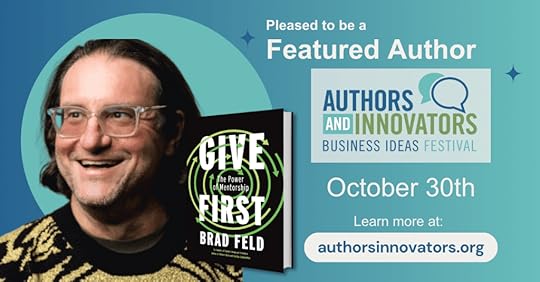
Authors & Innovators is a free, community-based event happening on October 30th in Newton, MA, for entrepreneurs, students, CEOs, venture and angel investors, and anyone interested in business. I attended in person a few years ago, and this year I will be there virtually with my book Give First: The Power of Mentorship (and a video). Larry Gennari created it a while ago, and if you like books, writers, readers, and entrepreneurship, it’s a blast.
Their overall goal is to introduce new ideas, foster meaningful dialogue, and move their motivated audience to read business books and engage with other like-minded entrepreneurs to learn more about the exciting journey of building a business!
This year, their theme is The Resilient Entrepreneur. They will be celebrating the spirit that drives founders to adapt, evolve, and thrive. Through thought-provoking conversations with visionary authors and business leaders, we’ll explore how resilience fuels innovation, creativity, and growth—both personally and collectively. From navigating uncertainty to cultivating curiosity and courage, this event shines a light on the mindset and community that empower entrepreneurs to turn challenges into catalysts for change.
The event is complementary, but registration is required at www.authorsinnovators.org.
The post Authors & Innovators 2025 appeared first on Feld Thoughts.
October 21, 2025
The Bear Roars: Dan and Brad
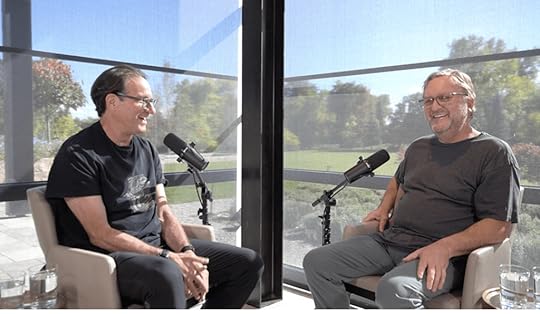
I recently joined Dan Caruso on The Bear Roars podcast, and our conversation brought one thing into focus: we’re living through a shift that’s not just changing what we build—it’s changing how we learn, lead, and collaborate.
We talked about AI, quantum computing, and robotics, but what we kept coming back to was access. How do we make sure every learner, founder, and educator has the tools—broadband, curiosity, and the freedom to experiment—to participate in this next era? The challenge isn’t the technology itself; it’s building the human systems around it that help people adapt and thrive.
Dan introduced the idea of the “super-professional”—someone who doesn’t just use AI, but grows alongside it. What stood out to me is that the real advantage won’t come from mastering the tools themselves, but from staying endlessly curious and open to learning. That mindset of give first—sharing what you learn as you go—feels more important than ever.
Check out the episode here:
Spotify: https://lnkd.in/gMMqrCzH
Apple: https://lnkd.in/gunRWYEH
YouTube: https://lnkd.in/gBzY_fHR
Amazon Music: https://lnkd.in/gkwEvPaY
The post The Bear Roars: Dan and Brad appeared first on Feld Thoughts.
October 13, 2025
Leveling Up in the Vibe Coding Video Game
While “vibe coding” was a catchy phrase when I first heard it, something about it felt like a head fake to me. And, now that I’ve leveled up to “competent individual software developer” again (after 33 years of not writing any code) I think it’s the wrong phrase. Instead, I’d refer to what’s going on as AI Pair Programming.
When I started playing around with AI-related coding tools last Christmas (because, well, I was bored), I had zero skills with contemporary software development. While I hadn’t written any production code since 1992, I played around with a new programming language every few years. Perl. Ruby. Ruby on Rails (sort of, not really). Python. Clojure. I could do Hello World and a few other simple things, but I never really got past basic CSS, tooling, or deployment stuff. I had a Github account and would futz around with it, but quickly get tired of trying to figure out why I didn’t care about a PR. And damn, so many CLI things.
For Level 1, I downloaded Cursor. After trying to figure out how Django actually worked (yet another online course), gave up, and decided to use Next.js. That led me to Vercel, reinforced by a few friends in their 20s who told me that all the cool kids were using Vercel (although Render, Digital Ocean, and AWS all were the beneficiaries of my credit card.) Pretty soon, I was using Cursor to fight with Vercel, Supabase, Clerk, and Github. After realizing Auto was no fun, I shifted to Claude 3.5. Dinostroids resulted (security holes and all …)
For Level 2, I got a little more serious. I discovered Linear, fought with Notion, and came up with a few ideas and a broader hypothesis around how things might work. I built a v0.1 of a thing.
For Level 3, I decided Lovable might be a better way than Cursor given that everyone was talking about it. I wasted about $200 on it, built a really cool design by vibe coding, but then watched it get very, very confused as it tried to go from simple design to something that actually worked that had some data complexity and AI calls. I thought about trying Bolt and Replit but quickly realized, after too much scrolling around on the web, that I’d likely run into the same issues.
So, I went back to Cursor and put a lot of efforts into my system prompt, tuning things, watching Cursor evolve quickly on a number of fronts (MCPs – yippee!, Agent mode as default – finally) while simultaneously watching my Cursor bill go up. It was easy to decide to go to Max mode and spend $200 / month instead of $20 / month when dinner in Aspen costs at least $100 / person no matter which restaurant you go to.
I hung out at Level 4 for a while. Cursor kept improving. Claude 4 came out. Auto mode still went off the rails and broke all my code. I started refactoring things and realized that the amount of cruft in my code was absurd. Little bugs turned into fatal flaws when I tried to have Cursor fix something. I learned about “git reset –hard HEAD”. I spent way too much time fighting with config issues on localhost:3000 (at least I’d figured out how to make Cursor always start the server on localhost:3000). I started using Docker. I was baffled that Cursor couldn’t remember stuff I told it the prior day, but intellectually understood why this was. I mean, memories.
The end of my joy at Level 4 was when ChatGPT 5 came out and was free on Cursor for a week. At first, it felt fast. Wheeee. Lots of stuff changing. It seems to be working. And then, after a few days, holy shit what a tangled mess of code it generated. Why are all my API routes suddenly broken. Console statements everywhere. UI elements in different parts of the application doing the same thing but look totally different. I went back to Claude and did another code review and major refactor. So many Vercel build errors. I finally embraced CI/CD. And Prettier. And Husky. Suddenly, I ran out of my monthly Cursor credits and shifted to usage-based pricing. $800 later, I realized that there was no reason for me to be using Opus or the thinking models for what I was doing.
Level 4 was a huge drag. But it was also when I started thinking of this as AI pair programming. The AI (or agent, or sub-agent, or whatever you want to call it) is my pair with hands on keyboard. It can type much faster than me. But I have to watch and constantly look over its shoulder, give it feedback, point at the stuff that needs to be done differently, and document what is important to remember to do.
And then I discovered Claude Code. This didn’t happen until Claude Code 2 came out at the end of September and corresponded with Sonnet 4.5. After my ChatGPT 5 I went back to Claude (and Sonnet) and started referring to Claude Sonnet as “Claudia” since she was my pair programmer. I thought about Claudia as a pair, related to her as I would a human pair programmer, and changed my approach. But when I loaded up Claude Code 2 in my terminal (I mean, just type “Claude”) I immediately leveled up again.
So – I’m now at Level 5 in the video game. It’s changed from a game of vibe coding to AI pair programming. And, it’s still fun!
The post Leveling Up in the Vibe Coding Video Game appeared first on Feld Thoughts.
October 11, 2025
Book: Echoes of October
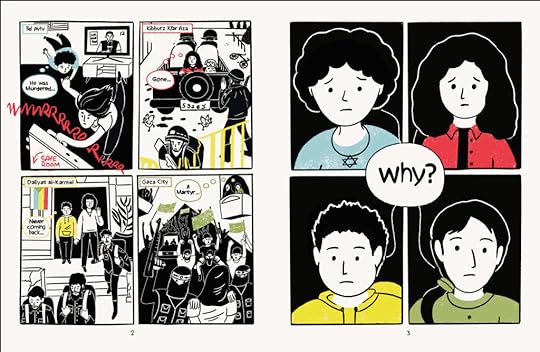
I approached Echoes of October with trepidation. A graphic novel about violence and grief isn’t easy terrain. But it succeeds in a haunting, urgent way. The creators have chosen to explore the year leading into the October 7, 2023 massacre through the lives of four children who each lose a parent. The children are from different locales (Gaza City, Toronto, Tel Aviv, and Daliyat al‑Karmel) which enables a textured, multi‑vantage narrative.
What impressed me most is the restraint and care in which the story is told. The voices are calibrated: they carry sorrow, confusion, hope, anger, but rarely descend into melodrama. Because the characters are composite (e.g., everything that happens in the book is true, the characters are not), the authors manage to create space for truths without claiming to own them.
I love graphic novels (scifi and history) and regularly have them in my reading diet. The panels breathe. There are silences, negative space, quiet facial expressions, and moments of violent disruption. The juxtaposition of children’s everyday worlds (school, family, and play) with the encroaching shadows of conflict makes the tragedy more palpable and intense.
This is not an easy read, nor should it be. Echoes of October is demanding: it expects the reader to engage, be uncomfortable, and reckon with stories that hold no clean resolution. But in doing so, it honors the complexity of memory, the weight of loss, and the imperative of bearing witness.
I recommend it to anyone willing to engage deeply with how conflict impacts children and the possibility (however fragile) of empathy.
The post Book: Echoes of October appeared first on Feld Thoughts.
October 1, 2025
Break the Fast With Me and Sue Heilbronner in Longmont on 10/2

I’m not aware if there has ever been a book launch associated with a Yom Kippur Break Fast, but we are going to have one as part of the launch of Sue Heilbronner’s excellent new book, Never Ask for the Sale: Supercharge Your Business with the Power of Passionate Ambivalence.
It’ll start at 6:30 pm on Thursday, October 2, at Greeley Sachs’ bookstore, Composition Shop, in downtown Longmont.
Sue and I will do a fireside chat about her book and my latest book, Give First: The Power of Mentorship. We will both be signing books. And … food!
Come join us at Composition Shop for the Break the Fast.
The post Break the Fast With Me and Sue Heilbronner in Longmont on 10/2 appeared first on Feld Thoughts.
September 15, 2025
New(ish) Podcast for Startup Community Builders
Back when the pandemic hit, Chris Heivly spearheaded a podcast with Ian Hathaway and me in support of our upcoming two books, The Startup Community Way: Evolving an Entrepreneurial Ecosystem and Build The Fort: The Startup Community Builder’s Field Guide.
We did eight episodes of a solid but complicated-to-produce series.
Chris is now spearheading a Season 2 podcast series with Techstars, mirroring a format pioneered by Seth Godin, who was a recent guest on our GiveFirst podcast.
Chris has designed a very simple, concise way for those of us who continue to learn how to effectively build our startup communities. At around 15 minutes per episode, they are an easy listen for even the busiest of leaders, instigators, and feeders.
Every other week, Chris will do a deep dive on a specific topic. I saw his topic list, which numbers over 100+ draft episode titles, so we are covered for the next few years. This list is based on his continued leadership in this area and the countless conversations he continues to have with community and ecosystem enthusiasts all over the world.
You can find the podcast on all the typical platforms including:
Spotify Apple PodcastYouTubeTechstars Podcast WebsiteYou can also read a weekly blog post from Chris and published by Techstars for thought leadership around startup communities and entrepreneurial ecosystems.
If this topic is important or interesting to you, subscribe to your favorite channel.
The post New(ish) Podcast for Startup Community Builders appeared first on Feld Thoughts.
September 12, 2025
Reid Hoffman’s Superagency

Reid Hoffman’s new book Superagency: What Could Possibly Go Right with Our AI Future is spectacular and a must-read for every non-technologist about how to think about this “AI thing.” If you want the short version, the recent AI & I podcast with Reid is an excellent way to get a feel for it.
Reid describes his approach as “smart risk taking” rather than blind optimism. “Everyone, generally speaking, focuses way too much on what could go wrong, and insufficiently on what could go right,” he told TechCrunch recently. This resonates with me. I’m tired of the endless AI apocalypse takes.
The book’s central idea is “superagency” – basically when technology gives us new superpowers and millions of people get those superpowers at the same time. Reid uses the car analogy. Cars were once so scary they required a person walking in front waving an orange flag. Now we can’t imagine life without them.
What I love about the book is how practical it is. Reid and his co-author Greg Beato didn’t use AI to write it, but they used AI to vet it – checking facts, doing research, getting different perspectives. That’s exactly how I think about AI tools. They’re not going to replace my thinking, but they can definitely amplify it.
The timing feels perfect given what’s happening here in Colorado with our AI regulation mess. While Reid is writing optimistically about AI’s potential, Colorado has been having a complete meltdown trying to regulate it. Our state legislature passed SB 24-205 in May 2024, making us the first state to broadly restrict private companies using AI. Governor Polis signed it “with reservations” and within a month Polis, our attorney general Phil Weiser, and the bill sponsor Robert Rodriguez issued an open letter that “Starting today, in the lead up to the 2025 legislative session and well before the February 2026 deadline for implementation of the law, at the governor and legislative leadership’s direction, state and legislative leaders will engage in a process to revise the new law, and minimize unintended consequences associated with its implementation,”
This is exactly the kind of regulatory approach Reid warns against. In his recent podcast, he explained his philosophy: “I tend to be more regulatory cautious than anti-regulation.” The key difference? Start with measurement rather than prohibition. “When you start having the impulse that maybe there should be regulation, you should start with, well, how do we measure the questions that we’re worried about as harms?”
Colorado did the opposite and went straight to broad restrictions without first understanding what we were actually trying to prevent or how to measure it. The timeline since then has been a comedy of errors – multiple failed attempts to amend the law during the regular session, and most recently, an August special session that ended with lawmakers just pushing the start date from February 2026 to June 2026. That’s it. After over a year of fighting, we got a four-month delay.
Reid believes in “iterative deployment” – getting AI tools into people’s hands and then responding to actual feedback and real problems, not hypothetical ones. Instead, Colorado jumped straight to prescriptive rules based on fears rather than evidence. Reid’s approach would have been: Deploy AI systems, measure actual discrimination outcomes, then iterate on solutions. Our approach was: Assume the worst, regulate preemptively, and figure out implementation later.
The Colorado situation perfectly illustrates Reid’s point about fear-based thinking around AI. Superagency offers a much better framework – one that acknowledges challenges while focusing on AI’s potential to increase individual agency and create better outcomes for society.
Read the book. We need more thoughtful optimism and less regulatory panic. Especially here in Colorado, where we’re supposed to be leaders in technology, not cautionary tales about how fear can paralyze good policy-making.
The post Reid Hoffman’s Superagency appeared first on Feld Thoughts.
September 7, 2025
A Call for Founder Voices for an MIT Study on Entrepreneurial Ethics
I’m helping MIT (Fiona Murray and Alon Shklarek) share a short survey exploring how founders around the world navigate ethical challenges. Insights will shape practical tools for entrepreneurs, investors, and ecosystem leaders.
Survey link: https://mit.co1.qualtrics.com/jfe/form/SV_2rVOSwnXT0Qe8qa?org=3
It takes just 8 minutes, and your input directly contributes to a healthier entrepreneurial ecosystem.
The post A Call for Founder Voices for an MIT Study on Entrepreneurial Ethics appeared first on Feld Thoughts.