Michael B. Morgan's Blog
October 1, 2025
Do not attempt to compete with the machine.
Is using it unethical? Stupid? Clever? Condemnable? Unacceptable? Good? Bad?
Some people barely think about it. Others worry too much. I don't have any big answers. But as a reader, I know one thing: I still prefer to read a human book.
I came across an interesting reflection and wanted to share it with you.
Link to the author’s page at the end.
People assume that books are different to the chocolate bar sitting in front of counter in the corner store; but, if you stop and wonder about consumers reasons for buying many ‘genre’ books, they are largely for pleasure; immediate satisfaction, comfort, fun, escapism. None of these are bad reasons on their own, yet they are the very reasons these kinds of books will become automated, produced in the Artificial Intelligence factory.
Factories, for two long centuries now, have produced ‘pleasure-consumables’ for the mass - and some assholes have finally worked out how to mass-produce books. If you already have a big enough audience, or are very lucky, you may be one of the few that can survive writing genre fiction in the same manner of those who became successful in the twentieth century. Yet, if you’re like me, and who loves science fiction, fantasy, crime, thriller, and horror - do not, I repeat, do not attempt to compete with the machine.
Artificial Intelligence is truly, a gross behemoth and, despite what I wrote earlier, no one deserves to have the thing the love to do - which provides them comfort and joy and for the lucky even money - become automated. Yet you should see this an opportunity; if it was really your goal to create transcendental art - to be an ‘artist’ - then the other path of ‘selling out’ is not really an option anymore.
The mass has Artificial Intelligence for that.
We Are All Literary Fiction Authors Now (Or Else)


August 22, 2025
May 23, 2025
Science Fiction Vibes
Bouncing around inside the car.
Shivers run down your skin.
The road ahead will never be long enough.
Science fiction.
link: Arctic Monkeys - Science Fiction
May 14, 2025
Fake Nostalgia
Nostalgia is warm and cozy until it really isn’t. Once you’ve really given yourself to it, it can take a hold of you like nothing else, suffocating any seemingly new thought.
Nostalgia runs deep in the movie, but it’s a kind of “fake,” tied to implanted memories. Agent K, the main character, lives with memories that aren’t his. The nostalgia he feels for childhood, for everyday experiences, for a holographic wife… is manufactured. It’s a product, an illusion that gives depth to an artificial life. His love for her is a side effect.
The article points out that Blade Runner 2049 is textbook cyberpunk, featuring all the typical signs of a world where technology replaces humanity. But it lacks the grit, fear, and existential dread of the first movie. I agree. The prob is that Roy Batty’s iconic monologue still holds up:
I've seen things you people wouldn't believe. Attack ships on fire off the shoulder of Orion. I watched C-beams glitter in the dark near the Tannhäuser Gate. All those moments will be lost in time, like tears in rain. Time to die.
But now it feels almost routine. The edge has worn off. It’s like the whole question of consciousness doesn’t really matter anymore. Whether you’re a robot or a human is just a matter of perspective. So, the second Blade Runner was just a way to satisfy nostalgic fans, not an obsessive search for answers to a terrifying question. But what if nostalgia is fake?
Here is the article I quoted: Blade Runner 2049 is proof that nostalgia is bad
April 28, 2025
Do AIs Dream of Electric Books?
I found an interesting article on Substack today about AI, writers, and publishers. It was published on October 02, 2024. Here's how Jacob Baugher, the author, begins:
“I understand that I can’t use Gen AI to write my book,” one question on the r/writingtips subreddit read last week, “But is it OK if I use AI to help me plan my novel?"
Ethics aside, the answer will soon be no, because some lawsuits are already in the works. If successful, they will open a can of worms for publishers regarding copyright. Read a lawsuit in full Here. And the publishers are already on the warpath:
Asimov & Analog
Statement on the Use of “AI” writing tools such as ChatGPT
We will not consider any submissions written, developed, or assisted by these tools. Attempting to submit these works may result in being banned from submitting works in the future.
Clarkesworld
Statement on the Use of “AI” writing tools such as ChatGPT
We will not consider any submissions written, developed, or assisted by these tools. Attempting to submit these works may result in being banned from submitting works in the future.
Flash Fiction Online
AI-GENERATED SUBMISSIONS: We are committed to publishing stories written and edited by humans. We reserve the right to reject any submission that we suspect to be primarily generated or created by language modeling software, Chat GPT, chat bots, or any other AI apps, bots, or software. We reserve the right to ban submissions from accounts, emails, or users who we believe or suspect have submitted AI-generated content.
Berkley Open Submission Program
May I submit a project if I have used AI in the creation of that project, whether in the outlining or writing of my manuscript?
No, authors may not make submissions that have used AI in their creation.
Andrea Brown Literary Agency
Prepare and polish your complete manuscript and/or artwork. Submit your best work. Note that we only accept human-created submissions; no AI-generated work will be considered.
Okay, we're reading a lot of books written, proofread, and built with AI. I see why using an AI tool can be helpful, it can take some of the workload off of authors. But the way some people are abusing it is causing a pretty strong reaction in the publishing world. And in readers too.
Action and reaction.
Is "human art" beginning to fight back?
Full article Here.
January 10, 2025
The Fourth Law
Based on the Three Laws of Robotics by Isaac Asimov. Check out I, Robot.
Human creativity is at a crossroads, it is said.
I'm working with a friend on an article about AI and we came across this site proposing something called The Fourth Law.
It's like being trapped in a science fiction book. Maybe we could get away with it if it were an Asimov story. But I fear we have landed in a Philip K. Dick book.
Here is the link to go deeper:
Site link
The Fourth Law
Based on the Three Laws of Robotics by Isaac Asimov. Check out I, Robot.
Human creativity is at a crossroads, it is said.
I'm working with a friend on an article about AI and we came across this site proposing something called The Fourth Law.
It's like being trapped in a science fiction book. Maybe we could get away with it if it were an Asimov story. But I fear we have landed in a Philip K. Dick book.
Here is the link to go deeper:
Site link
July 13, 2024
Siberian wolf smile
It is day and there is a deep silence. He knows the sun never goes out this time of year. He wanders calmly, for he likes to move in the imperfect darkness of the undergrowth. But today there is an intense glow in the forest of ice-leafed birches, and the trees shine as if covered with sparks of fire. But it doesn’t matter how much light there is, he always follows paths that border ‘tween dark and light. And there are hidden paths around every corner, so he stands with alert senses. There is the smell of mushrooms; there is the damp presence of lichens; there is the acrid smell of grasses growing in the forest shade; there is the powerful perception of Siberian cold. And here the cold never ends. He might stay quiet, but something has been tickling his nostrils ever since he arrived in this area, forcing him to lift his long snout from time to time to keep his bearings. It smells like a female and she must be very close. If he could he would smile, but he was not meant to. The silver-gray fur on his back is raised in the excitement of the hunt; a different hunt, a hunt he goes on to generate life, not to kill.
He already knows he belongs to her because she is the one calling him. Suddenly, however, her scent trail thins and he stops. He looks around with his dark amber eyes, and his whole body is watchful, vigilant. Then, the rustle of a step on the crystal ground alarms him. There she is. If he could smile he would smile at her. But he is not designed to smile. So he never did. Her fur is albescent, made bright by the strange light that surrounds her, because the strange light of this strange day has now grown stronger, as if someone has started a fire in the sky.
Just he doesn’t care about the sky.
He wants the ground.
He wants her.
So he looks at her. He lowers his head and begins to walk toward her.
But the trees begin to sway for the wind has all of a sudden risen. A wind that comes from above, swooping down. It is a warm breath full of something that he’s never smelled before. The female also holds up her snout and sniffs. The sky is changing color. Then, a flash of light, a wave of heat and a powerful boom. An intense brightness rips through the clouds and colors them with red flames and with the dark, violent gray of ash.
A deafening, hysterical hiss hurts his delicate hearing. He crouches in the shade of the trees. His heart beats faster, every muscle in his body tenses. The female looks at him in horror and runs to crouch beside him. And they stay there. A huge fireball bursts into the air, drawing a scorching line between the sky and the ground. And then the sky opens and splits in two, revealing the most intense light he has ever seen. And again something explodes, and then loud blasts of air come in waves, one after the other, creating a rush of air and a terrifying sucking that takes his breath away. Trees explode, swept away by the blast, falling forward and toppling over each other. And everything around burns and turns to ashes without a flame. For it is not the fire that burns everything to ashes: It is the air itself. If he could, he would protect his female. But he knows he cannot.
Finally, every shadow disappears and everything radiates with a new, alien light which penetrates his eyes and his body. When he turns to face the female, she has become almost pure light, and a white fire burns within him as well. And as he looks at her, the flesh of his muzzle burns and curls into his first and last smile.
The Tunguska true event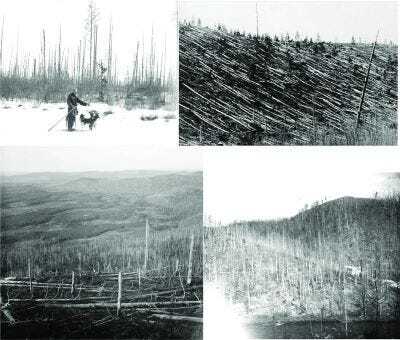 Photos of the Tunguska blast from the 1921–29 expeditions. (here).
On June 30, 1908, at exactly 7:14 a.m. local time, in Eastern Siberia (Tunguska-Pietrosa river basin), a glowing object appeared in the sky and exploded about 5 miles high, releasing the energy of several atomic bombs. The forest was leveled over an area of about 1,500 square miles; millions of trees were thrown to the ground, stripped of their bark and partially charred. All life in the area went incinerated. Fire, dust, debris, and steam were shot everywhere. The shock wave, got by seismographs, traveled twice around the Earth. The most accepted theory to the present is that it was a meteorite.
Thanks for reading!
BooksThe Tunguska Mystery by Vladimir Rubtsov.The Fire Came By: The Riddle of the Great Siberian Explosion by John Baxter.Tunguska: A Siberian Mystery and Its Environmental Legacy by Andy Bruno.The Mystery of the Tunguska Fireball by Surendra Verma.[image error]June 14, 2024
Heart of Brightness. Or the electron whispering.
Well, you cannot see me. But I see you.
This is not to say that I spend my time watching you, I have no reason to, but I like to interact with you from time to time. Do you know when you feel the release of an electrostatic charge on your skin? That’s me moving from another place to you and walking all over you and electrifying you. I don’t mean to, it’s my nature: I’m a charged guy. It may seem strange that an electron — an elusive impulse — is talking to you, but don’t stop it. Live your imagination. Let it take you. I want you to know my view of what surrounds you. I am small, very small, but I can see and do things that you do not even notice. Today I’ll shine just for you and enter your mind with extraordinary concepts. Let me, an electron, explain to you what is actually part of you. For you are like me: You are a quantum reality.
First of all, let me say that I am not just a particle. No, no, listen: Forget what they taught you in school. Trust me, I am dual, which means I am both a particle and a wave. This is one of the things I like most about me: Being in two states at the same time, in two situations. It means I can have two faces, two ways of being, two natures. I can be a point or a cloud of possibilities. Do you think you are so different? Do you really think so? You too can be a body but you have a mind that expands into a moving wave. Of course, it is not quite the same, but it is very similar. We are more alike than you think, you and I. You smile, I see you. Your wishes are known only to you. But sometimes I behave like a particle traveling from one point to another, and sometimes I behave like a wave traveling through space. Sometimes I jump, sometimes I vibrate. Are you so different from me?
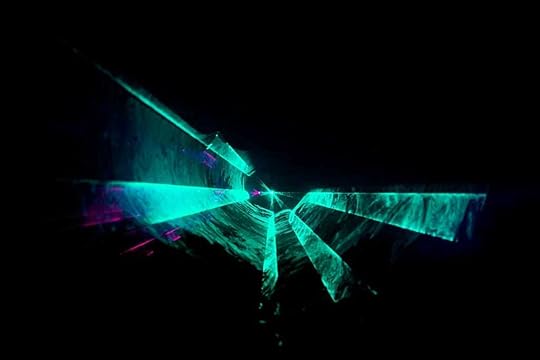 I don’t live by certainties
You often talk about your certainties. No doubt you have something you rely on, something you are sure of. Your car parked in the driveway, the tree in the middle of your yard, your dog waiting at the door. The intriguing smile you get from a stranger walking down the street. That smile makes you ask yourself a question, the simplest one: Why did that stranger smile at me? Because you need to know, you need certainty. And you have some certainties, for example you think you know exactly where you are and what time it is. A chair and a clock are all you need to fuel your certainties. Well, in my world there is no certainty, and that means that you cannot grasp me, you cannot know my exact location and my speed at the same time. I am elusive to you. I am uncertain. I am intangible. I am the charge on your arm that you cannot control. I’m like your emotions: Where are they? When did they begin and when will they end? Well, you know what? You are not in control of everything.
Heisenberg’s Uncertainty Principle says that you cannot know my exact location and my speed at the same time. If you know exactly where I am, you don’t know how fast I’m moving, and vice versa. This principle introduces an element of uncertainty inherent in my nature in a quantum systems. And whether you like it or not, it is also an element of uncertainty in your existence.
When the distance between two points is too great for you to reach, you need roads, paths, bridges. But imagine that you can jump from one place to another without going through the points in between. In the quantum world, I, a tiny, insignificant electron, can do what you cannot: Make a quantum leap. Energy that vibrates. Energy that turns on. Energy that moves into the world in discrete quantities called quanta. In an atom, I can jump between energy levels without crossing the space between them. It is like teleporting from the first to the second floor of a building without using stairs. I bet there’s a smile on your face. Don’t you believe it? What if someday you could do it? Are you not smiling now? Those are shivers of excitement, aren’t they? How many times have you wished you could teleport to “her” or “him”? Or maybe to an unreachable place. Or maybe into space. Or maybe in the past, but I don’t want to open too many scenarios. It might be too exciting for you.
The SuperpositionYou know when you are at a conference, or maybe at work, or even at home, with someone talking over you, or maybe in a state of total wishing you were somewhere else. May be with someone else. Sometimes you wish you could move unnoticed. You wish you could be here and there, to have a way out, but discreetly. This is another fascinating aspect of my life from a quantum point of view: Superposition. I can be in several states at once, as long as you’re not watching me. Imagine you are at the gym. Yes, I’m there with you while you are training; if you could observe the subatomic world, you would notice that as long as you don’t observe me, I can be everywhere around you. It is as if I can be in several places at once. Only when someone observes me do I “collapse” into a single defined state. It is as if I have infinite possibilities and the act of observation determines my ultimate fate. Maybe that’s why I elude you, what do you think?
The EntanglementYou may have heard of a concept called entanglement. When two electrons become entangled, their properties remain linked regardless of the distance between them. So when I’m entangled with another electron, if something happens to me, it immediately affects the other electron, even though we’re at opposite ends of the universe. It is an instantaneous connection that transcends space and time. You don’t believe that? Yet they have demonstrated it, and it is something that even gave Einstein the creeps. Why are you so amazed? Have you never been able to experience what another person is experiencing miles away? I’d say you have. Emotions? Okay, you’re right, I know it’s not good to confuse physical dynamics with the soul or spiritual stuff, but the instant is something that belongs to us. To me and to you. Maybe we should discuss what consciousness is, you and I, but not now. I am already compromising too much by talking to you face to face. So I can’t right now, but we will, I promise.
Heart of brightnessIn my world, everything is based on probabilities. There are no certainties, only possibilities. Quantum physics uses wave functions to describe these probabilities. Remember your chair and your clock? They’re fixed quantities that don’t exist in a quantum point of view. Or, better yet, they don’t exist together. You can’t fix them at the same time. You can only talk in terms of probability, never absolute certainty. This amuses me greatly when I observe the way you pass by without even noticing me. But I am there. Remember the charge on your skin? Yes, I am there. My existence is governed by principles that defy your daily intuition. But when you observe me — even though I am subatomic — you are observing the burning heart of the universe. For I am the luminous dust that gives currents in the sidereal spaces, illuminating the stars, resonating from the depths of mystery. And since my average lifetime is 19 orders of magnitude longer than the total lifetime of the universe, that makes me a small, shimmering glimmer of eternity.
So listen to me, human, I am part of you. You and I are one. That’s why I tell you: Don’t try to understand quantum physics, just live it.
May 27, 2024
The first photo ever to capture atoms turning into quantum waves: Schrödinger would be very happy
The authors of the study are Drs. Tarik Yefsah, Joris Verstraten, Tim de Jongh, and Bruno Peaudecerf. And the study has not yet been submitted for peer review. The paper is available on the pre-print server ArXiv.: In-situ Imaging of a Single-Atom Wave Packet in Continuous Space
A photo that is going to change the world?Finally physicists have managed to get a clear image of individual atoms behaving like a wave. This is crucial because the wavelike nature of matter remains one of the most fascinating aspects of QM. To simplify as much as possible, particles can be thought of not as objects with position and momentum, but as quantum fields scattered in space that “collapse” — that is, become real particles — only when an instrument observes them. The Schrödinger equation gives mathematical form to this idea, saying that atoms exist as wave-like probability packets in space: There is no definite position and no definite momentum until we observe it. At the very moment of observation, the wave function collapses into a particle, resulting in the wave-particle duality of the matter.
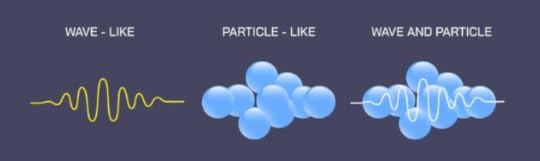 Wave Particle Duality: Vector Art | Shutterstock
The image researchers took shows fluorescent lithium atoms turning into small “fuzzy wave packets”. This would prove that atoms exist as both particles and waves, an idea introduced by de Broglie around 1924. A few years after de Broglie’s work, Schrödinger stated that the wave-particle dualism holds true for all quantum particles (not only light). This means that all matter exists both as a particle and as a wave at the same time.
How did they get the image?Thanks to a new imaging technique that captured frozen lithium atoms. They froze them because in QM the position and momentum cannot be determined before, so freezing them prepared atoms to be observed. Simply put (I’m still trying to figure it out, guys!), physicists first cooled the lithium atoms to temperatures near absolute zero, and then trapped them in an optical lattice. For those of you who have never been in a physics lab, an optical lattice consists of a sheet of glass, with a network of parallel, equal, equidistant lines etched into the surface of the glass at distances comparable to the wavelength of light. It is used to separate the colors of light and exploits precisely the wave nature of it.
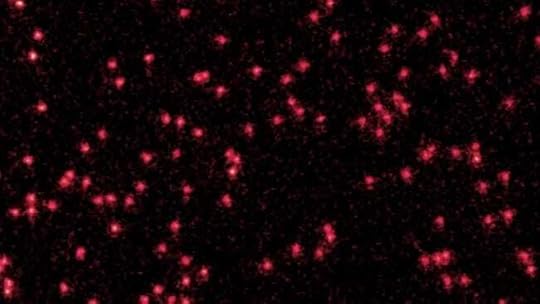 The image shows Lithium atoms cooled to near absolute zero appearing as red dots on the image. By combining several of these images, the authors were able to observe atoms behaving like waves. (Image credit: Verstraten et al.)
While a microscope camera recorded the light emitted by the atoms, the researchers periodically turned the optical lattice off and on. When the optical lattice is turned on, the state is particle-like; when it is turned off the atomic wave expands. During this process, the trapped atom emits fluorescence that can be detected by the microscopy system. By stitching together multiple images, the researchers were able to capture the moment when individual lithium atoms (optical lattice on) began to behave as localized quantum waves (optical lattice off). So, have a look at the image: Each red dot is a lithium atom in particle form; the fuzzy dots are atoms in the wave state (that is, a cloud of possibilities):
What will this lead to?
“This imaging method consists in turning back on the lattice to project each wave packet into a single well to turn them into a particle again — it is not a wave anymore,” study co-author Tarik Yefsah, a physicist at the French National Centre for Scientific Research and the École normale supérieure in Paris, told Live Science. “You can see our imaging method as a way to sample the wavefunction density, not unlike the pixels of a CCD camera.” [ here ]
The demonstration of one of the key principles of QM can have a significant impact on the progress of research. In addition, by improving these new techniques, we can better understand the states of matter, open new horizons in our understanding of the universe, and explore the unseen world with more powerful tools.
Guys, this is great!
Thanks for reading! And, please, point out conceptual errors if there are any, so I can correct them! ;-)
More insightsLithium LabsFirst-Of-Its-Kind Image Shows Single Lithium Atoms Turning Into Quantum Waves[image error]