Christopher Reilley's Blog
April 22, 2026
Earth Day
 NASA
NASAEarth Day - User Manual for a Planet with No Warranty
Earth does not need a holiday greeting card.It needs fewer receipts.
Still—happy orbit around the Sun,you third rock with excellent water features,a magnetic field that quietly blocks the worst of space’s bad ideas.Earth is doing great, considering the tenants.
What can you do - every day?Start with the low-hanging habits—that don’t require a ladder or a personality transplant.
Turn off lights that are auditioning for nobody.Electricity is invisible until it isn’t—coal remembers, gas remembers,even the clean stuff prefers not to be wastedlike a good joke told to an empty room.
Drive less when you can.Combustion is just ancient sunlightreleased with dramatic flair and a stiff bill.Walk, bike, take a train—let your commute become a small rebellionagainst turning dinosaurs into traffic.
Eat like a thoughtful omnivore.Plants are efficient storytellers—they turn photons into lunch with admirable restraint.Meat is a longer sentence; enjoy it,just don’t insist it narrate every meal.
Waste less.Landfills are museums of our indecision—objects we finally broke up with.Buy fewer, better things; repair what sulks;recycle like a librarian who believes in second chances.
Water is not a personality trait; it is a finite miracle on tap.Shorter showers, fewer leaks— let the rivers keep their plotlines.
Plant something.A tree if you’ve got the yard and the patience—carbon will gladly sign a long-term lease in wood.A window herb if you don’t—basil is forgiving and smells like optimism.
Advocate.Vote like the atmosphere can hear you,because policy is just weather with paperwork.Support the people doing the slow, unglamorous mathof keeping coastlines where they are.
And yes, laugh.Despair is a terrible project manager.Hope, properly staffed, gets things done.
Earth Day has no finale.It’s a recurring meeting with action items.Bring your best small changes—they scale, they compound, they gossip to each other.
The planet isn’t asking for perfection.It’s asking for participation.Preferably the kind that leaves the placeslightly better than you found it,which, on a sphere,is a surprisingly efficient promise.
-----
EARTH DAY RESOURCES
©2026 Christopher Reilley
I would love to know what you thought about this piece. Please consider leaving a comment.


April 21, 2026
Contributor’s Note from the Quiet Side of Earth
 NASA
NASAContributor’s Note from the Quiet Side of Earth
I mailed some poems to the Moon—not with stamps, but with engineers,with payload mass budgets and a tolerance for wonder.
They called it the Lunar Codex:a library miniaturized into stubborn endurance—nickel plates, etched like patient fossils,or memory so small it requires a microscopeand a belief that eyes will follow later.
We argue about archives down here—formats, failures,bit rot nibbling at the edges of our certainty—but up there the vacuum is a careful librarian.No oxygen to gossip with the pages, no rain to revise the margins.Just sunlight, blunt and honest,and a regolith that keeps secrets without asking what they mean.
I imagine my lines tucked among others—artists, scientists, the occasional heretic of beauty—compressed into geometry, a choir rehearsing in silence.It’s a peculiar kind of immortality: not the loud forever of statues,but the quiet maybe of a backup placed where tides can’t reach.
Yes, the Moon is already an archive—basalts remembering fire,craters keeping time with impacts—but we have added our footnotes,our human habit of saying we were herein a language that hopes to be read by anything that knows how to look closely.
There’s humor in it, too.We send poems to a place without air and call it preservation;we trust that future minds—human or otherwise—will bring their own atmosphere to the act of reading.
If you ask what it means, I’ll give you a scientist’s shrug in a poet’s coat:it is redundancy against forgetting, a checksum for the species,a line break inserted into history so the next reader can breathe.
And if no one comes?
Then the Moon keeps our library like a held note—no decay, just duration—while back here we keep writing, because sending a poem that farturns distance into a verb, and proves we know how to aim hopewith both hands.
www.lunarcodex.com
-----
©2026 Christopher Reilley
I would love to know what you thought about this piece. Please consider leaving a comment.
April 20, 2026
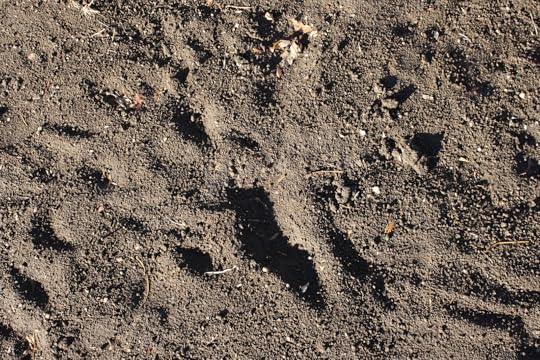
Dirt:
 Public Domain Photos
Dirt:
crushed ambition of mountains, loam with a résumé.
It grows lunch, keeps secrets, takes them too—a reliable archivist with worms for interns.
We call scandals “dirt” and gardens “soil,”as if vocabulary could launder origins.
Dig under every story, a little grit insists.
-----
This Quadrille (44 word poem) shared with those digging dogs over at DVerse Poets Pub.
©2026 Christopher Reilley
----- I would love to know what you thought about this piece. Please consider leaving a comment.
April 16, 2026
Following the Brush, with One Name I Don’t Say
 origin unknown
Following the Brush, with One Name I Don’t Say
The last two chairs at the table face each other like rival hypotheses. We sit in neither. Dust conducts the meeting with admirable neutrality.
My sibling prefers the physics of denial: a closed system where no energy is lost because nothing is admitted. I bring conservation laws to dinner; he brings a lid.
Fact: memory is reconstructive. Each recall edits the file. We have become unreliable narrators of the same afternoon, co-authors who refuse to share a bibliography.
I inventory the dead—mother, father, elder brother, the cousins who used to laugh like loose change. Absence scales poorly; it makes our disagreement look large enough to live in.
He says, It didn’t happen like that. I say, It happened enough. Between those two measurements sits a gulf with excellent acoustics.
Life always allows digression: the hinge on the old door still squeals. I oil it. Mechanisms, when tended, accept correction. Blood, less so.
Humor, carefully: we are experts in non-apologies, fluent in the passive voice. Mistakes were made, by weather, by furniture, by the general atmosphere of being alive.
I draft a letter I will not send. It is precise as a lab protocol and just as likely to be contaminated by feeling.
Age advances like a quiet auditor. It underlines the columns: time remaining, words unspent, the cost of being right amortized over a shrinking horizon.
He keeps the story airtight; I keep it ventilated. One of us avoids drafts, the other avoids suffocation. Neither of us calls it love, though something stubborn breathes.If reconciliation is a bridge, ours is all blueprint and no steel. Still, I carry bolts in my pocket, ridiculous with readiness.
Last note: I practice saying his name without flinching. It behaves like a small instrument—temperamental, necessary—waiting for a hand that will not pretend it was never dropped.
-----
My first crack at a Zuihitsu , a form I just learned of from those layered, introspective types at the DVerse Poets Pub .
-----
©2026 Christopher Reilley
I would love to know what you thought about this piece. Please consider leaving a comment.
April 15, 2026
Painting by Numbers, With Invisible Paint
 cropped from random craft website
Painting by Numbers, With Invisible Paint
I bought the kit because it promised mastery—all I had to do was stay inside the lines and trust the legend.
Number 1: Confidence (a bold cerulean).Number 2: Vision (something between sunrise and rent due).Number 3: Depth (apply generously).
I uncapped the paint—nothing.A brush dipped in optimism,dragged across a canvas as blank as my browser history in incognito mode.
Still, I obeyed the arithmetic.Filled in 4 with decisive strokes, outlined 7 like I meant it.The numbers disappeared under my diligence,leaving behind the faint, smug scent of effort.
From a distance, I declared it a landscape.Up close, it was more of a philosophy.
Guests tilt their heads.“Mmm,” they say, admiring the negative space like it’s curated.I nod, solemn as a docent of nothing,murmuring about minimalism and the tyranny of pigment.
Truth is, I love the ritual—the quiet counting,the click of brush against rim,the steady lie that structure equals substance.
One day, perhaps, a color will show up unannounced—bleeding past its assigned square, ruining the symmetry,making a mess of my careful compliance.
Until then, I’ll keep painting what you can’t see,number by number, masterpiece by maybe.
-----
This ekphrastic poem's title is the ninth line from one of my earlier poems , that poem was made up of incomplete sentences, that somehow made great titles.
-----
©2026 Christopher Reilley
I would love to know what you thought about this piece. Please consider leaving a comment.
April 14, 2026
Where Does Love Go When It Goes?
 BrainsWay
Where Does Love Go When It Goes?
It does not vanish. That would violate conservation—not of energy, not of mass, but of imprint.As Shelley suggested, the cloud dissolves and is not lost,it becomes weather elsewhere—a redistribution of ache across atmosphere.
Auden was less patient: “Stop all the clocks,” he said,as if time were a rude waiter refusing to close the check.
But clocks don’t stop. They redshift.
Love leaves like light from a receding galaxy—not gone, just stretched thin,its wavelength pulled toward the quieter end of the spectrum,until what was once a bright declarationarrives as background radiation,a soft, persistent hiss in the instruments.
You can measure it, if you’re careful—in the way you still set the table for two,in the reflex to share a joke that now lands in vacuum,in the ghost-limb itch of a hand no longer held.
There’s humor in it, if you’re unkind enough to look:we build entire cosmologies around one unreliable star,then act surprised when it evolves off the main sequence.
Still—nothing wasted.
Neurons that fired together once have already wired their quiet conspiracy.The pathways remain, well-paved roads to a city no longer issuing permits.
So where does love go when it goes?
It goes diffuse.It becomes field instead of particle,less a thing you can point to than a condition you move through—like gravity, like memory, like a melody from Sinatralingering in a room after the record lifts,the last note hanging with unreasonable confidencethat someone, somewhere,is still listening.
-----
For those over at The DVerse Poets Pub , I can tell you it is not with the lost socks or my car keys.
-----©2026 Christopher Reilley
I would love to know what you thought about this piece. Please consider leaving a comment.
Firmware for a Lyric Engine
 Tammi Simpson
Firmware for a Lyric Engine
A poem used to arrive barefoot—ink-stained, carrying weather in its pockets,smelling faintly of cedar and argument.
Now it boots.
Somewhere between a blinking cursorand a server farm the size of a modest mythology,language is being distilled into vectors—coordinates for longing, indexed heartbreak,a taxonomy of awe with version control.
We have taught machines to complete our sentences,which is to say: to anticipate us with unnerving politeness.They do not feel the metaphor,but they map its probability density—love as a high-frequency signal,grief as a long-tailed distribution that refuses to converge.
Still, the old magic lingers in the circuitry.A line break behaves like a switch—open, closed—a pause that carries more current than the words themselves.
Consider the neuron: electrochemical gossip,ions slipping across membraneslike rumors through a crowded conference.Consider the transistor: a gatekeeper with impeccable timing,deciding which whispers become voltage.
We are not so different, only wetter.
You, with your pipettes and proofs, know that precision is a kind of poetry—error bars like polite disclaimers on the edge of certainty.You publish data; we publish doubt wearing a clever hat.
And here is the joke, gently soldered in place:we built machines to mirror thought,then discovered thought had been mechanical all along—pattern-seeking, recursive,a loop that occasionally dreams it is free.
So write your poems like code that almost compiles,leave one beautiful bug—a line that refuses optimization,that slows the reader just enough to notice the heat in the system.
Because even now, in this cathedral of processors,someone is reading not for accuracy,but for the small, unquantifiable spark—the unauthorized voltage—that leaps the gap and calls it meaning.
-----
NaPoWriMo Day 14
Following this Prompt from NaPoWriMo.net
©2026 Christopher Reilley
I would love to know what you thought about this piece. Please consider leaving a comment.
April 13, 2026
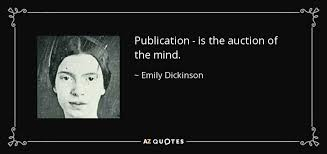
Publication is the Auction Of the Mind
Publication is the Auction Of the Mind
Publication is an auction where your thoughts stand on a tiny stage, wearing their best verbs, hoping someone raises a hand instead of an eyebrow. Editors are careful bidders—they don’t want noise, they want something that hums after the page is closed.
So polish your poem until it stops squeaking. Cut the extra words—they’re couch cushions hiding lost change. Start strong; no one bids on a whisper that arrives late. Follow the rules of the place you’re sending it—every magazine has its own secret handshake.
Rejection will show up wearing a smug hat. Let it. It’s just practice applause in disguise.
Then send again. And again.
Because somewhere, a reader is already reaching for your line, coin in hand, waiting for you to step into the light.
-----
This bit of prosery was ekphrastically prompted by the title, which is a line from Emily Dickinson, from The Poems of Emily Dickinson Edited by R. W. Franklin (Harvard University Press, 1999) and those bidders with loose change over at DVerse Poets Pub.
-----
©2026 Christopher Reilley
I would love to know what you thought about this piece. Please consider leaving a comment.
April 12, 2026
A Poem is Like a Pizza
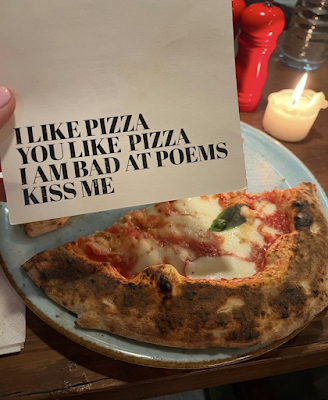 Pexels.com
A Poem is Like a Pizza
A poem is like a pizza,which means you should take it seriouslybut not so seriously that you forget to enjoy it.
The crust is structure—holding everything together,doing quiet engineering work like a bridge that also tastes good.
The sauce is feeling, spread everywhere on purpose,not just dumped in one emotional puddlelike someone tripped and spilled a jar of tomatoes.
Cheese is language—melting across the whole thing,connecting every bite, stretching just enoughso nothing feels separate or lonely.
Toppings are details—pepperoni facts,mushroom memories, random olives of weirdnessthat not everyone asked for but somehow belong there.
Too many toppingsand the whole thing collapses under its own ambition,which is a real structural problem, and also a life lesson.
Too few and it’s just dough thinking about greatness.
You have to decidehow much is enough,how weird is too weird,how bold you want to bewith pineapple-level decisionsthat divide entire civilizations.
And when it’s done, you hand it to someone else,hoping they taste what you were trying to say—even if they pick off the onions.
-----
©2026 Christopher Reilley
I would love to know what you thought about this piece. Please consider leaving a comment.
April 11, 2026
Stitching Time's Ankles Together
 SpotifyStitching Time’s Ankles Together
I caught Time mid-stride, all calves and calendar,sprinting barefoot through my to-do list—and thought, what if I hemmed him in?
So I fetched my grandmother’s thimble,threaded it with good intentions (the color of “Monday”),and crouched behind the hour hand like a tailor with delusions of grandeur.
Time pretended not to notice—whistling elevator music, checking his watch(which is just himself, very meta).
I aimed for the ankles—neat cross-stitch,nothing aggressive, just a polite hobbleso he’d stop outrunning my ambition and sit awhile for coffee.
But Time has excellent cardio.
He laughed in leap year, flicked lint from his lapel of seconds,and dragged my tidy seam down the boulevard of afternoon.
Now I’m here with a spool of “eventually” unraveling at my feet,needle stuck in the cuff of yesterday,explaining to the mirror that this was always performance art.
Truth is, Time doesn’t need tripping.He needs dancing with—a little less chase, a little more waltz.
Still, if you see him limping—just slightly—that was me.
-----
©2026 Christopher Reilley
I would love to know what you thought about this piece. Please consider leaving a comment.