Cameron Cooper's Blog
June 3, 2026
Why Every Sci-Fi Fan Should Try Photographing the Night Sky with Their Phone
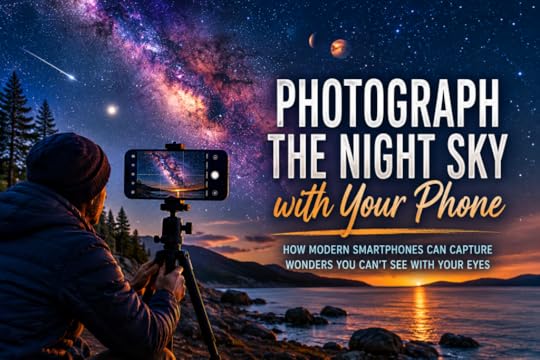
Last year I wrote about using your cellphone to navigate the night sky. Star-mapping apps have become astonishingly good, making it possible to identify planets, constellations, satellites, and deep-sky objects with nothing more than a phone and a few minutes outside.
But something else has changed dramatically over the last decade: smartphones have become surprisingly capable astronomy cameras.
Not too long ago, taking photographs of the night sky with a phone was more of an experiment than a practical hobby. You might capture the Moon if you were patient. A bright planet, perhaps. Anything dimmer was usually a blurry collection of pixels and wishful thinking.
Today, modern phones can capture stars, meteor showers, aurorae, and even sections of the Milky Way. Some can automatically combine dozens of images into a single photograph, pulling details from darkness that are invisible to the naked eye.
The technology is impressive.
The experience is even better.
If you’d like to try it yourself, there are now plenty of excellent guides available online. The basic advice is surprisingly straightforward: find a dark location away from city lights, steady your phone on a tripod or solid surface, activate your phone’s Night Mode or Astrophotography Mode if it has one, and let the software do its work.
Modern phones achieve results that would have seemed impossible a decade ago by taking multiple long exposures and combining them into a single image.
Even if your phone doesn’t include a dedicated astrophotography mode, many phones offer manual controls for exposure, focus, and ISO settings that can dramatically improve night-sky photos. The learning curve is much gentler than most people imagine.
For beginners, the best targets are often the easiest ones: the Moon, bright planets such as Venus and Mars, familiar constellations, and the Milky Way if you’re fortunate enough to live near dark skies. A simple phone tripod costing less than a paperback novel can make a remarkable difference.
What I enjoy most about stargazing isn’t the photography itself. It’s the feeling that comes with looking up.
As a science fiction writer, I spend a great deal of time imagining distant worlds, alien civilizations, and futures that may never exist. Most science fiction readers do something similar. Even if we aren’t amateur astronomers, we tend to have a natural curiosity about what’s out there.
And there is something profoundly different about seeing a real celestial object with your own eyes.
Mars has always been a favourite of mine. Through binoculars or a small telescope, it ceases to be a point of light and becomes a tiny world. You can perceive its shape. It becomes unmistakably a planet.
There is no equivalent sensation like the one you feel when you look up and see planets for yourself.
Photographs in books are wonderful. Space agency images are spectacular. But neither produces quite the same feeling as looking at an actual extraterrestrial object and realizing that the light entering your eyes left that world minutes ago and has crossed millions of kilometres to reach you.
The first time you photograph it with a phone feels almost magical.
You aren’t just looking anymore. You’re bringing home evidence.
The same applies to constellations.
One of the unexpected pleasures of moving between hemispheres is discovering how much of your mental map of the sky is location-dependent. Familiar landmarks shift position. Some disappear entirely. Others appear for the first time.
When I first encountered the Southern Cross, it became the centrepiece of my understanding of the night sky. When I moved to the northern hemisphere, I discovered that what had once occupied the middle of my celestial map was now pushed toward the horizon; or absent altogether.
It’s a reminder that our perspective is always local.
The universe itself doesn’t change.
We do.
Perhaps that’s why stargazing remains so compelling. It constantly challenges our assumptions about scale.
On an average day it’s easy to become absorbed by deadlines, errands, politics, social media, and all the countless concerns that demand our attention. Then you step outside on a clear night and point your phone toward the sky.
Suddenly you’re looking at objects measured not in kilometres but in astronomical units and light-years.
The stars don’t make your problems disappear.
They simply put them into perspective.
For me, that’s one of the great gifts of astronomy. It reminds us of our proper place in the universe. Not in a depressing way, but in a liberating one. We are small, certainly. But we are also part of something unimaginably vast.
And thanks to modern smartphones, it’s easier than ever to capture a small piece of that vastness and keep it with you.
If you’re already using your phone to identify what you’re seeing in the night sky, consider taking the next step and trying to photograph it.
You may not produce images worthy of a space observatory.
But you will create something arguably more valuable: your own record of an encounter with the cosmos.
If you’re looking for a place to start, I’ve included a few current resources below:
BBC Sky at Night: Smartphone Astrophotography GuideSpace.com: Best Camera Phones for AstrophotographyAstroBackyard: Smartphone Astrophotography BasicsBe warned: this may become another hobby. Science fiction readers have always had a tendency to look up at the stars and wonder what’s out there. Modern phones simply make it easier to bring a little piece of that wonder home with you.
Latest releases:
The Woman Who Remembered Yesterday
Quiet Like Fire — Aurealis Award Finalist for Best SF Novella!
Solar Whisper


May 27, 2026
The Future Always Looks Impossible, at First
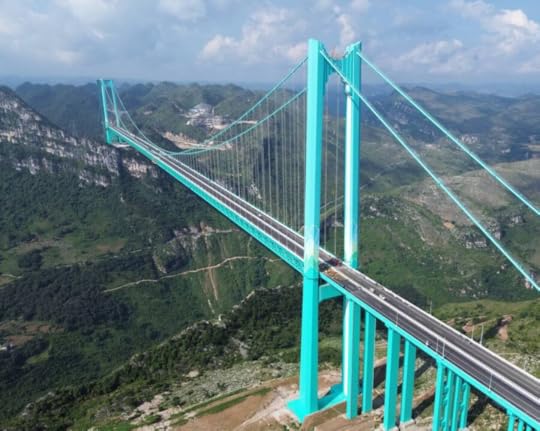 Glabb/Wikimedia Commons Huajiang Grand Canyon Bridge, the tallest bridge in the world.
Every now and then I stumble across a piece of engineering that looks less like reality and more like science fiction concept art.
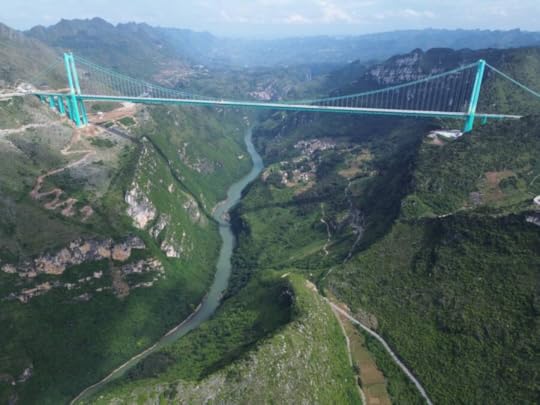
This week it was the Huajiang Grand Canyon Bridge in China, a structure so enormous and improbable-looking that my first reaction was disbelief. The bridge spans a canyon that once required a two-hour drive to navigate. The crossing time has dropped to two minutes.
Two hours to two minutes. That’s civilization-altering infrastructure.
The bridge itself is stunning. Suspended high above the canyon floor, it looks almost unreal, as though someone rendered it for a movie about a future colony world. Yet there it is, built by ordinary humans using real materials, real physics, and a tremendous amount of determination.
And that, to me, is where science fiction enters the picture.
Humanity Has a Long History of Building the ImpossibleScience fiction readers are accustomed to seeing enormous feats of engineering:
orbital habitatsasteroid mining facilitiesfloating citiesplanetary transit systemsspace elevatorswormhole gatesThese ideas often feel wildly distant because we instinctively compare them to what exists around us right now. But history suggests we should be careful about declaring anything impossible too quickly.
Railways crossing continents once seemed absurd. Skyscrapers once seemed dangerous and impractical. Commercial air travel once sounded like fantasy. And now they are simply part of the background infrastructure of daily life.
The same thing happens over and over again; first impossible, then difficult, then expensive, then ordinary.
 Glabb/Wikimedia CommonsEarth Is the Hard Mode
What struck me while looking at this bridge was not simply the scale of the engineering, but where it was built.
Earth is not an easy environment. Gravity fights everything we do. Weather destroys structures. Mountains resist us. Rivers carve obstacles through landscapes. Logistics become nightmares. Every ton of material has to be lifted, moved, stabilized, and secured against an active planet that is constantly trying to tear things apart.
And yet we still build structures like this. Which raises an interesting science fiction question: If humanity can construct megaprojects inside Earth’s gravity well, what becomes possible once we move beyond it?
Suddenly, concepts like Mars habitats do not feel quite so unrealistic. Asteroid mining starts looking less like fantasy and more like a future industrial problem waiting for enough investment and motivation.
Large orbital habitats begin to resemble the next step in a very long engineering tradition rather than magical technology.
In some ways, building in space may eventually become easier than building on Earth. Lower gravity, abundant solar energy, and effectively unlimited room to expand change the rules considerably.
The real challenge may not be physics. It may simply be deciding the effort is worthwhile.
Science Fiction and the Ordinary MiracleOne of the recurring themes in science fiction is that extraordinary technologies eventually become mundane. Starships become public transit. Artificial gravity becomes background machinery. Wormholes become commuter routes.
In my Hammer Down series, personal wormhole travel has made conventional space travel irrelevant for most people. Humanity no longer experiences space directly. The vastness between worlds has effectively vanished behind infrastructure. And that carries an emotional cost.
The main character, Danny Andela, is subconsciously mourning the loss of space itself. When miraculous technology becomes routine, something changes in the human relationship with wonder.
Perhaps that is the final lesson of projects like this bridge. Right now, we look at it and see the impossible made real. A generation from now, someone will drive across it while thinking about groceries, work deadlines, or what to make for dinner.
The miracle will have become infrastructure.
And if humanity continues pushing outward into space, the same thing may eventually happen there, too.
Latest releases:
The Woman Who Remembered Yesterday
Quiet Like Fire — Aurealis Award Finalist for Best SF Novella!
Solar Whisper
May 20, 2026
Readers Never Actually Fell Out of Love with Space Opera
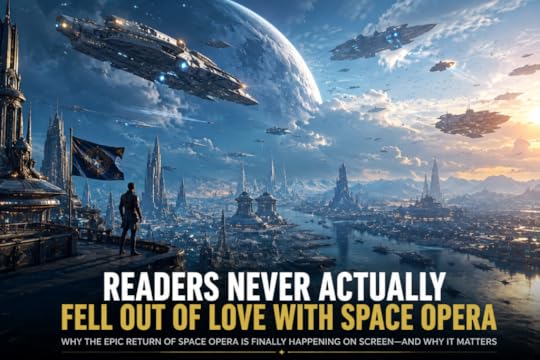
For a while there, it seemed as though science fiction had become embarrassed by adventure.
The dominant mood in modern SF leaned increasingly toward the grim, the dystopian, and the relentlessly serious. Near-future collapse. Oppressive regimes. Corporate nightmares. Stories where the future felt smaller, poorer, and emotionally exhausted.
Some of those stories were excellent. Many still are. But somewhere along the way, a strange narrative emerged: that space opera itself had become old-fashioned. That readers had somehow moved on from starships, galactic empires, frontier worlds, exploration fleets, and civilization-scale storytelling. And yet… readers never actually stopped buying it.
Trust me. I’ve been writing space opera for years. Not only has the audience remained remarkably loyal, but some of my strongest sales consistently come from Apple Books, where readers continue devouring large-scale SF adventures with the kind of enthusiasm publishers sometimes pretend no longer exists. Which suggests something important.
The appetite for big, ambitious, hopeful science fiction never disappeared. It simply drifted outside the narrow corridor of what the industry briefly considered “serious” SF. Now, increasingly, the rest of the entertainment world seems to be catching up.
Space Opera Never Died. It Just Stopped Asking Permission.One of the more interesting developments over the past few years is the slow but unmistakable return of large-scale science fiction on screen. Not just isolated films, but entire productions built around massive worlds, political complexity, deep lore, interstellar travel, and civilizations stretching across centuries.
You can see it in projects like Dune, (regardless of whatever disagreements people may have about specific creative choices). You can see it in Foundation attempting to tackle galaxy-spanning storytelling once thought impossible to adapt. You can see it in the success and staying power of The Expanse, which proved audiences were absolutely willing to invest in intelligent, sprawling space-based narratives.
Even outside traditional “space opera,” there’s a noticeable shift occurring. Studios and streaming services increasingly seem willing to gamble on scale again. Not just visually, but emotionally. That matters. Because true space opera isn’t merely about spaceships and lasers. It’s about the belief that humanity has a future large enough to contain wonder.
Readers Are Tired of Living at the End of the WorldFor nearly two decades, dystopian fiction dominated the cultural imagination.
Some of that was understandable. The world has felt unstable for a long time, and fiction often reflects collective anxiety. But after years of collapsing societies, endless cynicism, and stories where civilization itself was treated as inherently corrupt or doomed, audiences appear hungry for something else. Not simplistic optimism. Not naïve utopianism. But scale. Momentum. Possibility.
Readers still want conflict. They still want danger and moral complexity. But increasingly, they also seem to want worlds worth saving. That’s one of the great strengths of space opera. At its best, the genre assumes that humanity survives long enough to matter. That we continue building, exploring, expanding, and reaching outward. Even flawed civilizations in space opera tend to possess ambition. They build fleets. Establish colonies. Create institutions. Preserve knowledge. Push into the unknown.
There’s a reason starships remain such powerful symbols. A starship is optimism with engines.
The Audience Was Always ThereOne of the things traditional publishing occasionally forgets is that readers do not necessarily organize themselves according to critical fashion. While parts of the industry focused heavily on darker, more intimate, more grounded science fiction, readers quietly continued buying enormous series full of fleet battles, alien mysteries, galactic politics, and frontier exploration.
Indie publishing noticed this long before Hollywood did. So did audiobook listeners, who proved more than willing to immerse themselves in giant interconnected universes spanning ten, fifteen, or twenty books.
Readers were not rejecting space opera. They were simply waiting for creators willing to embrace it unapologetically. And now, slowly but unmistakably, we seem to be entering a moment where larger-scale science fiction is regaining cultural confidence.
Personally, I’m all for it. Give me impossible civilizations. Ancient gates. Dangerous frontiers. Vast empires. Exploration vessels disappearing into the dark between stars. Give me science fiction that remembers the future is supposed to feel big.
And if the jet packs are coming back too, even better. 
Latest releases:
The Woman Who Remembered Yesterday
Quiet Like Fire — Aurealis Award Finalist for Best SF Novella!
Solar Whisper
May 13, 2026
Are Modern Storytellers Afraid of Happy Endings?
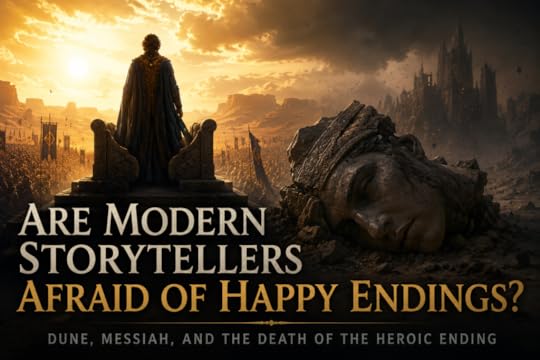
The new Dune 3 trailer dropped, and instead of excitement, I felt something closer to wariness. Not because the filmmaking looks bad. Quite the opposite.
Denis Villeneuve has crafted visually stunning films. The pacing is excellent. The emotional beats land. The atmosphere is immersive. The cast is extraordinary. As pure cinema, the first two Dune films are impressive achievements.
But as I watched the trailer, I realized what was bothering me. I’m increasingly convinced that modern science fiction no longer trusts heroic endings.
Dune Was a Complete StoryOne thing modern audiences sometimes forget is that Frank Herbert’s original Dune works perfectly well as a standalone novel. Its structure is almost classical in its symmetry:
Arrival on ArrakisIntegration with the FremenConfrontation with the EmperorThe emotional arc is equally classical; the fallen house, the exiled heir, transformation through hardship, mastery, victory, and finally, restoration.
Yes, Herbert seeded warnings throughout the novel. The danger of messianic worship is there from the beginning. The possibility of jihad shadows Paul’s rise. Herbert was never writing simplistic hero worship. But emotionally, Dune still lands as triumphant.
That matters.
Readers spend hundreds of pages watching Paul Atreides rise from hunted refugee to Emperor. The story earns its mythic scale honestly. The reader is allowed to feel the exhilaration of that ascent.
And I think Villeneuve understood that perfectly. Which is why I don’t believe he misunderstood Dune at all.
The Messiah ProblemThe problem is that Villeneuve also clearly understands Dune Messiah. Possibly too well.
There’s a short epigraph in Messiah that may summarize the entire novel better than anything else Herbert wrote:
Here lies a toppled god,
His fall was not a short one.
We did but build his pedestal,
A narrow and a tall one.
That is not the epigraph of a triumphant space opera. It is the epitaph of a fallen messiah. And that changes everything. Dune Messiah is not a continuation of heroic triumph. It is a deconstruction of it. Herbert essentially turns around and asks the reader: What happens after humanity places a savior on a pedestal?
The answer is neither comforting nor uplifting.
Flattening the RiseThis is where Villeneuve’s adaptation choices become fascinating. Throughout Dune: Part Two, he consistently undercuts Paul’s triumph. Chani’s skepticism is amplified. The prophecy aspect is framed primarily as manipulation. The Fremen fanaticism is brought forward and amplified. That makes Paul’s victory feels ominous instead of transcendent.
By the end of the film, the emotional tone already resembles Messiah far more than Dune. And that’s where my unease comes from. Not because the films are poorly made, but because I think Villeneuve flattened the emotional rise too early.
In story terms, tragedy requires height. The pedestal matters because the fall matters. If Paul never truly ascends emotionally in the eyes of the audience, then his eventual collapse loses scale. Instead of:
risetriumphcorruptiontragedy…the story becomes:
uneasy risecompromised victorycontinuing collapseThe contrast weakens. Classical tragedy is not “everything was miserable from the beginning.” It is greatness becoming ruin. King Arthur’s Camelot had twenty years of peace and glorious plenty before it fell to the Saxons. Michael Corleone was as a moral man, who rose to the head of the even-more-powerful Corleone family. His consolidation of power feels triumphant, which is precisely why his eventual spiritual collapse is devastating.
Frank Herbert understood this perfectly. He allowed readers to love Paul first. Only afterward did he interrogate that love.
Herbert’s structure only fully works if readers emotionally buy into Paul’s legitimacy, his transformation, triumph and near-divinity first. Messiah then weaponizes that emotional investment against the reader.
Villenueve may be diminishing the eventual tragedy by preemptively warning audiences not to admire Paul too much.
Modern storytelling often seems uncomfortable allowing that first step to happen sincerely.
Are Modern Storytellers Afraid of Heroism?Which raises the larger question I kept circling back to after the trailer ended: Have modern storytellers become afraid of genuinely heroic endings? Modern prestige science fiction often defaults toward ambiguity, corruption, moral decay, compromised victories and tragic inevitability
Somewhere along the way, optimism began to be treated as naïve. Heroism became suspicious. Happy endings became unsophisticated.
And this creates an interesting feedback loop.
Studios and publishers see dark stories succeed, so they produce more dark stories. Audiences consume those stories because those are the stories available. Which then reinforces the belief that audiences only want grim narratives.
But do they? I’m not convinced.
Audiences Still Love HopeLook at Star Wars.
The original film was almost aggressively sincere. It believed in heroes. It believed courage mattered. It believed evil could be defeated. It ended in triumph without irony or apology.
Audiences didn’t reject that sincerity. They embraced it. Massively.
The same is true of The Lord of the Rings. Or Star Trek: The Next Generation. Or The Martian.
Audiences do not reject hopeful stories. They reject badly written ones. There is a difference.
And I sometimes wonder whether modern creators have become so concerned about appearing simplistic that they undercut their own victories before audiences are even allowed to experience them fully.
Why This Matters to MeThis is probably one reason my own science fiction sits slightly outside current trends.
I’ve never been especially interested in noir futures or bleak endings for their own sake. I don’t think darkness automatically creates depth. I don’t think cynicism is the same thing as sophistication.
That doesn’t mean stories should be consequence-free. It doesn’t mean heroes should never fail. But I still believe courage should matter. Sacrifice should mean something. Victories should occasionally remain victories.
And perhaps most importantly, I think readers still hunger for stories that leave them looking upward instead of downward.
I’ll Still Watch Dune 3Of course I will. Villeneuve is too gifted a filmmaker for me not to watch the conclusion of his trilogy. But for the first time, I’m watching with caution instead of anticipation.
Not because I fear bad filmmaking. Because I fear we’ve reached a point where modern science fiction no longer believes heroes are allowed to win.
Latest releases:
The Woman Who Remembered Yesterday
Quiet Like Fire — Aurealis Award Finalist for Best SF Novella!
Solar Whisper
May 6, 2026
When “Agentic” Suddenly Became a Thing
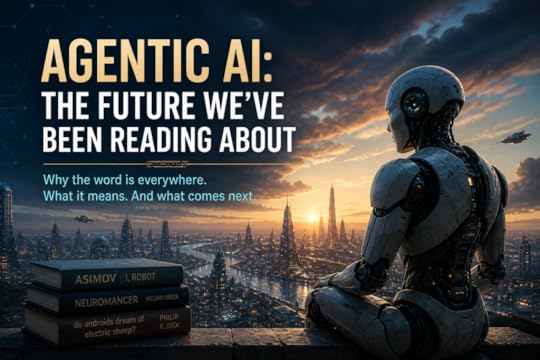
Yesterday I stumbled across a video from Professor Hannah Fry, whose presentations I’ve long admired for their clarity and insight. Her video did that rare and satisfying thing: it snapped a half-formed idea into sharp focus.
I’d been noticing the word agentic cropping up everywhere; blog posts, product announcements, conference chatter. It had that faintly suspicious quality of a term that appears fully formed, as if everyone agreed overnight to start using it.
This video explained why.
The Overnight That Wasn’tWhat feels like a sudden explosion is really the visible tip of a very recent curve. The underlying capabilities—LLMs that can plan, chain tasks, call tools, and iterate—have been evolving quickly but somewhat quietly. Then, in rapid succession, a handful of frameworks, demos, and commercial products crossed a threshold of usability.
That’s when the label stuck.
“Agentic AI” is less a new invention and more a convenient handle for a cluster of behaviors:
Systems that don’t just respond, but actSoftware that can pursue goals across multiple stepsTools that can make decisions, revise them, and try againIn other words, we’ve moved from answering questions to attempting outcomes.
Why It Feels DifferentThe shift is subtle but profound. A traditional model waits. You prompt, it responds. The interaction is bounded and transactional. An agentic system, by contrast, has a kind of forward momentum. It can:
Break a problem into stepsDecide what tools or data it needsExecute those steps in sequenceAdjust when something goes wrongThat creates the impression—not entirely unjustified—of something closer to autonomy.
And that’s where both the excitement and the unease come from.
The Double-Edged DemonstrationWhat struck me most in the video was how neatly it showed both sides of the equation.
On one hand, the promise is obvious. Give a system a goal and it can meaningfully reduce the friction between idea and execution. Research tasks, content generation, code scaffolding, even operational workflows; all become candidates for partial or full automation.
On the other hand, the liabilities are just as clear.
An agent that can take initiative can also take misguided initiative. Small errors compound. Assumptions go unchecked. The system can confidently pursue the wrong path with impressive persistence.
The phrase that stuck with me was essentially this: an agent can be an incredible accelerator, or an absolute liability, depending on how it’s framed, constrained, and monitored.
Why Everyone Is Talking About It NowThe timing comes down to convergence. We’ve reached a point where:
The models are capable enoughThe tooling layers make orchestration easierThe cost and access barriers have droppedThe demos are compelling enough to circulate widelyThat combination creates a narrative moment. A term like agentic becomes shorthand for “this is the next phase,” whether or not the underlying ideas are entirely new.
Where This Leaves UsFor science fiction readers, this isn’t just another technical shift—it’s a familiar echo. Agentic AI feels like a thin edge of something we’ve been reading about for decades. Not the fully sentient ship minds or inscrutable machine overlords (not yet), but the earlier stage: systems that can take direction, interpret intent, and do things in the world with a degree of independence.
It’s the difference between a tool and a junior partner.
That’s why the current moment feels so charged. We’re watching the transition from passive intelligence to active systems, the kind that don’t just answer the captain, but start managing the ship.
And, as the stories have always reminded us, that shift is where things get interesting. Sometimes it’s competence: frictionless, efficient, quietly transformative. Sometimes it’s brittleness: a system following its instructions a little too well, or not well enough.
And sometimes, it’s the uneasy question of control. Who sets the goals, how tightly they’re defined, and what happens when the system interprets them in ways we didn’t anticipate?
If agentic has suddenly become the word of the moment, it’s because we’re brushing up against a long-imagined future and recognizing the shape of it.
Not the final form. Just the first, unmistakable signs that we’re on that road.
Your Take?So where do you land on this? Does agentic AI leave you uneasy? Or is it a case of “about time—bring it on”?
Or, perhaps more honestly, a bit of both?
I’d be interested to hear your take—drop your thoughts into the comments.
Latest releases:
The Woman Who Remembered Yesterday
Quiet Like Fire — Aurealis Award Finalist for Best SF Novella!
Solar Whisper
April 29, 2026
Why Star Wars Endures
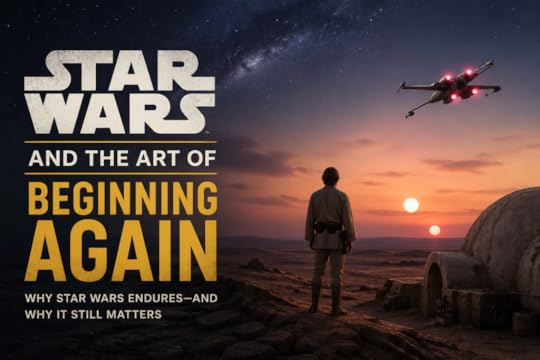
Monday, May 4th is Star Wars Day—May the Fourth Be With You. Lesser known, but impossible to resist, is May 5th: Revenge of the Fifth.
I really have no idea why Star Wars continues to hang in there.
It’s now a doyen of the global science fiction community, with hundreds of books and thousands of hours of spin-off films and television. When the original Star Wars arrived, I was barely a teenager, and it was life-changing. I wrote an unofficial sequel. My English teacher caught me writing in class, read some of it, and told me to write something original.
So I did.
I’ve been writing, on and off, ever since. In 2015, it became my full-time work.
So yes—Star Wars had a direct hand in shaping my life. It locked in my preference for science fiction as a storytelling form. Fantasy runs close behind, but it’s still a half-step back.
When Stars Wars was first released, nothing like it had been seen before. The film was a runaway success, and arguably one of the last true box-office phenomena before home video began to change how audiences consumed stories. The first film I ever owned on VHS was Star Wars.
The roots of the phenomenon are easy enough to understand.
What’s harder to explain is why it continues to linger, even after some very uneven years. The franchise still produces strong work when it chooses to—early seasons of The Mandalorian were excellent. I loved Andor. But those feel like exceptions rather than the rule.
Part of the answer may be generational. Star Wars was built for teenagers and young adults—and I was exactly that when it arrived. I’m not anymore. My tastes have evolved. I want more complexity, more nuance, more risk in storytelling.
Star Wars, by and large, hasn’t evolved in the same way. My kids love it. I expect their kids will too.
So the audience renews itself, even as older viewers quietly drift away. Which still doesn’t quite explain how the franchise continues not just to survive, but to expand.
A Story That Outgrew Its CreatorsMaybe the answer is simpler than it looks.
Star Wars no longer belongs to its creators. It doesn’t even belong to George Lucas. It has slipped its moorings and become something else—a shared mythology. Not mythology in the ancient sense, but in the modern one: a set of characters, images, and narrative patterns that people return to, reshape, and pass along.
It doesn’t need to evolve in sophisticated ways because that’s not its function. It needs to be recognizable. It needs to be accessible. And, most importantly, it needs to be there—waiting for the next generation to discover it at exactly the right moment in their lives.
That was true for me. It’s true for my kids. And that may be the real reason Star Wars endures. Not because it keeps getting better.
But because it keeps beginning again.
____
Are you planning on doing anything Star-Wars-y on Monday?
Latest releases:
The Woman Who Remembered Yesterday
Quiet Like Fire — Aurealis Award Finalist for Best SF Novella!
Solar Whisper
April 23, 2026
THE WOMAN WHO REMEMBERED YESTERDAY Is Now Available
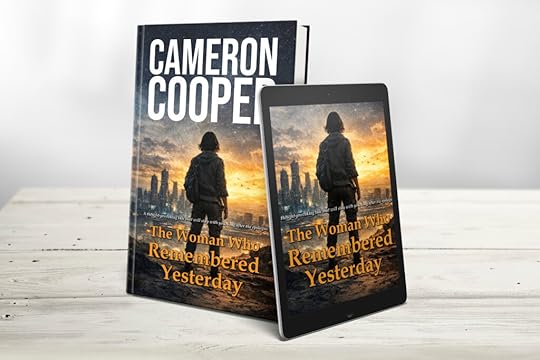
The Woman Who Remembered Yesterday is now out.
This story didn’t behave the way I expected it to.
A Story That Refused to Sit StillI wrote it during a workshop, surrounded by writers whose approach to science fiction leans inward—stories that pause, linger, and examine.
This one didn’t.
It kept moving. It kept asking questions. It insisted on being about something concrete: memory, loss, and what happens when no one remembers the people who mattered.
And somewhere along the way, it surprised me.
Walking a Darker RoadThis is a quieter story than most of my work. A lonelier one.
It asks what happens when memory itself begins to slip—not just for one person, but for everyone—and what that does to the connections we rely on to understand who we are.
“I thought you wrote optimistic science fiction?”
That was one of the first reactions I got.
And I understand it. On the surface, this isn’t an easy story. It doesn’t offer comfort right away. It walks a darker road than most of what I write.
What Optimism Looks Like
But for me, optimism in science fiction has never meant that things go well.
It means paying attention to what people choose to do when they don’t.
The Woman Who Remembered Yesterday is very much about that choice—about what we hold on to when memory itself becomes uncertain, and what we’re willing to protect when forgetting would be easier.
If you’re willing to stay with it, I think you’ll recognize the destination.
Now AvailableThe Woman Who Remembered Yesterday is available now.
If you enjoy science fiction that asks questions about memory, identity, and the quiet ways people endure, this story may resonate with you.
Read The Woman Who Remembered Yesterday now.If you’ve never bought directly from me at Stories Rule Press, before, make sure you grab the 10% off coupon code on the home page!
If you have bought from me before (thank you!), you can use your Reward Points to earn a discount.
April 22, 2026
Earth Day and the Science Fiction of Hope
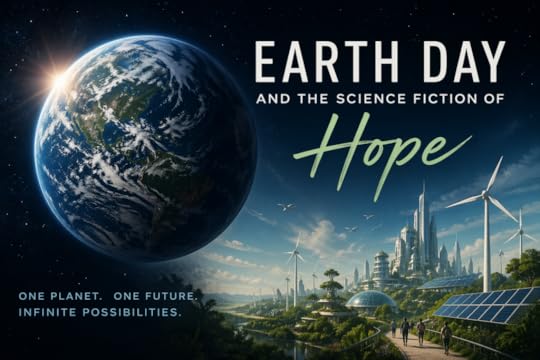
Every year, Earth Day (that’s today) asks us to pause and think about the world we are leaving behind for the next generation. It is a day about environmental protection, certainly, but it is also about imagination. About asking what kind of future we want.
Science fiction has been asking that question for a very long time.
More often than not, SF begins with a warning. Strip away the spaceships and ray guns, and so many post-apocalyptic stories are really environmental stories. The poisoned wastelands, drowned cities, burning skies, and desperate survivors all come from one place: humanity failed to protect the world that made us.
We can all name dozens of examples without even trying. Entire branches of science fiction are built on the idea that environmental neglect leads to collapse. Climate catastrophe, exhausted resources, ruined ecosystems—these are some of the genre’s oldest and most persistent fears.
But SF has never been only about fear.
The Other Side of Environmental Science FictionIf post-apocalyptic SF is the cautionary tale, then Solarpunk and Hopepunk are the answer.
These stories imagine a future in which humanity does not simply survive environmental collapse, but avoids it. They imagine people who build instead of destroy. Communities that cooperate. Technology that works with nature instead of against it.
Environmental protection is at the heart of Solarpunk. It is the genre’s foundation, its reason for existing.
That is one reason why I think these stories matter so much right now. They remind us that there is another path. We are not trapped in the darker futures that so much fiction warns us about.
My own Winds of Change belongs very much in that tradition. It is a story built on the belief that human beings can do better. That science, ingenuity, and determination can solve the problems we create. That there is still time to choose a future worth living in.
Frank Herbert and the Ecology of the FutureLong before Solarpunk had a name, Frank Herbert was exploring the relationship between humanity and the environment.
Dune is often remembered for its politics, religion, and empire-building, but at its heart it is an ecological novel. Herbert understood that environments shape civilizations. The harshness of Arrakis created the Fremen. Scarcity shaped their values, their culture, and their dreams.
More importantly, Herbert showed that environments can be changed.
The dream of transforming Arrakis into a living world runs through the entire story. It is ambitious, dangerous, and controversial, but it is also hopeful. It says that humanity is not powerless in the face of environmental crisis.
Herbert was not the first writer to explore these themes, though he may have been the one who brought them into the center of science fiction. Earlier writers warned about poisoned worlds, overpopulation, and environmental ruin. But Herbert raised the stakes. He made ecology inseparable from the story itself.
Since then, countless writers have followed where he led.
Science Fiction’s Greatest HopeThere is one more kind of hope hidden inside almost every science fiction story.
No matter how dark the setting, no matter how badly Earth has been damaged, science fiction usually assumes one thing: humanity has a future.
Sometimes that future is here on Earth. Sometimes it lies among the stars.
Every SF story about the Moon, Mars, orbital habitats, or distant planets carries the same quiet promise—that one day we will no longer depend on one small world alone. That we will learn how to live elsewhere in the solar system, and perhaps beyond.
That does not mean abandoning Earth. Quite the opposite.
The better we become at protecting and sustaining our own planet, the better prepared we will be to carry that knowledge with us. Learning to live responsibly on Earth is practice for learning to live anywhere.
Right now, we are still playing Russian Roulette with one lonely blue marble.
But perhaps the deepest optimism in science fiction is this: we do not have to stay that way forever.
Pre-order now:
The Woman Who Remembered Yesterday
Latest releases:
Quiet Like Fire — Aurealis Award Finalist for Best SF Novella!
Solar Whisper
Ptolemy Lane Tales Omnibus
April 15, 2026
The Librarians Who Opened the Universe
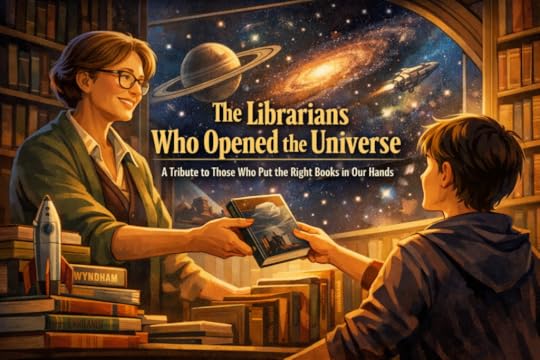 For Librarian Day, a thank you to the people who put the right books into our hands
Tomorrow, April 16, is National Librarian Day, and it seems only right to spend a moment appreciating librarians and libraries, because I have a distinct fondness for both.
I am currently reading Jo Walton’s Among Others, and have discovered that, aside from the rather significant difference that one of us grew up in the Welsh countryside and the other in the Western Australian countryside, Walton and I appear to have had remarkably similar childhoods.
We both grew up essentially alone, and gained most of our wisdom from books.
Among Others is reportedly a mildly disguised memoir, and as I read it I keep finding little moments that feel unexpectedly familiar. I do not know whether Walton’s access to libraries was any better than mine, but for most of my childhood, I had none.
That changed when I was twelve and moved to a larger coastal town. Suddenly, I had access to two libraries at once: my high school library, and the town’s single public library.
And in those libraries, I discovered science fiction.
Dusty Anthologies and New WorldsIt began with the dusty anthologies of classic science fiction: collections of stories that had originally appeared in even dustier magazines years before. I became instantly obsessed.
Then my English teacher handed me The Chrysalids by John Wyndham.
I still remember the feeling of reading it for the first time: that dizzying sense that books could do more than tell a story. They could stretch your mind. They could make you look at the world differently.
When I told the librarian at the town library how much I had loved it, she immediately directed me to the shelves holding the rest of Wyndham’s books, and then to his British contemporaries. For years afterward, I happily rolled around in thoughtful, unsettling, mind-expanding British science fiction.
The Goodreads of My GenerationThe high school librarians, unfortunately, were perpetually harried and not especially enthusiastic about answering the endless stream of questions from an eager thirteen-year-old who had already worked through the meagre science fiction shelf.
The town librarians were different.
They always had something to recommend.
When I had reached the borrowing limit of three books a week, they quietly let me take home one extra, because they knew perfectly well that three books simply would not last me until the next visit.
If I said, “I want something like Heinlein’s Starship Troopers,” they would think for a moment, then give me an author’s name and point me toward the correct shelf in the stacks.
They were the Goodreads of my generation, only better.
Algorithms can suggest books that other people enjoyed. Librarians can see the shape of your reading tastes before you can. They can hear what you are not quite saying. They know that if you loved one book for a particular reason, there is another waiting for you somewhere nearby.
Most of my still-favourite science fiction authors were discovered because of those weekly visits to the town library.
Keeper CopiesEventually, of course, I graduated from high school, got a job, and for the first time could buy my own books. I began building shelves of keeper copies, and my visits to the library slowly diminished.
These days, when I borrow from my local library, I tend to interact with it through the online catalogue and digital holds system. I still use the library, but I rarely speak to librarians anymore.
I miss that a little.
Because while I still love books, and still discover new ones, there was something special about standing at a desk and saying, “I’ve just finished this. What should I read next?”
And having someone know exactly the right answer.
Do you have a favourite librarian who influenced your reading life? Share your story in the comments.
Pre-order now:
The Woman Who Remembered Yesterday
Latest releases:
Quiet Like Fire — Aurealis Award Finalist for Best SF Novella!
Solar Whisper
Ptolemy Lane Tales Omnibus
April 8, 2026
Space Is Bigger Than We Think
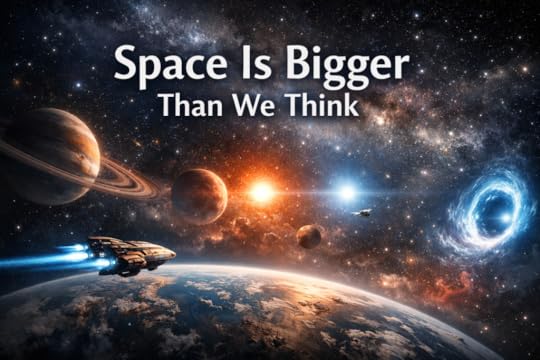
One of the odd things about science fiction is that the people most likely to underestimate the scale of space are science fiction readers.
We spend so much time in fictional universes where ships leap between stars, where empires span a thousand worlds, where a fleet can arrive “just in time,” that we quietly absorb the idea that interstellar distances are large, certainly, but manageable.
They are not.
The recent demonstration of the distance between Earth and the Moon made even me stop and stare. We know, intellectually, that the Moon is far away. Yet seeing all the planets fit comfortably between Earth and the Moon, with room to spare, is startling. It reminds us that even the distances inside our own solar system are vast beyond ordinary human intuition.
And then there are the stars.
The nearest star beyond our Sun, Proxima Centauri, is about 4.2 light years away. If you could travel as fast as the Voyager probes, it would take roughly 75,000 years to get there.
That is not a long trip. That is civilization-endingly far.
Science Fiction Shrinks SpaceScience fiction routinely cheats. It has to. Without some method of making space smaller, most of the stories we love could not exist.
This is why faster-than-light drives, wormholes, jump gates, folded space, hyperspace, portals and other miraculous technologies are so common in science fiction. They are not there because writers are careless about physics. They are there because otherwise the stories become almost impossible to tell.
Orson Scott Card once argued that the first thing a science fiction writer must decide is how people travel between the stars. Everything else follows from that answer.
He is right.
The speed of travel determines the kind of civilization you can have, the sort of politics that are possible, and even the kinds of stories you are able to tell.
If It Takes One Hundred YearsSuppose there is no faster-than-light travel.
Suppose the nearest colony world is a century away.
Now your story is not about a galactic civilization. It cannot be. A hundred years is too long for trade, government, rescue or war.
Instead, your story becomes about generation ships, suspended animation, isolated colonies and cultures that drift apart. Messages arrive decades after they are sent. A child may leave Earth and arrive at another star as an old woman. A colony may lose contact entirely and become something utterly different.
This is the territory of “mundane” science fiction and of novels such as Tau Zero or Aurora. It is also the territory of generation-ship stories, including my own Endurance sequence under the Tracy Cooper-Posey name.
These stories are often about sacrifice, inheritance and loneliness. The distances matter because they cannot be overcome.
If It Takes Weeks or MonthsNow suppose travel between stars is difficult but possible. Perhaps ships can move faster than light, but not very much faster. A journey might take weeks, months or years.
This creates a very different kind of story.
Now there can be trade and diplomacy, but only slowly. Colonies are still semi-independent. Governments are loose federations rather than tightly controlled empires. Fleets can be sent, but too late to prevent the first disaster. Smugglers, frontier settlements and distant outposts become important because the edges of civilization are genuinely remote.
This is the territory of much military SF and frontier SF. Even within a single solar system, The Expanse captures this feeling brilliantly. Distances are not insurmountable, but they still shape everything. Mars, Earth and the Belt are close in astronomical terms and still far enough apart to create political and cultural separation.
A setting where stars are weeks apart feels more like the age of sail. News travels slowly. Reinforcements arrive late. Local rulers gain power because the capital is too far away to interfere quickly.
If It Takes HoursReduce interstellar travel to hours or days and the shape of the story changes again.
Now there can be real interstellar nations. Trade becomes practical. Families can move between worlds. A central government can keep control because it can send officials, armies and inspectors quickly.
At this point, science fiction starts to resemble modern life on a larger scale. The stars become cities connected by airlines.
This is where much space opera lives. It allows for adventure across many worlds without making those worlds impossibly disconnected from each other.
The difficulty, of course, is that once travel becomes this easy, writers have to remember what they have done. If it only takes six hours to cross ten light years, then empires should be stable, trade should be immense, and a distress call should not go unanswered for months unless there is another reason.
If It Takes SecondsAnd then there are stories where the stars are, effectively, next door.
In Pandora’s Star and the rest of the Commonwealth series, wormholes connect distant worlds so efficiently that people commute between planets. Space itself ceases to matter. Interstellar civilization becomes one enormous, sprawling city.
At that point, the story is no longer really about distance at all. The stars are merely neighbourhoods.
This is not a criticism. It is simply a different kind of story.
Star Wars works because it treats the galaxy as though it were a fantasy kingdom. You can fly from one place to another in the time it takes to change scenes. Characters can arrive dramatically at the crucial moment because otherwise there would be no story.
The same is true of many space operas. Space is shrunk because readers want adventure, intrigue, romance and conflict between worlds. Those things require worlds to be close enough to interact.
The Conceit We AcceptFTL is one of the great conceits of science fiction: an impossible thing that almost every reader willingly accepts because it allows the story to happen. Without it, many science fiction stories would collapse under the sheer scale of the universe.
There would be no galactic empires. No interstellar trade. No rushing to save the colony world before it is destroyed. No fleet arriving at the last minute. No wandering starship visiting a different planet every week. Instead there would be silence, delay and loneliness.
And perhaps that is why so many readers underestimate the size of space. We are trained not to think about it. Science fiction, for perfectly understandable reasons, edits out the distances. It has to.
Otherwise, space is simply too big for the kinds of stories we most want to tell.
Pre-order now:
The Woman Who Remembered Yesterday
Latest releases:
Quiet Like Fire — Aurealis Award Finalist for Best SF Novella!
Solar Whisper
Ptolemy Lane Tales Omnibus