
Scott E. Hendrix's Blog
June 8, 2020
Tom Nichols’ The Death of Expertise is a missed opportunity.
In 2017 Tom Nichols, a professor of National Security Affairs at the U.S. Naval War College and Adjunct Professor at the Harvard Extension School, published The Death of Expertise with Oxford University Press. This book is a call to action, a warning that “everyone is drowning in data,” which is a problem because, as Nichols argues, citizens lack the capacity to separate good data from bad, to evaluate truth versus fiction, or to even understand the depths of their own ignorance (Nichols, 143). This is a problem, because it is “ignorant narcissism for laypeople to believe that they can maintain a large and advanced nation without listening to the voices of those who are more educated and experienced than themselves” (Nichols, 208). Thus, Nichols points to a collapse in expertise among those who hold university degrees, while highlighting the much bigger problem of the widespread denigration of experts among the public that may lead to a collapse of society. As an expert in history–I have a Ph.D. from the University of Tennessee–with more than 20 years of experience teaching, I agree with Nichols on his fears about the lack of respect for expertise in our the U.S., but I’m saddened by his inability to recognize how we got here.
To start with, I’ve tried to separate my personal feelings from my analysis of this book. I was eager to read The Death of Expertise because of my personal encounters with those who don’t understand or value expertise. I’ve also watched the problem play out in the public sphere with a great deal of trepidation. However, as I read Nichols’ book, I found myself increasingly alarmed, irritated, and at times outright offended by his elitism, his refusal to approach his subject critically, and his unwillingness to follow his own advice about how to understand the world. I found myself having to step back and ask myself if I was reacting to his book out of my feelings of anger and being personally affronted, or if it was because of anything wrong with the book. After careful consideration, I decided it’s genuinely because this is a bad book. That’s unfortunate, because Nichols makes some good points, but these are drowned out by his poor use of evidence–in most cases his lack of evidence–and the biases he wears on his sleave.
So why is this book problematic? The first two chapters are on “Experts and Citizens” and “How Conversation Becomes Exhausting,” which I often found myself nodding along to. However, as an expert at critical analysis–I’ve written dozens or hundreds of critical reviews of books both in class and for academic journals, not to mention my decades of training and experience applying this skill–I found myself with “a sense that something ‘isn’t right,'” which Nichols points to as a hallmark of someone who combines expertise with experience (Nichols, 33). That led me to pause and think about why, and it immediately became clear. In a section on the “Rise of the Low-Information Voter” Nichols discusses the wildly inflated estimates citizens make for how much foreign aid the U.S. government supplies to other nations (Nichols, 25-28). The problem is in his assertion that this is anything new. I agree with Nichols that specific mistaken beliefs such as this one about foreign aid is a real problem, but he doesn’t even make an effort to provide any evidence that the problem is new. In fact, this section follows another with the subheading, “So it’s Not New. Is it Even a Problem?” But the assertion that there has been a “rise” of the “low-information voter” is an empirical claim that can be tested, yet Nichols provides no evidence that voters in the 21st century know less about foreign aid than those in the mid 20th century or the 19th.
This problem of making empirical assertions lacking any evidence runs throughout the book, and frequently lapses into the realm of outright insult. Chapter 3 is devoted to “Higher Education,” with the subheading “The Customer is Always Right.” This chapter takes a multi-pronged approach of attacking students for their laziness, ignorance, and feelings of self entitlement, attacking institutions of higher learning for becoming corrupted by market forces, and attacking faculty for lack of proper expertise. The short version of what Nichols argues in this chapter is that too many students now attend universities, which compete for these students by offering water slides and climbing walls rather than quality education, as well as pressuring faculty to give good grades for limited effort. The faculty themselves are often unprepared to provide a quality education anyway, lacking the expertise necessary to do so even if they wanted to, since so many “generic universities” as Nichols calls them crank out individuals with graduate degrees without the necessary resources (Nichols, 88-95). This chapter is a perfect example of what’s wrong with The Death of Expertise. Nichols supports his assertions with 21 footnotes, and of those only three are from peer-reviewed sources. The rest are a mish-mash of online newspapers, blog posts, and magazine articles. Even those questionable sources provide not a single iota of evidence that any of the issues Nichols points to is new. Do students today learn less than those of the 1960s or 1860s? Are faculty in Nichols’ so-called “generic universities” less good at their jobs than those of elite institutions? Does grade inflation, which is at least a documented issue, indicate that students today are learning less than those of the past?
My gut-instinct about that last question is a sold maybe, but as a scholar, I know the problem of working from gut instinct, and Nichols doesn’t bother to even try to provide evidence to support the various claims he makes that any of the issues he sees with modern higher education are in any way new. As Roger L. Geiger explores in American Higher Education Since World War II, the implementation of the G.I. Bill after World War II brought a much higher percentage of men to college than the U.S. had ever seen before. Furthermore, those students were older, more career-oriented than generations past, and this influx had ripple effects as increasing numbers of students were drawn to college. However, in recent decades funding for higher education has been slashed in most states, not only causing students to take on more debt but also to be more likely to have to work part or full time in order to attend college. Thus, students today are more interested in how they will pay off the increasing amount of debt they incur in college, and how the education they’re obtaining will help them in their careers, than students prior to World War II were. But those students were drawn from a much smaller pool of relatively affluent individuals who were less concerned about their futures because many of them could fall back on family wealth. There were certainly fewer of those students who came to college in need of remedial education in math or writing, fewer still with learning disabilities or in need of mental health care, not to mention that minorities had far fewer chances for higher education during what Nichols clearly thinks of as the “good old days” of higher education.
Nichols mentions none of those issues. Perhaps he doesn’t because in spite of stating that he comes from a working-class background, he has always either attended or taught at elite institutions, which might mean that he just doesn’t know what students at non-elite schools are like, or what it’s like to teach at one of the “generic universities” he mocks. I guess it’s easier to depend on caricature and cling to elitism than it is to do even the minimal research necessary to learn about schools that aren’t Harvard, the history of education, and any of a number of other points Nichols makes authoritative statements about.
Nichols elitism and fondness for the good old days regularly gets in the way of his understanding of the problem he writes about. For example, in chapter 4, “Let me Google that For You,” he spends considerable time discussing the information about quack cures and misinformation found on the internet. Those are real problems, but Nichols again fails to acknowledge that people have always had a weakness for quackery. From the use of magical talismans in the middle ages to the tonics and elixirs of the 19th and 20th century (or today for that matter), quack treatments have always been big sellers, as detailed by historians such as Roy Porter whose Quacks: Fakers and Charlatans in Medicine could have disabused Nichols of the notion that the modern penchant to turn to questionable medical “treatments” is in any way new.
However, it’s chapter 5 on “The ‘New’ New Journalism” where Nichols really trips over his own elitism. He regularly tosses around empirical statements with no support, such as “not only do people know less about the world around them, they are less interested in it,” meaning less than people of some undefined past period I presume, but Nichols doesn’t tell us who he’s comparing people today to, or what evidence there is that modern people are any more ignorant than those of some undefined past (Nichols, 137). Far worse, though is when he complains about celebrity news crowding out more important stories. As with much of this book, there is a kernel of truth in Nichols’ complaint that the past presence of expert gatekeepers who decided what counted as news “wasn’t entirely a bad thing” (Nichols, 141). However, his nostalgia for a period when “the public saw the world as it was viewed by the corporations who ran the networks” is eye-popping (Nichols, 141). Take the “me too” movement as only one example of an issue ignored by these corporations of the past. It wasn’t that powerful men weren’t committing sexual assault and harassment in the past, it was just that news organization prior to the late 20th and early 21st century ignored this problem. Or what about the issue of police brutality against African Americans? For most of American history, this issue was most often ignored or seen as no problem at all. Maybe Nichols doesn’t think about these things, though, because he’s not a historian– and it shows. It’s hard not to snort when he waxes nostalgic about the good old days of the news if one knows anything at all about the history of yellow journalism.
None of this is meant to indicate that Nichols isn’t pointing to a real problem in America today. Too often both citizens and policy makers ignore or outright attack expertise, and this problem is demonstrably worse today than it was in the past. Nichols sometimes gets the reasons right, such as when he discusses the rise of people such as Rush Limbaugh or organizations such as Fox News. However, he completely ignores the larger problem of corporations actively funding propaganda against climate change and the experts who do scientific work in this field, religious organizations that attack science relating to gay rights or birth control and the experts who work on related topics, or the right-wing politicians who promote these forms of propaganda. That last point gets to the heart of why this book fails on so many different levels to live up to its promise. Nichols doesn’t want to discuss the role of conservatives who attack expertise. Whether this is because of his personal political convictions or because Oxford University Press doesn’t want to alienate those readers, this is a regrettable oversight. Given the large number of empirical claims that lack any evidentiary base, it’s even more regrettable that this book passed the muster of peer review, and that Oxford chose to publish it.
[image error]


June 1, 2020
My country is bleeding and leaderless
I don’t want to be sitting here writing this essay. The nation has gone through so much lately, with the global pandemic and cratering of the economy, that I’d like to focus on something that makes me happier and gives me hope. My scholarship, the Brother Cadfael novel I’m reading, the comedy show Letterkenny… in other words, pretty much anything other than serious, gut-wrenching and traumatic events, but I really have no choice. Across the nation people have marched in protests sparked by the killing of George Floyd, the 46 year-old father whom a police officer killed by kneeling on his neck. Night after night, at various places across the country some of the protesters have purposefully damaged property in order to force people to hear what they’re saying, while in other instances anger has exploded into spontaneous violence committed by both protesters and police. Sometimes the police have undeniably committed acts of violence aimed at intimidating the protesters and forcing the protests to end. Throughout the six nights of protests there has been an utter failure on the part of the president to address these protests in any meaningful way, while the man who hopes to be president has been slow out of the gate with a useful response.
I wrote above that the killing of George Floyd sparked these nation-wide protests, because while we shouldn’t forget the death that acted as the final straw for so many people, the grievances that are being expressed in these protests run far deeper than one man’s tragic, preventable, and violent death. A glance at Mr. Floyd’s life, though, shows us some of the reasons why the anger is over more than just his death, and why firing three cops and charging one with murder will do little to address the complex problems at play. Those problems are the result of long-running injustices and systemic racism that pervade our society.
Floyd was born in North Carolina, and though this state does better than many in the South, racism and racial inequality remain endemic. Schools have become increasingly segregated since the 1990s, eroding the two previous decades of improvement seen in the state, deep and violent racism persists, as shown in 2019 when two high school students chatted online about murdering black babies, and a pattern of racism in jury selection has called the “justice” of the state’s criminal justice system into question. Things certainly didn’t improve for Floyd when he moved to Houston, Texas when he was young. This is a city the Department of Housing and Human Development declared in violation of the Civil Rights Act in 2017 for “blocking and deterring affordable housing proposals in integrated neighborhoods,” a major factor in the cities high rates of racial segregation.
That segregation has important real-world impacts. Not only do people of differing races not learn to better get along with one another and to think of one another as worthy of respect, but the schools in predominately black areas of Houston perform far worse than those in predominately white areas. Thanks to a history of redlining, black residents were once forced to live in areas with substandard housing for many decades while missing out on the opportunity to amass the wealth necessary to live a middle class lifestyle because they weren’t allowed to buy their own homes. Formal or informal housing compacts continued to restrict African Americans from moving out of areas that were predominately black, while they also weren’t allowed to buy homes even in those areas. Once discrimination ended the situation hardly improved, which is why African Americans continued to live in the same neighborhoods where their parents and grandparents lived. Absentee landlords often failed to maintain these properties well, allowing them to further decline in value. And since schools obtain their funding primarily through local property taxes, those in predominately African-American neighborhoods tend to be underfunded and thus of poor quality. Thus, when George Floyd dropped out of school, it’s likely he left an institution that struggled to provide a quality education or support for its students. I honestly don’t know this to be true, but statistics are on my side.
But really, while many Americans would like to think these are all Southern problems, that’s far from the truth. I live just down the road from Milwaukee, Wisconsin, and the Milwaukee metropolitan region is the most segregated in the nation. Thanks largely to that segregation and the history of redlining in the city, property taxes in the African-American parts of Milwaukee don’t bring in enough money to support schools of the quality, or with the comprehensive support networks necessary, to support the students who attend these schools. Therefore, in spite of the hard work of many dedicated teachers (some of whom are my former students) and support staff, far too many young people fall through the cracks in the Milwaukee Public School system, which is also true of inner-city and impoverished schools across the nation.
This problem is compounded by another problem George Floyd faced in his all-too-short life: mass incarceration. The United States not only locks up more of its population than any other country in the world, it also locks up its citizens at a much higher rate than any other country. We have over 2.3 million people behind bars, and taken as a percentage of our population this makes the United States far worse than Russia, Rwanda, or even El Salvador. China is an acknowledged police state and Russia is a dictatorship in all but name, and yet the U.S. incarceration rate is 698 per 100,000 compared to 445 and 119 per 100,000 in Russia and China respectively.
We arrest so many people in the United States that it’s impossible to give everyone a fair trial, Constitutional protections be damned. Although we regularly see exciting court trials portrayed on T.V. and in movies, in reality, court trials almost never happen. 97% of all federal cases and 94% of state cases instead end in plea bargains. And of course a disproportionate number of those entangled by the criminal justice system are black, because police are more likely to stop African Americans than whites in both traffic and street stops, even though there is no evidence of greater criminality among African Americans. Furthermore, 27.4% of African Americans live in poverty compared to 9.9% of white Americans, meaning that more African Americans will confront the court system without being able to afford to pay a lawyer on their own, leaving them with an over-worked and under-paid public defender who is more likely to urge their client to accept a plea deal than if he or she were being paid by a well-heeled client. Many accept these plea bargains in spite of their innocence, due to fear of suffering worse consequences, a failure to understand the charges leveled against them, or simply to get out of jail when bail is unaffordable and remaining locked up means job loss, loss of a place to live, and a host of other bad effects. As The Atlantic reports, “According to the Prison Policy Initiative, 630,000 people are in jail on any given day, and 443,000 of them—70 percent—are in pretrial detention. Many of these defendants are facing minor charges that would not mandate further incarceration, but they lack the resources to make bail and secure their freedom. Some therefore feel compelled to take whatever deal the prosecutor offers, even if they are innocent.”
All of these factors and more lead to African Americans being incarcerated at five times the rate of white Americans, many of them for crimes they didn’t commit. I don’t know if that was the case with George Floyd, who accepted a plea deal when charged with a home invasion in 2009. But regardless of his guilt or innocence, prison likely offered little in the way of job training or rehabilitative efforts, instead focusing on dehumanization and punishment. When he got out, Mr. Floyd would have received little support, and saddled with a felony record it’s no wonder he then struggled to find a job. His experience is depressingly common among African American men. According to The Sentencing Project, “the percentage of black men with a felony conviction increased from 13% in 1980 to 33% in 2010 (compared to 5% and 13% for all adult men during these periods, respectively). . . the percentage of black men who had experienced imprisonment increased from 6% in 1980 to 15% in 2010 (compared to 2% and 6% for all adult men during these periods, respectively).”
Look at that statistic again: 1/3 of all Black men have a felony conviction on their record now. Having such a conviction can invalidate many rights other Americans enjoy as a matter of course. For example, in 21 states felons lose their right to vote while incarcerated and for some time after, and in 11 states some felons lose their voting rights indefinitely. In others, such as Florida, the burdens to regain voting rights are so onerous that many will never be able to jump through all the required hoops. But voting may be the least of a felon‘s worries, since many struggle to find employment or housing. This compounds the difficulties African Americans already face, given the implicit and explicit biases that make employers more likely to call white applicants with a felony in for an interview than a college graduate with no criminal record and a “black-sounding name.” This is only one of the many forms of bias that African Americans face when seeking employment or housing.
In short, it’s hard to be an African American even in the best of times, and we aren’t living in the best of times by a long shot. Even for those African American with a job, and even before the global pandemic African American unemployment was nearly twice that for whites, odds are they’ll be paid less, are less likely to have a position in management, and of vital importance given the pandemic we’re living through, about half as likely to have a job that can be done remotely than a white American. This is one of the many reasons why African Americans are more likely to sicken and die from COVID-19 than white Americans.
I don’t want to reduce George Floyd to a statistic. I don’t want to devalue his life or lessen the impact of his death in any way. However, while his death sparked the current protests happening in America, they’re about more than just one man being killed by a cop kneeling on his throat. There is a great deal of justifiable anger that has been bubbling beneath the surface for a long time. This is anger at an economic system in which African Americans are more often losers than winners, which is why some protesters have attacked economic symbols such as big-box retail stores, banks, and even smaller neighborhood stores. This is anger over militarized police forces that unjustly target African Americans, leading to their over-representation in jails in prisons, which is why some protesters attacked a Minneapolis police station. And it’s certainly anger over a President with a history of racist rhetoric, who personally paid for ads calling for the execution of a group of black and Latino teens wrongly accused of rape, who championed the conspiracy theory that America’s first black president wasn’t born in the United States, and who has ignored the plight of African Americans, which is why some protesters have targeted the White House.
It’s not as if people haven’t tried to tell President Trump something is very wrong in America. Over the last few years protesters have blocked traffic on highways and city streets to protest police violence in places as disparate as Chicago, Illinois and Atlanta, Georgia. The quarterback for the San Francisco 49ers, Colin Kaepernick, began kneeling during the National Anthem in order to protest police violence and racism, soon followed by a growing number of other NFL players. Sadly, none of this is even new, as thousands of protesters had marched against police brutality in Washington, D.C. in 2014, two years before Trump’s election.
However, these years of peaceful protest have not only failed to have any positive impact, but they’ve all too often been met by derision, anger, and threats of violence from white Americans–including President Trump. This is, after all, the same man who said there were “very fine people” among the white nationalists who marched at Charlottesville, Virginia, in 2017, where one of these men murdered a woman. In recent days, President Trump has Tweeted that when “when the looting starts, the shooting starts,” mimicking if not quoting the long-time police chief of Miami, Walter Headley, who was known to use brutal measures against black men in his city. Even more recently Trump berated the nation’s governors for being weak and not using military force to “dominate” the protesters.
Hopefully, cooler heads will prevail, though that remains to be seen. If any governor is so unwise as to follow Trump’s advice, the result will be a disaster. In the 1960s, violence broke out in a number of U.S. cities, from Los Angeles to Detroit, before exploding into a whirlwind of unrest in over 120 cities across the nation following Dr. Martin Luther King, jr.’s assassination in 1968. The police and military forces deployed against these protesters, leaving some 3500 injured, 43 dead, and 27,000 arrested. Deployment of the military may allow the government to crush those who oppose it, but it will do nothing to get at the roots of the despair and anguish that fuel these protests.
Look back at what happened after the violence of 1968. President Johnson established the Kerner Commission to get at the roots of the problem, and as The Smithsonian Magazine describes, this commission found many of the problems that still exist today, such as that “racial discrimination limited African-Americans’ ability to escape from poverty. Moreover, the report deplored a common reaction to riots: arming police officers with more deadly weapons to use in heavily populated urban neighborhoods. Its primary recommendation was “a policy which combines ghetto enrichment with programs designed to encourage integration of substantial numbers of Negroes into the society outside the ghetto.”
Most white Americans reacted with anger toward the Kerner Commission report and the government ignored it, which is why more than fifty years later so many problems persist. To let this situation continue on is not just morally wrong, it is plainly stupid.
This is not the time to use force to suppress the protesters. If President Trump were any sort of a leader at all, he would at the very least address the nation and try to tone down the level of anger instead of stoking it. Joe Biden is at least trying to talk the talk, meeting personally with an array of African American leaders and promising specific reforms, such as more oversight and training for police officers, and more economic opportunities for the African American community. I would have been happier if this response hadn’t followed an earlier knee-jerk call to end violence, not because I condone violence but because it indicates he was slow to think about the root causes of these protests. Still, it’s a damned sight better than threatening to shoot protesters.
May 13, 2020
Why I won’t use the term “covidiot.”
You’ve probably come across the term covidiot. It seems like it’s everywhere, most likely regarding a story about a Kentucky woman who cut a hole in her face mask to make it easier to breathe while shopping. I point to this as the most likely source where you’ve encountered the term, because this story and an accompanying video has been shared widely, in the New York Post, Britain’s Daily Mail, and even on the website, India.com. As a story, it’s a perfect candidate for going viral, but it also demonstrates why both the term “covidiot” and the way of thinking it represents are deeply problematic.
Let’s consider why the story is so perfect for our viral (in more ways than one) age. It includes a short video made by a store clerk, showing the woman with her “modified” mask, and the clerk making fun of her without her being able to recognize his ridicule. This is pretty perfect internet fodder, as it allows people to look at her and this exchange and think, “well, I may not be perfect, but I’m smarter and better than her.” Peter Coffin has a great video about the way our society manufactures and uses outrage that’s worth checking out, showing that this is much of the appeal of reality T.V., memes, and many other common elements in our society. Thus, we are provided with a target for our fear and loathing, allowing us a smug sense of self satisfaction at others’ expense.
I would argue that this element is even more important during the public health crisis we are all facing. I recently read Martha C. Nussbaum’s Monarchy of Fear. The central insight of the book is that while we are all wired for fear, it’s an often self-defeating impulse that can be used and manipulated by societal elites for their own purposes. As I write this, there have been over 80,000 confirmed deaths due to Covid 19 in the United States. Americans are on edge and fearful with good reason: fearful about their own health and that of their friends and loved ones, about economic concerns, and even just the uncertainty of when life can return to normal. Not being able to go to the gym or a hair salon may seem like small things to worry about, but the inability to do these sorts of things is symbolic of all the ways the pandemic is negatively affecting our lives and making us fearful. It’s only natural that societal elites and tastemakers will manipulate this fear for their own ends. The president attempts to direct this fear toward the Chinese and the WHO in order to shift blame for the state of the country away from his administration, Alex Jones uses fear of the coronavirus to sell products claiming to boost the immune system while also seeking to shore up his political relevancy, Rush Limbaugh seeks to hold onto his sense of self importance and wealth by telling his listeners that the pandemic is a hoax, and so on into near infinity. So many are using fear of the coronavirus for their own purposes, it would take a book rather than a blog post to even scratch the surface of the phenomenon. To be fair, Democrats and liberals are doing this as well– their intended goal may be to save lives, but this means they have to increase their political power as well, so there’s obviously an element of self interest in all discussions of the impact of the pandemic.
What often gets missed in the name calling ensuing from all of this mess is that the underlying assumptions are flawed. We end up blaming those who refuse to practice self isolation for being too stupid to know better, causing the #covidiots to blow up on Twitter. We ridicule those who bring military-style ordinance to protest social-distancing measures as “gun-toting idiots.” And many particularly enjoy the opportunity to make fun of a Kentucky woman for failing to understand how a mask works, because in our society targets of ridicule are all the more convenient if they speak with a Southern accent or use non-standard English. It’s understandable why these individuals are blamed and draw ridicule in our society, for personal responsibility and free will are cornerstones upon which our culture is built.
However, we should think about why those who attack calls to wear masks in public, who reject social distancing guidelines, or who bring guns to protest stay-at-home orders think the way they do. It’s highly unlikely that they came up with these ideas on their own. Instead, they learned them by listening to prominent news sources such as Fox News, through Alex Jones’ Infowars website, by listening to Rush Limbaugh’s radio show, or even from statements the president of the United States have made. What all of these sources have in common is a motivation to spread misinformation about the pandemic, whether that motivation is a desire to get rich, be reelected, or simply to hold onto relevance.
Sadly, in spite of the potentially democratizing elements of the internet, we don’t all have equal access to information, or the tools to process that information equally well. That’s not because some of us are smart and others stupid. Rather, it’s because those with economic and political power have a greater capacity to be heard and listened to, and it’s their ideas that are more likely to gain acceptance in our society. This is true for all sorts of reasons, from the way the ideas of the wealthy elite are embedded in movies, television, and advertising and presented as simply the way things are, to the decades-long campaign by political elites to subvert the authority of experts who might contradict cherry picked and non-evidence-based arguments. Given all the power aligned against the average person, it’s small wonder that so many people come to accept a view of the world lacking in any cohesive support as not only rational, but more rational than accepting what the common “sheeple” believe.
In the case of our current pandemic many find it useful to put the evidence-based narrative of the danger the virus represents into doubt. Owners of casinos want people to get back to gambling, the oil companies want people driving and traveling again, and in a million other ways the economic elite want people getting out and spending money rather than self isolating in their homes. Sure, some companies are profiting from lock down orders, but most are not.
Furthermore, beyond the current crisis, it’s politically useful to keep society atomized into individuals and small groups angry at one another. Liberals hate conservatives and vice versa, those who reject the idea of human-caused climate change sneer at those who believe the science, and everyone feels good about demeaning those reality shows present to us as having made bad personal decisions. If we weren’t so atomized, people might join together and demand real changes to society so that people are prioritized over corporations.
None of this is meant to let those who flout social distancing guidelines or otherwise reject the scientific evidence about the coronavirus pandemic off the hook. What they are doing harms society, puts lives at risk, and threatens us all. We should challenge their views, and we should insist on rational, evidence-based political solutions to our current crisis. We should penalize their actions, when those actions represent a great enough potential for harm. However, it helps us neither at the individual nor societal level to use personal attacks against those who have been swayed by misinformation their personal associations to accept false claims. While it goes against the American view of individualism and individual responsibility, at a fundamental level those protesting stay-at-home orders and regurgitating arguments that fears of the pandemic are overblown or an outright hoax aren’t personally at fault for their beliefs; we need to be mindful that such people are victims of a vast misinformation machine. Not only might it reduce the tension inherent in personal interactions, but perhaps by interacting humanely rather than angrily, minds might be changed and society might function just a little bit better.
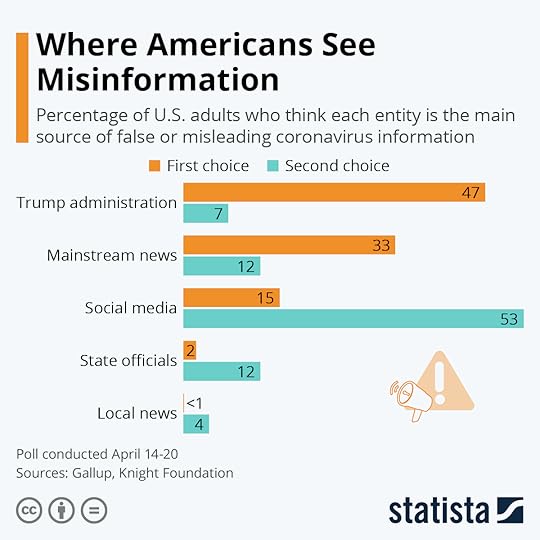 Source: https://www.statista.com/chart/21693/misinformation-on-covid-in-america/, accessed 5.13.2020.
April 17, 2020
Understanding correlation vs. causation and African American deaths from covid 19
Like many people, I’ve been spending a lot of time online lately, as I work from home and use the internet for both entertainment and information as well. Also like a lot of people, this means I’ve been on social media more than is likely healthy. I recently saw some Facebook friends discussing the fact that African Americans are contracting coronavirus and dying of covid 19 at far higher rates than white Americans. For example, I live close to Milwaukee, where officials are tracking the race of those who die of this virus, and they have found that as of the beginning of April, “African Americans made up almost half of Milwaukee County’s 945 cases and 81% of its 27 deaths in a county whose population is 26% black.”
This raises many legitimate questions about why this is happening. Unfortunately, there are various ways I’ve seen people misunderstand this information, from attributing it to some sort of genetic reason to blaming African Americans for engaging in behaviors that put themselves at risk.
This is a clear example of misunderstanding how correlation and causation are, and are not, related. When two things happen in close proximity to one another, one incidence might be influencing the other, but that isn’t necessarily the case. Tyler Vigen has put together charts showing funny examples of correlation that obviously don’t equal causation. My favorite is his chart showing a correlation between the number of movies Nicholas Cage appeared in between 1999 and 2009 and the number of swimming pool drownings in the U.S. Obviously, Cage isn’t causing people to drown themselves by making movies, no matter how bad some of them might be. Instead, this is just an example of a correlation between different things that actually don’t affect one another at all.
However, sometimes correlations provide useful information, if analyzed carefully. This is certainly the case for the number of African Americans contracting coronavirus and dying of covid 19, but it has nothing to do with genetics. Instead, due to a long history of oppression, African Americans are less likely to have the sort of professional jobs that allow working from home. If fact, only 1 in 5 black Americans can work from home, and only 1 in 6 Hispanic Americans. Black Americans also are less likely to own a car than white Americans, meaning they’re more likely to be forced to use the public transportation that puts people at greater chance of exposure to the coronavirus than white Americans, are less likely to have paid sick leave allowing them to stay at home should they have been exposed to the virus, and are less likely to have medical insurance than white Americans.
This last factor is unique to the United States among all wealthy nations, and is particularly a problem. Coupled with the fact that black Americans are more likely to live in poverty than their white counterparts and you have the basis for a very serious problem. Poor Americans eat worse and exercise less than others, leading to health problems such as heart disease, diabetes, and other chronic health conditions, and even if they have health insurance, are less likely to receive basic preventative care due to the prevalence of expensive deductibles in the U.S.
The end result of all this is that African Americans are more likely to be exposed to the coronavirus and more likely to have underlying health problems that can lead one to die from covid 19. They’re also less likely to be in a position to seek medical help at the first onset of symptoms, leading to higher death rates as well.
In short, it’s not genetics or simple cultural factors that’s killing African Americans– it’s oppression and systemic racism that’s contributing to the disparities.
https://www.lhsfna.org/index.cfm/lifelines/july-2013/health-disparities-infographic/, accessed 4.17.2020
[image error]
April 6, 2020
Pastors who are coronavirus deniers–religion versus science?
Across the United States, there are pastors who deny the existence of the coronavirus and the disease it causes, Covid-19, reject the idea that this is a dangerous disease, or in other ways deny the scientific approach to understanding and reacting to this pandemic. For example, Rodney Howard-Browne has called Covid-19 a “phantom plague,” former Alabama State Supreme Court Chief Justice and failed Senate candidate, Roy Moore, has told pastors they have a “duty to continue church assemblies, even in the midst of these trying times,” while the Texas-based pastor Kenneth Copeland has called the Covid-19 a “weak strain of the flu” and stated that only those who fear the virus have anything to worry about, because “fear is a magnet for sickness and disease … You are giving the devil a pathway to your body.” All of these men have continued to hold religious services, at times to packed houses of congregants, many of whom are elderly and in high-risk groups for dying from this disease.
It’s easy to sneer at these people, and use them as examples of the presumed incompatibility between religion and science. And derision is certainly the appropriate reaction to these men, who endanger not only themselves and their families, but also those who listen to them and the communities in which they live as well. From an ethical standpoint, these men share a considerable measure of blame for anyone who is sickened or dies due to listening to to their message, or who simply has the bad fortune of coming into contact with such people.
However, this isn’t an example of religion, or the Christian faith more specifically, versus science. First of all, as vocal and visible as these men are, they are in the minority. Pope Francis has warned against a “viral genocide” if political leaders put concerns for the economy ahead of care of their people, the Episcopal church put a stop to much global travel by episcopal leaders as far back as February of 2020 due to concerns about the coronavirus, and the leaders of the Presbyterian Church (U.S.A.) issued an eloquent call to ministers and other religious leaders to “demonstrate that they are taking seriously the facts of the situation and keeping the best interests of the community in mind. At the same time, they can model a response that is faithful, gracious and wise — trusting God in all things, remaining calm in a time of distress, extending compassion to those who are suffering, and praying for the healing of the world.” In short, the vast majority of American Christians, and Christians around the world for that matter, have taken both this pandemic and their responsibility for protecting their flock seriously.
If most Christians take a rational, evidence-based approach to understanding and dealing with the coronavirus pandemic, then there must be some other motivation driving those pastors who reject the science. The answer lies in the same reason these men reject such scientific ideas as evolution by natural selection and the so-called Big Bang Theory: a concern about modernity. For example, men such as Rodney Howard Brown have demonstrated an intense fear of government at every level, stating that the World Health Organization has generated the fear of this pandemic as a false-flag operation in order to enforce vaccinations that will kill millions and allow the expansion of a singular world government. While such statements might sound laughable to many, this is a concern generated by a combination of observing the omnipresence of government that is a hallmark of modern society coupled with the rejection of all reputable forms of media, which itself has resulted from many decades of attacks on the media by those who don’t want their agendas questioned.
There are many ways such pastors reject modernity. The mega-church pastor John MacArthur typifies this rejection of modernity, for example, by promoting the idea that women belong in the home rather than the workplace- a view that dovetails nicely with his rejection of the right of women to have autonomy over their bodies– while gathering pastors together for an in-person Shepherds’ Conference in spite of the danger of the pandemic, where one pastor caught the virus that would later kill him. However, while there is a strong correlation between those who reject modernity in American and adherence to Christianity, this is a prime example of where we should be careful about correlation and causation. Pastors might reject modernity for many reasons, such as a fear that allowing women to preach will somehow diminish their own authority, and explain this rejection in religious terms, but that doesn’t mean their rejection is caused by their religious beliefs.
I discuss these issues at length in chapter 7 of my book, Gods, Philosophers, and Scientists: Religion and Science in the West, and I’m reminded of Thomas Aquinas’ stance on perceived conflicts between reasoned evaluations of the world and religious beliefs. If such a conflict appears to exist, according to Aquinas, then the person perceiving the conflict has made an error. The Thomistic view of religion and science, then, is that there can be no conflict between these ways of knowing. After all, if one believes that God created the universe, and imbued humans with reason, then why would one believe that a reasoned analysis of the universe would conflict with religious beliefs? Furthermore, Aquinas would hold that those of faith who reject a reasoned view of the world are, in effect, rejecting God by denying the fundamental element God imbued humans with that distinguishes them from other animals.
For all these reasons, whether a person holds or does not hold a religious faith, I would argue that it’s neither useful nor coherent to attack “religion” when they see people of faith attack scientific positions, even if their attack is one that puts people in danger. Instead, we should strive to increase scientific literacy and break down the barriers to understanding the world, and accepting the modern world, that have been put in place through decades of striving by misguided people.
 Linsly-Chittenden Hall, Yale University
April 3, 2020
Can history help us understand anything about the coronavirus pandemic?
I’m a historian, and as such, I’ve spent a lot of time learning what people think of as historical facts and even more time thinking about why we think of these things as facts, what that means, and what the past might mean to us. Therefore it’s no surprise that as this current world historical event, the coronavirus pandemic, emerged I viewed it in historical terms. I thought about what it might mean for the future, but also what the past has to teach us about this event. For example, there’s the question of just how concerned we should be. Does this pandemic represent an existential threat to the people living through this event, to human civilization, or even to things such as the economy? Based on what history teaches me about these things, we should be very worried and take appropriate action. However, this pandemic, like so many that have come before, will not destroy our civilization or even our economy, so long as our responses are rationally thought through and managed.
As I first learned of this new pandemic, one of the things to leap out at me was that this is a zoonotic illness that only recently made the jump to humans. This is a really, really big deal, because it means human bodies have no defenses against the disease. This has happened many times before, where an illness that affected animals made the leap to humans, and every time the result has been devastating.
For example, in the sixth century a plague ravaged the Byzantine Empire. We’re not sure exactly what this plague, known as the Plague of Justinian after the Emperor Justinian (r.527-565), was, though smallpox is one of the top possibilities. What we do know is that this plague tore through the empire, killing many millions before its initial wave finally burned itself out. But as bad as things were, life continued in the empire. Not only that, but Justinian managed to continue waging a massive war against the Gothic peoples of the West in a vain effort to regain control of the entirety of what had been the Roman Empire. Sure, the plague weakened the empire. Millions died and the economy staggered. But it certainly didn’t end the empire.
Better-known than Justinian’s Plague is the Black Death that ravaged the world, starting in what is now Mongolia and China in the 1330s before making its way westward into Europe and across what is now Russia in the 1340s. For a long time historians debated and discussed what this plague might have been, but the most likely candidate was always that it was the Bubonic Plague caused by the bacterium Yersinia pestis, and while that’s likely the case, it’s still not confirmed. But what we do know is that this plague was truly a monstrous killer, and it had all the hallmarks of a zoonotic illness making the leap to humans. In its first wave, from 1345 to 1351, it killed roughly 1/3 of the population of Europe, and it continued to recur, though in less deadly waves, until 1666. In some places, particularly in crowded cities, it wiped out half the population.
This plague was very bad. It disrupted normal family life and social practices, killing so many that it was impossible to bury them in the traditional fashion in most places. Furthermore, terrified people sometimes committed horrible acts. Some accused Jews of poisoning wells and otherwise spreading the disease: “some 300 Jewish communities were destroyed in the mass hysteria associated with the plague.” And they weren’t the only ones, as any marginalized group could suffer from the irrational fear the plague wrought. Lepers, those who didn’t ascribe to the dominant Catholic beliefs and who were thus branded heretic, beggars, those women who gave out magical cures--anyone who didn’t fit into the mold of what passed for “normal” society.
However, what the plague didn’t do is to undo society or destroy civilization. Yes, many people didn’t receive the individualized burials Christians and Jews valued, but bodies were buried, people continued to marry and have children, and society continued to function. The economy didn’t crumble, and governments continued to chug along. Thus, one of the most powerful lessons I’ve learned from history that’s applicable to our current crisis is that we will make it through this pandemic. We should listen to the scientific and medical experts, and the impact of the plague can be greatly mitigated by individual, group, and government action. But above all, we cannot succumb to fear. There are too many signs of incipient panic visible in the United States and elsewhere, from panic buying of toilet paper and guns and ammunition to acts of violence against marginalized groups.
It is this latter, darker element of the human psyche that makes me as concerned about the panic some people are feeling as I am about the plague itself. History teaches that the impact of this plague is going to get worse before it gets better. It’s likely to recur in seasonal cycles, and while it won’t kill the millions the Black Death did–modern populations are healthier, medical science is better, and Covid-19 simply isn’t as deadly as these previous plagues–there won’t be a vaccine for a while yet, and there’s no guarantee about the effectiveness of the vaccine when it becomes available.
Therefore, stay calm, wash your hands, practice social distancing to the extent you’re capable of doing so, help your neighbors, don’t panic, and don’t spread alarmist, unsubstantiated information. It’s not good for people’s mental well being, and it can well lead to violence against minorities and marginalized groups.
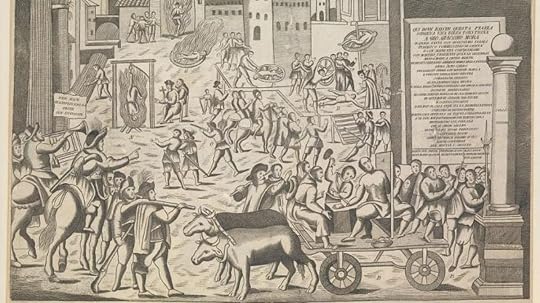 Drawing of the Great Plague in Milan. (Credit: Fine Art Images/Heritage Images/Getty Images)
March 15, 2020
Religion and Science often complement one another, even in the modern world.
While many people in the modern world see science as having supplanted religion, not all agree. In times of crisis, many people feel they need both. As D. J. Jenkins, the pastor at Anthology Church in Studio City, CA–who also happens to have a degree in biology–notes: ‘“Science is a wonderful arena of truth and understanding truth. It is an amazing tool that can help human flourishing. We just believe it can’t address all truth that exists.”
As the evolutionary biologist, Stephen J. Gould, noted, science and religion are non-overlapping and deal with different domains of knowledge. While there are some problems in the way he viewed religion’s role in understanding the world, he is essentially right. Religion has nothing at all to say about the physical process of how to deal with a threat such as Covid-19, but science has little if anything to say about how to deal with the psychic stress this pandemic is causing. For that, some will legitimately turn to prayer. Others may appeal to meditation or philosophical analysis.
This doesn’t mean to say that science can’t be effective in treating mental health conditions caused by this pandemic. Disciplines such as psychology and psychiatry, or even medications provided by a general practitioner for depression and anxiety, are all important. But those approaches deal with health problems, and don’t answer important “why questions” about the pandemic that can help people deal with this issue in a long-term sense.
In short, religion, philosophy, and disciplines such as meditation and yoga, are still very much needed in our modern world.
February 15, 2020
Discussing science and religion
On the most recent episode of Blog Talk radio with Lawrence Knorr, we discussed the historical relationship between religion and science. It’s clear that many people care about this topic, but misinformation abounds. To learn more, listen to our discussion.
December 28, 2019
Basic scientific literacy-what is a theory?
One of the reasons why so many people fall into denying established science, whether in regards to evolution, climate change, or vaccinations, is because they lack basic scientific literacy. For example, as Olga Khazan reports, “in 2017, a Utah school-board member […] suggested “maybe just teaching theory and letting both sides of the argument come out—whether it’s intelligent design or the Darwin origin.” This is the sort of statement that indicates an absence of basic scientific literacy, due to a failure to understand what a theory is. Rather than an educated guess, a theory is comprehensive, predictive, and based on a considerable amount of testable–and tested–hypotheses, all of which have survived repeated efforts to prove or falsify them. Intelligent design fails to rise to this standard on a number of grounds. While it is comprehensive, it’s not predictive. What sort of predictions can one make about the idea that an intelligent designer has, well, designed the universe and all that’s in it? Nor is that idea testable. How would you test the existence of an intelligent designer? And you certainly can’t falsify the notion of an intelligent designer, since how could you possible prove that such a designer doesn’t exist?
It’s perfectly fine to believe in an intelligent designer as a religious belief. Most scientists in the United States are people of faith, who believe in a deity who is just such a designer. But they believe in that deity as an act of faith, not as an element of a scientific theory. Faith is powerful, and it’s certainly compatible with scientific reasoning, but faith is not scientific. For more about what a scientific theory actually is, this website provides a good overview.
Thoughts about religion and science
I’ve been teaching for more than twenty years, and I’ve studied the history of ideas for far longer. When I started teaching my course on “The History and Philosophy of Science” I wasn’t surprised to learn that most of my students thought religion and science have always been in conflict. This is, after all, what I believed well into my 20s, and it’s what public intellectuals such as Neil deGrasse Tyson, Richard Dawkins, and a host of others tell people. But is it true? That was the question I sought to answer in my most recent book. Spoiler alert! It’s a lot more complicated than that. By examining the historical record from the time of the Ancient Greeks to today, readers are able to see that religion and science have been allies more often than enemies, and when conflict does occur it’s too simplistic to view it as coming from something inherent to either science or religion. Instead, as with the case of Greek philosophy or the reception of Darwinian evolution, complex social forces are to blame, and in cases such as the infamous one of Galileo’s conflict with the Catholic Church, clashing personalities are at least as important as those social forces.
For some people, the idea that religion (and for most Americans, this means Christianity) and science don’t conflict might raise eyebrows. After all, as Olga Khazan reported in The Atlantic about 60% of high school science teachers don’t discuss evolution at all. About 13% of those openly advocate the teaching of creationism or intelligent design. But is this really about religion? After all, the majority of the world’s Christians belong to groups such as the Catholic and Episcopalian churches that openly support the teaching of evolution. Even many prominent Baptist leaders such as Billy Graham have expressed support for evolutionary theory. Therefore, it seems there must be something more than simply religious belief driving opposition to this theory.
It might be instructive to consider what those who oppose the teaching of evolution have in common besides their religion. These are people who tend to favor what they refer to as “traditional” marriage and “traditional” family roles, who look back to the past for a model of how things should be now. In other words, those who oppose evolutionary theory are concerned about modernity in general, and this theory is just one of many aspects of modernity they oppose.
For anyone who wants to learn more about the historical relationship between religion and science in the West, or about the history of science in general along with an overview of the philosophy of science, all written for the average educated reader, have a look at Gods, Philosophers, and Scientists from the Oxford Southern Imprint of Sunbury Press.



.JPG)