Donald Friedman's Blog
February 20, 2026
MARTY SUPREME: A NEW GUISE FOR AN ANCIENT HATRED
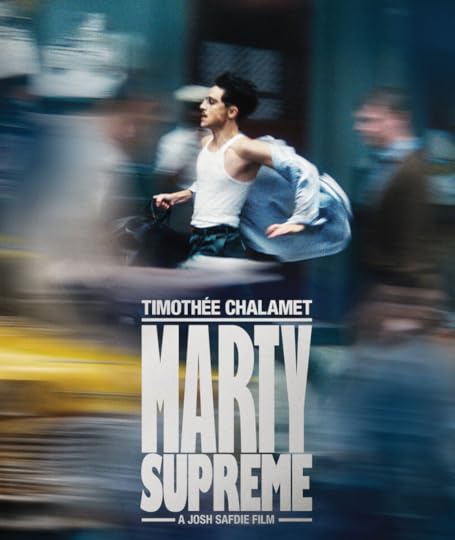
To foster antisemitism the medieval church arranged paintings and carvings depicting Jews being excreted by pigs. In Germany they were called “Juden Sau” or Jews sow. You can see them preserved in the choir stalls of Cologne Cathedral (1308) and in bas relief in the town church of Wittenberg (1305). Jews forced to ride or suckle from pigs was a popular theme not just in Germany but throughout Europe. Until the conclusion of Marty Supreme I could not have imagined the hateful humiliation being used to vilify a Jew in 2026.
Marty Mauser (from the German “Maus” for mouse—the way the murdered Jews of Europe are presented in Art Spiegelman’s brilliant graphic novel, “Maus”—the first of numerous borrowings by the scriptwriters) is a shallow, morally hollow narcissist who aspires to a world championship in ping-pong. The story is set in the 1950s with the Holocaust still fresh in the public consciousness. Contrast this with Budd Schulberg’s Sammy Glick character in “What Makes Sammy Run?” who made his appearance in 1941 before the mass exterminations were fully underway, but with the antisemitism of the 1930s, of Hitler and Henry Ford, on virulent display here and abroad. Like Sammy Glick, Marty Mauser seeks to escape the low class life of Brooklyn as Glick did from the Lower East Side, each with unconstrained ambition. Both characters are drawn to fit the trope of the Jew as pushy, manipulative, and unprincipled. Schulberg, himself a Jew, justified the stereotype by arguing that his goal was not to depict a Jew, qua Jew, but to expose the immorality of Hollywood and the unscrupulous means by which the powerful got there. Like Marty Mauser, Glick leaves a trail of ruined lives in his ascendant wake, but unlike Marty, who fails utterly, Glick achieves his dreams and becomes a mogul.
For unlike Glick, Marty is frankly too stupid to even consider the consequences of his actions. Or the effect of his words as when he, with gross insensitivity, off-handedly promises to do what Hitler couldn’t and finish off an opponent with a visible number on his arm. The movie amplifies the pushy and dishonest Jewish stereotype but omits the intelligence. Marty’s manipulations, his dissembling, are so transparent the viewer is continually marveling at the credulity of the supporting characters around him. Enduring two plus hours of this deeply boring, inch deep, amoral Marty is a struggle since at no point does he gain any kind of redemptive insight that would suggest characterological development. Indeed, Marty does not even prize growth and achievement in his selected sport but only the material benefits he imagines success in it will bring.
Also scrubbed from the story is anything that would reflect the true conditions for American Jews during this period: quotas at elite colleges and graduate schools; denial of corporate jobs; refusals of club memberships and even hotel rooms; implicit and explicit restrictions on home- buying with legally enforceable deed restrictions. Antisemitism was institutionalized, pervasive, and culturally accepted. Acknowledging any of this would not lessen the negative tropes used to shape Marty’s character, but it would have at least given him and us a social context in which to judge.
To compensate for giving us unlikeable uninteresting characters, the filmmakers distract us with a mess of non-actor celebrity cameos (“look that’s Kevin O’Leary—and there’s what’s his name, the basketball player, and isn’t that…”) and give us a frenetic plot—actually not so much a plot, as a series of random scenes contrived for maximum tension, but which do not advance the story line—they are simply incidental. (See “Run, Lola, Run” for freneticism with a point.) We are given Black and white guys hustling local rubes in case you missed “White Men Can’t Jump.” And then the revenge attack when they wake up (but without the thumb-breaking Fast Eddie had to endure in “The Hustler”) and the perps’ getaway after a gas station fire that comes out of nowhere.
The scenes are driven by anachronistic synth-pop music from the 1980s. Even a major subplot involving Marty’s seduction of Gweneth Paltrow’s washed up actress character has no point: neither his nor her motivation for the affair is clear. Nor the cops’ for arresting them for embracing in the park. And you will search in vain for credible motivations for most of the other characters. (Among the more ludicrous is a scene in which Marty’s uncle and former employer has paid a policeman friend to put the cuffs on Marty for taking money owed him out of the shop till—while admitting he has already recovered the amount of the missing money from Marty’s luggage. Since all’s square, the cuffs are taken off, the cop is handed cash for his services and a gratuitous line about how Jewish pastrami is superior to gentile roast beef; Marty is released from the state’s custody. But when he exits through a window, suddenly the cop and his partners give chase, for no reason other than it’s time for another chase.)
What we are presented as resolution of this misbegotten (if timely) work of antisemitism is the unearned, implied transformation of a low-life mouse into a full-grown mensch. The same Marty who exploited his friend’s wife in an adulterous relationship, and who, on learning she was pregnant, immediately denied the child was his, then proposed they give up, we see moved to tears at the mere sight of his newborn son. Maybe. But for anyone who’s read Alice Miller (or any number of other psychologists on the way narcissistic parents ruin their children) one can only be horrified at the thought of the life this kid will have.


April 11, 2025
DRAWING TRUTH TO POWER: MY LATEST INTERFACES ESSAY
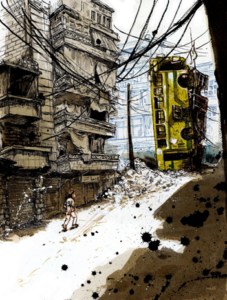
In the current copy of the now Open Edition INTERFACES, I write about the brilliant, popular originator of what Der Spiegel magazine dubbed “art-journalism,” Molly Crabapple, and using multiple examples, demonstrate how combining image and text enables her to convey truths with an immediacy and accessibility that neither can do alone.
You will learn how the synergy of Crabapple’s duple talents enables her to give a voice to the victimized, stigmatized, and oppressed–how she has sympathetically portrayed the Occupy Wall Street protesters, sex workers, taxi drivers whose lives were destroyed by predatory lenders, the tortured inmates of Guantanamo, the Syrian peoples warred upon by their own government, and the Ukrainians attacked by Russia.
Enjoy, and don’t miss my embedded 2024 video interview with her.
Click here to read the article.
https://journals.openedition.org/interfaces/9762
The post DRAWING TRUTH TO POWER: MY LATEST INTERFACES ESSAY appeared first on Donald Friedman.
January 22, 2025
Jules Feiffer: In Memoriam
Brilliant and creative to the last of his 95 years (January 26, 1929-January 17, 2025), author of 35-plus books, plays, and screenplays, winner of a Pulitzer Prize and an Academy Award, all of Feiffer’s work was infused with social and political satire of the highest order.
In this interview he acknowledges that his goal was no less than the overthrow of the government and that the technique he employed was to make complex ideas readily accessible and, like Fred Astaire’s dancing, make the difficult seem easy.
A staunch opponent of authoritarianism, he has been taken from us just as we need him the most.
The post Jules Feiffer: In Memoriam appeared first on Donald Friedman.
October 21, 2024
The Chip on Molly Crabapple’s Shoulder
In this July 2024 interview, the brilliant, popular originator of what Der Spiegel magazine dubbed “art-journalism,” Molly Crabapple explained that if she carried a chip on her shoulder it was not anger at some past injustice she suffered, but for other people.
Seeking to give a voice to victimized, stigmatized, and oppressed, Crabapple, has sympathetically portrayed the Occupy Wall Street protesters, sex workers, taxi drivers whose lives were destroyed by predatory lenders, the tortured inmates of Guantanamo, the Syrian peoples warred upon by their own government, and the Ukrainians attacked by Russia. Combining image and text enables her to convey truths with an immediacy and accessibility that neither can do alone.
Here, in this art-filled video, she narrates her first-hand experiences in war zones, with refugee children and struggling adults, as well as her observations on capturing beauty, the advantages of a pad and pen over a camera, and using art to earn a living as well as to circumvent censors.
The post The Chip on Molly Crabapple’s Shoulder appeared first on Donald Friedman.
July 26, 2024
My latest INTERFACES essay–a new art form

Voilá, the latest issue of INTERFACES, internationally renowned journal of text and image and my contribution to it–an extended essay on Frederic Tuten along with an on-camera interview with him. Note this is not the brief commentary previously posted but an expanded discussion of the prolific author Tuten, and his art, including a first-of-its-kind art in which separate but complementary words and images combine to create a new form. Enjoy it and the many fascinating takes on adaptations as they cross a variety of media.
51 | 2024I found Paris inside me – Frederic Tuten creates a new art formAnd check out The Writer’s Brush: Paintings, Drawings, and Sculpture by Writers for more than 400 plates of artwork by great writers and the stories behind them.
Connect with me on Twitter, Facebook, Google+, LinkedIn, Medium, YouTube, Goodreads , and please sign up for my blog ! You can purchase The Writer’s Brush and other books on Amazon here.
The post My latest INTERFACES essay–a new art form appeared first on Donald Friedman.
June 17, 2024
AN EDITOR’S PICK
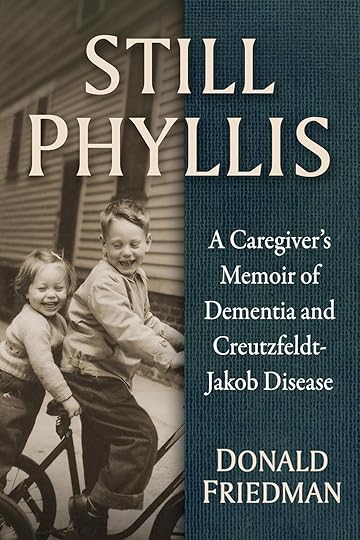

I am happy to report that Book Life selected Still Phyllis as an Editor’s Pick, saying:
“Incisive, moving, and stripped of sentimentality…scrupulous prose… Scenes of brother and sister still managing to understand each other despite the fraying of Phyllis’s capacity for language have rich power… That commitment to rigorous thinking and writing about life as it’s actually lived powers this first-rate memoir, an act of memory, empathy, and love. … Finely wrought, deeply human memoir of a sister’s neurodegenerative disorder.”―Book Life
All royalties from sales of Still Phyllis have been assigned to the Creutzfeldt-Jakob Disease Foundation
My sister Phyllis was a vital, single woman, a photographer and writer, who was enjoying life in the city when she was suddenly stricken by Creutzfeldt-Jakob Disease (CJD), a disease rarer than a lightning strike that spreads, incredibly, via a non-living molecule called a prion. Terrified to realize she couldn’t perform her duties at work, Phyllis very soon couldn’t even find her way to her desk or to her apartment from the corner store. Informed of her diagnosis with this dementing and always fatal illness, I, her estranged brother, her only living relative, brought her home (against the advice of her doctors) to care for her with my wife.
This memoir tells the profoundly affecting family drama that ensued. It is a story of reconciliation and of how, paradoxically, closeness can deepen when words are lost—a truth that I hope will inspire others with a friend or family member with dementia.
Buy the Book: Amazon, Barnes & Noble, Bookshop, Books-A-Million
All royalties from sales of Still Phyllis have been assigned to the Creutzfeldt-Jakob Disease Foundation
The post AN EDITOR’S PICK appeared first on Donald Friedman.
May 20, 2024
STILL PHYLLIS: A CAREGIVER’S MEMOIR

―William Kotzwinkle author of ET the Extraterrestrial and Felonious Monk
All royalties from sales of Still Phyllis have been assigned to the Creutzfeldt-Jakob Disease Foundation
My sister Phyllis was a vital, single woman, a photographer and writer, who was enjoying life in the city when she was suddenly stricken by Creutzfeldt-Jakob Disease (CJD), a disease rarer than a lightning strike that spreads, incredibly, via a non-living molecule called a prion. Terrified to realize she couldn’t perform her duties at work, Phyllis very soon couldn’t even find her way to her desk or to her apartment from the corner store. Informed of her diagnosis with this dementing and always fatal illness, I, her estranged brother, her only living relative, brought her home (against the advice of her doctors) to care for her with my wife.
This memoir tells the profoundly affecting family drama that ensued. It is a story of reconciliation and of how, paradoxically, closeness can deepen when words are lost—a truth that I hope will inspire others with a friend or family member with dementia.
Buy the Book: Amazon, Barnes & Noble, Bookshop, Books-A-Million
All royalties from sales of Still Phyllis have been assigned to the Creutzfeldt-Jakob Disease Foundation
The post STILL PHYLLIS: A CAREGIVER’S MEMOIR appeared first on Donald Friedman.
January 25, 2024
FREDERIC TUTEN FOUND A NEW JOY
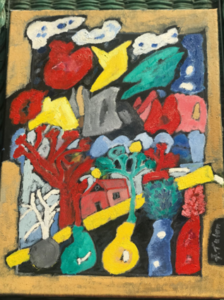
“At this time of my life–someone would say, the winter of my life, although I don’t feel cold,” Frederic Tuten, novelist, essayist, short story writer, and art critic, tells of finding a new joy in painting. “Practically no day passes where I’m not either writing and painting or painting and writing, whichever comes first in the morning.” And Tuten’s art is not merely avocational, but has been critically praised, reproduced in a 2022 book, On a Terrace in Tangiers, and is shown and sold through quality art galleries. Moreover, in Tangiers Tuten creates an entirely new kind of art in which the images are accompanied by stories. Uniquely, the images do not illustrate the stories, nor do the stories explain the art; rather, they synergistically produce a third reality–a set of emotions and perceptions in the reader/viewer that are different and deeper than either text or image could alone.
With his natural story-telling skills, in this 2023 interview Tuten tells how he went from adolescent fantasizing about being an artist in Paris to this late in life success. “At 15 I just thought I would go to Paris and somehow I’d meet some artists, and they would all sort of like take me in as a fellow artist and I would get a little place maybe like in the film ‘American in Paris,’ a little atelier up above a cafe, and I’ll meet a great-looking beautiful woman like Leslie Caron in the film, and then she’ll become my girlfriend and my model.” After a failed attempt at figure drawing at the Art Students’ League he turned his focus to fiction writing–but also to reviewing contemporary art shows in the U.S. and abroad for the New York Times and leading art magazines.
Today, it is Tuten’s art that is being shown and reviewed: “Not thinking about anything except the sheer pleasure of making the work, Tuten forges wondrous paths…(that) inspire us to be just as spirited and creative and capricious as the artist,” wrote Ida Panicelli in ARTFORUM. An example:
Enjoy many more in this video interview, and especially the story of how Tuten, having worked up the courage to show some early efforts to his friend, famed artist Roy Lichtenstein, got the encouragement he needed to persist, to transform himself from amateur to professional, to achieve his goal of making pictures that would give others pleasure.
Please check out The Writer’s Brush: Paintings, Drawings, and Sculpture by Writers for more than 400 plates of artwork by great writers and the stories behind them.
Connect with me on Twitter, Facebook, Google+, LinkedIn, Medium, YouTube, Goodreads , and please sign up for my blog ! You can purchase The Writer’s Brush and other books on Amazon here.

The post FREDERIC TUTEN FOUND A NEW JOY appeared first on Donald Friedman.
April 3, 2023
WHY IS THIS NIGHT DIFFERENT FROM ALL OTHER NIGHTS? PASSOVER 2023
Why is this night of Passover,2023, different from all other nights?
Because this celebration of the Exodus, a symbol to peoples everywhere—Jews and Christians alike–who’ve won the hard fight for freedom, is being overshadowed in Israel itself by a group of democracy-suppressing, racist, and violent Jews.
Because, after centuries of Seders, of praying for return to a Jewish homeland, Israel and all that it was meant to symbolize is being destroyed—not by the increasingly antisemitic world, but by the Jewish citizens of Israel themselves.
Because the dream of Israel as a light unto the nations, a democratic state embodying the Jewish principle that each of us has an obligation to, and must have compassion for, others—Hillel’s lesson that Jesus took to heart and made a foundation of Christianity—is in danger of being extinguished. It is the principle that evoked the murderous hatred of Hitler whose opposing belief was that the world belongs to those with the power to seize it.
The betrayal of this principle is found in the attempted disempowerment of Israel’s Supreme Court by Netanyahu and Itamar Ben-Gvir, momentarily halted by massive opposition. But there is also a terrible threat in the effort to create a policing force to address internal disorder, to be run by Ben-Gvir, the same Ben-Gvir who was convicted in 2006 of supporting a terrorist organization and inciting racism, the Ben-Gvir who openly advocates shooting demonstrators, expelling Arab citizens, and who has supported settler pogroms.
In this he seems to have taken a page from Hitler’s tactic in the 1930s. after his conviction and imprisonment for a failed coup in Bavaria. To initiate his agenda, Hitler created a paramilitary wing within his Nazi party, to protect its rallies, to disrupt the meetings of the opposition, and intimidate trade unionists and most especially Jews. It was called the Sturmabteilung, also known as the SA, but more informally as the Brownshirts for the color of their uniforms. It was this huge group of thugs that gets the credit for Kristallnacht, when virtually all of Germany’s 200 synagogues were destroyed, along with more than 7,000 Jewish stores, a number of Jews were beaten to death, and 30,000 Jewish men were arrested and removed to concentration camps.
If Itamar Ben-Gvir were given command of a National Guard, he could and likely would employ it as his own private militia—his own Kahanist/Proud Boys/Oath Keepers/Boogaloo Boys band—fully armed and militarized, but with the sanction of the state—giving him the unbridled ability to attack the Arab minority, and progressive secular Jews as well.
Yesterday, the New York Times reports, the government agreed to move forward with Ben-Gvir’s National Guard, as it was his demand for supporting Netanyahu’s plan to destroy the independent judiciary and abort his trial for corruption.
This night, this Passover, is different from all others, because when it concludes with the ancient cry, “Next year in Jerusalem,” we will need to consider deeply what we might get were that wish granted. .
The post WHY IS THIS NIGHT DIFFERENT FROM ALL OTHER NIGHTS? PASSOVER 2023 appeared first on Donald Friedman.
March 28, 2023
RALPH STEADMAN: “GENIUSES ARE REALLY LOSERS WHO TRY HARDER.”
The genius of Ralph Steadman can be found in the more than 50 books he’s written or illustrated (or both written and illustrated), in his famous partnership with Hunter Thompson and the creation of Gonzo journalism—the two not just covering a story but becoming it. “Bats over Barstow,” reproduced here, is one of his drawings from Fear and Loathing in Las Vegas.
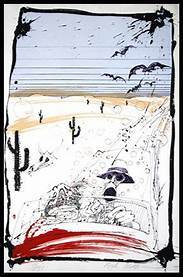
Steadman’s creative brilliance shines in the lyrics he wrote for Richard Harvey’s oratorio Plague and the Moonflower, in the songs he’s written and recorded, and in a wide range of artistic expressions–from beer bottle labels, to British postage stamps, to diverse theater sets, including one for the Royal Opera House production of a ballet of The Crucible. But most of all, Steadman’s genius is manifested in his scathing, scurrilous, occasionally scatological, always over the top, visual assaults on corrupt, authoritarian, and stupid politicians, and in his protest of social unfairness.
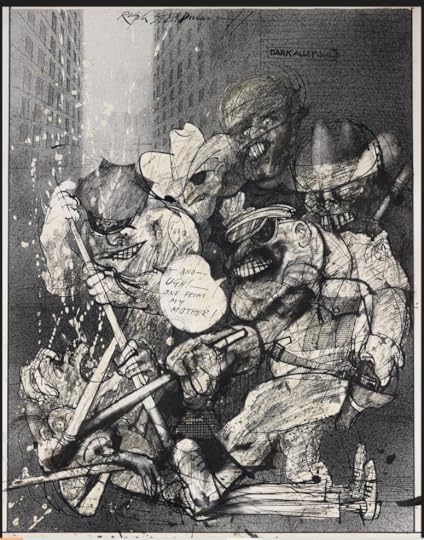
You may be as surprised as I was to discover when I had the privilege of interviewing this savage satirist, that Ralph Steadman is a gentle, soft-spoken, utterly decent man. Less surprising were his observations and insights into the horrors of America and what he calls its “screaming lifestyle.” Consider this prescient 1975 drawing of a mob of police beating some poor soul–a scene that is sadly ubiquitous across the country nearly half century later:
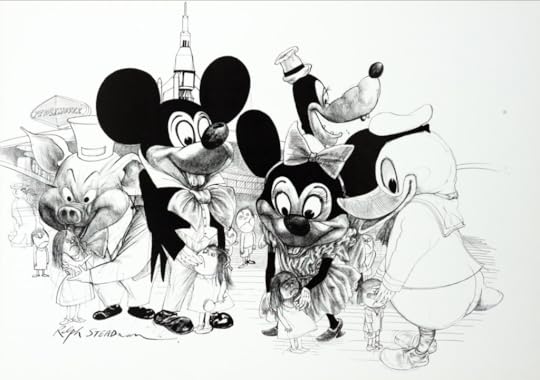
Or how, with subtle alteration, he exposes a hidden malevolence–specifically the corporate greed and manipulation behind the oversized, ostensibly benign and child-beloved cartoon figures at Disneyland. From their unhappy faces, the kids, unlike their dollar-drained parents, are not taken in.
Enjoy many more examples of Steadman’s art in this video interview, and especially the story of how the boy Steadman, inspired by a fifty cent used copy of Leonardo Da Vinci’s notebooks, was able through hard work and “taking pains,” to turn early failure into great success.
Please check out The Writer’s Brush: Paintings, Drawings, and Sculpture by Writers for more than 400 plates of artwork by great writers and the stories behind them.
Connect with me on Twitter, Facebook, Google+, LinkedIn, Medium, YouTube, Goodreads , and please sign up for my blog ! You can purchase The Writer’s Brush and other books on Amazon here.
The post RALPH STEADMAN: “GENIUSES ARE REALLY LOSERS WHO TRY HARDER.” appeared first on Donald Friedman.