
Elizabeth Stewart's Blog
April 21, 2026
Californio Braided Brooches
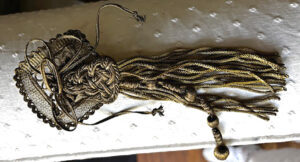 EC inherited a Bible from her mom. It belonged to Isabel Robbins Carrillo (1845-1914), a lady from one of Santa Barbara’s most distinguished families. Along with the Bible she found two brooches. EC wondered if the brooches dated from the Californio period (1769-1846). Our area transitioned from the Spanish Period (1769-1821) to Mexican Rule (1821-1846). After the Mexican American War (1848) the Californio Ranchos fell in decline, as did the clothing styles of the Californios. The braided brooch is in a European style of the 1850-1860s and the “button” brooch is in a later style of 1880-1890s.
The Castillo family became known in the Californio period as cattle ranchers, and hide and tallow traders. Renowned for their horsemanship and hospitality, trademarks of the Californio way of life. The clothing of the period is also distinctive, a Spanish flair, reminiscent of folk styles of the 18th century. Conversely, the style of these brooches places them in the later part of the 19th century perhaps not within the traditional Californio era.
A European FlairMatching the dates of her life to the style of the braided brooch, it’s possible the braided brooch belonged to Isabel Robbins Carrillo’s grandmother Maria Josefa Raymundo de Castro (1792-1853) or her mother Maria de la Encarnacion Carrillo (1814-1876). If either woman wore such a piece in the mid-19th century, she’d dress in the Continental style with a European flair. The brooch adding a slightly masculine, almost military flavor.
From the European Continent regimental uniforms came the braided metallic silk corded style of the braided brooch. That braiding also serves as a signature of both Spanish and French clothing. I estimate the brooch to date from 1850-1860. Women wore these at the collar of a shirtwaist, and the lightweight braid made them wearable on cotton fabric. The style in the last half of the 1800s trended to full skirts, tight bodices, small, belted waists. It included decorative features of braiding, ruffles, ribbons, with brooches worn at the collar.
By the last half of the 19th century, exotic Spanish styles and the romance of Spain as interpreted in clothing, and architecture, became fashionable. I studied the costumes of the famed Spanish dancer who made Spanish clothing a worldwide style. The courtesan and eventual mistress of King Ludwig I of Bavaria, the controversial Lola Montez, wore such a braided brooch circa 1850-60.
She Wore Braided BroochesLola chose Spain. She wasn’t born in Spain, nor Alta Californio, but in County Sligo, Connacht, Ireland in 1818 as Eliza Rosanna Gilbert. She made her debut as a Spanish dancer in 1843 in London, Paris, and Warsaw. Lola dressed in the Spanish style, and wore braided metal brooches to fasten a velvet cloak. Her stage presence was anything but the demur Californio matron. Lola performed in San Francisco in 1853. Her Spanish dancing career declined, along with her advancing age. She married a local newspaper reporter and retired to Grass Valley CA.
The tradition of braided metal broches, metallic mesh thread woven on a support of silk threading, dates to French and Spanish military (regimental) jackets of the 18th century. I found such an embellished braid in the collection of the MET Costume Institute, as a textile trim. The MET also owns an example in their collection of a metal tassel watch fob, made of 10K gold thread, which, like our example, is blackened with oxidation. By the late 19th century “tassel” brooches became popular made of gold, rolled or plated gold and lesser valued wirework in imitation of the metallic thread brooches worn in the previous years, by both women and men as a military flourish. When 10K or 14K gold tassel brooches added black enameling, these were worn as mourning brooches, especially as made popular in England after the death of Prince Albert (1861).
EC’s “button” brooch, more feminine and lacier, with a sentimental design of flowers, dates from the last years of 1900, a glass button with an reserve engraved and painted sweetheart design. The sweetness of the style places it later than the more structured metallic wire tassel brooch.
Is the tassel brooch a Californio brooch?In that era finery was “imported” from the East Coast, so we cannot be sure it was made expressly for the Californio clothing style. Was it worn by a member of a noted Californio family? YES. Because of this fact, the value is in the category called irreplaceable
The post Californio Braided Brooches first appeared on Elizabeth Appraisals.
The post Californio Braided Brooches appeared first on Elizabeth Appraisals.


April 19, 2026
Santa Barbara Mission Archive-Library
Father Jack Clark Robinson, OFM, PhD talks about the Santa Barbara Mission Archive Library.
Watch Video

The post Santa Barbara Mission Archive-Library first appeared on Elizabeth Appraisals.
The post Santa Barbara Mission Archive-Library appeared first on Elizabeth Appraisals.
April 14, 2026
Rediscovery of the Warwick Vase
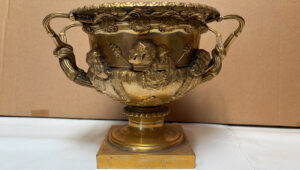 PP sent me a large drinking vessel, a replica of the Warwick Vase. Collected in the early 20th century on a 19th century grand tour. Wealthy young men on their lively bachelor tours of Europe collected classical bronze works of art. They brought back decorative objects as trophies, along with the usual portrait painted of that handsome rich young traveler by an eminent Italian artist.
I believe this bronze gilded vessel is French, likely from the era of Napoleon III (1860-80), likely collected on the continent. No sculptor’s mark nor foundry mark appears on it. But I did see a number etched in to the metal of the base verso. This shows someone cataloged it for their personal collection. Although not English, blue bloods in 18th and 19th century England coveted this style.
Yes, I Called This A Drinking VesselInspired by the first Roman god of the vine, Greek Dionysus/Roman Bacchus. The Bacchic motifs seen on the vase are masks of Dionysus, leopard and lion pelmets (Dionysus’ sacred felines), and vines, bodies covered in vines, and handles of intertwining wine branches. The rod that crosses the front between the masks is the Thyrus, the emblem of the god, a staff topped with what appears like a pine cone. If you look close you see the presentation of phalli, also found in many cities that honored the god.
Dionysus/Bacchus himself would feel proud of this bronze punch bowl. He himself collected drinking vessels, bringing back a silver goblet from his conquest of India. There was always something foreign about this god, and something feminine. However, nothing feminine, so they say, about the first owner of this archetypal first century marble drinking vase or punch bowl, the first Emperor to sport a beard, Roman Emperor Hadrian (100AD).
The Glasgow Museum in Scotland houses the original, rare, marble vessel, called the Warwick Vase, a treasure almost eight feet high. Scottish Neo-Classical painter, archeologist, and savvy dealer of Greek and Roman antiquities Gavin Hamilton (1723-1798) found the vessel in fragments. He discovered it in 1769–1770, while excavating in the silts of Lake Pantanello on the grounds of the Villa Tiburtina. The villa of the Roman Emperor Hadrian (117 to 138) stands outside Rome. The vase, likely created in ancient Tivoli, Italy, adorned the villa gardens. A monumental marble sculpture in the form of a two-handled drinking cup decorated with masks and motifs relating to the cult of the Roman god of wine, Bacchus/Dionysos. George Greville, Earl of Warwick, bought the vas for the courtyard of Warwick Castle. It stood there almost two centuries until the Scottish Heritage Association purchased it for The Burrell Collection in 1979.
An Ultra-Sexy GodFrom the 18th century onwards the rediscovery of the Warwick Vase provided a major source of inspiration for the Neo-Classical school in the decorative arts in Britain. It bridged the millennia between Classical Antiquity and 18th century taste in Britian and Europe. Look at Dionysus’ laughing face placed around the vessel, offering wine, song, dance, and debauchery.
Dionysus/Bacchus was slightly foreign, slightly androgynous, ultra-sexy god of theatre, panthers, donkeys, and goats. Also the god of regeneration and vegetation, pleasure, madness and collective ecstasy. His cult was a Mystery Cult. Only the initiated participated in rituals, which involved days of revels, mainly carried out by females. Dionysus/Bacchus cults practiced sexual liberation. The god himself participated in both heterosexual and homosexual relations. His favorite boy being Ampelos, who died riding a wild bull. The god transformed him into a vine and a constellation in the sky, making him immortal, writes Ovid, the Roman poet, born 43 BC.
Examples of objects from antiquity featuring Dionysius/Bacchus were found in India, Serbia, Greece, and Italy. The god is represented in many forms, none more famous that the Warwick Vase. PP’s bronze is a late 19th century copy, not in marble, like the original. But cast in bronze with gold overlay gilding. Sotheby’s sold one very similar for $2,700 in November 2012. Since this is an older comparable sale, I estimate the value of the bronze at $3,000 today.
The post Rediscovery of the Warwick Vase first appeared on Elizabeth Appraisals.
The post Rediscovery of the Warwick Vase appeared first on Elizabeth Appraisals.
April 7, 2026
Another Wedding Basket This One From China
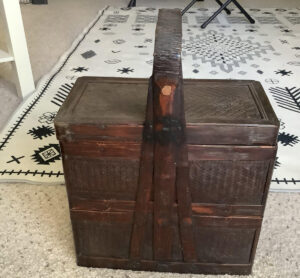 JW owns a Chinese rattan two-tiered tall rectangular basket circa 1900. She wrote me because of my previous article about a Victorian Bride’s Baskets. Her Chinese basket is ALSO a bride’s basket traditionally given in the Guo Da Li pre-wedding processional during the betrothal period. A gift from the groom’s family to the bride’s family, this tradition emerged in the early 1900s. The baskets became a popular export from China to England and the US from 1880-1930s, advertised as tea or sewing baskets from Canton.
In the 19th century the composition of the basket showed the financial status of the groom’s family. The festive delivery of the basket to the bride’s family indicated respect. Don’t confuse wedding baskets with fine Chinese lunch baskets, which usually have a layer of insulation inside. The baskets symbolized the bride’s transition into her new family, as she will soon move into her husband’s family home, serve his parents, honor his ancestors, become a member of his household and his relative’s households, in the patrilinear tradition. The third day after the wedding, the bride and groom return to the bride’s home where she’s treated as a guest, signifying a break with her natal family. Thus the wedding basket festival became a happy-sad event.
One of the Traditional Styles of Wedding BasketsJW’s basket is hand woven rattan with a bamboo structure and arched handle wrapped with rattan. It’s about eighteen inches high in two parts: each, a rectangular container, with a lid on top. A family of minor means gave this basket. A wealthier family might offer the bride’s family a basket made of Shandong Elm, of a box shape of two squares. Or a bamboo tub shaped basket with a band of auspicious enameled flowers and dragons around the girdle. The finest came with calligraphy of the names of the families and poems for both good wishes and many offspring. The best baskets were completely lacquered (bakul siah) in tones of amber and red, red considered a lucky color.
Baskets contained gifts, but not just any gift. Objects carried in these baskets symbolized the couple’s future lives together. The first category of gifts contained dowry items: food, jewelry, and clothing. A procession complete with music might carry more than one of these baskets. From a family with money, a second basket might contain special objects of red: wine, packets of red containing coconut, or dragon or phoenix shaped candles. Accents of red and gold symbolize wealth, beauty, and good beginnings. The Four Treasures often found their way into these baskets: gold, dried fruit, dried seafood, pig’s feet, abalone for abundance and wealth, fat choy for prosperity and good fortune.
The creators in 1900 might paint a basket like JW’s or accented it with live peony beds and blooms symbolizing fertility and prosperity.
Tradition of Gifting Pre-Wedding Baskets Strong TodayGift Hampers Hong Kong creates lavish wedding baskets, “Chinese Pre Wedding Hampers” filled with symbolic favors. Any well-wisher may present baskets not specifically from the groom’s family to the bride‘s family.
The correct contents recommended by Gift Hampers Hong Kong for modern-day Wedding Hampers include lucky fruits, such as jujubes for wealth prosperity and fertility, peanuts for health, longevity, life, growth, flourishing love, and mandarin oranges for wealth and prosperity, or longans for good luck, including lotus seeds for prosperity and offspring, and grapes, but only those that contain seeds, as seeds bring prosperity and offspring.
Painted features include dragon and phoenix images for a fruitful and loving marriage, successful endeavors, and offspring. Well-wishers order a four, siz, or eight hamper package for the prewedding Guo Da Li ceremony. The four hamper package includes gourmet delicacies, wine, gifts, fruit and golden coconut. All packages contain Hang Heung, the Chinese Bridal cake. Well-wishers order six or eight hampers of dried seafood and six to eight hampers of dried and fresh fruit. The most expensive series of eight hampers costs $1,800.
JW’s vintage 1900 wedding basket contained simpler contents. Afterwards, the couple kept the basket during their marriage in the home. Today it’s valued at $400.
The post Another Wedding Basket This One From China first appeared on Elizabeth Appraisals.
The post Another Wedding Basket This One From China appeared first on Elizabeth Appraisals.
April 5, 2026
C.J. Cook on the South Pacific
Author and historian C.J. Cook talks about his collection of art from the South Pacific.
Watch Video

The post C.J. Cook on the South Pacific first appeared on Elizabeth Appraisals.
The post C.J. Cook on the South Pacific appeared first on Elizabeth Appraisals.
March 31, 2026
Portrait of Male face Composed of Nude Women
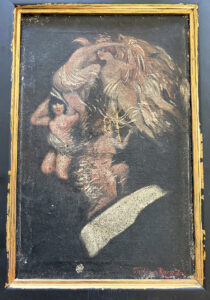 DD sent me this strange portrait of a male face in profile composed of writhing nude bodies. I KNEW I’d seen this technique before: a mélange of nude women arranged to form a head, a skull, a profile. But WHERE?
In the work of Salvidor Dali of course. In his In Voluptas Mors (Voluptuous Death) he collaborated with Philippe Halsman for a photo arrangement. They stacked and arranged a group of naked females to form a skull with orbital openings, nose, and teeth. Dali and Halsman met in 1941 and collaborated for thirty years. Voluptuous Death shows Dali at the front of the composed photo, in top hat and tails, a circus ringmaster gesturing towards the death-head of full sized female bodies. Dali painted in this style of bodies IN bodies, such as The Face of War, the eyes and mouth of skulls full of skulls like so many marbles. Marvelous, in a style called both surrealism and anamorphic.
I didn’t find the artist who signed DD’s work. He may have been an amateur that happened to discover this anamorphic style. I wonder if he experienced the paintings of Giuseppe Arcimboldo (1526-1593) who not only composed portrait faces from naked bodies, but portraits from fruits and flowers, plants, vegetables, books, animals and sea creatures.
Cabinets of WonderConsidered the first surrealist before the term became known, Arcimboldo emerged in the 16th century when the wealthy celebrated oddities of nature in macabre ways. Bones, shells, fossils, heads, teeth, skulls entered into personal cabinets of wonder. Likewise, the painter Arcimboldo painted his fanciful and frightening images as “scherzi”—diversions or “capriccio”—for caprices, for jokes and laughs, for amusement at the strangeness of the world. Five hundred years later the artist of DD’s painting expressed his strange way of seeing a man’s face: through female nudes.
Feminist critics point out that men don’t inhabit the female body, nonetheless they exerted control over the female body’s representation throughout cultural history. Think of works by Michaelangelo, Da Vinci, Rubens, Goya, Picasso, Dali, Arcimboldo, and now DD’s artist!
Similarly, a painter in the 19th century, Filippo Balbi (1806-1890) created heads of males composed of nude figures: Head of a Man Composed of Nude Figures Wrestling.
Arcimboldo Inspired Dali and Other SurrealistsLike Dali, Arcimboldo worked in cycles. He did portrait representation of the four seasons, the four elements (earth air fire and water). He also did what looks like insulting caricatures of Royal and court personages, such as Rudolf the 2nd and his officers in fruit, in naked bodies, in fish. His reimagined heads as edible arrangements of food for Royal patrons created visual feasts. This is the tradition from whence DD’s portrait originates.
X rays of Arcimboldo’s canvases from the 16th century show he worked upside down, using still life before their time. WHY? He felt drawn to the curiosities and grotesqueries of nature., and his customer base laughed along with him.
If You Like SurrealismI suggest you fly to Paris, where on Avenue Hoche on March 26, Bonhams and Cornette de Saint Cyr will hold an all-surrealism auction. In fact the most expensive photo ever sold, $12m having been shown at the MET in a show called When Objects Dream 2022, is a surreal 1924 photo Le Violon d ’Ingres by Man Ray. Ray transformed a woman into a violin. This was his photo of the jazz singer Alice Prin, or Kiki of Montparnasse—the bohemian neighborhood of Paris in the 1920s. He photographed her from behind, wearing nothing but a turban. On her back he painted two black f-shaped acoustic sound holes, the kind you see on a violin. He “hollowed” her out to be played, as it were!
At the website Postcard Guy DD might, for $40, purchase a 1910 postcard called L’Eunuque where for a private gentleman’s’ delectation, he might in 1910 have owned a postcard of a man’s face composed of naked women. Another face composed of naked people was created recently to promote an Australian TV show called Who Do You Think You Are?
The relationship of bodies to faces is integral to how we think about our humanity, as we see by DD’s macabre portrait. The value is unknown.
The post Portrait of Male face Composed of Nude Women first appeared on Elizabeth Appraisals.
The post Portrait of Male face Composed of Nude Women appeared first on Elizabeth Appraisals.
March 29, 2026
A Night with Janis Joplin
Tony-Nominee Mary Bridget Davies talks about Ensemble Theatre Company’s production of A Night with Janis Joplin which runs April 1 – 26.
Watch Video

The post A Night with Janis Joplin first appeared on Elizabeth Appraisals.
The post A Night with Janis Joplin appeared first on Elizabeth Appraisals.
March 24, 2026
Quality Artistry Of A Amphora Vase
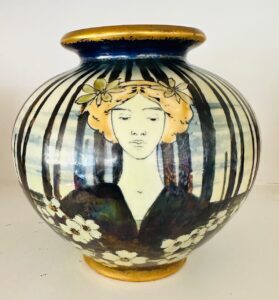 This winter I bought a vacant for years 1919 chalet on Lake Arrowhead. I’m studying its architecture and decorative art of the period. Coincidence? Synergy? Everything I look at trickles back to this period, like DD’s vase from the first quarter of the 20th century. This thirty-year period in the history of design is so fruitful. Styles butt heads and blend in some cases, thus DD’s vase is a blend of:
Under the broader umbrella of Art Pottery, this era focused on freedom of flowing line, unique colored glazes, naturalistic form, unique scale and sizes, animals, the female form, marine life, and flora.
“Allegory” VasesAn area near Dresden abundant with Kaolin-rich soil, the Turn Teplitz region, saw porcelain production and innovative designs in the late 19th early 20th century. One maker of DD’s vase, Alfred Stellmacher, developed an unique composition for his “slip,” Ivory Porcelain, resistant to high temperatures. The label on DD’s vase says: “Turn Teplitz Bohemia, R st. K Made in Austria.” Riessner, Stellmacher, Kessel, a partnership in Teplitz called its wares “Amphora.” The company became known for “allegory” vases that referenced a story. In this case a Faustian image of Gretchen, the maiden, despoiled by Faust.
Each of the three founding partners, Riessner, Stellmacher, Kessel brought a different approach to the pottery business. Their distinctive porcelain won them a Gold medal at the Chicago World’s Fair in 1893. Stellmacher broke from the firm in 1905 and formed his own company in the Kaolin-rich region teeming with other porcelain factories at the time. He quit in 1912, taking with him artist Paul Dachsel, the finest designer of the era in this style. When Kessel left the factory called Reissner and Kessel Amphora became Amphora Werke Reissner. The quality of design remained the best in the art porcelain world.
In those tumultuous years competition ran high. Connoisseurs considered Amphora the finest, and they still do to this day. Amphora created a unique LIZARD VASE, the sinewy beastie crawling up the length, the glazes handmade. Both Art Nouveau and Austria-German Secessionist-Jugendstil designs feature unique organic references. Each lovingly created vase led to a more innovative design.
Vase Competition Ran HighA early 20th century, competitor, Zsolnay in Pecs Hungary sent spies to infiltrate the Amphora factory and collect specimens of the vases.
Even with intense competition in a small geographical area, we don’t know many of the artist’s names who designed, cast, or painted the vases. If you remember what went on in the world, anonymity of the artists won’t surprise you. The era saw WWI, communism, the flu epidemic, and impenetrable kiln fires.
The climate of the turn of the last century interests me as a buyer of a 1919 cottage. Why did this era produce some of the world’s finest design innovations? Why is this period’s art pottery considered valuable? To give you an idea, Philip Chasen Antiques in East Norwich England offers a similar vase to DD’s. The female bust in Medieval garb, a central theme of Art Nouveau, shows the same attribution mark. It’s eleven by five inches offered for $6,600. Another dealer, Morgan Strickland of Hannay Lane, London, owns a similar allegory vase, a Mucha-Esque face, offered for $4,500.
The answer to the values achieved for Amphora is the quality of the artistry which improved over the period 1890-1920 because of competition among artists. For Amphora gathered artists trained at the Imperial Technical School for Ceramics and Associated Applied Arts (1885-1917). The students went through years of study, asked to create works from live models, such as a live lizard, studies on the nature of clay and chemical composition of the glazes. Professors didn’t “pass” a piece unless they thought it worthy. If they deemed a design good enough for production, it received a number, as we see on DD’s vase, and entered the décor books. Those books were lost in WWII.
The value of DD’s vase is $3,500.
The post Quality Artistry Of A Amphora Vase first appeared on Elizabeth Appraisals.
The post Quality Artistry Of A Amphora Vase appeared first on Elizabeth Appraisals.
March 22, 2026
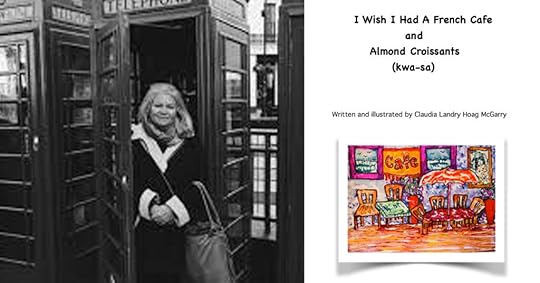
Author Claudia Landry Hoag McGarry
Author Claudia Landry Hoag McGarry talks about her new memoir, I Wish I had a French Cafe and Almond Croissants, with guest host Richard Dugan.
Watch Video
The post Author Claudia Landry Hoag McGarry first appeared on Elizabeth Appraisals.
The post Author Claudia Landry Hoag McGarry appeared first on Elizabeth Appraisals.
March 17, 2026
Ashtray With A Mystery Round Thing
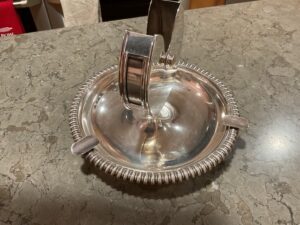 Coops sent me a fantastic piece of ancient history—an ashtray, classy looking in silver with a cradles for cigarettes. Now collected in a class of objects called tobacciana, vintage from the days when most of us smoked. This ashtray contains something round and silver springing from the middle top surface. Her grandparents smoked: she, cigarettes, he, a pipe.
Nothing I found resembled this round shape on the top of the ashtray. it HELD something integral to smoking. Coops showed it around. People thought the center round thing held matches with the slider on the side used as a striking surface. I think it held a lighter because the round thing detaches from the ashtray. It’s heavy even without the centerpiece, which shows lines of threading which requires several counter clockwise spins to undo it from the ashtray. In any event it’s a curiosity.
Yes, Ashtrays Are Now CollectablesIt’s also curious to think that smoking related objects are collectible. There’s plenty of smoking related objects, so many that the context of collecting those is called Tobacciana. By the 1960s sixty-five percent of all American men smoked, according to the American Lung Association. My best friend Devi (1978) and I did too, sneaking around in high school. Women began to smoke almost as much as men after 1930-40. The advertising world showed cigarettes associated with glamor. Sometimes I miss smoking.
The little round thing, assuming it held something to light things with, is a cavity two and a half inches deep. The center sports little knobs on the side and screws that unscrew. A hallmark shows two shield shapes; one bears a shape of a leopard’s head with a “V” mark. The leopard head means the object was made in London or wanted to appear made in London. However, people associate the leopard head with sterling silver since Edward I decreed it such in 1300, confusing leopards with lions. This isn’t sterling, but it is British. If three other “touches;” a lion “passant,” a date letter in a box or shield shape, and a maker’s mark, usually initials, accompanied the leopard’s head, then it might read as sterling.
Sterling Vs. SilverplateCoops writes she barely made out the “V” inside the shield shapes. That tips me off that her little ashtray is electro plated nickel silver specifically created by Viners silverplate of Sheffield, England. This firm founded in the 19th century by Emile and Adolphe Viener, used their special process to make silverplate called ALPHA plate. The British populace of the 1930s and 1940s LOVED silverplate because it looked like the Queen’s silver, but affordable.
I find it interesting that objects that scream “upper class” come silverplated. For example, an ashtray that holds burning cigarettes and cigars shouldn’t be made of silverplated metal. But it looked so classy! Imagine a hot piece of metal on your nice George III style mahogany coffee table and you will see what I mean.
Viners Silver, notice the anglicized version of the name Viener, became the dominant maker of silver plate and only sold out in 1980 to the American firm Oneida. Viners made tea trays, tea sets, coasters, and flatware, usually with fancy edges like Coop’s round ashtray. People considered them the lower class version of the higher class silverplate firm, Mappin and Webb.
Silverplated objects don’t hold much value unless you it’s Shefield silver, a process done previous, before 1850, to electroplated silver. I love Sheffield plate because you see the copper metal underneath the silverplating. It gives off a warm glow. It’s called Sheffield because it hailed from Sheffield and grew to Birmingham. Post 1840s silverplate will bear the initials EPNS or EPBM for electroplated plated nickel silver or electroplated Brittania metal silver.
Coop’s little ashtray with round thing might bring $75. If anyone knows what the round thing is, please email me.
The post Ashtray With A Mystery Round Thing first appeared on Elizabeth Appraisals.
The post Ashtray With A Mystery Round Thing appeared first on Elizabeth Appraisals.
Elizabeth Stewart's Blog

- Elizabeth Stewart's profile
- 5 followers

