
Doc Searls's Blog
October 19, 2026
Cluesdays
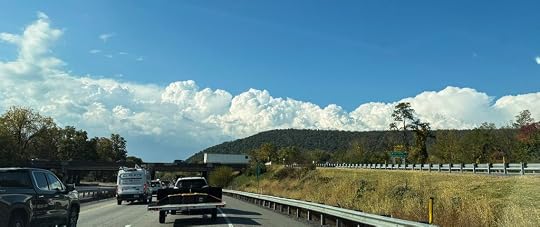 Soon as we skirted that ridge, the skies opened. Then it got colder. A lot colder.
Riding wide
On the road for a while. Above is a storm coming over Elk Country in north-central Pennsylvania. After that, Elk Country, Ohio, and back to Indiana, by RAV4.
Didn’t know there was one, but yeah
Chick-fil-A takes a stand against fast-food drive-thru AI trend.
Maybe


October 16, 2026
The Mentat’s Method of AI
This is the flyer for the next talk in our speaker series at IU. It’s on Tuesday, and a can’t-miss event. I explain more below.
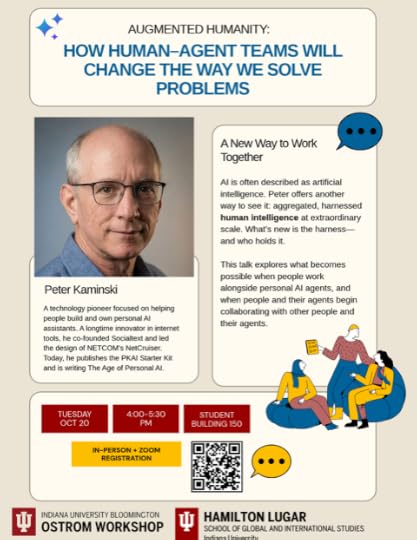
I know a lot of people who know a lot about AI. Or seem to. Or say they do. But Pete Kaminski is the real deal. More importantly, he knows more about putting AI to work for you than anyone else I know. If you want to know how to get personal—not personalized—AI working for you, Pete’s your guy.
His talk is this coming Tuesday, 20 October, 4 PM Eastern, in the Student Building, Room 150, at Indiana University. And on Zoom. Go here to register and tune in (see the Join Event button). It’s participatory, so be ready to ask questions.
The Dune fans among us should grok the headline, but in case not, mentats are superintelligent humans. These would be handy to have if AIs were outlawed, as they were in the Dune universe. For AI knowhow, Pete is my mentat, even if nobody in reality fits the description.
Big thanks to the Ostrom Workshop and the Hamilton Lugar School at IU for their help and support in this, our sixth year of the series—and for all their earlier efforts as well.
See ya’ll there!
October 10, 2026
Enjoying the Shows
 Nikki D & Sisters of Thunder at the 2026 Lotus Festival
The idea was to get my photos from the latest Lotus Festival up right after the three-day event ended on Sunday the 4th. I had too many other things to do, so a week went by. But at least my shots of the last two performances are up. This one is for Nikki D & Sisters of Thunder, who describe their show as “sacred steel gospel and blues.” Fun group. Singing and musicianship are first-rate. Great personalities. Very charismatic. Dancing is required.
This one is for Gadan, which does “Irish trad and bluegrass with the soul of Celtic and Appalachian roots music – all spiced with unmistakable Italian flair!” Here’s that photo album:
 Gadan at the Lotus Festival
Another great band. Loads of fun. Great music. Can’t sit to them either.
Here’s another thing. All the photos in both albums are Creative Commons licensed CC-BY-4.0: there for anyone to use, requiring only photo credit.
I invite both bands, the Lotus Festival folks, and any member of Bloomington’s news commons to have at them as well.
Here’s more about Lotus. It’s an amazing event. If you like great music from everywhere, you’ll love the show. It’ll be back next October.
Running
I'm in Chicago for the Marathon and our son's birthday (he's running tomorrow). Also hanging with relatives and enjoying the city, which always feels to me like a giant Boston. (Color me wrong, it's okay.)
Meaning it was fully yours
Steven Levy: I’m Still Convinced the iPod Was the Perfect Gadget—Apple’s original music player got many things right. Chief among them: It didn’t connect to the internet.
October 7, 2026
Time to book your rides
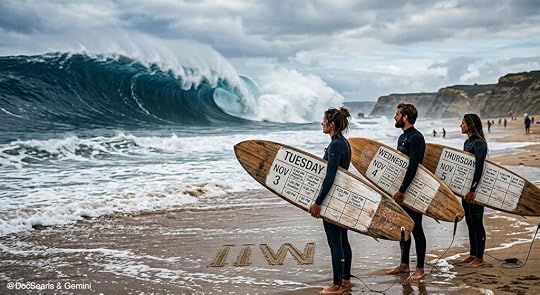
AI isn’t just a “surf’s up” moment. It’s a tsunami. You have to surf that tsunami, just to keep from drowning.
Using your time. Your calendar is your surfboard.
What’s your best beach for riding that calendar?
Well, right now there are countless conferences with “AI” or “Agentic” in their titles. Yes, they’re beaches. You can ride there.
But where will you get the most done? Where can you write the agenda, and work with other people dealing with the same problems or pursuing the same opportunities? Real people doing real work. People who can help.
Really, do you want to hear yet another CEO blather about what their VCs and marketing people want them to say?
Or do you want to get work done?
IIW was made for getting things done. It has been a wide beach for surfing big tech waves since 2005, twice a year at the Computer History Museum in Silicon Valley. The next one is our 43rd. It’s on November 3rd to 6th, less than a month from now.
We immodestly believe that IIW is the most leveraged conference in the world. Two reasons:
Our focus (without limits) is on identity, with lots of real-world results. OAuth, OpenID, passkeys, self-sovereign identity (SSI), decentralized identifiers (DIDs) UMA, SSI, VRM, and Personal AI—to name a few—would not be the same without countless forward-moving conversations and work at IIWs.What we don’t have. No keynotes. No panels. No agenda other than what participants choose.And that’s you. IIW is what you make of it.
So join us. Register here.
You’ll leave wet but a lot more fit.
October 6, 2026
Cluesday
Didn't know there was one, but yeah
Chick-fil-A takes a stand against fast-food drive-thru AI trend.
Maybe
October 5, 2026
WaningCrescentMoonday
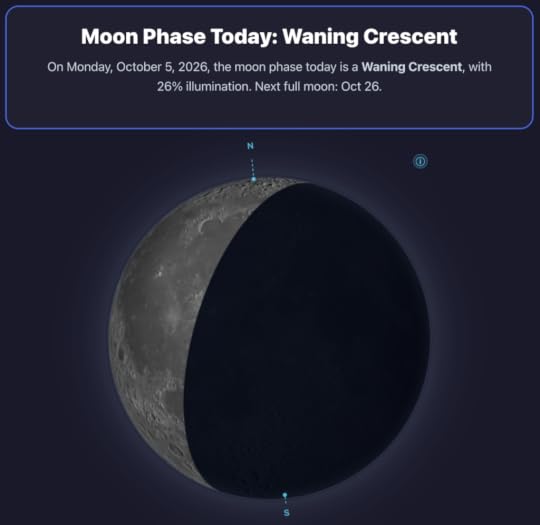 Now, roughly.
That’s what it says at MoonPhase.today
Specifically, 26%.
I’ll consider them unreal if they’re not at IIW.
The UOR Foundation has plans to… Well, I can’t copy and paste the text, so here’s a screengrab:

I’ll say not. Quite.
AM I? | A Documentary About AI Consciousness.
Ever notice the groovy ditches in tidal swampland?
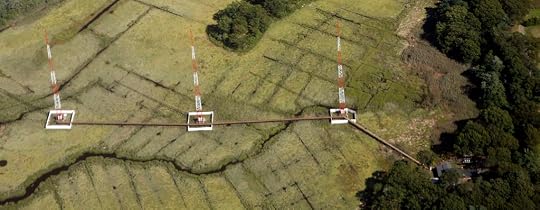 This swamp is under three AM broadcast towers south of Boston, built in 1940, when AM radio listening was at high tide. They were built for WNAC/1260. It’s now WBIX, known to Portuguese speakers as Nossa Radio USA. The towers were also used by WMEX/1510 until that station shut down on the last day of September. I shot it on approach to Logan in 2011.
It’s called “grid ditching,” and is explained here:
Grid Ditching
The grid ditch system still evident on our salt marshes today, were dug by hand between 1928 and 1934. The primary purpose of this era of ditching was to put as many people to work as possible, as this was the time of the great depression. No entomological studies were conducted in conjunction with this ditching effort; mosquito control was a secondary consideration at best.
However mosquito control was achieved by default as practically every square inch of marsh was drained by the extensive project. Some engineering studies were done to determine where and at what intervals ditches were dug. Ditches were dug in straight rows by hand with sod saws and two man shovels. In 1934, at the peak of this ditching effort, over 11,000 men were employed digging ditches and when completed nearly 3,000 linear miles of salt marsh ditch were dug in Massachusetts alone.
Virtually all salt marsh in New England was ditched with the exception of one marsh in Rhode Island. Later in the late 1940s and early 1950s soldiers returned home from World War II. Housing shortages were a big problem in the more populated areas particularly in and around Boston. A generation of young families, eager to get their lives back on track migrated to the north shore of Massachusetts to start new lives.
This migration coincided with the degradation of the grid ditch system created in the 1930s. These ditches had not been maintained and now produced far more mosquitoes then they had initially eliminated. By many accounts it was so bad some considered the area to be almost uninhabitable. A few local programs were established to try to reopen the ditches but it was impossible to duplicate the labor force that had originally created the ditches.
In 1958, a grass roots effort, fueled by public demand for relief resulted in legislation establishing the Essex County Mosquito Control Project. For reasons unknown the project was not formally funded until 1965. Equipment was purchased and a major effort was launched to reclaim salt marsh ditches.
Salt Marsh Ditch Maintenance in Northeast Massachusetts
In the late 1970s, Walter Montgomery was an equipment operator for what was then, the Essex County Mosquito Control Project, ECMCP. Montgomery’s primary duty was to maintain the extensive salt marsh grid ditch system, excavated for the most part, between 1928 and 1934.
Montgomery recalls using an implement known as a scavel plow; this was a large wedge shaped device mounted under a wing plow and could be attached to the front of a tractor or sometimes towed behind. A scavel plow wedge was basically constructed to the original ditch dimension. The wedge would be dropped into the ditch and the tractor either pushed or pulled it along. As the wedge peeled spoil out of the ditch the wing plow would roll the spoil into furrows approximately six feet wide on both sides of the ditch. These furrows of spoil were then either run over to flatten them or plowed off the marsh.
On a productive day Montgomery recalls completing two or more miles of ditch maintenance but even at that rate maintenance of hundreds of linear miles of ditch was an endless endeavor. It was Montgomery’s experience that freshly maintained ditches were really only effective for about two years before requiring additional maintenance.
Typically ditches would become blocked on the high marsh and previously drained salt pannes would often reestablish. Montgomery observed that the open water areas of these pannes or ponds didn’t have mosquito larvae but the grassy sheltered areas around the edges or isolated depressions adjacent to the ponds, supported mosquito larvae.
Montgomery’s observations further supported his belief that continued maintenance of the grid ditch system was not productive and furthermore there had to be a better way to manage salt marsh mosquito populations.
That is from a .pdf titled MASSACHUSETTS MOSQUITO CONTROL OPEN MARSH WATER MANAGEMENT STANDARDS MAY 2010. It is worth continuing to read, if mosquito control is your jam.
Alas, as you may gather by now, everything is my jam.
Seems Flickr is having an outage of some kind:
 Pages load. Notes load. Text loads. Photos don’t.
October 2, 2026
Lintlinks

If you don’t, you’re a human AI
Test: See if you don’t laugh at something as you scroll down through this.
Am I alone in finding it annoying?
Does anybody want, or use, the “workspace” that shows up, whether you want it or not, every time you open a Zoom session?
Getting less faint
Wall Street Journal: The Global Bond Rout Is Getting Messy—Unwinding popular hedge fund trades helped drive U.S. Treasury yields lower, but there is also ‘a faint smell of a crisis in the making’
Overheard
“That was like hearing a mirror.”
How advertising ends and something you like less begins
Jamie Smith: Meta turning its money-printing machine (ads) into a ‘customer engagement machine’ – and it should be 100x bigger.
Theory
We can’t reconcile the Hippocratic Oath and executions.
October 1, 2026
September 30, 2026
Notesday
In wasted dollars
Our species began to get civilized when it invented clothing: the original privacy tech. But that was in the natural world. In the digital one, we are still naked, and privacy is just a promise you get from "consent" (cookie notice) agreements and settings. It's a fail. Example: the GDPR Privacy Monitor examined 97,000 websites and found that—
55% displayed no consent (cookie choice) banner80.4% continued tracking after the user clicked reject68% activate third-party tracking before the user has given consent66.6% set cookies before consentAnd the consent management platform (CMP) business weighs in at $4.1 billion.
We now return to hiss
WMEX/1510, which in its heyday was Boston's main top 40 music station, has signed off for a final time. The station had a cursed transmitter history you can read about at the opening link. When I lived in Arlington, Mass from 2007 to 2013, the transmitter was nearby in Belmont, using four towers in a parking lot in an industrial part of town. It was 50,000 watts at the time. Killer signal, but a doomed site. I shot it in 2008. Here's the photo album. In the late Teens, after a period of silence, it moved to the 1260 AM site (built for what was then WNAC) on a tidal swamp south of town. Then only 10,000 watts and just 100 watts at night, it operated as an oldies station. I shot that site too, from an airplane on approach to Logan in 2011.
What we're watching is the slo-mo heart failure of the AM broadcast band. Knowing that, I like to document what was there before it's gone.
In case there is a reason
This piece (first of three in a series) about Zoom' privacy practices was written more than six years ago, and I haven't revisited the topic since then. But I thought it might be worth bringing up.
You can deal with the identity piece at IIW
I just learned that Reverse Alignment is a thing. It addresses—
Large, coordinated investments in the human and institutional side of the AI transformation. They span identity, privacy, markets, governance, work, and knowledge. They share an architecture, and they share a method. No single sector can deliver any one of them alone.
We found a clubhouse!
Reason: Kids Are Using NPR Podcast Comments as Secret Group Chats.
Doc Searls's Blog

- Doc Searls's profile
- 11 followers
